EP1062093B1 - Film thermoretractable multicouche d'emballage a couche interieure de polyester - Google Patents
Film thermoretractable multicouche d'emballage a couche interieure de polyester Download PDFInfo
- Publication number
- EP1062093B1 EP1062093B1 EP99909785A EP99909785A EP1062093B1 EP 1062093 B1 EP1062093 B1 EP 1062093B1 EP 99909785 A EP99909785 A EP 99909785A EP 99909785 A EP99909785 A EP 99909785A EP 1062093 B1 EP1062093 B1 EP 1062093B1
- Authority
- EP
- European Patent Office
- Prior art keywords
- layer
- heat
- percent
- thickness
- film
- Prior art date
- Legal status (The legal status is an assumption and is not a legal conclusion. Google has not performed a legal analysis and makes no representation as to the accuracy of the status listed.)
- Expired - Lifetime
Links
- 229920000728 polyester Polymers 0.000 title claims abstract description 93
- 229920006281 multilayer packaging film Polymers 0.000 title 1
- 239000004952 Polyamide Substances 0.000 claims abstract description 53
- 229920002647 polyamide Polymers 0.000 claims abstract description 53
- 238000002844 melting Methods 0.000 claims abstract description 52
- 230000008018 melting Effects 0.000 claims abstract description 52
- 238000000034 method Methods 0.000 claims abstract description 37
- 229920000098 polyolefin Polymers 0.000 claims abstract description 30
- 230000008569 process Effects 0.000 claims abstract description 30
- 229920002635 polyurethane Polymers 0.000 claims abstract description 18
- 239000004814 polyurethane Substances 0.000 claims abstract description 18
- 239000004793 Polystyrene Substances 0.000 claims abstract description 7
- 229920002223 polystyrene Polymers 0.000 claims abstract description 7
- VGGSQFUCUMXWEO-UHFFFAOYSA-N Ethene Chemical compound C=C VGGSQFUCUMXWEO-UHFFFAOYSA-N 0.000 claims description 91
- 239000005977 Ethylene Substances 0.000 claims description 91
- 229920001577 copolymer Polymers 0.000 claims description 74
- 239000004711 α-olefin Substances 0.000 claims description 60
- 229920000089 Cyclic olefin copolymer Polymers 0.000 claims description 52
- 238000007789 sealing Methods 0.000 claims description 36
- 229920006257 Heat-shrinkable film Polymers 0.000 claims description 35
- 239000000203 mixture Substances 0.000 claims description 28
- 238000004806 packaging method and process Methods 0.000 claims description 25
- -1 polypropylene Polymers 0.000 claims description 22
- 229920000219 Ethylene vinyl alcohol Polymers 0.000 claims description 18
- 239000004715 ethylene vinyl alcohol Substances 0.000 claims description 18
- UFRKOOWSQGXVKV-UHFFFAOYSA-N ethene;ethenol Chemical compound C=C.OC=C UFRKOOWSQGXVKV-UHFFFAOYSA-N 0.000 claims description 15
- KKEYFWRCBNTPAC-UHFFFAOYSA-L terephthalate(2-) Chemical compound [O-]C(=O)C1=CC=C(C([O-])=O)C=C1 KKEYFWRCBNTPAC-UHFFFAOYSA-L 0.000 claims description 11
- 229920000139 polyethylene terephthalate Polymers 0.000 claims description 9
- 239000005020 polyethylene terephthalate Substances 0.000 claims description 9
- 229920001155 polypropylene Polymers 0.000 claims description 9
- 239000002253 acid Substances 0.000 claims description 8
- XTXRWKRVRITETP-UHFFFAOYSA-N Vinyl acetate Chemical compound CC(=O)OC=C XTXRWKRVRITETP-UHFFFAOYSA-N 0.000 claims description 7
- 239000004743 Polypropylene Substances 0.000 claims description 6
- 229920006020 amorphous polyamide Polymers 0.000 claims description 3
- 229920006037 cross link polymer Polymers 0.000 claims description 2
- 230000032798 delamination Effects 0.000 claims description 2
- 239000010410 layer Substances 0.000 description 336
- 239000010408 film Substances 0.000 description 261
- 229920000642 polymer Polymers 0.000 description 65
- 239000000047 product Substances 0.000 description 35
- 239000000178 monomer Substances 0.000 description 24
- 239000000126 substance Substances 0.000 description 19
- 239000000463 material Substances 0.000 description 18
- 229920005989 resin Polymers 0.000 description 17
- 239000011347 resin Substances 0.000 description 17
- QQONPFPTGQHPMA-UHFFFAOYSA-N propylene Natural products CC=C QQONPFPTGQHPMA-UHFFFAOYSA-N 0.000 description 14
- 125000004805 propylene group Chemical group [H]C([H])([H])C([H])([*:1])C([H])([H])[*:2] 0.000 description 14
- VXNZUUAINFGPBY-UHFFFAOYSA-N 1-Butene Chemical compound CCC=C VXNZUUAINFGPBY-UHFFFAOYSA-N 0.000 description 13
- 229920001519 homopolymer Polymers 0.000 description 13
- 238000009826 distribution Methods 0.000 description 12
- 238000007334 copolymerization reaction Methods 0.000 description 11
- 239000005033 polyvinylidene chloride Substances 0.000 description 11
- 229920001328 Polyvinylidene chloride Polymers 0.000 description 10
- 150000008064 anhydrides Chemical class 0.000 description 9
- 239000005038 ethylene vinyl acetate Substances 0.000 description 9
- 239000000155 melt Substances 0.000 description 9
- 229920001200 poly(ethylene-vinyl acetate) Polymers 0.000 description 9
- LIKMAJRDDDTEIG-UHFFFAOYSA-N 1-hexene Chemical compound CCCCC=C LIKMAJRDDDTEIG-UHFFFAOYSA-N 0.000 description 8
- 239000011248 coating agent Substances 0.000 description 8
- 238000000576 coating method Methods 0.000 description 8
- 235000013372 meat Nutrition 0.000 description 8
- 238000006116 polymerization reaction Methods 0.000 description 8
- XLYOFNOQVPJJNP-UHFFFAOYSA-N water Substances O XLYOFNOQVPJJNP-UHFFFAOYSA-N 0.000 description 8
- 150000001336 alkenes Chemical class 0.000 description 7
- 235000013305 food Nutrition 0.000 description 7
- 229920000092 linear low density polyethylene Polymers 0.000 description 7
- 239000004707 linear low-density polyethylene Substances 0.000 description 7
- JRZJOMJEPLMPRA-UHFFFAOYSA-N olefin Natural products CCCCCCCC=C JRZJOMJEPLMPRA-UHFFFAOYSA-N 0.000 description 7
- 229920003207 poly(ethylene-2,6-naphthalate) Polymers 0.000 description 7
- 239000011112 polyethylene naphthalate Substances 0.000 description 7
- 229920001634 Copolyester Polymers 0.000 description 6
- 229920002292 Nylon 6 Polymers 0.000 description 6
- 239000004698 Polyethylene Substances 0.000 description 6
- 238000001816 cooling Methods 0.000 description 6
- 230000005865 ionizing radiation Effects 0.000 description 6
- 238000005259 measurement Methods 0.000 description 6
- 230000005855 radiation Effects 0.000 description 6
- KWKAKUADMBZCLK-UHFFFAOYSA-N 1-octene Chemical compound CCCCCCC=C KWKAKUADMBZCLK-UHFFFAOYSA-N 0.000 description 5
- 239000000853 adhesive Substances 0.000 description 5
- 230000001070 adhesive effect Effects 0.000 description 5
- 230000004888 barrier function Effects 0.000 description 5
- 239000011324 bead Substances 0.000 description 5
- 230000008901 benefit Effects 0.000 description 5
- 238000003851 corona treatment Methods 0.000 description 5
- 238000001125 extrusion Methods 0.000 description 5
- 238000010438 heat treatment Methods 0.000 description 5
- 238000010348 incorporation Methods 0.000 description 5
- 230000003287 optical effect Effects 0.000 description 5
- 229920001083 polybutene Polymers 0.000 description 5
- 229920000573 polyethylene Polymers 0.000 description 5
- BVKZGUZCCUSVTD-UHFFFAOYSA-L Carbonate Chemical compound [O-]C([O-])=O BVKZGUZCCUSVTD-UHFFFAOYSA-L 0.000 description 4
- VZCYOOQTPOCHFL-OWOJBTEDSA-N Fumaric acid Chemical compound OC(=O)\C=C\C(O)=O VZCYOOQTPOCHFL-OWOJBTEDSA-N 0.000 description 4
- 229920002302 Nylon 6,6 Polymers 0.000 description 4
- KKEYFWRCBNTPAC-UHFFFAOYSA-N Terephthalic acid Chemical compound OC(=O)C1=CC=C(C(O)=O)C=C1 KKEYFWRCBNTPAC-UHFFFAOYSA-N 0.000 description 4
- 235000015278 beef Nutrition 0.000 description 4
- 230000000052 comparative effect Effects 0.000 description 4
- 238000004132 cross linking Methods 0.000 description 4
- JBKVHLHDHHXQEQ-UHFFFAOYSA-N epsilon-caprolactam Chemical compound O=C1CCCCCN1 JBKVHLHDHHXQEQ-UHFFFAOYSA-N 0.000 description 4
- 238000004519 manufacturing process Methods 0.000 description 4
- 229920003023 plastic Polymers 0.000 description 4
- 229920001281 polyalkylene Polymers 0.000 description 4
- 229920005606 polypropylene copolymer Polymers 0.000 description 4
- 235000015277 pork Nutrition 0.000 description 4
- 244000144977 poultry Species 0.000 description 4
- 235000013594 poultry meat Nutrition 0.000 description 4
- 239000000565 sealant Substances 0.000 description 4
- VZCYOOQTPOCHFL-UHFFFAOYSA-N trans-butenedioic acid Natural products OC(=O)C=CC(O)=O VZCYOOQTPOCHFL-UHFFFAOYSA-N 0.000 description 4
- 235000019687 Lamb Nutrition 0.000 description 3
- 229920000299 Nylon 12 Polymers 0.000 description 3
- 239000012790 adhesive layer Substances 0.000 description 3
- 230000005540 biological transmission Effects 0.000 description 3
- IAQRGUVFOMOMEM-UHFFFAOYSA-N butene Natural products CC=CC IAQRGUVFOMOMEM-UHFFFAOYSA-N 0.000 description 3
- 239000003054 catalyst Substances 0.000 description 3
- 150000001875 compounds Chemical class 0.000 description 3
- 239000012792 core layer Substances 0.000 description 3
- 238000000113 differential scanning calorimetry Methods 0.000 description 3
- 208000028659 discharge Diseases 0.000 description 3
- 229920001038 ethylene copolymer Polymers 0.000 description 3
- 229920006213 ethylene-alphaolefin copolymer Polymers 0.000 description 3
- 239000007789 gas Substances 0.000 description 3
- RZXDTJIXPSCHCI-UHFFFAOYSA-N hexa-1,5-diene-2,5-diol Chemical compound OC(=C)CCC(O)=C RZXDTJIXPSCHCI-UHFFFAOYSA-N 0.000 description 3
- 229920001903 high density polyethylene Polymers 0.000 description 3
- 239000004700 high-density polyethylene Substances 0.000 description 3
- 229920000554 ionomer Polymers 0.000 description 3
- 235000013622 meat product Nutrition 0.000 description 3
- 239000004033 plastic Substances 0.000 description 3
- 239000002985 plastic film Substances 0.000 description 3
- 229920006255 plastic film Polymers 0.000 description 3
- 229920005638 polyethylene monopolymer Polymers 0.000 description 3
- 229920005629 polypropylene homopolymer Polymers 0.000 description 3
- 238000010791 quenching Methods 0.000 description 3
- 230000000171 quenching effect Effects 0.000 description 3
- 230000009467 reduction Effects 0.000 description 3
- 229920001866 very low density polyethylene Polymers 0.000 description 3
- 241000251468 Actinopterygii Species 0.000 description 2
- 241000283707 Capra Species 0.000 description 2
- 241000283073 Equus caballus Species 0.000 description 2
- XEEYBQQBJWHFJM-UHFFFAOYSA-N Iron Chemical group [Fe] XEEYBQQBJWHFJM-UHFFFAOYSA-N 0.000 description 2
- 229920000571 Nylon 11 Polymers 0.000 description 2
- 229920000305 Nylon 6,10 Polymers 0.000 description 2
- 229920000572 Nylon 6/12 Polymers 0.000 description 2
- 239000004721 Polyphenylene oxide Substances 0.000 description 2
- OFOBLEOULBTSOW-UHFFFAOYSA-N Propanedioic acid Natural products OC(=O)CC(O)=O OFOBLEOULBTSOW-UHFFFAOYSA-N 0.000 description 2
- 229920002472 Starch Polymers 0.000 description 2
- BAPJBEWLBFYGME-UHFFFAOYSA-N acrylic acid methyl ester Natural products COC(=O)C=C BAPJBEWLBFYGME-UHFFFAOYSA-N 0.000 description 2
- 239000000654 additive Substances 0.000 description 2
- 230000015572 biosynthetic process Effects 0.000 description 2
- 229910052799 carbon Inorganic materials 0.000 description 2
- 150000001732 carboxylic acid derivatives Chemical class 0.000 description 2
- 230000007547 defect Effects 0.000 description 2
- 239000000975 dye Substances 0.000 description 2
- 238000010828 elution Methods 0.000 description 2
- 150000002148 esters Chemical class 0.000 description 2
- 238000007765 extrusion coating Methods 0.000 description 2
- 238000005194 fractionation Methods 0.000 description 2
- 239000001530 fumaric acid Substances 0.000 description 2
- 230000007062 hydrolysis Effects 0.000 description 2
- 238000006460 hydrolysis reaction Methods 0.000 description 2
- 230000000977 initiatory effect Effects 0.000 description 2
- 238000005304 joining Methods 0.000 description 2
- 238000003475 lamination Methods 0.000 description 2
- VZCYOOQTPOCHFL-UPHRSURJSA-N maleic acid Chemical compound OC(=O)\C=C/C(O)=O VZCYOOQTPOCHFL-UPHRSURJSA-N 0.000 description 2
- 239000011976 maleic acid Substances 0.000 description 2
- 239000002184 metal Chemical class 0.000 description 2
- 229910052751 metal Chemical class 0.000 description 2
- TVMXDCGIABBOFY-UHFFFAOYSA-N n-Octanol Natural products CCCCCCCC TVMXDCGIABBOFY-UHFFFAOYSA-N 0.000 description 2
- 239000012785 packaging film Substances 0.000 description 2
- 229920006280 packaging film Polymers 0.000 description 2
- 239000005022 packaging material Substances 0.000 description 2
- 229920006111 poly(hexamethylene terephthalamide) Polymers 0.000 description 2
- 229920000515 polycarbonate Polymers 0.000 description 2
- 239000004417 polycarbonate Substances 0.000 description 2
- 229920000570 polyether Polymers 0.000 description 2
- 239000002954 polymerization reaction product Substances 0.000 description 2
- 229920005672 polyolefin resin Polymers 0.000 description 2
- 235000020991 processed meat Nutrition 0.000 description 2
- 235000020989 red meat Nutrition 0.000 description 2
- 230000000630 rising effect Effects 0.000 description 2
- 150000003839 salts Chemical class 0.000 description 2
- 235000013580 sausages Nutrition 0.000 description 2
- 239000002356 single layer Substances 0.000 description 2
- 239000007787 solid Substances 0.000 description 2
- 239000007921 spray Substances 0.000 description 2
- 239000008107 starch Substances 0.000 description 2
- 235000019698 starch Nutrition 0.000 description 2
- 229920001897 terpolymer Polymers 0.000 description 2
- 238000012360 testing method Methods 0.000 description 2
- 229920001169 thermoplastic Polymers 0.000 description 2
- 229920001862 ultra low molecular weight polyethylene Polymers 0.000 description 2
- 238000011144 upstream manufacturing Methods 0.000 description 2
- 229920003313 Bynel® Polymers 0.000 description 1
- OKTJSMMVPCPJKN-UHFFFAOYSA-N Carbon Chemical compound [C] OKTJSMMVPCPJKN-UHFFFAOYSA-N 0.000 description 1
- 239000004716 Ethylene/acrylic acid copolymer Substances 0.000 description 1
- VEXZGXHMUGYJMC-UHFFFAOYSA-N Hydrochloric acid Chemical compound Cl VEXZGXHMUGYJMC-UHFFFAOYSA-N 0.000 description 1
- 229920010126 Linear Low Density Polyethylene (LLDPE) Polymers 0.000 description 1
- 239000006057 Non-nutritive feed additive Substances 0.000 description 1
- 239000004372 Polyvinyl alcohol Substances 0.000 description 1
- 229920003365 Selar® Polymers 0.000 description 1
- BQCADISMDOOEFD-UHFFFAOYSA-N Silver Chemical compound [Ag] BQCADISMDOOEFD-UHFFFAOYSA-N 0.000 description 1
- 241000656145 Thyrsites atun Species 0.000 description 1
- 239000004708 Very-low-density polyethylene Substances 0.000 description 1
- ORLQHILJRHBSAY-UHFFFAOYSA-N [1-(hydroxymethyl)cyclohexyl]methanol Chemical group OCC1(CO)CCCCC1 ORLQHILJRHBSAY-UHFFFAOYSA-N 0.000 description 1
- 238000005299 abrasion Methods 0.000 description 1
- 150000001252 acrylic acid derivatives Chemical class 0.000 description 1
- 125000001931 aliphatic group Chemical group 0.000 description 1
- 238000004458 analytical method Methods 0.000 description 1
- 239000003963 antioxidant agent Substances 0.000 description 1
- 239000002216 antistatic agent Substances 0.000 description 1
- 125000003118 aryl group Chemical group 0.000 description 1
- QVGXLLKOCUKJST-UHFFFAOYSA-N atomic oxygen Chemical compound [O] QVGXLLKOCUKJST-UHFFFAOYSA-N 0.000 description 1
- 230000005250 beta ray Effects 0.000 description 1
- 229920001400 block copolymer Polymers 0.000 description 1
- 238000007664 blowing Methods 0.000 description 1
- 235000020996 boneless meat Nutrition 0.000 description 1
- 238000005266 casting Methods 0.000 description 1
- 238000006555 catalytic reaction Methods 0.000 description 1
- 230000008859 change Effects 0.000 description 1
- 238000006243 chemical reaction Methods 0.000 description 1
- 239000007795 chemical reaction product Substances 0.000 description 1
- 229920006026 co-polymeric resin Polymers 0.000 description 1
- 238000004737 colorimetric analysis Methods 0.000 description 1
- 230000001010 compromised effect Effects 0.000 description 1
- 125000004122 cyclic group Chemical group 0.000 description 1
- 230000007423 decrease Effects 0.000 description 1
- 230000001419 dependent effect Effects 0.000 description 1
- 230000001627 detrimental effect Effects 0.000 description 1
- 238000004980 dosimetry Methods 0.000 description 1
- 230000009977 dual effect Effects 0.000 description 1
- 229920001971 elastomer Polymers 0.000 description 1
- 239000000806 elastomer Substances 0.000 description 1
- 229920006242 ethylene acrylic acid copolymer Polymers 0.000 description 1
- 125000000816 ethylene group Chemical group [H]C([H])([*:1])C([H])([H])[*:2] 0.000 description 1
- 239000000945 filler Substances 0.000 description 1
- 238000010096 film blowing Methods 0.000 description 1
- 235000013332 fish product Nutrition 0.000 description 1
- 230000004927 fusion Effects 0.000 description 1
- 230000005251 gamma ray Effects 0.000 description 1
- 238000012685 gas phase polymerization Methods 0.000 description 1
- 238000005227 gel permeation chromatography Methods 0.000 description 1
- 229920000578 graft copolymer Polymers 0.000 description 1
- 229920001112 grafted polyolefin Polymers 0.000 description 1
- 239000012793 heat-sealing layer Substances 0.000 description 1
- 239000004615 ingredient Substances 0.000 description 1
- 229920001684 low density polyethylene Polymers 0.000 description 1
- 230000001050 lubricating effect Effects 0.000 description 1
- 229920001179 medium density polyethylene Polymers 0.000 description 1
- 229920003145 methacrylic acid copolymer Polymers 0.000 description 1
- 229940117841 methacrylic acid copolymer Drugs 0.000 description 1
- 230000003647 oxidation Effects 0.000 description 1
- 238000007254 oxidation reaction Methods 0.000 description 1
- 229910052760 oxygen Inorganic materials 0.000 description 1
- 239000001301 oxygen Substances 0.000 description 1
- 235000021485 packed food Nutrition 0.000 description 1
- PNJWIWWMYCMZRO-UHFFFAOYSA-N pent‐4‐en‐2‐one Natural products CC(=O)CC=C PNJWIWWMYCMZRO-UHFFFAOYSA-N 0.000 description 1
- 239000000049 pigment Substances 0.000 description 1
- 229920006112 polar polymer Polymers 0.000 description 1
- 229920002239 polyacrylonitrile Polymers 0.000 description 1
- 229920006149 polyester-amide block copolymer Polymers 0.000 description 1
- 229920005644 polyethylene terephthalate glycol copolymer Polymers 0.000 description 1
- 229920000306 polymethylpentene Polymers 0.000 description 1
- 239000011116 polymethylpentene Substances 0.000 description 1
- 229920002451 polyvinyl alcohol Polymers 0.000 description 1
- 239000004800 polyvinyl chloride Substances 0.000 description 1
- 229920000915 polyvinyl chloride Polymers 0.000 description 1
- 239000002516 radical scavenger Substances 0.000 description 1
- 229920005604 random copolymer Polymers 0.000 description 1
- 238000012163 sequencing technique Methods 0.000 description 1
- 229920006300 shrink film Polymers 0.000 description 1
- 229910052709 silver Inorganic materials 0.000 description 1
- 239000004332 silver Substances 0.000 description 1
- 239000012748 slip agent Substances 0.000 description 1
- 239000002002 slurry Substances 0.000 description 1
- 235000012424 soybean oil Nutrition 0.000 description 1
- 239000003549 soybean oil Substances 0.000 description 1
- 239000003381 stabilizer Substances 0.000 description 1
- 238000007655 standard test method Methods 0.000 description 1
- 238000003860 storage Methods 0.000 description 1
- 239000002344 surface layer Substances 0.000 description 1
- 230000003746 surface roughness Effects 0.000 description 1
- 230000002195 synergetic effect Effects 0.000 description 1
- 239000000454 talc Substances 0.000 description 1
- 229910052623 talc Inorganic materials 0.000 description 1
- 238000002076 thermal analysis method Methods 0.000 description 1
- 239000003017 thermal stabilizer Substances 0.000 description 1
- 239000012815 thermoplastic material Substances 0.000 description 1
- 229920002397 thermoplastic olefin Polymers 0.000 description 1
- 239000004416 thermosoftening plastic Substances 0.000 description 1
- 239000010409 thin film Substances 0.000 description 1
- 238000002834 transmittance Methods 0.000 description 1
- 238000009461 vacuum packaging Methods 0.000 description 1
- 125000000391 vinyl group Chemical group [H]C([*])=C([H])[H] 0.000 description 1
- 229920002554 vinyl polymer Polymers 0.000 description 1
Images

Classifications
-
- B—PERFORMING OPERATIONS; TRANSPORTING
- B32—LAYERED PRODUCTS
- B32B—LAYERED PRODUCTS, i.e. PRODUCTS BUILT-UP OF STRATA OF FLAT OR NON-FLAT, e.g. CELLULAR OR HONEYCOMB, FORM
- B32B27/00—Layered products comprising a layer of synthetic resin
- B32B27/06—Layered products comprising a layer of synthetic resin as the main or only constituent of a layer, which is next to another layer of the same or of a different material
- B32B27/08—Layered products comprising a layer of synthetic resin as the main or only constituent of a layer, which is next to another layer of the same or of a different material of synthetic resin
-
- Y—GENERAL TAGGING OF NEW TECHNOLOGICAL DEVELOPMENTS; GENERAL TAGGING OF CROSS-SECTIONAL TECHNOLOGIES SPANNING OVER SEVERAL SECTIONS OF THE IPC; TECHNICAL SUBJECTS COVERED BY FORMER USPC CROSS-REFERENCE ART COLLECTIONS [XRACs] AND DIGESTS
- Y10—TECHNICAL SUBJECTS COVERED BY FORMER USPC
- Y10S—TECHNICAL SUBJECTS COVERED BY FORMER USPC CROSS-REFERENCE ART COLLECTIONS [XRACs] AND DIGESTS
- Y10S428/00—Stock material or miscellaneous articles
- Y10S428/91—Product with molecular orientation
-
- Y—GENERAL TAGGING OF NEW TECHNOLOGICAL DEVELOPMENTS; GENERAL TAGGING OF CROSS-SECTIONAL TECHNOLOGIES SPANNING OVER SEVERAL SECTIONS OF THE IPC; TECHNICAL SUBJECTS COVERED BY FORMER USPC CROSS-REFERENCE ART COLLECTIONS [XRACs] AND DIGESTS
- Y10—TECHNICAL SUBJECTS COVERED BY FORMER USPC
- Y10T—TECHNICAL SUBJECTS COVERED BY FORMER US CLASSIFICATION
- Y10T428/00—Stock material or miscellaneous articles
- Y10T428/24—Structurally defined web or sheet [e.g., overall dimension, etc.]
- Y10T428/24942—Structurally defined web or sheet [e.g., overall dimension, etc.] including components having same physical characteristic in differing degree
- Y10T428/2495—Thickness [relative or absolute]
-
- Y—GENERAL TAGGING OF NEW TECHNOLOGICAL DEVELOPMENTS; GENERAL TAGGING OF CROSS-SECTIONAL TECHNOLOGIES SPANNING OVER SEVERAL SECTIONS OF THE IPC; TECHNICAL SUBJECTS COVERED BY FORMER USPC CROSS-REFERENCE ART COLLECTIONS [XRACs] AND DIGESTS
- Y10—TECHNICAL SUBJECTS COVERED BY FORMER USPC
- Y10T—TECHNICAL SUBJECTS COVERED BY FORMER US CLASSIFICATION
- Y10T428/00—Stock material or miscellaneous articles
- Y10T428/31504—Composite [nonstructural laminate]
- Y10T428/31551—Of polyamidoester [polyurethane, polyisocyanate, polycarbamate, etc.]
-
- Y—GENERAL TAGGING OF NEW TECHNOLOGICAL DEVELOPMENTS; GENERAL TAGGING OF CROSS-SECTIONAL TECHNOLOGIES SPANNING OVER SEVERAL SECTIONS OF THE IPC; TECHNICAL SUBJECTS COVERED BY FORMER USPC CROSS-REFERENCE ART COLLECTIONS [XRACs] AND DIGESTS
- Y10—TECHNICAL SUBJECTS COVERED BY FORMER USPC
- Y10T—TECHNICAL SUBJECTS COVERED BY FORMER US CLASSIFICATION
- Y10T428/00—Stock material or miscellaneous articles
- Y10T428/31504—Composite [nonstructural laminate]
- Y10T428/31551—Of polyamidoester [polyurethane, polyisocyanate, polycarbamate, etc.]
- Y10T428/31565—Next to polyester [polyethylene terephthalate, etc.]
-
- Y—GENERAL TAGGING OF NEW TECHNOLOGICAL DEVELOPMENTS; GENERAL TAGGING OF CROSS-SECTIONAL TECHNOLOGIES SPANNING OVER SEVERAL SECTIONS OF THE IPC; TECHNICAL SUBJECTS COVERED BY FORMER USPC CROSS-REFERENCE ART COLLECTIONS [XRACs] AND DIGESTS
- Y10—TECHNICAL SUBJECTS COVERED BY FORMER USPC
- Y10T—TECHNICAL SUBJECTS COVERED BY FORMER US CLASSIFICATION
- Y10T428/00—Stock material or miscellaneous articles
- Y10T428/31504—Composite [nonstructural laminate]
- Y10T428/31551—Of polyamidoester [polyurethane, polyisocyanate, polycarbamate, etc.]
- Y10T428/31573—Next to addition polymer of ethylenically unsaturated monomer
-
- Y—GENERAL TAGGING OF NEW TECHNOLOGICAL DEVELOPMENTS; GENERAL TAGGING OF CROSS-SECTIONAL TECHNOLOGIES SPANNING OVER SEVERAL SECTIONS OF THE IPC; TECHNICAL SUBJECTS COVERED BY FORMER USPC CROSS-REFERENCE ART COLLECTIONS [XRACs] AND DIGESTS
- Y10—TECHNICAL SUBJECTS COVERED BY FORMER USPC
- Y10T—TECHNICAL SUBJECTS COVERED BY FORMER US CLASSIFICATION
- Y10T428/00—Stock material or miscellaneous articles
- Y10T428/31504—Composite [nonstructural laminate]
- Y10T428/31551—Of polyamidoester [polyurethane, polyisocyanate, polycarbamate, etc.]
- Y10T428/31573—Next to addition polymer of ethylenically unsaturated monomer
- Y10T428/31587—Hydrocarbon polymer [polyethylene, polybutadiene, etc.]
-
- Y—GENERAL TAGGING OF NEW TECHNOLOGICAL DEVELOPMENTS; GENERAL TAGGING OF CROSS-SECTIONAL TECHNOLOGIES SPANNING OVER SEVERAL SECTIONS OF THE IPC; TECHNICAL SUBJECTS COVERED BY FORMER USPC CROSS-REFERENCE ART COLLECTIONS [XRACs] AND DIGESTS
- Y10—TECHNICAL SUBJECTS COVERED BY FORMER USPC
- Y10T—TECHNICAL SUBJECTS COVERED BY FORMER US CLASSIFICATION
- Y10T428/00—Stock material or miscellaneous articles
- Y10T428/31504—Composite [nonstructural laminate]
- Y10T428/31786—Of polyester [e.g., alkyd, etc.]
-
- Y—GENERAL TAGGING OF NEW TECHNOLOGICAL DEVELOPMENTS; GENERAL TAGGING OF CROSS-SECTIONAL TECHNOLOGIES SPANNING OVER SEVERAL SECTIONS OF THE IPC; TECHNICAL SUBJECTS COVERED BY FORMER USPC CROSS-REFERENCE ART COLLECTIONS [XRACs] AND DIGESTS
- Y10—TECHNICAL SUBJECTS COVERED BY FORMER USPC
- Y10T—TECHNICAL SUBJECTS COVERED BY FORMER US CLASSIFICATION
- Y10T428/00—Stock material or miscellaneous articles
- Y10T428/31504—Composite [nonstructural laminate]
- Y10T428/31786—Of polyester [e.g., alkyd, etc.]
- Y10T428/31797—Next to addition polymer from unsaturated monomers
-
- Y—GENERAL TAGGING OF NEW TECHNOLOGICAL DEVELOPMENTS; GENERAL TAGGING OF CROSS-SECTIONAL TECHNOLOGIES SPANNING OVER SEVERAL SECTIONS OF THE IPC; TECHNICAL SUBJECTS COVERED BY FORMER USPC CROSS-REFERENCE ART COLLECTIONS [XRACs] AND DIGESTS
- Y10—TECHNICAL SUBJECTS COVERED BY FORMER USPC
- Y10T—TECHNICAL SUBJECTS COVERED BY FORMER US CLASSIFICATION
- Y10T428/00—Stock material or miscellaneous articles
- Y10T428/31504—Composite [nonstructural laminate]
- Y10T428/31855—Of addition polymer from unsaturated monomers
-
- Y—GENERAL TAGGING OF NEW TECHNOLOGICAL DEVELOPMENTS; GENERAL TAGGING OF CROSS-SECTIONAL TECHNOLOGIES SPANNING OVER SEVERAL SECTIONS OF THE IPC; TECHNICAL SUBJECTS COVERED BY FORMER USPC CROSS-REFERENCE ART COLLECTIONS [XRACs] AND DIGESTS
- Y10—TECHNICAL SUBJECTS COVERED BY FORMER USPC
- Y10T—TECHNICAL SUBJECTS COVERED BY FORMER US CLASSIFICATION
- Y10T428/00—Stock material or miscellaneous articles
- Y10T428/31504—Composite [nonstructural laminate]
- Y10T428/31855—Of addition polymer from unsaturated monomers
- Y10T428/31909—Next to second addition polymer from unsaturated monomers
-
- Y—GENERAL TAGGING OF NEW TECHNOLOGICAL DEVELOPMENTS; GENERAL TAGGING OF CROSS-SECTIONAL TECHNOLOGIES SPANNING OVER SEVERAL SECTIONS OF THE IPC; TECHNICAL SUBJECTS COVERED BY FORMER USPC CROSS-REFERENCE ART COLLECTIONS [XRACs] AND DIGESTS
- Y10—TECHNICAL SUBJECTS COVERED BY FORMER USPC
- Y10T—TECHNICAL SUBJECTS COVERED BY FORMER US CLASSIFICATION
- Y10T428/00—Stock material or miscellaneous articles
- Y10T428/31504—Composite [nonstructural laminate]
- Y10T428/31855—Of addition polymer from unsaturated monomers
- Y10T428/31938—Polymer of monoethylenically unsaturated hydrocarbon
Definitions
- the present invention relates to heat-shrinkable films, especially multilayer. heat-shrinkable films suitable for use in the packaging of products.
- the present invention is also directed to a packaging method using such films.
- US-A-4 188 443 discloses multi-layer polyester/polyolefin shrink film providing an advantageous combination of shrink tension, hot seal strength, sealability, and shrink temperature range.
- the preferred film has five layers in which the middle layer may comprise a polyester or copolyester, two inner layers adjacent the middle layer may comprise ethylene-vinyl acetate copolymer, and the skin or outer layers may be different from each other so that one can consist of an ethylene-propylene copolymer while the other can consist of a polyester or copolyester (see claim 10 and Example 4).
- EP 0 476 836 A (U.S. Patent No. 5,336,549) discloses a heat-shrinkable film which can be made into bags. Apparently, users of this film, which is commercially available, have discovered that bags made from the film can be stacked on top of one another during sealing, without sticking to another (i.e., the bags are "stack-sealable"). This enables the output of vacuum chamber packaging machinery to be, for example, doubled, if two bags are stacked on top of one another and simultaneously sealed.
- the film disclosed in EP 0 476 836 A is a biaxially oriented laminated film which comprises (i) a surface layer of a polyester containing not less than 88 mol% of terephthalic acid as an acid ingredient, (ii) an intermediate layer of a polyamide having a melting point of from 160°C to 210°C, and (iii) a heat-sealing layer of a polyolefin, the thickness of the polyester layer being less than the thickness of the polyamide layer.
- the film can include additional layers like gas barrier layers and adhesive layers.
- Example 4 relates to a film comprising the following layers: A first outer polyolefin layer, a second adhesive acid-modified ethylene-a-olefin copolymer layer with a thickness of 2 microns, a third layer of EVOH, a fourth layer comprising a blend of two different polyamides, one of which (70%) has a melting point of 195°C and the other (30%) has a melting point of 135°C, a fifth adhesive layer of the same material as the second adhesive layer, and a sixth outer polyethylene terephthalate layer.
- films which can provide a combination of desirable characteristics: high impact strength, especially at elevated temperatures, high free shrink at 85°C (185°F), high modulus, high gloss and package presentation, good sealability and seal strength, and stack/overlap sealing capability. Moreover, in the process of making these films, the orientation step is not difficult. In addition, films in accordance with our invention can be made significantly thinner than prior art polyolefinic films and still possess comparable or superior performance attributes.
- Example 1 which is in accordance with the present invention, exhibits one or more of the following advantages over heat-shrinkable films which are predominantly polyolefinic: a higher impact strength at both room temperature and elevated temperature, superior optics (e.g., gloss and haze), and, superior grease-resistance,
- films comprising a polyamide with a high melting point i.e., greater than 160°C (e.g., polyamide 6, polyamide 66, polyamide 6/66, polyamide 6.6/6.10, polyamide 12, etc.).
- a polyamide with a high melting point i.e., greater than 160°C
- the use of an inner layer comprising polyester and an outer layer comprising a polyester is especially preferred in the films of this invention.
- the use of a polyester is also preferred in the films of this invention because it is significantly less expensive than a polyamide.
- the present invention is directed to a heat-shrinkable multilayer film comprising: (A) a first layer, which is an outer layer, and which comprises polyolefin; (B) a second layer comprising at least one member selected from the group consisting of polyolefin, polystyrene, and polyurethane; (C) a third layer comprising at least one member selected from the group consisting of amorphous polyester and polyester having a melting point of from 130°C to less than 190°C; (D) a fourth layer, which is an outer layer, the fourth layer comprising at least one member selected from the group consisting of polyester having a melting point of at least 190°C, polyamide , polypropylene and polyurethane; (E) a fifth layer which serves as an O 2 -barrier layer and which is between the third layer and the fourth layer, the fifth layer comprising EVOH; and (F) a sixth layer which comprises at least one member selected from the group consisting of amorphous
- the film has a total free shrink, at 85°C (185°F), of from about 40 to about 170 percent; more preferably, from about 50 to about 150 percent; more preferably, from about 60 to about 130 percent; more preferably, from about 65 to about 110 percent; more preferably. from about 70 to about 100 percent; and, more preferably. from about 75 to about 95 percent.
- 185°F 85°C
- the film has a thickness uniformity of at least 20 percent; more preferably, at least 30 percent; still more preferably, at least 40 percent; yet still more preferably, at least 50 percent; even yet still more preferably, at least 60 percent; still more preferably, at least 70 percent: still more preferably, at least 80 percent; and, still more preferably, at least 85 percent.
- the third layer comprises an amorphous polyester.
- the fourth layer comprises at least one member selected from the group consisting of amorphous polyester and polyester having a melting point of at least 190°C. If the fourth layer comprises a polyester having a melting point (i.e., a non-amorphous polyester), preferably this polyester has a melting point of up to about 250°C; even more preferably from about 190°C to about 240°C: still more preferably, from about 200°C to about 240°C; and yet still more preferably, from about 210 to about 235°C.
- a melting point i.e., a non-amorphous polyester
- the polyester in the fourth layer comprises from about 70 to about 95 mole percent terephthalate mer units; more preferably, from about 80 to about 95 mole percent terephthalate mer units; still more preferably, from about 85 to about 90 mole percent terephthalate mer units.
- the fourth layer comprises at least one member selected from the group consisting of amorphous polyamide and/or polyamide having a melting point of from about 130°C to about 260°C.
- the fourth layer comprises a polyamide having a melting point (i.e., a non-amorphous polyamide)
- this polyamide has a melting point of from about 150°C to about 260°C; even more preferably, from about 170°C to about 250°C: still more preferably, from about 180°C to about 240°C; still more preferably, from about 190°C to about 240°C; still more preferably, from about 200°C to about 240°C; and yet still more preferably, from about 210 to about 235°C.
- the film has a gloss of at least 50 percent, as measured against the fourth layer by ASTM D2457 (hereby incorporated in its entirety. by reference thereto); more preferably, the gloss is at least about 55 percent; more preferably, at least about 60 percent; more preferably, at least about 65 percent; more preferably, at least about 70 percent ; and still more preferably, at least about 75%.
- the film has a haze of no more than 10 percent, as measured by ASTM D 1003 (hereby incorporated, in its entirety, by reference thereto); more preferably, a haze of from about 0 to about 7 percent; still more preferably, from about 0 to about 5 percent.
- the film has a total thickness of from about 12.7 to about 254 ⁇ m (0.5 - 10 mils); more preferably, from about 2.54 to about 127 ⁇ m (1 - 5 mils); more preferably, from about 33 to about 101.6 ⁇ m (1.3 - 4 mils); still more preferably, from about 38.1 to about 88.9 ⁇ m(1.5-3.5 mils), yet still more preferably, from about 45.7 to about 63.5 ⁇ m (1.8 - 2.5 mils).
- the film further comprises a fifth layer which serves as an O 2 -barrier layer, the fifth layer comprising at least one member selected from the group consisting of EVOH, PVDC, polyalkylene carbonate, polyamide, and polyethylene naphthalate.
- the fifth layer is between the third layer and the fourth layer.
- the film further comprises a sixth layer which comprises at least one member selected from the group consisting of polyester and polyamide, wherein the sixth layer is between the fourth layer and the fifth layer. More preferably, the film further comprises a seventh layer which is a tie layer, the seventh layer being between the second layer and the third layer, and an eighth layer which is also a tie layer, the eighth layer being between the fourth layer and the sixth layer.
- the first layer comprises ethylene/alpha-olefin copolymer
- the second layer comprises ethylene/vinyl acetate copolymer
- the third layer comprises polyethylene terephthalate
- the fourth layer comprises EVOH
- the fifth layer comprises polyethylene terephthalate.
- the first layer comprises a blend of homogeneous ethylene/alpha-olefin copolymer and heterogeneous ethylene/alpha-olefin copolymer.
- the second layer is between the first layer and the third layer
- the third layer is between the second layer and the fifth layer
- the fifth layer is between the third layer and the fourth layer.
- the first layer has a thickness of from about 1 to about 60 percent (more preferably, from about 10 to about 30 percent), based on total film thickness;
- the second layer has a thickness of from about 1 to about 50 percent (more preferably. from about 5 to about 25 percent), based on total film thickness;
- the third layer has a thickness of from about 5 to about 40 percent (more preferably, from about 10 to about 25 percent), based on total film thickness;
- the fourth layer has a thickness of from about 1 to about 40 percent (more preferably, from about 4 to about 20 percent), based on total film thickness;
- the fifth layer has a thickness of from about 1 to about 20 percent, based on total film thickness (more preferably, from about 5 to about 15 percent).
- the film comprises a crosslinked polymer network.
- the film has an impact strength, as measured by ASTM 3763 (hereby incorporated by reference thereto, in its entirety), of at least about 60 Newtons (N); more preferably, from about 60 to about 500 N; yet more preferably, from about 70 to about 500 N; yet still more preferably, from about 80 to about 500 N; more preferably, from about 90 to about 500 N; more preferably, from about 100 to about 500 N; more preferably, from about 110 to about 500 N; more preferably, from about 120 to about 500 N.
- N the film has an impact strength, as measured by ASTM 3763 (hereby incorporated by reference thereto, in its entirety), of at least about 60 Newtons (N); more preferably, from about 60 to about 500 N; yet more preferably, from about 70 to about 500 N; yet still more preferably, from about 80 to about 500 N; more preferably, from about 90 to about 500 N; more preferably, from about 100 to about 500 N; more preferably, from about 110 to about 500 N; more preferably, from about 120 to about 500 N.
- the film has an impact strength (peak load) at 190°F (88°C), as measured by ASTM 3763 conducted at 88°C, of at least about 10 pounds (i.e., lbf or poundforce); more preferably, from about 10 to about 150 pounds; more preferably, from about 12 to about 100 pounds; more preferably, from about 14 to about 75 pounds; more preferably, from about 16 to about 60 pounds; more preferably, from about 18 to about 50 pounds; and more preferably, from about 20 to about 40 pounds.
- peak load at 190°F (88°C)
- ASTM 3763 conducted at 88°C
- the present invention pertains to a bag made from the film according to the first aspect of the present invention.
- the bag is made from a preferred film according to the first aspect of the present invention.
- the bag is produced by sealing the first layer to itself, whereby the first layer is an inside bag layer and the fourth layer is an outside bag layer.
- the bag is made from a preferred film according to the first aspect of the present invention.
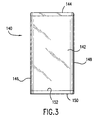
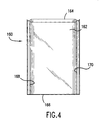
- the bag can be an end-seal bag, a side-seal bag, an L-seal bag (i.e., sealed across the bottom and along one side, with an open top), or a pouch (i.e., sealed on three sides, with an open top).
- the present invention is directed to a process for packaging a product, comprising the steps of: (A) placing a first product into a flexible, heat-shrinkable bag which is in accordance with the second aspect of the present invention; (B) repeating the placing step with a second product and a second bag, whereby a second bagged product results; (C)stacking at least the first and second bagged products so that an excess bag length of each of the bagged products are within a sealing distance of a means for heat-sealing; and (D) heat-sealing the inside layer of first bag to itself in the region between the open end of the first bag and the first product, and the inside layer of the second bag to itself in the region between the open end of the second bag and the second product, so that the first product is completely sealed within the first bag and the second product is completely sealed with the second bag.
- the sealing is carried out at a temperature so that the resulting packaged products can be freely separated from one another without layer delamination.
- the bag has an open top so that prior to sealing, both the first bagged product and the second bagged product have excess bag length.
- the first layer is sealed to itself, as the first layer is the inside layer in both the first bag and the second bag.
- the fourth layer is the outside layer of the first bag and the second bag.
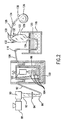
- the process can be carried out in a continuous, single, dual, or rotary chamber vacuum packaging machine.
- from 2 to 5 bagged products are stacked on top of one another during heat-sealing.
- the process utilizes a preferred bag in accordance with the present invention.
- free shrink refers to the percent dimensional change in a 10 cm x 10 cm specimen of film, when subjected to selected heat (i.e., at a certain temperature), with the quantitative determination being carried out according to ASTM D 2732, as set forth in the 1990 Annual Book of ASTM Standards, Vol. 08.02, pp.368-371.
- the multilayer film according to the present invention preferably has a total free shrink of at least 40 percent at 85°C (185°F).
- Total free shrink is determined by summing the percent free shrink in the machine direction with the percentage of free shrink in the transverse direction. For example, a film which exhibits, at 185°F, 50% free shrink in the transverse direction and 40% free shrink in the machine direction, has a “total free shrink” at 85°C (185°F) of 90%. It should be noted, however, the film does not have to have shrinkage in both directions. Unless specified otherwise, the phrase "free shrink”, as used herein, refers to total free shrink.
- the multilayer film of the present invention has a total free shrink at 85°C (185°F) of from 40 to about 170 percent: more preferably, from about 50 to about 150 percent; more preferably, from about 60 to about 130 percent; more preferably, from about 65 to about 110 percent; more preferably, from about 70 to about 100 percent; and, more preferably, from about 75 to about 95 percent.
- 185°F 85°C
- the film has a gloss (as measured by ASTM D2457) of at least 50% (preferably, from about 50 to about 90%), more preferably 60% (preferably, from about 60 to about 90%), more preferably 65% (preferably, from about 65% to about 90%), more preferably 70% (preferably, from about 70% to about 90%), and more preferably 75% (preferably, from about 75% to about 90%).
- a gloss as measured by ASTM D2457
- the percent haze of film is determined by subjecting the film to analysis by ASTM D1003. This method is described in detail in 1990 Annual Book of ASTM Standards , Section 8, Vol. 08.01, ASTM D 1003, "Standard Test Method for Haze and Luminous Transmittance of Transparent Plastics", pp. 358-363.
- the film of the instant invention has a haze of less than 10 percent; more preferably, from 0 to about 9 percent; more preferably, from about 1 to about 8 percent; more preferably, from about 2 to about 7 percent; still more preferably, from about 2 to about 6; yet still more preferably, from about 2 to about 5 percent; and yet still more preferably, from about 2 to about 4 percent.
- Haze is a measurement of the transmitted light scattered more than 2.5° from the axis of the incident light. It is measured with a meter similar to a total light transmission meter, with the exception that it contains a light trap to absorb light scattered less than 2.5° and regular transmitted light. It is common to measure the total transmitted light first by defeating the light trap and then setting the meter to 100. Then the light trap is allowed to absorb the light scattered less than 2.5° (plus regular transmitted light), and haze is read as a percentage of total transmitted light. Note that the denominator here is total transmitted light (I s + I r ), not incident light (I i ), as in the measurement of total transmitted light.
- films of and used in the present invention have a thickness of 0.25 mm or less.
- packaging refers to packaging materials used in the packaging of a product.
- the phrases “seal layer”, “sealing layer”, “heat seal layer”, and “sealant layer”, refer to an outer layer, or layers, involved in the sealing of the film to itself, another layer of the same or another film, and/or another article which is not a film.
- the phrase “seal layer,” and the like refer herein only to the outer film layer(s) which is to be heat-sealed to itself, another film, etc. Any inner film layers which contribute to the sealing performance of the film are herein designated as “seal-assist" layers.
- the phrase "sealant layer” generally refers to the inside layer of a package, the inside layer being an outer film layer which frequently also serves as a food contact layer in the packaging of foods.
- the composition of the other layers can also affect sealability and seal strength.
- sealant layers employed in the packaging art have included the genus of thermoplastic polymer, including thermoplastic polyolefin, polyamide, polyester, polyvinyl chloride, and ionomer.
- Preferred polymers for the sealant layer include homogeneous ethylene/alpha-olefin copolymer, ethylene/vinyl acetate copolymer, and ionomer.
- the term "seal” refers to any seal of a first region of a film surface to a second region of a film surface, wherein the seal is formed by heating the regions to at least their respective seal initiation temperatures.
- the heating can be performed by any one or more of a wide variety of manners, such as using a heated bar. hot wire, hot air, infrared radiation, ultrasonic sealing, etc.
- Heat-sealing is the process of joining two or more thermoplastic films or sheets by heating areas in contact with each other to the temperature at which fusion occurs, usually aided by pressure. Heat-sealing is inclusive of thermal sealing, melt-bead sealing, impulse sealing, dielectric sealing, and ultrasonic sealing.
- barrier layer As used herein, the term “barrier”, and the phrase “barrier layer”, as applied to films and/or layers, is used with reference to the ability of a film or layer to serve as a barrier to one or more gases.
- oxygen (i.e., gaseous O 2 ) barrier layers have, in general, included, for example, ethylene/vinyl alcohol copolymer (polymerized ethylene vinyl alcohol), polyvinylidene chloride (PVDC), polyalkylene carbonate, polyamide, polyethylene naphthalate, polyester, polyacrylonitrile, etc., as known to those of skill in the art.
- the O 2 -barrier layer preferably comprises either EVOH or polyvinylidene chloride, the PVDC comprising a thermal stabilizer (i.e., HCl scavenger, e.g., epoxidized soybean oil) and a lubricating processing aid, which, for example, comprises one or more acrylates.
- a thermal stabilizer i.e., HCl scavenger, e.g., epoxidized soybean oil
- a lubricating processing aid which, for example, comprises one or more acrylates.
- the phrases “abuse layer”, as well as the phrase “puncture-resistant layer”, refer to any film layer which serves to resist abrasion, puncture, and other potential causes of reduction of package integrity, as well as potential causes of reduction of package appearance quality.
- the phrase “skin layer” refers to an outside layer of a multilayer film in packaging a product, this skin layer being subject to abuse.
- core refers to any internal layer which preferably has a function other than serving as an adhesive or compatibilizer for adhering two layers to one another.
- the core layer or layers provide the multilayer film with a desired level of strength, i.e., modulus, and/or optics, and/or added abuse resistance, and/or specific impermeability.
- tie layer refers to any internal layer having the primary purpose of adhering two layers to one another.
- tie layers can comprise any polymer having a polar group grafted thereon, so that the polymer is capable of covalent bonding to polar polymers such as polyamide and ethylene/vinyl alcohol copolymer.
- Preferred polymers for use in tie layers include, but are not restricted to, ethylene/unsaturated acid copolymer, ethylene/unsaturated ester copolymer, anhydride-grafted polyolefin, polyurethane, and mixtures thereof.
- the phrase "bulk layer” refers to any layer of a film which is present for the purpose of increasing the abuse-resistance, toughness, modulus, orientability, etc., of a multilayer film. Bulk layers generally comprise polymers which are inexpensive relative to other polymers in the film.
- the phrases “food-contact layer” and “meat-contact layer”, refer to a layer of a multilayer film which is in direct contact with the food/meat in the package comprising the film.
- the food-contact/meat-contact layer is an outer layer of the multilayer film, in the sense that the food-contact/meat-contact layer is in direct contact with the meat product within the package.
- the food-contact/meat-contact layer is an inside layer in the sense that with respect to the packaged food product/meat product, the food-contact/meat-contact layer is the inside layer (i.e., innermost layer) of the package, this inside layer being in direct contact with the food/meat.
- food-contact surface and “meat-contact surface” refers to an outer surface of a food-contact layer/meat-contact layer, this outer surface being in direct contact with the food/meat within the package.
- the maximum and minimum thicknesses are determined by taking a total of 10 thickness measurements at regular distance intervals along the entirety of the transverse direction of a film sample, recording the highest and lowest thickness values as the maximum and minimum thickness values, respectively, and computing the thickness uniformity (a percent value) using the formula above.
- a thickness uniformity of 100% represents a film of absolute thickness uniformity, i.e., no measurable differences in thickness; in contrast, a film in which the film thickness(min) is measured at 45% of the film thickness(max) has a thickness uniformity of only 45%.
- EVOH refers to ethylene/vinyl alcohol copolymer.
- EVOH includes saponified or hydrolyzed ethylene/vinyl acetate copolymers, and refers to a vinyl alcohol copolymer having an ethylene comonomer, and prepared by, for example, hydrolysis of vinyl acetate copolymers, or by chemical reactions with polyvinyl alcohol.
- the degree of hydrolysis is preferably at least 50%, and more preferably, at least 85%.
- the EVOH comprises from about 28 to about 48 mole % ethylene, more preferably, from about 32 to about 44 mole % ethylene, and even more preferably, from about 38 to about 44 mole % ethylene.
- laminate refers to the process, and resulting product, made by bonding together two or more layers of film or other materials. Lamination can be accomplished by joining layers with adhesives, joining with heat and pressure, and even spread coating and extrusion coating.
- laminate is also inclusive of coextruded multilayer films comprising one or more tie layers.
- the term "oriented” refers to a polymer-containing material which has been stretched at an elevated temperature (the orientation temperature), followed by being “set” in the stretched configuration by cooling the material while substantially retaining the stretched dimensions. Upon subsequently heating unrestrained, unannealed, oriented polymer-containing material to its orientation temperature, heat shrinkage is produced almost to the original unstretched, i.e., preoriented dimensions. More particularly, the term "oriented”, as used herein, refers to oriented films, wherein the orientation can be produced in one or more of a variety of manners.
- the phrase "orientation ratio" refers to the multiplication product of the extent to which the plastic film material is expanded in several directions, usually two directions perpendicular to one another. Expansion in the machine direction is herein referred to as “drawing”, whereas expansion in the transverse direction is herein referred to as “stretching". For films extruded through an annular die, stretching is usually obtained by "blowing" the film to produce a bubble. For such films, drawing is usually obtained by passing the film through two sets of powered nip rolls, with the downstream set having a higher surface speed than the upstream set, with the resulting draw ratio being the surface speed of the downstream set of nip rolls divided by the surface speed of the upstream set of nip rolls. The degree of orientation is also referred to as the orientation ratio, or sometimes as the "racking ratio".
- machine direction refers to a direction “along the length” of the film, i.e., in the direction of the film as the film is formed during extrusion and/or coating.
- TD transverse direction
- heat-shrinkable refers to the tendency of a film, generally an oriented film, to shrink upon the application of heat. i.e., to contract upon being heated, such that the size (area) of the film decreases while the film is in an unrestrained state. Likewise, the tension of a heat-shrinkable film increases upon the application of heat if the film is restrained from shrinking.
- heat-contracted refers to a heat-shrinkable film, or a portion thereof, which has been exposed to heat such that the film or portion thereof is in a heat-shrunken state, i.e., reduced in size (unrestrained) or under increased tension (restrained).
- the multilayer films of the invention can be annealed or heat-set to reduce the free shrink either slightly or substantially.
- the term "monomer” refers to a relatively simple compound, usually containing carbon and of low molecular weight, which can react to form a polymer by combining with itself or with other similar molecules or compounds.
- the term "comonomer” refers to a monomer which is copolymerized with at least one different monomer in a copolymerization reaction, the result of which is a copolymer.
- polymer refers to the product of a polymerization reaction, and is inclusive of homopolymers. copolymers, terpolymers, etc.
- the layers of a film can consist essentially of a single polymer, or can have still additional polymers together therewith, i.e., blended therewith.
- homopolymer is used with reference to a polymer resulting from the polymerization of a single monomer, i.e., a polymer consisting essentially of a single type of mer, i.e., repeating unit.
- copolymer refers to polymers formed by the polymerization reaction of at least two different monomers.
- copolymer includes the copolymerization reaction product of ethylene and an alpha-olefin, such as 1-hexene.
- copolymer is also inclusive of, for example, the copolymerization of a mixture of ethylene, propylene, 1-hexene, and 1-octene.
- copolymer is also inclusive of random copolymers, block copolymers, and graft copolymers.
- polymerization is inclusive of homopolymerizations, copolymerizations, terpolymerizations, etc., and includes all types of copolymerizations such as random, graft, block, etc.
- the polymers in the films used in accordance with the present invention can be prepared in accordance with any suitable polymerization process, including slurry polymerization, gas phase polymerization, and high pressure polymerization processes.
- copolymerization refers to the simultaneous polymerization of two or more monomers to result in a copolymer.
- a copolymer identified in terms of a plurality of monomers e.g., "propylene/ethylene copolymer” refers to a copolymer in which either monomer may copolymerize in a higher weight or molar percent than the other monomer or monomers.
- the first listed monomer preferably polymerizes in a higher weight percent than the second listed monomer, and, for copolymers which are terpolymers, quadripolymers, etc., preferably the first monomer copolymerizes in a higher weight percent than the second monomer, and the second monomer copolymerizes in a higher weight percent than the third monomer, etc.
- copolymers are identified, i.e., named, in terms of the monomers from which the copolymers are produced.
- the phrase "propylene/ethylene copolymer” refers to a copolymer produced by the copolymerization of both propylene and ethylene, with or without additional comonomer(s).
- a copolymer comprises recurring "mers" derived from the monomers from which the copolymer is produced, e.g., a propylene/ethylene copolymer comprises propylene mer units and ethylene mer units.
- ethylene alpha-olefin copolymer is the equivalent of "ethylene/alpha-olefin copolymer.”
- heterogeneous polymer refers to polymerization reaction products of relatively wide variation in molecular weight and relatively wide variation in composition distribution, i.e., typical polymers prepared, for example, using conventional Ziegler-Natta catalysts. Heterogeneous polymers are useful in various layers of the film used in the present invention. Although there are a few exceptions (such as TAFMER (TM) linear homogeneous ethylene/alpha-olefin copolymers produced by Mitsui Petrochemical Corporation, using Ziegler-Natta catalysts), heterogeneous polymers typically contain a relatively wide variety of chain lengths and comonomer percentages.
- TAFMER TM linear homogeneous ethylene/alpha-olefin copolymers produced by Mitsui Petrochemical Corporation, using Ziegler-Natta catalysts
- homogeneous polymer refers to polymerization reaction products of relatively narrow molecular weight distribution and relatively narrow composition distribution. Homogeneous polymers are useful in various layers of the multilayer film used in the present invention. Homogeneous polymers are structurally different from heterogeneous polymers, in that homogeneous polymers exhibit a relatively even sequencing of comonomers within a chain, a mirroring of sequence distribution in all chains, and a similarity of length of all chains, i.e., a narrower molecular weight distribution. Furthermore, homogeneous polymers are typically prepared using metallocene, or other single-site type catalysis, rather than using Ziegler Natta catalysts.
- homogeneous ethylene/alpha-olefin copolymers may be characterized by one or more methods known to those of skill in the art, such as molecular weight distribution (M w /M n ), composition distribution breadth index (CDBI), and narrow melting point range and single melt point behavior.
- M w /M n molecular weight distribution
- CDBI composition distribution breadth index
- M w /M n composition distribution breadth index
- the homogeneous ethylene/alpha-olefin copolymers useful in this invention generally have (M w /M n ) of less than 2.7; preferably from about 1.9 to about 2.5; more preferably, from about 1.9 to about 2.3.
- composition distribution breadth index (CDBI) of such homogeneous ethylene/alpha-olefin copolymers will generally be greater than about 70 percent.
- the CDBI is defined as the weight percent of the copolymer molecules having a comonomer content within 50 percent (i.e., plus or minus 50%) of the median total molar comonomer content.
- the CDBI of linear polyethylene, which does not contain a comonomer, is defined to be 100%.
- the Composition Distribution Breadth Index (CDBI) is determined via the technique of Temperature Rising Elution Fractionation (TREF).
- CDBI determination clearly distinguishes the homogeneous copolymers used in the present invention (narrow composition distribution as assessed by CDBI values generally above 70%) from VLDPEs available commercially which generally have a broad composition distribution as assessed by CDBI values generally less than 55%.
- the CDBI of a copolymer is readily calculated from data obtained from techniques known in the art, such as, for example, temperature rising elution fractionation as described, for example, in Wild et. al., J. Poly. Sci. Poly. Phys. Ed. , Vol. 20, p.441 (1982).
- the homogeneous ethylene/alpha-olefin copolymers have a CDBI greater than about 70%, i.e., a CDBI of from about 70% to about 99%.
- the homogeneous ethylene/alpha-olefin copolymers in the multilayer films of the present invention also exhibit a relatively narrow melting point range, in comparison with "heterogeneous copolymers", i.e, polymers having a CDBI of less than 55%.
- the homogeneous ethylene/alpha-olefin copolymers exhibit an essentially singular melting point characteristic, with a peak melting point (T m ), as determined by Differential Scanning Colorimetry (DSC), of from about 60°C to about 105°C.
- T m peak melting point
- DSC Differential Scanning Colorimetry
- the homogeneous copolymer has a DSC peak T m of from about 80°C to about 100°C.
- the phrase "essentially single melting point" means that at least about 80%, by weight, of the material corresponds to a single T m peak at a temperature within the range of from about 60°C to about 105°C, and essentially no substantial fraction of the material has a peak melting point in excess of about 115°C, as determined by DSC analysis.
- DSC measurements are made on a Perkin Elmer System 7 Thermal Analysis System. Melting information reported are second melting data, i.e., the sample is heated at a programmed rate of 10°C./min. to a temperature below its critical range. The sample is then reheated (2nd melting) at a programmed rate of 10°C/min.
- the presence of higher melting peaks is detrimental to film properties such as haze, and compromises the chances for meaningful reduction in the seal initiation temperature of the final film.
- a homogeneous ethylene/alpha-olefin copolymer can, in general, be prepared by the copolymerization of ethylene and any one or more alpha-olefins.
- the alpha-olefin is a C 3 -C 20 alpha-monoolefin, more preferably, a C 4 -C 12 alpha-monoolefin, still more preferably, a C 4 -C 8 alpha-monoolefin.
- the alpha-olefin comprises at least one member selected from the group consisting of butene-1, hexene-1, and octene-1, i.e., 1-butene, 1-hexene, and 1-octene, respectively. Most preferably, the alpha-olefin comprises octene-1, and/or a blend of hexene-1 and butene-1.
- polyolefin refers to any polymerized olefin, which can be linear, branched, cyclic, aliphatic, aromatic, substituted, or unsubstituted. More specifically, included in the term polyolefin are homopolymers of olefin, copolymers of olefin, copolymers of an olefin and an non-olefinic comonomer copolymerizable with the olefin, such as vinyl monomers, modified polymers thereof, and the like.
- polyethylene homopolymer polypropylene homopolymer, polybutene, ethylene/alpha-olefin copolymer, propylene/alpha-olefin copolymer, butene/alpha-olefin copolymer, ethylene/unsaturated ester copolymer, ethylene/unsaturated acid copolymer, (especially ethyl acrylate copolymer, ethylene/butyl acrylate copolymer, ethylene/methyl acrylate copolymer, ethylene/acrylic acid copolymer. ethylene/methacrylic acid copolymer), modified polyolefin resin. ionomer resin, polymethylpentene, etc.
- Modified polyolefin resin is inclusive of modified polymer prepared by copolymerizing the homopolymer of the olefin or copolymer thereof with an unsaturated carboxylic acid, e.g., maleic acid, fumaric acid or the like, or a derivative thereof such as the anhydride, ester or metal salt or the like. It could also be obtained by incorporating into the olefin homopolymer or copolymer, an unsaturated carboxylic acid, e.g., maleic acid, fumaric acid or the like, or a derivative thereof such as the anhydride, ester or metal salt or the like.
- an unsaturated carboxylic acid e.g., maleic acid, fumaric acid or the like
- a derivative thereof such as the anhydride, ester or metal salt or the like.
- identifying polymers such as “polyamide”, “polyester”, “polyurethane”, etc. are inclusive of not only polymers comprising repeating units derived from monomers known to polymerize to form a polymer of the named type, but are also inclusive of comonomers, derivatives, etc. which can copolymerize with monomers known to polymerize to produce the named polymer.
- polyamide encompasses both polymers comprising repeating units derived from monomers, such as caprolactam, which polymerize to form a polyamide, as well as copolymers derived from the copolymerization of caprolactam with a comonomer which when polymerized alone does not result in the formation of a polyamide.
- terms identifying polymers are also inclusive of mixtures, blends, etc. of such polymers with other polymers of a different type.
- modified polymer as well as more specific phrases such as “modified ethylene/vinyl acetate copolymer”, and “modified polyolefin” refer to such polymers having an anhydride functionality, as defined immediately above, grafted thereon and/or copolymerized therewith and/or blended therewith.
- modified polymers Preferably, such modified polymers have the anhydride functionality grafted on or polymerized therewith, as opposed to merely blended therewith.
- anhydride-containing polymer and “anhydride-modified polymer”, refer to one or more of the following: (1) polymers obtained by copolymerizing an anhydride-containing monomer with a second, different monomer. and (2) anhydride grafted copolymers, and (3) a mixture of a polymer and an anhydride-containing compound.
- ethylene alpha-olefin copolymer and “ethylene/alpha-olefin copolymer” refer to such heterogeneous materials as linear low density polyethylene (LLDPE), and very low and ultra low density polyethylene (VLDPE and ULDPE); and homogeneous polymers such as metallocene-catalyzed EXACT (TM) linear homogeneous ethylene/alpha olefin copolymer resins obtainable from the Exxon Chemical Company, of Baytown, Texas, and TAFMER (TM) linear homogeneous ethylene/alpha-olefin copolymer resins obtainable from the Mitsui Petrochemical Corporation.
- LLDPE linear low density polyethylene
- VLDPE and ULDPE very low and ultra low density polyethylene
- homogeneous polymers such as metallocene-catalyzed EXACT (TM) linear homogeneous ethylene/alpha olefin copolymer resins obtainable from the Exxon Chemical Company, of Bay
- All these materials generally include copolymers of ethylene with one or more comonomers selected from C 4 to C 10 alpha-olefin such as butene-1 (i.e., 1-butene), hexene-1, octene-1, etc. in which the molecules of the copolymers comprise long chains with relatively few side chain branches or cross-linked structures.
- This molecular structure is to be contrasted with conventional low or medium density polyethylenes which are more highly branched than their respective counterparts.
- the heterogeneous ethylene/alpha-olefin commonly known as LLDPE has a density usually in the range of from about 0.91 grams per cubic centimeter to about 0.94 grams per cubic centimeter.
- ethylene/alpha-olefin copolymers such as the long chain branched homogeneous ethylene/alpha-olefin copolymers available from The Dow Chemical Company, known as AFFINITY (TM) resins, are also included as another type of homogeneous ethylene/ alpha-olefin copolymer useful in the present invention.
- AFFINITY TM resins
- the ethylene/alpha-olefin copolymer comprises a copolymer resulting from the copolymerization of from about 80 to about 99 weight percent ethylene and from 1 to about 20 weight percent alpha-olefin.
- the ethylene/alpha-olefin copolymer comprises a copolymer resulting from the copolymerization of from about 85 to about 95 weight percent ethylene and from about 5 to about 15 weight percent alpha-olefin.
- the phrases “inner layer” and “internal layer” refer to any layer, of a multilayer film, having both of its principal surfaces directly adhered to another layer of the film.
- outer layer refers to any layer of film having less than two of its principal surfaces directly adhered to another layer of the film.
- the phrase is inclusive of monolayer and multilayer films.
- multilayer films there are two outer layers, each of which has a principal surface adhered to only one other layer of the multilayer film.
- monolayer films there is only one layer, which, of course, is an outer layer in that neither of its two principal surfaces are adhered to another layer of the film.
- inside layer refers to the outer layer, of a multilayer film packaging a product, which is closest to the product, relative to the other layers of the multilayer film. "Inside layer” also is used with reference to the innermost layer of a plurality of concentrically arranged layers simultaneously coextruded through an annular die.
- outside layer refers to the outer layer, of a multilayer film packaging a product, which is furthest from the product relative to the other layers of the multilayer film.
- the phrase “outside layer” also is used with reference to the outermost layer of a plurality of concentrically arranged layers coextruded through an annular die.
- the term "adhered” is inclusive of films which are directly adhered to one another using a heat-seal or other means, as well as films which are adhered to one another using an adhesive which is between the two films.
- the phrase "directly adhered”, as applied to layers, is defined as adhesion of the subject layer to the object layer, without a tie layer, adhesive, or other layer therebetween.
- the word "between”, as applied to a layer expressed as being between two other specified layers, includes both direct adherence of the subject layer between to the two other layers it is between, as well as including a lack of direct adherence to either or both of the two other layers the subject layer is between, i.e., one or more additional layers can be imposed between the subject layer and one or more of the layers the subject layer is between.
- the term "extrusion” is used with reference to the process of forming continuous shapes by forcing a molten plastic material through a die, followed by cooling or chemical hardening. Immediately prior to extrusion through the die, the relatively high-viscosity polymeric material is fed into a rotating screw of variable pitch, i.e., an extruder, which forces the polymeric material through the die.
- coextrusion refers to the process of extruding two or more materials through a single die with two or more orifices arranged so that the extrudates merge and weld together into a laminar structure before chilling, i.e., quenching. Coextrusion can be employed in film blowing, free film extrusion, and extrusion coating processes.
- At least a portion of the multilayer film of the present invention is preferably irradiated to induce crosslinking.
- the film is subjected to one or more energetic radiation treatment, such corona discharge, plasma, flame, ultraviolet, X-ray, gamma ray, beta ray, and high energy electron treatment, each of which induce cross-linking between molecules of the irradiated material.
- energetic radiation treatment such corona discharge, plasma, flame, ultraviolet, X-ray, gamma ray, beta ray, and high energy electron treatment, each of which induce cross-linking between molecules of the irradiated material.
- a suitable radiation dosage of high energy electrons is employed, preferably using an electron accelerator, with a dosage level being determined by standard dosimetry methods.
- Other accelerators such as a Van de Graaf or resonating transformer may be used.
- the radiation is not limited to electrons from an accelerator since any ionizing radiation may be used.
- the ionizing radiation can be used to crosslink the polymers in the film.
- the film is irradiated at a level of from about 3 MR to about 20.7 MR (30 - 207 kGy), more preferably from about 3 MR to about 14 MR (30 - 140 kGy).
- the most preferred amount of radiation is dependent upon the film and its end use.
- corona treatment and “corona discharge treatment” refer to subjecting the surfaces of thermoplastic materials, such as polyolefins, to corona discharge, i.e., the ionization of a gas such as air in close proximity to a film surface, the ionization initiated by a high voltage passed through a nearby electrode, and causing oxidation and other changes to the film surface, such as surface roughness.
- thermoplastic materials such as polyolefins
- Corona treatment of polymeric materials is disclosed in U.S. Patent No. 4,120,716, to BONET, issued October 17, 1978.
- BONET discloses-improved adherence characteristics of the surface of polyethylene by corona treatment, to oxidize the polyethylene surface.
- U.S. Patent No. 4,879,430, to HOFFMAN discloses the use of corona discharge for the treatment of plastic webs for use in meat cook-in packaging, with the corona treatment of the inside surface of the web to increase the adhesion of the meat to the adhesion of the meat to the proteinaceous material.
- the films of this invention can be corona-treated in a preferred embodiment.
- the film according to the present invention comprises a total of from 4 to 20 layers; more preferably, from 4 to 12 layers; and still more preferably, from 5 to 9 layers.
- the multilayer film of the present invention can have any total thickness desired, so long as the film provides the desired properties for the particular packaging operation in which the film is used, e.g. optics, modulus, seal strength, etc.
- the multilayer film according to the present invention comprises 6 layers.
- the first layer comprises at least one polyolefin; more preferably, at least one member selected from the group consisting of polyethylene homopolymer, polyethylene copolymer, polypropylene homopolymer, polypropylene copolymer, polybutene homopolymer, polybutene copolymer; still more preferably, at least one member selected from the group consisting of ethylene/alpha-olefin copolymer, ethylene/unsaturated ester copolymer, and ethylene/unsaturated acid copolymer. More preferably, the first layer comprises a homogeneous ethylene/alpha-olefin copolymer.
- the ethylene/alpha-olefin copolymer has a density of less than 0.930 g/cc (preferably, from about 0.86 to less than 0.930, more preferably, from about 0.880 to less than 0.930), more preferably, less than 0.920, more preferably, less than 0.915, more preferably, less than 0.910, more preferably less than 0.905, more preferably, less than 0.903, more preferably, less than 0.900, more preferably, less than 0.898.
- the lower the density of the polyolefin in the seal layer the better the sealability and resistance to bum-through.
- the polyolefin in the first layer has a melting point less than about 125°C (more preferably, from about 50°C to less than 125°C; still more preferably, from about 70°C to less than about 125°C); more preferably, less than 120°C; more preferably, less than 115°C; more preferably, less than 110°C; more preferably, less than 108°C; more preferably, less than 105°C; more preferably, less than 100°C; more preferably, less than 97°C; more preferably less than 95°C; more preferably, less than 93°C, more preferably, less than 90°C.
- the first layer can further comprise additional polymer(s) in an amount of from about 5 to about 80 percent, based on layer weight. more preferably from about 10 to about 40% and even more preferably, from about 10 to about 20%.
- Preferred additional polymers include at least one member selected from the group consisting of polyolefin, polystyrene, polyamide, polyester, polymerized ethylene vinyl alcohol, polyvinylidene chloride, polyether, polyurethane, polycarbonate, and starch-containing polymer; more preferably, at least one member selected from the group consisting of ethylene/alpha-olefin copolymer, propylene/alpha-olefin copolymer, butene/alpha-olefin copolymer, ethylene/unsaturated ester copolymer, and ethylene/unsaturated acid copolymer.
- the first layer comprises a blend of a homogeneous ethylene-alpha olefin copolymer with a heterogeneous ethylene alpha-olefin copolymer.
- the homogeneous ethylene-alpha olefin copolymer has a density less than about 0.910 g/cc (preferably, from about 0.86 to less than about 0.910; more preferably, from about 0.88 to less than about 0.910) and the heterogeneous ethylene-alpha olefin copolymer has a density greater than about 0.910.
- the polyolefin of the first layer has a melt index of from about 0.3 to about 50 g/10 min; more preferably from about 1 to about 20; still more preferably from about 2 to about 10, even more preferably from about 3 to about 8; and, still more preferably from about 4 to about 6 (as measured by ASTM D1238, which is hereby incorporated, in its entirety, by reference thereto).
- the first layer has a thickness of from about 2.54 to about 101.6 ⁇ m (0.1 - 4 mils); more preferably, from about 5.08 to about 25.4 ⁇ m (0.2 - 1 mil); and, still more preferably, from about 7.62 to about 20.32 ⁇ m (0.3 - 0.8 mil).
- the thickness of the first layer is from about 1 to about 60 percent of the total thickness of the multilayer film; more preferably, about 5 to about 50%; more preferably, about 10 to about 40%; more preferably, about 15 to about 35%; and even more preferably, about 15 to about 30%.
- the thickness of the first layer is at least 50% of the thickness of the third layer; more preferably, at least 75% of the thickness of the third layer, more preferably, at least 100% of the thickness of the third layer; more preferably, at least 125% of the thickness of the third layer; and, even more preferably, at least 150% of the thickness of the third layer.
- a polyolefin with a low melting point preferably, less than 120°C ⁇ more preferably, from about 70°C to less than 120°C; still more preferably, from about 80°C to less than 120°C ⁇ ; more preferably, less than about 110°C, e.g., homogeneous ethylene/alpha olefin copolymers
- a polyolefin with a low melting point preferably, less than 120°C ⁇ more preferably, from about 70°C to less than 120°C; still more preferably, from about 80°C to less than 120°C ⁇ ; more preferably, less than about 110°C, e.g., homogeneous ethylene/alpha olefin copolymers
- the use of a lower sealing temperature enhances the use of this film for applications involving stack/overlap sealing.
- the use of a polyolefin with a low melting point, in combination with an inner layer comprising a polyester provides the article of manufacture made therefrom with high seal strength.
- the use of the preferred polyolefins as described in the first layer also enables the film of the invention to be oriented more easily and provide the multilayer film with high free shrink and excellent optics.
- the second layer comprises at least one member selected from the group consisting of polyolefin, polystyrene and polyurethane; more preferably, at least one member selected from the group consisting of polyethylene homopolymer, polyethylene copolymer, polypropylene homopolymer, polypropylene copolymer, polybutene homopolymer, polybutene copolymer; even more preferably, at least one member selected from the group consisting of ethylene/alpha-olefin copolymer, ethylene/unsaturated ester copolymer, and ethylene/unsaturated acid copolymer. Still more preferably, the second layer comprises an ethylene-vinyl acetate copolymer.
- a preferred ethylene/vinyl acetate copolymer comprises from about 3 to about 28% vinyl acetate comonomer, more preferably, from about 5 to about 20% vinyl acetate comonomer, even more preferably, from about 8 to about 18% vinyl acetate copolymer and even yet still more preferably, from about 12 to about 18% vinyl acetate comonomer.
- the second layer can further comprise additional polymer in an amount of from about 5 to about 80% based on layer weight, more preferably from about 10 to about 40% and even more preferably, from about 10 to about 20%.
- Preferred additional polymers include at least one member selected from the group consisting of polyolefin, polystyrene, polyamide, polyester, polymerized ethylene vinyl alcohol, polyvinylidene chloride, polyether, polyurethane, polycarbonate, and starch-containing polymer; more preferably, at least one member selected from the group consisting of ethylene/alpha-olefin copolymer, propylene/alpha-olefin copolymer, butene/alpha-olefin copolymer, ethylene/unsaturated ester copolymer, and ethylene/unsaturated acid copolymer.
- the second layer facilitates the orientation process used to produce the film of the invention and also provides the film with excellent free shrink, impact resistance and optics.
- the second layer could also serve
- the polymer of the second layer preferably has a melt index of from about 0.3 to about 50, more preferably from about 1 to about 20, still more preferably from about 1 to about 10, even more preferably from about 1 to about 5, and, still more preferably from about 1 to about 3.
- the second layer has a thickness of from about 1.27 to about 101.6 ⁇ m (0.05 - 4 mils) more preferably, from about 2.54 to about 25.4 ⁇ m (0.1 - 1 mil); and, still more preferably, from about 5.08 to about 17.8 ⁇ m (0.2 - 0.7 mil).
- the thickness of the second layer is from about 1 to about 50 percent, based on total film thickness; more preferably, from about 5 to about 50 percent; more preferably, from about 8 to about 50 percent; more preferably, from about 10 to about 45 percent; more preferably, from about 13 to about 40 percent: more preferably, from about 15 to about 35 percent; more preferably, from about 17 to about 25 percent; and more preferably, from about 20 to about 25 percent.
- the thickness of the second layer is at least 50% of the thickness of the third layer, more preferably, at least 75% of the thickness of the third layer, more preferably, at least 100% of the thickness of the third layer, more preferably, at least 125% of the thickness of the third layer and even more preferably, at least 150% of the thickness of the third layer.
- the third layer comprises a polyester. While the polyester utilized in the third layer could be a homopolymer or a copolymer, preferably the polyester is a copolyester. Preferably, the polyester comprises from about 70 to about 95 mole percent terephthalate mer units: more preferably, from about 80 to about 95 mole percent terephthalate mer units; and still more preferably, from about 85 to about 90 mole percent terephthalate mer units.
- the polyester has a melting point of from 130°C to about 190°C; more preferably, from about 150°C to about 170°C or about 180°C.
- the polyester in the third layer is an amorphous polyester (i.e., has no crystallinity or relatively low crystallinity).
- suitable polyesters include PET homopolymer, PET copolymer, PEN homopolymer, and PEN copolymer.
- a polyester in the third layer in conjunction with an outer layer comprising at least one member selected from the group consisting of polyester, polyamide, polypropylene and polyurethane, provides certain unexpected results when compared to the use of polyolefins or polyamides with high melting points (i.e., melting points greater than 160°C) in the third layer.
- the use of an inner layer comprising a polyester, in conjunction with an outer layer comprising polyester increases the impact strength of the film at room temperature; increases the impact strength of the film at elevated temperatures, relative to the impact strength of films which are predominantly polyolefinic; provides superior film optics; and provides superior grease-resistance.
- the films of this invention are easier to orient; and can be oriented to a higher degree, when compared to other films, especially those comprising an inner polyamide layer having a high melting point.
- the ease of orientability and wider orientation window provided the films of this invention also result in a more stable orientation process.
- the films of this invention can also be oriented at a lower temperature than films comprising an inner layer comprising a polyamide with a high melting point, e.g. polyamide 6. While the composition of the films of this invention also provide higher free shrink, the process of orientation at a lower temperature also enhances the free shrink of the multilayer films of this invention.
- the films of this invention are also relatively free of optical defects (such as die-lines), versus films comprising an inner layer comprising a polyamide with a high melting point, i.e., greater than 160°C (e.g., polyamide 6).
- a polyester facilitates the incorporation and orientation of thicker layers of polyester, thereby providing superior impact strength (as compared to films comprising an inner layer comprising a high melting polyamide).
- the third layer has a thickness of from about 5 to about 40 percent, based on the total thickness of the multilayer film; more preferably, from about 7 to about 30 percent; more preferably, from about 10 to about 28 percent; more preferably, from about 12 to 26 percent; and more preferably, from about 18 to about 25 percent. If the thickness of the third layer is less than about 5% of the total thickness of the multilayer film, the film exhibits a less-than-preferred impact strength, toughness, and puncture resistance. On the other hand, if the thickness of the third layer is greater than about 40% of the total thickness of the multilayer film, the film has a shrink and clarity which are less-than-preferred; moreover, the tape, from which the film is made, becomes more difficult to orient.
- the third layer has a thickness of from about 1.27 to about 50.8 ⁇ m (0.05 - 2 mils); more preferably, from about 2.54 to about 25.4 ⁇ m (0.1 - 1 mil); still more preferably, from about 5.08 to about 20.32 ⁇ m (0.2 - 0.8 mils); yet still more preferably, from about 5.08 to about 10.16 ⁇ m (0.2 - 0.4 mil); and, even yet still more preferably, from about 5.08 to about 7.62 ⁇ m (0.2 - 0.3 mil).
- the fourth layer comprises at least one member selected from the group consisting of polyester, polyamide, polypropylene and polyurethane.
- the polyester has a melting point of at least 190°C to about 260°C; more preferably, to about 250°C; even more preferably to about 240°C; still more preferably, from about 200°C to about 240°C; and yet still more preferably, from about 210°C to about 235°C.
- higher melting point polyester is preferred.
- the higher melting point polyester comprises polyester having a terephthalic acid mer content of at least 75 mole percent; more preferably, at least 80 mole percent; more preferably, at least 85 mole percent; and even more preferably, at least 90 mole percent.
- the polyester in the fourth layer is an amorphous polyester, more preferably, an amorphous copolyester.
- the polyester utilized in the fourth layer could be a homopolymer or a copolymer
- the polyester is a copolyester.
- the polyester comprises from about 70 to about 95 mole percent terephthalate mer units; more preferably, from about 80 to about 95 mole percent terephthalate mer units; and still more preferably, from about 85 to about 90 mole percent terephthalate mer units.
- polyester having a higher mole percent of terephthalate mer units is preferred.
- suitable polyester include PET homopolymer, PET copolymer, PEN homopolymer, and PEN copolymer.
- the fourth layer comprises polyamide.
- the polyamide comprises at least one member selected from the group consisting of polyamide 6, polyamide 9, polyamide 10, polyamide 11, polyamide 12, polyamide 66, polyamide 610, polyamide 612, polyamide 61, polyamide 6T, polyamide 69, and copolymers thereof.
- the polyamide has a melting point of from about 130°C to about 235°C; more preferably, from about 150°C to about 235°C; more preferably, from about 170°C to about 235°C; more preferably, from about 180°C to about 235°C; and more preferably from about 195°C to about 235°C.
- the fourth layer comprises a polypropylene; preferably a polypropylene copolymer; more preferably, a polypropylene copolymer comprising at least 70% propylene mer; more preferably, from about 70 to about 99% propylene mer; more preferably, from about 80 to about 99% propylene mer; more preferably, from about 85 to about 99% propylene mer; more preferably, from about 90 to about 99% propylene mer; and more preferably, from about 94 to about 99% propylene mer.
- the polypropylene has a melting point of at least 120°C; more preferably, from about 120°C to about 160°C; more preferably, from about 130°C to about 150°C; and even more preferably, from about 135°C to about 145°C.
- the fourth layer comprises a polyurethane, preferably having a melting point of at least 120°C.
- the fourth layer has a thickness of from about 1.27 to about 101.6 ⁇ m (0.05 - 4mils) more preferably, from about 2.54 to about 25.4 ⁇ m (0.1 - 1mil); and, still more preferably, from about 5.08 to about 20.32 ⁇ m (0.2 - 0.8 mil).
- the thickness of the fifth layer is from about 1 to about 30 percent of the total thickness of the multilayer film; more preferably, from about 4 to about 20 percent; still more preferably, from about 4 to about 16 percent; still more preferably. from about 5 to about 15 percent; and, still more preferably, from about 7 to about 12 percent.
- the film according to the present invention further comprises a fifth layer which has O 2 -barrier characteristics.
- the fifth layer has a thickness of from about 1.27 about 50.2 ⁇ m (0.05-2 mils); more preferably, from about 1.27 to about 12.7 ⁇ m (0.05 - 0.5 mil) yet still more preferably, from about 2.54 to about 7.62 ⁇ m (0.1 - 0.3mil)and even yet still more preferably, from about 3.05 to about 4.32 ⁇ m (0.12 - 0.17 mil).
- the fifth layer comprises at least one member selected from the group consisting of EVOH, PVDC, polyalkylene carbonate, polyamide, and polyethylene naphthalate; more preferably, EVOH having about 44 mole percent ethylene mer.
- the thickness of the fifth layer is from about 1 to about 25 percent of the total thickness of the multilayer film; more preferably, about 3 to about 18 percent: and, still more preferably, from about 5 to about 15 percent.
- the film further comprises a sixth layer which has a composition which is similar to or identical with the composition of the third layer, as described above.
- the sixth layer comprises a polyamide.
- the polyamide comprises at least one member selected from the group consisting of polyamide 6, polyamide 9, polyamide 10, polyamide 11, polyamide 12, polyamide 66, polyamide 610, polyamide 612, polyamide 61, polyamide 6T, polyamide 69, and copolymers thereof.
- the film further comprises a seventh layer, and more preferably, an eighth layer.
- the seventh layer and the eighth layer preferably serve as tie layers.
- the thickness and composition of tie layers used in the films of this invention are as known to those of skill in the art.
- the third layer and the fourth layer are not adjacent one another.
- the multilayer film of this invention has at least one layer between the third layer and the fourth layer, this layer comprising a polymer having a lower modulus than the polyamide or polyester in the third or fourth layers.
- the polymer referred to above which has a lower modulus than the polyamide or polyester in the third or fourth layer, comprises at least one member selected from the group consisting of polyolefin, polystyrene, polyurethane. EVOH, polyalkylene carbonate, and PVDC.
- the layer having a lower modulus than the polyamide or polyester can also serve as a tie layer, or as an O 2 -barrier layer.
- the film comprises polyester in an amount of at least 10 percent polyester, based on the total weight of film; more preferably, from about 5 percent to about 60 percent; more preferably, from about 10 percent to about 50 percent; more preferably, from about 15 percent to about 40 percent; more preferably, from about 20 percent to about 40 percent; and even more preferably, from about 25 percent to about 35 percent.
- the film exhibits a modulus of at least 276 MPa (40,000 psi) (more preferably from about 276 to about 1,725 MPa (40,000- 250,000psi)); more preferably at least about 345 (50,000); more preferably, at least about 414 (60,000); more preferably, at least about 483 (70,000), more preferably, at least about 552 (80,000); more preferably, at least about 621 (90,000); more preferably, at least about 690 (100,000); more preferably, at least about 759 (110,000), and more preferably, at least about 828 MPa (120,000 psi). Modulus is measured in accordance with ASTM D 882.
- the film exhibits a shrink tension in at least one direction of at least 0.69 MPa (100 psi), more preferably 1.21 MPa (175 psi); still more preferably, from about 1.21(175) to about 3.45 MPa (500 psi); still more preferably, from about 1.38(200) to about 3.45 MPa (500 psi); more preferably, from about 1.55 (225) to about 3.45 MPa (500 psi); more preferably from about 1.73 (250) to about 3.45 MPa (500 psi); more preferably from about 1.90 (275) to about 3.45 MPa (500 psi); more preferably, from about 2.07(300) to about 3.45 MPa (500 psi) and more preferably, from about 2.24 to about 3.45 MPa (500 psi).
- Shrink tension is measured in accordance with ASTM D 2838.
- the multilayer films of the invention can also comprise more than 6 layers.
- the film is produced by casting an annular tape which is thereafter oriented at least 2.7:1 in at least 1 direction; more preferably, from about 2.7:1 to about 10:1 in at least one direction: still more preferably, at least 2.8:1; still more preferably, at least 2.9:1, yet still more preferably, at least 3.0:1; even yet still more preferably, at least 3.1:1; yet still more preferably, at least 3.2:1; yet still more preferably, at least 3.3:1; yet still more preferably, at least 3.4:1; yet still more preferably, at least 3.5:1; yet still more preferably, at least 3.6:1; and, yet still more preferably, at least 3.7:1.
- Films comprising polyamide with a melting point greater than 160°C in the inner layer are difficult to orient at a ratio of about 2.7 to 1 in the transverse direction; above 3.0 orientation becomes even more difficult.
- the films of this invention can be easily oriented at least 3:1 in at least one direction.
- Figure 1 illustrates a schematic view of a first preferred process for making films according to the present invention.
- solid polymer beads (not illustrated) are fed to a plurality of extruders 28 (for simplicity, only one extruder is illustrated). Inside extruders 28, the polymer beads are forwarded, melted, and degassed, following which the resulting bubble-free melt is forwarded into die head 30, and extruded through an annular die, resulting in tubing 32 which is preferably about 10 to 20 mils thick.
- tubing 32 After cooling or quenching by water spray from cooling ring 34, tubing 32 is collapsed by pinch rolls 36. and is thereafter fed through irradiation vault 38 surrounded by shielding 40, where tubing 32 is irradiated with high energy electrons (i.e., ionizing radiation) from iron core transformer accelerator 42. Tubing 32 is guided through irradiation vault 38 on rolls 44. Preferably, tubing 32 is irradiated to a level of from about 4 MR to about 12 MR (40 - 120 kGy).
- irradiated tubing 46 is directed through pinch rolls 48, following which irradiated tubing 46 is slightly inflated, resulting in trapped bubble 50.
- trapped bubble 50 the tubing is not significantly drawn longitudinally, as the surface speed of nip rolls 52 are about the same speed as nip rolls 48.
- irradiated tubing 46 is inflated only enough to provide a substantially circular tubing without significant transverse orientation, i.e., without stretching.
- Coating stream 58 preferably comprises an O 2 -barrier layer, which does not pass through the ionizing radiation. Further details of the above-described coating step are generally as set forth in U.S. Patent No. 4,278,738, to BRAX et. al.
- two-ply tubing film 60 is wound up onto windup roll 62. Thereafter, windup roll 62 is removed and installed as unwind roll 64, on a second stage in the process of making the tubing film as ultimately desired.
- Two-ply tubular film 60, from unwind roll 64, is unwound and passed over guide roll 66, after which two-ply tubular film 60 passes into hot water bath tank 68 containing hot water 70.
- the now collapsed, irradiated, coated tubular film 60 is immersed in hot water 70 (preferably, having temperature of about 85 to 99°C (185°F to 210°F)) for a period of from about 10 to about 100 seconds, i.e., for a time period in order to bring the film up to the desired temperature for biaxial orientation.
- hot water 70 preferably, having temperature of about 85 to 99°C (185°F to 210°F)
- irradiated tubular film 60 is directed through nip rolls 72, and bubble 74 is blown, thereby transversely stretching tubular film 60.
- nip rolls 76 draw tubular film 60 in the longitudinal direction, as nip rolls 76 have a surface speed higher than the surface speed of nip rolls 72.
- irradiated, coated biaxially-oriented blown tubing film 78 is produced, this blown tubing preferably having been both stretched in a ratio of from about 1:1.5 to about 1:6, and drawn at a ratio of from about 1:1.5 to about 1:6; more preferably, the stretching and drawing are each performed a ratio of from about 1:2 to about 1:4.
- the result is a biaxial orientation of from about 1:2.25 to about 1:36, more preferably, from about 1:4 to about 1:16.
- Figure 2 illustrates a schematic of a second preferred process for making a film in accordance with the present invention.
- solid polymer beads (not illustrated) are fed to a plurality of extruders (for simplicity, only extruder 88 is illustrated). Inside extruders 88, the polymer beads are forwarded, melted, and degassed, following which the resulting bubble-free melt is forwarded into die head 90, and extruded through an annular die, resulting in tubing tape 92 which is preferably from about 10 to 20 mils thick, and preferably has a lay-flat width of from about 2 to 10 inches.
- tubing tape 92 After cooling or quenching by water spray from cooling ring 94, tubing tape 92 is collapsed by pinch rolls 96, and is thereafter fed through irradiation vault 98 surrounded by shielding 100, where tubing 92 is irradiated with high energy electrons (i.e., ionizing radiation) from iron core transformer accelerator 102. Tubing 92 is guided through irradiation vault 98 on rolls 104.
- high energy electrons i.e., ionizing radiation
- tubing 92 is irradiated to a level of from about 4 to about 12 MR (40 - 120 kGy), resulting in irradiated tubing 106, which is then passed over guide roll 116, after which irradiated tubing 106 is passed into and through hot water bath tank 118 containing hot water 120.
- Irradiated tubing 106 is immersed in hot water 120 (preferably having a temperature of about 85 to about 99°C) for a period of about 10 to about 100 seconds, i.e., for a time period long enough to bring the film up to the desired temperature for biaxial orientation.
- nip rolls 124 Thereafter, the resulting hot, irradiated tubing 122 is directed through nip rolls 124, and bubble 126 is blown, thereby transversely stretching hot, irradiated tubular tubing 122 so that an oriented film tube 128 is formed. Furthermore, while being blown, i.e., transversely stretched, nip rolls 130 have a surface speed higher than the surface speed of nip rolls 124, thereby resulting in longitudinal orientation. As a result of the transverse stretching and longitudinal drawing, oriented film tube 128 is produced, this blown tubing preferably having been both stretched at a ratio of from about 1:1.5 to about 1:6, and drawn at a ratio of from about 1:1.5 to about 1:6.
- the stretching and drawing are each performed at a ratio of from about 1:2 to about 1:4.
- the result is a biaxial orientation of from about 1:2.25 to about 1:36, more preferably, from about 1:4 to about 1:16.
- bubble 126 is maintained between pinch rolls 124 and 130
- oriented film tube 128 is collapsed by rollers 132, and thereafter conveyed through pinch rolls 130 and across guide roll 134, and then rolled onto wind-up roll 136.
- Idler roll 138 assures a good wind-up.
- This process can be carried out continuously in a single operation, or intermittently, e.g., as a two-stage process, in which the extruded, irradiated tape is wound up after irradiation, and. after a period of storage, unwound and subjected to heating and orienting in order to arrrive at oriented film tubing 128.
- Film No. 1 is an example of the multilayer film of the current invention.
- the first layer was an outer layer and which served as a seal layer, inside bag layer, and product-contact layer; (2) the second layer comprised polyolefin; (3) the third layer comprised a polyester; (4) the fourth layer was an outer layer and comprised a polyester; (5) the fifth layer served as an O 2 -barrier layer, (6) the sixth layer comprised polyester; (7) the seventh layer served as a tie layer ; and (8) the eighth layer served as a tie layer.
- the layer arrangement was in the order of Table I, above.
- the resins identified in the table were as follows:
- Homogeneous ethylene/alpha-olefin copolymer was AFFINITY® DPL 1280 long chain branched substantially linear single site catalyzed ethylene/octene copolymer containing 13 weight percent octene mer and having a density of 0.900 g/cc and a melt index of 6.0 grams/min. This resin was obtained from The Dow Chemical Company, of Midland, Michigan.
- LLDPE was ESCORENE® LL3003.32 linear low density polyethylene having 90 weight percent ethylene mer 10 weight percent hexene mer, having a density of 0.9175 g/cc and a melt index of 3.2 g/min. This resin was obtained from Exxon Chemical Americas, of Houston, Texas.
- EVA was PE 5269T ethylene/vinyl acetate copolymer having a vinyl acetate content of 6.5 percent, a melt index of 0.5 g/min, and a density of 0.9315 g/cc. This resin was obtained from the Chevron Chemical Company, of Houston, Texas.
- Modified EMA was BYNEL® 2174 anhydride grafted ethylene/methyl acrylate copolymer having a melt index of 2.8 and a density of 0.931 g/cc. This resin was obtained from the Dupont Company. of Wilmington, Delaware.
- Polyester #1 was EASTAR® 6763 PETG polyethylene terephthalate copolyester modified with cyclohexanedimethanol, which had an intrinsic viscosity of 0.74 at 220°C, and which was obtained from Eastman Chemical Company of Kingsport, Tennessee. This is essentially an amorphous polyester.
- EVOH was EVAL® LC-E105A ethylene/vinyl alcohol copolymer, and contained 44 mole percent ethylene and had a melting point of 166.5°C. This resin was obtained from Eval Company of America, of Lisle, Illinois.
- Polyester #2 was SELAR® PT 8307 modified polyester copolymer resin, and had a melting point of 220°C (as measured by differential scanning calorimetry, according to ASTM 3410), a density of 1.33 g/cc (as measured by differential scanning calorimetry, according to ASTM D1505), and an intrinsic viscosity of 0.71 (measured by the DuPont method).
- This resin was obtained from the Chevron Chemical Company, of Houston, Texas.
- Film No. 1 had a total thickness of 43.2 ⁇ m (1.7 mils), a peak load impact strength of 117.3 N (at 22.8°C, 73°F), a peak load impact strength of 18.8 lbs (at 87.8°C, 190°F), a total free shrink at (185°F) of 81 percent, a gloss of 77 percent, and a haze of 5.0 percent. Film No. 1 also had a modulus (at 22.8°C, 733°F) of 703.8 MPa (102.000 psi), significantly higher than that of polyolefinic films. In summary, Film No. 1 had excellent impact strength, high free shrink, and high optics in terms of significantly low haze and high gloss.
- Film No. 1 was especially suited to making a bag with the first layer as the inside layer and the eighth layer as the outside layer. Such bags made from Film No. 1 can be stacked on top of one another and simultaneously sealed by a single sealing means, and thereafter further processed, without sticking to one another.
- Film No. 1 The extrusion and orientation to produce Film No. 1 was surprisingly easy. considering the fact that it had two layers comprising polyester, had good bubble stability and excellent thickness uniformity (greater than 70%). Film No. 1 also had an unexpectedly high impact strength, especially considering its thickness of only 43.2 ⁇ m. This was quite unexpected and is believed to be due to the incorporation of two relatively thin layers of polyester as opposed to a single thicker layer. Based on this unexpected result, it is now believed that the incorporation of two discrete layers, one comprising a polyester and the other comprising a polyester, polyamide and/or polyurethane, will provide the films of this invention with the required modulus and also, surprisingly, enhance the impact strength, especially at elevated temperatures.
- the multilayer films of the invention can be made in downgauged versions (i.e., thinner). while still providing abuse-resistance and impact strength comparable/superior to other thicker films.
- Film No. 2 another preferred eight-layer, heat-shrinkable multilayer film according to the present invention, can be produced in the same general manner that Film No. 1 was produced.
- Film No. 2 is of the chemical composition as described in Table 2 and is also characterized by good impact strength, high gloss and high degree of free shrink. (Characteristics of Film No.
- the layer arrangement is in the order of Table 2, above.
- the resins specified in Table 2 are as identified above, i.e., below Table 1.
- Comparative Film No. 3 has been used for the packaging of fresh red meat and is illustrated for comparative purposes.
- Film No. 3 had the chemical composition as set forth in Table 3, below.
- Film No. 3 was about 50.8 ⁇ m (2.0 mils) thick and had a peak load impact strength of about 120 Newtons (at 22.8°C 73°F), a peak load impact strength of about 14 lbs (at 87.8°C, 190°F), a total free shrink at 85°C (185°F) of about 80 percent, gloss of about 81%, a haze of about 5%, and a modulus (at 22,8°C, 73°F) of about 224,9 MPa (32,600 psi).
- a peak load impact strength of about 120 Newtons (at 22.8°C 73°F)
- peak load impact strength of about 14 lbs (at 87.8°C, 190°F)
- a total free shrink at 85°C (185°F) of about 80 percent
- the layer arrangement was in the order of Table 3, above.
- the resins identified in Table 3 were as follows: Homogeneous ethylene/alpha-olefin copolymer and LLDPE are as identified above, i.e., below Table 1.
- EVA#2 was ESCORENE® LD-720.92 ethylene/vinyl acetate copolymer having a vinyl acetate content of 18 percent, a melt index of 1.5 g/min, and a density of 0.940 g/cc. This resin was obtained from Exxon Chemical Americas, of Houston, Texas.
- EVA#3 was ESCORENE® LD-318.92 ethylene/vinyl acetate copolymer having a vinyl acetate content of 9 percent, a melt index of 2 g/min, and a density of 0.930 g/cc. This resin was obtained from Exxon Chemical Americas, of Houston, Texas.
- PVDC was a PVDC/MA copolymer obtained from The Dow Chemical Company of Midland, Michigan.
- HDPE#1 was Fortiflex® T60-500-199 high density polyethylene resin with a density of 0.961 g/cc and a melt index of 6.2 g/min. This resin was obtained from Solvay Polymers of Deer Park, Texas.
- the film of Example 1 possessed significantly higher impact strength (at an elevated temperature, e.g., 87.8°C 190°F) than the Comparative Film No. 3, and also significantly higher modulus.
- an elevated temperature e.g., 87.8°C 190°F
- optical and shrink properties are not compromised by the incorporation of the layers comprising polyesters.
- FIG. 3 is a schematic of preferred end seal bag 140, in a lay-flat position, this bag being in accord with the present invention.
- Bag 140 comprises bag film 142. top edge 144 defining an open top, first bag side edge 146, second bag side edge 148, bottom edge 150, and end seal 152.
- FIG. 4 illustrates side-seal bag 160, an alternative bag according to the present invention.
- Side seal bag 160 is comprised of bag film 162, top edge 164 defining an open top, bottom edge 166, first side seal 168, and second side seal 170.
- the bag according to the present invention can be used in the packaging of any product, the bag of the present invention is especially advantageous for the packaging of food products, especially processed meat products and fresh meat products.
- the types of meat which can be packaged in the films and packages according to the present invention are poultry, pork, beef, lamb, goat, horse, and fish.
- the bag of the present invention is used in the packaging of boneless meat products, such as boneless beef, pork, poultry, lamb, and fish products.
- the multilayer film of the invention can be used as a bag or as a tubular casing, preferably a shirrable casing.
- the casing is used for the packaging of food products, especially processed meat products and fresh red meat products.
- the types of meat which can be packaged in the films and packages according to the present invention are poultry, pork, beef, sausage, lamb, goat, horse, and fish.
- the casing of the present invention is used in the packaging of pork, poultry, beef, and sausage products.
- the polymer components used to fabricate multilayer films according to the present invention may also contain appropriate amounts of other additives normally included in such compositions. These include slip agents such as talc, antioxidants. fillers, dyes, pigments and dyes, radiation stabilizers, antistatic agents, elastomers, and the like additives known to those of skill in the art of packaging films.
- slip agents such as talc, antioxidants. fillers, dyes, pigments and dyes, radiation stabilizers, antistatic agents, elastomers, and the like additives known to those of skill in the art of packaging films.
Landscapes
- Laminated Bodies (AREA)
- Wrappers (AREA)
Claims (32)
- Film multicouche thermorétractable comprenant :(A) une première couche, qui est une couche extérieure, et qui comprend une polyoléfine ;(B) une deuxième couche comprenant au moins un élément sélectionné dans le groupe comprenant la polyoléfine, le polystyrène et le polyuréthanne ;(C) une troisième couche comprenant au moins un élément sélectionné dans le groupe comprenant le polyester amorphe et le polyester ayant un point de fusion compris entre 130 °C et moins de 190 °C ;(D) une quatrième couche, qui est une couche extérieure, la quatrième couche comprenant au moins un élément sélectionné dans le groupe comprenant le polyester ayant un point de fusion d'au moins 190 °C, le polyamide, le polypropylène et le polyuréthanne ;(E) une cinquième couche qui sert de couche barrière d'O2 et qui est située entre la troisième et la quatrième couche, la cinquième couche comprenant un EVOH ; et(F) une sixième couche qui comprend au moins un élément sélectionné dans le groupe comprenant le polyester amorphe et le polyester ayant un point de fusion compris entre 130 °C et moins de 190 °C, la sixième couche étant située entre la quatrième et la cinquième couche.
- Film thermorétractable selon la revendication 1, dans lequel le film a un retrait total libre, à 85 °C (185 °F), de 40 à 170 pour cent.
- Film thermorétractable selon la revendication 1 ou 2, dans lequel la troisième couche comprend un polyester amorphe et la quatrième couche comprend au moins un élément sélectionné dans le groupe comprenant le polyester amorphe et le polyester ayant un point de fusion compris entre 190 °C et 260 °C.
- Film thermorétractable selon l'une quelconque des revendications précédentes, dans lequel la quatrième couche comprend au moins un élément sélectionné dans le groupe comprenant le polyamide amorphe et le polyamide ayant un point de fusion compris entre 130 °C et environ 250°C.
- Film thermorétractable selon l'une quelconque des revendications précédentes, dans lequel la quatrième couche comprend un polyester ayant environ 70 à 95 moles en pourcentage de motifs monomères téréphtalates.
- Film thermorétractable selon l'une quelconque des revendications précédentes, dans lequel le film a une brillance d'au moins 50 pour cent, telle que mesurée par rapport à la quatrième couche par la méthode d'essai ASTM D2457.
- Film thermorétractable selon l'une quelconque des revendications précédentes, dans lequel le film a une épaisseur totale de 25,4 à 127 µm (1 à 5 mils).
- Film thermorétractable selon la revendication 7, dans lequel le film a une épaisseur totale de 38,1 à 76,2 µm (1,5 à 3 mils).
- Film thermorétractable selon l'une quelconque des revendications précédentes, comprenant en outre :une septième couche qui est une couche de liage, la septième couche étant située entre la deuxième et la troisième couche ; etune huitième couche qui est une couche de liage, la huitième couche étant située entre la quatrième et la sixième couche.
- Film thermorétractable selon l'une quelconque des revendications précédentes, dans lequel la première couche comprend un copolymère d'éthylène/alpha-oléfine ; la deuxième couche comprend un copolymère d'éthylène-vinylacétate/ et la quatrième couche comprend un polyéthylène téréphtalate.
- Film thermorétractable selon l'une quelconque des revendications précédentes, dans lequel, par rapport à l'épaisseur totale du film, la première couche a une épaisseur de 1 à 60 pour cent, la deuxième couche a une épaisseur de 1 à 50 pour cent, la troisième couche a une épaisseur de 5 à 40 pour cent, la quatrième couche a une épaisseur de 1 à 40 pour cent et la cinquième couche a une épaisseur de 1 à 20 pour cent.
- Film thermorétractable selon la revendication 11, dans lequel, par rapport à l'épaisseur totale du film, la première couche à une épaisseur de 10 à 30 pour cent, la deuxième couche a une épaisseur de 5 à 25 pour cent, la troisième couche a une épaisseur de 10 à 25 pour cent, la quatrième couche a une épaisseur de 4 à 20 pour cent et la cinquième couche a une épaisseur de 5 à 15 pour cent.
- Film thermorétractable selon l'une quelconque des revendications précédentes, dans lequel la deuxième couche est située entre la première et la troisième couche, et la troisième couche est située entre la deuxième et la cinquième couche.
- Film thermorétractable selon l'une quelconque des revendications précédentes, dans lequel le film a un trouble inférieur à 10 %, tel que mesuré par la méthode d'essai ASTM D1003.
- Film thermorétractable selon l'une quelconque des revendications précédentes, dans lequel la première couche comprend un mélange de copolymère d'éthylène/alpha-oléfine homogène et de copolymère éthylène/alpha-oléfine hétérogène.
- Film thermorétractable selon l'une quelconque des revendications précédentes, dans lequel le film comprend un réseau de polymère réticulé.
- Film thermorétractable selon l'une quelconque des revendications précédentes, dans lequel le film a un retrait total libre, à 85 °C (185 °F), de 60 à 150 pour cent ; une résistance au choc d'au moins 60 Newtons, telle que mesurée par la méthode d'essai ASTM D3763 ; une brillance d'au moins 50 pour cent, telle que mesurée par la méthode d'essai ASTM D2457 ; et un trouble inférieur à 10 %, tel que mesuré par la méthode d'essai ASTM D1003.
- Film thermorétractable selon l'une quelconque des revendications précédentes, dans lequel la polyoléfine de la première couche a un point de fusion compris entre 50 °C et moins de 125 °C.
- Film thermorétractable selon l'une quelconque des revendications précédentes, dans lequel la polyoléfine de la première couche comprend un copolymère d'éthylène/alpha-oléfine.
- Film thermorétractable selon l'une quelconque des revendications précédentes, dans lequel la deuxième couche a une épaisseur de 10 à 45 pour cent de l'épaisseur totale du film, et la quatrième couche a une épaisseur dé 1 à 30 pour cent de l'épaisseur totale du film.
- Film thermorétractable selon la revendication 20, dans lequel la deuxième couche a une épaisseur de 13 à 40 pour cent de l'épaisseur totale du film, et la quatrième couche a une épaisseur de 4 à 20 pour cent de l'épaisseur totale du film.
- Film thermorétractable selon la revendication 21, dans lequel la deuxième couche a une épaisseur de 15 à 35 pour cent de l'épaisseur totale du film, et la quatrième couche a une épaisseur de 4 à 16 pour cent de l'épaisseur totale du film.
- Film thermorétractable selon la revendication 22, dans lequel la deuxième couche a une épaisseur de 17 à 25 pour cent de l'épaisseur totale du film, et la quatrième couche a une épaisseur de 5 à 15 pour cent de l'épaisseur totale du film.
- Film thermorétractable selon la revendication 23, dans lequel la deuxième couche a une épaisseur de 20 à 25 pour cent dé l'épaisseur totale du film, et la quatrième couche a une épaisseur de 7 à 12 pour cent de l'épaisseur totale du film.
- Film thermorétractable selon l'une quelconque des revendications précédentes, dans lequel la deuxième couche comprend au moins un élément sélectionné dans le groupe comprenant le copolymère d'éthylène/alpha-oléfine, le copolymère d'éthylène/acide non saturé et le copolymère d'éthylène/ester non saturé.
- Film thermorétractable selon la revendication 25, dans lequel la deuxième couche comprend un copolymère d'éthylène/vinylacétaté contenant entre 12 et 18 pour cent de motifs monomères d'acétate de vinyle.
- Film thermorétractable selon l'une quelconque des revendications précédentes, dans lequel le film a une résistance au choc d'au moins 16 livres à 88 °C.
- Film thermorétractable selon l'une quelconque des revendications précédentes, dans lequel le film a une résistance au choc d'au moins 120 Newtons à 22,8 °C (73 °F) .
- Sac comprenant un film multicouche thermorétractable tel que défini selon l'une quelconque des. revendications précédentes, dans lequel le sac est produit en scellant la première couche sur elle-même, moyennant quoi la première couche est une couche intérieure du sac et la cinquième couche est une couche extérieure du sac.
- Procédé d'emballage d'un produit, comprenant les étapes consistant à :(A) mettre un premier produit dans un sac souple, thermorétractable ; le sac ayant une ouverture sur le dessus, moyennant quoi on obtient ainsi un premier produit ensaché avec une longueur de sac excédentaire, et dans lequel le sac comprend un film multicouche thermorétractable tel que défini selon l'une quelconque des revendications 1 à 28 ;(B) répéter l'étape d'ensachage avec un second produit et un second sac comprenant un film multicouche thermorétractable tel que défini selon l'une quelconque des revendications 1 à 28, moyennant quoi on obtient un deuxième produit ensaché ;(C) empiler au moins les premier et deuxième produits ensachés de sorte que la longueur de sac excédentaire de chacun des produits ensachés se trouve à une distance de scellage d'un dispositif de thermoscellage ;(D) thermosceller la couche intérieure du premier sac sur elle-même dans la région entre l'extrémité ouverte du premier sac et le produit, et la couche intérieure du deuxième sac sur elle-même dans la région entre l'extrémité ouverte du deuxième sac et le produit, de sorte que le premier produit est complètement scellé à l'intérieur du premier sac et le deuxième produit est complètement scellé à l'intérieur du deuxième sac, le scellage étant effectué par chauffage de sorte que les produits emballés obtenus peuvent être librement séparés l'un de l'autre sans délaminage des couches.
- Procédé selon la revendication 30, dans lequel le procédé est effectué dans une machine sous vide à chambre rotative.
- Procédé selon la revendication 30 ou 31, dans lequel de 2 à 5 produits ensachés sont empilés les uns au-dessus des autres pendant le thermoscellage.
Applications Claiming Priority (3)
| Application Number | Priority Date | Filing Date | Title |
|---|---|---|---|
| US34836 | 1996-12-31 | ||
| US09/034,836 US6610392B1 (en) | 1998-03-04 | 1998-03-04 | Heat-shrinkable multilayer packaging film comprising inner layer comprising a polyester |
| PCT/US1999/004684 WO1999044823A1 (fr) | 1998-03-04 | 1999-03-04 | Film thermoretractable multicouche d'emballage a couche interieure de polyester |
Publications (2)
| Publication Number | Publication Date |
|---|---|
| EP1062093A1 EP1062093A1 (fr) | 2000-12-27 |
| EP1062093B1 true EP1062093B1 (fr) | 2003-05-28 |
Family
ID=21878911
Family Applications (1)
| Application Number | Title | Priority Date | Filing Date |
|---|---|---|---|
| EP99909785A Expired - Lifetime EP1062093B1 (fr) | 1998-03-04 | 1999-03-04 | Film thermoretractable multicouche d'emballage a couche interieure de polyester |
Country Status (8)
| Country | Link |
|---|---|
| US (2) | US6610392B1 (fr) |
| EP (1) | EP1062093B1 (fr) |
| AT (1) | ATE241463T1 (fr) |
| AU (1) | AU749297B2 (fr) |
| CA (1) | CA2321084C (fr) |
| DE (1) | DE69908316T2 (fr) |
| NZ (1) | NZ506075A (fr) |
| WO (1) | WO1999044823A1 (fr) |
Cited By (1)
| Publication number | Priority date | Publication date | Assignee | Title |
|---|---|---|---|---|
| US10967615B2 (en) | 2016-02-15 | 2021-04-06 | Macro Technology Inc. | Multilayer barrier film |
Families Citing this family (66)
| Publication number | Priority date | Publication date | Assignee | Title |
|---|---|---|---|---|
| NZ506122A (en) * | 1998-03-04 | 2003-11-28 | Cryovac Inc | Stack-sealable, heat-shrinkable multiplayer packaging film |
| US6406763B1 (en) | 1999-12-23 | 2002-06-18 | Cryovac, Inc. | Post pasteurization multilayered film |
| JP2002174620A (ja) * | 2000-12-07 | 2002-06-21 | Denso Corp | ガスセンサ素子及びガスセンサ |
| US20040175464A1 (en) | 2003-03-07 | 2004-09-09 | Blemberg Robert J. | Multilayer structures, packages, and methods of making multilayer structures |
| US20040175466A1 (en) * | 2003-03-07 | 2004-09-09 | Douglas Michael J. | Multilayer barrier structures, methods of making the same and packages made therefrom |
| CN100522604C (zh) | 2003-07-30 | 2009-08-05 | 克里奥瓦克公司 | 多层取向的高模量薄膜 |
| WO2005092611A2 (fr) * | 2004-03-09 | 2005-10-06 | Cryovac, Inc. | Film multicouche, article fabrique a partir de ce film et produit emballe utilisant cet article |
| US7413800B2 (en) * | 2004-03-22 | 2008-08-19 | Terphane Inc. | Co-extruded biaxially oriented sealable, peelable film and process for its production |
| US7867531B2 (en) | 2005-04-04 | 2011-01-11 | Curwood, Inc. | Myoglobin blooming agent containing shrink films, packages and methods for packaging |
| US8545950B2 (en) | 2004-04-02 | 2013-10-01 | Curwood, Inc. | Method for distributing a myoglobin-containing food product |
| US8741402B2 (en) | 2004-04-02 | 2014-06-03 | Curwood, Inc. | Webs with synergists that promote or preserve the desirable color of meat |
| US8053047B2 (en) | 2004-04-02 | 2011-11-08 | Curwood, Inc. | Packaging method that causes and maintains the preferred red color of fresh meat |
| US8470417B2 (en) | 2004-04-02 | 2013-06-25 | Curwood, Inc. | Packaging inserts with myoglobin blooming agents, packages and methods for packaging |
| US8029893B2 (en) | 2004-04-02 | 2011-10-04 | Curwood, Inc. | Myoglobin blooming agent, films, packages and methods for packaging |
| US8110259B2 (en) | 2004-04-02 | 2012-02-07 | Curwood, Inc. | Packaging articles, films and methods that promote or preserve the desirable color of meat |
| MXPA06011837A (es) | 2004-04-27 | 2007-01-16 | Baxter Int | Sistema de reactor de tanque agitado. |
| US20060013929A1 (en) * | 2004-07-16 | 2006-01-19 | Susie Morris | Visually-appealing microwaveable frozen meal |
| WO2006063283A2 (fr) | 2004-12-10 | 2006-06-15 | Curwood, Inc. | Films d'emballage a compositions de melange de nylons |
| TW200637573A (en) * | 2005-01-14 | 2006-11-01 | Univ Maryland | Peptide for delivery of mucosal vaccines |
| DE102005020913B3 (de) * | 2005-05-04 | 2006-08-03 | Brückner Maschinenbau GmbH | Hochfeste Barrierefolie für Verpackungszwecke auf Polypropylenbasis, Verfahren zu ihrer Herstellung und ihre Verwendung |
| US20060286321A1 (en) * | 2005-06-17 | 2006-12-21 | Cryovac, Inc. | Films having a combination of high impact strength and high shrink |
| US8129006B2 (en) * | 2005-09-30 | 2012-03-06 | Flexopack S.A. | Stack sealable heat shrinkable film |
| US8192845B2 (en) * | 2005-11-04 | 2012-06-05 | Cargill, Incorported | Lecithin-containing starch compositions, preparation thereof and paper products having oil and grease resistance, and/or release properties |
| US7931778B2 (en) | 2005-11-04 | 2011-04-26 | Cargill, Incorporated | Lecithin-starches compositions, preparation thereof and paper products having oil and grease resistance, and/or release properties |
| EP1976695B1 (fr) * | 2006-01-24 | 2018-11-21 | Cryovac, Inc. | Film orienté multicouche |
| US20080003332A1 (en) * | 2006-05-12 | 2008-01-03 | Dimitrios Ginossatis | Multilayer heat shrinkable cook-in film |
| EP1857270B1 (fr) | 2006-05-17 | 2013-04-17 | Curwood, Inc. | Agent d'émission de myoglobine, films, emballages et procédés d'emballage |
| US20080063845A1 (en) * | 2006-09-12 | 2008-03-13 | Excel-Pac Inc. | Multilayer structures, uses and preparation thereof |
| US20080138478A1 (en) * | 2006-12-12 | 2008-06-12 | Cryovac, Inc. | Vacuum packaging of a meat product using a film having a carbon dioxide scavenger |
| ES2380973T3 (es) * | 2007-04-26 | 2012-05-22 | Flexopack S.A. Plastics Industry | Película termorretráctil sellable en superposición |
| EP1985440A3 (fr) * | 2007-04-26 | 2011-05-04 | Flexopack S.A. Plastics Industry | Films thermoformants |
| KR101190348B1 (ko) * | 2007-12-11 | 2012-10-11 | 코오롱인더스트리 주식회사 | 열수축성 폴리에스테르계 필름 |
| EP2077297B1 (fr) | 2008-01-02 | 2012-04-04 | Flexopack S A | Formulation de PVDC et film thermorétrecissable |
| AU2008264215A1 (en) * | 2008-01-03 | 2009-07-23 | Flexopack S.A. | Thermoforming film |
| EP2085216B1 (fr) * | 2008-01-29 | 2016-04-20 | Flexopack S A | Film fin à utiliser pour l'emballage de déchets malodorants |
| EP2111979B1 (fr) * | 2008-04-21 | 2012-01-18 | Flexopack S.A. Plastics Industry | Film thermorétrécissable scellable en superposition |
| PL2147783T3 (pl) * | 2008-07-23 | 2018-10-31 | Flexopack S.A. | Folia termokurczliwa do zgrzewania w stosie |
| US7735926B1 (en) * | 2008-12-09 | 2010-06-15 | Combs John A | Chair lift |
| GB2475961B (en) * | 2009-12-02 | 2015-07-08 | Flexopack Sa | Thin film for waste packing cassettes |
| CN101879802B (zh) * | 2010-07-13 | 2012-04-04 | 浙江大东南包装股份有限公司 | 一种防锈膜及其制备方法 |
| MX2013002695A (es) * | 2010-09-14 | 2013-06-07 | Dupont Teijin Films Ltd | Laminado de copoliester termoformable. |
| CN102085735B (zh) * | 2010-11-09 | 2013-03-27 | 浙江大东南包装股份有限公司 | 一种多功能bopp烟用包装膜及其制造方法 |
| US20120125477A1 (en) | 2010-11-19 | 2012-05-24 | Cryovac, Inc. | Coiled Valve and Methods of Making and Using the Same |
| DE202011110798U1 (de) | 2011-05-03 | 2016-08-09 | Flexopack S.A. | Abfallverpackungssystem und Folie |
| EP2527142A1 (fr) | 2011-05-24 | 2012-11-28 | Cryovac, Inc. | Film multicouche en polyester pour repas prêts à consommer |
| DE202011110797U1 (de) | 2011-06-16 | 2016-08-10 | Flexopack S.A. | Abfallverpackungssystem und Folie |
| US20130074454A1 (en) * | 2011-09-26 | 2013-03-28 | Cryovac, Inc. | Polyolefin Films for Packaging and Administering Medical Solutions |
| US8794836B2 (en) | 2011-10-12 | 2014-08-05 | Cryovac, Inc. | Easy-open heat-shrinkable packaging article and package made therefrom |
| US9604430B2 (en) | 2012-02-08 | 2017-03-28 | Flexopack S.A. | Thin film for waste packing cassettes |
| US20130272630A1 (en) | 2012-04-16 | 2013-10-17 | Cryovac, Inc. | Packaging Receptacle For Making Packaging Article Exhibiting Combination of Linear Tear and Directional Curl |
| US20130323488A1 (en) * | 2012-05-31 | 2013-12-05 | Prolamina Midwest Corporation | Packaging Film and Method of Manufacture |
| US9624019B2 (en) | 2012-11-09 | 2017-04-18 | Winpak Films Inc. | High oxygen and water barrier multilayer film |
| AU2014203227B2 (en) | 2013-06-14 | 2018-01-04 | Flexopack S.A. | Heat shrinkable film |
| US9334099B2 (en) | 2013-08-22 | 2016-05-10 | M&Q Ip Leasing, Inc. | Covers and containment systems and methods for food service pans |
| US8950622B1 (en) | 2014-04-25 | 2015-02-10 | M & Q Ip Leasing, Inc. | Covers and containment systems and methods for food service pans |
| US10843443B2 (en) | 2013-11-01 | 2020-11-24 | Cryovac, Inc. | Delamination-resistant heat-shrinkable multilayer oxygen barrier film containing polyester |
| CN105899358B (zh) | 2014-01-15 | 2019-08-13 | 克里奥瓦克公司 | 多层pvdc阻隔可热收缩膜 |
| AU2015258191B2 (en) | 2014-11-19 | 2020-02-27 | Flexopack S.A. | Oven skin packaging process |
| WO2017112886A1 (fr) * | 2015-12-23 | 2017-06-29 | Coveris Holding Corp. | Films multicouches et procédés de fabrication de ces films |
| WO2018191506A1 (fr) * | 2017-04-13 | 2018-10-18 | Cryovac, Inc. | Article d'emballage à haute résistance et hautement rétractable présentant une déchirure directionnelle |
| EP3501822A1 (fr) | 2017-12-22 | 2019-06-26 | Flexopack S.A. | Film de revêtement pour fibc |
| DE102018122210B4 (de) | 2018-09-12 | 2023-06-29 | Rittec Umwelttechnik Gmbh | Verfahren und Verwendung einer Vorrichtung zur Wiederaufarbeitung von Polyalkylenterephthalat enthaltenden Abfällen |
| DE102019135578A1 (de) | 2019-12-20 | 2021-06-24 | Rittec Umwelttechnik Gmbh | Verfahren, Vorrichtung und Verwendung zur Wiederaufarbeitung |
| US20230356510A1 (en) * | 2020-02-26 | 2023-11-09 | Sealed Air Corporation (Us) | Packaging article film having reclaimed content |
| US11618602B1 (en) | 2022-03-10 | 2023-04-04 | Henry G. Schirmer | Process for making pouches having strong transverse shrinkage |
| CN115352155B (zh) * | 2022-08-10 | 2024-08-27 | 苏州泰仑电子材料有限公司 | 耐高温收缩型保护膜及其制备方法 |
Family Cites Families (55)
| Publication number | Priority date | Publication date | Assignee | Title |
|---|---|---|---|---|
| DE1636055A1 (de) | 1968-01-12 | 1971-02-04 | Union Verpackungs Gmbh | Mehrschichtige Tiefziehfolie |
| US4064296A (en) | 1975-10-02 | 1977-12-20 | W. R. Grace & Co. | Heat shrinkable multi-layer film of hydrolyzed ethylene vinyl acetate and a cross-linked olefin polymer |
| GB1580187A (en) | 1976-06-03 | 1980-11-26 | Grace W R & Co | Flexible envelopes |
| US4278738A (en) | 1978-03-10 | 1981-07-14 | W. R. Grace & Co. | Ethylene-vinyl acetate copolymer film laminate |
| US4188443A (en) | 1978-08-30 | 1980-02-12 | W. R. Grace & Co. | Multi-layer polyester/polyolefin shrink film |
| JPS553137A (en) | 1978-06-23 | 1980-01-10 | Hitachi Ltd | Ceramic capacitor assembly for gas sprayed breaker |
| US4274900A (en) * | 1978-08-30 | 1981-06-23 | W. R. Grace & Co. | Multi-layer polyester/polyolefin shrink film |
| JPS5677143A (en) | 1979-11-30 | 1981-06-25 | Yoshino Kogyosho Co Ltd | Polyethylene terephthalate resin product |
| IE51047B1 (en) * | 1980-06-25 | 1986-09-17 | Grace W R & Co | Packaging process and apparatus |
| JPS58175658A (ja) | 1982-04-07 | 1983-10-14 | ユニチカ株式会社 | 積層2軸延伸フイルム及びその製造方法 |
| US4469742A (en) | 1983-01-31 | 1984-09-04 | W. R. Grace & Co., Cryovac Div. | Pasteurizable, cook-in shrink film |
| JPS60120050A (ja) | 1983-12-02 | 1985-06-27 | 呉羽化学工業株式会社 | 熱収縮性筒状積層フイルム |
| JPS60232948A (ja) | 1984-05-04 | 1985-11-19 | 大倉工業株式会社 | 熱収縮性ポリエステル積層フイルム |
| US4654240A (en) | 1984-09-28 | 1987-03-31 | Baxter Travenol Laboratories, Inc. | Laminate film for flexible containers |
| JPH0813898B2 (ja) | 1985-08-06 | 1996-02-14 | 呉羽化学工業株式会社 | 燻煙処理可能な食品包装フイルム |
| US5002782A (en) | 1985-10-08 | 1991-03-26 | W. R. Grace & Co.-Conn. | Perforated cook-in shrink bag |
| US5086924A (en) | 1985-10-08 | 1992-02-11 | W. R. Grace & Co. - Conn. | Perforated cook-in shrink bag |
| US4879124A (en) | 1985-10-08 | 1989-11-07 | W. R. Grace & Co.-Conn | Perforated cook-in shrink bag |
| US4855183A (en) | 1986-11-17 | 1989-08-08 | W. R. Grace & Co.-Conn. | Multiple-layer, cook-in film |
| JPH0222052A (ja) | 1987-02-05 | 1990-01-24 | Kureha Chem Ind Co Ltd | 熱収縮性積層フイルム及びその製造方法 |
| US4908272A (en) | 1987-04-27 | 1990-03-13 | Mitsubishi Gas Chemical Company, Inc. | Gas-barrier multilayered structure |
| US4879430A (en) | 1987-05-14 | 1989-11-07 | Plicon Corporation | Patterned adherent film structures and process for making |
| GB8722201D0 (en) | 1987-09-21 | 1987-10-28 | Grace W R & Co | Packaging method & apparatus |
| JPH01167041A (ja) | 1987-12-22 | 1989-06-30 | Mitsubishi Gas Chem Co Inc | 多層容器 |
| JPH01225550A (ja) | 1988-03-04 | 1989-09-08 | Kureha Chem Ind Co Ltd | 熱収縮性多層フィルム |
| US4977022A (en) | 1988-03-15 | 1990-12-11 | W. R. Grace & Co.-Conn. | Barrier stretch film |
| JPH01247160A (ja) | 1988-03-29 | 1989-10-03 | Sumitomo Bakelite Co Ltd | 積層体 |
| US5053259A (en) | 1988-08-23 | 1991-10-01 | Viskase Corporation | Amorphous nylon copolymer and copolyamide films and blends |
| AU615804B2 (en) | 1988-09-30 | 1991-10-10 | Exxon Chemical Patents Inc. | Linear ethylene interpolymer blends of interpolymers having narrow molecular weight and composition distributions |
| US5079051A (en) | 1989-12-08 | 1992-01-07 | W. R. Grace & Co.-Conn. | High shrink energy/high modulus thermoplastic multi-layer packaging film and bags made therefrom |
| US5213900A (en) | 1990-03-23 | 1993-05-25 | W. R. Grace & Co.-Conn. | Cook-in film with improved seal strength |
| US5272236A (en) | 1991-10-15 | 1993-12-21 | The Dow Chemical Company | Elastic substantially linear olefin polymers |
| JP2552946B2 (ja) | 1990-08-20 | 1996-11-13 | 呉羽化学工業株式会社 | 2軸延伸積層フィルム |
| AU660043B2 (en) | 1991-07-18 | 1995-06-08 | Exxon Chemical Patents Inc. | Heat sealed article |
| US5677383A (en) | 1991-10-15 | 1997-10-14 | The Dow Chemical Company | Fabricated articles made from ethylene polymer blends |
| US5278272A (en) | 1991-10-15 | 1994-01-11 | The Dow Chemical Company | Elastic substantialy linear olefin polymers |
| US5562958A (en) | 1991-10-15 | 1996-10-08 | The Dow Chemical Company | Packaging and wrapping film |
| US5206075A (en) | 1991-12-19 | 1993-04-27 | Exxon Chemical Patents Inc. | Sealable polyolefin films containing very low density ethylene copolymers |
| US5241031A (en) | 1992-02-19 | 1993-08-31 | Exxon Chemical Patents Inc. | Elastic articles having improved unload power and a process for their production |
| US5258230A (en) * | 1992-05-04 | 1993-11-02 | Rohm And Haas Company | High gas barrier co-extruded multiplayer films |
| US6221410B1 (en) * | 1992-09-25 | 2001-04-24 | Cryovac, Inc. | Backseamed casing and packaged product incorporating same |
| US5482770A (en) * | 1992-11-03 | 1996-01-09 | W. R. Grace & Co.-Conn. | Highly oriented multilayer film |
| DE69333773T2 (de) | 1992-11-13 | 2006-04-06 | Cryovac, Inc. | Wärmeschrumpfbare, durch Single-site-Katalyse hergestellte Copolymere enthaltende Folien. |
| US5604043A (en) | 1993-09-20 | 1997-02-18 | W.R. Grace & Co.-Conn. | Heat shrinkable films containing single site catalyzed copolymers having long chain branching |
| US5524418A (en) | 1994-03-29 | 1996-06-11 | W. R. Grace & Co.-Conn. | Process for making a package in a form/fill system |
| EP0756542A1 (fr) * | 1994-04-18 | 1997-02-05 | W.R. Grace & Co.-Conn. | Film presentant une fonctionnalite anhydride dans sa couche exterieure |
| TW272163B (fr) * | 1994-06-24 | 1996-03-11 | Mitsubishi Gas Chemical Co | |
| NZ280151A (en) | 1994-10-04 | 1997-12-19 | Grace W R & Co | Heat-shrinkable, multilayer packaging film which maintains transparency after shrinking |
| US5534277A (en) | 1994-12-09 | 1996-07-09 | W. R. Grace & Co.-Conn. | Film for cook-in applications with plural layers of nylon blends |
| US5539078A (en) | 1994-12-14 | 1996-07-23 | Shell Oil Company | Process for manufacturing polyester copolymers |
| EP1787806B1 (fr) * | 1996-05-28 | 2013-07-03 | Kureha Corporation | Film multicouche thermorétrécissable |
| US5843502A (en) * | 1996-06-26 | 1998-12-01 | Cryovac, Inc. | Package having cooked food product packaged in film having food adhesion layer containing high vicat softening point olefin/acrylic acid copolymer |
| US6667082B2 (en) * | 1997-01-21 | 2003-12-23 | Cryovac, Inc. | Additive transfer film suitable for cook-in end use |
| US20010052304A1 (en) * | 1997-06-30 | 2001-12-20 | Stephen Floyd Compton | Packaged explosive product and packaging process therefor |
| US6282869B1 (en) * | 1997-07-21 | 2001-09-04 | Cryovac, Inc. | Method of cutting and sealing film |
-
1998
- 1998-03-04 US US09/034,836 patent/US6610392B1/en not_active Expired - Lifetime
-
1999
- 1999-03-04 CA CA002321084A patent/CA2321084C/fr not_active Expired - Fee Related
- 1999-03-04 NZ NZ506075A patent/NZ506075A/en unknown
- 1999-03-04 EP EP99909785A patent/EP1062093B1/fr not_active Expired - Lifetime
- 1999-03-04 WO PCT/US1999/004684 patent/WO1999044823A1/fr not_active Ceased
- 1999-03-04 DE DE69908316T patent/DE69908316T2/de not_active Expired - Lifetime
- 1999-03-04 AT AT99909785T patent/ATE241463T1/de not_active IP Right Cessation
- 1999-03-04 AU AU28913/99A patent/AU749297B2/en not_active Ceased
-
2003
- 2003-07-23 US US10/041,129 patent/US7200977B2/en not_active Expired - Fee Related
Cited By (1)
| Publication number | Priority date | Publication date | Assignee | Title |
|---|---|---|---|---|
| US10967615B2 (en) | 2016-02-15 | 2021-04-06 | Macro Technology Inc. | Multilayer barrier film |
Also Published As
| Publication number | Publication date |
|---|---|
| DE69908316D1 (de) | 2003-07-03 |
| NZ506075A (en) | 2004-01-30 |
| CA2321084A1 (fr) | 1999-09-10 |
| US7200977B2 (en) | 2007-04-10 |
| WO1999044823A1 (fr) | 1999-09-10 |
| AU749297B2 (en) | 2002-06-20 |
| EP1062093A1 (fr) | 2000-12-27 |
| US6610392B1 (en) | 2003-08-26 |
| AU2891399A (en) | 1999-09-20 |
| DE69908316T2 (de) | 2003-11-27 |
| US20040065052A1 (en) | 2004-04-08 |
| ATE241463T1 (de) | 2003-06-15 |
| CA2321084C (fr) | 2007-08-14 |
Similar Documents
| Publication | Publication Date | Title |
|---|---|---|
| EP1062093B1 (fr) | Film thermoretractable multicouche d'emballage a couche interieure de polyester | |
| EP1060077B1 (fr) | Film d'emballage multicouche thermoretrecissable soudable en superposition | |
| US6716499B1 (en) | Moisture/oxygen barrier bag | |
| US6514583B1 (en) | High impact strength film containing single site catalyzed copolymer | |
| US6761965B2 (en) | Irradiated multilayer film having seal layer containing hyperbranched polymer | |
| GB2296005A (en) | Patch bag comprising homogeneous ethylene/alpha-olefin copolymer | |
| AU2006259635A1 (en) | Films having a combination of high impact strength and high shrink | |
| WO1998036903A1 (fr) | Film d'emballage multicouche contenant du noir de carbone | |
| CA2528396C (fr) | Sac a pieces rapportees et sac a barriere contre l'oxygene | |
| WO1999000248A1 (fr) | Film d'emballage multicouche haute barriere resistant aux manipulations abusives | |
| EP0873266B1 (fr) | Sac a renfort continu | |
| CA2559180A1 (fr) | Film multicouche, article fabrique a partir de ce film et produit emballe utilisant cet article | |
| AU2002360340A1 (en) | Irradiated multilayer film having seal layer containing hyperbranched polymer |
Legal Events
| Date | Code | Title | Description |
|---|---|---|---|
| PUAI | Public reference made under article 153(3) epc to a published international application that has entered the european phase |
Free format text: ORIGINAL CODE: 0009012 |
|
| 17P | Request for examination filed |
Effective date: 20000901 |
|
| AK | Designated contracting states |
Kind code of ref document: A1 Designated state(s): AT BE CH CY DE DK ES FI FR GB GR IE IT LI NL PT SE |
|
| 17Q | First examination report despatched |
Effective date: 20010209 |
|
| GRAH | Despatch of communication of intention to grant a patent |
Free format text: ORIGINAL CODE: EPIDOS IGRA |
|
| GRAH | Despatch of communication of intention to grant a patent |
Free format text: ORIGINAL CODE: EPIDOS IGRA |
|
| GRAA | (expected) grant |
Free format text: ORIGINAL CODE: 0009210 |
|
| AK | Designated contracting states |
Designated state(s): AT BE CH CY DE DK ES FI FR GB GR IE IT LI NL PT SE |
|
| PG25 | Lapsed in a contracting state [announced via postgrant information from national office to epo] |
Ref country code: LI Free format text: LAPSE BECAUSE OF FAILURE TO SUBMIT A TRANSLATION OF THE DESCRIPTION OR TO PAY THE FEE WITHIN THE PRESCRIBED TIME-LIMIT Effective date: 20030528 Ref country code: FI Free format text: LAPSE BECAUSE OF FAILURE TO SUBMIT A TRANSLATION OF THE DESCRIPTION OR TO PAY THE FEE WITHIN THE PRESCRIBED TIME-LIMIT Effective date: 20030528 Ref country code: CY Free format text: LAPSE BECAUSE OF FAILURE TO SUBMIT A TRANSLATION OF THE DESCRIPTION OR TO PAY THE FEE WITHIN THE PRESCRIBED TIME-LIMIT Effective date: 20030528 Ref country code: CH Free format text: LAPSE BECAUSE OF FAILURE TO SUBMIT A TRANSLATION OF THE DESCRIPTION OR TO PAY THE FEE WITHIN THE PRESCRIBED TIME-LIMIT Effective date: 20030528 Ref country code: BE Free format text: LAPSE BECAUSE OF FAILURE TO SUBMIT A TRANSLATION OF THE DESCRIPTION OR TO PAY THE FEE WITHIN THE PRESCRIBED TIME-LIMIT Effective date: 20030528 Ref country code: AT Free format text: LAPSE BECAUSE OF FAILURE TO SUBMIT A TRANSLATION OF THE DESCRIPTION OR TO PAY THE FEE WITHIN THE PRESCRIBED TIME-LIMIT Effective date: 20030528 |
|
| REG | Reference to a national code |
Ref country code: GB Ref legal event code: FG4D |
|
| REG | Reference to a national code |
Ref country code: CH Ref legal event code: EP |
|
| REG | Reference to a national code |
Ref country code: IE Ref legal event code: FG4D |
|
| REF | Corresponds to: |
Ref document number: 69908316 Country of ref document: DE Date of ref document: 20030703 Kind code of ref document: P |
|
| PG25 | Lapsed in a contracting state [announced via postgrant information from national office to epo] |
Ref country code: SE Free format text: LAPSE BECAUSE OF FAILURE TO SUBMIT A TRANSLATION OF THE DESCRIPTION OR TO PAY THE FEE WITHIN THE PRESCRIBED TIME-LIMIT Effective date: 20030828 Ref country code: PT Free format text: LAPSE BECAUSE OF FAILURE TO SUBMIT A TRANSLATION OF THE DESCRIPTION OR TO PAY THE FEE WITHIN THE PRESCRIBED TIME-LIMIT Effective date: 20030828 Ref country code: GR Free format text: LAPSE BECAUSE OF FAILURE TO SUBMIT A TRANSLATION OF THE DESCRIPTION OR TO PAY THE FEE WITHIN THE PRESCRIBED TIME-LIMIT Effective date: 20030828 Ref country code: DK Free format text: LAPSE BECAUSE OF FAILURE TO SUBMIT A TRANSLATION OF THE DESCRIPTION OR TO PAY THE FEE WITHIN THE PRESCRIBED TIME-LIMIT Effective date: 20030828 |
|
| PG25 | Lapsed in a contracting state [announced via postgrant information from national office to epo] |
Ref country code: ES Free format text: LAPSE BECAUSE OF FAILURE TO SUBMIT A TRANSLATION OF THE DESCRIPTION OR TO PAY THE FEE WITHIN THE PRESCRIBED TIME-LIMIT Effective date: 20030908 |
|
| REG | Reference to a national code |
Ref country code: CH Ref legal event code: PL |
|
| ET | Fr: translation filed | ||
| PLBE | No opposition filed within time limit |
Free format text: ORIGINAL CODE: 0009261 |
|
| STAA | Information on the status of an ep patent application or granted ep patent |
Free format text: STATUS: NO OPPOSITION FILED WITHIN TIME LIMIT |
|
| 26N | No opposition filed |
Effective date: 20040302 |
|
| PGFP | Annual fee paid to national office [announced via postgrant information from national office to epo] |
Ref country code: IE Payment date: 20060313 Year of fee payment: 8 |
|
| REG | Reference to a national code |
Ref country code: IE Ref legal event code: MM4A |
|
| PG25 | Lapsed in a contracting state [announced via postgrant information from national office to epo] |
Ref country code: IE Free format text: LAPSE BECAUSE OF NON-PAYMENT OF DUE FEES Effective date: 20070305 |
|
| PGFP | Annual fee paid to national office [announced via postgrant information from national office to epo] |
Ref country code: IT Payment date: 20100326 Year of fee payment: 12 Ref country code: FR Payment date: 20100406 Year of fee payment: 12 |
|
| PGFP | Annual fee paid to national office [announced via postgrant information from national office to epo] |
Ref country code: GB Payment date: 20100326 Year of fee payment: 12 |
|
| PGFP | Annual fee paid to national office [announced via postgrant information from national office to epo] |
Ref country code: NL Payment date: 20100324 Year of fee payment: 12 Ref country code: DE Payment date: 20100329 Year of fee payment: 12 |
|
| REG | Reference to a national code |
Ref country code: NL Ref legal event code: V1 Effective date: 20111001 |
|
| GBPC | Gb: european patent ceased through non-payment of renewal fee |
Effective date: 20110304 |
|
| REG | Reference to a national code |
Ref country code: FR Ref legal event code: ST Effective date: 20111130 |
|
| PG25 | Lapsed in a contracting state [announced via postgrant information from national office to epo] |
Ref country code: DE Free format text: LAPSE BECAUSE OF NON-PAYMENT OF DUE FEES Effective date: 20111001 Ref country code: FR Free format text: LAPSE BECAUSE OF NON-PAYMENT OF DUE FEES Effective date: 20110331 Ref country code: NL Free format text: LAPSE BECAUSE OF NON-PAYMENT OF DUE FEES Effective date: 20111001 |
|
| REG | Reference to a national code |
Ref country code: DE Ref legal event code: R119 Ref document number: 69908316 Country of ref document: DE Effective date: 20111001 |
|
| PG25 | Lapsed in a contracting state [announced via postgrant information from national office to epo] |
Ref country code: GB Free format text: LAPSE BECAUSE OF NON-PAYMENT OF DUE FEES Effective date: 20110304 Ref country code: IT Free format text: LAPSE BECAUSE OF NON-PAYMENT OF DUE FEES Effective date: 20110304 |