EP1062661B1 - Sprachkodierung - Google Patents
Sprachkodierung Download PDFInfo
- Publication number
- EP1062661B1 EP1062661B1 EP99903710A EP99903710A EP1062661B1 EP 1062661 B1 EP1062661 B1 EP 1062661B1 EP 99903710 A EP99903710 A EP 99903710A EP 99903710 A EP99903710 A EP 99903710A EP 1062661 B1 EP1062661 B1 EP 1062661B1
- Authority
- EP
- European Patent Office
- Prior art keywords
- vector
- quantised
- subframes
- signal
- gain value
- Prior art date
- Legal status (The legal status is an assumption and is not a legal conclusion. Google has not performed a legal analysis and makes no representation as to the accuracy of the status listed.)
- Expired - Lifetime
Links
- 239000013598 vector Substances 0.000 claims description 158
- 238000012937 correction Methods 0.000 claims description 43
- 230000005284 excitation Effects 0.000 claims description 39
- 238000000034 method Methods 0.000 claims description 29
- 238000012545 processing Methods 0.000 claims description 21
- 230000007774 longterm Effects 0.000 claims description 10
- 230000002194 synthesizing effect Effects 0.000 claims description 4
- 238000001914 filtration Methods 0.000 claims description 3
- 230000006870 function Effects 0.000 description 9
- 230000015572 biosynthetic process Effects 0.000 description 5
- 238000003786 synthesis reaction Methods 0.000 description 5
- IVEKVTHFAJJKGA-BQBZGAKWSA-N (2s)-2-amino-5-[[(2r)-1-ethoxy-1-oxo-3-sulfanylpropan-2-yl]amino]-5-oxopentanoic acid Chemical compound CCOC(=O)[C@H](CS)NC(=O)CC[C@H](N)C(O)=O IVEKVTHFAJJKGA-BQBZGAKWSA-N 0.000 description 4
- 238000010586 diagram Methods 0.000 description 4
- 230000008569 process Effects 0.000 description 4
- 101710196810 Non-specific lipid-transfer protein 2 Proteins 0.000 description 3
- 101710125352 Probable non-specific lipid-transfer protein 2 Proteins 0.000 description 3
- 230000001413 cellular effect Effects 0.000 description 3
- 230000000694 effects Effects 0.000 description 3
- 238000011045 prefiltration Methods 0.000 description 3
- 230000005540 biological transmission Effects 0.000 description 2
- 238000004891 communication Methods 0.000 description 2
- 230000006872 improvement Effects 0.000 description 2
- 230000009467 reduction Effects 0.000 description 2
- 230000003595 spectral effect Effects 0.000 description 2
- 101100379142 Mus musculus Anxa1 gene Proteins 0.000 description 1
- 230000003044 adaptive effect Effects 0.000 description 1
- 230000008859 change Effects 0.000 description 1
- 238000004040 coloring Methods 0.000 description 1
- 125000004122 cyclic group Chemical group 0.000 description 1
- 238000013500 data storage Methods 0.000 description 1
- 238000009795 derivation Methods 0.000 description 1
- 238000001514 detection method Methods 0.000 description 1
- 239000011159 matrix material Substances 0.000 description 1
- 238000010295 mobile communication Methods 0.000 description 1
- 238000012986 modification Methods 0.000 description 1
- 230000004048 modification Effects 0.000 description 1
- 230000008447 perception Effects 0.000 description 1
- 230000004044 response Effects 0.000 description 1
- 230000000630 rising effect Effects 0.000 description 1
- 238000001228 spectrum Methods 0.000 description 1
Images


Classifications
-
- G—PHYSICS
- G10—MUSICAL INSTRUMENTS; ACOUSTICS
- G10L—SPEECH ANALYSIS TECHNIQUES OR SPEECH SYNTHESIS; SPEECH RECOGNITION; SPEECH OR VOICE PROCESSING TECHNIQUES; SPEECH OR AUDIO CODING OR DECODING
- G10L19/00—Speech or audio signals analysis-synthesis techniques for redundancy reduction, e.g. in vocoders; Coding or decoding of speech or audio signals, using source filter models or psychoacoustic analysis
- G10L19/04—Speech or audio signals analysis-synthesis techniques for redundancy reduction, e.g. in vocoders; Coding or decoding of speech or audio signals, using source filter models or psychoacoustic analysis using predictive techniques
- G10L19/16—Vocoder architecture
-
- G—PHYSICS
- G10—MUSICAL INSTRUMENTS; ACOUSTICS
- G10L—SPEECH ANALYSIS TECHNIQUES OR SPEECH SYNTHESIS; SPEECH RECOGNITION; SPEECH OR VOICE PROCESSING TECHNIQUES; SPEECH OR AUDIO CODING OR DECODING
- G10L19/00—Speech or audio signals analysis-synthesis techniques for redundancy reduction, e.g. in vocoders; Coding or decoding of speech or audio signals, using source filter models or psychoacoustic analysis
- G10L19/002—Dynamic bit allocation
-
- G—PHYSICS
- G10—MUSICAL INSTRUMENTS; ACOUSTICS
- G10L—SPEECH ANALYSIS TECHNIQUES OR SPEECH SYNTHESIS; SPEECH RECOGNITION; SPEECH OR VOICE PROCESSING TECHNIQUES; SPEECH OR AUDIO CODING OR DECODING
- G10L19/00—Speech or audio signals analysis-synthesis techniques for redundancy reduction, e.g. in vocoders; Coding or decoding of speech or audio signals, using source filter models or psychoacoustic analysis
- G10L19/04—Speech or audio signals analysis-synthesis techniques for redundancy reduction, e.g. in vocoders; Coding or decoding of speech or audio signals, using source filter models or psychoacoustic analysis using predictive techniques
- G10L19/06—Determination or coding of the spectral characteristics, e.g. of the short-term prediction coefficients
Definitions
- the present invention relates to speech coding and more particularly to the coding of speech signals in discrete time subframes containing digitised speech samples.
- the present invention is applicable in particular, though not necessarily, to variable bit-rate speech coding.
- GSM Global System for Mobile communications
- GSM Phase 2 GSM Phase 2; 06.60
- EFR Enhanced Full Rate
- EFR is designed to reduce the bit-rate required for an individual voice or data communication. By minimising this rate, the number of separate calls which can be multiplexed onto a given signal bandwidth is increased.
- FIG. 1 A very general illustration of the structure of a speech encoder similar to that used in EFR is shown in Figure 1.
- a sampled speech signal is divided into 20ms frames x , each containing 160 samples. Each sample is represented digitally by 16 bits.
- the frames are encoded in turn by first applying them to a linear predictive coder (LPC) 1 which generates for each frame a set of LPC coefficients a . These coefficients are representative of the short term redundancy in the frame.
- LPC linear predictive coder
- the output from the LPC 1 comprises the LPC coefficients a and a residual signal r 1 produced by removing the short term redundancy from the input speech frame using a LPC analysis filter.
- the residual signal is then provided to a long term predictor (LTP) 2 which generates a set of LTP parameters b which are representative of the long term redundancy in the residual signal r 1 , and also a residual signal s from which the long term redundancy is removed.
- LTP long term predictor
- long term prediction is a two stage process, involving (1) a first open loop estimate of a set of LTP parameters for the entire frame and (2) a second closed loop refinement of the estimated parameters to generate a set of LTP parameters for each 40 sample subframe of the frame.
- the residual signal s provided by LTP 2 is in turn filtered through filters 1/A(z) and W(z) (shown commonly as block 2a in Figure 1) to provide a weighted residual signal .
- the first of these filters is an LPC synthesis filter whilst the second is a perceptual weighting filter emphasising the "formant" structure of the spectrum. Parameters for both filters are provided by the LPC analysis stage (block 1).
- An algebraic excitation codebook 3 is used to generate excitation (or innovation) vectors c .
- excitation or innovation vectors
- a number of different "candidate" excitation vectors are applied in turn, via a scaling unit 4, to a LTP synthesis filter 5.
- This filter 5 receives the LTP parameters for the current subframe and introduces into the excitation vector the long term redundancy predicted by the LTP parameters.
- the resulting signal is then provided to a LPC synthesis filter 6 which receives the LPC coefficients for successive frames. For a given subframe, a set of LPC coefficients are generated using frame to frame interpolation and the generated coefficients are in turn applied to generate a synthesized signal ss .
- the encoder of Figure 1 differs from earlier Code Excited Linear Prediction (CELP) encoders which utilise a codebook containing a predefined set of excitation vectors.
- CELP Code Excited Linear Prediction
- the former type of encoder instead relies upon the algebraic generation and specification of excitation vectors (see for example WO9624925) and is sometimes referred to as an Algebraic CELP or ACELP.
- quantised vectors d ( i ) are defined which contain 10 non-zero pulses. All pulses can have the amplitudes +1 or -1.
- Each pair of pulse positions in a given track is encoded with 6 bits (i.e. 3 bits for each pulse giving a total of 30 bits), whilst the sign of the first pulse in the track is encoded with 1 bit (a total of 5 bits).
- the sign of the second pulse is not specifically encoded but rather is derived from its position relative to the first pulse. If the sample position of the second pulse is prior to that of the first pulse, then the second pulse is defined as having the opposite sign to the first pule, otherwise both pulses are defined as having the same sign. All of the 3-bit pulse positions are Gray coded in order to improve robustness against channel errors, allowing the quantised vectors to be encoded with a 35-bit algebraic code u .
- the quantised vector d ( i ) defined by the algebraic code u is filtered through a pre-filter F E ( z ) which enhances special spectral components in order to improve synthesized speech quality.
- the pre-filter (sometimes known as a "colouring" filter) is defined in terms of certain of the LTP parameters generated for the subframe.
- a difference unit 7 determines the error between the synthesized signal and the input signal on a sample by sample basis (and subframe by subframe).
- a weighting filter 8 is then used to weight the error signal to take account of human audio perception.
- the excitation vectors are multiplied at the scaling unit 4 by a gain g c .
- a gain value is selected which results in the scaled excitation vector having an energy equal to the energy of the weighted residual signal provided by the LTP 2.
- the gain is given by: where H is the linear prediction model (LTP and LPC) impulse response matrix.
- the correction factor is then quantised using vector quantisation with a gain correction factor codebook comprising 5-bit code vectors. It is the index vector ⁇ ⁇ identifying the quantised gain correction factor ⁇ and gc which is incorporated into the encoded frame. Assuming that the gain g c varies little from frame to frame, ⁇ gc ⁇ 1 and can be accurately quantised with a relatively short codebook.
- the predicted gain g and c is derived using a moving average (MA) prediction with fixed coefficients.
- a 4th order MA prediction is performed on the excitation energy as follows.
- the encoded frame comprises the LPC coefficients, the LTP parameters, the algebraic code defining the excitation vector, and the quantised gain correction factor codebook index.
- further encoding is carried out on certain of the coding parameters in a coding and multiplexing unit 12.
- the LPC coefficients are converted into a corresponding number of line spectral pair (LSP) coefficients as described in 'Efficient Vector Quantisation of LPC Parameters at 24Bits/Frame', Kuldip K.P. and Bishnu S.A.,IEEE Trans.
- the entire coded frame is also encoded to provide for error detection and correction.
- the codec specified for GSM Phase 2 encodes each speech frame with exactly the same number of bits, i.e. 244, rising to 456 after the introduction of convolution coding and the addition of cyclic redundancy check bits.
- Figure 2 shows the general structure of an ACELP decoder, suitable for decoding signals encoded with the encoder of Figure 1.
- a demultiplexer 13 separates a received encoded signal into its various components.
- a gain correction factor is determined from a gain correction factor codebook, using the received quantised gain correction factor, and this is used in block 15 to correct the predicted gain derived from previously decoded subframes and determined in block 16.
- the excitation vector is multiplied at block 17 by the corrected gain before applying the product to an LTP synthesis filter 18 and a LPC synthesis filter 19.
- the LTP and LPC filters receive respectively the LTP parameters and LPC coefficients conveyed by the coded signal and reintroduce long term and short term redundancy into the excitation vector.
- Speech is by its very nature variable, including periods of high and low activity and often relative silence.
- the use of fixed bit-rate coding may therefore be wasteful of bandwidth resources.
- a number of speech codecs have been proposed which vary the coding bit rate frame by frame or subframe by subframe.
- US5,657,420 proposes a speech codec for use in the US CDMA system and in which the coding bit-rate for a frame is selected from a number of possible rates depending upon the level of speech activity in the frame.
- subframes for which the weighted residual signal varies only slowly with time may be coded using code vectors d ( i ) having relatively few pulses (e.g. 2) whilst subframes for which the weighted residual signal varies relatively quickly may be coded using code vectors d ( i ) having a relatively large number of pulses (e.g. 10).
- a speech signal which signal comprises a sequence of subframes containing digitised speech samples, the method comprising, for each subframe:
- the present invention achieves an improvement in the accuracy of the predicted gain value g and c when the number of pulses (or energy) present in the quantised vector d ( i ) varies from subframe to subframe. This in turn reduces the range of the gain correction factor ⁇ gc and enables accurate quantisation thereof with a smaller quantisation codebook than heretofore.
- the use of a smaller codebook reduces the bit length of the vector required to index the codebook.
- an improvement in quantisation accuracy may be achieved with the same size of codebook as has heretofore been used.
- the number m of pulses in the vector d ( i ) depends upon the nature of the subframe speech signal. In another alternative embodiment, the number m of pulses is determined by system requirements or properties. For example, where the coded signal is to be transmitted over a transmission channel, the number of pulses may be small when channel interference is high thus allowing more protection bits to be added to the signal. When channel interference is low, and the signal requires fewer protection bits, the number of pulses in the vector may be increased.
- the method of the present invention is a variable bit-rate coding method and comprises generating said weighted residual signal by substantially removing long term and short term redundancy from the speech signal subframe, classifying the speech signal subframe according to the energy contained in the weighted residual signal , and using the classification to determine the number of pulses m in the quantised vector d ( i ).
- the method comprises generating a set of linear predictive coding (LPC) coefficients a for each subframe and a set of long term prediction (LTP) parameters b for each frame, wherein a frame comprises a plurality of speech subframes, and producing a coded speech signal on the basis of the LPC coefficients, the LTP parameters, the quantised vector d ( i ), and the quantised gain correction factor ⁇ and gc .
- LPC linear predictive coding
- LTP long term prediction
- the quantised vector d ( i ) is defined by an algebraic code u which code is incorporated into the coded speech signal.
- the gain value g c is used to scale said further vector c ( i ), and that further vector is generated by filtering the quantised vector d ( i ).
- E c is determined using the equation: where N is the number of samples in the subframe.
- N is the number of samples in the subframe.
- k M m where M is the maximum permissible number of pulses in the quantised vector d ( i ).
- the quantisation vector d ( i ) comprises two or more pulses, where all of the pulses have the same amplitude.
- a method of decoding a sequence of coded subframes of a digitised sampled speech signal comprising for each subframe:
- each coded subframe of the received signal comprises an algebraic code u defining the quantised vector d ( i ) and an index addressing a quantised gain correction factor codebook from where the quantised gain correction factor ⁇ and gc is obtained.
- apparatus fo coding a speech signal which signal comprises a sequence of subframes containing digitised speech samples the apparatus having means for coding eacl of said subframes in turn, which means comprises:
- apparatus for decoding a sequence of coded subframes of a digitised sampled speech signal having means for decoding each of said subframes in turn, the means comprising:
- FIG. 3 illustrates a modified ACELP speech encoder suitable for the variable bit-rate encoding of a digitised sampled speech signal and in which functional blocks already described with reference to Figure 1 are identified with like reference numerals.
- the single algebraic codebook 3 of Figure 1 is replaced with a pair of algebraic codebooks 130, 140.
- a first of the codebooks 130 is arranged to generate excitation vectors c ( i ) based on code vectors d ( i ) containing two pulses whilst a second of the codebooks 14 is arranged to generate excitation vectors c ( i ) based on code vectors d ( i ) containing ten pulses.
- the choice of codebook 130, 140 is made by a codebook selection unit 150 in dependence upon the energy contained in the weighted residual signal provided by the LTP 2.
- the ten pulse codebook 140 is selected. On the other hand, if the energy in the weighted residual signal falls below the defined threshold, then the two pulse codebook 130 is selected. It will be appreciated that two or more threshold levels may be defined in which case three or more codebooks are used. For a more detailed description of a suitable codebook selection process, reference should be made to "Toll Quality Variable-Rate Speech Codec"; Ojala P; Proc. of IEEE International Conference on Acoustics, Speech and Signal Processing, Kunststoff, Germany, Apr. 21-24 1997.
- Equation (3) is modified as follows:
- Figure 4 illustrates a decoder suitable for decoding speech signals encoded with the ACELP encoder of Figure 3, that is where speech subframes are encoded with a variable bit rate.
- Much of the functionality of the decoder of Figure 4 is the same as that of Figure 3 and as such functional blocks already described with reference to Figure 2 are identified in Figure 4 with like reference numerals.
- the main distinction lies in the provision of two algebraic codebooks 20,21, corresponding to the 2 and 10 pulse codebooks of the encoder of Figure 3.
- the nature of the received algebraic code u determines the selection of the appropriate codebook 20,21 after which the decoding process proceeds in much the same way as previously described.
- the predicted gain g and c is calculated in block 22 using equation (6), the scaled excitation vector energy E c as given by equation (9), and the scaled mean-removed excitation energy E ( n ) given by equation (11).
- the present invention may be applied to CELP encoders, as well as to ACELP encoders.
- CELP encoders have a fixed codebook for generating the quantised vector d ( i ), and the amplitude of pulses within a given quantised vector can vary
- the scaling factor k for scaling the amplitude of the excitation vector c ( i ) is not a simple function (as in equation (10)) of the number of pulses m . Rather, the energy for each quantised vector d ( i ) of the fixed codebook must be computed and the ratio of this energy, relative to for example, the maximum quantised vector energy, determined. The square root of this ratio then provides the scaling factor k .
Landscapes
- Engineering & Computer Science (AREA)
- Computational Linguistics (AREA)
- Signal Processing (AREA)
- Health & Medical Sciences (AREA)
- Audiology, Speech & Language Pathology (AREA)
- Human Computer Interaction (AREA)
- Physics & Mathematics (AREA)
- Acoustics & Sound (AREA)
- Multimedia (AREA)
- Compression, Expansion, Code Conversion, And Decoders (AREA)
Claims (16)
- Verfahren zum Codieren eines Sprachsignals, das eine Folge von Unterrahmen enthält, die digitalisierte Sprachabtastwerte enthalten, wobei das Verfahren für jeden Unterrahmen umfaßt:(a) Wählen eines quantisierten Vektors d(i), der wenigstens einen Impuls enthält, wobei die Anzahl m und die Position der Impulse im Vektor d(i) in den Unterrahmen verschieden sein kann;(b) Bestimmen eines Verstärkungswerts gc zum Skalieren der Amplitude des quantisierten Vektors d(i) oder eines anderen Vektors c(i), der vom quantisierten Vektor d(i) abgeleitet ist, wobei der skalierte Vektor ein gewichtetes Restsignalsynthetisiert;
 (c) Bestimmen eines Skalierungsfaktors k, der eine Funktion des Verhältnisses eines vorgegebenen Energiepegels zur Energie im quantisierten Vektor d(i) ist;(d) Bestimmen eines vorhergesagten Verstärkungswerts g andc auf der Grundlage eines oder mehrerer zuvor verarbeiteter Unterrahmen und als eine Funktion der Energie Ec des quantisierten Vektors d(i) oder des anderen Vektors c(i), wenn die Amplitude des Vektors durch den Skalierungsfaktor k skaliert ist; und(e) Bestimmen eines quantisierten Verstärkungskorrekturfaktors γ andgc unter Verwendung des Verstärkungswerts gc und des vorhergesagten Verstärkungswerts g andc.
 - Verfahren nach Anspruch 1, wobei das Verfahren ein Verfahren zum Codieren bei veränderlicher Bitrate ist und umfaßt:Erzeugen des gewichteten Restsignals, indem im wesentlichen die Langzeit- und die Kurzzeitredundanz aus dem Sprachsignal-Unterrahmen entfernt werden; und
 Klassifizieren des Sprachsignal-Unterrahmens anhand der Energie, die im gewichteten Restsignalenthalten ist, und Verwenden der Klassifizierung, um die Anzahl der Impulse m im quantisierten Vektor d(i) zu bestimmen.
- Verfahren nach Anspruch 1 oder 2, umfassend:Erzeugen eines Satzes Koeffizienten a der Codierung durch lineare Prädiktion (LPC) für jeden Unterrahmen und eines Satzes Parameter b der Langzeitprädiktion (LTP) für jeden Rahmen, wobei ein Rahmen mehrere Unterrahmen enthält; undErzeugen eines codierten Sprachsignals auf der Grundlage der LPC-Koeffizienten, der LTP-Parameter, des quantisierten Vektors d(i) und des quantisierten Verstärkungskorrekturfaktors γ andgc.
- Verfahren nach einem der vorhergehenden Ansprüche, das das Definieren des quantisierten Vektors d(i) im codierten Signal durch einen algebraischen Code u umfaßt.
- Verfahren nach einem der vorhergehenden Ansprüche, bei dem der vorhergesagte Verstärkungswert gemäß folgender Gleichung definiert ist:
E eine Konstante ist und Ê(n) die Prädiktion der Energie im aktuellen Unterrahmen ist, die auf der Grundlage der zuvor verarbeiteten Unterrahmen bestimmt wird. - Verfahren nach einem der vorhergehenden Ansprüche, bei dem der vorhergesagte Verstärkungswert g andc eine Funktion der um den Mittelwert verminderten Anregungsenergie E(n) des quantisierten Vektors d(i) oder des weiteren Vektors c(i) aus jedem der zuvor verarbeiteten Unterrahmen ist, wenn die Amplitude des Vektors durch den Skalierungsfaktor k skaliert ist.
- Verfahren nach einem der vorhergehenden Ansprüche, bei dem der Verstärkungswert gc verwendet wird, um den weiteren Vektor c(i) zu skalieren, und wobei der weitere Vektor erzeugt wird, indem der quantisierte Vektor d(i) gefiltert wird.
- Verfahren nach Anspruch 5, wobei:wobei bi die veränderlichen Koeffizienten der Mittelwertprädiktion sind, p ist die Ordnung der Prädiktion und R and(j) ist der Fehler in der vorhergesagten Energie Ê(j) am vorherigen Unterrahmen j, der gegeben ist durch:der vorhergesagte Verstärkungswert g andc eine Funktion der um den Mittelwert verminderten Anregungsenergie E(n) des quantisierten Vektors d(i) oder des weiteren Vektors c(i) von jedem der zuvor verarbeiteten Unterrahmen ist, wenn die Amplitude des Vektors durch den Skalierungsfaktor k skaliert ist;der Verstärkungswert gc verwendet wird, um den weiteren Vektor c(i) zu skalieren, und der weitere Vektor erzeugt wird, indem der quantisierte Vektor d(i) gefiltert wird; unddie vorhergesagte Energie unter Verwendung der folgenden Gleichung bestimmt wird;

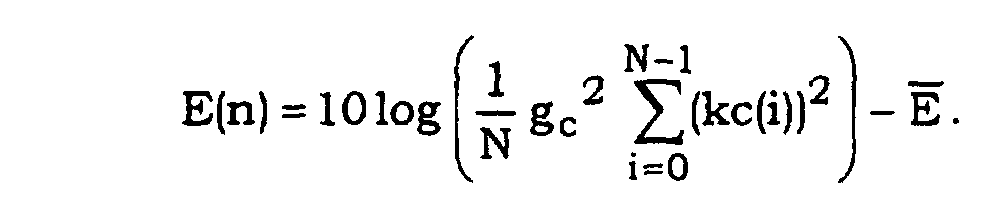
- Verfahren nach Anspruch 5, wobei der Term Ec unter Verwendung der folgenden Gleichung bestimmt wird:wobei N die Anzahl der Abtastwerte im Unterrahmen ist.

- Verfahren nach einem der vorhergehenden Ansprüche, wobei dann, wenn der Quantisierungsvektor d(i) zwei oder mehr Impulse enthält, alle Impulse dieselbe Amplitude besitzen.
- Verfahren nach einem der vorhergehenden Ansprüche, wobei der Skalierungsfaktor gegeben ist durch:
- Verfahren nach einem der vorhergehenden Ansprüche, umfassend das Durchsuchen eines Verstärkungskorrekturfaktor-Codebuchs, um den quantisierten Verstärkungskorrekturfaktor γ andgc zu bestimmen, der den Fehler
- Verfahren zum Decodieren einer Folge codierter Unterrahmen eines digitalisierten abgetasteten Sprachsignals, wobei das Verfahren für jeden Unterrahmen umfaßt:(a) Wiederherstellen eines quantisierten Vektors d(i), der wenigstens einen Impuls enthält, aus dem codierten Signal, wobei die Anzahl m und die Position der Impulse im Vektor d(i) in den Unterrahmen verschieden sein können;(b) Wiederherstellen eines quantisierten Verstärkungskorrekturfaktors γ andgc aus dem codierten Signal;(c) Bestimmen eines Skalierungsfaktors k, der eine Funktion des Verhältnisses eines vorgegebene Energiepegels zur Energie im quantisierten Vektor d(i) ist;(d) Bestimmen eines vorgesagten Verstärkungswerts g andc auf der Grundlage von einem oder mehreren zuvor verarbeiteten Unterrahmen und als eine Funktion der Energie Ec des quantisierten Vektors d(i) oder eines weiteren Vektors c(i), der vom quantisierten Vektor abgeleitet ist, wenn die Amplitude des Vektors durch den Skalierungsfaktor k skaliert ist; und(e) Korrigieren des vorhergesagten Verstärkungswerts g andc unter Verwendung des quantisierten Verstärkungskorrekturfaktors γ andgc, um einen korrigierten Verstärkungswert gc zu schaffen; und(f) Skalieren des quantisierten Vektors d(i) oder des weiteren Vektors c(i) unter Verwendung des Verstärkungswerts gc, um einen Anregungsvektor zu erzeugen, der ein Restsignalsynthetisiert, das im ursprünglichen Unterrahmen-Sprachsignal verbleibt, nachdem daraus im wesentlichen die redundanten Informationen entfernt wurden.

- Verfahren nach Anspruch 13, bei dem jeder codierte Unterrahmen des empfangenen Signals einen algebraischen Code, der den quantisierten Vektor d(i) definiert, und einen Index enthält, der ein Codebuch des quantisierten Verstärkungskorrekturfaktors adressiert, aus dem der quantisierte Verstärkungskorrekturfaktor γ andgc erhalten wird.
- Vorrichtung zum Codieren eines Sprachsignals, wobei das Signal eine Folge von Unterrahmen mit digitalisierten Sprachabtastwerten enthält, wobei die Vorrichtung Mittel aufweist, um nacheinander jeden dieser Unterrahmen zu codieren, wobei die Mittel umfassen:Vektorskalierungsmittel zum Wählen eines quantisierten Vektors d(i), der wenigstens einen Impuls enthält, wobei die Anzahl m und die Position der Impulse im Vektor d(i) in den Unterrahmen verschieden sein können;erste Signalverarbeitungsmittel zum Bestimmen eines Verstärkungswerts gc zum Skalieren der Amplitude des quantisierten Vektors d(i) oder eines weiteren Vektors c(i), der vom quantisierten Vektor d(i) abgeleitet ist, wobei der skalierte Vektor ein gewichtetes Restsignalsynthetisiert;
 zweite Signalverarbeitungsmittel zum Bestimmen eines Skalierungsfaktors k, der eine Funktion des Verhältnisses eines vorgegebenen Energiepegels zur Energie im quantisierten Vektor d(i) ist;dritte Signalverarbeitungsmittel zum Bestimmen eines vorhergesagten Verstärkungswerts g andc auf der Grundlage eines oder mehrerer zuvor verarbeiteter Unterrahmen und als eine Funktion der Energie Ec des quantisierten Vektors d(i) oder des weiteren Vektors c(i), wenn die Amplitude des Vektors durch den Skalierungsfaktor k skaliert ist; undvierte Signalverarbeitungsmittel zum Bestimmen eines quantisierten Verstärkungskorrekturfaktors γ and gc unter Verwendung des Verstärkungswerts gc und des vorhergesagten Verstärkungswerts g andc.
 - Vorrichtung zum Decodieren einer Folge codierter Unterrahmen eines digitalisierten abgetasteten Sprachsignals, wobei die Vorrichtung Mittel aufweist, um nacheinander jeden der Unterrahmen zu decodieren, wobei die Mittel umfassen:erste Signalverarbeitungsmittel zum Wiederherstellen eines quantisierten Vektors d(i), der wenigstens einen Impuls enthält, aus dem codierten Signal, wobei die Anzahl m und die Position der Impulse im Vektor d(i) in den Unterrahmen verschieden sein können;zweite Signalverarbeitungsmittel zum Wiederherstellen eines quantisierten Verstärkungskorrekturfaktors γ andgc aus dem codierten Signal;dritte Signalverarbeitungsmittel zum Bestimmen eines Skalierungsfaktors k, der eine Funktion des Verhältnisses eines vorgegebenen Energiepegels zur Energie im quantisierten Vektor d(i) ist;vierte Signalverarbeitungsmittel zum Bestimmen eines vorhergesagten Verstärkungswerts g andc auf der Grundlage eines oder mehrerer zuvor verarbeiteter Unterrahmen und als eine Funktion der Energie Ec des quantisierten Vektors d(i) oder eines weiteren Vektors c(i), der vom quantisierten Vektor abgeleitet ist, wenn die Amplitude des Vektors durch den Skalierungsfaktor k skaliert ist; undKorrekturmittel zum Korrigieren des vorhergesagten Verstärkungswerts g andc unter Verwendung des quantisierten Verstärkungskorrekturfaktors γ andgc, um einen korrigierten Verstärkungswerts gc zu schaffen; undSkalierungsmittel zum Skalieren des quantisierten Vektors d(i) oder des weiteren Vektors c(i) unter Verwendung des Verstärkungswerts gc, um einen Anregungsvektor zu schaffen, der ein Restsignalsynthetisiert, das im ursprünglichen Unterrahmen-Sprachsignal verbleibt, nachdem daraus im wesentlichen redundante Informationen entfernt wurden.

Applications Claiming Priority (3)
| Application Number | Priority Date | Filing Date | Title |
|---|---|---|---|
| FI980532A FI113571B (fi) | 1998-03-09 | 1998-03-09 | Puheenkoodaus |
| FI980532 | 1998-03-09 | ||
| PCT/FI1999/000112 WO1999046764A2 (en) | 1998-03-09 | 1999-02-12 | Speech coding |
Publications (2)
| Publication Number | Publication Date |
|---|---|
| EP1062661A2 EP1062661A2 (de) | 2000-12-27 |
| EP1062661B1 true EP1062661B1 (de) | 2002-01-09 |
Family
ID=8551196
Family Applications (1)
| Application Number | Title | Priority Date | Filing Date |
|---|---|---|---|
| EP99903710A Expired - Lifetime EP1062661B1 (de) | 1998-03-09 | 1999-02-12 | Sprachkodierung |
Country Status (11)
| Country | Link |
|---|---|
| US (1) | US6470313B1 (de) |
| EP (1) | EP1062661B1 (de) |
| JP (1) | JP3354138B2 (de) |
| KR (1) | KR100487943B1 (de) |
| CN (1) | CN1121683C (de) |
| AU (1) | AU2427099A (de) |
| BR (1) | BR9907665B1 (de) |
| DE (1) | DE69900786T2 (de) |
| ES (1) | ES2171071T3 (de) |
| FI (1) | FI113571B (de) |
| WO (1) | WO1999046764A2 (de) |
Cited By (1)
| Publication number | Priority date | Publication date | Assignee | Title |
|---|---|---|---|---|
| CN101741504B (zh) * | 2008-11-24 | 2013-06-12 | 华为技术有限公司 | 一种确定信号线性预测编码阶数的方法和装置 |
Families Citing this family (30)
| Publication number | Priority date | Publication date | Assignee | Title |
|---|---|---|---|---|
| US6714907B2 (en) * | 1998-08-24 | 2004-03-30 | Mindspeed Technologies, Inc. | Codebook structure and search for speech coding |
| AU766830B2 (en) * | 1999-09-22 | 2003-10-23 | Macom Technology Solutions Holdings, Inc. | Multimode speech encoder |
| US6604070B1 (en) * | 1999-09-22 | 2003-08-05 | Conexant Systems, Inc. | System of encoding and decoding speech signals |
| ATE420432T1 (de) * | 2000-04-24 | 2009-01-15 | Qualcomm Inc | Verfahren und vorrichtung zur prädiktiven quantisierung von stimmhaften sprachsignalen |
| US6947888B1 (en) * | 2000-10-17 | 2005-09-20 | Qualcomm Incorporated | Method and apparatus for high performance low bit-rate coding of unvoiced speech |
| US7037318B2 (en) * | 2000-12-18 | 2006-05-02 | Boston Scientific Scimed, Inc. | Catheter for controlled stent delivery |
| US7054807B2 (en) * | 2002-11-08 | 2006-05-30 | Motorola, Inc. | Optimizing encoder for efficiently determining analysis-by-synthesis codebook-related parameters |
| JP3887598B2 (ja) * | 2002-11-14 | 2007-02-28 | 松下電器産業株式会社 | 確率的符号帳の音源の符号化方法及び復号化方法 |
| US7249014B2 (en) * | 2003-03-13 | 2007-07-24 | Intel Corporation | Apparatus, methods and articles incorporating a fast algebraic codebook search technique |
| FI119533B (fi) * | 2004-04-15 | 2008-12-15 | Nokia Corp | Audiosignaalien koodaus |
| US7386445B2 (en) * | 2005-01-18 | 2008-06-10 | Nokia Corporation | Compensation of transient effects in transform coding |
| UA94041C2 (ru) * | 2005-04-01 | 2011-04-11 | Квелкомм Инкорпорейтед | Способ и устройство для фильтрации, устраняющей разреженность |
| US20090164211A1 (en) * | 2006-05-10 | 2009-06-25 | Panasonic Corporation | Speech encoding apparatus and speech encoding method |
| US8712766B2 (en) * | 2006-05-16 | 2014-04-29 | Motorola Mobility Llc | Method and system for coding an information signal using closed loop adaptive bit allocation |
| SG165383A1 (en) | 2006-11-10 | 2010-10-28 | Panasonic Corp | Parameter decoding device, parameter encoding device, and parameter decoding method |
| US20100049512A1 (en) * | 2006-12-15 | 2010-02-25 | Panasonic Corporation | Encoding device and encoding method |
| US8788264B2 (en) * | 2007-06-27 | 2014-07-22 | Nec Corporation | Audio encoding method, audio decoding method, audio encoding device, audio decoding device, program, and audio encoding/decoding system |
| US20090094026A1 (en) * | 2007-10-03 | 2009-04-09 | Binshi Cao | Method of determining an estimated frame energy of a communication |
| CN101499281B (zh) * | 2008-01-31 | 2011-04-27 | 华为技术有限公司 | 一种语音编码中的增益量化方法及装置 |
| CN101609674B (zh) * | 2008-06-20 | 2011-12-28 | 华为技术有限公司 | 编解码方法、装置和系统 |
| US7898763B2 (en) * | 2009-01-13 | 2011-03-01 | International Business Machines Corporation | Servo pattern architecture to uncouple position error determination from linear position information |
| US20110051729A1 (en) * | 2009-08-28 | 2011-03-03 | Industrial Technology Research Institute and National Taiwan University | Methods and apparatuses relating to pseudo random network coding design |
| US8990094B2 (en) * | 2010-09-13 | 2015-03-24 | Qualcomm Incorporated | Coding and decoding a transient frame |
| US8862465B2 (en) | 2010-09-17 | 2014-10-14 | Qualcomm Incorporated | Determining pitch cycle energy and scaling an excitation signal |
| US8325073B2 (en) * | 2010-11-30 | 2012-12-04 | Qualcomm Incorporated | Performing enhanced sigma-delta modulation |
| US9626982B2 (en) | 2011-02-15 | 2017-04-18 | Voiceage Corporation | Device and method for quantizing the gains of the adaptive and fixed contributions of the excitation in a CELP codec |
| DE20163502T1 (de) * | 2011-02-15 | 2020-12-10 | Voiceage Evs Gmbh & Co. Kg | Vorrichtung und verfahren zur quantisierung der verstärkung von adaptiven und festen beiträgen der anregung in einem celp-koder-dekoder |
| CN112741961A (zh) * | 2020-12-31 | 2021-05-04 | 江苏集萃智能制造技术研究所有限公司 | 一种便携式集成tensems功能的电子脉冲刺激器 |
| CN114913863B (zh) * | 2021-02-09 | 2024-10-18 | 同响科技股份有限公司 | 数字音信数据编码方法 |
| CN113763973B (zh) * | 2021-04-30 | 2026-02-27 | 腾讯科技(深圳)有限公司 | 音频信号增强方法、装置、计算机设备和存储介质 |
Family Cites Families (19)
| Publication number | Priority date | Publication date | Assignee | Title |
|---|---|---|---|---|
| US4969192A (en) | 1987-04-06 | 1990-11-06 | Voicecraft, Inc. | Vector adaptive predictive coder for speech and audio |
| IT1232084B (it) * | 1989-05-03 | 1992-01-23 | Cselt Centro Studi Lab Telecom | Sistema di codifica per segnali audio a banda allargata |
| GB2235354A (en) * | 1989-08-16 | 1991-02-27 | Philips Electronic Associated | Speech coding/encoding using celp |
| IL95753A (en) * | 1989-10-17 | 1994-11-11 | Motorola Inc | Digital speech coder |
| CA2010830C (en) | 1990-02-23 | 1996-06-25 | Jean-Pierre Adoul | Dynamic codebook for efficient speech coding based on algebraic codes |
| US5754976A (en) | 1990-02-23 | 1998-05-19 | Universite De Sherbrooke | Algebraic codebook with signal-selected pulse amplitude/position combinations for fast coding of speech |
| FR2668288B1 (fr) * | 1990-10-19 | 1993-01-15 | Di Francesco Renaud | Procede de transmission, a bas debit, par codage celp d'un signal de parole et systeme correspondant. |
| US5293449A (en) * | 1990-11-23 | 1994-03-08 | Comsat Corporation | Analysis-by-synthesis 2,4 kbps linear predictive speech codec |
| DE69233794D1 (de) | 1991-06-11 | 2010-09-23 | Qualcomm Inc | Vocoder mit veränderlicher Bitrate |
| US5255339A (en) * | 1991-07-19 | 1993-10-19 | Motorola, Inc. | Low bit rate vocoder means and method |
| US5233660A (en) * | 1991-09-10 | 1993-08-03 | At&T Bell Laboratories | Method and apparatus for low-delay celp speech coding and decoding |
| US5327520A (en) * | 1992-06-04 | 1994-07-05 | At&T Bell Laboratories | Method of use of voice message coder/decoder |
| FI96248C (fi) | 1993-05-06 | 1996-05-27 | Nokia Mobile Phones Ltd | Menetelmä pitkän aikavälin synteesisuodattimen toteuttamiseksi sekä synteesisuodatin puhekoodereihin |
| FI98163C (fi) | 1994-02-08 | 1997-04-25 | Nokia Mobile Phones Ltd | Koodausjärjestelmä parametriseen puheenkoodaukseen |
| SE506379C3 (sv) * | 1995-03-22 | 1998-01-19 | Ericsson Telefon Ab L M | Lpc-talkodare med kombinerad excitation |
| CA2177413A1 (en) * | 1995-06-07 | 1996-12-08 | Yair Shoham | Codebook gain attenuation during frame erasures |
| US5732389A (en) * | 1995-06-07 | 1998-03-24 | Lucent Technologies Inc. | Voiced/unvoiced classification of speech for excitation codebook selection in celp speech decoding during frame erasures |
| US5664055A (en) * | 1995-06-07 | 1997-09-02 | Lucent Technologies Inc. | CS-ACELP speech compression system with adaptive pitch prediction filter gain based on a measure of periodicity |
| US5692101A (en) * | 1995-11-20 | 1997-11-25 | Motorola, Inc. | Speech coding method and apparatus using mean squared error modifier for selected speech coder parameters using VSELP techniques |
-
1998
- 1998-03-09 FI FI980532A patent/FI113571B/fi not_active IP Right Cessation
-
1999
- 1999-02-12 DE DE69900786T patent/DE69900786T2/de not_active Expired - Lifetime
- 1999-02-12 AU AU24270/99A patent/AU2427099A/en not_active Abandoned
- 1999-02-12 CN CN99803763A patent/CN1121683C/zh not_active Expired - Lifetime
- 1999-02-12 BR BRPI9907665-9B1A patent/BR9907665B1/pt active IP Right Grant
- 1999-02-12 JP JP2000536069A patent/JP3354138B2/ja not_active Expired - Lifetime
- 1999-02-12 KR KR10-2000-7008992A patent/KR100487943B1/ko not_active Expired - Lifetime
- 1999-02-12 EP EP99903710A patent/EP1062661B1/de not_active Expired - Lifetime
- 1999-02-12 WO PCT/FI1999/000112 patent/WO1999046764A2/en not_active Ceased
- 1999-02-12 ES ES99903710T patent/ES2171071T3/es not_active Expired - Lifetime
- 1999-03-04 US US09/263,439 patent/US6470313B1/en not_active Expired - Lifetime
Cited By (1)
| Publication number | Priority date | Publication date | Assignee | Title |
|---|---|---|---|---|
| CN101741504B (zh) * | 2008-11-24 | 2013-06-12 | 华为技术有限公司 | 一种确定信号线性预测编码阶数的方法和装置 |
Also Published As
| Publication number | Publication date |
|---|---|
| CN1121683C (zh) | 2003-09-17 |
| DE69900786T2 (de) | 2002-09-26 |
| WO1999046764A2 (en) | 1999-09-16 |
| KR100487943B1 (ko) | 2005-05-04 |
| DE69900786D1 (de) | 2002-02-28 |
| CN1292914A (zh) | 2001-04-25 |
| ES2171071T3 (es) | 2002-08-16 |
| FI980532A7 (fi) | 1999-09-10 |
| BR9907665A (pt) | 2000-10-24 |
| BR9907665B1 (pt) | 2013-12-31 |
| WO1999046764A3 (en) | 1999-10-21 |
| FI113571B (fi) | 2004-05-14 |
| KR20010024935A (ko) | 2001-03-26 |
| JP2002507011A (ja) | 2002-03-05 |
| EP1062661A2 (de) | 2000-12-27 |
| FI980532A0 (fi) | 1998-03-09 |
| AU2427099A (en) | 1999-09-27 |
| US6470313B1 (en) | 2002-10-22 |
| JP3354138B2 (ja) | 2002-12-09 |
| HK1035055A1 (en) | 2001-11-09 |
Similar Documents
| Publication | Publication Date | Title |
|---|---|---|
| EP1062661B1 (de) | Sprachkodierung | |
| US5142584A (en) | Speech coding/decoding method having an excitation signal | |
| EP1222659B1 (de) | Lpc-harmonischer sprachkodierer mit überrahmenformat | |
| EP1224662B1 (de) | Celp sprachkodierung mit variabler bitrate mittels phonetischer klassifizierung | |
| EP1202251B1 (de) | Transkodierer zur Vermeidung einer Kaskadenkodierung von Sprachsignalen | |
| EP2301022B1 (de) | Vorrichtung und verfahren zur lpc-filter-quantisierung mit mehreren referenzwerten | |
| EP2102619B1 (de) | Verfahren und einrichtung zur codierung von übergangsrahmen in sprachsignalen | |
| US6260009B1 (en) | CELP-based to CELP-based vocoder packet translation | |
| EP0360265B1 (de) | Zur Sprachqualitätsmodifizierung geeignetes Übertragungssystem durch Klassifizierung der Sprachsignale | |
| EP0833305A2 (de) | Grundfrequenzkodierer mit niedriger Bitrate | |
| EP1181687B1 (de) | Kodierung von sprachsegmenten mit signalübergängen durch interpolation von mehrimpulsanregungssignalen | |
| KR20010087391A (ko) | 시간 동기식 파형 보간법을 이용한 피치 프로토타입파형으로부터의 음성 합성 | |
| EP1597721B1 (de) | Melp (mixed excitation linear prediction)-transkodierung mit 600 bps | |
| MXPA01003150A (es) | Procedimiento de cuantificacion de los parametros de un codificador de palabras. | |
| Drygajilo | Speech Coding Techniques and Standards | |
| WO2001009880A1 (en) | Multimode vselp speech coder | |
| JPH08202398A (ja) | 音声符号化装置 | |
| JPH034300A (ja) | 音声符号化復号化方式 | |
| HK1035055B (en) | Speech coding | |
| JPWO2000000963A1 (ja) | 音声符号化装置 |
Legal Events
| Date | Code | Title | Description |
|---|---|---|---|
| PUAI | Public reference made under article 153(3) epc to a published international application that has entered the european phase |
Free format text: ORIGINAL CODE: 0009012 |
|
| 17P | Request for examination filed |
Effective date: 20001009 |
|
| AK | Designated contracting states |
Kind code of ref document: A2 Designated state(s): DE ES FR GB IT NL SE |
|
| GRAG | Despatch of communication of intention to grant |
Free format text: ORIGINAL CODE: EPIDOS AGRA |
|
| RIC1 | Information provided on ipc code assigned before grant |
Free format text: 7G 10L 19/04 A, 7G 10L 101:10 Z |
|
| 17Q | First examination report despatched |
Effective date: 20010405 |
|
| GRAG | Despatch of communication of intention to grant |
Free format text: ORIGINAL CODE: EPIDOS AGRA |
|
| GRAH | Despatch of communication of intention to grant a patent |
Free format text: ORIGINAL CODE: EPIDOS IGRA |
|
| GRAH | Despatch of communication of intention to grant a patent |
Free format text: ORIGINAL CODE: EPIDOS IGRA |
|
| GRAA | (expected) grant |
Free format text: ORIGINAL CODE: 0009210 |
|
| REG | Reference to a national code |
Ref country code: GB Ref legal event code: IF02 |
|
| AK | Designated contracting states |
Kind code of ref document: B1 Designated state(s): DE ES FR GB IT NL SE |
|
| REF | Corresponds to: |
Ref document number: 69900786 Country of ref document: DE Date of ref document: 20020228 |
|
| RAP2 | Party data changed (patent owner data changed or rights of a patent transferred) |
Owner name: NOKIA CORPORATION |
|
| REG | Reference to a national code |
Ref country code: GB Ref legal event code: 732E |
|
| NLT2 | Nl: modifications (of names), taken from the european patent patent bulletin |
Owner name: NOKIA CORPORATION |
|
| REG | Reference to a national code |
Ref country code: ES Ref legal event code: FG2A Ref document number: 2171071 Country of ref document: ES Kind code of ref document: T3 |
|
| PLBE | No opposition filed within time limit |
Free format text: ORIGINAL CODE: 0009261 |
|
| STAA | Information on the status of an ep patent application or granted ep patent |
Free format text: STATUS: NO OPPOSITION FILED WITHIN TIME LIMIT |
|
| 26N | No opposition filed | ||
| REG | Reference to a national code |
Ref country code: GB Ref legal event code: 732E Free format text: REGISTERED BETWEEN 20150910 AND 20150916 |
|
| REG | Reference to a national code |
Ref country code: DE Ref legal event code: R082 Ref document number: 69900786 Country of ref document: DE Representative=s name: BECKER, KURIG, STRAUS, DE Ref country code: DE Ref legal event code: R081 Ref document number: 69900786 Country of ref document: DE Owner name: NOKIA TECHNOLOGIES OY, FI Free format text: FORMER OWNER: NOKIA CORP., 02610 ESPOO, FI |
|
| REG | Reference to a national code |
Ref country code: ES Ref legal event code: PC2A Owner name: NOKIA TECHNOLOGIES OY Effective date: 20151124 |
|
| REG | Reference to a national code |
Ref country code: FR Ref legal event code: PLFP Year of fee payment: 18 |
|
| REG | Reference to a national code |
Ref country code: NL Ref legal event code: PD Owner name: NOKIA TECHNOLOGIES OY; FI Free format text: DETAILS ASSIGNMENT: VERANDERING VAN EIGENAAR(S), OVERDRACHT; FORMER OWNER NAME: NOKIA CORPORATION Effective date: 20151111 |
|
| REG | Reference to a national code |
Ref country code: FR Ref legal event code: TP Owner name: NOKIA CORPORATION, FI Effective date: 20161118 |
|
| REG | Reference to a national code |
Ref country code: FR Ref legal event code: PLFP Year of fee payment: 19 |
|
| REG | Reference to a national code |
Ref country code: FR Ref legal event code: TP Owner name: NOKIA TECHNOLOGIES OY, FI Effective date: 20170109 |
|
| REG | Reference to a national code |
Ref country code: FR Ref legal event code: PLFP Year of fee payment: 20 |
|
| PGFP | Annual fee paid to national office [announced via postgrant information from national office to epo] |
Ref country code: NL Payment date: 20180214 Year of fee payment: 20 |
|
| PGFP | Annual fee paid to national office [announced via postgrant information from national office to epo] |
Ref country code: ES Payment date: 20180301 Year of fee payment: 20 Ref country code: DE Payment date: 20180130 Year of fee payment: 20 Ref country code: GB Payment date: 20180207 Year of fee payment: 20 |
|
| PGFP | Annual fee paid to national office [announced via postgrant information from national office to epo] |
Ref country code: FR Payment date: 20180111 Year of fee payment: 20 Ref country code: SE Payment date: 20180213 Year of fee payment: 20 Ref country code: IT Payment date: 20180221 Year of fee payment: 20 |
|
| REG | Reference to a national code |
Ref country code: DE Ref legal event code: R071 Ref document number: 69900786 Country of ref document: DE |
|
| REG | Reference to a national code |
Ref country code: NL Ref legal event code: MK Effective date: 20190211 |
|
| REG | Reference to a national code |
Ref country code: GB Ref legal event code: PE20 Expiry date: 20190211 |
|
| REG | Reference to a national code |
Ref country code: SE Ref legal event code: EUG |
|
| PG25 | Lapsed in a contracting state [announced via postgrant information from national office to epo] |
Ref country code: GB Free format text: LAPSE BECAUSE OF EXPIRATION OF PROTECTION Effective date: 20190211 |
|
| REG | Reference to a national code |
Ref country code: ES Ref legal event code: FD2A Effective date: 20200803 |
|
| PG25 | Lapsed in a contracting state [announced via postgrant information from national office to epo] |
Ref country code: ES Free format text: LAPSE BECAUSE OF EXPIRATION OF PROTECTION Effective date: 20190213 |