EP1062811B1 - Universelles signalverteilsystem - Google Patents
Universelles signalverteilsystem Download PDFInfo
- Publication number
- EP1062811B1 EP1062811B1 EP99900227A EP99900227A EP1062811B1 EP 1062811 B1 EP1062811 B1 EP 1062811B1 EP 99900227 A EP99900227 A EP 99900227A EP 99900227 A EP99900227 A EP 99900227A EP 1062811 B1 EP1062811 B1 EP 1062811B1
- Authority
- EP
- European Patent Office
- Prior art keywords
- distribution
- condominium
- community environment
- signals
- channel
- Prior art date
- Legal status (The legal status is an assumption and is not a legal conclusion. Google has not performed a legal analysis and makes no representation as to the accuracy of the status listed.)
- Expired - Lifetime
Links
- 238000006243 chemical reaction Methods 0.000 claims abstract description 10
- 238000011144 upstream manufacturing Methods 0.000 claims description 30
- 238000000034 method Methods 0.000 claims description 19
- 230000006870 function Effects 0.000 claims description 17
- 230000005540 biological transmission Effects 0.000 claims description 10
- 230000010287 polarization Effects 0.000 claims description 5
- 238000001914 filtration Methods 0.000 claims description 4
- 230000001143 conditioned effect Effects 0.000 claims description 3
- GWAOOGWHPITOEY-UHFFFAOYSA-N 1,5,2,4-dioxadithiane 2,2,4,4-tetraoxide Chemical compound O=S1(=O)CS(=O)(=O)OCO1 GWAOOGWHPITOEY-UHFFFAOYSA-N 0.000 claims 1
- 230000005236 sound signal Effects 0.000 abstract description 3
- 239000008186 active pharmaceutical agent Substances 0.000 description 17
- 206010065042 Immune reconstitution inflammatory syndrome Diseases 0.000 description 8
- 208000008498 Infantile Refsum disease Diseases 0.000 description 8
- 230000008901 benefit Effects 0.000 description 7
- 238000010586 diagram Methods 0.000 description 4
- 238000009434 installation Methods 0.000 description 4
- 230000002452 interceptive effect Effects 0.000 description 4
- 230000010363 phase shift Effects 0.000 description 3
- 230000006854 communication Effects 0.000 description 2
- 238000004891 communication Methods 0.000 description 2
- 238000005516 engineering process Methods 0.000 description 2
- 238000003780 insertion Methods 0.000 description 2
- 230000037431 insertion Effects 0.000 description 2
- PKAHQJNJPDVTDP-UHFFFAOYSA-N methyl cyclopropanecarboxylate Chemical compound COC(=O)C1CC1 PKAHQJNJPDVTDP-UHFFFAOYSA-N 0.000 description 2
- 238000001228 spectrum Methods 0.000 description 2
- 230000007175 bidirectional communication Effects 0.000 description 1
- 230000000903 blocking effect Effects 0.000 description 1
- 230000008859 change Effects 0.000 description 1
- 230000006835 compression Effects 0.000 description 1
- 238000007906 compression Methods 0.000 description 1
- 238000012790 confirmation Methods 0.000 description 1
- 238000011161 development Methods 0.000 description 1
- 230000003993 interaction Effects 0.000 description 1
- 230000001678 irradiating effect Effects 0.000 description 1
- 230000009467 reduction Effects 0.000 description 1
- 230000004044 response Effects 0.000 description 1
Images


Classifications
-
- H—ELECTRICITY
- H04—ELECTRIC COMMUNICATION TECHNIQUE
- H04N—PICTORIAL COMMUNICATION, e.g. TELEVISION
- H04N7/00—Television systems
- H04N7/10—Adaptations for transmission by electrical cable
-
- H—ELECTRICITY
- H04—ELECTRIC COMMUNICATION TECHNIQUE
- H04H—BROADCAST COMMUNICATION
- H04H40/00—Arrangements specially adapted for receiving broadcast information
- H04H40/18—Arrangements characterised by circuits or components specially adapted for receiving
- H04H40/27—Arrangements characterised by circuits or components specially adapted for receiving specially adapted for broadcast systems covered by groups H04H20/53 - H04H20/95
- H04H40/90—Arrangements characterised by circuits or components specially adapted for receiving specially adapted for broadcast systems covered by groups H04H20/53 - H04H20/95 specially adapted for satellite broadcast receiving
-
- H—ELECTRICITY
- H04—ELECTRIC COMMUNICATION TECHNIQUE
- H04H—BROADCAST COMMUNICATION
- H04H20/00—Arrangements for broadcast or for distribution combined with broadcast
- H04H20/53—Arrangements specially adapted for specific applications, e.g. for traffic information or for mobile receivers
- H04H20/61—Arrangements specially adapted for specific applications, e.g. for traffic information or for mobile receivers for local area broadcast, e.g. instore broadcast
- H04H20/63—Arrangements specially adapted for specific applications, e.g. for traffic information or for mobile receivers for local area broadcast, e.g. instore broadcast to plural spots in a confined site, e.g. MATV [Master Antenna Television]
-
- H—ELECTRICITY
- H04—ELECTRIC COMMUNICATION TECHNIQUE
- H04L—TRANSMISSION OF DIGITAL INFORMATION, e.g. TELEGRAPHIC COMMUNICATION
- H04L5/00—Arrangements affording multiple use of the transmission path
- H04L5/02—Channels characterised by the type of signal
- H04L5/023—Multiplexing of multicarrier modulation signals, e.g. multi-user orthogonal frequency division multiple access [OFDMA]
-
- H—ELECTRICITY
- H04—ELECTRIC COMMUNICATION TECHNIQUE
- H04N—PICTORIAL COMMUNICATION, e.g. TELEVISION
- H04N7/00—Television systems
- H04N7/10—Adaptations for transmission by electrical cable
- H04N7/106—Adaptations for transmission by electrical cable for domestic distribution
-
- H—ELECTRICITY
- H04—ELECTRIC COMMUNICATION TECHNIQUE
- H04N—PICTORIAL COMMUNICATION, e.g. TELEVISION
- H04N7/00—Television systems
- H04N7/16—Analogue secrecy systems; Analogue subscription systems
-
- H—ELECTRICITY
- H04—ELECTRIC COMMUNICATION TECHNIQUE
- H04N—PICTORIAL COMMUNICATION, e.g. TELEVISION
- H04N7/00—Television systems
- H04N7/16—Analogue secrecy systems; Analogue subscription systems
- H04N7/162—Authorising the user terminal, e.g. by paying; Registering the use of a subscription channel, e.g. billing
- H04N7/163—Authorising the user terminal, e.g. by paying; Registering the use of a subscription channel, e.g. billing by receiver means only
-
- H—ELECTRICITY
- H04—ELECTRIC COMMUNICATION TECHNIQUE
- H04H—BROADCAST COMMUNICATION
- H04H20/00—Arrangements for broadcast or for distribution combined with broadcast
- H04H20/38—Arrangements for distribution where lower stations, e.g. receivers, interact with the broadcast
-
- H—ELECTRICITY
- H04—ELECTRIC COMMUNICATION TECHNIQUE
- H04H—BROADCAST COMMUNICATION
- H04H20/00—Arrangements for broadcast or for distribution combined with broadcast
- H04H20/65—Arrangements characterised by transmission systems for broadcast
- H04H20/76—Wired systems
- H04H20/77—Wired systems using carrier waves
- H04H20/78—CATV [Community Antenna Television] systems
Definitions
- the present industrial invention refers to a distribution system of a plurality of television signals, and/or audio signals, in particular pertaining to different standards, in a condominium and/or community environment
- condominium is meant a block of flats, and by community a block of one or several buildings
- VOD Video on Demand
- NVOD Near Video on Demand
- Said digital signals and the analog signal have, as a final destination, a single user Said signals are however subject to different modulations
- teh signal from satellite is usually QSPK modulated QPSK (Quadrature Phase Shift Keving)
- the terrestrial digital television signals according to the DVB specification (Digital Video Broadcasting)
- COFDM modulation Coded Orthogonal Frequency Division Multiplexing
- the cable signals are QAM modulated
- the final user has therefore the necessity of having different types of demodulators, in order to be able to receive the programs which reach the condominium distribution system, in this way, most of the advantages deriving from a single system are lost.
- different equipments from those used for analog signals are required to receive such new digital signals, which may lead to conflicting interests, for instance among the residents in a condominium or community
- both the programs and interactive services are supplied against payment, through a conditioned access system managed by the broadcaster and based on the use of smart cards, where each user should be able to operate on the distribution system through smart cards, in order to decode the programs purchased under exclusivity.
- the system there disclosed provides for a preliminary conversion of all received signals in a bus signal having a certain bandwidth (IGHz).
- Said bus signal runs on a bus constituting the distribution network.
- Each received signal is converted in a predetermined, frequency position place on the span of said bandwidth.
- a control computer interfaced to the bus also adds addresses and commands in predetermined frequency position to the bus signals, according to the user needs.
- the present invention has the aim of providing a distribution system which, by solving the above drawbacks, allows for the distribution of a plurality of services in a condominium and/or community environment, independently from the type of standards of the signals received and the time when such signals become available.
- a further aim of the present invention is to provide a distribution system of digital signals in a condominium and/or community environment, which allows a gradual implementation of the system based on the free decision of each individual user, obviously without affecting the service already supplied by the system.
- a further aim of the present invention is to provide a distribution system of digital signals in a condominium and/or community environment, which allows each user to use said digital signals in a bi-directional way, without affecting the service already supplied by the system.
- a further aim of the present invention is to provide a fast installation of the system associated with the use of a smart card, while protecting the broadcaster's interests and the user's privacy.
- a system according to the invention is set out in claim 1 and a corresponding method is set out in claim 50.
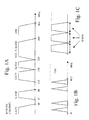
- FIG. 1A shows schematically the frequencies spectrum used for signals distribution, specifically, the band up to 40 MHz is engaged by the CATV return channels (CAble TV) for communications exchange between the user and the service supplier: 47-68 MHz and 174-230 MHz bands contain the television channels pertaining to the 1st VHF band and 3rd VHF band, respectively, UHF television channels are allocated in the 470-862 MHz band Both the 110-174 MHz and 230-445 MHz bands are partially used for the distribution of CATV channels and converted satellite channels. The 230-445 MHz band is also known as extended S band. VHF bands are subdivided into 7 MHz wide channels, whereas CATV and UHF channels are 8 MHz wide, as shown schematically in Fig. 1C.
- Figure 1B shows schematically a particular use of the spectrum in the range of 41-46 5 MHz, which will be described in the following.
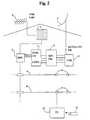
- Figure 2 shows a known system for the reception and the distribution of signals
- Number 1 indicates a set of aerials for receiving VHF and UHF signals amplified by means of channel amplifiers, represented by block 2, and subsequently sent to a mixer 3 and then distributed.
- Number 4 indicates an aerial to receive satellite signals, which are notoriously transmitted in the band around 12 GHz in 27 MHz wide channels, with an FM modulated carrier
- Block 5 represents a so-called LNB (Low Noise Block) of the universal type, which amplifies and convert in the first intermediate 0 950 - 2 050 GHz frequency both the analog signals in 27 MHz channels and the digital signals in 36 MHz channels
- Block 6 reveals the FM signals, which are thus AM remodulated and converted in VHF, UHF or extended S band channels by block 7.
- the signals are then sent to the mixer 3 and then distributed.
- the lines indicated with 8 represent the entries to the various flats consisting of a coaxial cable; number 9 indicates the signal sockets available in the flats, whereas 10 indicates a user terminal, in the specific instance a television set receiver that can be operated by a remote control 11.
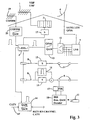
- Figure 3 represents a distribution system of a plurality of signals in a condominium and/or community environment according to the present invention, where the possibility of receiving both the analog television signals and new digital signals is considered. It has to be noticed that the blocks indicated with the same reference number in Fig 2 and Fig 3 perform the same functions, thus, blocks 4 and 5 are used to receive both the analog and digital signals from satellite In Fig 3, blocks 6 and 7 shown of Fig 2, specifically related to analog signals, are omitted for clarity's sake
- the terrestrial digital television signals are received, which according to DVB Specifications (Digital Video Broadcasting) have COFDM modulation (Coded Orthogonal Frequency Division Multiplexing) and are transmitted through the same channel system for VHF and UHF analog signals
- the block 14 receives, through a coaxial cable 14', the digital CATV signal, being QAM modulated (Quadrature Amplitude Modulation) in 8 MHz channels, whereas as mentioned above the aerial 4 receives digital signals from satellite, being QPSK modulated (Quadrature Phase Shift Keying)
- the above digital, terrestrial, satellite and cable signals are modulated in different modes (COFDM, QPSK, QAM, respectively), so that three different types of demodulators are required for their use.
- SCPC procedures Single Channel Per Carrier
- transmission of digital television signals as provided by the DVB standard Digital Video Broadcasting
- MCPC procedure Multi Channel Per Carrier
- an S band-stop filter being represented by blocks 15, is connected in series with the distribution cable, i.e. a filter blocking the passage of signals comprised within a predetermined band, thus hindering their reception inside the flat or building. Therefore, this band is a reserved band within the distribution in a condominium and/or community environment, being inhibited to all users who do not wish to receive new signals.
- all analog signals have to be distributed in channels not comprised in the above reserved band, and this can be easily obtained using the known frequency conversion technique.
- the above reserved band may consist of several parts and in this case the filter 15 inhibits the flow of signals in several bands, for example in the extended S band and the 110-174 MHz band.
- the band-stop filter also inserted at the output of block 2.
- the so modified system represents the basic structure for subsequent implementations.
- a single user may, along with analog signals, also have in his flat a digital signal of his own choice containing 4 to 6 programs, each one being receivable from an IRD in an independent mode.
- another personal channel with its associated transmodulators and channel-pass filter need to be installed; of course, availability of at least two IRDs is also required
- the system for the distribution to a condominium and/or a community environment has the advantage that the single user only requires one demodulator for the digital signals which are received with the very different modulations, as these signals are all QAM remodulated prior to their distribution
- a transmodulation drastically reduces the problems of interferences, signals equalizations and intermodulation, being usually present in the case of a multistandard distribution
- the condominium and/or community distribution system of a plurality of signals described above offers a high flexibility and can freely accept subsequent gradual implementations, without causing any conflicts with the rules governing the condominium or community
- the distribution system of a plurality of signals in a condominium and/or community environment offers a further advantage in that the same system wired for analog signals can also be used for the new signals distribution, i e without requiring a new wiring setup.
- the signals distribution system shown in Fig. 3 requires installation, for each new user wishing access to new digital signals (for example those irradiated by satellite), of a proper transmodulator 13 for each signal pertaining to a different standard, said transmodulator 13 comprising at least a tuner for selecting the signal, a demodulator, a QAM modulator and a frequency converter.
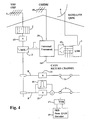
- Fig 4 the diagram of a variant embodiment of the distribution system of a plurality of signals in a condominium and/or community environment of Fig. 3 is shown, which comprises a modified transmodulation device.
- Fig. 4 shows three different types of received digital television signals: however, the following description applies for any digital signal, such as the DAB (Digital Audio Broadcasting) signal for digital radio broadcasting and/or a data carrying signal and or a video signal in general.
- DAB Digital Audio Broadcasting
- transmodulators 13, 14 and 20 of Fig. 3 are replaced by the transmodulator 29 of Fig. 4, the remaining portion of the distribution system of a plurality of signals in a condominium and/or community environment will operate in the same way.
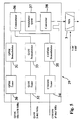
- FIG. 5 A way to provide the block 29 is detailed in Fig. 5, where the block 30 represents a tuner for selecting, in the QPSK range 950-2150 MHz, satellite digital channels QPSK modulated and properly preselected in the block 12; the digital channel selected in block 30 under the user's control is then demodulated by a QPSK demodulator represented by block 31.
- the block 30 represents a tuner for selecting, in the QPSK range 950-2150 MHz, satellite digital channels QPSK modulated and properly preselected in the block 12; the digital channel selected in block 30 under the user's control is then demodulated by a QPSK demodulator represented by block 31.
- Block 32 represents a tuner for the selection of the QAM modulated digital channels received by cable in the range 5-862 MHz; the digital channel tuned by the block 32 under the user's control is then demodulated by a QAM demodulator represented by block 33.
- Block 34 represents a tuner for the selection, in the range 47-862 Mhz, of COFDM modulated terrestrial digital channels; the digital channel tuned by the block 34 under the user's control is then demodulated by a COFDM demodulator represented by block 35
- Block 36 represents a commutator, receiving the digital signals demodulated in the demodulators 31, 33, 35; one of these three signals selected by the user through the block 17 is present at the output of block 36.
- This signal is QAM remodulated by a QAM modulator, represented by block 37, and then converted by a converter represented by block 38 into the above said personal channel for the exclusive use of a single user, which is comprised in a frequency band ranging from 47 to 862 MHz, preferably 230 to 445 MHz
- Each user is therefore the owner of a universal transmodulator 29, containing a converter with a fixed frequency output channel for his own personal use.
- the signal is then sent to the mixer 3 to be distributed as previously described
- the system still provides for a "return channel" module, which can be contained in the interface or user terminal 17, allowing the user himself to send a selection control signal to blocks 12, 30, 32, 34 and 36 using a signal being preferably FSK or PSK, allocated to a channel, for example in the range 41-46 5 MHz.
- this signal can be sent through the common distribution coaxial cable of the system.
- the above universal transmodulator 29 can be advantageously used both for a signals distribution system in a condominium and/or community environment and in the instance of a single system.
- the various parts of the universal transmodulator 29, i e. the selection means 30, 32, 34, 36, the demodulation means 31, 33, 35, the modulation means 37 and the conversion means 38, can be obviously be housed in one same container, with clear practical advantages, also in view of the system installation and the reduction of its composing elements.
- the distribution system of a plurality of signals in a condominium and/or community environment represented in Fig 3 or Fig 4 operates only on the so-called downstream signal, i.e the signal received by the provider or broadcaster, whereas it does not allow the user to operate for transmitting an upstream signal to the provider
- Fig. 6 therefore represents the diagram of another variant embodiment of the distribution system of a plurality of television signals in a condominium and or community environment shown in Fig. 3.
- the blocks, related to both terrestrial analog and digital television signals are omitted, moreover, the remaining blocks of Fig. 6 indicating the same reference number have the same function of the blocks already shown in Fig. 3.
- Block 40 represents a terminal, used by the user to transmit upstream type signals US and receive downstream type signals DS, which is directly connected to the interface 17 previously described with reference to Fig. 3.
- Said terminal 40 performs the following known functions:
- Downstream signals DS being received and upstream signals US being transmitted by block 40 are allocated to the above personal channel for the exclusive use by the user as explained in the following.
- the distribution system of a plurality of digital signals in a condominium and or community environment uses the satellite to send the return signals towards the provider Therefore, the upstream signal US is sent, through the interface 17, the filter 16, the cable 8 and the mixer 3, from the block 40 to an SCPC transmodulator indicated by the block 40.
- the latter which demodulates said upstream signal US according to QAM coding, remodulates it according to the QPSK coding in accordance with the SCPC procedure, then convert said upstream signal US in a frequency being compatible with the frequencies available in a satellite channel and finally send it to the aerial 4 for its transmission to the satellite
- the downstream signal DS being received by the aerial 4 is sent to a transmodulator 42 which, besides the function pertaining to the block 13 of Fig.
- the downstream signal DS being received at the block 42, upon reception of a proper control sent by block 40, is demodulated in QPSK under SCPC procedure, remodulated in QAM coding and converted into a frequency band contamed in the above personal channel.
- the downstream signal DS reaches the block 40, through the mixer 3, the cable 8, the filter 16 and the interface 17.
- the upstream signal US is sent by block 40, through blocks 17, 16 and 8, to the mixer 3, and then to an SCPC transmodulator indicated by block 43
- the upstream signal US is converted into a frequencies band compatible with the frequencies associated with a cable channel, subsequently the upstream signal US is sent to the service provider through the coaxial cable 14.
- the downstream signal DS is selected by the transmodulator 44, which besides the functions performed by the block 14 previously described, tunes the downstream signal DS being QAM modulated under SCPC procedure and convert it into a frequencies band corresponding to the band of the above personal channel
- the downstream signal DS then reaches block 40 through blocks 3, 8, 16 and 17
- Blocks 41 and 42 may be advantageously housed in a same device; the same applies for blocks 43 and 44, which can also be contained in one device Still more advantageously, all blocks 41, 42, 43, 44 can be housed together in a single device
- Fig. 7 Allocation of the upstream signals US and downstream signals DS in the personal channel is shown in Fig. 7, where the hatched line S1 indicates the frequency band of the personal channel, normally 8 MHz wide, the solid line S2 represents the band occupted by the downstream signal DS to which a carrier f 1 is associated, whereas the line S3 represents the band of the upstream signal US, to which a carrier f 2 is associated.
- Fig. 7 also shows some possible frequency allocations of the FSK or PSK modulated return channel, which is used, as previously mentioned, to control the blocks of the distribution system through the interface 17.
- the above return channel can be located in an area not occupied by the upstream signals US and the downstream signals DS, as indicated with reference number S5, or in an area where the frequency response of the personal channel is gradually reduced to zero, i e a so-called roll-off area, as indicated with reference number S4
- upstream signals US and the downstream signals DS are simultaneously available in the personal channel, i.e. when the system operates with frequency multiplexing (FDMA procedure, i e Frequency Division Multiplexing Access), it is clear that bands S2 and S3 should not overlap
- FDMA procedure i e Frequency Division Multiplexing Access
- TDMA procedure i.e Time Division Multiplexing Access
- the user disables blocks 40, 41, 43 through the interface 17 and the return channel, and switches blocks 42 and 44 to the functions already described for blocks 13 and 14, respectively.
- Fig 8 shows the diagram of a further variant embodiment of the distribution system of a plurality of digital signals in a condominium and/or community environment according to the invention.
- the blocks having the same reference number perform the same function of the blocks already represented in Fig. 3.
- Fig. 8 a new block indicated with 51 is shown, instead of the block 18 illustrated in Fig 3. representing an IRD receiver apt to read one or more smart cards 52, as better detailed later
- Each broadcaster or provider adopts for pay channels his own conditioned access system, and therefore a particular set top box, receiver 51 and smart card 52 are necessary for the vision, which are usually supplied by the broadcaster himself.
- a member of the condominium decides to make a subscription, for example, to pay channels irradiated by satellite, in addition to the devices already provided for digital channels reception from the satellite (i.e., a transponder preselector circuit 12 and a QPSK/QAM transmodulator 13, which generate his personal channel for exclusive use), he would need also need the receiver 51; said receiver, besides demodulating in QAM and decoding the signal, has also to perform the descrambling operation required to make the signal itself usable.
- the receiver 51 has to be fitted with a reader capable of reading the information associated with the smart card 52, which contains the electronic key necessary for enabling the use of the interactive services through descrambling Besides information required for allowing the descrambling at the receiver 51, also the information necessary to the QPSK/QAM transmodulator 13 and the transponder preselector 12 for tuning on the channels transmitting the pay programs are inserted in the smart card 52.
- Said tuning information comprise in particular the frequency of the channels to be inserted in the personal channel, where said information have to be sent to the transmodulator 13, said information also comprise the polarization type (horizontal or vertical), bit rate and frequency band (high or low) of the signals to be received, which have to be sent to the transponder preselector circuit 12.
- the receiver 51 transfers the above information, through the return channel, to the transponder preselector 12 and the QPSK/QAM transmodulator 13, which can thus be tuned on the channels enabled by the smart card 52 Obviously, mutual interaction between the receiver 51 and the associated smart card 52, the transponder preselector 12 and the QPSK/QAM transmodulator 13 shall be permitted, and this is obtained by a proper programming of the microprocessors controlling the above devices For this reason, the receiver 51 and the associated smart card 52, the transponder preselector 12 and the QPSK/QAM transmodulator 13 are usually manufactured and supplied as a whole, usually on a rent basis, by the broadcaster transmitting the pay programs.
- a further "software electronic key" is inserted by the installer in the QPSK/QAM transmodulator 13, so that when the smart card 52 is inserted in the receiver 51, the QPSK/QAM transmodulator 13 may only be tuned on the channels enabled by the smart card 52 associated with the broadcaster supplying the devices.
- the transmodulator 13 operation will be inhibited Insertion of said software electronic key, i.e.
- a proper digital signal may for instance be provided using a serial port of the microprocessor controlling the QPSK/QAM transmodulator 13, such a port being accessible through a connector from outside the QPSK/QAM transmodulator 13 Obviously, if no smart card 52 is inserted in the receiver 51, the system may be tuned on any free access channel
- the system according to the invention provides that the frequency of one's personal channel can be inserted, for example by the installer, in each user's smart card 52, so that the receiver 51 will only receive the signal in said personal channel
- the frequency of one's personal channel can be inserted, for example by the installer, in each user's smart card 52, so that the receiver 51 will only receive the signal in said personal channel
- CATV CAble TV
- COFDM Coded Orthogonal Frequency Division Multiplexing
- the return-channel can be radio frequency irradiated, instead of being transmitted by cable; in this case, blocks 12, 13, 14 and 20 have to be equipped with appropriate known radiofrequency reception devices.
- the block 14 may provide for the possibility of demodulating and remodulating the QAM signal, for recovering the bit error rate introduced by the cable distribution
- MMDS Multi-channel Multipoint Distribution System
- LMDS Local Multipoint Distribution System
- the signals from various sources are received by a sole equipment, consisting for example of blocks 1, 2, 3, 4, 12, 13, 14, 19, 20 of Fig 3.
- the output signal of the mixer is then converted to high frequency (up to about 40 GHz) and then irradiated
- the signal is received by known reception devices in the various buildings or also in the individual flats, is reconverted in the 47-862 MHz range and then distributed by cable as done at the mixer output 3 shown in Fig. 3,
- the presence of the band-stop filter 15 may also be used not only for the filtering of the signals distributed by the system, but also to filter likely signals eventually available on a distribution network inside the flat
- household distribution networks of both radio-television, information, operation and control signals are known, which often employ the same physical means used for the distribution of radio-television signals received from satellite, cable or aerial. Therefore, a suitable configuration of the band-stop filter 15 will prevent signals outcoming from inside the flat and their pick-up by other system users
- the block 33 can be emitted in the universal transmodulator 29.
- the signal directly passes from the QAM tuner to the commutator 36; in this case, the latter needs a further output directly to the converter 28, which has to be used should the user select a QAM channel.
- tuners 30, 32, 34, or at least two of them may be integrated in one extended band tuner, for example from 5 to 2150 MHz, containing inside the suitable filters and switching devices for selecting the input signal
- Demodulators 31, 33, 35, or at least two of them can be obtained in one integrated circuit, similarly, also blocks 31, 33, 35, 36, 37 can be contained in a single integrated circuit
- the user terminal 17 can be an independent block, or be contained in the QAM tuner of the IRD receiver 18
- the upstream channel can be sent by cable and the downstream signal received from the satellite, or viceversa.
- the upstream signal which as said is usually transmitted with a low bit rate, can be sent by telephone through a modem connected to the block 40, according to well-known techniques
- SCPC transmodulators can comprise a device for storing transit data, commonly called buffer, wherein the incoming upstream signals are stored; the signals are sent when said buffer is substantially fully occupied by signals
- upstream signals may come from more personal channels, for instance when a number of users agrees to use one sole SCPC transmodulator for sending the signals e g by satellite
- tuning information contained in the smart card may be changed by the broadcaster, because the transponder frequency has changed, or new services have been purchased by the user, or the services transmission mode has changed, e g. from MCPC to SCPC or viceversa.
- the reception devices automatically tit the new situation through the instructions received from the smart card
- the new data can be sent by a modem, usually incorporated in the receiver, or through the so-called Service Information (SI), i.e. service information expressly inserted in the digital signal transmitted.
- SI Service Information
- the receiver has to be equipped with a write device, among those known in the digital technology, for data insertion in the EEPROM memory of the smart card.
Landscapes
- Engineering & Computer Science (AREA)
- Signal Processing (AREA)
- Multimedia (AREA)
- Computer Security & Cryptography (AREA)
- Computer Networks & Wireless Communication (AREA)
- Physics & Mathematics (AREA)
- Astronomy & Astrophysics (AREA)
- General Physics & Mathematics (AREA)
- Two-Way Televisions, Distribution Of Moving Picture Or The Like (AREA)
- Details Of Television Systems (AREA)
- Transplanting Machines (AREA)
- Optical Communication System (AREA)
- Measurement And Recording Of Electrical Phenomena And Electrical Characteristics Of The Living Body (AREA)
- Small-Scale Networks (AREA)
- Closed-Circuit Television Systems (AREA)
- Radar Systems Or Details Thereof (AREA)
- Burglar Alarm Systems (AREA)
- Input Circuits Of Receivers And Coupling Of Receivers And Audio Equipment (AREA)
Claims (51)
- System für die Verteilung einer Vielzahl von digitalen Signalen, die nach unterschiedlichen Standards übertragen werden, in einer Wohnanlage und/oder einer Gemeinschaftsumgebung, wobei die digitalen Signale zusammen mit anderen Informationssignalen verteilt werden, enthaltend Mittel (1, 4, 14', 19) zum Empfangen der digitalen Signale, Mittel (13, 14, 20) für die Frequenzumsetzung der digitalen Signale, Mittel (13) zum Mischen aller Informationssignale in einem Verteilnetzwerk (8), welches mehrere mit Empfängern (18) verbundene Signalstecker (9) versorgt, unter denen zumindest ein Teil dafür vorgesehen ist, die digitalen Signale zu empfangen, wobei die Mittel (13, 14, 20) für die Frequenzumsetzung der digitalen Signale Mittel zum Demodulieren der digitalen Signale, die unterschiedliche Übertragungsstandards aufweisen, und Mittel zum Rückmodulieren der digitalen Signale mit einer einzigen digitalen Modulationsart (QAM) enthalten, wobei die digitalen Signale der einzigen Modulationsart (QAM) den Mitteln (3) zum Mischen der Informationssignale in dem Verteilnetzwerk (8) bereit gestellt werden, und wobei die Empfänger (18), die dazu vorgesehen sind, die digitalen Signale zu empfangen, in der Lage sind, diese einzige Modulationsart (QAM) zu dekodieren.
- System für die Verteilung in einer Wohnanlage und/oder einer Gemeinschaftsumgebung nach Anspruch 1, wobei die einzige Modulationsart (QAM) die Quadraturamplitudenmodulation (QAM) ist.
- System für die Verteilung in einer Wohnanlage und/oder einer Gemeinschaftsumgebung nach Anspruch 1, wobei die Mittel (13, 14, 20) für die Frequenzumsetzung der digitalen Signale Mittel (13, 14, 20) zur Frequenzumsetzung eines oder mehrerer der empfangenen digitalen Signale in reservierte Frequenzabschnitte (S1) oder individuelle Kanäle des Bandes sind, wobei die individuellen Kanäle (S1) für entsprechende vorbestimmte Signalstecker (9) reserviert sind und für die verbleibenden Stecker (9) durch ein Mittel (15, 16), das den Zugang zu den individuellen Kanälen (S1) des Bandes nur den entsprechenden Signalsteckern (9) ermöglicht, ausgeschlossen sind, wobei die Mittel (13, 14, 20) für die Frequenzumsetzung eines oder mehrerer der empfangenen digitalen Signale in individuelle Kanäle (S1) des Bandes durch entsprechende Benutzersteuermittel (11, 17, 18; 40; 51) gesteuert werden.
- System für die Verteilung in einer Wohnanlage und/oder einer Gemeinschaftsumgebung nach Anspruch 1, wobei das Verteilnetzwerk (8) der Informationssignale einen Verteilträger (8) enthält, der durch ein Koaxialkabel gebildet ist.
- System für die Verteilung in einer Wohnanlage und/oder einer Gemeinschaftsumgebung nach Anspruch 1, wobei das Verteilnetzwerk (8) zum Verteilen der Informationssignale MMDS- und/oder LMDS-Netzwerke enthält.
- System für die Verteilung in einer Wohnanlage und/oder einer Gemeinschaftsumgebung nach Anspruch 1, wobei der individuelle Kanal 8 MHz breit ist.
- System für die Verteilung in einer Wohnanlage und/oder einer Gemeinschaftsumgebung nach Anspruch 1, wobei der individuelle Kanal in einem Frequenzband enthalten ist, das zwischen 47 MHz und 862 MHz liegt.
- System für die Verteilung in einer Wohnanlage und/oder einer Gemeinschaftsumgebung nach Anspruch 7, wobei das Frequenzband vorzugsweise von 230 MHz bis 445 MHz reicht.
- System für die Verteilung in einer Wohnanlage und/oder einer Gemeinschaftsumgebung nach Anspruch 1, wobei das Mittel (15, 16), welches den Zugang zu den individuellen Kanälen (S1) ermöglicht, Mittel (15, 16) zum Filtern des individuellen Kanals enthält, die stromaufwärts der Signalstecker (9) angeordnet sind.
- System für die Verteilung in einer Wohnanlage und/oder einer Gemeinschaftsumgebung nach Anspruch 1, wobei das Filtermittel (15, 16) ein Bandsperrfilter (15) enthält, das in der Lage ist, den Empfang der individuellen Kanäle durch einen Empfänger (18) über den Signalstecker (9) auszuschließen.
- System für die Verteilung in einer Wohnanlage und/oder einer Gemeinschaftsumgebung nach Anspruch 10, wobei das Filtermittel (15, 16) weiterhin in Übereinstimmung mit einem vorbestimmten Signalstecker (9) ein Kanaldurchlassfilter (16) enthält, welches parallel zu dem Bandsperrfilter (15) angeordnet ist und welches in der Lage ist, den individuellen Kanal zu dem einzelnen Benutzer hindurchgehen zu lassen.
- System für die Verteilung in einer Wohnanlage und/oder einer Gemeinschaftsumgebung nach Anspruch 1, wobei die Auswahl des in den individuellen Kanal umzusetzenden digitalen Signals durch einen Rückkanal ausgeführt wird.
- System für die Verteilung in einer Wohnanlage und/oder einer Gemeinschaftsumgebung nach Anspruch 12, wobei der Rückkanal FSK moduliert ist.
- System für die Verteilung in einer Wohnanlage und/oder einer Gemeinschaftsumgebung nach Anspruch 12, wobei der Rückkanal PSK moduliert ist.
- System für die Verteilung in einer Wohnanlage und/oder einer Gemeinschaftsumgebung nach Anspruch 12, wobei der Rückkanal QPSK moduliert ist.
- System für die Verteilung in einer Wohnanlage und/oder einer Gemeinschaftsumgebung nach Anspruch 12, wobei der Rückkanal QAM moduliert ist.
- System für die Verteilung in einer Wohnanlage und/oder einer Gemeinschaftsumgebung nach Anspruch 12, wobei der Rückkanal unter dem TDMA-Verfahren bidirektional ist.
- System für die Verteilung in einer Wohnanlage und/oder einer Gemeinschaftsumgebung nach Anspruch 12, wobei der Rückkanal eine Bandbreite von 128 kHz oder einem Mehrfachen hiervon aufweist.
- System für die Verteilung in einer Wohnanlage und/oder einer Gemeinschaftsumgebung nach Anspruch 12, wobei der Rückkanal zwischen 41 MHz und 56,5 MHz liegt.
- System für die Verteilung in einer Wohnanlage und/oder einer Gemeinschaftsumgebung nach Anspruch 12, wobei der Rückkanal das gleiche Koaxialkabel des Verteilnetzwerks (8) des Systems verwendet.
- System für die Verteilung in einer Wohnanlage und/oder einer Gemeinschaftsumgebung nach Anspruch 12, wobei der Rückkanal, der durch den Benutzer verwendet wird, nicht für alle anderen Benutzer des Systems zugänglich ist.
- System für die Verteilung in einer Wohnanlage und/oder einer Gemeinschaftsumgebung nach Anspruch 12, wobei der Rückkanal Hochfrequenz abstrahlt.
- System für die Verteilung in einer Wohnanlage und/oder einer Gemeinschaftsumgebung nach Anspruch 1, wobei die Auswahl, die Modulation und die Frequenzumsetzung in einen vorbestimmten Kanal des digitalen Signals mittels eines Transmodulators (13, 20; 29; 41, 42, 43, 44) erhalten wird.
- System für die Verteilung in einer Wohnanlage und/oder einer Gemeinschaftsumgebung nach Anspruch 1, wobei ein Benutzeranschluss (17) und ein IRD-Empfängerdecoder (18; 40; 51) vorgesehen sind, die durch die gleiche Fernsteuerung (11) gesteuert werden können.
- System für die Verteilung in eine Wohnanlage und/oder eine Gemeinschaftsumgebung nach Anspruch 1, wobei zwei oder mehrere Auswählmittel (13, 14, 20) in einer einzigen Transmodulatoreinrichtung (29) enthalten sind.
- System für die Verteilung in einer Wohnanlage und/oder einer Gemeinschaftsumgebung nach Anspruch 25, wobei die einzige Transmodulatoreinrichtung (29) Tunermittel (30, 32, 34) enthält, welche in der Lage sind, die Auswahl der digitalen Signale innerhalb zumindest zweier Frequenzbereiche auszuführen, und weiter Demodulationsmittel (31, 33, 35) enthält, welchen in der Lage sind, zumindest zwei der digitalen Signale, die mit unterschiedlichen Standards übertragen werden, zu demodulieren.
- System für die Verteilung in einer Wohnanlage und/oder einer Gemeinschaftsumgebung nach Anspruch 26, wobei die Transmodulatoreinrichtung (29) zumindest zwei Tuner (30, 32, 34) für die Auswahl von digitalen Signalen und zumindest zwei Demodulatoren (31, 33, 35) für die digitalen Signale enthält.
- System für die Verteilung in einer Wohnanlage und/oder einer Gemeinschaftsumgebung nach Anspruch 26, wobei die Transmodulatoreinrichtung (29) darüber hinaus einen Kommutator (36) enthält, der in der Lage ist, die digitalen Signale zu empfangen, welche von den Demodulatoren (31, 33, 35) kommen.
- System für die Verteilung in einer Wohnanlage und/oder einer Gemeinschaftsumgebung nach Anspruch 26, wobei die Transmodulatoreinrichtung (29) darüber hinaus einen Modulator (37) zum Rückmodulieren des Ausgangsignals des Kommutators (36) enthält.
- System für die Verteilung in einer Wohnanlage und/oder einer Gemeinschaftsumgebung nach Anspruch 26, wobei die Transmodulatoreinrichtung (29) darüber hinaus einen Konverter (38) zur Frequenzumsetzung des Ausgangssignals des Modulators (37) in einen vorbestimmten Kanal enthält.
- System für die Verteilung in einer Wohnanlage und/oder einer Gemeinschaftsumgebung nach Anspruch 1, wobei die Steuermittel (11, 17, 18; 40) darüber hinaus in der Lage sind, eines oder mehrere digitale Signale bei der Übertragung der Zulaufsignale (US) zu erzeugen und diese in den individuellen Kanal umzusetzen, und wobei zweite Auswähl- und Handhabungsmittel (41, 43) für die digitalen Signale bei der Übertragung und Mittel (4, 14') für die Übertragung der Zulaufsignale (US) aus einem Satellit und/oder durch Kabel vorgesehen sind.
- System für die Verteilung in einer Wohnanlage und/oder einer Gemeinschaftsumgebung nach Anspruch 31, wobei die Transmodulatormittel (42, 44) und die zweiten Auswählmittel (41, 43) auf den empfangenen Ablaufsignalen (DS) oder auf den Zulaufsignalen (US) unter dem SCPC-Verfahren QAM modulieren.
- System für die Verteilung in einer Wohnanlage und/oder einer Gemeinschaftsumgebung nach Anspruch 31, wobei der individuelle Kanal, der nur durch den Benutzer zugänglich ist, unter dem FDMA-Verfahren verwendet wird, d. h. die Zulaufsignale (US) und die Ablaufsignale (DS) sind simultan in dem individuellen Kanal vorhanden.
- System für die Verteilung in einer Wohnanlage und/oder einer Gemeinschaftsumgebung nach Anspruch 33, wobei in dem individuellen Kanal sowohl die Zulaufsignale (US) als auch die Ablaufsignale (DS) keine sich überlappenden Frequenzbänder besitzen.
- System für die Verteilung in einer Wohnanlage und/oder einer Gemeinschaftsumgebung nach Anspruch 31, wobei der individuelle Kanal unter dem TDMA-Verfahren verwendet wird, d. h., dass sowohl die Zulaufsignale (US) als auch die Ablaufsignale (DS) nicht gleichzeitig in dem individuellen Kanal vorhanden sind.
- System für die Verteilung in einer Wohnanlage und/oder einer Gemeinschaftsumgebung nach Anspruch 34, wobei die Auswählmittel (42, 44) sowie die zweiten Auswähl- und Handhabungsmittel (41, 43) in einem einzelnen Behälter enthalten sind.
- System für die Verteilung in einer Wohnanlage und/oder einer Gemeinschaftsumgebung nach Anspruch 3, wobei die Benutzersteuermittel (11, 17, 18; 40; 51) einen Empfänger (51) enthalten, der in der Lage ist, eine Zugangsfunktion zu mehreren bedingten Zugangsdienstleistungen durch Lesen der Informationen, die in einer Smartcard (52) enthalten sind, auszuführen, und wobei die in der Smartcard (52) enthaltenen Informationen die Mittel (13, 14, 20) für die Frequenzumsetzung einer oder mehrere der empfangenen reservierten digitalen Signale in den individuellen Kanal steuern.
- System für die Verteilung in einer Wohnanlage und/oder einer Gemeinschaftsumgebung nach Anspruch 37, wobei die in der Smartcard (52) enthaltenen Informationen Informationen zum Abstimmen der Transmodulatormittel (13, 14, 20; 29; 41, 42, 43, 44) aufweisen.
- System für die Verteilung in einer Wohnanlage und/oder einer Gemeinschaftsumgebung nach Anspruch 37, wobei die in der Smartcard (52) enthaltenen Informationen Informationen zum Abstimmen der Transpondervorauswählmittel aufweisen.
- System für die Verteilung in einer Wohnanlage und/oder einer Gemeinschaftsumgebung nach Anspruch 39, wobei die Informationen für das Abstimmen der Transpondervorauswählmittel (12) Auswählinformationen der Bänder der abzustimmenden Kanäle sind.
- System für die Verteilung in einer Wohnanlage und/oder einer Gemeinschaftsumgebung nach Anspruch 39, wobei die Informationen für die Abstimmung der Transpondervorauswählmittel (12) Informationen zum Bestimmen der Polarisation der abzustimmenden Kanäle sind.
- System für die Verteilung in einer Wohnanlage und/oder einer Gemeinschaftsumgebung nach Anspruch 38, wobei die Informationen, die in der Smartcard (52) enthalten sind, Frequenzinformationen der abzustimmenden Kanäle enthalten.
- System für die Verteilung in einer Wohnanlage und/oder einer Gemeinschaftsumgebung nach Anspruch 37, wobei die in der Smartcard (52) enthaltenen Informationen darüber hinaus Frequenzinformationen des individuellen Kanals enthalten.
- System für die Verteilung in einer Wohnanlage und/oder einer Gemeinschaftsumgebung nach Anspruch 37, wobei die Auswählmittel (12, 13, 14, 20; 29; 41, 42, 43, 44) und die Smartcard (52) entsprechende elektronische Schlüssel enthalten, deren Übereinstimmung den Betrieb des Verteilersystems von mehreren Signalen in einer Wohnanlage und/oder einer Gemeinschaftsumgebung ermöglicht.
- System für die Verteilung in einer Wohnanlage und/oder einer Gemeinschaftsumgebung nach Anspruch 37, wobei das Steuermittel (51) eine Einrichtung zum Einschreiben von Daten in einen Programmspeicher eines Mikroprozessors, der in der Smartcard (52) enthalten ist, aufweisen.
- System für die Verteilung in einer Wohnanlage und/oder einer Gemeinschaftsumgebung nach Anspruch 45, wobei der Programmspeicher ein EEPROM-Speicher ist.
- System für die Verteilung in einer Wohnanlage und/oder einer Gemeinschaftsumgebung nach Anspruch 45, wobei die Einrichtung zum Einschreiben von Daten in einen Programmspeicher eines Mikroprozessors, der in der Smartcard (52) enthalten ist, bei Daten arbeitet, die durch ein Modem dem Steuermittel (51) übertragen werden.
- System für die Verteilung in einer Wohnanlage und/oder einer Gemeinschaftsumgebung nach Anspruch 45, wobei die Einrichtung zum Einschreiben von Daten in einen Programmspeicher eines Mikroprozessors, der in der Smartcard (52) enthalten ist, bei Daten arbeitet, die mittels der Serviceinformationen, welche in dem empfangenen digitalen Signal enthalten sind, zu den Steuermittel (51) gesandt werden.
- System für die Verteilung in einer Wohnanlage und/oder einer Gemeinschaftsumgebung nach Anspruch 1, wobei die Mittel (15, 16) zum Ermöglichen des Zugangs zu den individuellen Kanälen (S1) in der Lage sind, den Durchgang von Signalen zu verhindern, die innerhalb eines weiteren Verteilnetzwerks erzeugt werden, welches zu einem Signalstecker (9) gehört, insbesondere innerhalb eines Wohnhauses oder einer Wohnung.
- Verfahren für die Verteilung in einer Wohnanlage und/oder einer Gemeinschaftsumgebung von mehreren digitalen Signalen, die nach unterschiedlichen Standards übertragen werden und die verteilt werden, zusammen mit anderen Informationssignalen, wobei zumindest einige der digitalen Signale für vorbestimmte Signalstecker in der Wohnanlage und/oder der Gemeinschaftsumgebung durch Umsetzen der digitalen Signale in reservierte Frequenzabschnitte reserviert sind, enthaltend die folgenden Schritte:wobei in dem Schritt der Frequenzumsetzung der empfangenen reservierten digitalen Signale die empfangenen digitalen Signale demoduliert und anschließend mit einer einzigen digitalen Modulationsart rückmoduliert werden, anschließend mit den anderen Informationssignalen zu einem gemeinsamen Signal in dem Verteilnetzwerk gemischt werden, von dem das gemeinsame Signal an die Empfänger, die mit den Steckern verbunden und geeignet sind, eine derartige einzige digitale Modulationsart zu decodieren, verteilt wird.Empfangen der digitalen Signale;Anwenden einer Frequenzumsetzung auf die empfangenen digitalen Signale;Mischen der digitalen Signale in einem Verteilnetzwerk (8), das die digitalen Signale an die Stecker (9) verteilt,
- Verfahren für die Verteilen in einer Wohnanlage und oder einer Gemeinschaftsumgebung von mehreren digitalen Signalen nach Anspruch 50, wobei eine derartige einzige digitale Modulationsart eine Quadraturamplitudenmodulation ist.
Applications Claiming Priority (9)
| Application Number | Priority Date | Filing Date | Title |
|---|---|---|---|
| ITTO980049 ITTO980049A1 (it) | 1998-01-20 | 1998-01-20 | Impianto universale di distribuzione di segnali |
| ITTO980049 | 1998-01-20 | ||
| ITTO980184U | 1998-10-08 | ||
| IT1998TO000184 IT245919Y1 (it) | 1998-10-08 | 1998-10-08 | Disposotivo transmodulare per un sistema di distribuzione di segnalitelevisivi e/o segnali audio e/o segnali di dati trasmessi con |
| ITTO980967 | 1998-11-17 | ||
| ITTO980967 IT1305187B1 (it) | 1998-11-17 | 1998-11-17 | Impianto per la distribuzione condominiale e/o comunitaria di unapluralita' di segnali digitali. |
| IT98TO001109 IT1305104B1 (it) | 1998-12-30 | 1998-12-30 | Impianto per la distribuzione condominiale e/o comunitaria di segnalitelevisivi e/o segnali audio e/o segnali dati. |
| ITTO981109 | 1998-12-30 | ||
| PCT/IB1999/000063 WO1999037093A1 (en) | 1998-01-20 | 1999-01-18 | Universal signal distribution system |
Publications (2)
| Publication Number | Publication Date |
|---|---|
| EP1062811A1 EP1062811A1 (de) | 2000-12-27 |
| EP1062811B1 true EP1062811B1 (de) | 2002-05-22 |
Family
ID=27453058
Family Applications (2)
| Application Number | Title | Priority Date | Filing Date |
|---|---|---|---|
| EP99900227A Expired - Lifetime EP1062811B1 (de) | 1998-01-20 | 1999-01-18 | Universelles signalverteilsystem |
| EP99900081A Expired - Lifetime EP1057335B1 (de) | 1998-01-20 | 1999-01-18 | Universelles signalverteilsystem |
Family Applications After (1)
| Application Number | Title | Priority Date | Filing Date |
|---|---|---|---|
| EP99900081A Expired - Lifetime EP1057335B1 (de) | 1998-01-20 | 1999-01-18 | Universelles signalverteilsystem |
Country Status (17)
| Country | Link |
|---|---|
| EP (2) | EP1062811B1 (de) |
| JP (2) | JP2002510175A (de) |
| KR (2) | KR20010040367A (de) |
| CN (2) | CN1143538C (de) |
| AT (2) | ATE218023T1 (de) |
| AU (2) | AU760037B2 (de) |
| CA (2) | CA2318918C (de) |
| DE (2) | DE69901549T2 (de) |
| ES (2) | ES2177218T3 (de) |
| HU (2) | HU223921B1 (de) |
| ID (2) | ID27292A (de) |
| IL (2) | IL137397A (de) |
| MX (1) | MXPA00007084A (de) |
| PL (2) | PL342014A1 (de) |
| SK (2) | SK10872000A3 (de) |
| TR (2) | TR200002136T2 (de) |
| WO (2) | WO1999037093A1 (de) |
Families Citing this family (14)
| Publication number | Priority date | Publication date | Assignee | Title |
|---|---|---|---|---|
| US6567981B1 (en) | 1998-08-03 | 2003-05-20 | Elysium Broadband Inc. | Audio/video signal redistribution system |
| US6038425A (en) * | 1998-08-03 | 2000-03-14 | Jeffrey; Ross A. | Audio/video signal redistribution system |
| WO2002065771A1 (en) * | 2001-02-09 | 2002-08-22 | Quadriga Technology Limited | System for and method of distributing television, video and other signals |
| WO2002065705A2 (en) * | 2001-02-09 | 2002-08-22 | Quadriga Technology Limited | Method and apparatus for distributing data |
| FR2835368A1 (fr) | 2002-01-29 | 2003-08-01 | St Microelectronics Sa | Transmission de signaux sur un cable coaxial |
| KR20040104642A (ko) * | 2002-04-26 | 2004-12-10 | 코닌클리케 필립스 일렉트로닉스 엔.브이. | 제한을 가진 조건적 액세스를 위한 보안 모듈들 |
| CN1720735B (zh) * | 2002-12-06 | 2011-04-13 | 汤姆森许可贸易公司 | 用于额外付费频道和预付费视频转售的方法和系统 |
| AU2003293222A1 (en) | 2002-12-06 | 2004-06-30 | Thomson Licensing S.A. | A method and system for premium channel and pay per view video resell |
| US20050015805A1 (en) * | 2003-07-17 | 2005-01-20 | Sony Corporation | Power line home network |
| ITTO20040528A1 (it) * | 2004-07-29 | 2004-10-29 | Btel S R L | Sistema per la distribuzione di segnali ad una pluralita' di utenti. |
| WO2007081733A1 (en) * | 2006-01-04 | 2007-07-19 | Thomson Licensing | Apparatus and method for satellite channel selection and translation |
| EP1987611A2 (de) * | 2006-02-22 | 2008-11-05 | InvaCom Ltd., Business & Technology Center | Verteilung von datensignalen aus ausstrahlungsdaten-empfangsmitteln |
| ITTO20060164A1 (it) * | 2006-03-07 | 2007-09-08 | Fracarro Radioindustrie Spa | Sistema e metodo per la distribuzione condominiale e/o comunitaria a canale dedicato di una pluralita' di segnali |
| FR2943478A1 (fr) * | 2009-03-23 | 2010-09-24 | Canal & France | Procede et dispositif de reception satellite sur une installation de distributeur terrestre |
Family Cites Families (5)
| Publication number | Priority date | Publication date | Assignee | Title |
|---|---|---|---|---|
| DE4012657C2 (de) * | 1990-04-20 | 1995-06-01 | Comtec Ag | Gemeinschaftsantennenanlage |
| US5193208A (en) * | 1990-05-14 | 1993-03-09 | Sony Corporation | Signal transmission system |
| JP2829159B2 (ja) * | 1991-09-10 | 1998-11-25 | パイオニア株式会社 | Catvシステムにおける告知情報通信方法 |
| US5574964A (en) * | 1995-05-30 | 1996-11-12 | Apple Computer, Inc. | Signal distribution system |
| US5710815A (en) * | 1995-06-07 | 1998-01-20 | Vtech Communications, Ltd. | Encoder apparatus and decoder apparatus for a television signal having embedded viewer access control data |
-
1999
- 1999-01-18 MX MXPA00007084A patent/MXPA00007084A/es not_active IP Right Cessation
- 1999-01-18 DE DE69901549T patent/DE69901549T2/de not_active Expired - Lifetime
- 1999-01-18 CA CA002318918A patent/CA2318918C/en not_active Expired - Fee Related
- 1999-01-18 JP JP2000540675A patent/JP2002510175A/ja active Pending
- 1999-01-18 HU HU0101249A patent/HU223921B1/hu not_active IP Right Cessation
- 1999-01-18 PL PL99342014A patent/PL342014A1/xx unknown
- 1999-01-18 ES ES99900227T patent/ES2177218T3/es not_active Expired - Lifetime
- 1999-01-18 CN CNB998042595A patent/CN1143538C/zh not_active Expired - Fee Related
- 1999-01-18 WO PCT/IB1999/000063 patent/WO1999037093A1/en not_active Ceased
- 1999-01-18 IL IL13739799A patent/IL137397A/xx active IP Right Grant
- 1999-01-18 CN CNB998042587A patent/CN1178502C/zh not_active Expired - Fee Related
- 1999-01-18 CA CA002318916A patent/CA2318916C/en not_active Expired - Fee Related
- 1999-01-18 ID IDW20001583A patent/ID27292A/id unknown
- 1999-01-18 WO PCT/IB1999/000046 patent/WO1999037092A1/en not_active Ceased
- 1999-01-18 EP EP99900227A patent/EP1062811B1/de not_active Expired - Lifetime
- 1999-01-18 AT AT99900227T patent/ATE218023T1/de not_active IP Right Cessation
- 1999-01-18 IL IL13740699A patent/IL137406A0/xx unknown
- 1999-01-18 AU AU18855/99A patent/AU760037B2/en not_active Ceased
- 1999-01-18 PL PL99342015A patent/PL342015A1/xx unknown
- 1999-01-18 ID IDW20001584A patent/ID27193A/id unknown
- 1999-01-18 SK SK1087-2000A patent/SK10872000A3/sk unknown
- 1999-01-18 KR KR1020007007943A patent/KR20010040367A/ko not_active Ceased
- 1999-01-18 TR TR2000/02136T patent/TR200002136T2/xx unknown
- 1999-01-18 AU AU17778/99A patent/AU760243B2/en not_active Ceased
- 1999-01-18 EP EP99900081A patent/EP1057335B1/de not_active Expired - Lifetime
- 1999-01-18 DE DE69901546T patent/DE69901546T2/de not_active Expired - Lifetime
- 1999-01-18 JP JP2000540676A patent/JP2002510176A/ja active Pending
- 1999-01-18 KR KR1020007007944A patent/KR20010040368A/ko not_active Ceased
- 1999-01-18 SK SK1086-2000A patent/SK10862000A3/sk unknown
- 1999-01-18 TR TR2000/02135T patent/TR200002135T2/xx unknown
- 1999-01-18 HU HU0100481A patent/HU223235B1/hu not_active IP Right Cessation
- 1999-01-18 ES ES99900081T patent/ES2177217T3/es not_active Expired - Lifetime
- 1999-01-18 AT AT99900081T patent/ATE218022T1/de not_active IP Right Cessation
Also Published As
Similar Documents
| Publication | Publication Date | Title |
|---|---|---|
| US5666365A (en) | Simulcast transmission of digital programs to shared antenna receiving systems | |
| US6005605A (en) | Television distribution system and method | |
| US5651010A (en) | Simultaneous overlapping broadcasting of digital programs | |
| US7263713B2 (en) | Television signal distributor apparatus, receiver apparatus, television signal transmission system and method | |
| JP3472118B2 (ja) | ダイナミックに選択可能なチャンネルを有するトランスモジュレータ | |
| EP1057335B1 (de) | Universelles signalverteilsystem | |
| JP2001506434A (ja) | 多重テレビ受像機を備える加入者/家庭用のディジタルビデオ変換器箱 | |
| US5563892A (en) | Method of upgrading the program transport capacity of an RF broadcast channel | |
| CA2343065A1 (en) | Home network system for two-way multimedia service | |
| US20030162546A1 (en) | Digital and method for digital data transmission | |
| MXPA00007072A (en) | Universal signal distribution system | |
| CN105765888B (zh) | 用于传输和接收地面数字广播类型的无线电视信号的方法和系统以及相关的发射器、接收器系统、转换调制器和接收器 | |
| CZ20002630A3 (cs) | Univerzální systém distribuce signálů | |
| CZ20002631A3 (cs) | Universální systém distribuce signálů | |
| JPH10308934A (ja) | ケーブルテレビ用端末装置 | |
| JP2005176113A (ja) | Catv用端末装置及びcatvシステム | |
| EP1833250A1 (de) | System und Verfahren zur Verteilung vielfältiger Signale auf dedizierte Kanäle in einem Kondominium und/oder einer Gemeinschaftsumgebung | |
| WO1996028909A1 (en) | Simulcast transmission of digital programs to shared antenna receiving systems | |
| ITTO981109A1 (it) | Impianto per la distribuzione condominiale e/o comunitaria di segnalitelevisivi e/o segnali audio e/o segnali dati. | |
| ITTO980967A1 (it) | Impianto per la distribuzione condominiale e/o comunitaria di unapluralita' di segnali digitali. | |
| HK1103499A (en) | System and method for dedicated-channel distribution of a plurality of signals in a condominium and/or community environment |
Legal Events
| Date | Code | Title | Description |
|---|---|---|---|
| PUAI | Public reference made under article 153(3) epc to a published international application that has entered the european phase |
Free format text: ORIGINAL CODE: 0009012 |
|
| 17P | Request for examination filed |
Effective date: 20000818 |
|
| AK | Designated contracting states |
Kind code of ref document: A1 Designated state(s): AT BE CH CY DE DK ES FI FR GB GR IE IT LI LU MC NL PT SE |
|
| AX | Request for extension of the european patent |
Free format text: AL PAYMENT 20000816;LT PAYMENT 20000816;LV PAYMENT 20000816;RO PAYMENT 20000816;SI PAYMENT 20000816 |
|
| GRAG | Despatch of communication of intention to grant |
Free format text: ORIGINAL CODE: EPIDOS AGRA |
|
| 17Q | First examination report despatched |
Effective date: 20010814 |
|
| GRAG | Despatch of communication of intention to grant |
Free format text: ORIGINAL CODE: EPIDOS AGRA |
|
| GRAH | Despatch of communication of intention to grant a patent |
Free format text: ORIGINAL CODE: EPIDOS IGRA |
|
| GRAH | Despatch of communication of intention to grant a patent |
Free format text: ORIGINAL CODE: EPIDOS IGRA |
|
| GRAA | (expected) grant |
Free format text: ORIGINAL CODE: 0009210 |
|
| AX | Request for extension of the european patent |
Free format text: AL PAYMENT 20000816;LT PAYMENT 20000816;LV PAYMENT 20000816;RO PAYMENT 20000816;SI PAYMENT 20000816 |
|
| LTIE | Lt: invalidation of european patent or patent extension | ||
| PG25 | Lapsed in a contracting state [announced via postgrant information from national office to epo] |
Ref country code: NL Free format text: LAPSE BECAUSE OF FAILURE TO SUBMIT A TRANSLATION OF THE DESCRIPTION OR TO PAY THE FEE WITHIN THE PRESCRIBED TIME-LIMIT Effective date: 20020522 Ref country code: LI Free format text: LAPSE BECAUSE OF FAILURE TO SUBMIT A TRANSLATION OF THE DESCRIPTION OR TO PAY THE FEE WITHIN THE PRESCRIBED TIME-LIMIT Effective date: 20020522 Ref country code: GR Free format text: LAPSE BECAUSE OF FAILURE TO SUBMIT A TRANSLATION OF THE DESCRIPTION OR TO PAY THE FEE WITHIN THE PRESCRIBED TIME-LIMIT Effective date: 20020522 Ref country code: FI Free format text: LAPSE BECAUSE OF FAILURE TO SUBMIT A TRANSLATION OF THE DESCRIPTION OR TO PAY THE FEE WITHIN THE PRESCRIBED TIME-LIMIT Effective date: 20020522 Ref country code: CH Free format text: LAPSE BECAUSE OF FAILURE TO SUBMIT A TRANSLATION OF THE DESCRIPTION OR TO PAY THE FEE WITHIN THE PRESCRIBED TIME-LIMIT Effective date: 20020522 Ref country code: AT Free format text: LAPSE BECAUSE OF FAILURE TO SUBMIT A TRANSLATION OF THE DESCRIPTION OR TO PAY THE FEE WITHIN THE PRESCRIBED TIME-LIMIT Effective date: 20020522 |
|
| REF | Corresponds to: |
Ref document number: 218023 Country of ref document: AT Date of ref document: 20020615 Kind code of ref document: T |
|
| REG | Reference to a national code |
Ref country code: GB Ref legal event code: FG4D |
|
| REG | Reference to a national code |
Ref country code: CH Ref legal event code: EP |
|
| REG | Reference to a national code |
Ref country code: IE Ref legal event code: FG4D |
|
| REF | Corresponds to: |
Ref document number: 69901549 Country of ref document: DE Date of ref document: 20020627 |
|
| PG25 | Lapsed in a contracting state [announced via postgrant information from national office to epo] |
Ref country code: SE Free format text: LAPSE BECAUSE OF FAILURE TO SUBMIT A TRANSLATION OF THE DESCRIPTION OR TO PAY THE FEE WITHIN THE PRESCRIBED TIME-LIMIT Effective date: 20020822 Ref country code: PT Free format text: LAPSE BECAUSE OF FAILURE TO SUBMIT A TRANSLATION OF THE DESCRIPTION OR TO PAY THE FEE WITHIN THE PRESCRIBED TIME-LIMIT Effective date: 20020822 Ref country code: DK Free format text: LAPSE BECAUSE OF FAILURE TO SUBMIT A TRANSLATION OF THE DESCRIPTION OR TO PAY THE FEE WITHIN THE PRESCRIBED TIME-LIMIT Effective date: 20020822 |
|
| ET | Fr: translation filed | ||
| NLV1 | Nl: lapsed or annulled due to failure to fulfill the requirements of art. 29p and 29m of the patents act | ||
| REG | Reference to a national code |
Ref country code: CH Ref legal event code: PL |
|
| REG | Reference to a national code |
Ref country code: ES Ref legal event code: FG2A Ref document number: 2177218 Country of ref document: ES Kind code of ref document: T3 |
|
| PG25 | Lapsed in a contracting state [announced via postgrant information from national office to epo] |
Ref country code: LU Free format text: LAPSE BECAUSE OF NON-PAYMENT OF DUE FEES Effective date: 20030118 Ref country code: CY Free format text: LAPSE BECAUSE OF FAILURE TO SUBMIT A TRANSLATION OF THE DESCRIPTION OR TO PAY THE FEE WITHIN THE PRESCRIBED TIME-LIMIT Effective date: 20030118 |
|
| PG25 | Lapsed in a contracting state [announced via postgrant information from national office to epo] |
Ref country code: IE Free format text: LAPSE BECAUSE OF NON-PAYMENT OF DUE FEES Effective date: 20030120 |
|
| PG25 | Lapsed in a contracting state [announced via postgrant information from national office to epo] |
Ref country code: MC Free format text: LAPSE BECAUSE OF NON-PAYMENT OF DUE FEES Effective date: 20030131 |
|
| PLBE | No opposition filed within time limit |
Free format text: ORIGINAL CODE: 0009261 |
|
| STAA | Information on the status of an ep patent application or granted ep patent |
Free format text: STATUS: NO OPPOSITION FILED WITHIN TIME LIMIT |
|
| 26N | No opposition filed |
Effective date: 20030225 |
|
| REG | Reference to a national code |
Ref country code: IE Ref legal event code: MM4A |
|
| PGFP | Annual fee paid to national office [announced via postgrant information from national office to epo] |
Ref country code: DE Payment date: 20120207 Year of fee payment: 14 |
|
| PGFP | Annual fee paid to national office [announced via postgrant information from national office to epo] |
Ref country code: BE Payment date: 20120126 Year of fee payment: 14 Ref country code: IT Payment date: 20120121 Year of fee payment: 14 Ref country code: GB Payment date: 20120125 Year of fee payment: 14 |
|
| PGFP | Annual fee paid to national office [announced via postgrant information from national office to epo] |
Ref country code: FR Payment date: 20130220 Year of fee payment: 15 |
|
| PGFP | Annual fee paid to national office [announced via postgrant information from national office to epo] |
Ref country code: ES Payment date: 20120111 Year of fee payment: 14 |
|
| BERE | Be: lapsed |
Owner name: *FRACARRO RADIOINDUSTRIE S.P.A. Effective date: 20130131 |
|
| GBPC | Gb: european patent ceased through non-payment of renewal fee |
Effective date: 20130118 |
|
| PG25 | Lapsed in a contracting state [announced via postgrant information from national office to epo] |
Ref country code: DE Free format text: LAPSE BECAUSE OF NON-PAYMENT OF DUE FEES Effective date: 20130801 Ref country code: BE Free format text: LAPSE BECAUSE OF NON-PAYMENT OF DUE FEES Effective date: 20130131 |
|
| REG | Reference to a national code |
Ref country code: DE Ref legal event code: R119 Ref document number: 69901549 Country of ref document: DE Effective date: 20130801 |
|
| PG25 | Lapsed in a contracting state [announced via postgrant information from national office to epo] |
Ref country code: GB Free format text: LAPSE BECAUSE OF NON-PAYMENT OF DUE FEES Effective date: 20130118 |
|
| REG | Reference to a national code |
Ref country code: ES Ref legal event code: FD2A Effective date: 20140321 |
|
| PG25 | Lapsed in a contracting state [announced via postgrant information from national office to epo] |
Ref country code: ES Free format text: LAPSE BECAUSE OF NON-PAYMENT OF DUE FEES Effective date: 20130119 |
|
| REG | Reference to a national code |
Ref country code: FR Ref legal event code: ST Effective date: 20140930 |
|
| PG25 | Lapsed in a contracting state [announced via postgrant information from national office to epo] |
Ref country code: FR Free format text: LAPSE BECAUSE OF NON-PAYMENT OF DUE FEES Effective date: 20140131 |
|
| PG25 | Lapsed in a contracting state [announced via postgrant information from national office to epo] |
Ref country code: IT Free format text: LAPSE BECAUSE OF NON-PAYMENT OF DUE FEES Effective date: 20140118 |