EP1062885A2 - Sicherheitsschuh - Google Patents
Sicherheitsschuh Download PDFInfo
- Publication number
- EP1062885A2 EP1062885A2 EP00107810A EP00107810A EP1062885A2 EP 1062885 A2 EP1062885 A2 EP 1062885A2 EP 00107810 A EP00107810 A EP 00107810A EP 00107810 A EP00107810 A EP 00107810A EP 1062885 A2 EP1062885 A2 EP 1062885A2
- Authority
- EP
- European Patent Office
- Prior art keywords
- stiffening plate
- protective cap
- safety shoe
- shoe according
- length
- Prior art date
- Legal status (The legal status is an assumption and is not a legal conclusion. Google has not performed a legal analysis and makes no representation as to the accuracy of the status listed.)
- Granted
Links
Images


Classifications
-
- A—HUMAN NECESSITIES
- A43—FOOTWEAR
- A43B—CHARACTERISTIC FEATURES OF FOOTWEAR; PARTS OF FOOTWEAR
- A43B23/00—Uppers; Boot legs; Stiffeners; Other single parts of footwear
- A43B23/08—Heel stiffeners; Toe stiffeners
- A43B23/081—Toe stiffeners
- A43B23/082—Toe stiffeners made of metal
-
- A—HUMAN NECESSITIES
- A43—FOOTWEAR
- A43B—CHARACTERISTIC FEATURES OF FOOTWEAR; PARTS OF FOOTWEAR
- A43B23/00—Uppers; Boot legs; Stiffeners; Other single parts of footwear
- A43B23/08—Heel stiffeners; Toe stiffeners
- A43B23/081—Toe stiffeners
-
- A—HUMAN NECESSITIES
- A43—FOOTWEAR
- A43B—CHARACTERISTIC FEATURES OF FOOTWEAR; PARTS OF FOOTWEAR
- A43B23/00—Uppers; Boot legs; Stiffeners; Other single parts of footwear
- A43B23/08—Heel stiffeners; Toe stiffeners
- A43B23/081—Toe stiffeners
- A43B23/086—Toe stiffeners made of impregnated fabrics, plastics or the like
- A43B23/087—Toe stiffeners made of impregnated fabrics, plastics or the like made of plastics
-
- A—HUMAN NECESSITIES
- A43—FOOTWEAR
- A43B—CHARACTERISTIC FEATURES OF FOOTWEAR; PARTS OF FOOTWEAR
- A43B7/00—Footwear with health or hygienic arrangements
- A43B7/32—Footwear with health or hygienic arrangements with shock-absorbing means
Definitions
- the invention relates to a safety shoe.
- a safety shoe in which one Protective cap with an inward flange in the front shoe area under a lining and an insole connected to it.
- At the the front end of the toe of the shoe bottom has a thickness of Flange with the corresponding lining, in which the flange of the protective cap is arranged.
- the object of the invention is to overcome the disadvantages mentioned above avoid and a safety shoe of the type mentioned continue to develop that the toe space between the protective cap and the Insole, regardless of the load condition of the shoe and the Movement of the wearer is restricted as little as possible.
- a safety shoe is provided in the Shoe toe a substantially dome-shaped protective cap and one Forefoot stiffening plate are arranged, the stiffening plate one Forms part of the shoe sole and is the ratio of the length of the Stiffening plate and the length of the shoe sole as well as the length of the Protective cap and the length of the stiffening plate is 0.3 to 0.7 each.
- the pivot point of the drawer floor for example when the Wearer, is at the end of the shoe facing away from the Stiffening plate that extends significantly towards the center of the shoe than the rear upper edge of the protective cap.
- the ratio of the length of the stiffening plate and the Length of the shoe sole as well as the length of the protective cap and the length of the Stiffening plate 0.5 each.
- the rear border of the protective cap can be on the toe of the shoe facing away from a cushion part, which in a substantially congruently designed protrusion of the protective cap is arranged, which itself extends upwards from the sole of the shoe.
- the advantage here is that the upper limit of the toe area free of erratic Changes in direction is and the space between the protective cap and Insole not despite the cushion part at the rear upper end of the protective cap is reduced.
- the protective cap and the stiffening plate preferably form one pre-assembled unit.
- the stiffening plate in Forefoot area is arranged inside or outside the protective cap.
- the Pre-assembled unit is preferred by a positive connection reached between the protective cap and the stiffening plate.
- the toe cap can - viewed in longitudinal section - from the toe of the shoe an ever increasing distance to the rear boundary Have the sole of the shoe. This configuration also contributes significantly Solution of the task at.
- the free height between the inside of the Protective cap and the insole is therefore also with a curved shoe sole essentially constant and an undesirable touch of the rear top edge of the protective cap with your foot in the area of the toe roots locked out.
- the Shoe sole includes an insole that extends into the protective cap and is connected to the protective cap by means of the stiffening plate. Since the Protective cap the pressure on the base of the shoe sole transmits, this must be firmly connected to the protective cap.
- the insole is preferably non-positive with the preassembled unit consisting of Protective cap and stiffening plate connected, the protective cap and the stiffening plate, for example by a snap-on connection are fixed to each other.
- the stiffening plate can - viewed in plan view - essentially be crescent-shaped. This will make the Safety shoe increases without losing the benefits in terms of Freedom of movement of the foot would be restricted. It is also through the crescent shape of the stiffening plate advantageous that the Stiffness change gradually from the toe to the rear. The Stiffness decreases smoothly from the forefoot area towards the heel.
- the stiffening plate can preferably have an edge in the area of the protective cap have with a circumferentially extending recess in which a congruently designed, inward flanging of the edge of the Protective cap is arranged.
- the flanging is preferably essentially arranged flush in the recess.
- the ratio of the thickness of the stiffening plate and the thickness of the The insole is essentially one.
- the advantage here is that also Safety shoes with comparatively thin soles are the most advantageous Have usage properties of the claimed safety shoe.
- the Thickness of the insole and the thickness of the stiffening plate in the area outside the depressions is preferably 2.5 mm, for example.
- the stiffening plate preferably consists of a polymeric material. It is advantageous that the stiffening plate, for example, in the hot-melt process through a hot melt adhesive with adjacent components can be connected.
- the rear edge of the stiffening plate facing away from the tip of the shoe can Have a chamfer on the side facing away from the insole.
- the advantage here is that no undesirably high Notch effects occur in the area of the shoe sole and the risk of breakage The sole of the shoe is reduced to a minimum.
- the Chamfer avoided that the contours of the stiffening plate on the Press off the insole and the wearing comfort is reduced.
- the safety shoe according to the invention it is advantageous that at kneeling and crouching work, such as laying tiles that rear upper edge 8 of the protective cap 2 by the large bending radius Bend line of the shoe sole 4 does not press into the toe roots. Pressure points and This causes bruises and also partial skin injuries locked out.
- the design of the safety shoe will Volume in the toe area compared to safety shoes from a standing start the technology significantly increased, so that the foot even with flexion (flexion) of the Toes, which is generally between 30 ° and 35 ° to the horizontal, does not come into contact with the protective cap 2.
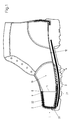
- FIG. 1 An exemplary embodiment of the entire safety shoe is shown in FIG.
- the toe 1 is in the essentially by the dome-shaped protective cap 2, the insole 12 and the forefoot stiffening plate 3 is formed, the protective cap 2 from the shaft 19 is enclosed, which is connected to the outsole 20.
- the arrangement of the stiffening plate 3 in the shoe sole 4th and their assignment to protective cap 2 of crucial importance is about 0.5.
- the rear limit 8 of the protective cap 2 is with a cushion part 9 is provided in order to also at a bending angle of For example, to avoid more than 60 ° injuries to the roots of the toes.
- the cushion part 9 is in the example shown here partially with the rear Boundary 8 connected, for example glued.
- the angle between the front boundary 21 and the upper boundary 22 of the protective cap 2 is in any case more than 90 ° in order to have a larger free space for the foot to reach.
- the geometric dimensions are enlarged Excerpt from Figure 1 shown.
- Figure 2 is the forefoot area of a shoe shown, the protective cap 2 and the insole 12 by means of Stiffening plate 3 are interconnected.
- the ratio of the length 5 of the stiffening plate 3 and the length 6 of the shoe sole 4 and the length 7 of the protective cap 2 and the length 5 of the stiffening plate 3 is here embodiment shown each about 0.5.
- the stiffening plate 3 is on the side facing the protective cap 2 with a circumferential direction extending recess 13 provided in the congruent designed after internally directed, flange-shaped flange 14 of the edge of the protective cap 2 is arranged.
- this corresponds to Thickness 16 of the insole 12 of the thickness 15 of the stiffening plate 3 and is each about 2.5 mm.
- the stiffening plate 3 is in the region of the recess 13 in contrast, only 1.5 mm thick.
- the flange 14 is essentially arranged flush with the surface in the recess 13.
- On the protective cap 2 facing away from the stiffening plate 3 is provided with a chamfer 18 to get a gradual transition to the insole 12.
- FIG. 3 shows a top view of the stiffening plate 3 from FIG. 2.
- the length 5 of the stiffening plate 3 corresponds approximately to half the length 6 of the Shoe sole 4.
- the recess 13 is arranged, in contrast, the bevel 18 on the rear edge 17 of the stiffening plate 3.
Landscapes
- Chemical & Material Sciences (AREA)
- Engineering & Computer Science (AREA)
- Materials Engineering (AREA)
- Health & Medical Sciences (AREA)
- Epidemiology (AREA)
- General Health & Medical Sciences (AREA)
- Public Health (AREA)
- Footwear And Its Accessory, Manufacturing Method And Apparatuses (AREA)
- Gloves (AREA)
- Orthopedics, Nursing, And Contraception (AREA)
- Pharmaceuticals Containing Other Organic And Inorganic Compounds (AREA)
Abstract
Description
- Figur 1
- zeigt ein Ausführungsbeispiel eines Sicherheitsschuhs,
- Figur 2
- zeigt einen Ausschnitt aus dem Sicherheitsschuh aus Figur 1 und
- Figur 3
- zeigt eine Draufsicht auf die Versteifungsplatte aus den Figuren 1 und 2.
Claims (12)
- Sicherheitsschuh, in dessen Schuhspitze (1) eine im wesentlichen kuppelförmige Schutzkappe (2) und eine Vorfuß-Versteifungsplatte (3) angeordnet sind, wobei die Versteifungsplatte (3) einen Bestandteil einer Schuhsohle (4) bildet und wobei das Verhältnis aus der Länge (5) der Versteifungsplatte (3) und der Länge (6) der Schuhsohle (4) sowie der Länge (7) der Schutzkappe (2) und der Länge (5) der Versteifungsplatte (3) jeweils 0,3 bis 0,7 beträgt.
- Sicherheitsschuh nach Anspruch 1, dadurch gekennzeichnet, daß die hintere Begrenzung (8) der Schutzkappe (2) auf der der Schuhspitze (1) abgewandten Seite ein Polsterteil (9) aufweist, das in einer im wesentlichen kongruent gestalteten Vorwölbung (10) der Schutzkappe (2) angeordnet ist, die sich von der Schuhsohle (4) weg nach oben erstreckt.
- Sicherheitsschuh nach einem der Ansprüche 1 oder 2, dadurch gekennzeichnet, daß die Schutzkappe (2) und die Versteifungsplatte (3) eine vormontierbare Einheit bilden.
- Sicherheitsschuh nach einem der Ansprüche 1 bis 3, dadurch gekennzeichnet, daß die Schutzkappe (2) -im Längsschnitt betrachtetvon der Schuhspitze (1) zur hinteren Begrenzung (8) einen sich stets vergrößernden Abstand (11) zur Brandsohle (12) aufweist.
- Sicherheitsschuh nach einem der Ansprüche 1 bis 4, dadurch gekennzeichnet, daß die Schuhsohle (4) die Brandsohle (12) umfaßt, die sich bis in die Schutzkappe (2) erstreckt und mittels der Versteifungsplatte (3) mit der Schutzkappe (2) verbunden ist.
- Sicherheitsschuh nach einem der Ansprüche 1 bis 5, dadurch gekennzeichnet, daß die Versteifungsplatte (3) -in der Draufsicht betrachtet- im wesentlichen sichelförmig ausgebildet ist.
- Sicherheitsschuh nach einem der Ansprüche 1 bis 6, dadurch gekennzeichnet, daß die Versteifungsplatte (3) im Bereich der Schutzkappe (2) einen Rand mit sich Umfangsseitig erstreckender Vertiefung (13) aufweist, in der eine kongruent gestaltete, nach innen gerichtete Umbördelung (14) des Randes der Schutzkappe (2) angeordnet ist.
- Sicherheitsschuh nach Anspruch 7, dadurch gekennzeichnet, daß die Umbördelung (14) im wesentlichen oberflächenbündig in der Vertiefung (13) angeordnet ist.
- Sicherheitsschuh nach einem der Ansprüche 1 bis 8 dadurch gekennzeichnet, daß das Verhältnis aus der Dicke (15) der Versteifungsplatte (3) und der Dicke (16) der Brandsohle (12) im wesentlichen eins beträgt.
- Sicherheitsschuh nach einem der Ansprüche 1 bis 9, dadurch gekennzeichnet, daß die Dicke (15) der Versteifungsplatte (3) 2 bis 3 mm beträgt und im Bereich der Vertiefung (13) 1 bis 2 mm.
- Sicherheitsschuh nach einem der Ansprüche 1 bis 10, dadurch gekennzeichnet, daß die Versteifungsplatte (3) aus einem polymeren Werkstoff besteht.
- Sicherheitsschuh nach einem der Ansprüche 1 bis 11, dadurch gekennzeichnet, daß der von der Schuhspitze (1) abgewandte hintere Rand (17) der Versteifungsplatte (3) auf der der Brandsohle (12) abgewandten Seite eine Fase (18) aufweist.
Applications Claiming Priority (2)
| Application Number | Priority Date | Filing Date | Title |
|---|---|---|---|
| DE19928502A DE19928502C2 (de) | 1999-06-22 | 1999-06-22 | Sicherheitsschuh |
| DE19928502 | 1999-06-22 |
Publications (3)
| Publication Number | Publication Date |
|---|---|
| EP1062885A2 true EP1062885A2 (de) | 2000-12-27 |
| EP1062885A3 EP1062885A3 (de) | 2001-11-28 |
| EP1062885B1 EP1062885B1 (de) | 2004-07-14 |
Family
ID=7912107
Family Applications (1)
| Application Number | Title | Priority Date | Filing Date |
|---|---|---|---|
| EP00107810A Expired - Lifetime EP1062885B1 (de) | 1999-06-22 | 2000-04-12 | Sicherheitsschuh |
Country Status (4)
| Country | Link |
|---|---|
| EP (1) | EP1062885B1 (de) |
| AT (1) | ATE270832T1 (de) |
| DE (2) | DE19928502C2 (de) |
| NO (1) | NO316491B1 (de) |
Cited By (1)
| Publication number | Priority date | Publication date | Assignee | Title |
|---|---|---|---|---|
| CN107736679A (zh) * | 2013-03-13 | 2018-02-27 | Tbl许可有限责任公司 | 安全鞋 |
Citations (1)
| Publication number | Priority date | Publication date | Assignee | Title |
|---|---|---|---|---|
| DE19616027A1 (de) | 1996-04-23 | 1997-10-30 | Alsa Gmbh | Sicherheitsschuh und Verfahren zu seiner Herstellung |
Family Cites Families (4)
| Publication number | Priority date | Publication date | Assignee | Title |
|---|---|---|---|---|
| GB863944A (en) * | 1958-05-06 | 1961-03-29 | Btr Industries Ltd | Improvements in boots and shoes |
| DE1140838B (de) * | 1961-02-22 | 1962-12-06 | Klaus Maertens Dr Med | Sicherheitsschuh mit eingearbeiteter Stahlkappe und Sohlen-Stahlblecheinlage |
| BE789236A (fr) * | 1971-10-01 | 1973-01-15 | Hocks Kurt | Dispositif de protection pour chaussures |
| DE2855309A1 (de) * | 1978-12-21 | 1980-07-03 | Management Operations Ltd | Sicherheitsfussbekleidung |
-
1999
- 1999-06-22 DE DE19928502A patent/DE19928502C2/de not_active Expired - Fee Related
-
2000
- 2000-04-12 DE DE50007042T patent/DE50007042D1/de not_active Expired - Fee Related
- 2000-04-12 AT AT00107810T patent/ATE270832T1/de not_active IP Right Cessation
- 2000-04-12 EP EP00107810A patent/EP1062885B1/de not_active Expired - Lifetime
- 2000-06-20 NO NO20003193A patent/NO316491B1/no not_active IP Right Cessation
Patent Citations (1)
| Publication number | Priority date | Publication date | Assignee | Title |
|---|---|---|---|---|
| DE19616027A1 (de) | 1996-04-23 | 1997-10-30 | Alsa Gmbh | Sicherheitsschuh und Verfahren zu seiner Herstellung |
Cited By (1)
| Publication number | Priority date | Publication date | Assignee | Title |
|---|---|---|---|---|
| CN107736679A (zh) * | 2013-03-13 | 2018-02-27 | Tbl许可有限责任公司 | 安全鞋 |
Also Published As
| Publication number | Publication date |
|---|---|
| NO20003193L (no) | 2000-12-27 |
| EP1062885A3 (de) | 2001-11-28 |
| DE19928502C2 (de) | 2002-06-27 |
| DE50007042D1 (de) | 2004-08-19 |
| NO20003193D0 (no) | 2000-06-20 |
| DE19928502A1 (de) | 2000-12-28 |
| EP1062885B1 (de) | 2004-07-14 |
| NO316491B1 (no) | 2004-02-02 |
| ATE270832T1 (de) | 2004-07-15 |
Similar Documents
| Publication | Publication Date | Title |
|---|---|---|
| DE69200272T2 (de) | Asymmetrischer Tanzschuh und derartiges Schuhpaar. | |
| DE60030188T2 (de) | Schuhwerk | |
| EP0015482B1 (de) | Fussstützende Sohle | |
| DE102018105628B4 (de) | Solenstruktur für Schuhe und Schuh mit der Sohlenstruktur | |
| EP0815758B1 (de) | Schuh- bzw. Laufsohle und Schuh mit dieser Sohle | |
| DE102016118168A1 (de) | Sohlenstruktur für Schuh und Schuh mit dieser Sohlenstruktur | |
| DE102017122278A1 (de) | Sohlenstruktur für schuhe und schuhe mit dieser sohlenstruktur | |
| CH678795A5 (de) | ||
| DE10218987A1 (de) | Schuhinnensohle für Diabetiker | |
| EP3151694B1 (de) | Schuh, insbesondere laufschuh | |
| EP2540181A2 (de) | Sohle für einen Schuh, insbesondere Laufschuh | |
| DE102019125481A1 (de) | Sohlenstruktur und Schuh mit der Sohlenstruktur | |
| WO2010006906A1 (de) | Schuhsohle | |
| EP3609360B1 (de) | Fussbett für absatzschuhe | |
| EP1062885B1 (de) | Sicherheitsschuh | |
| DE19928502C9 (de) | Sicherheitsschuh | |
| EP2684475B1 (de) | Sohle für diabetiker-schutzschuhe sowie diabetiker-schutzschuh mit einer solchen sohle | |
| EP1070458A2 (de) | Sicherheitsschuh | |
| EP3158886B1 (de) | Einlage mit einem einlagengrundkörper und einem einlagenkern | |
| EP2066274A1 (de) | Schuheinlage | |
| DE60009076T2 (de) | Schuh und sohle mit torsionsversteifung | |
| DE19623361C1 (de) | Sicherheitsschuh | |
| DE202015104193U1 (de) | Orthopädische Schuhsohle sowie Schuh umfassend eine solche | |
| WO2012084243A1 (de) | Einlage für einen schuh und schuh mit einer solchen einlage | |
| DE3940522A1 (de) | Schuhsohle |
Legal Events
| Date | Code | Title | Description |
|---|---|---|---|
| PUAI | Public reference made under article 153(3) epc to a published international application that has entered the european phase |
Free format text: ORIGINAL CODE: 0009012 |
|
| AK | Designated contracting states |
Kind code of ref document: A2 Designated state(s): AT BE CH CY DE DK ES FI FR GB GR IE IT LI LU MC NL PT SE |
|
| AX | Request for extension of the european patent |
Free format text: AL;LT;LV;MK;RO;SI |
|
| PUAL | Search report despatched |
Free format text: ORIGINAL CODE: 0009013 |
|
| AK | Designated contracting states |
Kind code of ref document: A3 Designated state(s): AT BE CH CY DE DK ES FI FR GB GR IE IT LI LU MC NL PT SE |
|
| AX | Request for extension of the european patent |
Free format text: AL;LT;LV;MK;RO;SI |
|
| 17P | Request for examination filed |
Effective date: 20020131 |
|
| AKX | Designation fees paid |
Free format text: AT BE CH CY DE DK ES FI FR GB GR IE IT LI LU MC NL PT SE |
|
| GRAP | Despatch of communication of intention to grant a patent |
Free format text: ORIGINAL CODE: EPIDOSNIGR1 |
|
| GRAS | Grant fee paid |
Free format text: ORIGINAL CODE: EPIDOSNIGR3 |
|
| GRAA | (expected) grant |
Free format text: ORIGINAL CODE: 0009210 |
|
| AK | Designated contracting states |
Kind code of ref document: B1 Designated state(s): AT BE CH CY DE DK ES FI FR GB GR IE IT LI LU MC NL PT SE |
|
| PG25 | Lapsed in a contracting state [announced via postgrant information from national office to epo] |
Ref country code: IT Free format text: LAPSE BECAUSE OF FAILURE TO SUBMIT A TRANSLATION OF THE DESCRIPTION OR TO PAY THE FEE WITHIN THE PRESCRIBED TIME-LIMIT;WARNING: LAPSES OF ITALIAN PATENTS WITH EFFECTIVE DATE BEFORE 2007 MAY HAVE OCCURRED AT ANY TIME BEFORE 2007. THE CORRECT EFFECTIVE DATE MAY BE DIFFERENT FROM THE ONE RECORDED. Effective date: 20040714 Ref country code: NL Free format text: LAPSE BECAUSE OF FAILURE TO SUBMIT A TRANSLATION OF THE DESCRIPTION OR TO PAY THE FEE WITHIN THE PRESCRIBED TIME-LIMIT Effective date: 20040714 Ref country code: FR Free format text: LAPSE BECAUSE OF FAILURE TO SUBMIT A TRANSLATION OF THE DESCRIPTION OR TO PAY THE FEE WITHIN THE PRESCRIBED TIME-LIMIT Effective date: 20040714 Ref country code: FI Free format text: LAPSE BECAUSE OF FAILURE TO SUBMIT A TRANSLATION OF THE DESCRIPTION OR TO PAY THE FEE WITHIN THE PRESCRIBED TIME-LIMIT Effective date: 20040714 Ref country code: IE Free format text: LAPSE BECAUSE OF FAILURE TO SUBMIT A TRANSLATION OF THE DESCRIPTION OR TO PAY THE FEE WITHIN THE PRESCRIBED TIME-LIMIT Effective date: 20040714 Ref country code: GB Free format text: LAPSE BECAUSE OF FAILURE TO SUBMIT A TRANSLATION OF THE DESCRIPTION OR TO PAY THE FEE WITHIN THE PRESCRIBED TIME-LIMIT Effective date: 20040714 |
|
| REG | Reference to a national code |
Ref country code: GB Ref legal event code: FG4D Free format text: NOT ENGLISH |
|
| REG | Reference to a national code |
Ref country code: CH Ref legal event code: EP |
|
| REF | Corresponds to: |
Ref document number: 50007042 Country of ref document: DE Date of ref document: 20040819 Kind code of ref document: P |
|
| REG | Reference to a national code |
Ref country code: IE Ref legal event code: FG4D Free format text: GERMAN |
|
| PG25 | Lapsed in a contracting state [announced via postgrant information from national office to epo] |
Ref country code: GR Free format text: LAPSE BECAUSE OF FAILURE TO SUBMIT A TRANSLATION OF THE DESCRIPTION OR TO PAY THE FEE WITHIN THE PRESCRIBED TIME-LIMIT Effective date: 20041014 Ref country code: DK Free format text: LAPSE BECAUSE OF FAILURE TO SUBMIT A TRANSLATION OF THE DESCRIPTION OR TO PAY THE FEE WITHIN THE PRESCRIBED TIME-LIMIT Effective date: 20041014 Ref country code: SE Free format text: LAPSE BECAUSE OF FAILURE TO SUBMIT A TRANSLATION OF THE DESCRIPTION OR TO PAY THE FEE WITHIN THE PRESCRIBED TIME-LIMIT Effective date: 20041014 |
|
| PG25 | Lapsed in a contracting state [announced via postgrant information from national office to epo] |
Ref country code: ES Free format text: LAPSE BECAUSE OF FAILURE TO SUBMIT A TRANSLATION OF THE DESCRIPTION OR TO PAY THE FEE WITHIN THE PRESCRIBED TIME-LIMIT Effective date: 20041025 |
|
| NLV1 | Nl: lapsed or annulled due to failure to fulfill the requirements of art. 29p and 29m of the patents act | ||
| GBV | Gb: ep patent (uk) treated as always having been void in accordance with gb section 77(7)/1977 [no translation filed] |
Effective date: 20040714 |
|
| REG | Reference to a national code |
Ref country code: IE Ref legal event code: FD4D |
|
| PG25 | Lapsed in a contracting state [announced via postgrant information from national office to epo] |
Ref country code: LU Free format text: LAPSE BECAUSE OF NON-PAYMENT OF DUE FEES Effective date: 20050412 Ref country code: CY Free format text: LAPSE BECAUSE OF FAILURE TO SUBMIT A TRANSLATION OF THE DESCRIPTION OR TO PAY THE FEE WITHIN THE PRESCRIBED TIME-LIMIT Effective date: 20050412 Ref country code: AT Free format text: LAPSE BECAUSE OF NON-PAYMENT OF DUE FEES Effective date: 20050412 |
|
| PG25 | Lapsed in a contracting state [announced via postgrant information from national office to epo] |
Ref country code: MC Free format text: LAPSE BECAUSE OF NON-PAYMENT OF DUE FEES Effective date: 20050430 Ref country code: CH Free format text: LAPSE BECAUSE OF NON-PAYMENT OF DUE FEES Effective date: 20050430 Ref country code: BE Free format text: LAPSE BECAUSE OF NON-PAYMENT OF DUE FEES Effective date: 20050430 Ref country code: LI Free format text: LAPSE BECAUSE OF NON-PAYMENT OF DUE FEES Effective date: 20050430 |
|
| PLBE | No opposition filed within time limit |
Free format text: ORIGINAL CODE: 0009261 |
|
| STAA | Information on the status of an ep patent application or granted ep patent |
Free format text: STATUS: NO OPPOSITION FILED WITHIN TIME LIMIT |
|
| 26N | No opposition filed |
Effective date: 20050415 |
|
| EN | Fr: translation not filed | ||
| BERE | Be: lapsed |
Owner name: OTTER *SCHUTZ G.M.B.H. Effective date: 20050430 |
|
| PG25 | Lapsed in a contracting state [announced via postgrant information from national office to epo] |
Ref country code: DE Free format text: LAPSE BECAUSE OF NON-PAYMENT OF DUE FEES Effective date: 20051101 |
|
| REG | Reference to a national code |
Ref country code: CH Ref legal event code: PL |
|
| BERE | Be: lapsed |
Owner name: OTTER *SCHUTZ G.M.B.H. Effective date: 20050430 |
|
| PG25 | Lapsed in a contracting state [announced via postgrant information from national office to epo] |
Ref country code: PT Free format text: LAPSE BECAUSE OF NON-PAYMENT OF DUE FEES Effective date: 20041214 |