EP1063217A1 - Verfahren zur Herstellung von Oxoisophoron in Gegenwart eines oder mehrerer Azetatsalze - Google Patents
Verfahren zur Herstellung von Oxoisophoron in Gegenwart eines oder mehrerer Azetatsalze Download PDFInfo
- Publication number
- EP1063217A1 EP1063217A1 EP00111532A EP00111532A EP1063217A1 EP 1063217 A1 EP1063217 A1 EP 1063217A1 EP 00111532 A EP00111532 A EP 00111532A EP 00111532 A EP00111532 A EP 00111532A EP 1063217 A1 EP1063217 A1 EP 1063217A1
- Authority
- EP
- European Patent Office
- Prior art keywords
- iii
- solvent
- base
- catalyst
- dmf
- Prior art date
- Legal status (The legal status is an assumption and is not a legal conclusion. Google has not performed a legal analysis and makes no representation as to the accuracy of the status listed.)
- Granted
Links
- AYJXHIDNNLJQDT-UHFFFAOYSA-N 2,6,6-Trimethyl-2-cyclohexene-1,4-dione Chemical compound CC1=CC(=O)CC(C)(C)C1=O AYJXHIDNNLJQDT-UHFFFAOYSA-N 0.000 title claims abstract description 26
- 159000000021 acetate salts Chemical class 0.000 title claims abstract description 14
- 238000004519 manufacturing process Methods 0.000 title description 7
- LKOKKQDYMZUSCG-UHFFFAOYSA-N 3,5,5-Trimethyl-3-cyclohexen-1-one Chemical compound CC1=CC(C)(C)CC(=O)C1 LKOKKQDYMZUSCG-UHFFFAOYSA-N 0.000 claims abstract description 36
- 238000006243 chemical reaction Methods 0.000 claims abstract description 29
- 239000003054 catalyst Substances 0.000 claims abstract description 28
- 239000002904 solvent Substances 0.000 claims abstract description 20
- 229910052751 metal Inorganic materials 0.000 claims abstract description 19
- 239000002184 metal Substances 0.000 claims abstract description 19
- 230000003647 oxidation Effects 0.000 claims abstract description 12
- 238000007254 oxidation reaction Methods 0.000 claims abstract description 12
- MYMOFIZGZYHOMD-UHFFFAOYSA-N Dioxygen Chemical compound O=O MYMOFIZGZYHOMD-UHFFFAOYSA-N 0.000 claims abstract description 8
- 229910001882 dioxygen Inorganic materials 0.000 claims abstract description 8
- 150000002739 metals Chemical class 0.000 claims abstract description 7
- 238000002360 preparation method Methods 0.000 claims abstract description 7
- VTLYFUHAOXGGBS-UHFFFAOYSA-N Fe3+ Chemical compound [Fe+3] VTLYFUHAOXGGBS-UHFFFAOYSA-N 0.000 claims abstract description 4
- 150000001768 cations Chemical class 0.000 claims abstract description 4
- ZMXDDKWLCZADIW-UHFFFAOYSA-N N,N-Dimethylformamide Chemical compound CN(C)C=O ZMXDDKWLCZADIW-UHFFFAOYSA-N 0.000 claims description 67
- 238000000034 method Methods 0.000 claims description 33
- 239000000654 additive Substances 0.000 claims description 25
- FXHOOIRPVKKKFG-UHFFFAOYSA-N N,N-Dimethylacetamide Chemical compound CN(C)C(C)=O FXHOOIRPVKKKFG-UHFFFAOYSA-N 0.000 claims description 22
- 239000001257 hydrogen Substances 0.000 claims description 19
- 229910052739 hydrogen Inorganic materials 0.000 claims description 19
- UFHFLCQGNIYNRP-UHFFFAOYSA-N Hydrogen Chemical compound [H][H] UFHFLCQGNIYNRP-UHFFFAOYSA-N 0.000 claims description 14
- 230000000996 additive effect Effects 0.000 claims description 13
- XIXADJRWDQXREU-UHFFFAOYSA-M lithium acetate Chemical compound [Li+].CC([O-])=O XIXADJRWDQXREU-UHFFFAOYSA-M 0.000 claims description 12
- 239000000203 mixture Substances 0.000 claims description 11
- YFTHZRPMJXBUME-UHFFFAOYSA-N tripropylamine Chemical compound CCCN(CCC)CCC YFTHZRPMJXBUME-UHFFFAOYSA-N 0.000 claims description 10
- 229910013594 LiOAc Inorganic materials 0.000 claims description 9
- 150000002431 hydrogen Chemical class 0.000 claims description 9
- 239000007858 starting material Substances 0.000 claims description 9
- SECXISVLQFMRJM-UHFFFAOYSA-N N-Methylpyrrolidone Chemical compound CN1CCCC1=O SECXISVLQFMRJM-UHFFFAOYSA-N 0.000 claims description 6
- VMHLLURERBWHNL-UHFFFAOYSA-M Sodium acetate Chemical compound [Na+].CC([O-])=O VMHLLURERBWHNL-UHFFFAOYSA-M 0.000 claims description 6
- 229910052736 halogen Inorganic materials 0.000 claims description 6
- 150000002367 halogens Chemical class 0.000 claims description 6
- 229910004013 NO 2 Inorganic materials 0.000 claims description 5
- 229910052794 bromium Inorganic materials 0.000 claims description 5
- 229910052801 chlorine Inorganic materials 0.000 claims description 5
- 229910052731 fluorine Inorganic materials 0.000 claims description 5
- 229910052740 iodine Inorganic materials 0.000 claims description 5
- 150000002500 ions Chemical class 0.000 claims description 5
- 239000011541 reaction mixture Substances 0.000 claims description 5
- SCVFZCLFOSHCOH-UHFFFAOYSA-M potassium acetate Chemical compound [K+].CC([O-])=O SCVFZCLFOSHCOH-UHFFFAOYSA-M 0.000 claims description 4
- 150000001242 acetic acid derivatives Chemical class 0.000 claims description 3
- 125000004432 carbon atom Chemical group C* 0.000 claims description 2
- 230000000536 complexating effect Effects 0.000 claims 1
- 125000005270 trialkylamine group Chemical group 0.000 claims 1
- 239000011572 manganese Substances 0.000 abstract description 15
- VEUMANXWQDHAJV-UHFFFAOYSA-N 2-[2-[(2-hydroxyphenyl)methylideneamino]ethyliminomethyl]phenol Chemical compound OC1=CC=CC=C1C=NCCN=CC1=CC=CC=C1O VEUMANXWQDHAJV-UHFFFAOYSA-N 0.000 abstract description 12
- WAEMQWOKJMHJLA-UHFFFAOYSA-N Manganese(2+) Chemical group [Mn+2] WAEMQWOKJMHJLA-UHFFFAOYSA-N 0.000 abstract description 3
- 229910052748 manganese Inorganic materials 0.000 abstract description 3
- MMIPFLVOWGHZQD-UHFFFAOYSA-N manganese(3+) Chemical group [Mn+3] MMIPFLVOWGHZQD-UHFFFAOYSA-N 0.000 abstract description 3
- JPVYNHNXODAKFH-UHFFFAOYSA-N Cu2+ Chemical compound [Cu+2] JPVYNHNXODAKFH-UHFFFAOYSA-N 0.000 abstract description 2
- CWYNVVGOOAEACU-UHFFFAOYSA-N Fe2+ Chemical compound [Fe+2] CWYNVVGOOAEACU-UHFFFAOYSA-N 0.000 abstract description 2
- 229910052723 transition metal Inorganic materials 0.000 abstract description 2
- 150000003624 transition metals Chemical class 0.000 abstract description 2
- 125000000217 alkyl group Chemical group 0.000 abstract 2
- 125000001475 halogen functional group Chemical group 0.000 abstract 2
- 101100134929 Gallus gallus COR9 gene Proteins 0.000 abstract 1
- PWHULOQIROXLJO-UHFFFAOYSA-N Manganese Chemical compound [Mn] PWHULOQIROXLJO-UHFFFAOYSA-N 0.000 abstract 1
- 239000002585 base Substances 0.000 description 16
- HJOVHMDZYOCNQW-UHFFFAOYSA-N isophorone Chemical compound CC1=CC(=O)CC(C)(C)C1 HJOVHMDZYOCNQW-UHFFFAOYSA-N 0.000 description 14
- 239000003446 ligand Substances 0.000 description 13
- HEMHJVSKTPXQMS-UHFFFAOYSA-M Sodium hydroxide Chemical compound [OH-].[Na+] HEMHJVSKTPXQMS-UHFFFAOYSA-M 0.000 description 9
- -1 manganese (II) salen derivatives Chemical class 0.000 description 8
- USFZMSVCRYTOJT-UHFFFAOYSA-N Ammonium acetate Chemical compound N.CC(O)=O USFZMSVCRYTOJT-UHFFFAOYSA-N 0.000 description 6
- XEKOWRVHYACXOJ-UHFFFAOYSA-N Ethyl acetate Chemical compound CCOC(C)=O XEKOWRVHYACXOJ-UHFFFAOYSA-N 0.000 description 6
- ZMANZCXQSJIPKH-UHFFFAOYSA-N Triethylamine Chemical compound CCN(CC)CC ZMANZCXQSJIPKH-UHFFFAOYSA-N 0.000 description 6
- VLKZOEOYAKHREP-UHFFFAOYSA-N n-Hexane Chemical compound CCCCCC VLKZOEOYAKHREP-UHFFFAOYSA-N 0.000 description 6
- 239000005695 Ammonium acetate Substances 0.000 description 5
- RTZKZFJDLAIYFH-UHFFFAOYSA-N Diethyl ether Chemical compound CCOCC RTZKZFJDLAIYFH-UHFFFAOYSA-N 0.000 description 5
- 229940043376 ammonium acetate Drugs 0.000 description 5
- 235000019257 ammonium acetate Nutrition 0.000 description 5
- 239000006227 byproduct Substances 0.000 description 5
- 239000003960 organic solvent Substances 0.000 description 5
- QTBSBXVTEAMEQO-UHFFFAOYSA-M Acetate Chemical group CC([O-])=O QTBSBXVTEAMEQO-UHFFFAOYSA-M 0.000 description 4
- LFQSCWFLJHTTHZ-UHFFFAOYSA-N Ethanol Chemical compound CCO LFQSCWFLJHTTHZ-UHFFFAOYSA-N 0.000 description 4
- PIICEJLVQHRZGT-UHFFFAOYSA-N Ethylenediamine Chemical compound NCCN PIICEJLVQHRZGT-UHFFFAOYSA-N 0.000 description 4
- 230000000052 comparative effect Effects 0.000 description 4
- SBZXBUIDTXKZTM-UHFFFAOYSA-N diglyme Chemical compound COCCOCCOC SBZXBUIDTXKZTM-UHFFFAOYSA-N 0.000 description 4
- 125000001424 substituent group Chemical group 0.000 description 4
- XLYOFNOQVPJJNP-UHFFFAOYSA-N water Substances O XLYOFNOQVPJJNP-UHFFFAOYSA-N 0.000 description 4
- QTBSBXVTEAMEQO-UHFFFAOYSA-N Acetic acid Chemical compound CC(O)=O QTBSBXVTEAMEQO-UHFFFAOYSA-N 0.000 description 3
- WEVYAHXRMPXWCK-UHFFFAOYSA-N Acetonitrile Chemical compound CC#N WEVYAHXRMPXWCK-UHFFFAOYSA-N 0.000 description 3
- UHOVQNZJYSORNB-UHFFFAOYSA-N Benzene Chemical compound C1=CC=CC=C1 UHOVQNZJYSORNB-UHFFFAOYSA-N 0.000 description 3
- OKKJLVBELUTLKV-UHFFFAOYSA-N Methanol Chemical compound OC OKKJLVBELUTLKV-UHFFFAOYSA-N 0.000 description 3
- KWYUFKZDYYNOTN-UHFFFAOYSA-M Potassium hydroxide Chemical compound [OH-].[K+] KWYUFKZDYYNOTN-UHFFFAOYSA-M 0.000 description 3
- 239000002262 Schiff base Substances 0.000 description 3
- 150000004753 Schiff bases Chemical class 0.000 description 3
- YXFVVABEGXRONW-UHFFFAOYSA-N Toluene Chemical compound CC1=CC=CC=C1 YXFVVABEGXRONW-UHFFFAOYSA-N 0.000 description 3
- 125000003118 aryl group Chemical group 0.000 description 3
- 150000001875 compounds Chemical class 0.000 description 3
- UAOMVDZJSHZZME-UHFFFAOYSA-N diisopropylamine Chemical compound CC(C)NC(C)C UAOMVDZJSHZZME-UHFFFAOYSA-N 0.000 description 3
- 239000000047 product Substances 0.000 description 3
- SMQUZDBALVYZAC-UHFFFAOYSA-N salicylaldehyde Chemical class OC1=CC=CC=C1C=O SMQUZDBALVYZAC-UHFFFAOYSA-N 0.000 description 3
- 238000006467 substitution reaction Methods 0.000 description 3
- FUGKCSRLAQKUHG-UHFFFAOYSA-N 5-chloro-2-hydroxybenzaldehyde Chemical compound OC1=CC=C(Cl)C=C1C=O FUGKCSRLAQKUHG-UHFFFAOYSA-N 0.000 description 2
- CSCPPACGZOOCGX-UHFFFAOYSA-N Acetone Chemical compound CC(C)=O CSCPPACGZOOCGX-UHFFFAOYSA-N 0.000 description 2
- IJGRMHOSHXDMSA-UHFFFAOYSA-N Atomic nitrogen Chemical compound N#N IJGRMHOSHXDMSA-UHFFFAOYSA-N 0.000 description 2
- HEDRZPFGACZZDS-UHFFFAOYSA-N Chloroform Chemical compound ClC(Cl)Cl HEDRZPFGACZZDS-UHFFFAOYSA-N 0.000 description 2
- LCGLNKUTAGEVQW-UHFFFAOYSA-N Dimethyl ether Chemical compound COC LCGLNKUTAGEVQW-UHFFFAOYSA-N 0.000 description 2
- ROSDSFDQCJNGOL-UHFFFAOYSA-N Dimethylamine Chemical compound CNC ROSDSFDQCJNGOL-UHFFFAOYSA-N 0.000 description 2
- WMFOQBRAJBCJND-UHFFFAOYSA-M Lithium hydroxide Chemical compound [Li+].[OH-] WMFOQBRAJBCJND-UHFFFAOYSA-M 0.000 description 2
- IMNFDUFMRHMDMM-UHFFFAOYSA-N N-Heptane Chemical compound CCCCCCC IMNFDUFMRHMDMM-UHFFFAOYSA-N 0.000 description 2
- CTQNGGLPUBDAKN-UHFFFAOYSA-N O-Xylene Chemical compound CC1=CC=CC=C1C CTQNGGLPUBDAKN-UHFFFAOYSA-N 0.000 description 2
- OFBQJSOFQDEBGM-UHFFFAOYSA-N Pentane Chemical compound CCCCC OFBQJSOFQDEBGM-UHFFFAOYSA-N 0.000 description 2
- WYURNTSHIVDZCO-UHFFFAOYSA-N Tetrahydrofuran Chemical compound C1CCOC1 WYURNTSHIVDZCO-UHFFFAOYSA-N 0.000 description 2
- YRKCREAYFQTBPV-UHFFFAOYSA-N acetylacetone Chemical compound CC(=O)CC(C)=O YRKCREAYFQTBPV-UHFFFAOYSA-N 0.000 description 2
- 125000004429 atom Chemical group 0.000 description 2
- QVGXLLKOCUKJST-UHFFFAOYSA-N atomic oxygen Chemical compound [O] QVGXLLKOCUKJST-UHFFFAOYSA-N 0.000 description 2
- 239000011575 calcium Substances 0.000 description 2
- 239000013522 chelant Substances 0.000 description 2
- XLJKHNWPARRRJB-UHFFFAOYSA-N cobalt(2+) Chemical compound [Co+2] XLJKHNWPARRRJB-UHFFFAOYSA-N 0.000 description 2
- 150000004985 diamines Chemical class 0.000 description 2
- JQVDAXLFBXTEQA-UHFFFAOYSA-N dibutylamine Chemical compound CCCCNCCCC JQVDAXLFBXTEQA-UHFFFAOYSA-N 0.000 description 2
- LIWAQLJGPBVORC-UHFFFAOYSA-N ethylmethylamine Chemical compound CCNC LIWAQLJGPBVORC-UHFFFAOYSA-N 0.000 description 2
- 238000004880 explosion Methods 0.000 description 2
- 238000003958 fumigation Methods 0.000 description 2
- 239000007789 gas Substances 0.000 description 2
- 238000004817 gas chromatography Methods 0.000 description 2
- 239000011521 glass Substances 0.000 description 2
- 238000006317 isomerization reaction Methods 0.000 description 2
- KWGKDLIKAYFUFQ-UHFFFAOYSA-M lithium chloride Chemical compound [Li+].[Cl-] KWGKDLIKAYFUFQ-UHFFFAOYSA-M 0.000 description 2
- 239000011777 magnesium Substances 0.000 description 2
- QPJVMBTYPHYUOC-UHFFFAOYSA-N methyl benzoate Chemical compound COC(=O)C1=CC=CC=C1 QPJVMBTYPHYUOC-UHFFFAOYSA-N 0.000 description 2
- 239000001301 oxygen Substances 0.000 description 2
- 229910052760 oxygen Inorganic materials 0.000 description 2
- 230000036284 oxygen consumption Effects 0.000 description 2
- 238000000746 purification Methods 0.000 description 2
- 239000011734 sodium Substances 0.000 description 2
- 239000000126 substance Substances 0.000 description 2
- GETQZCLCWQTVFV-UHFFFAOYSA-N trimethylamine Chemical compound CN(C)C GETQZCLCWQTVFV-UHFFFAOYSA-N 0.000 description 2
- 239000008096 xylene Substances 0.000 description 2
- WSLDOOZREJYCGB-UHFFFAOYSA-N 1,2-Dichloroethane Chemical compound ClCCCl WSLDOOZREJYCGB-UHFFFAOYSA-N 0.000 description 1
- RYHBNJHYFVUHQT-UHFFFAOYSA-N 1,4-Dioxane Chemical compound C1COCCO1 RYHBNJHYFVUHQT-UHFFFAOYSA-N 0.000 description 1
- FABVMBDCVAJXMB-UHFFFAOYSA-N 3,5-dichloro-2-hydroxybenzaldehyde Chemical compound OC1=C(Cl)C=C(Cl)C=C1C=O FABVMBDCVAJXMB-UHFFFAOYSA-N 0.000 description 1
- JZVUAOCDNFNSGQ-UHFFFAOYSA-N 7-methoxy-2-phenyl-1h-quinolin-4-one Chemical compound N=1C2=CC(OC)=CC=C2C(O)=CC=1C1=CC=CC=C1 JZVUAOCDNFNSGQ-UHFFFAOYSA-N 0.000 description 1
- NJQFCQXFOHVYQJ-PMACEKPBSA-N BF 4 Chemical compound C1([C@@H]2CC(=O)C=3C(O)=C(C)C4=C(C=3O2)[C@H](C(C)C)C2=C(O4)C(C)=C(C(C2=O)(C)C)OC)=CC=CC=C1 NJQFCQXFOHVYQJ-PMACEKPBSA-N 0.000 description 1
- 239000003341 Bronsted base Substances 0.000 description 1
- GKOBUKITZSFCJC-UHFFFAOYSA-N CC(C)(C=C(C)C1=O)C=C1O Chemical compound CC(C)(C=C(C)C1=O)C=C1O GKOBUKITZSFCJC-UHFFFAOYSA-N 0.000 description 1
- RLDREDRZMOWDOA-UHFFFAOYSA-N CC(C)(CC(C=C1C)=O)C1O Chemical compound CC(C)(CC(C=C1C)=O)C1O RLDREDRZMOWDOA-UHFFFAOYSA-N 0.000 description 1
- HVHHZSFNAYSPSA-UHFFFAOYSA-N CC(CC(CC1(C)C)=O)C1=O Chemical compound CC(CC(CC1(C)C)=O)C1=O HVHHZSFNAYSPSA-UHFFFAOYSA-N 0.000 description 1
- XDTMQSROBMDMFD-UHFFFAOYSA-N Cyclohexane Chemical compound C1CCCCC1 XDTMQSROBMDMFD-UHFFFAOYSA-N 0.000 description 1
- JCXJVPUVTGWSNB-UHFFFAOYSA-N Nitrogen dioxide Chemical compound O=[N]=O JCXJVPUVTGWSNB-UHFFFAOYSA-N 0.000 description 1
- XBDQKXXYIPTUBI-UHFFFAOYSA-N Propionic acid Chemical compound CCC(O)=O XBDQKXXYIPTUBI-UHFFFAOYSA-N 0.000 description 1
- 241001620634 Roger Species 0.000 description 1
- ZMZDMBWJUHKJPS-UHFFFAOYSA-M Thiocyanate anion Chemical compound [S-]C#N ZMZDMBWJUHKJPS-UHFFFAOYSA-M 0.000 description 1
- 150000001298 alcohols Chemical class 0.000 description 1
- 150000001338 aliphatic hydrocarbons Chemical class 0.000 description 1
- 239000000908 ammonium hydroxide Substances 0.000 description 1
- 150000001450 anions Chemical class 0.000 description 1
- 150000004945 aromatic hydrocarbons Chemical class 0.000 description 1
- 238000009835 boiling Methods 0.000 description 1
- VSGNNIFQASZAOI-UHFFFAOYSA-L calcium acetate Chemical compound [Ca+2].CC([O-])=O.CC([O-])=O VSGNNIFQASZAOI-UHFFFAOYSA-L 0.000 description 1
- 239000001639 calcium acetate Substances 0.000 description 1
- 235000011092 calcium acetate Nutrition 0.000 description 1
- 229960005147 calcium acetate Drugs 0.000 description 1
- 150000003857 carboxamides Chemical class 0.000 description 1
- 235000021466 carotenoid Nutrition 0.000 description 1
- 150000001747 carotenoids Chemical class 0.000 description 1
- 230000003197 catalytic effect Effects 0.000 description 1
- 239000003153 chemical reaction reagent Substances 0.000 description 1
- 239000008139 complexing agent Substances 0.000 description 1
- 238000001816 cooling Methods 0.000 description 1
- 229910052802 copper Inorganic materials 0.000 description 1
- 239000002537 cosmetic Substances 0.000 description 1
- XLJMAIOERFSOGZ-UHFFFAOYSA-M cyanate Chemical compound [O-]C#N XLJMAIOERFSOGZ-UHFFFAOYSA-M 0.000 description 1
- HPNMFZURTQLUMO-UHFFFAOYSA-N diethylamine Chemical compound CCNCC HPNMFZURTQLUMO-UHFFFAOYSA-N 0.000 description 1
- MTHSVFCYNBDYFN-UHFFFAOYSA-N diethylene glycol Chemical compound OCCOCCO MTHSVFCYNBDYFN-UHFFFAOYSA-N 0.000 description 1
- 229940043279 diisopropylamine Drugs 0.000 description 1
- WEHWNAOGRSTTBQ-UHFFFAOYSA-N dipropylamine Chemical compound CCCNCCC WEHWNAOGRSTTBQ-UHFFFAOYSA-N 0.000 description 1
- 238000001035 drying Methods 0.000 description 1
- 150000002085 enols Chemical group 0.000 description 1
- 150000002148 esters Chemical class 0.000 description 1
- 150000002170 ethers Chemical class 0.000 description 1
- 125000001495 ethyl group Chemical group [H]C([H])([H])C([H])([H])* 0.000 description 1
- 239000000796 flavoring agent Substances 0.000 description 1
- 235000019634 flavors Nutrition 0.000 description 1
- 238000009472 formulation Methods 0.000 description 1
- 239000003205 fragrance Substances 0.000 description 1
- 150000004820 halides Chemical class 0.000 description 1
- ZMZDMBWJUHKJPS-UHFFFAOYSA-N hydrogen thiocyanate Natural products SC#N ZMZDMBWJUHKJPS-UHFFFAOYSA-N 0.000 description 1
- 239000012442 inert solvent Substances 0.000 description 1
- 230000010354 integration Effects 0.000 description 1
- 239000013067 intermediate product Substances 0.000 description 1
- 229910052742 iron Inorganic materials 0.000 description 1
- 230000001788 irregular Effects 0.000 description 1
- 125000000959 isobutyl group Chemical group [H]C([H])([H])C([H])(C([H])([H])[H])C([H])([H])* 0.000 description 1
- 125000001449 isopropyl group Chemical group [H]C([H])([H])C([H])(*)C([H])([H])[H] 0.000 description 1
- 150000002540 isothiocyanates Chemical class 0.000 description 1
- 150000002576 ketones Chemical class 0.000 description 1
- 229910052744 lithium Inorganic materials 0.000 description 1
- INHCSSUBVCNVSK-UHFFFAOYSA-L lithium sulfate Inorganic materials [Li+].[Li+].[O-]S([O-])(=O)=O INHCSSUBVCNVSK-UHFFFAOYSA-L 0.000 description 1
- YUVWYJBBESPGJC-UHFFFAOYSA-M lithium;2,2-dichloroacetate Chemical compound [Li+].[O-]C(=O)C(Cl)Cl YUVWYJBBESPGJC-UHFFFAOYSA-M 0.000 description 1
- UEGPKNKPLBYCNK-UHFFFAOYSA-L magnesium acetate Chemical compound [Mg+2].CC([O-])=O.CC([O-])=O UEGPKNKPLBYCNK-UHFFFAOYSA-L 0.000 description 1
- 235000011285 magnesium acetate Nutrition 0.000 description 1
- 239000011654 magnesium acetate Substances 0.000 description 1
- 229940069446 magnesium acetate Drugs 0.000 description 1
- 229940095102 methyl benzoate Drugs 0.000 description 1
- 125000002496 methyl group Chemical group [H]C([H])([H])* 0.000 description 1
- 125000004108 n-butyl group Chemical group [H]C([H])([H])C([H])([H])C([H])([H])C([H])([H])* 0.000 description 1
- QHCCDDQKNUYGNC-UHFFFAOYSA-N n-ethylbutan-1-amine Chemical compound CCCCNCC QHCCDDQKNUYGNC-UHFFFAOYSA-N 0.000 description 1
- 125000004123 n-propyl group Chemical group [H]C([H])([H])C([H])([H])C([H])([H])* 0.000 description 1
- 150000002825 nitriles Chemical class 0.000 description 1
- 125000000449 nitro group Chemical group [O-][N+](*)=O 0.000 description 1
- 229910052757 nitrogen Inorganic materials 0.000 description 1
- 150000007524 organic acids Chemical class 0.000 description 1
- 235000005985 organic acids Nutrition 0.000 description 1
- 230000001590 oxidative effect Effects 0.000 description 1
- 235000011056 potassium acetate Nutrition 0.000 description 1
- 239000002244 precipitate Substances 0.000 description 1
- BDERNNFJNOPAEC-UHFFFAOYSA-N propan-1-ol Chemical compound CCCO BDERNNFJNOPAEC-UHFFFAOYSA-N 0.000 description 1
- 125000001453 quaternary ammonium group Chemical group 0.000 description 1
- 230000035484 reaction time Effects 0.000 description 1
- 229910052707 ruthenium Inorganic materials 0.000 description 1
- 238000000926 separation method Methods 0.000 description 1
- 229910052708 sodium Inorganic materials 0.000 description 1
- 239000001632 sodium acetate Substances 0.000 description 1
- 235000017281 sodium acetate Nutrition 0.000 description 1
- SNOOUWRIMMFWNE-UHFFFAOYSA-M sodium;6-[(3,4,5-trimethoxybenzoyl)amino]hexanoate Chemical compound [Na+].COC1=CC(C(=O)NCCCCCC([O-])=O)=CC(OC)=C1OC SNOOUWRIMMFWNE-UHFFFAOYSA-M 0.000 description 1
- 239000007787 solid Substances 0.000 description 1
- 238000003786 synthesis reaction Methods 0.000 description 1
- RBTVSNLYYIMMKS-UHFFFAOYSA-N tert-butyl 3-aminoazetidine-1-carboxylate;hydrochloride Chemical compound Cl.CC(C)(C)OC(=O)N1CC(N)C1 RBTVSNLYYIMMKS-UHFFFAOYSA-N 0.000 description 1
- 125000000999 tert-butyl group Chemical group [H]C([H])([H])C(*)(C([H])([H])[H])C([H])([H])[H] 0.000 description 1
- IMFACGCPASFAPR-UHFFFAOYSA-N tributylamine Chemical compound CCCCN(CCCC)CCCC IMFACGCPASFAPR-UHFFFAOYSA-N 0.000 description 1
- 239000011782 vitamin Substances 0.000 description 1
- 229940088594 vitamin Drugs 0.000 description 1
- 229930003231 vitamin Natural products 0.000 description 1
- 235000013343 vitamin Nutrition 0.000 description 1
Images

Classifications
-
- B—PERFORMING OPERATIONS; TRANSPORTING
- B01—PHYSICAL OR CHEMICAL PROCESSES OR APPARATUS IN GENERAL
- B01J—CHEMICAL OR PHYSICAL PROCESSES, e.g. CATALYSIS OR COLLOID CHEMISTRY; THEIR RELEVANT APPARATUS
- B01J31/00—Catalysts comprising hydrides, coordination complexes or organic compounds
- B01J31/16—Catalysts comprising hydrides, coordination complexes or organic compounds containing coordination complexes
- B01J31/22—Organic complexes
- B01J31/2204—Organic complexes the ligands containing oxygen or sulfur as complexing atoms
- B01J31/2208—Oxygen, e.g. acetylacetonates
- B01J31/2226—Anionic ligands, i.e. the overall ligand carries at least one formal negative charge
- B01J31/2243—At least one oxygen and one nitrogen atom present as complexing atoms in an at least bidentate or bridging ligand
-
- C—CHEMISTRY; METALLURGY
- C07—ORGANIC CHEMISTRY
- C07C—ACYCLIC OR CARBOCYCLIC COMPOUNDS
- C07C45/00—Preparation of compounds having >C = O groups bound only to carbon or hydrogen atoms; Preparation of chelates of such compounds
- C07C45/27—Preparation of compounds having >C = O groups bound only to carbon or hydrogen atoms; Preparation of chelates of such compounds by oxidation
- C07C45/32—Preparation of compounds having >C = O groups bound only to carbon or hydrogen atoms; Preparation of chelates of such compounds by oxidation with molecular oxygen
- C07C45/33—Preparation of compounds having >C = O groups bound only to carbon or hydrogen atoms; Preparation of chelates of such compounds by oxidation with molecular oxygen of CHx-moieties
- C07C45/34—Preparation of compounds having >C = O groups bound only to carbon or hydrogen atoms; Preparation of chelates of such compounds by oxidation with molecular oxygen of CHx-moieties in unsaturated compounds
-
- B—PERFORMING OPERATIONS; TRANSPORTING
- B01—PHYSICAL OR CHEMICAL PROCESSES OR APPARATUS IN GENERAL
- B01J—CHEMICAL OR PHYSICAL PROCESSES, e.g. CATALYSIS OR COLLOID CHEMISTRY; THEIR RELEVANT APPARATUS
- B01J2531/00—Additional information regarding catalytic systems classified in B01J31/00
- B01J2531/02—Compositional aspects of complexes used, e.g. polynuclearity
- B01J2531/0238—Complexes comprising multidentate ligands, i.e. more than 2 ionic or coordinative bonds from the central metal to the ligand, the latter having at least two donor atoms, e.g. N, O, S, P
- B01J2531/0241—Rigid ligands, e.g. extended sp2-carbon frameworks or geminal di- or trisubstitution
- B01J2531/0252—Salen ligands or analogues, e.g. derived from ethylenediamine and salicylaldehyde
-
- B—PERFORMING OPERATIONS; TRANSPORTING
- B01—PHYSICAL OR CHEMICAL PROCESSES OR APPARATUS IN GENERAL
- B01J—CHEMICAL OR PHYSICAL PROCESSES, e.g. CATALYSIS OR COLLOID CHEMISTRY; THEIR RELEVANT APPARATUS
- B01J2531/00—Additional information regarding catalytic systems classified in B01J31/00
- B01J2531/70—Complexes comprising metals of Group VII (VIIB) as the central metal
- B01J2531/72—Manganese
-
- B—PERFORMING OPERATIONS; TRANSPORTING
- B01—PHYSICAL OR CHEMICAL PROCESSES OR APPARATUS IN GENERAL
- B01J—CHEMICAL OR PHYSICAL PROCESSES, e.g. CATALYSIS OR COLLOID CHEMISTRY; THEIR RELEVANT APPARATUS
- B01J2531/00—Additional information regarding catalytic systems classified in B01J31/00
- B01J2531/90—Catalytic systems characterized by the solvent or solvent system used
Definitions
- the present invention relates to a method for manufacturing of 3,5,5-trimethylcyclohex-2-en-1,4-dione (oxoisophorone; OIP) by oxidation of 3,5,5-trimethyl-cyclohex-3-en-1-one ( ⁇ -isophorone, ⁇ -IP) with molecular oxygen in the presence of a Solvent, a base and a transition metal salene derivative as a catalyst.
- OIP 3,5,5-trimethylcyclohex-2-en-1,4-dione
- ⁇ -isophorone ⁇ -IP
- Oxoisophorone can be used as a flavor or fragrance in Food or used in cosmetic formulations become. OIP is also an intermediate product for the Production of vitamins and carotenoids.
- Patent specification DE 2610254 C2 describes the use of a large number of cobalt (II) and manganese (II) salen derivatives as catalysts, the salen-like chelate ligands being able to be prepared from a number of diamines and hydroxycarbonyl compounds.
- hydroxycarbonyl compounds halogenated 2-hydroxybenzaldehydes with a widely variable substitution pattern are mentioned, among many others.
- EP 0808816 A1 describes an improved process with the addition of catalytic additives such as organic acids, aliphatic alcohols, compounds which can form an enol structure and lithium sulfate. This is intended to achieve good selectivities and thus higher space-time yields even at higher educt concentrations. Starting from educt concentrations of 1.4 mol / l, the additives achieve selectivities of up to 92% (acetylacetone) with 80% conversion. The additive acetic acid causes the greatest reaction rate (5.3 * 10 -2 1 / min).
- the process has the disadvantage that the space-time yields achieved can only be achieved on a laboratory scale, since on a large industrial scale, large amounts of starting material cannot be introduced in exothermic reactions with molecular oxygen, but are slowly (up to 4 hours) added to the reaction mixture to avoid the risk of explosion. A conversion of only 80% still requires a complex separation of the unreacted starting materials.
- the known methods show a slow starting behavior the reaction so that the concentration of the continuously initiated educt ⁇ -IP high at the beginning.
- the disadvantage arises, especially on an industrial scale, that for safety reasons, initially a smaller amount of starting material can be fed in, resulting in a lower space-time yield results.
- an increased ⁇ -isophorone content leads to increased back isomerization to ⁇ -isophorone, which results in a lower selectivity for ⁇ -isophorone.
- the starting compound of the process is 3,5,5-trimethyl-cyclohex-3-en-1-one ( ⁇ -isophorone; ⁇ -IP).
- ⁇ -isophorone 3,5,5-trimethyl-cyclohex-2-en-1,4-dione
- OIP 3,5,5-trimethyl-cyclohex-2-en-1,4-dione
- the catalysts of the formula I are metal-salt complexes or metal-salt derivatives derived therefrom, which are composed of a central metal atom and a tetradentate chelate ligand (salen ligand).
- the salen ligand can be prepared in a manner known per se from ethylenediamine and the corresponding salicylaldehydes which are optionally substituted by R 1 to R 8 .
- M is understood to mean the metals Mn, Co, Fe, Cu or Ru in the oxidation state II or III.
- the metals in oxidation state III carry a negatively charged counter ion X (-) in the complex.
- negatively charged counterions X (-) include halides such as Cl (-) , Br (-) , I (-) , C 1 -C 5 alkanoates such as acetate, propiate or other anions such as N 3 (-) , thiocyanate, Cyanate, isothiocyanate, BF 4 (-) , PF 6 (-) , SO 4 2 (-) , PO 4 3 (-) or NO 3 (-) mentioned.
- Preferred metals or metals with counterions are Co (II), Mn (II), or Mn (III) Cl (-) .
- R 9 can denote hydrogen or a C 1 -C 4 alkyl radical such as methyl, ethyl, n-propyl, i-propyl, n-butyl, i-butyl or t-butyl.
- R 1 , R 3 , R 6 and R 8 are hydrogen, while the radicals R 2 and R 7 are the aforementioned substituents and R 4 and R 5 are hydrogen or the aforementioned substituents.
- the process is carried out in the presence of one or more acetate salts of the general formula II as an additive.
- Multiple acetate salts means a mixture containing two or three acetate salts.
- the radicals R 10 , R 11 and R 12 can independently of one another be hydrogen, F, Cl, Br, I or a C 1 -C 4 -alkyl radical, as mentioned above for R 9 .
- Y represents a positively charged counter ion, such as NH 4 + or a metal cation of 1-4.
- Main group such as Li + , Na + , K + , Ca 2+ , or Mg 2+ .
- the parameter m in the acetate salt represents the acetate coefficient corresponding to the charge number of the positively charged counterion and can be 1, 2, 3 or 4.
- Preferred acetate salts are Y-acetates or Y-haloacetates.
- Particularly preferred acetate salts are LiOAc (lithium acetate), NaOAc (sodium acetate), KOAc (potassium acetate), NH 4 OAc (ammonium acetate), Ca (OAc) 2 (calcium acetate), Mg (OAc) 2 (magnesium acetate), lithium trifluoroacetate or lithium dichloroacetate.
- Organic solvents and water are used as solvents Roger that.
- organic solvents optionally halogenated aliphatic or aromatic hydrocarbons, like pentane, hexane, technical hexane, heptane, Benzene, toluene, xylene, technical xylene, ethylene chloride, Chloroform, ethers, such as dimethyl ether, diethyl ether, THF, dioxane, Diglycol, dimethyl diglycol (diglyme), alcohols, such as methanol, Ethanol, propanol, ketones, such as acetone, esters, such as ethyl acetate, Nitriles, such as acetonitrile or carboxamides, such as Dimethylformamide (DMF), dimethylacetamide (DMA), N-methylpyrrolidone (NMP) understood.
- DMF Dimethylformamide
- DMA dimethylacetamide
- NMP N-methylpyrrolidone
- Organic solvents with metal complexing agents are preferred Properties, i.e. organic solvents, the groups or contain atoms with electron donor properties, such as NMP, DMF or DMA.
- Bases include Bronsted bases such as LiOH, NaOH, KOH, Li, Na or K-alcoholates or quaternary ammonium hydroxide or
- C 2 -C 14 -dialkylamines such as dimethylamine, diethylamine, methylethylamine, dipropylamine, diisopropylamine, ethylbutylamine, dibutylamine or C 3 -C 20 -trialkylamines, such as trimethylamine, triethylamine, tripropylemine or tributylamine.
- Preferred bases are C 3 -C 20 -trialkylamines. Due to the higher ignition temperature of the mixture with DMF or DMA, the use of tripropylamine as the base is particularly preferred.
- the concentration of Educts ⁇ -IP typically 0.5 to 4.0 mol / l, in particular 2.5 up to 3.6 mol / l.
- the temperature of the reaction is typically controlled at 20 ° C, to allow the strongly exothermic reaction to take place in a controlled manner.
- the concentrations of the reagents and catalysts are not critical and typically are each for the catalyst and the acetate salts or the mixture of the acetate salts as Additives 0.2 mol% to 5 mol%, in particular 0.3 mol% to 0.7 mol%, for the base 0.1 mol / l to 0.5 mol / l, in particular 0.15 mol / l to 0.35 mol / l.
- the duration of the implementation is typically 0.1 to 10 hours, especially 4 to 8 hours.
- ⁇ -IP concentration of ⁇ -IP and thus one to enable a further increase in the space-time yield is in a particularly preferred embodiment of the method inverse reaction, d. H. taking slower, more continuous Feeding of ⁇ -IP into the reaction mixture was carried out.
- the feed time is between one and six hours, especially 4 hours.
- the reaction was carried out analogously to Examples 4 to 7 and Comparative Examples 1 and 2 once without additives and twice each with the additive ammonium acetate and lithium acetate using the catalyst Ica.
- the level of ⁇ -isophorone in the reaction vessel was monitored kinetically. The results are shown in Table 3 and plotted in Figure 1.
- the additives inhibit the leveling up of ⁇ -isophorone.
Landscapes
- Chemical & Material Sciences (AREA)
- Organic Chemistry (AREA)
- Inorganic Chemistry (AREA)
- Engineering & Computer Science (AREA)
- Materials Engineering (AREA)
- Chemical Kinetics & Catalysis (AREA)
- Organic Low-Molecular-Weight Compounds And Preparation Thereof (AREA)
- Low-Molecular Organic Synthesis Reactions Using Catalysts (AREA)
Abstract
Description


- R1, R2, R3, R4, R5, R6, R7 und R8
-
unabhängig voneinander Wasserstoff, Halogen, NO2, COR9, OCOR9, COOR9 , SO2R9 oder SO3R9 bedeuten, wobei - R9
- Wasserstoff oder einen C1-C4-Alkylrest bedeutet,
- M
- Mn(II), Mn(III)(+)X(-), Co(II), Co(III)(+)X(-), Fe(II), Fe(III)(+)X(-), Cu(II) oder Ru(II) bedeutet, wobei
- X(-)
- bei Metallen M in der Oxidationsstufe III ein negativ geladenes Gegenion darstellt,
- R10, R11 und R12
- unabhängig voneinander Wasserstoff, F, Cl, Br, I oder einen C1-C4-Alkylrest,
- Y
- NH4 + oder ein ein- bis vierfach geladenes Metallkation und
- m
- 1, 2, 3 oder 4 bedeuten.

- R4 und R5
- unabhängig voneinander Wasserstoff oder Cl und
- M
- Mn(II) oder Mn(III)(+) Cl(-) bedeuten,
- Das Verfahren ist auch im großtechnischen Maßstab wirtschaftlich, d. h. mit hohen Raum-Zeit-Ausbeuten durchführbar.
- Es werden auch bei hohen Eduktkonzentrationen an β-IP (3,5 mol/l) bei einem Umsatz von 100% Selektivitäten und damit auch Ausbeuten bis zu 90% erreicht. Dadurch wird die Raum-Zeit-Ausbeute erhöht. Die Selektivitätserhöhung gelingt durch eine Reduzierung der normalerweise schwierig abzutrennenden Nebenprodukte IV-VII.
- Die Reaktion springt schnell an, was bewirkt, daß die Aufpegelung an β-IP zu Beginn der Reaktion reduziert wird. Dies hat einerseits den sicherheitstechnischen Vorteil einer geringeren Explosionsgefahr, andererseits den wirtschaftlichen Vorteil einer höheren Selektivität und Ausbeute, da das Nebenprodukt α-Isophoron durch Rückisomerisierung von β-IP entsteht. Des weiteren kann eine höhere Eduktmenge zugeleitet bzw. die gleiche Eduktmenge schneller zugeleitet werden. Die Erhöhung der Eduktmenge oder der Geschwindigkeit führt zu einer Erhöhung der Raum-Zeit-Ausbeute. Durch den Zusatz der Additive kann zusätzlich die Gesamtreaktionszeit von 8 Stunden auf 6 Stunden reduziert werden.
- Die Reaktion verläuft in Bezug auf Temperatur und Sauerstoffverbrauch sehr regelmäßig, so daß die Parameter nur zu Beginn der Reaktion eingestellt und nicht überwacht und nachgeregelt werden müssen. Dies ist als weiterer sicherheitstechnischer Vorteil zu sehen.
- Durch geeignete Wahl der Base und des Lösungsmittels kann die Zündtemperatur des Reaktionsgemisches erhöht werden, was einen weiteren sicherheitstechnischen Vorteil bietet.
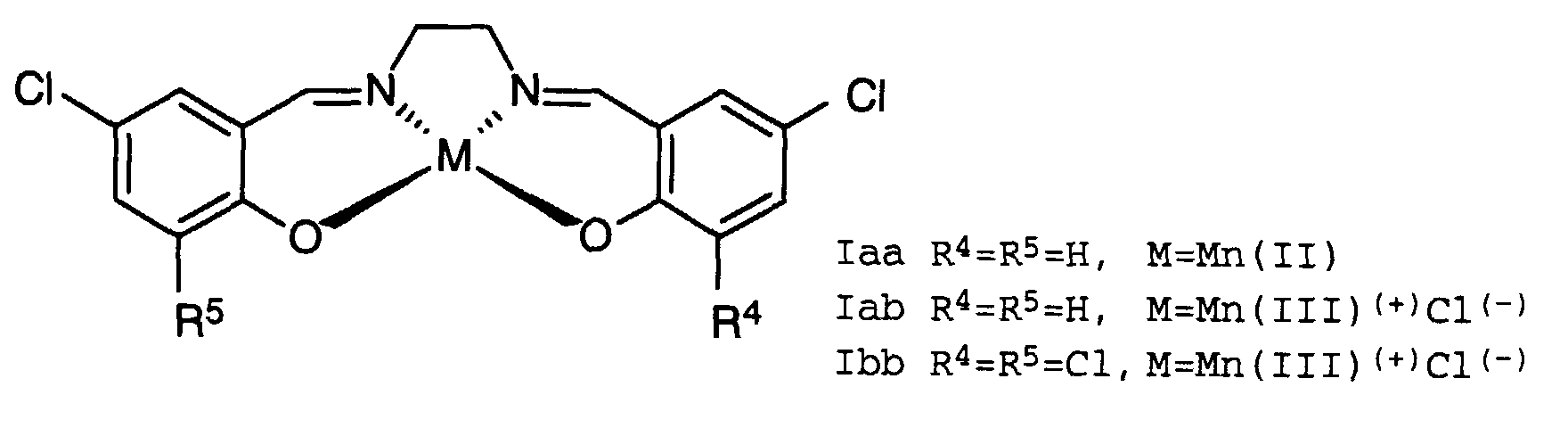
- Ausbeute:
- 7,4 - 7,7 g (94 bis 99 % der Theorie)
- Ausbeute:
- 8,40 g (99 % der Theorie)
- Ausbeute:
- 95 bis 99 % der Theorie

| Beispiel | Katalysator | Lösungsmittel | Additiv | Ausbeute in [%] | |||||
| OIP | β-IP | α-IP (IV) | V | VI | VII | ||||
| 4 | Iaa | DMF | LiOAc | 85,1 | 0 | 1,6 | 1,7 | 0,3 | 2,5 |
| 5 | Iaa | DMA | LiOAc | 88,2 | 0 | 1,6 | 1,6 | 0,1 | 1,1 |
| 6 | Iab | DMF | LiOAc | 86,1 | 0,1 | 1,4 | 1,2 | 0,4 | 0,5 |
| 7 | Iab | DMA | LiOAc | 89,4 | 0 | 1,5 | 1,3 | 0 | 1,3 |
| Vergleichsbeispiel | Katalysator | Lösungsmittel | Additiv | Ausbeute in [%] | |||||
| OIP | β-IP | α-IP (IV) | V | VI | VII | ||||
| 1 | Ica | DMF | - | 82,4 | 0,3 | 1,9 | 4,4 | 0,5 | 1,2 |
| 2 | Icb | DMF | - | 81,2 | 0 | 3,2 | 3,8 | 2,9 | 2,8 |
| Zeit in [h] | β-IP-Zulauf in [%] | β-Isophoronkonzentration in [%] | ||
| ohne Additiv | mit Ammoniumacetat | mit Lithiumacetat | ||
| 0 | 0 | 0 | 0 | 0 |
| 1 | 25 | 17,3 | 13,9 | 8,7 |
| 2 | 50 | 17,5 | 13,1 | 8,6 |
| 3 | 75 | 14,9 | 12,4 | 9,3 |
| 4 | 100 | 16,6 | 11,6 | 11,0 |
| 5 | 5,8 | 5,0 | ||
| 6 | 1,8 | 1,3 | 0,6 | |
| 7 | 0,5 | 0,4 | 0,1 | |
| 8 | 0,2 | 0,1 | 0 |
Claims (9)
- Verfahren zur Herstellung von 3,5,5-Trimethylcyclohex-2-en-1,4-dion durch Oxidation von 3,5,5-Trimethyl-cyclohex-3-en-1-on mit molekularem Sauerstoff in Gegenwart eines Lösungsmittels, einer Base und einem Katalysator der allgemeinen Formel I,wobei

- R1, R2, R3, R4, R5, R6, R7 und R8
-
unabhängig voneinander Wasserstoff, Halogen, NO2, COR9, OCOR9, COOR9 , SO2R9 oder SO3R9 bedeuten, wobei - R9
- Wasserstoff oder einen C1-C4-Alkylrest bedeutet,
- M
- Mn(II), Mn(III)(+)X(-), Co(II), Co(III)(+)X(-), Fe(II), Fe(III)(+)X(-), Cu(II) oder Ru(II) bedeutet, wobei
- X(-)
- bei Metallen in der Oxidationsstufe III ein negativ geladenes Gegenion darstellt,
- R10, R11 und R12
-
unabhängig voneinander Wasserstoff, F, Cl, Br, I oder einen C1-C4-Alkylrest, - Y
- NH4 + oder ein ein- bis vierfach geladenes Metallkation der 1. bis 4. Hauptgruppe und
- m
- 1, 2, 3 oder 4 bedeuten.
- Verfahren nach Anspruch 1, dadurch gekennzeichnet, daß man als Additiv NH4OAc, LiOAc, NaOAc, KOAc oder eine Mischung dieser Acetate verwendet.
- Verfahren nach einem der Ansprüche 1 oder 2, dadurch gekennzeichnet, daß man als Lösungsmittel ein Lösungsmittel mit komplexierenden Eigenschaften verwendet.
- Verfahren nach einem der Ansprüche 1 oder 2, dadurch gekennzeichnet, daß man als Lösungsmittel Dimethylformamid (DMF), N-Methylpyrrolidon (NMP) oder Dimethylacetamid (DMA) verwendet.
- Verfahren nach einem der Ansprüche 1 bis 4, dadurch gekenn-zeichnet, daß man als Base ein Trialkylamin mit 3 bis 20 C-Atomen verwendet.
- Verfahren nach einem der Ansprüche 1 bis 4, dadurch gekennzeichnet, daß man als Base Tripropylamin verwendet.
- Verfahren nach Anspruch 1 oder 2, dadurch gekennzeichnet, daß man als Lösungsmittel Dimethylformamid (DMF) oder Dimethylacetamid (DMA) in Kombination mit Tripropylamin als Base verwendet.
- Verfahren nach Anspruch 1, dadurch gekennzeichnet, daß man das Verfahren in Gegenwart eines Katalysators der allgemeinen Formel Iadurchführt, wobei

- R4 und R5
- unabhängig voneinander Wasserstoff oder Cl
- M
- Mn(II) oder Mn(III)(+) Cl(-) bedeuten,
unter Verwendung von Dimethylformamid (DMF) oder Dimethylacetamid (DMA) als Lösungsmittel,
Tripropylamin als Base und
unter Zusatz von NH4OAc, LiOAc, NaOAc oder einer Mischung dieser Acetate als Additiv.
- Verfahren nach Anspruch 1, dadurch gekennzeichnet, daß man das Verfahren unter inverser Reaktionsführung durch Zuleiten des Edukts zur Reaktionsmischung, enthaltend das Lösungsmittel, die Base und den Katalysator, durchführt.
Applications Claiming Priority (2)
| Application Number | Priority Date | Filing Date | Title |
|---|---|---|---|
| DE19929362 | 1999-06-25 | ||
| DE19929362A DE19929362A1 (de) | 1999-06-25 | 1999-06-25 | Verfahren zur Herstellung von Oxoisophoron unter Verwendung von Additiven |
Publications (2)
| Publication Number | Publication Date |
|---|---|
| EP1063217A1 true EP1063217A1 (de) | 2000-12-27 |
| EP1063217B1 EP1063217B1 (de) | 2003-03-05 |
Family
ID=7912676
Family Applications (1)
| Application Number | Title | Priority Date | Filing Date |
|---|---|---|---|
| EP00111532A Expired - Lifetime EP1063217B1 (de) | 1999-06-25 | 2000-05-30 | Verfahren zur Herstellung von Oxoisophoron in Gegenwart eines oder mehrerer Azetatsalze |
Country Status (6)
| Country | Link |
|---|---|
| US (1) | US6297404B1 (de) |
| EP (1) | EP1063217B1 (de) |
| JP (1) | JP2001026565A (de) |
| CN (1) | CN1185196C (de) |
| AT (1) | ATE233723T1 (de) |
| DE (2) | DE19929362A1 (de) |
Cited By (2)
| Publication number | Priority date | Publication date | Assignee | Title |
|---|---|---|---|---|
| WO2003062184A1 (en) * | 2002-01-23 | 2003-07-31 | Degussa Ag | Process for the preparation of 3,5,5-trimethyl-cyclohex-2-ene-1,4-dione |
| CN110721696A (zh) * | 2019-10-01 | 2020-01-24 | 山东新和成维生素有限公司 | 一种采用钙钛矿型复合氧化物催化合成茶香酮的方法 |
Families Citing this family (5)
| Publication number | Priority date | Publication date | Assignee | Title |
|---|---|---|---|---|
| CN100999453B (zh) * | 2007-01-19 | 2010-05-19 | 福州大学 | 制备酮代异佛尔酮的原料配方及方法 |
| CN105481671B (zh) * | 2016-01-20 | 2018-03-06 | 中南大学 | 一种可在水溶液中催化烯烃烯丙位氧化的方法 |
| CN108911954B (zh) * | 2018-08-01 | 2021-03-16 | 福建省福抗药业股份有限公司 | 一种三甲基氢醌的制备方法 |
| CN109456153B (zh) * | 2018-11-26 | 2020-04-28 | 上虞新和成生物化工有限公司 | 一种氧代异佛尔酮的合成方法 |
| CN115677461B (zh) * | 2022-10-27 | 2024-10-18 | 万华化学集团股份有限公司 | 一种利用塔式反应器连续生产4-氧代异佛尔酮的方法 |
Citations (2)
| Publication number | Priority date | Publication date | Assignee | Title |
|---|---|---|---|---|
| DE2610254A1 (de) * | 1975-03-11 | 1976-09-23 | Rhone Poulenc Ind | Verfahren zur oxydation von beta- aethylenischen ketonen |
| EP0808816A1 (de) * | 1996-05-15 | 1997-11-26 | Degussa Ag | Verfahren zur Herstellung von Isoketoisophoron |
Family Cites Families (1)
| Publication number | Priority date | Publication date | Assignee | Title |
|---|---|---|---|---|
| JPS6490150A (en) | 1987-09-30 | 1989-04-06 | Soda Aromatic | Production of 3,5,5-trimethylcyclohex-2-ene-1,4-dione |
-
1999
- 1999-06-25 DE DE19929362A patent/DE19929362A1/de not_active Withdrawn
-
2000
- 2000-05-30 DE DE50001359T patent/DE50001359D1/de not_active Expired - Fee Related
- 2000-05-30 AT AT00111532T patent/ATE233723T1/de not_active IP Right Cessation
- 2000-05-30 EP EP00111532A patent/EP1063217B1/de not_active Expired - Lifetime
- 2000-06-21 US US09/598,245 patent/US6297404B1/en not_active Expired - Fee Related
- 2000-06-22 JP JP2000188222A patent/JP2001026565A/ja not_active Withdrawn
- 2000-06-26 CN CNB001187619A patent/CN1185196C/zh not_active Expired - Fee Related
Patent Citations (2)
| Publication number | Priority date | Publication date | Assignee | Title |
|---|---|---|---|---|
| DE2610254A1 (de) * | 1975-03-11 | 1976-09-23 | Rhone Poulenc Ind | Verfahren zur oxydation von beta- aethylenischen ketonen |
| EP0808816A1 (de) * | 1996-05-15 | 1997-11-26 | Degussa Ag | Verfahren zur Herstellung von Isoketoisophoron |
Cited By (2)
| Publication number | Priority date | Publication date | Assignee | Title |
|---|---|---|---|---|
| WO2003062184A1 (en) * | 2002-01-23 | 2003-07-31 | Degussa Ag | Process for the preparation of 3,5,5-trimethyl-cyclohex-2-ene-1,4-dione |
| CN110721696A (zh) * | 2019-10-01 | 2020-01-24 | 山东新和成维生素有限公司 | 一种采用钙钛矿型复合氧化物催化合成茶香酮的方法 |
Also Published As
| Publication number | Publication date |
|---|---|
| ATE233723T1 (de) | 2003-03-15 |
| CN1287110A (zh) | 2001-03-14 |
| DE50001359D1 (de) | 2003-04-10 |
| DE19929362A1 (de) | 2000-12-28 |
| EP1063217B1 (de) | 2003-03-05 |
| CN1185196C (zh) | 2005-01-19 |
| JP2001026565A (ja) | 2001-01-30 |
| US6297404B1 (en) | 2001-10-02 |
Similar Documents
| Publication | Publication Date | Title |
|---|---|---|
| DE69705720T2 (de) | Verfahren zur herstellung von heterogenem bimetallischen palladium-gold-katalysator für die herstellung von vinylacetat | |
| DE60001881T3 (de) | Verfahren zur Herstellung von Olefinoxiden | |
| EP2046721A1 (de) | Direktaminierung von kohlenwasserstoffen | |
| EP2380152B1 (de) | Verfahren zur herstellung von 3,7-diaza-bicycloý3.3.1¨nonan-metall-komplexen | |
| EP1063217B1 (de) | Verfahren zur Herstellung von Oxoisophoron in Gegenwart eines oder mehrerer Azetatsalze | |
| EP1063218A1 (de) | Verfahren zur Herstellung von Oxoisophoron | |
| DE2546139C2 (de) | Verfahren zur gleichzeitigen Herstellung von ε-Caprolacton und Essigsäure | |
| WO2002026665A2 (de) | Verfahren zur herstellung von arylverbindungen | |
| DE2949847C2 (de) | ||
| DE2162495C2 (de) | Verfahren zur Herstellung von Biphenyl und dessen Derivaten durch oxidatives Kuppeln aromatischer Verbindungen | |
| DE69800265T2 (de) | Verfahren zur Hydroxylierung von aromatischen Kohlenwasserstoffen | |
| DE112009000527T5 (de) | Hydroxyapatit mit auf dessen Oberfläche befindlichem Silber | |
| DE69701271T2 (de) | Verfahren zur Herstellung von Wasserstoffperoxid | |
| EP1035917B1 (de) | Verfahren zur herstellung eines katalysators und nach diesem verfahren erhältliche katalysatoren | |
| EP0090977B2 (de) | Verfahren zur Herstellung von Kohlensäureestern | |
| DE2908934A1 (de) | Verfahren zur herstellung von benzolcarbonsaeuren | |
| DE2061538C3 (de) | Verfahren zur Herstellung von Kobalt (III)-bis-salicylaldehydäthylendiiminat -Komplexen | |
| EP0021221A1 (de) | Verfahren zur Dimerisierung von Hexafluorpropenoxid | |
| EP1083991A1 (de) | Verfahren und katalysator zur oxidativen carbonylierung von dienen | |
| EP0381040B1 (de) | Verfahren zur Herstellung von 2,2-Dialkylpropionaldehyden | |
| DE946983C (de) | Verfahren zur Herstellung von Terephthalsaeure oder deren Mono- oder Diestern | |
| DE2039904C (de) | Verfahren zur Herstellung von Diphenylen | |
| DE2039904B (de) | Verfahren zur Herstellung von Diphenylen | |
| DE1271104B (de) | Verfahren zur Herstellung von Essigsaeure durch katalytische Gasphasenoxydation von Olefinkohlenwasserstoffen | |
| DE3616363A1 (de) | Verfahren zur herstellung von 1,4-dihydroxy-5,8-dihydronaphthalin und verwandten verbindungen |
Legal Events
| Date | Code | Title | Description |
|---|---|---|---|
| PUAI | Public reference made under article 153(3) epc to a published international application that has entered the european phase |
Free format text: ORIGINAL CODE: 0009012 |
|
| 17P | Request for examination filed |
Effective date: 20001020 |
|
| AK | Designated contracting states |
Kind code of ref document: A1 Designated state(s): AT BE CH CY DE DK ES FI FR GB GR IE IT LI LU MC NL PT SE |
|
| AX | Request for extension of the european patent |
Free format text: AL;LT;LV;MK;RO PAYMENT 20001020;SI PAYMENT 20001020 |
|
| AKX | Designation fees paid |
Free format text: AT BE CH CY DE DK ES FI FR GB GR IE IT LI LU MC NL PT SE |
|
| AXX | Extension fees paid |
Free format text: RO PAYMENT 20001020;SI PAYMENT 20001020 |
|
| GRAG | Despatch of communication of intention to grant |
Free format text: ORIGINAL CODE: EPIDOS AGRA |
|
| 17Q | First examination report despatched |
Effective date: 20020531 |
|
| GRAG | Despatch of communication of intention to grant |
Free format text: ORIGINAL CODE: EPIDOS AGRA |
|
| GRAH | Despatch of communication of intention to grant a patent |
Free format text: ORIGINAL CODE: EPIDOS IGRA |
|
| GRAH | Despatch of communication of intention to grant a patent |
Free format text: ORIGINAL CODE: EPIDOS IGRA |
|
| GRAA | (expected) grant |
Free format text: ORIGINAL CODE: 0009210 |
|
| AK | Designated contracting states |
Designated state(s): AT BE CH CY DE DK ES FI FR GB GR IE IT LI LU MC NL PT SE |
|
| AX | Request for extension of the european patent |
Extension state: RO SI |
|
| PG25 | Lapsed in a contracting state [announced via postgrant information from national office to epo] |
Ref country code: GR Free format text: LAPSE BECAUSE OF FAILURE TO SUBMIT A TRANSLATION OF THE DESCRIPTION OR TO PAY THE FEE WITHIN THE PRESCRIBED TIME-LIMIT Effective date: 20030305 Ref country code: FI Free format text: LAPSE BECAUSE OF FAILURE TO SUBMIT A TRANSLATION OF THE DESCRIPTION OR TO PAY THE FEE WITHIN THE PRESCRIBED TIME-LIMIT Effective date: 20030305 Ref country code: IE Free format text: LAPSE BECAUSE OF FAILURE TO SUBMIT A TRANSLATION OF THE DESCRIPTION OR TO PAY THE FEE WITHIN THE PRESCRIBED TIME-LIMIT Effective date: 20030305 |
|
| REG | Reference to a national code |
Ref country code: GB Ref legal event code: FG4D Free format text: NOT ENGLISH |
|
| REG | Reference to a national code |
Ref country code: CH Ref legal event code: NV Representative=s name: SCHMAUDER & PARTNER AG PATENTANWALTSBUERO Ref country code: CH Ref legal event code: EP |
|
| REG | Reference to a national code |
Ref country code: IE Ref legal event code: FG4D Free format text: GERMAN |
|
| REF | Corresponds to: |
Ref document number: 50001359 Country of ref document: DE Date of ref document: 20030410 Kind code of ref document: P |
|
| GBT | Gb: translation of ep patent filed (gb section 77(6)(a)/1977) |
Effective date: 20030425 |
|
| PG25 | Lapsed in a contracting state [announced via postgrant information from national office to epo] |
Ref country code: AT Free format text: LAPSE BECAUSE OF NON-PAYMENT OF DUE FEES Effective date: 20030530 Ref country code: CY Free format text: LAPSE BECAUSE OF FAILURE TO SUBMIT A TRANSLATION OF THE DESCRIPTION OR TO PAY THE FEE WITHIN THE PRESCRIBED TIME-LIMIT Effective date: 20030530 Ref country code: LU Free format text: LAPSE BECAUSE OF NON-PAYMENT OF DUE FEES Effective date: 20030530 |
|
| PG25 | Lapsed in a contracting state [announced via postgrant information from national office to epo] |
Ref country code: MC Free format text: LAPSE BECAUSE OF NON-PAYMENT OF DUE FEES Effective date: 20030531 |
|
| PG25 | Lapsed in a contracting state [announced via postgrant information from national office to epo] |
Ref country code: PT Free format text: LAPSE BECAUSE OF FAILURE TO SUBMIT A TRANSLATION OF THE DESCRIPTION OR TO PAY THE FEE WITHIN THE PRESCRIBED TIME-LIMIT Effective date: 20030605 Ref country code: SE Free format text: LAPSE BECAUSE OF FAILURE TO SUBMIT A TRANSLATION OF THE DESCRIPTION OR TO PAY THE FEE WITHIN THE PRESCRIBED TIME-LIMIT Effective date: 20030605 Ref country code: DK Free format text: LAPSE BECAUSE OF FAILURE TO SUBMIT A TRANSLATION OF THE DESCRIPTION OR TO PAY THE FEE WITHIN THE PRESCRIBED TIME-LIMIT Effective date: 20030605 |
|
| PG25 | Lapsed in a contracting state [announced via postgrant information from national office to epo] |
Ref country code: ES Free format text: LAPSE BECAUSE OF FAILURE TO SUBMIT A TRANSLATION OF THE DESCRIPTION OR TO PAY THE FEE WITHIN THE PRESCRIBED TIME-LIMIT Effective date: 20030930 |
|
| REG | Reference to a national code |
Ref country code: IE Ref legal event code: FD4D Ref document number: 1063217E Country of ref document: IE |
|
| ET | Fr: translation filed | ||
| PLBE | No opposition filed within time limit |
Free format text: ORIGINAL CODE: 0009261 |
|
| STAA | Information on the status of an ep patent application or granted ep patent |
Free format text: STATUS: NO OPPOSITION FILED WITHIN TIME LIMIT |
|
| 26N | No opposition filed |
Effective date: 20031208 |
|
| PGFP | Annual fee paid to national office [announced via postgrant information from national office to epo] |
Ref country code: NL Payment date: 20070503 Year of fee payment: 8 |
|
| PGFP | Annual fee paid to national office [announced via postgrant information from national office to epo] |
Ref country code: DE Payment date: 20070524 Year of fee payment: 8 |
|
| PGFP | Annual fee paid to national office [announced via postgrant information from national office to epo] |
Ref country code: CH Payment date: 20070530 Year of fee payment: 8 |
|
| PGFP | Annual fee paid to national office [announced via postgrant information from national office to epo] |
Ref country code: GB Payment date: 20070530 Year of fee payment: 8 |
|
| PGFP | Annual fee paid to national office [announced via postgrant information from national office to epo] |
Ref country code: IT Payment date: 20070508 Year of fee payment: 8 |
|
| PGFP | Annual fee paid to national office [announced via postgrant information from national office to epo] |
Ref country code: BE Payment date: 20070719 Year of fee payment: 8 |
|
| PGFP | Annual fee paid to national office [announced via postgrant information from national office to epo] |
Ref country code: FR Payment date: 20070510 Year of fee payment: 8 |
|
| BERE | Be: lapsed |
Owner name: *BASF A.G. Effective date: 20080531 |
|
| REG | Reference to a national code |
Ref country code: CH Ref legal event code: PL |
|
| GBPC | Gb: european patent ceased through non-payment of renewal fee |
Effective date: 20080530 |
|
| PG25 | Lapsed in a contracting state [announced via postgrant information from national office to epo] |
Ref country code: CH Free format text: LAPSE BECAUSE OF NON-PAYMENT OF DUE FEES Effective date: 20080531 Ref country code: NL Free format text: LAPSE BECAUSE OF NON-PAYMENT OF DUE FEES Effective date: 20081201 Ref country code: LI Free format text: LAPSE BECAUSE OF NON-PAYMENT OF DUE FEES Effective date: 20080531 |
|
| REG | Reference to a national code |
Ref country code: FR Ref legal event code: ST Effective date: 20090119 |
|
| PG25 | Lapsed in a contracting state [announced via postgrant information from national office to epo] |
Ref country code: BE Free format text: LAPSE BECAUSE OF NON-PAYMENT OF DUE FEES Effective date: 20080531 |
|
| PG25 | Lapsed in a contracting state [announced via postgrant information from national office to epo] |
Ref country code: FR Free format text: LAPSE BECAUSE OF NON-PAYMENT OF DUE FEES Effective date: 20080602 Ref country code: DE Free format text: LAPSE BECAUSE OF NON-PAYMENT OF DUE FEES Effective date: 20081202 |
|
| PG25 | Lapsed in a contracting state [announced via postgrant information from national office to epo] |
Ref country code: GB Free format text: LAPSE BECAUSE OF NON-PAYMENT OF DUE FEES Effective date: 20080530 |
|
| PG25 | Lapsed in a contracting state [announced via postgrant information from national office to epo] |
Ref country code: IT Free format text: LAPSE BECAUSE OF NON-PAYMENT OF DUE FEES Effective date: 20080530 |