EP1063776A2 - Turbo décodeur - Google Patents
Turbo décodeur Download PDFInfo
- Publication number
- EP1063776A2 EP1063776A2 EP00110944A EP00110944A EP1063776A2 EP 1063776 A2 EP1063776 A2 EP 1063776A2 EP 00110944 A EP00110944 A EP 00110944A EP 00110944 A EP00110944 A EP 00110944A EP 1063776 A2 EP1063776 A2 EP 1063776A2
- Authority
- EP
- European Patent Office
- Prior art keywords
- scaling
- range
- decoding
- turbo decoder
- decoder according
- Prior art date
- Legal status (The legal status is an assumption and is not a legal conclusion. Google has not performed a legal analysis and makes no representation as to the accuracy of the status listed.)
- Withdrawn
Links
Images







Classifications
-
- H—ELECTRICITY
- H03—ELECTRONIC CIRCUITRY
- H03M—CODING; DECODING; CODE CONVERSION IN GENERAL
- H03M13/00—Coding, decoding or code conversion, for error detection or error correction; Coding theory basic assumptions; Coding bounds; Error probability evaluation methods; Channel models; Simulation or testing of codes
- H03M13/29—Coding, decoding or code conversion, for error detection or error correction; Coding theory basic assumptions; Coding bounds; Error probability evaluation methods; Channel models; Simulation or testing of codes combining two or more codes or code structures, e.g. product codes, generalised product codes, concatenated codes, inner and outer codes
- H03M13/2957—Turbo codes and decoding
- H03M13/2978—Particular arrangement of the component decoders
- H03M13/2984—Particular arrangement of the component decoders using less component decoders than component codes, e.g. multiplexed decoders and scheduling thereof
-
- H—ELECTRICITY
- H03—ELECTRONIC CIRCUITRY
- H03M—CODING; DECODING; CODE CONVERSION IN GENERAL
- H03M13/00—Coding, decoding or code conversion, for error detection or error correction; Coding theory basic assumptions; Coding bounds; Error probability evaluation methods; Channel models; Simulation or testing of codes
- H03M13/27—Coding, decoding or code conversion, for error detection or error correction; Coding theory basic assumptions; Coding bounds; Error probability evaluation methods; Channel models; Simulation or testing of codes using interleaving techniques
- H03M13/2792—Interleaver wherein interleaving is performed jointly with another technique such as puncturing, multiplexing or routing
-
- H—ELECTRICITY
- H03—ELECTRONIC CIRCUITRY
- H03M—CODING; DECODING; CODE CONVERSION IN GENERAL
- H03M13/00—Coding, decoding or code conversion, for error detection or error correction; Coding theory basic assumptions; Coding bounds; Error probability evaluation methods; Channel models; Simulation or testing of codes
- H03M13/29—Coding, decoding or code conversion, for error detection or error correction; Coding theory basic assumptions; Coding bounds; Error probability evaluation methods; Channel models; Simulation or testing of codes combining two or more codes or code structures, e.g. product codes, generalised product codes, concatenated codes, inner and outer codes
-
- H—ELECTRICITY
- H03—ELECTRONIC CIRCUITRY
- H03M—CODING; DECODING; CODE CONVERSION IN GENERAL
- H03M13/00—Coding, decoding or code conversion, for error detection or error correction; Coding theory basic assumptions; Coding bounds; Error probability evaluation methods; Channel models; Simulation or testing of codes
- H03M13/29—Coding, decoding or code conversion, for error detection or error correction; Coding theory basic assumptions; Coding bounds; Error probability evaluation methods; Channel models; Simulation or testing of codes combining two or more codes or code structures, e.g. product codes, generalised product codes, concatenated codes, inner and outer codes
- H03M13/2957—Turbo codes and decoding
-
- H—ELECTRICITY
- H03—ELECTRONIC CIRCUITRY
- H03M—CODING; DECODING; CODE CONVERSION IN GENERAL
- H03M13/00—Coding, decoding or code conversion, for error detection or error correction; Coding theory basic assumptions; Coding bounds; Error probability evaluation methods; Channel models; Simulation or testing of codes
- H03M13/65—Purpose and implementation aspects
- H03M13/6577—Representation or format of variables, register sizes or word-lengths and quantization
- H03M13/658—Scaling by multiplication or division
-
- H—ELECTRICITY
- H03—ELECTRONIC CIRCUITRY
- H03M—CODING; DECODING; CODE CONVERSION IN GENERAL
- H03M13/00—Coding, decoding or code conversion, for error detection or error correction; Coding theory basic assumptions; Coding bounds; Error probability evaluation methods; Channel models; Simulation or testing of codes
- H03M13/65—Purpose and implementation aspects
- H03M13/6577—Representation or format of variables, register sizes or word-lengths and quantization
- H03M13/6583—Normalization other than scaling, e.g. by subtraction
Definitions
- the present invention relates to a turbo decoder for decoding a sequence that has been generated according to a turbo-coding scheme.
- a transmission system using a turbo-decoding scheme can provide, for a desired transmission rate (SN ratio), an SN ratio (transmission rate) that is very close to the maximum SN ratio (transmission rate; generally called the Shannon limit) that is given by Shannon's channel coding theorem, because decoding that conforms to an error correcting coding scheme that was used in the transmitting end is repeatedly performed in the receiving end.
- SN ratio desired transmission rate
- transmission rate transmission rate
- turbo coder and the turbo decoder are promising as devices that can be applied to not only deep space communication but also mobile communication, broadcast, and reproduction systems of magnetic recording media, and applications in these fields are now being studied, developed, and put into practical use enthusiastically.
- Fig. 9 is a block diagram showing the configuration of a first example transmission system using a turbo-decoding scheme.
- a transmitting end 90 and a receiving end 91 are connected to each other via a transmission path 92.
- transmission information U is supplied to a turbo coder 93 and the outputs of the turbo coder 93 are connected to one ends of the transmission path 92.
- the transmission information U is supplied to the inputs of an elementary encoder 94-1 and an interleaver ( ⁇ ) 95 and the output of the interleaver 95 is connected to the input of an elementary encoder 94-2.
- a transmission sequence consisting of the following items is obtained at the output of the turbo coder 93:
- the received sequence is deteriorated in SN ratio because of a fluctuation of the transmission characteristics of the transmission path 92 and noise that has been superimposed in the transmission path 92.
- the output corresponding to the words ya is connected to the first input of an elementary decoder 97-1 and the input of an interleaver ( ⁇ ) 98-1.
- the output of the interleaver 98-1 is connected to the first input of an elementary decoder 97-2.
- the outputs corresponding to the words yb and yc are connected to the second inputs of the respective elementary decoders 97-1 and 97-2.
- the output of the elementary decoder 97-1 is connected to the third input of the elementary decoder 97-2 via an interleaver 98-2.
- One output of the elementary decoder 97-2 is connected to the third input of the elementary decoder 97-1 via a de-interleaver ( ⁇ -1) 99-1, and the other output of the elementary decoder 97-2 is connected to the input of a de-interleaver ( ⁇ -1 ) 99-2.
- a decoding result is obtained at the output of the de-interleaver 99-2.
- each of the elementary coders 94-1 and 94-2 is convolutional coding using a common constraint length and rate of coding.
- a received sequence that has been transmitted over the transmission path 92 is separated into words ya, yb, and yc on a prescribed code block basis and stored in storage areas of the receive buffer 96 corresponding to the respective kinds of words ya, yb, and yc.
- the elementary decoders 97-1 and 97-2, the interleavers 98-1 and 98-2, and the de-interleavers 99-1 and 99-2 are initialized prior to a start of decoding processing to be performed on those code blocks.
- the elementary decoder 97-1 After completion of the initialization, the elementary decoder 97-1 outputs a likelihood L1 by performing decoding processing that conforms to the coding processing that was performed by the elementary coder 94-1 in the transmitting end 90 on a likelihood that is supplied from the elementary decoder 97-2 via the de-interleaver 99-1 and words ya and yb that are supplied from the receive buffer 96 on a bit-by-bit basis.
- the interleavers 98-1 and 98-2 perform the same interleave processing as performed by the interleaver 95 in the transmitting end 90 on the word ya that is supplied parallel from the receive buffer 96 and the likelihood L1, respectively.
- the elementary decoder 97-2 outputs a likelihood L2 and a demodulation result (for simplicity, it is assumed here that the demodulation result is obtained as a result of hard decision) by performing decoding processing that conforms to the coding processing that was performed by the elementary coder 94-2 in the transmitting end 90 on results of the above interleave processing and a word yc that is supplied from the receive buffer 96 on a bit-by-bit basis.
- the de-interleaver 99-2 outputs a most probable decoding result for the transmission information U by de-interleaving the demodulation result in the same manner as the de-interleaver 99-1 does.
- the elementary decoders 97-1 and 97-2, the interleavers 98-1 and 98-2, and the de-interleavers 99-1 and 99-2 cooperate to repeatedly perform, together with the receive buffer 96, the above processing on a bit-by-bit basis a prescribed number of times.
- Fig. 10 is a block diagram showing the configuration of a second transmission system using a turbo-decoding scheme.
- the transmission system of Fig. 10 is different in configuration from that of Fig. 9 in a receiving end 91A that replaces the receiving end 91.
- decoding processing corresponding to the coding processing performed by the elementary coder 94-1 in the transmitting end 90 and decoding processing corresponding to the coding processing performed under cooperation between the interleaver 95 and the elementary coder 94-2 are performed in order that is reverse to the order in the receiving end 91 shown in Fig. 9.
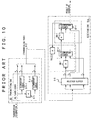
- Fig. 11 is a block diagram showing the configuration of a third transmission system using a turbo-decoding scheme.
- the transmission system of Fig. 11 is different in configuration from that of Fig. 9 in a receiving end 91B that replaces the receiving end 91.
- the receiving end 91B is different in configuration from the receiving end 91 in that an elementary decoder 100 serving as both of the elementary decoders 97-1 and 97-2 is provided in place of the elementary decoders 97-1 and 97-2; that an interleaver 101 is provided in place of the interleaver 98-1; that a de-interleaver 102 is provided in place of the de-interleaver 99-2; that a feedback processing part 103 serving as both of the interleaver 98-2 and the de-interleaver 99-1 is provided in place of the interleaver 98-2 and the de-interleaver 99-1; that a selector 104 is provided between the outputs corresponding to words yb and yc among the outputs of the receive buffer 96 and one input of the elementary decoder 100; and that a controlling part 105 is provided to which output ports corresponding to control terminals of the elementary decoder 100, the interleaver 101, the de-interleaver 102, the feedback processing
- the controlling part 105 synchronizes with words ya, yb, and yc that are read out from the receive butter 96 on a bit-by-bit basis and alternately makes switching for the following forms and pieces of information on a bit-by-bit basis:
- the elementary decoder 100 performs decoding processing that is equivalent to the decoding processing that is performed by the elementary decoders 97-1 and 97-2 shown in Fig. 9 or 10 by cooperating with the interleaver 101, the de-interleaver 102, the feedback processing part 103, the selector 104, and the receive buffer 96 under the control of the controlling part 105.
- the performance of the receiving end 91B does not lower as long as the above-described cooperation is made properly and the decoding processing that is performed under such cooperation is performed at a prescribed speed, and its hardware scale is made smaller than of the receiving ends 91 or 91A shown in Fig. 9 or 10.
- the information S is a permutation of symbols "yb" and "yc" showing respective words yb and yc to be selected by the selector 104 that are separated by a separator "/" and selected in time-series order cyclically.
- Fig. 11 two kinds of information enclosed in less than and greater than signs ⁇ > or parentheses () are shown for each of the pieces of information I, D, F, and S.
- the information enclosed in less than and greater than signs ⁇ > indicates a combination to be used to realize processing that is equivalent to the decoding processing that is performed in the receiving end 91 shown in Fig. 9.
- the information enclosed in parentheses () indicates a combination to be used to realize processing that is equivalent to the decoding processing that is performed in the receiving end 91A shown in Fig. 10.
- the likelihood value L1 or L2 that is computed by the elementary decoders 97-1, 97-2, or 100 increases as the number N of times of repetitive execution of the above-described decoding processing by the elementary decoder 97-1, 97-2 or 100 increases.
- the elementary decoders 97-1, 97-2, 100 need to perform operations with a word length that is much longer than the word length of words ya, yb, and yc that are obtained as a received sequence.
- the word length per unit storage area of a memory to be used for the interleave processing or the de-interleave processing by the interleavers 98-1 and 98-2 and the de-interleavers 99-1 and 99-2 also becomes very long.
- the scale of hardware constituting the receiving end becomes larger when larger deterioration in transmission quality may occur in the transmission path 92.
- An object of the present invention is to provide a turbo decoder which can flexibly adapt to a variety of transmission characteristics of transmission paths and can secure high transmission quality without the need for greatly changing the hardware scale and configuration.
- Another object of the invention is to provide a turbo decoder which can prevent a large drop in the accuracy of obtaining likelihood and approximately keep the range of likelihood values fixed even in a case where likelihood is obtained repeatedly over a large number of times or over a number of times that may vary to a large extent during the course of turbo-decoding.
- Another object of the invention is to provide a turbo decoder which can make the gain of turbo-decoding larger than in a case where interleave processing is performed with a constant word length and precision irrespective of the form of scaling that is determined by a scaling section (described later).
- Still another object of the invention is to provide a turbo decoder which can reduce the scale of hardware and enables efficient turbo-decoding even in a case where coding is repeated over a number N of times during the course of turbo-coding, where N is large or may be changed.
- Yet another object of the invention is to provide a turbo decoder which can reduce the scale of hardware and enables efficient turbo-decoding not only in a case where coding is repeated over a large number of times or over a variable number of times during the course of turbo-coding, but even in a case where the coding scheme is unfixed or may vary.
- a further object of the invention is to provide a turbo decoder which can simplify the configuration of hardware as long as the word length of the likelihood determined by the decoding section is within an allowable range.
- Another object of the invention is to provide a turbo decoder which can determine likelihood with high accuracy during the course of turbo-decoding while preventing the order from increasing rapidly.
- Another object of the invention is to provide a turbo decoder which can perform scaling efficiently with high reliability, according to simple arithmetic operations.
- Still another object is to provide a turbo decoder which can simplify the configuration of a decoding section that is incorporated in a transmission system or equipment.
- Yet another object of the invention is to provide a turbo decoder which can reduce the cost, size, and power consumption of a transmission system and equipment, increase their reliability, realize highly accurate, highly efficient decoding, and improve the transmission quality and performance.
- turbo decoder in which a distribution of likelihood values that are obtained during the course of turbo-decoding is watched and the object of an operation to be subjected to the computation of likelihood subsequent to the turbo-decoding is scaled in accordance with the distribution.
- turbo decoder in which interleave processing to be performed during the subsequent operation is performed in block on a word, among the objects of the turbo-decoding, representing transmission information that was appended on a common code block without being subjected to any coding on a transmitting end.
- the gain of the turbo-decoding can be enlarged compared to a case where such interleave processing is performed with constant word length and accuracy irrespective of such scaling.
- turbo decoder in which interleave processing is newly performed in block after de-interleave processing that nullifies all interleave processing that was performed while a pre-operation was performed.
- the gain of the turbo-decoding can be enlarged compared to a case where the interleave processing is performed with a constant word length and precision irrespective of the form of the scaling that is determined by the scaling section.
- turbo decoder in which elementary decoders are provided in a number that is smaller than the number of times coding was performed during the course of turbo-coding on a transmitting end and in which it performs desired decoding processing by these elementary decoders according to pipeline control.
- the scale of hardware can be reduced and efficient turbo-decoding is enabled even in a case where coding is repeated over a number N of times during the course of turbo-coding, where N is large or may vary.
- turbo decoder in which the number of the elementary decoders provided is "1" and plural kinds of turbo-decoding, including the desired decoding processing are performed in series by the elementary decoder.
- the scale of hardware can be reduced and efficient turbo-decoding is enabled not only in a case where coding is repeated over a large number of times or over a variable number of times during the course of turbo-coding, but even in a case where the coding scheme is unfixed or may be changed.
- turbo decoder in which interleave processing and de-interleave processing to be performed repeatedly during the course of the turbo-decoding are performed while reading from a memory for storing an operation object of the interleave processing and the de-interleave processing.
- a turbo decoder in which when an order increase between a previously obtained likelihood and a subsequently obtained likelihood has exceeded a prescribed value, the likelihood is rounded and used in a further subsequent operation.
- a turbo decoder in which the likelihood range (likelihood value distribution) is recognized as a maximum value or an average value of likelihood values obtained previously.
- Fig. 1 is a block diagram showing the principles of first to fourth turbo decoders according to the invention.
- the principle of the first turbo decoder according to the invention is as follows.
- a decoding section 11 accepts a received sequence on a code block basis and turbo-decoding on the received sequence by restoring transmission information represented by the received sequence.
- a range watching section 12 obtains a distribution of likelihood values that are obtained during the course of the turbo-decoding performed by the decoding section 11.
- a scaling section 13 determines a scaling that will suppress a variation of a distribution of likelihood values obtained as a result of a subsequent operation, to be a scaling for an object of the subsequent operation performed under the distribution obtained by the range watching section 12, where the subsequent operation is performed for the decoding section 11 to complete the turbo-decoding for a common code block.
- the decoding section 11 applies the scaling determined by the scaling section 13 to the object of the subsequent operation.
- the principle of the second turbo decoder according to the invention is as follows.
- the decoding section 11 performs, in block, interleave processing to be performed prior to both a pre-operation that was performed prior to the subsequent operation on a non-coded word, among the objects of the subsequent operation, representing transmission information that was appended to the common code block on a transmitting end without being subjected to any coding, and the subsequent operation, and applies the scaling determined by the scaling section 13 to the non-coded word.
- the principle of the third turbo decoder according to the invention is as follows.
- the decoding section 11 performs, in block, de-interleave processing that is reversible to all interleave processing that was performed during a pre-operation that was performed prior to the subsequent operation and all interleave processing to be performed prior to the pre-operation and the subsequent operation on a non-coded word, among the objects of the subsequent operation, subjected to the pre-operation and represents transmission information appended to the common code block without being subjected to any coding on a transmitting end, and applies the scaling determined by the scaling section 13 to the non-coded word.
- de-interleave processing that nullifies all interleave processing that was performed during a pre-operation is performed on a non-coded word to be subjected to the subsequent operation before execution of prescribed interleave processing with a word length and accuracy that conform to the scaling determined by the scaling section 13.
- the gain of the turbo-decoding can be enlarged compared to a case where the interleave processing is performed with a constant word length and accuracy irrespective of the form of the scaling that is determined by the scaling section 13.
- the principle of the fourth turbo decoder according to the invention is as follows.
- the decoding section 11 has number n of elementary decoders 21-1 to 21-n and turbo-decodes the received sequence according to a pipeline control while cooperating with the n of elementary decoders 21-1 to 21-n, n being smaller than the number N of times coding was performed during the course of turbo-coding on a transmitting end to generate a transmission sequence corresponding to the received sequence.
- the scale of hardware can be reduced and efficient turbo-decoding is enabled even in a case where coding is repeated over a number N of times during the course of turbo-coding, where N is large or may vary.
- Fig. 2 is a block diagram showing the principles of fifth to eighth turbo decoders according to the invention.
- the principle of the fifth turbo decoder according to the invention is as follows.
- the decoding section 11 has a single elementary decoder 31 that can adapt to all of a plurality of decoding schemes that were employed during the course of turbo-coding on a transmitting end to generate a transmission sequence corresponding to the received sequence and performs decoding according to a single designated decoding scheme among the plurality of decoding schemes, and turbo-decodes the received sequence by decoding in series according to the plurality of decoding schemes by using the single elementary decoder 31.
- the scale of hardware can be reduced and efficient turbo-decoding is enabled not only in a case where coding is repeated over a large number of times or over a variable number of times during the course of turbo-coding, but even in a case where the coding scheme is unfixed or may vary.
- the principle of the sixth turbo decoder according to the invention is as follows.
- the decoding section 11 has a memory 11M to be used in interleave processing and de-interleave processing that are performed on the object of the subsequent operation prior to the subsequent operation, and performs the scaling determined by the scaling section 13 while reading from the memory 11M.
- the configuration of hardware can be simplified as long as the word length of a likelihood determined by the decoding section 11 and can be stored in the memory 11M is within an allowable range.
- the principle of the seventh turbo decoder according to the invention is as follows.
- the scaling section 13 obtains, when the scaling should be updated, a range of varied likelihood values as compared with previously determined scaling, and employs, as new scaling, scaling that makes a width of the range smaller than a prescribed threshold value when the width of the range has exceeded the prescribed threshold value.
- the principle of the eighth turbo decoder according to the invention is as follows.
- the range watching section 12 obtains the likelihood value distribution as a maximum value or an average value of likelihood values obtained previously.
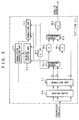
- Fig. 3 is a block diagram showing a first embodiment of the invention.
- This embodiment is different in configuration from the conventional example of Fig. 9 in that a normalizing part 51 is provided between the receive buffer 96 and the elementary decoders 97-1 and 97-2 and the interleaver 98-1; that a normalizing part 52 is provided having a ports that are interposed between the output of the elementary decoder 97-1 and the input of the interleaver 98-2 and ports that are interposed between the output of the elementary decoder 97-2 and the input of the de-interleaver 99-1; that a valid bit detecting part 53 is provided that is directly connected to the outputs of the elementary decoders 97-1 and 97-2; and that a normalization controlling part 54 is provided whose input is directly connected to the output of the valid bit detecting part 53 and that has outputs connected to the control inputs of the respective normalizing parts 51 and 52.
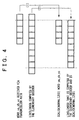
- Fig. 4 is a chart showing the operation of the first embodiment of the invention. The operation of this embodiment will be described below with reference to Figs. 3 and 4.
- the valid bit detecting part 53 outputs, for likelihoods computed by the elementary decoders 97-1 and 97-2, initial values of order identification information indicating a standard range where the elementary decoders 97-1 and 97-2 can cooperate with the interleavers 98-1 and 98-2 and the de-interleavers 99-1 and 99-2 without causing overflow or a truncation error and the number of bits that conforms to the standard range.
- the valid bit detecting part 53 determines order identification information indicating the number of bits effectively representing likelihoods that have been computed by the elementary decoders 97-1 and 97-2 in the same manner as in the conventional example (e.g., bits excluding both or one of useless bits having a value "0" among high-order bits and useless bits having a value "0" among low-order bits) among all the bits representing those likelihoods as well as a weight (order) of those bits.
- the normalization controlling part 54 judges the magnitude relationship between the following items:
- the normalization controlling part 54 generates first and second selection signals indicating bit-based scaling that assures continuation of the above-mentioned cooperation by correcting the new number of bits and the order identification information in accordance with a result of the above judgment.
- the normalizing part 51 performs the above-mentioned scaling (indicated by symbol (1) in Fig. 4) by extracting the bits of the order and the number of bits indicated by the first selection signal from bit strings representing words ya, yb, and yc that are read out cyclically from the receive buffer 96 in the same manner as in the conventional example, and supplies words ya, yb, and yc that are obtained as a result of the scaling to the elementary decoders 97-1 and 97-2 and the interleaver 98-1.
- the normalizing part 52 similarly performs the above-mentioned scaling (indicated by symbol (2) in Fig. 4) by extracting the bits of the order and the number of bits indicated by the second selection signal from bit strings representing likelihoods computed by the respective elementary decoders 97-1 and 97-2, and supplies likelihoods that are obtained as a result of the scaling to the interleaver 98-2 and the de-interleaver 99-1, respectively.
- the scale of hardware constituting the normalizing parts 51 and 52, the valid bit detecting part 53, and the normalization controlling part 54 is much smaller than the scale of hardware constituting computing units and memories that increases as the number of times of repetition of decoding processing increases.
- this embodiment suppresses lowering in reliability and increase in running cost to very small degrees and enables accurate turbo-decoding.
- Fig. 5 is a block diagram showing a second embodiment of the invention.
- This embodiment is different in configuration from the conventional example of Fig. 11 in that an interleaver 61, a de-interleaver 62, a feedback processing part 63, a controlling part 64, and a selector 65 are provided in place of the interleaver 101, the de-interleaver 102, the feedback processing part 103, the controlling part 105, and the selector 104, respectively; and that a valid bit detecting part 66 is provided whose input is directly connected, together with the input of the feedback processing part 63, to a corresponding output of the elementary decoder 100 and whose output is connected to a corresponding input port of the controlling part 64.
- the valid bit detecting part 66 determines the number of bits and order identification information in accordance with a likelihood computed by the elementary decoder 100.
- the controlling part 64 judges the magnitude relationship between the new number of bits and the prescribed word lengths of words ya, yb, and yc and a likelihood to be input to the elementary decoder 100, the interleaver 101, and the de-interleaver 102 in the same manner as the normalization controlling part 54 shown in Fig. 3 does.
- the controlling part 64 determines bit-based scaling that assures continuation of the above-mentioned cooperation by correcting the new number of bits and the order identification information in accordance with a result of the above judgment.
- the controlling part 64 synchronizes with words ya, yb, and yc that are read out from the receive buffer 96 on a bit-by-bit basis and generates pieces of information I, D, F, and S (described above) on a bit-by-bit basis.
- controlling part 64 generates pieces of information i, d, f, and s by appending scaling pointers indicating the above-mentioned scaling to the respective pieces of information I, D, F, and S, and supplies those pieces of information i, d, f, and s to the interleaver 61, the de-interleaver 62, the feedback processing part 63, and the selector 65, respectively.
- the selector 65 performs scaling by extracting the bits of the order and the number of bits indicated by the scaling pointer included in the information s from bit strings representing words yb and yc that are read out from the receive buffer 96 cyclically in accordance with the scaling pointer included in the information s in the same manner as the normalizing part 51 does.
- the selector 65 supplies words yb or yc obtained as a result of the scaling to the elementary decoder 100.
- the interleaver 61 performs scaling by extracting the bits of the order and the number of bits indicated by the scaling pointer included in the information i from a bit string representing a word ya that is read out from the receive buffer 96 cyclically in accordance with the scaling information included in the information i in the same manner as the normalizing part 51 does.
- the interleaver 61 supplies a word ya obtained as a result of the scaling to the elementary decoder 100.
- the feedback processing part 63 performs scaling indicated by the scaling pointer included in the information f in the same manner as the normalizing part 52 does.
- the elementary decoder 100 performs decoding processing that is equivalent to the decoding processing that is performed by the elementary decoders 97-1 and 97-2 shown in Figs. 9 and 10 in the same manner as in the conventional example of Fig. 11.
- this embodiment makes the hardware scale smaller than in the embodiment of Fig. 3 while avoiding overflow and minimizing rounding errors like the embodiment of Fig. 3.
- Fig. 6 is a block diagram showing a third embodiment of the invention.
- This embodiment is different in configuration from the embodiment of Fig. 3 in that an interleaver 71 is provided in place of the interleaver 98-2; that a de-interleaver 72 is provided in place of the de-interleaver 99-1; that the normalizing part 52 is not provided; and of the outputs of the normalization controlling part 54 the output connected to the normalization section 52 in Fig. 3 is connected to corresponding inputs of the interleaver 71 and the de-interleaver 72.
- the interleaver 71 has a memory 71M to be used for interleave processing and a reading circuit 71R that has a bus to be used for reading from the memory 71M and a control terminal connected to a corresponding output of the normalization controlling part 54 and that performs addressing for reading from the memory 71M.
- the de-interleaver 72 has a memory 72M to be used for de-interleave processing and a reading circuit 72R that has a bus to be used for reading from the memory 72M and a control terminal connected to a corresponding output of the normalization controlling part 54 and that performs addressing for reading from the memory 72M.
- the word lengths of the storage areas of the memory 71M provided in the interleaver 71 and the memory 72M provided in the de-interleaver 72 are preset at values that assure reliable storage of valid bit strings representing likelihoods that can be computed by the elementary decoders 97-1 and 97-2 in the same manner as in the embodiment of Fig. 3.
- Likelihoods computed by the elementary decoders 97-1 and 97-2 are written cyclically to the storage areas of the memories 71M and 72M according to prescribed addressing (hereinafter referred to as "write addressing").
- the reading circuits 71R and 72R read out the likelihoods that have been written to the storage areas of the memories 71M and 72M according to read addressing that is different from the above write addressing, perform scaling instead of the normalizing part 52 shown in Fig. 3 by extracting the bits of the order and the number of bits indicated by a second signal that is supplied from the normalizing part 54 from bits strings representing the read-out likelihoods, and supply likelihoods that are obtained as a result of the scaling to the respective elementary decoders 97-2 and 97-1, respectively.
- this embodiment can simplify the hardware configuration without lowering the accuracy of decoding as long as the number of valid bits representing likelihoods that can be computed by the elementary decoders 97-1 and 97-2 is allowable.
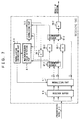
- Fig. 7 is a block diagram showing a fourth embodiment of the invention.
- This embodiment is different in configuration from the embodiment of Fig. 3 in that a maximum/minimum value detecting part 81 is provided in place of the valid bit detecting part 53.
- Fig. 8 shows the operation of the fourth embodiment of the invention. The operation of this embodiment will be described below with reference to Figs. 7 and 8.
- the maximum/minimum value detecting part 81 accepts likelihoods (hereinafter referred to as “updated likelihoods”) computed by the elementary decoders 97-1 and 97-2, and judges, for the values of updated likelihoods that are given according to scaling that is applied in advance (hereinafter referred to as "pre-scaling"), the magnitude relationship between:
- the maximum/minimum value detecting part 81 generates the following identification information by performing the above judgment:
- the normalization controlling part 54 and the normalizing parts 51 and 52 perform the scaling indicated by such order identification information while cooperating with each other in accordance with such order identification information.
- the normalizing parts 51 and 52 can change the scaling step by step without causing unduly large rounding errors even when the value or distribution of likelihoods that are obtained as a result of decoding that is repeatedly performed by the elementary decoders 97-1 and 97-2 varies rapidly as long as the above-mentioned difference between the maximum value and upper limit and the above-mentioned difference between the lower limit and minimum value are set at proper values in advance.
- the order of a likelihood that is obtained as a result of a subsequent decoding operation is prevented from increasing rapidly by 2 or more bits by setting the above-mentioned difference between the maximum value and upper limit and the above-mentioned difference between the lower limit and minimum value at proper values.
- the following processing may be performed by the maximum/minimum value detecting part 81 and scaling that is adapted to such order identification information (including appended information) may be performed by the normalization controlling part 54 and the normalizing parts 51 and 52:
- the above configuration secures flexible adaptability to the forms of the interleave processing performed by the interleavers 98-1 and 98-2 and the de-interleave processing performed by the de-interleavers 99-1 and 99-2 in addition to the scheme of decoding operations performed by the elementary decoders 97-1 and 97-2, and increases the stability to errors and deviations of the above-mentioned upper limit and lower limit.
- Each of the above embodiments does not specify a detailed procedure of the processing performed by the valid bit detecting part 53 or 66 or the maximum/minimum value detecting part 81.
- the procedure may be in any form as long as it can adapt to a distribution (described above) of likelihood values and can prevent overflow and generation of useless rounding errors during the course of operations to be performed subsequently.
- Each of the above embodiments does not disclose the format of a bit string representing a likelihood that is determined by the elementary decoder 97-1, 97-2 or 100.
- the format may be in any form as long as a bit string as an object of subsequent operations (described above) is subjected to interleave processing and de-interleave processing with desired accuracy and scaling is performed thereon properly.
- the procedure of the decoding operation to be performed by the elementary decoder 97-1, 97-2, or 100, the form of the interleave processing performed by the interleaver 98-1, 98-2, 61, or 71 or the feedback processing part 63, and the form of the de-interleave processing to be performed by the de-interleaver 99-1, 99-2, or 62 or the feedback processing part 63 are fixed.
- the procedure of such a decoding operation, the decoding scheme, the form of the interleave processing, and the form of the de-interleave processing may be switched properly as long as related information is given as known information in synchronism with a received sequence.
- Each of the above embodiments does not specify the algorithm of the decoding processing performed by the elementary decoder 97-1, 97-2, or 100.
- the decoding processing which is not a feature that characterizes the invention, can be realized according to not only the Viterbi decoding but also the following decoding schemes as long as they can adapt to the coding processing performed by the elementary coders 94-1 and 94-2 that are provided in the transmitting end 90 and can realize desired accuracy and response speed:
- the standard may be any of the following and other standards, and is not a feature that characterizes the invention. Further, use of a variety of known algorithms is possible for the standard. Therefore, the standard will not be described below.
- scaling of likelihood and a word ya to become objects of a subsequent operation is performed on a bit-by-bit basis upon a start of the operation.
- the scaling may be performed every word length (bits) that is predetermined for the word length of a symbol at each symbol point as long as the scaling adapts to a signal space diagram under a modulation scheme that was applied to a received sequence that is transmitted over the transmission path 92 when turbo-decoding is realized at a desired speed with desired accuracy.
- the scaling of a likelihood and a word ya may be performed at any time point of a subsequent operation that is performed to complete the turbo-decoding on a code block (a word ya, yb, or yc) basis.
- the scaling may be performed plural times.
- the number n of elementary decoders to be provided in the receiving end may be smaller than the number N of elementary coders, and the transmission delay time may be decreased or the transmission quality may be increased by causing the n elementary decoders to cooperate to perform the turbo-decoding efficiently according to a pipeline control.
Landscapes
- Engineering & Computer Science (AREA)
- Physics & Mathematics (AREA)
- Probability & Statistics with Applications (AREA)
- Theoretical Computer Science (AREA)
- Computer Networks & Wireless Communication (AREA)
- Error Detection And Correction (AREA)
- Cable Transmission Systems, Equalization Of Radio And Reduction Of Echo (AREA)
Priority Applications (1)
| Application Number | Priority Date | Filing Date | Title |
|---|---|---|---|
| EP04025790A EP1505737A3 (fr) | 1999-06-23 | 2000-05-25 | Turbo décodeur avec mise à l'échelle des informations de canal et extrinsèque |
Applications Claiming Priority (2)
| Application Number | Priority Date | Filing Date | Title |
|---|---|---|---|
| JP17661799 | 1999-06-23 | ||
| JP17661799A JP3670520B2 (ja) | 1999-06-23 | 1999-06-23 | ターボ復号器およびターボ復号装置 |
Related Child Applications (1)
| Application Number | Title | Priority Date | Filing Date |
|---|---|---|---|
| EP04025790A Division EP1505737A3 (fr) | 1999-06-23 | 2000-05-25 | Turbo décodeur avec mise à l'échelle des informations de canal et extrinsèque |
Publications (2)
| Publication Number | Publication Date |
|---|---|
| EP1063776A2 true EP1063776A2 (fr) | 2000-12-27 |
| EP1063776A3 EP1063776A3 (fr) | 2003-11-26 |
Family
ID=16016714
Family Applications (2)
| Application Number | Title | Priority Date | Filing Date |
|---|---|---|---|
| EP04025790A Withdrawn EP1505737A3 (fr) | 1999-06-23 | 2000-05-25 | Turbo décodeur avec mise à l'échelle des informations de canal et extrinsèque |
| EP00110944A Withdrawn EP1063776A3 (fr) | 1999-06-23 | 2000-05-25 | Turbo décodeur |
Family Applications Before (1)
| Application Number | Title | Priority Date | Filing Date |
|---|---|---|---|
| EP04025790A Withdrawn EP1505737A3 (fr) | 1999-06-23 | 2000-05-25 | Turbo décodeur avec mise à l'échelle des informations de canal et extrinsèque |
Country Status (3)
| Country | Link |
|---|---|
| US (1) | US6526539B1 (fr) |
| EP (2) | EP1505737A3 (fr) |
| JP (1) | JP3670520B2 (fr) |
Cited By (3)
| Publication number | Priority date | Publication date | Assignee | Title |
|---|---|---|---|---|
| WO2003047154A1 (fr) * | 2001-11-28 | 2003-06-05 | Telefonaktiebolaget L M Ericsson (Publ) | Reconfiguration de securite dans un systeme de telecommunications mobile universel |
| WO2004042989A1 (fr) * | 2002-11-07 | 2004-05-21 | Motorola Inc | Decodage iteratif avec ponderation de vraisemblance |
| CN104980172A (zh) * | 2014-04-01 | 2015-10-14 | 中国科学院大学 | 基于Turbo码的联合信道安全编码的比特级译码方法 |
Families Citing this family (15)
| Publication number | Priority date | Publication date | Assignee | Title |
|---|---|---|---|---|
| DE69908366T2 (de) * | 1999-10-21 | 2003-12-04 | Sony International (Europe) Gmbh | SOVA Turbodekodierer mit kleinerer Normalisierungskomplexität |
| US6606725B1 (en) * | 2000-04-25 | 2003-08-12 | Mitsubishi Electric Research Laboratories, Inc. | MAP decoding for turbo codes by parallel matrix processing |
| JP2002064385A (ja) * | 2000-08-18 | 2002-02-28 | Sony Corp | 復号装置及び復号方法 |
| JP2002076925A (ja) * | 2000-08-31 | 2002-03-15 | Sony Corp | 軟出力復号装置及び軟出力復号方法、並びに、復号装置及び復号方法 |
| US7000169B2 (en) * | 2000-09-20 | 2006-02-14 | Lsi Logic Corporation | Turbo decoding |
| US7340664B2 (en) * | 2000-09-20 | 2008-03-04 | Lsi Logic Corporation | Single engine turbo decoder with single frame size buffer for interleaving/deinterleaving |
| US6760390B1 (en) * | 2000-10-25 | 2004-07-06 | Motorola, Inc. | Log-map metric calculation using the avg* kernel |
| US6813742B2 (en) * | 2001-01-02 | 2004-11-02 | Icomm Technologies, Inc. | High speed turbo codes decoder for 3G using pipelined SISO log-map decoders architecture |
| JP3730885B2 (ja) * | 2001-07-06 | 2006-01-05 | 株式会社日立製作所 | 誤り訂正ターボ符号の復号器 |
| JP2003203435A (ja) * | 2002-01-09 | 2003-07-18 | Fujitsu Ltd | データ再生装置 |
| DE60312906T2 (de) * | 2003-12-23 | 2007-12-13 | Telefonaktiebolaget Lm Ericsson (Publ) | Turbo-dekodierung mit iterativer schätzung von kanalparametern |
| CN1954503A (zh) * | 2004-05-18 | 2007-04-25 | 皇家飞利浦电子股份有限公司 | Turbo解码器输入重新排序 |
| JP4996980B2 (ja) * | 2007-05-29 | 2012-08-08 | パナソニック株式会社 | データ受信装置 |
| JP5696604B2 (ja) * | 2011-06-30 | 2015-04-08 | 富士通株式会社 | 誤り訂正符号の復号装置、誤り訂正符号の復号方法及び基地局装置ならびに移動局装置 |
| US10879936B2 (en) * | 2018-08-23 | 2020-12-29 | Keysight Technologies, Inc. | Methods, systems, and computer readable media for de-interleaving data in a communication system |
Family Cites Families (7)
| Publication number | Priority date | Publication date | Assignee | Title |
|---|---|---|---|---|
| JPH0683077B2 (ja) | 1992-03-13 | 1994-10-19 | 株式会社日立製作所 | たたみ込み符号の復号器 |
| US5721745A (en) * | 1996-04-19 | 1998-02-24 | General Electric Company | Parallel concatenated tail-biting convolutional code and decoder therefor |
| CA2245603C (fr) * | 1997-08-14 | 2011-06-28 | Stewart Crozier | Methode d'amelioration du calcul du maximum du logarithme d'une probabilite a posteriori |
| FR2771228A1 (fr) * | 1997-11-18 | 1999-05-21 | Philips Electronics Nv | Systeme de transmission numerique, decodeur, et procede de decodage |
| US6304996B1 (en) * | 1999-03-08 | 2001-10-16 | General Electric Company | High-speed turbo decoder |
| US6377607B1 (en) * | 1999-05-13 | 2002-04-23 | Qualcomm Incorporated | System and method for performing accurate demodulation of turbo-encoded signals via pilot assisted coherent demodulation |
| US6393076B1 (en) * | 2000-10-11 | 2002-05-21 | Motorola, Inc. | Decoding of turbo codes using data scaling |
-
1999
- 1999-06-23 JP JP17661799A patent/JP3670520B2/ja not_active Expired - Fee Related
-
2000
- 2000-05-18 US US09/574,042 patent/US6526539B1/en not_active Expired - Fee Related
- 2000-05-25 EP EP04025790A patent/EP1505737A3/fr not_active Withdrawn
- 2000-05-25 EP EP00110944A patent/EP1063776A3/fr not_active Withdrawn
Cited By (6)
| Publication number | Priority date | Publication date | Assignee | Title |
|---|---|---|---|---|
| WO2003047154A1 (fr) * | 2001-11-28 | 2003-06-05 | Telefonaktiebolaget L M Ericsson (Publ) | Reconfiguration de securite dans un systeme de telecommunications mobile universel |
| US7020455B2 (en) | 2001-11-28 | 2006-03-28 | Telefonaktiebolaget L M Ericsson (Publ) | Security reconfiguration in a universal mobile telecommunications system |
| WO2004042989A1 (fr) * | 2002-11-07 | 2004-05-21 | Motorola Inc | Decodage iteratif avec ponderation de vraisemblance |
| US7159168B2 (en) | 2002-11-07 | 2007-01-02 | Motorola, Inc. | Iterative decoding with likelihood weighting |
| CN100527657C (zh) * | 2002-11-07 | 2009-08-12 | 摩托罗拉公司 | 带有似然加权的迭代解码 |
| CN104980172A (zh) * | 2014-04-01 | 2015-10-14 | 中国科学院大学 | 基于Turbo码的联合信道安全编码的比特级译码方法 |
Also Published As
| Publication number | Publication date |
|---|---|
| EP1505737A3 (fr) | 2005-02-23 |
| JP3670520B2 (ja) | 2005-07-13 |
| EP1063776A3 (fr) | 2003-11-26 |
| JP2001007711A (ja) | 2001-01-12 |
| US6526539B1 (en) | 2003-02-25 |
| EP1505737A2 (fr) | 2005-02-09 |
Similar Documents
| Publication | Publication Date | Title |
|---|---|---|
| US6526539B1 (en) | Turbo decoder | |
| EP1166451B1 (fr) | Decodeur a probabilite maximale a posteriori massivement parallele | |
| US5983385A (en) | Communications systems and methods employing parallel coding without interleaving | |
| US8443265B2 (en) | Method and apparatus for map decoding and turbo decoder using the same | |
| KR100671075B1 (ko) | 터보 코딩의 사용을 용이하게 하기 위한 디코더, 디코딩 시스템 및 디코딩 방법 | |
| EP1004181B1 (fr) | Procedes et systemes de communication utilisant un decodage selectif recursif | |
| US7539256B2 (en) | Decoding device and decoding method | |
| KR19990080592A (ko) | 통신시스템의 반복 복호 제어기를 이용한 채널 부호/복호 장치및 방법 | |
| US6434203B1 (en) | Memory architecture for map decoder | |
| EP1805899B1 (fr) | Perforation/deperforation effectuees a l'aide d'une structure de perforation differentielle comprimee | |
| CN100391108C (zh) | Turbo解码器及其所使用的动态解码方法 | |
| US20020094038A1 (en) | Error-correcting code decoding method and error-correcting code decoding apparatus | |
| US6857101B1 (en) | Apparatus and method of storing reference vector of state metric | |
| WO2000010254A1 (fr) | Architecture de memoire pour decodeur a probabilite maximale a posteriori | |
| US7096410B2 (en) | Turbo-code decoding using variably set learning interval and sliding window | |
| US20020035716A1 (en) | Decoder and decoding method | |
| Hong et al. | VLSI circuit complexity and decoding performance analysis for low-power RSC turbo-code and iterative block decoders design | |
| US7770092B2 (en) | Method for iterative decoding in a digital system and apparatus implementing the method | |
| Van Stralen et al. | Tailbiting and decoding recursive systematic codes | |
| KR100317377B1 (ko) | 변복조 시스템의 부호화 및 복호화 장치 | |
| WO2004019498A1 (fr) | Decodeur de convolution et procede de decodage de valeurs demodulees | |
| KR20040099360A (ko) | 이진 컨벌루션 코드를 사용하여 인코딩된 데이터 시퀀스를디코딩하기 위한 방법 | |
| WO2012123511A2 (fr) | Procédé de codage de correction d'erreurs, procédé de décodage et dispositifs associés |
Legal Events
| Date | Code | Title | Description |
|---|---|---|---|
| PUAI | Public reference made under article 153(3) epc to a published international application that has entered the european phase |
Free format text: ORIGINAL CODE: 0009012 |
|
| AK | Designated contracting states |
Kind code of ref document: A2 Designated state(s): AT BE CH CY DE DK ES FI FR GB GR IE IT LI LU MC NL PT SE |
|
| AX | Request for extension of the european patent |
Free format text: AL;LT;LV;MK;RO;SI |
|
| PUAL | Search report despatched |
Free format text: ORIGINAL CODE: 0009013 |
|
| AK | Designated contracting states |
Kind code of ref document: A3 Designated state(s): AT BE CH CY DE DK ES FI FR GB GR IE IT LI LU MC NL PT SE |
|
| AX | Request for extension of the european patent |
Extension state: AL LT LV MK RO SI |
|
| 17P | Request for examination filed |
Effective date: 20040226 |
|
| 17Q | First examination report despatched |
Effective date: 20040416 |
|
| AKX | Designation fees paid |
Designated state(s): DE FR GB |
|
| STAA | Information on the status of an ep patent application or granted ep patent |
Free format text: STATUS: THE APPLICATION IS DEEMED TO BE WITHDRAWN |
|
| 18D | Application deemed to be withdrawn |
Effective date: 20150331 |