EP1065472A2 - "Informationseinrichtung" - Google Patents
"Informationseinrichtung" Download PDFInfo
- Publication number
- EP1065472A2 EP1065472A2 EP00112354A EP00112354A EP1065472A2 EP 1065472 A2 EP1065472 A2 EP 1065472A2 EP 00112354 A EP00112354 A EP 00112354A EP 00112354 A EP00112354 A EP 00112354A EP 1065472 A2 EP1065472 A2 EP 1065472A2
- Authority
- EP
- European Patent Office
- Prior art keywords
- information
- information device
- vehicle
- location
- navigation system
- Prior art date
- Legal status (The legal status is an assumption and is not a legal conclusion. Google has not performed a legal analysis and makes no representation as to the accuracy of the status listed.)
- Granted
Links
Images
Classifications
-
- G—PHYSICS
- G01—MEASURING; TESTING
- G01C—MEASURING DISTANCES, LEVELS OR BEARINGS; SURVEYING; NAVIGATION; GYROSCOPIC INSTRUMENTS; PHOTOGRAMMETRY OR VIDEOGRAMMETRY
- G01C21/00—Navigation; Navigational instruments not provided for in groups G01C1/00 - G01C19/00
- G01C21/26—Navigation; Navigational instruments not provided for in groups G01C1/00 - G01C19/00 specially adapted for navigation in a road network
- G01C21/34—Route searching; Route guidance
- G01C21/36—Input/output arrangements for on-board computers
- G01C21/3688—Systems comprising multiple parts or multiple output devices (not client-server), e.g. detachable faceplates, key fobs or multiple output screens
Definitions
- the present invention relates to an information device, in particular a Information device as part of a navigation system for a Vehicle.
- Navigation systems have been developed for vehicles, which the leader of the Relieve the pressure on the vehicle and assist in finding a desired destination should.
- the navigation system has a data store, the local one Contains information, e.g. B. in the form of digitized road maps on a CD-ROM are saved.
- input devices e.g. B. a keyboard entered the desired destination in the navigation system.
- Sensors in Vehicle e.g. B. speed sensors and / or satellite sensors (GPS sensors)
- GPS sensors satellite sensors
- the driver of the vehicle is by acoustic and / or visual information about the determined route directed to the desired destination. This happens because each shortly before Reaching junction points are generated that lead the leader of the Initiate vehicle, a corresponding change of direction to make.
- To update the existing ones in the data storage of the navigation system Information can be a mobile phone and / or a radio receiver, e.g. B. a RDS radio receiver (radio data system radio receiver) and / or a DAB broadcast receiver (Digatal Audio Broadcast Broadcast Receiver) be provided which digitally receive and evaluate Allow additional information.
- a radio receiver e.g. B. a RDS radio receiver (radio data system radio receiver) and / or a DAB broadcast receiver (Digatal Audio Broadcast Broadcast Receiver) be provided which digitally receive and evaluate Allow additional information.
- Via mobile phone or radio receiver can current information about traffic, z. B. about Congestion or construction sites, are received and in the determination of the cheapest route.
- the navigation systems can do more Provide information, e.g. B. available parking lots, hotels or Attractions.
- Provide information e.g. B. available parking lots, hotels or Attractions.
- the known navigation systems have the disadvantage that they are fixed connected to the vehicle in which they were installed. Therefore the information of the navigation system is only available to the driver of the vehicle available inside the vehicle.
- the advantage of the information device according to the invention is in particular in being more flexible than previous information facilities for Navigation systems can be used because they are also outside of the Vehicle having navigation device can be used. there are always those relevant to the respective location in the information facility Data and information available as the data and information for the Information facility will be updated as long as the Information device is located in the vehicle and with the on-board electronics of the Vehicle is connected.
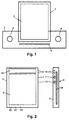
- Fig. 1 shows an embodiment of an inventive Information device 1, with a device 2 for displaying and operating the Information device 1.
- the device 2 for display and operation can for example formed by a touch screen.
- the Information device 1 is part of, for example, a car radio 3, can but also any other component of the on-board electronics of a vehicle be like B. a navigation system or an on-board computer.
- the Car radio 3 also has further operating devices 4, for example for Adjustment of volume or for channel selection, as well as a CD player or DVD player 5, which is used to play audio CDs or DVDs can be or as a data storage for a navigation system.
- the information device 1 is detachably connected to the car radio 3. It can be guided tours in the form of grooves in information facility 1 and car radio 3 can be provided, which allow the information device 1 in this way Car radio 3 insert that the touch screen 2 towards a user, e.g. B. shows the driver of a vehicle. In addition, a not shown releasable locking can be provided to the information device 1 in To be able to fix the car radio 3.
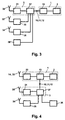
- the information device 1 is in a frontal and a side view shown, which is removed from the car radio 3 shown in Fig. 1.
- an antenna 14 on the information device 1 which serves to receive signals for determining the location, e.g. B. GPS signals.
- the side view contacts 10 are shown, which for Power supply to the information device 1, if this how described above, is connected to the car radio 3.
- Power supply provided in the information device 1, for. B. Batteries or batteries.
- an interface 11 for example an infrared interface, provided that for signal exchange between information device 1 and Car radio 3 is used.
- the interface 11 can also be used for data exchange other suitable devices, for example computers, are used, if the information device 1 is not connected to the car radio 3.
- a sensor 12 which detects the position of the information device 1 determines, in particular, whether the information device 1 with the car radio 3 connected is. This is of particular importance if, as in FIG. 2 indicated, further contacts 10 ', another interface 11' and another Sensor 12 'are provided which allow the information device 1 in Connect landscape or portrait format to the car radio 3. In this case corresponding tours both in the information facility 1 and in Car radio 3 be present to the connecting elements 10, 11, 12 and 10 ', 11 ', 12' of the information device 1 with the counterparts of the car radio 3 in To be able to connect to the information device 1 with the Connect on-board electronics of the vehicle. By means of the sensors 12 or 12 ' then determined which of the connecting elements 10, 11 or 10 ', 11', depending be used by the location.
- sensors 12 or 12 'as described for determining the position of the To use information device 1 can also be evaluated whether a Supply voltage is present at terminals 10 or 10 ', or whether Infrared signals are present at the infrared interface 11 or 11 '. It is the same possible a suitable other interface instead of an infrared interface use the z. B. by means of electrical contacts or wirelessly by radio is realized.
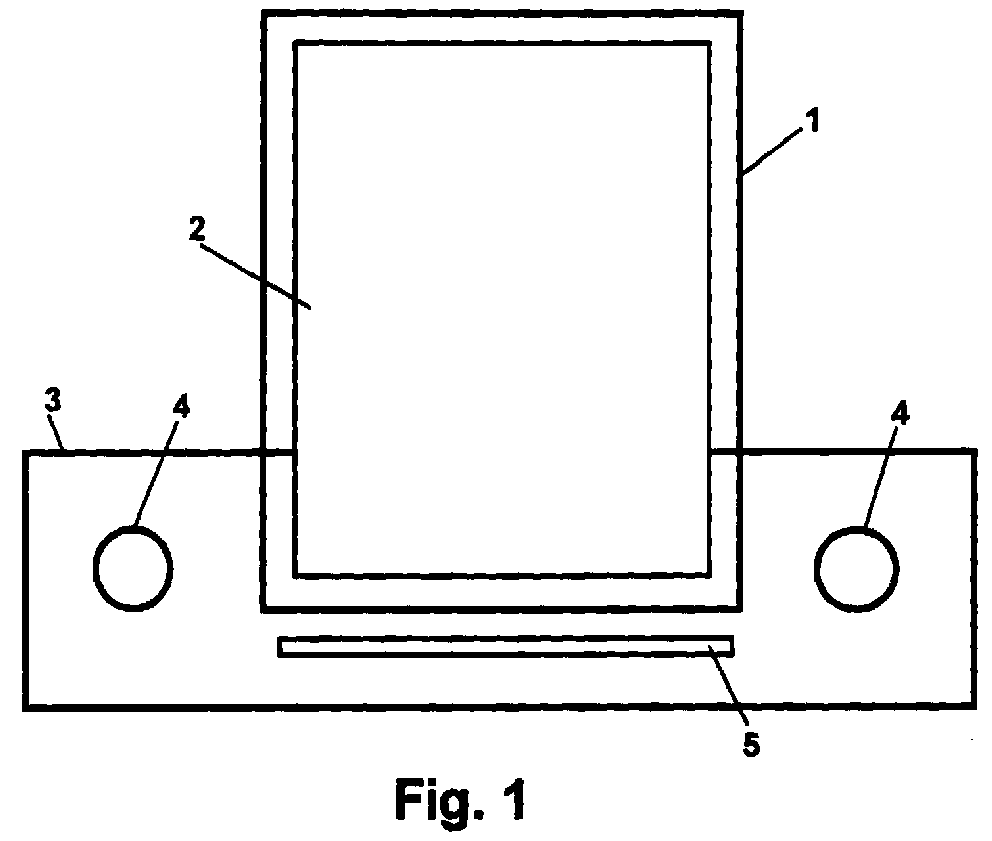
- FIG. 3 is a basic circuit diagram of a first embodiment of a information device 1 according to the invention shown. It has a car radio 3 with a radio receiver, consisting of an antenna 30 and one Receiving part 31 for the reception of radio signals. In particular contains the receiving part 31 a decoder, not shown, which in the evaluates received traffic signals contained traffic information. Receiving parts of this type are, for example, for the reception of RDS signals or DAB signals known.
- the decoded traffic information is from the Receiving part 31 to a control device 37, for example a Microcomputer, passed on.
- the Navigation device 36 is based on the evaluation of digitized street maps, the z. B. are stored on a CD-ROM and read by a CD player become. This can be, for example, the CD player 5 shown in FIG. 1 or another CD player that is under a seat or in the trunk of the Car radio 3 vehicle is attached.
- the navigation device 36 also has speed sensors, not shown, whose Signals from the navigation device 36 for determining the respective location be evaluated. To determine the location, those from Device 32, 33 determined for receiving signals for location determination Location information can also be used.
- the received from the device 32, 33 Signals can be GPS signals, for example.
- Traffic information can current traffic situations such as congestion, Detours due to construction sites or accidents when determining travel routes be taken into account. Additional information such as the occupancy of Parking spaces, rooms in hotels, etc., z. B. from the radio receiver 30, 31 or from the mobile device 34, 35 can also come from the determination of a route are taken into account or via Connecting elements 10, 11, 12 or 10 ', 11', 12 ', which in connection with Fig. 2 were described in more detail above, transmitted to an information device 1 become.
- the information device 1 has a control device 13, for example a microcomputer, and a display 2.
- the display 2 can be designed as a touch screen and then also serves as an input device for command input by a user.
- the car radio 3 or the above described components 32 to 36 originate in stored in a memory of the microcomputer 13. Since the memory of the Microcomputer 13 or at least a portion of the memory as non-volatile memory is configured, for. B. as a hard drive, flash or EEPROM memory, the information transferred is in the Information unit 1 is also available if the information device 1 was disconnected from the car radio 3 at the connecting elements 10, 11, 12.
- the information device 1 can then leave the vehicle be taken and places the stored information outside of the vehicle.
- the user is then z. B. a city map or Information about hotels, restaurants, attractions, etc. is available.
- FIG. 4 is a basic circuit diagram of a second embodiment of a information device 1 according to the invention shown.
- the structure corresponds the structure of the first embodiment shown in Fig. 3, with the Exception that the device 32, 33 for receiving signals for Location determination (e.g. GPS receiver) is part of the information facility 1 is.
- the antenna 14 shown in FIG. 2 is used. In this way, it is possible that the user to his Location-related information from the information facility 1 can be offered, both in the vehicle in connection with the car radio 3, as well as outside the vehicle.
- the information device 1 can also, as shown in Fig. 2, a CD player 15 have.
- the CD player 5 (Fig. 1) of the Car radios 3 used exclusively for the reproduction of audio signals become.
- the operation of the information device 1 is independent of Car radio 3 allows the entire digitized maps to be available stand, whereby the area of application of the information device 1 outside the Vehicle is significantly enlarged.
- a Mobile radio device and / or a radio receiver to the information device 1 connected or integrated into this.
- a remote control on the steering wheel of the vehicle is arranged with which the information device 1 instead of with the touch screen can be controlled. This makes the user less of Traffic distracted.
- the remote control can e.g. B. means Infrared signals are connected to the information device 1.
- Remote control and information device 1 must be corresponding Have sender or receiver.
- the information device 1 can be a so-called personal digital Assistant (PDA).
- PDAs personal digital Assistants
- Such PDAs all point to the operation of the Information device 1 required components such as touch screen, Microcomputer, memory and infrared interface.
- the information device 1 can also have a different appearance, in particular, it can be designed as a removable control panel of a car radio his.
- the information device 1 extends essentially over the entire front surface of the car radio and is used for display and operation from both the car radio and the information device 1.
- Theft protection for the car radio, which in this case can no longer be used is because it can no longer be operated.
- the information device 1 can also exchange data with other data processing devices such as computers.
- the information device 1 can then be used for additional Information at an appropriately equipped information terminal in addition to those stored in the memory of the control device 13 To load information or to update it. It is also possible that the user the additional information from the memory of the Information device 1 by means of the infrared interface 11 in the Navigation system 36 takes over or in the memory of a home computer transmits.
Landscapes
- Engineering & Computer Science (AREA)
- Radar, Positioning & Navigation (AREA)
- Remote Sensing (AREA)
- Automation & Control Theory (AREA)
- Physics & Mathematics (AREA)
- General Physics & Mathematics (AREA)
- Navigation (AREA)
- Burglar Alarm Systems (AREA)
- Measuring Pulse, Heart Rate, Blood Pressure Or Blood Flow (AREA)
- Traffic Control Systems (AREA)
Abstract
Description
- Fig. 1
- eine Ausführungsform einer erfindungsgemäßen Informationseinrichtung,
- Fig. 2
- eine Frontal- und Seitenansicht der Informationseinrichtung aus Fig. 1,
- Fig. 3
- ein Prinzipschaltbild einer ersten Ausführungsform einer erfindungsgemäßen Informationseinrichtung, und
- Fig. 4
- ein Prinzipschaltbild einer zweiten Ausführungsform einer erfindungsgemäßen Informationseinrichtung.
Claims (9)
- Informationseinrichtung (1) als Bestandteil eines Navigationssystems (36) für ein Fahrzeug, welche für den Betrieb im Fahrzeug mittels Verbindungselementen (10,11,12;10',11',12') mit der Bordelektronik (30,... 36), insbesondere mit dem Navigationssystem (36), verbunden ist, und über eine Anzeige- und Eingabeeinrichtung (2) verfügt,
dadurch gekennzeichnet, daßdie Informationseinrichtung (1) eine Steuereinrichtung (13) mit einem Speicher aufweist, wobei zumindest ein Teilbereich des Speichers nichtflüchtig ist, während des Betriebs der Informationseinrichtung (1) im Fahrzeug die vom Navigationssystem (36) erzeugten, vom jeweiligen Aufenthaltsort abhängigen Informationen über die Verbindungselemente (10,11,12;10',11',12') an die Informationseinrichtung (1) übertragen werden, deren Steuereinrichtung (13) die Informationen im nichtflüchtigen Teilbereich ihres Speichers abspeichert, unddie Verbindungselemente (10,11,12;10',11',12') lösbar sind, wodurch die Informationseinrichtung (1) zum Betrieb außerhalb des Fahrzeugs von der Bordelektronik gelöst werden kann. - Informationseinrichtung nach Anspruch 1,
dadurch gekennzeichnet, daßdie Anzeige- und Eingabeeinrichtung (2) als Touch-Screen ausgebildet ist. - Informationseinrichtung nach Anspruch 1 oder 2,
dadurch gekennzeichnet, daßan das Navigationssystem (36) ein Empfänger (32,33) für den Empfang von Signalen zur Ortsbestimmung, insbesondere von GPS-Signalen, angeschlossen ist, und daß das Navigationssystem (36) die vom Empfänger (32,33) für den Empfang von Signalen zur Ortsbestimmung erzeugten Positionsangaben bei der Ermittlung von ortsabhängigen Informationen verwendet. - Informationseinrichtung nach einem der Ansprüche 1 bis 3,
dadurch gekennzeichnet, daßan das Navigationssystem (36) ein Empfänger (30,31) für Rundfunksignale, insbesondere für Rundfunksignale wie DAB- oder RDS-Signale, die Verkehrsinformationen enthalten, angeschlossen ist, und daß das Navigationssystem (36) die vom Empfänger (30,31) für Rundfunksignale erzeugten Verkehrsinformationen bei der Ermittlung von ortsabhängigen Informationen verwendet. - Informationseinrichtung nach einem der Ansprüche 1 bis 4,
dadurch gekennzeichnet, daßan das Navigationssystem (36) ein Mobilfunkempfänger (34,35) angeschlossen ist, der den Empfang von digitalen, ortsabhängigen Informationen erlaubt, und daß das Navigationssystem (36) die vom Mobilfunkempfänger (34,35) empfangenen, ortsabhängigen Informationen bei der Ermittlung von ortsabhängigen Informationen verwendet. - Rundfunkempfänger nach einem der Ansprüche 1 bis 5,
dadurch gekennzeichnet, daßdie Informationseinrichtung (1) einen Empfänger (14,33) für den Empfang von Signalen zur Ortsbestimmung, insbesondere von GPS-Signalen, aufweist, und daß die Steuereinrichtung (13) die vom Empfänger (32,33) für den Empfang von Signalen zur Ortsbestimmung erzeugten Positionsangaben bei der Auswahl von ortsabhängigen Informationen aus ihrem Speicher verwendet. - Informationseinrichtung nach einem der Ansprüche 1 bis 6,
dadurch gekennzeichnet, daßdie Informationseinrichtung (1) einen Empfänger für Rundfunksignale, insbesondere für Rundfunksignale wie DAB- oder RDS-Signale, die Verkehrsinformationen enthalten, aufweist, und daß die Steuereinrichtung (13) die vom Empfänger für Rundfunksignale erzeugten Verkehrsinformationen bei der Auswahl von ortsabhängigen Informationen aus ihrem Speicher verwendet. - Informationseinrichtung nach einem der Ansprüche 1 bis 7,
dadurch gekennzeichnet, daßdie Informationseinrichtung (1) einen Mobilfunkempfänger aufweist, der den Empfang von digitalen, ortsabhängigen Informationen erlaubt, und daß die Steuereinrichtung (13) die vom Mobilfunkempfäger empfangenen, ortsabhängigen Informationen bei der Auswahl von ortsabhängigen Informationen aus ihrem Speicher verwendet. - Informationseinrichtung nach einem der Ansprüche 1 bis 8,
dadurch gekennzeichnet, daßdie Informationseinrichtung (1) einen Speicher (15) für digitalisierte Navigationsdaten aufweist, insbesondere einen CD-Spieler.
Applications Claiming Priority (2)
| Application Number | Priority Date | Filing Date | Title |
|---|---|---|---|
| DE19928903 | 1999-06-24 | ||
| DE19928903A DE19928903A1 (de) | 1999-06-24 | 1999-06-24 | Informationseinrichtung |
Publications (3)
| Publication Number | Publication Date |
|---|---|
| EP1065472A2 true EP1065472A2 (de) | 2001-01-03 |
| EP1065472A3 EP1065472A3 (de) | 2001-01-17 |
| EP1065472B1 EP1065472B1 (de) | 2003-05-14 |
Family
ID=7912353
Family Applications (1)
| Application Number | Title | Priority Date | Filing Date |
|---|---|---|---|
| EP00112354A Expired - Lifetime EP1065472B1 (de) | 1999-06-24 | 2000-06-09 | Informationseinrichtung als bestandteil eines Navigationssystems |
Country Status (4)
| Country | Link |
|---|---|
| EP (1) | EP1065472B1 (de) |
| AT (1) | ATE240504T1 (de) |
| DE (2) | DE19928903A1 (de) |
| ES (1) | ES2200756T3 (de) |
Cited By (8)
| Publication number | Priority date | Publication date | Assignee | Title |
|---|---|---|---|---|
| DE10312812A1 (de) * | 2003-03-21 | 2004-10-07 | Siemens Ag | Kombinierte Anzeige- und Eingabeeinrichtung für Kraftfahrzeuge |
| WO2004113842A1 (de) * | 2003-06-20 | 2004-12-29 | Harman/Becker Automotive Systems Gmbh | Navigationssystem |
| WO2005041517A1 (de) * | 2003-10-22 | 2005-05-06 | Voellm Ernst | Vorrichtung zur integrierten steuerung nutzung von unterhaltungs- und informationseinrichtungen |
| WO2005083362A1 (de) * | 2004-02-26 | 2005-09-09 | Robert Bosch Gmbh | Navigationssystem |
| EP1909070A1 (de) * | 2006-10-06 | 2008-04-09 | Harman Becker Automotive Systems GmbH | Elektronisches Fahrzeugsystem zur Kopplung eines mobilen Navigationsmoduls an ein Fahrzeugaudiomodul |
| EP1909072A1 (de) * | 2006-10-06 | 2008-04-09 | Harman Becker Automotive Systems GmbH | Elektronisches Fahrzeugsystem zur Kopplung eines mobilen Navigationsmoduls an ein Fahrzeugaudiomodul |
| FR2909476A1 (fr) * | 2006-11-30 | 2008-06-06 | Aram Hekimian | Equipement d'aide a la navigation et systeme correspondant |
| WO2014109690A1 (en) * | 2013-01-08 | 2014-07-17 | Scania Cv Ab | Itinerary planning for a vehicle |
Families Citing this family (5)
| Publication number | Priority date | Publication date | Assignee | Title |
|---|---|---|---|---|
| DE10110043A1 (de) * | 2001-03-02 | 2002-09-19 | Bosch Gmbh Robert | Verfahren zur Darstellung von Videodaten |
| DE20204697U1 (de) | 2002-03-23 | 2003-08-07 | Global Navigation Systems GNS - GmbH, 52146 Würselen | Handheld Computer |
| DE102005038300A1 (de) * | 2005-08-12 | 2007-02-15 | Royaltek Company Ltd. | Navigationsvorrichtung mit GPS und TMC und Verfahren davon |
| DE102007012617A1 (de) * | 2007-03-13 | 2008-09-18 | Funkwerk Dabendorf-Gmbh | Halter für portables Navigationsgerät |
| DE102008014627B4 (de) | 2008-03-17 | 2017-06-14 | Volkswagen Ag | Verfahren zum Betrieb einer mobilen Datenverarbeitungseinrichtung in einem Kraftfahrzeug |
Family Cites Families (6)
| Publication number | Priority date | Publication date | Assignee | Title |
|---|---|---|---|---|
| DE3445668C1 (de) * | 1984-12-14 | 1986-01-02 | Daimler-Benz Ag, 7000 Stuttgart | Steuervorrichtung fuer ein Fahrzeug-Zielfuehrungssystem |
| DE4432589A1 (de) * | 1994-09-13 | 1996-03-14 | Becker Gmbh | Elektronisches Gerät mit einem abnehmbaren Bedienteil |
| DE19521929A1 (de) * | 1994-10-07 | 1996-04-11 | Mannesmann Ag | Einrichtung zur Zielführung von Personen |
| DE19516477A1 (de) * | 1995-05-05 | 1996-11-07 | Bosch Gmbh Robert | Einrichtung zur Aufbereitung und Ausgabe von Informationen für einen Fahrzeugführer |
| DE19744724B4 (de) * | 1997-10-10 | 2013-11-07 | Robert Bosch Gmbh | Navigationsgerät eines Kraftfahrzeugs |
| DE19828077A1 (de) * | 1998-06-24 | 1999-12-30 | Bosch Gmbh Robert | Navigationssystem für ein Fortbewegungsmittel |
-
1999
- 1999-06-24 DE DE19928903A patent/DE19928903A1/de not_active Withdrawn
-
2000
- 2000-06-09 AT AT00112354T patent/ATE240504T1/de not_active IP Right Cessation
- 2000-06-09 DE DE50002145T patent/DE50002145D1/de not_active Expired - Lifetime
- 2000-06-09 EP EP00112354A patent/EP1065472B1/de not_active Expired - Lifetime
- 2000-06-09 ES ES00112354T patent/ES2200756T3/es not_active Expired - Lifetime
Cited By (9)
| Publication number | Priority date | Publication date | Assignee | Title |
|---|---|---|---|---|
| DE10312812A1 (de) * | 2003-03-21 | 2004-10-07 | Siemens Ag | Kombinierte Anzeige- und Eingabeeinrichtung für Kraftfahrzeuge |
| EP1475693A2 (de) | 2003-03-21 | 2004-11-10 | Siemens Aktiengesellschaft | Kombinierte Anzeige- und Eingabeeinrichtung für Kraftfahrzeuge |
| WO2004113842A1 (de) * | 2003-06-20 | 2004-12-29 | Harman/Becker Automotive Systems Gmbh | Navigationssystem |
| WO2005041517A1 (de) * | 2003-10-22 | 2005-05-06 | Voellm Ernst | Vorrichtung zur integrierten steuerung nutzung von unterhaltungs- und informationseinrichtungen |
| WO2005083362A1 (de) * | 2004-02-26 | 2005-09-09 | Robert Bosch Gmbh | Navigationssystem |
| EP1909070A1 (de) * | 2006-10-06 | 2008-04-09 | Harman Becker Automotive Systems GmbH | Elektronisches Fahrzeugsystem zur Kopplung eines mobilen Navigationsmoduls an ein Fahrzeugaudiomodul |
| EP1909072A1 (de) * | 2006-10-06 | 2008-04-09 | Harman Becker Automotive Systems GmbH | Elektronisches Fahrzeugsystem zur Kopplung eines mobilen Navigationsmoduls an ein Fahrzeugaudiomodul |
| FR2909476A1 (fr) * | 2006-11-30 | 2008-06-06 | Aram Hekimian | Equipement d'aide a la navigation et systeme correspondant |
| WO2014109690A1 (en) * | 2013-01-08 | 2014-07-17 | Scania Cv Ab | Itinerary planning for a vehicle |
Also Published As
| Publication number | Publication date |
|---|---|
| EP1065472A3 (de) | 2001-01-17 |
| ATE240504T1 (de) | 2003-05-15 |
| EP1065472B1 (de) | 2003-05-14 |
| DE50002145D1 (de) | 2003-06-18 |
| DE19928903A1 (de) | 2001-01-04 |
| ES2200756T3 (es) | 2004-03-16 |
Similar Documents
| Publication | Publication Date | Title |
|---|---|---|
| DE69531248T2 (de) | Intelligentes zielführungssystem für fahrzeuge | |
| DE69332359T2 (de) | Leitungsgerät für Fahrzeuge | |
| EP1102037B1 (de) | Navigationssystem mit verbesserter Objektauswahl | |
| DE69413322T2 (de) | Navigationssystem | |
| DE112007002882B4 (de) | Navigationsvorrichtung | |
| EP1065472B1 (de) | Informationseinrichtung als bestandteil eines Navigationssystems | |
| DE19505487C2 (de) | Einrichtung in einem Fahrzeug zur Bestimmung der aktuellen Fahrzeugposition | |
| EP1147375B1 (de) | Verfahren zur leitung eines führers eines fahrzeugs von mindestens einem start- zu mindestens einem zielpunkt | |
| DE29909002U1 (de) | Vorrichtung zum Auffinden eines geparkten Fahrzeugs | |
| DE19808802A1 (de) | Kraftfahrzeugnavigationssystem | |
| DE102005022769A1 (de) | Turn-by-Turn-Navigationssystem mit verbessertem Abbiege-Icon | |
| EP1636550A1 (de) | Navigationssystem mit fahrspurhinweisen | |
| WO2002037446A1 (de) | Verfahren zur navigation und vorrichtung zu dessen durchführung | |
| EP1133675B1 (de) | Navigationsgerät und navigationsverfahren | |
| DE112015006921T5 (de) | System und Verfahren für Pseudonavigationshilfe in einem Fahrzeug | |
| DE102014213677A1 (de) | Verfahren zum Modifizieren einer Ausgabe eines Fahrerassistenzsystems und Fahrerassistenzsystem | |
| DE10258161B4 (de) | Fahrzeugnavigationssystem und diesbezügliches Verfahren | |
| EP0978705A2 (de) | Verfahren zur Routenberechnung in einem Navigationsgerät und Navigationsgerät zur Ausführung dieses Verfahrens | |
| DE10218340A1 (de) | Navigationssystem und Verfahren zur Routenbestimmung | |
| EP1800274B1 (de) | Portabler computer für navigationsaufgaben | |
| EP1039429B1 (de) | Verfahren zur portablen Routenführung mit einem On-Board Navigationsgerät sowie portables Navigationssystem | |
| EP1092952A1 (de) | Navigationssystem mit automatischem Datenträgerwechsel | |
| WO2000065308A1 (de) | Mobiles satellitengesteuertes navigationssystem | |
| DE10346846B4 (de) | Datenverarbeitungseinheit für Assistenzeinrichtungen in einem Kraftfahrzeug und Verfahren zur Bereitstellung von aktuellen fusionierten Situationsdaten | |
| WO2005083362A1 (de) | Navigationssystem |
Legal Events
| Date | Code | Title | Description |
|---|---|---|---|
| PUAI | Public reference made under article 153(3) epc to a published international application that has entered the european phase |
Free format text: ORIGINAL CODE: 0009012 |
|
| PUAL | Search report despatched |
Free format text: ORIGINAL CODE: 0009013 |
|
| AK | Designated contracting states |
Kind code of ref document: A2 Designated state(s): AT BE CH CY DE DK ES FI FR GB GR IE IT LI LU MC NL PT SE |
|
| AX | Request for extension of the european patent |
Free format text: AL;LT;LV;MK;RO;SI |
|
| AK | Designated contracting states |
Kind code of ref document: A3 Designated state(s): AT BE CH CY DE DK ES FI FR GB GR IE IT LI LU MC NL PT SE |
|
| AX | Request for extension of the european patent |
Free format text: AL;LT;LV;MK;RO;SI |
|
| 17P | Request for examination filed |
Effective date: 20010626 |
|
| AKX | Designation fees paid |
Free format text: AT BE CH CY DE DK ES FI FR GB GR IE IT LI LU MC NL PT SE |
|
| 17Q | First examination report despatched |
Effective date: 20020123 |
|
| RTI1 | Title (correction) |
Free format text: INFORMATION DEVICE AS PART OF A NAVIGATIONS SYSTEM |
|
| GRAH | Despatch of communication of intention to grant a patent |
Free format text: ORIGINAL CODE: EPIDOS IGRA |
|
| RAP1 | Party data changed (applicant data changed or rights of an application transferred) |
Owner name: GRUNDIG CAR INTERMEDIA SYSTEMS GMBH |
|
| GRAH | Despatch of communication of intention to grant a patent |
Free format text: ORIGINAL CODE: EPIDOS IGRA |
|
| GRAA | (expected) grant |
Free format text: ORIGINAL CODE: 0009210 |
|
| AK | Designated contracting states |
Designated state(s): AT BE CH CY DE DK ES FI FR GB GR IE IT LI LU MC NL PT SE |
|
| PG25 | Lapsed in a contracting state [announced via postgrant information from national office to epo] |
Ref country code: IE Free format text: LAPSE BECAUSE OF FAILURE TO SUBMIT A TRANSLATION OF THE DESCRIPTION OR TO PAY THE FEE WITHIN THE PRESCRIBED TIME-LIMIT Effective date: 20030514 |
|
| REG | Reference to a national code |
Ref country code: GB Ref legal event code: FG4D Free format text: NOT ENGLISH |
|
| REG | Reference to a national code |
Ref country code: CH Ref legal event code: EP |
|
| PG25 | Lapsed in a contracting state [announced via postgrant information from national office to epo] |
Ref country code: LU Free format text: LAPSE BECAUSE OF NON-PAYMENT OF DUE FEES Effective date: 20030609 Ref country code: CY Free format text: LAPSE BECAUSE OF FAILURE TO SUBMIT A TRANSLATION OF THE DESCRIPTION OR TO PAY THE FEE WITHIN THE PRESCRIBED TIME-LIMIT Effective date: 20030609 |
|
| REG | Reference to a national code |
Ref country code: IE Ref legal event code: FG4D Free format text: GERMAN |
|
| REF | Corresponds to: |
Ref document number: 50002145 Country of ref document: DE Date of ref document: 20030618 Kind code of ref document: P |
|
| PG25 | Lapsed in a contracting state [announced via postgrant information from national office to epo] |
Ref country code: BE Free format text: LAPSE BECAUSE OF NON-PAYMENT OF DUE FEES Effective date: 20030630 Ref country code: MC Free format text: LAPSE BECAUSE OF NON-PAYMENT OF DUE FEES Effective date: 20030630 |
|
| REG | Reference to a national code |
Ref country code: SE Ref legal event code: TRGR |
|
| PG25 | Lapsed in a contracting state [announced via postgrant information from national office to epo] |
Ref country code: PT Free format text: LAPSE BECAUSE OF FAILURE TO SUBMIT A TRANSLATION OF THE DESCRIPTION OR TO PAY THE FEE WITHIN THE PRESCRIBED TIME-LIMIT Effective date: 20030814 Ref country code: GR Free format text: LAPSE BECAUSE OF FAILURE TO SUBMIT A TRANSLATION OF THE DESCRIPTION OR TO PAY THE FEE WITHIN THE PRESCRIBED TIME-LIMIT Effective date: 20030814 Ref country code: DK Free format text: LAPSE BECAUSE OF FAILURE TO SUBMIT A TRANSLATION OF THE DESCRIPTION OR TO PAY THE FEE WITHIN THE PRESCRIBED TIME-LIMIT Effective date: 20030814 |
|
| REG | Reference to a national code |
Ref country code: CH Ref legal event code: NV Representative=s name: BOVARD AG PATENTANWAELTE |
|
| GBT | Gb: translation of ep patent filed (gb section 77(6)(a)/1977) | ||
| BERE | Be: lapsed |
Owner name: *GRUNDIG CAR INTERMEDIA SYSTEM G.M.B.H. Effective date: 20030630 |
|
| REG | Reference to a national code |
Ref country code: IE Ref legal event code: FD4D Ref document number: 1065472E Country of ref document: IE |
|
| REG | Reference to a national code |
Ref country code: ES Ref legal event code: FG2A Ref document number: 2200756 Country of ref document: ES Kind code of ref document: T3 |
|
| ET | Fr: translation filed | ||
| PLBE | No opposition filed within time limit |
Free format text: ORIGINAL CODE: 0009261 |
|
| STAA | Information on the status of an ep patent application or granted ep patent |
Free format text: STATUS: NO OPPOSITION FILED WITHIN TIME LIMIT |
|
| 26N | No opposition filed |
Effective date: 20040217 |
|
| PGFP | Annual fee paid to national office [announced via postgrant information from national office to epo] |
Ref country code: GB Payment date: 20050601 Year of fee payment: 6 |
|
| PGFP | Annual fee paid to national office [announced via postgrant information from national office to epo] |
Ref country code: ES Payment date: 20050606 Year of fee payment: 6 |
|
| PGFP | Annual fee paid to national office [announced via postgrant information from national office to epo] |
Ref country code: AT Payment date: 20050617 Year of fee payment: 6 Ref country code: SE Payment date: 20050617 Year of fee payment: 6 |
|
| PGFP | Annual fee paid to national office [announced via postgrant information from national office to epo] |
Ref country code: FI Payment date: 20050620 Year of fee payment: 6 |
|
| PGFP | Annual fee paid to national office [announced via postgrant information from national office to epo] |
Ref country code: NL Payment date: 20050621 Year of fee payment: 6 |
|
| PGFP | Annual fee paid to national office [announced via postgrant information from national office to epo] |
Ref country code: CH Payment date: 20050622 Year of fee payment: 6 |
|
| PG25 | Lapsed in a contracting state [announced via postgrant information from national office to epo] |
Ref country code: FI Free format text: LAPSE BECAUSE OF NON-PAYMENT OF DUE FEES Effective date: 20060609 Ref country code: GB Free format text: LAPSE BECAUSE OF NON-PAYMENT OF DUE FEES Effective date: 20060609 Ref country code: AT Free format text: LAPSE BECAUSE OF NON-PAYMENT OF DUE FEES Effective date: 20060609 |
|
| PG25 | Lapsed in a contracting state [announced via postgrant information from national office to epo] |
Ref country code: ES Free format text: LAPSE BECAUSE OF NON-PAYMENT OF DUE FEES Effective date: 20060610 Ref country code: SE Free format text: LAPSE BECAUSE OF NON-PAYMENT OF DUE FEES Effective date: 20060610 |
|
| PG25 | Lapsed in a contracting state [announced via postgrant information from national office to epo] |
Ref country code: CH Free format text: LAPSE BECAUSE OF NON-PAYMENT OF DUE FEES Effective date: 20060630 Ref country code: LI Free format text: LAPSE BECAUSE OF NON-PAYMENT OF DUE FEES Effective date: 20060630 |
|
| PGFP | Annual fee paid to national office [announced via postgrant information from national office to epo] |
Ref country code: IT Payment date: 20060630 Year of fee payment: 7 |
|
| PG25 | Lapsed in a contracting state [announced via postgrant information from national office to epo] |
Ref country code: NL Free format text: LAPSE BECAUSE OF NON-PAYMENT OF DUE FEES Effective date: 20070101 |
|
| REG | Reference to a national code |
Ref country code: CH Ref legal event code: PL |
|
| EUG | Se: european patent has lapsed | ||
| GBPC | Gb: european patent ceased through non-payment of renewal fee |
Effective date: 20060609 |
|
| NLV4 | Nl: lapsed or anulled due to non-payment of the annual fee |
Effective date: 20070101 |
|
| REG | Reference to a national code |
Ref country code: FR Ref legal event code: TP |
|
| REG | Reference to a national code |
Ref country code: ES Ref legal event code: FD2A Effective date: 20060610 |
|
| PG25 | Lapsed in a contracting state [announced via postgrant information from national office to epo] |
Ref country code: IT Free format text: LAPSE BECAUSE OF NON-PAYMENT OF DUE FEES Effective date: 20070609 |
|
| PGFP | Annual fee paid to national office [announced via postgrant information from national office to epo] |
Ref country code: DE Payment date: 20130627 Year of fee payment: 14 |
|
| PGFP | Annual fee paid to national office [announced via postgrant information from national office to epo] |
Ref country code: FR Payment date: 20130702 Year of fee payment: 14 |
|
| REG | Reference to a national code |
Ref country code: DE Ref legal event code: R119 Ref document number: 50002145 Country of ref document: DE |
|
| REG | Reference to a national code |
Ref country code: DE Ref legal event code: R119 Ref document number: 50002145 Country of ref document: DE Effective date: 20150101 |
|
| REG | Reference to a national code |
Ref country code: FR Ref legal event code: ST Effective date: 20150227 |
|
| PG25 | Lapsed in a contracting state [announced via postgrant information from national office to epo] |
Ref country code: DE Free format text: LAPSE BECAUSE OF NON-PAYMENT OF DUE FEES Effective date: 20150101 |
|
| PG25 | Lapsed in a contracting state [announced via postgrant information from national office to epo] |
Ref country code: FR Free format text: LAPSE BECAUSE OF NON-PAYMENT OF DUE FEES Effective date: 20140630 |