EP1065793A2 - Récepteur du type Rake avec un égaliseur rétroactif intégré - Google Patents
Récepteur du type Rake avec un égaliseur rétroactif intégré Download PDFInfo
- Publication number
- EP1065793A2 EP1065793A2 EP00105039A EP00105039A EP1065793A2 EP 1065793 A2 EP1065793 A2 EP 1065793A2 EP 00105039 A EP00105039 A EP 00105039A EP 00105039 A EP00105039 A EP 00105039A EP 1065793 A2 EP1065793 A2 EP 1065793A2
- Authority
- EP
- European Patent Office
- Prior art keywords
- codeword
- coupled
- correlator
- decision
- output
- Prior art date
- Legal status (The legal status is an assumption and is not a legal conclusion. Google has not performed a legal analysis and makes no representation as to the accuracy of the status listed.)
- Withdrawn
Links
Images



Classifications
-
- H—ELECTRICITY
- H04—ELECTRIC COMMUNICATION TECHNIQUE
- H04B—TRANSMISSION
- H04B1/00—Details of transmission systems, not covered by a single one of groups H04B3/00 - H04B13/00; Details of transmission systems not characterised by the medium used for transmission
- H04B1/06—Receivers
- H04B1/16—Circuits
- H04B1/26—Circuits for superheterodyne receivers
-
- H—ELECTRICITY
- H04—ELECTRIC COMMUNICATION TECHNIQUE
- H04B—TRANSMISSION
- H04B1/00—Details of transmission systems, not covered by a single one of groups H04B3/00 - H04B13/00; Details of transmission systems not characterised by the medium used for transmission
- H04B1/69—Spread spectrum techniques
- H04B1/707—Spread spectrum techniques using direct sequence modulation
- H04B1/7097—Interference-related aspects
- H04B1/7103—Interference-related aspects the interference being multiple access interference
- H04B1/7105—Joint detection techniques, e.g. linear detectors
-
- H—ELECTRICITY
- H04—ELECTRIC COMMUNICATION TECHNIQUE
- H04B—TRANSMISSION
- H04B1/00—Details of transmission systems, not covered by a single one of groups H04B3/00 - H04B13/00; Details of transmission systems not characterised by the medium used for transmission
- H04B1/69—Spread spectrum techniques
- H04B1/707—Spread spectrum techniques using direct sequence modulation
- H04B1/7097—Interference-related aspects
- H04B1/711—Interference-related aspects the interference being multi-path interference
- H04B1/7115—Constructive combining of multi-path signals, i.e. RAKE receivers
-
- H—ELECTRICITY
- H04—ELECTRIC COMMUNICATION TECHNIQUE
- H04L—TRANSMISSION OF DIGITAL INFORMATION, e.g. TELEGRAPHIC COMMUNICATION
- H04L25/00—Baseband systems
- H04L25/02—Details ; arrangements for supplying electrical power along data transmission lines
- H04L25/03—Shaping networks in transmitter or receiver, e.g. adaptive shaping networks
- H04L25/03006—Arrangements for removing intersymbol interference
- H04L25/03012—Arrangements for removing intersymbol interference operating in the time domain
- H04L25/03019—Arrangements for removing intersymbol interference operating in the time domain adaptive, i.e. capable of adjustment during data reception
- H04L25/03057—Arrangements for removing intersymbol interference operating in the time domain adaptive, i.e. capable of adjustment during data reception with a recursive structure
-
- H—ELECTRICITY
- H04—ELECTRIC COMMUNICATION TECHNIQUE
- H04B—TRANSMISSION
- H04B1/00—Details of transmission systems, not covered by a single one of groups H04B3/00 - H04B13/00; Details of transmission systems not characterised by the medium used for transmission
- H04B1/69—Spread spectrum techniques
- H04B1/707—Spread spectrum techniques using direct sequence modulation
- H04B1/709—Correlator structure
- H04B1/7093—Matched filter type
-
- H—ELECTRICITY
- H04—ELECTRIC COMMUNICATION TECHNIQUE
- H04L—TRANSMISSION OF DIGITAL INFORMATION, e.g. TELEGRAPHIC COMMUNICATION
- H04L25/00—Baseband systems
- H04L25/02—Details ; arrangements for supplying electrical power along data transmission lines
- H04L25/03—Shaping networks in transmitter or receiver, e.g. adaptive shaping networks
- H04L25/03006—Arrangements for removing intersymbol interference
- H04L2025/0335—Arrangements for removing intersymbol interference characterised by the type of transmission
- H04L2025/03375—Passband transmission
-
- H—ELECTRICITY
- H04—ELECTRIC COMMUNICATION TECHNIQUE
- H04L—TRANSMISSION OF DIGITAL INFORMATION, e.g. TELEGRAPHIC COMMUNICATION
- H04L25/00—Baseband systems
- H04L25/02—Details ; arrangements for supplying electrical power along data transmission lines
- H04L25/03—Shaping networks in transmitter or receiver, e.g. adaptive shaping networks
- H04L25/03006—Arrangements for removing intersymbol interference
- H04L2025/0335—Arrangements for removing intersymbol interference characterised by the type of transmission
- H04L2025/03375—Passband transmission
- H04L2025/03401—PSK
-
- H—ELECTRICITY
- H04—ELECTRIC COMMUNICATION TECHNIQUE
- H04L—TRANSMISSION OF DIGITAL INFORMATION, e.g. TELEGRAPHIC COMMUNICATION
- H04L25/00—Baseband systems
- H04L25/02—Details ; arrangements for supplying electrical power along data transmission lines
- H04L25/03—Shaping networks in transmitter or receiver, e.g. adaptive shaping networks
- H04L25/03006—Arrangements for removing intersymbol interference
- H04L2025/03433—Arrangements for removing intersymbol interference characterised by equaliser structure
- H04L2025/03439—Fixed structures
- H04L2025/03445—Time domain
- H04L2025/03471—Tapped delay lines
- H04L2025/03484—Tapped delay lines time-recursive
- H04L2025/0349—Tapped delay lines time-recursive as a feedback filter
Definitions
- the present invention relates in general to wireless communication systems, such as but not limited to wireless local area networks (WLANs), and is particularly directed to a new and improved RAKE receiver that contains an embedded decision feedback equalizer (DFE) that increases the receiver's tolerance to the effects of (indoor WLAN) multipath distortion without losing robustness to thermal noise.
- WLANs wireless local area networks
- DFE embedded decision feedback equalizer
- FIG 1 shows, the power delay profile (PDF) 10 of a transmitted signal due to multipath distortion within an indoor WLAN system, such as the reduced complexity example illustrated in Figure 2, exhibits a largely exponentially-decayed Rayleigh fading characteristic.
- Physical aspects of the indoor transmission environment driving this behavior are the relatively large number of reflectors (e.g., walls) within the building, such as shown at nodes 12 and 13, between a transmitter site 14 and a receiver site 15, and the propagation loss associated with the respectively later time-of-arrival propagation paths t 1 , t 2 and t 3 , which contain logarithmically weaker energies.
- reflectors e.g., walls
- the power delay profile of the signal is the variation in mean signal power with respect to its power dispersed across time.
- the mean power level of the signal establishes the variance of its corresponding Rayleigh components.
- a principal aspect of the exponentially decayed multipath effect is due to the fact that a signal's propagation delay t i is proportional to the total distance traveled, so that, on-average, the strongest (minimal obstruction containing) transmission paths are those whose signals are the earliest to arrive at the receiver.
- a first to arrive, direct or line-of-sight path from the transmitter site 14 to the receiver site 15 may encounter an attenuating medium (such as one or more building walls and the like), while a later arriving signal reflected off a highly reflective surface and encounter no attenuating media may be have a larger channel impulse response (CIR) than the first-to-arrive signal.
- an attenuating medium such as one or more building walls and the like
- a later arriving signal reflected off a highly reflective surface and encounter no attenuating media may be have a larger channel impulse response (CIR) than the first-to-arrive signal.
- CIR channel impulse response
- the root mean squared (RMS) delay spread of a multipath channel may range from 20-50 nsec for small office and home office (SOHO) environments, 50-100 nsec for commercial environments, and 100-200 nsec for factory environments.
- the (exponential) decay constant is equal to the RMS delay spread.
- fading due to multipath is mostly 'flat'.
- DSSS direct sequence spread spectrum
- a preferred mechanism to counter this severe frequency-selective multipath distortion problem is a channel-matched correlation receiver, commonly referred to as a 'RAKE' receiver.
- a DSSS structure having a transmitted bandwidth larger than the information bandwidth.
- a respective codeword is formed of a sequence of PN code 'chips'.
- the term 'codeword', rather than 'symbol', is employed here to avoid confusion between 'chips' and codewords.
- the DSSS chips may be transmitted using a relatively simple modulation scheme such as QPSK, and codeword chips may be fixed as in a signature sequence, or they may be pseudo random.
- phase modulation of the codeword may be used to convey information. Namely, to impart additional bits of information per codeword, the codeword may be shifted in phase. For example two additional bits may be used to provide quadrature (ninety degree) phase shift increments: 0°, 90°, 180° and 270°.
- the codeword's chips may be selected from a multi-codeword set, where M bits select a particular codeword out of N codewords that make up the multi-codeword set.
- An example of such a scheme is the use of Walsh or Hadamard codes for the codeword set.
- the received (spread) signal is coupled to a codeword correlator 31, the output of which (shown as a sequence of time-of-arrival impulses 32-1, 32-2, 32-3) is applied to a coherent multipath combiner 33.
- the codeword correlator 31 contains a plurality of correlators each of which is configured to detect a respectively different one of the codewords of the multi-codeword set.
- the coherent multipath combiner may be readily implemented as a channel matched filter (whose filter taps have been established by means of a training preamble prior to commencement of a data transmission session).
- the output of the coherent multipath combiner 33 is coupled to a peak or largest value detector 35, which selects the largest output produced by the coherent multipath combiner as the transmitted codeword. Since the RAKE receiver is a linear system, the order of the operations carried out by the channel matched filter (coherent multipath combiner) 33 and codeword correlator 31 may be reversed, as shown in Figure 4, wherein the channel matched filter 33 is installed upstream of the codeword correlator 31.
- the present invention includes a RAKE receiver for a direct sequence spread spectrum receiver employable in a multipath environment comprising a channel matched filter to which received codewords of pluralities of direct spreading chips are applied, a codeword correlator unit coupled in a signal processing path with said channel matched filter, said codeword correlator unit containing a plurality of correlators for detecting respectively different codewords of pluralities of direct spreading chips, a peak energy detector which is operative to select the largest output from said codeword correlator unit as a respectively transmitted codeword, and a decision feedback equalizer coupled in said signal processing path of said channel matched filter with said codeword correlator unit.
- each codeword of the set has the following properties: 1- an impulse auto-correlation function; 2- it is mutually orthogonal (has a zero cross-correlation function) to all other codewords of the set; 3- it is long relative to the multipath spread; and 4- it has the same energy of each of the other N codewords of the set.
- the RAKE receiver must establish an orthogonal basis and account for the imbalance, just as in quadrature amplitude modulation - a receiver complexity issue.
- the codewords need not be long relative to the multipath spread, so long as the codewords are impulsive and have zero cross-correlation functions (namely, no intercodeword or intersymbol interference (ISI)). Interchip interference impacts only receiver energy (if the impulsive auto-correlation property is absent).
- the codeword length must be very large (e.g., on the order of 64, 128,256 or above, as used in military applications).
- the number of chips per codeword must be limited in order to maximize useable data bandwidth. Since the extent of codeword bleedover increases as the number of chips per codeword is reduced, where multipath distortion is significant, a very small codeword chip density may cause codeword energy bleedover/ leakage across multiple codewords. The problem therefore is how to optimize the signal-to-noise ratio of the output of the RAKE receiver using such less than ideal codewords.
- This problem is successfully addressed by an enhanced RAKE receiver architecture that contains a chip-based decision feedback equalizer (DFE) structure embedded in the signal processing path through the receiver's channel matched filter and codeword correlator.
- DFE decision feedback equalizer
- This decision feedback equalizer serves to reduce or cancel two types of distortion to which the limited chip length codewords are subjected as they are convolved with the multipath channel during transmission.
- the first is the 'bleeding' or leadage of energy in a respective codeword CW i with that of another codeword CW i+j .
- the second form of distortion is a 'smearing' of the energy within the chips of a respective codeword.
- a decision feedback equalizer is especially suited for combating indoor multipath distortion in a WLAN, since this type of multipath distortion is predominantly minimum phase, as the strongest signal components almost always arrive first, while the weaker components arrive last. Therefore, most of the multipath distortion appears as a decaying 'tail' on the channel impulse response.
- the feedback taps of a DFE serve ideally to combat minimum phase multipath distortion, while the feed-forward taps combat maximum phase components.
- a DFE for combating indoor multipath requires very few feed-forward taps, with most of the processing being executed in the feedback taps. Since implementing DFE feed-forward taps at baseband requires full complex multipliers, while feedback taps need only complex addition and substraction when QPSK elements are employed, so that implementation complexity is not a significant issue.
- the feedback taps eliminate the long decaying multipath echo tail and can span multiple codewords, so as to cancel inter-chip smearing and inter-codeword bleedover.
- the codeword correlator improves the signal-to-noise ratio by coherently combining the codeword's soft decision chips. Should a DFE chip-decision error be made, the codeword correlator is still able to make a correct decision by coherently combining all of the codeword's chips.
- error propagation in the decision feedback equalizer causes chip errors to occur in bursts. If soft chip decisions for setting the tap coefficients of the equalizer are incorrect, the DFE tap-weighting characteristic will rapidly degrade, preventing multipath distortion compensation.
- all of the received codeword chips are examined prior to making a hard decision. This is accomplished by generating a DFE-based correlation detection statistic for each codeword that could have been sent. The detection statistic for a potentially transmitted codeword is generated by performing feedback equalization of the codeword's chips, with the presumption that the codeword was actually transmitted.
- a DFE-embedded signal processing architecture for canceling inter-codeword interference may be 'wrapped around' the codeword correlator.
- the channel matched filter is differentially combined with a post-cursor representative echo that is produced by estimating the channel impulse response.
- the result is a 'cleaned-up' copy of the received codeword, which is coupled to the RAKE receiver's codeword correlator.
- the correlator output is coupled to codeword decision operator which examines all of the chips in a received codeword, to make a decision as to what codeword was actually transmitted.
- the codeword decision is used to synthesize a replica of the chip contents and phase information of the transmitted codeword.
- This synthesized codeword is then convolved with an estimate of the channel impulse response implemented in an FIR filter, to produce the representation of the post-cursor multipath echo in the signal received by the channel matched filter.
- each respective codeword correlator is configured to differentially combine the contents of all of the chips that make up each received codeword with a respective one of different sets of codeword-associated DFE feedback taps, that represent the post cursor multipath distortion echoes experienced by that particular codeword in the course of its transmission over the multipath channel from the transmitter.
- the post cursor multipath distortion may be removed either upstream or downstream of the codeword correlator.
- the invention also includes a method of processing received codewords comprised of pluralities of direct sequence spread spectrum chips comprising the steps of:
- each successively received codeword chip set is coupled to a plurality of codeword correlator statistical branches, each of which is associated with a different codeword.
- codeword correlator statistical branches each of which is associated with a different codeword.
- the received signal path is differentially combined with the output of an FIR filter feedback tap set, that synthesizes the multipath channel impulse response for its respective codeword's chip set (e.g., comprised of eight chips per codeword in the present example), so as to produce a representation of the post-cursor multipath echo for that codeword chip set.
- an FIR filter feedback tap set that synthesizes the multipath channel impulse response for its respective codeword's chip set (e.g., comprised of eight chips per codeword in the present example), so as to produce a representation of the post-cursor multipath echo for that codeword chip set.
- a more computationally efficient scheme for synthesizing the multipath channel impulse response may be realized by subtracting the respective FIR feedback filter tap stages from the received signal downstream of each codeword correlator.
- the codeword correlator may be implemented as a fast Walsh (Hadamard) structure. Because the differential combining of the processing path for the received signal and the feedback taps is a post-correlation operation, there is no need to regenerate the feedback taps as each newly received codeword chip set is clocked into the correlator. This reduces implementation complexity by allowing the functionality of the synthesized tap path to be stored in a look-up table.
- the receiver architecture of the invention resides primarily in modular arrangements of conventional digital communication circuits and associated digital signal processing components, and attendant supervisory control circuitry therefor that controls the operations of such circuits and components. It is also to be understood that the invention may be applied to any codeword-modulated direct sequence spread spectrum (DSSS) signal, including complementary codes. In a practical implementation that facilitates its incorporation into existing printed circuit cards of wireless tele-communication equipment, the invention may be readily implemented as field programmable gate array (FPGA)-implemented, or application specific integrated circuit (ASIC) chip sets.
- FPGA field programmable gate array
- ASIC application specific integrated circuit
- Figure 5 shows a portion of a sequence of limited chip-length direct sequence spread spectrum codewords (CWs) ..., 50-1, 50-2, 50-3, ..., being transmitted over a multipath WLAN channel.
- the chips convolve with the channel to create two types of distortion: inter-codeword bleed-over and intra-codeword chip-smearing.
- the former effect, shown at 51 is the 'bleeding' over energy in a respective codeword CW i with that of another codeword CW i+j .
- the second form of distortion is a 'smearing' of the energy within the chips of a respective codeword.
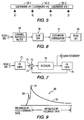
- a solution to this problem, illustrated in Figure 6, is to modify the RAKE receiver by installing a chip-based decision feedback equalizer (DFE) 36, in the signal processing path between the coherent multipath combiner (channel matched filter) 33 and the codeword correlator 31.
- DFE chip-based decision feedback equalizer
- the basic configuration of a decision feedback equalizer is shown in Figure 7 as comprising a multi-tap delay line configured finite impulse response (FIR) filter structure, containing a plurality of feed-forward taps 71, the signal transport path through which is coupled to a first input 72 of a differential combiner 73, having a second input 74 coupled to receive the output of a set of feedback taps 75.
- the output of the differential combiner 73 is coupled to a decision unit 76, the output of which is coupled to the feedback taps 75.
- FIR finite impulse response
- Figure 8 illustrates the RAKE receiver of Figure 6, incorporating the decision feedback equalizer structure of Figure 7.
- This signal processing architecture is operative to DFE-equalize the chips before soft, equalized chip levels are supplied to the codeword correlator 31.
- the channel matched filter 33 and the feed-forward tap section 71 of the front end of the DFE may be implemented in a composite structure as a 'whitened' matched filter, shown by broken lines 77.
- the multipath distortion is predominantly minimum phase, since the strongest signal components arrive first, while the weaker components arrive last.
- later arriving (multipath) components tend to be relatively weak, so that most of the multipath distortion appears as a decaying 'tail' on the channel impulse response.
- the feedback taps of a DFE serve ideally to combat minimum phase multipath components, while the feed-forward taps combat maximum phase components.
- a DFE for combating indoor multipath requires only a few feed-forward taps, with most of the processing being executed in the feedback taps. Because implementing the feed-forward taps of the DFE at baseband entails the use of full complex multipliers, while the feedback taps require only complex addition and substraction when QPSK elements are employed, for practical applications, it is preferred to employ an implementation that is dominated by feedback taps.
- Figure 9 shows a multipath impulse response characteristic 90 for the largest impulse response component.
- the decision unit of a DFE is centered on the peak 91 of the impulse response, since it is a single component with the largest signal-to-noise ratio.
- the feedback taps subtract the 'tail' 92 following the peak 91, while the feed-forward taps cancel the front-end impulse components 93 that precede the peak.
- canceling (intersymbol) interference involves forcing the energy outside the peak of the impulse to zero.
- feedback taps there is no noise amplification during equalization, and no complex multiplies are required, as noted above. As can be seen from Figure 1, this is nearly the case for an indoor wireless channel.
- ISI intersymbol interference
- ICI intra-codeword chip interference
- a DFE-embedded signal processing architecture for canceling such inter-codeword interference is diagrammatically illustrated in Figure 10 as being 'wrapped around' the codeword correlator.
- the output of the channel matched filter 33 is coupled to a first input 101 of a differential combiner 102, which has a second input 103 coupled to receive a post-cursor representative echo that is produced by estimating the channel impulse response.
- the output 104 of the differential combiner 102 which represents a 'cleaned-up' copy of the received codeword, is coupled to codeword correlator 31, the output of which is supplied to a codeword decision operator 105.
- the codeword decision operator 105 examines all of the M chips in a received codeword, rather than an individual chip, to make a decision as to what codeword was actually transmitted.
- a replica of the chip contents and phase information of the decided upon originally transmitted codeword is then synthesized in a transmitted codeword synthesizer 106.
- This synthesized codeword is then convolved with an estimate of the channel impulse response implemented in an FIR filter 107, so as to produce a representation of the post-cursor multipath echo in the signal received by the channel matched filter 33.
- the total ISI contribution in the output of the channel matched filter 33 is effectively canceled from the input to the codeword processor 31.
- the estimate of the channel impulse response implemented in the FIR filter 107 is not (codeword) length restricted; its output covers the entirety of the post-cursor multipath echo in the signal received by the channel matched filter 33, whether it crosses one or a plurality of codeword boundaries.
- the channel matched filter and the feed-forward tap section of the DFE may be implemented as a 'whitened' matched filter, as described previously.
- a conventional codeword correlator 31 for a RAKE receiver has a plurality of individual codeword correlators 31-1 - 31-N, each of which detects a respectively different codeword chip set.
- the initial large number of possible chip combinations may be empirically reduced to only those codewords having a prescribed chip set structure, such as a Walsh or Hadamard structure, as described previously. Even though such selection criteria may be satisfied, from a practical standpoint, not all of the codewords of the chosen set will have ideal properties (especially the preferred auto-correlation and cross-correlation properties described above), so that even without multipath based chip smearing, the correlator outputs will not exhibit ideal impulse/zero characteristics.
- each respective codeword correlator of the invention is configured to differentially combine the contents of all of the chips that make up each received codeword with a respective one of different sets of codeword-associated DFE feedback taps, that represent the post cursor multipath distortion echoes experienced by that particular codeword in the course of its transmission over the multipath channel from the transmitter.
- Processing the chips of each received codeword together serves to increase the SNR of the received signal by 6 dB and enables improve the detection statistic accuracy of each codeword correlator branch.
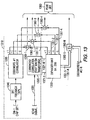
- Respective embodiments for effecting subtraction or removal of the post cursor multipath distortion from the correlator output upstream and downstream of the codeword correlator are shown diagrammatically in Figure 12 and in Figure 13.
- a received signal path 1201 for the successively received codeword chip sets is shown as being coupled to a plurality K of codeword correlator statistical branches 1203-1, ..., 1203-K, each of which is associated with a respectively different one of K codeword combinations.
- Each codeword correlator branch includes a differential combiner 1210, to a first (+) input 1211 of which the received signal path is coupled, and a second (-) input 1212 of which is coupled to receive the output of a respective FIR filter feedback tap set 1220.
- each respective FIR filter feedback tap set 1220 serves to synthesize the multipath channel impulse response for its respective codeword's chip set (e.g., comprised of eight chips per codeword in the present example), so as to produce a representation of the post-cursor multipath echo for that codeword chip set.
- each codeword's feedback tap set 1220 may be established during a training interval as described above.
- the input to an associated branch codeword correlator 1230 which is coupled to the output 1223 of the differential combiner 1220, is effectively a 'cleaned-up' version of the received codeword chip set from which multipath-based chip smearing has been removed.
- the output of each codeword correlator 1230 of the correlator statistical branches 1203-1, ..., 1203-K is coupled to a peak detector 1235, which selects the largest output as the transmitted codeword.
- the codeword correlator architecture of Figure 12 may be comprised of N (64, in the present example) branches, with the peak detector 1235 configured to conduct a two-stage selection process - the first being the largest magnitude-squared real component to identify the codeword, and the second being the complex value to identify the quadriphase rotation of the codeword.
- the differential combiner 1310 of a respective statistical branch 1300 is placed at the downstream end of each of a received path codeword correlator 1320, to which the received signal path 1301 is coupled, and a synthesized tap path codeword correlator 1330, to which the output of a respective FIR filter feedback tap set 1340 is coupled.
- Figure 12 illustrates the correlator architecture contains a plurality K of codeword correlator statistical branches 1300-1, ..., 1300-K, that are associated with respectively different ones of the K codeword combinations.
- the codeword correlator 1320 for the received signal path 1301 is preferably implemented as a fast Walsh (Hadamard) structure, which has a set of N outputs 1321-1, ..., 1321-N, respectively associated with the plurality of N codewords.
- Hadamard fast Walsh
- the synthesized tap path codeword correlator 1330 is coupled to the output of a respective FIR filter feedback tap set 1340, which, as in the embodiment of Figure 12, is operative to synthesize the multipath channel impulse response for its respective codeword's chip set, so as to produce a representation of the post-cursor multipath echo for that codeword chip set.
- the differential combining of the processing path for the received signal and the feedback taps is a post-correlation operation, there is no need to regenerate the feedback taps as each newly received codeword chip set is clocked into the correlator.
- This allows the functionality of the synthesized tap path to be stored in a look-up table, whose weighting coefficients are defined during a codeword training sequence as described above.
- the N outputs 1321-1, ..., 1321-N of the received signal path codeword correlator 1320 are expanded by an expander unit 1350 to a plurality of K correlator output lines 1351-1, ..., 1351-K, respectively associated with the 256 codeword combinations (64 codewords, each at one of 4 possible quadrature phases (0°, 90°, 180°, 270°)).
- the expander unit 1350 looks at the complex value of each of the N outputs 1321-1, ..., 1321-N of the received signal path codeword correlator 1320 to identify the quadriphase rotation (+1, +j, -1, -j) of the respective codeword.
- the quadriphase rotation outputs (+1, +j, -1, -j) of a respective codeword are coupled to first (+) inputs 1361 of a set of differential combiners 1360-1 - 1360-4.
- These differential combiners have second inputs 1362 coupled to receive complex correlation values for the synthesized tap path, stored in a look-up table memory. As described above, this obviates having to regenerate the feedback taps as each newly received codeword chip set is clocked into the correlator.
- the outputs 1363 of the differential combiners 1360-1 - 1360-K are coupled to a peak detector 1380, which selects the largest real output as the actually transmitted codeword.
- the performance of a conventional RAKE receiver used for indoor WLAN multipath applications on direct sequence spread spectrum signals having relatively short codeword lengths can be substantially enhanced by embedding a decision feedback equalizer structure in the signal processing path through the receiver's channel matched filter and codeword correlator.
- the decision feedback equalizer serves to cancel both inter-codeword interference or 'bleed-over' between codewords, and intra-codeword chip interference (ICI) or smearing of the energy within the chips of a respective codeword.
- ICI intra-codeword chip interference
- the performance of a RAKE receiver for indoor multipath WLAN applications on direct sequence spread spectrum signals having relatively short codeword lengths is enhanced by embedding a decision feedback equalizer structure in the signal processing path through the receiver's channel matched filter and codeword correlator.
- the decision feedback equalizer serves to cancel both inter-codeword interference (ISI) or 'bleed-over' between codewords, and intra-codeword chip interference (ICI) or smearing of the energy within the chips of a respective codeword.
- ISI inter-codeword interference
- ICI intra-codeword chip interference
Landscapes
- Engineering & Computer Science (AREA)
- Computer Networks & Wireless Communication (AREA)
- Signal Processing (AREA)
- Power Engineering (AREA)
- Cable Transmission Systems, Equalization Of Radio And Reduction Of Echo (AREA)
- Small-Scale Networks (AREA)
- Mobile Radio Communication Systems (AREA)
- Noise Elimination (AREA)
Applications Claiming Priority (2)
| Application Number | Priority Date | Filing Date | Title |
|---|---|---|---|
| US342583 | 1999-06-29 | ||
| US09/342,583 US6233273B1 (en) | 1999-06-29 | 1999-06-29 | Rake receiver with embedded decision feedback equalizer |
Publications (2)
| Publication Number | Publication Date |
|---|---|
| EP1065793A2 true EP1065793A2 (fr) | 2001-01-03 |
| EP1065793A3 EP1065793A3 (fr) | 2003-10-01 |
Family
ID=23342445
Family Applications (1)
| Application Number | Title | Priority Date | Filing Date |
|---|---|---|---|
| EP00105039A Withdrawn EP1065793A3 (fr) | 1999-06-29 | 2000-03-09 | Récepteur du type Rake avec un égaliseur rétroactif intégré |
Country Status (7)
| Country | Link |
|---|---|
| US (1) | US6233273B1 (fr) |
| EP (1) | EP1065793A3 (fr) |
| JP (1) | JP2001044892A (fr) |
| KR (1) | KR20010015100A (fr) |
| CN (1) | CN1287413A (fr) |
| CA (1) | CA2299767A1 (fr) |
| TW (1) | TW461194B (fr) |
Cited By (7)
| Publication number | Priority date | Publication date | Assignee | Title |
|---|---|---|---|---|
| WO2002080395A1 (fr) * | 2001-03-30 | 2002-10-10 | Intersil Americas Inc. | Recepteur rake comportant un egaliseur de retroaction de decision integre |
| WO2003026145A3 (fr) * | 2001-01-08 | 2003-05-15 | Ericsson Inc | Appareil et procede de compensation du brouillage inter-symboles dans des communications a spectre etale |
| EP1128566A3 (fr) * | 2000-01-28 | 2003-10-01 | Intersil Corporation | Récepteur du type rake avec correction de point zéro pour forme d'onde de spectre étalé |
| WO2009006912A1 (fr) * | 2007-07-06 | 2009-01-15 | Micronas Gmbh | Appareil et procédé pour un décodeur en particulier de code de nordstrom-robinson |
| KR100887090B1 (ko) | 2007-09-13 | 2009-03-04 | 삼성전기주식회사 | Dsss 송수신기 |
| EP1540817A4 (fr) * | 2002-06-12 | 2009-05-27 | Dsp Group Inc | Demodulation cck via egalisateur a decision retroactive de symboles |
| US10097383B1 (en) | 2017-08-02 | 2018-10-09 | International Business Machines Corporation | High speed DFEs with direct feedback |
Families Citing this family (56)
| Publication number | Priority date | Publication date | Assignee | Title |
|---|---|---|---|---|
| DE60033892T2 (de) * | 1999-07-30 | 2007-12-13 | Koninklijke Philips Electronics N.V. | Vorrichtung zur Spreizspektrumdatenübertragung mit einem Datenempfänger |
| FI114258B (fi) * | 2000-06-09 | 2004-09-15 | Nokia Corp | Menetelmä häiriön vaikutuksen vähentämiseksi ja vastaanotin |
| EP1540848B1 (fr) * | 2000-08-03 | 2009-02-11 | Infineon Technologies AG | Architecture de systeme amrt flexible |
| WO2002037754A2 (fr) | 2000-11-03 | 2002-05-10 | At & T Corp. | Acces tcma: procede pour un acces canal partage prioritarise |
| US7006563B2 (en) * | 2001-02-01 | 2006-02-28 | Broadcom Corporation | Decision feedback equalizer for minimum and maximum phase channels |
| US7151796B2 (en) * | 2001-02-01 | 2006-12-19 | Broadcom Corporation | High performance equalizer with enhanced DFE having reduced complexity |
| US7187730B1 (en) | 2001-03-21 | 2007-03-06 | Marvell International Ltd. | Method and apparatus for predicting CCK subsymbols |
| US7145969B1 (en) * | 2001-03-21 | 2006-12-05 | Marvell International Ltd. | Method and apparatus for complementary code keying |
| US20020176485A1 (en) * | 2001-04-03 | 2002-11-28 | Hudson John E. | Multi-cast communication system and method of estimating channel impulse responses therein |
| US7136361B2 (en) | 2001-07-05 | 2006-11-14 | At&T Corp. | Hybrid coordination function (HCF) access through tiered contention and overlapped wireless cell mitigation |
| US7277413B2 (en) | 2001-07-05 | 2007-10-02 | At & T Corp. | Hybrid coordination function (HCF) access through tiered contention and overlapped wireless cell mitigation |
| US7298798B1 (en) | 2001-08-24 | 2007-11-20 | Mediatek, Inc. | Method and system for decoding block codes |
| US7017104B1 (en) * | 2001-08-24 | 2006-03-21 | Mediatek Inc. | Method and system for decoding block codes by calculating a path metric according to a decision feedback sequence estimation algorithm |
| US7197092B2 (en) * | 2001-10-25 | 2007-03-27 | Symbol Technologies Inc. | Amplitude-offset invariant template detection for pulse position estimation; methods, systems and program products |
| TWI261468B (en) | 2001-11-02 | 2006-09-01 | Benq Corp | Rake reception device and method |
| US7245604B2 (en) | 2001-11-02 | 2007-07-17 | At&T Corp. | Fixed deterministic post-backoff for cyclic prioritized multiple access (CPMA) contention-free sessions |
| US7245605B2 (en) | 2001-11-02 | 2007-07-17 | At&T Corp. | Preemptive packet for maintaining contiguity in cyclic prioritized multiple access (CPMA) contention-free sessions |
| US7248600B2 (en) | 2001-11-02 | 2007-07-24 | At&T Corp. | ‘Shield’: protecting high priority channel access attempts in overlapped wireless cells |
| TW538603B (en) * | 2001-12-28 | 2003-06-21 | Realtek Semi Conductor Corp | Receiver for block code in near-minimum phase channel |
| US6826235B2 (en) * | 2002-01-04 | 2004-11-30 | Itran Communications Ltd. | Robust communications system utilizing repetition code and cumulative decoder associated therewith |
| US6760592B2 (en) | 2002-01-07 | 2004-07-06 | Symbol Technologies, Inc. | System and method for cyclic carrier de-rotation for earliest time of arrival estimation in a wireless communications system |
| US7027538B2 (en) * | 2002-02-14 | 2006-04-11 | Koninklijke Philips Electronics N.V. | Method and system for joint decision feedback equalization and complementary code key decoding using a trellis |
| DE10208416A1 (de) * | 2002-02-27 | 2003-09-25 | Advanced Micro Devices Inc | Interferenzverminderung in CCK-modulierten Signalen |
| US20030161422A1 (en) * | 2002-02-28 | 2003-08-28 | Hao Bi | Receiver and method for mitigating inter-code and inter-symbol interferences in a received signal |
| US7593357B2 (en) * | 2002-03-28 | 2009-09-22 | Interdigital Technology Corporation | Transmit processing using receiver functions |
| US6829470B2 (en) * | 2002-04-08 | 2004-12-07 | Lucent Technologies Inc. | Per stream rate control using APP decoding |
| US6795490B2 (en) * | 2002-04-17 | 2004-09-21 | Thomson Licensing S.A. | Signal detection in a direct-sequence spread spectrum transmission system |
| US6810093B1 (en) * | 2002-05-03 | 2004-10-26 | Atheros Communications, Inc. | Sequence detection |
| JP3867628B2 (ja) * | 2002-06-28 | 2007-01-10 | 日本電気株式会社 | 情報端末と通信可能な携帯通信端末及び異種ネットワークにおける携帯通信端末の制御プロトコル変換方法 |
| US7116734B1 (en) * | 2002-07-15 | 2006-10-03 | National Semiconductor Corporation | Method and system for providing maximum likelihood detection with decision feedback interference cancellation |
| US7224721B2 (en) * | 2002-10-11 | 2007-05-29 | The Mitre Corporation | System for direct acquisition of received signals |
| CN100527642C (zh) * | 2002-10-25 | 2009-08-12 | Gct半导体公司 | 接收机中减少信号失真的方法和系统、isi消除器及接收机 |
| DE10250890B4 (de) * | 2002-10-31 | 2006-10-12 | Advanced Micro Devices, Inc., Sunnyvale | Entscheidungsrückkoppelentzerrer mit reduzierter Gatezahl |
| US7200164B2 (en) * | 2002-11-07 | 2007-04-03 | Winbond Electronics Corp. | Packet-based multiplication-free CCK demodulator with a fast multipath interference cipher |
| US7230976B2 (en) * | 2002-11-20 | 2007-06-12 | Intel Corporation | Pre-corrupting reference signals with inter-symbol interference |
| US7200192B2 (en) * | 2002-12-26 | 2007-04-03 | Zydas Technology Corporation | Method and apparatus for decoding orthogonal codes |
| US7206365B2 (en) * | 2003-01-24 | 2007-04-17 | Via Technologies Inc | Decision sequence generating method and associated receiver with a decision feedback equalizer |
| US7342952B2 (en) * | 2003-06-24 | 2008-03-11 | Qualcomm Incorporated | Slicer input and feedback filter contents for block coded digital communications |
| US7127013B2 (en) * | 2003-08-18 | 2006-10-24 | Airgo Networks, Inc. | Spacetime equalization in a wireless receiver |
| US7248624B2 (en) * | 2003-08-28 | 2007-07-24 | Qualcomm Incorporated | Bit synchronization in a communications device |
| US7302025B2 (en) | 2003-09-25 | 2007-11-27 | Analog Devices, Inc. | Efficient joint equalization/decoding method and apparatus for Complementary-Code-Keying based systems |
| KR100604827B1 (ko) * | 2003-11-05 | 2006-07-28 | 삼성전자주식회사 | 에너지 손실을 보상하고 심볼간 간섭 및 칩간 간섭을동시에 제거하는 무선 랜을 위한 레이크 수신기 및 그 방법 |
| CN100435535C (zh) * | 2004-03-10 | 2008-11-19 | 威盛电子股份有限公司 | 具有判决反馈均衡器的接收机及其判决序列产生方法 |
| US7782932B2 (en) * | 2004-04-23 | 2010-08-24 | Texas Instruments Incorporated | Circuit and method for evaluating the performance of an adaptive decision feedback equalizer-based serializer deserializer and serdes incorporating the same |
| US7412000B1 (en) | 2004-09-03 | 2008-08-12 | Redpine Signals, Inc. | Maximum likelihood block decision feedback estimation for CCK demodulation apparatus and method |
| EP1672807B1 (fr) * | 2004-12-20 | 2011-12-07 | TELEFONAKTIEBOLAGET LM ERICSSON (publ) | Mise à l'échelle dans un recépteur pour symboles de données digitals codifiés |
| US7916773B2 (en) * | 2004-12-20 | 2011-03-29 | Telefonaktiebolaget L M Ericsson (Publ) | Scaling and truncating in a receiver for coded digital data symbols |
| US20060291552A1 (en) * | 2005-06-22 | 2006-12-28 | Yeung Evelina F | Decision feedback equalizer |
| US7471116B2 (en) * | 2005-12-08 | 2008-12-30 | Alcatel-Lucent Usa Inc. | Dynamic constant folding of a circuit |
| US7724844B2 (en) * | 2007-01-31 | 2010-05-25 | Seagate Technology Llc | Detection of servo data for a servo system |
| US8634500B2 (en) | 2012-03-27 | 2014-01-21 | Oracle International Corporation | Direct feedback equalization with dynamic referencing |
| US9866412B2 (en) * | 2016-01-29 | 2018-01-09 | Samsung Display Co., Ltd. | Equalization in high speed links through in-situ channel estimation |
| US20200205204A1 (en) * | 2018-12-20 | 2020-06-25 | Arris Enterprises Llc | Wireless network topology using specular and diffused reflections |
| CN112600625B (zh) * | 2020-12-08 | 2022-09-23 | 复旦大学 | 测距通信一体的空间激光外差相干解调处理模块和方法 |
| CN113595949B (zh) | 2021-09-30 | 2021-12-21 | 苏州浪潮智能科技有限公司 | 自适应pam4判决反馈均衡电路 |
| CN116318573B (zh) * | 2021-12-20 | 2026-01-30 | 中国移动通信有限公司研究院 | 信号处理方法及设备 |
Family Cites Families (4)
| Publication number | Priority date | Publication date | Assignee | Title |
|---|---|---|---|---|
| JPH05183456A (ja) * | 1991-12-27 | 1993-07-23 | Nec Corp | 制御信号発生装置 |
| FI96651C (fi) * | 1994-08-25 | 1996-07-25 | Nokia Telecommunications Oy | Vastaanottomenetelmä ja vastaanotin |
| US6012161A (en) * | 1997-11-26 | 2000-01-04 | At&T Corp. | System and method for joint coding and decision feedback equalization |
| US6678310B1 (en) * | 1998-01-16 | 2004-01-13 | Intersil Americas Inc | Wireless local area network spread spectrum transceiver with multipath mitigation |
-
1999
- 1999-06-29 US US09/342,583 patent/US6233273B1/en not_active Expired - Lifetime
-
2000
- 2000-02-29 CA CA002299767A patent/CA2299767A1/fr not_active Abandoned
- 2000-03-02 TW TW089103673A patent/TW461194B/zh not_active IP Right Cessation
- 2000-03-09 EP EP00105039A patent/EP1065793A3/fr not_active Withdrawn
- 2000-04-20 CN CN00106776A patent/CN1287413A/zh active Pending
- 2000-06-22 JP JP2000187247A patent/JP2001044892A/ja active Pending
- 2000-06-29 KR KR1020000036605A patent/KR20010015100A/ko not_active Withdrawn
Cited By (10)
| Publication number | Priority date | Publication date | Assignee | Title |
|---|---|---|---|---|
| US6690715B2 (en) | 1999-06-29 | 2004-02-10 | Intersil Americas Inc. | Rake receiver with embedded decision feedback equalizer |
| EP1128566A3 (fr) * | 2000-01-28 | 2003-10-01 | Intersil Corporation | Récepteur du type rake avec correction de point zéro pour forme d'onde de spectre étalé |
| WO2003026145A3 (fr) * | 2001-01-08 | 2003-05-15 | Ericsson Inc | Appareil et procede de compensation du brouillage inter-symboles dans des communications a spectre etale |
| US6975672B2 (en) | 2001-01-08 | 2005-12-13 | Ericsson Inc. | Apparatus and methods for intersymbol interference compensation in spread spectrum communications |
| WO2002080395A1 (fr) * | 2001-03-30 | 2002-10-10 | Intersil Americas Inc. | Recepteur rake comportant un egaliseur de retroaction de decision integre |
| EP1540817A4 (fr) * | 2002-06-12 | 2009-05-27 | Dsp Group Inc | Demodulation cck via egalisateur a decision retroactive de symboles |
| WO2009006912A1 (fr) * | 2007-07-06 | 2009-01-15 | Micronas Gmbh | Appareil et procédé pour un décodeur en particulier de code de nordstrom-robinson |
| CN101796785B (zh) * | 2007-07-06 | 2013-06-05 | 特莱登特微系统(远东)有限公司 | 主要用于Nordstrom-Robinson码译码器的设备和方法 |
| KR100887090B1 (ko) | 2007-09-13 | 2009-03-04 | 삼성전기주식회사 | Dsss 송수신기 |
| US10097383B1 (en) | 2017-08-02 | 2018-10-09 | International Business Machines Corporation | High speed DFEs with direct feedback |
Also Published As
| Publication number | Publication date |
|---|---|
| EP1065793A3 (fr) | 2003-10-01 |
| CN1287413A (zh) | 2001-03-14 |
| JP2001044892A (ja) | 2001-02-16 |
| TW461194B (en) | 2001-10-21 |
| US6233273B1 (en) | 2001-05-15 |
| KR20010015100A (ko) | 2001-02-26 |
| CA2299767A1 (fr) | 2000-12-29 |
Similar Documents
| Publication | Publication Date | Title |
|---|---|---|
| US6233273B1 (en) | Rake receiver with embedded decision feedback equalizer | |
| US6690715B2 (en) | Rake receiver with embedded decision feedback equalizer | |
| JP2570967B2 (ja) | Cdma受信機 | |
| US6614836B1 (en) | Biased-corrected rake receiver for direct sequence spread spectrum waveform | |
| KR100814155B1 (ko) | 시간 역전 시공 블록 송신기 다이버시티 인코딩을 하는코드 분할 다중 접속 무선 시스템 | |
| US7167506B2 (en) | Method and rake receiver for phasor estimation in communication systems | |
| KR100383208B1 (ko) | 다운링크cdma신호를복조하기위한방법및시스템 | |
| FI105517B (fi) | Vastaanottomenetelmä ja vastaanotin | |
| JP3091711B2 (ja) | スペクトル拡散通信システムにおける復調および電力制御ビット検出のための方法 | |
| EP1072105B1 (fr) | Emetteur-recepteur a etalement de spectre d'un reseau local sans fil a attenuation multivoies | |
| EP0807345B1 (fr) | Procede de transmission de donnees amrc, emetteur et recepteur avec supersymbole pour eliminer les interferences | |
| US6463043B1 (en) | Carrier phase recovery of multi-rate signals | |
| KR101068639B1 (ko) | 고속 무선 랜을 위한 양방향 터보 isi 소거기 기반의dsss 수신기 | |
| JP3275079B2 (ja) | 通信システムにおけるコヒーレント・チャネル推定のための方法および装置 | |
| KR20000069434A (ko) | 전송 매체 응답 추정을 이용하여 디지탈 심볼을 검출하기 위한 방법 및 장치 | |
| US7356074B2 (en) | Estimation of multipath channel with sub-chip resolution | |
| EP1176733A1 (fr) | Recepteur et procede de reception pour communication a spectre etale | |
| US7027490B2 (en) | Method and apparatus for reducing spread spectrum noise | |
| US6233272B1 (en) | Spread spectrum communication receiver | |
| EP0823795B1 (fr) | Procédé et système de diversité à voie pour récepteurs à spectre étalé | |
| Baltersee et al. | A novel multipath interference cancellation scheme for Rake channel estimation | |
| EP1379009A2 (fr) | Réceptor et méthode de réception AMRC avec un équaliseur utilisant des signaux d'erreur et d'amplitude étalés | |
| Zorba | Spread spectrum versus non-spread spectrum techniques to combat mobile radio impairments |
Legal Events
| Date | Code | Title | Description |
|---|---|---|---|
| PUAI | Public reference made under article 153(3) epc to a published international application that has entered the european phase |
Free format text: ORIGINAL CODE: 0009012 |
|
| AK | Designated contracting states |
Kind code of ref document: A2 Designated state(s): AT BE CH CY DE DK ES FI FR GB GR IE IT LI LU MC NL PT SE |
|
| AX | Request for extension of the european patent |
Free format text: AL;LT;LV;MK;RO;SI |
|
| PUAL | Search report despatched |
Free format text: ORIGINAL CODE: 0009013 |
|
| AK | Designated contracting states |
Kind code of ref document: A3 Designated state(s): AT BE CH CY DE DK ES FI FR GB GR IE IT LI LU MC NL PT SE |
|
| AX | Request for extension of the european patent |
Extension state: AL LT LV MK RO SI |
|
| RIC1 | Information provided on ipc code assigned before grant |
Ipc: 7H 04L 25/03 B Ipc: 7H 04B 1/707 A |
|
| 17P | Request for examination filed |
Effective date: 20040203 |
|
| AKX | Designation fees paid |
Designated state(s): AT BE CH CY DE DK ES FI FR GB GR IE IT LI LU MC NL PT SE |
|
| STAA | Information on the status of an ep patent application or granted ep patent |
Free format text: STATUS: THE APPLICATION HAS BEEN WITHDRAWN |
|
| 18W | Application withdrawn |
Effective date: 20041029 |