EP1065799B1 - Détection multiutilisateur pour AMDC à large bande - Google Patents
Détection multiutilisateur pour AMDC à large bande Download PDFInfo
- Publication number
- EP1065799B1 EP1065799B1 EP99305245A EP99305245A EP1065799B1 EP 1065799 B1 EP1065799 B1 EP 1065799B1 EP 99305245 A EP99305245 A EP 99305245A EP 99305245 A EP99305245 A EP 99305245A EP 1065799 B1 EP1065799 B1 EP 1065799B1
- Authority
- EP
- European Patent Office
- Prior art keywords
- user
- symbols
- block
- data symbols
- data
- Prior art date
- Legal status (The legal status is an assumption and is not a legal conclusion. Google has not performed a legal analysis and makes no representation as to the accuracy of the status listed.)
- Expired - Lifetime
Links
- 238000001514 detection method Methods 0.000 title description 11
- 238000000034 method Methods 0.000 claims abstract description 21
- 238000004891 communication Methods 0.000 claims abstract description 6
- 239000011159 matrix material Substances 0.000 claims description 37
- 230000007480 spreading Effects 0.000 claims description 11
- 230000005540 biological transmission Effects 0.000 description 6
- 230000001934 delay Effects 0.000 description 5
- 230000001360 synchronised effect Effects 0.000 description 3
- 108010003272 Hyaluronate lyase Proteins 0.000 description 2
- 239000000654 additive Substances 0.000 description 2
- 230000000996 additive effect Effects 0.000 description 2
- 230000001419 dependent effect Effects 0.000 description 2
- VJYFKVYYMZPMAB-UHFFFAOYSA-N ethoprophos Chemical compound CCCSP(=O)(OCC)SCCC VJYFKVYYMZPMAB-UHFFFAOYSA-N 0.000 description 2
- 230000008569 process Effects 0.000 description 2
- 230000004044 response Effects 0.000 description 2
- 230000008901 benefit Effects 0.000 description 1
- 230000005574 cross-species transmission Effects 0.000 description 1
- 230000000694 effects Effects 0.000 description 1
- 238000007689 inspection Methods 0.000 description 1
- 230000001788 irregular Effects 0.000 description 1
- 238000012886 linear function Methods 0.000 description 1
- 238000010295 mobile communication Methods 0.000 description 1
- 230000000135 prohibitive effect Effects 0.000 description 1
- 230000009467 reduction Effects 0.000 description 1
Images


Classifications
-
- H—ELECTRICITY
- H04—ELECTRIC COMMUNICATION TECHNIQUE
- H04B—TRANSMISSION
- H04B1/00—Details of transmission systems, not covered by a single one of groups H04B3/00 - H04B13/00; Details of transmission systems not characterised by the medium used for transmission
- H04B1/69—Spread spectrum techniques
- H04B1/707—Spread spectrum techniques using direct sequence modulation
- H04B1/7097—Interference-related aspects
- H04B1/7103—Interference-related aspects the interference being multiple access interference
- H04B1/7105—Joint detection techniques, e.g. linear detectors
- H04B1/71052—Joint detection techniques, e.g. linear detectors using decorrelation matrix
Definitions
- This invention relates to communication systems.
- it relates to mobile communications in a multi-rate environment using wideband code division multiple access (WCDMA)
- WCDMA wideband code division multiple access
- x is the vector of bits (or symbols) transmitted by all K mobile users in the cell
- n is the noise vector
- A is a sparse matrix which is a function of the user spreading codes and the radio propagation channel.
- the objective of multi-user detection (MUD) is to estimate the vector x of all user symbols, given the received vector r and the matrix A.
- a communication system such as a mobile telephone communication system, may typically have several users using the system simultaneously.
- the mobile stations may be synchronised or asynchronous.
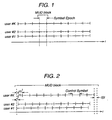
- Figure 1 illustrates the uplink transmissions of a number K of synchronised mobile stations.
- the result of this is that joint detection of the user symbols x 1 ... x K can be achieved at the base station receiver by considering one single symbol epoch at a time.
- the base station receiver needs to process signals transmitted by any number K uncoordinated mobile stations.
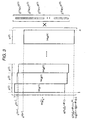
- the maximum asynchronous delay ⁇ max between the transmission of any two mobiles is less than a common-symbol epoch (Q c chip intervals).
- a control symbol epoch is chosen since this is common among all users.
- Figure 2 shows such a system and it is seen that the n th symbol of a user interferes not only with the n th, but also with ( n ⁇ 1) th symbols of all other users. Accordingly, joint detection of the user symbols can only be performed optimally by considering a signal block of an appropriate length. The block needs to be many symbols long.
- a natural MUD block length for WCDMA transmission is the time-slot period.
- the channel impulse response can be assumed to be fixed over a time-slot interval (625 ⁇ s) resulting in simplifications and reductions in the complexity of the multi-user detector.
- longer block lengths eg a frame period of 10 ms
- the block-length is time-varying and depends on the maximum delay ⁇ (K) ⁇ Q c -1, and is therefore upper bounded by MUD Block Length ⁇ ([N c +1]Q c +W-1)-1 samples
- (m) r ⁇ C ⁇ (N c Q c +W-1)+ ⁇ represent the MUD signal block at the output of the base station's antenna-m receive filter when sampled at ⁇ times the chip rate.
- x 2 (2) x d1 (2)
- x 3 (2) x d2 (2)
- Q d2 (2) 64.
- the product (m) ⁇ x is graphically illustrated in Figure 4.
- the first two groups of N c (1) and N d (1) columns relate to the first user; N c (1) shows the control symbols and N d (1) shows data symbols.
- the following three groups of N c (2) , N d1 (2) and N d2 (2) columns relate to the second user and show, respectively, control symbols and the two sets of data symbols for user 2.
- the length of each vertical line represents Q+W-1 which is equivalent to the length Q of the spreading sequence when filtered by a channel of length W chips.
- the chip oversampling factor in this example is ⁇ .
- MUD can be computationally very complex, particularly for a large number of users and is dependant upon the structure of matrix (m) ⁇ .
- the present invention arose in an attempt to reduce computational complexity for multi-rate multi-user detection, in WCDMA (wideband code division multiple access) systems.
- WCDMA wideband code division multiple access
- the present invention is characterised over the disclosure of the above mentioned Karimi paper in that the multi-user environment is multi-rate, and each user transmits control symbols and at least one group of data symbols, and wherein a convolution matrix (m) A is formed which is block-banded, each block including a number of columns relating to the number of groups of data or symbols transmitted by the users, and grouped according to the respective control symbols and in an order related to the order at which symbols arrive at a receiver.
- m convolution matrix
- control symbols are not considered in the multi-user detection problem, then the data symbols with the longest duration transmitted by each user effectively take up the role of control symbols.
- Other grouping methods may be used.
- the signal, (m) r , at the output of the antenna-m receive filter can always be represented as a linear function of a multi-user convolution matrix, (m) ⁇ , the vector of user symbols, x ⁇ , and additive noise (m) n .
- the objective of a multi-user detection algorithm is to eliminate the effects of multiple-access and inter-symbol interference by "reversing" the influence of the convolution matrix, (m) ⁇ , on the transmitted information.
- efficient implementation of MUD relies heavily on the exploitation of the structure and sparse nature of (m) ⁇ .
- (m) ⁇ is always sparse, this cannot be readily exploited since the detailed structure of (m) ⁇ is highly dependent on the number of users active in the cell, their relative delays and mix of data rates. This issue is addressed in embodiments of the invention by considering certain permutations of (m) ⁇ which render its structure more predictable and hence computationally friendly.
- a suitable permutation is one that groups the user symbols according to their respective control symbols and in a fashion which reflects the order in which the symbols arrive at the receiver. Such a permutation imposes a block-banded structure upon matrix (m) ⁇ .
- (m) A which is block-banded. Furthermore, when representing a block-length of one time-slot, (m) A can be completely defined via sub-matrices (m) B 1 ... (m) B N c each containing K c columns and (a maximum of) ⁇ (2Q c +W-1)-1 rows, as shown in Figure 5.
- Each block comprises a first control signal C- 1 , from user 1, two data symbols D 1 and D 2 from user 1, a second control symbol C 2 , from user 2, two data symbols D 3 and D 4 from the Nd 1 (2) data columns of user 2 in Figure (4), and four data symbols D 5 , D 6 , D 7 , D 8 from the Nd 2 (2) data columns of user 2 in Figure (4).
- Symbols x i (k) transmitted by the i th code of user k may then be extracted from the permuted symbol vector x as follows:
- control symbols are not considered in the multi-user detection problem; they may be detected by some other means.
- data symbols of chosen characteristics e.g. those of longest duration
- the invention extends to these methods.
- MATRIX NOTATION x Vector.
- X Matrix. x T X H Transpose and Hermitian Transpose.
- [ X ] i , j Element of X on the i th row and j th column.
- Sub-matrix of X from rows n 1 to n 2 and columns m 1 to m 2 .
- N ( k ) ⁇ R 1 Number of symbols transmitted by the k th user in a time-slot.
- N Number of symbols transmitted by all users in a time-slot.
- ⁇ ⁇ R 1 Oversampling factor (nominally 2).
- Q c ⁇ R 1 Spreading factor for control symbols.
- Q i ( k ) ⁇ R 1 Spreading factor for i th code of k th user.
- r ⁇ C K n ( ⁇ [ c N +1]+ W -1)-1) Receive vector associated with a time-slot.
Landscapes
- Physics & Mathematics (AREA)
- Mathematical Physics (AREA)
- Engineering & Computer Science (AREA)
- Computer Networks & Wireless Communication (AREA)
- Signal Processing (AREA)
- Mobile Radio Communication Systems (AREA)
- Indexing, Searching, Synchronizing, And The Amount Of Synchronization Travel Of Record Carriers (AREA)
- Circuits Of Receivers In General (AREA)
- Two-Way Televisions, Distribution Of Moving Picture Or The Like (AREA)
Claims (10)
- Procédé de détection de symboles d'utilisateur dans un environnement multi-utilisateurs, d'un système de communication à accès multiple à différence de code, AMDC, le procédé comprenant la modification de l'ordre dans lequel des symboles d'information sont estimés de façon à grouper les symboles d'utilisateur dans une structure en bandes de blocs, caractérisé en ce que l'environnement multi-utilisateurs est à débits multiples, et chaque utilisateur transmet des symboles de commande et au moins un groupe de symboles de données, et dans lequel une matrice de convolution (m)A en bandes de blocs est formée, chaque bloc comportant un nombre de colonnes lié au nombre de groupes de données ou de symboles transmis par les utilisateurs, et groupés conformément aux symboles de commande respectifs et dans un ordre lié à l'ordre dans lequel les symboles arrivent au niveau d'un récepteur.
- Procédé selon la revendication 1, dans lequel chaque bloc contient un symbole de commande pour chaque utilisateur et un ou plusieurs symboles de données pour chaque utilisateur.
- Procédé selon la revendication 2, dans lequel chaque bloc pour n utilisateurs comprend séquentiellement, un symbole de commande d'un premier utilisateur i, un ou plusieurs symboles de données du premier utilisateur i, et à son tour un symbole de commande de chaque (i + 1)e utilisateur, et un ou plusieurs symboles de données de chaque (i + 1)e utilisateur.
- Procédé selon l'une quelconque des revendications précédentes, dans lequel le nombre de symboles de données de chaque utilisateur dans un bloc est déterminé par le nombre de groupes de données transmis par cet utilisateur et les facteurs d'étalement relatifs des symboles de commande et symboles de données transmis par cet utilisateur.
- Procédé selon la revendication 4, dans lequel chaque utilisateur transmet de façon synchrone un nombre N de symboles de commande et de données, comprenant un symbole de commande et N-1 symboles de données, dans une époque, le procédé comprenant le brassage de l'ordre afin de former le nombre Nc de blocs, où Nc est égal au nombre de symboles de commande transmis dans une tranche de temps, chaque bloc étant de Kc colonnes, et le brassage des blocs de telle sorte que l'ordre des colonnes dans chaque bloc soit lié au temps auquel les symboles arrivent à une station.
- Procédé selon la revendication 1, dans lequel chaque utilisateur transmet une pluralité de groupes de symboles dans lequel une matrice de convolution (m)A est formée en bandes de blocs, chaque bloc comportant un nombre de colonnes lié au nombre de groupes de données ou de symboles transmis par les utilisateurs, et groupés dans un ordre lié à l'ordre dans lequel les symboles arrivent au niveau d'un récepteur.
- Procédé selon la revendication 6, dans lequel chaque bloc de n utilisateurs comprend, séquentiellement, une pluralité de symboles de données d'un premier utilisateur i, lié au nombre de groupes de symboles de données transmis par cet utilisateur, et un ou plusieurs symboles de données de chaque (i + 1)e utilisateur suivant, lié au nombre de groupes de symboles de données transmis par chaque utilisateur.
- Procédé selon l'une quelconque des revendications précédentes, dans lequel le nombre de symboles de données de chaque utilisateur dans un bloc est déterminé par le nombre de groupes de données transmis par cet utilisateur et les facteurs d'étalement relatifs des symboles de données transmis par cet utilisateur.
- Procédé selon la revendication 8, dans lequel chaque utilisateur transmet de façon synchrone un nombre N de symboles de données, dans une époque, le procédé comprenant le brassage de l'ordre afin de former le nombre Nc de blocs, où Nc est égal au nombre de symboles de données d'un groupe sélectionné transmis dans une tranche de temps, chaque bloc étant de Kc colonnes, et le brassage des blocs de telle sorte que l'ordre des colonnes dans chaque bloc soit lié au temps auquel les symboles arrivent à une station.
- Procédé selon la revendication 9, dans lequel le groupe sélectionné est celui ayant des symboles de plus longue durée.
Priority Applications (3)
| Application Number | Priority Date | Filing Date | Title |
|---|---|---|---|
| EP99305245A EP1065799B1 (fr) | 1999-07-02 | 1999-07-02 | Détection multiutilisateur pour AMDC à large bande |
| AT99305245T ATE324711T1 (de) | 1999-07-02 | 1999-07-02 | Mehrbenutzer detektion für breitbandigen cdma |
| DE69931041T DE69931041T2 (de) | 1999-07-02 | 1999-07-02 | Mehrbenutzer Detektion für Breitbandigen CDMA |
Applications Claiming Priority (1)
| Application Number | Priority Date | Filing Date | Title |
|---|---|---|---|
| EP99305245A EP1065799B1 (fr) | 1999-07-02 | 1999-07-02 | Détection multiutilisateur pour AMDC à large bande |
Publications (2)
| Publication Number | Publication Date |
|---|---|
| EP1065799A1 EP1065799A1 (fr) | 2001-01-03 |
| EP1065799B1 true EP1065799B1 (fr) | 2006-04-26 |
Family
ID=8241492
Family Applications (1)
| Application Number | Title | Priority Date | Filing Date |
|---|---|---|---|
| EP99305245A Expired - Lifetime EP1065799B1 (fr) | 1999-07-02 | 1999-07-02 | Détection multiutilisateur pour AMDC à large bande |
Country Status (3)
| Country | Link |
|---|---|
| EP (1) | EP1065799B1 (fr) |
| AT (1) | ATE324711T1 (fr) |
| DE (1) | DE69931041T2 (fr) |
Families Citing this family (4)
| Publication number | Priority date | Publication date | Assignee | Title |
|---|---|---|---|---|
| US6466611B1 (en) * | 2001-02-07 | 2002-10-15 | Motorola, Inc. | Multi-user detection using a finite-impulse-response matrix filter |
| US7376175B2 (en) | 2001-03-14 | 2008-05-20 | Mercury Computer Systems, Inc. | Wireless communications systems and methods for cache enabled multiple processor based multiple user detection |
| US7110431B2 (en) | 2001-03-14 | 2006-09-19 | Mercury Computer Systems, Inc. | Hardware and software for performing computations in a short-code spread-spectrum communications system |
| US6690660B2 (en) * | 2002-05-22 | 2004-02-10 | Interdigital Technology Corporation | Adaptive algorithm for a Cholesky approximation |
-
1999
- 1999-07-02 AT AT99305245T patent/ATE324711T1/de not_active IP Right Cessation
- 1999-07-02 EP EP99305245A patent/EP1065799B1/fr not_active Expired - Lifetime
- 1999-07-02 DE DE69931041T patent/DE69931041T2/de not_active Expired - Fee Related
Also Published As
| Publication number | Publication date |
|---|---|
| EP1065799A1 (fr) | 2001-01-03 |
| ATE324711T1 (de) | 2006-05-15 |
| DE69931041D1 (de) | 2006-06-01 |
| DE69931041T2 (de) | 2007-07-05 |
Similar Documents
| Publication | Publication Date | Title |
|---|---|---|
| US5237586A (en) | Rake receiver with selective ray combining | |
| JP3996888B2 (ja) | 単一ユーザ検出 | |
| KR100397772B1 (ko) | 직교 블럭 엔코딩 통신 시스템 및 그 방법 | |
| JP3181440B2 (ja) | Cdma方式通信装置 | |
| JP4944072B2 (ja) | 拡散率が一様でない符号のデータ検出 | |
| AU683694B2 (en) | A method of generating a spread code | |
| JP2002164826A (ja) | 時間反転空間時間ブロック送信機ダイバーシチ符号化を用いる符号分割多元接続無線システム | |
| JP3406355B2 (ja) | Cdmaシステムのための拡散系列のプレコーディング | |
| US7167529B2 (en) | Method and device for radio signal reception | |
| US7027817B2 (en) | Method for transmitting an information of a mobile telecommunication system | |
| CN1146163C (zh) | 提高td-cdma系统信道估计准确度的方法 | |
| EP1561289A1 (fr) | Detection multi-utilisateur mmse a complexite reduite pour liaison cdma a debits multiples | |
| JP4111953B2 (ja) | 拡張アルゴリズムデータ推定器 | |
| EP1446892A1 (fr) | Detecteur multi-utilisateur a faible complexite | |
| EP1065799B1 (fr) | Détection multiutilisateur pour AMDC à large bande | |
| CN1330101C (zh) | 一种移动通讯系统中降低复杂度的联合检测方法 | |
| Pigeonnat | Alternative solutions for joint detection in TD/CDMA multiple access scheme for UMTS | |
| JP2007529138A (ja) | 可変拡散率直交周波数・符号分割多重(vsf−ofcdm)システム、そのようなシステム内で受信信号を処理する受信機および方法 | |
| Pigeonnat | Joint detection for UMTS: complexity and alternative solutions | |
| Diaz et al. | Analysis of a linear interference canceller in cellular DS/CDMA systems | |
| JP2799474B2 (ja) | 符号分割多重信号受信方法 | |
| Wu et al. | Near optimum joint detection for CTDMA system | |
| Bakaimis et al. | Implications of random access collisions on physical layer performance of a hybrid TD/CDMA air interface with joint detection | |
| Chowdhury et al. | Combined MMSE equalization and multiuser detection for high-speed CDMA forward link with sparse multipath channels | |
| Yang et al. | A novel fast joint detector for smart antenna based CDMA systems |
Legal Events
| Date | Code | Title | Description |
|---|---|---|---|
| PUAI | Public reference made under article 153(3) epc to a published international application that has entered the european phase |
Free format text: ORIGINAL CODE: 0009012 |
|
| AK | Designated contracting states |
Kind code of ref document: A1 Designated state(s): AT BE CH CY DE DK ES FI FR GB GR IE IT LI LU MC NL PT SE |
|
| AX | Request for extension of the european patent |
Free format text: AL;LT;LV;MK;RO;SI |
|
| 17P | Request for examination filed |
Effective date: 20010620 |
|
| AKX | Designation fees paid |
Free format text: AT BE CH CY DE DK ES FI FR GB GR IE IT LI LU MC NL PT SE |
|
| 17Q | First examination report despatched |
Effective date: 20050420 |
|
| GRAP | Despatch of communication of intention to grant a patent |
Free format text: ORIGINAL CODE: EPIDOSNIGR1 |
|
| GRAS | Grant fee paid |
Free format text: ORIGINAL CODE: EPIDOSNIGR3 |
|
| GRAA | (expected) grant |
Free format text: ORIGINAL CODE: 0009210 |
|
| AK | Designated contracting states |
Kind code of ref document: B1 Designated state(s): AT BE CH CY DE DK ES FI FR GB GR IE IT LI LU MC NL PT SE |
|
| PG25 | Lapsed in a contracting state [announced via postgrant information from national office to epo] |
Ref country code: NL Free format text: LAPSE BECAUSE OF FAILURE TO SUBMIT A TRANSLATION OF THE DESCRIPTION OR TO PAY THE FEE WITHIN THE PRESCRIBED TIME-LIMIT Effective date: 20060426 Ref country code: LI Free format text: LAPSE BECAUSE OF FAILURE TO SUBMIT A TRANSLATION OF THE DESCRIPTION OR TO PAY THE FEE WITHIN THE PRESCRIBED TIME-LIMIT Effective date: 20060426 Ref country code: IT Free format text: LAPSE BECAUSE OF FAILURE TO SUBMIT A TRANSLATION OF THE DESCRIPTION OR TO PAY THE FEE WITHIN THE PRESCRIBED TIME-LIMIT;WARNING: LAPSES OF ITALIAN PATENTS WITH EFFECTIVE DATE BEFORE 2007 MAY HAVE OCCURRED AT ANY TIME BEFORE 2007. THE CORRECT EFFECTIVE DATE MAY BE DIFFERENT FROM THE ONE RECORDED. Effective date: 20060426 Ref country code: CH Free format text: LAPSE BECAUSE OF FAILURE TO SUBMIT A TRANSLATION OF THE DESCRIPTION OR TO PAY THE FEE WITHIN THE PRESCRIBED TIME-LIMIT Effective date: 20060426 Ref country code: BE Free format text: LAPSE BECAUSE OF FAILURE TO SUBMIT A TRANSLATION OF THE DESCRIPTION OR TO PAY THE FEE WITHIN THE PRESCRIBED TIME-LIMIT Effective date: 20060426 Ref country code: AT Free format text: LAPSE BECAUSE OF FAILURE TO SUBMIT A TRANSLATION OF THE DESCRIPTION OR TO PAY THE FEE WITHIN THE PRESCRIBED TIME-LIMIT Effective date: 20060426 |
|
| REG | Reference to a national code |
Ref country code: GB Ref legal event code: FG4D |
|
| REG | Reference to a national code |
Ref country code: IE Ref legal event code: FG4D |
|
| REF | Corresponds to: |
Ref document number: 69931041 Country of ref document: DE Date of ref document: 20060601 Kind code of ref document: P |
|
| PG25 | Lapsed in a contracting state [announced via postgrant information from national office to epo] |
Ref country code: IE Free format text: LAPSE BECAUSE OF NON-PAYMENT OF DUE FEES Effective date: 20060703 |
|
| PG25 | Lapsed in a contracting state [announced via postgrant information from national office to epo] |
Ref country code: SE Free format text: LAPSE BECAUSE OF FAILURE TO SUBMIT A TRANSLATION OF THE DESCRIPTION OR TO PAY THE FEE WITHIN THE PRESCRIBED TIME-LIMIT Effective date: 20060726 Ref country code: DK Free format text: LAPSE BECAUSE OF FAILURE TO SUBMIT A TRANSLATION OF THE DESCRIPTION OR TO PAY THE FEE WITHIN THE PRESCRIBED TIME-LIMIT Effective date: 20060726 |
|
| PG25 | Lapsed in a contracting state [announced via postgrant information from national office to epo] |
Ref country code: MC Free format text: LAPSE BECAUSE OF NON-PAYMENT OF DUE FEES Effective date: 20060731 |
|
| PG25 | Lapsed in a contracting state [announced via postgrant information from national office to epo] |
Ref country code: ES Free format text: LAPSE BECAUSE OF FAILURE TO SUBMIT A TRANSLATION OF THE DESCRIPTION OR TO PAY THE FEE WITHIN THE PRESCRIBED TIME-LIMIT Effective date: 20060806 |
|
| PG25 | Lapsed in a contracting state [announced via postgrant information from national office to epo] |
Ref country code: PT Free format text: LAPSE BECAUSE OF FAILURE TO SUBMIT A TRANSLATION OF THE DESCRIPTION OR TO PAY THE FEE WITHIN THE PRESCRIBED TIME-LIMIT Effective date: 20060926 |
|
| REG | Reference to a national code |
Ref country code: CH Ref legal event code: PL |
|
| NLV1 | Nl: lapsed or annulled due to failure to fulfill the requirements of art. 29p and 29m of the patents act | ||
| ET | Fr: translation filed | ||
| PLBE | No opposition filed within time limit |
Free format text: ORIGINAL CODE: 0009261 |
|
| STAA | Information on the status of an ep patent application or granted ep patent |
Free format text: STATUS: NO OPPOSITION FILED WITHIN TIME LIMIT |
|
| 26N | No opposition filed |
Effective date: 20070129 |
|
| PGFP | Annual fee paid to national office [announced via postgrant information from national office to epo] |
Ref country code: DE Payment date: 20070719 Year of fee payment: 9 |
|
| PGFP | Annual fee paid to national office [announced via postgrant information from national office to epo] |
Ref country code: FI Payment date: 20070713 Year of fee payment: 9 |
|
| PGFP | Annual fee paid to national office [announced via postgrant information from national office to epo] |
Ref country code: GB Payment date: 20070720 Year of fee payment: 9 |
|
| PG25 | Lapsed in a contracting state [announced via postgrant information from national office to epo] |
Ref country code: GR Free format text: LAPSE BECAUSE OF FAILURE TO SUBMIT A TRANSLATION OF THE DESCRIPTION OR TO PAY THE FEE WITHIN THE PRESCRIBED TIME-LIMIT Effective date: 20060727 |
|
| PGFP | Annual fee paid to national office [announced via postgrant information from national office to epo] |
Ref country code: FR Payment date: 20070710 Year of fee payment: 9 |
|
| PG25 | Lapsed in a contracting state [announced via postgrant information from national office to epo] |
Ref country code: LU Free format text: LAPSE BECAUSE OF NON-PAYMENT OF DUE FEES Effective date: 20060702 |
|
| PG25 | Lapsed in a contracting state [announced via postgrant information from national office to epo] |
Ref country code: CY Free format text: LAPSE BECAUSE OF FAILURE TO SUBMIT A TRANSLATION OF THE DESCRIPTION OR TO PAY THE FEE WITHIN THE PRESCRIBED TIME-LIMIT Effective date: 20060426 |
|
| GBPC | Gb: european patent ceased through non-payment of renewal fee |
Effective date: 20080702 |
|
| PG25 | Lapsed in a contracting state [announced via postgrant information from national office to epo] |
Ref country code: DE Free format text: LAPSE BECAUSE OF NON-PAYMENT OF DUE FEES Effective date: 20090203 |
|
| REG | Reference to a national code |
Ref country code: FR Ref legal event code: ST Effective date: 20090331 |
|
| PG25 | Lapsed in a contracting state [announced via postgrant information from national office to epo] |
Ref country code: FI Free format text: LAPSE BECAUSE OF NON-PAYMENT OF DUE FEES Effective date: 20080702 |
|
| PG25 | Lapsed in a contracting state [announced via postgrant information from national office to epo] |
Ref country code: GB Free format text: LAPSE BECAUSE OF NON-PAYMENT OF DUE FEES Effective date: 20080702 |
|
| PG25 | Lapsed in a contracting state [announced via postgrant information from national office to epo] |
Ref country code: FR Free format text: LAPSE BECAUSE OF NON-PAYMENT OF DUE FEES Effective date: 20080731 |