EP1065933B1 - Solutions antimicrobiennes - Google Patents
Solutions antimicrobiennes Download PDFInfo
- Publication number
- EP1065933B1 EP1065933B1 EP99909977A EP99909977A EP1065933B1 EP 1065933 B1 EP1065933 B1 EP 1065933B1 EP 99909977 A EP99909977 A EP 99909977A EP 99909977 A EP99909977 A EP 99909977A EP 1065933 B1 EP1065933 B1 EP 1065933B1
- Authority
- EP
- European Patent Office
- Prior art keywords
- weight percent
- hydantoin
- antimicrobial solution
- solution
- antimicrobial
- Prior art date
- Legal status (The legal status is an assumption and is not a legal conclusion. Google has not performed a legal analysis and makes no representation as to the accuracy of the status listed.)
- Expired - Lifetime
Links
- 230000000845 anti-microbial effect Effects 0.000 title claims abstract description 131
- 239000000203 mixture Substances 0.000 claims abstract description 70
- 239000007788 liquid Substances 0.000 claims abstract description 62
- 150000001469 hydantoins Chemical class 0.000 claims abstract description 51
- XLYOFNOQVPJJNP-UHFFFAOYSA-N water Substances O XLYOFNOQVPJJNP-UHFFFAOYSA-N 0.000 claims abstract description 41
- -1 alkyl carbamate Chemical compound 0.000 claims abstract description 39
- WVDDGKGOMKODPV-UHFFFAOYSA-N Benzyl alcohol Chemical compound OCC1=CC=CC=C1 WVDDGKGOMKODPV-UHFFFAOYSA-N 0.000 claims abstract description 30
- 239000003755 preservative agent Substances 0.000 claims abstract description 19
- 230000002335 preservative effect Effects 0.000 claims abstract description 17
- 238000011065 in-situ storage Methods 0.000 claims abstract description 12
- WSDISUOETYTPRL-UHFFFAOYSA-N dmdm hydantoin Chemical compound CC1(C)N(CO)C(=O)N(CO)C1=O WSDISUOETYTPRL-UHFFFAOYSA-N 0.000 claims description 86
- 229940099451 3-iodo-2-propynylbutylcarbamate Drugs 0.000 claims description 71
- WYVVKGNFXHOCQV-UHFFFAOYSA-N 3-iodoprop-2-yn-1-yl butylcarbamate Chemical group CCCCNC(=O)OCC#CI WYVVKGNFXHOCQV-UHFFFAOYSA-N 0.000 claims description 71
- WSFSSNUMVMOOMR-UHFFFAOYSA-N Formaldehyde Chemical compound O=C WSFSSNUMVMOOMR-UHFFFAOYSA-N 0.000 claims description 64
- OKKJLVBELUTLKV-UHFFFAOYSA-N Methanol Chemical group OC OKKJLVBELUTLKV-UHFFFAOYSA-N 0.000 claims description 46
- 230000000813 microbial effect Effects 0.000 claims description 32
- 238000000034 method Methods 0.000 claims description 28
- QCDWFXQBSFUVSP-UHFFFAOYSA-N 2-phenoxyethanol Chemical compound OCCOC1=CC=CC=C1 QCDWFXQBSFUVSP-UHFFFAOYSA-N 0.000 claims description 25
- 229960005323 phenoxyethanol Drugs 0.000 claims description 25
- 239000011541 reaction mixture Substances 0.000 claims description 21
- 125000000217 alkyl group Chemical group 0.000 claims description 12
- 244000005700 microbiome Species 0.000 claims description 12
- 125000004432 carbon atom Chemical group C* 0.000 claims description 11
- 229940058012 1,3-dimethylol-5,5-dimethylhydantoin Drugs 0.000 claims description 8
- WRMNZCZEMHIOCP-UHFFFAOYSA-N 2-phenylethanol Chemical compound OCCC1=CC=CC=C1 WRMNZCZEMHIOCP-UHFFFAOYSA-N 0.000 claims description 8
- 229930040373 Paraformaldehyde Natural products 0.000 claims description 8
- 229920002866 paraformaldehyde Polymers 0.000 claims description 8
- 230000008569 process Effects 0.000 claims description 8
- 238000010438 heat treatment Methods 0.000 claims description 7
- 125000002947 alkylene group Chemical group 0.000 claims description 5
- 238000004519 manufacturing process Methods 0.000 claims description 5
- 125000001997 phenyl group Chemical group [H]C1=C([H])C([H])=C(*)C([H])=C1[H] 0.000 claims description 5
- 125000001424 substituent group Chemical group 0.000 claims description 5
- KXDHJXZQYSOELW-UHFFFAOYSA-M Carbamate Chemical compound NC([O-])=O KXDHJXZQYSOELW-UHFFFAOYSA-M 0.000 claims description 4
- WVDDGKGOMKODPV-ZQBYOMGUSA-N phenyl(114C)methanol Chemical compound O[14CH2]C1=CC=CC=C1 WVDDGKGOMKODPV-ZQBYOMGUSA-N 0.000 claims description 4
- 238000001816 cooling Methods 0.000 claims description 2
- 230000002401 inhibitory effect Effects 0.000 claims 4
- 230000000979 retarding effect Effects 0.000 claims 4
- 230000000843 anti-fungal effect Effects 0.000 abstract description 19
- 238000002360 preparation method Methods 0.000 abstract description 18
- 239000002537 cosmetic Substances 0.000 abstract description 15
- 229940121375 antifungal agent Drugs 0.000 abstract description 13
- 238000009472 formulation Methods 0.000 abstract description 8
- 239000000654 additive Substances 0.000 abstract description 6
- 239000000243 solution Substances 0.000 description 111
- 239000002453 shampoo Substances 0.000 description 63
- FJKROLUGYXJWQN-UHFFFAOYSA-N 4-hydroxybenzoic acid Chemical compound OC(=O)C1=CC=C(O)C=C1 FJKROLUGYXJWQN-UHFFFAOYSA-N 0.000 description 31
- 239000000047 product Substances 0.000 description 27
- DNIAPMSPPWPWGF-UHFFFAOYSA-N Propylene glycol Chemical compound CC(O)CO DNIAPMSPPWPWGF-UHFFFAOYSA-N 0.000 description 24
- 238000012360 testing method Methods 0.000 description 21
- 239000000843 powder Substances 0.000 description 18
- 239000002609 medium Substances 0.000 description 17
- 230000001332 colony forming effect Effects 0.000 description 11
- 239000004615 ingredient Substances 0.000 description 11
- 239000004599 antimicrobial Substances 0.000 description 10
- 241000233866 Fungi Species 0.000 description 9
- 238000004321 preservation Methods 0.000 description 9
- 230000001580 bacterial effect Effects 0.000 description 8
- 238000004090 dissolution Methods 0.000 description 8
- 230000000415 inactivating effect Effects 0.000 description 8
- LXCFILQKKLGQFO-UHFFFAOYSA-N methylparaben Chemical compound COC(=O)C1=CC=C(O)C=C1 LXCFILQKKLGQFO-UHFFFAOYSA-N 0.000 description 8
- 239000012736 aqueous medium Substances 0.000 description 7
- 240000004808 Saccharomyces cerevisiae Species 0.000 description 6
- 238000006243 chemical reaction Methods 0.000 description 6
- 239000007859 condensation product Substances 0.000 description 5
- 229940091173 hydantoin Drugs 0.000 description 5
- 238000003756 stirring Methods 0.000 description 5
- PUPZLCDOIYMWBV-UHFFFAOYSA-N (+/-)-1,3-Butanediol Chemical compound CC(O)CCO PUPZLCDOIYMWBV-UHFFFAOYSA-N 0.000 description 4
- YIROYDNZEPTFOL-UHFFFAOYSA-N 5,5-Dimethylhydantoin Chemical compound CC1(C)NC(=O)NC1=O YIROYDNZEPTFOL-UHFFFAOYSA-N 0.000 description 4
- 241000894006 Bacteria Species 0.000 description 4
- 241000222122 Candida albicans Species 0.000 description 4
- ISWSIDIOOBJBQZ-UHFFFAOYSA-N Phenol Natural products OC1=CC=CC=C1 ISWSIDIOOBJBQZ-UHFFFAOYSA-N 0.000 description 4
- 230000000844 anti-bacterial effect Effects 0.000 description 4
- 229940095731 candida albicans Drugs 0.000 description 4
- 239000004292 methyl p-hydroxybenzoate Substances 0.000 description 4
- 235000010270 methyl p-hydroxybenzoate Nutrition 0.000 description 4
- 229960002216 methylparaben Drugs 0.000 description 4
- 239000000244 polyoxyethylene sorbitan monooleate Substances 0.000 description 4
- 235000010482 polyoxyethylene sorbitan monooleate Nutrition 0.000 description 4
- 229940068968 polysorbate 80 Drugs 0.000 description 4
- 229920000053 polysorbate 80 Polymers 0.000 description 4
- 229940095673 shampoo product Drugs 0.000 description 4
- 102000008186 Collagen Human genes 0.000 description 3
- 108010035532 Collagen Proteins 0.000 description 3
- 241000589517 Pseudomonas aeruginosa Species 0.000 description 3
- HEMHJVSKTPXQMS-UHFFFAOYSA-M Sodium hydroxide Chemical group [OH-].[Na+] HEMHJVSKTPXQMS-UHFFFAOYSA-M 0.000 description 3
- 239000002535 acidifier Substances 0.000 description 3
- 230000000996 additive effect Effects 0.000 description 3
- 230000003113 alkalizing effect Effects 0.000 description 3
- 239000003795 chemical substances by application Substances 0.000 description 3
- KRKNYBCHXYNGOX-UHFFFAOYSA-N citric acid group Chemical group C(CC(O)(C(=O)O)CC(=O)O)(=O)O KRKNYBCHXYNGOX-UHFFFAOYSA-N 0.000 description 3
- 229920001436 collagen Polymers 0.000 description 3
- 150000001875 compounds Chemical class 0.000 description 3
- 230000007423 decrease Effects 0.000 description 3
- 238000011978 dissolution method Methods 0.000 description 3
- 238000009826 distribution Methods 0.000 description 3
- 238000011156 evaluation Methods 0.000 description 3
- 229920000136 polysorbate Polymers 0.000 description 3
- 229940068965 polysorbates Drugs 0.000 description 3
- 102000004169 proteins and genes Human genes 0.000 description 3
- 108090000623 proteins and genes Proteins 0.000 description 3
- 229940058015 1,3-butylene glycol Drugs 0.000 description 2
- IIZPXYDJLKNOIY-JXPKJXOSSA-N 1-palmitoyl-2-arachidonoyl-sn-glycero-3-phosphocholine Chemical compound CCCCCCCCCCCCCCCC(=O)OC[C@H](COP([O-])(=O)OCC[N+](C)(C)C)OC(=O)CCC\C=C/C\C=C/C\C=C/C\C=C/CCCCC IIZPXYDJLKNOIY-JXPKJXOSSA-N 0.000 description 2
- 241000228245 Aspergillus niger Species 0.000 description 2
- 241000588724 Escherichia coli Species 0.000 description 2
- 241000191967 Staphylococcus aureus Species 0.000 description 2
- 239000002253 acid Substances 0.000 description 2
- 230000003115 biocidal effect Effects 0.000 description 2
- 239000003139 biocide Substances 0.000 description 2
- 235000019437 butane-1,3-diol Nutrition 0.000 description 2
- 239000001913 cellulose Substances 0.000 description 2
- 229920002678 cellulose Polymers 0.000 description 2
- 238000006482 condensation reaction Methods 0.000 description 2
- 229940080249 disodium oleamido mea-sulfosuccinate Drugs 0.000 description 2
- SMVRDGHCVNAOIN-UHFFFAOYSA-L disodium;1-dodecoxydodecane;sulfate Chemical compound [Na+].[Na+].[O-]S([O-])(=O)=O.CCCCCCCCCCCCOCCCCCCCCCCCC SMVRDGHCVNAOIN-UHFFFAOYSA-L 0.000 description 2
- ILMNXWNOEHOLDY-XXAVUKJNSA-L disodium;4-[2-[[(z)-octadec-9-enoyl]amino]ethoxy]-4-oxo-3-sulfonatobutanoate Chemical compound [Na+].[Na+].CCCCCCCC\C=C/CCCCCCCC(=O)NCCOC(=O)C(S([O-])(=O)=O)CC([O-])=O ILMNXWNOEHOLDY-XXAVUKJNSA-L 0.000 description 2
- 238000010410 dusting Methods 0.000 description 2
- 230000000855 fungicidal effect Effects 0.000 description 2
- 239000000417 fungicide Substances 0.000 description 2
- WJRBRSLFGCUECM-UHFFFAOYSA-N hydantoin Chemical group O=C1CNC(=O)N1 WJRBRSLFGCUECM-UHFFFAOYSA-N 0.000 description 2
- 238000011534 incubation Methods 0.000 description 2
- 239000000787 lecithin Substances 0.000 description 2
- 235000010445 lecithin Nutrition 0.000 description 2
- 229940067606 lecithin Drugs 0.000 description 2
- 238000007747 plating Methods 0.000 description 2
- QELSKZZBTMNZEB-UHFFFAOYSA-N propylparaben Chemical compound CCCOC(=O)C1=CC=C(O)C=C1 QELSKZZBTMNZEB-UHFFFAOYSA-N 0.000 description 2
- 238000012216 screening Methods 0.000 description 2
- 239000002904 solvent Substances 0.000 description 2
- NERNEXMEYQFFHU-UHFFFAOYSA-N 1,3-diazaspiro[4.5]decane-2,4-dione Chemical compound N1C(=O)NC(=O)C11CCCCC1 NERNEXMEYQFFHU-UHFFFAOYSA-N 0.000 description 1
- 229940090248 4-hydroxybenzoic acid Drugs 0.000 description 1
- GWTZZUPJEUZZLU-UHFFFAOYSA-N 5,5-diethylimidazolidine-2,4-dione Chemical compound CCC1(CC)NC(=O)NC1=O GWTZZUPJEUZZLU-UHFFFAOYSA-N 0.000 description 1
- VSJRBQDMBFFHMC-UHFFFAOYSA-N 5-ethyl-5-methylimidazolidine-2,4-dione Chemical compound CCC1(C)NC(=O)NC1=O VSJRBQDMBFFHMC-UHFFFAOYSA-N 0.000 description 1
- JNGWGQUYLVSFND-UHFFFAOYSA-N 5-methyl-5-phenylimidazolidine-2,4-dione Chemical compound C=1C=CC=CC=1C1(C)NC(=O)NC1=O JNGWGQUYLVSFND-UHFFFAOYSA-N 0.000 description 1
- QXNVGIXVLWOKEQ-UHFFFAOYSA-N Disodium Chemical compound [Na][Na] QXNVGIXVLWOKEQ-UHFFFAOYSA-N 0.000 description 1
- UFHFLCQGNIYNRP-UHFFFAOYSA-N Hydrogen Chemical compound [H][H] UFHFLCQGNIYNRP-UHFFFAOYSA-N 0.000 description 1
- CXOFVDLJLONNDW-UHFFFAOYSA-N Phenytoin Chemical compound N1C(=O)NC(=O)C1(C=1C=CC=CC=1)C1=CC=CC=C1 CXOFVDLJLONNDW-UHFFFAOYSA-N 0.000 description 1
- BTBJBAZGXNKLQC-UHFFFAOYSA-N ammonium lauryl sulfate Chemical compound [NH4+].CCCCCCCCCCCCOS([O-])(=O)=O BTBJBAZGXNKLQC-UHFFFAOYSA-N 0.000 description 1
- 229940063953 ammonium lauryl sulfate Drugs 0.000 description 1
- 238000004458 analytical method Methods 0.000 description 1
- 239000013011 aqueous formulation Substances 0.000 description 1
- 239000007864 aqueous solution Substances 0.000 description 1
- 239000003899 bactericide agent Substances 0.000 description 1
- 230000003385 bacteriostatic effect Effects 0.000 description 1
- 230000009286 beneficial effect Effects 0.000 description 1
- 230000033228 biological regulation Effects 0.000 description 1
- 150000004657 carbamic acid derivatives Chemical class 0.000 description 1
- MRUAUOIMASANKQ-UHFFFAOYSA-N cocamidopropyl betaine Chemical compound CCCCCCCCCCCC(=O)NCCC[N+](C)(C)CC([O-])=O MRUAUOIMASANKQ-UHFFFAOYSA-N 0.000 description 1
- 229940073507 cocamidopropyl betaine Drugs 0.000 description 1
- 230000000052 comparative effect Effects 0.000 description 1
- 239000000356 contaminant Substances 0.000 description 1
- 238000011109 contamination Methods 0.000 description 1
- 238000010790 dilution Methods 0.000 description 1
- 239000012895 dilution Substances 0.000 description 1
- 238000005516 engineering process Methods 0.000 description 1
- 150000002148 esters Chemical class 0.000 description 1
- 230000002349 favourable effect Effects 0.000 description 1
- 239000003205 fragrance Substances 0.000 description 1
- 230000002538 fungal effect Effects 0.000 description 1
- 230000003370 grooming effect Effects 0.000 description 1
- 239000012456 homogeneous solution Substances 0.000 description 1
- 229910052739 hydrogen Inorganic materials 0.000 description 1
- 239000001257 hydrogen Substances 0.000 description 1
- 238000000338 in vitro Methods 0.000 description 1
- 230000005764 inhibitory process Effects 0.000 description 1
- 238000011081 inoculation Methods 0.000 description 1
- 239000007791 liquid phase Substances 0.000 description 1
- 239000006193 liquid solution Substances 0.000 description 1
- 239000006210 lotion Substances 0.000 description 1
- 239000000463 material Substances 0.000 description 1
- WSFSSNUMVMOOMR-NJFSPNSNSA-N methanone Chemical compound O=[14CH2] WSFSSNUMVMOOMR-NJFSPNSNSA-N 0.000 description 1
- 238000012986 modification Methods 0.000 description 1
- 230000004048 modification Effects 0.000 description 1
- 229910052757 nitrogen Inorganic materials 0.000 description 1
- 125000004433 nitrogen atom Chemical group N* 0.000 description 1
- 239000012457 nonaqueous media Substances 0.000 description 1
- 231100000252 nontoxic Toxicity 0.000 description 1
- 230000003000 nontoxic effect Effects 0.000 description 1
- 238000013386 optimize process Methods 0.000 description 1
- 238000010979 pH adjustment Methods 0.000 description 1
- 230000000737 periodic effect Effects 0.000 description 1
- 239000000825 pharmaceutical preparation Substances 0.000 description 1
- 229940127557 pharmaceutical product Drugs 0.000 description 1
- 239000012071 phase Substances 0.000 description 1
- 239000001965 potato dextrose agar Substances 0.000 description 1
- 230000003389 potentiating effect Effects 0.000 description 1
- 239000004405 propyl p-hydroxybenzoate Substances 0.000 description 1
- 235000010232 propyl p-hydroxybenzoate Nutrition 0.000 description 1
- 229960003415 propylparaben Drugs 0.000 description 1
- 239000012429 reaction media Substances 0.000 description 1
- 230000009467 reduction Effects 0.000 description 1
- 230000004044 response Effects 0.000 description 1
- 238000005070 sampling Methods 0.000 description 1
- 238000010561 standard procedure Methods 0.000 description 1
- 230000003068 static effect Effects 0.000 description 1
- 238000003860 storage Methods 0.000 description 1
- 239000004094 surface-active agent Substances 0.000 description 1
- 230000000699 topical effect Effects 0.000 description 1
- 239000006150 trypticase soy agar Substances 0.000 description 1
- 238000010792 warming Methods 0.000 description 1
Classifications
-
- A—HUMAN NECESSITIES
- A01—AGRICULTURE; FORESTRY; ANIMAL HUSBANDRY; HUNTING; TRAPPING; FISHING
- A01N—PRESERVATION OF BODIES OF HUMANS OR ANIMALS OR PLANTS OR PARTS THEREOF; BIOCIDES, e.g. AS DISINFECTANTS, AS PESTICIDES OR AS HERBICIDES; PEST REPELLANTS OR ATTRACTANTS; PLANT GROWTH REGULATORS
- A01N47/00—Biocides, pest repellants or attractants, or plant growth regulators containing organic compounds containing a carbon atom not being member of a ring and having no bond to a carbon or hydrogen atom, e.g. derivatives of carbonic acid
- A01N47/08—Biocides, pest repellants or attractants, or plant growth regulators containing organic compounds containing a carbon atom not being member of a ring and having no bond to a carbon or hydrogen atom, e.g. derivatives of carbonic acid the carbon atom having one or more single bonds to nitrogen atoms
- A01N47/10—Carbamic acid derivatives, i.e. containing the group —O—CO—N<; Thio analogues thereof
- A01N47/12—Carbamic acid derivatives, i.e. containing the group —O—CO—N<; Thio analogues thereof containing a —O—CO—N< group, or a thio analogue thereof, neither directly attached to a ring nor the nitrogen atom being a member of a heterocyclic ring
Definitions
- This invention lies in the field of antimicrobial solutions of formaldehyde substituted hydantoin and iodoalkynyl alkyl carbamate and of methods for the preparation thereof.
- Antimicrobial combinations of formaldehyde substituted hydantoin, particularly 1,3-dimethylol-5,5-dimethyl hydantoin (abbreviated for convenience as DMDMH), with various selected other antimicrobial agents are desirable additives for use in a variety of personal care preparations, particularly cosmetics.
- Multiple usage personal care preparations, such as shampoos, skin lotions and the like, are especially prone to exposure to bacterial contamination during repeated opening of the container for product usage.
- DMDMH is a broad spectrum antimicrobial, it is primarily active against bacteria and less active against fungi. Thus, to fully achieve broad spectrum antimicrobial activity, DMDMH is frequently combined with a second component that is particularly active against fungi. Also, the two components in combination should preferably be water soluble and achieve a greater antimicrobial effectiveness than either component used separately at equivalent concentrations.
- the second, anti-fungal component employed is a paraben (or paraben mixture).
- the parabens are esters of parahydroxy benzoic acid (para acid).
- the parabens can only function in the water phase of a product but are not readily water soluble.
- the parabens can be partially or fully inactivated by hydrogen bonders, such as highly ethoxylated compounds, e.g., polysorbates, by cellulose derivatives, proteins and the like which are frequent ingredients in personal care preparations.
- IPBC 3-iodo-2-propynyl butyl carbamate
- IPBC has a limited solubility in water of reportedly about 160-200 parts per million (0.016-0.02%).
- the water solubility of the blend decreases.
- Merianos, in U.S. Patent No. 5,428,050 and No. 5,496,842 teaches, for example, that a high weight ratio of DMDMH to IPBC of upwards of 100:1 to 2000:1 in a DMDMH:IPBC powder blend is needed for water solubility and that at DMDMH:IPBC weight ratios below 100:1, it is difficult to uniformly distribute the iodopropynyl compound in aqueous use compositions.
- a liquid composition containing predispersed DMDMH and IPBC therefore, appears to offer the advantages of being readily admixable with aqueous or nonaqueous preparations and of achieving homogeneous distribution in the resulting finished system.
- liquid compositions of DMDMH and IPBC are described by Merianos in U.S. Pat. Nos. 5,496,842, 5,552,425 and 5,631,273 and which are prepared by using the foregoing water soluble, dry blend of DMDMH and IPBC predispersed in propylene glycol or 1,3-butylene glycol.
- the two foregoing alkylene glycols taught by Merianos are readily water soluble aliphatic diols but have little or no recognized antimicrobial activity, themselves, at use concentrations below about 10 weight percent in the finished preparation.
- the Merianos liquid compositions require that the water soluble, dry blend of DMDMH and IPBC have a high weight ratio of DMDMH to IPBC ranging upwards from 100:1 to 2000:1.
- the art needs a new and improved liquid composition for DMDMH and IPBC which, when admixed with an aqueous medium at a usage concentration preferably of no more than about one weight percent produces broad spectrum antimicrobial activity, and especially antifungal activity.
- the present invention provides such a new and improved liquid composition.
- the present invention relates to new and improved liquid antimicrobial solutions useful as preservative additives to personal care preparations, particularly cosmetic formulations and the like.
- the antimicrobial solutions of this invention display broad spectrum antimicrobial effectiveness, and especially antifungal effectiveness, at a relatively low usage concentration in an aqueous cosmetic medium.
- the antimicrobial solutions are made by combining components comprising a 5,5-disubstituted hydantoin which has in at least one, preferably both, of the 1 and 3 positions a methylol substituent and the 5,5 substituents are selected from phenyl or lower alkyl groups; a liquid aromatic alcohol having the formula: where R is selected from the group consisting of: -CH 2 OH, -OCH 2 OH, -OCH 2 CH 2 OH, -CH 2 CH 2 OH, -OC 3 H 6 OH, and -C 3 H 6 OH; an iodoalkynyl alkyl carbamate having the formula: where R 1 is an alkyl group containing no more than about 20 carbon atoms, and R 2 is an alkylene group containing from 1 through 4 carbon atoms; and less than about 15 weight percent water on a total solution weight basis.
- a 5,5-disubstituted hydantoin which has in at least one
- the methylol substituted 5,5-disubstituted hydantoin preferably is prepared in situ in a liquid medium containing the aromatic alcohol by first thermally reacting dissolved formaldehyde with dissolved 5,5-disubstituted hydantoin, and then, iodoalkynyl alkyl carbamate, having been separately prepared, can be dissolved in the reaction medium.
- the weight ratio of the methylol substituted 5,5-disubstituted hydantoin to the carbamate is in the range of from about 60:1 to about 80:1.
- the present invention relates to new and improved liquid antimicrobial solutions of in situ prepared 1,3,dimethylol-5,5-disubstituted hydantoin (DMDMH) in an antimicrobial liquid phenylic or benzylic alcohol which here also acts as a solvent for 3-iodo-2-propynyl butyl carbamate (IPBC).
- concentration of DMDMH in such liquid aromatic alcohol preferably is in the range of about 25 to about 75 weight percent (on a total liquid solution basis), more preferably at least about 30 weight percent.
- the aromatic alcohol preferably is phenoxyethanol and the concentration of the DMDMH to IPBC is preferably in the range of about 65:1 to about 78:1.
- an antimicrobial solution of this invention can be prepared by direct dissolution of separately prepared DMDMH and IPBC in a liquid medium comprising the aromatic alcohol, heating as needed to achieve a homogenous solution.
- a direct dissolution procedure is less commercially practical for the present inventive compositions.
- the preliminary preparation of DMDMH as a dry powder requires a plurality of manufacturing steps which substantially add to production costs.
- handling dry powders presents dusting problems at the time dissolution thereof is attempted.
- the present invention therefore, beneficially provides an optimized process for dissolving IPBC in a solution of in situ prepared DMDMH in liquid aromatic alcohol so that commercial production of the inventive compositions is directly achieved in a minimum of steps. Further, the present invention achieves liquid antimicrobial solutions that are readily water dispersible without having to preliminarily prepare dry powder blends of DMDMH and IPBC employing high weight ratios of DMDMH to IPBC of 100:1 to 2000:1 as taught by Merianos, U.S. Pat. No. 5,496,842.
- a liquid antimicrobial solution of this invention can be admixed with an aqueous medium, to achieve, at a relatively low dilution concentration in such a medium, a high level of broad spectrum antimicrobial activity, and antifungal activity, in particular. Further surprising, such solutions are substantially water dispersible and homogeneous distribution is characteristically observed.
- the antimicrobial solutions of this invention offer an optimized solution of DMDMH and IPBC that can be homogeneously dispersed in an aqueous medium containing known paraben inactivating ingredients for achieving broad spectrum antimicrobial activity, and antifungal activity, in particular, even at low dispersed concentration,.
- the antimicrobial solutions of this invention thus offer an alternative to paraben containing liquid antimicrobial solutions for use in formulations that contain paraben inactivating ingredients.
- each component of the present inventive antimicrobial solution is microbiologically active and can be dispersed in both aqueous and nonaqueous media.
- antimicrobial solution refers to a composition that can kill, prevent, inhibit or retard the growth and reproduction of microorganisms when it is included in a product medium at a concentration sufficient to prevent spoilage or prevent the growth of an inadvertently added microorganism (that is, an antimicrobially effective amount).
- an antimicrobial solution generally extends the useful life of a product without contributing otherwise to the claimed efficacy of the product and is useful as a preservative composition for personal care preparations.
- personal care preparations includes cosmetics, toiletries, skin and hair cleansers, cosmeceuticals, over-the-counter pharmaceutical products, and the like intended for topical use for beautifying or grooming skin and hair.
- water dispersible as used herein in connection with the antimicrobial solution means that when the composition is admixed with water at a relatively low concentration of no more than about 1 weight percent, a substantially clear solution produced within one minute.
- Preferred antimicrobial solution embodiments of this invention are prepared by producing methylolated 5,5-disubstituted hydantoin in situ by thermally reacting dissolved formaldehyde with dissolved 5,5-disubstituted hydantoin in the selected aromatic alcohol and then adding to the resulting solution the previously prepared iodoalkynyl alkyl carbamate.
- the reaction with formaldehyde introduces methylol groups bound to the nitrogen atom at each of the 1 and/or 3 positions of the hydantoin ring and 5,5-disubstituted hydantoin which can be so methylolated can have substituents selected from phenyl and lower alkyl groups.
- the term "lower alkyl" means that the alkyl group contains no more than about 7 carbon atoms.
- Exemplary 5,5-disubstituted hydantoin include 5,5-dimethyl hydantoin (DMH), 5-methyl-5-ethylhydantoin, 5,5-diethylhydantoin, 5,5-diphenylhydantoin, 5-methyl-5-phenylhydantoin, 5,5-pentamethylenehydantoin and the like known in the art as possessing broad spectrum bactericidal activity.
- DMH is particularly preferred for preparing 1,3-dimethylol-5,5-dimethyl hydantoin (DMDMH).
- liquid aromatic alcohols usable in the practice of the present invention are characterized by the formula: wherein R is selected from the group consisting of -CH 2 OH, -OCH 2 OH, - OCH 2 CH 2 OH, -CH 2 CH 2 OH, -OC 3 H 6 OH, and -C 3 H 6 OH.
- Preferred formula (1) compounds are phenoxyethanol (presently most preferred), benzyl alcohol, phenethyl alcohol, phenoxyisopropyl alcohol and mixtures thereof, all of which are known to have antimicrobial activity.
- substantially anhydrous denotes paraformaldehyde which is at an active concentration of above about 90 weight percent, preferably at about 95 weight percent or more based on total starting paraformaldehyde composition.
- the formaldehyde can be added as formalin, preferably methanol free and at a concentration of at least about 30 weight percent formaldehyde. Paraformaldehyde is preferred.
- the resulting liquid medium preferably contains an amount of at least about 2 weight percent, and, more preferably in the range of from about 10 to about 25 weight percent of total calculated formaldehyde on a 100 weight percent total liquid medium basis.
- This resulting liquid medium is then heated to a temperature of no more than about 50°C, preferably to a temperature of no more than about 45°C. Thereafter a 5,5-disubstituted hydantoin (such as above characterized) is admixed into (and dissolved in) the so-heated liquid medium to produce a reaction mixture.
- a 5,5-disubstituted hydantoin (such as above characterized) is admixed into (and dissolved in) the so-heated liquid medium to produce a reaction mixture.
- the amount of the 5,5-disubstituted hydantoin present is at least sufficient to produce in the reaction mixture an initial calculated mole ratio of formaldehyde to the substituted hydantoin of about 1:1 to about 3:1 and, more preferably, in the range of about 1.5:1 to about 2.1:1.
- the resulting reaction mixture is heated under autogenous pressure conditions (in a sealed reactor to avoid loss of volatile components) to a temperature of no more than about 110°C for a period sufficient for a liquid phase condensation reaction to ensue between the paraformaldehyde and the 5,5-disubstituted hydantoin.
- the condensation product contains a mixture of methylol substituted 5,5-disubstituted hydantoin with the methylol substituents being in the 1 and/or 3 positions.
- the reaction conditions influence the condensation product produced so that very high yields of 1,3-dimethylol substituted 5,5-disubstituted hydantoin (DMDMH) can be produced, as preferred.
- the temperature of the resulting reaction mixture is maintained until the condensation reaction is substantially complete as determined by the point where the amount of free formaldehyde present in the reaction mixture is no more than about 2.5 weight percent, preferably no more than about 1 weight percent, based on total reaction mixture weight. To reach such a free formaldehyde content, it may be desirable to add additional 5,5-disubstituted hydantoin as needed to the reaction mixture.
- the resulting reaction mixture can be cooled to a temperature below about 40°C, preferably to a temperature in the range of about 25 °C to about 35°C, and then dissolved therein is an iodoalkynyl alkyl carbamate characterized by the formula: where R 1 is an alkyl group containing no more than about 20 carbon atoms, and R 2 is an alkylene group containing from 1 through 4 carbon atoms.
- IPBC 3-iodo-2-propynyl butyl carbamate
- the resulting antimicrobial solution When the resulting antimicrobial solution is substantially homogeneous and visually clear, it can be further cooled to about ambient room temperature, if necessary. Optionally, this solution can be filtered to remove any particulates and to further clarify the solution.
- the total amount of methylol substituted 5,5-disubstituted hydantoin ranges from about 25 to about 75 weight percent while the amount of formula (1) aromatic alcohol preferably ranges from about 20 to about 70.
- the weight ratio of methylol substituted 5,5-disubstituted hydantoin to iodoalkynyl alkyl carbamate is in the range of from about 60:1 to about 80:1.
- the balance of up to 100 weight percent of the solution can comprise unreacted components (formaldehyde and 5,5-disubstituted hydantoin) and no more than about 15 weight percent total water (either intentionally added or as water of reaction).
- the water of reaction can be removed by stripping or the like, to produce a substantially anhydrous product solution, preferably before the dissolution therein of the iodoalkynyl alkyl carbamate.
- the total water content of the product antimicrobial solution can be adjusted after dissolution of the iodoalkynyl alkyl carbamate
- antimicrobial solution products of this invention are physically clear and remain so on storage.
- inventive solutions also demonstrate useful broad spectrum antimicrobial activity, especially antifungal activity, even at usage concentrations of no more than about one weight percent, preferably no more than about 0.8 weight percent, in an aqueous medium capable of supporting microbial growth and containing paraben inactivating ingredients.
- paraben inactivating ingredients include, without limitation, highly ethoxylated compounds such as polysorbates, and surfactants, proteins and derivatives thereof, cellulose derivative, lecithin and the like.
- Presently preferred product antimicrobial solutions of this invention are characterized by having the following compositional ranges of components as shown in Table I below: SOLUTION COMPOSITIONS Weight Percent Component Broad Range Preferred Range Most Preferred Range (a) Methylol substituted 5,5-disubstituted hydantoin 20 - 75 25 - 60 30 - 40 (b) Aromatic alcohol of formula (1) 20 - 70 35 - 65 50 - 60 Weight ratio of (a) to Carbamate of formula (2) 60:1-80:1 65:1-78:1 70:1-75:1 Water 0-15 2-12 6-10
- a presently most preferred practice for the present inventive process is to produce a product antimicrobial solution in which the antimicrobial liquid aromatic alcohol comprises phenoxyethanol and the 5,5-disubstituted hydantoin comprises 5,5-dimethyl hydantoin.
- the mole ratio between the formaldehyde and the substituted hydantoin is preferably such that the condensation product comprises on a 100 weight percent total condensation product basis at least about 10 weight percent 1,3-dimethylol-5,5-dimethyl hydantoin (DMDMH), and more preferably about 25 weight percent on a total condensate hydantoin weight basis.
- the amount of IPBC can be in the range of about 0.25 to about 1.25 weight percent, preferably in the range of about 0.3 to about 1 weight percent, most preferably in the range of about 0.4 to about 0.6 weight percent, of the total solution.
- the weight ratio of DMDMH to IPBC is in the range of from about 60:1 to about 80:1.
- a particularly preferred product solution contains at least about 30 weight percent DMDMH, at least about 50 weight percent phenoxyethanol and IPBC at a weight ratio of DMDMH to IPBC in the range of about 65:1 to about 78:1, most preferably in the range of about 70:1 to about 75:1.
- IPBC is readily dispersed and dissolved in phenoxyethanol containing in situ prepared DMDMH.
- separately prepared DMDMH powder and IPBC each can be directly dissolved in phenoxyethanol, warming if necessary, to fully dissolve the IPBC and form a substantially clear, homogenous solution.
- Antimicrobial solution products of this invention are substantially water dispersible. Surprisingly at a concentration of no more than about one weight percent in water at ambient room temperature, an antimicrobial solution containing a weight ratio of DMDMH to IPBC of about 70:1 formed which was initially hazy but within less than about one minute formed a substantially clear solution.
- An antimicrobial solution of the present invention preferably has a pH in the range of about 5 to about 7, more preferably in the range of about 5.5 and about 6.5. If it is desirable to adjust the pH of a product antimicrobial solution, the adjustment can be accomplished by addition to the solution of an aqueous acidifying agent or alkalizing agent, as the case may be.
- alkalizing agent and “acidifying agent” each respectively refer to any commercially practical alkaline base or acid that does not interfere with the preparation of the antimicrobially active preservative solution and which, if present in an amount in excess of that needed for pH adjustment, is preferably soluble in the solvent medium and is substantially nontoxic to humans.
- a preferred alkalizing agent is sodium hydroxide and a preferred acidifying agent is citric acid, both of which are commonly used in the personal care arts.
- microorganisms of greatest concern include, but are not limited to, molds, such as Aspergillus niger (An); yeasts, such as Candida albicans (Ca); gram-positive microorganisms, such as Staphylococcus aureus (Sa); nonfermentative gram-negative rod microorganisms, such as Pseudomonas aeruginosa (Pa) and fermentative gram-negative rod microorganisms, Escherichia coli (Ec).
- molds such as Aspergillus niger (An); yeasts, such as Candida albicans (Ca); gram-positive microorganisms, such as Staphylococcus aureus (Sa); nonfermentative gram-negative rod microorganisms, such as Pseudomonas aeruginosa (Pa) and fermentative gram-negative rod microorganisms, Escherichia coli (Ec).
- molds such
- IPBC IP-based antimicrobial activity
- inventive antimicrobial solutions were useful as preservative compositions in aqueous mediums containing known paraben inactivating ingredients, such as, for example, shampoos containing protein derivatives, polysorbates and the like.
- the preservation efficacy of the inventive antimicrobial solution was determined by in vitro modified microbial challenge testing when it was employed in an aqueous product formulation known to support microbial growth.
- a modified microbial challenge test protocol for rapidly screening the microbial efficacy in an aqueous medium was adapted from the standard method of the United States Pharmacopeia (USP) and the method of the Cosmetic, Toiletry and Fragrance Association (CTFA).
- USP United States Pharmacopeia
- CTFA Cosmetic, Toiletry and Fragrance Association
- the foregoing modified method allowed for a shortened challenge test period of multiple use cosmetic products, such as shampoos, and consisted of inoculating the product formulation with different types of microorganisms which are representative of the most frequently encountered contaminants in cosmetic and personal care formulations.
- an aqueous formulation capable of microbial growth was separately inoculated with a mixed bacterial culture of Pa, Sa and Ec, and individually with the fungi, Ca and An. Microbial growth then was periodically determined over an incubation period of at least 7 to 14 days.
- viable bacteria concentration had to be reduced to about 0.1 weight percent of the original total bacterial count (i.e., average count of microbial colony forming units (cfu) per milliliter (ml) of test product) within 7 days and remain at or below that level throughout the total 14 day test period.
- the modified microbial challenge test for fungi fungi (yeast and mold)
- the average fungal growth count had to remain at (static) or below the inoculation level by 7 days and not exceed that level for the remainder of the test.
- MEL minimum effective level
- the preferred solution compositions of Table I are characterized by broad spectrum microbial efficacy, and by being particularly effective against the yeast, Ca.
- an antimicrobial solution of this invention achieved adequate preservation at an MEL of no more than about 0.8 weight percent of the total shampoo composition. Further surprising was that adequate preservation and antifungal effectiveness was achieved in such a cosmetic medium at low usage levels of no more than about 0.005 % IPBC.
- This example illustrates a method embodiment for preparing a liquid antimicrobial solution containing IPBC dissolved in phenoxyethanol containing about 35 weight percent in situ prepared DMDMH from the following component mixture: Component Weight Percent 1. Phenoxyethanol 56.8 2. Paraformaldehyde Prills (95%) 11.5 3. 5,5-dimethyl hydantoin (96%) 25.2 4. IPBC (97-99%) 0.5 5. Water q.s. to 100
- Component No. 1 and about 60% of the total amount of component No. 5 desired in the solution were charged into a sealable reaction vessel outfitted with a jacket for heating or cooling and a sampling port and were admixed with stirring to form a liquid mixture.
- Component No. 2 was then dissolved with stirring in the liquid mixture and the resulting liquid medium was then heated to about 40 °C.
- Component No. 3 was then added slowly to the so-heated liquid medium to form a reaction mixture.
- the reactor was then sealed to prevent loss of volatile components, and formaldehyde in particular, from the reaction mixture during heating.
- the resulting reaction mixture was then heated to about 105 °C and maintained at that temperature, until, by periodic analysis, the desired amount of DMDMH was produced and the free formaldehyde concentration was no more than about 2.5 weight percent of the total weight of the reaction mixture.
- reaction mixture was then cooled to a temperature in the range of about 30°C to about 35°C.
- Component No. 4 was then admixed into the so-cooled reaction mixture with stirring until the resulting reaction mixture was a homogeneous and substantially clear liquid composition. Thereafter, the liquid composition was further cooled to about 25°C, adjusted for pH and total water content by adding the remaining amount of component No. 5, as needed, and the resulting antimicrobial solution collected.
- the product liquid antimicrobial solution had a pH in the range of about 5.5 and about 6.5.
- the assayed amount of free formaldehyde was in the range of about 1 to about 2.5 weight percent and the assayed amount of total water was between about 6 and about 10 weight percent on a total solution basis.
- Component Nos. 2 and 3 were admixed directly with component No.s 1 and 4 with stirring until a substantially clear, homogeneous solution was produced.
- This example illustrates the antimicrobial efficacy of an inventive antimicrobial solution (3A) prepared generally by the direct dissolution method of Example 2 compared to two commercial paraben containing antimicrobial solutions and a commercial dry blend of DMDMH/IPBC employing a model shampoo formulation having the composition shown in the following Table 1.
- Component Weight Percent Sodium laurylethersulfate (70%) 30 Cocamide DEA 3 Hydrolyzed collagen 1 Water q.s. to 100
- each of the indicated weight percent (wt%) of antimicrobial solution additive was incorporated into the model shampoo with stirring.
- the microbial efficacy of the antimicrobial solution in the model shampoo was assessed against that of the model shampoo without antimicrobial additive (control) by carrying out the modified microbial challenge test previously described for the inhibition of the growth of Aspergillus niger (An) ATCC No. #16404; Candida albicans (Ca) ATCC No. #10231; and a mixed bacterial culture of Staphylococcus aureus (Sa) ATCC No. #6538, Pseudomonas aeruginosa (Pa) ATCC No. #9027 and Escherichia coli (Ec) ATCC No. #8739.
- model shampoo samples were individually inoculated to contain about 10 5 to 10 6 cfu/ml of An, of Ca and of the mixed bacterial culture of Sa, Pa, Ec organisms.
- the inoculated model shampoo samples were individually plated out in tryptic soy agar medium with lecithin and Polysorbate 80 for assessing bacterial growth and in potato dextrose agar (acidified) for assessing fungi growth. Following platings at day 1 and day 7, and incubation, readings of the number of colony forming units per milliliter (cfu/ml) were made. After the day 7 plating, the model shampoo samples were reinoculated and plated at day 8 and day 14, incubated and readings taken again.
- a series of model shampoos were separately prepared to contain on a total shampoo weight basis, 0% (unpreserved control), about 0.4 wt%, about 0.5 wt%, and about 0.6 wt% use concentration of inventive liquid antimicrobial solution (3A).
- inventive liquid antimicrobial solution (3A) The average antimicrobial efficacy data for the inventive antimicrobial solution (3A) over the 14 day total test period was as shown in Table 2.
- the three concentrations of inventive antimicrobial solution (3A) evaluated in the model shampoo respectively represented, on an active basis, a usage concentration of DMDMH in the range of about 0.14 to about 0.21 wt%, of phenoxyethanol in the range of about 0.22 to about 0.34 wt% and of IPBC in the range of about 0.002 to about 0.003 wt%.
- a usage concentration of DMDMH in the range of about 0.14 to about 0.21 wt%
- of phenoxyethanol in the range of about 0.22 to about 0.34 wt%
- IPBC in the range of about 0.002 to about 0.003 wt%.
- Adequate preservation and surprisingly high antifungal effectiveness, especially against Ca was achieved at a usage concentration of 0.002 wt% IPBC.
- a second series of model shampoos were separately prepared employing a commercial liquid paraben containing preservative solution, (PARAGON® III, McIntyre Group, Ltd., University Park, IL, prepared generally by the procedure taught in U.S. No. 5,616,722, containing about 30% DMDMH, about 48% phenoxyethanol, about 11% methylparaben, about 4% propylparaben and about 7% water.
- the model shampoos were separately prepared to contain, on a total shampoo weight basis, the commercial preservative solution at a use concentration of about 0.5 wt%, about 0.6 wt%, about 0.7 wt% and about 0.8 wt%.
- the four concentrations of paraben containing antimicrobial solution in the model shampoos respectively represented, on an active basis, a usage concentration of DMDMH in the range of about 0.15 to about 0.24 wt%, of phenoxyethanol in the range of about 0.24 to about 0.38 wt%, and of a total paraben concentration in the range of about 0.075 to about 0.12 wt%.
- a third series of model shampoos were prepared employing a commercial liquid paraben containing preservative solution, (PARAGON®, McIntyre Group, Ltd., prepared generally by the procedure taught in U.S. No. 5,037,843, containing about 35% DMDMH, about 50% propylene glycol and about 15% methylparaben).
- the model shampoos were prepared to separately contain, on a total shampoo basis, the commercial paraben containing preservative solution at a use concentration of about 0.5 % and about 0.6 wt%.
- the average antimicrobial efficacy data assessed during the same foregoing modified microbial challenge study, was as shown in Table 4.
- Model shampoo w/ Wt% PARAGON® Colony Forming Units (cfu/ml) Org. Day 1 Day 7 Day 8 Day 14 0.5 An 90 ⁇ 10 ⁇ 10 ⁇ 10 Ca ⁇ 100 ⁇ 100 ⁇ 100 ⁇ 100 Sa, Pa, Ec 60 ⁇ 10 ⁇ 10 ⁇ 10 0.6 An ⁇ 10 ⁇ 10 ⁇ 10 Ca ⁇ 100 ⁇ 100 ⁇ 100 ⁇ 100 Sa,Pa,Ec ⁇ 10 ⁇ 10 ⁇ 10 ⁇ 10 0 (control) An 430,000 230,000 660,000 850,000 Ca 1,100 3,100 18,000 3,100 Sa,Pa,Ec 35,000 > 3x10 6 > 3x10 6 >3x10 6
- model shampoos were prepared employing a commercial preservative dry powder blend, (GLYDANT PLUS®, Lonza, Inc., Fair Lawn, NJ, described generally in U.S. No. 4,844,891, reportedly containing 95% DMDMH and 5% IPBC).
- the model shampoos were prepared to separately contain the commercial dry powder blend at a use concentration of about 0.05 wt%, about 0.1 wt %, and about 0.15 wt%.
- the average antimicrobial efficacy data for the powder commercial blend assessed during the same foregoing modified microbial challenge study, was as shown in Table 5.
- the three concentrations of powder blend in the model shampoos respectively represented, on an active basis, a usage concentration of DMDMH in the range of about 0.048 to about 0.142 wt%, and of IPBC in the range of about 0.0025 to about 0.0075 wt% in the shampoo product.
- inventive antimicrobial solution (4A) achieved adequate preservation of the model shampoo at a minimum effective level (MEL) of about 0.4 wt% use concentration, and that desirable antifungal effectiveness, especially against Ca was achieved at a usage concentration of about 0.002% IPBC.
- MEL minimum effective level
- inventive antimicrobial solution achieved good antifungal activity at a lower MEL than was required with the liquid paraben containing compositions.
- the data also show that greater and more consistently effective broad spectrum antimicrobial activity, especially against fungi, was achieved with the inventive antimicrobial solution (3A) than with the commercial powder blend of DMDMH and IPBC at equivalent DMDMH or equivalent IPBC usage concentrations.
- This example illustrates the antimicrobial efficacy of a liquid antimicrobial solution (4A) of this invention prepared generally by the direct dissolution method of Example 2 compared to a commercial liquid paraben containing antimicrobial solution and a commercial aqueous DMDMH solution.
- a series of model shampoos were prepared to separately contain, on a total shampoo weight basis, 0% (unpreserved control), about 0.2 wt%, about 0.4 wt%, and about 0.6 wt% use concentrations of the liquid antimicrobial solution (4A), dissolved in the shampoo with heating to form a substantially clear shampoo product.
- the microbial efficacy of antimicrobial solution (4A) was assessed by following the procedure of the modified challenge test described in Example 3. The average microbial efficacy data after the 14 day test was as shown in Table 7.
- model mild shampoos were separately prepared employing a commercial liquid paraben containing preservative solution (PARAGON®, McIntyre Group, Ltd., University Park, IL containing about 35% DMDMH, about 50% propylene glycol and about 15 weight percent methyl paraben).
- These model shampoos were prepared to separately contain, on a total shampoo basis, about 0.2 wt%, about 0.4 wt%, and about 0.6 wt% of the commercial paraben containing antimicrobial solution.
- the microbial effectiveness of the model shampoo was assessed during the challenge test in the foregoing study and the average microbial efficacy data was as shown in Table 8.
- Model shampoo w/ wt% PARAGON® Colony Forming Units (cfu/ml) Org. Day 1 Day 7 Day 8 Day 14 0.2 An 660,000 21,000 500,000 140,000 Ca 63,000 13,000 210,000 33,000 Sa, Pa, Ec 3,800 3,800 5,400 100 0.4 An 970 70 4,900 280 Ca 3,500 360 5,600 1,000 Sa,Pa,Ec 1,100 10 1,100 ⁇ 10 0.6 An ⁇ 10 ⁇ 10 20 ⁇ 10 Ca ⁇ 10 ⁇ 10 60 ⁇ 10 Sa,Pa,Ec 90 ⁇ 10 390 ⁇ 10 0 (control) An 710,000 690,000 >3x10 6 1.3x10 6 Ca 60,100 98,100 1,300 57,000 Sa,Pa,Ec 13,000 >3x10 6 >3x10 6 >3x10 6 >3x10 6
- the three concentrations of paraben containing solution respectively represented, on an active basis, a usage concentration of DMDMH in the range of about 0.074 to about 0.22 wt% DMDMH, of propylene glycol in the range of about 0.09 to about 0.26 wt%, and of methyl paraben in the range of about 0.03 to about 0.09 wt%.
- a third series of model mild shampoos were prepared employing a commercial aqueous solution of 55% DMDMH (MACKSTAT® DM, Mclntyre Group, Ltd., University Park, IL) to separately contain, on a total shampoo basis, a concentration of DMDMH of about 0.12 wt%, about 0.24 wt% and about 0.36 wt%.
- DMDMH 55% DMDMH
- the microbial efficacy of the DMDMH in the model shampoos was assessed during the foregoing modified microbial challenge test and the average antimicrobial efficacy data are shown in Table 9.
- the three use concentrations of DMDMH respectively represented, on an active basis, a usage concentration of DMDMH in the range of about 0.06 to about 0.2 wt%.
- the data show that, while all three concentrations were microbiologically effective, the antifungal effectiveness of DMDMH at a usage level of 0.14% or less was not as effective as that of the IPBC containing inventive solution (4A) at substantially the same equivalent usage level of DMDMH.
- This example illustrates the antimicrobial effectiveness of a liquid antimicrobial solution (5A) of this invention prepared generally by the in situ procedure of Example 1 to contain about 35 wt% DMDMH, about 56 wt% phenoxyethanol, about 0.5 wt% IPBC and about 8.5 wt% water when used in an aqueous model shampoo medium particularly prone to bacterial growth.
- the model shampoo contained known paraben inactivating ingredients and had the composition shown in Table 10.
- the efficacy of the inventive antimicrobial solution was compared to that of a commercial dry blend of DMDMH and IPBC.
- a series of separate model shampoos were prepared containing, on a total shampoo basis, 0% (unpreserved control), about 0.2 wt%, about 0.4 wt%, about 0.6 wt% and about 0.8 wt% of the inventive liquid antimicrobial solution (5A), heating as needed to form a substantially clear product shampoo.
- the microbial efficacy was assessed by following the procedure of the modified microbial challenge test of Example 3.
- the average antimicrobial efficacy data for the inventive liquid antimicrobial solution (5A) after day 7 and, after rechallenge on day 14 was as shown in Table 11.
- the four use concentrations of the inventive antimicrobial solution (5A) in the model shampoo respectively represented, on an active basis, a usage concentration of DMDMH in the range of about 0.07 to about 0.28 wt%, of phenoxyethanol in the range of about 0.112 to about 0.45 wt%, and of IPBC in the range of about 0.001 to about 0.004 wt%.
- Broad spectrum antibacterial activity was substantially achieved with the inventive solution (5A) at a use concentration of about 0.4 to about 0.8 wt%.
- model shampoos were prepared employing a commercial preservative powder blend, (GLYDANT PLUS®, Lonza, Inc., Fair Lawn, NJ, described generally in U.S. No. 4,844,891, reportedly containing 95% DMDMH and 5% IPBC).
- the model shampoos were prepared to contain the commercial dry powder blend at a use concentration of about 0.05 wt%, about 0.1 wt%, about 0.15 wt%, about 0.2 wt% and about 0.25 wt%.
- the average antimicrobial effectiveness of the powder blend was assessed during the same foregoing modified microbial challenge study and the average antimicrobial efficacy data was as shown in Table 12.
- Test shampoo wt% GLYDANT PLUS® Colony Forming Units (cfu/ml) Org. Day 7 Day 14 0.05 An 49,000 97,000 Ca 100,000 1,400 Sa, Pa, Ec > 3x10 6 > 3x10 6 0.1 An 2,600 8,400 Ca ⁇ 100 ⁇ 100 Sa,Pa,Ec 970 33,100 0.15 An 2,000 3,000 Ca ⁇ 100 ⁇ 100 Sa,Pa,Ec 270 850 0.2 An ⁇ 1,000 2,000 Ca ⁇ 10 ⁇ 10 Sa,Pa,Ec 90 50 0.25 An ⁇ 1,000 ⁇ 10 Ca ⁇ 1,000 ⁇ 10 Sa,Pa,Ec 10 20 0 (control) An 100,000 380,000 Ca 39,000 160,000 Sa,Pa,Ec > 3x10 6 > 3x10 6
- the five concentrations of the commercial powder blend respectively represented, on an active basis, a usage concentration of DMDMH in the range of about 0.048 to about 0.23 wt%, and a usage concentration of IPBC in s range of about 0.0025 to about 0.0125 wt%.
- liquid antimicrobial solutions of this invention surprisingly were more effective in achieving substantially broad spectrum microbial reduction than liquid antimicrobial solutions of paraben containing DMDMH prepared in a phenoxyethanol or propylene glycol medium at a lower usage concentration of antifungal component.
- the efficacy achieved in controlling Ca within 7 days at a concentration of about 0.4 wt% with inventive antimicrobial solution was substantially equivalent to that of a concentration of about 0.5 wt% of commercial paraben containing antimicrobial solutions of the '722 patent and the '843 patent and of about 0.05 wt% of the commercial powder blend of DMDMH and IPBC at an equivalent IPBC concentration.
Landscapes
- Life Sciences & Earth Sciences (AREA)
- Agronomy & Crop Science (AREA)
- Pest Control & Pesticides (AREA)
- Plant Pathology (AREA)
- Health & Medical Sciences (AREA)
- Engineering & Computer Science (AREA)
- Dentistry (AREA)
- General Health & Medical Sciences (AREA)
- Wood Science & Technology (AREA)
- Zoology (AREA)
- Environmental Sciences (AREA)
- Agricultural Chemicals And Associated Chemicals (AREA)
- Cosmetics (AREA)
Claims (24)
- Solution antimicrobienne liquide pour usage comme composition de conservation réalisée par combinaison, sur la base du poids total de solution, de composants comprenant:(a) une hydantoïne 5,5-disubstituée qui a sur au moins l'une des positions 1 et 3 un substituant méthylol, ledit substituant méthylol étant présent sur les deux des dites positions 1 et 3 dans au moins environ 10 pour cent en poids par rapport au poids total de ladite hydantoïne 5,5-disubstituée par du méthylol, et où chacun des dits substituants en 5,5 est choisi dans le groupe consistant en des groupes phényle et alkyle inférieur;(b) un alcool aromatique liquide ayant la formule:où R est choisi dans le groupe consistant en:
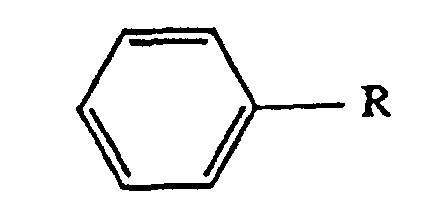
-CH2OH, -OCH2OH, -OCH2CH2OH,
-CH2CH2OH, -OC3H6OH, et -C3H6OH;(c) un alkyl carbamate d'iodoalcynyle ayant la formule:où: R1 est un groupe alkyle ne contenant pas plus d'environ 20 atomes de carbone, et R2 est un groupe alcylène contenant de 1 à 4 atomes de carbone; et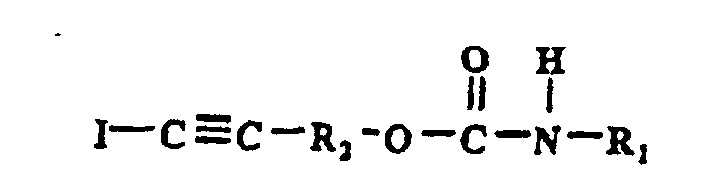 (d) moins d'environ 15 pour cent en poids d'eau; ladite combinaison ayant été réalisée par préparation d'hydantoïne 5,5-disubstituée, substituée par du méthylol, in situ dans un milieu liquide comprenant ledit alcool aromatique par réaction thermique de formaldéhyde dissous avec de l'hydantoïne 5,5-disubstituée dissoute, et ensuite dissolution du dit alkyl carbamate d'iodoalcynyle dans une solution comprenant ladite hydantoïne 5,5-disubstituée, substituée par du méthylol, ainsi préparée in situ, dissoute dans ledit alcool aromatique.
 - Solution antimicrobienne selon la revendication 1, dans laquelle le rapport en poids du composant (a) au composant (c) est dans l'intervalle d'environ 60:1 à environ 80:1.
- Solution antimicrobienne selon la revendication 1, dans laquelle le composant (a) comprend au moins environ 25 pour cent en poids de 1,3-diméthylol-5,5-diméthyl hydantoïne sur une base de 100 pour cent en poids d'hydantoïne 5,5-disubstituée, substituée par du méthylol totale.
- Solution antimicrobienne selon la revendication 1, dans laquelle ledit alcool aromatique est choisi dans le groupe consistant en phénoxyéthanol, alcool benzylique, alcool phénéthylique, alcool phénoxyisopropylique et leurs mélanges.
- Solution antimicrobienne selon la revendication 1, dans laquelle le composant (b) comprend du phénoxyéthanol.
- Solution antimicrobienne selon la revendication 1, dans laquelle ledit alkyl carbamate d'iodoalcynyle est le butyl carbamate de 3-iodo-2-propynyle.
- Solution antimicrobienne selon la revendication 1, dans laquelle, sur une base de 100 pour cent de solution, le composant (a) comprend au moins environ 30 pour cent en poids de 1,3-diméthylol-5,5-diméthyl hydantoïne, le composant (b) comprend au moins environ 50 pour cent en poids de phénoxyéthanol, le composant (c) comprend du butyl carbamate de 3-iodo-2-propynyle et le rapport en poids du composant (a) au composant (c) est dans l'intervalle d'environ 65:1 à environ 78:1.
- Solution antimicrobienne selon la revendication 7, dans laquelle le rapport en poids du composant (a) au composant (c) est dans l'intervalle d'environ 70:1 à environ 75:1.
- Solution antimicrobienne liquide pour utilisation comme composition de conservation comprenant, sur une base de 100 pour cent en poids:(a) environ 20 à environ 75 pour cent en poids d'une hydantoïne 5,5-disubstituée qui a dans au moins l'une des positions 1 et 3 un substituant méthylol, ledit substituant méthylol étant présent dans les deux dites positions 1 et 3 dans au moins environ 10 pour cent en poids du poids total de ladite hydantoïne 5,5-disubstituée, substituée par du méthylol, et tandis que chacun des dits substituants en 5,5 est choisi dans le groupe consistant en des groupes phényle et alkyle inférieur;(b) environ 20 à environ 70 pour cent en poids d'un alcool aromatique liquide ayant la formule:où R est choisi dans le groupe consistant en:

-CH2OH, -OCH2OH, -OCH2CH2OH,
-CH2CH2OH, -OC3H6OH, et -C3H6OH;(c) une quantité efficace du point de vue antifongique d'alkyl carbamate d'iodoalcynyle ayant la formule:où: R1 est un groupe alkyle ne contenant pas plus d'environ 20 atomes de carbone, et R2 est un groupe alcylène contenant de 1 à 4 atomes de carbone; et (d) moins d'environ 15 pour cent en poids d'eau; le rapport en poids de ladite hydantoïne 5,5-disubstituée, substituée par du méthylol au dit carbamate étant dans l'intervalle d'environ 60:1 à environ 80:1; et ladite hydantoïne 5,5-disubstituée, substituée par du méthylol ayant été préparée in situ dans ledit alcool aromatique par réaction thermique de formaldéhyde dissous avec de l'hydantoïne 5,5-disubstituée dissoute, et ledit alkyl carbamate d'iodoalcynyle qui a été préparé séparément étant ensuite dissous dans une solution comprenant ladite hydantoïne 5,5-disubstituée, substituée par du méthylol, ainsi préparée in situ, dissoute dans ledit alcool aromatique.
 - Solution antimicrobienne selon la revendication 9, dans laquelle ladite hydantoïne 5,5-disubstituée, substituée par du méthylol comprend de la 1,3-diméthylol-5,5-diméthyl hydantoïne.
- Solution antimicrobienne selon la revendication 9, dans laquelle ledit alcool aromatique est choisi dans le groupe consistant en phénoxyéthanol, alcool benzylique, alcool phénéthylique, alcool phénoxyisopropylique et leurs mélanges.
- Solution antimicrobienne selon la revendication 9, dans laquelle l'alkyl carbamate d'iodoalcynyle comprend environ 0,25 à environ 1,25 pour cent en poids de butyl carbamate de 3-iodo-2-propynyle.
- Solution antimicrobienne selon la revendication 9, dans laquelle l'hydantoïne 5,5-disubstituée comprend au moins environ 30 pour cent en poids de 1,3-diméthylol-5,5-diméthyl hydantoïne, ledit alcool aromatique comprend au moins environ 50 pour cent en poids de phénoxyéthanol et ledit alkyl carbamate d'iodoalcynyle comprend du butyl carbamate de 3-iodo-2-propynyle.
- Procédé pour la préparation d'une solution antimicrobienne liquide comprenant un alcool aromatique liquide qui contient (i) une hydantoïne 5,5-disubstituée, substituée par du méthylol, qui comprend all moins environ 10 pour cent en poids, sur une base de 100 pour cent en poids total d'hydantoïne 5,5-disubstituée, substituée par du méthylol, de 1,3-diméthylol-5,5-disubstituée hydantoïne, et tandis que chacun des dits substituants en 5,5 est choisi dans le groupe consistant en des groupes phényle et alkyle inférieur, et (ii) un alkyl carbamate d'iodoalcynyle ayant la formule:où: R1 est un groupé alkyle ne contenant pas plus d'environ 20 atomes de carbone, et R2 est un groupe alcylène contenant de 1 à 4 atomes de carbone,
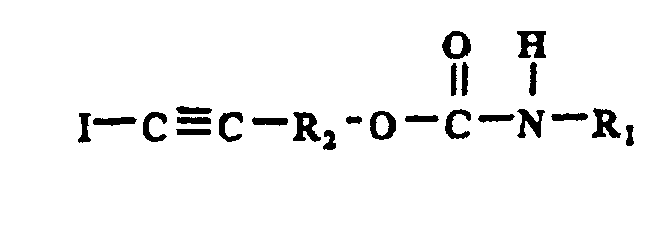
ledit procédé comprenant les étapes de:(a) dissolution d'un formaldéhyde choisi dans le groupe consistant en paraformaldéhyde et formaline dans au moins un alcool aromatique liquide ayant la formule:où R est choisi dans le groupe consistant en: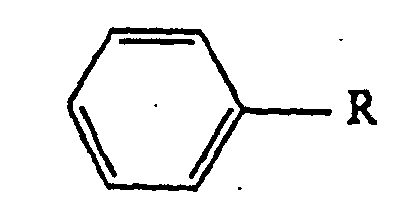
-CH2OH, -OCH2OH, -OCH2CH2OH,
-CH2CH2OH, -OC3H6OH, et -C3H6OH;
pour procurer un milieu liquide;(b) chauffage du dit milieu liquide à une température ne dépassant pas environ 50°C pour procurer un milieu liquide chauffé;(c) addition avec mélange dans ledit milieu liquide chauffé de ladite hydantoïne 5,5-disubstituée pour procurer un mélange réactionnel, la quantité de ladite hydantoïne 5,5-disubstituée ainsi mélangée étant suffisante pour produire dans ledit mélange réactionnel un rapport molaire calculé initial du formaldéhyde à ladite hydantoïne 5,5-disubstituée d'environ 1:1 à environ 3:1:(d) chauffage poursuivi dans des conditions autogènes dudit mélange réactionnel à une température ne dépassant pas environ 110°C et maintien de ladite température jusqu'à ce que ladite 1,3-diméthylol hydantoïne 5,5-disubstituée soit produite;(e) refroidissement du dit mélange réactionnel résultant dans un intervalle de température entre environ 25°C et pas plus d'environ 40°C; et(f) dissolution dans ledit mélange réactionnel résultant ainsi refroidi du dit alkyl carbamate d'iodoalcynyle dans une quantité suffisante pour produire sur une base de solution antimicrobienne totale résultante un rapport en poids de ladite 1,3-diméthylol hydantoïne 5,5-disubstituée au dit alkyl carbamate d'iodoalcynyle dans l'intervalle d'environ 60:1 à environ 80:1. - Procédé selon la revendication 14, dans lequel ladite solution antimicrobienne contient en outre de l'eau dans une quantité totale ne dépassant pas environ 15 pour cent en poids, sur la base du poids total de solution, une portion de ladite eau ayant été ajoutée dans au moins l'une des étapes (a) à (f).
- Procédé selon la revendication 14, dans lequel ladite hydantoïne 5,5-disubstituée, substituée par du méthylol comprend de la 1,3-diméthylol-5,5-diméthyl hydantoïne.
- Procédé selon la revendication 14, dans lequel ledit alcool aromatique est choisi dans le groupe consistant en phénoxyéthanol, alcool benzylique, alcool phénéthylique, alcool phénoxyisopropylique et leurs mélanges.
- Procédé selon la revendication 14, dans lequel ledit alkyl carbamate d'iodoalcynyle comprend du butyl carbamate de 3-iodo-2-propynyle.
- Solution antimicrobienne résultante produite par le procédé selon la revendication 14.
- Solution antimicrobienne résultante produite par le procédé selon la revendication 15, dans laquelle sur une base de 100 pour cent en poids de solution:(a) ladite hydantoïne 5,5-disubstituée, substituée par du méthylol comprend environ 20 à environ 75 pour cent en poids de 1,3-diméthylol-5,5-diméthyl hydantoïne;(b) ledit alcool aromatique comprend environ 20 à environ 70 pour cent en poids de phénoxyéthanol;(c) la quantité d'eau ne dépasse pas environ 10 pour cent en poids; et le rapport en poids de ladite hydantoïne 5,5-disubstituée, substituée par du méthylol au dit carbamate est dans l'intervalle d'environ 65:1 à environ 78:1.
- Procédé pour inhiber ou retarder la croissance microbienne dans un milieu capable de supporter la croissance de micro-organismes, comprenant l'incorporation dans ledit milieu d'une quantité efficace du point de vue antimicrobien de ladite solution antimicrobienne selon la revendication 1.
- Procédé pour inhiber ou retarder la croissance microbienne dans un milieu capable de supporter la croissance de micro-organismes, comprenant l'incorporation dans ledit milieu d'une quantité efficace du point de vue antimicrobien de ladite solution antimicrobienne selon la revendication 9.
- Procédé pour inhiber ou retarder la croissance microbienne dans un milieu capable de supporter la croissance de micro-organismes, comprenant l'incorporation dans ledit milieu d'une quantité efficace du point de vue antimicrobien de ladite solution antimicrobienne résultante selon la revendication 19.
- Procédé pour inhiber ou retarder la croissance microbienne dans un milieu capable de supporter la croissance de micro-organismes, comprenant l'incorporation dans ledit milieu d'une quantité efficace du point de vue antimicrobien de ladite solution antimicrobienne résultante selon la revendication 20.
Applications Claiming Priority (3)
| Application Number | Priority Date | Filing Date | Title |
|---|---|---|---|
| US50787 | 1998-03-30 | ||
| US09/050,787 US5965594A (en) | 1998-03-30 | 1998-03-30 | Antimicrobial liquid preservative solutions and process for preparation |
| PCT/US1999/005579 WO1999049730A1 (fr) | 1998-03-30 | 1999-03-16 | Solutions antimicrobiennes |
Publications (2)
| Publication Number | Publication Date |
|---|---|
| EP1065933A1 EP1065933A1 (fr) | 2001-01-10 |
| EP1065933B1 true EP1065933B1 (fr) | 2002-06-26 |
Family
ID=21967425
Family Applications (1)
| Application Number | Title | Priority Date | Filing Date |
|---|---|---|---|
| EP99909977A Expired - Lifetime EP1065933B1 (fr) | 1998-03-30 | 1999-03-16 | Solutions antimicrobiennes |
Country Status (8)
| Country | Link |
|---|---|
| US (1) | US5965594A (fr) |
| EP (1) | EP1065933B1 (fr) |
| AT (1) | ATE219623T1 (fr) |
| AU (1) | AU2905399A (fr) |
| CA (1) | CA2324272C (fr) |
| DE (1) | DE69901942D1 (fr) |
| IL (1) | IL138498A (fr) |
| WO (1) | WO1999049730A1 (fr) |
Families Citing this family (17)
| Publication number | Priority date | Publication date | Assignee | Title |
|---|---|---|---|---|
| US6143204A (en) | 1998-06-19 | 2000-11-07 | Lonza Inc. | Stabilization of iodopropynl compounds |
| FR2786689A1 (fr) * | 1998-12-03 | 2000-06-09 | Oreal | Composition cosmetique ou dermatologique comprenant au moins un alkynyl carbamate et au moins un polyol |
| DE10034137A1 (de) * | 2000-07-13 | 2002-01-24 | Beiersdorf Ag | Wirkstoffkombinationen aus 3-Iodo-2-propinyl-butylcarbamat und einem oder mehreren 4-Hydroxybenzoesäureestern und Zubereitungen, solche Wirkstoffkombinationen enthaltend |
| DE10034138A1 (de) * | 2000-07-13 | 2002-01-24 | Beiersdorf Ag | Wirkstoffkombinationen aus 3-Iodo-2-propinyl-butylcarbomat und Phenoxyethanol und Zubereitungen, solche Wirkstoffkombinationen enthaltend |
| DE10034136A1 (de) * | 2000-07-13 | 2002-01-24 | Beiersdorf Ag | Wirkstoffkombinationen aus 3-Iodo-2-propinyl-butylcarbamat, einem oder mehreren 4-Hydroxybenzoesäureester und Phenoxyethanol und Zubereitungen, solche Wirkstoffkomibnationen enthaltend |
| FR2830187B1 (fr) * | 2001-09-28 | 2004-10-15 | Oreal | Emulsion ultrafine contenant un derive haloalkynylique |
| FR2830197B1 (fr) * | 2001-09-28 | 2008-02-01 | Oreal | Emulsion ultrafine contenant de l'iodopropynylbutylcarbamate |
| FR2838347A1 (fr) * | 2002-09-09 | 2003-10-17 | Oreal | Composition comprenant un halogenoalkynyl carbamate et au moins un agent antimicrobien |
| US6645474B1 (en) * | 2002-12-06 | 2003-11-11 | Societe L'oreal S.A. | Stable self-tanning foams containing sodium coco-sulfate |
| US7666827B2 (en) * | 2004-09-15 | 2010-02-23 | The Procter & Gamble Company | Wet wipe lotions comprising particulate material |
| FR2910283A1 (fr) * | 2006-12-20 | 2008-06-27 | Oreal | Composition cosmetique comprenant au moins un polymere obtenu a partir d'un monomere dielectrophile |
| US8911801B2 (en) | 2008-10-06 | 2014-12-16 | Woodcliff Skincare Solutions, Inc. | Natural preservative alternatives and compositions containing same |
| EP2752116A1 (fr) | 2008-10-06 | 2014-07-09 | Woodcliff Skincare Solutions, Inc. | Alternatives de conservation naturelle comprenant un extrait de lonicera et compositions les contenant |
| JP5727456B2 (ja) * | 2009-04-06 | 2015-06-03 | ダウ グローバル テクノロジーズ エルエルシー | 冷温安定性殺生物組成物 |
| CN101897338A (zh) * | 2010-07-14 | 2010-12-01 | 铜陵高聚生物科技有限公司 | 一种水溶性防霉剂及其制备方法 |
| BR112017020457C8 (pt) * | 2015-03-31 | 2020-09-08 | Basf Se | composição, método para tratar plantas, controlar fungos fitopatogênicos e/ou crescimento indesejável de plantas e/ou infestação indesejável de insetos ou ácaros e/ou para regular o crescimento de plantas, e método para produzir uma composição |
| JP6897031B2 (ja) * | 2016-09-01 | 2021-06-30 | 住友ベークライト株式会社 | 防カビ剤、防カビ樹脂フィルム、防カビ積層フィルム及び防カビ包装体 |
Citations (1)
| Publication number | Priority date | Publication date | Assignee | Title |
|---|---|---|---|---|
| WO1999065316A1 (fr) * | 1998-06-19 | 1999-12-23 | Lonza Inc. | Melanges stabilises d'un compose iodopropargylique et d'un donneur formaldehyde |
Family Cites Families (6)
| Publication number | Priority date | Publication date | Assignee | Title |
|---|---|---|---|---|
| US4844891A (en) * | 1988-02-03 | 1989-07-04 | Lonza, Inc. | Admixtures of iodopropargyl compounds and a formaldehyde donor |
| US5037843A (en) * | 1990-03-05 | 1991-08-06 | The Mcintyre Group, Ltd. | Antimicrobial preservative system and method comprising a formaldehyde substituted hydantoin |
| US5552425A (en) * | 1994-04-28 | 1996-09-03 | Isp Chemicals Inc. | Synergistic water soluble preservative compositions of biocidal mixtures |
| US5428050A (en) * | 1994-04-28 | 1995-06-27 | Isp Chemicals Inc. | Synergistic water soluble preservative compositions of biocidal mixtures |
| US5616722A (en) * | 1995-12-05 | 1997-04-01 | Mcintyre Group, Ltd. | Antimicrobial solution of formaldehyde substituted hydantoin and process for preparation |
| US5693849A (en) * | 1996-10-30 | 1997-12-02 | Troy Corporation | Aqueous synthesis of iodopropargyl carbamate |
-
1998
- 1998-03-30 US US09/050,787 patent/US5965594A/en not_active Expired - Lifetime
-
1999
- 1999-03-16 IL IL13849899A patent/IL138498A/xx not_active IP Right Cessation
- 1999-03-16 CA CA002324272A patent/CA2324272C/fr not_active Expired - Lifetime
- 1999-03-16 WO PCT/US1999/005579 patent/WO1999049730A1/fr not_active Ceased
- 1999-03-16 EP EP99909977A patent/EP1065933B1/fr not_active Expired - Lifetime
- 1999-03-16 AU AU29053/99A patent/AU2905399A/en not_active Abandoned
- 1999-03-16 DE DE69901942T patent/DE69901942D1/de not_active Expired - Lifetime
- 1999-03-16 AT AT99909977T patent/ATE219623T1/de not_active IP Right Cessation
Patent Citations (1)
| Publication number | Priority date | Publication date | Assignee | Title |
|---|---|---|---|---|
| WO1999065316A1 (fr) * | 1998-06-19 | 1999-12-23 | Lonza Inc. | Melanges stabilises d'un compose iodopropargylique et d'un donneur formaldehyde |
Also Published As
| Publication number | Publication date |
|---|---|
| DE69901942D1 (de) | 2002-08-01 |
| WO1999049730A1 (fr) | 1999-10-07 |
| US5965594A (en) | 1999-10-12 |
| CA2324272A1 (fr) | 1999-10-07 |
| IL138498A (en) | 2005-06-19 |
| IL138498A0 (en) | 2001-10-31 |
| AU2905399A (en) | 1999-10-18 |
| EP1065933A1 (fr) | 2001-01-10 |
| ATE219623T1 (de) | 2002-07-15 |
| CA2324272C (fr) | 2004-03-09 |
Similar Documents
| Publication | Publication Date | Title |
|---|---|---|
| EP1065933B1 (fr) | Solutions antimicrobiennes | |
| US7537776B1 (en) | Liquid concentrate for preserving cosmetics | |
| US6123966A (en) | Stabilized two-part disinfecting system and compositions and methods related thereto | |
| EP0327220B1 (fr) | Composition biocide synergique | |
| US5705532A (en) | Triple antimicrobial composition | |
| KR101140473B1 (ko) | 항균 조성물 | |
| US5037843A (en) | Antimicrobial preservative system and method comprising a formaldehyde substituted hydantoin | |
| US20020165283A1 (en) | Preservative blends containing quaternary ammonium compounds | |
| US5552425A (en) | Synergistic water soluble preservative compositions of biocidal mixtures | |
| US5496842A (en) | Synergistic water soluble preservative compositions of biocidal mixtures | |
| CN1315382C (zh) | 碘代丙炔基衍生物与酮酸或其盐和/或与芳香羧酸或其盐的组合 | |
| JP2002544144A (ja) | イソチアゾロンの安定化 | |
| CN100560071C (zh) | 抗菌组合物 | |
| EP0892785B1 (fr) | Solution antimicrobienne de hydantoine substituee par formaldehyde et procede de preparation | |
| US6107344A (en) | Aqueous germicidal film forming composition for applying to teats of dairy cows | |
| EP3701794A1 (fr) | Procédé de lutte contre un champignon phytopathogène choisi parmi rhizoctonia solani, magnaporthe grisea, helminthosporium oryzae, xanthomonas oryzae pv.oryza, sclerotium oryzae ou saro-cladium oryzae dans le riz par des compositions comprenant du méfentrifluconazole | |
| US5696083A (en) | Personal care composition containing pyrithione and polymyxin | |
| JP4902929B2 (ja) | 工業用抗菌組成物及び抗菌方法 | |
| US5360788A (en) | Personal care composition containing pyrithione and a basic lipopeptide | |
| MXPA00009543A (en) | Antimicrobial solutions | |
| US20030039580A1 (en) | Stable preservative formulations comprising halopropynyl compounds and butoxydiglycol solvent |
Legal Events
| Date | Code | Title | Description |
|---|---|---|---|
| PUAI | Public reference made under article 153(3) epc to a published international application that has entered the european phase |
Free format text: ORIGINAL CODE: 0009012 |
|
| 17P | Request for examination filed |
Effective date: 20001017 |
|
| AK | Designated contracting states |
Kind code of ref document: A1 Designated state(s): AT BE CH CY DE DK ES FI FR GB GR IE IT LI LU MC NL PT SE |
|
| AX | Request for extension of the european patent |
Free format text: AL PAYMENT 20001017;LT PAYMENT 20001017;LV PAYMENT 20001017;RO PAYMENT 20001017;SI PAYMENT 20001017 |
|
| RAP1 | Party data changed (applicant data changed or rights of an application transferred) |
Owner name: MCINTYRE GROUP, LTD. |
|
| GRAG | Despatch of communication of intention to grant |
Free format text: ORIGINAL CODE: EPIDOS AGRA |
|
| 17Q | First examination report despatched |
Effective date: 20010511 |
|
| GRAG | Despatch of communication of intention to grant |
Free format text: ORIGINAL CODE: EPIDOS AGRA |
|
| GRAH | Despatch of communication of intention to grant a patent |
Free format text: ORIGINAL CODE: EPIDOS IGRA |
|
| GRAH | Despatch of communication of intention to grant a patent |
Free format text: ORIGINAL CODE: EPIDOS IGRA |
|
| GRAA | (expected) grant |
Free format text: ORIGINAL CODE: 0009210 |
|
| AK | Designated contracting states |
Kind code of ref document: B1 Designated state(s): AT BE CH CY DE DK ES FI FR GB GR IE IT LI LU MC NL PT SE |
|
| AX | Request for extension of the european patent |
Free format text: AL PAYMENT 20001017;LT PAYMENT 20001017;LV PAYMENT 20001017;RO PAYMENT 20001017;SI PAYMENT 20001017 |
|
| PG25 | Lapsed in a contracting state [announced via postgrant information from national office to epo] |
Ref country code: NL Free format text: LAPSE BECAUSE OF FAILURE TO SUBMIT A TRANSLATION OF THE DESCRIPTION OR TO PAY THE FEE WITHIN THE PRESCRIBED TIME-LIMIT Effective date: 20020626 Ref country code: LI Free format text: LAPSE BECAUSE OF FAILURE TO SUBMIT A TRANSLATION OF THE DESCRIPTION OR TO PAY THE FEE WITHIN THE PRESCRIBED TIME-LIMIT Effective date: 20020626 Ref country code: IT Free format text: LAPSE BECAUSE OF FAILURE TO SUBMIT A TRANSLATION OF THE DESCRIPTION OR TO PAY THE FEE WITHIN THE PRESCRIBED TIME-LIMIT;WARNING: LAPSES OF ITALIAN PATENTS WITH EFFECTIVE DATE BEFORE 2007 MAY HAVE OCCURRED AT ANY TIME BEFORE 2007. THE CORRECT EFFECTIVE DATE MAY BE DIFFERENT FROM THE ONE RECORDED. Effective date: 20020626 Ref country code: GR Free format text: LAPSE BECAUSE OF FAILURE TO SUBMIT A TRANSLATION OF THE DESCRIPTION OR TO PAY THE FEE WITHIN THE PRESCRIBED TIME-LIMIT Effective date: 20020626 Ref country code: FR Free format text: LAPSE BECAUSE OF NON-PAYMENT OF DUE FEES Effective date: 20020626 Ref country code: FI Free format text: LAPSE BECAUSE OF FAILURE TO SUBMIT A TRANSLATION OF THE DESCRIPTION OR TO PAY THE FEE WITHIN THE PRESCRIBED TIME-LIMIT Effective date: 20020626 Ref country code: CH Free format text: LAPSE BECAUSE OF FAILURE TO SUBMIT A TRANSLATION OF THE DESCRIPTION OR TO PAY THE FEE WITHIN THE PRESCRIBED TIME-LIMIT Effective date: 20020626 Ref country code: BE Free format text: LAPSE BECAUSE OF FAILURE TO SUBMIT A TRANSLATION OF THE DESCRIPTION OR TO PAY THE FEE WITHIN THE PRESCRIBED TIME-LIMIT Effective date: 20020626 Ref country code: AT Free format text: LAPSE BECAUSE OF FAILURE TO SUBMIT A TRANSLATION OF THE DESCRIPTION OR TO PAY THE FEE WITHIN THE PRESCRIBED TIME-LIMIT Effective date: 20020626 |
|
| REF | Corresponds to: |
Ref document number: 219623 Country of ref document: AT Date of ref document: 20020715 Kind code of ref document: T |
|
| REG | Reference to a national code |
Ref country code: GB Ref legal event code: FG4D |
|
| REG | Reference to a national code |
Ref country code: CH Ref legal event code: EP |
|
| REG | Reference to a national code |
Ref country code: IE Ref legal event code: FG4D |
|
| REF | Corresponds to: |
Ref document number: 69901942 Country of ref document: DE Date of ref document: 20020801 |
|
| PG25 | Lapsed in a contracting state [announced via postgrant information from national office to epo] |
Ref country code: SE Free format text: LAPSE BECAUSE OF FAILURE TO SUBMIT A TRANSLATION OF THE DESCRIPTION OR TO PAY THE FEE WITHIN THE PRESCRIBED TIME-LIMIT Effective date: 20020926 Ref country code: PT Free format text: LAPSE BECAUSE OF FAILURE TO SUBMIT A TRANSLATION OF THE DESCRIPTION OR TO PAY THE FEE WITHIN THE PRESCRIBED TIME-LIMIT Effective date: 20020926 Ref country code: DK Free format text: LAPSE BECAUSE OF FAILURE TO SUBMIT A TRANSLATION OF THE DESCRIPTION OR TO PAY THE FEE WITHIN THE PRESCRIBED TIME-LIMIT Effective date: 20020926 |
|
| PG25 | Lapsed in a contracting state [announced via postgrant information from national office to epo] |
Ref country code: DE Free format text: LAPSE BECAUSE OF FAILURE TO SUBMIT A TRANSLATION OF THE DESCRIPTION OR TO PAY THE FEE WITHIN THE PRESCRIBED TIME-LIMIT Effective date: 20020927 |
|
| NLV1 | Nl: lapsed or annulled due to failure to fulfill the requirements of art. 29p and 29m of the patents act | ||
| PG25 | Lapsed in a contracting state [announced via postgrant information from national office to epo] |
Ref country code: ES Free format text: LAPSE BECAUSE OF FAILURE TO SUBMIT A TRANSLATION OF THE DESCRIPTION OR TO PAY THE FEE WITHIN THE PRESCRIBED TIME-LIMIT Effective date: 20021220 |
|
| REG | Reference to a national code |
Ref country code: CH Ref legal event code: PL |
|
| EN | Fr: translation not filed | ||
| PG25 | Lapsed in a contracting state [announced via postgrant information from national office to epo] |
Ref country code: LU Free format text: LAPSE BECAUSE OF NON-PAYMENT OF DUE FEES Effective date: 20030316 Ref country code: CY Free format text: LAPSE BECAUSE OF FAILURE TO SUBMIT A TRANSLATION OF THE DESCRIPTION OR TO PAY THE FEE WITHIN THE PRESCRIBED TIME-LIMIT Effective date: 20030316 |
|
| PG25 | Lapsed in a contracting state [announced via postgrant information from national office to epo] |
Ref country code: IE Free format text: LAPSE BECAUSE OF NON-PAYMENT OF DUE FEES Effective date: 20030317 |
|
| PG25 | Lapsed in a contracting state [announced via postgrant information from national office to epo] |
Ref country code: MC Free format text: LAPSE BECAUSE OF NON-PAYMENT OF DUE FEES Effective date: 20030331 |
|
| PLBE | No opposition filed within time limit |
Free format text: ORIGINAL CODE: 0009261 |
|
| STAA | Information on the status of an ep patent application or granted ep patent |
Free format text: STATUS: NO OPPOSITION FILED WITHIN TIME LIMIT |
|
| 26N | No opposition filed |
Effective date: 20030327 |
|
| REG | Reference to a national code |
Ref country code: IE Ref legal event code: MM4A |
|
| REG | Reference to a national code |
Ref country code: GB Ref legal event code: 732E Free format text: REGISTERED BETWEEN 20110811 AND 20110817 |
|
| PGFP | Annual fee paid to national office [announced via postgrant information from national office to epo] |
Ref country code: GB Payment date: 20180314 Year of fee payment: 20 |
|
| REG | Reference to a national code |
Ref country code: GB Ref legal event code: PE20 Expiry date: 20190315 |
|
| PG25 | Lapsed in a contracting state [announced via postgrant information from national office to epo] |
Ref country code: GB Free format text: LAPSE BECAUSE OF EXPIRATION OF PROTECTION Effective date: 20190315 |