EP1067055A2 - Lebensmittelverpackung zum mikrowellenkochen - Google Patents
Lebensmittelverpackung zum mikrowellenkochen Download PDFInfo
- Publication number
- EP1067055A2 EP1067055A2 EP00112494A EP00112494A EP1067055A2 EP 1067055 A2 EP1067055 A2 EP 1067055A2 EP 00112494 A EP00112494 A EP 00112494A EP 00112494 A EP00112494 A EP 00112494A EP 1067055 A2 EP1067055 A2 EP 1067055A2
- Authority
- EP
- European Patent Office
- Prior art keywords
- package
- foodstuff
- microwave active
- active material
- frangible
- Prior art date
- Legal status (The legal status is an assumption and is not a legal conclusion. Google has not performed a legal analysis and makes no representation as to the accuracy of the status listed.)
- Withdrawn
Links
- 238000010411 cooking Methods 0.000 title claims abstract description 17
- 235000013305 food Nutrition 0.000 title claims description 54
- 238000004806 packaging method and process Methods 0.000 title claims description 3
- 239000011149 active material Substances 0.000 claims abstract description 57
- 239000000463 material Substances 0.000 claims abstract description 56
- 238000010438 heat treatment Methods 0.000 claims description 8
- 230000008859 change Effects 0.000 claims description 6
- 230000000694 effects Effects 0.000 claims description 5
- 230000003313 weakening effect Effects 0.000 claims description 4
- 230000015572 biosynthetic process Effects 0.000 claims description 3
- 238000003825 pressing Methods 0.000 claims description 2
- 238000009877 rendering Methods 0.000 claims description 2
- 230000008901 benefit Effects 0.000 description 6
- 238000012856 packing Methods 0.000 description 5
- 230000005855 radiation Effects 0.000 description 4
- 241001137251 Corvidae Species 0.000 description 2
- 240000005002 Erythronium dens canis Species 0.000 description 2
- 230000009471 action Effects 0.000 description 2
- 230000005540 biological transmission Effects 0.000 description 2
- 210000003811 finger Anatomy 0.000 description 2
- 230000012447 hatching Effects 0.000 description 2
- 239000000123 paper Substances 0.000 description 2
- 235000015108 pies Nutrition 0.000 description 2
- 235000013550 pizza Nutrition 0.000 description 2
- 239000004033 plastic Substances 0.000 description 2
- 229920003023 plastic Polymers 0.000 description 2
- 210000003813 thumb Anatomy 0.000 description 2
- 244000061456 Solanum tuberosum Species 0.000 description 1
- 235000002595 Solanum tuberosum Nutrition 0.000 description 1
- 238000004026 adhesive bonding Methods 0.000 description 1
- 235000012970 cakes Nutrition 0.000 description 1
- 239000011248 coating agent Substances 0.000 description 1
- 238000000576 coating method Methods 0.000 description 1
- 239000002131 composite material Substances 0.000 description 1
- 238000010276 construction Methods 0.000 description 1
- 238000010586 diagram Methods 0.000 description 1
- 239000003292 glue Substances 0.000 description 1
- 238000005470 impregnation Methods 0.000 description 1
- 238000011065 in-situ storage Methods 0.000 description 1
- 230000003993 interaction Effects 0.000 description 1
- 239000007788 liquid Substances 0.000 description 1
- 238000004519 manufacturing process Methods 0.000 description 1
- 230000004048 modification Effects 0.000 description 1
- 238000012986 modification Methods 0.000 description 1
- 235000011837 pasties Nutrition 0.000 description 1
- 235000014594 pastries Nutrition 0.000 description 1
- 230000000630 rising effect Effects 0.000 description 1
- 238000000926 separation method Methods 0.000 description 1
Images






Classifications
-
- B—PERFORMING OPERATIONS; TRANSPORTING
- B65—CONVEYING; PACKING; STORING; HANDLING THIN OR FILAMENTARY MATERIAL
- B65D—CONTAINERS FOR STORAGE OR TRANSPORT OF ARTICLES OR MATERIALS, e.g. BAGS, BARRELS, BOTTLES, BOXES, CANS, CARTONS, CRATES, DRUMS, JARS, TANKS, HOPPERS, FORWARDING CONTAINERS; ACCESSORIES, CLOSURES, OR FITTINGS THEREFOR; PACKAGING ELEMENTS; PACKAGES
- B65D5/00—Rigid or semi-rigid containers of polygonal cross-section, e.g. boxes, cartons or trays, formed by folding or erecting one or more blanks made of paper
- B65D5/42—Details of containers or of foldable or erectable container blanks
- B65D5/54—Lines of weakness to facilitate opening of container or dividing it into separate parts by cutting or tearing
- B65D5/5405—Lines of weakness to facilitate opening of container or dividing it into separate parts by cutting or tearing for opening containers formed by erecting a blank in tubular form
- B65D5/542—Lines of weakness to facilitate opening of container or dividing it into separate parts by cutting or tearing for opening containers formed by erecting a blank in tubular form the lines of weakness being provided in the container body
-
- B—PERFORMING OPERATIONS; TRANSPORTING
- B65—CONVEYING; PACKING; STORING; HANDLING THIN OR FILAMENTARY MATERIAL
- B65D—CONTAINERS FOR STORAGE OR TRANSPORT OF ARTICLES OR MATERIALS, e.g. BAGS, BARRELS, BOTTLES, BOXES, CANS, CARTONS, CRATES, DRUMS, JARS, TANKS, HOPPERS, FORWARDING CONTAINERS; ACCESSORIES, CLOSURES, OR FITTINGS THEREFOR; PACKAGING ELEMENTS; PACKAGES
- B65D81/00—Containers, packaging elements, or packages, for contents presenting particular transport or storage problems, or adapted to be used for non-packaging purposes after removal of contents
- B65D81/34—Containers, packaging elements, or packages, for contents presenting particular transport or storage problems, or adapted to be used for non-packaging purposes after removal of contents for packaging foodstuffs or other articles intended to be cooked or heated within the package
- B65D81/3446—Containers, packaging elements, or packages, for contents presenting particular transport or storage problems, or adapted to be used for non-packaging purposes after removal of contents for packaging foodstuffs or other articles intended to be cooked or heated within the package specially adapted to be heated by microwaves
- B65D81/3453—Rigid containers, e.g. trays, bottles, boxes, cups
-
- B—PERFORMING OPERATIONS; TRANSPORTING
- B65—CONVEYING; PACKING; STORING; HANDLING THIN OR FILAMENTARY MATERIAL
- B65D—CONTAINERS FOR STORAGE OR TRANSPORT OF ARTICLES OR MATERIALS, e.g. BAGS, BARRELS, BOTTLES, BOXES, CANS, CARTONS, CRATES, DRUMS, JARS, TANKS, HOPPERS, FORWARDING CONTAINERS; ACCESSORIES, CLOSURES, OR FITTINGS THEREFOR; PACKAGING ELEMENTS; PACKAGES
- B65D2581/00—Containers, packaging elements, or packages, for contents presenting particular transport or storage problems, or adapted to be used for non-packaging purposes after removal of contents
- B65D2581/34—Containers, packaging elements, or packages, for contents presenting particular transport or storage problems, or adapted to be used for non-packaging purposes after removal of contents for packaging foodstuffs or other articles intended to be cooked or heated within
- B65D2581/3437—Containers, packaging elements, or packages, for contents presenting particular transport or storage problems, or adapted to be used for non-packaging purposes after removal of contents for packaging foodstuffs or other articles intended to be cooked or heated within specially adapted to be heated by microwaves
- B65D2581/3439—Means for affecting the heating or cooking properties
- B65D2581/3455—Packages having means for improving the internal circulation of air
- B65D2581/3456—Means for holding the contents at a distance from the base of the package, e.g. raised islands or protrusions
-
- B—PERFORMING OPERATIONS; TRANSPORTING
- B65—CONVEYING; PACKING; STORING; HANDLING THIN OR FILAMENTARY MATERIAL
- B65D—CONTAINERS FOR STORAGE OR TRANSPORT OF ARTICLES OR MATERIALS, e.g. BAGS, BARRELS, BOTTLES, BOXES, CANS, CARTONS, CRATES, DRUMS, JARS, TANKS, HOPPERS, FORWARDING CONTAINERS; ACCESSORIES, CLOSURES, OR FITTINGS THEREFOR; PACKAGING ELEMENTS; PACKAGES
- B65D2581/00—Containers, packaging elements, or packages, for contents presenting particular transport or storage problems, or adapted to be used for non-packaging purposes after removal of contents
- B65D2581/34—Containers, packaging elements, or packages, for contents presenting particular transport or storage problems, or adapted to be used for non-packaging purposes after removal of contents for packaging foodstuffs or other articles intended to be cooked or heated within
- B65D2581/3437—Containers, packaging elements, or packages, for contents presenting particular transport or storage problems, or adapted to be used for non-packaging purposes after removal of contents for packaging foodstuffs or other articles intended to be cooked or heated within specially adapted to be heated by microwaves
- B65D2581/3486—Dielectric characteristics of microwave reactive packaging
- B65D2581/3494—Microwave susceptor
Definitions
- This invention relates to an improved package, and more specifically to a package made of sheet material and including microwave active material, which package is adapted to contain foodstuff which requires cooking with the assistance of the microwave active material while in situ within the said package.
- Granted UK Patent Number 2046060 discloses a receptor material which can be applied to the internal surfaces of packages, said receptor material being in sheet form and being activated by microwave radiation such that it generates heat and is thus ideally suited for heating foodstuff, for example for browning the surface of the foodstuff.
- the microwave active material depending upon its form (e.g. sheet, coating applied in liquid form, impregnation and so on) can be disposed on the inner surfaces of packages by appropriate means.
- This invention can be applied to most formats of packages (produced from or including sheet material) inside which active microwave materials are disposed.
- Typical styles of packages include sleeves, "end-load” cartons, “top-load” cartons and lid/tray combinations.
- End-load packages are typically glued along a side seam and flattened before being delivered to the premises where the foodstuff is packed into the carton. After erecting a blank, from which the package is constructed, to form a hollow tube, the foodstuff is loaded into the package through one of the open ends thereof before being adhered in a closed condition.
- Sleeves are similar except they do not have end flaps which can be adhered together to form a closed box package construction.
- top load type packages of which an example is shown in Figures 5-8 herein, which are also provided in blank form are erected to form a base tray into which the foodstuff is loaded through the open top before the lid is folded down and adhered against the side walls of the package.
- the primary objective of using a microwave active material within cartons is to effect the heating, for example crisping/browning of the surface or to a desired internal temperature profile of the food product in close proximity therewith.
- the radiation heat transmission factor is known to be comparatively low.
- the radiation heat transmission factor of microwave active materials is known to be comparatively low and indeed ineffective if the food product is displaced from the surface of the microwave active material sheet more than approximately 2-4mm.
- the performance of microwave field modification materials is also affected by their position relative to the food product, close proximity to the food product often being an important factor in achieving the optimum and safest performance.
- the primary difficulty associated with ensuring contact between or sufficient closeness of the product surface with the microwave active material within the package arises from the requirement for clearance between the food product and the package interior, during loading the foodstuff into the package, to facilitate loading and closing of the package.
- the packages to which this invention is ideally suited are commonly used for packing such items as folded pizzas, pies, pasties, filled rolls, and other baked items, the fact that no single food product will be of identical shape necessitates the use of a package of certain minimum dimensions which is capable of easily packing and containing food products produced.
- a sheet material package containing or adapted to contain a foodstuff to be cooked by microwaves whilst in the package, wherein the package includes a portion of microwave active material connected to or forming part of the sheet material of the package, and which is for creating localised heat and/or to distribute the microwave energy in the foodstuff, with the objective of optimising the foodstuff's eating qualities and/or reducing the time during which the foodstuff needs to be heated, said package being adapted so that when the package holds the foodstuff the microwave active material is spaced relative to the foodstuff, and the package includes means rendering the package capable of change of configuration by the user whereby the microwave active material moves into contact with or closer proximity to the foodstuff, for the more effective heating of either one or more portions/areas of the foodstuff or of the foodstuff as a whole when the package with the foodstuff therein is subjected to microwave energy.
- the microwave active material preferably is spaced from the top or the side of the foodstuff, prior to the change in configuration of the package, but in another embodiment the food stuff may sit on the microwave active material, and the user inverts the package so that the microwave active material is spaced above the foodstuff, and then the package is reconfigured to bring the microwave active material into contact or closer proximity with the foodstuff.
- the microwave active material is more effectively used.
- the package can be designed so that when the foodstuff is placed therein, there will be a space between the top of the foodstuff and the top of the package, where the microwave active material will be located. In this way the foodstuff can be loaded into the package quite easily, without any interference between the package and the foodstuff, which is the case when the foodstuff is a close fit in the package.
- microwave active material is attached to or forms part of the package sheet material, it will remain in place during production, transport and filling of the package, and it will be ensured that the microwave active material remains in the correct place in the finished package.
- Another advantage is that the bringing together into contact or closer proximity of the microwave active sheet material and the foodstuff is that the foodstuff will be properly heated during microwave cooking.
- Typical of products which can be cooked in such a package are pies of all types, pizzas, cakes, potato, and indeed the list is infinite.
- microwave active material is part of the sheet material of the package
- lines of weakening around the microwave active portion so that it can be pushed from the remainder by breaking the package along the lines of weakening, whereby the said portion becomes detached from the remainder and is repositioned in a controlled manner so that it drops onto the top of the foodstuff.
- the base of the package may be capable of being inwardly pressed, by tear and tuck flaps or the like, whereby the foodstuff is pressed upwards against the microwave active portion prior to cooking.
- sections of the package may be torn along tear lines or folded back permitting the microwave active portion to be tucked towards the foodstuff and into contact or closer proximity thereto.
- the microwave active portion is attached to the sheet material of the package, but can be released therefrom by the changing of the configuration of the package.
- the package may be in two slidably fitted sections, which can be moved closer together by pressing the top towards the bottom.
- the package may have fold lines around it, whereby the package is adapted to be compressed concertina fashion to reduce its height, for the achieving the same effect as mentioned above.
- the packages to which the invention relates will be for holding foodstuff which is to be cooked in a microwave oven, it is preferred that the packages, after being filled with the foodstuff, are of the type which have to be broken open to be used, so that the breaking open will provide evidence of tampering.
- the said breaking open may comprise the change of configuration of the package.
- the advantages of the invention include that the packages can be filled easier as the microwave active material portion is attached to or forms part of the sheet material of the package, the microwave active material portion will remain in place more reliably, and the erecting and filling of the packages with the predetermined foodstuff will be simpler and faster, in that the foodstuff will be filled into the packages with a "clearance" in that the microwave active material portion is initially spaced from the top and/or the sides of the foodstuff.
- microwave active material "rests" on the top of the foodstuff is that if the foodstuff is of a type which rises as it is heated, such as puff pastry, then the microwave active material will rise along with the foodstuff, ensuring effective cooking thereof.
- microwave active material Any conventional type of microwave active material may be used, and of particular advantage is the use of a paper sheet with a receptor layer thereon, as described in UK Patent No. 2046060.
- the package is provided with frangible means which in unbroken state maintains a first disposition between the microwave active sheet and the foodstuff, characterised in that after fracture of the frangible means, which gives rise to frangible portion edges, said frangible portion edges are brought to engage with other edge portions of the package such that the particular surface is maintained in a second, closer disposition with respect to the foodstuff for the reasons as aforesaid.
- the fracture of the frangible means in the formation of at least one tongue portion with frangible portion edges separated from the body of the package as a result of the fracture, said body accordingly having corresponding frangible portion edges.
- the other edge portions are provided in the body of the package and are separated by a distance less than that of the width of the tongue portion, the frangible portion edges of which can thus be brought to engage therewith.
- the engagement of the frangible portion edges of the tongue portion with the other edge portions is frictional.
- the other edge portions of the package are frangible portion edges with which the tongue frangible portion edges are brought to engage, the frangible portion edges of the package having a shape which maintains the frangible portion edges of the tongue portion in the said second disposition.
- the package is provided with two microwave active material sheet portions internally thereof, one of which is provided underneath the food product, and the second being provided substantially above the food product and on the particular surface which is brought into contact with the food product as a result of the fracture of the frangible portions.
- the food product is trapped between and in contact with microwave active material portions of the package above and below the said product.
- frangible portions are provided on the package which on fracture permit access to the product as trapped between the two microwave active material portions and allow same to slide therefrom onto, for example, a plate.
- the further frangible portions are provided proximate one end of the package which on fracture preferably effected by rotation of the said end of the package relative to the remainder thereof permit access to the contents of the package at the said end.
- frangible portions are lines of perforations which may be dog-toothed or of "concora" profile.
- frangible portions depends on the style of package and the firmness with which the tongue portion is required to be held.
- the reference to closer proximity is meant that the food product is spaced in the order of 2mm or less distant from the microwave active material over a reasonable portion of its area.
- FIG. 1 there is shown a sheet material (such as cardboard) blank 2 provided with a number of fold lines and lines of perforations which are denoted in this figure and subsequent figures by long dash/dot lines and dashed lines respectively.
- a central body portion 4 of the blank 2 is provided with a plurality of fold lines 6, 8, 10, 12, which ultimately define side wall portions 14, 16, 18, a base portion 20, and a lid portion 22 once the blank has been erected to form the package.
- the ends of the erected carton are provided with a plurality of different flap portions 24, 26, 28, 30 which extend from the side wall portions 14, 16, and the base and lid portions 20, 22.
- Dog tooth perforation lines 32, 34 extend from a lip 36 of the side wall portion 18 and on either side thereof into the body 4 of the blank and terminate at their intersection with the fold line 8.
- Further perforation lines 38, 40 extend from the intersection between fold lines 42, 44 which continue within the body 4 of the blank after the perforation lines 32, 34 have ceased and terminate at the lateral fold line 6. Said perforation lines 38, 40 terminate at the free edge of the side wall section 14.
- a pair of receptor material sheets 46, 48 are adhered to the surface of the body portion 4 of the carton blank which ultimately forms the interior of the carton when erected. It will be seen from the figure that receptor material sheet 46 is adhered both to the lid portion 22 and the side wall portion 16 across the fold line 10, whereas receptor material sheet 48 is adhered substantially centrally within the base portion 20. The reason for this will become apparent with reference to Figures 2 and 3, and the description provided hereinafter with reference to these figures.
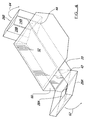
- FIG. 2 shows a package 50 erected from the carton blank of Figure 1, and it should be pointed out that in all the figures, hatching indicates a surface of one or other of the receptor material sheets 46, 48. It can be seen from Figure 2 that once erected, the package defines a cavity between the side wall portion 16, 18, and the base and lid portions 20, 22, within which a food product (not shown) may be deposited. Although the package is shown in its fully erected condition, it is to be appreciated that the formation of the ends from flap portions 26A, 26B may be the final step in the erection of the package, prior to which the said food products may be "end loaded" into the partially formed package, which at that stage would resemble a tube of substantially rectangular cross-section.
- the package and food product contained therein is transported to its point of sale, possibly in a refrigerated or frozen condition.
- the particular size of the blank and package resulting therefrom is only important as regards the maximum size of the food product which the package is to contain.
- partially erected packages which receive food products must be of a size greater than the product itself to allow for variances in the size and shape of the product being deposited therein, and the greater the size difference, the easier it is to load the food product.
- the packages of the prior art have been inadequate as regards the browning operation because the microwave active material has been spaced too far from the food product.
- the object of the invention is achieved by the package of Figure 2 in that a user wishing to cook the food product contained within the package firstly lifts the lip 36 away from the side wall portion 18 thus tearing the carton material along the lines of perforation 32, 34. This tearing action is continued across the lid portion 22, and the side wall portion 16 until a flap of package material 52 can be folded about the corner of the package defined by the fold line 8. The said flap 52 is subsequently folded back towards the remaining side wall portions 18 about an intermediary fold line 54 such that the receptor material sheet 46 previously deformed around the corner of the carton defined by the fold line 10, is rendered substantially planar and furthermore displaced inwardly of the remaining lid portions 22.
- This reconfiguration of the carton is shown in Figure 3.
- the said cavity is indicated generally by reference numeral 60. It can be seen from the figure that convenient access to said cavity is provided by means of the additional perforation lines 38, 40 which, after the separation of the flap portion 52 from the carcass of the package by tearing along perforation lines 32, 34, prevent the remaining end portion from rotating about the fold lines 42, 44 and hold said end portion in perpendicular relationship to the base portion 20.
- the configuration of the package according to this embodiment of the invention is advantageous because the means by which the package would be conventionally manipulated after cooking do not become exceedingly hot, and therefore there is only minimal risk of burning of the user's fingers or the like during such manipulation.
- FIG. 5 there is shown a package blank 100 comprising a body portion 104 comprising a plurality of lateral fold lines 106, 108, 110, 112, which define side wall portions 114, 116, 118, a base portion 120, and a lid portion 122.
- a similar convention as regards fold lines and lines of perforation is adopted to that of Figures 1 to 4, but in the case of Figures 5 to 8, the important lines of perforation are restricted to the side wall portions 116, 118, and the lid portion 122.
- the lid portion 122 is provided with a pair of curved perforation lines 124, 126 which define tab portions 128, 130 with the fold lines 112, 110 respectively.
- a receptor material sheet 132 is adhered substantially centrally of the base portion 120, and a further receptor material sheet 134 is positioned substantially centrally of the lid portion 122, but adhered only to one side of the tab portions 128, 130.
- the said curved perforation lines 124, 126 extend into the side wall portions 116, 118 at sinusoidal perforation lines 136, 138, 140, 142 until intersecting with intermediate fold lines 144, 146.
- the said perforation lines 136, 138, 140, 142 extend linearly from their intersection with intermediate fold lines 144, 146 until they intersect with secondary intermediate fold lines 148, 150. Thereafter, the perforation lines continue only on one side of the tab portions 128, 130, on the one hand terminating at the fold line 108, and on the other hand terminating at the edge of the side wall portion 118.
- These final perforation lines are identified by reference numerals 152, 154.
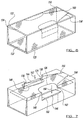
- the package blank of Figure 5 is shown in its erected condition in Figure 6 in which the two receptor material sheets 132, 134 are shown by hatching on the base portion 120 and the lid portion 122 of the package.
- Further perforation lines 156, 158 extend from one corner of the tab portions 128, 130 to the end of the lid portion 122 defined by a fold line 160, and these further perforation lines can be seen clearly in Figures 5 to 8, as can the various perforation line described with reference to Figure 5.
- the receptor material sheet 134 is maintained in contact with or in close proximity to with the food product contained within the package by means of the interaction between the edges of the tab portions 128, 130 and the remaining sinusoidal perforation lines 136, 138, 140, 142.
- the frictional inter-engagement of the respective edges prevents the said receptor material sheet 134 from springing upwardly against the resiliency of the board from which the package is manufactured, as would normally be the case after the folding the material along lines 146, 150, and 144, 148 which results from the downward pressure applied to the tab portions 128, 130.
- the package of Figures 5 to 8 is additionally provided with an access feature in similar manner to the package of Figures 1 to 4 in that an end 166 may be rotated about a longitudinal fold line 168 thus fracturing perforation lines 152, 154, and also perforation line 170 and allowing access to the food product trapped between receptor material sheets 132 and 134 within the package.
- a user can simply tilt the open ended package upwardly to allow the food product to slide from between the two receptor material sheets and onto a plate.
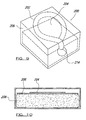
- a package 200 according to the embodiment shown is of generally rectangular configuration, and is constructed of cut and creased sheet material such as cardboard.
- the top of the package is provided with a tear strip 202 which can be removed as shown in Figure 11 to detach a central portion 204 of the top of the package from the remainder.
- a sheet of microwave active material 206 To the underside of the portion 204 is connected a sheet of microwave active material 206, and the arrangement is that when the strip 202 is torn away as shown in Figure 11, the portion 204 which is detached, and the sheet 206 drops within the package and onto the top of the food product 208 so that the microwave active material 206 comes to rest on top of the food product and therefore during microwave cooking will effectively heat the top of the product 208. If the product 208 is of the type which rises when being heated, the assembly comprising the portion 204 and the microwave active material 206 will be able to rise to accommodate the rising of the food product.
- the front 210 of the package is a cut-out 212 into which the leading end 214 of the strip 202 extends so that it can be engaged easily by the finger and thumb and the strip torn away.
- the tear strip 202 is of conventional type, and in tearing it away, the board of the top of the package fractures to separate the portion 204.
- the strip 202 may extend straight across the top of the package, and its underside would be attached to the microwave active sheet 206 so that when the strip is torn away, the remaining portions of the top of the package serve to restrain the sheet 206 which becomes detached from the strip (which may be connected thereto by a spot of glue or the like), and falls onto the food product in the manner shown in Figure 10.
- Figure 11 also shows the detached portion 204 and the microwave active sheet 206 in the dropped position.
- the package shown in Figures 9 to 11 may be constructed in any suitable manner, such as from a blank of cut and crease material, and normally the package will be sealed as it contains a food product 208, but the package is reconfigured from the initial condition shown in Figure 9 in which it is sold, and the position shown in Figure 11 in which it is used.
- the top 220 of the package is provided with fold lines 222 and 224 where indicated, and between the fold lines the microwave active material 226 extends.
- the top 220 includes a top flap 228 which extends into the package to the inside of the front wall.
- the lid 220 is opened, and this may require the tearing away of a portion of the package or otherwise fracturing it and the lid can then be raised by pivoting about the corner 230. After it has been so pivoted, it is refolded about fold lines 222 and 224 and tucked inwardly as shown in Figure 13, so that the microwave active sheet 226 comes into contact with the top of the food product 232, and cooking can be commenced.
- the package 240 has fold lines 242 and 244 extending horizontally around the sides or at least the two sides, and to reconfigure the package the top 246 is pushed downwardly as shown by arrow 248 so that the microwave active material 250 on the underside of the top 246 is forced down onto the top of the food product 252 as shown in Figure 15, the sides buckling about the fold lines 242 and 244.
- the tear away portion may not be necessary.
- the package 260 has a tear away strip 262 extending around the package, and when that strip is torn away, the effective height of the package is reduced, and the two portions of the package which are separated by the removal of the strip 262 can come closer together or the top portion 264 can fall so that the microwave active material 266 on the underside of the portion 264 can fall into contact with the food product 268.
- the package 270 has tuck panels 272 and 274 at opposite sides, and in order to use the package the tuck panels 272 and 274 are tucked inwardly to force the base 276 (for example by tearing same or breaking same away from the remainder of the package) to force the food product 278 upwardly and into contact with the microwave active material 280 as shown in Figure 19.
- Figures 12 to 19 are diagrammatic and show the principle of constructing the package to enable it to operate in accordance with the general principles of the invention. It can be understood therefore that there are many manifestations of a package according to the invention, and it will normally be desired that these packages are of a sealed nature and require to be broken or torn open or otherwise manipulated to enable the movement of the product and the microwave active material together to bring them into contact or into closer proximity.
- packages described herein represent a significant advance over existing packages which are provided with microwave active material and are adapted for cooking food products contained within the package because the package according to the invention allows for both error free packing, and effective heating (e.g. in some cases browning) of the food product during cooking.
- the embodiments of the invention herein comprise packages which suitably are made of cardboard, and so the packages could be considered to be cartons, but it is to be mentioned that other sheet materials could be used, such as plastic sheeting.
- the packages could be composites of different sheet materials, and the sheet material need not be cut and creased.
- the sheets could be moulded from paper and plastics, and the packages could be of part cut and creased material and part moulded material.
Landscapes
- Engineering & Computer Science (AREA)
- Mechanical Engineering (AREA)
- Life Sciences & Earth Sciences (AREA)
- Food Science & Technology (AREA)
- Package Specialized In Special Use (AREA)
Applications Claiming Priority (2)
| Application Number | Priority Date | Filing Date | Title |
|---|---|---|---|
| GBGB9915801.6A GB9915801D0 (en) | 1999-07-07 | 1999-07-07 | Package for foodstuff |
| GB9915801 | 1999-07-07 |
Publications (2)
| Publication Number | Publication Date |
|---|---|
| EP1067055A2 true EP1067055A2 (de) | 2001-01-10 |
| EP1067055A3 EP1067055A3 (de) | 2003-07-02 |
Family
ID=10856738
Family Applications (1)
| Application Number | Title | Priority Date | Filing Date |
|---|---|---|---|
| EP00112494A Withdrawn EP1067055A3 (de) | 1999-07-07 | 2000-06-13 | Lebensmittelverpackung zum mikrowellenkochen |
Country Status (2)
| Country | Link |
|---|---|
| EP (1) | EP1067055A3 (de) |
| GB (1) | GB9915801D0 (de) |
Cited By (5)
| Publication number | Priority date | Publication date | Assignee | Title |
|---|---|---|---|---|
| EP1452458A3 (de) * | 2003-02-26 | 2004-11-03 | Polestar Jowetts Limited | Lebensmittelkarton |
| WO2006110685A3 (en) * | 2005-04-11 | 2007-02-22 | Graphic Packaging Int Inc | Microwavable food package having an easy-open feature |
| US7652233B2 (en) | 2005-11-07 | 2010-01-26 | Graphic Packaging International, Inc. | Microwave interactive display package |
| WO2020263885A1 (en) * | 2019-06-27 | 2020-12-30 | Westrock Shared Services, Llc | Shippers with variable depth |
| US11511907B2 (en) | 2019-06-27 | 2022-11-29 | Westrock Shared Services, Llc | Shippers with a constant depth |
Citations (1)
| Publication number | Priority date | Publication date | Assignee | Title |
|---|---|---|---|---|
| GB2046060A (en) | 1979-03-16 | 1980-11-05 | Seiferth O E | Food receptacle for microwave cooking |
Family Cites Families (7)
| Publication number | Priority date | Publication date | Assignee | Title |
|---|---|---|---|---|
| US1920227A (en) * | 1932-01-11 | 1933-08-01 | Kellog Co | Storage carton |
| GB528602A (en) * | 1939-05-10 | 1940-11-01 | John Cartner | Improvements in and relating to cartons |
| US4813594A (en) * | 1987-12-24 | 1989-03-21 | Federal Paper Board Co., Inc. | Microwavable package |
| US5045330A (en) * | 1989-08-23 | 1991-09-03 | James River Corporation | Biased food contact container and container insert |
| US5049710A (en) * | 1989-12-29 | 1991-09-17 | The Procter & Gamble Company | Microwave food carton having two integral layer-divider panels and blank therefor |
| GB9207318D0 (en) * | 1992-04-03 | 1992-05-13 | Waddingtons Cartons Ltd | Improvements relating to packaging |
| FR2762296B1 (fr) * | 1997-04-21 | 1999-07-09 | Smurfit Socar Sa | Flan en un materiau semi-rigide, predecoupe et refoule, pour la realisation d'un conditionnement en au moins deux parties distinctes |
-
1999
- 1999-07-07 GB GBGB9915801.6A patent/GB9915801D0/en not_active Ceased
-
2000
- 2000-06-13 EP EP00112494A patent/EP1067055A3/de not_active Withdrawn
Patent Citations (1)
| Publication number | Priority date | Publication date | Assignee | Title |
|---|---|---|---|---|
| GB2046060A (en) | 1979-03-16 | 1980-11-05 | Seiferth O E | Food receptacle for microwave cooking |
Cited By (7)
| Publication number | Priority date | Publication date | Assignee | Title |
|---|---|---|---|---|
| EP1452458A3 (de) * | 2003-02-26 | 2004-11-03 | Polestar Jowetts Limited | Lebensmittelkarton |
| WO2006110685A3 (en) * | 2005-04-11 | 2007-02-22 | Graphic Packaging Int Inc | Microwavable food package having an easy-open feature |
| US8063345B2 (en) | 2005-04-11 | 2011-11-22 | Graphic Packaging International, Inc. | Microwavable food package having an easy-open feature |
| US7652233B2 (en) | 2005-11-07 | 2010-01-26 | Graphic Packaging International, Inc. | Microwave interactive display package |
| US8253083B2 (en) | 2005-11-07 | 2012-08-28 | Graphic Packaging International, Inc. | Microwave interactive display package |
| WO2020263885A1 (en) * | 2019-06-27 | 2020-12-30 | Westrock Shared Services, Llc | Shippers with variable depth |
| US11511907B2 (en) | 2019-06-27 | 2022-11-29 | Westrock Shared Services, Llc | Shippers with a constant depth |
Also Published As
| Publication number | Publication date |
|---|---|
| EP1067055A3 (de) | 2003-07-02 |
| GB9915801D0 (en) | 1999-09-08 |
Similar Documents
| Publication | Publication Date | Title |
|---|---|---|
| US4877932A (en) | Microwave container assembly | |
| EP3024747B1 (de) | Karton für lebensmittelprodukt | |
| US4836383A (en) | Microwave food carton with divider panel | |
| US4896820A (en) | Holder for tacos or the like | |
| US6137099A (en) | Food packaging for microwave cooking having a corrugated susceptor with fold lines | |
| US4355757A (en) | Venting carton and blank therefor | |
| US4836438A (en) | Ovenable carton with handles | |
| US4111306A (en) | Self-contained baking tray carton | |
| US5543606A (en) | Non-circular ovenable food package having a base with depending leg members and at least one raised portion and associated food package | |
| US4821884A (en) | Secondary packaging | |
| US4930639A (en) | Ovenable food container with removable lid | |
| US6063415A (en) | Microwaveable food container and method of using same | |
| US5071062A (en) | Reducible carton for pizza pies and the like | |
| US5263634A (en) | Safety carton for pizza and similar articles | |
| EP1452458B1 (de) | Lebensmittelkarton | |
| US3346399A (en) | Expandable frozen dough package | |
| JP3539737B2 (ja) | パッケージ | |
| US5826781A (en) | Identification button for paperboard container | |
| US5045330A (en) | Biased food contact container and container insert | |
| WO1991005448A1 (en) | Improvements relating to packaging containers | |
| JPH07257561A (ja) | 紙 箱 | |
| US12344445B2 (en) | Adjustable tray | |
| EP1067055A2 (de) | Lebensmittelverpackung zum mikrowellenkochen | |
| JPH02117823A (ja) | 複合シート材と容器 | |
| EP1422151A1 (de) | Einrichtung zum Öffnen eines Pappkartons |
Legal Events
| Date | Code | Title | Description |
|---|---|---|---|
| PUAI | Public reference made under article 153(3) epc to a published international application that has entered the european phase |
Free format text: ORIGINAL CODE: 0009012 |
|
| AK | Designated contracting states |
Kind code of ref document: A2 Designated state(s): AT BE CH CY DE DK ES FI FR GB GR IE IT LI LU MC NL PT SE |
|
| AX | Request for extension of the european patent |
Free format text: AL;LT;LV;MK;RO;SI |
|
| PUAL | Search report despatched |
Free format text: ORIGINAL CODE: 0009013 |
|
| STAA | Information on the status of an ep patent application or granted ep patent |
Free format text: STATUS: THE APPLICATION IS DEEMED TO BE WITHDRAWN |
|
| AK | Designated contracting states |
Designated state(s): AT BE CH CY DE DK ES FI FR GB GR IE IT LI LU MC NL PT SE |
|
| AX | Request for extension of the european patent |
Extension state: AL LT LV MK RO SI |
|
| 18D | Application deemed to be withdrawn |
Effective date: 20021231 |