EP1068880B1 - Harnais d'encordement à longe d'accrochage déportée - Google Patents
Harnais d'encordement à longe d'accrochage déportée Download PDFInfo
- Publication number
- EP1068880B1 EP1068880B1 EP00410070A EP00410070A EP1068880B1 EP 1068880 B1 EP1068880 B1 EP 1068880B1 EP 00410070 A EP00410070 A EP 00410070A EP 00410070 A EP00410070 A EP 00410070A EP 1068880 B1 EP1068880 B1 EP 1068880B1
- Authority
- EP
- European Patent Office
- Prior art keywords
- strap
- shoulder
- harness
- retaining part
- straps
- Prior art date
- Legal status (The legal status is an assumption and is not a legal conclusion. Google has not performed a legal analysis and makes no representation as to the accuracy of the status listed.)
- Expired - Lifetime
Links
- 238000000926 separation method Methods 0.000 claims description 2
- 210000000115 thoracic cavity Anatomy 0.000 description 4
- 230000001960 triggered effect Effects 0.000 description 2
- 241000287107 Passer Species 0.000 description 1
- 210000000038 chest Anatomy 0.000 description 1
- 230000009194 climbing Effects 0.000 description 1
- 210000002414 leg Anatomy 0.000 description 1
- 238000000034 method Methods 0.000 description 1
- 238000011084 recovery Methods 0.000 description 1
- 230000000452 restraining effect Effects 0.000 description 1
- 210000000689 upper leg Anatomy 0.000 description 1
Images


Classifications
-
- A—HUMAN NECESSITIES
- A62—LIFE-SAVING; FIRE-FIGHTING
- A62B—DEVICES, APPARATUS OR METHODS FOR LIFE-SAVING
- A62B35/00—Safety belts or body harnesses; Similar equipment for limiting displacement of the human body, especially in case of sudden changes of motion
- A62B35/0006—Harnesses; Accessories therefor
- A62B35/0018—Full body harnesses covering at least shoulders and thighs
-
- A—HUMAN NECESSITIES
- A62—LIFE-SAVING; FIRE-FIGHTING
- A62B—DEVICES, APPARATUS OR METHODS FOR LIFE-SAVING
- A62B35/00—Safety belts or body harnesses; Similar equipment for limiting displacement of the human body, especially in case of sudden changes of motion
- A62B35/0006—Harnesses; Accessories therefor
- A62B35/0025—Details and accessories
- A62B35/0037—Attachments for lifelines and lanyards
Definitions
- Known harnesses usually have two hooks to be connected to the lifeline by means of a lanyard and a follower blocker.
- the first type of insurance on point before ventral or is shown in Figures 1 and 2.
- the 50 follower blocker is connected at the point of attachment before, with the disadvantage of the presence the rope 52 in front of the user, which hinders him to progress and to work ( Figure 1).
- the user is safely hooked to rope 52 with comfort optimum, and the rope 52 is easily accessible allowing a possibility ascent (Figure 2).
- the second type of dorsal backstart insurance is shown on FIGS. 3 and 4.
- the follower blocker 50 is connected to the hooking point back with the advantage that the rope 52 is in the back without disturbing the user to progress and work ( Figure 3). Nevertheless in case fall, the user finds himself in an uncomfortable position by being hanged in the back, with the rope 52 rendered inaccessible ( Figure 4). all attempt to raise the rope by oneself is then impossible.
- the object of the invention is to provide a reliable hitching harness which combines the advantages of the known solutions without their disadvantages, that is to say in which the user is not bothered by the rope in use normal, and is stopped in case of a fall with optimum comfort, while retaining accessibility to the rope for a possible autosecours.
- the harness according to the invention is characterized in that the lanyard has a first attachment end secured to the front of the harness, and a second end of hooking brought to the back of the harness being superimposed on one of the shoulder straps by means of a restraint detachable material likely to be in a contact position or in a triggered position according to the tension force exerted on the lanyard is less than or greater than a predetermined threshold, the passage of the contact position to the triggered position occurring as a result of a fall or manual intervention by causing the separation of the second end of the ramp, and moving the lanyard towards forward.
- the retaining link of the lanyard is located in the contact position on the dorsal strap of the ramp.
- the first fastening end of the lanyard is on a part common assembly of the chest straps of the two straps at the belt.
- the detachable retaining link can be formed either by at least one fastening tape, either by a fastening system by snap buttons, either by elastic holding means.
- a roping harness 10 is composed of a shorts 12 associated with a pair of braces 14, 16 crossed.
- the shorts 12 has a holding belt 18 intended to surround the waist of the user, and a pair of leg loops 20, 22 connected to the front of the belt 18 by first connecting straps 24, 26, and at the back of the belt 18 by second straps 28, 30 elastics of positioning.
- Each strap 14, 16 comprises a thoracic strap 32 extended by a dorsal strap 34 forming a half-turn on the shoulder of the user.
- the two thoracic straps 32 of the shoulder straps 14, 16 are joined to a common part 36 attached to the front of the belt 18, while that the two ends of the back straps 34 are stitched on the back of the belt 18.
- a fastening ring 38 is secured to the belt 18 by being mounted on the common part 36 of the shoulder straps 14, 16.
- the harness 10 is equipped in addition to a remote hooking lanyard 40, which consists of an auxiliary extension strap, having a first end 42 attached to the front of the harness 10 in the vicinity of the common part 36, and a second end 44 brought back in the back to the back of the harness 10.
- the loin 40 is superimposed on one of the straps 14, and the second end 44 is held in engagement against the back strap 34 by a retaining link 46.
- the second end 44 is shaped according to a ring intended to be connected to a blocker via a carabiner.
- the liaison of retainer 46 occupies a contact position when the blocker slides normally along the lifeline.
- the force applied to the lanyard 40 when a normal progression is insufficient to unlock the retaining link 46.
- Triggering of restraining link 46 intervenes following a fall of the user, since the force of tension exerted on the loin 40 exceeds a predetermined threshold. In this case, the retaining link 46 jumps like a fuse, and the user gets found attached to the rope by the first fixed end 42 fixed on the front of the harness 10.
- the detachable retaining link 46 can be made of different manners, for example by means of a hook-and-loop tape commercially known as Velcro (registered trademark), a system snap-fasteners, or holding devices elastic.
- the retaining link 46 is preferably arranged at the beginning the back strap 34 in the vicinity of the back shoulder of the user.
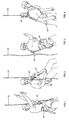
- FIGS. 7 to 9 The operation of the harness 10 equipped with the 40 hooking lanyard deportee according to the invention, is represented in FIGS. 7 to 9:
- the retaining link 46 of the lanyard 40 is in position contact with the dorsal strap 34, and the second end 44 is maintained with its blocker 50 in the back of the user.
- the rope 52 is permanently at the back of the user, and does not hinder his progression in normal use.
- the detachable retaining link 46 has tripped as a result of of a fall, and the blocker 50 automatically stops the movement of descent of the user with the rope 52 passing through the front. The user is then comfortably hooked to the rope 52 by the first end 42 front of the loin 40.
- the rope 52 is easily accessible, and the user can descend and go up along the rope 52, which is then accessible with the usual techniques of rope progression.
- the retaining link 46 is easily detachable manually for facilitate the placement of the blocker 50.
- the furling harness 10 at 40 offset can be used to self-insurance in climbing, and for work at height.
Landscapes
- Health & Medical Sciences (AREA)
- General Health & Medical Sciences (AREA)
- Business, Economics & Management (AREA)
- Emergency Management (AREA)
- Emergency Lowering Means (AREA)
Description
- un cuissard composé d'une ceinture de maintien et d'une paire de tours de cuisse reliés à la ceinture par des sangles de liaison,
- une paire de bretelles fixée à l'avant et à l'arrière de la ceinture, chaque bretelle comportant une sangle thoracique prolongée par une sangle dorsale en formant une demi-spire destinée à passer sur l'épaule de l'utilisateur,
- et une longe d'accrochage déportée constituée par une sangle d'extension auxiliaire.
- les figures 1 et 2 sont des vues schématiques d'un harnais connu de l'art antérieur avec un point d'accrochage ventral ou thoracique, respectivement avant et après la chute;
- les figures 3 et 4 sont des vues schématiques d'un harnais connu de l'art antérieur avec un point d'accrochage arrière dorsal, respectivement avant et après la chute;
- la figure 5 montre une vue en perspective d'un harnais équipé d'une longe selon l'invention;
- la figure 6 représente le harnais de la figure 5 vu de l'arrière, la longe se trouvant dans la position de contact avec l'une des bretelles;
- les figures 7-9 montrent les différentes phases de fonctionnement du harnais de la figure 5, respectivement avant et après la chute, et lors de la remontée par autosecours.
Claims (7)
- Harnais d'encordement comprenant:caractérisé en ce que la longe (40) possède une première extrémité (42) de fixation assujettie sur le devant du harnais (10), et une deuxième extrémité (44) d'accrochage ramenée à l'arrière du harnais (10) en étant superposée à l'une des bretelles (14) au moyen d'une liaison de retenue (46) détachable susceptible de se trouver dans une position de contact ou dans une position déclenchée selon que la force de tension exercée sur la longe (40) est inférieure ou supérieure à un seuil prédéterminé, le passage de la position de contact vers la position déclenchée intervenant à la suite d'une chute ou d'une intervention manuelle en provoquant la séparation de la deuxième extrémité (44) de la bretelle, et le transfert de la longe (40) vers l'avant.un cuissard (12) composé d'une ceinture (18) de maintien et d'une paire de tours de cuisse (20, 22) reliés à la ceinture (18) par des sangles de liaison ( 24, 26, 28, 30),une paire de bretelles (14, 16) fixée à l'avant et à l'arrière de la ceinture (18), chaque bretelle (14, 16) comportant une sangle thoracique (32) prolongée par une sangle dorsale (34) en formant une demi-spire destinée à passer sur l'épaule de l'utilisateur,et une longe (40) d'accrochage déportée constituée par une sangle d'extension auxiliaire,
- Harnais d'encordement selon la revendication 1, caractérisé en ce que la liaison de retenue (46) de la longe (40) est localisée en position de contact sur la sangle dorsale (34) de la bretelle (14).
- Harnais d'encordement selon la revendication 1 ou 2, caractérisé en ce que la première extrémité (42) de fixation de la longe (40) se trouve sur une partie commune (36) d'assemblage des sangles thoraciques (32) des deux bretelles (14, 16) à la ceinture (18).
- Harnais d'encordement selon la revendication 1 ou 2, caractérisé en ce que la liaison de retenue (46) est formée par au moins une bande de fermeture autoagrippante.
- Harnais d'encordement selon la revendication 1 ou 2, caractérisé en ce que la liaison de retenue (46) est formée par un système de fermeture par boutons-pression enfichables.
- Harnais d'encordement selon la revendication 1 ou 2, caractérisé en ce que la liaison de retenue (46) est formée par des moyens de maintien élastiques.
- Harnais d'encordement selon la revendication 2, caractérisé en ce que la liaison de retenue(46)est agencée au début de la sangle dorsale (34) au voisinage de l'épaule de l'utilisateur.
Applications Claiming Priority (2)
| Application Number | Priority Date | Filing Date | Title |
|---|---|---|---|
| FR9909412 | 1999-07-16 | ||
| FR9909412A FR2796297B1 (fr) | 1999-07-16 | 1999-07-16 | Harnais d'encordement a longe d'accrochage deportee |
Publications (2)
| Publication Number | Publication Date |
|---|---|
| EP1068880A1 EP1068880A1 (fr) | 2001-01-17 |
| EP1068880B1 true EP1068880B1 (fr) | 2005-06-15 |
Family
ID=9548315
Family Applications (1)
| Application Number | Title | Priority Date | Filing Date |
|---|---|---|---|
| EP00410070A Expired - Lifetime EP1068880B1 (fr) | 1999-07-16 | 2000-07-06 | Harnais d'encordement à longe d'accrochage déportée |
Country Status (7)
| Country | Link |
|---|---|
| US (1) | US6374946B1 (fr) |
| EP (1) | EP1068880B1 (fr) |
| JP (1) | JP2001054580A (fr) |
| CA (1) | CA2313944A1 (fr) |
| DE (1) | DE60020780T2 (fr) |
| ES (1) | ES2242591T3 (fr) |
| FR (1) | FR2796297B1 (fr) |
Families Citing this family (40)
| Publication number | Priority date | Publication date | Assignee | Title |
|---|---|---|---|---|
| US6658666B2 (en) * | 2002-04-17 | 2003-12-09 | James R. Schweer | Hunting garment with safety device |
| US6648101B2 (en) * | 2001-05-24 | 2003-11-18 | Michael P. Kurtgis | Fall protection lanyard apparatus |
| FR2827522B1 (fr) * | 2001-07-20 | 2003-09-26 | Mkm | Harnais cuissard a ceinture fermee non ouvrable sans boucle de securite |
| CA2357885C (fr) * | 2001-09-28 | 2006-11-28 | Safety Direct Ltd. | Harnais de securite a anneau en d a l'avant |
| US20030146044A1 (en) * | 2002-02-01 | 2003-08-07 | Jordan Omar P. | Sefety harness with support strap |
| SE525869C2 (sv) * | 2002-09-02 | 2005-05-17 | Act Safe Systems Ab | Riggplatta för hängsele |
| FR2847170B1 (fr) * | 2002-11-14 | 2005-01-21 | Pms Ind | Harnais d'antichute integralement reglable par coulissements auto bloques |
| US7979919B2 (en) | 2002-12-19 | 2011-07-19 | Rapid Intervention Technologies, Inc. | Full body harness |
| US20060195962A1 (en) * | 2002-12-19 | 2006-09-07 | Rit Rescue And Escape Systems | Full body harness |
| US20040182644A1 (en) * | 2003-03-03 | 2004-09-23 | Todd Kotarski | Rescue harness for injured person and rescuer |
| US7490610B2 (en) * | 2003-12-09 | 2009-02-17 | Franklin Scott D | Fall protection harness |
| US20050189176A1 (en) * | 2004-02-10 | 2005-09-01 | Demeyer Gerald | Safety harness with removable outer shell |
| US7594281B1 (en) * | 2004-04-14 | 2009-09-29 | Larry & Brenda Stinson | Explosion and fire extraction safety garment |
| US20060054387A1 (en) * | 2004-08-17 | 2006-03-16 | Paul-Emile Fortin | Saftey harness |
| US20070023231A1 (en) * | 2005-07-26 | 2007-02-01 | Gorman Patrick J | Lightweight safety harness |
| KR100671167B1 (ko) * | 2005-09-12 | 2007-01-19 | 이상익 | 개인용 긴급 구난 벨트 |
| GB0525386D0 (en) * | 2005-12-13 | 2006-01-18 | Dawson Brian | Safety harness |
| FR2900347B1 (fr) * | 2006-04-26 | 2008-06-27 | Zedel Soc Par Actions Simplifi | Ceinture pour harnais d'encordement munie d'un dispositif porte materiel en saillie. |
| FR2900579B1 (fr) * | 2006-05-02 | 2008-06-27 | Zedel Soc Par Actions Simplifi | Harnais de securite a bloqueur ventral integre |
| US20070272484A1 (en) * | 2006-05-25 | 2007-11-29 | Helms James K | Safety harness |
| USD558402S1 (en) | 2006-06-06 | 2007-12-25 | Zedel | Harness |
| USD556383S1 (en) * | 2006-07-07 | 2007-11-27 | Zedel | Harness |
| PT2724752T (pt) * | 2006-12-11 | 2017-06-30 | Checkmate Ltd | Arnês para detenção de queda |
| JP4926012B2 (ja) * | 2007-11-29 | 2012-05-09 | ミドリ安全株式会社 | ハーネス型安全帯 |
| USD604912S1 (en) * | 2008-12-09 | 2009-11-24 | Bashlin Industries, Inc. | Pole climbing and fall restraint device |
| KR101170961B1 (ko) * | 2010-01-07 | 2012-08-03 | 주식회사 성안세이브 | 다리벨트와 주벨트의 위치 조정이 간편한 산업용 안전그네 |
| KR101121437B1 (ko) | 2011-10-07 | 2012-03-16 | 주식회사 성안세이브 | 다리벨트와 주벨트의 위치 조정이 간편한 산업용 안전그네 |
| ES1094563Y (es) * | 2013-11-11 | 2014-02-18 | Garcia Mazagatos Eduardo (50 0%) | Dispositivo de atenuación del trauma por suspensiónen rescates |
| DE102015000078A1 (de) * | 2015-01-12 | 2016-07-14 | Engin Tasci | Vorrichtung zur Absturzsicherung und Verfahren zur Vermeidung eines Hängetraumas |
| US9737736B2 (en) * | 2015-01-15 | 2017-08-22 | Cmc Rescue, Inc. | Fall arrest harness |
| DE102015117138A1 (de) * | 2015-10-07 | 2017-04-13 | Edelrid Gmbh & Co. Kg | Haltevorrichtung für Bergsteiger, Kletterer oder in der Anwendung zur Absturzsicherung in der Arbeitssicherheit |
| JP6078182B1 (ja) * | 2016-02-02 | 2017-02-08 | 最首 哲也 | はくだけハーネス |
| US10799731B2 (en) | 2016-12-12 | 2020-10-13 | Msa Technology, Llc | Harness with integrated energy absorber |
| US10702723B2 (en) * | 2016-12-12 | 2020-07-07 | Msa Technology, Llc | Harness with structural tear tape |
| AT520047B1 (de) * | 2017-06-14 | 2019-10-15 | Ing Hans Julian Dzugan | Auffanggurtvorrichtung |
| US20190269948A1 (en) * | 2018-01-09 | 2019-09-05 | Sherry Green Mullins | Suspension relief seat as an intermediate article of manufacture |
| USD977722S1 (en) * | 2020-05-21 | 2023-02-07 | Zhejiang Shengbang Safety Protection Co., Ltd | Safety belt |
| US20220040510A1 (en) * | 2020-08-05 | 2022-02-10 | Alexander Andrew, Inc. Dba Falltech | Web harness system with leg components |
| EP4249081B1 (fr) * | 2022-03-24 | 2025-01-29 | Paratec Fallschirmbau - Technik - Service Vertrieb GmbH | Dispositif de sauvetage d'une personne d'une eolienne et eolienne |
| CN119300736A (zh) * | 2022-04-19 | 2025-01-10 | 维尔纳公司 | 用于坠落保护系统的安全带 |
Family Cites Families (19)
| Publication number | Priority date | Publication date | Assignee | Title |
|---|---|---|---|---|
| US3444957A (en) * | 1967-12-13 | 1969-05-20 | Rose Mfg Co | Shock absorber for safety belt |
| GB2066346B (en) * | 1979-11-13 | 1983-04-07 | Gq Defence Equip Ltd | Releasable connectors |
| US4479624A (en) * | 1982-08-23 | 1984-10-30 | The United States Of America As Represented By The Secretary Of The Navy | Parachute riser assembly |
| US5090503A (en) * | 1990-10-29 | 1992-02-25 | Michael Bell | Visually inspectable safety lanyard |
| DE4206873A1 (de) * | 1991-04-08 | 1992-10-15 | Manfred Meckel Fabrik Fuer Sic | Sicherheitsgeschirr mit auffangfunktion |
| US5174410A (en) * | 1991-05-28 | 1992-12-29 | Db Industries, Inc. | Shock absorber safety system for workers and method of making same |
| US5228412A (en) * | 1992-06-04 | 1993-07-20 | Michael Bell | Harness with rappelling straps, positioning pad, and tool belt |
| US5878833A (en) * | 1992-07-17 | 1999-03-09 | Bell; Michael | Fall prevention and lowering system, methods of use and body engagement means utilizable therewith |
| US6006860A (en) * | 1993-11-10 | 1999-12-28 | Bell; Michael | Safety harness or belt with fiber means to indicate shock loading |
| GB9325508D0 (en) * | 1993-12-14 | 1994-02-16 | Northern Electric Plc | Personal safety devices |
| US6158548A (en) * | 1993-12-14 | 2000-12-12 | Barrow Hepburn Sala Ltd. | Personal safety device |
| US5569057A (en) * | 1994-07-20 | 1996-10-29 | Gary Keith Barsdorf | Body surfing device |
| US5433289A (en) * | 1994-07-26 | 1995-07-18 | Surety Manufacturing & Testing Ltd. | Workers' Multi-functional harness |
| US5598900A (en) * | 1994-10-21 | 1997-02-04 | Surety Manufacturing & Testing Ltd. | Horizontal lifeline energy absorber |
| US5664844A (en) * | 1994-10-27 | 1997-09-09 | Petite Peche Ltd. | Harness safety system |
| US6125966A (en) * | 1995-04-07 | 2000-10-03 | Jones; Dennis Keith | Harness assembly for safely restraining a person in elevated position proximate a vertical object |
| US5960480A (en) * | 1995-05-26 | 1999-10-05 | Otis Elevator Company | Fall protection safety suit |
| US6006700A (en) * | 1996-09-24 | 1999-12-28 | Dalloz Safety, Inc. | Safety harness |
| CZ291448B6 (cs) * | 1997-03-11 | 2003-03-12 | Igor Rajnoch | Taktický třídílný postroj, způsob jeho konečné úpravy a způsob slaňování osob pomocí tohoto postroje |
-
1999
- 1999-07-16 FR FR9909412A patent/FR2796297B1/fr not_active Expired - Fee Related
-
2000
- 2000-06-20 US US09/597,091 patent/US6374946B1/en not_active Expired - Fee Related
- 2000-07-06 EP EP00410070A patent/EP1068880B1/fr not_active Expired - Lifetime
- 2000-07-06 ES ES00410070T patent/ES2242591T3/es not_active Expired - Lifetime
- 2000-07-06 DE DE60020780T patent/DE60020780T2/de not_active Expired - Fee Related
- 2000-07-12 JP JP2000211086A patent/JP2001054580A/ja not_active Withdrawn
- 2000-07-14 CA CA002313944A patent/CA2313944A1/fr not_active Abandoned
Also Published As
| Publication number | Publication date |
|---|---|
| ES2242591T3 (es) | 2005-11-16 |
| DE60020780T2 (de) | 2006-03-16 |
| CA2313944A1 (fr) | 2001-01-16 |
| DE60020780D1 (de) | 2005-07-21 |
| FR2796297A1 (fr) | 2001-01-19 |
| US6374946B1 (en) | 2002-04-23 |
| FR2796297B1 (fr) | 2001-10-26 |
| EP1068880A1 (fr) | 2001-01-17 |
| JP2001054580A (ja) | 2001-02-27 |
Similar Documents
| Publication | Publication Date | Title |
|---|---|---|
| EP1068880B1 (fr) | Harnais d'encordement à longe d'accrochage déportée | |
| EP3093047B1 (fr) | Harnais d'encordement perfectionné | |
| EP1852145B1 (fr) | Harnais de sécurité à bloqueur ventral intégré | |
| EP3307400B1 (fr) | Crochet de séparation | |
| US6874596B2 (en) | Safety harness with front D ring | |
| US10596397B2 (en) | Harness configurations for a suspension device | |
| US5360082A (en) | Fall prevention and lowering system, methods of use and body engagement means utilizable therewith | |
| US2920714A (en) | Safety device for pole climbers | |
| EP2755724B1 (fr) | Harnais d'antichute et de maintien en suspension à confort amélioré | |
| US5878833A (en) | Fall prevention and lowering system, methods of use and body engagement means utilizable therewith | |
| US5787529A (en) | Rescue carrier device | |
| US8191848B2 (en) | Air tank bracket with strap-supporting arms | |
| EP2052631A1 (fr) | Vêtement pourvu d'un harnais | |
| US20110067953A1 (en) | Extraction Device | |
| AU2016207015B2 (en) | Fall arrest harness | |
| CA2780449A1 (fr) | Harnais | |
| US20150060195A1 (en) | Harness with Integral Relief Loops for Suspension Trauma | |
| US12496244B2 (en) | Fireman's carry harness | |
| EP1277497A1 (fr) | Harnais cuissard à ceinture fermée non ouvrable | |
| US20030040372A1 (en) | Child safety restraint system for swing sets | |
| JP2018038876A (ja) | 雪下ろし用シットハーネス | |
| JP5823916B2 (ja) | ヘリ救助用の被災者用装着バンド | |
| WO2007110581A1 (fr) | Harnais de securite | |
| CZ20002600A3 (cs) | Závěsný sedací postroj s přestavovacím závěsem | |
| WO2014072522A2 (fr) | Système de maintien pour une personne et plaque de support pour dispositif de protection respiratoire |
Legal Events
| Date | Code | Title | Description |
|---|---|---|---|
| PUAI | Public reference made under article 153(3) epc to a published international application that has entered the european phase |
Free format text: ORIGINAL CODE: 0009012 |
|
| AK | Designated contracting states |
Kind code of ref document: A1 Designated state(s): DE ES GB IT |
|
| AX | Request for extension of the european patent |
Free format text: AL;LT;LV;MK;RO;SI |
|
| 17P | Request for examination filed |
Effective date: 20010702 |
|
| AKX | Designation fees paid |
Free format text: DE ES GB IT |
|
| GRAP | Despatch of communication of intention to grant a patent |
Free format text: ORIGINAL CODE: EPIDOSNIGR1 |
|
| GRAS | Grant fee paid |
Free format text: ORIGINAL CODE: EPIDOSNIGR3 |
|
| GRAA | (expected) grant |
Free format text: ORIGINAL CODE: 0009210 |
|
| AK | Designated contracting states |
Kind code of ref document: B1 Designated state(s): DE ES GB IT |
|
| REG | Reference to a national code |
Ref country code: GB Ref legal event code: FG4D Free format text: NOT ENGLISH |
|
| REF | Corresponds to: |
Ref document number: 60020780 Country of ref document: DE Date of ref document: 20050721 Kind code of ref document: P |
|
| GBT | Gb: translation of ep patent filed (gb section 77(6)(a)/1977) |
Effective date: 20050902 |
|
| REG | Reference to a national code |
Ref country code: ES Ref legal event code: FG2A Ref document number: 2242591 Country of ref document: ES Kind code of ref document: T3 |
|
| PLBE | No opposition filed within time limit |
Free format text: ORIGINAL CODE: 0009261 |
|
| STAA | Information on the status of an ep patent application or granted ep patent |
Free format text: STATUS: NO OPPOSITION FILED WITHIN TIME LIMIT |
|
| 26N | No opposition filed |
Effective date: 20060316 |
|
| PGFP | Annual fee paid to national office [announced via postgrant information from national office to epo] |
Ref country code: DE Payment date: 20060629 Year of fee payment: 7 |
|
| PGFP | Annual fee paid to national office [announced via postgrant information from national office to epo] |
Ref country code: GB Payment date: 20060705 Year of fee payment: 7 |
|
| PGFP | Annual fee paid to national office [announced via postgrant information from national office to epo] |
Ref country code: ES Payment date: 20060825 Year of fee payment: 7 |
|
| PGFP | Annual fee paid to national office [announced via postgrant information from national office to epo] |
Ref country code: IT Payment date: 20070730 Year of fee payment: 8 |
|
| GBPC | Gb: european patent ceased through non-payment of renewal fee |
Effective date: 20070706 |
|
| PG25 | Lapsed in a contracting state [announced via postgrant information from national office to epo] |
Ref country code: DE Free format text: LAPSE BECAUSE OF NON-PAYMENT OF DUE FEES Effective date: 20080201 |
|
| PG25 | Lapsed in a contracting state [announced via postgrant information from national office to epo] |
Ref country code: GB Free format text: LAPSE BECAUSE OF NON-PAYMENT OF DUE FEES Effective date: 20070706 |
|
| REG | Reference to a national code |
Ref country code: ES Ref legal event code: FD2A Effective date: 20070707 |
|
| PG25 | Lapsed in a contracting state [announced via postgrant information from national office to epo] |
Ref country code: ES Free format text: LAPSE BECAUSE OF NON-PAYMENT OF DUE FEES Effective date: 20070707 |
|
| PG25 | Lapsed in a contracting state [announced via postgrant information from national office to epo] |
Ref country code: IT Free format text: LAPSE BECAUSE OF NON-PAYMENT OF DUE FEES Effective date: 20080706 |