EP1068896A1 - Festbettkatalysatoren vom Raney-Typ - Google Patents
Festbettkatalysatoren vom Raney-Typ Download PDFInfo
- Publication number
- EP1068896A1 EP1068896A1 EP00111604A EP00111604A EP1068896A1 EP 1068896 A1 EP1068896 A1 EP 1068896A1 EP 00111604 A EP00111604 A EP 00111604A EP 00111604 A EP00111604 A EP 00111604A EP 1068896 A1 EP1068896 A1 EP 1068896A1
- Authority
- EP
- European Patent Office
- Prior art keywords
- fixed bed
- raney
- catalyst
- catalysts
- bed catalysts
- Prior art date
- Legal status (The legal status is an assumption and is not a legal conclusion. Google has not performed a legal analysis and makes no representation as to the accuracy of the status listed.)
- Granted
Links
- 239000007868 Raney catalyst Substances 0.000 title description 4
- 239000003054 catalyst Substances 0.000 claims abstract description 63
- 229910052751 metal Inorganic materials 0.000 claims abstract description 20
- 239000002184 metal Substances 0.000 claims abstract description 20
- 239000000835 fiber Substances 0.000 claims abstract description 15
- 238000000605 extraction Methods 0.000 claims abstract description 11
- 238000000034 method Methods 0.000 claims description 17
- 229910001092 metal group alloy Inorganic materials 0.000 claims description 6
- 230000008569 process Effects 0.000 claims description 6
- 238000005984 hydrogenation reaction Methods 0.000 claims description 5
- 150000002894 organic compounds Chemical class 0.000 claims description 5
- 230000036571 hydration Effects 0.000 claims description 3
- 238000006703 hydration reaction Methods 0.000 claims description 3
- 238000006317 isomerization reaction Methods 0.000 claims description 3
- 238000005932 reductive alkylation reaction Methods 0.000 claims description 3
- 238000006268 reductive amination reaction Methods 0.000 claims description 3
- 238000006356 dehydrogenation reaction Methods 0.000 claims description 2
- 230000000737 periodic effect Effects 0.000 claims description 2
- 229910052761 rare earth metal Inorganic materials 0.000 claims description 2
- 150000002910 rare earth metals Chemical class 0.000 claims description 2
- 230000007704 transition Effects 0.000 claims description 2
- 238000002360 preparation method Methods 0.000 claims 1
- 238000005275 alloying Methods 0.000 abstract 1
- 239000000956 alloy Substances 0.000 description 31
- 229910045601 alloy Inorganic materials 0.000 description 31
- HEMHJVSKTPXQMS-UHFFFAOYSA-M Sodium hydroxide Chemical compound [OH-].[Na+] HEMHJVSKTPXQMS-UHFFFAOYSA-M 0.000 description 30
- PXHVJJICTQNCMI-UHFFFAOYSA-N Nickel Chemical compound [Ni] PXHVJJICTQNCMI-UHFFFAOYSA-N 0.000 description 20
- 229910052782 aluminium Inorganic materials 0.000 description 16
- 239000000203 mixture Substances 0.000 description 16
- 235000011121 sodium hydroxide Nutrition 0.000 description 12
- 239000000843 powder Substances 0.000 description 11
- 238000001816 cooling Methods 0.000 description 9
- 229910052759 nickel Inorganic materials 0.000 description 9
- 230000004913 activation Effects 0.000 description 8
- XAGFODPZIPBFFR-UHFFFAOYSA-N aluminium Chemical compound [Al] XAGFODPZIPBFFR-UHFFFAOYSA-N 0.000 description 8
- 239000011230 binding agent Substances 0.000 description 8
- 238000001354 calcination Methods 0.000 description 8
- 238000000465 moulding Methods 0.000 description 8
- 239000000463 material Substances 0.000 description 7
- 238000004519 manufacturing process Methods 0.000 description 6
- 230000000052 comparative effect Effects 0.000 description 5
- 239000010410 layer Substances 0.000 description 5
- 150000002739 metals Chemical class 0.000 description 5
- XLYOFNOQVPJJNP-UHFFFAOYSA-N water Substances O XLYOFNOQVPJJNP-UHFFFAOYSA-N 0.000 description 5
- UFHFLCQGNIYNRP-UHFFFAOYSA-N Hydrogen Chemical compound [H][H] UFHFLCQGNIYNRP-UHFFFAOYSA-N 0.000 description 4
- XEEYBQQBJWHFJM-UHFFFAOYSA-N Iron Chemical compound [Fe] XEEYBQQBJWHFJM-UHFFFAOYSA-N 0.000 description 4
- 230000003197 catalytic effect Effects 0.000 description 4
- 239000001257 hydrogen Substances 0.000 description 4
- 229910052739 hydrogen Inorganic materials 0.000 description 4
- LQNUZADURLCDLV-UHFFFAOYSA-N nitrobenzene Chemical compound [O-][N+](=O)C1=CC=CC=C1 LQNUZADURLCDLV-UHFFFAOYSA-N 0.000 description 4
- HCHKCACWOHOZIP-UHFFFAOYSA-N Zinc Chemical compound [Zn] HCHKCACWOHOZIP-UHFFFAOYSA-N 0.000 description 3
- 238000006555 catalytic reaction Methods 0.000 description 3
- -1 hydrogenation Chemical class 0.000 description 3
- 238000009987 spinning Methods 0.000 description 3
- RYGMFSIKBFXOCR-UHFFFAOYSA-N Copper Chemical compound [Cu] RYGMFSIKBFXOCR-UHFFFAOYSA-N 0.000 description 2
- LFQSCWFLJHTTHZ-UHFFFAOYSA-N Ethanol Chemical compound CCO LFQSCWFLJHTTHZ-UHFFFAOYSA-N 0.000 description 2
- 238000005266 casting Methods 0.000 description 2
- 229910017052 cobalt Inorganic materials 0.000 description 2
- 239000010941 cobalt Substances 0.000 description 2
- GUTLYIVDDKVIGB-UHFFFAOYSA-N cobalt atom Chemical compound [Co] GUTLYIVDDKVIGB-UHFFFAOYSA-N 0.000 description 2
- 229910052802 copper Inorganic materials 0.000 description 2
- 239000010949 copper Substances 0.000 description 2
- 230000000694 effects Effects 0.000 description 2
- JIQVGGQJISZHSS-UHFFFAOYSA-N ethene N-octadecanoyloctadecanamide Chemical compound C=C.CCCCCCCCCCCCCCCCCC(=O)NC(=O)CCCCCCCCCCCCCCCCC JIQVGGQJISZHSS-UHFFFAOYSA-N 0.000 description 2
- 239000007789 gas Substances 0.000 description 2
- 229910052742 iron Inorganic materials 0.000 description 2
- 238000002844 melting Methods 0.000 description 2
- 230000008018 melting Effects 0.000 description 2
- 239000012768 molten material Substances 0.000 description 2
- 239000003960 organic solvent Substances 0.000 description 2
- 239000011148 porous material Substances 0.000 description 2
- 230000002829 reductive effect Effects 0.000 description 2
- 238000007493 shaping process Methods 0.000 description 2
- 229910052710 silicon Inorganic materials 0.000 description 2
- 239000010703 silicon Substances 0.000 description 2
- 229910052725 zinc Inorganic materials 0.000 description 2
- 239000011701 zinc Substances 0.000 description 2
- VYZAMTAEIAYCRO-UHFFFAOYSA-N Chromium Chemical compound [Cr] VYZAMTAEIAYCRO-UHFFFAOYSA-N 0.000 description 1
- 229910000531 Co alloy Inorganic materials 0.000 description 1
- 229920000914 Metallic fiber Polymers 0.000 description 1
- ZOKXTWBITQBERF-UHFFFAOYSA-N Molybdenum Chemical compound [Mo] ZOKXTWBITQBERF-UHFFFAOYSA-N 0.000 description 1
- XUIMIQQOPSSXEZ-UHFFFAOYSA-N Silicon Chemical compound [Si] XUIMIQQOPSSXEZ-UHFFFAOYSA-N 0.000 description 1
- 239000004809 Teflon Substances 0.000 description 1
- 229920006362 Teflon® Polymers 0.000 description 1
- RTAQQCXQSZGOHL-UHFFFAOYSA-N Titanium Chemical compound [Ti] RTAQQCXQSZGOHL-UHFFFAOYSA-N 0.000 description 1
- 238000005299 abrasion Methods 0.000 description 1
- 238000013459 approach Methods 0.000 description 1
- 238000000889 atomisation Methods 0.000 description 1
- 239000010953 base metal Substances 0.000 description 1
- 238000010923 batch production Methods 0.000 description 1
- 239000012018 catalyst precursor Substances 0.000 description 1
- 239000003518 caustics Substances 0.000 description 1
- 238000006243 chemical reaction Methods 0.000 description 1
- 239000011362 coarse particle Substances 0.000 description 1
- 150000001875 compounds Chemical class 0.000 description 1
- 239000002826 coolant Substances 0.000 description 1
- 230000009849 deactivation Effects 0.000 description 1
- 230000018044 dehydration Effects 0.000 description 1
- 238000006297 dehydration reaction Methods 0.000 description 1
- 238000013461 design Methods 0.000 description 1
- 238000005516 engineering process Methods 0.000 description 1
- 238000001914 filtration Methods 0.000 description 1
- 238000004817 gas chromatography Methods 0.000 description 1
- 239000008187 granular material Substances 0.000 description 1
- 230000006872 improvement Effects 0.000 description 1
- 230000007774 longterm Effects 0.000 description 1
- WPBNNNQJVZRUHP-UHFFFAOYSA-L manganese(2+);methyl n-[[2-(methoxycarbonylcarbamothioylamino)phenyl]carbamothioyl]carbamate;n-[2-(sulfidocarbothioylamino)ethyl]carbamodithioate Chemical compound [Mn+2].[S-]C(=S)NCCNC([S-])=S.COC(=O)NC(=S)NC1=CC=CC=C1NC(=S)NC(=O)OC WPBNNNQJVZRUHP-UHFFFAOYSA-L 0.000 description 1
- 229910052750 molybdenum Inorganic materials 0.000 description 1
- 239000011733 molybdenum Substances 0.000 description 1
- 239000002245 particle Substances 0.000 description 1
- 239000002243 precursor Substances 0.000 description 1
- 238000012545 processing Methods 0.000 description 1
- 239000000376 reactant Substances 0.000 description 1
- 239000012429 reaction media Substances 0.000 description 1
- 239000011541 reaction mixture Substances 0.000 description 1
- 230000007420 reactivation Effects 0.000 description 1
- 238000004062 sedimentation Methods 0.000 description 1
- 238000005245 sintering Methods 0.000 description 1
- 238000010583 slow cooling Methods 0.000 description 1
- 239000007787 solid Substances 0.000 description 1
- 239000002904 solvent Substances 0.000 description 1
- 238000003860 storage Methods 0.000 description 1
- 239000000126 substance Substances 0.000 description 1
- 239000002344 surface layer Substances 0.000 description 1
- 229910052715 tantalum Inorganic materials 0.000 description 1
- GUVRBAGPIYLISA-UHFFFAOYSA-N tantalum atom Chemical compound [Ta] GUVRBAGPIYLISA-UHFFFAOYSA-N 0.000 description 1
- 238000012360 testing method Methods 0.000 description 1
- 239000010936 titanium Substances 0.000 description 1
- 229910052719 titanium Inorganic materials 0.000 description 1
- 238000012549 training Methods 0.000 description 1
- WFKWXMTUELFFGS-UHFFFAOYSA-N tungsten Chemical compound [W] WFKWXMTUELFFGS-UHFFFAOYSA-N 0.000 description 1
- 229910052721 tungsten Inorganic materials 0.000 description 1
- 239000010937 tungsten Substances 0.000 description 1
- 229910052720 vanadium Inorganic materials 0.000 description 1
- GPPXJZIENCGNKB-UHFFFAOYSA-N vanadium Chemical compound [V]#[V] GPPXJZIENCGNKB-UHFFFAOYSA-N 0.000 description 1
Classifications
-
- B—PERFORMING OPERATIONS; TRANSPORTING
- B01—PHYSICAL OR CHEMICAL PROCESSES OR APPARATUS IN GENERAL
- B01J—CHEMICAL OR PHYSICAL PROCESSES, e.g. CATALYSIS OR COLLOID CHEMISTRY; THEIR RELEVANT APPARATUS
- B01J25/00—Catalysts of the Raney type
- B01J25/02—Raney nickel
-
- B—PERFORMING OPERATIONS; TRANSPORTING
- B01—PHYSICAL OR CHEMICAL PROCESSES OR APPARATUS IN GENERAL
- B01J—CHEMICAL OR PHYSICAL PROCESSES, e.g. CATALYSIS OR COLLOID CHEMISTRY; THEIR RELEVANT APPARATUS
- B01J25/00—Catalysts of the Raney type
Definitions
- the present invention relates to Raney-type fixed bed catalysts.
- Activated metal catalysts are in the chemical field Technique known as Raney catalysts. You will be, largely in powder form, for a large number of reactions organic compounds such as hydrogenation, dehydrogenation, Isomerization, reductive alkylation, reductive amination and hydration used.
- This powdery Catalysts are made from an alloy of a catalytic active metal, also in the present case as a catalyst metal designated, with a further alloy component, which is soluble in alkalis.
- catalyst metals mainly nickel, cobalt, copper or iron used.
- Aluminum is usually considered the alloy component used, which is soluble in alkalis, however other components can be used, in particular Zinc and silicon or mixtures thereof with aluminum.
- Raney alloys are usually made after the block casting process. With this procedure become a mixture of the catalyst metal and for example Aluminum first melted and poured into blocks. Typical Alloy approaches on a production scale are approximately 10 to 100 kg per block. According to DE 21 59 736 cooling times received up to 2 hours. This corresponds to one average cooling rate of about 0.2 / second. in the Contrast this in procedures where a quick Cooling is used (e.g. in an atomization process) Rates from 102 to 106 K / sec. reached. The cooling rate is particularly due to the particle size and Cooling medium influences (see materials science and technology (Ed. R. W. Chan, P. Haasen, E. J. Kramer, Vol.
- the Raney alloy is used to produce a catalyst first finely ground when in their making was not obtained in the desired powder form. Then it will Aluminum completely or partially by extraction with alkalis, such as For example, a solution of caustic soda by extraction away. This activates the alloy powder. After extracting the aluminum, the alloy powder has a high specific surface area (BET value) of 20 to 100 m2 / g and is rich in active hydrogen.
- the activated catalyst powder is pyrophoric and is under Water or organic solvents stored or in organic compounds that solid at room temperature are embedded.
- Powdered catalysts have the disadvantage that they used only in a batch process and after the catalytic reaction from the Reaction medium through expensive sedimentation and / or Filtration must be separated.
- the most diverse processes for the production of moldings discloses which to activated metallic fixed bed catalysts after extracting the aluminum. Accordingly are z. E.g. coarse particle Raney alloys, i.e. Raney alloys that were only roughly ground are available and can be treated with a solution be activated by caustic soda. The extraction and Activation then only takes place in one surface layer, their thickness due to the conditions used during the extraction can be adjusted.
- the patent application EP 0 648 534 B1 describes shaped, activated Raney metal fixed bed catalysts and their production.
- the disadvantages described above are intended here be avoided, such as E.g. the poor mechanical stability, resulting from the activation of an outer layer.
- a mixture of powders of a catalyst alloy and a binder used the catalyst alloys each at least one catalytically active catalyst metal and one extractable alloy component included.
- the pure catalyst metals or their mixtures, which are not extractable Containing components are used as binders.
- the use of the binder in an amount of 0.5 to 20% by weight with respect to the catalyst alloy is essential in order to have a sufficient mechanical after activation To achieve stability.
- the obtained are fresh manufactured moldings at temperatures below 850 ° C. calcined.
- this leads to firm connections between the individual granules of the catalyst alloy.
- This Compounds are in contrast to catalyst alloys not extractable or only extractable to a small extent, so that a mechanically stable structure even after activation is obtained.
- the added binder has the disadvantage that it is essentially catalytically inactive which is the number of active centers in the activated Layer is reduced.
- the bulk density of these catalysts not less than 1.9 kg per liter be reduced without loss of strength.
- the high bulk density for a high investment per reactor bed although this is partly due to the high Activity and long-term stability of these catalysts balanced becomes.
- the high Bulk density of the catalyst also a mechanically reinforced Reactor design.
- an object of the present invention is to provide of catalysts with activated base metal from metallic fibers and flakes, which have the disadvantages known fixed bed catalysts can be largely avoided.
- the aim of the invention are fixed bed catalysts of the Raney type, which are characterized by the fact that they are made of metal alloy fibers and / or flakes are made previously manufactured by the crucible metal extraction process and then tableted, pressed into mats and / or into a cartridge were filled.
- Another object of the present invention is a method for the production of Raney-type fixed bed catalysts which are characterized by the fact that metal alloy fibers and / or flakes after the crucible melt extraction process produced and then tabletted, pressed into mats and / or be filled into a cartridge.
- Raney-type fixed bed catalysts are activated.
- the above and other objects of the invention will be achieved achieved by removing fibers or flakes from the desired ones Metals and / or alloys according to the crucible melt extraction process manufactures and for the manufacture of the catalyst carries out any necessary activation procedures.
- the main advantages of this invention are that the fibers and cool down flakes quickly so that the desired ones small phase ranges in these Raney alloys form, and these materials are unlike powders easier to separate from the reaction mixture. You can either be filled into a cartridge assembly to to perform their catalytic reaction or they can in Mats, tablets or other commonly used forms are pressed, which as fixed bed catalysts without more are useful.
- those for the present Fibers and flakes manufactured in accordance with DE 197 11 764 A1 produced by the crucible melt extraction process In this process there is a rectangular crucible with molten alloy below a water-cooled Copper spinning wheel with specially designed notches its surface is equipped. The crucible is then slowly lifted up so that the spinning wheel just barely touched is coming. In this way, the wheel strokes the melted one Alloy off while the molten material accumulates in the notched surface of the wheel and solidified before quickly entering a collection area is released. The result is a quick cool down Material with an adjustable shape. Depending on the training the notches on the spinning wheel are the end material either flakes or fibers of a certain length and a certain Diameter.
- Raney catalyst alloys are typically made from one Melt the catalyst metal and aluminum obtained. Regardless, they can be made from identical microscopic compositions get different phase structures depending on how and how quickly that happens cools down molten material. A rough phase structure with large phase areas usually form during casting of blocks due to the slow cooling rate. However, a much finer structure is formed when a faster cooling process is used.
- the required Cooling rate can be determined by those skilled in the art be determined by suitable tests. As one Guideline for required cooling rates can Cooling times of less than 2 minutes from the melting point at less than 700 ° C. This corresponds to cooling speeds of 5 K / sec.
- the bulk density of the fixed bed catalyst obtained is for highly active catalysts are also important. This should be less than 2.0 kg / liter. If the bulk density more than 2.0 kg / liter, the catalysts are too compact and consequently less active.
- the weight ratio of the catalyst metal to the extractable alloy component in the catalyst alloy is like Raney alloys usual, in the range from 20:80 to 80:20.
- Catalysts according to the invention can also be doped with other metals, to have an effect on the catalytic properties. The purpose of this type of doping is e.g. E.g. the Improvement of the selectivity regarding a special implementation. Doping metals are often called promoters. Doping or treating the Raney catalyst with promoters z. For example, in U.S. Patent 4,153,578 and in DE-AS 21 01 856, in DE-OS 21 00 373 and in DE-AS 2053799 described.
- any known metal alloy can be used extractable elements such as Eg aluminum, zinc and Silicon can be used for the present invention.
- Suitable Promoters are transition elements in groups IIIB to VIIB and VIII and Group IB of the Periodic Table of the Elements and also the rare earth metals. You will be in one Quantity of up to 20% by weight based on the total weight of the catalyst used.
- promoters with a different extractable Metal alloy in the form of a separable metal powder can be used, or the promoters can be used later be added to the catalyst material.
- a later application of promoters can either be after calcination or after activation. An optimal one Adjustment of the catalyst properties in the special Catalysis is therefore possible.
- the Raney type catalysts prepared herein were either filled into a cartridge and filled with a Solution caustic sodas activated or they were in Molds such as tablets and mats pressed.
- the molded material was optionally with a binder, such as. E.g. a nickel powder, produced, calcined in air and with a solution of caustic soda activated.
- a binder such as. E.g. a nickel powder, produced, calcined in air and with a solution of caustic soda activated.
- a 20% caustic solution heated to 80 ° C Sodas are used.
- the precursors of the catalysts resulting from the calcination of the Raney type are in terms of their own economy the invention is also very important. she are not pyrophoric and can be handled without difficulty and be transported. Activation can be done by the user be carried out shortly before their use. A storage under water or organic solvents, or embedding in organic compounds is for the catalyst precursors not mandatory.
- the fixed bed catalysts in the Raney type according to the present Invention can be used for hydrogenation, dehydration, isomerization, reductive alkylation, reductive amination and / or hydration of organic compounds applied become.
- a Teflon basket was 7 g of fibers 50 Ni: 50% Al (one length of 5 mm and a diameter of 100 ⁇ m) and 1.5 Hours at 80 ° C in a 20% caustic soda solution activated.
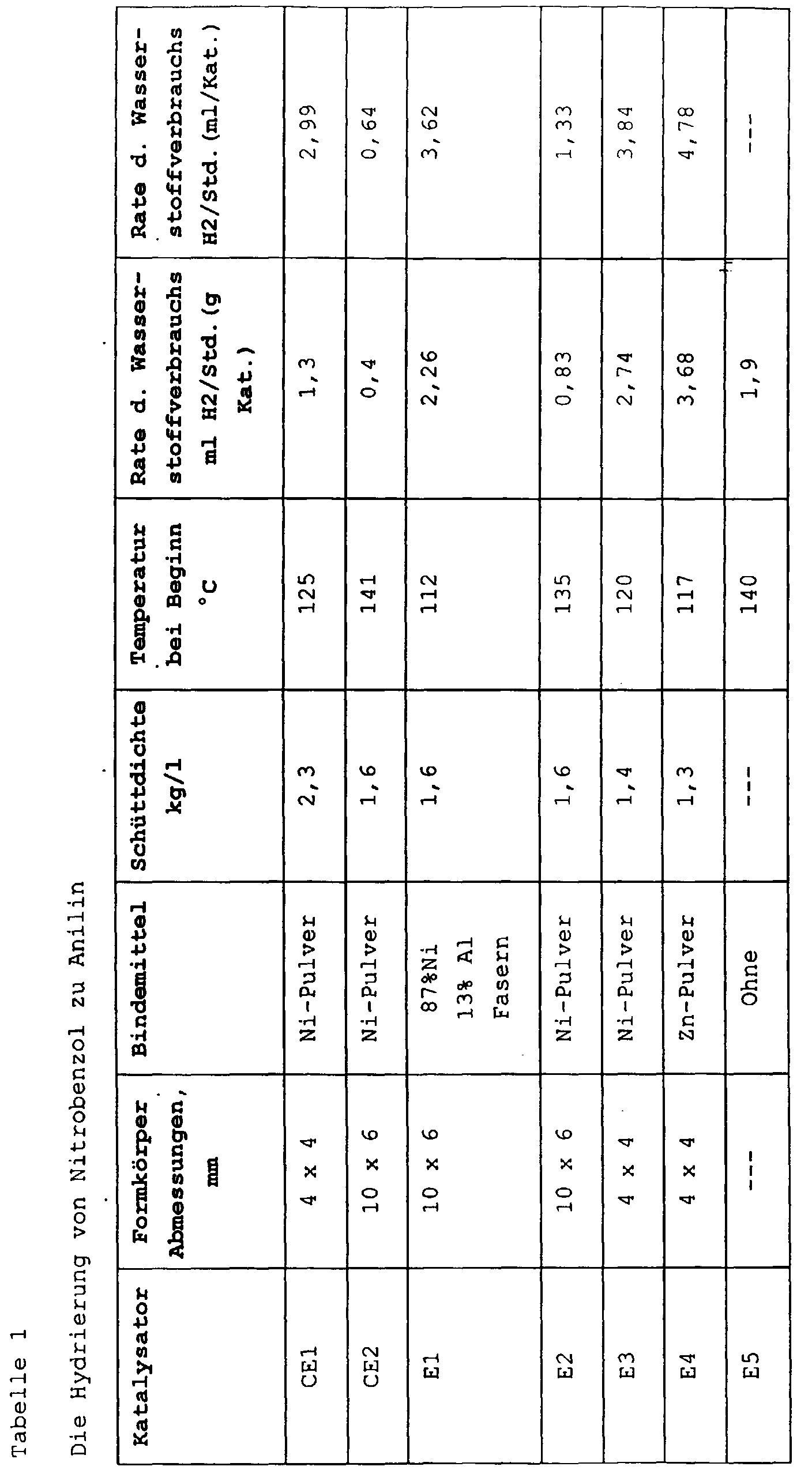
- the catalytic activity of the catalyst from Comparative Examples 1 and 2 and from Examples 1 to 5 were compared with one another during the hydrogenation of nitrobenzene.
- 100 g of nitrobenzene and 100 g of ethanol were placed in a stirred autoclave with a capacity of 0.5 liters, which was equipped with a gas stirrer.
- 10 g of the catalyst to be examined was suspended in the stirred autoclave using a catalyst basket so that the catalyst material was thoroughly washed by the mixture of the reactant and the solvent, and hydrogen was introduced.
- the hydrogenation was carried out at a hydrogen pressure of 40 bar and a temperature of 150 ° C.
- the temperature at the start and the rate of hydrogen consumption were determined.
- the results are shown in Table 1. As a check, samples were taken after 1, 2, 3, 4 and 5 hours and analyzed by gas chromatography.
Landscapes
- Chemical & Material Sciences (AREA)
- Engineering & Computer Science (AREA)
- Materials Engineering (AREA)
- Organic Chemistry (AREA)
- Chemical Kinetics & Catalysis (AREA)
- Organic Low-Molecular-Weight Compounds And Preparation Thereof (AREA)
- Catalysts (AREA)
- Low-Molecular Organic Synthesis Reactions Using Catalysts (AREA)
- Medicinal Preparation (AREA)
- Physical Or Chemical Processes And Apparatus (AREA)
- Nitrogen Condensed Heterocyclic Rings (AREA)
Abstract
Description
Claims (6)
- Festbettkatalysatoren vom Raney-Typ, dadurch gekennzeichnet, dass sie aus Metalllegierungsfasern und/oder - flocken hergestellt sind, welche zuvor gemäß dem Tiegelmetallextraktionsverfahren hergestellt und sodann tablettiert, in Matten verpresst und/oder in eine Kartusche abgefüllt wurden.
- Verfahren zur Herstellung der Festbettkatalysatoren vom Raney-Typ gemäß Anspruch 1, dadurch gekennzeichnet, dass Metalllegierungsfasern und/oder -flocken nach dem Tiegelschmelzextraktionsverfahren hergestellt und sodann tablettiert, in Matten verpresst und/oder in eine Kartusche abgefüllt werden.
- Verfahren gemäß Anspruch 2, dadurch gekennzeichnet, dass die Festbettkatalysatoren vom Raney-Typ aktiviert sind.
- Verfahren gemäß Anspruch 2, dadurch gekennzeichnet, dass die Festbettkatalysatoren vom Raney-Typ mit Übergangselementen der Gruppen IIIB bis VIIB und VIII und der Gruppe IB des Periodensystems der Elemente und auch mit Seltene Erden-Metallen in einer Menge von bis zu 20 Gew.% dotiert werden.
- Verfahren gemäß Anspruch 4, dadurch gekennzeichnet, dass die dotierten Festbettkatalysatoren vom Raney-Typ aktiviert werden.
- Verwendung der Festbettkatalysatoren vom Raney-Typ gemäß Anspruch 1 zur Hydrierung, Dehydrierung, Isomerisierung, reduktiven Alkylierung, reduktiven Aminierung und/oder Hydratisierung organischer Verbindungen.
Applications Claiming Priority (2)
| Application Number | Priority Date | Filing Date | Title |
|---|---|---|---|
| DE19931316A DE19931316A1 (de) | 1999-07-07 | 1999-07-07 | Festbettkatalysatoren vom Raney-Typ |
| DE19931316 | 1999-07-07 |
Publications (2)
| Publication Number | Publication Date |
|---|---|
| EP1068896A1 true EP1068896A1 (de) | 2001-01-17 |
| EP1068896B1 EP1068896B1 (de) | 2001-12-12 |
Family
ID=7913925
Family Applications (1)
| Application Number | Title | Priority Date | Filing Date |
|---|---|---|---|
| EP00111604A Expired - Lifetime EP1068896B1 (de) | 1999-07-07 | 2000-05-31 | Festbettkatalysatoren vom Raney-Typ |
Country Status (17)
| Country | Link |
|---|---|
| EP (1) | EP1068896B1 (de) |
| JP (1) | JP2001054736A (de) |
| KR (1) | KR20010066901A (de) |
| AT (1) | ATE210499T1 (de) |
| BR (1) | BR0002646A (de) |
| CA (1) | CA2313660A1 (de) |
| DE (2) | DE19931316A1 (de) |
| DK (1) | DK1068896T3 (de) |
| ES (1) | ES2168244T3 (de) |
| HU (1) | HUP0002586A3 (de) |
| ID (1) | ID26460A (de) |
| MX (1) | MXPA00006359A (de) |
| NO (1) | NO20003483L (de) |
| PL (1) | PL341196A1 (de) |
| PT (1) | PT1068896E (de) |
| TW (1) | TW521002B (de) |
| ZA (1) | ZA200003400B (de) |
Cited By (1)
| Publication number | Priority date | Publication date | Assignee | Title |
|---|---|---|---|---|
| CN105237409A (zh) * | 2014-06-05 | 2016-01-13 | 中国石油化工股份有限公司 | 一种利用喷射反应器进行还原胺化的方法 |
Citations (4)
| Publication number | Priority date | Publication date | Assignee | Title |
|---|---|---|---|---|
| EP0648534A1 (de) * | 1993-10-16 | 1995-04-19 | Degussa Aktiengesellschaft | Aktivierter Metall-Festbettkatalysator nach Raney und Verfahren zu seiner Herstellung |
| DE4446907A1 (de) * | 1994-12-27 | 1996-07-04 | Basf Ag | Verfahren zur Herstellung eines Hydrierkatalysators |
| DE19640554A1 (de) * | 1996-10-01 | 1998-04-02 | Basf Ag | Verfahren zur Herstellung von Phthaliden |
| EP0880996A1 (de) * | 1997-05-26 | 1998-12-02 | Degussa Aktiengesellschaft | Geformter Metall-Festbettkatalysator nach Raney, Verfahren zu seiner Herstellung und seine Verwendung |
Family Cites Families (3)
| Publication number | Priority date | Publication date | Assignee | Title |
|---|---|---|---|---|
| DE3337904A1 (de) * | 1983-10-19 | 1985-05-09 | Werner 7101 Flein Baum | Katalysatorbauteil |
| DE19711764B4 (de) * | 1996-03-27 | 2005-11-17 | Deutsches Zentrum für Luft- und Raumfahrt e.V. | Verfahren zum Recycling des metallischen Anteiles von vornehmlich auf der Basis von Aluminium hergestellten Metallmatrix-Verbundwerkstoffen und von Aluminium mittels Tiegelschmelzextraktion |
| DE19753501A1 (de) * | 1997-12-03 | 1999-06-10 | Bayer Ag | Raney-Nickel-Katalysatoren, ein Verfahren zu deren Herstellung und deren Verwendung zur Hydrierung organischer Verbindungen |
-
1999
- 1999-07-07 DE DE19931316A patent/DE19931316A1/de not_active Ceased
-
2000
- 2000-05-31 EP EP00111604A patent/EP1068896B1/de not_active Expired - Lifetime
- 2000-05-31 ES ES00111604T patent/ES2168244T3/es not_active Expired - Lifetime
- 2000-05-31 DK DK00111604T patent/DK1068896T3/da active
- 2000-05-31 PT PT00111604T patent/PT1068896E/pt unknown
- 2000-05-31 DE DE50000058T patent/DE50000058D1/de not_active Expired - Fee Related
- 2000-05-31 AT AT00111604T patent/ATE210499T1/de not_active IP Right Cessation
- 2000-06-26 MX MXPA00006359 patent/MXPA00006359A/es not_active Application Discontinuation
- 2000-06-29 ID IDP20000534A patent/ID26460A/id unknown
- 2000-07-03 TW TW089113141A patent/TW521002B/zh not_active IP Right Cessation
- 2000-07-04 JP JP2000202548A patent/JP2001054736A/ja active Pending
- 2000-07-05 KR KR1020000038180A patent/KR20010066901A/ko not_active Withdrawn
- 2000-07-05 PL PL00341196A patent/PL341196A1/xx not_active Application Discontinuation
- 2000-07-06 ZA ZA200003400A patent/ZA200003400B/xx unknown
- 2000-07-06 HU HU0002586A patent/HUP0002586A3/hu unknown
- 2000-07-06 NO NO20003483A patent/NO20003483L/no not_active Application Discontinuation
- 2000-07-06 CA CA002313660A patent/CA2313660A1/en not_active Abandoned
- 2000-07-07 BR BR0002646-8A patent/BR0002646A/pt not_active IP Right Cessation
Patent Citations (4)
| Publication number | Priority date | Publication date | Assignee | Title |
|---|---|---|---|---|
| EP0648534A1 (de) * | 1993-10-16 | 1995-04-19 | Degussa Aktiengesellschaft | Aktivierter Metall-Festbettkatalysator nach Raney und Verfahren zu seiner Herstellung |
| DE4446907A1 (de) * | 1994-12-27 | 1996-07-04 | Basf Ag | Verfahren zur Herstellung eines Hydrierkatalysators |
| DE19640554A1 (de) * | 1996-10-01 | 1998-04-02 | Basf Ag | Verfahren zur Herstellung von Phthaliden |
| EP0880996A1 (de) * | 1997-05-26 | 1998-12-02 | Degussa Aktiengesellschaft | Geformter Metall-Festbettkatalysator nach Raney, Verfahren zu seiner Herstellung und seine Verwendung |
Cited By (1)
| Publication number | Priority date | Publication date | Assignee | Title |
|---|---|---|---|---|
| CN105237409A (zh) * | 2014-06-05 | 2016-01-13 | 中国石油化工股份有限公司 | 一种利用喷射反应器进行还原胺化的方法 |
Also Published As
| Publication number | Publication date |
|---|---|
| DE19931316A1 (de) | 2001-01-18 |
| BR0002646A (pt) | 2001-03-13 |
| NO20003483D0 (no) | 2000-07-06 |
| HUP0002586A2 (en) | 2001-03-28 |
| PL341196A1 (en) | 2001-01-15 |
| PT1068896E (pt) | 2002-06-28 |
| ATE210499T1 (de) | 2001-12-15 |
| CA2313660A1 (en) | 2001-01-07 |
| NO20003483L (no) | 2001-01-08 |
| DK1068896T3 (da) | 2002-04-02 |
| DE50000058D1 (de) | 2002-01-24 |
| ID26460A (id) | 2001-01-11 |
| MXPA00006359A (es) | 2002-04-01 |
| ES2168244T3 (es) | 2002-06-16 |
| ZA200003400B (en) | 2001-02-02 |
| KR20010066901A (ko) | 2001-07-11 |
| EP1068896B1 (de) | 2001-12-12 |
| HU0002586D0 (en) | 2000-09-28 |
| TW521002B (en) | 2003-02-21 |
| HUP0002586A3 (en) | 2001-07-30 |
| JP2001054736A (ja) | 2001-02-27 |
Similar Documents
| Publication | Publication Date | Title |
|---|---|---|
| EP0648534B1 (de) | Aktivierter Metall-Festbettkatalysator nach Raney und Verfahren zu seiner Herstellung | |
| EP1068900B1 (de) | Aktivierte Raney-Metallkatalysatoren umfassend hohle Formen | |
| EP1066111B1 (de) | Raney-nickel-katalysatoren, ein verfahren zu deren herstellung und deren verwendung zur hydrierung organischer verbindungen | |
| DE69113966T2 (de) | Verbundpulver aus aluminiumoxyd/metall, cermets daraus und verfahren zu ihrer herstellung. | |
| EP0083791B1 (de) | Kieselsäurehaltige Formkörper, Verfahren zu ihrer Herstellung und ihre Verwendung | |
| EP0880996B1 (de) | Geformter Metall-Festbettkatalysator nach Raney, Verfahren zu seiner Herstellung und seine Verwendung | |
| EP2096098A1 (de) | Katalysator zur Herstellung von Alkoholen | |
| DE3241979C2 (de) | Verfahren zur Herstellung von kubischem Bornitrid unter Verwendung einer Verbindung vom Bornitridtyp als Katalysator | |
| EP4021885B1 (de) | Verfahren zur hydrierung von aromatischen nitroverbindungen | |
| EP0984831B1 (de) | Geformter, aktivierter metall-festbettkatalysator | |
| DE19936135A1 (de) | Festbettkatalysatoren | |
| EP1570021A2 (de) | Schleifmittel mit verbesserten schleifeigenschaften | |
| EP1512459A1 (de) | Verfahren und Herstellung von Raney-Nickel-Katalysatoren und deren Verwendung zur Hydrierung organischer Verbindungen | |
| EP1068896B1 (de) | Festbettkatalysatoren vom Raney-Typ | |
| DE102019131569A1 (de) | Chromfreier wasser- und saeurestabiler katalysator fuer hydrierungen | |
| US20030120116A1 (en) | Fixed-bed Raney-type catalysts | |
| DE102020106964A1 (de) | Chromfreier hydrierkatalysator mit erhoehter wasser- und saeurestabilitaet | |
| DE832604C (de) | Verfahren zur Herstellung von porigen Nickel-Aluminium-Katalysatoren | |
| CZ20002506A3 (cs) | Pevně uložené katalyzátory Raneyova typu | |
| WO2006008311A1 (de) | Organisch gebundene trenn- oder schleifkörper mit einem funktionellen additiv | |
| DE2100880A1 (de) | Nickelhaltige Legierung sowie daraus hergestellter Katalysator | |
| DE2320658A1 (de) | Verfahren zur herstellung von anilin |
Legal Events
| Date | Code | Title | Description |
|---|---|---|---|
| PUAI | Public reference made under article 153(3) epc to a published international application that has entered the european phase |
Free format text: ORIGINAL CODE: 0009012 |
|
| 17P | Request for examination filed |
Effective date: 20000531 |
|
| AK | Designated contracting states |
Kind code of ref document: A1 Designated state(s): AT BE CH CY DE DK ES FI FR GB GR IE IT LI LU MC NL PT SE |
|
| AX | Request for extension of the european patent |
Free format text: AL;LT;LV;MK;RO;SI |
|
| GRAG | Despatch of communication of intention to grant |
Free format text: ORIGINAL CODE: EPIDOS AGRA |
|
| RAP1 | Party data changed (applicant data changed or rights of an application transferred) |
Owner name: DEGUSSA AG |
|
| GRAG | Despatch of communication of intention to grant |
Free format text: ORIGINAL CODE: EPIDOS AGRA |
|
| GRAH | Despatch of communication of intention to grant a patent |
Free format text: ORIGINAL CODE: EPIDOS IGRA |
|
| GRAH | Despatch of communication of intention to grant a patent |
Free format text: ORIGINAL CODE: EPIDOS IGRA |
|
| GRAH | Despatch of communication of intention to grant a patent |
Free format text: ORIGINAL CODE: EPIDOS IGRA |
|
| AKX | Designation fees paid |
Free format text: AT BE CH CY DE DK ES FI FR GB GR IE IT LI LU MC NL PT SE |
|
| GRAA | (expected) grant |
Free format text: ORIGINAL CODE: 0009210 |
|
| AK | Designated contracting states |
Kind code of ref document: B1 Designated state(s): AT BE CH CY DE DK ES FI FR GB GR IE IT LI LU MC NL PT SE |
|
| PG25 | Lapsed in a contracting state [announced via postgrant information from national office to epo] |
Ref country code: CH Free format text: LAPSE BECAUSE OF NON-PAYMENT OF DUE FEES Effective date: 20011212 Ref country code: FI Free format text: LAPSE BECAUSE OF FAILURE TO SUBMIT A TRANSLATION OF THE DESCRIPTION OR TO PAY THE FEE WITHIN THE PRESCRIBED TIME-LIMIT Effective date: 20011212 Ref country code: GR Free format text: LAPSE BECAUSE OF FAILURE TO SUBMIT A TRANSLATION OF THE DESCRIPTION OR TO PAY THE FEE WITHIN THE PRESCRIBED TIME-LIMIT Effective date: 20011212 Ref country code: LI Free format text: LAPSE BECAUSE OF NON-PAYMENT OF DUE FEES Effective date: 20011212 |
|
| REF | Corresponds to: |
Ref document number: 210499 Country of ref document: AT Date of ref document: 20011215 Kind code of ref document: T |
|
| REG | Reference to a national code |
Ref country code: CH Ref legal event code: NV Representative=s name: BOVARD AG PATENTANWAELTE Ref country code: CH Ref legal event code: EP |
|
| REG | Reference to a national code |
Ref country code: GB Ref legal event code: IF02 |
|
| GBT | Gb: translation of ep patent filed (gb section 77(6)(a)/1977) |
Effective date: 20011212 |
|
| REG | Reference to a national code |
Ref country code: IE Ref legal event code: FG4D Free format text: GERMAN |
|
| REF | Corresponds to: |
Ref document number: 50000058 Country of ref document: DE Date of ref document: 20020124 |
|
| REG | Reference to a national code |
Ref country code: DK Ref legal event code: T3 |
|
| ET | Fr: translation filed | ||
| PG25 | Lapsed in a contracting state [announced via postgrant information from national office to epo] |
Ref country code: MC Free format text: LAPSE BECAUSE OF NON-PAYMENT OF DUE FEES Effective date: 20020531 Ref country code: CY Free format text: LAPSE BECAUSE OF FAILURE TO SUBMIT A TRANSLATION OF THE DESCRIPTION OR TO PAY THE FEE WITHIN THE PRESCRIBED TIME-LIMIT Effective date: 20020531 Ref country code: LU Free format text: LAPSE BECAUSE OF NON-PAYMENT OF DUE FEES Effective date: 20020531 |
|
| REG | Reference to a national code |
Ref country code: ES Ref legal event code: FG2A Ref document number: 2168244 Country of ref document: ES Kind code of ref document: T3 |
|
| REG | Reference to a national code |
Ref country code: PT Ref legal event code: SC4A Free format text: AVAILABILITY OF NATIONAL TRANSLATION Effective date: 20020311 |
|
| PLBE | No opposition filed within time limit |
Free format text: ORIGINAL CODE: 0009261 |
|
| STAA | Information on the status of an ep patent application or granted ep patent |
Free format text: STATUS: NO OPPOSITION FILED WITHIN TIME LIMIT |
|
| 26N | No opposition filed | ||
| PGFP | Annual fee paid to national office [announced via postgrant information from national office to epo] |
Ref country code: PT Payment date: 20030421 Year of fee payment: 4 |
|
| PGFP | Annual fee paid to national office [announced via postgrant information from national office to epo] |
Ref country code: IE Payment date: 20030430 Year of fee payment: 4 |
|
| PGFP | Annual fee paid to national office [announced via postgrant information from national office to epo] |
Ref country code: DK Payment date: 20030505 Year of fee payment: 4 Ref country code: SE Payment date: 20030505 Year of fee payment: 4 |
|
| PGFP | Annual fee paid to national office [announced via postgrant information from national office to epo] |
Ref country code: AT Payment date: 20030506 Year of fee payment: 4 |
|
| PGFP | Annual fee paid to national office [announced via postgrant information from national office to epo] |
Ref country code: BE Payment date: 20030512 Year of fee payment: 4 Ref country code: FR Payment date: 20030512 Year of fee payment: 4 |
|
| PGFP | Annual fee paid to national office [announced via postgrant information from national office to epo] |
Ref country code: ES Payment date: 20030519 Year of fee payment: 4 |
|
| PG25 | Lapsed in a contracting state [announced via postgrant information from national office to epo] |
Ref country code: BE Free format text: LAPSE BECAUSE OF NON-PAYMENT OF DUE FEES Effective date: 20040531 Ref country code: IE Free format text: LAPSE BECAUSE OF NON-PAYMENT OF DUE FEES Effective date: 20040531 Ref country code: AT Free format text: LAPSE BECAUSE OF NON-PAYMENT OF DUE FEES Effective date: 20040531 Ref country code: GB Free format text: LAPSE BECAUSE OF NON-PAYMENT OF DUE FEES Effective date: 20040531 |
|
| PG25 | Lapsed in a contracting state [announced via postgrant information from national office to epo] |
Ref country code: SE Free format text: LAPSE BECAUSE OF NON-PAYMENT OF DUE FEES Effective date: 20040601 Ref country code: ES Free format text: LAPSE BECAUSE OF NON-PAYMENT OF DUE FEES Effective date: 20040601 Ref country code: DK Free format text: LAPSE BECAUSE OF NON-PAYMENT OF DUE FEES Effective date: 20040601 |
|
| BERE | Be: lapsed |
Owner name: *DEGUSSA A.G. Effective date: 20040531 |
|
| PG25 | Lapsed in a contracting state [announced via postgrant information from national office to epo] |
Ref country code: PT Free format text: LAPSE BECAUSE OF NON-PAYMENT OF DUE FEES Effective date: 20041130 |
|
| PG25 | Lapsed in a contracting state [announced via postgrant information from national office to epo] |
Ref country code: NL Free format text: LAPSE BECAUSE OF NON-PAYMENT OF DUE FEES Effective date: 20041201 |
|
| REG | Reference to a national code |
Ref country code: DK Ref legal event code: EBP |
|
| REG | Reference to a national code |
Ref country code: CH Ref legal event code: PL |
|
| GBPC | Gb: european patent ceased through non-payment of renewal fee | ||
| PG25 | Lapsed in a contracting state [announced via postgrant information from national office to epo] |
Ref country code: FR Free format text: LAPSE BECAUSE OF NON-PAYMENT OF DUE FEES Effective date: 20050131 |
|
| EUG | Se: european patent has lapsed | ||
| NLV4 | Nl: lapsed or anulled due to non-payment of the annual fee |
Effective date: 20041201 |
|
| EUG | Se: european patent has lapsed | ||
| REG | Reference to a national code |
Ref country code: PT Ref legal event code: MM4A Free format text: LAPSE DUE TO NON-PAYMENT OF FEES Effective date: 20041130 |
|
| REG | Reference to a national code |
Ref country code: FR Ref legal event code: ST |
|
| REG | Reference to a national code |
Ref country code: IE Ref legal event code: MM4A |
|
| PG25 | Lapsed in a contracting state [announced via postgrant information from national office to epo] |
Ref country code: IT Free format text: LAPSE BECAUSE OF NON-PAYMENT OF DUE FEES Effective date: 20050531 |
|
| REG | Reference to a national code |
Ref country code: ES Ref legal event code: FD2A Effective date: 20040601 |
|
| PGFP | Annual fee paid to national office [announced via postgrant information from national office to epo] |
Ref country code: DE Payment date: 20080523 Year of fee payment: 9 |
|
| PG25 | Lapsed in a contracting state [announced via postgrant information from national office to epo] |
Ref country code: DE Free format text: LAPSE BECAUSE OF NON-PAYMENT OF DUE FEES Effective date: 20091201 |