EP1069881B1 - Dispositif pour reanimer des patients victimes d'arret cardiaque - Google Patents
Dispositif pour reanimer des patients victimes d'arret cardiaque Download PDFInfo
- Publication number
- EP1069881B1 EP1069881B1 EP99958053A EP99958053A EP1069881B1 EP 1069881 B1 EP1069881 B1 EP 1069881B1 EP 99958053 A EP99958053 A EP 99958053A EP 99958053 A EP99958053 A EP 99958053A EP 1069881 B1 EP1069881 B1 EP 1069881B1
- Authority
- EP
- European Patent Office
- Prior art keywords
- portal
- patient
- lifting
- thorax
- lifting device
- Prior art date
- Legal status (The legal status is an assumption and is not a legal conclusion. Google has not performed a legal analysis and makes no representation as to the accuracy of the status listed.)
- Expired - Lifetime
Links
- 208000010496 Heart Arrest Diseases 0.000 title claims abstract description 9
- 210000000038 chest Anatomy 0.000 claims abstract description 26
- 238000009423 ventilation Methods 0.000 claims description 26
- 238000000034 method Methods 0.000 claims description 14
- 230000000747 cardiac effect Effects 0.000 claims description 13
- QVGXLLKOCUKJST-UHFFFAOYSA-N atomic oxygen Chemical compound [O] QVGXLLKOCUKJST-UHFFFAOYSA-N 0.000 claims description 7
- 229910052760 oxygen Inorganic materials 0.000 claims description 7
- 239000001301 oxygen Substances 0.000 claims description 7
- 230000029058 respiratory gaseous exchange Effects 0.000 claims description 5
- 230000006837 decompression Effects 0.000 claims description 4
- 239000012080 ambient air Substances 0.000 claims 1
- 230000009347 mechanical transmission Effects 0.000 claims 1
- 238000002680 cardiopulmonary resuscitation Methods 0.000 description 4
- 101100441413 Caenorhabditis elegans cup-15 gene Proteins 0.000 description 2
- 230000006835 compression Effects 0.000 description 2
- 238000007906 compression Methods 0.000 description 2
- 230000007774 longterm Effects 0.000 description 2
- 230000001681 protective effect Effects 0.000 description 2
- 238000012935 Averaging Methods 0.000 description 1
- 206010008469 Chest discomfort Diseases 0.000 description 1
- 230000006978 adaptation Effects 0.000 description 1
- 239000008280 blood Substances 0.000 description 1
- 210000004369 blood Anatomy 0.000 description 1
- 238000010276 construction Methods 0.000 description 1
- 230000001419 dependent effect Effects 0.000 description 1
- 238000003745 diagnosis Methods 0.000 description 1
- 238000010586 diagram Methods 0.000 description 1
- 238000007373 indentation Methods 0.000 description 1
- 210000004072 lung Anatomy 0.000 description 1
- 230000000737 periodic effect Effects 0.000 description 1
- 230000002093 peripheral effect Effects 0.000 description 1
- 239000012780 transparent material Substances 0.000 description 1
Images


Classifications
-
- A—HUMAN NECESSITIES
- A61—MEDICAL OR VETERINARY SCIENCE; HYGIENE
- A61M—DEVICES FOR INTRODUCING MEDIA INTO, OR ONTO, THE BODY; DEVICES FOR TRANSDUCING BODY MEDIA OR FOR TAKING MEDIA FROM THE BODY; DEVICES FOR PRODUCING OR ENDING SLEEP OR STUPOR
- A61M16/00—Devices for influencing the respiratory system of patients by gas treatment, e.g. ventilators; Tracheal tubes
- A61M16/0057—Pumps therefor
- A61M16/0075—Bellows-type
-
- A—HUMAN NECESSITIES
- A61—MEDICAL OR VETERINARY SCIENCE; HYGIENE
- A61H—PHYSICAL THERAPY APPARATUS, e.g. DEVICES FOR LOCATING OR STIMULATING REFLEX POINTS IN THE BODY; ARTIFICIAL RESPIRATION; MASSAGE; BATHING DEVICES FOR SPECIAL THERAPEUTIC OR HYGIENIC PURPOSES OR SPECIFIC PARTS OF THE BODY
- A61H31/00—Artificial respiration by a force applied to the chest; Heart stimulation, e.g. heart massage
- A61H31/004—Heart stimulation
- A61H31/007—Manual driven
-
- A—HUMAN NECESSITIES
- A61—MEDICAL OR VETERINARY SCIENCE; HYGIENE
- A61M—DEVICES FOR INTRODUCING MEDIA INTO, OR ONTO, THE BODY; DEVICES FOR TRANSDUCING BODY MEDIA OR FOR TAKING MEDIA FROM THE BODY; DEVICES FOR PRODUCING OR ENDING SLEEP OR STUPOR
- A61M16/00—Devices for influencing the respiratory system of patients by gas treatment, e.g. ventilators; Tracheal tubes
- A61M16/0057—Pumps therefor
- A61M16/0084—Pumps therefor self-reinflatable by elasticity, e.g. resuscitation squeeze bags
-
- A—HUMAN NECESSITIES
- A61—MEDICAL OR VETERINARY SCIENCE; HYGIENE
- A61H—PHYSICAL THERAPY APPARATUS, e.g. DEVICES FOR LOCATING OR STIMULATING REFLEX POINTS IN THE BODY; ARTIFICIAL RESPIRATION; MASSAGE; BATHING DEVICES FOR SPECIAL THERAPEUTIC OR HYGIENIC PURPOSES OR SPECIFIC PARTS OF THE BODY
- A61H31/00—Artificial respiration by a force applied to the chest; Heart stimulation, e.g. heart massage
- A61H2031/001—Artificial respiration by a force applied to the chest; Heart stimulation, e.g. heart massage fixed on the chest by suction
Definitions
- the invention relates to a device for reviving Cardiac arrest patients with the characteristics of the generic term of claim 1.
- the previously known resuscitation devices either work the CPR process or the ACD process.
- the CPR procedure is the standard resuscitation one differentiates between the one-helper and the two-helper method.
- the one-hand method fifteen cardiac massages are used exercised, followed by two breaths.
- the Two-helper method five heart compressions are carried out followed by a breath.
- the ACD method is based on chest compression this raised again with a suction cup. This active Decompressing what promotes venous blood backflow improves the effectiveness of cardiopulmonary resuscitation.
- US-A 3,489,140 is a resuscitation device with an as Portal trained carrier for a lifting device for a on the chest lowerable stamp known, in which the Portal can be dismantled into cross beams and legs and the portal width is adaptable to the patient's chest.
- the Leg up top inserts with side holes running along of the rail-like cross member are movable.
- the cross member has rows of holes on the side that match the holes in the inserts aligned.
- the holes in the inserts or cross member are threaded so that the Width of the portal by moving the leg inserts in the cross member and fixing the desired position with screws, by appropriate pairs of holes between cross member and Inserts are guided and screwed into it, is possible.
- this type of device width adjustment is extremely cumbersome and much too time consuming in an emergency.
- the present invention has for its object a device to resuscitate patients with cardiac arrest going to improve that they are flexible and easy to use is.
- the invention solves this problem by means of a device with the features of claim 1.
- the resuscitation device is easy on patients with different Chest size attachable and independent of the applicable to local conditions.
- the portal construction of the Carrier is also very stable because it is symmetrical
- the device can be supported on both sides of the patient is.
- the device has an adjustment handle, by means of which the portal can be adjusted at least in its width. This means that the portal can be accessed with both handles Width and, if it is also adjustable in height, also in Height can be adjusted.
- the portal legs can be moved inwards pointing feet, which are preferably wedge-shaped, be provided. These feet are placed under the patient's chest pushed and thus prevent lifting of the entire Device if the rib cage by means of the stamp or the suction cup is compressed.
- the adaptation of the resuscitation device to different ones For example, widths in different chest baskets in that the cross member of the portal as Telescopic tube is formed on which the legs can be pulled out are arranged. It can in the telescopic tube and / or Legs for automatic averaging of the lifting device the patient a spring mechanism or a rack and pinion mechanism be arranged.
- the left and right cross members of the portal can be used instead aligned in line with each other his.
- an adjustment of the width of the Portals possible.
- the staggered arrangement of the left and right crossmember the device for transport are reduced so much in their external dimensions that it doesn't have to be disassembled.
- a translation mechanism be used. This can be used as a lever or gearbox, hydraulic, pneumatic pressure intensifier or the like implemented become. After actuation, the mechanism can automatically return to its home position.
- the lifting device can also have a lifting cylinder, who draws in air from the environment, which is used for artificial ventilation of the patient via a mask or a tube to the Patient is dispensable.
- a lifting cylinder who draws in air from the environment, which is used for artificial ventilation of the patient via a mask or a tube to the Patient is dispensable.
- the resuscitation device also for ventilation of the patient and independent of Oxygen cylinders can be used. So that both a mask and the resuscitation device can also be used have an adapter.
- the lifting device So that the air does not move downwards during a lifting movement Intake opening can emerge from the cylinder, the lifting device have a check valve so that the air only escape towards the face mask or tube can.
- the device can preferably automatically between cardiac massage and ventilation switch.
- the device can operated according to the CPR process and / or the ACD process become.
- the device can obtain ventilation volume have a scale for the stroke and ventilation volume.
- the resuscitation device can advantageously be a Oxygen connection for an oxygen bottle or for a have an intermediate oxygen reservoir.
- the device expediently be dismantled.
- the device can also as a pure respirator or as a pure cardiac massager be used.
- the resuscitation device can preferably be maintenance-free be designed.
- the device can also be steam sterilized his.
- the suction cup When using the device according to the ACD method, the On the return stroke, the suction cup is raised above the chest height to produce the required decompression.
- the decompression force can be used to relieve the operating personnel released by a spring during the pressure stroke is biased.
- decompression can be done using a force-relieving mechanism, for example by a Leverage or supported by external energy.
- the lifting device can be operated via a lever to be served. It is particularly advantageous if this Lever is rotatably mounted on the device so that the device by everyone or at least can be operated from several sides.
- the lever can be locked in certain angular positions be designed.
- Such an embodiment of the device has also left-handed operation of the device Benefits. Even in confined spaces, for example in the middle aisle of an airplane, it offers one that can rotate stored lever advantages.
- the device has a switching mechanism that automatically switches from ventilation mode switches to cardiac massage and vice versa.
- a switching mechanism can be done, for example, by a Gear mechanism or a guideway can be realized.
- the ventilation volume can be adjusted automatically depending on the height position of the lifting device.
- Form of a stop can be provided, which makes it possible is a constant ventilation volume, regardless of the chest size generate, the indentation depth by hand can be adjustable or automatically adjustable.
- the device can also be expanded with a defibrillator and thus form a combination device for resuscitation.
- the determined data from the diagnosis of an automatic external Defibrillators (AED) can a. to be used the Start or stop the functions of the resuscitation device.
- the resuscitation device can without such an extension or work with external energy.
- FIG. 1 shows a device 10 for resuscitating patients with cardiac arrest.
- a Lifting device 12 which has a lifting cylinder 13, is actuated. So it is operated purely mechanically and is thereby from external electrical, pneumatic or hydraulic Energy independent.
- a push rod 14 Lifting device 12 a suction bell 15 with stamp 15.1 in a periodic up and down movement.
- the stamp 15.1 sits in the Use case on a patient's chest pressure point on, with the up and down movement of the stamp 15.1 a cardiac massage of the patient is carried out. With Each return stroke is the chest by means of the suction cup 15 raised.
- the lifting device 12 is in shape on a carrier a portal 16 arranged.
- the portal 16 has a cross member 17, in which a telescopic tube 30 is inserted.
- Telescopic tube 30 can the portal 16 to the respective chest width of the patient to be treated.
- springs 19 are housed, which a cable 29 (Fig. 2) coupled to the telescopic tube 30 are. Since the springs 19 in the legs 18 left and right identical are when the telescopic tube 30 is pulled apart the lifting device 12 is automatically averaged. Doing so the suction cup 15 and the stamp 15.1 are always direct centered on the patient's chest.
- the portal legs 18 are standing on feet 20 pointing inwards. The feet 20 are wedge-shaped trained and can therefore easily under the chest of the Patients are pushed.
- the device 10 Fixed during treatment thus the patient, because he lies on the feet 20, the device 10 by its weight. So that the device 10 transported in a handy carrying case can be folded, the feet 20 or by simple Handles are released from the portal legs 18 and the cross member 17 together with the portal legs 18 by pressure released on the unlocking button 21 from the lifting device 12 become. The device 10 can thus be moved in a few simple steps can be disassembled quickly and easily stowed in the transport case.
- the device 10 is for both cardiac massage and Ventilation of the patient can be used. Through a locking disc 22nd the ratio of the ventilation strokes to the massage strokes can be determine.
- the lifting cylinder 13 has two chambers 23 and 24 on.
- the chamber 24 is above by a rotary piston 25 and limited below by a divider 26.
- Chamber 23 is at the top through a piston disc 27 and below through the cylinder bottom 28 limited.
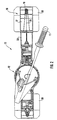
- FIG. 2 shows the device 10 from FIG. 1 from above.
- the lifting device 12 is actuated and thereby the Cardiac massage performed or the patient with breathing air provided.
- the cross member 17 of the portal 16 runs a cable 29, the spring 19 with the telescopic tube 30 connects.
- the portal 16 stands on the broadly trained Feet 20, which are pushed under the patient's body.
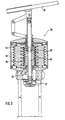
- FIG. 3 shows a device 39 for resuscitating patients with cardiac arrest.
- the lever 31 By means of the lever 31 the bellows 32 and 33 determining the ventilation volume are compressed, whereby the ventilation air is supplied to the patient becomes.
- the inner bellows 32 has the task of a Push rod 34 and the associated mechanics of the ventilation volume to separate.
- the outer bellows 33 limits this Ventilation volume depending on the outside environment.
- a spring 35 is arranged, which both touching each other on their floor and on their ceiling standing bellows 32 and 33 after the executed Apart the ventilation stroke. It also increases the spring 35 the operating force during ventilation in order to get a quick one To prevent ventilation volume from being supplied.
- a nozzle 37 is used also to increase the operating force during ventilation, by drawing the cross section of the air duct through which the air the patient is fed, narrowed.
- a transparent one Protective cylinder 36 encapsulates the outer bellows 33 to the outside from. Due to the transparent material of the protective cylinder 36 the operator of the device 39 can start the ventilation process observe.
- a stop wedge 38 limits the stroke of the push rod 34th
- Fig. 4 shows the basic arrangement of the two to each other offset cross member 40. These are in their longitudinal direction displaceable.
- the two cross members 40 are closed by one revolving cable 41 connected to each other. By the closed peripheral cable 41 become the two cross members at the same time by the same distance to the left or moved to the right, causing the lifting device at Pull apart the two cross members 40 just above that Patient is averaged. Before use, the cross beams 40 pulled apart and pushed together again after use. Thus, the entire device in their External dimensions are reduced so much that they are suitable for the Transport does not have to be disassembled.
Landscapes
- Health & Medical Sciences (AREA)
- Emergency Medicine (AREA)
- Heart & Thoracic Surgery (AREA)
- Animal Behavior & Ethology (AREA)
- Pulmonology (AREA)
- Veterinary Medicine (AREA)
- Public Health (AREA)
- General Health & Medical Sciences (AREA)
- Life Sciences & Earth Sciences (AREA)
- Biomedical Technology (AREA)
- Hematology (AREA)
- Anesthesiology (AREA)
- Engineering & Computer Science (AREA)
- Cardiology (AREA)
- Epidemiology (AREA)
- Pain & Pain Management (AREA)
- Physical Education & Sports Medicine (AREA)
- Rehabilitation Therapy (AREA)
- Critical Care (AREA)
- Percussion Or Vibration Massage (AREA)
Abstract
Claims (25)
- Dispositif (10) pour réanimer des patients victimes d'arrêt cardiaque comportant un dispositif de levage (12), disposé sur un support, pour un piston à placer sur la cage thoracique du patient, lequel est déplaçable en montée et descente, ou pour une cloche d'aspiration (15) avec piston (15.1), le support étant réalisé comme un portique (16) à placer au-dessus de la cage thoracique du patient, et le portique (16) étant réglable au moins en largeur, caractérisé en ce que sur le portique (16) est disposé un mécanisme à ressort (19), un mécanisme à roue dentée et crémaillère ou une commande par câble ou par chaíne pour le positionnement automatique du dispositif de levage (12) au-dessus du patient.
- Dispositif (10, 39) selon la revendication 1, caractérisé en ce qu'il comporte une poignée de réglage pour pouvoir régler le portique au moins dans sa largeur.
- Dispositif (10, 39) selon la revendication 1 ou 2, caractérisé en ce que la force de manoeuvre agissant sur le piston (15.1) ou la cloche d'aspiration (15) peut être augmentée en particulier au moyen d'un ressort (35) et/ou d'une buse (37).
- Dispositif (10, 39) selon l'une des revendications 1 à 3, caractérisé en ce que les jambes (18) du portique sont pourvues de pieds (20) dirigés vers l'intérieur qui peuvent être poussés sous la cage thoracique du patient.
- Dispositif (10, 39) selon l'une des revendications 1 à 4, caractérisé en ce que la traverse (17) du portique (16) est réalisée comme un tube télescopique (30).
- Dispositif (10, 39) selon l'une des revendications 1 à 4, caractérisé en ce que la traverse gauche et la traverse droite (40) du portique (16) sont disposées décalées l'une par rapport à l'autre.
- Dispositif (10, 39) selon la revendication 6, caractérisé en ce que le dispositif de levage (12) peut être centré au-dessus du patient au moyen d'une commande par câble ou par chaíne montée sur la traverse (40).
- Dispositif (10, 39) selon l'une des revendications 1 à 7, caractérisé en ce que le dispositif de levage (12) est disposé réglable en hauteur sur le portique (16).
- Dispositif (10, 39) selon l'une des revendications 1 à 8, caractérisé en ce que le dispositif de levage (12) peut être actionné de manière purement mécanique à travers un levier (11), une transmission à roue dentée ou d'autres transmissions mécaniques.
- Dispositif (10, 39) selon l'une des revendications 1 à 9, caractérisé en ce que le dispositif de levage (12) comporte un cylindre de levage (13) qui aspire, du milieu ambiant, de l'air qui peut être délivré au patient, pour sa respiration artificielle, à travers un masque ou un tube.
- Dispositif (10, 39) selon l'une des revendications 1 à 10, caractérisé en ce qu'il alterne automatiquement entre le massage cardiaque et la respiration.
- Dispositif (10, 39) selon l'une des revendications 1 à 11, caractérisé en ce qu'il peut fonctionner suivant le procédé CPR et/ou ACD.
- Dispositif (10, 39) selon l'une des revendications 1 à 12, caractérisé en ce que la course pour le massage cardiaque peut être réglée en fonction de la taille de la cage thoracique du patient.
- Dispositif (10, 39) selon la revendication 13, caractérisé en ce qu'il règle automatiquement la course pour le massage cardiaque et en fonction de la position en hauteur du dispositif de levage (12).
- Dispositif (10, 39) selon l'une des revendications 1 à 14, caractérisé en ce que le volume de respiration peut être réglé en fonction de la taille de la cage thoracique du patient.
- Dispositif (10, 39) selon la revendication 15, caractérisé en ce que le volume de respiration délivré par le cylindre de levage peut être réglé automatiquement en fonction de la position en hauteur du dispositif de levage (12).
- Dispositif (10, 39) selon l'une des revendications 1 à 16, caractérisé en ce qu'il comporte une échelle pour la distance de course et le volume de respiration.
- Dispositif (10, 39) selon l'une des revendications 1 à 17, caractérisé en ce qu'il comporte un raccord d'oxygène pour une bouteille d'oxygène ou pour un réservoir d'oxygène intercalé.
- Dispositif (10, 39) selon l'une des revendications 1 à 18, caractérisé en ce qu'il peut être démonté pour le transport.
- Dispositif (10, 39) selon l'une des revendications 1 à 19, caractérisé en ce qu'il peut être utilisé uniquement comme un appareil de respiration ou comme un appareil de massage cardiaque.
- Dispositif (10, 39) selon l'une des revendications 1 à 20, caractérisé en ce qu'il ne nécessite pas d'entretien.
- Dispositif (10, 39) selon l'une des revendications 1 à 21, caractérisé en ce qu'il peut être stérilisé à la vapeur.
- Dispositif (10, 39) selon l'une des revendications 1 à 22, caractérisé en ce que le cylindre de levage (13) comporte un clapet de antiretour.
- Dispositif (10, 39) selon l'une des revendications 1 à 23, caractérisé en ce que pendant le fonctionnement du dispositif avec cloche d'aspiration (15), il peut être déplacé, lors de la course de retour, à une hauteur qui est supérieure à la hauteur de la cage thoracique.
- Dispositif (10, 39) selon l'une des revendications 1 à 24, caractérisé en ce que la force de décompression de la cloche d'aspiration (15) peut être libérée par un ressort (31) qui peut être précontraint lors de la course de compression.
Applications Claiming Priority (3)
| Application Number | Priority Date | Filing Date | Title |
|---|---|---|---|
| DE19857421 | 1998-12-12 | ||
| DE19857421A DE19857421A1 (de) | 1998-12-12 | 1998-12-12 | Vorrichtung zur Wiederbelebung von Patienten mit Herzstillstand |
| PCT/EP1999/008810 WO2000035404A2 (fr) | 1998-12-12 | 1999-11-16 | Dispositif pour reanimer des patients victimes d'arret cardiaque |
Publications (2)
| Publication Number | Publication Date |
|---|---|
| EP1069881A2 EP1069881A2 (fr) | 2001-01-24 |
| EP1069881B1 true EP1069881B1 (fr) | 2003-08-27 |
Family
ID=7890896
Family Applications (1)
| Application Number | Title | Priority Date | Filing Date |
|---|---|---|---|
| EP99958053A Expired - Lifetime EP1069881B1 (fr) | 1998-12-12 | 1999-11-16 | Dispositif pour reanimer des patients victimes d'arret cardiaque |
Country Status (6)
| Country | Link |
|---|---|
| US (1) | US6648841B1 (fr) |
| EP (1) | EP1069881B1 (fr) |
| JP (1) | JP3627215B2 (fr) |
| CA (1) | CA2320889C (fr) |
| DE (2) | DE19857421A1 (fr) |
| WO (1) | WO2000035404A2 (fr) |
Families Citing this family (27)
| Publication number | Priority date | Publication date | Assignee | Title |
|---|---|---|---|---|
| US6923774B2 (en) * | 2001-09-11 | 2005-08-02 | Vipul Narain Roy | Mobile radioluscent cardiac massage assembly |
| US7569021B2 (en) * | 2002-03-21 | 2009-08-04 | Jolife Ab | Rigid support structure on two legs for CPR |
| US8281788B2 (en) * | 2004-04-06 | 2012-10-09 | Thompson Darrel K | Cardiopulmonary resuscitation device |
| TWI360416B (en) | 2006-12-14 | 2012-03-21 | Ind Tech Res Inst | Apparatus of cardiopulmonary resuscitator |
| US20090234255A1 (en) * | 2008-03-12 | 2009-09-17 | Votel Thomas W | Ergonomic device for administering cardio-pulmonary resuscitation |
| KR101013027B1 (ko) * | 2008-12-31 | 2011-02-14 | 미래산업 주식회사 | 표면실장장치 |
| TWI386199B (zh) * | 2009-12-08 | 2013-02-21 | 私立中原大學 | Heart massage device |
| KR101024617B1 (ko) * | 2010-12-09 | 2011-03-29 | 박정길 | 휴대용 심폐소생장치 |
| US20140024979A1 (en) | 2010-12-23 | 2014-01-23 | Mark Bruce Radbourne | Respiration-assistance systems, devices, or methods |
| DE102011014304A1 (de) * | 2011-03-17 | 2012-09-20 | GS-Elektromedizinische Geräte, G. Stemple GmbH | Vorrichtung zur Reanimation eines Patienten |
| US8535251B1 (en) * | 2011-04-04 | 2013-09-17 | Subhakar Patthi Rao | Mechanical device to assist in the external compression of the chest during cardio-pulmonary resuscitation |
| US8942800B2 (en) | 2012-04-20 | 2015-01-27 | Cardiac Science Corporation | Corrective prompting system for appropriate chest compressions |
| US20140100496A1 (en) * | 2012-10-09 | 2014-04-10 | Physio-Control, Inc. | Devices and methods for performing cpr while standing up |
| US9539173B2 (en) * | 2013-02-05 | 2017-01-10 | Physio-Control, Inc. | Fixation of device to back plate |
| US9603772B2 (en) | 2013-02-05 | 2017-03-28 | Physio-Control, Inc. | Beam mechanical compression device |
| US9320678B2 (en) | 2013-09-30 | 2016-04-26 | Zoll Circulation, Inc. | Chest compression device |
| KR101532418B1 (ko) * | 2014-09-16 | 2015-06-30 | 서울특별시 | 흉부 압박 시스템 |
| DE102017115732A1 (de) * | 2017-07-13 | 2019-01-17 | GS Elektromedizinische Geräte G. Stemple GmbH | Vorrichtung zur kardiopulmonalen Massage und/oder Reanimation |
| US11179293B2 (en) | 2017-07-28 | 2021-11-23 | Stryker Corporation | Patient support system with chest compression system and harness assembly with sensor system |
| CN109276431B (zh) * | 2017-12-19 | 2024-05-28 | 姜德谦 | 一种便携式心肺复苏急救装置 |
| KR101956053B1 (ko) * | 2018-04-13 | 2019-03-08 | 순천대학교 산학협력단 | 흉부압박시 압박되는 깊이가 조절되는 심폐소생술 장치 |
| CN111467212A (zh) * | 2020-04-29 | 2020-07-31 | 宗宵 | 一种心肺复苏装置 |
| CN111773066A (zh) * | 2020-08-14 | 2020-10-16 | 董华伟 | 一种心内科应急用心脏复苏装置 |
| CN111956473A (zh) * | 2020-09-16 | 2020-11-20 | 展静 | 一种便携式电动心肺复苏仪 |
| CN114569434B (zh) * | 2022-03-03 | 2023-02-07 | 吉林大学 | 一种基于人体仿生机构的呼吸科用胸外按压装置 |
| CN114601716B (zh) * | 2022-04-22 | 2023-06-06 | 达州职业技术学院 | 一种临床紧急救援装置 |
| CN119499090B (zh) * | 2025-01-08 | 2025-05-20 | 首都医科大学附属北京康复医院(北京工人疗养院) | 一种手动式心肺复苏仪 |
Family Cites Families (13)
| Publication number | Priority date | Publication date | Assignee | Title |
|---|---|---|---|---|
| US3489140A (en) * | 1960-08-05 | 1970-01-13 | Hyman Hurvitz | Apparatus to restore heartbeat |
| FR1331573A (fr) * | 1962-05-25 | 1963-07-05 | Dispositif de réanimation par circulation et ventilation artificielles | |
| US3351052A (en) * | 1965-10-18 | 1967-11-07 | Carl E Hewson | Heart and lung resuscitator |
| US3425409A (en) | 1965-11-08 | 1969-02-04 | Max Isaacson | Resuscitator |
| US3512522A (en) * | 1968-03-01 | 1970-05-19 | Research Corp | Closed chest cardiac massage apparatus |
| FR2140920A5 (fr) * | 1971-06-07 | 1973-01-19 | Derouineau Rene | |
| AT329174B (de) | 1974-05-17 | 1976-04-26 | Ragailler Franz | Vorrichtung zur kunstlichen beatmung eines menschen |
| FR2382889A1 (fr) | 1977-03-07 | 1978-10-06 | Bloch Laroque Paul | Reanimateur par massages cardiaques et respiration assistee |
| US5257619A (en) * | 1992-10-07 | 1993-11-02 | Everete Randall L | External cardiac compression device |
| US5327887A (en) | 1993-01-25 | 1994-07-12 | Ludwik Nowakowski | Cardiopulmonary resuscitation device |
| JPH0663039U (ja) * | 1993-02-12 | 1994-09-06 | 株式会社杉山悟郎商店 | 心臓マッサージ装置 |
| JPH0727565U (ja) * | 1993-10-21 | 1995-05-23 | 株式会社杉山悟郎商店 | 心臓マッサージ装置 |
| JP2000024069A (ja) * | 1998-07-15 | 2000-01-25 | Kooken Medical Kk | 自動衝撃心肺蘇生器 |
-
1998
- 1998-12-12 DE DE19857421A patent/DE19857421A1/de not_active Withdrawn
-
1999
- 1999-11-16 JP JP2000587725A patent/JP3627215B2/ja not_active Expired - Fee Related
- 1999-11-16 US US09/601,939 patent/US6648841B1/en not_active Expired - Fee Related
- 1999-11-16 EP EP99958053A patent/EP1069881B1/fr not_active Expired - Lifetime
- 1999-11-16 WO PCT/EP1999/008810 patent/WO2000035404A2/fr not_active Ceased
- 1999-11-16 DE DE59906778T patent/DE59906778D1/de not_active Expired - Lifetime
- 1999-11-16 CA CA002320889A patent/CA2320889C/fr not_active Expired - Fee Related
Also Published As
| Publication number | Publication date |
|---|---|
| JP2002532149A (ja) | 2002-10-02 |
| US6648841B1 (en) | 2003-11-18 |
| EP1069881A2 (fr) | 2001-01-24 |
| JP3627215B2 (ja) | 2005-03-09 |
| DE19857421A1 (de) | 2000-06-15 |
| CA2320889C (fr) | 2009-04-21 |
| WO2000035404A3 (fr) | 2000-11-23 |
| CA2320889A1 (fr) | 2000-06-22 |
| WO2000035404A2 (fr) | 2000-06-22 |
| DE59906778D1 (de) | 2003-10-02 |
Similar Documents
| Publication | Publication Date | Title |
|---|---|---|
| EP1069881A2 (fr) | Dispositif pour reanimer des patients victimes d'arret cardiaque | |
| DE60115037T2 (de) | Tragbare kardiopulmonale wiederbelebungsvorrichtung mit präziser komprimierungstiefe und -gleichförmigkeit | |
| DE2227617A1 (de) | Wiederbelebungsapparat | |
| EP3253355B1 (fr) | Dispositif de massage et/ou de réanimation cardiopulmonaire | |
| EP1307168B1 (fr) | Dispositif d'amincissement | |
| DE2521121C3 (de) | Vorrichtung zur künstlichen Beatmung eines Menschen | |
| DE29511509U1 (de) | Orthopädisches Gerät zum Gehen und für die Rehabilitation von behinderten Personen | |
| DE2023104A1 (de) | Krankenbett | |
| DE102007047756B4 (de) | Vorrichtung für Übungen der Bewegungstherapie | |
| DE2363390A1 (de) | Vorrichtung zum strecken der wirbelsaeule | |
| DE102008005068A1 (de) | Vorrichtung und Verfahren zum Verstellen einer Höhe einer Patientenlagerungs- und Patiententransportvorrichtung, Patientenlagerungs- und Patiententransportvorrichtung sowie medizinische Diagnostik- und/oder Therapieanlage | |
| DE2822030A1 (de) | Hubpumpe fuer gase, insbesondere fuer ein beatmungsgeraet | |
| EP3651716B1 (fr) | Dispositif de massage et/ou de réanimation cardiopulmonaire | |
| DE29900419U1 (de) | Gehwagen | |
| DE10038849C2 (de) | Vorrichtung zum kippsicheren Umsetzen insbesondere körperbehinderter Personen | |
| DE19538175A1 (de) | Operationstisch für Tiere, insbesondere Großtiere | |
| DE102007044650A1 (de) | Aktiv-Passiv-Schultermobilisator | |
| DE19704032A1 (de) | Hebelarm-Reanimation | |
| DE102025130389B3 (de) | Fahrwerk für eine mobile medizinische Vorrichtung und Basis einer mobilen medizinischen Vorrichtung | |
| DE222515C (fr) | ||
| DE4426693A1 (de) | Vorrichtung zur Bedienung eines handbetätigbaren Beatmungsgerätes | |
| EP0255938B1 (fr) | Table d'opération, particulièrement pour le soin des accidentés | |
| DE2346678A1 (de) | Koerpertrainingsgeraet | |
| DE4316656A1 (de) | Personenhebezeug | |
| DE19935722C1 (de) | Vorrichtung zur Verbesserung der Venenaktivität |
Legal Events
| Date | Code | Title | Description |
|---|---|---|---|
| PUAI | Public reference made under article 153(3) epc to a published international application that has entered the european phase |
Free format text: ORIGINAL CODE: 0009012 |
|
| 17P | Request for examination filed |
Effective date: 20000728 |
|
| AK | Designated contracting states |
Kind code of ref document: A2 Designated state(s): AT BE CH CY DE DK ES FI FR GB GR IE IT LI LU MC NL PT SE |
|
| 17Q | First examination report despatched |
Effective date: 20020321 |
|
| GRAH | Despatch of communication of intention to grant a patent |
Free format text: ORIGINAL CODE: EPIDOS IGRA |
|
| GRAS | Grant fee paid |
Free format text: ORIGINAL CODE: EPIDOSNIGR3 |
|
| GRAA | (expected) grant |
Free format text: ORIGINAL CODE: 0009210 |
|
| AK | Designated contracting states |
Designated state(s): DE FR GB IT |
|
| REG | Reference to a national code |
Ref country code: GB Ref legal event code: FG4D Free format text: NOT ENGLISH |
|
| REG | Reference to a national code |
Ref country code: IE Ref legal event code: FG4D Free format text: GERMAN |
|
| REF | Corresponds to: |
Ref document number: 59906778 Country of ref document: DE Date of ref document: 20031002 Kind code of ref document: P |
|
| GBT | Gb: translation of ep patent filed (gb section 77(6)(a)/1977) | ||
| REG | Reference to a national code |
Ref country code: IE Ref legal event code: FD4D |
|
| ET | Fr: translation filed | ||
| PLBE | No opposition filed within time limit |
Free format text: ORIGINAL CODE: 0009261 |
|
| STAA | Information on the status of an ep patent application or granted ep patent |
Free format text: STATUS: NO OPPOSITION FILED WITHIN TIME LIMIT |
|
| 26N | No opposition filed |
Effective date: 20040528 |
|
| PGFP | Annual fee paid to national office [announced via postgrant information from national office to epo] |
Ref country code: FR Payment date: 20101104 Year of fee payment: 12 |
|
| PGFP | Annual fee paid to national office [announced via postgrant information from national office to epo] |
Ref country code: DE Payment date: 20101209 Year of fee payment: 12 |
|
| PGFP | Annual fee paid to national office [announced via postgrant information from national office to epo] |
Ref country code: GB Payment date: 20101020 Year of fee payment: 12 |
|
| PGFP | Annual fee paid to national office [announced via postgrant information from national office to epo] |
Ref country code: IT Payment date: 20101122 Year of fee payment: 12 |
|
| GBPC | Gb: european patent ceased through non-payment of renewal fee |
Effective date: 20111116 |
|
| REG | Reference to a national code |
Ref country code: FR Ref legal event code: ST Effective date: 20120731 |
|
| PG25 | Lapsed in a contracting state [announced via postgrant information from national office to epo] |
Ref country code: IT Free format text: LAPSE BECAUSE OF NON-PAYMENT OF DUE FEES Effective date: 20111116 |
|
| REG | Reference to a national code |
Ref country code: DE Ref legal event code: R119 Ref document number: 59906778 Country of ref document: DE Effective date: 20120601 |
|
| PG25 | Lapsed in a contracting state [announced via postgrant information from national office to epo] |
Ref country code: GB Free format text: LAPSE BECAUSE OF NON-PAYMENT OF DUE FEES Effective date: 20111116 |
|
| PG25 | Lapsed in a contracting state [announced via postgrant information from national office to epo] |
Ref country code: FR Free format text: LAPSE BECAUSE OF NON-PAYMENT OF DUE FEES Effective date: 20111130 |
|
| PG25 | Lapsed in a contracting state [announced via postgrant information from national office to epo] |
Ref country code: DE Free format text: LAPSE BECAUSE OF NON-PAYMENT OF DUE FEES Effective date: 20120601 |