EP1070075B1 - Ligands phosphores chiraux utiles dans des catalyseurs - Google Patents
Ligands phosphores chiraux utiles dans des catalyseurs Download PDFInfo
- Publication number
- EP1070075B1 EP1070075B1 EP99920633A EP99920633A EP1070075B1 EP 1070075 B1 EP1070075 B1 EP 1070075B1 EP 99920633 A EP99920633 A EP 99920633A EP 99920633 A EP99920633 A EP 99920633A EP 1070075 B1 EP1070075 B1 EP 1070075B1
- Authority
- EP
- European Patent Office
- Prior art keywords
- group
- alkyl
- ligand
- phosphorated
- formula
- Prior art date
- Legal status (The legal status is an assumption and is not a legal conclusion. Google has not performed a legal analysis and makes no representation as to the accuracy of the status listed.)
- Expired - Lifetime
Links
- 239000003446 ligand Substances 0.000 title claims abstract description 69
- 239000003054 catalyst Substances 0.000 title claims abstract description 20
- 238000000034 method Methods 0.000 claims abstract description 38
- 238000002360 preparation method Methods 0.000 claims abstract description 27
- 125000002524 organometallic group Chemical group 0.000 claims abstract description 14
- 230000000707 stereoselective effect Effects 0.000 claims abstract description 9
- 238000006243 chemical reaction Methods 0.000 claims description 31
- 125000003118 aryl group Chemical group 0.000 claims description 28
- 150000001875 compounds Chemical class 0.000 claims description 24
- 125000000623 heterocyclic group Chemical group 0.000 claims description 23
- 125000001997 phenyl group Chemical group [H]C1=C([H])C([H])=C(*)C([H])=C1[H] 0.000 claims description 23
- 125000004429 atom Chemical group 0.000 claims description 22
- 125000004437 phosphorous atom Chemical group 0.000 claims description 20
- -1 2,5-dimethyl-thien-3-yl Chemical group 0.000 claims description 17
- 125000000217 alkyl group Chemical group 0.000 claims description 16
- KDLHZDBZIXYQEI-UHFFFAOYSA-N Palladium Chemical compound [Pd] KDLHZDBZIXYQEI-UHFFFAOYSA-N 0.000 claims description 14
- 125000006615 aromatic heterocyclic group Chemical group 0.000 claims description 14
- 230000015572 biosynthetic process Effects 0.000 claims description 14
- 125000002837 carbocyclic group Chemical group 0.000 claims description 13
- 229910052723 transition metal Inorganic materials 0.000 claims description 13
- 150000003624 transition metals Chemical class 0.000 claims description 13
- 125000004432 carbon atom Chemical group C* 0.000 claims description 12
- 125000000008 (C1-C10) alkyl group Chemical group 0.000 claims description 11
- 125000005842 heteroatom Chemical group 0.000 claims description 11
- IJGRMHOSHXDMSA-UHFFFAOYSA-N Atomic nitrogen Chemical compound N#N IJGRMHOSHXDMSA-UHFFFAOYSA-N 0.000 claims description 10
- PXHVJJICTQNCMI-UHFFFAOYSA-N Nickel Chemical compound [Ni] PXHVJJICTQNCMI-UHFFFAOYSA-N 0.000 claims description 10
- 229910052736 halogen Inorganic materials 0.000 claims description 10
- 150000002367 halogens Chemical class 0.000 claims description 10
- 150000003003 phosphines Chemical class 0.000 claims description 10
- 229910052757 nitrogen Inorganic materials 0.000 claims description 9
- 230000003287 optical effect Effects 0.000 claims description 9
- 230000009467 reduction Effects 0.000 claims description 9
- 229910052799 carbon Inorganic materials 0.000 claims description 8
- 229910052763 palladium Inorganic materials 0.000 claims description 8
- 238000006722 reduction reaction Methods 0.000 claims description 8
- 150000003839 salts Chemical class 0.000 claims description 8
- YLQBMQCUIZJEEH-UHFFFAOYSA-N Furan Chemical compound C=1C=COC=1 YLQBMQCUIZJEEH-UHFFFAOYSA-N 0.000 claims description 6
- 230000004888 barrier function Effects 0.000 claims description 6
- RAXXELZNTBOGNW-UHFFFAOYSA-N imidazole Natural products C1=CNC=N1 RAXXELZNTBOGNW-UHFFFAOYSA-N 0.000 claims description 6
- 229910052759 nickel Inorganic materials 0.000 claims description 6
- QVGXLLKOCUKJST-UHFFFAOYSA-N atomic oxygen Chemical compound [O] QVGXLLKOCUKJST-UHFFFAOYSA-N 0.000 claims description 5
- 125000001072 heteroaryl group Chemical group 0.000 claims description 5
- 238000007037 hydroformylation reaction Methods 0.000 claims description 5
- 238000006459 hydrosilylation reaction Methods 0.000 claims description 5
- 229910052751 metal Inorganic materials 0.000 claims description 5
- 239000002184 metal Substances 0.000 claims description 5
- 125000001624 naphthyl group Chemical group 0.000 claims description 5
- 125000004433 nitrogen atom Chemical group N* 0.000 claims description 5
- 229910052760 oxygen Inorganic materials 0.000 claims description 5
- 239000001301 oxygen Substances 0.000 claims description 5
- 229910052703 rhodium Inorganic materials 0.000 claims description 5
- IANQTJSKSUMEQM-UHFFFAOYSA-N 1-benzofuran Chemical compound C1=CC=C2OC=CC2=C1 IANQTJSKSUMEQM-UHFFFAOYSA-N 0.000 claims description 4
- FCEHBMOGCRZNNI-UHFFFAOYSA-N 1-benzothiophene Chemical compound C1=CC=C2SC=CC2=C1 FCEHBMOGCRZNNI-UHFFFAOYSA-N 0.000 claims description 4
- HBAQYPYDRFILMT-UHFFFAOYSA-N 8-[3-(1-cyclopropylpyrazol-4-yl)-1H-pyrazolo[4,3-d]pyrimidin-5-yl]-3-methyl-3,8-diazabicyclo[3.2.1]octan-2-one Chemical class C1(CC1)N1N=CC(=C1)C1=NNC2=C1N=C(N=C2)N1C2C(N(CC1CC2)C)=O HBAQYPYDRFILMT-UHFFFAOYSA-N 0.000 claims description 4
- SIKJAQJRHWYJAI-UHFFFAOYSA-N Indole Chemical compound C1=CC=C2NC=CC2=C1 SIKJAQJRHWYJAI-UHFFFAOYSA-N 0.000 claims description 4
- KAESVJOAVNADME-UHFFFAOYSA-N Pyrrole Chemical compound C=1C=CNC=1 KAESVJOAVNADME-UHFFFAOYSA-N 0.000 claims description 4
- NINIDFKCEFEMDL-UHFFFAOYSA-N Sulfur Chemical compound [S] NINIDFKCEFEMDL-UHFFFAOYSA-N 0.000 claims description 4
- 239000005864 Sulphur Substances 0.000 claims description 4
- YTPLMLYBLZKORZ-UHFFFAOYSA-N Thiophene Chemical compound C=1C=CSC=1 YTPLMLYBLZKORZ-UHFFFAOYSA-N 0.000 claims description 4
- 239000002253 acid Substances 0.000 claims description 4
- 229910052784 alkaline earth metal Inorganic materials 0.000 claims description 4
- 150000001342 alkaline earth metals Chemical class 0.000 claims description 4
- 125000003545 alkoxy group Chemical group 0.000 claims description 4
- 125000004122 cyclic group Chemical group 0.000 claims description 4
- 238000005669 hydrocyanation reaction Methods 0.000 claims description 4
- 229910052741 iridium Inorganic materials 0.000 claims description 4
- 150000003004 phosphinoxides Chemical class 0.000 claims description 4
- RYGMFSIKBFXOCR-UHFFFAOYSA-N Copper Chemical compound [Cu] RYGMFSIKBFXOCR-UHFFFAOYSA-N 0.000 claims description 3
- 125000005210 alkyl ammonium group Chemical group 0.000 claims description 3
- 238000005937 allylation reaction Methods 0.000 claims description 3
- 238000005899 aromatization reaction Methods 0.000 claims description 3
- 230000003197 catalytic effect Effects 0.000 claims description 3
- 229910052802 copper Inorganic materials 0.000 claims description 3
- 239000010949 copper Substances 0.000 claims description 3
- 238000005859 coupling reaction Methods 0.000 claims description 3
- 238000002425 crystallisation Methods 0.000 claims description 3
- GPAYUJZHTULNBE-UHFFFAOYSA-N diphenylphosphine Chemical compound C=1C=CC=CC=1PC1=CC=CC=C1 GPAYUJZHTULNBE-UHFFFAOYSA-N 0.000 claims description 3
- 238000006197 hydroboration reaction Methods 0.000 claims description 3
- 229910052739 hydrogen Inorganic materials 0.000 claims description 3
- 125000001979 organolithium group Chemical group 0.000 claims description 3
- 125000002734 organomagnesium group Chemical group 0.000 claims description 3
- 239000002243 precursor Substances 0.000 claims description 3
- 239000000376 reactant Substances 0.000 claims description 3
- 229910052707 ruthenium Inorganic materials 0.000 claims description 3
- 239000000758 substrate Substances 0.000 claims description 3
- 230000007704 transition Effects 0.000 claims description 3
- HYZJCKYKOHLVJF-UHFFFAOYSA-N 1H-benzimidazole Chemical compound C1=CC=C2NC=NC2=C1 HYZJCKYKOHLVJF-UHFFFAOYSA-N 0.000 claims description 2
- WTKZEGDFNFYCGP-UHFFFAOYSA-N Pyrazole Chemical compound C=1C=NNC=1 WTKZEGDFNFYCGP-UHFFFAOYSA-N 0.000 claims description 2
- 230000002378 acidificating effect Effects 0.000 claims description 2
- XQJHRCVXRAJIDY-UHFFFAOYSA-N aminophosphine Chemical class PN XQJHRCVXRAJIDY-UHFFFAOYSA-N 0.000 claims description 2
- LJOLGGXHRVADAA-UHFFFAOYSA-N benzo[e][1]benzothiole Chemical compound C1=CC=C2C(C=CS3)=C3C=CC2=C1 LJOLGGXHRVADAA-UHFFFAOYSA-N 0.000 claims description 2
- 125000004197 benzothien-3-yl group Chemical group [H]C1=C(*)C2=C([H])C([H])=C([H])C([H])=C2S1 0.000 claims description 2
- 230000009920 chelation Effects 0.000 claims description 2
- 239000003638 chemical reducing agent Substances 0.000 claims description 2
- HDULBKVLSJEMGN-UHFFFAOYSA-N dicyclohexylphosphane Chemical compound C1CCCCC1PC1CCCCC1 HDULBKVLSJEMGN-UHFFFAOYSA-N 0.000 claims description 2
- 239000003480 eluent Substances 0.000 claims description 2
- PZOUSPYUWWUPPK-UHFFFAOYSA-N indole Natural products CC1=CC=CC2=C1C=CN2 PZOUSPYUWWUPPK-UHFFFAOYSA-N 0.000 claims description 2
- RKJUIXBNRJVNHR-UHFFFAOYSA-N indolenine Natural products C1=CC=C2CC=NC2=C1 RKJUIXBNRJVNHR-UHFFFAOYSA-N 0.000 claims description 2
- 125000001041 indolyl group Chemical group 0.000 claims description 2
- ZLTPDFXIESTBQG-UHFFFAOYSA-N isothiazole Chemical compound C=1C=NSC=1 ZLTPDFXIESTBQG-UHFFFAOYSA-N 0.000 claims description 2
- CTAPFRYPJLPFDF-UHFFFAOYSA-N isoxazole Chemical compound C=1C=NOC=1 CTAPFRYPJLPFDF-UHFFFAOYSA-N 0.000 claims description 2
- 239000012528 membrane Substances 0.000 claims description 2
- 150000002894 organic compounds Chemical class 0.000 claims description 2
- OJMIONKXNSYLSR-UHFFFAOYSA-N phosphorous acid Chemical compound OP(O)O OJMIONKXNSYLSR-UHFFFAOYSA-N 0.000 claims description 2
- 229910052698 phosphorus Inorganic materials 0.000 claims description 2
- 229910052697 platinum Inorganic materials 0.000 claims description 2
- BASFCYQUMIYNBI-UHFFFAOYSA-N platinum Substances [Pt] BASFCYQUMIYNBI-UHFFFAOYSA-N 0.000 claims description 2
- 238000000926 separation method Methods 0.000 claims description 2
- 229930192474 thiophene Natural products 0.000 claims description 2
- 150000003852 triazoles Chemical class 0.000 claims description 2
- 238000006886 vinylation reaction Methods 0.000 claims description 2
- 238000003786 synthesis reaction Methods 0.000 abstract description 6
- YMWUJEATGCHHMB-UHFFFAOYSA-N Dichloromethane Chemical compound ClCCl YMWUJEATGCHHMB-UHFFFAOYSA-N 0.000 description 33
- 239000000243 solution Substances 0.000 description 26
- 239000000203 mixture Substances 0.000 description 24
- 239000010948 rhodium Substances 0.000 description 23
- 239000004305 biphenyl Substances 0.000 description 16
- RTZKZFJDLAIYFH-UHFFFAOYSA-N Diethyl ether Chemical compound CCOCC RTZKZFJDLAIYFH-UHFFFAOYSA-N 0.000 description 15
- 238000003756 stirring Methods 0.000 description 14
- XLYOFNOQVPJJNP-UHFFFAOYSA-N water Substances O XLYOFNOQVPJJNP-UHFFFAOYSA-N 0.000 description 13
- LFQSCWFLJHTTHZ-UHFFFAOYSA-N Ethanol Chemical compound CCO LFQSCWFLJHTTHZ-UHFFFAOYSA-N 0.000 description 10
- 239000012074 organic phase Substances 0.000 description 10
- VYXHVRARDIDEHS-QGTKBVGQSA-N (1z,5z)-cycloocta-1,5-diene Chemical compound C\1C\C=C/CC\C=C/1 VYXHVRARDIDEHS-QGTKBVGQSA-N 0.000 description 9
- OKKJLVBELUTLKV-UHFFFAOYSA-N Methanol Chemical compound OC OKKJLVBELUTLKV-UHFFFAOYSA-N 0.000 description 9
- YXFVVABEGXRONW-UHFFFAOYSA-N Toluene Chemical compound CC1=CC=CC=C1 YXFVVABEGXRONW-UHFFFAOYSA-N 0.000 description 9
- VYPSYNLAJGMNEJ-UHFFFAOYSA-N Silicium dioxide Chemical compound O=[Si]=O VYPSYNLAJGMNEJ-UHFFFAOYSA-N 0.000 description 8
- FAPWRFPIFSIZLT-UHFFFAOYSA-M Sodium chloride Chemical compound [Na+].[Cl-] FAPWRFPIFSIZLT-UHFFFAOYSA-M 0.000 description 8
- WYURNTSHIVDZCO-UHFFFAOYSA-N Tetrahydrofuran Chemical compound C1CCOC1 WYURNTSHIVDZCO-UHFFFAOYSA-N 0.000 description 8
- 125000001544 thienyl group Chemical group 0.000 description 8
- QTBSBXVTEAMEQO-UHFFFAOYSA-N Acetic acid Chemical compound CC(O)=O QTBSBXVTEAMEQO-UHFFFAOYSA-N 0.000 description 6
- HEMHJVSKTPXQMS-UHFFFAOYSA-M Sodium hydroxide Chemical compound [OH-].[Na+] HEMHJVSKTPXQMS-UHFFFAOYSA-M 0.000 description 6
- JFDZBHWFFUWGJE-UHFFFAOYSA-N benzonitrile Chemical compound N#CC1=CC=CC=C1 JFDZBHWFFUWGJE-UHFFFAOYSA-N 0.000 description 6
- 238000004364 calculation method Methods 0.000 description 6
- VURFVHCLMJOLKN-UHFFFAOYSA-N diphosphane Chemical compound PP VURFVHCLMJOLKN-UHFFFAOYSA-N 0.000 description 6
- HFPZCAJZSCWRBC-UHFFFAOYSA-N p-cymene Chemical compound CC(C)C1=CC=C(C)C=C1 HFPZCAJZSCWRBC-UHFFFAOYSA-N 0.000 description 6
- GAMVWPRJLGCSSF-UHFFFAOYSA-N 3-bromo-4-dicyclohexylphosphoryl-2,5-dimethylthiophene Chemical compound BrC1=C(C)SC(C)=C1P(=O)(C1CCCCC1)C1CCCCC1 GAMVWPRJLGCSSF-UHFFFAOYSA-N 0.000 description 5
- 239000012300 argon atmosphere Substances 0.000 description 5
- 239000012298 atmosphere Substances 0.000 description 5
- UBJFKNSINUCEAL-UHFFFAOYSA-N lithium;2-methylpropane Chemical compound [Li+].C[C-](C)C UBJFKNSINUCEAL-UHFFFAOYSA-N 0.000 description 5
- XSBFBCXBJUCXNA-UHFFFAOYSA-N 3-bromo-4-diphenylphosphoryl-2,5-dimethylthiophene Chemical compound BrC1=C(C)SC(C)=C1P(=O)(C=1C=CC=CC=1)C1=CC=CC=C1 XSBFBCXBJUCXNA-UHFFFAOYSA-N 0.000 description 4
- PCLIMKBDDGJMGD-UHFFFAOYSA-N N-bromosuccinimide Chemical compound BrN1C(=O)CCC1=O PCLIMKBDDGJMGD-UHFFFAOYSA-N 0.000 description 4
- XYFCBTPGUUZFHI-UHFFFAOYSA-N Phosphine Chemical compound P XYFCBTPGUUZFHI-UHFFFAOYSA-N 0.000 description 4
- PMZURENOXWZQFD-UHFFFAOYSA-L Sodium Sulfate Chemical compound [Na+].[Na+].[O-]S([O-])(=O)=O PMZURENOXWZQFD-UHFFFAOYSA-L 0.000 description 4
- 239000007864 aqueous solution Substances 0.000 description 4
- 238000004128 high performance liquid chromatography Methods 0.000 description 4
- 239000012071 phase Substances 0.000 description 4
- 238000000746 purification Methods 0.000 description 4
- 239000011780 sodium chloride Substances 0.000 description 4
- UAYWVJHJZHQCIE-UHFFFAOYSA-L zinc iodide Chemical compound I[Zn]I UAYWVJHJZHQCIE-UHFFFAOYSA-L 0.000 description 4
- 0 CC1C(*)CCCC1 Chemical compound CC1C(*)CCCC1 0.000 description 3
- DIIDLXYGSDXOJX-UHFFFAOYSA-N CC=1SC(=CC1)C.P Chemical compound CC=1SC(=CC1)C.P DIIDLXYGSDXOJX-UHFFFAOYSA-N 0.000 description 3
- XEKOWRVHYACXOJ-UHFFFAOYSA-N Ethyl acetate Chemical compound CCOC(C)=O XEKOWRVHYACXOJ-UHFFFAOYSA-N 0.000 description 3
- 230000005526 G1 to G0 transition Effects 0.000 description 3
- 238000004615 MNDO calculation Methods 0.000 description 3
- 229910021586 Nickel(II) chloride Inorganic materials 0.000 description 3
- 229910002666 PdCl2 Inorganic materials 0.000 description 3
- 238000005452 bending Methods 0.000 description 3
- 229910001914 chlorine tetroxide Inorganic materials 0.000 description 3
- 238000004587 chromatography analysis Methods 0.000 description 3
- BHEPBYXIRTUNPN-UHFFFAOYSA-N hydridophosphorus(.) (triplet) Chemical compound [PH] BHEPBYXIRTUNPN-UHFFFAOYSA-N 0.000 description 3
- 238000011835 investigation Methods 0.000 description 3
- QMMRZOWCJAIUJA-UHFFFAOYSA-L nickel dichloride Chemical compound Cl[Ni]Cl QMMRZOWCJAIUJA-UHFFFAOYSA-L 0.000 description 3
- PIBWKRNGBLPSSY-UHFFFAOYSA-L palladium(II) chloride Chemical compound Cl[Pd]Cl PIBWKRNGBLPSSY-UHFFFAOYSA-L 0.000 description 3
- VLTRZXGMWDSKGL-UHFFFAOYSA-M perchlorate Chemical compound [O-]Cl(=O)(=O)=O VLTRZXGMWDSKGL-UHFFFAOYSA-M 0.000 description 3
- 239000000047 product Substances 0.000 description 3
- MHOVAHRLVXNVSD-UHFFFAOYSA-N rhodium atom Chemical compound [Rh] MHOVAHRLVXNVSD-UHFFFAOYSA-N 0.000 description 3
- 239000000377 silicon dioxide Substances 0.000 description 3
- ZDHXKXAHOVTTAH-UHFFFAOYSA-N trichlorosilane Chemical compound Cl[SiH](Cl)Cl ZDHXKXAHOVTTAH-UHFFFAOYSA-N 0.000 description 3
- 239000005052 trichlorosilane Substances 0.000 description 3
- GWQOOADXMVQEFT-UHFFFAOYSA-N 2,5-Dimethylthiophene Chemical compound CC1=CC=C(C)S1 GWQOOADXMVQEFT-UHFFFAOYSA-N 0.000 description 2
- SHOXGOWAOZUVEB-UHFFFAOYSA-N 3-iodo-2,5-dimethylthiophene Chemical compound CC1=CC(I)=C(C)S1 SHOXGOWAOZUVEB-UHFFFAOYSA-N 0.000 description 2
- KFZMGEQAYNKOFK-UHFFFAOYSA-N Isopropanol Chemical compound CC(C)O KFZMGEQAYNKOFK-UHFFFAOYSA-N 0.000 description 2
- UIIMBOGNXHQVGW-UHFFFAOYSA-M Sodium bicarbonate Chemical compound [Na+].OC([O-])=O UIIMBOGNXHQVGW-UHFFFAOYSA-M 0.000 description 2
- 150000007513 acids Chemical class 0.000 description 2
- 238000013459 approach Methods 0.000 description 2
- 239000008346 aqueous phase Substances 0.000 description 2
- GGRQQHADVSXBQN-FGSKAQBVSA-N carbon monoxide;(z)-4-hydroxypent-3-en-2-one;rhodium Chemical compound [Rh].[O+]#[C-].[O+]#[C-].C\C(O)=C\C(C)=O GGRQQHADVSXBQN-FGSKAQBVSA-N 0.000 description 2
- XGRJZXREYAXTGV-UHFFFAOYSA-N chlorodiphenylphosphine Chemical compound C=1C=CC=CC=1P(Cl)C1=CC=CC=C1 XGRJZXREYAXTGV-UHFFFAOYSA-N 0.000 description 2
- 238000010668 complexation reaction Methods 0.000 description 2
- 230000001965 increasing effect Effects 0.000 description 2
- 230000001939 inductive effect Effects 0.000 description 2
- GKOZUEZYRPOHIO-UHFFFAOYSA-N iridium atom Chemical compound [Ir] GKOZUEZYRPOHIO-UHFFFAOYSA-N 0.000 description 2
- 238000006317 isomerization reaction Methods 0.000 description 2
- 229910052744 lithium Inorganic materials 0.000 description 2
- 229910000073 phosphorus hydride Inorganic materials 0.000 description 2
- 229910052700 potassium Inorganic materials 0.000 description 2
- SCVFZCLFOSHCOH-UHFFFAOYSA-M potassium acetate Chemical compound [K+].CC([O-])=O SCVFZCLFOSHCOH-UHFFFAOYSA-M 0.000 description 2
- 230000006340 racemization Effects 0.000 description 2
- 239000012047 saturated solution Substances 0.000 description 2
- 229910052708 sodium Inorganic materials 0.000 description 2
- 239000011734 sodium Substances 0.000 description 2
- 229910052938 sodium sulfate Inorganic materials 0.000 description 2
- 235000011152 sodium sulphate Nutrition 0.000 description 2
- 239000002904 solvent Substances 0.000 description 2
- DPKBAXPHAYBPRL-UHFFFAOYSA-M tetrabutylazanium;iodide Chemical compound [I-].CCCC[N+](CCCC)(CCCC)CCCC DPKBAXPHAYBPRL-UHFFFAOYSA-M 0.000 description 2
- 238000012795 verification Methods 0.000 description 2
- RRKODOZNUZCUBN-CCAGOZQPSA-N (1z,3z)-cycloocta-1,3-diene Chemical compound C1CC\C=C/C=C\C1 RRKODOZNUZCUBN-CCAGOZQPSA-N 0.000 description 1
- 125000004169 (C1-C6) alkyl group Chemical group 0.000 description 1
- LZQROXSIGGQMGQ-UHFFFAOYSA-N 1-(4-bromo-2,5-dimethylthiophen-3-yl)propan-1-one Chemical compound CCC(=O)C1=C(C)SC(C)=C1Br LZQROXSIGGQMGQ-UHFFFAOYSA-N 0.000 description 1
- MEKOFIRRDATTAG-UHFFFAOYSA-N 2,2,5,8-tetramethyl-3,4-dihydrochromen-6-ol Chemical compound C1CC(C)(C)OC2=C1C(C)=C(O)C=C2C MEKOFIRRDATTAG-UHFFFAOYSA-N 0.000 description 1
- KMGUEILFFWDGFV-UHFFFAOYSA-N 2-benzoyl-2-benzoyloxy-3-hydroxybutanedioic acid Chemical compound C=1C=CC=CC=1C(=O)C(C(C(O)=O)O)(C(O)=O)OC(=O)C1=CC=CC=C1 KMGUEILFFWDGFV-UHFFFAOYSA-N 0.000 description 1
- LLLHBFGZBJOINC-UHFFFAOYSA-N 3-bromo-4,6-dimethyl-1-benzofuran Chemical compound CC1=CC(C)=C2C(Br)=COC2=C1 LLLHBFGZBJOINC-UHFFFAOYSA-N 0.000 description 1
- ZDAFBJAOSFNLKM-UHFFFAOYSA-N CC(C1)C=CC=C1P(c1c(C)[s]c(C)c1-c1c(C)c(cccc2)c2[n]1P(c1ccccc1)c1ccccc1)c1ccccc1 Chemical compound CC(C1)C=CC=C1P(c1c(C)[s]c(C)c1-c1c(C)c(cccc2)c2[n]1P(c1ccccc1)c1ccccc1)c1ccccc1 ZDAFBJAOSFNLKM-UHFFFAOYSA-N 0.000 description 1
- 241000023586 Chetone Species 0.000 description 1
- UFHFLCQGNIYNRP-UHFFFAOYSA-N Hydrogen Chemical compound [H][H] UFHFLCQGNIYNRP-UHFFFAOYSA-N 0.000 description 1
- KWYHDKDOAIKMQN-UHFFFAOYSA-N N,N,N',N'-tetramethylethylenediamine Chemical compound CN(C)CCN(C)C KWYHDKDOAIKMQN-UHFFFAOYSA-N 0.000 description 1
- CTQNGGLPUBDAKN-UHFFFAOYSA-N O-Xylene Chemical compound CC1=CC=CC=C1C CTQNGGLPUBDAKN-UHFFFAOYSA-N 0.000 description 1
- KJTLSVCANCCWHF-UHFFFAOYSA-N Ruthenium Chemical compound [Ru] KJTLSVCANCCWHF-UHFFFAOYSA-N 0.000 description 1
- UIIMBOGNXHQVGW-DEQYMQKBSA-M Sodium bicarbonate-14C Chemical compound [Na+].O[14C]([O-])=O UIIMBOGNXHQVGW-DEQYMQKBSA-M 0.000 description 1
- QAOWNCQODCNURD-UHFFFAOYSA-N Sulfuric acid Chemical compound OS(O)(=O)=O QAOWNCQODCNURD-UHFFFAOYSA-N 0.000 description 1
- 238000005411 Van der Waals force Methods 0.000 description 1
- 230000004913 activation Effects 0.000 description 1
- 239000012670 alkaline solution Substances 0.000 description 1
- 150000001336 alkenes Chemical class 0.000 description 1
- 150000001412 amines Chemical class 0.000 description 1
- 238000004458 analytical method Methods 0.000 description 1
- 150000001728 carbonyl compounds Chemical class 0.000 description 1
- 125000003178 carboxy group Chemical group [H]OC(*)=O 0.000 description 1
- 239000007795 chemical reaction product Substances 0.000 description 1
- AKJFBIZAEPTXIL-UHFFFAOYSA-N chloro(dicyclohexyl)phosphane Chemical compound C1CCCCC1P(Cl)C1CCCCC1 AKJFBIZAEPTXIL-UHFFFAOYSA-N 0.000 description 1
- 230000006835 compression Effects 0.000 description 1
- 238000007906 compression Methods 0.000 description 1
- 238000010276 construction Methods 0.000 description 1
- 238000007796 conventional method Methods 0.000 description 1
- 230000008025 crystallization Effects 0.000 description 1
- 125000000113 cyclohexyl group Chemical group [H]C1([H])C([H])([H])C([H])([H])C([H])(*)C([H])([H])C1([H])[H] 0.000 description 1
- 238000013461 design Methods 0.000 description 1
- 238000011917 diastereoselective reduction Methods 0.000 description 1
- PFBUKDPBVNJDEW-UHFFFAOYSA-N dichlorocarbene Chemical group Cl[C]Cl PFBUKDPBVNJDEW-UHFFFAOYSA-N 0.000 description 1
- 239000002027 dichloromethane extract Substances 0.000 description 1
- 239000011982 enantioselective catalyst Substances 0.000 description 1
- 239000012634 fragment Substances 0.000 description 1
- 230000005283 ground state Effects 0.000 description 1
- 239000001257 hydrogen Substances 0.000 description 1
- 230000007062 hydrolysis Effects 0.000 description 1
- 238000006460 hydrolysis reaction Methods 0.000 description 1
- 150000002466 imines Chemical class 0.000 description 1
- 150000002475 indoles Chemical class 0.000 description 1
- PNDPGZBMCMUPRI-UHFFFAOYSA-N iodine Chemical compound II PNDPGZBMCMUPRI-UHFFFAOYSA-N 0.000 description 1
- 125000002496 methyl group Chemical group [H]C([H])([H])* 0.000 description 1
- NALMPLUMOWIVJC-UHFFFAOYSA-N n,n,4-trimethylbenzeneamine oxide Chemical compound CC1=CC=C([N+](C)(C)[O-])C=C1 NALMPLUMOWIVJC-UHFFFAOYSA-N 0.000 description 1
- NSQLXUOCLNVPOZ-UHFFFAOYSA-N n-[1-(4-bromo-2,5-dimethylthiophen-3-yl)propylideneamino]aniline Chemical compound CC=1SC(C)=C(Br)C=1C(CC)=NNC1=CC=CC=C1 NSQLXUOCLNVPOZ-UHFFFAOYSA-N 0.000 description 1
- 230000007935 neutral effect Effects 0.000 description 1
- 230000003647 oxidation Effects 0.000 description 1
- 238000007254 oxidation reaction Methods 0.000 description 1
- 230000001590 oxidative effect Effects 0.000 description 1
- YJVFFLUZDVXJQI-UHFFFAOYSA-L palladium(ii) acetate Chemical compound [Pd+2].CC([O-])=O.CC([O-])=O YJVFFLUZDVXJQI-UHFFFAOYSA-L 0.000 description 1
- HKOOXMFOFWEVGF-UHFFFAOYSA-N phenylhydrazine Chemical compound NNC1=CC=CC=C1 HKOOXMFOFWEVGF-UHFFFAOYSA-N 0.000 description 1
- 229940067157 phenylhydrazine Drugs 0.000 description 1
- 235000011056 potassium acetate Nutrition 0.000 description 1
- 230000008569 process Effects 0.000 description 1
- KIDHWZJUCRJVML-UHFFFAOYSA-N putrescine Chemical compound NCCCCN KIDHWZJUCRJVML-UHFFFAOYSA-N 0.000 description 1
- 239000011541 reaction mixture Substances 0.000 description 1
- 238000004064 recycling Methods 0.000 description 1
- 238000010992 reflux Methods 0.000 description 1
- 229920006395 saturated elastomer Polymers 0.000 description 1
- 238000010898 silica gel chromatography Methods 0.000 description 1
- 235000017557 sodium bicarbonate Nutrition 0.000 description 1
- 229910000030 sodium bicarbonate Inorganic materials 0.000 description 1
- 235000015281 sodium iodate Nutrition 0.000 description 1
- 239000011697 sodium iodate Substances 0.000 description 1
- 229940032753 sodium iodate Drugs 0.000 description 1
- 235000019345 sodium thiosulphate Nutrition 0.000 description 1
- 125000001424 substituent group Chemical group 0.000 description 1
- 125000001174 sulfone group Chemical group 0.000 description 1
- 239000001117 sulphuric acid Substances 0.000 description 1
- 235000011149 sulphuric acid Nutrition 0.000 description 1
- 238000012360 testing method Methods 0.000 description 1
- RIOQSEWOXXDEQQ-UHFFFAOYSA-N triphenylphosphine Substances C1=CC=CC=C1P(C=1C=CC=CC=1)C1=CC=CC=C1 RIOQSEWOXXDEQQ-UHFFFAOYSA-N 0.000 description 1
- 238000004832 voltammetry Methods 0.000 description 1
- 238000005406 washing Methods 0.000 description 1
- 238000002424 x-ray crystallography Methods 0.000 description 1
- 239000008096 xylene Substances 0.000 description 1
Images


Classifications
-
- B—PERFORMING OPERATIONS; TRANSPORTING
- B01—PHYSICAL OR CHEMICAL PROCESSES OR APPARATUS IN GENERAL
- B01J—CHEMICAL OR PHYSICAL PROCESSES, e.g. CATALYSIS OR COLLOID CHEMISTRY; THEIR RELEVANT APPARATUS
- B01J31/00—Catalysts comprising hydrides, coordination complexes or organic compounds
- B01J31/16—Catalysts comprising hydrides, coordination complexes or organic compounds containing coordination complexes
- B01J31/24—Phosphines, i.e. phosphorus bonded to only carbon atoms, or to both carbon and hydrogen atoms, including e.g. sp2-hybridised phosphorus compounds such as phosphabenzene, phosphole or anionic phospholide ligands
- B01J31/2404—Cyclic ligands, including e.g. non-condensed polycyclic ligands, the phosphine-P atom being a ring member or a substituent on the ring
- B01J31/2409—Cyclic ligands, including e.g. non-condensed polycyclic ligands, the phosphine-P atom being a ring member or a substituent on the ring with more than one complexing phosphine-P atom
-
- B—PERFORMING OPERATIONS; TRANSPORTING
- B01—PHYSICAL OR CHEMICAL PROCESSES OR APPARATUS IN GENERAL
- B01J—CHEMICAL OR PHYSICAL PROCESSES, e.g. CATALYSIS OR COLLOID CHEMISTRY; THEIR RELEVANT APPARATUS
- B01J31/00—Catalysts comprising hydrides, coordination complexes or organic compounds
- B01J31/16—Catalysts comprising hydrides, coordination complexes or organic compounds containing coordination complexes
- B01J31/24—Phosphines, i.e. phosphorus bonded to only carbon atoms, or to both carbon and hydrogen atoms, including e.g. sp2-hybridised phosphorus compounds such as phosphabenzene, phosphole or anionic phospholide ligands
- B01J31/2404—Cyclic ligands, including e.g. non-condensed polycyclic ligands, the phosphine-P atom being a ring member or a substituent on the ring
- B01J31/2409—Cyclic ligands, including e.g. non-condensed polycyclic ligands, the phosphine-P atom being a ring member or a substituent on the ring with more than one complexing phosphine-P atom
- B01J31/2414—Cyclic ligands, including e.g. non-condensed polycyclic ligands, the phosphine-P atom being a ring member or a substituent on the ring with more than one complexing phosphine-P atom comprising aliphatic or saturated rings
-
- B—PERFORMING OPERATIONS; TRANSPORTING
- B01—PHYSICAL OR CHEMICAL PROCESSES OR APPARATUS IN GENERAL
- B01J—CHEMICAL OR PHYSICAL PROCESSES, e.g. CATALYSIS OR COLLOID CHEMISTRY; THEIR RELEVANT APPARATUS
- B01J31/00—Catalysts comprising hydrides, coordination complexes or organic compounds
- B01J31/16—Catalysts comprising hydrides, coordination complexes or organic compounds containing coordination complexes
- B01J31/24—Phosphines, i.e. phosphorus bonded to only carbon atoms, or to both carbon and hydrogen atoms, including e.g. sp2-hybridised phosphorus compounds such as phosphabenzene, phosphole or anionic phospholide ligands
- B01J31/2404—Cyclic ligands, including e.g. non-condensed polycyclic ligands, the phosphine-P atom being a ring member or a substituent on the ring
- B01J31/2419—Cyclic ligands, including e.g. non-condensed polycyclic ligands, the phosphine-P atom being a ring member or a substituent on the ring comprising P as ring member
- B01J31/2428—Cyclic ligands, including e.g. non-condensed polycyclic ligands, the phosphine-P atom being a ring member or a substituent on the ring comprising P as ring member with more than one complexing phosphine-P atom
- B01J31/2433—Cyclic ligands, including e.g. non-condensed polycyclic ligands, the phosphine-P atom being a ring member or a substituent on the ring comprising P as ring member with more than one complexing phosphine-P atom comprising aliphatic or saturated rings
-
- B—PERFORMING OPERATIONS; TRANSPORTING
- B01—PHYSICAL OR CHEMICAL PROCESSES OR APPARATUS IN GENERAL
- B01J—CHEMICAL OR PHYSICAL PROCESSES, e.g. CATALYSIS OR COLLOID CHEMISTRY; THEIR RELEVANT APPARATUS
- B01J31/00—Catalysts comprising hydrides, coordination complexes or organic compounds
- B01J31/16—Catalysts comprising hydrides, coordination complexes or organic compounds containing coordination complexes
- B01J31/24—Phosphines, i.e. phosphorus bonded to only carbon atoms, or to both carbon and hydrogen atoms, including e.g. sp2-hybridised phosphorus compounds such as phosphabenzene, phosphole or anionic phospholide ligands
- B01J31/2404—Cyclic ligands, including e.g. non-condensed polycyclic ligands, the phosphine-P atom being a ring member or a substituent on the ring
- B01J31/2442—Cyclic ligands, including e.g. non-condensed polycyclic ligands, the phosphine-P atom being a ring member or a substituent on the ring comprising condensed ring systems
- B01J31/2447—Cyclic ligands, including e.g. non-condensed polycyclic ligands, the phosphine-P atom being a ring member or a substituent on the ring comprising condensed ring systems and phosphine-P atoms as substituents on a ring of the condensed system or on a further attached ring
- B01J31/2452—Cyclic ligands, including e.g. non-condensed polycyclic ligands, the phosphine-P atom being a ring member or a substituent on the ring comprising condensed ring systems and phosphine-P atoms as substituents on a ring of the condensed system or on a further attached ring with more than one complexing phosphine-P atom
-
- B—PERFORMING OPERATIONS; TRANSPORTING
- B01—PHYSICAL OR CHEMICAL PROCESSES OR APPARATUS IN GENERAL
- B01J—CHEMICAL OR PHYSICAL PROCESSES, e.g. CATALYSIS OR COLLOID CHEMISTRY; THEIR RELEVANT APPARATUS
- B01J31/00—Catalysts comprising hydrides, coordination complexes or organic compounds
- B01J31/16—Catalysts comprising hydrides, coordination complexes or organic compounds containing coordination complexes
- B01J31/24—Phosphines, i.e. phosphorus bonded to only carbon atoms, or to both carbon and hydrogen atoms, including e.g. sp2-hybridised phosphorus compounds such as phosphabenzene, phosphole or anionic phospholide ligands
- B01J31/2404—Cyclic ligands, including e.g. non-condensed polycyclic ligands, the phosphine-P atom being a ring member or a substituent on the ring
- B01J31/2442—Cyclic ligands, including e.g. non-condensed polycyclic ligands, the phosphine-P atom being a ring member or a substituent on the ring comprising condensed ring systems
- B01J31/2447—Cyclic ligands, including e.g. non-condensed polycyclic ligands, the phosphine-P atom being a ring member or a substituent on the ring comprising condensed ring systems and phosphine-P atoms as substituents on a ring of the condensed system or on a further attached ring
- B01J31/2452—Cyclic ligands, including e.g. non-condensed polycyclic ligands, the phosphine-P atom being a ring member or a substituent on the ring comprising condensed ring systems and phosphine-P atoms as substituents on a ring of the condensed system or on a further attached ring with more than one complexing phosphine-P atom
- B01J31/2457—Cyclic ligands, including e.g. non-condensed polycyclic ligands, the phosphine-P atom being a ring member or a substituent on the ring comprising condensed ring systems and phosphine-P atoms as substituents on a ring of the condensed system or on a further attached ring with more than one complexing phosphine-P atom comprising aliphatic or saturated rings, e.g. Xantphos
-
- B—PERFORMING OPERATIONS; TRANSPORTING
- B01—PHYSICAL OR CHEMICAL PROCESSES OR APPARATUS IN GENERAL
- B01J—CHEMICAL OR PHYSICAL PROCESSES, e.g. CATALYSIS OR COLLOID CHEMISTRY; THEIR RELEVANT APPARATUS
- B01J31/00—Catalysts comprising hydrides, coordination complexes or organic compounds
- B01J31/16—Catalysts comprising hydrides, coordination complexes or organic compounds containing coordination complexes
- B01J31/24—Phosphines, i.e. phosphorus bonded to only carbon atoms, or to both carbon and hydrogen atoms, including e.g. sp2-hybridised phosphorus compounds such as phosphabenzene, phosphole or anionic phospholide ligands
- B01J31/2404—Cyclic ligands, including e.g. non-condensed polycyclic ligands, the phosphine-P atom being a ring member or a substituent on the ring
- B01J31/2442—Cyclic ligands, including e.g. non-condensed polycyclic ligands, the phosphine-P atom being a ring member or a substituent on the ring comprising condensed ring systems
- B01J31/2461—Cyclic ligands, including e.g. non-condensed polycyclic ligands, the phosphine-P atom being a ring member or a substituent on the ring comprising condensed ring systems and phosphine-P atoms as ring members in the condensed ring system or in a further ring
- B01J31/2471—Cyclic ligands, including e.g. non-condensed polycyclic ligands, the phosphine-P atom being a ring member or a substituent on the ring comprising condensed ring systems and phosphine-P atoms as ring members in the condensed ring system or in a further ring with more than one complexing phosphine-P atom
- B01J31/2476—Cyclic ligands, including e.g. non-condensed polycyclic ligands, the phosphine-P atom being a ring member or a substituent on the ring comprising condensed ring systems and phosphine-P atoms as ring members in the condensed ring system or in a further ring with more than one complexing phosphine-P atom comprising aliphatic or saturated rings
-
- B—PERFORMING OPERATIONS; TRANSPORTING
- B01—PHYSICAL OR CHEMICAL PROCESSES OR APPARATUS IN GENERAL
- B01J—CHEMICAL OR PHYSICAL PROCESSES, e.g. CATALYSIS OR COLLOID CHEMISTRY; THEIR RELEVANT APPARATUS
- B01J31/00—Catalysts comprising hydrides, coordination complexes or organic compounds
- B01J31/16—Catalysts comprising hydrides, coordination complexes or organic compounds containing coordination complexes
- B01J31/24—Phosphines, i.e. phosphorus bonded to only carbon atoms, or to both carbon and hydrogen atoms, including e.g. sp2-hybridised phosphorus compounds such as phosphabenzene, phosphole or anionic phospholide ligands
- B01J31/2495—Ligands comprising a phosphine-P atom and one or more further complexing phosphorus atoms covered by groups B01J31/1845 - B01J31/1885, e.g. phosphine/phosphinate or phospholyl/phosphonate ligands
-
- C—CHEMISTRY; METALLURGY
- C07—ORGANIC CHEMISTRY
- C07B—GENERAL METHODS OF ORGANIC CHEMISTRY; APPARATUS THEREFOR
- C07B53/00—Asymmetric syntheses
-
- C—CHEMISTRY; METALLURGY
- C07—ORGANIC CHEMISTRY
- C07C—ACYCLIC OR CARBOCYCLIC COMPOUNDS
- C07C45/00—Preparation of compounds having >C = O groups bound only to carbon or hydrogen atoms; Preparation of chelates of such compounds
- C07C45/49—Preparation of compounds having >C = O groups bound only to carbon or hydrogen atoms; Preparation of chelates of such compounds by reaction with carbon monoxide
- C07C45/50—Preparation of compounds having >C = O groups bound only to carbon or hydrogen atoms; Preparation of chelates of such compounds by reaction with carbon monoxide by oxo-reactions
- C07C45/505—Asymmetric hydroformylation
-
- C—CHEMISTRY; METALLURGY
- C07—ORGANIC CHEMISTRY
- C07F—ACYCLIC, CARBOCYCLIC OR HETEROCYCLIC COMPOUNDS CONTAINING ELEMENTS OTHER THAN CARBON, HYDROGEN, HALOGEN, OXYGEN, NITROGEN, SULFUR, SELENIUM OR TELLURIUM
- C07F15/00—Compounds containing elements of Groups 8, 9, 10 or 18 of the Periodic Table
- C07F15/0006—Compounds containing elements of Groups 8, 9, 10 or 18 of the Periodic Table compounds of the platinum group
- C07F15/0033—Iridium compounds
- C07F15/004—Iridium compounds without a metal-carbon linkage
-
- C—CHEMISTRY; METALLURGY
- C07—ORGANIC CHEMISTRY
- C07F—ACYCLIC, CARBOCYCLIC OR HETEROCYCLIC COMPOUNDS CONTAINING ELEMENTS OTHER THAN CARBON, HYDROGEN, HALOGEN, OXYGEN, NITROGEN, SULFUR, SELENIUM OR TELLURIUM
- C07F15/00—Compounds containing elements of Groups 8, 9, 10 or 18 of the Periodic Table
- C07F15/0006—Compounds containing elements of Groups 8, 9, 10 or 18 of the Periodic Table compounds of the platinum group
- C07F15/0046—Ruthenium compounds
- C07F15/0053—Ruthenium compounds without a metal-carbon linkage
-
- C—CHEMISTRY; METALLURGY
- C07—ORGANIC CHEMISTRY
- C07F—ACYCLIC, CARBOCYCLIC OR HETEROCYCLIC COMPOUNDS CONTAINING ELEMENTS OTHER THAN CARBON, HYDROGEN, HALOGEN, OXYGEN, NITROGEN, SULFUR, SELENIUM OR TELLURIUM
- C07F15/00—Compounds containing elements of Groups 8, 9, 10 or 18 of the Periodic Table
- C07F15/0006—Compounds containing elements of Groups 8, 9, 10 or 18 of the Periodic Table compounds of the platinum group
- C07F15/0073—Rhodium compounds
- C07F15/008—Rhodium compounds without a metal-carbon linkage
-
- C—CHEMISTRY; METALLURGY
- C07—ORGANIC CHEMISTRY
- C07F—ACYCLIC, CARBOCYCLIC OR HETEROCYCLIC COMPOUNDS CONTAINING ELEMENTS OTHER THAN CARBON, HYDROGEN, HALOGEN, OXYGEN, NITROGEN, SULFUR, SELENIUM OR TELLURIUM
- C07F9/00—Compounds containing elements of Groups 5 or 15 of the Periodic Table
- C07F9/02—Phosphorus compounds
- C07F9/547—Heterocyclic compounds, e.g. containing phosphorus as a ring hetero atom
- C07F9/553—Heterocyclic compounds, e.g. containing phosphorus as a ring hetero atom having one nitrogen atom as the only ring hetero atom
- C07F9/572—Five-membered rings
- C07F9/5728—Five-membered rings condensed with carbocyclic rings or carbocyclic ring systems
-
- C—CHEMISTRY; METALLURGY
- C07—ORGANIC CHEMISTRY
- C07F—ACYCLIC, CARBOCYCLIC OR HETEROCYCLIC COMPOUNDS CONTAINING ELEMENTS OTHER THAN CARBON, HYDROGEN, HALOGEN, OXYGEN, NITROGEN, SULFUR, SELENIUM OR TELLURIUM
- C07F9/00—Compounds containing elements of Groups 5 or 15 of the Periodic Table
- C07F9/02—Phosphorus compounds
- C07F9/547—Heterocyclic compounds, e.g. containing phosphorus as a ring hetero atom
- C07F9/6553—Heterocyclic compounds, e.g. containing phosphorus as a ring hetero atom having sulfur atoms, with or without selenium or tellurium atoms, as the only ring hetero atoms
- C07F9/655345—Heterocyclic compounds, e.g. containing phosphorus as a ring hetero atom having sulfur atoms, with or without selenium or tellurium atoms, as the only ring hetero atoms the sulfur atom being part of a five-membered ring
-
- C—CHEMISTRY; METALLURGY
- C07—ORGANIC CHEMISTRY
- C07F—ACYCLIC, CARBOCYCLIC OR HETEROCYCLIC COMPOUNDS CONTAINING ELEMENTS OTHER THAN CARBON, HYDROGEN, HALOGEN, OXYGEN, NITROGEN, SULFUR, SELENIUM OR TELLURIUM
- C07F9/00—Compounds containing elements of Groups 5 or 15 of the Periodic Table
- C07F9/02—Phosphorus compounds
- C07F9/547—Heterocyclic compounds, e.g. containing phosphorus as a ring hetero atom
- C07F9/6558—Heterocyclic compounds, e.g. containing phosphorus as a ring hetero atom containing at least two different or differently substituted hetero rings neither condensed among themselves nor condensed with a common carbocyclic ring or ring system
- C07F9/65586—Heterocyclic compounds, e.g. containing phosphorus as a ring hetero atom containing at least two different or differently substituted hetero rings neither condensed among themselves nor condensed with a common carbocyclic ring or ring system at least one of the hetero rings does not contain nitrogen as ring hetero atom
-
- C—CHEMISTRY; METALLURGY
- C07—ORGANIC CHEMISTRY
- C07F—ACYCLIC, CARBOCYCLIC OR HETEROCYCLIC COMPOUNDS CONTAINING ELEMENTS OTHER THAN CARBON, HYDROGEN, HALOGEN, OXYGEN, NITROGEN, SULFUR, SELENIUM OR TELLURIUM
- C07F9/00—Compounds containing elements of Groups 5 or 15 of the Periodic Table
- C07F9/02—Phosphorus compounds
- C07F9/547—Heterocyclic compounds, e.g. containing phosphorus as a ring hetero atom
- C07F9/6564—Heterocyclic compounds, e.g. containing phosphorus as a ring hetero atom having phosphorus atoms, with or without nitrogen, oxygen, sulfur, selenium or tellurium atoms, as ring hetero atoms
- C07F9/6568—Heterocyclic compounds, e.g. containing phosphorus as a ring hetero atom having phosphorus atoms, with or without nitrogen, oxygen, sulfur, selenium or tellurium atoms, as ring hetero atoms having phosphorus atoms as the only ring hetero atoms
-
- C—CHEMISTRY; METALLURGY
- C07—ORGANIC CHEMISTRY
- C07F—ACYCLIC, CARBOCYCLIC OR HETEROCYCLIC COMPOUNDS CONTAINING ELEMENTS OTHER THAN CARBON, HYDROGEN, HALOGEN, OXYGEN, NITROGEN, SULFUR, SELENIUM OR TELLURIUM
- C07F9/00—Compounds containing elements of Groups 5 or 15 of the Periodic Table
- C07F9/02—Phosphorus compounds
- C07F9/547—Heterocyclic compounds, e.g. containing phosphorus as a ring hetero atom
- C07F9/6564—Heterocyclic compounds, e.g. containing phosphorus as a ring hetero atom having phosphorus atoms, with or without nitrogen, oxygen, sulfur, selenium or tellurium atoms, as ring hetero atoms
- C07F9/6568—Heterocyclic compounds, e.g. containing phosphorus as a ring hetero atom having phosphorus atoms, with or without nitrogen, oxygen, sulfur, selenium or tellurium atoms, as ring hetero atoms having phosphorus atoms as the only ring hetero atoms
- C07F9/65683—Heterocyclic compounds, e.g. containing phosphorus as a ring hetero atom having phosphorus atoms, with or without nitrogen, oxygen, sulfur, selenium or tellurium atoms, as ring hetero atoms having phosphorus atoms as the only ring hetero atoms the ring phosphorus atom being part of a phosphine
-
- B—PERFORMING OPERATIONS; TRANSPORTING
- B01—PHYSICAL OR CHEMICAL PROCESSES OR APPARATUS IN GENERAL
- B01J—CHEMICAL OR PHYSICAL PROCESSES, e.g. CATALYSIS OR COLLOID CHEMISTRY; THEIR RELEVANT APPARATUS
- B01J2231/00—Catalytic reactions performed with catalysts classified in B01J31/00
- B01J2231/30—Addition reactions at carbon centres, i.e. to either C-C or C-X multiple bonds
- B01J2231/32—Addition reactions to C=C or C-C triple bonds
-
- B—PERFORMING OPERATIONS; TRANSPORTING
- B01—PHYSICAL OR CHEMICAL PROCESSES OR APPARATUS IN GENERAL
- B01J—CHEMICAL OR PHYSICAL PROCESSES, e.g. CATALYSIS OR COLLOID CHEMISTRY; THEIR RELEVANT APPARATUS
- B01J2231/00—Catalytic reactions performed with catalysts classified in B01J31/00
- B01J2231/40—Substitution reactions at carbon centres, e.g. C-C or C-X, i.e. carbon-hetero atom, cross-coupling, C-H activation or ring-opening reactions
- B01J2231/42—Catalytic cross-coupling, i.e. connection of previously not connected C-atoms or C- and X-atoms without rearrangement
-
- B—PERFORMING OPERATIONS; TRANSPORTING
- B01—PHYSICAL OR CHEMICAL PROCESSES OR APPARATUS IN GENERAL
- B01J—CHEMICAL OR PHYSICAL PROCESSES, e.g. CATALYSIS OR COLLOID CHEMISTRY; THEIR RELEVANT APPARATUS
- B01J2531/00—Additional information regarding catalytic systems classified in B01J31/00
- B01J2531/02—Compositional aspects of complexes used, e.g. polynuclearity
- B01J2531/0261—Complexes comprising ligands with non-tetrahedral chirality
- B01J2531/0266—Axially chiral or atropisomeric ligands, e.g. bulky biaryls such as donor-substituted binaphthalenes, e.g. "BINAP" or "BINOL"
-
- B—PERFORMING OPERATIONS; TRANSPORTING
- B01—PHYSICAL OR CHEMICAL PROCESSES OR APPARATUS IN GENERAL
- B01J—CHEMICAL OR PHYSICAL PROCESSES, e.g. CATALYSIS OR COLLOID CHEMISTRY; THEIR RELEVANT APPARATUS
- B01J2531/00—Additional information regarding catalytic systems classified in B01J31/00
- B01J2531/80—Complexes comprising metals of Group VIII as the central metal
- B01J2531/82—Metals of the platinum group
- B01J2531/821—Ruthenium
-
- B—PERFORMING OPERATIONS; TRANSPORTING
- B01—PHYSICAL OR CHEMICAL PROCESSES OR APPARATUS IN GENERAL
- B01J—CHEMICAL OR PHYSICAL PROCESSES, e.g. CATALYSIS OR COLLOID CHEMISTRY; THEIR RELEVANT APPARATUS
- B01J2531/00—Additional information regarding catalytic systems classified in B01J31/00
- B01J2531/80—Complexes comprising metals of Group VIII as the central metal
- B01J2531/82—Metals of the platinum group
- B01J2531/822—Rhodium
-
- B—PERFORMING OPERATIONS; TRANSPORTING
- B01—PHYSICAL OR CHEMICAL PROCESSES OR APPARATUS IN GENERAL
- B01J—CHEMICAL OR PHYSICAL PROCESSES, e.g. CATALYSIS OR COLLOID CHEMISTRY; THEIR RELEVANT APPARATUS
- B01J2531/00—Additional information regarding catalytic systems classified in B01J31/00
- B01J2531/80—Complexes comprising metals of Group VIII as the central metal
- B01J2531/82—Metals of the platinum group
- B01J2531/824—Palladium
-
- B—PERFORMING OPERATIONS; TRANSPORTING
- B01—PHYSICAL OR CHEMICAL PROCESSES OR APPARATUS IN GENERAL
- B01J—CHEMICAL OR PHYSICAL PROCESSES, e.g. CATALYSIS OR COLLOID CHEMISTRY; THEIR RELEVANT APPARATUS
- B01J2531/00—Additional information regarding catalytic systems classified in B01J31/00
- B01J2531/80—Complexes comprising metals of Group VIII as the central metal
- B01J2531/82—Metals of the platinum group
- B01J2531/827—Iridium
-
- B—PERFORMING OPERATIONS; TRANSPORTING
- B01—PHYSICAL OR CHEMICAL PROCESSES OR APPARATUS IN GENERAL
- B01J—CHEMICAL OR PHYSICAL PROCESSES, e.g. CATALYSIS OR COLLOID CHEMISTRY; THEIR RELEVANT APPARATUS
- B01J2531/00—Additional information regarding catalytic systems classified in B01J31/00
- B01J2531/80—Complexes comprising metals of Group VIII as the central metal
- B01J2531/82—Metals of the platinum group
- B01J2531/828—Platinum
-
- B—PERFORMING OPERATIONS; TRANSPORTING
- B01—PHYSICAL OR CHEMICAL PROCESSES OR APPARATUS IN GENERAL
- B01J—CHEMICAL OR PHYSICAL PROCESSES, e.g. CATALYSIS OR COLLOID CHEMISTRY; THEIR RELEVANT APPARATUS
- B01J2531/00—Additional information regarding catalytic systems classified in B01J31/00
- B01J2531/80—Complexes comprising metals of Group VIII as the central metal
- B01J2531/84—Metals of the iron group
- B01J2531/847—Nickel
-
- C—CHEMISTRY; METALLURGY
- C07—ORGANIC CHEMISTRY
- C07B—GENERAL METHODS OF ORGANIC CHEMISTRY; APPARATUS THEREFOR
- C07B2200/00—Indexing scheme relating to specific properties of organic compounds
- C07B2200/07—Optical isomers
Definitions
- the present invention refers to new atropo-isomeric chiral phosphorated ligands having C 1 symmetry, the procedure for their preparation, the organometallic complexes containing said phosphorated ligands in optically active form, and the use of these complexes as catalysts in stereoselective organic syntheses.
- Stereoselective reactions catalysed by enantiomerically pure complexes of transition metals such as enantio- and/or diastereo-selective reactions of reduction, isomerization, hydroformylation, hydroboration, hydrosilylation, hydrocyanation, allylation, vinylation, and other reactions of formation of the C-C bond, are the subject of considerable interest from the scientific and application standpoints.
- the patent application WO 96/01831 describes chiral diphosphines consisting of a C 2 -symmetry atropo-isomeric biheterocyclic pentatomic aromatic system, which, by complexation with transition metals, give rise to chiral catalysts capable of inducing good stereoselection in enantio- and/or diastereo-selective reduction and isomerization reactions.
- the applicant has unexpectedly found a critical selection of molecular parameters which enables the properties of phosphorated ligands to be foreseen, and hence selective and efficient organometallic catalysts to be synthesized, determining a priori the structures of interest, and thus avoiding a purely experimental approach based upon the synthesis and a posteriori verification of the properties of the ligands.
- R 1 and R 2 bound to the phosphorous atoms, equal to or different from one another, are selected from a linear, branched or cyclic C 3 -C 10 alkyl group, a carbocyclic aromatic group (for example, phenyl or naphthyl), and a heterocyclic aromatic group having 5-6 members in the cycle, containing one or more hetero-atoms (for example, 1-2) chosen among oxygen, sulphur and nitrogen, where said carbocyclic or heterocyclic aromatic group is possibly substituted with one or more groups selected from a linear or branched C 1 -C 10 alkyl group, a linear or branched C 1 -C 10 alkoxyl group, an halogen, -COOR 4 , -SO 3 R 4 and -NR 5 R 6 , where R 4 is chosen among H, alkyl (for example, C 1 -C 10 ), aryl (for example, phenyl), alkaline or alkaline-earth metal, -NH 4 +
- the groups -P 1 (R 1 ) 2 and -(X) n -P 2 (R 2 ) 2 are bound to the corresponding carbocyclic or heterocyclic aromatic residue by means of a carbon atom of said aromatic residue or by means of a nitrogen atom comprised as hetero-atom in a pentatomic heterocyclic residue.
- a further subject of the present invention is the procedure of preparation of the above-mentioned ligands of formula (I), comprising: one of the following procedure :
- the present atropo-isomeric chiral phosphorated ligands of formula (I), having C 1 symmetry, are useful in the preparation of complexes with transition metals, which are in turn useful as catalysts in stereoselective reactions.
- organometallic complexes between the optically active form (enanatiomerically pure or at least enriched) of a ligand of formula (I) and a transition metal the procedure for their preparation, and their use in the preparation of an optically active chiral catalyst.
- Further subjects of the present invention are the use of the present catalyst in stereoselective (diastereoselective or enantioselective) reactions, and therefore the processes of synthesis for the preparation of organic compounds in the form of stereo-isomers, which comprise at least one strereocontrolled reaction carried out in the presence of one of the present optically active chiral catalysts.
- optically active chiral catalysts of the present invention have unexpectedly been found to be superior to those described by WO 96/01831 in some stereoselective reactions.
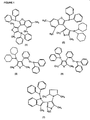
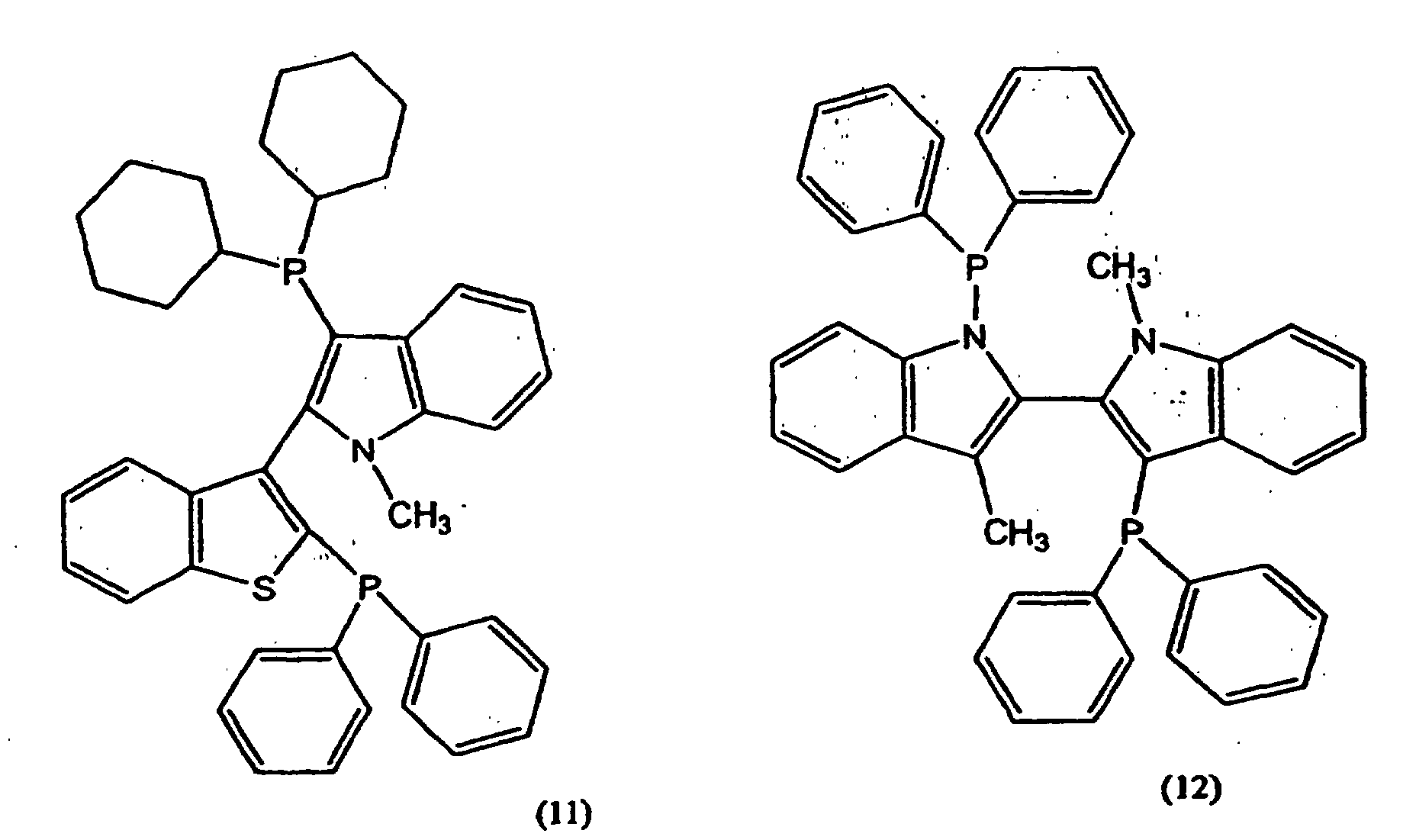
- Figures 1-3 show the structures of some examples of phosphorated ligands according to the present invention, indicated as compounds (1) - (15).
- the atoms engaged in the bond between the two aromatic cycles are carbon atoms or nitrogen atoms.
- the present ligands of formula (I) having C 1 symmetry in which Ar is a heterocycle and those in which Ar is phenyl are represented by the following formulas (I)a and (I)b, respectively: wherein Het 1 and Het 2 are pentatomic heterocyclic aromatic rings, equal to or different from one another, defined as Het is defined above; n is 0 or 1; and X, A, B, C, D, E, Q 1 , Q 2 , Z 1 and Z 2 are as defined above.
- the C 1 -type asymmetry occurs, for example, when the two pentatomic cyclic residues, even if they derive from the same type of aromatic heterocycle, are bound together via two different relative positions with respect to the hetero-atom, for example via the position 2' of Het 1 and the position 3' of Het 2 .
- Het, Het 1 and Het 2 heterocyclic residues are thiophene, pyrrole, furan, imidazole, isoxazole, isothiazole, pyrazole and triazole.
- Het, Het 1 or Het 2 pentatomic heterocyclic ring is condensed with phenyl or naphthyl.
- Het, Het 1 or Het 2 may be, for example, benzothiophene, naphthothiophene, indole, benzofuran or benzoimidazole.
- Q 1 , Q 2 , Z 1 and Z 2 are, for example, methyl.
- heterocyclic aromatic residues present in the ligands of the present invention are 2,5-dimethyl-thien-3-yl, 4,6-dimethyl-benzofur-3-yl, 3-methyl-indol-2-yl, 1-N-methyl-indol-2-yl and benzothien-3-yl.
- the carbocyclic aromatic residue is, for example, phenyl.
- n is, for example, 0.
- X is, for example, -O-.
- R 1 and R 2 are, for example, phenyl or cyclohexyl, hence -P 1 (R 1 ) 2 and -P 2 (R 2 ) 2 are, for instance, diphenyl phosphine or dicyclohexyl phosphine.
- the two R 1 residues bound together with the atom P 1 represent a cyclic residue J 1 or J 2 or a polycyclic aromatic residue, for example, of formula J 3
- Examples of sub-structures contained in the phosphorated ligands of the present invention are: (4-diphenylphosphine)- or (4-dicyclohexylphosphine)-2,5-dimethylthien-3-yl; (1-N-diphenylphosphine)- or (1-N-dicyclohexylphosphine)-3-methylindol-2-yl; (3-diphenylphosphine)- or (3-dicyclohexylphosphine)-1-N-methylindol-2-yl; 2-(diphenylphosphine)- or 2-(dicyclohexylphosphine)-benzothien-3-yl; 2-(diphenylphosphine-oxy)- or 2-(dicyclohexylphosphine-oxy)-phenyl-1-yl; 4-(diphenylphosphine-oxy)- or 4-(dicyclohexylphosphine-oxy
- Examples of the present C 1 -symmetry atropo-isomeric ligands are the ligands of formulas (I)c, (I)d, and (I)e represented below:
- Het 1 and Het 2 are defined as Het ;
- A, B, C, D, E, Q 1 , Z 1 , P 1 , R 1 , Q 2 , Z 2 , P 2 , R 2 and T are as defined as for the formula (I) ;
- m is 0, 1 or 2.
- transition metals contained in the organometallic complexes of the present invention are Rh, Ru, Ir, Pt, Pd and Ni.
- Minimisation of the structures, calculation of the energy levels associated to the ground state and to the transition state, and the value of the atomic charges can be determined by using the program MOPAC, Version 6.0, Method MNDO [J.P. Stewart, J. Comp. - Aideed Molec. Design, 4 (1), 1990 ; QCPE, Quantum Chemistry Program Exchange - QCMP019 Indiana University - Chemistry Department].
- the structures of the ligands of formula (I) can be created according to step a) of the present procedure by using the SYBYL modelling software, Version 6.2. Then, according to procedures known to the person skilled in the art, a structural investigation was carried out to determine the minimum-energy conformation associated to each individual structure.
- the reliability of the forecast of the minimum-energy conformer can then be increased by subjecting the conformations thus identified to a further structural investigation, defined as "optimisation", by using the program MOPAC, Version 6.0, method MNDO, via which the energy levels of the conformers were calculated, as well as the values of the residual charge quantities Q(P 1 ) and Q(P 2 ) for the phosphorous atoms P 1 and P 2 , and then the ⁇ Q(P) as defined above.
- This ⁇ E corresponds to the maximum possible extension, given by the difference between the energy of the maximum-energy conformers E trans and the energy of the minimum-energy conformer E min , for each ligand examined, and can be calculated by imposing that the said maximum energy should be the one associated to the conformer in which the two aromatic rings (the two heterocycles, or the heterocycle and the carbocyclic system) are coplanar.
- the cone angle ⁇ n is as defined in the article by Casey et al., Isr. J. Chem ., 30, 299-304, 1990, and is determined uniquely by the steric compression of the ligand structure, and not by the valence angle of the transition metal chosen for the complexation. However, it can be calculated by using a program other than the software program AMBER which was employed according to the said article.
- the introduction of the groups containing the phosphorous atom may precede or follow the reaction of formation of the inter-annular bond.
- the resolution of the present phosphorated ligands into their optical antipodes is carried out according to techniques in themselves known; for example, by separation on chromatographic column or through membrane, by using a chiral stationary substrate or a chiral eluent, or by means of fractioned crystallisation of a corresponding diastereomeric adduct.
- the diastereo-isomeric adducts are, for example, the corresponding salts with enantiomerically pure chiral acids or bases.
- the diastereo-isomeric adducts may be, for example, the diastereo-isomeric salts among enantiomerically pure chiral acids, and the phosphinoxides corresponding to the phosphorated ligands, obtained by phosphorous oxidation according to conventional methods : in this case, optical resolution is followed by reduction of the optically active phosphinoxides to phosphine, by means of a treatment with suitable reducing agents, such as sylans, in non-racemising reaction conditions, for example, according to the procedure described in WO 96/01831.
- suitable reducing agents such as sylans
- the complexes between ligands of formula (I) in the optically active form and transition metals are useful as catalysts in enantio- and/or diastereoselective reactions of reduction, hydroformylation, hydroboration, hydrosilylation, hydrocyanation, allylation, vynylation and other reactions of formation of the C-C bond.
- ⁇ Q (P), ⁇ n and ⁇ E of the present ligands can be measured according to methods known in the art and described in literature.
- the ⁇ Q (P) data can be obtained from the difference between the electrochemical oxidative potentials (E°) of the two phosphorous atoms, measured by voltammetry (see, for example, T. Benincori, E. Brenna, F. Sanniccol ⁇ et al., J. Organomet. Chem. 1997, 529, 445).
- the parameter ⁇ n that represents the angle between the phosphorous atoms P 1 and P 2 of the present ligand and a metal M, can be obtained by means of X-ray crystallography (see, for example, M. J. Burk, J. E. Feaster et al., J. Am. Chem. Soc . 1993, 115, 10125; X. Zahng, K. Mashima et al., J. Chem. Soc., Perkin Trans. I 1994 , 2309).
- the ⁇ E value can be calculated through racemization tests at different temperatures; the optical rotation decrease of enantiomerically pure ligands is measured as a function of time, thus determining the rate constants K at different temperatures; the Arrhenius plot of In K versus 1/T, wherein T is the temperature, leads to the activation data ⁇ E.
- the aqueous phase is separated, and the organic phase is washed, in order, with an aqueous solution of sodium chloride (10 g in 68.5 ml), an alkaline solution of sodium hyposulphite (6.8 g in 70 ml of 1% sodium hydroxide), and again with an aqueous solution of sodium chloride (10 g in 68.5 ml).
- the organic phase is then dried on sodium sulphate and concentrated to yield 16.4 g of crude 3-iodo-2,5-dimethylthiophene.
- This residue in inert atmosphere, is treated with 50 ml of DMF, and the following are added: 8.8 g of potassium acetate, 2 mg of palladium acetate, and 13.8 ml of diphenyl phosphine.
- the mixture is heated up to approximately 130°C and kept at this temperature until the reaction is completed (approximately 15 hours).
- the mixture is then cooled to approximately 30°C and diluted with 20 ml of water and 300 ml of methylene chloride.
- the dichloromethylene phase is separated and washed with 30 ml of water. After concentration to dry residue, 18.5 g are obtained of 3-diphenyl phosphine-2,5-dimethyl-thiophene.
- the product is purified via silica chromatography, and resolved in its optical antipodes by crystallization of the diastereo-isomeric salts, using enantiomerically pure dibenzoyltartaric acid, for example, according to the procedure described in WO 96/01831.
- racemic disphosphine is obtained by reduction with trichlorosilane, and is resolved via HPLC on stationary chiral phase.
- the mixture is then filtered on celite and concentrated under vacuum ; the residue is treated with 30 ml of diethyl ether, and the solution, in inert atmosphere, is fed drop by drop into 5 ml of a t-BuLi solution 1.6 M in penthane at the temperature of -30°C ; then 1.4 ml of chlorodiphenyl phosphine is added, and the reaction mixture is allowed to reconstitute at room temperature.
- Example 6 The procedure of Example 6 is repeated using 3.3 g of 3-diphenylphosphinyl-4-bromo-2,5-dimethyl-thiophene, prepared as described in Example 3, instead of the 3.4 g of 3-dicyclohexylphosphinyl-4-bromo-2,5-dimethyl-thiophene, to recover 2.2 g of racemic 2-diphenyl phosphine-3-[3'(4'-diphenyl phosphine-2',5'-dimethyl(thienyl)]-4,6-dimethyl-benzofuran, which is resolved into its optical antipodes by means of HPLC on chiral stationary phase.
- the organic phase is concentrated under vacuum, and the crude reaction product is purified by means of silica chromatography to yield the 4-bromo-2,5-dimethyl-3-propionyl-thiophene phenylhydrazone, which is dissolved in 350 ml of isopropanol/HCl (7.5 M) and kept stirred at room temperature until the reaction is completed.
- the solvent is removed under reduced pressure, and the residue is treated with methylene chloride.
- the organic phase is subjected to washings with a saturated solution of sodium bicarbonate, then with water, and finally concentrated under reduced pressure to yield 4.7 g of 2-[3'(4'-bromo-2',5'-dimethyl)-thienyl]-3-methyl-indole.
- a dichloromethane solution (10 ml) containing 4.2 mmol of optically pure ligand (+)(15) is added under stirring to a 4.2 mmol solution of hexahydrated NiCl 2 in 30 ml of ethanol. After 1 h the mixture is concentrated to a small volume, and the residue is squashed with ethanol and subsequently dried under vacuum.
- the complex is used as such in enantoselective reactions of formation of C-C bonds. It is assumed that the complex obtained has the following structure: [NiCl 2 (compound (+)(15)].
- a dichloromethane solution (10 ml) containing 2.6 mmol of optically pure ligand (+)(15) and 2.6 mmol of PdCl 2 (benzonitrile) 2 is kept under stirring for 1 h at room temperature.
- the mixture is concentrated to a small volume and the residue is squashed with ethanol and subsequently dried under vacuum.
- the complex obtained is used as such in enantioselective reactions of formation of C-C bonds. It is assumed that the complex obtained has the following structure: [PdCl 2 (compound (+)(15)].
Landscapes
- Chemical & Material Sciences (AREA)
- Organic Chemistry (AREA)
- Chemical Kinetics & Catalysis (AREA)
- Inorganic Chemistry (AREA)
- Engineering & Computer Science (AREA)
- Materials Engineering (AREA)
- Health & Medical Sciences (AREA)
- Life Sciences & Earth Sciences (AREA)
- Biochemistry (AREA)
- General Health & Medical Sciences (AREA)
- Molecular Biology (AREA)
- Organic Low-Molecular-Weight Compounds And Preparation Thereof (AREA)
- Catalysts (AREA)
- Low-Molecular Organic Synthesis Reactions Using Catalysts (AREA)
Claims (20)
- Ligand phosphoré chiral atropo-isomérique de formuledans laquelle(I) ayant une symétrie C1, sous forme optiquement active ou sous forme racémique
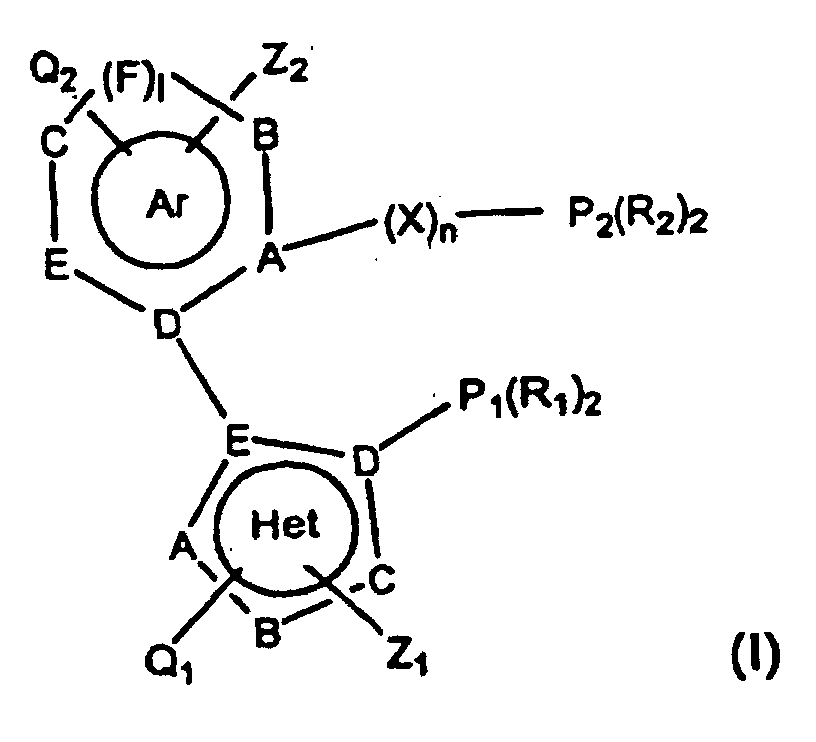 ledit ligand phosphoré ayant aussi :les atomes A, B, C, D, E et F identiques ou différents les uns des autres sont des atomes de carbone ou des hétéroatomes choisis parmi l'oxygène, l'azote et le soufre, qui forment en association un résidu Ar ou Het aromatique, où Ar est choisi entre un résidu hétérocyclique penta-atomique et le groupe phényle, et Het est un résidu hétérocyclique penta-atomique, et où ledit résidu aromatique hétérocyclique penta-atomique contient 1 ou 2 hétéroatomes identiques ou différents l'un de l'autre, choisis au sein du groupe consistant en -O-, -S- et -NR3- dans lequel R3 = H, un groupe alkyle, un groupe aromatique, un groupe -P1(R1)2 ou un atome d'azote compris en tant qu'hétéroatome dans l'autre résidu hétérocyclique penta-atomique appartenant à la structure de formule (I) ;I = 0,1 ; lorsque I = 1, F est un atome de carbone ;R1 et R2 liés aux atomes de phosphore, identiques ou différents l'un de l'autre, sont choisis entre un groupe alkyle C3-C10 linéaire, ramifié ou cyclique, un groupe aromatique carbocyclique et un groupe aromatique hétérocyclique ayant 5-6 atomes dans le cycle, contenant un ou plusieurs hétéroatomes choisis parmi l'oxygène, le soufre et l'azote, où ledit groupe carbocyclique ou hétérocyclique aromatique est éventuellement substitué par un ou plusieurs groupes choisis entre un groupe alkyle C1-C10 linéaire ou ramifié, un groupe alcoxyle C1-C10 linéaire ou ramifié, un halogène, -COOR4, -SO3R4 et -NR5R6 où R4 est choisi parmi H, les groupes alkyle, aryle, les métaux alcalins ou alcalinoterreux, -NH4 + et les cations alkylammonium ayant 4 à 20 atomes de carbone ; et où R5 et R6, identiques ou différents l'un de l'autre représentent H ou un groupe alkyle ; ouR1 et R2 en association avec l'atome de phosphore, forment un hétérocycle ayant 3 à 6 atomes dans le cycle, éventuellement substitué par des groupes alkyle C1-C10 linaires ou ramifiés ;X représente un groupe -O- ou un groupe -N(R7)- dans lequel R7 est choisi parmi H, les groupes alkyle et phényle ;n est égal à 0 ou à 1 lorsque Ar est un résidu aromatique hétérocyclique ;n est égal à 1 lorsque Ar est un groupe phényle ;Q1, Q2, Z1 et Z2, identiques ou différents les uns des autres, sont choisis au sein du groupe consistant en H, en des groupes alkyle C1-C10 linéaires, ramifiés ou cycliques, en des groupes alcoxyle C1-C10 linéaires, ramifiés ou cycliques, en un groupe phényle et en groupe halogène, ouQ1 pris en association avec Z1, ou Q2 pris en association avec Z2, forme un cycle aromatique carbocyclique choisi entre les groupes phényle et naphtyle, ledit cycle aromatique carbocyclique étant éventuellement substitué par un ou plusieurs groupes T, où T est choisi parmi les halogènes, les groupe alkyle C1-C10, alcoxyle C1-C10, -COOR4, -SO3R4 et -NR5R6 où R4 est choisi parmi H, les groupes alkyle C1-C10, phényle, les métaux alcalins ou alcalinoterreux, -NH4 + ou les cations alkylammonium C4-C12 et où R5 et R6, identiques ou différents l'un de l'autre, sont choisis entre H et les groupes alkyle C1-C10 ; et dans laquelleP1(R1)2 et -(X)n-P2(R2)2 sont liés au résidu aromatique carbocyclique ou hétérocyclique correspondant au moyen d'un atome de carbone dudit résidu aromatique ou au moyen d'un atome d'azote compris en tant qu'hétéroatome dans un résidu hétérocyclique penta-atomique ;où Etrans est la valeur de l'énergie pour l'état de transition et Emin est la valeur associée à l'état d'énergie minimum des énantiomères, exprimées en kcal/mole.(i) une différence entre les charges résiduelles des atomes de phosphore(ii) un angle conique βn (« natural bite angle » selon Casey) compris entre 80° et 130° défini comme étant l'angle de chélation préféré P1-M- P2 entre les atomes de phosphore P1 et P2 et un métal de transition M ;(iii) une valeur de barrière d'énergie d'interconversion entre les deux énantiomères d'un ligand donné
 - Ligand phosphoré selon la revendication 1, dans lequel(i) ladite différence ΔQ(P) = Q(P1) - Q(P2) est > 0,15 ;(ii) ledit « natural bite angle » βn est compris entre 83° et 120°.
- Ligand phosphoré selon la revendication 1, dans lequel ledit ligand phosphoré est choisi entre un ligand de formule (I)a et un ligand de formule (I)b :dans lesquelles
 Het1 et Het2 représentent des cycles aromatiques hétérocycliques penta-atomiques, identiques ou différents les uns des autres, définis comme Het dans la revendication 1 ;n est égal à 0 ou à 1 ;X, A, B, C, D, E, Q1, Q2, Z1 et Z2 sont tels que définis dans la revendication 1.
 - Ligand phosphoré selon la revendication 1, dans lequel ledit résidu hétérocyclique est choisi au sein du groupe consistant en le thiophène, le pyrrole, le furanne, l'imidazole, l'isoxasole, l'isothiazole, le pyrazole et le triazole.
- Ligand phosphoré selon la revendication 1, dans lequel Q1 pris en association avec Z1, ou Q2 pris en association avec Z2 forme un cycle carbocyclique, et Het est condensé avec un groupe phényle ou naphtyle.
- Ligand phosphoré selon la revendication 5, dans lequel ledit résidu hétérocyclique Het condensé avec un groupe phényle, est choisi au sein du groupe consistant en le benzothiophène, le naphtothiophène, l'indole, le benzofuranne et le benzoimidazole.
- Ligand phosphoré selon la revendication 1, dans lequel ledit ligand phosphoré est choisi entre un ligand de formule (I)c, de formule (I)d et de formule (I)e :
 dans lesquelles
 Het1 et Het2 sont définis comme Het dans la revendication 1 ;A, B, C, D, E, Q1, Z1, P1, R1, Q2, Z2, P2, R2 et T sont tels que définis dans la revendication 1 pour la formule (I) ;m est égal à 0, 1 ou 2.
 - Ligand phosphoré selon la revendication 1, dans lequel ledit résidu aromatique hétérocyclique est choisi au sein du groupe consistant en le 2,5-diméthylthién-3-yle, le 4,6-diméthylbenzofur-3-yle, le 3-méthylindol-2-yle, le 1-N-méthylindol-2-yle et le benzothién-3-yle ; et ledit résidu aromatique carbocyclique est le groupe phényle.
- Ligand phosphoré selon la revendication 1, dans lequel lesdits groupes -P1(R1)2 et -P2 (R2)2 sont choisis parmi la diphénylphosphine, la dicyclohexylphosphine, J1, J2 et J3, où J1, J2 et J3 ont les formules suivantes :


- Ligand phosphoré selon la revendication 1, contenant une des sous-structures suivantes :(4-diphénylphosphine)- ou (4-dicyclohexylphosphine)-2,5-diméthyl-thién-3-yle ;(1-N-diphénylphosphine)- ou (1-N-dicyclohexylphosphine)-3-méthyl-indol-2-yle ;(3-diphénylphosphine)- ou (3-dicyclohexylphosphine)-1-N-méthyl-indol-2-yle ;2-(diphénylphosphine)- ou 2-(dicyclohexylphosphine)benzothién-3-yle ;2-(diphénylphosphine-oxy)- ou 2-(dicyclohexylphosphine-oxy)phényl-1-yle ;4-(diphénylphosphine-oxy)- ou 4-(dicyclohexylphosphine-oxy)-2,5-diméthylthién-3-yle ; .4-(2',5'-diméthylphospholyl)- ou 4-(dibenzophospholyl)-2,5-diméthyl-thién-3-yle ;1-N-(2',5'-diméthylphospholyl)- ou 1-N-(dibenzophospholyl)-3-méthylindol-2-yle.
- Ligand phosphoré selon la revendication 1, dans lequel ledit ligand phosphoré est choisi parmi les composés (1) à (15).



- Procédé pour la préparation d'un ligand phosphoré atropo-isomérique de formule (I) ayant une symétrie C1 selon la revendication 1, comprenant une des procédures suivantes :dans ledit procédé, l'introduction des groupes contenant l'atome de phosphore précédant ou faisant suite à la réaction de formation de la liaison inter-annulaire.(A) réaction de couplage entre des halogénures aromatiques ou hétéro-aromatiques avec des réactifs organo-métalliques aryle ou hétéro-aryle choisis parmi les organolithiens, les organomagnésiens, les organozinciques et les organoboriques, en présence des quantités catalytiques de sels ou complexes de cuivre, de nickel ou de palladium ; ou(B) cyclisation et aromatisation, avec formation de l'un des deux cycles hétérocycliques compris dans la structure de formule (I), d'un précurseur contenant déjà l'autre système hétérocyclique ou carbocyclique ;
- Procédé selon la revendication 12, dans lequel ladite introduction des groupes contenant l'atome de phosphore est effectuée selon l'une des réactions suivantes :dans le cas des dérivés phosphine :
Ar est un résidu aromatique compris dans la structure de formule (I) ;
[M] est un groupe organo-métallique ;
X est un halogène, ;
Z est un métal alcalin ;
R1 et R2 sont des résidus alkyle ou aryle ;dans le cas des dérivés phosphite ou aminophosphine :
Ar est un résidu aromatique ou hétéro-aromatique compris dans la structure de formule (I) ;
Ind est un résidu indole ;
X est un halogène, ;
Z est un métal alcalin ;
R1 est un groupe alkyle ou aryle ;
R2 est H ou un groupe alkyle ou aryle. - Procédé selon la revendication 12, comprenant aussi la décomposition d'un ligand de formule (I) en ses antipodes optiques, via une séparation sur colonne de chromatographie ou à travers une membrane, par l'utilisation d'un substrat chiral stationnaire ou d'un éluant chiral, ou via la cristallisation fractionnée d'un adduit diastéréo-isomérique correspondant.
- Procédé selon la revendication 14, dans lequel, si le ligand de formule (I) comprend des groupes basiques ou acides, l'adduit diastéréoisomérique est le sel correspondant avec un acide ou une base chiral énantiomériquement pur ; en alternative, ledit adduit est le sel diastéréo-isomérique entre un acide chiral énantiomériquement pur et le phosphinoxyde correspondant au présent ligand phosphoré. Dans ce cas, la décomposition optique est suivi de la réduction des phosphinoxydes optiquement actifs en phosphines, par traitement à l'aide d'un agent réducteur.
- Complexe organo-métallique comprenant un ligand phosphoré chiral de formule (I) selon chacune des revendications 1 à 11, sous une forme énantiomériquement pure ou enrichie, et un métal de transition.
- Complexe organo-métallique selon la revendication 16, dans lequel le métal de transition est choisi au sein du groupe consistant en Rh, Ru, Ir, Pt, Pd et Ni.
- Utilisation d'un complexe organo-métallique selon la revendication 16, pour la préparation d'un catalyseur chiral optiquement actif.
- Procédé pour la préparation d'un composé organique sous forme de stéréoisomère, comprenant au moins une réaction stéréosélective conduite en présence d'au moins un complexe organo-métallique tel que défini dans la revendication 16.
- Procédé selon la revendication 19, dans lequel ladite réaction stéréosélective est choisie au sein du groupe consistant en réactions de réduction énantio- et/ou diastéréo-sélectives, hydroformylation, hydroboration, hydrosilylation, hydrocyanation, allylation, vinylation, et autres réactions de formation de la liaison C-C.
Applications Claiming Priority (3)
| Application Number | Priority Date | Filing Date | Title |
|---|---|---|---|
| IT98MI000773A IT1299068B1 (it) | 1998-04-10 | 1998-04-10 | Legandi fosforati chirali e loro complessi organometallici, utili come catalizzatori in sintesi stereoselettive |
| ITMI980773 | 1998-04-10 | ||
| PCT/EP1999/002432 WO1999052915A1 (fr) | 1998-04-10 | 1999-04-09 | Ligands phosphores chiraux utiles dans des catalyseurs |
Publications (2)
| Publication Number | Publication Date |
|---|---|
| EP1070075A1 EP1070075A1 (fr) | 2001-01-24 |
| EP1070075B1 true EP1070075B1 (fr) | 2003-10-08 |
Family
ID=11379741
Family Applications (1)
| Application Number | Title | Priority Date | Filing Date |
|---|---|---|---|
| EP99920633A Expired - Lifetime EP1070075B1 (fr) | 1998-04-10 | 1999-04-09 | Ligands phosphores chiraux utiles dans des catalyseurs |
Country Status (8)
| Country | Link |
|---|---|
| EP (1) | EP1070075B1 (fr) |
| JP (1) | JP2002511473A (fr) |
| AT (1) | ATE251634T1 (fr) |
| AU (1) | AU3814799A (fr) |
| DE (1) | DE69911936T2 (fr) |
| ES (1) | ES2209431T3 (fr) |
| IT (1) | IT1299068B1 (fr) |
| WO (1) | WO1999052915A1 (fr) |
Families Citing this family (22)
| Publication number | Priority date | Publication date | Assignee | Title |
|---|---|---|---|---|
| IT1303757B1 (it) * | 1998-11-16 | 2001-02-23 | Sigma Tau Ind Farmaceuti | Processo industriale per la produzione di l-carnitina. |
| EP1274744A2 (fr) | 2000-04-13 | 2003-01-15 | E.I. DUPONT DE NEMOURS AND COMPANY, Legal Patent Records Center | Synthese sur supports polymeres de ligands bidentes heteroatomiques convenant pour la catalyse |
| DE10100708A1 (de) * | 2001-01-10 | 2002-07-11 | Oxeno Olefinchemie Gmbh | Neue N-Phenylpyrrolbisphosphanverbindungen und deren Metallkomplexe |
| ATE310007T1 (de) | 2001-03-29 | 2005-12-15 | Liganden für pnicogenchelatkomplexe mit einem metall der viii. nebengruppe und verwendung der komplexe als katalysatoren für hydroformylierung, carbonylierung, hydrocyanierung oder hydrierung | |
| WO2003018192A2 (fr) * | 2001-08-24 | 2003-03-06 | Basf Aktiengesellschaft | Procede de preparation de 2-propylheptanol |
| JP4298505B2 (ja) * | 2001-10-05 | 2009-07-22 | ソルヴィーアス アクチェンゲゼルシャフト | 不斉反応のためのリガンド |
| RU2223965C1 (ru) * | 2002-07-15 | 2004-02-20 | Нифантьев Илья Эдуардович | Гетероарил-арилдифосфины и способ их получения |
| DE10242636A1 (de) | 2002-09-13 | 2004-03-18 | Basf Ag | Verfahren zur Herstellung von Dialdehyden und/oder ethylenisch ungesättigten Monoaldehyden durch Hydroformylierung ethylenisch ungesättigter Verbindungen |
| RU2239639C1 (ru) * | 2003-02-06 | 2004-11-10 | Нифантьев Илья Эдуардович | Ахиральные p,n-бидентатные лиганды и способ их получения |
| EP1595888A1 (fr) * | 2004-05-11 | 2005-11-16 | Degussa AG | Ligands de cycloolefine-phosphines et leur utilisation en catalyse |
| US7629470B2 (en) | 2004-07-08 | 2009-12-08 | Merck & Co., Inc. | Formation of tetra-substituted enamides and stereoselective reduction thereof |
| BRPI0515344A (pt) | 2004-09-17 | 2008-07-15 | Idenix Pharmaceuticals Inc | composto, composição farmacêutica, e, usos de uma quantidade eficaz de um composto 3-fosfoindol ou sal, pró-droga, estereoisÈmero, tautÈmero, n-óxido ou amina quaternária farmaceuticamente aceitável do mesmo e de uma quantidade de tratamento eficaz anti-hiv de um composto de 3-fosfoindol ou sal, pró-droga, estereo-isÈmero, tautÈmero, n-óxido ou amina quaternária farmaceuticamente aceitável do mesmo |
| JP2010504978A (ja) | 2006-09-29 | 2010-02-18 | アイデニクス ファーマシューティカルズ,インコーポレーテッド | Hiv阻害剤としての鏡像異性的に純粋なホスホインドール |
| FR2932476B1 (fr) * | 2008-06-17 | 2010-07-30 | Rhodia Operations | Procede de fabrication de composes nitriles a partir de composes a insaturation ethylenique |
| JP5493352B2 (ja) * | 2008-12-25 | 2014-05-14 | 東ソー株式会社 | イミダゾール化合物及びそれを用いたクロスカップリング反応用触媒組成物 |
| US9410016B2 (en) | 2013-07-16 | 2016-08-09 | Dow Global Technologies Llc | Aromatic polyacetals and articles comprising them |
| US8962779B2 (en) | 2013-07-16 | 2015-02-24 | Dow Global Technologies Llc | Method of forming polyaryl polymers |
| US8933239B1 (en) | 2013-07-16 | 2015-01-13 | Dow Global Technologies Llc | Bis(aryl)acetal compounds |
| US9063420B2 (en) | 2013-07-16 | 2015-06-23 | Rohm And Haas Electronic Materials Llc | Photoresist composition, coated substrate, and method of forming electronic device |
| GB201401230D0 (en) * | 2014-01-24 | 2014-03-12 | Givaudan Sa | Improvements in or relating to organic compounds |
| CN107459533B (zh) * | 2016-06-02 | 2020-06-05 | 香港理工大学深圳研究院 | 一种苯并咪唑-吲哚骨架的膦配体及其制备方法和应用 |
| CN112679546A (zh) * | 2020-12-24 | 2021-04-20 | 安徽泽升科技有限公司 | 一种环状三氮膦配体化合物及其制备方法 |
Family Cites Families (2)
| Publication number | Priority date | Publication date | Assignee | Title |
|---|---|---|---|---|
| IT1270082B (it) * | 1994-07-12 | 1997-04-28 | Univ Degli Studi Milano | Difosfine eteroaromatiche come leganti chirali, complessi tra dette difosfine e metalli di transizione ed impiego di detti complessi come catalizzatori chirali |
| DE69727684D1 (de) * | 1996-06-14 | 2004-03-25 | Univ Penn State Res Found | Durch übergangsmetallkomplexe mit zyklischen chiralen liganden katalysierte asymmetrische synthese |
-
1998
- 1998-04-10 IT IT98MI000773A patent/IT1299068B1/it active IP Right Grant
-
1999
- 1999-04-09 ES ES99920633T patent/ES2209431T3/es not_active Expired - Lifetime
- 1999-04-09 JP JP2000543471A patent/JP2002511473A/ja active Pending
- 1999-04-09 AU AU38147/99A patent/AU3814799A/en not_active Abandoned
- 1999-04-09 EP EP99920633A patent/EP1070075B1/fr not_active Expired - Lifetime
- 1999-04-09 AT AT99920633T patent/ATE251634T1/de not_active IP Right Cessation
- 1999-04-09 DE DE69911936T patent/DE69911936T2/de not_active Expired - Fee Related
- 1999-04-09 WO PCT/EP1999/002432 patent/WO1999052915A1/fr not_active Ceased
Also Published As
| Publication number | Publication date |
|---|---|
| WO1999052915A1 (fr) | 1999-10-21 |
| DE69911936D1 (de) | 2003-11-13 |
| ITMI980773A1 (it) | 1999-10-10 |
| ATE251634T1 (de) | 2003-10-15 |
| IT1299068B1 (it) | 2000-02-07 |
| ES2209431T3 (es) | 2004-06-16 |
| DE69911936T2 (de) | 2004-09-09 |
| JP2002511473A (ja) | 2002-04-16 |
| EP1070075A1 (fr) | 2001-01-24 |
| AU3814799A (en) | 1999-11-01 |
Similar Documents
| Publication | Publication Date | Title |
|---|---|---|
| EP1070075B1 (fr) | Ligands phosphores chiraux utiles dans des catalyseurs | |
| Glueck | Recent advances in metal-catalyzed C–P bond formation | |
| Nettekoven et al. | Phosphorus-chiral analogues of 1, 1 ‘-bis (diphenylphosphino) ferrocene: asymmetric synthesis and application in highly enantioselective Rhodium-catalyzed hydrogenation reactions | |
| Korff et al. | Preparation of chiral triarylphosphines by Pd-catalysed asymmetric P–C cross-coupling | |
| Stoop et al. | Diphosphines Containing Stereogenic P Atoms: Synthesis of (S, S)-C, C ‘-Tetramethylsilanebis-(1-naphthylphenylphosphine) and Applications in Enantioselective Catalysis | |
| JP2004505091A (ja) | アダマンチル基を有するホスファンリガンド、その製造および接触反応におけるその使用 | |
| Wang et al. | NiII-catalyzed enantioselective anti-markovnikov hydrophosphination of unactivated alkynes | |
| Berger et al. | Manganese-catalyzed and mediated synthesis of arylphosphinates and related compounds | |
| Balázs et al. | Catalytic asymmetric diarylphosphine addition to α-diazoesters for the synthesis of P-stereogenic phosphinates via P*—N bond formation | |
| Chen et al. | Palladium-catalyzed C–P (III) bond formation by coupling ArBr/ArOTf with acylphosphines | |
| Biosca et al. | P-stereogenic N-phosphine–phosphite ligands for the Rh-catalyzed hydrogenation of olefins | |
| He et al. | Optical Resolution, Configurational Stability, and Coordination Chemistry of the P-Chiral Heterocyclic Diphosphine 1, 1 ‘-Diphenyl-3, 3 ‘, 4, 4 ‘-tetramethyl-2, 2 ‘-diphosphole-3, 3 ‘-diene | |
| JP3100982B2 (ja) | キラルな三座ビス(ホスホラン)配位子 | |
| Jaillet et al. | Design of P-chirogenic aminophosphine–phosphinite ligands at both phosphorus centers: origin of enantioselectivities in Pd-catalyzed allylic reactions | |
| Ghebreyessus et al. | Conformationally rigid diphosphine arene–ruthenium (II) complexes as catalysts for transfer hydrogenation of ketones | |
| JP6006723B2 (ja) | ビアリールジホスフィン配位子、それらの中間体、および不斉触媒反応におけるそれらの使用法 | |
| Jaillet et al. | P (III)-Chirogenic phosphinite building blocks by stereospecific N→ O phosphinyl migration | |
| Chapp et al. | Platinum-catalyzed asymmetric alkylation of bis (isitylphosphino) ethane: stereoselectivity reversal in successive formation of two P− C bonds | |
| JP4201916B2 (ja) | 光学活性な1,2−ビス(ジアルキルホスフィノ)ベンゼン誘導体及びその製造方法、並びに該化合物を配位子とするロジウム金属錯体 | |
| van Duren et al. | Chiral (diphosphonite) platinum complexes in asymmetric hydroformylation | |
| US6333291B1 (en) | Optically active diphosphine compound, production intermediate thereof, transition metal complex containing the compound as ligand and asymmetric hydrogenation catalyst containing the complex | |
| US6613922B2 (en) | Phosphorus p-cyclophane ligands and their use in transition metal catalyzed asymmetric reactions | |
| Kuznetsov et al. | Chiral Ruthenium Complexes with P, N-Ligands Derived from (S)-Proline | |
| Weir et al. | Asymmetric synthesis of bis (tertiary arsines): highly stereoselective alkylations of diastereomers of a chiral phosphine-stabilized bis (arsenium triflate) | |
| US20040072680A1 (en) | Chiral phosphorus cyclic compounds for transition metal-catalyzed asymmetric reactions |
Legal Events
| Date | Code | Title | Description |
|---|---|---|---|
| PUAI | Public reference made under article 153(3) epc to a published international application that has entered the european phase |
Free format text: ORIGINAL CODE: 0009012 |
|
| 17P | Request for examination filed |
Effective date: 20001107 |
|
| AK | Designated contracting states |
Kind code of ref document: A1 Designated state(s): AT BE CH CY DE DK ES FI FR GB GR IE IT LI NL PT SE |
|
| RAP1 | Party data changed (applicant data changed or rights of an application transferred) |
Owner name: CHEMI S.P.A. |
|
| 17Q | First examination report despatched |
Effective date: 20020214 |
|
| GRAH | Despatch of communication of intention to grant a patent |
Free format text: ORIGINAL CODE: EPIDOS IGRA |
|
| GRAS | Grant fee paid |
Free format text: ORIGINAL CODE: EPIDOSNIGR3 |
|
| GRAA | (expected) grant |
Free format text: ORIGINAL CODE: 0009210 |
|
| AK | Designated contracting states |
Kind code of ref document: B1 Designated state(s): AT BE CH CY DE DK ES FI FR GB GR IE IT LI NL PT SE |
|
| PG25 | Lapsed in a contracting state [announced via postgrant information from national office to epo] |
Ref country code: FI Free format text: LAPSE BECAUSE OF FAILURE TO SUBMIT A TRANSLATION OF THE DESCRIPTION OR TO PAY THE FEE WITHIN THE PRESCRIBED TIME-LIMIT Effective date: 20031008 Ref country code: CY Free format text: LAPSE BECAUSE OF FAILURE TO SUBMIT A TRANSLATION OF THE DESCRIPTION OR TO PAY THE FEE WITHIN THE PRESCRIBED TIME-LIMIT Effective date: 20031008 |
|
| REG | Reference to a national code |
Ref country code: GB Ref legal event code: FG4D |
|
| REG | Reference to a national code |
Ref country code: CH Ref legal event code: EP |
|
| REG | Reference to a national code |
Ref country code: IE Ref legal event code: FG4D |
|
| REF | Corresponds to: |
Ref document number: 69911936 Country of ref document: DE Date of ref document: 20031113 Kind code of ref document: P |
|
| PG25 | Lapsed in a contracting state [announced via postgrant information from national office to epo] |
Ref country code: SE Free format text: LAPSE BECAUSE OF FAILURE TO SUBMIT A TRANSLATION OF THE DESCRIPTION OR TO PAY THE FEE WITHIN THE PRESCRIBED TIME-LIMIT Effective date: 20040108 Ref country code: GR Free format text: LAPSE BECAUSE OF FAILURE TO SUBMIT A TRANSLATION OF THE DESCRIPTION OR TO PAY THE FEE WITHIN THE PRESCRIBED TIME-LIMIT Effective date: 20040108 Ref country code: DK Free format text: LAPSE BECAUSE OF FAILURE TO SUBMIT A TRANSLATION OF THE DESCRIPTION OR TO PAY THE FEE WITHIN THE PRESCRIBED TIME-LIMIT Effective date: 20040108 |
|
| REG | Reference to a national code |
Ref country code: CH Ref legal event code: NV Representative=s name: N&G PATENT SERVICES SA |
|
| PGFP | Annual fee paid to national office [announced via postgrant information from national office to epo] |
Ref country code: CH Payment date: 20040407 Year of fee payment: 6 |
|
| PGFP | Annual fee paid to national office [announced via postgrant information from national office to epo] |
Ref country code: IE Payment date: 20040416 Year of fee payment: 6 |
|
| PGFP | Annual fee paid to national office [announced via postgrant information from national office to epo] |
Ref country code: NL Payment date: 20040422 Year of fee payment: 6 |
|
| PGFP | Annual fee paid to national office [announced via postgrant information from national office to epo] |
Ref country code: AT Payment date: 20040426 Year of fee payment: 6 |
|
| PGFP | Annual fee paid to national office [announced via postgrant information from national office to epo] |
Ref country code: ES Payment date: 20040427 Year of fee payment: 6 |
|
| PGFP | Annual fee paid to national office [announced via postgrant information from national office to epo] |
Ref country code: BE Payment date: 20040518 Year of fee payment: 6 |
|
| REG | Reference to a national code |
Ref country code: ES Ref legal event code: FG2A Ref document number: 2209431 Country of ref document: ES Kind code of ref document: T3 |
|
| ET | Fr: translation filed | ||
| PLBE | No opposition filed within time limit |
Free format text: ORIGINAL CODE: 0009261 |
|
| STAA | Information on the status of an ep patent application or granted ep patent |
Free format text: STATUS: NO OPPOSITION FILED WITHIN TIME LIMIT |
|
| 26N | No opposition filed |
Effective date: 20040709 |
|
| PG25 | Lapsed in a contracting state [announced via postgrant information from national office to epo] |
Ref country code: IT Free format text: LAPSE BECAUSE OF NON-PAYMENT OF DUE FEES;WARNING: LAPSES OF ITALIAN PATENTS WITH EFFECTIVE DATE BEFORE 2007 MAY HAVE OCCURRED AT ANY TIME BEFORE 2007. THE CORRECT EFFECTIVE DATE MAY BE DIFFERENT FROM THE ONE RECORDED. Effective date: 20050409 Ref country code: AT Free format text: LAPSE BECAUSE OF NON-PAYMENT OF DUE FEES Effective date: 20050409 |
|
| PG25 | Lapsed in a contracting state [announced via postgrant information from national office to epo] |
Ref country code: IE Free format text: LAPSE BECAUSE OF NON-PAYMENT OF DUE FEES Effective date: 20050411 Ref country code: ES Free format text: LAPSE BECAUSE OF NON-PAYMENT OF DUE FEES Effective date: 20050411 |
|
| PG25 | Lapsed in a contracting state [announced via postgrant information from national office to epo] |
Ref country code: LI Free format text: LAPSE BECAUSE OF NON-PAYMENT OF DUE FEES Effective date: 20050430 Ref country code: CH Free format text: LAPSE BECAUSE OF NON-PAYMENT OF DUE FEES Effective date: 20050430 Ref country code: BE Free format text: LAPSE BECAUSE OF NON-PAYMENT OF DUE FEES Effective date: 20050430 |
|
| BERE | Be: lapsed |
Owner name: *CHEMI S.P.A. Effective date: 20050430 |
|
| PG25 | Lapsed in a contracting state [announced via postgrant information from national office to epo] |
Ref country code: NL Free format text: LAPSE BECAUSE OF NON-PAYMENT OF DUE FEES Effective date: 20051101 |
|
| REG | Reference to a national code |
Ref country code: CH Ref legal event code: PL |
|
| NLV4 | Nl: lapsed or anulled due to non-payment of the annual fee |
Effective date: 20051101 |
|
| REG | Reference to a national code |
Ref country code: ES Ref legal event code: FD2A Effective date: 20050411 |
|
| PGFP | Annual fee paid to national office [announced via postgrant information from national office to epo] |
Ref country code: GB Payment date: 20070329 Year of fee payment: 9 |
|
| PGFP | Annual fee paid to national office [announced via postgrant information from national office to epo] |
Ref country code: DE Payment date: 20070427 Year of fee payment: 9 |
|
| BERE | Be: lapsed |
Owner name: *CHEMI S.P.A. Effective date: 20050430 |
|
| PG25 | Lapsed in a contracting state [announced via postgrant information from national office to epo] |
Ref country code: PT Free format text: LAPSE BECAUSE OF NON-PAYMENT OF DUE FEES Effective date: 20040308 |
|
| PGFP | Annual fee paid to national office [announced via postgrant information from national office to epo] |
Ref country code: FR Payment date: 20070327 Year of fee payment: 9 |
|
| GBPC | Gb: european patent ceased through non-payment of renewal fee |
Effective date: 20080409 |
|
| PG25 | Lapsed in a contracting state [announced via postgrant information from national office to epo] |
Ref country code: DE Free format text: LAPSE BECAUSE OF NON-PAYMENT OF DUE FEES Effective date: 20081101 |
|
| REG | Reference to a national code |
Ref country code: FR Ref legal event code: ST Effective date: 20081231 |
|
| PG25 | Lapsed in a contracting state [announced via postgrant information from national office to epo] |
Ref country code: FR Free format text: LAPSE BECAUSE OF NON-PAYMENT OF DUE FEES Effective date: 20080430 |
|
| PG25 | Lapsed in a contracting state [announced via postgrant information from national office to epo] |
Ref country code: GB Free format text: LAPSE BECAUSE OF NON-PAYMENT OF DUE FEES Effective date: 20080409 |