EP1071012A2 - Zeiteinschätzer - Google Patents
Zeiteinschätzer Download PDFInfo
- Publication number
- EP1071012A2 EP1071012A2 EP00302458A EP00302458A EP1071012A2 EP 1071012 A2 EP1071012 A2 EP 1071012A2 EP 00302458 A EP00302458 A EP 00302458A EP 00302458 A EP00302458 A EP 00302458A EP 1071012 A2 EP1071012 A2 EP 1071012A2
- Authority
- EP
- European Patent Office
- Prior art keywords
- values
- multipliers
- time
- formula
- design
- Prior art date
- Legal status (The legal status is an assumption and is not a legal conclusion. Google has not performed a legal analysis and makes no representation as to the accuracy of the status listed.)
- Withdrawn
Links
Images
Classifications
-
- G—PHYSICS
- G06—COMPUTING OR CALCULATING; COUNTING
- G06Q—INFORMATION AND COMMUNICATION TECHNOLOGY [ICT] SPECIALLY ADAPTED FOR ADMINISTRATIVE, COMMERCIAL, FINANCIAL, MANAGERIAL OR SUPERVISORY PURPOSES; SYSTEMS OR METHODS SPECIALLY ADAPTED FOR ADMINISTRATIVE, COMMERCIAL, FINANCIAL, MANAGERIAL OR SUPERVISORY PURPOSES, NOT OTHERWISE PROVIDED FOR
- G06Q10/00—Administration; Management
- G06Q10/10—Office automation; Time management
- G06Q10/109—Time management, e.g. calendars, reminders, meetings or time accounting
Definitions
- This invention relates to estimating software systems development, that is to say how long it will take to realise (code/program) a design, in particular an object-oriented design.
- Every commercial project needs a tool by which resources can be allocated effectively to produce the implementation of a design. This results in both lower risk and better utilization of assets.
- This can be achieved by expert opinion, where an expert in the domain, i.e. the programming language and design style can produce an opinion of the total time to completion.
- a new metrics tool is required and preferably one which is not solely based on human guesswork, that is inheritance multiplied by some magic number means X days in total, and/or the number of lines of code or other dynamic implementation based attributes.
- a known technique for obtaining such a time estimate involves use of Function Point Analysis (FPA), which attempts to measure the software from the point of view of the software consumer rather than the software producer.
- Function point methodology is based on the amount of function delivered to the user rather than counting lines of code.
- Implementation is a two-stage process. First, data on existing projects is recorded in a database. Second, the project to be estimated is compared with the projects in the database using regression analysis or ranking to determine the man-hours estimate. Function point analysis uses statistical correlation to predict the amounts of effort required to build a system. The project's key measures are evaluated with statistical correlation. First, the size of completed project is determined by counting up function points (each form, report and table is assigned a number based on how many fields are in that object). The hours spent building the project are added up, resulting in two numbers: function points and effort. Regression analysis determines the extent to which these numbers are correlated. If they are sufficiently related then one has an equation which converts function points to man hours.
- FPA Function Point Analysis
- a method of estimating the time a particular designer or any one of a group of designers will take to realise a new design using an object-oriented methodology, including the step of determining for the particular designer or group of designers the appropriate version of a formula which links the time estimate and the numbers of predeterminated types of object-oriented elements present in a design, each element type having a respective multiplier for the particular designer or group of designers associated with it, wherein values for the respective multipliers are calculated from the numbers of the object-oriented elements of each type that the particular designer or group of designers employed in a plurality of previous designs and the actual realisation times for those designs, and including the steps of inserting the numbers of each of the types of the object-oriented elements present in the new design in the appropriate version of the formula and evaluating the formula, thereby obtaining the time estimate.
- each project is individual and each designer is individual, they work differently. One may create many objects whereas another may create only a small number. It is thus considered that it is more appropriate to produce a time estimate, for a particular project (object-oriented design) which is to be handled by a particular designer, based on that designer's past performance, since this will take into account that designer's method of working, although it is equally applicable to a group of skilled designers who work in basically the same manner.
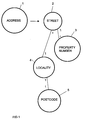
- An address is an element used in a Local Government taxation scenario, for example the address of a property for Council tax purposes.
- An address to the man in the street, is a single object or entity, but it is actually made up of many objects, each representing different things. Quite how one decides to "sub-divide" such an object will affect how many individual objects, classes , methods, attributes etc, are involved and from a programming point of view how long it will take to realise (program) the overall object.
- the address object 1 of Fig 1 is equivalent to a number of objects. As illustrated there is a street object 2, associated with which is a property number object 3. The Street is in a town or city, hence there is a locality object 4, and associated with the address is a postcode, hence there is a postcode object 5.
- the symbols "*" and "1" indicate a many-to-one relationship between objects.
- the right hand part of Fig 1 can thus be taken as meaning there are zero or more properties on a street, there are many streets in a locality but the locality corresponds to one postcode.
- a street has a street name and may be considered, according to the Post Office, as a sub or main through-fare, hence the street object 2 contains data corresponding to name and type of thoroughfare.
- a particular designer will break a design down in a particular way corresponding to his/her method of working, eg. creating more or less objects than another designer.
- Formula ( i) was derived by considering the premise that the time taken is proportional to the complexity of a project.
- a hypothetical complexity factor might be: number of lines of code * number of inherited classes * number of methods in which case the time taken could be: a number * complexity factor
- Time to implement Complexity / some amount
- Complexity ⁇ ⁇ factor N ⁇ * ⁇ multiplier N ⁇
- Optimisation problems can be solved in many ways, for example, by use of neural networks (especially Hopfield-Tank networks), generic algorithms, simple search, random walk and hill-climbing. Different strategies are applicable to different problems but the last three options are the simplest.
- a simple search is the easiest to implement but the slowest to perform as it simply evaluates every option possible.
- Random walking is also very easy but its performance varies greatly.
- Hill-climbing is a well known, and consistently used, strategy for optimisation. It is reasonably efficient, normally produces good results and is easy to implement. In fact, a hill climber is simply a specialised form of the random walk strategy.
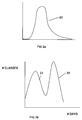
- Fig 2b A theoretical construct to aid the understanding of hill climbing techniques is the "complexity landscape", also known as the problem / fitness landscape.
- the landscape could be as in Fig 2a, with a single hill 20.
- Fig 2b A more complex case is shown in Fig 2b, albeit still only in two-dimensions. In either case the climber always attempts to "climb" up a slope, preferably the steepest in multi-dimensions, to attain the best solution to the problem.
- the curve in Fig 2b highlights the essential problem with hill climbing.
- the multipliers A, B, C, D, E, F, G and H, in an eight element case, and Z are given values selected at random and the number of classes, methods etc as used by the designer or any one of group of designers for a previous project employed.
- the hill-climber algorithm is then used to adjust the values of the multipliers and divisor until, in effect, the top of one of the hills is reached, the hill-climber always looking for the best way forward, and a calculated value of time taken can be compared with the actual time taken for the previous project. If these differ wildly, such as calculated at 20 days but actually took 70 days, then the values used do not possibly correspond to the highest hill on the multidimensional surface.
- Fig 2b illustrates, albeit for a two dimensional case for simplicity, a possible graph of number of classes versus number of days which has two "hills". Depending on the starting point the hill climber could reach the top of the lower hill, rather than the higher hill, and the time estimate will therefore not be as good as it could have been.
- the values of the multipliers and divisor determined by the hill-climber algorithm for one previous project are then combined with the number of classes etc for another project carried out by the same designer or any one of the group of designers and a time calculated for that other project. This is compared with the actual time as before and the multiplier and divisor values adjusted as appropriate by the hill-climber algorithm in an attempt to achieve a better match. This is repeated for say a total of ten previous projects in order to "train" the hill-climber algorithm to the method of working of the designer or the group of designers and produce an appropriate time estimate formula for that designer or any one of the group of designers.
- the above process may be carried out on a computer having a database into which the data and time details can be inserted and running a program serving to perform iterations resulting in the best-fit values, for example a hill-climber algorithm.
- multipliers and a divisor are referred to in the above as separate item, alternatively the values of the multipliers can comprise values which take the divisor into account, eg A/Z, B/Z etc.
- the invention involves estimating for a UML (Unified Method Language), or any other object-orientated methodology, design, the total time that a particular skilled programmer or any one of group of programmers will take to realize (code/program) the design.
- a formula for the time estimate is constructed, by training an algorithm, particularly a simple hill-climber, on past data (say 10 actual implementations by that particular designer or any one of group of designers) which formula links the number of classes, number of methods on interfaces, number of attributes, total number of methods, and object interaction data, with the total time taken.
Landscapes
- Business, Economics & Management (AREA)
- Human Resources & Organizations (AREA)
- Engineering & Computer Science (AREA)
- Strategic Management (AREA)
- Entrepreneurship & Innovation (AREA)
- Operations Research (AREA)
- Economics (AREA)
- Marketing (AREA)
- Data Mining & Analysis (AREA)
- Quality & Reliability (AREA)
- Tourism & Hospitality (AREA)
- Physics & Mathematics (AREA)
- General Business, Economics & Management (AREA)
- General Physics & Mathematics (AREA)
- Theoretical Computer Science (AREA)
- Stored Programmes (AREA)
Applications Claiming Priority (2)
| Application Number | Priority Date | Filing Date | Title |
|---|---|---|---|
| GB9909020 | 1999-04-21 | ||
| GB9909020A GB2349243A (en) | 1999-04-21 | 1999-04-21 | Time estimator |
Publications (2)
| Publication Number | Publication Date |
|---|---|
| EP1071012A2 true EP1071012A2 (de) | 2001-01-24 |
| EP1071012A3 EP1071012A3 (de) | 2004-01-07 |
Family
ID=10851886
Family Applications (1)
| Application Number | Title | Priority Date | Filing Date |
|---|---|---|---|
| EP00302458A Withdrawn EP1071012A3 (de) | 1999-04-21 | 2000-03-24 | Zeiteinschätzer |
Country Status (3)
| Country | Link |
|---|---|
| US (1) | US6550053B1 (de) |
| EP (1) | EP1071012A3 (de) |
| GB (1) | GB2349243A (de) |
Families Citing this family (29)
| Publication number | Priority date | Publication date | Assignee | Title |
|---|---|---|---|---|
| JP4139042B2 (ja) * | 2000-04-26 | 2008-08-27 | 本田技研工業株式会社 | 工数管理システム |
| US7392515B2 (en) * | 2001-02-09 | 2008-06-24 | International Business Machines Corporation | Program components having multiple selectable implementations |
| DE10123959B4 (de) * | 2001-05-17 | 2005-05-12 | Ontoprise Gmbh | Rechnersystem |
| US7003766B1 (en) * | 2001-06-19 | 2006-02-21 | At&T Corp. | Suite of metrics for software quality assurance and product development |
| US20030055702A1 (en) * | 2001-09-20 | 2003-03-20 | International Business Machines Corporation | System and method for estimating and planning website development |
| US20030070157A1 (en) * | 2001-09-28 | 2003-04-10 | Adams John R. | Method and system for estimating software maintenance |
| US7801834B2 (en) * | 2002-03-28 | 2010-09-21 | Siebel Systems, Inc. | Method and apparatus for estimator tool |
| US20040003369A1 (en) * | 2002-06-26 | 2004-01-01 | Gonos Dan G. | Object-oriented system estimation |
| US7640531B1 (en) * | 2004-06-14 | 2009-12-29 | Sprint Communications Company L.P. | Productivity measurement and management tool |
| US7743369B1 (en) | 2005-07-29 | 2010-06-22 | Sprint Communications Company L.P. | Enhanced function point analysis |
| US20070067756A1 (en) * | 2005-09-20 | 2007-03-22 | Trinity Millennium Group, Inc. | System and method for enterprise software portfolio modernization |
| US8401890B1 (en) | 2005-12-29 | 2013-03-19 | Sprint Communications Company L.P. | System and method for identifying one or more business transactions and/or business systems |
| US20070203858A1 (en) * | 2006-01-30 | 2007-08-30 | Omax Corporation | Method and apparatus for enabling use of design software with a price based on design complexity |
| US8032404B2 (en) | 2007-06-13 | 2011-10-04 | International Business Machines Corporation | Method and system for estimating financial benefits of packaged application service projects |
| US20080312980A1 (en) * | 2007-06-13 | 2008-12-18 | International Business Machines Corporation | Method and system for staffing and cost estimation models aligned with multi-dimensional project plans for packaged software applications |
| US20080313008A1 (en) * | 2007-06-13 | 2008-12-18 | International Business Machines Corporation | Method and system for model-driven approaches to generic project estimation models for packaged software applications |
| US7971180B2 (en) * | 2007-06-13 | 2011-06-28 | International Business Machines Corporation | Method and system for evaluating multi-dimensional project plans for implementing packaged software applications |
| US8006223B2 (en) * | 2007-06-13 | 2011-08-23 | International Business Machines Corporation | Method and system for estimating project plans for packaged software applications |
| US8055606B2 (en) * | 2007-06-13 | 2011-11-08 | International Business Machines Corporation | Method and system for self-calibrating project estimation models for packaged software applications |
| US20090228261A1 (en) * | 2008-03-06 | 2009-09-10 | International Business Machines Corporation | Method for characterizing a software application |
| US20100042968A1 (en) * | 2008-08-17 | 2010-02-18 | Technopark Corporation | Method for software cost estimating using scope champions |
| US20100138807A1 (en) * | 2008-12-03 | 2010-06-03 | Bogdan Pamela A M | Method and System for Benefits Calculator for Information Technology Projects |
| CN103577195B (zh) * | 2013-11-14 | 2016-10-12 | 中国联合网络通信集团有限公司 | 一种软件需求分析量化方法及系统 |
| US20150143327A1 (en) * | 2013-11-15 | 2015-05-21 | Linkedin Corporation | Project management tool |
| US20150193227A1 (en) * | 2014-01-09 | 2015-07-09 | International Business Machines Corporation | Unified planning for application lifecycle management |
| US10430799B1 (en) * | 2017-02-03 | 2019-10-01 | Numerify, Inc. | System and method for determining a time threshold guarantee of a task for updating in a penalty clause of a service level agreement |
| US11554461B1 (en) | 2018-02-13 | 2023-01-17 | Omax Corporation | Articulating apparatus of a waterjet system and related technology |
| CN110109835B (zh) * | 2019-05-05 | 2021-03-30 | 重庆大学 | 一种基于深度神经网络的软件缺陷定位方法 |
| CN111124489B (zh) * | 2019-12-31 | 2023-05-23 | 浙江工业大学 | 一种基于bp神经网络的软件功能点数估算方法 |
Family Cites Families (8)
| Publication number | Priority date | Publication date | Assignee | Title |
|---|---|---|---|---|
| WO1993012488A1 (en) * | 1991-12-13 | 1993-06-24 | White Leonard R | Measurement analysis software system and method |
| JPH05165842A (ja) * | 1991-12-13 | 1993-07-02 | Toyota Central Res & Dev Lab Inc | 工程時間の見積り装置 |
| US5918219A (en) * | 1994-12-14 | 1999-06-29 | Isherwood; John Philip | System and method for estimating construction project costs and schedules based on historical data |
| US5815638A (en) * | 1996-03-01 | 1998-09-29 | Client/Server Connection, Ltd. | Project estimator |
| US5930798A (en) * | 1996-08-15 | 1999-07-27 | Predicate Logic, Inc. | Universal data measurement, analysis and control system |
| US5960196A (en) * | 1996-12-18 | 1999-09-28 | Alcatel Usa Sourcing, L.P. | Software release metric reporting system and method |
| US6027112A (en) * | 1998-03-02 | 2000-02-22 | Xerox Corporation | Adaptive multiagent control system for controlling object motion with smart matter |
| US6219805B1 (en) * | 1998-09-15 | 2001-04-17 | Nortel Networks Limited | Method and system for dynamic risk assessment of software systems |
-
1999
- 1999-04-21 GB GB9909020A patent/GB2349243A/en not_active Withdrawn
-
2000
- 2000-03-24 EP EP00302458A patent/EP1071012A3/de not_active Withdrawn
- 2000-04-05 US US09/543,242 patent/US6550053B1/en not_active Expired - Fee Related
Non-Patent Citations (4)
| Title |
|---|
| FINNIE G R ET AL: "A comparison of software effort estimation techniques: using function points with neural networks, case-based reasoning and regression models" JOURNAL OF SYSTEMS AND SOFTWARE, DEC. 1997, ELSEVIER, USA, vol. 39, no. 3, pages 281-289, XP001170324 ISSN: 0164-1212 * |
| GREENE J R: "A role for simple, robust black-box' optimisers in the evolution of engineering systems and artefacts" SECOND INTERNATIONAL CONFERENCE ON GENETIC ALGORITHMS IN ENGINEERING SYSTEMS: INNOVATIONS AND APPLICATIONS (CONF. PUBL. NO.446), PROCEEDINGS OF GENETIC ALGORITHMS IN ENGINEERING SYSTEMS, GLASGOW, UK, 2-4 SEPT. 1997, pages 427-432, XP001170317 1997, London, UK, IEE, UK ISBN: 0-85296-693-8 * |
| HEEMSTRA F J: "Software cost estimation models" PROCEEDINGS OF THE 5TH JERUSALEM CONFERENCE ON INFORMATION TECHNOLOGY (JCIT). NEXT DECADE IN INFORMATION TECHNOLOGY (CAT. NO.90TH0326-9), JERUSALEM, ISRAEL, 22-25 OCT. 1990, pages 286-297, XP010020775 1990, Los Alamitos, CA, USA, IEEE Comput. Soc, USA ISBN: 0-8186-2078-1 * |
| SHEPPERD M ET AL: "Estimating software project effort using analogies" IEEE TRANSACTIONS ON SOFTWARE ENGINEERING, NOV. 1997, IEEE, USA, vol. 23, no. 11, pages 736-743, XP001170307 ISSN: 0098-5589 * |
Also Published As
| Publication number | Publication date |
|---|---|
| US6550053B1 (en) | 2003-04-15 |
| GB2349243A (en) | 2000-10-25 |
| EP1071012A3 (de) | 2004-01-07 |
| GB9909020D0 (en) | 1999-06-16 |
Similar Documents
| Publication | Publication Date | Title |
|---|---|---|
| US6550053B1 (en) | Time estimator for object oriented software development | |
| Lin et al. | Optimal placement of replicas in data grid environments with locality assurance | |
| Karagiannis et al. | SELFIS: A tool for self-similarity and long-range dependence analysis | |
| CN1354862A (zh) | 增强资产组合优化构架中的实用性和使模型风险多样化 | |
| CN105099731B (zh) | 挖掘导致网络应用的用户流失的流失因子的方法及系统 | |
| Hochbaum | 50th anniversary article: Selection, provisioning, shared fixed costs, maximum closure, and implications on algorithmic methods today | |
| CN111047338A (zh) | 用户活跃度预测方法、预测系统及介质 | |
| US20120054212A1 (en) | Systems and methods for interpolating conformal input sets based on a target output | |
| Normoyle et al. | Stochastic activity authoring with direct user control | |
| Kim et al. | Classifier using extended data expression | |
| Dean et al. | Deliberation scheduling for time-critical sequential decision making | |
| Zheng et al. | A priority-based level heuristic approach for scheduling DAG applications with uncertainties | |
| Reinecke et al. | Phase-type distributions for realistic modelling in discrete-event simulation. | |
| Roig et al. | A New Model for Static Mapping of Parallel Applications with Task and Data Parallelism. | |
| CN114936851B (zh) | 一种基于区块链的idc数据协同方法及系统 | |
| US10831951B1 (en) | Generation and use of simulation profiles to preserve computing resources | |
| Donzelli et al. | A dynamic simulator of software processes to test process assumptions | |
| Artés et al. | Core allocation policies on multicore platforms to accelerate forest fire spread predictions | |
| Poženel et al. | Separation of interleaved Web sessions with heuristic search | |
| US20090106738A1 (en) | Methods, systems, and computer program products for real time configuration and analysis of network based algorithmic service objectives | |
| Geipel | Modularity, dependence and change | |
| Li et al. | An open-source software system for setting wildfire evacuation triggers | |
| Fan et al. | Rank NBA teams with Event-Driven PageRank Algorithm | |
| US7536427B2 (en) | Comparing process sizes | |
| Hyungwook | Nash Equilibrium Analysis of the Public Supercomputing Duopoly Ecosystem. |
Legal Events
| Date | Code | Title | Description |
|---|---|---|---|
| PUAI | Public reference made under article 153(3) epc to a published international application that has entered the european phase |
Free format text: ORIGINAL CODE: 0009012 |
|
| AK | Designated contracting states |
Kind code of ref document: A2 Designated state(s): AT BE CH CY DE DK ES FI FR GB GR IE IT LI LU MC NL PT SE |
|
| AX | Request for extension of the european patent |
Free format text: AL;LT;LV;MK;RO;SI |
|
| RAP1 | Party data changed (applicant data changed or rights of an application transferred) |
Owner name: FUJITSU SERVICES LIMITED |
|
| PUAL | Search report despatched |
Free format text: ORIGINAL CODE: 0009013 |
|
| AK | Designated contracting states |
Kind code of ref document: A3 Designated state(s): AT BE CH CY DE DK ES FI FR GB GR IE IT LI LU MC NL PT SE |
|
| AX | Request for extension of the european patent |
Extension state: AL LT LV MK RO SI |
|
| AKX | Designation fees paid | ||
| REG | Reference to a national code |
Ref country code: DE Ref legal event code: 8566 |
|
| STAA | Information on the status of an ep patent application or granted ep patent |
Free format text: STATUS: THE APPLICATION IS DEEMED TO BE WITHDRAWN |
|
| 18D | Application deemed to be withdrawn |
Effective date: 20040708 |