EP1073217A2 - Zeitschlitz Zuteilungsverfahren - Google Patents
Zeitschlitz Zuteilungsverfahren Download PDFInfo
- Publication number
- EP1073217A2 EP1073217A2 EP00306364A EP00306364A EP1073217A2 EP 1073217 A2 EP1073217 A2 EP 1073217A2 EP 00306364 A EP00306364 A EP 00306364A EP 00306364 A EP00306364 A EP 00306364A EP 1073217 A2 EP1073217 A2 EP 1073217A2
- Authority
- EP
- European Patent Office
- Prior art keywords
- time slots
- cell
- time slot
- time
- assigned
- Prior art date
- Legal status (The legal status is an assumption and is not a legal conclusion. Google has not performed a legal analysis and makes no representation as to the accuracy of the status listed.)
- Withdrawn
Links
Images





Classifications
-
- H—ELECTRICITY
- H04—ELECTRIC COMMUNICATION TECHNIQUE
- H04B—TRANSMISSION
- H04B7/00—Radio transmission systems, i.e. using radiation field
- H04B7/24—Radio transmission systems, i.e. using radiation field for communication between two or more posts
- H04B7/26—Radio transmission systems, i.e. using radiation field for communication between two or more posts at least one of which is mobile
- H04B7/2643—Radio transmission systems, i.e. using radiation field for communication between two or more posts at least one of which is mobile using time-division multiple access [TDMA]
Definitions
- the present invention relates to a method of assigning time slots to each cell, and more particularly to a time slot assignment method used in a mobile communication system.
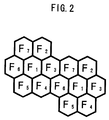
- an applied frequency is divided as shown in Fig. 1, and frequencies are assigned to respective cells as shown in Fig. 2.
- 320 channels 11 1 through 11 320 are assigned within a bandwidth of 8 MHz in which one channel has a frequency range of 25 kHz.
- the 320 channels are grouped into seven channel groups 10 1 through 10 7 .
- the seven channel groups 10 1 through 10 7 correspond to the frequencies used in cells F 1 through F 7 shown in Fig. 2.
- the cell F 1 uses the group 10 1 of frequencies 11 1 through 11 n .
- the cell F 2 uses the group 10 2 of frequencies.
- the cell F 7 uses the group 10 7 of frequencies.
- the frequencies are reused at a constant distance. In this manner, the frequencies are efficiently utilized.
- the conventional mobile communication system is constructed mainly taking into consideration transmissions of voice signals.
- one channel is sufficient to have a frequency of 25 kHz.
- the conventional arrangements shown in Figs. 1 and 2 are not capable of realizing real-time transmissions of video data and a large amount of data in mobile communication systems in the multimedia age.
- QoS quality of service
- a more specific object of the present invention is to provide a time slot assignment method capable of transmitting a large amount of information in mobile communication systems in the multimedia age and providing quality of service appropriate for a variety of needs.
- a time slot assignment method comprising a step of assigning one or a plurality of time slots to each cell so that the respective number of time slots assigned to each cell can be changed.
- the mobile communication system in the multimedia age has a specification such that a bit rate of 4 Mbps is selected when a mobile station is moving and a bit rate of 10 ⁇ 20 Mbps is selected when the mobile station is stationary and that a bandwidth of 100 MHz is assigned.
- Fig. 5A shows a bandwidth of 100 MHz.
- a digital signal stream is divided into time slots assigned to cells, as shown in Fig. 5B.
- a frame of the digital signal stream having the whole bandwidth of 100 MHz may be divided into time slots or may be divided into a plurality of parts, each of which parts is divided into time slots.
- the number of time slots in one frame has m 31 1 ⁇ 31 m in total (m is an integer equal to or greater than 2), and are grouped into, for example, seven time slot groups 30 1 ⁇ 30 7 .
- the seven time slot groups 30 1 ⁇ 30 7 correspond to time slots assigned to cells T 1 ⁇ T 7 shown in Fig. 4, respectively.
- the cell T 1 uses the time slot group 30 1 which are formed by time slots 31 1 ⁇ 31 m
- the cell T 2 uses the time slot group 30 2
- the cell T 7 uses the time slot group 30 7 .
- the time slot groups can be reused so as to be separated at a given distance.
- the time slots can be efficiently utilized.
- the arrangement depicted in Fig. 4 is such that T 1 is located at the center. However, similar arrangements can be illustrated when each of the cells T 2 ⁇ T 7 is located at the center.
- the number of time slot groups is not limited to 7, but an arbitrary number of time slot groups can be selected. For example, three or four time slot groups may be arranged.
- Each cell may be arranged to have a sector structure.
- a microcell may be provided.
- a radio base station of each cell assigned to the respective time slot group assigns a call an idle time slot among the time slots assigned thereto when the above call is initiated.
- the mobile station communicates using the assigned time slot.
- time slot is based on the control of the times of transmission and reception from a reference time. Thus, it is sufficient to merely send and receive signals at the assigned times, so that the time slot assignment can be made easily.
- Each cell is not assigned the fixed number of time slots but is dynamically assigned the number of time slots based on the traffic demand in each cell. Also, the number of time slots may be dynamically assigned to each cell taking into consideration QoS for users.
- QoS indicates the degree of communication service that the users wish to have.
- QoS levels are determined, dependent on, for example, the quality of communications, bit rate and loss of calls.
- the setting of a desired QoS level is performed each time a communication takes place or in accordance with a given contract. The fees may be determined based on the QoS levels.
- QoS information is managed in, for example, radio base stations, channel control stations, and mobile communication switch stations.
- the number of time slots may also be determined taking into account both the traffic demand and QoS.
- the assignment of the number of time slots to each cell may be made in a station which controls channel control stations, or a mobile communication switch station. It is also possible for the base station to autonomously carry out the assignment of the number of time slots by obtaining information concerning other base stations. In other words, there are a first method in which the number of time slots is assigned by an apparatus that is commonly provided to cells, and a second method in which the number of time slots is assigned by an apparatus that is provided in each cell.
- the apparatus commonly provided to cells always monitors the traffic demand in the related cells or QoS for users, and assigns the optimal number of time slots to each cell. It is also possible to assign the optimal number of time slots to each cell by taking into consideration both the traffic demand in the cells and QoS for users.
- each cell performs autonomous distribution control.
- Each of the radio base stations located in the periphery of each cell mutually send traffic information to the other stations, and autonomously assigns the optimal number of time slots.
- One way to make the autonomous assignment is to determine a given number of cells and proportionally distribute all the time slots used in the determined cells in accordance with the traffic demand, so that the optimal number of time slots can be assigned.
- each cell is assigned time slots that can be used.
- the radio base station in each cell assigns idle time slots to each call initiated.
- each time a call is initiated a time slot is assigned the call.
- the second method for assigning a time slot each time a call is initiated may employ either a first process of using a fixed order of assignment of time slots or a second process of assigning a time slot having no interference.
- the first process can discriminate time slots which are liable to cause interference and those which are not liable to cause interference by referring to the state of use of time slots assigned.
- the base station in each cell preferentially assigns the time slots which are not liable to cause interference.
- the order of assignment of time slots is determined with regard to each cell in advance. A time slot among the time slots preferentially assigned is sequentially assigned to a call initiated.
- the second process detects a time slot which does not cause interference when a call is initiated and assigns the time slot thus detected.
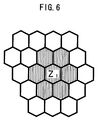
- Each cell is associated with a respective, different range in which interference occurs.
- cell Z 1 shown in Fig. 6 interferes with only the adjacent cells.
- Cell Z 2 shown in Fig. 7 interferes with not only the adjacent cells but also cells Z A and Z B .
- the time slot assignment in the second process may employ a state-of-use table commonly provided to each cell or another state-of-use table provided in the radio base station in each cell.
- Fig. 8 shows such a state-of-use table.
- a reference number 50 represents numbers respectively assigned to time slots, and a reference number 40 represents numbers respectively representing cells.
- a symbol "O" is added to each time slot that is presently in use. Each time slot that is not assigned a symbol "O" is not in use.
- the state-of-use table commonly provided to each cell is referred to at the time of making the time slot assignment, the numbers of all the cells that refer to this table and the state of the time slots in use by these cells are displayed in real time.
- the state-of-use table is created and updated so that the radio base stations of the cells send the state of the time slots in use regularly or each occasion.
- the radio base station in each cell refers to the state-of-use table when a call is initiated, and assigns the call an idle time slot which is not used in the cells which cause interface.
- each radio base station is equipped with a state-of-use table related to cells which interferes with the cell of interest.
- the second state-of-use table is referred to so that an idle time slot can be assigned.
- the above state-of-use table is created and updated in such a manner that the radio base stations of the related cells send the state of the time slots in use regularly at given time intervals or each occasion.
- the radio base station in each cell assigns a time slot which does not cause interference within the assigned number of time slots each time a call is initiated.
- Each cell has one or more time slots for control use (control time slots) in addition to the time slots for voice communication.
- a control of initiating and terminating a call is performed through the time slots for control use.
- the time slots for control use are commonly used by a plurality of cells.
- a mobile station MS makes a call using the control time slot.
- An associated ratio base station BS1 senses the call, and informs the mobile station MS of one time slot, which is one of the time slots assigned to the base station BS1, time slots with comparatively high priority of assignment, or time slots which do not cause interference.
- the mobile station MS uses the assigned time slot (T 1 ) as a channel for communication.
- the mobile station MS communicates with a radio base station BS1 through the time slot T 1 .
- a time slot T 7 is assigned thereto by a radio base station BS7. Then, the mobile station MS communicates through the time slot T 7 .
- the mobile station MS communicates with the radio base station BS1 through the time slot T 1 .
- the time slot before cell change and a time slot of the cell located in the traveling direction are simultaneously used at the interface between the adjacent cells.
- a signal from the other party is concurrently sent by the radio base stations BS1 and BS17.
- the mobile station MS simultaneously communicates with the radio base stations BS1 and BS7.
- the mobile station MS receives the signal having the comparatively high level.
- the mobile station MS can communicate with the radio base station BS7 through only the time slot T7.
- the control of time slots in the radio base stations may be autonomously performed by each base station.
- the control of time slots can be performed by a station which controls channel control stations, and a mobile communication switch station, or an apparatus specifically provided for controlling time slots of the radio base stations.
- the present invention it is possible to provide a time slot assignment method capable of transmitting a large amount of information in mobile communication systems in the multimedia age and providing quality of service appropriate for a variety of needs.
- a new band can be defined by using an idle frequency band.
Landscapes
- Engineering & Computer Science (AREA)
- Computer Networks & Wireless Communication (AREA)
- Signal Processing (AREA)
- Mobile Radio Communication Systems (AREA)
- Time-Division Multiplex Systems (AREA)
- Data Exchanges In Wide-Area Networks (AREA)
Applications Claiming Priority (2)
| Application Number | Priority Date | Filing Date | Title |
|---|---|---|---|
| JP21137899 | 1999-07-26 | ||
| JP11211378A JP2001045546A (ja) | 1999-07-26 | 1999-07-26 | タイムスロット割当て方法 |
Publications (2)
| Publication Number | Publication Date |
|---|---|
| EP1073217A2 true EP1073217A2 (de) | 2001-01-31 |
| EP1073217A3 EP1073217A3 (de) | 2002-01-09 |
Family
ID=16604981
Family Applications (1)
| Application Number | Title | Priority Date | Filing Date |
|---|---|---|---|
| EP00306364A Withdrawn EP1073217A3 (de) | 1999-07-26 | 2000-07-26 | Zeitschlitz Zuteilungsverfahren |
Country Status (3)
| Country | Link |
|---|---|
| EP (1) | EP1073217A3 (de) |
| JP (1) | JP2001045546A (de) |
| CN (1) | CN1180640C (de) |
Cited By (2)
| Publication number | Priority date | Publication date | Assignee | Title |
|---|---|---|---|---|
| KR100542439B1 (ko) * | 2002-12-10 | 2006-01-11 | 한국전자통신연구원 | 비동기 무선 통신 시스템 트래픽 제어 장치의 시간 조각할당 방법 및 이를 저장한 컴퓨터 판독 가능 기록매체 |
| US9844069B2 (en) | 2014-08-07 | 2017-12-12 | Huawei Technologies Co., Ltd. | Dual band adaptive concurrent processing method and apparatus |
Families Citing this family (5)
| Publication number | Priority date | Publication date | Assignee | Title |
|---|---|---|---|---|
| JP2002369235A (ja) | 2001-06-08 | 2002-12-20 | Nec Corp | 移動通信システム、基地局及びそれに用いるパケット送信タイミング制御方法並びにそのプログラム |
| KR100511554B1 (ko) | 2003-09-02 | 2005-08-31 | 한국전자통신연구원 | Ofdma fdd 기반 시스템에서의 순방향 채널 구성방법 및 순방향 채널 할당 방법 |
| CN101098500B (zh) * | 2006-06-30 | 2010-05-12 | 联想(北京)有限公司 | 融合移动通信网络与视频广播网络的通信系统及通信方法 |
| JP2009239749A (ja) * | 2008-03-27 | 2009-10-15 | Kyocera Corp | 割当方法およびそれを利用した基地局装置 |
| JP7795702B2 (ja) * | 2022-03-10 | 2026-01-08 | 岩崎通信機株式会社 | コードレス電話装置の基地局、コードレス電話装置の基地局および子機、およびコードレス電話システムの電話制御装置および基地局 |
Family Cites Families (6)
| Publication number | Priority date | Publication date | Assignee | Title |
|---|---|---|---|---|
| US5497504A (en) * | 1994-05-13 | 1996-03-05 | The Trustees Of Columbia University | System and method for connection control in mobile communications |
| GB2324686B (en) * | 1994-09-30 | 1999-02-10 | Motorola Inc | Method for dynamically allocating wireless communication resources |
| US5790551A (en) * | 1995-11-28 | 1998-08-04 | At&T Wireless Services Inc. | Packet data transmission using dynamic channel assignment |
| JP2000511750A (ja) * | 1997-02-21 | 2000-09-05 | モトローラ・インコーポレイテッド | ワイヤレス通信システムにおいてスペクトル資源を配分するための方法および装置 |
| FI104143B1 (fi) * | 1997-07-31 | 1999-11-15 | Nokia Networks Oy | Menetelmä tietoliikenneresurssien kontrolloimiseksi |
| US6169898B1 (en) * | 1998-07-16 | 2001-01-02 | Nokia Mobile Phones Ltd | Apparatus, and associated method, for maintaining a selected quality of service level in a radio communication system |
-
1999
- 1999-07-26 JP JP11211378A patent/JP2001045546A/ja active Pending
-
2000
- 2000-07-26 CN CNB001219499A patent/CN1180640C/zh not_active Expired - Fee Related
- 2000-07-26 EP EP00306364A patent/EP1073217A3/de not_active Withdrawn
Cited By (2)
| Publication number | Priority date | Publication date | Assignee | Title |
|---|---|---|---|---|
| KR100542439B1 (ko) * | 2002-12-10 | 2006-01-11 | 한국전자통신연구원 | 비동기 무선 통신 시스템 트래픽 제어 장치의 시간 조각할당 방법 및 이를 저장한 컴퓨터 판독 가능 기록매체 |
| US9844069B2 (en) | 2014-08-07 | 2017-12-12 | Huawei Technologies Co., Ltd. | Dual band adaptive concurrent processing method and apparatus |
Also Published As
| Publication number | Publication date |
|---|---|
| EP1073217A3 (de) | 2002-01-09 |
| JP2001045546A (ja) | 2001-02-16 |
| CN1180640C (zh) | 2004-12-15 |
| CN1287456A (zh) | 2001-03-14 |
Similar Documents
| Publication | Publication Date | Title |
|---|---|---|
| US5822678A (en) | CATV network for transport of radio frequency signals | |
| CN1148021C (zh) | 通讯系统及其操作方法 | |
| AU724424B2 (en) | Adaptive channel allocation method and apparatus for multi-slot, multi-carrier communication system | |
| US7486639B2 (en) | Adaptive time division duplexing method and apparatus for dynamic bandwidth allocation within a wireless communication system | |
| CN1132334C (zh) | 在蜂窝网中实现多载波的系统和方法 | |
| RU2110893C1 (ru) | Способ формирования первоначального вызова подвижной станции и распределения каналов для обмена информацией в сотовой системе связи | |
| USRE40715E1 (en) | Method and means for allocating time slots in a TDD system | |
| US6414947B1 (en) | Communication network and method of allocating resource therefor | |
| US7822420B1 (en) | Method and base station for allocating a channel required for a radio transmission | |
| US5835859A (en) | Method for frequency allocation and assignment in wireless communication systems | |
| KR20080044285A (ko) | 동적 스펙트럼 접근 무선 시스템에서의 스펙트럼 관리 | |
| JP2001500687A (ja) | 増大する需要を収容する周波数計画 | |
| KR20010043442A (ko) | 무선 통신 시스템에서 채널을 할당하기 위한 방법 및기지국 시스템 | |
| KR20030084957A (ko) | 무선 코드 분할 다중 접속 통신을 위한 시스템 및 방법 | |
| US6985737B2 (en) | Communication channel setting method, communication controller, and radio communication system | |
| JP2001522567A (ja) | チャネル割り当て方法 | |
| CN1602595A (zh) | Utra tdd时隙分配 | |
| KR100994917B1 (ko) | 무선 통신 시스템, 무선 통신 장치, 및 그 모니터링 방법 | |
| CN1180640C (zh) | 时隙分配方法 | |
| US6845086B1 (en) | Cellular congestion reduction via intracell handover providing fixed and flexible service | |
| JP2002217825A (ja) | 基地局、移動局、無線データ通信システム、無線データ通信網構築方法およびプログラム | |
| JP3545591B2 (ja) | タイムスロット割り当て方法 | |
| EP1063855B1 (de) | System zur asymmetrischen Datenübertragung in einem Funkkommunikationssystem | |
| JP2000032540A (ja) | マルチサ―ビス移動無線通信セルラシステム内で無線資源を割り当てるシステム | |
| JP2002218526A (ja) | 無線チャネル割当て方法、無線基地局装置および移動局装置 |
Legal Events
| Date | Code | Title | Description |
|---|---|---|---|
| PUAI | Public reference made under article 153(3) epc to a published international application that has entered the european phase |
Free format text: ORIGINAL CODE: 0009012 |
|
| 17P | Request for examination filed |
Effective date: 20000825 |
|
| AK | Designated contracting states |
Kind code of ref document: A2 Designated state(s): AT BE CH CY DE DK ES FI FR GB GR IE IT LI LU MC NL PT SE Kind code of ref document: A2 Designated state(s): DE FR GB IT SE |
|
| AX | Request for extension of the european patent |
Free format text: AL;LT;LV;MK;RO;SI |
|
| PUAL | Search report despatched |
Free format text: ORIGINAL CODE: 0009013 |
|
| AK | Designated contracting states |
Kind code of ref document: A3 Designated state(s): AT BE CH CY DE DK ES FI FR GB GR IE IT LI LU MC NL PT SE |
|
| AX | Request for extension of the european patent |
Free format text: AL;LT;LV;MK;RO;SI |
|
| AKX | Designation fees paid |
Free format text: DE FR GB IT SE |
|
| 17Q | First examination report despatched |
Effective date: 20060926 |
|
| STAA | Information on the status of an ep patent application or granted ep patent |
Free format text: STATUS: THE APPLICATION IS DEEMED TO BE WITHDRAWN |
|
| 18D | Application deemed to be withdrawn |
Effective date: 20080129 |