EP1073236A2 - Procédé de gestion des connexions d'une interface numérique - Google Patents
Procédé de gestion des connexions d'une interface numérique Download PDFInfo
- Publication number
- EP1073236A2 EP1073236A2 EP00306325A EP00306325A EP1073236A2 EP 1073236 A2 EP1073236 A2 EP 1073236A2 EP 00306325 A EP00306325 A EP 00306325A EP 00306325 A EP00306325 A EP 00306325A EP 1073236 A2 EP1073236 A2 EP 1073236A2
- Authority
- EP
- European Patent Office
- Prior art keywords
- point
- connection
- break
- point connection
- plug
- Prior art date
- Legal status (The legal status is an assumption and is not a legal conclusion. Google has not performed a legal analysis and makes no representation as to the accuracy of the status listed.)
- Granted
Links
Images

Classifications
-
- H—ELECTRICITY
- H04—ELECTRIC COMMUNICATION TECHNIQUE
- H04N—PICTORIAL COMMUNICATION, e.g. TELEVISION
- H04N21/00—Selective content distribution, e.g. interactive television or video on demand [VOD]
- H04N21/40—Client devices specifically adapted for the reception of or interaction with content, e.g. set-top-box [STB]; Operations thereof
- H04N21/43—Processing of content or additional data, e.g. demultiplexing additional data from a digital video stream; Elementary client operations, e.g. monitoring of home network or synchronising decoder's clock; Client middleware
- H04N21/436—Interfacing a local distribution network, e.g. communicating with another STB or one or more peripheral devices inside the home
- H04N21/4363—Adapting the video stream to a specific local network, e.g. a Bluetooth® network
- H04N21/43632—Adapting the video stream to a specific local network, e.g. a Bluetooth® network involving a wired protocol, e.g. IEEE 1394
-
- H—ELECTRICITY
- H04—ELECTRIC COMMUNICATION TECHNIQUE
- H04L—TRANSMISSION OF DIGITAL INFORMATION, e.g. TELEGRAPHIC COMMUNICATION
- H04L9/00—Cryptographic mechanisms or cryptographic arrangements for secret or secure communications; Network security protocols
- H04L9/40—Network security protocols
-
- H—ELECTRICITY
- H04—ELECTRIC COMMUNICATION TECHNIQUE
- H04N—PICTORIAL COMMUNICATION, e.g. TELEVISION
- H04N21/00—Selective content distribution, e.g. interactive television or video on demand [VOD]
- H04N21/40—Client devices specifically adapted for the reception of or interaction with content, e.g. set-top-box [STB]; Operations thereof
- H04N21/43—Processing of content or additional data, e.g. demultiplexing additional data from a digital video stream; Elementary client operations, e.g. monitoring of home network or synchronising decoder's clock; Client middleware
- H04N21/442—Monitoring of processes or resources, e.g. detecting the failure of a recording device, monitoring the downstream bandwidth, the number of times a movie has been viewed, the storage space available from the internal hard disk
- H04N21/44227—Monitoring of local network, e.g. connection or bandwidth variations; Detecting new devices in the local network
Definitions
- the present invention relates to a connection managing method of a digital interface for performing connection management between digital devices connected through the digital interface, and more particularly, to a connection managing method of a digital interface which, when a point-to-point connection is established among digital devices connected through a digital interface such as the IEEE 1394, enables the concerned device of the point-to-point connection to release this connection.
- a plurality of digital devices can be interconnected through a digital interface which conforms to an interface standard such as the IEEE 1394 standard, and a connection managing method between those digital devices is prescribed in the International Electrotechnical Commission (IEC) 61883 standard.
- IEC 61883 standard input and output plugs are defined for each digital device as the entry of an incoming bit stream and the exit of an outgoing bit stream, respectively. Further, the input and output plugs are controlled by managing registers such as an output master plug register (oMPR), an output plug control register (oPCR), an input master plug register (iMPR), and an input plug control register (iPCR), so that management of a connection between digital devices can be performed.
- IEC 61883 input and output plugs are defined for each digital device as the entry of an incoming bit stream and the exit of an outgoing bit stream, respectively. Further, the input and output plugs are controlled by managing registers such as an output master plug register (oMPR), an output plug control register (oPCR), an input master plug register (iMPR), and an
- a point-to-point connection which is a kind of connection made among such digital devices, consists of an output plug, an input plug, and a channel therebetween.
- the connection it is defined that an arbitrary device can establish or overlay the connection and that only a device which establishes the connection can break the connection.
- Establishment or release of the point-to-point connection is performed by managing registers such as oMPR, oPCR, iMPR, and iPCR.
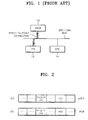
- Figure 1 is a diagram for explaining a conventional connection managing method.
- Figure 2 shows connection related fields of oPCR and iPCR used in the IEC 61883 standard.
- a point-to-point connection is established among a DVCR 10, a first DTV 12, and a second DTV 14 by an IEEE 1394 interface.
- an output plug control register oPCR shown in (a) and an input plug control register iPCR shown in (b) include the connection related fields P-2-Pcnt and nCh, respectively.
- a point-to-point connection of the DVCR 10 and the first DTV 12 is said to be established.
- the IEEE 1394 modules of the DVCR 10 and the first DTV 12 are controlled by a connection establishment information denoting the connection establishment state of such point-to-point connection, thereby allowing the first DTV 12 to receive and see the output content of the DVCR 10.
- the second DTV 14 When a connection is established between the DVCR 10 and the first DTV as described above, if the second DTV 14 is to monitor the output content of the DVCR 10, which is a sink device, the second DTV 14 attempts to establish a point-to-point connection or broadcast-in connection with the DVCR 10 by overlaying the connection on the already established point-to-point connection between the DVCR 10 and the first DTV 12.
- the second DTV 14 controls its own IEEE 1394 module according to such information, which allows it to receive and see the output content of the DVCR 10.
- a point-to-point connection between DVCR 10 and the first DTV 12 can be released by the first DTV 12.
- a connection managing method of a digital interface for example, if a third party device establishes a point-to-point connection between first and second devices, the connection cannot be released by any device other than the third party device.
- the first DTV 12 which is the concerned connected device, attempts to connect an input plug used in the connection to another device, since the input plug is already point-to-point connected to the DVCR 10, the first DTV 12 cannot break the connection so long as the second DTV 14 does not do so.
- the first DTV 12 encounters a problem in that a considerable part of its operation depends on the operation of the second DTV 14.
- the second DTV 14 does not operate as desired by the first DTV 12, the second DTV 14 cannot perform its own desired operation.
- D-VHS digital-video home system
- DTV digital versatile disk
- DVD digital versatile disk
- the DTV In order to perform the operation, the DTV must break a point-to point connection between its own input plug and D-VHS's output plug to thereafter establish a new connection between its own input plug and DVD's output plug.
- the DTV since the point-to-point connection is established by the D-VHS, the DTV has no authority to break the connection. Thus, the user's request to watch DVD on the DTV screen is not satisfied.
- a connection managing method of a digital interface according to the conventional art, for example, it creates much inconvenience in that the concerned connected device cannot break the connection.
- connection managing method of a digital interface in which, when a point-to-point connection is established among digital devices interconnected through a digital interface such as IEEE 1394, the concerned device of the point-to-point connection can break the connection.
- the present invention provides a connection managing method of a digital interface for performing connection management on a plurality of devices which are point-to-point connected by a digital interface, the method including the steps of (a) a second device, which establishes a point-to-point connection between an arbitrary first device and another device, receiving a connection release request command requesting the second device to break the point-to-point connection from the first device; and (b) the second device breaking the point-to-point connection in response to the connection release request command.
- the method preferably includes, prior to the step (b), the step of (p-b-1) the second device analyzing the connection release request command to determine whether the point-to-point connection is a point-to-point connection previously established by itself.
- the step (b) here preferably includes the step of (b') if it is determined that the point-to-point connection is a point-to-point connection previously established by the second device, the second device breaking the point-to-point connection.
- the step (b') preferably includes the steps of (b'-1) if it is determined that the point-to-point connection is a point-to-point connection previously established by the second device, a user determining whether to break the point-to-point connection by the second device; (b'-2) if the user determines to break the connection in the step (b'-1), the second device breaking the point-to-point connection established between the first device and another device; and (b'-3) if the user determines not to break the connection in the step (b'-1), the second device maintaining the point-to-point connection established between the first device and another device.
- the step (b'-1) preferably includes the steps of (b'-1-1) if the point-to-point connection is determined to be a point-to-point connection previously established by the second device, the second device indicating whether to break the point-to-point connection on a predetermined display device, and (b'-1-2) the second device receiving a determination on whether to break the point-to-point connection by the second device from the user.
- the connection release request command preferably includes a plug type field which indicates the plug type of the first device in the presently established point-to-point connection, and a plug identification field which indicates the plug identifier of the first device as an operand.
- the connection release request command is preferably an audio-video control command defined within an audio-video control command transaction set, and the digital interface preferably conforms to the IEEE 1394 standard.
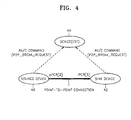
- a point-to-point connection is made between a source device 40 and a sink device 42 through an output plug No. ID 2 of the source device 40 and an input plug ID No. 5 of the sink device 42.
- the point-to-point connection is established by a device EST 44. If a user determines that a source device 40 desires to break the point-to-point connection (step 300), the source device 40 sends the device EST 44, which establishes the point-to-point connection, a command P2P_Break_Request requesting another device to break a point-to-point connection to which the source device 40 is currently connected (step 302).
- the command P2P_Break_Request uses an audio-video control (AV/C) command defined in an AV/C command transaction set (AV/C CTS). Furthermore, the AV/C command includes a plug type field indicating whether the plug is an output or input plug, and a plug identification (ID) denoting a plug identifier as an operand.
- AV/C audio-video control
- ID plug identification
- the plug type field is established in such a way as to indicate an output plug OUTPUT_PLUG corresponding to the plug type of the source device 40 in the currently established point-to-point connection.
- the plug ID field is established in such a way as to indicate 2 corresponding to the plug identifier of the source device 40 in the currently established point-to-point connection.
- the source device 40 requests the device EST 44, which establishes the point-to-point connection, to release the point-to-point connection, using the command P2P_Break_Request which is supposed to demand a break in the point-to-point connection to which the source device 40 is currently related.
- the device EST 44 analyzes the AV/C command P2P_Break_Reqeust (step 304). Then, the device EST 44 determines whether the point-to-point connection is a point-to-point connection previously established by itself, based on the result of analysis made in the step 304 (step 306). If it is determined that the point-to-point connection is a point-to-point connection previously established by itself in the step 306, the device EST 44 indicates whether to break the connection or not, in a display device such as an on screen display (OSD) (step 308). The user determines whether he or she will break the connection according to the indication on the display device (step 310).
- OSD on screen display
- the device EST 44 which established the point-to-point connection, breaks the point-to-point connection established between the source device 40 and the sink device 42 (step 312).
- the device EST 44 maintains the point-to-point connection between the source device 40 and the sink device 42 (step 314).
- the sink device 42 requests the device EST 44 to release the point-to-point connection, using the command P2P_Break_Request which is supposed to demand a break in the point-to-point connection to which the source device 40 is currently related.
- the device EST analyzes the plug type and plug ID to determine whether or not the point-to-point connection is a point-to-point connection previously established by itself. If it is determined that the point-to-point connection is a point-to-point connection previously established by itself, the device EST 44 indicates whether or not to break the connection, and the user determines whether he or she will break the connection depending on the indication on the display device.
- the device EST 44 which previously established the point-to-point connection, breaks the point-to-point connection established between the source device 40 and the sink device 42 (step 312). On the other hand, if the user does not choose to break the connection ((2)), the device EST 44 maintains the point-to-point connection between the source device 40 and the sink device 42 (step 314).
- connection managing method of the digital interface described above if a plurality of devices are connected through a point-to-point connection, the concerned device of the point-to-point connection can break the connection. Accordingly, since a point-to-point connection can be released at the request of a device other than the device which establishes the connection, efficiency of connection management can be enhanced.
- the above method may be embodied as a computer program which can be executed on a computer including a microprocessor or processor.
- the program can be stored in a recording medium such as a magnetic recording medium or an optical recording medium.
- the program can be held in a memory such as read-only memory (ROM) or flash memory.
- the program can be scattered within the devices connected by a digital interface to be stored and executed thereon.
- a flash memory in which a program for implementing the above method is stored, and a microprocessor, which reads out the program from the flash memory to execute it, constitute a firmware for performing a control operation on devices connected to a digital interface. Further, the control operation performed by a firmware acts as a software such as a protocol performed between devices linking through a digital interface, as understood by a person skilled in the art.
- a connection managing method of a digital interface enables the concerned device of the point-to-point connection to break the connection, thereby allowing for enhanced connection management efficiency.
Landscapes
- Engineering & Computer Science (AREA)
- Computer Networks & Wireless Communication (AREA)
- Signal Processing (AREA)
- Computer Security & Cryptography (AREA)
- Multimedia (AREA)
- Databases & Information Systems (AREA)
- Two-Way Televisions, Distribution Of Moving Picture Or The Like (AREA)
- Communication Control (AREA)
- Small-Scale Networks (AREA)
Applications Claiming Priority (2)
| Application Number | Priority Date | Filing Date | Title |
|---|---|---|---|
| KR9930339 | 1999-07-26 | ||
| KR9930339 | 1999-07-26 |
Publications (3)
| Publication Number | Publication Date |
|---|---|
| EP1073236A2 true EP1073236A2 (fr) | 2001-01-31 |
| EP1073236A3 EP1073236A3 (fr) | 2003-10-01 |
| EP1073236B1 EP1073236B1 (fr) | 2005-08-31 |
Family
ID=19604568
Family Applications (1)
| Application Number | Title | Priority Date | Filing Date |
|---|---|---|---|
| EP00306325A Expired - Lifetime EP1073236B1 (fr) | 1999-07-26 | 2000-07-25 | Procédé de gestion des connexions d'une interface numérique |
Country Status (6)
| Country | Link |
|---|---|
| EP (1) | EP1073236B1 (fr) |
| JP (1) | JP3447675B2 (fr) |
| KR (1) | KR100644560B1 (fr) |
| CN (1) | CN1129271C (fr) |
| CA (1) | CA2314424C (fr) |
| DE (1) | DE60022277T2 (fr) |
Cited By (1)
| Publication number | Priority date | Publication date | Assignee | Title |
|---|---|---|---|---|
| EP1487164A2 (fr) * | 2003-05-16 | 2004-12-15 | Pioneer Corporation | Dispositif, méthode, programme et médium d'enregistrement pour la communication où la légalité d'une requête de déconnexion est jugée |
Families Citing this family (2)
| Publication number | Priority date | Publication date | Assignee | Title |
|---|---|---|---|---|
| KR100607933B1 (ko) * | 1999-07-26 | 2006-08-03 | 삼성전자주식회사 | 디지털 인터페이스의 연결 관리방법 |
| JP2001237862A (ja) * | 2000-02-21 | 2001-08-31 | Sony Corp | 情報処理装置および方法、並びに記録媒体 |
Family Cites Families (1)
| Publication number | Priority date | Publication date | Assignee | Title |
|---|---|---|---|---|
| KR100259768B1 (ko) * | 1997-12-17 | 2000-06-15 | 이계철 | 분산 노드 환경에서 점대점 프로토콜 및 다중링크 프로토콜을이용한 서비스 처리 방법 |
-
1999
- 1999-07-26 KR KR1019990030339A patent/KR100644560B1/ko not_active Expired - Fee Related
-
2000
- 2000-07-18 CN CN00120143A patent/CN1129271C/zh not_active Expired - Fee Related
- 2000-07-25 JP JP2000224525A patent/JP3447675B2/ja not_active Expired - Fee Related
- 2000-07-25 EP EP00306325A patent/EP1073236B1/fr not_active Expired - Lifetime
- 2000-07-25 DE DE60022277T patent/DE60022277T2/de not_active Expired - Fee Related
- 2000-07-25 CA CA002314424A patent/CA2314424C/fr not_active Expired - Fee Related
Non-Patent Citations (2)
| Title |
|---|
| ALFONZETTI S ET AL: "A FORMAL DESCRIPTION OF THE DTE PACKET LEVEL IN THE X.25 RECOMMENDATION" ALTA FREQUENZA, UFFICIO CENTRALE AEI-CEI. MILANO, IT, vol. 48, no. 4, August 1979 (1979-08), pages 513-522, XP000813194 * |
| PRINTER WORKING GROUP C (PWG-C) ET AL: "PWG-C proposal to the 1394 Trade Association AV WG: AV/C Managed Asynchronous Serial Bus Connections" 1394 TRADE ASSOCIATION, 7 July 1998 (1998-07-07), XP002215801 Retrieved from the Internet: <URL:http://www.pima.net/standards/it10/me mbers/asynchan_proposal.pdf> [retrieved on 2002-10-04] * |
Cited By (2)
| Publication number | Priority date | Publication date | Assignee | Title |
|---|---|---|---|---|
| EP1487164A2 (fr) * | 2003-05-16 | 2004-12-15 | Pioneer Corporation | Dispositif, méthode, programme et médium d'enregistrement pour la communication où la légalité d'une requête de déconnexion est jugée |
| US7420930B2 (en) | 2003-05-16 | 2008-09-02 | Pioneer Corporation | Communication apparatus, communication method, communication program and information recording medium having the program recorded thereon |
Also Published As
| Publication number | Publication date |
|---|---|
| CA2314424C (fr) | 2005-03-29 |
| CA2314424A1 (fr) | 2001-01-26 |
| JP3447675B2 (ja) | 2003-09-16 |
| JP2001069158A (ja) | 2001-03-16 |
| KR100644560B1 (ko) | 2006-11-13 |
| DE60022277D1 (de) | 2005-10-06 |
| DE60022277T2 (de) | 2006-01-26 |
| EP1073236A3 (fr) | 2003-10-01 |
| EP1073236B1 (fr) | 2005-08-31 |
| KR20010011114A (ko) | 2001-02-15 |
| CN1282031A (zh) | 2001-01-31 |
| CN1129271C (zh) | 2003-11-26 |
Similar Documents
| Publication | Publication Date | Title |
|---|---|---|
| US7659940B2 (en) | Apparatus and method for improved device interoperability | |
| JP5036098B2 (ja) | ディジタルバスを介して周辺電子装置を制御するディジタルテレビジョン装置 | |
| US8817812B2 (en) | Method of controlling connection between nodes in digital interface | |
| KR100553867B1 (ko) | Ieee 1394 버스로 연결된 네트워크에서의 버스 리셋 처리방법 | |
| EP1073236B1 (fr) | Procédé de gestion des connexions d'une interface numérique | |
| US6842814B1 (en) | Method for managing a digital interface connection | |
| US7042896B1 (en) | Method for managing a digital interface connection | |
| US6606712B1 (en) | Electronic device and power source control method | |
| KR100346683B1 (ko) | Ieee1394를지원하는컴퓨터에서의주변기기연결장치및그방법 | |
| US7903686B2 (en) | Connected device to be connected to an IEEE 1394 serial bus | |
| GB2354916A (en) | Connection management between digital devices | |
| KR20030043996A (ko) | 무선 링크를 포함하는 네트워크에서 등시성 자원을예약하는 방법 | |
| KR100607933B1 (ko) | 디지털 인터페이스의 연결 관리방법 | |
| JP3471589B2 (ja) | 接続状況送信装置及び接続状況表示方法 | |
| KR100561389B1 (ko) | 디지털 인터페이스 연결 관리 방법 | |
| JP2006217236A (ja) | データ通信処理装置 | |
| JP2003333046A (ja) | 信号処理システム及び通信制御方法 |
Legal Events
| Date | Code | Title | Description |
|---|---|---|---|
| PUAI | Public reference made under article 153(3) epc to a published international application that has entered the european phase |
Free format text: ORIGINAL CODE: 0009012 |
|
| 17P | Request for examination filed |
Effective date: 20000802 |
|
| AK | Designated contracting states |
Kind code of ref document: A2 Designated state(s): AT BE CH CY DE DK ES FI FR GB GR IE IT LI LU MC NL PT SE |
|
| AX | Request for extension of the european patent |
Free format text: AL;LT;LV;MK;RO;SI |
|
| RIN1 | Information on inventor provided before grant (corrected) |
Inventor name: KIM, DO-HYOUNG, C/O SAMSUNG ELECTRONICS CO. LTD Inventor name: SEONG, GOAN-SOO |
|
| PUAL | Search report despatched |
Free format text: ORIGINAL CODE: 0009013 |
|
| AK | Designated contracting states |
Kind code of ref document: A3 Designated state(s): AT BE CH CY DE DK ES FI FR GB GR IE IT LI LU MC NL PT SE |
|
| AX | Request for extension of the european patent |
Extension state: AL LT LV MK RO SI |
|
| RIC1 | Information provided on ipc code assigned before grant |
Ipc: 7H 04L 12/28 A Ipc: 7H 04L 12/64 B Ipc: 7H 04L 29/06 B Ipc: 7H 04L 12/24 B Ipc: 7H 04N 7/24 B |
|
| 17Q | First examination report despatched |
Effective date: 20031216 |
|
| AKX | Designation fees paid |
Designated state(s): DE FR GB |
|
| GRAP | Despatch of communication of intention to grant a patent |
Free format text: ORIGINAL CODE: EPIDOSNIGR1 |
|
| GRAS | Grant fee paid |
Free format text: ORIGINAL CODE: EPIDOSNIGR3 |
|
| GRAA | (expected) grant |
Free format text: ORIGINAL CODE: 0009210 |
|
| AK | Designated contracting states |
Kind code of ref document: B1 Designated state(s): DE FR GB |
|
| REG | Reference to a national code |
Ref country code: GB Ref legal event code: FG4D |
|
| REF | Corresponds to: |
Ref document number: 60022277 Country of ref document: DE Date of ref document: 20051006 Kind code of ref document: P |
|
| ET | Fr: translation filed | ||
| PLBE | No opposition filed within time limit |
Free format text: ORIGINAL CODE: 0009261 |
|
| STAA | Information on the status of an ep patent application or granted ep patent |
Free format text: STATUS: NO OPPOSITION FILED WITHIN TIME LIMIT |
|
| 26N | No opposition filed |
Effective date: 20060601 |
|
| PGFP | Annual fee paid to national office [announced via postgrant information from national office to epo] |
Ref country code: DE Payment date: 20080807 Year of fee payment: 9 |
|
| PGFP | Annual fee paid to national office [announced via postgrant information from national office to epo] |
Ref country code: FR Payment date: 20080718 Year of fee payment: 9 |
|
| PGFP | Annual fee paid to national office [announced via postgrant information from national office to epo] |
Ref country code: GB Payment date: 20080806 Year of fee payment: 9 |
|
| GBPC | Gb: european patent ceased through non-payment of renewal fee |
Effective date: 20090725 |
|
| REG | Reference to a national code |
Ref country code: FR Ref legal event code: ST Effective date: 20100331 |
|
| PG25 | Lapsed in a contracting state [announced via postgrant information from national office to epo] |
Ref country code: FR Free format text: LAPSE BECAUSE OF NON-PAYMENT OF DUE FEES Effective date: 20090731 |
|
| PG25 | Lapsed in a contracting state [announced via postgrant information from national office to epo] |
Ref country code: GB Free format text: LAPSE BECAUSE OF NON-PAYMENT OF DUE FEES Effective date: 20090725 |
|
| PG25 | Lapsed in a contracting state [announced via postgrant information from national office to epo] |
Ref country code: DE Free format text: LAPSE BECAUSE OF NON-PAYMENT OF DUE FEES Effective date: 20100202 |