EP1073268A2 - Bildseitenverhältniskonverter - Google Patents
Bildseitenverhältniskonverter Download PDFInfo
- Publication number
- EP1073268A2 EP1073268A2 EP00106725A EP00106725A EP1073268A2 EP 1073268 A2 EP1073268 A2 EP 1073268A2 EP 00106725 A EP00106725 A EP 00106725A EP 00106725 A EP00106725 A EP 00106725A EP 1073268 A2 EP1073268 A2 EP 1073268A2
- Authority
- EP
- European Patent Office
- Prior art keywords
- aspect ratio
- image
- image signal
- horizontal scanning
- scanning period
- Prior art date
- Legal status (The legal status is an assumption and is not a legal conclusion. Google has not performed a legal analysis and makes no representation as to the accuracy of the status listed.)
- Ceased
Links
Images


Classifications
-
- H—ELECTRICITY
- H04—ELECTRIC COMMUNICATION TECHNIQUE
- H04N—PICTORIAL COMMUNICATION, e.g. TELEVISION
- H04N7/00—Television systems
- H04N7/01—Conversion of standards, e.g. involving analogue television standards or digital television standards processed at pixel level
- H04N7/0117—Conversion of standards, e.g. involving analogue television standards or digital television standards processed at pixel level involving conversion of the spatial resolution of the incoming video signal
- H04N7/0122—Conversion of standards, e.g. involving analogue television standards or digital television standards processed at pixel level involving conversion of the spatial resolution of the incoming video signal the input and the output signals having different aspect ratios
Definitions
- the present invention relates to an image aspect ratio converting apparatus for converting an image material having an aspect ratio of 4:3 such as NTSC, PAL or SECAM to a wide image material having a different aspect ratio (e.g., an image material of a high vision having an aspect ratio of 16:9 and 480i). More particularly, it relates to an aspect ratio converting apparatus which performs the image processing of both ends in the horizontal direction of the wide image material obtained by the conversion.
- an image aspect ratio converting apparatus for converting an image material having an aspect ratio of 4:3 such as NTSC, PAL or SECAM to a wide image material having a different aspect ratio (e.g., an image material of a high vision having an aspect ratio of 16:9 and 480i). More particularly, it relates to an aspect ratio converting apparatus which performs the image processing of both ends in the horizontal direction of the wide image material obtained by the conversion.
- a screen aspect ratio is 4:3, but in a high vision, a transversely prolonged wide screen is used in which the screen aspect ratio is set to 16:9.
- the widening of this television screen is indispensable to regenerate an image more powerful than ever and to provide the feeling of realism.
- television sets with a transversely long screen size (16:9) have actually been manufactured and spread.
- a still image material having an aspect ratio of 4:3 is converted, to a still image material having a wide aspect ratio (e.g., 16:9) so as to regenerate a similarly powerful image on a wide television screen.
- a wide aspect ratio e.g. 16:9
- the present invention has been developed in consideration of the above-described situations, and an object thereof is to provide an image aspect ratio converting apparatus in which when an image material having an aspect ratio of 4:3 is outputted as it is to a screen having a wide aspect ratio, the image material can be converted to the image material having a wide aspect ratio while a natural property is held.
- an image aspect ratio converting apparatus comprising: aspect ratio converting means for converting an image signal having an aspect ratio of 4:3 to an image signal having a predetermined wide aspect ratio; image extracting means for extracting a predetermined amount of a left end image and a predetermined amount of a right end image of a horizontal scanning period of the image signal having an aspect ratio of 4:3; and extrapolating means for using the extracted predetermined amount of the left end image to extrapolate a region of from the left end of the horizontal scanning period of the image signal having an aspect ratio of 4:3 to the left end of the horizontal scanning period of the image signal having the wide aspect ratio, and for using the extracted predetermined amount of the right end image to extrapolate a region of from the right end of the horizontal scanning period of the image signal having an aspect ratio of 4:3 to the right end of the horizontal scanning period of the still image signal having the wide aspect ratio.
- the extrapolation is performed for a region of from the left end of the horizontal scanning period of the image signal having an aspect ratio of 4:3 to the left end of the horizontal scanning period of the image signal having the wide aspect ratio, and a region of from the right end of the horizontal scanning period of the image signal having an aspect ratio of 4:3 to the right end of the horizontal scanning period of the image signal having the wide aspect ratio.
- the image material having an aspect ratio of 4:3 can be converted to the image material having the wide aspect ratio while the natural property is held.
- the extrapolating means repeatedly applies one to several samples of images generated from the extracted predetermined amount of the left end image to the region of from the left end of the horizontal scanning period of the image signal having an aspect ratio of 4:3 to the left end of the horizontal scanning period of the image signal having the wide aspect ratio, and repeatedly applies one to several samples of images generated from the extracted predetermined amount of right end image to the region of from the right end of the horizontal scanning period of the image signal having an aspect ratio of 4:3 to the right end of the horizontal scanning period of the image signal having the wide aspect ratio.
- the extrapolation of both the left and right ends can be performed by repeatedly applying the same image.
- the extrapolating means extrapolates the region of from the left end of the horizontal scanning period of the image signal having an aspect ratio of 4:3 to the left end of the horizontal scanning period of the image signal having the wide aspect ratio with an image so generated from the extracted predetermined amount of the left end image as to have a monotonously decreased gradation property, and extrapolates the region of from the right end of the horizontal scanning period of the image signal having an aspect ratio of 4:3 to the right end of the horizontal scanning period of the image signal having the wide aspect ratio with an image so generated from the extracted predetermined amount of the right end image as to have a monotonously decreased gradation property.
- the gradation property comprises at least one of luminance, hue, and ⁇ property.
- the gradation property can be changed to thereby extrapolate both the left and right ends.
- the extrapolating means extrapolates the region of from the left end of the horizontal scanning period of the image signal having an aspect ratio of 4:3 to the left end of the horizontal scanning period of the image signal having the wide aspect ratio with an image so generated from the extracted predetermined amount of left end image as to have a gradually increased defocus amount, and extrapolates the region of from the right end of the horizontal scanning period of the image signal having an aspect ratio of 4:3 to the right end of the horizontal scanning period of the image signal having the wide aspect ratio with an image so generated from the extracted predetermined amount of right end image as to have a gradually increased defocus amount.
- the defocus amount of the image can be changed to thereby extrapolate both the left and right ends.
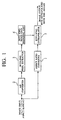
- Fig.1 shows the configuration of an image aspect ratio converting apparatus according to an embodiment of the present invention.
- the image aspect ratio converting apparatus is provided with an aspect ratio converter 1 and an A/D converter 2 which receive image inputs, a both-end pixel extractor 3 for receiving an output of A/D converter 2, a both-wing image data preparing unit 4 for receiving an output of both-end pixel extractor 3, and a both-wing extrapolator 5 for receiving outputs of aspect ratio converter 1 and both-wing image data preparing unit 4 and outputting an extrapolated image.
- the aspect ratio converter 1 corresponds to the aspect ratio converting means; mainly the both-end pixel extractor 3 corresponds to the image extracting means; and the both-wing image data preparing unit 4 and both-wing extrapolator 5 entirely correspond to the extrapolating means.
- the image signal of a still image material having an aspect ratio of 4:3, such as NTSC, PAL and SECAM is inputted.
- the description is made on the assumption that the image signal is NTSC.
- the still image material having the wide aspect ratio to be outputted is described here as the still image material having an aspect ratio of 16:9, but the description may similarly be made even when another still image material such as 480i is obtained.
- the aspect ratio converter 1 is, for example, an NTSC/high vision up-converter.
- the aspect ratio converter 1 converts the inputted NTSC image signal from an aspect ratio of 4:3 to 16:9, and sends an output thereof to the both-wing extrapolator 5.
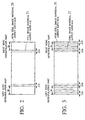
- a wide still image material 20 having a converted wide aspect ratio of 16:9 corresponds to a still image material 21, having an aspect ratio of 4:3, whose ends are both extended.
- gaps between both ends of the still image material 21 and both ends of the wide still image material 20 are extrapolated.
- the right-side gap is referred to as a right wing extrapolation part Hr
- a left-side gap is referred to as a left wing extrapolation part Hl.
- the both-end pixel extractor 3 extracts one to several samples ( ⁇ Sr, ⁇ Sl) of pixels in the vicinity of both ends of the still image material 21 shown in Fig.2, and sends the extracted samples to the both-wing image data preparing unit 4.
- the both-wing image data preparing unit 4 computes image data to extrapolate the right wing extrapolation part Hr and left wing extrapolation part Hl shown in Fig.2 based on the obtained pixels as described later, and sends the computed image data to the both-wing extrapolator 5.
- the both-wing extrapolator 5 inserts and synthesizes desirable image data computed by the both-wing extrapolator 5 to the right wing extrapolation part Hr and left wing extrapolation part Hl in the wide still image material 20 converted by the aspect ratio converter 1, and outputs the still image material having a wide aspect ratio of 16:9 in which both wing images have been extrapolated.
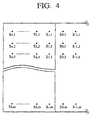
- the both-wing image data preparing unit 4 obtains several samples ⁇ Sl of pixels in the vicinity of the left end of the still image material 21 from the both-end pixel extractor 3, computes several samples ⁇ Sl' of image data to be successively repeatedly applied to the left wing extrapolation part Hl, and sends the computed several samples ⁇ Sl' to the both-wing extrapolator 5.
- ⁇ Sl ⁇ Sl' .
- the both-wing image data preparing unit 4 obtains several samples ⁇ Sr of pixels in the vicinity of the right end of the still image material 21 having an aspect ratio of 4:3 from the both-end pixel extractor 3, computes several samples ⁇ Sr' of image data to be successively repeatedly applied to the right wing extrapolation part Hr, and sends the computed several samples ⁇ Sr' to the both-wing extrapolator 5.
- ⁇ Sr ⁇ Sr' .
- the similar technique may be used even when three samples are repeated.
- the extrapolation of the right end part may be performed in the same technique as that of the left end part.
- the both-wing extrapolator 5 successively and repeatedly applies several samples ⁇ Sl' of image data to the left wing extrapolation part Hl, and successively and repeatedly applies several samples ⁇ Sr' of image data to the right wing extrapolation part Hr, so that the left wing extrapolation part Hl and right wing extrapolation part Hr of the wide still image material 20 are extrapolated.
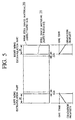
- the both-wing image data preparing unit 4 obtains several samples ⁇ Sl of pixels in the vicinity of the left end of the still image material 21 from the both-end pixel extractor 3, computes image data whose gradation property (luminance level, hue, ⁇ property, and the like, the same will apply to the following) monotonously decreases in the left wing extrapolation part Hl as shown in the following equation (3), and sends the computed image data to the both-wing extrapolator 5.
- gradation property luminance level, hue, ⁇ property, and the like, the same will apply to the following
- the both-wing image data preparing unit 4 obtains several samples ⁇ Sr of pixels in the vicinity of the right end of the still image material 21 from the both-end pixel extractor 3, computes image data whose gradation property monotonously decreases in the right wing extrapolation part Hr as shown in the following equation (3), and sends the computed image data to the both-wing extrapolator 5.
- the equation (3) can similarly be applied simply by changing the luminance to the hue or the ⁇ property in the equation.
- the both-wing extrapolator 5 applies the image data computed for the left wing extrapolation part Hl and having the monotonously decreasing gradation property to the left wing extrapolation part Hl, and applies the image data computed for the right wing extrapolation part Hr and having the monotonously decreasing gradation property to the right wing extrapolation part Hr, to extrapolate the left wing extrapolation part Hl and right wing extrapolation part Hr of the wide still image material 20.
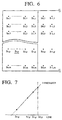
- Fig.5 shows an example of using a linear function conversion table as shown in Fig.7 to compute the linearly decreasing image data, but alternatively, for example, a sine function conversion table may be used to compute the image data decreasing in a sine curve manner.
- the both-wing image data preparing unit 4 obtains several samples ⁇ Sl of pixels in the vicinity of the left end of the still image material 21 from the both-end pixel extractor 3, gradually increases defocus amount in accordance with the defocus level of the obtained several samples ⁇ Sl so as to compute image data which can be extrapolated from the left end of the still image material 21 to the left end of the wide still image material 20 in the left wing extrapolation part Hl, and sends the computed image data to the both-wing extrapolator 5.
- the defocus amount means the deviation amount of focus of image.
- the both-wing image data preparing unit 4 obtains several samples ⁇ Sr of pixels in the vicinity of the right end of the still image material 21 from the both-end pixel extractor 3, gradually increases defocus amount in accordance with the defocus level of the obtained several samples ⁇ Sr so as to compute the image data which can be extrapolated from the right end of the still image material 21 to the right end of the wide still image material 20 in the right wing extrapolation part Hr, and sends the computed image data to the both-wing extrapolator 5.
- the extrapolation by defocusing is performed in a technique of increasing the defocus amount, for example, by performing an average value processing of four samples from the material right end (or left end), and performing the average value processing of the next nine samples.
- each wing extrapolated image as an extrapolation basis is prepared.
- the both-wing extrapolator 5 applies the image data computed for the left wing extrapolation part Hl as described above and having the gradually increasing defocus amount to the left wing extrapolation part Hl, and applies the image data computed for the right wing extrapolation part Hr as described above and having the gradually increasing defocus amount to the right wing extrapolation part Hr, to extrapolate the left wing extrapolation part Hl and right wing extrapolation part Hr of the wide still image material 20.
- Fig.8 shows an example of using the linear function conversion table to compute the image data whose defocus amount linearly increases, but alternatively, a sine function conversion table may be used to compute the image data which increases in a sine curve manner.
- the above-described image aspect ratio converting apparatus of the present invention can be applied to either a transmission side or a reception side.
- an aspect ratio converter is expensive, it is preferable to apply the apparatus to the transmission side.
- 525(NTSC) having an aspect ratio of 4:3 is converted to the high vision, it is better to do so, since an up-converter from NTSC to high vision is expensive.
- both ends of the horizontal scanning direction of the image signal having the wide aspect ratio are subjected to the predetermined desirable extrapolation processing, so that the conversion to the image material having the wide aspect ratio can be performed with the natural property being held.
Landscapes
- Engineering & Computer Science (AREA)
- Computer Graphics (AREA)
- Multimedia (AREA)
- Signal Processing (AREA)
- Television Systems (AREA)
Applications Claiming Priority (2)
| Application Number | Priority Date | Filing Date | Title |
|---|---|---|---|
| JP21550799 | 1999-07-29 | ||
| JP21550799A JP3492946B2 (ja) | 1999-07-29 | 1999-07-29 | 画像アスペクト比変換装置 |
Publications (2)
| Publication Number | Publication Date |
|---|---|
| EP1073268A2 true EP1073268A2 (de) | 2001-01-31 |
| EP1073268A3 EP1073268A3 (de) | 2005-09-28 |
Family
ID=16673558
Family Applications (1)
| Application Number | Title | Priority Date | Filing Date |
|---|---|---|---|
| EP00106725A Ceased EP1073268A3 (de) | 1999-07-29 | 2000-03-29 | Bildseitenverhältniskonverter |
Country Status (3)
| Country | Link |
|---|---|
| US (1) | US6519006B1 (de) |
| EP (1) | EP1073268A3 (de) |
| JP (1) | JP3492946B2 (de) |
Families Citing this family (2)
| Publication number | Priority date | Publication date | Assignee | Title |
|---|---|---|---|---|
| JP4621152B2 (ja) * | 2006-02-16 | 2011-01-26 | キヤノン株式会社 | 撮像装置、その制御方法、およびプログラム |
| JP2007329700A (ja) * | 2006-06-08 | 2007-12-20 | Sony Corp | 映像信号処理装置、映像表示装置および映像表示方法 |
Citations (1)
| Publication number | Priority date | Publication date | Assignee | Title |
|---|---|---|---|---|
| JPH05115056A (ja) * | 1991-10-22 | 1993-05-07 | Sharp Corp | テレビジヨン信号伝送方式 |
Family Cites Families (7)
| Publication number | Priority date | Publication date | Assignee | Title |
|---|---|---|---|---|
| US4651208A (en) * | 1985-03-18 | 1987-03-17 | Scientific Atlanta, Inc. | Compatibility of widescreen and non-widescreen television transmissions |
| JP2812731B2 (ja) | 1989-08-25 | 1998-10-22 | 株式会社日立製作所 | ビデオディスプレイ装置 |
| US5504536A (en) * | 1990-03-26 | 1996-04-02 | Canon Kabushiki Kaisha | Image display apparatus |
| JPH0750765A (ja) * | 1993-08-06 | 1995-02-21 | Fujitsu General Ltd | 画像表示装置 |
| US5699123A (en) * | 1993-10-20 | 1997-12-16 | Victor Company Of Japan, Ltd. | Television receiver with an adjustable frame size |
| TW269091B (de) * | 1993-12-22 | 1996-01-21 | Matsushita Electric Industrial Co Ltd | |
| JP3953561B2 (ja) * | 1996-10-15 | 2007-08-08 | 株式会社日立製作所 | 画像信号のフォーマット変換信号処理方法及び回路 |
-
1999
- 1999-07-29 JP JP21550799A patent/JP3492946B2/ja not_active Expired - Fee Related
-
2000
- 2000-03-29 US US09/538,625 patent/US6519006B1/en not_active Expired - Fee Related
- 2000-03-29 EP EP00106725A patent/EP1073268A3/de not_active Ceased
Patent Citations (1)
| Publication number | Priority date | Publication date | Assignee | Title |
|---|---|---|---|---|
| JPH05115056A (ja) * | 1991-10-22 | 1993-05-07 | Sharp Corp | テレビジヨン信号伝送方式 |
Also Published As
| Publication number | Publication date |
|---|---|
| JP3492946B2 (ja) | 2004-02-03 |
| US6519006B1 (en) | 2003-02-11 |
| EP1073268A3 (de) | 2005-09-28 |
| JP2001045400A (ja) | 2001-02-16 |
Similar Documents
| Publication | Publication Date | Title |
|---|---|---|
| JP3729863B2 (ja) | 劣化した垂直クロミナンス遷移部を有するテレビジョン信号の垂直解像度を高めるための方法および装置 | |
| US6208382B1 (en) | Color video processing system and method | |
| US6744818B2 (en) | Method and apparatus for visual perception encoding | |
| CA2000294A1 (en) | Method and apparatus for improving vertical definition of a television signal by scan conversion | |
| JPS63269691A (ja) | 順次走査テレビ情報の発生方法および装置 | |
| US7679676B2 (en) | Spatial signal conversion | |
| US6188437B1 (en) | Deinterlacing technique | |
| EP1494485B1 (de) | Videosignalverarbeitungsvorrichtung und videosignalverarbeitungsverfahren | |
| JPS6359172A (ja) | テレビジヨン信号の輪郭補償装置 | |
| EP1073268A2 (de) | Bildseitenverhältniskonverter | |
| EP1802100A1 (de) | Videosignalverarbeitungsvorrichtung und bildverarbeitungsvorrichtung | |
| US7012719B1 (en) | Sign sensitive aperture correction system and method | |
| US4882628A (en) | Amplitude characteristics of TV vertical frequency signal | |
| US8537904B2 (en) | Pre-processing device and method before encoding of a video image sequence | |
| US20050220365A1 (en) | Method and device for interpolating a pixel of an interline of a field | |
| JPH02108390A (ja) | Palカラーテレビ信号の輝度信号・色信号分離回路 | |
| US20070258653A1 (en) | Unit for and Method of Image Conversion | |
| KR20060023150A (ko) | 공간 신호 변환 | |
| JP2523373B2 (ja) | 動き適応型輝度信号色信号分離装置 | |
| JPS6354093A (ja) | カラー画像処理装置 | |
| JP3020544B2 (ja) | 画像信号の走査変換装置 | |
| Okano | Influence of image enhancement processing on SFR of digital cameras | |
| JPH03151785A (ja) | 適応型輪郭補正回路 | |
| Zhao | De Haan | |
| US20030035062A1 (en) | Apparatus and method for displaying an image on a display screen |
Legal Events
| Date | Code | Title | Description |
|---|---|---|---|
| PUAI | Public reference made under article 153(3) epc to a published international application that has entered the european phase |
Free format text: ORIGINAL CODE: 0009012 |
|
| AK | Designated contracting states |
Kind code of ref document: A2 Designated state(s): AT BE CH CY DE DK ES FI FR GB GR IE IT LI LU MC NL PT SE |
|
| AX | Request for extension of the european patent |
Free format text: AL;LT;LV;MK;RO;SI |
|
| PUAL | Search report despatched |
Free format text: ORIGINAL CODE: 0009013 |
|
| AK | Designated contracting states |
Kind code of ref document: A3 Designated state(s): AT BE CH CY DE DK ES FI FR GB GR IE IT LI LU MC NL PT SE |
|
| AX | Request for extension of the european patent |
Extension state: AL LT LV MK RO SI |
|
| 17P | Request for examination filed |
Effective date: 20060307 |
|
| AKX | Designation fees paid |
Designated state(s): DE FR GB |
|
| 17Q | First examination report despatched |
Effective date: 20080407 |
|
| STAA | Information on the status of an ep patent application or granted ep patent |
Free format text: STATUS: THE APPLICATION HAS BEEN REFUSED |
|
| 18R | Application refused |
Effective date: 20091007 |