EP1073294A1 - Controlé d'access au réseau - Google Patents
Controlé d'access au réseau Download PDFInfo
- Publication number
- EP1073294A1 EP1073294A1 EP00306447A EP00306447A EP1073294A1 EP 1073294 A1 EP1073294 A1 EP 1073294A1 EP 00306447 A EP00306447 A EP 00306447A EP 00306447 A EP00306447 A EP 00306447A EP 1073294 A1 EP1073294 A1 EP 1073294A1
- Authority
- EP
- European Patent Office
- Prior art keywords
- access
- network
- telecommunications network
- wireless
- terminals
- Prior art date
- Legal status (The legal status is an assumption and is not a legal conclusion. Google has not performed a legal analysis and makes no representation as to the accuracy of the status listed.)
- Withdrawn
Links
- 230000004044 response Effects 0.000 claims abstract description 4
- 238000000034 method Methods 0.000 claims description 12
- 230000001413 cellular effect Effects 0.000 claims description 7
- 238000004891 communication Methods 0.000 description 15
- 230000011664 signaling Effects 0.000 description 5
- 230000005540 biological transmission Effects 0.000 description 4
- 238000005516 engineering process Methods 0.000 description 3
- 238000007792 addition Methods 0.000 description 1
- 230000008901 benefit Effects 0.000 description 1
- 210000004271 bone marrow stromal cell Anatomy 0.000 description 1
- 210000004027 cell Anatomy 0.000 description 1
- 230000006835 compression Effects 0.000 description 1
- 238000007906 compression Methods 0.000 description 1
- 230000006837 decompression Effects 0.000 description 1
- 238000001514 detection method Methods 0.000 description 1
- 230000001771 impaired effect Effects 0.000 description 1
- 230000006872 improvement Effects 0.000 description 1
- 230000010354 integration Effects 0.000 description 1
- 238000012423 maintenance Methods 0.000 description 1
- 238000010295 mobile communication Methods 0.000 description 1
- 230000008569 process Effects 0.000 description 1
- 238000012545 processing Methods 0.000 description 1
- 238000013519 translation Methods 0.000 description 1
Images
Classifications
-
- H—ELECTRICITY
- H04—ELECTRIC COMMUNICATION TECHNIQUE
- H04W—WIRELESS COMMUNICATION NETWORKS
- H04W12/00—Security arrangements; Authentication; Protecting privacy or anonymity
- H04W12/08—Access security
-
- H—ELECTRICITY
- H04—ELECTRIC COMMUNICATION TECHNIQUE
- H04W—WIRELESS COMMUNICATION NETWORKS
- H04W12/00—Security arrangements; Authentication; Protecting privacy or anonymity
- H04W12/60—Context-dependent security
- H04W12/69—Identity-dependent
- H04W12/72—Subscriber identity
-
- H—ELECTRICITY
- H04—ELECTRIC COMMUNICATION TECHNIQUE
- H04W—WIRELESS COMMUNICATION NETWORKS
- H04W84/00—Network topologies
- H04W84/02—Hierarchically pre-organised networks, e.g. paging networks, cellular networks, WLAN [Wireless Local Area Network] or WLL [Wireless Local Loop]
- H04W84/10—Small scale networks; Flat hierarchical networks
- H04W84/16—WPBX [Wireless Private Branch Exchange]
Definitions
- the present invention relates to a company intranet and in particular to a method for dealing with visitors.
- Prior art office-based communications systems usually operate conventional fixed-line telephone units linked via an internal switchboard or PBX (private branch exchange.) Such fixed-line systems are able to provide relatively high voice quality. However, user mobility is severely impaired. It is also known to connect a base unit for a cordless system such as DECT to the internal PBX. This allows users to use cordless handsets in the office, but the server handsets (unless they are equipped with a dual-mode capability) can not be used outside the local cordless coverage area.
- PBX private branch exchange.
- RCP ich Call Platform
- GSM Global System for Mobile communications
- the system preferably makes use of a known concept called Internet Telephony or Voice-over-IP (Internet Protocol).
- Voice-over-IP is a technology which allows sound information to be transmitted over existing IP-based Local or Wide Area Networks or the Internet.
- data and video information can be encoded so as to be capable of transmission over the same networks.
- the technology thus provides for convergence and integration of three different media types over the same network.
- Voice-over-IP effectively combines these three media types such that they can be transmitted simultaneously on the same packet-switched intranet network or IP-routed throughout the office environment and, using an external network such as the internet, beyond the confines of the office.
- Voice-over-IP In order to provide for such media convergence, Voice-over-IP often uses a specific ITU (International Telecommunication Union) standard protocol to control the media flow over the Intranet.
- ITU International Telecommunication Union
- H.323 One common standard protocol used in Voice-over-IP systems, and the one used in the RCP system, is termed H.323.
- H.323 is an ITU standard for multimedia communications (voice, video and data) and allows multimedia streaming over conventional packet-switched networks.
- the protocol provides for call control, multimedia management and bandwidth management for both point-to-point (2 end-users) and multipoint (3 or more end-users) conferences.
- H.323 also supports standard video and audio codecs (compression/decompression methods such as MPEG) and supports data sharing via the T.120 standard.
- H.323 is network, platform and application independent allowing any H.323 compliant terminal to operate in conjunction with any other terminal.
- the H.323 standard defines the use of three further command and control protocols:
- the H.245 control channel is responsible for control messages governing the operation of the H.323 terminal including capability exchanges, commands and indications.
- Q.931 is used to set up a connection between two terminals.
- RAS governs registration, admission and bandwidth functions between endpoints and Mobile Telephone Server (defined later).
- Terminals are the user end-points on the network, e.g. a telephone or fax unit or a computer terminal. All H.323 compliant terminals must support voice communications, but video and data support is optional.
- Gateways connect H.323 networks to other networks or protocols. For an entirely internal communications network i.e. with no external call facility, gateways are not required.
- Mobile Telephone Servers are the control centre of the Voice-over-IP network. It is under the control of a Mobile Telephone Server that most transactions (communication between two terminals) are established. Primary functions of the Mobile Telephone Server are address translation, bandwidth management and call control to limit the number of simultaneous H.323 connections and the total bandwidth used by those connections.
- An H.323 "zone" is defined as the collection of all terminals, gateways and multipoint-control units (MCU - defined below) which are managed by a single Mobile Telephone Server.
- Multipoint Control Units support communications between three or more terminals.
- the MCU comprises a multipoint controller (MC) which performs H.245 negotiations between all terminals to determine common audio and video processing capabilities, and a multipoint processor (MP) which routes audio, video and data streams between terminals.
- MC multipoint controller
- MP multipoint processor
- the conventional Voice-over-IP system described herein above normally utilises standard fixed-line telephone systems which are subject to the disadvantages outlined above, namely the lack of mobility and the lack of user commands.
- the RCP concept takes Voice-over-IP further in that it provides for the use of conventional mobile telephone units, such as GSM mobile stations, within the Voice-over-IP system.
- RCP combines known Voice-over-IP, as described above, with conventional GSM-based mobile systems.
- GSM base stations are provided to give coverage within the office, and are connected to the company's intranet. Intra-office calls to or from cellular telephones in the office are routed through the office intranet and extra-office calls are routed conventionally through the GSM network.
- Such a system provides most or all of the features supported by the mobile station and the network such as telephone directories, short messaging, multiparty services, data calls, call barring, call forwarding etc.
- RCP therefore, provides for integrated voice, video and data communications by interfacing an H.323-based voice-over-IP network with a GSM mobile network.
- the RCP system is a cellular network, similar to the conventional GSM network and is divided into H.323 Zones as described above.
- One H.323 Zone may comprise a number of cells.
- Two or more H.323 zones may be contained within an administrative domain. The allocation of H.323 zones to an administrative domain is an issue primarily concerning billing and is therefore not relevant to this invention.
- a company RCP may be physically located in two or more separate office sites. These sites may reside in two different countries in areas managed by two or more different GSM operators. They may also reside in different regions of a country, in which two different GSM operators would be competing for customers.
- RCP network or another like network
- an access control system for controlling access by wireless terminals to a wireless telecommunications network, the access control system comprising: a database storing the identities of a set of wireless terminals belonging to the telecommunications network; a configurable store for storing a supplementary access value indicative of whether terminals that do not belong to the telecommunications network may access the network; and an access control unit for receiving an access request message indicating the identity of a wireless terminal and in response to that message accessing the database and/or the store to permit access to the wireless telecommunications network by the wireless terminal if:
- a method for controlling access by wireless terminals to a wireless telecommunications network having a database storing the identities of a set of wireless terminals belonging to the telecommunications network and a configurable store for storing a supplementary access value indicative of whether terminals that do not belong to the telecommunications network may access the network; the method comprising: receiving an access request message indicating the identity of a wireless terminal; accessing the database to determine whether the identity of the wireless terminal is present in the database and/or accessing the supplementary access value to determine whether it indicates that terminals that do not belong to the telecommunications network may access the network; and if:
- the access control unit may suitably be configured to permit or deny access to the network by means of transmitting a permission or denial message. That message may, for example, be transmitted to the terminal itself or to another network. That other network may be a network which the terminal currently is permitted to access.
- the access request message may be a location update request.
- the access control unit suitably replies to such a location update request by transmitting a location update response.
- the message may be a location update reject message, preferably (where this is provided for) with a value indicative of location access not being allowed.
- One or other or both of the networks may be operable according to the GSM standard or a derivative thereof.
- the said network is suitably a localised network, preferably one employing an intranet or other packet-based communications system for at least some traffic communications.
- the said network is suitably under the control of an operator of the other network.
- One or both of the networks may be cellular telephone systems.
- the said identities may be provided as any suitable identifier. In a GSM system, or in certain other systems derived from the GSM standard , the identities may be IMSIs. In other networks the equivalent level of identification is preferably used.
- the wireless telecommunications network could be a data network.
- the access control unit need not be the only unit that has control over access to the said network.
- the access control unit could itself be under the control of another unit (e.g. a unit at the other network) or could share control with such a unit.
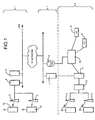
- Figure 1 shows schematically some components of an office intranet and an external internet and mobile telecommunications system.
- the office intranet area is indicated generally by 1 and the external internet and mobile telecommunications system area is indicated generally by 2.
- the relevant components of the intranet system 1 as shown are a Base Transceiver Station (BTS) 3, an Intranet Mobile Cluster (IMC) 4, a RCP Mobile Telephone Server (MTS) 5, an Intranet Location Register (ILR) database 6 and an A-lntranet Gateway 7. These components are connected over a wireless Local Area Network (LAN), forming the "office network" 1.
- BTS Base Transceiver Station
- IMC Intranet Mobile Cluster
- MTS RCP Mobile Telephone Server
- ILR Intranet Location Register
- A-lntranet Gateway 7 A-lntranet Gateway
- VLR Visitor Location Register
- HLR/AC/EIR Mobile Switching Centre
- MSC Mobile Switching Centre
- TSCM Transcoder and Subrate Channel Multiplexer
- BSC Base Station Controller
- the BTS 3 is equivalent to the BTSs 13 in the GSM operator network and its purpose is to receive and transmit signals to and from mobile phones and to interface with the IMC.
- the IMC is equivalent to a Base Station Controller in a standard GSM network. Its functions include detection of the possible need for handover, generation of speech and data frames, configuration of the BTS, control of interfacing with the MTS including status enquiry and establishing calls to/from the BTS.
- the MTS is responsible for controlling access to the intranet, by using information obtained from the ILR, as will be described in more detail below.
- the ILR is managed by the home GSM network operator and resides in the home GSM operator premises. It has access to two GSM registers via a MAP interface, namely the HLR 9 and VLR 8.
- the HLR and VLR hold all the location information of all subscribers.
- the HLR is a database which contains all the data concerning the access capabilities of subscribers of the site with which it is associated, and services to which they are entitled. Also the HLR provides MSCs associated with other sites with similar information to allow the subscriber to receive calls whilst visiting another site which is part of the same intranet.
- the Equipment Identity Register within an Authentication Centre allows interrogation of the HLR for verifying whether a user is listed in the HLR.
- the VLR stores subscriber information for all mobile phones which enter its area of coverage, which allows the MSC to set up calls to and from such phones. When a mobile phone enters its area, the subscriber data is interrogated and can be added to the VLR, so the VLR would contain the address of the subscriber's HLR.
- the office and operator networks 1,2 are connected by three interfaces :
- GSM mobile phones 14 In a typical office environment having an internal intranet, company members and a variable number of visitors, all carrying GSM mobile phones 14 will enter the geographical area of the intranet 1. If they are in the middle of a call, their phone will continue to send and receive signals via the external BTS to which it is already connected, thus using the external network as normal. At the end of the call, or if they enter the intranet area whilst not in the middle of a call, their phone will automatically try to attach to the BTS 3, since this would be the closest one.
- the intranet BTS 3 is similar to normal external BTSs, hence mobile phones will try to attach to it as they would any BTS which comes into geographical proximity.
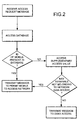
- the BTS 3 Upon receiving an LU, the BTS 3 sends the signal to the IMC 4.
- the IMC 4 accesses the MTS for information as to whether the user is to be allowed to access the network.
- the MTS checks the ILR database 6.
- This ILR contains a list of all the company members' IMSls, or has other identifier information such as phone numbers that allow members belonging tot he company network to be identified. This identifier is preferably the same as is used in the LU request message, to allow matching to be done easily.
- the ILR sends a signal back to the MTS indicating whether the LU request is from a company member or a visitor.
- the MTS If the signal received back by the MTS indicates that the LU is from a company member, it informs the IMC as such and the IMC then allows the phone to attach to the BTS 3.
- External calls from an employee to any phone outside the intranet are routed via BTS 3, to the IMC 4, to the MTS 5 and to the A-lntranet Gateway 7, where they are transferred over the A-interface to the TCSM 11. From here they are sent to the MSC and then forwarded to the BSC 12 and to a BTS 13, from where the phone can receive them.
- the MTS makes a decision as to whether to allow the visitor to access the intranet.
- the parameter can be set by the company IT department, to allow or reject the LU request.
- the advantage of this process is that the IT department can decide at any particular time whether or not to allow visitors access to the intranet. This could be important at busy periods during which visitors cause considerable extra load on the system. Thus a high service quality can be maintained at all times for company members.
- the GSM operator may also have the ability to set the parameter, to allow load on the external GSM network to be relieved by the RCP network.
- the MTS sends an appropriate signal to the IMC which then prevents the BTS 3 from allowing the phone to attach to it.
- the phone will remain attached to or search for the nearest external BTS. This can be done using standard GSM codes.
- the MTS sends a different signal to the IMC which allows the BTS to attach to the phone.
- the visitor's calls are then routed through the LAN and out to the external system.
- the facility for direct access to other phones within the intranet would not be available to visitors. Nevertheless, the fact that their calls are routed through the intranet would improve the quality of reception for the visitor.
- the parameter does not indicate the ability of specific users to access the intranet. Specific additional users can be allowed access by making additions to the database of members.
- the location update request is not a prerequisite to the making of a handover from one base station to another.
- the system as described above would not, in such a GSM-based system, deny access to the intranet to terminals that requested handovers into the RCP system. Such handovers may be tolerated, or could be blocked (at least to non-member terminals) by other means associated with the handover procedure.
- the company intranet would be owned by the external operator and leased by the company.
- the system would then operate in a similar manner except the ILR would communicate via the PCM interface through the MSC 10 to the VLR 8 and the HLR AC EIR 9 owned by the operator.
- the ILR would be interrogated to determine whether an LU request was from a RCP member or not.
- the VLR 8 could be used to list visitors who were temporarily using the office network 1.
Landscapes
- Engineering & Computer Science (AREA)
- Computer Security & Cryptography (AREA)
- Computer Networks & Wireless Communication (AREA)
- Signal Processing (AREA)
- Mobile Radio Communication Systems (AREA)
Applications Claiming Priority (2)
| Application Number | Priority Date | Filing Date | Title |
|---|---|---|---|
| GB9918046 | 1999-07-30 | ||
| GB9918046A GB2355885A (en) | 1999-07-30 | 1999-07-30 | Network access control |
Publications (1)
| Publication Number | Publication Date |
|---|---|
| EP1073294A1 true EP1073294A1 (fr) | 2001-01-31 |
Family
ID=10858328
Family Applications (1)
| Application Number | Title | Priority Date | Filing Date |
|---|---|---|---|
| EP00306447A Withdrawn EP1073294A1 (fr) | 1999-07-30 | 2000-07-28 | Controlé d'access au réseau |
Country Status (3)
| Country | Link |
|---|---|
| US (1) | US6813496B2 (fr) |
| EP (1) | EP1073294A1 (fr) |
| GB (1) | GB2355885A (fr) |
Cited By (7)
| Publication number | Priority date | Publication date | Assignee | Title |
|---|---|---|---|---|
| FR2829650A1 (fr) * | 2001-09-13 | 2003-03-14 | Cit Alcatel | Passerelle inter-reseaux de transmission de signaux numeriques |
| EP1377090A1 (fr) * | 2002-06-28 | 2004-01-02 | Tenovis GmbH & Co. KG | Procédé pour enregistrer un terminal sans fil chez un commutateur d'un système radio et appareil muni d'une application de gestion |
| EP1408653A1 (fr) * | 2002-10-08 | 2004-04-14 | Broadcom Corporation | Système de commutation de réseau local sans fil d'enterprise |
| AU2002313435B2 (en) * | 2002-08-16 | 2008-02-14 | Togewa Holding Ag | Method and system for GSM authentication during WLAN roaming |
| US7561631B2 (en) | 2004-08-25 | 2009-07-14 | Broadcom Corporation | Multiple streams using partial STBC with SDM within a wireless local area network |
| US7660362B2 (en) | 2004-06-18 | 2010-02-09 | Broadcom Corporation | Wireless local area network system using space-time block coding (STBC) having backward compatibility with prior standards |
| US7796696B2 (en) | 2004-02-19 | 2010-09-14 | Broadcom Corporation | Asymmetrical multiple stream wireless communication using STBC |
Families Citing this family (25)
| Publication number | Priority date | Publication date | Assignee | Title |
|---|---|---|---|---|
| US7440572B2 (en) * | 2001-01-16 | 2008-10-21 | Harris Corportation | Secure wireless LAN device and associated methods |
| US6952691B2 (en) | 2002-02-01 | 2005-10-04 | International Business Machines Corporation | Method and system for searching a multi-lingual database |
| US8630414B2 (en) | 2002-06-20 | 2014-01-14 | Qualcomm Incorporated | Inter-working function for a communication system |
| EP1395074A1 (fr) * | 2002-08-30 | 2004-03-03 | Siemens Aktiengesellschaft | Méthode de fonctionnement d'un terminal dans un système de communication par radio, système de communication par radio, terminal et unité de confirmation dans un système de communication par radio |
| WO2004071037A1 (fr) * | 2003-02-04 | 2004-08-19 | Matsushita Electric Industrial Co., Ltd. | Systeme de communication, et serveur de commande de communication et terminaux de communication constituant ledit systeme de communication |
| US7854009B2 (en) * | 2003-06-12 | 2010-12-14 | International Business Machines Corporation | Method of securing access to IP LANs |
| GB2405286A (en) * | 2003-08-20 | 2005-02-23 | Siemens Ag | A telecommunications service access control method |
| US8014997B2 (en) * | 2003-09-20 | 2011-09-06 | International Business Machines Corporation | Method of search content enhancement |
| US20050065774A1 (en) * | 2003-09-20 | 2005-03-24 | International Business Machines Corporation | Method of self enhancement of search results through analysis of system logs |
| US7305069B1 (en) * | 2004-07-20 | 2007-12-04 | Cisco Technology, Inc. | Multi-copy, multi-media, non-redundant messaging |
| US8094821B2 (en) | 2004-08-06 | 2012-01-10 | Qualcomm Incorporated | Key generation in a communication system |
| TWI256480B (en) * | 2004-08-18 | 2006-06-11 | Wintecronics Ltd | Method and system using a communication device to trace the location of a moving object |
| US7263076B1 (en) | 2004-10-09 | 2007-08-28 | Radiuz Networks Llc | System and method for managing a wireless network community |
| DE602005013281D1 (de) * | 2004-12-17 | 2009-04-23 | Huawei Tech Co Ltd | Verfahren und system zum halten einer sitzungskontinuität |
| US7209739B1 (en) * | 2004-12-28 | 2007-04-24 | Sprint Spectrum L.P. | Method and system for processing calls within a local micro network |
| DE202005021930U1 (de) | 2005-08-01 | 2011-08-08 | Corning Cable Systems Llc | Faseroptische Auskoppelkabel und vorverbundene Baugruppen mit Toning-Teilen |
| US7924780B2 (en) | 2006-04-12 | 2011-04-12 | Fon Wireless Limited | System and method for linking existing Wi-Fi access points into a single unified network |
| US9826102B2 (en) | 2006-04-12 | 2017-11-21 | Fon Wireless Limited | Linking existing Wi-Fi access points into unified network for VoIP |
| GB0621772D0 (en) * | 2006-11-01 | 2006-12-13 | Nokia Corp | Accessing services |
| GB2446738C (en) | 2007-02-02 | 2014-10-01 | Ubiquisys Ltd | Basestation measurement modes |
| GB2449533B (en) | 2007-02-23 | 2009-06-03 | Ubiquisys Ltd | Basestation for cellular communications system |
| US20080298344A1 (en) * | 2007-06-01 | 2008-12-04 | Motorola, Inc. | Method and Apparatus to Facilitate Assessing and Using Security State Information Regarding a Wireless Communications Device |
| EP2096884A1 (fr) | 2008-02-29 | 2009-09-02 | Koninklijke KPN N.V. | Réseau de télécommunication et procédé d'accès de réseau en fonction du temps |
| WO2009146107A2 (fr) * | 2008-04-02 | 2009-12-03 | Mavenir Systems, Inc. | Accès à des services de réseau fédérateur |
| KR101304617B1 (ko) * | 2011-10-07 | 2013-09-05 | 엘에스산전 주식회사 | 댁내 에너지 표시장치의 사용자 인증방법 |
Citations (4)
| Publication number | Priority date | Publication date | Assignee | Title |
|---|---|---|---|---|
| WO1997034437A1 (fr) * | 1996-03-13 | 1997-09-18 | Telefonaktiebolaget Lm Ericsson (Publ) | Reseau mobile de telecommunication comportant un systeme integre de bureautique sans fil |
| US5670950A (en) * | 1994-07-13 | 1997-09-23 | Nec Corporation | Private communications network system and method of authentication for a mobile station used in private communications networks |
| DE19630399C1 (de) * | 1996-07-26 | 1997-10-16 | Siemens Ag | Verfahren und System zur Leitweglenkung |
| US5793762A (en) * | 1994-04-12 | 1998-08-11 | U S West Technologies, Inc. | System and method for providing packet data and voice services to mobile subscribers |
Family Cites Families (14)
| Publication number | Priority date | Publication date | Assignee | Title |
|---|---|---|---|---|
| GB2250660A (en) * | 1990-12-05 | 1992-06-10 | Byps Communications Ltd | Cordless telephone system using link identification codes |
| GB2254982B (en) * | 1991-04-19 | 1995-06-14 | British Aerospace | Data networks |
| US5564068A (en) * | 1994-10-28 | 1996-10-08 | Telefonaktiebolaget Lm Ericsson | Home location register for manual visitors in a telecommunication system |
| US5729542A (en) * | 1995-06-28 | 1998-03-17 | Motorola, Inc. | Method and apparatus for communication system access |
| GB2304497A (en) * | 1995-08-19 | 1997-03-19 | Northern Telecom Ltd | Cellular communications system with provision of services to visiting mobiles |
| JPH09271066A (ja) * | 1996-03-29 | 1997-10-14 | Sony Corp | 通信方法,通信システム,通信端末及び通信管理装置 |
| GB2322998A (en) * | 1997-02-20 | 1998-09-09 | Vodafone Ltd | Method of Interconnecting Communication Networks |
| FI103631B (fi) * | 1996-09-17 | 1999-07-30 | Nokia Telecommunications Oy | Menetelmä ja järjestely tilaajien rekisteröitymisen rajoittamiseksi ma tkaviestinjärjestelmässä |
| KR100194577B1 (ko) * | 1996-12-02 | 1999-06-15 | 정선종 | 무선 atm망을 위한 매체접근 제어구조 및 그 방법 |
| SE9604601L (sv) * | 1996-12-16 | 1998-06-17 | Ericsson Telefon Ab L M | Anordning, system och förfarande avseende access till och styrning av telekommunikation |
| DE19722424C5 (de) * | 1997-05-28 | 2006-09-14 | Telefonaktiebolaget Lm Ericsson (Publ) | Verfahren zum Sichern eines Zugreifens auf ein fernab gelegenes System |
| US6324402B1 (en) * | 1997-10-07 | 2001-11-27 | Nortel Dasa Network System Gmbh & Co. Kg | Integration scheme for a mobile telephone |
| US6453159B1 (en) * | 1999-02-25 | 2002-09-17 | Telxon Corporation | Multi-level encryption system for wireless network |
| US6389284B1 (en) * | 1999-05-27 | 2002-05-14 | Qwest Communications International, Inc. | System and method for controlling wireless network access |
-
1999
- 1999-07-30 GB GB9918046A patent/GB2355885A/en not_active Withdrawn
-
2000
- 2000-07-28 EP EP00306447A patent/EP1073294A1/fr not_active Withdrawn
-
2003
- 2003-02-24 US US10/370,597 patent/US6813496B2/en not_active Expired - Lifetime
Patent Citations (4)
| Publication number | Priority date | Publication date | Assignee | Title |
|---|---|---|---|---|
| US5793762A (en) * | 1994-04-12 | 1998-08-11 | U S West Technologies, Inc. | System and method for providing packet data and voice services to mobile subscribers |
| US5670950A (en) * | 1994-07-13 | 1997-09-23 | Nec Corporation | Private communications network system and method of authentication for a mobile station used in private communications networks |
| WO1997034437A1 (fr) * | 1996-03-13 | 1997-09-18 | Telefonaktiebolaget Lm Ericsson (Publ) | Reseau mobile de telecommunication comportant un systeme integre de bureautique sans fil |
| DE19630399C1 (de) * | 1996-07-26 | 1997-10-16 | Siemens Ag | Verfahren und System zur Leitweglenkung |
Cited By (11)
| Publication number | Priority date | Publication date | Assignee | Title |
|---|---|---|---|---|
| FR2829650A1 (fr) * | 2001-09-13 | 2003-03-14 | Cit Alcatel | Passerelle inter-reseaux de transmission de signaux numeriques |
| EP1296503A3 (fr) * | 2001-09-13 | 2004-02-18 | Alcatel | Passerelle de voix-sur-IP |
| EP1377090A1 (fr) * | 2002-06-28 | 2004-01-02 | Tenovis GmbH & Co. KG | Procédé pour enregistrer un terminal sans fil chez un commutateur d'un système radio et appareil muni d'une application de gestion |
| AU2002313435B2 (en) * | 2002-08-16 | 2008-02-14 | Togewa Holding Ag | Method and system for GSM authentication during WLAN roaming |
| EP1408653A1 (fr) * | 2002-10-08 | 2004-04-14 | Broadcom Corporation | Système de commutation de réseau local sans fil d'enterprise |
| US7440573B2 (en) | 2002-10-08 | 2008-10-21 | Broadcom Corporation | Enterprise wireless local area network switching system |
| US7779071B2 (en) | 2002-10-08 | 2010-08-17 | Broadcom Corporation | Enterprise wireless local area network switching system |
| US8838752B2 (en) | 2002-10-08 | 2014-09-16 | Broadcom Corporation | Enterprise wireless local area network switching system |
| US7796696B2 (en) | 2004-02-19 | 2010-09-14 | Broadcom Corporation | Asymmetrical multiple stream wireless communication using STBC |
| US7660362B2 (en) | 2004-06-18 | 2010-02-09 | Broadcom Corporation | Wireless local area network system using space-time block coding (STBC) having backward compatibility with prior standards |
| US7561631B2 (en) | 2004-08-25 | 2009-07-14 | Broadcom Corporation | Multiple streams using partial STBC with SDM within a wireless local area network |
Also Published As
| Publication number | Publication date |
|---|---|
| GB2355885A (en) | 2001-05-02 |
| GB9918046D0 (en) | 1999-10-06 |
| US6813496B2 (en) | 2004-11-02 |
| US20030125024A1 (en) | 2003-07-03 |
Similar Documents
| Publication | Publication Date | Title |
|---|---|---|
| US6813496B2 (en) | Network access control | |
| CN1096804C (zh) | 固定通信网络的蜂窝分机 | |
| EP1183831B1 (fr) | Element pour systeme de communication | |
| US7215957B2 (en) | Handover in a mobile communication system | |
| US20020191595A1 (en) | Providing communications capabilities to mobile devices at an enterprise | |
| US6850778B1 (en) | Gateway arrangement | |
| EP1073295B1 (fr) | Itinerence interne | |
| US20060120351A1 (en) | Method and system for providing cellular voice, messaging and data services over IP networks to enterprise users | |
| EP1064804A2 (fr) | Procede et systeme pour acheminer un appel entre des sous-systemes cellulaires | |
| US20070058787A1 (en) | Centralized Feature Platform In A Packetized Network | |
| US6985732B1 (en) | Handover in a mobile communication system using conference facility | |
| US20030008643A1 (en) | Supplementary call grabber service for mobile networks | |
| US20030119495A1 (en) | Method and arrangement for controlling calls in a hybrid cellular telecommunication system | |
| KR100401262B1 (ko) | 이동전화망에서의 화상전화 서비스 제공 장치 및 그 방법 | |
| US7342905B1 (en) | Communications system | |
| CA2391517C (fr) | Procede et dispositif permettant de mettre en oeuvre des procedures de securite comprenant des stations mobiles dans des systemes de telecommunication cellulaire hybrides | |
| US7583680B1 (en) | Method and arrangement for transmitting information between subsystems in hybrid cellular telecommunication systems |
Legal Events
| Date | Code | Title | Description |
|---|---|---|---|
| PUAI | Public reference made under article 153(3) epc to a published international application that has entered the european phase |
Free format text: ORIGINAL CODE: 0009012 |
|
| 17P | Request for examination filed |
Effective date: 20000814 |
|
| AK | Designated contracting states |
Kind code of ref document: A1 Designated state(s): CH DE FR LI NL |
|
| AX | Request for extension of the european patent |
Free format text: AL;LT;LV;MK;RO;SI |
|
| AKX | Designation fees paid |
Free format text: CH DE FR LI NL |
|
| RAP1 | Party data changed (applicant data changed or rights of an application transferred) |
Owner name: NOKIA CORPORATION |
|
| 17Q | First examination report despatched |
Effective date: 20080124 |
|
| STAA | Information on the status of an ep patent application or granted ep patent |
Free format text: STATUS: THE APPLICATION IS DEEMED TO BE WITHDRAWN |
|
| 18D | Application deemed to be withdrawn |
Effective date: 20080605 |