EP1073307A2 - Knotenregelvorrichtung, Knotenvorrichtung und Verfahren zur Einstellung des Optisches Übertragungsweges - Google Patents
Knotenregelvorrichtung, Knotenvorrichtung und Verfahren zur Einstellung des Optisches Übertragungsweges Download PDFInfo
- Publication number
- EP1073307A2 EP1073307A2 EP00116439A EP00116439A EP1073307A2 EP 1073307 A2 EP1073307 A2 EP 1073307A2 EP 00116439 A EP00116439 A EP 00116439A EP 00116439 A EP00116439 A EP 00116439A EP 1073307 A2 EP1073307 A2 EP 1073307A2
- Authority
- EP
- European Patent Office
- Prior art keywords
- node device
- optical path
- cut
- packet
- optical
- Prior art date
- Legal status (The legal status is an assumption and is not a legal conclusion. Google has not performed a legal analysis and makes no representation as to the accuracy of the status listed.)
- Granted
Links
Images






Classifications
-
- H—ELECTRICITY
- H04—ELECTRIC COMMUNICATION TECHNIQUE
- H04Q—SELECTING
- H04Q11/00—Selecting arrangements for multiplex systems
- H04Q11/0001—Selecting arrangements for multiplex systems using optical switching
- H04Q11/0005—Switch and router aspects
-
- H—ELECTRICITY
- H04—ELECTRIC COMMUNICATION TECHNIQUE
- H04Q—SELECTING
- H04Q11/00—Selecting arrangements for multiplex systems
- H04Q11/0001—Selecting arrangements for multiplex systems using optical switching
- H04Q11/0062—Network aspects
- H04Q11/0066—Provisions for optical burst or packet networks
-
- H—ELECTRICITY
- H04—ELECTRIC COMMUNICATION TECHNIQUE
- H04Q—SELECTING
- H04Q11/00—Selecting arrangements for multiplex systems
- H04Q11/0001—Selecting arrangements for multiplex systems using optical switching
- H04Q11/0005—Switch and router aspects
- H04Q2011/0007—Construction
- H04Q2011/0016—Construction using wavelength multiplexing or demultiplexing
-
- H—ELECTRICITY
- H04—ELECTRIC COMMUNICATION TECHNIQUE
- H04Q—SELECTING
- H04Q11/00—Selecting arrangements for multiplex systems
- H04Q11/0001—Selecting arrangements for multiplex systems using optical switching
- H04Q11/0005—Switch and router aspects
- H04Q2011/0037—Operation
- H04Q2011/0039—Electrical control
-
- H—ELECTRICITY
- H04—ELECTRIC COMMUNICATION TECHNIQUE
- H04Q—SELECTING
- H04Q11/00—Selecting arrangements for multiplex systems
- H04Q11/0001—Selecting arrangements for multiplex systems using optical switching
- H04Q11/0005—Switch and router aspects
- H04Q2011/0037—Operation
- H04Q2011/0041—Optical control
-
- H—ELECTRICITY
- H04—ELECTRIC COMMUNICATION TECHNIQUE
- H04Q—SELECTING
- H04Q11/00—Selecting arrangements for multiplex systems
- H04Q11/0001—Selecting arrangements for multiplex systems using optical switching
- H04Q11/0062—Network aspects
- H04Q2011/0073—Provisions for forwarding or routing, e.g. lookup tables
Definitions
- the present invention relates to a node control device, node device and optical path setting method suitable for establishing an optical network system.
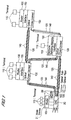
- Fig. 1 shows an aspect of a conventional optical network system.
- the optical network system comprises user terminals 110 connected to routers (or a packet switching machine) 100 and optical cross-connects or optical add-drop-multiplexer (OADM) 130 which are connected with the router 100 and are inter-connected via inter-office optical fibers 120.
- the optical cross-connect 130 is an device for executing the relay/insertion (add) /extraction (drop) of optical signals and the setting connection of optical signals (that is, optical paths 140) between two node devices which are not necessarily adjacent to each other.
- optical cross-connects 130 do not use wavelength division multiplexing transmission technology, but they also handle optical paths which are optical signal connections given by OCDM or OTDM technology.
- the many optical cross-connects use a wavelength division multiplexing transmission technology where a plurality of optical signals are sent over one optical fiber, and these multiplexed signals are used as a resource for transmission so as to increase capacity.
- the optical cross-connects 130 in Fig. 1 can multiplex a plurality of optical signals having different wavelengths using wavelength multiplexers/demultiplexers and optical spatial switches.
- An interface 150 is disposed between the router 100 or electronic switching machine (for example, SDH systems or ATM systems) and the optical cross-connect 130 shown in Fig. 1. For this interface 150, wavelength variable (or fix) type O/O (optical/optical) or E/O (Electric/Optical) conversion device and O/E (Optical/Electric) conversion device are used.
- a packet sent from a user terminal 110 is transmitted to the router 100 via the transmission path.
- the router 100 analyzes the header of this packet, and transfers the packet to an input interface 150 of the optical path (connection of optical signals) 140 which is set between routers (strictly speaking, an optical path is allocated between interfaces for routers in different nodes) where the destination terminal is connected to or an appropriate router for relaying.
- the transfer target packet reaches the router 100 accommodating the destination user terminal, and is transferred to the destination user terminal 110 via this router.
- the optical path 140 shown in Fig. 1 is set by the optical cross-connect (e.g. optical ADM (Add/Drop Multiplexer)) 130 and the optical fiber 120.
- the input/output interface 150 is disposed between the optical cross-connect 130 and the packet switching machine (e.g. router, electronic switching machine) 100.
- each node device has an optical cross-connect as one composing element.
- each node device may use ADM (Add/Drop Multiplexer) having a switching function to switch the Add/Drop state/relay state instead of using the optical cross-connect.
- ADM Add/Drop Multiplexer
- the system comprises a plurality of edge node devices which are designed as dedicated for respective edge nodes and one or more core node devices which are connected between said plurality of edge node devices via a transfer route and are designed as dedicated for respective core nodes.
- the edge node device is connected only between an external terminal, etc. and the core node device.
- the core node device is connected only with both or one of said edge node device and another core node device, and has core node input/output ports for forwarding a transfer packet with the other core node device but does not have input/output ports for forwarding a transfer packet with an external terminal.
- an optical network system by providing a node device where the edge node device and core node device are designated as dedicated for the respective edge node and core node.
- Fig. 3 shows an embodiment of the optical network system in accordance with the present invention.
- this optical network system comprises node device 2 to which one or more terminals 1 are connected, and optical fibers 3 which inter-connect these node device 2.
- Fig. 3 shows the case when the optical network is created in a net configuration, the optical network can also be created in a loop or other configuration.
- the node device 2 in accordance with embodiments to be discussed later are used for the node device 2.
- the node device 2 comprises three functional parts: a router 2A, a node control function part 2B for controlling the operation of the node device in general, and an optical cross-connect 2C.
- the optical cross-connect may include a wavelength converter and ADM (Add/Drop Multiplexer) having a switching function to switch the Add/Drop state/relay state may be used instead of the optical cross-connect.
- ADM Add/Drop Multiplexer
- This means of implementing the optical switch is not restricted by a switch using the Opt-Electric effect, but a mechanical optical switch or a pseudo-optical switch having the same interface function, such as switching light to electricity by an electrical switch then converting it to light again, may be used.
- node device an device which implements the optical path setting function, which is implemented by linking these three functional parts, is called the "node device”.
- the node device having a configuration unique to the present invention when it is necessary to distinguish the node device having a configuration unique to the present invention from an ordinary node device which is generally used, the node device having the configuration unique to the present invention is called the "IP (Internet Protocol)/optical multi-layer switch node device".
- IP Internet Protocol
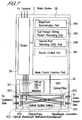
- Fig. 2 shows a functional configuration of the node device in accordance with the first embodiment.
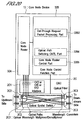
- the node device 2 comprises a router 2A, a node control function part 2B and an optical cross-connect 2C which is called as an optical XC.
- the node control function part is also referred to as node control device.
- the router 2A has a function to read the header part from the packet signal which was input, and determines the output destination according to the destination described in this header part.
- the destination here is not only another node device or a terminal or access system network connected to the concerned node device (hereafter this may be referred to as "present node device"), but may be the present node device itself.
- the router 2A also has a function to notify the information on the transferred packet to the node control function part 2B.
- the node control function part 2B has a function to switch the directions of the optical cross-connect 2C autonomously by the determination of itself or based on the instructions of the received packet.
- This node control function part 2B constitutes the major part of the node device in accordance with the present invention.
- the optical cross-connect 2C has a function to channel optical signals input from another node device to an arbitrary output optical fiber by inserting (adding) the optical signals into the optical fiber net (i.e. source side optical path termination) or extracting (dropping) the optical signals from the optical fiber net (i.e. destination side optical path termination), so as to set an optical path between two node device which are physically not necessarily adjacent to each other.
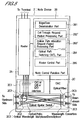
- the node control function part 2B in accordance with this embodiment comprises the following five functional parts.
- the edge/core determination part 2B1 is a function part for each node device to determine its position in the optical network system.
- the edge/core determination part 2B1 specifically determines whether the concerned node device, that is, the present node device is a transmission side edge node device, a core node device, or a destination side edge node device. This distinction is determined by the relationship between the present node device, that is, the IP/optical multi-layer switch node device, and a packet to be input to this node device.
- the present node device is the IP/optical multi-layer switch node device
- the transmission side edge node device, core node device and destination side edge node device are defined as follows.
- the present node device is the transmission side edge node device for the packet.
- a previous node device, to which a packet is input, of a node device is an IP/optical multi-layer switch, the management or operation thereof is executed by another network, and the optical path is always set with the present node device as the start point, then the present node device is the destination side edge node device.
- the present node device is the core node device for the packet.
- the present node device is the destination side edge node device for the packet.
- next node device, to which the packet is transferred, of a node device is an IP/optical multi-layer switch, the management or operation thereof is executed by another network, and the optical path is always terminated by the present node device, then the present node device is the destination side edge node device.
- the relationship between the present node device and the packet to be input thereto determines whether the IP/optical multi-layer switch node device of the present invention is the transmission side edge node device, core node device or destination side edge node device. Therefore, it is possible that an IP/optical multi-layer switch node device is defined as the transmission side edge node device based on the relationship with a packet, and is also defined as the core node device based on the relationship with another packet.
- the edge/core determination part 2B1 determines which node device is the concerned node device, that is, the present node device, based on the above criterion.
- the cut-through request packet processing part 2B2 is a functional part for collecting optical path resource and uses information required for setting a cut-through optical path. This functional part operates as follows according to the determination result of the above mentioned edge/core determination part 2B1.
- the cut-through request packet processing part 2B2 notifies the existence of the packet which passed through the present node device and the open resource and traffic information (e.g. wavelength) of the present node device as a cut-through request packet, to the node device which is positioned next to the present node device at the upstream side (transmission origination side).
- the open resource and traffic information e.g. wavelength
- the cut-through request packet processing part 2B2 adds the open resource information of the present node device to the received cut-through request packet and transfers the packet to the node device at the upstream side.
- the optical path allocation request packet processing part 2B3 is a functional part for determining the allocation of a cut-through optical path based on the collected open resource information and requesting the setting of the cut-through optical path based on this allocation. This functional part operates as follows according to the determination result of the above mentioned edge/core determination part 2B1.
- the optical path allocation request packet processing part 2B3 calculates the optimum allocation of the optical path based on the open resource information and other data like traffic information included in the packet. Or the processing part 2B3 determines the optimum allocation of the optical path based on the lock-up table, instead of the above calculation.
- the processing part 2B3 notifies the cut-through optical path setting request based on the result to the present node device, the core node device and the destination side edge node device. An optical path allocation request packet is used for this notification.
- cut-through request packet and the "optical path allocation request packet” may be collectively called the "optical path control packet”.
- the optical path switching control part 2B4 is a functional part for the node device 2 to actually set the cut-through optical path according to the instructions of the received optical path allocation request packet.
- the optical path switching control part 2B4 controls the optical cross-connect 2C according to the instructions of this packet, and sets the cut-through optical path in the present node device.
- the optical path switching control part 2B4 transmits the optical path setting completion notice packet and notifies the completion to the transmission side edge node device.
- the router control part 2B5 is a functional part for notifying completion of the setting of the cut-through optical path to the router 2A, and instructing the router 2A to transfer a series of packets via the cut-through optical path from there on.
- the router control part 2B5 can release the newly set cut-through optical path when a predetermined time has elapsed since the initial setting, or when an event occurs, such as a decrease in the number of communication packets (from the threshold) at the node device positioned at both ends of the cut-through optical path. Release here may be a physical release or may be a logical release, where the setting status remains but the path is regarded as an available resource so that the setting is changed when a new optical path setting is requested.
- the decrease in the number of communication packets at the node device positioned at both ends of the cut-through path is notified via a dedicated communication line (optical path or electric wire) disposed between the node devices or via several hops of other optical paths displaced between the node devices.
- a dedicated communication line optical path or electric wire
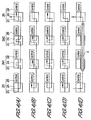
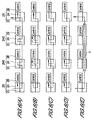
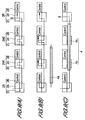
- Fig. 4 shows a setting of an optical path for cut-through in an optical network.
- the left end is the upstream side of the path route and the right end is the downstream side of the path route.
- the node device 2S at the left end operates as the transmission side edge node device
- the node device 2R at the right end operates as the destination side edge node device
- the two node device 2M1 and 2M2 disposed between these operate as the core node device.
- the first user packet for a destination arrives from a terminal (or a net in an access system) to a node device 2S (transmission side edge node device at the left in Fig. 4) accommodating the destination.
- a node device 2S transmission side edge node device at the left in Fig. 4
- the node device 2S (that is, the transmission side edge node device) transfers the packet to the next transfer destination, that is, the node device 2M1, according to the optical path and routing table currently set at the router 2A of the node device 2S.
- the node device 2M1 to which the first packet was transferred, transfers the packet to the node device 2M2 which is the next transfer destination in the same way, as long as the node device 2M1 is not the destination side edge node device.
- the first packet is eventually transferred to the node device 2R, (that is, the destination side edge node device) accommodating the destination terminal (or net of an access system), and is transferred to the destination via the router 2A of the node device 2R.
- transfer is executed by the routing function of the router 2A without intervention of the node control function part 2B.
- the flow of the packet shown by the arrow marks in Fig. 4 (A) shows this transfer operation.
- the next step is started by the destination side edge node device 2R.
- the router 2A of each node device 2 (2S, 2M1, 2M2, 2R) has a function to transfer the packet to the node control function part 2B, as well as transferring the packet to the next transfer destination, when the destination of the user packet is the terminal (or net of an access system) of the concerned node device, that is, the present node device.
- This function is shown by an arrow mark (broken line) in Fig. 4 (A), for example.)
- the node control function part 2B of the node device 2R receives the user packet
- the node control function part 2B confirms that the node device which the node control function part 2B belongs to is the destination edge node device using the edge/core determination part. Then this function part 2B starts up the cut-through request packet processing part 2B2, and transmits the open resource information (e.g. wavelength) to the upstream side as a cut-through request packet (Fig. 4 (B)).
- the cut-through request packet transferred to the node device (core node device) 2M2 at the upstream side is routed by the router 2A of the core node device 2M2, and is sent to the node control function part 2B.
- the node control function part 2B of the core node device 2M2 confirms the position of the present device, that is, the core node device 2M2, using the edge/core determination part 2B, just like the case of the node control function part 2B of the destination side edge node device. Then this function part 2B starts up the cut-through request packet processing part 2B2, and adds the open resource information (e.g. wavelength) of the present node device itself to the cut-through request packet and transfers the packet. This operation is executed repeatedly.
- the open resource information e.g. wavelength
- the cut-through request packet eventually reaches the transmission side edge node device 2S.
- This node device 2S receives the cut-through request packet, then confirms that the present node device is the transmission side edge node device 2S. After this confirmation, the node device 2S starts up the optical path allocation request packet processing part 2B3 of the present node device 2S. By this startup, this processing part 2B3 calculates the optimum allocation of the optical path based on the information written in the cut-through request packet (e.g. node information on current set route and open resource information).
- the optical path allocation request packet processing part 2B3 transmits the optical path allocation request packet to each node device 2S, 2M1, 2M2 and 2R on the route, including the present node device 2S, and notifies the calculation result. This packet is transferred sequentially to the downstream side, as shown in Fig. 4 (C).
- the packet When the present node device is included in one of the destinations of transfer of the optical path allocation request packet, the packet is loaded to the node control function part 2B in the present node device (core node device), and the optical path allocation request packet processing part 2B3 is started up. And the optical path allocation request packet processing part 2B3 confirms the allocation to set the cut-through optical path.
- the optical path switching control part 2B4 executes the actual switching of the optical cross-connect 2C.
- an optical path which omits the router 2A (communication path for user packets which does not go through the router 2A), is set for the optical cross-connect 2C.
- Completion of the optical path setting is notified to the transmission side edge node device 2S.
- This notification is performed by core node devices 2M1 and 2M2 adding information on completion of the optical path setting at the respective node devices to the optical path setting completion notice packet transmitted from the destination side edge node device 2R, and transferring the packet with this added information to the transmission side edge node as shown in Fig. 4 (D).
- Fig. 4 (E) shows the status after the cut-through optical path is allocated.
- the optical path 4 which does not go through the router 2A, is set at the part of the core node device 2M1 and 2M2.
- a user packet is transferred via this cut-through optical path 4.
- the node control function part 2B of the transmission side edge node device 2S calculates the optimum allocation of the optical path such that the number of relay hops by the router 2A on the route from the transmission side edge node device 2S to the destination side edge node device 2R becomes a minimum.
- the node control function part 2B calculates the allocation of the optical path so as to be relayed in the optical cross-connect 2C and to omit the router 2A.
- optical path must be set to one hop without passing at all through the routers 2A of the core node device 2M1 and 2M2, which are located on the route from the transmission side edge node device 2S to the destination side edge node device 2R.
- Possible handling methods of a user packet, for which transfer via the cut-through optical path is demanded are a method of allowing the user packet to standby in the node device until a new cut-through optical path is set, and a method of transferring the user packet via an old conventional path until a new cut-through optical path is set, then the path for packet transfer is changed after setting.
- the cut-through request packet processing part 2B2 when the cut-through request packet processing part 2B2 receives a cut-through request packet from the downstream side for the present node device, the cut-through request packet processing part 2B2 adds the information on the present node device to this packet, and transfers the packet to the upstream side.
- this configuration may be such that the cut-through request packet is directly transmitted to the transmission side edge node device from the processing part 2B2, without waiting for the packet from downstream.
- the transmission side edge node device which received the cut-through request packet, transmits the optical path allocation request packet.
- transmission of the packet need not be executed from the transmission side edge node device.
- node device node control device, optical path setting method
- the load to be applied to the router 2A can be decreased dramatically compared with a conventional system. So an improvement of throughput and a decrease of delay time can be implemented in a packet transfer. As a consequence, if this optical network system is used for Internet service, for example, the user will experience such benefits as quicker response times.
- an optical path set once is basically used with that setting, and is not switched according to the traffic of IP packets.
- the present invention allows optimizing the setting of an optical path (e.g. decreasing the number of hops in an IP router).
- the second embodiment corresponds to a modification form of the node device in accordance with the above mentioned first embodiment, and the configuration of the functional parts 1A - 2C, and each part 2B1 - 2B5 constituting the node control function part 2B are essentially the same as the case of the first embodiment shown in Fig. 5.
- the transfer direction of the optical path control packets (cut-through request packet and optical path allocation request packet) in the second embodiment concerning the setting of the cut-through optical path is the opposite from the first embodiment.
- FIG. 6 which shows the status of setting the optical path for cut through in the present embodiment
- Fig. 4 which shows the status of setting the optical path for cut through in the first embodiment.
- the transfer directions of Figs. 6(B) - 6(C) are opposite the transfer directions of Figs. 4(B) - 4(C) respectively. This is the biggest difference when the optical network system is constructed by disposing the node device 2 in accordance with the present embodiment.
- the node control function part 2B constituting the node device 2 in accordance with the present embodiment, comprises the following five functional parts.
- the cut-through request packet processing part 2B2' of the present embodiment as well is for collecting the optical path resouce and traffic information required for setting a cut-through optical path.
- this processing part 2B2' When the node device to which this cut-through request packet processing part 2B2' belongs is determined as the transmission side edge node device 2S, this processing part 2B2' notifies the information on existence of the packet, which passed the present node device, and the open resource and traffic information (e.g. wavelength) of the present node device as the cut-through request packet to the node device 2M2, which is positioned next to the present node device 2R at the downstream side (destination side).
- the open resource and traffic information e.g. wavelength
- the cut-through request packet processing part 2B2 adds the open resource and traffic information of the present node device to the received cut through request packet, and transfers the packet to the node device at the downstream side.
- the optical path allocation request packet processing part 2B3' of the present embodiment as well is for determining the allocation of a cut-through optical path based on the collected open resource and traffic information, and for requesting to set the cut-through optical path based on this allocation.
- the optical path allocation request packet processing part 2B3' calculates the optimum allocation of the optical path based on the open resource information and other information like traffic flowing this node included in the packet, and notifies the cut-through optical path setting request based on the result to the present node device, the core node device 2M1 and 2M2, and the transmission side edge node device 2S.
- An optical path allocation request packet is used for this notice.
- each function part is essentially the same as that of the first embodiment, with the exception of a difference in the directions of receiving or transmitting packets related to the operation.
- the optical path setting operation of the present embodiment progresses in the same manner as the first embodiment. After a new cut-through optical packet, which omits the layer 2 and layer 3 processing in the core node device, is set, a transfer at high throughput and low delay time is implemented using that route (Fig. 6 (E)).
- the load to be applied to the router 2A can be decreased dramatically by the cut through on the optical layer (layer 1) compared with a conventional system, so an improvement of throughput and a decrease of delay time can be implemented in a packet transfer.
- this optical network system is used for Internet service, for example, the user will experience such benefits as quicker response times.
- the first embodiment where the transmission side edge node device determines the optical wavelength and setting blocks to be used for cut through, may be advantageous in the case of (1) below. However, in the case of (2) below, the present embodiment is more advantageous than the first embodiment.
- the third embodiment will be described with reference to Fig. 7.
- the basic functional configuration is a router 2A, node control function part 2B, and an optical cross-connect 2C, which is the same as the case of the first embodiment.
- the difference is the content of the function parts constituting the node control function part 2B. Therefore, in the following description, primarily the difference in configuration of the node control function part 2B will be described.
- the node control function part 2B in accordance with the present embodiment comprises the following four function parts.
- function parts which are the same as those of the first embodiment are denoted with the same signs
- functional parts which are different from those of the first embodiment are denoted with the corresponding sign and a prime (').
- edge/core determination part 2B1 and the router control part 2B5 have the same functions as the case of the first embodiment, therefore descriptions are omitted.
- the cut-through setting packet processing part 2B6 which is a configuration unique to the present invention, is a function part for setting the cut-through optical path autonomously using the optical wavelength resource notified from the downstream side, and notifying the open resource information (e.g. wavelength) of the node device to which this processing part 2B6 belongs by transferring a cut-through setting packet.
- the cut-through setting packet transmission part 2B6 adds information on the cut-through optical path to be set to the received cut through setting packet, and transfers this packet to the node device at the upstream side.
- the cut-through setting packet transmission part 2B6 transfers information on cut through, which has been set thus far, and open resource information in the present node device, to the node device at the upstream side together.
- the cut-through setting packet transmission part 2B6 which confirmed existence of the packet which passed through the present node device, notifies existence of the packet which passed through and open resource information (e.g. wavelength) of the present node device to the node device at the upstream side as the cut-through setting packet.
- the optical path switching control part 2B4' is a functional part for actually setting the cut-through optical path for the resources for which the cut-through setting packet processing part 2B6 determined that the cut-through optical path can be set.
- the optical path switching part 2B4 controls the optical cross-connect 2C and sets the cut-through optical path in the present node device.
- Fig. 8 shows the status when an optical path for cut through is set on the optical network.
- Fig. 8 shows, in the case of the present embodiment, time until setting of the optical path is shorter compared with the above mentioned first and second embodiments. This is because in the case of the first and second embodiments, the open resource information of all node device on the communication route is collected at either the destination side (first embodiment) or the transmission side (second embodiment) first, then the allocation of the optical path is set based on that information. In the case of the third embodiment however, the procedure for setting of optical path allocation used for the first and second embodiment is not used, so time until the optical path setting can be decreased.
- the node device 2 (transmission side edge node device 2S at the left end of Fig. 8), which received a user packet from the terminal (or access system net) having a first packet for a certain destination, transfers the packet to the node device 2M, which is the next transfer destination, according to the optical path and routing table which are currently set in the router 2A of the present node device 2S so as to start a series of operations, which are the same as the first and second embodiments.
- the first user packet is transferred sequentially by conventional routing processing in the node device, which is selected as a transfer destination, and eventually reaches the destination, side edge node device 2R.
- the destination side edge node device 2R which received the packet, outputs this user packet to the destination terminal (or access system net), but then returns the cut-through setting packet to the node device (core node device 2M2) at the upstream side from which the user packet was transferred. At this time, the open resource information on the destination side node device 2R is notified.
- the core node device 2M2 determines whether the open wavelength resource exists on the next device at both the upstream side and downstream side of the present node device 2M2, and if so, the core node device 2M2 determines that cut through is possible within the present node device 2M2, sets the cut-through optical path 4a (Fig. 8 (B)), and notifies this information to the upstream node device 2M1 and the downstream node device 2R.
- the core node device 2M1 checks whether there is a wavelength resource for setting a cut-through optical path to connect with the cut-through optical path 4a, which has already been set at the downstream side, in the upstream side of the present node device.
- the core node device sets a new cut-through optical path 4b in the present node device, extends the conventional cut-through optical path 4a to the next node device 2M1 at the upstream side, notifies this to the next node device 2S at the upstream side, and the cut-through optical path 4 is set.
- the subsequent user packet to be transferred is transferred using the cut-through optical path 4, that is, a high-speed transfer omitting the layer 2 and layer 3 processing can be implemented.
- the node device node control device, optical path setting method having a functional configuration in accordance with the present embodiment, is disposed in the optical network system, it is possible to omit the IP layer (layer 3), and therefore load to be applied to the router 2A can be dramatically decreased compared with the conventional system. In this way, improvement of throughput and a decrease of delay time in a packet transfer can be implemented.
- a status where cut through is possible can be implemented when the cut-through setting packet, which was output from the destination side edge node device, reaches the transmission side edge node device. This can decrease the time until setting of the cut-through optical path compared with cases of the first and second embodiments.
- the cut-through optical path can be set for a longer block than the case of the third embodiment, since the optical path is set after collecting all information on all core node device which relay the transfer of a packet.
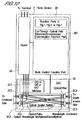
- the fourth embodiment features the following functional part which is added to the node control function part 2B mounted in the node device 2 in accordance with the above mentioned embodiments, and corresponds to a modification form of the respective above mentioned embodiments.
- the new functional part to be added is called the cut-through optical path necessary/unnecessary determination function part 2B7.
- This cut-through optical path necessary/unnecessary determination function part 2B7 determines the necessity of setting the cut-through optical path before the setting operation described in the respective above mentioned embodiments actually start, and selectively sets the cut-through optical path only when it is determined as necessary.
- the necessity of setting a cut-through optical path is determined before transmitting the cut-through setting request packet, but in the case of the first embodiment or the second embodiment, the necessity is determined before transmitting the optical path setting request packet.
- the cut-through optical path necessary/unnecessary determination function part 2B7 judges the necessity of the cut-through optical path before the edge node device transmits the cut-through request packet (first or second embodiment) or, based on the following criteria, the cut-through setting packet (third embodiment).
- the criteria used here is whether it is possible that a large volume of packets having the same transmission origination address (SA) and the same destination address (DA) as a user packet having a new address transferred first, will be transferred on the optical network system in the future. This possibility is determined not only by determining whether it is possible that a large volume of packets will flow on the same route, but also whether the packets are application packets for which the requirement for delay times is strict (real-time packets).
- cut-through request packet first embodiment or second embodiment
- cut-through setting packet third embodiment
- the cut-through optical path is set only when a new path is necessary.
- the cut-through optical path is set only when a highly required service for the entire network or for a certain user is provided, therefore a system which exhibits minimal waste of wavelength resources can be constructed under current optical communication technology, where the number of wavelengths is limited to several ten to several hundred.
- An object of the present embodiment is implementing a node device (node control device, optical path setting method) which can use the band of the optical path as effectively as possible, and implementing an optical network system where utilization of bandwidth of the optical path is efficient.
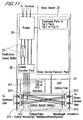
- Fig. 11 shows a configuration example of a node device in accordance with the present embodiment.
- the node control function part 2B one of the node control function part 2B (Fig. 1, Fig. 5, Fig. 7, Fig. 10), described in the first to fourth embodiments, is applied.
- the configuration unique to the present embodiment is characterized by that the destination-based buffer 2D is disposed at some outputs of the router 2A constituting the node device 2.
- data output of the router 2A is input to the optical cross-connect (optical ADM) 2C via the destination-based buffer 2D.
- the destination-based buffer 2D has a switch function part 2E which allows guiding the signal read from each buffer to an arbitrary input port of the optical cross-connect 2C.
- This switch function part 2E can be implemented in various way, such as a function of the optical cross-connect 2C side.
- the node device 2 in the present embodiment When an IP packet is sent from a terminal (or access net), the node device 2 in the present embodiment once stores the IP packet in the destination-based buffer 2D. When a number of IP packets begin to store in the destination-based buffer 2D, cut-through optical path setting processing is executed by the node control function part 2B.
- the cut-through optical path When the cut-through optical path is set, the IP packets, which have been stored in the destination-based buffer 2D thus far, are all transmitted to the destination side node device. After this transmission ends, this cut-through optical path is released. After releasing, this optical path is used for the transmission of IP packets stored in another destination-based buffer 2D.
- a description on the cut-through optical path setting operation is omitted here, since it is the same as the operation described in the respective above mentioned first to fourth embodiments.
- the destinations of the IP packets stored in the destination-based buffer 2D need not be exactly the same. Even if the final destination is different, a packet can be effectively stored in the same destination-based buffer 2D if the packet passes through the same route.
- node device node control device, optical path setting method having the functional configuration in accordance with the fifth embodiment is disposed in the optical network system, a decrease of load to be applied to the router 2A and an improvement of throughput can be implemented by setting the cut-through optical path, and also a limited band of optical signals can be more effectively used.
- the sixth embodiment corresponds to a modification form of the above mentioned fifth embodiment.
- the difference between the sixth embodiment and the fifth embodiment is that in the case of the sixth embodiment, an allowable delay recognition function part 2A1 is newly disposed in the router 2A constituting the node device 2.
- the allowable delay recognition function part 2A1 functions primarily at the transmission side edge node device.
- This function part is provided for the purpose of adaptively preventing the occurrence of problems which may occur when the fifth embodiment is used alone.
- an improvement of throughput and effective use of band are possible, but the delay time may become a problem.
- service quality may drop if packets are stored for a predetermined time or longer.
- the allowable delay recognition function part 2A1 of the router 2A first determines whether the current transfer target packet is a packet of a real-time system application such as an Internet TV telephone, or a packet of a non-real-time system application such as a file transfer. As a result of this determination, a packet transfer using the destination-based buffer 2D is selected only for the packet determined as the latter.
- the node device in accordance with the present embodiment transfers a packet of a non-real-time system application (a packet to be stored in the destination-based buffer 2D) via the cut-through optical path, which is set in the optical layer (layer 1) when a certain number of packets accumulate (or by an event based on a certain time interval).
- a packet of a non-real-time system application a packet to be stored in the destination-based buffer 2D
- the cut-through optical path which is set in the optical layer (layer 1) when a certain number of packets accumulate (or by an event based on a certain time interval).
- an optical path where priority is assigned for efficient bandwidth utilization (an optical path which is set such that the number of cut-throughs become a maximum), for example, is used.
- Another method is, for example, that some destination-based buffers are used for storing packets which cannot be delayed too long, and the packets stored in the buffers are output before the delay time becomes too long.
- node device node control device, optical path setting method
- packets of a real-time system application can be transferred without being delayed in a queue in the destination-based buffer, and has the features of the fifth embodiment as well.
- the first to fourth embodiments are methods combining the basic concept, which is the dynamic allocation of an optical path and flow driven type multi-layer switch in an IP/ATM system, as mentioned above.
- the resource environment assumed in IP/ATM and the resource environment assumed in IP/Lightwave, which is described in the present description, are not always the same.
- IP/ATM IP/ATM
- IP/ATM IP/ATM
- communication with an adjacent node device is insured if one logical channel is free, since ATM can set channels logically on a physical network.
- IP/Lightwave the method used for ATM cannot be used for a logical channel for an information transfer which has a narrow band, since the number of optical paths is restricted by the number of optical wavelengths multiplexed. Therefore, if all optical paths are allocated to omit the layer 2 and layer 3 processing in a node device of an optical network, this node cannot communicate with other node device.
- At least one optical path is free to communicate with another node device, it is certainly possible to communicate with any node device by using that optical path by repeatedly hopping. However, in this case, a large load is applied to the optical path.
- the node device in accordance with the present embodiment, it is proposed to dispose a function part for executing control to always keep free an optical path to be used as an information channel between the present node device and another node device.
- This function part is called an information channel insuring confirmation function part 2B8.
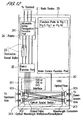
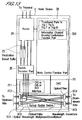
- Fig. 13 shows a configuration example of the node device in accordance with the present embodiment.
- An information signal processing function part for exchanging information signals with another node device is disposed in the node control function part 2B, although the information signal processing function part is not illustrated in Fig. 13 (or in other drawing). Disposition of the information signal processing function part is the same for the above mentioned and later mentioned embodiments.
- Fig. 13 shows a configuration where the information channel insuring confirmation function part 2B8 is added to the node device in accordance with the above mentioned sixth embodiment, it is certainly possible to apply the information channel insuring confirmation function part 2B8 in accordance with the present embodiment to each node device in accordance with the first to fifth embodiment.
- the node device 2 receives a request to omit the layer 2 and layer 3 processing by the optical layer (layer 1), the node device 2 confirms the existence and appropriateness of the open wavelength source of the present node device by function part of the node control function part 2B, and determines whether cut through is possible.
- the node device 2 determines whether an information channel required for communication between the present node device and another node device is free by the information channel insuring confirmation function part 2B8. If it is confirmed that a required information channel is free, the node device 2 actually executes switching to the optical path.
- a general data packet can also be transferred to the optical path for an information channel insured in this manner. It is easiest to set this information channel between the present node device and an adjacent node device, but this approach is not an absolute. Even if some packet transfers are necessary (using a longer route), required information (packet) can reach its destination via the insured information channel.
- node device node control device, optical path setting method
- an information channel can always be insured between adjacent nodes, in addition to the effects of the respective above mentioned embodiments. Therefore such communication as releasing the setting of an optical path can always be directly executed.
- the above mentioned seventh embodiment is a configuration example based on a technical concept only to insure an information channel.
- a node device which sets a dedicated optical path in advance for an information channel, that is, allocates a certain optical wavelength dedicated to an information channel, so as to insure releasing the setting of the cut-through optical path, will be described.
- an optical path extraction/insertion (drop/add) part for the information channel 2F to extract (drop) optical signals with a specified wavelength from the optical fiber 3 or insert (add) optical signals with a specified wavelength into the optical fiber 3, is disposed in the node device.
- the optical path extraction/insertion (drop/add) part for the information channel 2F functions in some cases as a means for extracting (dropping) optical signals for the information channel, which were transferred from another node device, from the optical fiber 3, and functions as a means for inserting (adding) optical signals for the information channel to another node device.
- the optical path extraction/insertion (drop/add) part for the information channel 2F extracts (drops) an optical signal with a specified wavelength from the optical fiber 3, transfers the optical signal to the router 2A and guides the optical signal to the information signal processing function part (in the node control function part 2B) which processes information conveyed on the optical signal.
- the optical path extraction/insertion (drop/add) part for the information channel 2F also receives the information which the information signal processing function part (in the node control function part 2B) addressed to another node device via the router 2A, and inserts (adds) the optical signal with a specified wavelength, where this information is conveyed, to the optical fiber 3.
- node device node control device, optical path setting method in accordance with the present embodiment is disposed in the optical network system, an information channel required for the transfer of information for switching of an optical path can be absolutely and physically insured.
- a dedicated optical path for the information channel is not set in advance, instead a pilot tone signal is overlaid on the normal cut-through optical path for user data so as to insure the information channel at all times.
- the node device 2 in accordance with the present embodiment implements this function by the pilot tone signal transmission function part 2G disposed in the node device.
- this function information can be exchanged between adjacent nodes (or nodes slightly distant from each other), even if all or almost all optical paths in a node device 2 are set to the cut-through optical paths.
- a certain effect can be expected when the present method is applied as is, but if a plurality of node device on the same path transmit pilot tone signals at the same time, a collision of pilot tone signals may occur at the node device furthest downstream, and transmitted information may not be received.
- the pilot tone signals are transmitted in bursts only when information is transmitted.
- the node device furthest downstream can request a resend using the idle time of the information channel.
- Another example is predetermining to always reply an acknowledgment (ACK) to the transmission side whenever information is received normally, so that information is automatically resent if the acknowledgment (ACK) is not returned.
- ACK acknowledgment
- the probability of an occurrence of collisions can be further decreased if the node device at the upstream side executes a resend at different timing by some means (e.g. determining a time until a resend by random numbers).
- node device node control device, optical path setting method in accordance with the present embodiment is disposed in an optical network system, an information exchange between adjacent node device (including node device slightly distant from each other) becomes possible, even if all or almost optical paths pass through the node device without layer 2 or layer 3 processing.
- an information channel is insured by time division multiplex (TDM) of pilot tone signals on a normal cut-through optical path for user data.
- TDM time division multiplex
- the node device 2 in accordance with the present embodiment implements this function by TDM pilot tone transmission function part 2H for the information channel which is disposed in the node device.
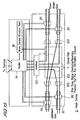
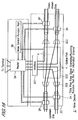
- Fig. 17 shows an example of time division multiplex (TDM) of pilot tone signals.
- TDM time division multiplex
- the synchronous circuit used for receiving the pilot tone signals can be used as is.
- Cross-talk clearly does not occur on different optical paths, even if pilot tone signals with the same frequency are used.
- node device node control device, optical path setting method in accordance with the present embodiment is disposed in the optical network system, information can be transferred without a collision of pilot tone signals occurring.
- a TDM system is used for the transmission of pilot tone signals, but a transmitter-receiver for pilot tone signals with different frequencies may be provided in each device, so as to enable communication between the node devices by the transmitter-receivers.
- a different frequency for a pilot tone signal is assigned to each node device.
- the same frequency may be used in an appropriate spatial arrangement.
- the present invention can also be applied to the layer 4 switch where the header information of the layer 4 (transport layer) of the input packet, such as the port numbers of TCP and UDP, is read to transfer packets. In this case, processing for the layer 3 or layers higher than the layer 3 is omitted.
- the node device itself judges whether the self node device is at the transmission side or destination side edge node or core node device before executing the processing required for setting an optical path.
- the node device it is preferable that the node device have such a configuration that judging the role of the self node device is unnecessary.
- Fig. 18 is a drawing depicting an example of a net where the optical network system is comprised of such dedicated node devices.
- the optical network is comprised of three edge node devices 10A, 10B and 10C (these edge node devices are collectively denoted by 10) and four core node devices 12A, 12B, 12C and 12D.
- the terminal 14A, LAN 16A and the core node device 12A are connected to the edge node device 10A.
- the terminals 14B, 14C and the core node device 12D are connected to the edge node device 10B.
- the terminal 14D, another network 18, and the core node device 12C are connected to the edge node device 10C.
- the core node device 12A is connected to the core node devices 12B and 12D respectively via optical fibers.
- the core node device 12B is connected to the core node devices 12D and 12C respectively via optical fibers
- the core node device 12C is connected to the edge node device 10C via optical fibers.
- the core node device 12D is connected to the edge node device 12B via optical fibers.
- an edge node device is connected only between an external terminal and a core node device.
- a core node device is connected only with one or both of an edge node device and another core node device. Therefore, a core node device has core node input/output ports to forward transfer packets with another core node device, but does not have input/output ports to forward transfer packets with an external terminal.
- the transfer packets include a user packet and a control packet.
- the edge node device 10 dedicated to the edge is configured such that the edge/core judgment part 2B1 and the optical path switching control part 2B4 are omitted from the configuration of the node control part of the general edge node device 2, that is, the node control device 2B, which is described with reference to Fig. 2, and the optical transmission device, that is, a simple input/output part, is used instead of the optical cross-connect 2C.
- Fig. 19 shows a configuration example of the edge node device 10 dedicated to the edge. In Fig. 19, the same components as in Fig. 2 are denoted with the same reference characters. However, the edge node control function part, which corresponds to the node control device 2B in Fig. 2, is denoted with 22B, the input/output part is denoted with 22C, and the edge node router is denoted with 22A.
- the input part 22C has edge node input/output ports to forward transfer packets between the edge node device which includes this input part 22C and a core node device.
- These edge node input/output ports are comprised of an optical wavelength multiplexer/demultiplexer 2C3. And these input/output ports 2C3 are connected to the router 22A via the interface 2C1.
- the transfer packets include a user packet and a control packet.
- the edge node router 22A has input/output ports for connection with an external terminal or LAN or another network.
- the edge node router 22A determines the output destination of the transfer packet which was input from the input/output ports according to the header information of layer 2 and layer 3, and outputs the output destination to the input/output part 22C.
- the edge node control function part 22B controls the decision of the output destination in the router 22A according to the instruction of the transfer packet which was input thereto. Or, the edge node control function part 22B outputs the packet which was input from the input part 22C to an appropriate terminal interface.
- the above mentioned transfer packets include a user packet and a control packet.
- the edge node control function part has a cut-through request packet processing part 22B2, an optical path allocation request packet processing part 22B3, and an edge node router control part 22B5.
- the cut-through request packet processing part 22B2 When a transfer packet from a transmission origination edge node device is input, the cut-through request packet processing part 22B2 notifies the open resource information in the self edge node device to the transmission origination edge node device as a cut-through request packet.
- the optical path allocation request packet processing part 22B3 decides an optimum optical path allocation based on the open resource information written in the cut-through request packet, and notifies the allocation to the core node device and the destination side edge node device as the optical path allocation request packet.
- the edge node router control part 22B5 controls the edge node router 22A so that transfer packets are transferred via this cut-through optical path.
- a core node device 12 dedicated to the core is configured such that the edge/core judgment part 2B1 and the optical path allocation request packet processing part 2B3 are omitted from the configuration of the node control part of the general edge node device 2, that is, the node control device 2B which was described with reference to Fig. 2.
- Fig. 20 shows a configuration example of the edge node device 12 dedicated to the edge.
- the same components as the components in Fig. 2 are denoted with the same reference characters.
- the core node control function part which corresponds to the node control device 2B in Fig. 2
- the core node router is denoted with 32A.
- the core node device 12 has core node input/output ports to forward the transfer packets with an edge node device or with another core node device, and has an optical cross-connect 2C for setting an optical path between input/output ports of this core node.
- the core node input/output ports are comprised respectively of an optical wavelength multiplexer/demultiplexer 2C3, which constitutes a part of the optical cross-connect 22C.
- the core node router 32A decides the output destination of the transfer packet which was input from the core node input/output part 2C3 according to the header information of layer 2 and layer 3, and outputs the output destination to the core node input/output part 2C3.
- the user packets which are input to the same node device pass through only the optical cross-connect via the optical path, or are transferred to a router and is routed to an appropriate output destination in the router.
- the core node control function part 32B decides the output destination in the core node router 32A according to the instruction of the control packet which was input, and controls the switching of a connected pair of each input port and output port inside the optical cross-connect 2C.
- the core node control function part 32B has a cut-through request packet processing part 32B2, an optical path switching control part 32B4, and a core node router control part 32B5.
- the cut-through request packet processing part 32B2 adds an open resource information in the self core node device to the cut-through request packet which is received from the upstream side or is independently generated and transfers the packet to the upstream side.
- the optical path switching control part 32B4 sets a cut-through optical path in the optical cross-connect 2C according to the instruction of the optical path allocation request packet notified from the edge node device.
- the core node router control part 32B5 controls the core node router 32A so that the transfer packet is transferred via this cut-through optical path.
- control can be executed by control signals (control packet), for example, which are sent by a pilot tone.
Landscapes
- Engineering & Computer Science (AREA)
- Computer Networks & Wireless Communication (AREA)
- Data Exchanges In Wide-Area Networks (AREA)
- Optical Communication System (AREA)
Applications Claiming Priority (2)
| Application Number | Priority Date | Filing Date | Title |
|---|---|---|---|
| JP21318599A JP3773380B2 (ja) | 1999-07-28 | 1999-07-28 | ノード制御装置、ノード装置、光ネットワークシステム及び光パス設定方法 |
| JP21318599 | 1999-07-28 |
Publications (3)
| Publication Number | Publication Date |
|---|---|
| EP1073307A2 true EP1073307A2 (de) | 2001-01-31 |
| EP1073307A3 EP1073307A3 (de) | 2007-01-03 |
| EP1073307B1 EP1073307B1 (de) | 2008-09-17 |
Family
ID=16634958
Family Applications (1)
| Application Number | Title | Priority Date | Filing Date |
|---|---|---|---|
| EP00116439A Expired - Lifetime EP1073307B1 (de) | 1999-07-28 | 2000-07-28 | Knotenregelvorrichtung, Knotenvorrichtung und Verfahren zur Einstellung von optischen Übertragungswegen |
Country Status (4)
| Country | Link |
|---|---|
| US (1) | US6879783B1 (de) |
| EP (1) | EP1073307B1 (de) |
| JP (1) | JP3773380B2 (de) |
| DE (1) | DE60040260D1 (de) |
Cited By (12)
| Publication number | Priority date | Publication date | Assignee | Title |
|---|---|---|---|---|
| EP1076468A3 (de) * | 1999-08-12 | 2002-09-18 | Nippon Telegraph and Telephone Corporation | Übertragungseinrichtung für IP-Paketen |
| WO2004095874A3 (en) * | 2003-04-16 | 2004-12-29 | Intel Corp | Architecture, method and system of multiple high-speed servers for wdm based photonic burst-switched networks |
| US7200330B2 (en) | 2001-11-02 | 2007-04-03 | Nippon Telegraph And Telephone Corporation | Optical dynamic burst switch |
| US7263289B2 (en) | 2001-11-02 | 2007-08-28 | Nippon Telegraph And Telephone Corporation | Optical dynamic burst switch |
| US7266295B2 (en) | 2003-04-17 | 2007-09-04 | Intel Corporation | Modular reconfigurable multi-server system and method for high-speed networking within photonic burst-switched network |
| US7266296B2 (en) | 2003-06-11 | 2007-09-04 | Intel Corporation | Architecture and method for framing control and data bursts over 10 Gbit Ethernet with and without WAN interface sublayer support |
| US7272310B2 (en) | 2003-06-24 | 2007-09-18 | Intel Corporation | Generic multi-protocol label switching (GMPLS)-based label space architecture for optical switched networks |
| US7310480B2 (en) | 2003-06-18 | 2007-12-18 | Intel Corporation | Adaptive framework for closed-loop protocols over photonic burst switched networks |
| US7315693B2 (en) | 2003-10-22 | 2008-01-01 | Intel Corporation | Dynamic route discovery for optical switched networks |
| US7526202B2 (en) | 2003-05-19 | 2009-04-28 | Intel Corporation | Architecture and method for framing optical control and data bursts within optical transport unit structures in photonic burst-switched networks |
| US8660427B2 (en) | 2002-09-13 | 2014-02-25 | Intel Corporation | Method and apparatus of the architecture and operation of control processing unit in wavelenght-division-multiplexed photonic burst-switched networks |
| WO2020139554A1 (en) * | 2018-12-26 | 2020-07-02 | Microsoft Technology Licensing, Llc | Grid network for layer one optical connectivity from edge to cloud |
Families Citing this family (18)
| Publication number | Priority date | Publication date | Assignee | Title |
|---|---|---|---|---|
| US7286756B1 (en) * | 2001-05-15 | 2007-10-23 | Cisco Technology, Inc. | DWDM system with IP telephony provisioning at remote locations |
| CA2410137C (en) * | 2001-11-02 | 2008-04-15 | Nippon Telegraph And Telephone Corporation | Optical dynamic burst switch |
| JP2003198485A (ja) * | 2001-12-28 | 2003-07-11 | Nec Corp | クロスコネクト装置及び光通信システム |
| US7117257B2 (en) * | 2002-03-28 | 2006-10-03 | Nortel Networks Ltd | Multi-phase adaptive network configuration |
| US8315518B1 (en) * | 2002-09-18 | 2012-11-20 | Ciena Corporation | Technique for transmitting an optical signal through an optical network |
| FR2846185B1 (fr) * | 2002-10-21 | 2005-02-25 | Cit Alcatel | Routeur perfectionne a insertion et/ou extraction de ressources |
| JP3939665B2 (ja) * | 2003-02-28 | 2007-07-04 | Kddi株式会社 | 波長パス交換ノード装置及び波長パス割付け方法 |
| US7428383B2 (en) | 2003-02-28 | 2008-09-23 | Intel Corporation | Architecture, method and system of WDM-based photonic burst switched networks |
| US7340169B2 (en) | 2003-11-13 | 2008-03-04 | Intel Corporation | Dynamic route discovery for optical switched networks using peer routing |
| US7734176B2 (en) | 2003-12-22 | 2010-06-08 | Intel Corporation | Hybrid optical burst switching with fixed time slot architecture |
| US7587145B2 (en) * | 2006-06-29 | 2009-09-08 | Intel Corporation | Optical receiver with electric ternary coding |
| US7986640B2 (en) * | 2006-07-05 | 2011-07-26 | Cisco Technology, Inc. | Technique for efficiently determining acceptable link-based loop free alternates in a computer network |
| JP5381194B2 (ja) * | 2009-03-16 | 2014-01-08 | 富士通株式会社 | 通信プログラム、中継ノード、および通信方法 |
| JP5704694B2 (ja) * | 2010-12-20 | 2015-04-22 | 独立行政法人情報通信研究機構 | 光アクセスシステム |
| EP2466809B1 (de) * | 2010-12-20 | 2013-05-01 | Alcatel Lucent | Verfahren und Netzwerkknoten zur Konfigurierung eines Netzwerks für optimierten Transport von Paketverkehr |
| US8634714B2 (en) * | 2011-01-05 | 2014-01-21 | Mitsubishi Electric Research Laboratories, Inc. | Methods for determining energy efficient optical routes |
| EP2665212B1 (de) * | 2012-05-16 | 2016-11-30 | Alcatel Lucent | Optisches Datenübertragungssystem |
| WO2025041346A1 (ja) * | 2023-08-24 | 2025-02-27 | 日本電信電話株式会社 | 信号転送システム、光伝送装置、制御装置及び信号転送方法 |
Family Cites Families (6)
| Publication number | Priority date | Publication date | Assignee | Title |
|---|---|---|---|---|
| US5303078A (en) * | 1990-12-18 | 1994-04-12 | Bell Communications Research, Inc. | Apparatus and method for large scale ATM switching |
| US5914798A (en) * | 1995-12-29 | 1999-06-22 | Mci Communications Corporation | Restoration systems for an optical telecommunications network |
| US5956165A (en) * | 1997-09-12 | 1999-09-21 | Mci Communications Corporation | Method and apparatus for updating subcarrier modulation in a communication network |
| JP3436871B2 (ja) * | 1997-10-23 | 2003-08-18 | 株式会社東芝 | 通信資源管理方法及びノード装置 |
| US6535313B1 (en) * | 1998-10-16 | 2003-03-18 | Lucent Technologies Inc. | Dynamically assignable optical signal access control apparatus |
| US7471625B2 (en) * | 2001-10-31 | 2008-12-30 | Nec Corporation | Fault recovery system and method for a communications network |
-
1999
- 1999-07-28 JP JP21318599A patent/JP3773380B2/ja not_active Expired - Fee Related
-
2000
- 2000-07-07 US US09/612,371 patent/US6879783B1/en not_active Expired - Lifetime
- 2000-07-28 EP EP00116439A patent/EP1073307B1/de not_active Expired - Lifetime
- 2000-07-28 DE DE60040260T patent/DE60040260D1/de not_active Expired - Lifetime
Cited By (18)
| Publication number | Priority date | Publication date | Assignee | Title |
|---|---|---|---|---|
| EP1076468A3 (de) * | 1999-08-12 | 2002-09-18 | Nippon Telegraph and Telephone Corporation | Übertragungseinrichtung für IP-Paketen |
| US6701088B1 (en) | 1999-08-12 | 2004-03-02 | Nippon Telegraph And Telephone Corporation | IP packet transmission equipment |
| US7200330B2 (en) | 2001-11-02 | 2007-04-03 | Nippon Telegraph And Telephone Corporation | Optical dynamic burst switch |
| US7263289B2 (en) | 2001-11-02 | 2007-08-28 | Nippon Telegraph And Telephone Corporation | Optical dynamic burst switch |
| US8660427B2 (en) | 2002-09-13 | 2014-02-25 | Intel Corporation | Method and apparatus of the architecture and operation of control processing unit in wavelenght-division-multiplexed photonic burst-switched networks |
| US7298973B2 (en) | 2003-04-16 | 2007-11-20 | Intel Corporation | Architecture, method and system of multiple high-speed servers to network in WDM based photonic burst-switched networks |
| CN1806466B (zh) * | 2003-04-16 | 2011-05-18 | 英特尔公司 | 在基于wdm的光子突发交换网络中连网的多个高速服务器的体系结构、方法和系统 |
| WO2004095874A3 (en) * | 2003-04-16 | 2004-12-29 | Intel Corp | Architecture, method and system of multiple high-speed servers for wdm based photonic burst-switched networks |
| US7266295B2 (en) | 2003-04-17 | 2007-09-04 | Intel Corporation | Modular reconfigurable multi-server system and method for high-speed networking within photonic burst-switched network |
| US7526202B2 (en) | 2003-05-19 | 2009-04-28 | Intel Corporation | Architecture and method for framing optical control and data bursts within optical transport unit structures in photonic burst-switched networks |
| US7266296B2 (en) | 2003-06-11 | 2007-09-04 | Intel Corporation | Architecture and method for framing control and data bursts over 10 Gbit Ethernet with and without WAN interface sublayer support |
| US7310480B2 (en) | 2003-06-18 | 2007-12-18 | Intel Corporation | Adaptive framework for closed-loop protocols over photonic burst switched networks |
| US7272310B2 (en) | 2003-06-24 | 2007-09-18 | Intel Corporation | Generic multi-protocol label switching (GMPLS)-based label space architecture for optical switched networks |
| US7315693B2 (en) | 2003-10-22 | 2008-01-01 | Intel Corporation | Dynamic route discovery for optical switched networks |
| WO2020139554A1 (en) * | 2018-12-26 | 2020-07-02 | Microsoft Technology Licensing, Llc | Grid network for layer one optical connectivity from edge to cloud |
| US10979165B2 (en) | 2018-12-26 | 2021-04-13 | Microsoft Technology Licensing, Llc | Grid network for layer one optical connectivity from edge to cloud |
| CN113170242A (zh) * | 2018-12-26 | 2021-07-23 | 微软技术许可有限责任公司 | 用于从边缘到云的层一光连接的网格网络 |
| CN113170242B (zh) * | 2018-12-26 | 2024-05-03 | 微软技术许可有限责任公司 | 用于从边缘到云的层一光连接的网格网络 |
Also Published As
| Publication number | Publication date |
|---|---|
| EP1073307A3 (de) | 2007-01-03 |
| US6879783B1 (en) | 2005-04-12 |
| EP1073307B1 (de) | 2008-09-17 |
| JP2001045052A (ja) | 2001-02-16 |
| JP3773380B2 (ja) | 2006-05-10 |
| DE60040260D1 (de) | 2008-10-30 |
Similar Documents
| Publication | Publication Date | Title |
|---|---|---|
| EP1073307B1 (de) | Knotenregelvorrichtung, Knotenvorrichtung und Verfahren zur Einstellung von optischen Übertragungswegen | |
| US6873796B1 (en) | Node device and optical path setting method | |
| EP1460811B1 (de) | Zuweisung eines geteilten Datenpfades mit niedriger Latenz | |
| US8463123B2 (en) | Optical switch and protocols for use therewith | |
| KR20010070982A (ko) | 광태그 스위칭을 사용하며 높은 처리율과 낮은 대기시간을가지는 차세대 인터넷 네트워크 | |
| Yoo et al. | A novel switching paradigm for buffer-less WDM networks | |
| JP4899577B2 (ja) | 光ネットワーク及びノード | |
| US7272311B2 (en) | Optical ring network for burst data communication | |
| CN1328863C (zh) | 利用双光数据总线构建的环网 | |
| Frederick et al. | Light trails: a sub-wavelength solution for optical networking | |
| KR100715520B1 (ko) | 광 스위칭 시스템에서의 광 데이터 전달장치 및 그 방법 | |
| Lamba et al. | Survey on contention resolution techniques for optical burst switching networks | |
| US6985443B2 (en) | Method and apparatus for alleviating traffic congestion in a computer network | |
| Yoo | Choices, features and issues in optical burst switching | |
| JP3777261B2 (ja) | 光ネットワーク | |
| KR100565943B1 (ko) | 파장 대역 경로 기반의 광패킷 레이블 스위칭 장치 | |
| JP3574363B2 (ja) | 光ネットワーク | |
| Jin et al. | An integrated architecture enabling different resource sharing schemes for AAPN networks | |
| JP2000324162A (ja) | データ転送方法、データ転送装置及び光通信ネットワーク | |
| Mouftah et al. | Optical Burst Switching | |
| Chi et al. | A novel node architecture for all-optical switching networks | |
| JP2006050659A (ja) | 光ネットワーク | |
| KR20120072057A (ko) | 패킷-광 전달 방법 및 그 장치 | |
| JPH05327641A (ja) | 時分割多重方式による通信とフレーム多重方式による通信を混在させて収容するハイブリッドディジタル多重装置 |
Legal Events
| Date | Code | Title | Description |
|---|---|---|---|
| PUAI | Public reference made under article 153(3) epc to a published international application that has entered the european phase |
Free format text: ORIGINAL CODE: 0009012 |
|
| AK | Designated contracting states |
Kind code of ref document: A2 Designated state(s): AT BE CH CY DE DK ES FI FR GB GR IE IT LI LU MC NL PT SE |
|
| AX | Request for extension of the european patent |
Free format text: AL;LT;LV;MK;RO;SI |
|
| RIC1 | Information provided on ipc code assigned before grant |
Ipc: H04Q 11/00 20060101AFI20001107BHEP Ipc: H04J 14/02 20060101ALI20060927BHEP |
|
| PUAL | Search report despatched |
Free format text: ORIGINAL CODE: 0009013 |
|
| AK | Designated contracting states |
Kind code of ref document: A3 Designated state(s): AT BE CH CY DE DK ES FI FR GB GR IE IT LI LU MC NL PT SE |
|
| AX | Request for extension of the european patent |
Extension state: AL LT LV MK RO SI |
|
| 17P | Request for examination filed |
Effective date: 20070626 |
|
| 17Q | First examination report despatched |
Effective date: 20070720 |
|
| AKX | Designation fees paid |
Designated state(s): DE FR GB |
|
| GRAJ | Information related to disapproval of communication of intention to grant by the applicant or resumption of examination proceedings by the epo deleted |
Free format text: ORIGINAL CODE: EPIDOSDIGR1 |
|
| GRAP | Despatch of communication of intention to grant a patent |
Free format text: ORIGINAL CODE: EPIDOSNIGR1 |
|
| GRAP | Despatch of communication of intention to grant a patent |
Free format text: ORIGINAL CODE: EPIDOSNIGR1 |
|
| GRAS | Grant fee paid |
Free format text: ORIGINAL CODE: EPIDOSNIGR3 |
|
| GRAA | (expected) grant |
Free format text: ORIGINAL CODE: 0009210 |
|
| AK | Designated contracting states |
Kind code of ref document: B1 Designated state(s): DE FR GB |
|
| REG | Reference to a national code |
Ref country code: GB Ref legal event code: FG4D |
|
| REF | Corresponds to: |
Ref document number: 60040260 Country of ref document: DE Date of ref document: 20081030 Kind code of ref document: P |
|
| PLBE | No opposition filed within time limit |
Free format text: ORIGINAL CODE: 0009261 |
|
| STAA | Information on the status of an ep patent application or granted ep patent |
Free format text: STATUS: NO OPPOSITION FILED WITHIN TIME LIMIT |
|
| 26N | No opposition filed |
Effective date: 20090618 |
|
| PGFP | Annual fee paid to national office [announced via postgrant information from national office to epo] |
Ref country code: GB Payment date: 20120725 Year of fee payment: 13 |
|
| PGFP | Annual fee paid to national office [announced via postgrant information from national office to epo] |
Ref country code: FR Payment date: 20120719 Year of fee payment: 13 Ref country code: DE Payment date: 20120725 Year of fee payment: 13 |
|
| GBPC | Gb: european patent ceased through non-payment of renewal fee |
Effective date: 20130728 |
|
| REG | Reference to a national code |
Ref country code: FR Ref legal event code: ST Effective date: 20140331 |
|
| PG25 | Lapsed in a contracting state [announced via postgrant information from national office to epo] |
Ref country code: DE Free format text: LAPSE BECAUSE OF NON-PAYMENT OF DUE FEES Effective date: 20140201 Ref country code: GB Free format text: LAPSE BECAUSE OF NON-PAYMENT OF DUE FEES Effective date: 20130728 |
|
| REG | Reference to a national code |
Ref country code: DE Ref legal event code: R119 Ref document number: 60040260 Country of ref document: DE Effective date: 20140201 |
|
| PG25 | Lapsed in a contracting state [announced via postgrant information from national office to epo] |
Ref country code: FR Free format text: LAPSE BECAUSE OF NON-PAYMENT OF DUE FEES Effective date: 20130731 |