EP1074285A2 - Méthode de contrôle de l'évolution d'un jeu, machine de jeu et support d'enregistrement correspondant - Google Patents
Méthode de contrôle de l'évolution d'un jeu, machine de jeu et support d'enregistrement correspondant Download PDFInfo
- Publication number
- EP1074285A2 EP1074285A2 EP00116533A EP00116533A EP1074285A2 EP 1074285 A2 EP1074285 A2 EP 1074285A2 EP 00116533 A EP00116533 A EP 00116533A EP 00116533 A EP00116533 A EP 00116533A EP 1074285 A2 EP1074285 A2 EP 1074285A2
- Authority
- EP
- European Patent Office
- Prior art keywords
- game
- personality
- mate
- personality elements
- player character
- Prior art date
- Legal status (The legal status is an assumption and is not a legal conclusion. Google has not performed a legal analysis and makes no representation as to the accuracy of the status listed.)
- Withdrawn
Links
- 238000000034 method Methods 0.000 title claims abstract description 37
- 238000011161 development Methods 0.000 title claims abstract description 21
- 230000008859 change Effects 0.000 claims abstract description 51
- 230000009471 action Effects 0.000 claims abstract description 19
- 238000013459 approach Methods 0.000 claims description 15
- 230000008569 process Effects 0.000 claims description 11
- 230000006870 function Effects 0.000 claims description 7
- 238000013500 data storage Methods 0.000 description 14
- 230000000875 corresponding effect Effects 0.000 description 11
- 238000004891 communication Methods 0.000 description 9
- 230000001276 controlling effect Effects 0.000 description 8
- 206010034719 Personality change Diseases 0.000 description 5
- 238000004088 simulation Methods 0.000 description 5
- 230000000694 effects Effects 0.000 description 4
- 238000012545 processing Methods 0.000 description 4
- 230000004044 response Effects 0.000 description 4
- 238000010586 diagram Methods 0.000 description 3
- 230000003796 beauty Effects 0.000 description 2
- 230000002093 peripheral effect Effects 0.000 description 2
- 238000009877 rendering Methods 0.000 description 2
- 230000005236 sound signal Effects 0.000 description 2
- 238000012546 transfer Methods 0.000 description 2
- 230000003044 adaptive effect Effects 0.000 description 1
- 230000015572 biosynthetic process Effects 0.000 description 1
- 238000006243 chemical reaction Methods 0.000 description 1
- 238000012790 confirmation Methods 0.000 description 1
- 238000010276 construction Methods 0.000 description 1
- 238000012937 correction Methods 0.000 description 1
- 230000002596 correlated effect Effects 0.000 description 1
- 238000005516 engineering process Methods 0.000 description 1
- MJEMIOXXNCZZFK-UHFFFAOYSA-N ethylone Chemical compound CCNC(C)C(=O)C1=CC=C2OCOC2=C1 MJEMIOXXNCZZFK-UHFFFAOYSA-N 0.000 description 1
- 230000014509 gene expression Effects 0.000 description 1
- 230000000737 periodic effect Effects 0.000 description 1
- 238000011002 quantification Methods 0.000 description 1
- 238000005070 sampling Methods 0.000 description 1
- 230000001360 synchronised effect Effects 0.000 description 1
- 230000009466 transformation Effects 0.000 description 1
Images


Classifications
-
- A—HUMAN NECESSITIES
- A63—SPORTS; GAMES; AMUSEMENTS
- A63F—CARD, BOARD, OR ROULETTE GAMES; INDOOR GAMES USING SMALL MOVING PLAYING BODIES; VIDEO GAMES; GAMES NOT OTHERWISE PROVIDED FOR
- A63F13/00—Video games, i.e. games using an electronically generated display having two or more dimensions
- A63F13/80—Special adaptations for executing a specific game genre or game mode
- A63F13/822—Strategy games; Role-playing games
-
- A—HUMAN NECESSITIES
- A63—SPORTS; GAMES; AMUSEMENTS
- A63F—CARD, BOARD, OR ROULETTE GAMES; INDOOR GAMES USING SMALL MOVING PLAYING BODIES; VIDEO GAMES; GAMES NOT OTHERWISE PROVIDED FOR
- A63F13/00—Video games, i.e. games using an electronically generated display having two or more dimensions
- A63F13/80—Special adaptations for executing a specific game genre or game mode
- A63F13/825—Fostering virtual characters
-
- A—HUMAN NECESSITIES
- A63—SPORTS; GAMES; AMUSEMENTS
- A63F—CARD, BOARD, OR ROULETTE GAMES; INDOOR GAMES USING SMALL MOVING PLAYING BODIES; VIDEO GAMES; GAMES NOT OTHERWISE PROVIDED FOR
- A63F13/00—Video games, i.e. games using an electronically generated display having two or more dimensions
- A63F13/25—Output arrangements for video game devices
-
- A—HUMAN NECESSITIES
- A63—SPORTS; GAMES; AMUSEMENTS
- A63F—CARD, BOARD, OR ROULETTE GAMES; INDOOR GAMES USING SMALL MOVING PLAYING BODIES; VIDEO GAMES; GAMES NOT OTHERWISE PROVIDED FOR
- A63F13/00—Video games, i.e. games using an electronically generated display having two or more dimensions
- A63F13/45—Controlling the progress of the video game
- A63F13/47—Controlling the progress of the video game involving branching, e.g. choosing one of several possible scenarios at a given point in time
-
- A—HUMAN NECESSITIES
- A63—SPORTS; GAMES; AMUSEMENTS
- A63F—CARD, BOARD, OR ROULETTE GAMES; INDOOR GAMES USING SMALL MOVING PLAYING BODIES; VIDEO GAMES; GAMES NOT OTHERWISE PROVIDED FOR
- A63F13/00—Video games, i.e. games using an electronically generated display having two or more dimensions
- A63F13/45—Controlling the progress of the video game
- A63F13/48—Starting a game, e.g. activating a game device or waiting for other players to join a multiplayer session
-
- A—HUMAN NECESSITIES
- A63—SPORTS; GAMES; AMUSEMENTS
- A63F—CARD, BOARD, OR ROULETTE GAMES; INDOOR GAMES USING SMALL MOVING PLAYING BODIES; VIDEO GAMES; GAMES NOT OTHERWISE PROVIDED FOR
- A63F13/00—Video games, i.e. games using an electronically generated display having two or more dimensions
- A63F13/50—Controlling the output signals based on the game progress
- A63F13/53—Controlling the output signals based on the game progress involving additional visual information provided to the game scene, e.g. by overlay to simulate a head-up display [HUD] or displaying a laser sight in a shooting game
- A63F13/533—Controlling the output signals based on the game progress involving additional visual information provided to the game scene, e.g. by overlay to simulate a head-up display [HUD] or displaying a laser sight in a shooting game for prompting the player, e.g. by displaying a game menu
-
- A—HUMAN NECESSITIES
- A63—SPORTS; GAMES; AMUSEMENTS
- A63F—CARD, BOARD, OR ROULETTE GAMES; INDOOR GAMES USING SMALL MOVING PLAYING BODIES; VIDEO GAMES; GAMES NOT OTHERWISE PROVIDED FOR
- A63F13/00—Video games, i.e. games using an electronically generated display having two or more dimensions
- A63F13/55—Controlling game characters or game objects based on the game progress
- A63F13/58—Controlling game characters or game objects based on the game progress by computing conditions of game characters, e.g. stamina, strength, motivation or energy level
-
- A—HUMAN NECESSITIES
- A63—SPORTS; GAMES; AMUSEMENTS
- A63F—CARD, BOARD, OR ROULETTE GAMES; INDOOR GAMES USING SMALL MOVING PLAYING BODIES; VIDEO GAMES; GAMES NOT OTHERWISE PROVIDED FOR
- A63F2300/00—Features of games using an electronically generated display having two or more dimensions, e.g. on a television screen, showing representations related to the game
- A63F2300/30—Features of games using an electronically generated display having two or more dimensions, e.g. on a television screen, showing representations related to the game characterized by output arrangements for receiving control signals generated by the game device
- A63F2300/308—Details of the user interface
-
- A—HUMAN NECESSITIES
- A63—SPORTS; GAMES; AMUSEMENTS
- A63F—CARD, BOARD, OR ROULETTE GAMES; INDOOR GAMES USING SMALL MOVING PLAYING BODIES; VIDEO GAMES; GAMES NOT OTHERWISE PROVIDED FOR
- A63F2300/00—Features of games using an electronically generated display having two or more dimensions, e.g. on a television screen, showing representations related to the game
- A63F2300/60—Methods for processing data by generating or executing the game program
- A63F2300/63—Methods for processing data by generating or executing the game program for controlling the execution of the game in time
- A63F2300/632—Methods for processing data by generating or executing the game program for controlling the execution of the game in time by branching, e.g. choosing one of several possible story developments at a given point in time
-
- A—HUMAN NECESSITIES
- A63—SPORTS; GAMES; AMUSEMENTS
- A63F—CARD, BOARD, OR ROULETTE GAMES; INDOOR GAMES USING SMALL MOVING PLAYING BODIES; VIDEO GAMES; GAMES NOT OTHERWISE PROVIDED FOR
- A63F2300/00—Features of games using an electronically generated display having two or more dimensions, e.g. on a television screen, showing representations related to the game
- A63F2300/60—Methods for processing data by generating or executing the game program
- A63F2300/63—Methods for processing data by generating or executing the game program for controlling the execution of the game in time
- A63F2300/636—Methods for processing data by generating or executing the game program for controlling the execution of the game in time involving process of starting or resuming a game
-
- A—HUMAN NECESSITIES
- A63—SPORTS; GAMES; AMUSEMENTS
- A63F—CARD, BOARD, OR ROULETTE GAMES; INDOOR GAMES USING SMALL MOVING PLAYING BODIES; VIDEO GAMES; GAMES NOT OTHERWISE PROVIDED FOR
- A63F2300/00—Features of games using an electronically generated display having two or more dimensions, e.g. on a television screen, showing representations related to the game
- A63F2300/60—Methods for processing data by generating or executing the game program
- A63F2300/65—Methods for processing data by generating or executing the game program for computing the condition of a game character
-
- A—HUMAN NECESSITIES
- A63—SPORTS; GAMES; AMUSEMENTS
- A63F—CARD, BOARD, OR ROULETTE GAMES; INDOOR GAMES USING SMALL MOVING PLAYING BODIES; VIDEO GAMES; GAMES NOT OTHERWISE PROVIDED FOR
- A63F2300/00—Features of games using an electronically generated display having two or more dimensions, e.g. on a television screen, showing representations related to the game
- A63F2300/80—Features of games using an electronically generated display having two or more dimensions, e.g. on a television screen, showing representations related to the game specially adapted for executing a specific type of game
- A63F2300/8058—Virtual breeding, e.g. tamagotchi
-
- A—HUMAN NECESSITIES
- A63—SPORTS; GAMES; AMUSEMENTS
- A63F—CARD, BOARD, OR ROULETTE GAMES; INDOOR GAMES USING SMALL MOVING PLAYING BODIES; VIDEO GAMES; GAMES NOT OTHERWISE PROVIDED FOR
- A63F2300/00—Features of games using an electronically generated display having two or more dimensions, e.g. on a television screen, showing representations related to the game
- A63F2300/80—Features of games using an electronically generated display having two or more dimensions, e.g. on a television screen, showing representations related to the game specially adapted for executing a specific type of game
- A63F2300/807—Role playing or strategy games
Definitions
- the present invention relates to games, and in particular, to technology for realizing a simulation video game which displays, in accordance with a game scenario, phenomena relating to the game scenario and a plurality of mate characters relating to a player character manipulated by a game player, and which develops the contents of the game scenario particularly relating to human relations in accordance with operations by the game player.
- the mate character can show responses similar to those in an actual human relationship.
- the player character can be characterized by points such as "whether the player character is excellent in appearance", “whether the player character is excellent in exercise ability", “whether the player character is skilled at academic ability of subjects of human science", “whether the player character is skilled at academic ability of subjects of science", “whether the player character is excellent in sense of beauty”, and “whether the player character has encyclopedic knowledge", and the mate character can be set so as to "tend to like a person excellent in appearance", “tend to like a person excellent in exercise ability” or “tend to like a person skilled at academic ability of subjects of human science”.
- the game player performs operations so that the personality elements of the player character are set to those liked by the mate character, whereby a situation is created in which the mate character, which is selected as the game player's type, likes the player character, which represents the game player.
- This process is such that the process of formation of human relations in the actual world, in which a person gets appreciation from another person of his or her type by making an effort and obtains a resultant favor, is reproduced as a game. This is an easily understandable and strong incentive for the game player to continue the game.
- a type of game that uses the above-described technique of characterizing the player character can sufficiently entertain the game player. However, by setting the main part so as to respond as an actual person does, the contents of the game can be further deepened.
- the response of the mate character to the player character changes.
- the above-described technique controls and changes the characteristics of the player character, the characteristics of the mate character itself does not change. In actual human relations, it is common that two persons influence each other. Thus, if a process in which two persons influence each other to cause a change in the characteristics of each person can be reproduced between the player character and the mate character, the entertaining features of this type of game can be further enhanced.
- the present invention is made for embodying the above-described knowledge, and an object thereof is to provide a game-development control method and a game machine that reproduce, in the form of a game, actual human relations in which persons influence mutually to cause a change in the characteristics of each person, and a recording medium used with the method and the machine.
- a game-development control method for execution on a computer including a control unit for controlling a predetermined display unit to display, in accordance with a game scenario, a plurality of mate characters relating to phenomena on the game scenario and to a player character provided with a plurality of characterizing personality elements including a changeable element, the mate characters being provided with a plurality of personality elements which include a changeable element and which are common to the personality elements provided to the player character, the control unit developing a game based on the game scenario in accordance with a change in the personality elements of each of the mate characters which is caused by an operation by a game player.
- the control unit records the personality elements of each of the mate characters on a recording medium, and reads the recorded personality elements so that the change in the personality elements is reflected in an action of each of the mate characters.
- each mate character is provided with personality elements common to the personality elements provided to the player character. Since the present invention sequentially changes the personality elements and causes actions of the mate character to reflect the change, the actions of the mate character change from time to time, whereby the actions of the mate character, which are similar to actual human relations, can be reproduced in the form of a game.
- the game-development control method of the present invention it is preferable to reflect the personality elements of each mate character in the actions of the mate character in the progress of the scenario.
- the mate character acts similarly to the player character in the progress of the scenario, whereby the actions of the mate character are set to be closer to those in the real society.
- a process may be included which sets at least one of the personality elements of each of the mate characters, which are common to the personality elements of said player character, so as to approach one of the personality elements of said player character. If this is replaced by the case of the real human relations, it is indicated that the mate character is influenced by the player character to act similarly to the player character.
- This process can reproduce, in the form of a game, the actual human relations in which persons mutually influence to change their characteristics.
- the personality elements of each of the mate characters may be changed based on a change in a preference parameter as a value obtained by quantifying the preference of each of the mate characters for said player character.
- a preference parameter as a value obtained by quantifying the preference of each of the mate characters for said player character.
- the "quantifying" in this Specification means the case where the degree of preference of the mate character for the player character is numerically expressed, the case where the degree of preference of the mate character for the player character is classified into a plurality of levels, etc.
- the personality elements of each mate character are changed based on a change in the preference parameter.
- the personality elements of the mate character can be set to approach the personality elements of the player character.
- the preference parameter of the mate character exceeds a preset threshold value, the personality elements provided to the mate character can be set to approach the personality elements of the player character at that time. In the latter case, a small load of a process for executing the method is only required.
- the personality elements of each of the mate characters may be changed for each lapse of a predetermined time, and the change in said preference parameter may be reflected in the change for each lapse of the predetermined time.
- the threshold value is set to be identical for all the mate characters, the threshold value can be set to differ for each mate character. Among persons, there are those who tend to like the opposite sex and those who do not tend. Also, there are those who are easily influenced by another person and those who are not easily influenced. By setting the threshold value to differ for each mate character, the circumstances can be reproduced as a game, whereby the entertaining features of a game to which the game-development control method is applied are further enhanced.
- the personality parameter of the mate character which correspond to the personality parameter that is maximum among the personality elements provided to the player character can be set to approach the personality parameter of the player character.
- the process of setting the personality elements of the mate character to approach the personality elements of the player character may be performed for all the personality elements, but may be performed for one personality element, as described.
- the one personality element as a personality element of the mate character which corresponds to one of the personality elements provided to the player character which has a maximum parameter, a change in the personality elements of the mate character can be understandably displayed for the game player.
- a game machine including: an input unit for receiving operations by a game player; a control unit control unit for controlling a predetermined display unit to display, in accordance with a game scenario, a plurality of mate characters relating to phenomena on the game scenario and to a player character provided with a plurality of characterizing personality elements including a changeable element, the mate characters being provided with a plurality of personality elements which include a changeable element and which are common to the personality elements provided to the player character, the control unit developing a game based on the game scenario in accordance with a change in the personality elements of each of the mate characters which is caused by an operation by a game player; and a recording medium.
- the control unit have the functions of: recording the personality elements of each of the mate characters on the recording medium, and the recorded personality elements on demand; detecting a preference parameter obtained by quantifying the preference of each of the mate characters for the player character, and determining a change in the preference parameter by referring to the preference parameter; and setting, based on the change in the preference parameter, at least one of the personality elements which are provided to each of the mate characters and are common to the personality elements of the player character so as to approach the corresponding personality element of the player character at the time the change occurs, and setting the change in the personality element to be reflected in an action of each of the mate characters.
- the foregoing object is achieved through provision of a computer-readable recording medium containing a program code for controlling a computer so that, when controlling a predetermined display unit to display, in accordance with a game scenario, a plurality of mate characters relating to phenomena on the game scenario and to a player character provided with a plurality of characterizing personality elements including a changeable element, the mate characters being provided with a plurality of personality elements which include a changeable element and which are common to the personality elements provided to the player character, and developing a game based on the game scenario, the computer executes the steps of: recording the personality elements of each of the mate characters on the recording medium, and the recorded personality elements; detecting a preference parameter obtained by quantifying the preference of each of the mate characters for the player character, and determining a change in the preference parameter by referring to the preference parameter; and setting, based on the change in the preference parameter, at least one of the personality elements which are provided to each of the mate characters and are common to
- entertaining features of a video game can be enhanced because actual human relations in which persons influence each other and their characteristics change can be reproduced as a game.
- a game-machine main part which is associated with a recording medium to constitute a video game machine is described. This embodiment only describes the case where a love-simulation game is executed by the video game machine.
- the game-machine main part reads a program code (hereinafter referred to as a "game program") for executing the game from a CD-ROM as an example of the recording medium of the present invention, and executes the game program, whereby actions of player characters and mate characters in accordance with instructions from a game player, and environments for actions of the player characters, are displayed and controlled.
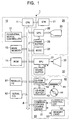
- a specific example of the game-machine main part is as shown in Fig. 1.
- a game-machine main part 1 includes a main controller 10, an image processor 20, an audio processor 30, a disk controller 40, a communications control unit 50, and a main bus B for connecting the functional units 10 to 50 so as to bidirectionally communicate with one another.
- the main controller 10 includes a central processing unit (CPU) 11, a peripheral device controller 12 for performing interruption control, direct-memory-access (DMA) transfer control, etc., a main memory 13 for temporarily the game program read from the CD-ROM, and a read-only memory (ROM) 14 including an operating system (OS) that controls the image processor 20 and the audio processor 30.
- the CPU 11 is a reduced instruction set computer (RISC). The CPU 11 controls basic operations in the entirety of the game-machine main part 1, and generates a plurality of functional blocks (described below) by executing the game program stored in the main memory 13.
- RISC reduced instruction set computer
- the image processor 20 includes a geometry transfer engine (GTE) 21 that performs high-speed coordinate transformation, etc., on data stored in the main memory 13, a graphics processing unit (GPU) 22 that forms various game character images and environment images by rendering polygons and sprites (such as triangles and tetragons) based on rendering instructions from the CPU 11, a frame buffer 23 that stores images rendered by the GPU 22, and an image decoder (MDEC) 24 that decodes compressed image data as required.
- the data rendered (stored) in the frame buffer 23 are read and displayed on a display device.
- the audio processor 30 includes a sound-reproducing processing unit (SPU) 31 that generates game tones and effect sounds, a sound buffer 32 that stores data read from the CD-ROM, such as sounds and tones, and sound-source data, etc., and a speaker that outputs the tones, the effect sounds, etc., generated by the SPU 31.
- SPU sound-reproducing processing unit
- the SPU 31 includes, for example, an adaptive-differential-pulse-code-modulation decoding function that decodes adaptive-differential-pulse-code-modulated audio data as 4-bit differential signals obtained by performing adaptive differential pulse code modulation on 16-bit audio signals, a function of reproducing effect sounds by reading the sound source data stored in the sound buffer 32, and a modulating function of modulating the audio data stored in the sound buffer 32 for sound reproduction.
- These functions enable the audio processor 30 to be used as a sampling sound source that generates, in accordance with instructions from the CPU 11, tones, effect sounds, etc., based on the audio and other data stored in the sound buffer 32.
- the disk controller 40 includes a disk drive 41 that reads a game program recorded on a CD-ROM 44, a CD-ROM decoder 42 that decodes data recorded with error-correction codes, and a buffer 43 that temporarily stores data read from the disk drive 41.
- the decoder 42 is also included in the audio processor 30.
- the data that are recorded on the CD-ROM 44 and that are read by the disk drive 41 includes not only the ADPCM data but also pulse-code-modulated (PCM) data obtained by performing analog-to-digital conversion on the audio signals.
- Audio data in the form of ADPCM data in which differences of 16-bit digital data are represented by four bits are error-corrected and decoded by the decoder 42.
- the error-corrected and decoded data are supplied to the SPU 31, and are processed so as to be converted from digital form to analog form. After that, the processed data are used to drive the speaker 33.
- An audio output from the decoder 42 is temporarily input to the SPU 31, and the sum of the audio output and an output from the SPU 31 becomes a final audio output after passing through a reverb unit.
- the communications control unit 50 includes a communications control device 51 that controls communication with the CPU 11 via a main bus B, a controller 52, and a memory card 53.
- a controller 52 is an interface that allows the game player to input instructions, and includes a start key for instructing the start of the game and restart, a reset key for instructing game resetting, selection keys that instruct a vertical or horizontal movement of a player character and that position a cursor on various menus and items which are displayed, and instruction keys for instructing detailed actions of the player character and designating a selected menu.
- the controller 52 transmits the state of each key to the communications control device 51 by synchronous communications.
- the communication control unit 51 transmits the state of each key of the controller 52 to the CPU 11. This transmits an instruction from the game player to the CPU 11, whereby the game-machine main part 1 can be operated in accordance with the intention of the game player.
- the CPU 11 When the CPU 11 must store settings of the game being executed and results obtained at the end or middle of the game, the CPU 11 transmits data at that time to the communications control device 51, and the communications control device 51 stores the data from the CPU 11 in the memory card 53. Since the memory card 53 is separated from the main bus B, it can be connected or disconnected, with the main power supplied to the game-machine main part 1. This enables the settings of the game. etc., to be stored in a plurality of memory cards like the memory card 53.
- the game-machine main part 1 is provided with a parallel input/output (I/O) port 61 and a serial input/output (I/O) port 62 which are connected to the main bus B.
- the game-machine main part 1 can be connected to peripheral devices via the parallel I/O port 61, and can communicate with another video game machine via the serial I/O port 62.
- the CPU 11 executes the OS stored in the ROM 14, thereby performing initialization in the entirety of the game-machine main part 1, such as confirmation of operations, and controlling the disk controller 40 to read and execute the game program stored in the CD-ROM 44.
- the CPU 11 executes the game program, the CPU 11 generates functional blocks as shown in Fig. 2 and realizes a video game machine 2 of the present invention.
- the video game machine 2 includes an instruction decoder 100, a controller 200, an image controller 300 for controlling an image displayed on the display device 25.
- the instruction decoder 100 decodes instructions from the controller 52, and performs control required for the instructions.
- the instructions includes specifying the speech of the player character (reflecting the intention of the game player) by selecting an option in addition to those essential in playing the game, such as starting the game, interrupting the game, restarting the game, ending the game, and instructing actions of the player character.
- the instruction decoder 72 establishes environment required for executing the game by loading the game program stored in the CD-ROM and data saved in the memory card 53.
- game data such as points by characters, which have been obtained up to the time, are saved in the memory card 53.
- the controller 200 includes a scenario control unit 210, a player-character-data control unit 220, and a mate-character-data control unit 230.
- the controller 200 instructs the image controller 300 to display a plurality of mate characters or phenomena relating to a player character manipulated by the game player in accordance with a game scenario.
- the image controller 300 generates an image in accordance with the instruction on the display device 25.
- the scenario control unit 210 is connected to a scenario-data storage unit 211, and instructs the image controller 300 so that the game is developed on the display device 25 based on the game scenario in accordance with an operation input by the game player.
- the player-character-data control unit 220 is connected to a player-character-data storage unit 221, and controls the player-character-data storage unit 221 to store data on a plurality of personality elements provided to the player character at the time.
- the stored personality elements are the items shown in Fig. 5A, "appearance”, “exercise ability”, “human-science-subject ability”, “science-subject ability”, “sense of music”, “sense of beauty”, and “encyclopedic knowledge”. These items are represented by personality parameters obtained by quantifying the personality elements. In this example, the quantification is in the form of numerical expressions.
- the mate-character-data control unit 230 includes a preference detecting unit 231, a data write/read unit 232, a preference determining unit 233, a personality-element determining unit 234, and mate-character-data storage units (a), (b), (c), and (d) (235) as recording media, as shown in Fig. 3.
- the preference detecting unit 231 quantifies a preference parameter of each mate character obtained at the time, that is, the degree of a preference of each mate character for the player character at the time, and detects the value.
- the preference detecting unit 231 detects the value numerically in this example.
- the data write/read unit 232 has functions of controlling the mate-character-data storage units (a), (b), (c), and (d) (235) to store preference parameter data detected by the preference detecting unit 231, and reading the personality parameter data and preference parameter data stored in the mate-character-data storage units (a), (b), (c), and (d) (235).
- the data are sent to the scenario control unit 210, and are used to control the game scenario.
- mate characters (a), (b), (c), and (d) appear, and data on the mate characters (a) to (d) are stored in the mate-character-data storage units (a) to (d) (235), respectively.
- the personality elements provided to each mate character are set to coincide with those provided to the player character.
- the preference parameter and personality elements of each mate character are stored in each of the mate-character-data storage units (a) to (d) (235) in the form shown in Fig. 5A.
- the parameters of the mate characters (a) to (d), which are numerically expressed, are indicated by the bar graphs shown in Figs. 4A, 4B, 4C, and 4D, respectively.
- the preference parameters of the mate characters (a) to (d) have threshold values S(a), S(b), S(c), and S(d).
- the preference parameters of the mate characters (a) to (d) have different values as threshold values S(a) to S(d).
- the preference determining unit 233 receives the preference parameter data of each mate character, determines whether the preference parameters of the mate characters (a) to (d) are greater than the respective threshold values S(a) to S(d), and notifies the personality-element determining unit 234 that one of the mate characters (a) to (d) has a preference parameter greater than the corresponding threshold value. In accordance with the notification, the personality-element determining unit 234 determines the personality elements of each mate character.
- step S401 When the game is initiated (step S401), a setting screen is displayed on the display device 25.
- the game player operates the controller 52 to name the player character and to determine an initial value of each personality parameter.
- the main part of the game is initiated (step S402). Specifically, the scenario control unit 210 reads the data from the scenario-data storage unit 211, and develops the game based on the main part scenario in accordance with a predetermined flow.
- the image controller 300 displays the images of a street of stores and buildings, scenes in school, each mate character, etc.
- the game player operates the controller 52 in time to each game development, whereby the player character has a conversation with each mate character, and the personality elements of the player character are changed. Specifically, by operating the controller 52 so that the player character has a personality liked by a mate character which is the type of the game player, the human relation between the mate character and the player character is changed, while the personality elements of the player character is being changed.
- Data on a change in the personality elements of the player character is sent via the player-character-data control unit 220, and is stored in the player-character-data storage unit 221.
- the data on a change in the personality elements is read as required, and is sent to the scenario control unit 210.
- the development of the game is changed based on the data.
- the preference parameter of each mate character changes.
- the preference parameter of each mate character at the time is detected and is numerically expressed by the preference detecting unit 231.
- the numerically expressed parameter of each mate character is recorded in each mate-character-data storage unit 235 via the data write/read unit 232.
- the stored preference parameter of each mate character is read from each mate-character-data storage unit 235 via the data write/read unit 232, as required (step S403).
- the read preference parameter is sent to the preference determining unit 233.
- the preference detecting unit 233 determines whether the preference parameter of each mate character exceeds the corresponding threshold value (S(a), S(b), S(c), or S(d)) (step S404). When any one of the preference parameters of the mate characters (a) to (d) exceeds the corresponding threshold value (S(a), S(b), S(c), or S(d)), the preference determining unit 234 is notified of the satisfaction of the condition in step S404.
- the preference determining unit 234 is notified of the dissatisfaction of the condition in step S404.
- step S404 When any one of the preference parameters of the mate characters (a) to (d) exceeds the corresponding threshold value (S(a), S(b), S(c), or S(d)) ("YES" in step S404), the personality elements of the mate character are set to approach those of the player character at the time, and the new personality elements are stored in the corresponding mate-character-data storage unit 235 (step S405). For each mate character which has a preference parameter less than the corresponding threshold value (S(a), S(b), S(c), or S(d)), its personality elements are changed.
- the personality elements of the mate character (b) change since its preference parameter exceeds threshold value S(b).
- the personality elements of the mate character are changed in the form shown in Figs. 5A and 5B.
- one of the personality elements of the mate character which corresponds to the maximum one of the personality elements of the player character at the time, is changed so as to have a value equal to the maximum personality parameter of the player character.
- the exercise ability of the mate character increases since, among the values of the personality elements of the player character, the value of the exercise ability is maximum.
- the personality elements of the player character are reflected in actions of each mate character.
- the preference parameter change appears in the game in a form in which a mate character having a preference for the player character imitates each action of the player character.
- the personality elements of the mate character may be set so as to approach the personality elements of the player character in a single process, or may be set so as to gradually approach the personality elements of the player character in separate processes.
- Each personal parameter of each mate character may be periodically changed, with it separated from a change in the preference parameter. In this change, based on a predetermined process, and in view of random factors, each personality element may be changed. In addition, in the periodic change, the change in the preference parameter can be reflected.
- the personality-element determining unit 234 stores the personality elements of the mate character in the corresponding mate-character-data storage unit 235 without changing the personality elements of the mate character (step S406).
- the main part scenario is terminated when the story of the game has reached graduation from high school.
- the scenario control unit 210 determines whether the game has developed up to the high school graduation (step S407). If the determination is negative ("NO” in step S407), the game is developed up to the high school graduation. If the determination is affirmative (“YES” in step S407), a screen on which one mate character sufferes its love to the player character is displayed on the display device 25, and the game is terminated (step S408).
Landscapes
- Engineering & Computer Science (AREA)
- Multimedia (AREA)
- Theoretical Computer Science (AREA)
- Human Computer Interaction (AREA)
- Physics & Mathematics (AREA)
- Optics & Photonics (AREA)
- Processing Or Creating Images (AREA)
- Display Devices Of Pinball Game Machines (AREA)
Applications Claiming Priority (2)
| Application Number | Priority Date | Filing Date | Title |
|---|---|---|---|
| JP11254713A JP2001046734A (ja) | 1999-08-05 | 1999-08-05 | ゲーム展開の制御方法、ゲーム装置及び記録媒体 |
| JP25471399 | 1999-08-05 |
Publications (2)
| Publication Number | Publication Date |
|---|---|
| EP1074285A2 true EP1074285A2 (fr) | 2001-02-07 |
| EP1074285A3 EP1074285A3 (fr) | 2004-11-10 |
Family
ID=17268824
Family Applications (1)
| Application Number | Title | Priority Date | Filing Date |
|---|---|---|---|
| EP00116533A Withdrawn EP1074285A3 (fr) | 1999-08-05 | 2000-07-31 | Méthode de contrôle de l'évolution d'un jeu, machine de jeu et support d'enregistrement correspondant |
Country Status (2)
| Country | Link |
|---|---|
| EP (1) | EP1074285A3 (fr) |
| JP (2) | JP2001046734A (fr) |
Cited By (3)
| Publication number | Priority date | Publication date | Assignee | Title |
|---|---|---|---|---|
| EP1260252A3 (fr) * | 2001-05-21 | 2003-12-03 | Konami Corporation | Programme de jeu, appareil de jeu et méthode pour exécuter un jeu |
| CN113457159A (zh) * | 2021-06-30 | 2021-10-01 | 网易(杭州)网络有限公司 | 游戏中人格数据的确定方法、装置以及电子终端 |
| CN115770389A (zh) * | 2021-09-07 | 2023-03-10 | 腾讯科技(深圳)有限公司 | 虚拟角色的移动同步方法、装置、设备及存储介质 |
Families Citing this family (6)
| Publication number | Priority date | Publication date | Assignee | Title |
|---|---|---|---|---|
| JP3545753B2 (ja) * | 2002-09-18 | 2004-07-21 | コナミ株式会社 | ゲーム装置、プログラム、及びゲームシステム |
| JP3534344B1 (ja) * | 2002-10-18 | 2004-06-07 | コナミ株式会社 | ゲームプログラム及びゲーム装置 |
| JP4799144B2 (ja) * | 2005-11-18 | 2011-10-26 | 任天堂株式会社 | ゲームプログラムおよびゲーム装置 |
| JP6665215B2 (ja) * | 2018-02-26 | 2020-03-13 | 株式会社カプコン | ゲームプログラムならびにゲームシステム |
| JP7053125B2 (ja) * | 2020-03-31 | 2022-04-12 | 株式会社バンダイ | プログラム、端末、ゲームシステム及びゲーム管理装置 |
| WO2025243528A1 (fr) * | 2024-05-24 | 2025-11-27 | 株式会社Nttドコモ | Dispositif et procédé |
Family Cites Families (3)
| Publication number | Priority date | Publication date | Assignee | Title |
|---|---|---|---|---|
| JP3220328B2 (ja) * | 1994-06-01 | 2001-10-22 | 株式会社ソニー・コンピュータエンタテインメント | ビデオゲーム機 |
| JP3044116U (ja) * | 1997-03-18 | 1997-12-16 | 株式会社バンダイ | 仮想生命体の育成シミュレーション装置 |
| JPH1176608A (ja) * | 1997-09-04 | 1999-03-23 | Konami Co Ltd | 遊技者の性格を反映したゲームの展開制御方法、ビデオゲーム装置及び記録媒体 |
-
1999
- 1999-08-05 JP JP11254713A patent/JP2001046734A/ja active Pending
-
2000
- 2000-07-31 EP EP00116533A patent/EP1074285A3/fr not_active Withdrawn
-
2006
- 2006-03-02 JP JP2006057028A patent/JP2006142097A/ja active Pending
Non-Patent Citations (1)
| Title |
|---|
| None |
Cited By (3)
| Publication number | Priority date | Publication date | Assignee | Title |
|---|---|---|---|---|
| EP1260252A3 (fr) * | 2001-05-21 | 2003-12-03 | Konami Corporation | Programme de jeu, appareil de jeu et méthode pour exécuter un jeu |
| CN113457159A (zh) * | 2021-06-30 | 2021-10-01 | 网易(杭州)网络有限公司 | 游戏中人格数据的确定方法、装置以及电子终端 |
| CN115770389A (zh) * | 2021-09-07 | 2023-03-10 | 腾讯科技(深圳)有限公司 | 虚拟角色的移动同步方法、装置、设备及存储介质 |
Also Published As
| Publication number | Publication date |
|---|---|
| EP1074285A3 (fr) | 2004-11-10 |
| JP2006142097A (ja) | 2006-06-08 |
| JP2001046734A (ja) | 2001-02-20 |
Similar Documents
| Publication | Publication Date | Title |
|---|---|---|
| JPH1176608A (ja) | 遊技者の性格を反映したゲームの展開制御方法、ビデオゲーム装置及び記録媒体 | |
| JP3125006B2 (ja) | キャラクタ画像の表示制御方法および装置、記録媒体 | |
| WO1999054010A1 (fr) | Support d'enregistrement et systeme de divertissement | |
| US6638171B1 (en) | Story generating game system using partial programs with different endings | |
| JP2002210238A (ja) | 記録媒体、プログラム、プログラム実行システム及びプログラム実行装置 | |
| JP2002516734A (ja) | 携帯用電子機器及びエンタテインメント・システム | |
| KR20010049659A (ko) | 비디오게임의 제어방법, 비디오게임장치 및 비디오게임의프로그램을 기록한 컴퓨터판독가능한 매체 | |
| JP3252842B2 (ja) | 遊戯者データを利用したゲーム実行方法及び、ゲーム装置 | |
| JP2001079262A (ja) | 情報処理装置、エンタテインメント装置、起動画像表示方法および情報記録媒体 | |
| EP1074285A2 (fr) | Méthode de contrôle de l'évolution d'un jeu, machine de jeu et support d'enregistrement correspondant | |
| US6561910B1 (en) | Method for controlling character based electronic game development | |
| JP2001340650A (ja) | ゲームシステム及び情報記憶媒体 | |
| JPH09192353A (ja) | アイコン表示制御装置、コマンドの入力支援方法、制御方法およびコンピュータプログラムが格納された記録媒体 | |
| JP2992499B2 (ja) | 画像処理方法及び装置、記録媒体 | |
| JP3084621B2 (ja) | ゲーム機及びゲーム処理方法並びに媒体 | |
| JP3849132B2 (ja) | ゲーム装置およびゲーム処理方法ならびにプログラムを記録した記録媒体 | |
| JP2000116955A (ja) | アイコン表示制御装置、コマンドの入力支援方法、制御方法およびコンピュ―タプログラムが格納された記録媒体 | |
| JP2002210233A (ja) | エンタテインメント装置、記録媒体及びプログラム | |
| JP3730237B2 (ja) | ゲームプログラム、及びゲーム装置 | |
| JPH1176621A (ja) | ビデオゲーム装置及び記録媒体 | |
| JP3502367B2 (ja) | ゲームシステム、記憶媒体、エンタテインメント装置 | |
| JP2001113043A (ja) | 情報処理装置及び方法、並びにデータ記憶装置 | |
| JP4880298B2 (ja) | プログラム、情報記憶媒体、及びデータ再生システム | |
| JP2001314653A (ja) | ゲーム装置、メモリカード装置、及び、記録媒体 | |
| JP4173426B2 (ja) | ゲームプログラム、ゲーム装置及びゲーム制御方法 |
Legal Events
| Date | Code | Title | Description |
|---|---|---|---|
| PUAI | Public reference made under article 153(3) epc to a published international application that has entered the european phase |
Free format text: ORIGINAL CODE: 0009012 |
|
| AK | Designated contracting states |
Kind code of ref document: A2 Designated state(s): AT BE CH CY DE DK ES FI FR GB GR IE IT LI LU MC NL PT SE |
|
| AX | Request for extension of the european patent |
Free format text: AL;LT;LV;MK;RO;SI |
|
| PUAL | Search report despatched |
Free format text: ORIGINAL CODE: 0009013 |
|
| AK | Designated contracting states |
Kind code of ref document: A3 Designated state(s): AT BE CH CY DE DK ES FI FR GB GR IE IT LI LU MC NL PT SE |
|
| AX | Request for extension of the european patent |
Extension state: AL LT LV MK RO SI |
|
| RIC1 | Information provided on ipc code assigned before grant |
Ipc: 7A 63F 13/00 B Ipc: 7A 63F 13/10 A |
|
| AKX | Designation fees paid | ||
| REG | Reference to a national code |
Ref country code: DE Ref legal event code: 8566 |
|
| STAA | Information on the status of an ep patent application or granted ep patent |
Free format text: STATUS: THE APPLICATION IS DEEMED TO BE WITHDRAWN |
|
| 18D | Application deemed to be withdrawn |
Effective date: 20050511 |