EP1074659A2 - Bloc élastique et procédé pour le fabriquer - Google Patents
Bloc élastique et procédé pour le fabriquer Download PDFInfo
- Publication number
- EP1074659A2 EP1074659A2 EP00304692A EP00304692A EP1074659A2 EP 1074659 A2 EP1074659 A2 EP 1074659A2 EP 00304692 A EP00304692 A EP 00304692A EP 00304692 A EP00304692 A EP 00304692A EP 1074659 A2 EP1074659 A2 EP 1074659A2
- Authority
- EP
- European Patent Office
- Prior art keywords
- rubber
- layer
- elastic
- powdery
- elastic block
- Prior art date
- Legal status (The legal status is an assumption and is not a legal conclusion. Google has not performed a legal analysis and makes no representation as to the accuracy of the status listed.)
- Withdrawn
Links
- 238000000034 method Methods 0.000 title claims description 4
- 230000008569 process Effects 0.000 title claims description 4
- 229920001971 elastomer Polymers 0.000 claims abstract description 148
- 239000005060 rubber Substances 0.000 claims abstract description 147
- 239000004636 vulcanized rubber Substances 0.000 claims abstract description 61
- 239000011230 binding agent Substances 0.000 claims abstract description 41
- 239000000203 mixture Substances 0.000 claims abstract description 32
- 229920005989 resin Polymers 0.000 claims abstract description 22
- 239000011347 resin Substances 0.000 claims abstract description 22
- 239000002245 particle Substances 0.000 claims abstract description 19
- 230000006835 compression Effects 0.000 claims abstract description 9
- 238000007906 compression Methods 0.000 claims abstract description 9
- 238000004073 vulcanization Methods 0.000 claims abstract description 7
- 238000000465 moulding Methods 0.000 claims abstract description 4
- 239000010410 layer Substances 0.000 claims description 201
- 229920002635 polyurethane Polymers 0.000 claims description 11
- 239000004814 polyurethane Substances 0.000 claims description 11
- 239000000049 pigment Substances 0.000 claims description 10
- 229920005549 butyl rubber Polymers 0.000 claims description 9
- 239000002344 surface layer Substances 0.000 claims description 8
- 229920003048 styrene butadiene rubber Polymers 0.000 claims description 6
- 244000043261 Hevea brasiliensis Species 0.000 claims description 4
- 239000003963 antioxidant agent Substances 0.000 claims description 4
- 230000003078 antioxidant effect Effects 0.000 claims description 4
- 229920003052 natural elastomer Polymers 0.000 claims description 4
- 229920001194 natural rubber Polymers 0.000 claims description 4
- 229920002857 polybutadiene Polymers 0.000 claims description 4
- 239000005062 Polybutadiene Substances 0.000 claims description 3
- 239000000945 filler Substances 0.000 claims description 3
- JOYRKODLDBILNP-UHFFFAOYSA-N Ethyl urethane Chemical compound CCOC(N)=O JOYRKODLDBILNP-UHFFFAOYSA-N 0.000 claims description 2
- 229920000181 Ethylene propylene rubber Polymers 0.000 claims description 2
- 239000006096 absorbing agent Substances 0.000 claims description 2
- 238000004040 coloring Methods 0.000 claims description 2
- 229920002681 hypalon Polymers 0.000 claims description 2
- XLYOFNOQVPJJNP-UHFFFAOYSA-N water Substances O XLYOFNOQVPJJNP-UHFFFAOYSA-N 0.000 description 17
- 230000000052 comparative effect Effects 0.000 description 8
- 239000003795 chemical substances by application Substances 0.000 description 7
- 239000000463 material Substances 0.000 description 6
- 239000000853 adhesive Substances 0.000 description 5
- 230000001070 adhesive effect Effects 0.000 description 5
- 238000011156 evaluation Methods 0.000 description 5
- 238000010438 heat treatment Methods 0.000 description 5
- 230000035699 permeability Effects 0.000 description 5
- 230000007774 longterm Effects 0.000 description 4
- 229920002803 thermoplastic polyurethane Polymers 0.000 description 4
- 239000000654 additive Substances 0.000 description 3
- 238000013329 compounding Methods 0.000 description 3
- 238000013461 design Methods 0.000 description 3
- 238000011835 investigation Methods 0.000 description 3
- 239000007788 liquid Substances 0.000 description 3
- 229920003002 synthetic resin Polymers 0.000 description 3
- 239000000057 synthetic resin Substances 0.000 description 3
- 238000012360 testing method Methods 0.000 description 3
- UPMLOUAZCHDJJD-UHFFFAOYSA-N 4,4'-Diphenylmethane Diisocyanate Chemical compound C1=CC(N=C=O)=CC=C1CC1=CC=C(N=C=O)C=C1 UPMLOUAZCHDJJD-UHFFFAOYSA-N 0.000 description 2
- 229920002943 EPDM rubber Polymers 0.000 description 2
- LFQSCWFLJHTTHZ-UHFFFAOYSA-N Ethanol Chemical compound CCO LFQSCWFLJHTTHZ-UHFFFAOYSA-N 0.000 description 2
- 206010017577 Gait disturbance Diseases 0.000 description 2
- 239000002174 Styrene-butadiene Substances 0.000 description 2
- 239000010426 asphalt Substances 0.000 description 2
- 230000008859 change Effects 0.000 description 2
- 238000000748 compression moulding Methods 0.000 description 2
- 238000010276 construction Methods 0.000 description 2
- 239000012948 isocyanate Substances 0.000 description 2
- 150000002513 isocyanates Chemical class 0.000 description 2
- 230000007480 spreading Effects 0.000 description 2
- 238000003892 spreading Methods 0.000 description 2
- 238000010998 test method Methods 0.000 description 2
- QNRATNLHPGXHMA-XZHTYLCXSA-N (r)-(6-ethoxyquinolin-4-yl)-[(2s,4s,5r)-5-ethyl-1-azabicyclo[2.2.2]octan-2-yl]methanol;hydrochloride Chemical compound Cl.C([C@H]([C@H](C1)CC)C2)CN1[C@@H]2[C@H](O)C1=CC=NC2=CC=C(OCC)C=C21 QNRATNLHPGXHMA-XZHTYLCXSA-N 0.000 description 1
- 239000004698 Polyethylene Substances 0.000 description 1
- 239000004902 Softening Agent Substances 0.000 description 1
- 238000010521 absorption reaction Methods 0.000 description 1
- 230000000996 additive effect Effects 0.000 description 1
- 230000003712 anti-aging effect Effects 0.000 description 1
- 230000003247 decreasing effect Effects 0.000 description 1
- 230000000694 effects Effects 0.000 description 1
- 239000013013 elastic material Substances 0.000 description 1
- 239000000806 elastomer Substances 0.000 description 1
- 230000002708 enhancing effect Effects 0.000 description 1
- 230000001747 exhibiting effect Effects 0.000 description 1
- 239000004615 ingredient Substances 0.000 description 1
- 229910010272 inorganic material Inorganic materials 0.000 description 1
- 239000011147 inorganic material Substances 0.000 description 1
- 238000004898 kneading Methods 0.000 description 1
- 238000012986 modification Methods 0.000 description 1
- 230000004048 modification Effects 0.000 description 1
- 239000004570 mortar (masonry) Substances 0.000 description 1
- 229920000768 polyamine Polymers 0.000 description 1
- -1 polyethylene Polymers 0.000 description 1
- 229920000573 polyethylene Polymers 0.000 description 1
- 229920005862 polyol Polymers 0.000 description 1
- 150000003077 polyols Chemical class 0.000 description 1
- 239000005077 polysulfide Substances 0.000 description 1
- 229920001021 polysulfide Polymers 0.000 description 1
- 150000008117 polysulfides Polymers 0.000 description 1
- 229920005749 polyurethane resin Polymers 0.000 description 1
- 239000000843 powder Substances 0.000 description 1
- 238000005096 rolling process Methods 0.000 description 1
- 229920002379 silicone rubber Polymers 0.000 description 1
- 239000004945 silicone rubber Substances 0.000 description 1
Images


Classifications
-
- B—PERFORMING OPERATIONS; TRANSPORTING
- B32—LAYERED PRODUCTS
- B32B—LAYERED PRODUCTS, i.e. PRODUCTS BUILT-UP OF STRATA OF FLAT OR NON-FLAT, e.g. CELLULAR OR HONEYCOMB, FORM
- B32B25/00—Layered products comprising a layer of natural or synthetic rubber
- B32B25/04—Layered products comprising a layer of natural or synthetic rubber comprising rubber as the main or only constituent of a layer, which is next to another layer of the same or of a different material
- B32B25/047—Layered products comprising a layer of natural or synthetic rubber comprising rubber as the main or only constituent of a layer, which is next to another layer of the same or of a different material of particles
-
- B—PERFORMING OPERATIONS; TRANSPORTING
- B32—LAYERED PRODUCTS
- B32B—LAYERED PRODUCTS, i.e. PRODUCTS BUILT-UP OF STRATA OF FLAT OR NON-FLAT, e.g. CELLULAR OR HONEYCOMB, FORM
- B32B25/00—Layered products comprising a layer of natural or synthetic rubber
-
- B—PERFORMING OPERATIONS; TRANSPORTING
- B32—LAYERED PRODUCTS
- B32B—LAYERED PRODUCTS, i.e. PRODUCTS BUILT-UP OF STRATA OF FLAT OR NON-FLAT, e.g. CELLULAR OR HONEYCOMB, FORM
- B32B25/00—Layered products comprising a layer of natural or synthetic rubber
- B32B25/12—Layered products comprising a layer of natural or synthetic rubber comprising natural rubber
-
- B—PERFORMING OPERATIONS; TRANSPORTING
- B32—LAYERED PRODUCTS
- B32B—LAYERED PRODUCTS, i.e. PRODUCTS BUILT-UP OF STRATA OF FLAT OR NON-FLAT, e.g. CELLULAR OR HONEYCOMB, FORM
- B32B25/00—Layered products comprising a layer of natural or synthetic rubber
- B32B25/14—Layered products comprising a layer of natural or synthetic rubber comprising synthetic rubber copolymers
-
- B—PERFORMING OPERATIONS; TRANSPORTING
- B32—LAYERED PRODUCTS
- B32B—LAYERED PRODUCTS, i.e. PRODUCTS BUILT-UP OF STRATA OF FLAT OR NON-FLAT, e.g. CELLULAR OR HONEYCOMB, FORM
- B32B25/00—Layered products comprising a layer of natural or synthetic rubber
- B32B25/16—Layered products comprising a layer of natural or synthetic rubber comprising polydienes homopolymers or poly-halodienes homopolymers
-
- B—PERFORMING OPERATIONS; TRANSPORTING
- B32—LAYERED PRODUCTS
- B32B—LAYERED PRODUCTS, i.e. PRODUCTS BUILT-UP OF STRATA OF FLAT OR NON-FLAT, e.g. CELLULAR OR HONEYCOMB, FORM
- B32B25/00—Layered products comprising a layer of natural or synthetic rubber
- B32B25/18—Layered products comprising a layer of natural or synthetic rubber comprising butyl or halobutyl rubber
-
- B—PERFORMING OPERATIONS; TRANSPORTING
- B32—LAYERED PRODUCTS
- B32B—LAYERED PRODUCTS, i.e. PRODUCTS BUILT-UP OF STRATA OF FLAT OR NON-FLAT, e.g. CELLULAR OR HONEYCOMB, FORM
- B32B5/00—Layered products characterised by the non- homogeneity or physical structure, i.e. comprising a fibrous, filamentary, particulate or foam layer; Layered products characterised by having a layer differing constitutionally or physically in different parts
- B32B5/16—Layered products characterised by the non- homogeneity or physical structure, i.e. comprising a fibrous, filamentary, particulate or foam layer; Layered products characterised by having a layer differing constitutionally or physically in different parts characterised by features of a layer formed of particles, e.g. chips, powder or granules
-
- E—FIXED CONSTRUCTIONS
- E01—CONSTRUCTION OF ROADS, RAILWAYS, OR BRIDGES
- E01C—CONSTRUCTION OF, OR SURFACES FOR, ROADS, SPORTS GROUNDS, OR THE LIKE; MACHINES OR AUXILIARY TOOLS FOR CONSTRUCTION OR REPAIR
- E01C13/00—Pavings or foundations specially adapted for playgrounds or sports grounds; Drainage, irrigation or heating of sports grounds
- E01C13/04—Pavings made of prefabricated single units
- E01C13/045—Pavings made of prefabricated single units the prefabricated single units consisting of or including bitumen, rubber or plastics
-
- E—FIXED CONSTRUCTIONS
- E01—CONSTRUCTION OF ROADS, RAILWAYS, OR BRIDGES
- E01C—CONSTRUCTION OF, OR SURFACES FOR, ROADS, SPORTS GROUNDS, OR THE LIKE; MACHINES OR AUXILIARY TOOLS FOR CONSTRUCTION OR REPAIR
- E01C5/00—Pavings made of prefabricated single units
- E01C5/18—Pavings made of prefabricated single units made of rubber units
-
- E—FIXED CONSTRUCTIONS
- E04—BUILDING
- E04F—FINISHING WORK ON BUILDINGS, e.g. STAIRS, FLOORS
- E04F15/00—Flooring
- E04F15/02—Flooring or floor layers composed of a number of similar elements
- E04F15/10—Flooring or floor layers composed of a number of similar elements of other materials, e.g. fibrous or chipped materials, organic plastics, magnesite tiles, hardboard, or with a top layer of other materials
-
- E—FIXED CONSTRUCTIONS
- E04—BUILDING
- E04F—FINISHING WORK ON BUILDINGS, e.g. STAIRS, FLOORS
- E04F15/00—Flooring
- E04F15/22—Resiliently-mounted floors, e.g. sprung floors
-
- B—PERFORMING OPERATIONS; TRANSPORTING
- B32—LAYERED PRODUCTS
- B32B—LAYERED PRODUCTS, i.e. PRODUCTS BUILT-UP OF STRATA OF FLAT OR NON-FLAT, e.g. CELLULAR OR HONEYCOMB, FORM
- B32B38/00—Ancillary operations in connection with laminating processes
- B32B2038/0052—Other operations not otherwise provided for
- B32B2038/0076—Curing, vulcanising, cross-linking
-
- B—PERFORMING OPERATIONS; TRANSPORTING
- B32—LAYERED PRODUCTS
- B32B—LAYERED PRODUCTS, i.e. PRODUCTS BUILT-UP OF STRATA OF FLAT OR NON-FLAT, e.g. CELLULAR OR HONEYCOMB, FORM
- B32B2305/00—Condition, form or state of the layers or laminate
- B32B2305/72—Cured, e.g. vulcanised, cross-linked
-
- B—PERFORMING OPERATIONS; TRANSPORTING
- B32—LAYERED PRODUCTS
- B32B—LAYERED PRODUCTS, i.e. PRODUCTS BUILT-UP OF STRATA OF FLAT OR NON-FLAT, e.g. CELLULAR OR HONEYCOMB, FORM
- B32B2307/00—Properties of the layers or laminate
- B32B2307/50—Properties of the layers or laminate having particular mechanical properties
- B32B2307/56—Damping, energy absorption
-
- B—PERFORMING OPERATIONS; TRANSPORTING
- B32—LAYERED PRODUCTS
- B32B—LAYERED PRODUCTS, i.e. PRODUCTS BUILT-UP OF STRATA OF FLAT OR NON-FLAT, e.g. CELLULAR OR HONEYCOMB, FORM
- B32B2471/00—Floor coverings
-
- Y—GENERAL TAGGING OF NEW TECHNOLOGICAL DEVELOPMENTS; GENERAL TAGGING OF CROSS-SECTIONAL TECHNOLOGIES SPANNING OVER SEVERAL SECTIONS OF THE IPC; TECHNICAL SUBJECTS COVERED BY FORMER USPC CROSS-REFERENCE ART COLLECTIONS [XRACs] AND DIGESTS
- Y10—TECHNICAL SUBJECTS COVERED BY FORMER USPC
- Y10T—TECHNICAL SUBJECTS COVERED BY FORMER US CLASSIFICATION
- Y10T428/00—Stock material or miscellaneous articles
- Y10T428/24—Structurally defined web or sheet [e.g., overall dimension, etc.]
- Y10T428/24942—Structurally defined web or sheet [e.g., overall dimension, etc.] including components having same physical characteristic in differing degree
- Y10T428/2495—Thickness [relative or absolute]
-
- Y—GENERAL TAGGING OF NEW TECHNOLOGICAL DEVELOPMENTS; GENERAL TAGGING OF CROSS-SECTIONAL TECHNOLOGIES SPANNING OVER SEVERAL SECTIONS OF THE IPC; TECHNICAL SUBJECTS COVERED BY FORMER USPC CROSS-REFERENCE ART COLLECTIONS [XRACs] AND DIGESTS
- Y10—TECHNICAL SUBJECTS COVERED BY FORMER USPC
- Y10T—TECHNICAL SUBJECTS COVERED BY FORMER US CLASSIFICATION
- Y10T428/00—Stock material or miscellaneous articles
- Y10T428/24—Structurally defined web or sheet [e.g., overall dimension, etc.]
- Y10T428/24942—Structurally defined web or sheet [e.g., overall dimension, etc.] including components having same physical characteristic in differing degree
- Y10T428/2495—Thickness [relative or absolute]
- Y10T428/24967—Absolute thicknesses specified
-
- Y—GENERAL TAGGING OF NEW TECHNOLOGICAL DEVELOPMENTS; GENERAL TAGGING OF CROSS-SECTIONAL TECHNOLOGIES SPANNING OVER SEVERAL SECTIONS OF THE IPC; TECHNICAL SUBJECTS COVERED BY FORMER USPC CROSS-REFERENCE ART COLLECTIONS [XRACs] AND DIGESTS
- Y10—TECHNICAL SUBJECTS COVERED BY FORMER USPC
- Y10T—TECHNICAL SUBJECTS COVERED BY FORMER US CLASSIFICATION
- Y10T428/00—Stock material or miscellaneous articles
- Y10T428/25—Web or sheet containing structurally defined element or component and including a second component containing structurally defined particles
- Y10T428/254—Polymeric or resinous material
-
- Y—GENERAL TAGGING OF NEW TECHNOLOGICAL DEVELOPMENTS; GENERAL TAGGING OF CROSS-SECTIONAL TECHNOLOGIES SPANNING OVER SEVERAL SECTIONS OF THE IPC; TECHNICAL SUBJECTS COVERED BY FORMER USPC CROSS-REFERENCE ART COLLECTIONS [XRACs] AND DIGESTS
- Y10—TECHNICAL SUBJECTS COVERED BY FORMER USPC
- Y10T—TECHNICAL SUBJECTS COVERED BY FORMER US CLASSIFICATION
- Y10T428/00—Stock material or miscellaneous articles
- Y10T428/26—Web or sheet containing structurally defined element or component, the element or component having a specified physical dimension
- Y10T428/269—Web or sheet containing structurally defined element or component, the element or component having a specified physical dimension including synthetic resin or polymer layer or component
-
- Y—GENERAL TAGGING OF NEW TECHNOLOGICAL DEVELOPMENTS; GENERAL TAGGING OF CROSS-SECTIONAL TECHNOLOGIES SPANNING OVER SEVERAL SECTIONS OF THE IPC; TECHNICAL SUBJECTS COVERED BY FORMER USPC CROSS-REFERENCE ART COLLECTIONS [XRACs] AND DIGESTS
- Y10—TECHNICAL SUBJECTS COVERED BY FORMER USPC
- Y10T—TECHNICAL SUBJECTS COVERED BY FORMER US CLASSIFICATION
- Y10T428/00—Stock material or miscellaneous articles
- Y10T428/29—Coated or structually defined flake, particle, cell, strand, strand portion, rod, filament, macroscopic fiber or mass thereof
- Y10T428/2982—Particulate matter [e.g., sphere, flake, etc.]
-
- Y—GENERAL TAGGING OF NEW TECHNOLOGICAL DEVELOPMENTS; GENERAL TAGGING OF CROSS-SECTIONAL TECHNOLOGIES SPANNING OVER SEVERAL SECTIONS OF THE IPC; TECHNICAL SUBJECTS COVERED BY FORMER USPC CROSS-REFERENCE ART COLLECTIONS [XRACs] AND DIGESTS
- Y10—TECHNICAL SUBJECTS COVERED BY FORMER USPC
- Y10T—TECHNICAL SUBJECTS COVERED BY FORMER US CLASSIFICATION
- Y10T428/00—Stock material or miscellaneous articles
- Y10T428/31504—Composite [nonstructural laminate]
- Y10T428/31551—Of polyamidoester [polyurethane, polyisocyanate, polycarbamate, etc.]
- Y10T428/31569—Next to natural rubber
-
- Y—GENERAL TAGGING OF NEW TECHNOLOGICAL DEVELOPMENTS; GENERAL TAGGING OF CROSS-SECTIONAL TECHNOLOGIES SPANNING OVER SEVERAL SECTIONS OF THE IPC; TECHNICAL SUBJECTS COVERED BY FORMER USPC CROSS-REFERENCE ART COLLECTIONS [XRACs] AND DIGESTS
- Y10—TECHNICAL SUBJECTS COVERED BY FORMER USPC
- Y10T—TECHNICAL SUBJECTS COVERED BY FORMER US CLASSIFICATION
- Y10T428/00—Stock material or miscellaneous articles
- Y10T428/31504—Composite [nonstructural laminate]
- Y10T428/31551—Of polyamidoester [polyurethane, polyisocyanate, polycarbamate, etc.]
- Y10T428/31573—Next to addition polymer of ethylenically unsaturated monomer
- Y10T428/31587—Hydrocarbon polymer [polyethylene, polybutadiene, etc.]
-
- Y—GENERAL TAGGING OF NEW TECHNOLOGICAL DEVELOPMENTS; GENERAL TAGGING OF CROSS-SECTIONAL TECHNOLOGIES SPANNING OVER SEVERAL SECTIONS OF THE IPC; TECHNICAL SUBJECTS COVERED BY FORMER USPC CROSS-REFERENCE ART COLLECTIONS [XRACs] AND DIGESTS
- Y10—TECHNICAL SUBJECTS COVERED BY FORMER USPC
- Y10T—TECHNICAL SUBJECTS COVERED BY FORMER US CLASSIFICATION
- Y10T428/00—Stock material or miscellaneous articles
- Y10T428/31504—Composite [nonstructural laminate]
- Y10T428/31826—Of natural rubber
-
- Y—GENERAL TAGGING OF NEW TECHNOLOGICAL DEVELOPMENTS; GENERAL TAGGING OF CROSS-SECTIONAL TECHNOLOGIES SPANNING OVER SEVERAL SECTIONS OF THE IPC; TECHNICAL SUBJECTS COVERED BY FORMER USPC CROSS-REFERENCE ART COLLECTIONS [XRACs] AND DIGESTS
- Y10—TECHNICAL SUBJECTS COVERED BY FORMER USPC
- Y10T—TECHNICAL SUBJECTS COVERED BY FORMER US CLASSIFICATION
- Y10T428/00—Stock material or miscellaneous articles
- Y10T428/31504—Composite [nonstructural laminate]
- Y10T428/31826—Of natural rubber
- Y10T428/3183—Next to second layer of natural rubber
Definitions
- the present invention relates to elastic blocks made of elastic materials which are to be used as pavement materials for underlining bases such as road bases and floor bases in pavements, promenades, bicycle roads, outdoor sport facilities, indoor sport facilities, squares and plazas, rooftops, club houses in golf courses, halls, passenger boats, public facilities, parks, schools, etc., and which are suitable for enhancing safety in cases where persons, particularly aged persons, infants and children fall.
- the elastic pavement roads constituted by such elastic blocks have been frequently used in pavements, promenades, gymnastic facilities, jogging roads, pavements in golf courses.
- the elastic blocks are organic elastic pavement materials softer and more considering safety.
- organic elastic pavement material a water non-permeable elastic pavement material formed by spreading a polyurethane-based resin with a trowel or the like is known.
- water-permeable elastic blocks in which rubber chips obtained by grinding tires or the like are bound to one another with a synthetic resin binder such as a urethane resin are known.
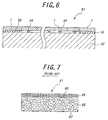
- Fig. 7 shows a sectional view of such a block.
- This block 61 includes a front-surface layer 64 and a rear-surface layer 65 in which rubber chips 66 and 67 obtained by grinding tires or the like and having respectively different are bound to one another with the synthetic resin binder such as urethane resin to make the block excellent in water permeability.
- the synthetic resin binder such as urethane resin
- the road is first paved with asphalt or concrete, the asphalt or the concrete is cured, and then a number of elastic blocks are paved on the cured layer, and entirely joined thereto with an adhesive, thereby forming the paved road.
- the elastically paved road constructed by spreading the polyurethane-based resin with the trowels has no water permeability.
- Such a paved road repels water, so that it causes pedestrians to slip or fall with staying water on walking, if the road has poor drainage.
- the elastic blocks in which rubber chips obtained by grinding tires or the like are fixedly bound to one another with a synthetic resin binder such as a urethane resin have water permeability, so that they prevent water from staying at their surfaces. As a result, they have high safety and can enhance walk feeling, so that they are frequently used.
- the upwardly warped blocks as a matter of course deteriorate the appearance of the paved road, and form steps at the warped portions, which cause pedestrians to stumble and fall and become safety problems.
- the present invention is aimed at obtaining elastic blocks which can axe prevented from being upwardly warped and have excellent safety and constructionability.
- the present invention relates to an elastic block adapted to be paved on an underlying base for absorbing impacts, said elastic block comprising a laminate composed of a powdery rubber-containing layer and a vulcanized rubber layer underlying the powdery rubber-containing layer, said powdery rubber-containing layer being a compression molded layer composed of a mixture comprising elastic chips having the particle size of 0.5 to 10 mm and a resin binder, said vulcanized rubber layer being a vulcanized molding of an unvulcanized rubber layer, wherein the elastic chips are fixedly bonded to one another with the resin binder and the powdery rubber-containing layer is adhered to the vulcanized rubber layer when the mixture layer and the unvulcanized rubber layer are subjected to pressurization and vulcanization.
- the invention also relates to a process for producing the same.
- the present invention clarified the causes warping the upper layer portions of the elastic blocks when used for a long time, and overcomes the warping problems of the elastic blocks by removing those causes.
- the present inventors discovered that even when the elastic blocks were entirely bound to the base, the adhesion between them decreased during the long-term use, and consequently the warping of the elastic blocks could not be suppressed. Further, it was clarified that the entire bonding caused poor constructionability, variations in joints in construction, etc., which resulted in practical problems.
- the present inventors discovered that the below elastic block can be stably prevented from being upwardly warped for an long time, that is, the elastic block being a laminate composed of a powdery rubber-containing layer and a vulcanized rubber layer underlying the powdery rubber-containing layer, said powdery rubber-containing layer being a compression molded layer in which elastic chips are the particle size of 0.5 to 10 mm and a resin binder, said vulcanized rubber layer being a vulcanized, molded layer of an unvulcanized rubber layer, wherein the powdery rubber-containing layer is adhered to the vulcanized rubber layer when the mixture layer and the unvulcanized rubber layer are subjected to pressurization and heating.
- the powdery rubber-containing layer is adhered to the vulcanized rubber layer and held by the vulcanized rubber layer. Therefore, even if water enters the powdery rubber-containing layer and stays in a lower portion of the powdery rubber-containing layer, the expansion of the powdery rubber-containing layer is suppressed to prevent the elastic block from being warped.
- the elastic block can exhibit excellent dimension stability over an extended time period. Further, the elastic body does not warp or change its deformability even after being paved, while maintaining water drainage. Consequently, the elastic block can sufficiently exhibit its functions to prevent slippage, absorb impacts, and ensure safety.
- the elastic block according to the present invention can prevent itself from being upwardly warped even during the long-term use, it needs not be bonded to the underlying base over its entire surface, so that the elastic block can be easily located and tentatively bonded to attain excellent constructionability.
- the elastic blocks according to the present invention are prevented from being warped over the long time period, they do not deteriorate the appearance of the elastically paved roads, etc. or form steps due to warping. Therefore, the elastic blocks can offer an elastically paved structure capable of preventing stumbling, falling, etc. and exhibiting high safety.
- the powdery rubber-containing layer is a compression molded layer composed of a mixture comprising elastic chips having the particle size of 0.5 to 10 mm preferably 1 to 3 mm, and a resin binder.
- the thickness of the powdery rubber-containing layer is not restrictive, but generally is preferably 10 to 20 mm. At that time, the thickness of the vulcanized rubber layer is preferably not less than 5 mm.
- the elastic chips may be elastic chips made of a rubbery material or an urethane-based elastomer.
- elastic chips particularly vulcanized chips, which can maintain given elasticity irrespective of changes in temperature, are preferably used.
- rubbery powders obtained particularly from used vulcanized rubbers recovered, such as used tires, are preferably used from the viewpoint of effectively utilizing the natural resources.
- vulcanized rubber chips which are obtained by adding a vulcanizing agent, a filler, a pigment, etc. into fresh rubber, kneading and vulcanizing the mixture and grinding the vulcanized mixture may be used as the vulcanized rubber chips.
- the vulcanized rubber chips to be used in a front-surface portion of the powdery rubber layer of the elastic block are preferably made of ethylene-propylene-diene terpolymer (EPDM).
- an aggregate may be incorporated into the powdery rubber-containing layer.
- an aggregate such as small stones having sizes of around 5 mm may be recited.
- the powdery rubber-containing layer may be molded with use of a smaller amount of the binder, which can reduce the cost.
- such elastic chips and additionally aggregate are fixedly bound to one another with an appropriate binder.
- a binder a polyurethane binder is particularly preferred. Since the polyurethane-based binder has excellent elongation and strength, the binder affords wear resistance.
- Such a polyurethane-based binder may be obtained by reacting an appropriate polyfunctional isocyanate with an appropriate polyfunctional alcohol.
- an appropriate polyfunctional isocyanate trilenediisocyanate (TDI) and diphenylmethane diisocyanate (MDI) may be recited
- TDI trilenediisocyanate
- MDI diphenylmethane diisocyanate
- PPG polypropyrene glycohol
- PEG polyethylene glycohol
- 100 parts by weight of the elastic chips are preferably bonded to one another with 5 to 30 parts by weight of at least one kind of a resin binder selected from the group consisting of the urethane resin and a liquid polybutadiene rubber.
- a resin binder selected from the group consisting of the urethane resin and a liquid polybutadiene rubber.
- the resin binder polyurethane-based binder, polybutadiene-based binder, polysulfide rubber-based binder, silicone rubber-based binder, etc. are recited. Among them, polyurethane-based binder is preferred.
- the resin binder is less than 5 parts by weight, it is not enough to fully bind the elastic chips in the powdery rubber-containing layer, whereas more than 30 parts by weight unfavorably results in a higher cost.
- the resin binder of the powdery rubber-containing layer use may be made of a one-liquid type curing agent which is curable with moisture and a two-liquid type curing binder in which a polyol-based curing agent, a polyamine curing agent, etc. are cured in combination.
- the powdery rubber-containing layer may comprise a plurality of powdery rubber-containing layers, for example, two upper and lower powdery rubber-containing layers. These plural powdery rubber-containing layers may contain the same kind of elastic chips or different kinds of elastic chips at the same compounding ratio or different mixing ratios.
- kind is meant the material from which the chips are made, the particle size and/or the average particle size.
- the compounding ratio of the elastic chips may be so changed that the upper powdery rubber can afford a smoother surface and high mechanical strength and more effectively absorb impact.
- the particle size of the elastic chips in the upper powdery rubber-containing layer may be smaller than the underlying powdery rubber-containing layer(s) for similar purposes as mentioned above.
- the elastic chips may be classified according to particle size by the use of a sieve.
- another vulcanized rubber layer may be interposed between the adjacent powdery rubber-containing layers.
- Such a construction further strengthens the mechanical strength of the elastic block.
- an antioxidant in the elastic block according to the present invention, an antioxidant, a UV ray absorber, a pigment, etc. may be incorporated into a front-surface powdery rubber-containing layer. If the pigment or the like is used, the powdery rubber-containing layer can be colored to a desired color.
- the powdery rubber-containing layer is an elastic layer having the elastic chips fixedly bound to one another with the resin binder, and possesses water permeability due to voids defined among the elastic chips bonded to one another with the resin binder.
- the bulk density of the powdery rubber-containing layer is preferably 0.7 to 1.5 g/cm 3 . If it is less than 0.7 g/cm 3 , durability becomes a problem, whereas more than 1.5 g/cm 3 deteriorates the elastic function.
- the unvulcanized rubber layer natural rubber, butyl rubber, styrene-butadiene rubber, butadiene rubber, ethylene-propylene rubber, chlorosulfonated polyethylene rubber, etc. may be used singly or in a mixed state.
- the thickness of the vulcanized rubber layer is not restrictive, but generally may be preferably not less than 5 mm.
- a softener a vulcanizer, a vulcanization accelerator, a filler, a coloring matter, a pigment, a dye, an anti-aging agent, other compounding agent, etc. may be incorporated, and the mixture can be molded to a sheet-shaped unvulcanized rubber layer in the present invention by press rolling with use of a calendar.
- the thickness of the vulcanized rubber layer is 5 to 60 % of that of the elastic block. If it is less than 5%, the upward warping of the unvulcanized rubber layer in the present invention is insufficient, whereas if the thickness of the vulcanized rubber layer exceeds beyond 60 %, the warping of the elastic block cannot be suppressed any more, and to the contrary the water permeability of the elastic block is interrupted.
- the elastic block may take any planar shape selected from a square, a rectangular shape, a polygonal shape, an elliptical shape, a round shape, a rhombic shape, a wavy shape, etc. as well as various three-dimensional shapes including designs.
- elastic chips are added and mixed into a resin binder together with appropriate additives such as a pigments, (2) a layer of the mixture is obtained for a powdery rubber-containing layer, (3) a laminate of this mixture layer and a layer of an unvulcanized rubber is prepared and placed in a mold, (4) the mixture layer is compression molded, and simultaneously the unvulcanized rubber layer is compression molded during vulcanization, and (5) the resultant product is released from the mold, thereby giving an elastic block.
- appropriate additives such as a pigments
- the non-reacted ingredient in the mixture layer reacts with that of the unvulcanized rubber layer at their boundary portion, so that the powdery rubber-containing layer is adhered to the vulcanized rubber layer to prevent the warping of the elastic block.
- a elastically paved structure is constructed by preferably closely paving the elastic blocks according to the present invention on an underlying base in such a manner that some of the elastic blocks are bound to the upper surface of the base with an adhesive over their entire surfaces, and the other only partly bound to the base with the adhesive.
- the elastic blocks 1 located at opposite sides may be bound to the upper surface of the base 52 with an adhesive 53 over their entire rear surfaces, and the other between the elastic blocks at the opposite sides only partly bound to the base 52 with the adhesive 54 applied to parts of their rear surfaces.
- the powdery rubber-containing layer is integrated with the vulcanized rubber layer, so that the elastic blocks have high dimensional stability even under exposure to water over a long time period, are free from deformation such as warping, and therefore need not be bound to the base over their entire surfaces.
- the elastic blocks according to the present invention when the elastic blocks according to the present invention are to be interlocked with one another, those at the side portions where the elastic blocks are more likely to be turned up or peeled are bound to the underlying base over their entire surfaces, whereas those in the other area are spot-bounded or partially, for example, linearly bound with the underlying base. Therefore, the elastic blocks according to the present invention have excellent constructionability.
- the elastic blocks according to the present invention do not warp, the paved structure does not cause pedestrians to stumble during walking, with the result that the turning up or peeling of the elastic blocks are not induced by such stumbling.
- the elastic blocks according to the present invention mitigate impact loads upon pedestrians' feet and legs, reduce fatigue feeling, decrease noise, and increase slip resistance at low-temperature and highly humid condition to give rise to difficult slippage on walking with extremely high safety. Further, even if a pedestrian falls on walking, an influence upon his or her human body can be reduce. Moreover, since the powdery rubber-containing layer penetrates water, the elastic floor having good drainage can be constructed. Thus, the elastic blocks according to the present invention can exhibit their inherent functions over a long time period.
- Fig. 2 is a perspective view of an embodiment of the elastic block according to the present invention.
- Fig. 3 is a perspective view of another embodiment of the elastic block according to the present invention.
- Fig. 4 is a sectional view of a further embodiment of the elastic block according to the present invention.
- Fig. 5 is a sectional view of a still further embodiment of the elastic block according to the present invention.
- Fig. 6 is a sectional view of a paved road using the elastic blocks according to the present invention.
- the elastic blocks according to the present invention which comprise elastic bodies, are to be paved on an underlying base to absorb impacts.
- the elastic block 1 shown in Fig. 2 have a rectangular shape with a throttled middle portion, and comprises a laminate of a powdery rubber-containing layer 12 and a vulcanized rubber layer 13 integrally underlying the powdery rubber-containing layer 12.
- the powdery rubber-containing layer 12 comprises an upper powdery layer 12a containing elastic chips 12c and a lower powdery layer 12b containing elastic chips 12d.
- the particle size of the elastic chips 12c and 12d fall in a range of 0.5 to 10 mm, the particle diameter of the elastic chips 12c is smaller than that of the elastic chips 12d.
- the particle size of the elastic chips 12c may be substantially equal to that of the elastic chips 12d.
- the particle size of the elastic chips is 1 to 3 mm.
- the reason why the powdery rubber-containing layer 12 comprises the upper and lower powdery rubber-containing layers like this is that this embodiment can ensure a smoother surface and a more impact-absorbing effect.
- the powdery rubbery layer is not limited to not only one integral type but also such a two-layer type, the powdery rubber-containing layer may be any plural(three, ---)-layer type.
- the elastic chips 12c and 12d are vulcanized rubber chips, and each kind of the elastic chips 12c and 12d is mixed with a resin binder to form a layer of the mixture.
- the two mixture layers are laminated together with the unvulcanized rubber layer as shown in Fig. 2, and the laminate is placed in a mold where the two mixture layers are bonded together and compression molded into the powdery rubber-containing layer, and the elastic chips are fixedly bonded together with the resin binder.
- the powdery rubber-containing layer 12 is adhered to the vulcanized rubber layer 13 under compression and heating treatment.
- the upper powdery rubber-containing layer is bonded to the lower powdery rubber-containing layer under heating with pressure inside the mold,
- Fig. 3 is a perspective view of another embodiment of the elastic block according to the present invention. This embodiment merely differs from that in Fig. 2 in that it has a unique crossing shape having a curved crossing design. Therefore, detailed explanation on this embodiment is omitted for simplification.
- Reference numerals 21, 22(22a, 22b, 22c, 22d) and 23 in Fig. 3 correspond to 11, 12 (12a, 12b, 12c, 12d) and 13 in Fig. 2, respectively.
- Fig. 4 is a sectional view of a further embodiment of the elastic block according to the present invention, which is structurally similar to those shown in Figs. 2 and 3.
- the elastic block in Fig. 4 differs from those shown in Figs. 2 and 3 in that the elastic chips 32d and the aggregate 32e are incorporated in a lower powdery rubber-containing layer 32b, the elastic chips 32d and the aggregate 32e having the respective particle sizes greater than that of elastic chips 32c in an upper powdery rubber-containing layer 32a.
- Reference numerals 31, 32 (32a, 32b, 32c & 33d) and 33 correspond to 11, 12 (12a, 12b, 12c, 12d) and 13 in Fig. 2, respectively. Therefore, detailed explanation of the embodiment in Fig. 4 is omitted for avoiding overlapping explanation with Fig. 2.
- Fig. 5 is a still further embodiment of the elastic block according to the present invention which differs from that of Fig. 4 in that two vulcanized rubber layer 43a and 43b are provided in the state that a first one 43a is interposed between a front-surface powdery rubber-containing layer 42a and an internal powdery rubber-containing layer 42b, and a second one 43b is arranged at the rear-surface side of the internal powdery rubber-containing layer 42b.
- the reason why two vulcanized rubber layers are provided is that such vulcanized rubber layers can further increase the strength of the elastic back and further prevent upward warping of the elastic block.
- Reference numerals 41, 42 (42a, 42b, 42c, 42d & 42e) and 43 (43a, 43b) correspond to 11,1 2 (12a, 12b, 12c, 12d) and 13 in Fig. 4, respectively. Therefore, detailed explanation of the embodiment in Fig. 5 is omitted for avoiding overlapping explanation with that in Fig. 2.
- the elastic block according to the present invention is constructed such that one or more powdery rubber-containing layers and one or more vulcanized rubber layers are laminated in the state that one powdery rubber-containing layer is to be located at a front surface side, whereas one vulcanized rubber layer is to be placed on the base.
- the unvulcanized rubber sheet, the 14 mm-thick mixture layer and the 5 mm-thick mixture layer were laminated from the lower side in this order, and placed in a mold. Then, the laminate was subjected to compression molding under heating at 150°C for 25 minutes, thereby obtaining an elastic block having a brown surface layer.
- the elastic block had the total thickness of 20 mm with the vulcanized rubber layer being 1 mm thick.
- Example 2 was effected fundamentally similar to Example 1 except that the thickness of a mixture layer for a lower powdery rubber-containing rubber layer was 18 mm and the thickness of an unvulcanized rubber sheet was 2 mm, thereby obtaining an elastic block with the total thickness of 25 mm. The thickness of the vulcanized rubber of this elastic block was 2 mm.
- Example 3 was effected fundamentally similar to Example 1 except that the thickness of a mixture layer for a lower powdery rubber-containing rubber layer was 7 mm and the thickness of an unvulcanized rubber sheet was 3 mm, thereby obtaining an elastic block with the total thickness of 15 mm. The thickness of the vulcanized rubber of this elastic block was 3 mm.
- Example 4 was effected fundamentally similar to Example 1 except that the thickness of a mixture layer for a lower powdery rubber-containing rubber layer was 9 mm and the thickness of an unvulcanized rubber sheet was 6 mm, thereby obtaining an elastic block with the total thickness of 20 mm. The thickness of the vulcanized rubber of this elastic block was 6 mm.
- the thickness of the vulcanized rubber of this elastic block was 6 mm.
- Example 6 was effected fundamentally similar to Example 1, thereby producing an elastic block with a single powdery rubber-containing layer.
- Example 2 the mixture layer was laminated on the unvulcanized rubber sheet, from the lower side in this order, and the laminate was placed in a mold. Then, the laminate was subjected to compression molding under heating at 150°C for 25 minutes, thereby obtaining an elastic block having a brown surface layer with the total thickness of 20 mm.
- the vulcanized rubber layer of the elastic block is 6 mm thick.
- Example 7 was effected fundamentally similar to Example 6 except that the thickness of a mixture layer for a powdery rubber-containing rubber layer was 19 mm and the thickness of an unvulcanized rubber sheet was 1 mm, thereby obtaining an elastic block with the total thickness of 25 mm. The thickness of the vulcanized rubber of this elastic block was 1 mm.
- Example 8 was effected fundamentally similar to Example 1 except that the thickness of a mixture layer for a powdery rubber-containing rubber layer was 6 mm and the thickness of an unvulcanized rubber sheet was 9 mm, thereby obtaining an elastic block with the total thickness of 15 mm. The thickness of the vulcanized rubber of this elastic block was 9 mm.
- Example 9 was effected fundamentally similar to Example 3 except that an unvulcanized rubber sheet was made of natural rubber, thereby obtaining an elastic block with the total thickness of 15 mm.
- the thickness of the vulcanized rubber of this elastic block was 3 mm.
- Comparative Example 1 was effected fundamentally similar to Example 1 except that the thickness of a mixture layer for a lower powdery rubber-containing rubber layer was 15 mm and no unvulcanized rubber sheet was used thereby obtaining a block with the total thickness of 30 mm.
- An unvulcanized rubber sheet was laminated upon a powdery rubber-containing layer as a base layer, and the laminated layers were simultaneously subjected to vulcanization molding. Then, the vulcanized molded laminate was subjected to a warping promotion test. Test condition was that the vulcanized rubber layer was immersed in warm water at 40°C for one month, and then the warped state of the laminate was measured.
- o ⁇ denotes that the upward warping was 0 or minus (downward warping).
- ⁇ denotes that the upward warping was 1 to 2 mm.
- X denotes that the upward warping was more than 2 mm.
- the blocks were paved on the outdoor concrete floor, and the stepped degree was examined between the blocks one month later.
- ⁇ denotes that the elastic block was inexpensive
- X denotes that the elastic block was expensive
- JIS K6256 Vulcanized Rubber Adhesion Test Method
- o ⁇ denotes that the adhered force was more than 2N/25 mm.
- ⁇ denotes that the adhered force was 1 to 2 N/25 mm.
- X denotes that the adhered force was less than 1 N/mm.
- Example 1 gives thicknesses of the respective layers in Examples 1 to 9 and Comparative Example 1.
- Example 1 Example 2
- Example 3 Example 4
- Example 5 Thickness of front-surface layer of powdery (unit: mm) 5 5 5 5 5 5
- Thickness of next layer of powdery (unit:mm) 14 18 7 9 9
- Thickness of vulcanized rubber layer (unit: mm) 1 2 3 6 6
- Example 6 Example 7
- Example 8 Example 9 Comparative Example 1 Thickness of front-surface layer of powdery (unit: mm) 14 5 6 5 5
- Thickness of next layer of powdery (unit: mm) 0 19 0 7 15
- Thickness of vulcanized rubber layer (unit: mm) 6 1 9 3 0
- the thickness of the vulcanized rubber layer is not more than 60 %, warping can be sufficiently suppressed in the elastic blocks according to the present invention, so that the elastic blocks can be produced at a low cost.
Landscapes
- Engineering & Computer Science (AREA)
- Architecture (AREA)
- Civil Engineering (AREA)
- Structural Engineering (AREA)
- Life Sciences & Earth Sciences (AREA)
- Wood Science & Technology (AREA)
- Road Paving Structures (AREA)
- Laminated Bodies (AREA)
Applications Claiming Priority (2)
| Application Number | Priority Date | Filing Date | Title |
|---|---|---|---|
| JP22206799 | 1999-08-05 | ||
| JP22206799 | 1999-08-05 |
Publications (2)
| Publication Number | Publication Date |
|---|---|
| EP1074659A2 true EP1074659A2 (fr) | 2001-02-07 |
| EP1074659A3 EP1074659A3 (fr) | 2003-08-13 |
Family
ID=16776604
Family Applications (1)
| Application Number | Title | Priority Date | Filing Date |
|---|---|---|---|
| EP00304692A Withdrawn EP1074659A3 (fr) | 1999-08-05 | 2000-06-02 | Bloc élastique et procédé pour le fabriquer |
Country Status (2)
| Country | Link |
|---|---|
| US (1) | US6602586B2 (fr) |
| EP (1) | EP1074659A3 (fr) |
Cited By (8)
| Publication number | Priority date | Publication date | Assignee | Title |
|---|---|---|---|---|
| ES2190743A1 (es) * | 2001-10-19 | 2003-08-01 | Alarcon Angel Corbera | Pavimento de goma vulcanizada para pisos y zocalos |
| RU2307887C2 (ru) * | 2004-04-29 | 2007-10-10 | Валерий Федорович Митякин | Способ изготовления покрытия |
| AT503683B1 (de) * | 2006-05-16 | 2008-05-15 | Sterner Franz | Im spritzguss- oder pressverfahren herstellbarer formteil |
| CN113047100A (zh) * | 2021-03-11 | 2021-06-29 | 苏州车同轨交通科技有限公司 | 一种自恢复式避险车道 |
| CN113863066A (zh) * | 2021-09-24 | 2021-12-31 | 洛阳双瑞橡塑科技有限公司 | 一种小阻力扣件垫板及其生产方法 |
| CN114481766A (zh) * | 2021-12-28 | 2022-05-13 | 中交一航局第三工程有限公司 | 一种水稳基层钢线法施工控制方法 |
| WO2022180247A1 (fr) * | 2021-02-26 | 2022-09-01 | Marko Seidensticker | Unité interverrouillable pour court de tennis et son procédé de production |
| WO2022268834A1 (fr) * | 2021-06-22 | 2022-12-29 | Marko Seidensticker | Surface de sport multicouche, procédé de fabrication d'une surface de sport et utilisation d'une telle surface de sport |
Families Citing this family (12)
| Publication number | Priority date | Publication date | Assignee | Title |
|---|---|---|---|---|
| US6920723B2 (en) * | 2001-08-16 | 2005-07-26 | Dodge-Regupol, Incorporated | Impact sound insulation |
| WO2004031501A1 (fr) | 2002-10-01 | 2004-04-15 | Dodge-Regupol, Incorporated | Tapis attenuateur de bruits et de vibrations |
| US20040200140A1 (en) * | 2003-02-20 | 2004-10-14 | Alexander Karoleen B. | Multi-layered structure for tree well skirts and sidewalks and method of making same |
| US7452159B2 (en) * | 2004-01-14 | 2008-11-18 | Karoleen B. Alexander | Method of making a multi-layered structure for tree well skirt and sidewalks |
| US20060244187A1 (en) | 2005-05-02 | 2006-11-02 | Downey Paul C | Vibration damper |
| US9079347B2 (en) | 2010-07-23 | 2015-07-14 | Inpress Technologies Inc. | Paving block formed of rubber crumb and a method of manufacturing the same |
| CA2914212C (fr) | 2015-06-25 | 2018-05-22 | Pliteq, Inc. | Tapis amortisseur d'impact, accessoire d'equipement et systeme de plancher |
| US20180202150A1 (en) | 2015-06-25 | 2018-07-19 | Pliteq Inc. | Impact damping mat, equipment accessory and flooring system |
| WO2017024401A1 (fr) * | 2015-08-10 | 2017-02-16 | New Rubber Technologies Holdings, Inc. | Procédé de fabrication d'un produit comprenant un corps composite et une surface de caoutchouc |
| US20170291389A1 (en) * | 2016-04-07 | 2017-10-12 | Kent Weisenberg | Laminate Surface Covering Suited for Marine Environments |
| US11390057B2 (en) * | 2016-06-10 | 2022-07-19 | Adco Products, Llc | Low and ultra low density butyl constrained layer patches |
| WO2019189378A1 (fr) * | 2018-03-27 | 2019-10-03 | 日本碍子株式会社 | Feuille de nitrure d'aluminium |
Family Cites Families (13)
| Publication number | Priority date | Publication date | Assignee | Title |
|---|---|---|---|---|
| US2347233A (en) * | 1941-02-12 | 1944-04-25 | Archie L Blades | Composite surfacing material and method of applying the same |
| USRE25778E (en) * | 1959-03-04 | 1965-05-18 | Non-slip structures | |
| US3801421A (en) * | 1970-11-09 | 1974-04-02 | Minnesota Mining & Mfg | Resilient composite useful as surfacing for athletics |
| DE2654845A1 (de) * | 1976-12-03 | 1978-06-08 | Willi Kohl | Kunststoffbelag fuer spiel-, sport- und tennisanlagen und verfahren zur herstellung desselben |
| US4337283A (en) * | 1980-09-11 | 1982-06-29 | Haas Jr Frederick T | Synthetic turf playing surface with resilient top-dressing |
| JP2719391B2 (ja) * | 1989-03-27 | 1998-02-25 | 株式会社ブリヂストン | ゴムマットの製造方法 |
| US5100704A (en) * | 1989-11-14 | 1992-03-31 | The Yokohama Rubber Co., Ltd. | Method for making a composite of vulcanized rubber and a urethane elastomer |
| JPH0796643B2 (ja) * | 1989-12-28 | 1995-10-18 | 横浜ゴム株式会社 | 道路舗装用ゴムブロック成形体 |
| US5094905A (en) * | 1990-02-13 | 1992-03-10 | Murray Kevin N | Structural articles made of recycled rubber fragments from tires |
| DE4011599A1 (de) * | 1990-04-10 | 1991-10-17 | Kraiburg Gummi Dev Gmbh | Gleisuebergangseinrichtung |
| JPH0794150B2 (ja) * | 1990-06-29 | 1995-10-11 | 広島化成株式会社 | 装飾性表面被覆材の製造方法 |
| DE4104731A1 (de) * | 1991-02-15 | 1992-08-20 | Kraiburg Gummi | Verbundkoerper aus vulkanisiertem altgummimaterial |
| DE4136647A1 (de) * | 1991-06-22 | 1992-12-24 | Clouth Gummiwerke Ag | Absorptionsmatte, insbesondere fuer organische kohlenwasserstoffe |
-
2000
- 2000-05-12 US US09/570,432 patent/US6602586B2/en not_active Expired - Fee Related
- 2000-06-02 EP EP00304692A patent/EP1074659A3/fr not_active Withdrawn
Non-Patent Citations (1)
| Title |
|---|
| None * |
Cited By (8)
| Publication number | Priority date | Publication date | Assignee | Title |
|---|---|---|---|---|
| ES2190743A1 (es) * | 2001-10-19 | 2003-08-01 | Alarcon Angel Corbera | Pavimento de goma vulcanizada para pisos y zocalos |
| RU2307887C2 (ru) * | 2004-04-29 | 2007-10-10 | Валерий Федорович Митякин | Способ изготовления покрытия |
| AT503683B1 (de) * | 2006-05-16 | 2008-05-15 | Sterner Franz | Im spritzguss- oder pressverfahren herstellbarer formteil |
| WO2022180247A1 (fr) * | 2021-02-26 | 2022-09-01 | Marko Seidensticker | Unité interverrouillable pour court de tennis et son procédé de production |
| CN113047100A (zh) * | 2021-03-11 | 2021-06-29 | 苏州车同轨交通科技有限公司 | 一种自恢复式避险车道 |
| WO2022268834A1 (fr) * | 2021-06-22 | 2022-12-29 | Marko Seidensticker | Surface de sport multicouche, procédé de fabrication d'une surface de sport et utilisation d'une telle surface de sport |
| CN113863066A (zh) * | 2021-09-24 | 2021-12-31 | 洛阳双瑞橡塑科技有限公司 | 一种小阻力扣件垫板及其生产方法 |
| CN114481766A (zh) * | 2021-12-28 | 2022-05-13 | 中交一航局第三工程有限公司 | 一种水稳基层钢线法施工控制方法 |
Also Published As
| Publication number | Publication date |
|---|---|
| EP1074659A3 (fr) | 2003-08-13 |
| US6602586B2 (en) | 2003-08-05 |
| US20020015840A1 (en) | 2002-02-07 |
Similar Documents
| Publication | Publication Date | Title |
|---|---|---|
| US6602586B2 (en) | Elastic blocks and process for producing the same | |
| KR100975984B1 (ko) | 조립식 운동장 바닥재 및 그 제조 방법 | |
| KR101325024B1 (ko) | 테니스 코트용 난슬립 바닥재의 시공방법 및 그의 상도층 조성물 | |
| CN102549217A (zh) | 人工草皮填充物及包含所述填充物的人工草皮 | |
| KR101179318B1 (ko) | 육상시설, 산책로, 보행로, 자전거 도로, 공원 등의 탄성이 요구되는 바닥에 설치되는 탄성 바닥재 | |
| JP4382966B2 (ja) | 弾性ブロック及びその製造方法 | |
| KR100784455B1 (ko) | 다양한 용도의 바닥부재 및 그 제조방법 | |
| KR100834523B1 (ko) | 체육시설용 탄성매트 제조방법 및 그 제품 | |
| KR20130066144A (ko) | 고무칩이 구비된 고무부재 제조방법 및 고무칩을 이용한 고무매트 | |
| JP3983594B2 (ja) | 弾性ブロック | |
| US7125199B2 (en) | Elastic permeable pavement comprising waste-polyurethane chips for use on new roads and a paving method using the same | |
| KR20050118132A (ko) | 조립식으로 구성되는 고무 블록과 그 제조방법 | |
| KR200374096Y1 (ko) | 스포츠 시설용 탄성 바닥재 | |
| KR102076818B1 (ko) | 재활용탄성고무분말과 ASR(Automobile Shredder Residue) 충진재를 함유하는 바닥재 제조방법 및 바닥재 시공방법 | |
| JP2655387B2 (ja) | 舗装用弾性ブロックおよびその製造法 | |
| KR200426472Y1 (ko) | 체육시설용 탄성매트 | |
| JP2670214B2 (ja) | 弾性舗装用ブロック | |
| JPH09105115A (ja) | 点字ブロック | |
| RU2806892C1 (ru) | Декоративное изделие | |
| KR200410601Y1 (ko) | 고무칩으로 제조된 탄성포장재와 인조잔디를 결합한탄성포장잔디 | |
| JP2016061042A (ja) | 複合型弾性舗装材 | |
| CN208049356U (zh) | 运动场用拼装板以及由该拼装板拼装的运动场 | |
| KR200317073Y1 (ko) | 이중 구조의 복합층 인ㆍ보도블럭 | |
| JP2000199201A (ja) | 弾性舗装構造体及びその施工方法 | |
| ES2296508B1 (es) | Pavimento de seguridad para proteccion contra impactos, resistente a la intemperie. |
Legal Events
| Date | Code | Title | Description |
|---|---|---|---|
| PUAI | Public reference made under article 153(3) epc to a published international application that has entered the european phase |
Free format text: ORIGINAL CODE: 0009012 |
|
| AK | Designated contracting states |
Kind code of ref document: A2 Designated state(s): AT BE CH CY DE DK ES FI FR GB GR IE IT LI LU MC NL PT SE |
|
| AX | Request for extension of the european patent |
Free format text: AL;LT;LV;MK;RO;SI |
|
| PUAL | Search report despatched |
Free format text: ORIGINAL CODE: 0009013 |
|
| AK | Designated contracting states |
Designated state(s): AT BE CH CY DE DK ES FI FR GB GR IE IT LI LU MC NL PT SE |
|
| AX | Request for extension of the european patent |
Extension state: AL LT LV MK RO SI |
|
| RIC1 | Information provided on ipc code assigned before grant |
Ipc: 7B 32B 31/00 B Ipc: 7B 32B 25/02 B Ipc: 7B 32B 25/00 B Ipc: 7E 01C 5/18 A |
|
| 17P | Request for examination filed |
Effective date: 20040203 |
|
| AKX | Designation fees paid |
Designated state(s): GB |
|
| REG | Reference to a national code |
Ref country code: DE Ref legal event code: 8566 |
|
| 17Q | First examination report despatched |
Effective date: 20050701 |
|
| 17Q | First examination report despatched |
Effective date: 20050701 |
|
| STAA | Information on the status of an ep patent application or granted ep patent |
Free format text: STATUS: THE APPLICATION IS DEEMED TO BE WITHDRAWN |
|
| 18D | Application deemed to be withdrawn |
Effective date: 20080101 |