EP1074974A2 - Sichere Benutzeridentifizierung über eine drahtlose Kommunikationsverbindung mittels Stimmerkennung - Google Patents
Sichere Benutzeridentifizierung über eine drahtlose Kommunikationsverbindung mittels Stimmerkennung Download PDFInfo
- Publication number
- EP1074974A2 EP1074974A2 EP00304841A EP00304841A EP1074974A2 EP 1074974 A2 EP1074974 A2 EP 1074974A2 EP 00304841 A EP00304841 A EP 00304841A EP 00304841 A EP00304841 A EP 00304841A EP 1074974 A2 EP1074974 A2 EP 1074974A2
- Authority
- EP
- European Patent Office
- Prior art keywords
- user
- speech
- mobile station
- prompting
- inputting
- Prior art date
- Legal status (The legal status is an assumption and is not a legal conclusion. Google has not performed a legal analysis and makes no representation as to the accuracy of the status listed.)
- Withdrawn
Links
Images


Classifications
-
- G—PHYSICS
- G06—COMPUTING OR CALCULATING; COUNTING
- G06Q—INFORMATION AND COMMUNICATION TECHNOLOGY [ICT] SPECIALLY ADAPTED FOR ADMINISTRATIVE, COMMERCIAL, FINANCIAL, MANAGERIAL OR SUPERVISORY PURPOSES; SYSTEMS OR METHODS SPECIALLY ADAPTED FOR ADMINISTRATIVE, COMMERCIAL, FINANCIAL, MANAGERIAL OR SUPERVISORY PURPOSES, NOT OTHERWISE PROVIDED FOR
- G06Q20/00—Payment architectures, schemes or protocols
- G06Q20/38—Payment protocols; Details thereof
- G06Q20/40—Authorisation, e.g. identification of payer or payee, verification of customer or shop credentials; Review and approval of payers, e.g. check credit lines or negative lists
-
- G—PHYSICS
- G06—COMPUTING OR CALCULATING; COUNTING
- G06Q—INFORMATION AND COMMUNICATION TECHNOLOGY [ICT] SPECIALLY ADAPTED FOR ADMINISTRATIVE, COMMERCIAL, FINANCIAL, MANAGERIAL OR SUPERVISORY PURPOSES; SYSTEMS OR METHODS SPECIALLY ADAPTED FOR ADMINISTRATIVE, COMMERCIAL, FINANCIAL, MANAGERIAL OR SUPERVISORY PURPOSES, NOT OTHERWISE PROVIDED FOR
- G06Q20/00—Payment architectures, schemes or protocols
- G06Q20/30—Payment architectures, schemes or protocols characterised by the use of specific devices or networks
- G06Q20/32—Payment architectures, schemes or protocols characterised by the use of specific devices or networks using wireless devices
- G06Q20/322—Aspects of commerce using mobile devices [M-devices]
-
- G—PHYSICS
- G06—COMPUTING OR CALCULATING; COUNTING
- G06Q—INFORMATION AND COMMUNICATION TECHNOLOGY [ICT] SPECIALLY ADAPTED FOR ADMINISTRATIVE, COMMERCIAL, FINANCIAL, MANAGERIAL OR SUPERVISORY PURPOSES; SYSTEMS OR METHODS SPECIALLY ADAPTED FOR ADMINISTRATIVE, COMMERCIAL, FINANCIAL, MANAGERIAL OR SUPERVISORY PURPOSES, NOT OTHERWISE PROVIDED FOR
- G06Q20/00—Payment architectures, schemes or protocols
- G06Q20/38—Payment protocols; Details thereof
- G06Q20/40—Authorisation, e.g. identification of payer or payee, verification of customer or shop credentials; Review and approval of payers, e.g. check credit lines or negative lists
- G06Q20/401—Transaction verification
- G06Q20/4014—Identity check for transactions
- G06Q20/40145—Biometric identity checks
-
- G—PHYSICS
- G07—CHECKING-DEVICES
- G07C—TIME OR ATTENDANCE REGISTERS; REGISTERING OR INDICATING THE WORKING OF MACHINES; GENERATING RANDOM NUMBERS; VOTING OR LOTTERY APPARATUS; ARRANGEMENTS, SYSTEMS OR APPARATUS FOR CHECKING NOT PROVIDED FOR ELSEWHERE
- G07C9/00—Individual registration on entry or exit
- G07C9/20—Individual registration on entry or exit involving the use of a pass
- G07C9/22—Individual registration on entry or exit involving the use of a pass in combination with an identity check of the pass holder
- G07C9/25—Individual registration on entry or exit involving the use of a pass in combination with an identity check of the pass holder using biometric data, e.g. fingerprints, iris scans or voice recognition
- G07C9/257—Individual registration on entry or exit involving the use of a pass in combination with an identity check of the pass holder using biometric data, e.g. fingerprints, iris scans or voice recognition electronically
-
- G—PHYSICS
- G07—CHECKING-DEVICES
- G07C—TIME OR ATTENDANCE REGISTERS; REGISTERING OR INDICATING THE WORKING OF MACHINES; GENERATING RANDOM NUMBERS; VOTING OR LOTTERY APPARATUS; ARRANGEMENTS, SYSTEMS OR APPARATUS FOR CHECKING NOT PROVIDED FOR ELSEWHERE
- G07C9/00—Individual registration on entry or exit
- G07C9/20—Individual registration on entry or exit involving the use of a pass
- G07C9/27—Individual registration on entry or exit involving the use of a pass with central registration
-
- G—PHYSICS
- G10—MUSICAL INSTRUMENTS; ACOUSTICS
- G10L—SPEECH ANALYSIS TECHNIQUES OR SPEECH SYNTHESIS; SPEECH RECOGNITION; SPEECH OR VOICE PROCESSING TECHNIQUES; SPEECH OR AUDIO CODING OR DECODING
- G10L17/00—Speaker identification or verification techniques
-
- H—ELECTRICITY
- H04—ELECTRIC COMMUNICATION TECHNIQUE
- H04M—TELEPHONIC COMMUNICATION
- H04M1/00—Substation equipment, e.g. for use by subscribers
- H04M1/26—Devices for calling a subscriber
- H04M1/27—Devices whereby a plurality of signals may be stored simultaneously
- H04M1/271—Devices whereby a plurality of signals may be stored simultaneously controlled by voice recognition
-
- H—ELECTRICITY
- H04—ELECTRIC COMMUNICATION TECHNIQUE
- H04M—TELEPHONIC COMMUNICATION
- H04M1/00—Substation equipment, e.g. for use by subscribers
- H04M1/72—Mobile telephones; Cordless telephones, i.e. devices for establishing wireless links to base stations without route selection
- H04M1/724—User interfaces specially adapted for cordless or mobile telephones
Definitions
- This invention relates generally to biometric systems and methods and, in particular, to systems that identify a speaker by the automatic recognition of the speaker's voice and, more particularly, to a wireless telecommunications system employing voice recognition.
- Biometric systems typically employ and measure some physical characteristic of a particular individual to uniquely identify that individual.
- the characteristic could be, by example, a fingerprint, a retinal pattern, or a voice pattern.
- the use of this latter characteristic is especially attractive for those systems that already include a microphone, such as telecommunications system, as no hardware expense may need to be incurred in order to implement the identification system.
- the system can then grant the speaker access to some location or to some resource. That is, this type of biometric system can be viewed as an electronic, voice actuated lock.
- the system is trained to recognize a particular speaker using a limited set of spoken words.
- the speaker may be expected to say his or her name, and/or some predetermined password.
- the limited set of words used for identification may not be desirable, and may in fact lead some other persons to attempt to defeat the voice recognition-based biometric system.
- a person attempting to defeat the system may simply surreptitiously tape record a person speaking the word or words that the biometric system expects to be spoken, and then play back the authorized person's speech to the voice input transducer of the biometric system.
- a mobile telephone such as a vehicle-installed cellular telephone
- a voice recognition capability in order to replace or augment the normal user input device(s). For example, the user can dial a number by speaking the digits, or by speaking a name having a stored telephone number. Some commands could be given to the telephone in the same manner.
- current user identification methods are based on measuring one static feature: e.g., a written password, a spoken password (voice recognition), a fingerprint, an image of the eye and so on. In the identifying situation the user knows what is measured and how.
- a most straightforward way to implement the invention is with voice recognition.
- the user is presented with a voice stimulus, or a text stimulus, or a graphical image stimulus, and the user reacts with his or her voice.
- the stimulus can be direct (e.g., the user speaks a displayed word) or indirect (e.g., the user responds to a question that only the user knows the answer to). Since even the correct user does not know beforehand the details of the identification situation, it becomes very difficult or impossible to know beforehand what the expected correct response will be.
- a method is disclosed to authorize or authenticate a user of a wireless telecommunication system, and includes steps of (a) selecting a word at random from a set of reference words, or synthesizing a random reference word; (b) prompting the user to speak the reference word; and (c) authenticating the user to operate in or through or with a resource reachable through the wireless telecommunication system, only if the user's speech characteristics match predetermined characteristics associated with the reference word.
- the steps of selecting or synthesizing, prompting and authenticating are performed in a mobile station having a speech transducer for inputting the user's speech, while in another embodiment at least one of the steps of selecting or synthesizing, prompting and authenticating are performed in a wireless telecommunications network that is coupled between the mobile station and a telephone network. In yet another embodiment at least one of the steps of selecting or synthesizing, prompting and authenticating are performed in a data communications network resource that is coupled through a data communications network, such as the Internet, and the wireless telecommunications network to the mobile station.
- the step of prompting may include a step of displaying alphanumeric text and/or a graphical image to the user using a display of the mobile station.
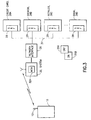
- a wireless user terminal or mobile station 10 such as but not limited to a cellular radiotelephone or a personal communicator, that is suitable for practicing this invention.
- the mobile station 10 includes an antenna 12 for transmitting signals to and for receiving signals from a base site or base station 30.
- the base station 30 is a part of a wireless telecommunications network or system 32, that may include a mobile switching center (MSC) 34.
- the MSC 34 provides a connection to landline trunks, such as the public switched telephone network (PSTN) 35, when the mobile station 10 is involved in a call.
- PSTN public switched telephone network
- the mobile station includes a modulator (MOD) 14A, a transmitter 14, a receiver 16, a demodulator (DEMOD) 16A, and a controller 18 that provides signals to and receives signals from the transmitter 14 and receiver 16, respectively.
- These signals include signalling information in accordance with the air interface standard of the applicable cellular system, and also user speech and/or user generated data.
- the particular air interface standard and/or access type is not germane to the operation of this system, as mobile stations and wireless systems employing most if not all air interface standards and access types (e.g., TDMA, CDMA, FDMA, etc.) can benefit from the teachings of this invention.
- the controller 18 also includes the circuitry required for implementing the audio and logic functions of the mobile station.
- the controller 18 may be comprised of a digital signal processor device, a microprocessor device, and various analog to digital converters, digital to analog converters, and other support circuits.
- the control and signal processing functions of the mobile station 10 are allocated between these devices according to their respective capabilities.
- the mobile station 10 will include a voice encoder/decoder (vocoder) 18A of any suitable type.
- a user interface includes a conventional earphone or speaker 17, a conventional microphone 19, a display 20, and a user input device, typically a keypad 22, all of which are coupled to the controller 18.
- the keypad 22 includes the conventional numeric (0-9) and related keys (#,*) 22a, and other keys 22b used for operating the mobile station 10. These other keys 22b may include, by example, a SEND key, various menu scrolling and soft keys, and a PWR key.
- the mobile station 10 also includes a battery 26 for powering the various circuits that are required to operate the mobile station.
- the mobile station 10 also includes various memories, shown collectively as the memory 24, wherein are stored a plurality of constants and variables that are used by the controller 18 during the operation of the mobile station.
- the memory 24 may also store all or some of the values of various wireless system parameters and the number assignment module (NAM).
- An operating program for controlling the operation of controller 18 is also stored in the memory 24 (typically in a ROM device).
- the controller 18 includes a speech recognition function (SRF) 29 that receives digitized input that originates from the microphone 19, and which is capable of processing the digitized input and for comparing the characteristics of the user's speech with pre-stored characteristics stored in the memory 24. If a match occurs then the controller 18 is operable to grant the speaker access to some resource, for example to a removable electronic card 28 which authorizes or enables the speaker to, in a typical application, make a telephone call from the mobile station 10.
- SRF speech recognition function
- the subscriber data required to make a telephone call such as the Mobile Identification Number (MIN), and/or some authentication-related key or other data, can be stored in the card 28, and access to this information is only granted when the user speaks a word or words that are expected by the SRF 29, and which match predetermined enrollment (training) data already stored in the memory 24.
- MIN Mobile Identification Number
- some authentication-related key or other data can be stored in the card 28, and access to this information is only granted when the user speaks a word or words that are expected by the SRF 29, and which match predetermined enrollment (training) data already stored in the memory 24.
- the training data could as well be stored in some other memory, such as a memory 28A within the card 28, or in a memory 32A located in the system 32, or in some remote memory that is accessible through the system 32.
- a memory 39 storing the training data set could be located in a data communications network (e.g., the Internet) entity or resource 38, which is accessible from the PSTN 35 through a network interface 36 (e.g., an Internet Service Provider or ISP), and a local area or wide area data communications network 37 (e.g., the Internet).
- a data communications network e.g., the Internet
- a network interface 36 e.g., an Internet Service Provider or ISP
- ISP Internet Service Provider
- a local area or wide area data communications network 37 e.g., the Internet
- the identification system and software, as well as the prestored speech samples and characteristics may be located in the mobile station 10, in a server of the network 37 or the system 32, or in the system of a service provider.
- the user can be prompted to speak one or a set of words, with the specific word to be spoken being selected randomly from the set of known words by the SRF 29. Assuming that the set of known words has a non-trivial number of elements, then it becomes difficult for another person to defeat the SRF 29 by recording a word or words expected to be spoken by the user.
- the user can be prompted to speak the selected word or words in various ways.
- the SRF 29 displays the selected word on the display 20.
- the SRF 29 can use a speech synthesizer and the mobile station's speaker 17 to audibly prompt the user for the word to be spoken.
- the display 20 is used to present some graphical image corresponding to a word to be spoken (e.g., a tree).
- some generic graphical image is used to suggest to the user a predetermined word to be spoken, and that was previously agreed upon during the training or enrollment stage.
- the words can be encrypted to prevent unauthorized access and/or modification.
- the SRF 29 can be resident outside of the mobile station 10, such as at one or more network entities or resources 38A-38D (e.g., a credit card supplier, stock broker, retailer or bank.)
- the SRF 29 signals back to the mobile station 10 a randomly selected word to be spoken by the user, via the network 37, network interface 36, and wireless system 32.
- the user speaks the word and, in one embodiment, the spectral and temporal characteristics of the user's utterance are transmitted from the mobile station 10 as a digital data stream (not as speech per se) to the SRF 29 of the bank 38D for processing and comparison.
- the user's spoken utterance is transmitted in a normal manner, such as by transmitting voice encoder/decoder (vocoder 18A) parameters, which are converted to speech in the system 32.
- vocoder 18A voice encoder/decoder
- This speech is then routed to the SRF 29 of the bank 38D for processing and comparison.
- the spectral and temporal and characteristics transmitted in the first embodiment could be the vocoder 18A output parameters as well, which are then transmitted on further to the SRF 29 of the band 38D, without being first converted to a speech signal in the system 32.
- the necessary signalling protocol must first be defined and established so that the system 32 knows to bypass its speech decoder.
- SRF 29A whose responsibility it is to authenticate users for other locations.
- the user of the mobile station 10 telephones the bank 38D and wishes to access an account.
- the user authentication process is handled by the intervention of the SRF 29A which has a database (DB) 29B of recognition word sets and associated speech characteristics for a plurality of different users.
- the SRF 29A after processing the user's speech signal, signals the bank 38D that the user is either authorized or is not authorized. This process could be handled in several ways, such as by connecting the user's call directly to the SRF 29A, or by forwarding the user's voice characteristics from the bank 38D to the SRF 29A. In either case the bank 38D is not required to have the SRF 29, nor are the other network resources 38A-38C.
- the set of recognition words stored in the DB 29B could be different for every user. It should be further noted that this process implies that at some time the user interacts with the SRFs 29, or just with the SRF 29A, in order to execute an enrollment or training process whereby the user's database entries (set of recognition words and the associated speech temporal and spectral characteristics) are created. As was noted above, at least some of these speech characteristics could be based on or include voice encoder 18A parameters.
- about 20-50 prestored voice samples can be used, and the stimulus and the sample are randomly or pseudorandomly selected among these (e.g., text-dependent speaker verification).
- the connection between the stimulus and the sample may be meaningful only for the user.
- the user is not required to memorize one or more passwords or numeric codes.
- the term "random" is considered to encompass both truly random as well as pseudorandom.
- the prestored samples are not required, but instead the system creates one or more synthesized reference word(s) that are compared to the user's voice response (text-independent speaker verification).
- the generated reference word is preferably generated randomly or pseudorandomly.
- the teachings of this invention could be combined with the use of one or more other types of identification systems and techniques, such as fingerprint identification.
- various ones of the stimulus types described above could be used in combination.
- the user may be presented with a randomly selected or generated alphanumeric string that the user is expected vocalize, as well as with a related or totally unrelated graphical image to which the user is expected to verbally respond.
- the "word” may actually be a phrase comprised of a plurality of words and also possibly numbers (e.g., a date, or an address).
Landscapes
- Engineering & Computer Science (AREA)
- Business, Economics & Management (AREA)
- Physics & Mathematics (AREA)
- General Physics & Mathematics (AREA)
- Accounting & Taxation (AREA)
- Strategic Management (AREA)
- Theoretical Computer Science (AREA)
- General Business, Economics & Management (AREA)
- Computer Security & Cryptography (AREA)
- Finance (AREA)
- Human Computer Interaction (AREA)
- Computer Networks & Wireless Communication (AREA)
- Health & Medical Sciences (AREA)
- Audiology, Speech & Language Pathology (AREA)
- Acoustics & Sound (AREA)
- Multimedia (AREA)
- Mobile Radio Communication Systems (AREA)
- Telephonic Communication Services (AREA)
Applications Claiming Priority (2)
| Application Number | Priority Date | Filing Date | Title |
|---|---|---|---|
| US326717 | 1999-06-07 | ||
| US09/326,717 US6393305B1 (en) | 1999-06-07 | 1999-06-07 | Secure wireless communication user identification by voice recognition |
Publications (2)
| Publication Number | Publication Date |
|---|---|
| EP1074974A2 true EP1074974A2 (de) | 2001-02-07 |
| EP1074974A3 EP1074974A3 (de) | 2002-04-17 |
Family
ID=23273381
Family Applications (1)
| Application Number | Title | Priority Date | Filing Date |
|---|---|---|---|
| EP00304841A Withdrawn EP1074974A3 (de) | 1999-06-07 | 2000-06-07 | Sichere Benutzeridentifizierung über eine drahtlose Kommunikationsverbindung mittels Stimmerkennung |
Country Status (2)
| Country | Link |
|---|---|
| US (1) | US6393305B1 (de) |
| EP (1) | EP1074974A3 (de) |
Cited By (9)
| Publication number | Priority date | Publication date | Assignee | Title |
|---|---|---|---|---|
| WO2002086865A1 (en) * | 2001-04-13 | 2002-10-31 | Koninklijke Philips Electronics N.V. | Speaker verification in a spoken dialogue system |
| EP1531459A1 (de) * | 2003-11-13 | 2005-05-18 | Voice.Trust Ag | Verfahren zur Authentifizierung eines Benutzers anhand dessen Stimmprofils |
| CN102781075A (zh) * | 2011-05-12 | 2012-11-14 | 中兴通讯股份有限公司 | 一种降低移动终端通话功耗的方法及移动终端 |
| EP2626826A1 (de) * | 2012-02-07 | 2013-08-14 | Voice Commerce Group Technologies Limited | System und Verfahren zur Verarbeitung von Transaktionen |
| GB2519571A (en) * | 2013-10-25 | 2015-04-29 | Aplcomp Oy | Audiovisual associative authentication method and related system |
| EP3272101A4 (de) * | 2015-03-20 | 2018-09-26 | Aplcomp OY | Audiovisuelles assoziatives authentifizierungsverfahren, entsprechendes system und vorrichtung |
| US11811681B1 (en) | 2022-07-12 | 2023-11-07 | T-Mobile Usa, Inc. | Generating and deploying software architectures using telecommunication resources |
| US12164887B2 (en) | 2022-07-12 | 2024-12-10 | T-Mobile Usa, Inc. | Identifying standards-related requirements for software architectures using telecommunication resources |
| US12356207B2 (en) | 2022-07-12 | 2025-07-08 | T-Mobile Usa, Inc. | Telecommunication resource deployment using machine learning systems and methods |
Families Citing this family (50)
| Publication number | Priority date | Publication date | Assignee | Title |
|---|---|---|---|---|
| KR100636111B1 (ko) * | 1999-10-30 | 2006-10-18 | 삼성전자주식회사 | 분실된 이동 단말기에 내장된 데이터 보호 방법 및 이에 관한 기록매체 |
| GB2358987B (en) * | 2000-02-01 | 2003-10-29 | Ericsson Telefon Ab L M | Electronic devices |
| US6961584B2 (en) | 2000-03-22 | 2005-11-01 | Mlr, Llc | Tiered wireless, multi-modal access system and method |
| US7933589B1 (en) * | 2000-07-13 | 2011-04-26 | Aeritas, Llc | Method and system for facilitation of wireless e-commerce transactions |
| US7240036B1 (en) | 2000-07-13 | 2007-07-03 | Gtech Global Services Corporation | Method and system for facilitation of wireless e-commerce transactions |
| US20020026423A1 (en) * | 2000-08-23 | 2002-02-28 | Sony Electronics, Inc. | Automated usage-independent and location-independent agent-based incentive method and system for customer retention |
| US20020026419A1 (en) * | 2000-08-24 | 2002-02-28 | Sony Electronics, Inc. | Apparatus and method for populating a portable smart device |
| US20020029203A1 (en) * | 2000-09-01 | 2002-03-07 | Pelland David M. | Electronic personal assistant with personality adaptation |
| WO2002042890A1 (en) * | 2000-11-22 | 2002-05-30 | Fujitsu Limited | Security system for information processor |
| EP1209663A1 (de) * | 2000-11-27 | 2002-05-29 | Siemens Aktiengesellschaft | Zugangssteueranordnung und Verfahren zur Zugangssteuerung |
| US7188110B1 (en) * | 2000-12-11 | 2007-03-06 | Sony Corporation | Secure and convenient method and apparatus for storing and transmitting telephony-based data |
| US20020091937A1 (en) * | 2001-01-10 | 2002-07-11 | Ortiz Luis M. | Random biometric authentication methods and systems |
| WO2002069325A1 (en) * | 2001-02-26 | 2002-09-06 | Startouch International, Ltd. | Apparatus and methods for implementing voice enabling applications in a coverged voice and data network environment |
| US20030061173A1 (en) * | 2001-09-27 | 2003-03-27 | Hiroshi Ogino | Electronic gathering of product information and purchasing of products |
| US7243239B2 (en) * | 2002-06-28 | 2007-07-10 | Microsoft Corporation | Click passwords |
| US7415410B2 (en) * | 2002-12-26 | 2008-08-19 | Motorola, Inc. | Identification apparatus and method for receiving and processing audible commands |
| US7222072B2 (en) * | 2003-02-13 | 2007-05-22 | Sbc Properties, L.P. | Bio-phonetic multi-phrase speaker identity verification |
| US7549170B2 (en) * | 2003-04-30 | 2009-06-16 | Microsoft Corporation | System and method of inkblot authentication |
| US7212613B2 (en) * | 2003-09-18 | 2007-05-01 | International Business Machines Corporation | System and method for telephonic voice authentication |
| US7636855B2 (en) * | 2004-01-30 | 2009-12-22 | Panasonic Corporation | Multiple choice challenge-response user authorization system and method |
| US20050273333A1 (en) * | 2004-06-02 | 2005-12-08 | Philippe Morin | Speaker verification for security systems with mixed mode machine-human authentication |
| US20060085189A1 (en) * | 2004-10-15 | 2006-04-20 | Derek Dalrymple | Method and apparatus for server centric speaker authentication |
| US7328012B2 (en) * | 2005-02-11 | 2008-02-05 | Harris Corporation | Aircraft communications system and related method for communicating between portable wireless communications device and ground |
| US7953983B2 (en) | 2005-03-08 | 2011-05-31 | Microsoft Corporation | Image or pictographic based computer login systems and methods |
| US20060293898A1 (en) * | 2005-06-22 | 2006-12-28 | Microsoft Corporation | Speech recognition system for secure information |
| CN1905445B (zh) | 2005-07-27 | 2012-02-15 | 国际商业机器公司 | 使用可移动的语音标识卡的语音认证系统及语音认证方法 |
| US20070055517A1 (en) * | 2005-08-30 | 2007-03-08 | Brian Spector | Multi-factor biometric authentication |
| US8396711B2 (en) * | 2006-05-01 | 2013-03-12 | Microsoft Corporation | Voice authentication system and method |
| US20080195395A1 (en) * | 2007-02-08 | 2008-08-14 | Jonghae Kim | System and method for telephonic voice and speech authentication |
| US8817964B2 (en) * | 2008-02-11 | 2014-08-26 | International Business Machines Corporation | Telephonic voice authentication and display |
| US8504365B2 (en) * | 2008-04-11 | 2013-08-06 | At&T Intellectual Property I, L.P. | System and method for detecting synthetic speaker verification |
| US8275097B2 (en) | 2008-08-28 | 2012-09-25 | Ebay Inc. | Voice phone-based method and system to authenticate users |
| US8458485B2 (en) | 2009-06-17 | 2013-06-04 | Microsoft Corporation | Image-based unlock functionality on a computing device |
| US8321209B2 (en) | 2009-11-10 | 2012-11-27 | Research In Motion Limited | System and method for low overhead frequency domain voice authentication |
| US8326625B2 (en) * | 2009-11-10 | 2012-12-04 | Research In Motion Limited | System and method for low overhead time domain voice authentication |
| US9246914B2 (en) * | 2010-07-16 | 2016-01-26 | Nokia Technologies Oy | Method and apparatus for processing biometric information using distributed computation |
| US10089606B2 (en) | 2011-02-11 | 2018-10-02 | Bytemark, Inc. | System and method for trusted mobile device payment |
| US20120296826A1 (en) | 2011-05-18 | 2012-11-22 | Bytemark, Inc. | Method and system for distributing electronic tickets with visual display |
| US10762733B2 (en) | 2013-09-26 | 2020-09-01 | Bytemark, Inc. | Method and system for electronic ticket validation using proximity detection |
| US10453067B2 (en) | 2011-03-11 | 2019-10-22 | Bytemark, Inc. | Short range wireless translation methods and systems for hands-free fare validation |
| US10360567B2 (en) | 2011-03-11 | 2019-07-23 | Bytemark, Inc. | Method and system for distributing electronic tickets with data integrity checking |
| US8494967B2 (en) * | 2011-03-11 | 2013-07-23 | Bytemark, Inc. | Method and system for distributing electronic tickets with visual display |
| AU2011202415B1 (en) | 2011-05-24 | 2012-04-12 | Microsoft Technology Licensing, Llc | Picture gesture authentication |
| US9042867B2 (en) | 2012-02-24 | 2015-05-26 | Agnitio S.L. | System and method for speaker recognition on mobile devices |
| CA2989051C (en) | 2015-08-17 | 2024-05-28 | Bytemark, Inc. | Short range wireless translation methods and systems for hands-free fare validation |
| US11803784B2 (en) | 2015-08-17 | 2023-10-31 | Siemens Mobility, Inc. | Sensor fusion for transit applications |
| CN109146450A (zh) | 2017-06-16 | 2019-01-04 | 阿里巴巴集团控股有限公司 | 支付方法、客户端、电子设备、存储介质和服务器 |
| US11178028B1 (en) | 2020-09-15 | 2021-11-16 | T-Mobile Usa, Inc. | Web interface to remotely collect and analyze mobile device logs |
| US11315575B1 (en) * | 2020-10-13 | 2022-04-26 | Google Llc | Automatic generation and/or use of text-dependent speaker verification features |
| US12341909B2 (en) | 2022-10-28 | 2025-06-24 | T-Mobile Usa, Inc. | Authenticating a user interacting with a wireless telecommunication network via a non-internet connected phone |
Family Cites Families (14)
| Publication number | Priority date | Publication date | Assignee | Title |
|---|---|---|---|---|
| US4827518A (en) * | 1987-08-06 | 1989-05-02 | Bell Communications Research, Inc. | Speaker verification system using integrated circuit cards |
| CA2040724A1 (en) * | 1990-04-25 | 1991-10-26 | James L. Flanagan | Voice password controlled computer security system |
| FI97919C (fi) | 1992-06-05 | 1997-03-10 | Nokia Mobile Phones Ltd | Puheentunnistusmenetelmä ja -järjestelmä puheella ohjattavaa puhelinta varten |
| US5907597A (en) * | 1994-08-05 | 1999-05-25 | Smart Tone Authentication, Inc. | Method and system for the secure communication of data |
| US5774525A (en) * | 1995-01-23 | 1998-06-30 | International Business Machines Corporation | Method and apparatus utilizing dynamic questioning to provide secure access control |
| US5805674A (en) * | 1995-01-26 | 1998-09-08 | Anderson, Jr.; Victor C. | Security arrangement and method for controlling access to a protected system |
| EP0746136A3 (de) | 1995-06-02 | 1999-06-23 | Nokia Mobile Phones Ltd. | Automatisches Kreditkartenanrufsystem |
| US5692032A (en) | 1995-11-27 | 1997-11-25 | Nokia Mobile Phones Ltd. | Mobile terminal having one key user message acknowledgment function |
| US5903832A (en) | 1995-12-21 | 1999-05-11 | Nokia Mobile Phones Llimited | Mobile terminal having enhanced system selection capability |
| US5794142A (en) | 1996-01-29 | 1998-08-11 | Nokia Mobile Phones Limited | Mobile terminal having network services activation through the use of point-to-point short message service |
| US5870683A (en) | 1996-09-18 | 1999-02-09 | Nokia Mobile Phones Limited | Mobile station having method and apparatus for displaying user-selectable animation sequence |
| US5897616A (en) * | 1997-06-11 | 1999-04-27 | International Business Machines Corporation | Apparatus and methods for speaker verification/identification/classification employing non-acoustic and/or acoustic models and databases |
| US6185536B1 (en) * | 1998-03-04 | 2001-02-06 | Motorola, Inc. | System and method for establishing a communication link using user-specific voice data parameters as a user discriminator |
| US6263311B1 (en) * | 1999-01-11 | 2001-07-17 | Advanced Micro Devices, Inc. | Method and system for providing security using voice recognition |
-
1999
- 1999-06-07 US US09/326,717 patent/US6393305B1/en not_active Expired - Lifetime
-
2000
- 2000-06-07 EP EP00304841A patent/EP1074974A3/de not_active Withdrawn
Cited By (17)
| Publication number | Priority date | Publication date | Assignee | Title |
|---|---|---|---|---|
| CN1302455C (zh) * | 2001-04-13 | 2007-02-28 | 皇家菲利浦电子有限公司 | 语音对话系统中的说话人的验证的方法 |
| WO2002086865A1 (en) * | 2001-04-13 | 2002-10-31 | Koninklijke Philips Electronics N.V. | Speaker verification in a spoken dialogue system |
| EP1531459A1 (de) * | 2003-11-13 | 2005-05-18 | Voice.Trust Ag | Verfahren zur Authentifizierung eines Benutzers anhand dessen Stimmprofils |
| US7801508B2 (en) | 2003-11-13 | 2010-09-21 | Voicecash Ip Gmbh | Method for authentication of a user on the basis of his/her voice profile |
| US8090410B2 (en) | 2003-11-13 | 2012-01-03 | Voicecash Ip Gmbh | Method for authentication of a user on the basis of his/her voice profile |
| CN102781075B (zh) * | 2011-05-12 | 2016-08-24 | 中兴通讯股份有限公司 | 一种降低移动终端通话功耗的方法及移动终端 |
| CN102781075A (zh) * | 2011-05-12 | 2012-11-14 | 中兴通讯股份有限公司 | 一种降低移动终端通话功耗的方法及移动终端 |
| EP2551847A4 (de) * | 2011-05-12 | 2014-01-22 | Zte Corp | Verfahren zur reduzierung des anrufstromverbrauchs eines mobilen endgeräts und mobiles endgerät |
| EP2626826A1 (de) * | 2012-02-07 | 2013-08-14 | Voice Commerce Group Technologies Limited | System und Verfahren zur Verarbeitung von Transaktionen |
| GB2519571A (en) * | 2013-10-25 | 2015-04-29 | Aplcomp Oy | Audiovisual associative authentication method and related system |
| GB2519609A (en) * | 2013-10-25 | 2015-04-29 | Aplcomp Oy | Audiovisual associative authentication method and related system |
| GB2519609B (en) * | 2013-10-25 | 2017-02-15 | Aplcomp Oy | Audiovisual associative authentication method and related system |
| EP3272101A4 (de) * | 2015-03-20 | 2018-09-26 | Aplcomp OY | Audiovisuelles assoziatives authentifizierungsverfahren, entsprechendes system und vorrichtung |
| US10146923B2 (en) | 2015-03-20 | 2018-12-04 | Aplcomp Oy | Audiovisual associative authentication method, related system and device |
| US11811681B1 (en) | 2022-07-12 | 2023-11-07 | T-Mobile Usa, Inc. | Generating and deploying software architectures using telecommunication resources |
| US12164887B2 (en) | 2022-07-12 | 2024-12-10 | T-Mobile Usa, Inc. | Identifying standards-related requirements for software architectures using telecommunication resources |
| US12356207B2 (en) | 2022-07-12 | 2025-07-08 | T-Mobile Usa, Inc. | Telecommunication resource deployment using machine learning systems and methods |
Also Published As
| Publication number | Publication date |
|---|---|
| US6393305B1 (en) | 2002-05-21 |
| EP1074974A3 (de) | 2002-04-17 |
Similar Documents
| Publication | Publication Date | Title |
|---|---|---|
| US6393305B1 (en) | Secure wireless communication user identification by voice recognition | |
| US8090410B2 (en) | Method for authentication of a user on the basis of his/her voice profile | |
| JP3904608B2 (ja) | 話者確認法 | |
| JP4060716B2 (ja) | ユーザのアイデンティティデータの決定 | |
| KR100386044B1 (ko) | 음성 트랜잭션을 보안하기 위한 시스템 및 방법 | |
| US5907597A (en) | Method and system for the secure communication of data | |
| US7158776B1 (en) | Techniques for voice-based user authentication for mobile access to network services | |
| US7263347B2 (en) | Biometric authentication of a wireless device user | |
| US6078908A (en) | Method for authorizing in data transmission systems | |
| US20170163639A1 (en) | Voice Over IP Based Biometric Authentication | |
| US20030163739A1 (en) | Robust multi-factor authentication for secure application environments | |
| EP2065798A1 (de) | Verfahren zum Durchführen sicherer Online-Geschäfte mit einer Mobilstation | |
| US9462134B2 (en) | Method enabling verification of the user ID by means of an interactive voice response system | |
| US20020007462A1 (en) | User authentication system | |
| US20070055517A1 (en) | Multi-factor biometric authentication | |
| JP4633059B2 (ja) | 携帯機器を用いた電気通信網における認証の方法及びデバイス | |
| JPH10508161A (ja) | データ通信を安全にするための方法および装置 | |
| JP2002312318A (ja) | 電子装置、本人認証方法およびプログラム | |
| JPH05284228A (ja) | 電話通信サービスへのアクセスを認可する方法 | |
| JP2014072701A (ja) | 通信端末 | |
| KR102080994B1 (ko) | 데이터 추출을 통한 사용자 검증 방법 | |
| JP2003087860A (ja) | 移動体通信における個人認証方法、移動体通信における個人認証システム及び個人認証装置 | |
| JP2001144865A (ja) | 携帯電話を用いた認証システム | |
| JP3592415B2 (ja) | 話者認識システム | |
| US12493682B2 (en) | Strong authentication of a user of a communication terminal |
Legal Events
| Date | Code | Title | Description |
|---|---|---|---|
| PUAI | Public reference made under article 153(3) epc to a published international application that has entered the european phase |
Free format text: ORIGINAL CODE: 0009012 |
|
| AK | Designated contracting states |
Kind code of ref document: A2 Designated state(s): AT BE CH CY DE DK ES FI FR GB GR IE IT LI LU MC NL PT SE Kind code of ref document: A2 Designated state(s): DE FR GB IT |
|
| AX | Request for extension of the european patent |
Free format text: AL;LT;LV;MK;RO;SI |
|
| PUAL | Search report despatched |
Free format text: ORIGINAL CODE: 0009013 |
|
| RAP1 | Party data changed (applicant data changed or rights of an application transferred) |
Owner name: NOKIA CORPORATION |
|
| AK | Designated contracting states |
Kind code of ref document: A3 Designated state(s): AT BE CH CY DE DK ES FI FR GB GR IE IT LI LU MC NL PT SE |
|
| AX | Request for extension of the european patent |
Free format text: AL;LT;LV;MK;RO;SI |
|
| RIC1 | Information provided on ipc code assigned before grant |
Free format text: 7G 10L 17/00 A, 7H 04M 3/493 B |
|
| 17P | Request for examination filed |
Effective date: 20021002 |
|
| AKX | Designation fees paid |
Free format text: DE FR GB IT |
|
| 17Q | First examination report despatched |
Effective date: 20040622 |
|
| STAA | Information on the status of an ep patent application or granted ep patent |
Free format text: STATUS: THE APPLICATION IS DEEMED TO BE WITHDRAWN |
|
| 18D | Application deemed to be withdrawn |
Effective date: 20041103 |