EP1075134A1 - Systeme de gestion des tarifs telephoniques - Google Patents
Systeme de gestion des tarifs telephoniques Download PDFInfo
- Publication number
- EP1075134A1 EP1075134A1 EP99939245A EP99939245A EP1075134A1 EP 1075134 A1 EP1075134 A1 EP 1075134A1 EP 99939245 A EP99939245 A EP 99939245A EP 99939245 A EP99939245 A EP 99939245A EP 1075134 A1 EP1075134 A1 EP 1075134A1
- Authority
- EP
- European Patent Office
- Prior art keywords
- telephone
- autodialer
- host computer
- managing
- terminal
- Prior art date
- Legal status (The legal status is an assumption and is not a legal conclusion. Google has not performed a legal analysis and makes no representation as to the accuracy of the status listed.)
- Withdrawn
Links
Images




Classifications
-
- H—ELECTRICITY
- H04—ELECTRIC COMMUNICATION TECHNIQUE
- H04M—TELEPHONIC COMMUNICATION
- H04M15/00—Arrangements for metering, time-control or time indication ; Metering, charging or billing arrangements for voice wireline or wireless communications, e.g. VoIP
-
- H—ELECTRICITY
- H04—ELECTRIC COMMUNICATION TECHNIQUE
- H04M—TELEPHONIC COMMUNICATION
- H04M15/00—Arrangements for metering, time-control or time indication ; Metering, charging or billing arrangements for voice wireline or wireless communications, e.g. VoIP
- H04M15/68—Payment of value-added services
-
- G—PHYSICS
- G06—COMPUTING OR CALCULATING; COUNTING
- G06Q—INFORMATION AND COMMUNICATION TECHNOLOGY [ICT] SPECIALLY ADAPTED FOR ADMINISTRATIVE, COMMERCIAL, FINANCIAL, MANAGERIAL OR SUPERVISORY PURPOSES; SYSTEMS OR METHODS SPECIALLY ADAPTED FOR ADMINISTRATIVE, COMMERCIAL, FINANCIAL, MANAGERIAL OR SUPERVISORY PURPOSES, NOT OTHERWISE PROVIDED FOR
- G06Q20/00—Payment architectures, schemes or protocols
- G06Q20/30—Payment architectures, schemes or protocols characterised by the use of specific devices or networks
- G06Q20/34—Payment architectures, schemes or protocols characterised by the use of specific devices or networks using cards, e.g. integrated circuit [IC] cards or magnetic cards
- G06Q20/342—Cards defining paid or billed services or quantities
-
- G—PHYSICS
- G07—CHECKING-DEVICES
- G07F—COIN-FREED OR LIKE APPARATUS
- G07F7/00—Mechanisms actuated by objects other than coins to free or to actuate vending, hiring, coin or paper currency dispensing or refunding apparatus
- G07F7/02—Mechanisms actuated by objects other than coins to free or to actuate vending, hiring, coin or paper currency dispensing or refunding apparatus by keys or other credit registering devices
- G07F7/025—Mechanisms actuated by objects other than coins to free or to actuate vending, hiring, coin or paper currency dispensing or refunding apparatus by keys or other credit registering devices by means, e.g. cards, providing billing information at the time of purchase, e.g. identification of seller or purchaser, quantity of goods delivered or to be delivered
-
- G—PHYSICS
- G07—CHECKING-DEVICES
- G07G—REGISTERING THE RECEIPT OF CASH, VALUABLES, OR TOKENS
- G07G1/00—Cash registers
- G07G1/0036—Checkout procedures
-
- H—ELECTRICITY
- H04—ELECTRIC COMMUNICATION TECHNIQUE
- H04M—TELEPHONIC COMMUNICATION
- H04M1/00—Substation equipment, e.g. for use by subscribers
- H04M1/26—Devices for calling a subscriber
- H04M1/27—Devices whereby a plurality of signals may be stored simultaneously
- H04M1/274—Devices whereby a plurality of signals may be stored simultaneously with provision for storing more than one subscriber number at a time, e.g. using toothed disc
- H04M1/2745—Devices whereby a plurality of signals may be stored simultaneously with provision for storing more than one subscriber number at a time, e.g. using toothed disc using static electronic memories, e.g. chips
- H04M1/275—Devices whereby a plurality of signals may be stored simultaneously with provision for storing more than one subscriber number at a time, e.g. using toothed disc using static electronic memories, e.g. chips implemented by means of portable electronic directories
-
- H—ELECTRICITY
- H04—ELECTRIC COMMUNICATION TECHNIQUE
- H04M—TELEPHONIC COMMUNICATION
- H04M17/00—Prepayment of wireline communication systems, wireless communication systems or telephone systems
- H04M17/02—Coin-freed or check-freed systems, e.g. mobile- or card-operated phones, public telephones or booths
-
- H—ELECTRICITY
- H04—ELECTRIC COMMUNICATION TECHNIQUE
- H04M—TELEPHONIC COMMUNICATION
- H04M2215/00—Metering arrangements; Time controlling arrangements; Time indicating arrangements
- H04M2215/01—Details of billing arrangements
- H04M2215/0196—Payment of value-added services, mainly when their charges are added on the telephone bill, e.g. payment of non-telecom services, e-commerce, on-line banking
Definitions
- the present invention relates to a phone card (autodialer) having an identification number (user ID number) for identifying a telephone user and having an autodialing function, sold in a convenience store, etc., a telephone rate managing system when a call is made with the above phone card, and a system of paying for a telephone charge in a convenience store, or the like.
- a prepaid card for international calls is conventionally available, which has an ID number and is easily obtained in a convenience store, or the like.
- This prepaid card is not inserted into a telephone machine unlike a phone card, and a scratch portion on the reverse side of the card is peeled off and an ID number printed there is inputted in a telephone machine to call.
- a host computer in KDD recognizes the ID number of each card, and subtracts a charged time period of calling from a possible time period of calling.
- the above card has the property of a coupon in that price information such as 1,000yen, 3,000yen or 5,000yen is written in the card itself, so that it may be an object to be stolen or may cause great loss when lost.
- a managing staff member of a convenience store, etc., dealing with such cards is required to handle them under strict control or store them in a safe for protecting them against robbery and loss.
- the high unit prices of the cards increase an inventory cost on the store.
- the above card having the property of a coupon is also with problems of robbery and loss during transportation, and transportation companies have to share a large transportation cost like transporting cash itself.
- Claims 1 to 7 and 10 to 13 are directed to a system using an autodialer as a fund card, and claims 8, 9 and 14 to 17 are directed to a system using it as a membership card.
- the invention of Claim 1 is a telephone rate managing system mainly comprising at least
- the invention of Claim 2 is a telephone rate managing system mainly comprising at least
- the invention of Claim 3 is a telephone rate managing system mainly comprising at least
- the invention of Claim 4 is a telephone rate managing system according to claim 3, wherein the communication control means is a communication control means for encrypting the electric data text before sending it to the managing host computer.
- the invention of Claim 5 is a telephone rate managing system according to claim 4, wherein the managing host computer has an interface portion for receiving and decrypting the encrypted electric data text sent from said communication control means.
- the invention of Claim 6 is a telephone rate managing system according to any one of claims 3 to 5, wherein the communication lines are public telephone lines.
- the invention of Claim 7 is a telephone rate managing method using any system of claims 3 to 5, wherein a user of the autodialer generates PB tones from the telephone number of the connecting telephone company, the identification number identifying the telephone user and the pre-registered abbreviated telephone number of a person to be called up,
- the invention of Claim 8 is a telephone rate managing system mainly comprising at least
- the invention of Claim 10 is a telephone rate managing system mainly comprising at least
- the invention of Claim 11 is a telephone rate managing system according to claim 10, wherein the host computer of the banking institution has at least an account of said connecting telephone company.
- the invention of Claim 12 is a telephone rate managing method using the system of claim 10 or 11, wherein a user of the autodialer generates PB tones from the telephone number of the connecting telephone company, the identification number identifying the telephone user and the pre-registered abbreviated telephone number of a person to be called up,
- the invention of Claim 13 is a telephone rate managing system according to claim 12, wherein the host computer of the banking institute has at least an account of said connecting telephone company.
- the invention of Claim 14 is a telephone rate managing system mainly comprising at least
- the invention of Claim 15 is a telephone rate managing system according to claim 14, wherein the host computer of the banking institute has at least an account of said connecting telephone company.
- the invention of Claim 16 is a telephone rate managing method using the system of claim 14 or 15, wherein a user of the autodialer generates PB tones from the telephone number of the connecting telephone company, the identification number identifying the telephone user and the pre-registered abbreviated telephone number of a person to be called up,
- the Invention of Claim 17 is a telephone rate managing system according to claim 16, wherein the host computer of the banking institute has at least an account of said connecting telephone company.
- 1 shows an autodialer
- 2 shows a ROM portion
- 3 shows a RAM portion
- 5 shows a data input portion
- 7 shows a PB signal generating portion
- 9 shows a speaker
- 15 shows a central processing portion (CPU portion)
- 17 shows a contact point
- 30 shows a store processing terminal
- 30' shows a terminal unit
- 33 shows a first input means
- 33' shows an interface
- 35 shows a second input means
- 37 shows a storage means (RAM portion)
- 38 shows a central control means
- 39 shows an output means for outputting an electric data text for a POS terminal
- 40 shows a POS terminal
- 41 shows a communication control means
- 50 shows an ATM unit
- 53 shows a card leader means
- 55 shows a display means
- 57 shows a paper money handling means
- 59 shows a coin handling means
- 60 shows an ATM central control means
- 63 shows a cash managing means
- 65 shows an ATM storage means
- 67 shows an ATM
- the autodialer used in the telephone rate managing system of the present invention will be explained first.
- the autodialer refers to a portable device capable of reading a pre-registered telephone number through touch keys and generating a push button (PB) signal for telephone from a speaker, and it is generally known.
- PB push button
- the autodialer has touch keys corresponding to dial keys of a push-button telephone, stores a telephone number inputted with the touch keys and outputs PB tones (DTMF (Dual-Tone Multiple-Frequency) signal sounds) corresponding to keys of a push-button telephone for the registered telephone number from a speaker.
- PB tones DTMF (Dual-Tone Multiple-Frequency) signal sounds
- the outputted PB tones are sent through a transmitter of a telephone to operate a telephone switchboard.
- the autodialer used in the present invention has characteristic features in that it has (1) at least pre-registered telephone number of a connecting telephone company and a pre-registered identification number identifying a telephone user, (2) has the function of registering telephone numbers of persons to be called up, as abbreviated numbers, and (3) has means of generating PB tones of these registered telephone numbers.
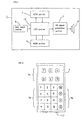
- Fig. 1 is a block diagram of one example of the constitution of the above autodialer
- Fig. 2 is a front view of the autodialer.
- Fig. 1 shows a ROM portion, and it stores OS and a control program and also stores at least the telephone number of a connecting telephone company (the connecting telephone company refers to a telephone company which issues the autodialer and performs a subtraction processing and a billing processing to a prepaid amount in accordance with charges of telephone calls) and an identification number identifying a telephone user.
- the connecting telephone company refers to a telephone company which issues the autodialer and performs a subtraction processing and a billing processing to a prepaid amount in accordance with charges of telephone calls
- an identification number identifying a telephone user the connecting telephone company
- 3 shows a RAM portion, which is a user memory portion in which a user of the autodialer stores and registers telephone numbers of persons to be called up, as abbreviated numbers.
- the above telephone numbers are inputted through numeric keys 5a and function keys 5b of the data input portion 5.
- These registered numbers can be sent to the PB signal generating portion 7 and outputted through the speaker 9 (which is, for example, an electronic speaker provided on the reverse surface of the autodialer) as PB tones.
- the speaker 9 which is, for example, an electronic speaker provided on the reverse surface of the autodialer
- the autodialer used in the present invention has no function of writing coupon information.
- the autodialer used in the present invention is sold in a store dealing with it, such as a convenience store, in a state where it has at least a pre-registered telephone number of a connecting telephone company and a pre-registered identification number identifying a telephone user (to be also referred to as "user ID" hereinafter) in the ROM portion thereof as described above.
- the autodialer used in the present invention has no function of writing coupon information from the beginning, so that it has no other information such as registered information of some thousands yen' worth of calls, at a stage where it is displayed in a store. That is, differing from prepaid cards such as a phone card, the autodialer is sold in a state where it does not have any coupon value.
- the store for the sale of the above autodialer has a store processing terminal for processing merchandise information having regard to the autodialer, such as the telephone number of the connecting telephone company, the identification number identifying a telephone user, a merchandise code and a transaction code.
- the store is, for example, a convenience store as described above, and it generally deals in merchandise in a quantity of thousands to tens of thousands. All of sale information data of merchandise dealt in there are reported one by one to headquarters as a franchiser through telephone lines, and the like. The headquarters catches what goods are so-called most popular goods every minute, and lines of merchandise are supplied and developed so as to meet with consumers' needs. Further, customer information is managed.
- the above merchandise management is what is well known as POS (information control on point of sale) system.
- a register connected to a bar code reader is installed on a checkout counter in each store, and the resister also works as a POS terminal.
- Merchandise information data inputted from bar codes is generally sent to the headquarters of each store through another computer and a modem in each store and through communication lines such as telephone lines.
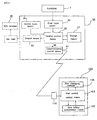
- Fig. 3 is a block diagram of one example of the store processing terminal 30.
- Fig. 5 is a front view thereof, showing a layout of inputting buttons.
- the inputting buttons may be button switches, or they may be touch-screen (touch panel) switches on a liquid crystal screen.
- 40 shows a POS terminal installed in each store
- 100 shows a managing host computer of a connecting telephone company.
- the host computer stores and manages all of information on each autodialer issued and dealt in. -
- the terminal 30 has the following constitution. That is, it comprises a pre-registered identification code (to be also referred to as "terminal ID" hereinafter) of the terminal,
- the above storage means 37 has a ROM portion and a RAM portion.
- the identification code of the terminal is pre-stored in the ROM portion, and the above merchandise information including the telephone number, the identification number, the merchandise code and the transaction code inputted from the first and second input means is stored in the RAM portion.
- the POS terminal it is not necessarily required to constitute the POS terminal and the store processing terminal as physically distinct two devices.
- the above store processing terminal may be incorporated into the POS terminal to form an integrated unit as required.
- the autodialer is sold with the above store processing terminal in the following manner.
- a sale staff member of a store (to be referred to as “a salesclerk” hereinafter) connects an autodialer 1 to an interface 33' to the input means 33 of the store processing terminal 30.
- connection is carried out, for example, by means of a pin-connector using a male (female) pin formed on the autodialer side and a female (male) pin formed on the terminal side.
- the terminal is provided with an insertion slot for the autodialer, and the autodialer is connected in a state where the autodialer is inserted and held.
- a cassette containing a plurality of autodialers is set inside the store processing terminal, and one autodialer is automatically taken out of the cassette, moved with a proper moving mechanism and electrically connected at the interface by button operation from outside.
- the above autodialer 1 is connected to the first input means 33, whereby the telephone number and the identification number pre-registered in the ROM of the autodialer are read and inputted.
- the salesclerk inputs the merchandise code and the transaction code to the terminal with the second input means.
- This input means is, for example, a button input means, and the inputting is carried out by pressing buttons (a, b, c, d, e).
- the a to e may be a touch panel as described already.
- the term "merchandise code” refers to a code defining a class of the merchandise (e.g., amount such as 1,000 yen, 3,000 yen, 5,000 yen, or the like, volume of call, or time length of call).
- a and b are buttons for inputting the transaction code, and for example, a corresponds to a settling button, and b corresponds to a canceling button.
- c to e are "amount buttons".
- c is a button corresponding to 1,000 yen
- d is a button corresponding to 3,000 yen
- e is a button corresponding to 5,000 yen.
- z is a button for paying, for example, a bill when the autodialer is used as a membership card as will be described later.
- a salesclerk presses the button e (5,000 yen) and also presses the settling button a to prove the payment of the amount, whereby finally settled transaction information of the merchandise code, the transaction code, etc., is inputted, which constitutes final transaction information.
- The, when the canceling button b is pressed, inputting can be redone.
- the telephone number of the connecting company, the identification number identifying a telephone user (user ID), the merchandise code and the transaction code (to be referred to as "merchandise information" hereinafter) inputted by the first and second input means are received and stored in the RAM portion of the storage means 37 in Fig. 3.
- the ROM portion of the storage means 37 has the identification code of the terminal (terminal ID) pre-registered as already described.
- the central control means 38 assembles an electric data text L for a POS terminal, to be outputted to the POS terminal 40, from the above stored merchandise information, and further assembles an electric data text M of the merchandise information and the terminal identification code, to be sent to the managing host computer 100.
- the POS terminal prints out a result of the above transaction as a receipt.
- the electric data text L for a POS terminal is outputted to the POS terminal 40 with the POS output means 39, and the electric data text M of the merchandise information and the identification code of the terminal is sent to the host computer through communication lines with the communication control means 41.
- the sending of the electric data text of the merchandise information, etc. is executed when the final transaction information is inputted with the settling button.
- the sent electric data text M of the merchandise information, etc. is received and stored in the host computer of the connecting telephone company.
- the store processing terminal and the POS terminal are connected, for example, with a fork-end connecter, and a generally used bar code reader and the processing terminal are connected to the POS terminal in parallel.
- the above processing terminal has no output means to the POS terminal as shown in Fig. 4.
- This embodiment uses a means for displaying a bar code identified by the merchandise code and the telephone number of the connecting telephone company. That is, there is provided a table (merchandise/bar code table) showing bar codes identified by the merchandise codes and the telephone number of the connecting telephone company, and a salesclerk allows the bar code reader to read a bar code on the table, which bar code corresponds, for example, to 5,000 yen, to input such data to the POS terminal.
- the processing terminal similarly has an output means 39' to output data of a merchandise code as shown in Fig. 4, and this output means outputs a bar code identified by the merchandise code and the telephone number of the connecting telephone company.
- This output may be printed out on a printing medium such as paper as a hard copy, or may be displayed on a screen with a display means such as CRT or LCD.
- a salesclerk similarly allows this bar code information with the bar code reader, to input such data to the POS terminal.
- This bar code may be a so-called bar code, or it may be a symbolized code such as OCR characters, MICR characters or caltra code.
- the bar code reader refers to a reader that can read such a code.
- the above operation shows an example in which input procedures are carried out with the assistance of a salesclerk.
- a customer can execute the transaction by carrying out the above operation with a bilateral store processing terminal on which a customer himself or herself operates a touch panel.
- the terminal may be a terminal specialized for dealing in autodialers, or it may be a so-called multimedia terminal having other functions in addition to the function of dealing in autodialers. That is, the terminal may have the function of selling and replacing game programs and the function of booking or reserving tickets for concerts and movies and transportations of travels and tourisms in addition to the function of dealing in the autodialers.
- the store processing terminal used in the present invention may be a terminal having not only the above bilateral function but also the function of an automatic teller machine as will be described in detail below.
- the automatic teller machine (to be referred to as "ATM” hereinafter) is an automatic machine with which a customer deposits cash (receipt or deposit), draws cash (payment, withdrawal) and transfers cash.
- ATM automatic teller machine
- the above procedures are carried out with a cash card (to be referred to as "card” hereinafter) and/or a bankbook.
- the above bank includes not only a so-called bank (licensed under the law) but also financial institutions in a broad sense such as a non-bank, a credit sale agent company and a leasing company.
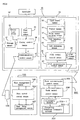
- the store processing terminal 30 is constituted of a terminal unit 30' and an ATM unit 50 as shown in the block diagram of Fig. 8.
- the terminal unit 30' is not necessarily required to be connected to the POS terminal, and in such a case, the terminal unit 30' has no POS output means for an electric data text of the merchandise code to the POS terminal as shown Fig. 8.
- the above ATM unit has a constitution and functions basically similar to those of a conventionally known ATM unit. That is, the ATM unit has a card reader means 53, a display means 55, a paper money handling means 57, a coin handling means 59, an ATM central control means 60, a cash managing means 63, an ATM storage means 65 and an ATM communication control means 67. Further, the ATM unit may have a slip preparation means and a bank book printing means.
- the above ATM unit for serving customers has a card insertion slot 69, a bank note insertion slot 70, a paper money in and out port, a coin in and out port 73, a touch panel display portion 75, and the like as shown in Fig. 9
- the card reader means 53 is a portion for reading and writing data in a record portion (magnetic stripe), for example, of a magnetic card inserted through the card insertion slot 69.
- the display means 55 is for displaying guidance on the touch panel display portion 75 for a customer (purchaser) and for displaying a touch panel for the customer selecting and inputting a transaction type and an amount of money.
- the paper money handling means 57 and the coin handling means 59 is for discriminating and counting paper money and coins placed through the paper money in and out port 71 and the coin in and out port 73 to receive the same, and for taking out a proper amount of paper money and/or coins from paper money and coins reserved in advance to pay them back through the paper money in and out port and/or the coin in and out port.
- the ATM central control means 60 is for totally controlling the card reader means 53, the display means 55, the paper money handling means 57, the coin handling means 59 and a cash managing means 63 to manage various information on receipt and payment of cash according to a managing program stored in the ATM storage means 65. Further, a result of the transaction is also stored in the ATM storage means 65.
- the ATM central control means 60 of the ATM unit 50 and the central control means 38 of the store processing terminal 30' are connected to each other, and data processed in each unit is exchanged between these two units. Further, it is not necessarily required to provide the central control means 38 of the store processing terminal and the ATM central control means 60 of the ATM unit as two separate means, and one central control means may be provided which works as these two means.
- the ATM unit 50 is connected to a managing host computer 200 of the bank with an ATM communication control means 67 through communication lines and a bank communication control means 201.
- the above managing host computer is constituted of the bank communication control means 201, account managing files 203 and a bank central control means 208.
- the account managing files 203 of the bank preferably include a customer (purchaser) account 203-1 and an account 203-2 of the connecting telephone company, and desirably, the bank central control means 208 performs a managing operation of these data together with the managing of the bank communication control means 201.
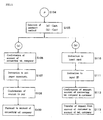
- a purchaser selects the transaction of an autodialer (Step S100), and selects a type of the transaction of the autodialer (Step S101).
- a selection is made, for example, among 1 ⁇ issue of a new autodialer, 2 ⁇ reloading of an autodialer (additional purchase) and 3 ⁇ payment of a bill.
- Step S101 When (1) the issue of a new autodialer is selected in Step S101, a display screen is switched to an amount selection screen, and for example, 5,000 yen is selected on a touch panel (Step S102).
- one autodialer hold in a tray portion is released from its holding and taken out, and the telephone number and the identification number registered in the ROM portion of the above autodialer are read and inputted. Further, the selected amount 5,000 yen is inputted with the second input means 35, and stored in the storage means 37.
- the display screen is switched to a confirmation screen for confirming whether or not to issue the autodialer for 5,000 yen (Step S103).
- a payment step P follows (Step S104). The payment step P is carried out through the ATM unit.
- Step S105 payment by cash (a) or payment by card (b) is selected.
- the payment by cash (a) refers to a method of paying cash in the account 203-2 of the connecting telephone company.
- the payment by card (b) refers to a method of transferring a corresponding amount from the account 203-1 of a customer to the account 203-2 of the connecting telephone company.
- Step S106 When the payment by cash (a) is selected, the account of the connection telephone company is shown on the screen, and the account is confirmed (Step S106). According to an instruction to put paper money, etc. (Step S107), an amount of money for the payment is confirmed (Step S108), and the payment is effected by paper money handling means 57.
- the data of the payment is sent to the managing host computer 200 connected to the above ATM unit 50 through lines, and the amount of money is paid to the account 203-2 of the connecting telephone company (Step S109).
- the ATM central control means 60 receives information of completion of the payment from the bank communication control means 201 through the lines, and transfers the information to the central control means 38 of the store processing unit 30'.
- the central control means 38 assembles an electric data text M of merchandise information and the identification code of the terminal to be sent to the managing host computer 100 of the connecting telephone company.
- the text M is sent with the communication control means 41 through communication lines, received and stored in the host computer of the connecting telephone company and then processed as has been already described.
- a card is inserted and a personal identification number (ID) is inputted according to an instruction to insert a card (Step S110) and an instruction to input a personal identification (ID) number (Step S111).
- a displayed screen shows a purchase amount, the account of the connecting telephone company and the account of a customer, and the customer is requested to confirm these (Step S112). When these are confirmed, an amount (5,000 yen in this case) is transferred from the account of the customer to the account of the connecting telephone company (Step S113).
- the central control means 60 assembles an electric data text M of merchandise information and the identification code of the terminal to be sent to the managing host computer 100 of the connecting telephone company.
- the text M is sent with the communication control means 41 through communication lines, and received and stored in the host computer of the connecting telephone company.
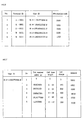
- Fig. 6 shows one example of format of data storage, the data being stored in the memory of the host computer.
- the data is stored, for example, as "ID registered file of autodialers".
- the file is constituted, for example, of a terminal ID area, a user ID area and a merchandise code area.
- a terminal ID data (“A-0001") is written in the terminal ID area
- a user ID (“81#11000772894#”) is written in the use ID area
- a merchandise code (“5,000") is written in the merchandise code area.
- a "billing charge management file" having the format shown in Fig. 7 is prepared with regard to every user ID.
- Figure shows a file corresponding to the use ID ("81#11000772894#"), and the file shows a balance of 5,000 yen when the autodialer is registered (No. 1).
- the information data M is encrypted.
- the above communication control means 41 shown in Fig. 3 has means of encrypting an electric text and sending the encrypted electric text to the managing host computer, and the host computer has an interface portion 109 for receiving and decrypting the encrypted electric text sent from the above communication control means.
- an encrypting/decrypting program is stored in a storage device of a hard disk or an expansion board of each of communication terminals such as the communication control means and the interface portion, and when communication is made, a plaintext of the information data M is encrypted in the communication control means as a transmission terminal, and transmitted as an encrypted text.
- the encrypted text is received and decrypted in the above interface portion as a receiving terminal.
- IC cards specialized for encryption and decryption may be connected to these terminals.
- the managing host computer may have a communication control means, and the above interface portion may be included therein.
- the communication lines may be leased lines or switched lines.
- switched lines public telephone lines using a voice frequency band of 300 to 3,400 Hz are sufficient for attaining the above object.
- ISDN integrated services digital network
- each of the communication control means and the interface portion is required to have a modem (modulator-demodulator), and when the latter digital lines are used, a DSU (digital service unit) and a TA (terminal adaptor) are required in place of the modem.
- the autodialer used in the present invention has, for example, an input keyboard layout as shown in Fig. 2.
- 5a shows numeric keys, for example, having the same layout as the button layout of a PB dialing telephone set
- 5b (W, X, Y, Z) shows function keys used for registration of an abbreviated number and temporary registration (registration of a telephone number other than an abbreviated telephone number)
- 5c (T, U, A, B, C, D) shows abbreviated number keys.
- a user uses these keys to register a telephone number of a person to call up in the RAM portion 3 which is a user memory.
- the registering operation may be designed as required and shall not be specially limited.
- key inputting is carried out in the order of an abbreviated number key A ⁇ function key W ⁇ telephone number "**********" ⁇ function key A, whereby the abbreviated key A is assigned to the telephone number "**********".
- X is a dialing button for temporary registration
- Y is a button for clearing the registered number.
- a key T corresponds to the telephone number of the connecting telephone company
- a key U corresponds to the identification number (user ID) identifying a telephone user.
- a user can therefore assign A, B, C and D to the abbreviated registration of telephone numbers.
- the PB tone of a registered number is outputted from a speaker 9.
- the autodialer of the present invention can be used with any telephone so long as it is one of subscriber's telephone, a public telephone and a cellular phone (including PHS (personal handy-phone system)).
- PHS personal handy-phone system
- the PB tone of the identification number (user ID) identifying the telephone user is sent.
- the user ID is sent to the managing host computer of the connecting telephone company through the switchboard.
- the host central control means 103 retrieves the host managing memory 105 storing the user ID. That is, specifically, the "user ID registration file" in Fig. 6 is opened and retrieved, to search for the user ID.
- the "billing charge management file" prepared with regard to every user ID is opened to check a billed state (balance of a prepaid charge/callable length of time).
- the callable length of time of the user ID (81#11000772894#) is read to be 3,150 yen.
- the host computer informs the user that the callable length of time as a balance is 3,150 yen with an automatic voice means through the terminal telephone with which the autodialer is used, and a call is permitted.
- the user who is permitted to call is press, for example, the abbreviated number key A to generate the PB tone of the previously registered telephone number "*******".
- the switchboard performs a connection to a line corresponding to the PB tone, and this information is also simultaneously transmitted to the host computer 100.
- the host central control means 103 of the host computer recognizes a response from the telephone called up and then starts a host billing management means 107.
- the billing management means processes billing for a time period of the call, and after the call is finished, the billing management means records the telephone number called up, the time period of the call, a billed charge (call charge), a callable time length (balance of money), etc., in the "billing charge management file" of the user ID.
- Management data may be overwritten to retain a final data alone.
- a history as shown in Fig. 7 is retained for making it possible to output a management report so as to comply with demands such as a demand from the user.
- "when a call using the autodialer is made” includes not only a case when a call is made by actually generating a PB tone with the autodialer but also a case, for example, when the telephone number of the connecting telephone company and the identification number (user ID) identifying a telephone user, registered in the autodialer, is button-inputted with a subscriber's telephone, a cellular phone, PHS, a mobile data terminal such as a mobile computer or a personal computer and a PB tone is generated with the subscriber's telephone, or the like.
- the host computer informs the user of a telephone terminal to that effect, requests for additional purchase of a call charge with regard to the user ID, and makes no connection to a line.
- the purchase of a call charge in this case is carried out as follows.
- the salesclerk who is to help the purchase of the additional call charge connects the autodialer 1 to which the additional call charge is to be added to the interface 33' of the first input means 33 of a store processing terminal 30, to read and input the telephone number and the identification number pre-registered in the ROM thereof.
- the identification code (terminal ID) identifying the above store is pre-registered in the terminal.
- buttons (a, b, c, d, e) of the button input means(a second input means) to input a merchandise code and a transaction code.
- the salesclerk presses the (5,000 yen) button e and presses the settling button a which indicates payment of the amount, to input the merchandise code and the transaction code, and this data constitutes final transaction information.
- an electric data text L for a POS terminal is outputted to the POS terminal 40 with the POS output means 39, and an electric data text M of the merchandise information and the terminal identification code is sent to the host computer through communication lines with the communication control means 41.
- the host computer retrieves a "billing charge management file" of the corresponding user ID, writes therein that the amount (e.g., 5,000 yen) has been newly paid and add the amount to a balance to record a total amount. For example, when 5,000 yen for a call charge is newly paid in addition to a balance in the amount of 1,000 yen, 6,000 yen is written in the "billing charge management file" as a callable amount balance.
- the amount e.g., 5,000 yen
- the reloading is the same as the issue of a new autodialer.
- 2 ⁇ reloading of autodialer is selected.
- the autodialer to be reloaded is connected to the interface 33' of the first input means 33 of the store processing terminal unit 30' by inserting the autodialer through an autodialer insertion slot provided in the terminal, and the telephone number and the identification number pre-registered in the ROM of the autodialer are read and inputted.
- a display screen is switched to an amount selection screen, and, for example, 5,000 yen is selected on the touch panel (Step S202).
- the selected amount 5,000 yen is inputted with the second input means and stored in the storage means 37.
- Step S104 a payment step P follows (Step S104).
- the payment step P is carried out through the ATM unit.
- a payment method selection screen Step S105
- payment by cash (a) or payment by card (b) can be selected in the same manner as in the case of the issue of a new autodialer.
- the ATM central control means 60 sends the information to the central control means 38 of the store processing terminal unit 30', and the central control means assembles an electric data text M of the merchandise information and the identification code of the terminal to be sent to the managing host computer 100 of the connecting telephone company.
- the text is sent with the communication control means 41 through communication lines, and received and stored in the host computer of the connecting telephone company.
- an autodialer as a membership card does not differ from the use thereof as a fund card.
- the managing host computer of a connecting telephone company performs an addition processing of a call charge to be billed, in accordance with a call charge amount when a call is made, on the basis of stored information with regard to an issued user ID, and further, the managing host computer issues a bill of call charges to the membership card user.
- the billed call charge is paid through a store processing terminal installed in a store where payment of the billed call charge can be made with regard to the autodialer.
- a person who reguests for the issuance of an autodialer as a membership card applies directly to a connecting telephone company.
- the application is generally made by writing the telephone number of the person as a subscriber, and it can be also made by on-line sign-up on the network to a connecting telephone company.
- the connecting telephone company which has accepted the application issues an autodialer as a membership card.
- the autodialer has a pre-registered telephone number of the connecting telephone company and a pre-registered identification number (user ID) identifying the user, and it further has the function of registering telephone numbers of persons to be called up as abbreviated numbers and has means of generating the PB tone of the registered number.
- This issued autodialer is sent to the applicant identified by the subscriber's telephone number.
- the functions of the above autodialer itself are the same as those of the already described fund card, and the autodialer can be used to make automatic dialing and call through the switchboard of the connecting telephone company completely in the same manner.
- the difference from the fund card is that the host computer performs an addition processing of a billed call charge in the "billing charge management file" of the user ID in accordance with a call charge in place of performing a subtraction processing of a prepaid call charge in accordance with a call charge.
- a bill of call charges is issued to the user after a predetermined period of time.
- the payment of the above call charges can be completely similarly made through the store processing terminal used for the purchase of the fund card in a store dealing in fund cards.
- the payment for the bill can be also made by reading and inputting the bill through a slot 69', and repeating the case of reloading nearly in the same manner as in the case of reloading. That is, when the 3 ⁇ payment of bill is selected in the step S101 in Fig. 10, an instruction to insert an autodialer (Step S301), inputting of an amount (Step S302) and confirmation (Step S303) are carried out, followed by the payment step P, whereby the payment is effected.
- ID numbers, etc. are registered in the autodialer as abbreviated numbers, so that a call can be made by a simple button operation, which is remarkably convenient.
- call charges can be paid, for example, in a convenience store, so that a charge can be paid immediately when the charge is not paid or a prepaid charge is deficient. Further, upon payment, the store processing terminal sends the data to the managing host computer to operate the billing charge management file, so that a telephone is connected without any delay, and a call can be resumed.
- the present invention is very effective for budget control of telephone charges when the user is an corporate organization. That is, when a company as a corporation obtains a plurality of user IDs so that salespersons, etc., who frequently make phone calls out of office use autodialers as membership cards, the telephone company issues bills together with details to the company, so that a manager of the company can grasp call charges of the each salesperson (user ID) exactly and clearly on the basis of the detailed contents. In this manner, the company can grasp all of the telephones called up with regard to each user ID, so that employees substantially refrain from using the autodialers of the present invention to make private phone calls.
- the autodialer used in the present invention has no coupon information written therein, so that it is not much necessary to take account of a risk of a loss caused by stealing, robbery or losing, and the management thereof is remarkably simplified. For example, large managing costs and excessive inventory costs which transportation company members and managers of convenience stores have paid are no longer necessary.
Landscapes
- Engineering & Computer Science (AREA)
- Computer Networks & Wireless Communication (AREA)
- Signal Processing (AREA)
- Physics & Mathematics (AREA)
- General Physics & Mathematics (AREA)
- Business, Economics & Management (AREA)
- General Business, Economics & Management (AREA)
- Strategic Management (AREA)
- Accounting & Taxation (AREA)
- Microelectronics & Electronic Packaging (AREA)
- Theoretical Computer Science (AREA)
- Computer Security & Cryptography (AREA)
- Telephonic Communication Services (AREA)
- Cash Registers Or Receiving Machines (AREA)
- Meter Arrangements (AREA)
- Prepayment Telephone Systems (AREA)
Applications Claiming Priority (3)
| Application Number | Priority Date | Filing Date | Title |
|---|---|---|---|
| JP7302198 | 1998-03-09 | ||
| JP7302198 | 1998-03-09 | ||
| PCT/JP1999/001072 WO1999046925A1 (fr) | 1998-03-09 | 1999-03-05 | Systeme de gestion des tarifs telephoniques |
Publications (1)
| Publication Number | Publication Date |
|---|---|
| EP1075134A1 true EP1075134A1 (fr) | 2001-02-07 |
Family
ID=13506276
Family Applications (1)
| Application Number | Title | Priority Date | Filing Date |
|---|---|---|---|
| EP99939245A Withdrawn EP1075134A1 (fr) | 1998-03-09 | 1999-03-05 | Systeme de gestion des tarifs telephoniques |
Country Status (7)
| Country | Link |
|---|---|
| EP (1) | EP1075134A1 (fr) |
| KR (1) | KR20010041445A (fr) |
| CN (1) | CN1292971A (fr) |
| AU (1) | AU746334B2 (fr) |
| CA (1) | CA2320765A1 (fr) |
| IL (1) | IL138003A0 (fr) |
| WO (1) | WO1999046925A1 (fr) |
Cited By (1)
| Publication number | Priority date | Publication date | Assignee | Title |
|---|---|---|---|---|
| US6631840B1 (en) * | 1999-03-10 | 2003-10-14 | Yasuo Muramatsu | Telephone charge management system |
Families Citing this family (5)
| Publication number | Priority date | Publication date | Assignee | Title |
|---|---|---|---|---|
| JP3782617B2 (ja) | 1999-09-02 | 2006-06-07 | グレートインフォメーション株式会社 | 有価暗号情報発行システム及び通話料決済システム |
| JP2002358378A (ja) * | 2001-06-01 | 2002-12-13 | Fujitsu Ltd | 店舗管理システム |
| WO2021058929A1 (fr) * | 2019-09-25 | 2021-04-01 | May Cameron | Procédés et systèmes pour relayer un détail de carte de paiement pendant un appel téléphonique entre le téléphone d'un client et le téléphone d'un vendeur |
| KR102662615B1 (ko) | 2021-12-16 | 2024-05-03 | 에스2정보 주식회사 | 전용회선 요금관리 시스템 |
| KR102692777B1 (ko) | 2022-03-11 | 2024-08-07 | 에스2정보 주식회사 | 전용회선 운영관리 시스템 |
Family Cites Families (5)
| Publication number | Priority date | Publication date | Assignee | Title |
|---|---|---|---|---|
| JPH0257653U (fr) * | 1988-10-21 | 1990-04-25 | ||
| WO1990007756A1 (fr) * | 1988-12-29 | 1990-07-12 | Unisys Corporation | Systeme commande par clavier |
| JPH05233672A (ja) * | 1992-02-26 | 1993-09-10 | Fujitsu Ltd | プリペイドカードを払い出す現金自動預金支払装置 |
| JPH09102815A (ja) * | 1995-07-28 | 1997-04-15 | Empire Airport Service Co Ltd | カード型オートダイアル装置 |
| JP3044194B2 (ja) * | 1996-04-26 | 2000-05-22 | 株式会社ウイング・ラボ | カード管理システム |
-
1999
- 1999-03-05 AU AU32750/99A patent/AU746334B2/en not_active Ceased
- 1999-03-05 WO PCT/JP1999/001072 patent/WO1999046925A1/fr not_active Ceased
- 1999-03-05 CA CA002320765A patent/CA2320765A1/fr not_active Abandoned
- 1999-03-05 EP EP99939245A patent/EP1075134A1/fr not_active Withdrawn
- 1999-03-05 CN CN998037893A patent/CN1292971A/zh active Pending
- 1999-03-05 IL IL13800399A patent/IL138003A0/xx unknown
- 1999-03-05 KR KR1020007009594A patent/KR20010041445A/ko not_active Ceased
Non-Patent Citations (1)
| Title |
|---|
| See references of WO9946925A1 * |
Cited By (1)
| Publication number | Priority date | Publication date | Assignee | Title |
|---|---|---|---|---|
| US6631840B1 (en) * | 1999-03-10 | 2003-10-14 | Yasuo Muramatsu | Telephone charge management system |
Also Published As
| Publication number | Publication date |
|---|---|
| AU3275099A (en) | 1999-09-27 |
| AU746334B2 (en) | 2002-04-18 |
| WO1999046925A1 (fr) | 1999-09-16 |
| KR20010041445A (ko) | 2001-05-25 |
| IL138003A0 (en) | 2001-10-31 |
| CA2320765A1 (fr) | 1999-09-16 |
| CN1292971A (zh) | 2001-04-25 |
Similar Documents
| Publication | Publication Date | Title |
|---|---|---|
| US6631840B1 (en) | Telephone charge management system | |
| US11403920B2 (en) | Multi-purpose kiosk and methods | |
| US20090159695A1 (en) | Method and system for automated value transfer | |
| US7363274B2 (en) | Automatic teller machine | |
| WO2000077697A1 (fr) | Procede et systeme de paiements d'achats a distance | |
| EP1934920B1 (fr) | Systeme et procede de transfert d'argent | |
| US6339638B1 (en) | Telephone used for electronic money card transaction and method of operation of the same | |
| TW200301057A (en) | Prepaid card information issuing system, telephone charge settlement system, communication charge settlement system, and charge settlement system | |
| US20050108158A1 (en) | Method and system for remote purchase payments | |
| AU746334B2 (en) | Telephone rate managing system | |
| JP2002083237A (ja) | プリペイドシステムによる電子商取引の決済管理方法 | |
| US20020065666A1 (en) | Method and system for transferring money orders | |
| US6963636B1 (en) | Valuable cipher information issuing system and issuing method, telephone charge settlement system and telephone charge settlement method, and charge settlement system and charge settlement method | |
| JP3330139B2 (ja) | 電話料金管理システム | |
| JP2003132400A (ja) | プリペイドシステム | |
| JPH10187847A (ja) | 電子通貨取引装置 | |
| JPH11331437A (ja) | 電話料金管理システム | |
| JP4259089B2 (ja) | 商品販売システムおよびその現金自動取引装置と情報処理装置のプログラム | |
| JP2003069752A (ja) | 電話料金管理システム | |
| JP2005122258A (ja) | 料金前払収納システム | |
| JPWO2005073885A1 (ja) | カード決済システム | |
| JP2001211271A (ja) | 国際電話通信システム | |
| HK1046488A (en) | Valuable cipher information issuing system and issuing method, telephone charge settlement system and telephone charge settlement method, and charge settlement system and charge settlement method | |
| JP2002185651A (ja) | 回線接続代行システム | |
| GB2385682A (en) | Ordering and payment apparatus |
Legal Events
| Date | Code | Title | Description |
|---|---|---|---|
| PUAI | Public reference made under article 153(3) epc to a published international application that has entered the european phase |
Free format text: ORIGINAL CODE: 0009012 |
|
| 17P | Request for examination filed |
Effective date: 20001003 |
|
| AK | Designated contracting states |
Kind code of ref document: A1 Designated state(s): DE FR GB |
|
| STAA | Information on the status of an ep patent application or granted ep patent |
Free format text: STATUS: THE APPLICATION IS DEEMED TO BE WITHDRAWN |
|
| 18D | Application deemed to be withdrawn |
Effective date: 20031001 |