EP1075143B1 - Procédé et appareil de diffusion de données de service avec des données de télévision numérique - Google Patents
Procédé et appareil de diffusion de données de service avec des données de télévision numérique Download PDFInfo
- Publication number
- EP1075143B1 EP1075143B1 EP00306508A EP00306508A EP1075143B1 EP 1075143 B1 EP1075143 B1 EP 1075143B1 EP 00306508 A EP00306508 A EP 00306508A EP 00306508 A EP00306508 A EP 00306508A EP 1075143 B1 EP1075143 B1 EP 1075143B1
- Authority
- EP
- European Patent Office
- Prior art keywords
- data
- portions
- broadcast
- memory
- processor
- Prior art date
- Legal status (The legal status is an assumption and is not a legal conclusion. Google has not performed a legal analysis and makes no representation as to the accuracy of the status listed.)
- Expired - Lifetime
Links
- 238000000034 method Methods 0.000 title claims description 14
- 230000015654 memory Effects 0.000 claims description 44
- 238000012545 processing Methods 0.000 claims description 20
- 238000003672 processing method Methods 0.000 claims description 3
- 239000004065 semiconductor Substances 0.000 claims description 3
- 239000000284 extract Substances 0.000 claims description 2
- 238000007906 compression Methods 0.000 description 16
- 230000006835 compression Effects 0.000 description 16
- 230000006837 decompression Effects 0.000 description 15
- 230000000007 visual effect Effects 0.000 description 14
- 230000005540 biological transmission Effects 0.000 description 7
- 238000005516 engineering process Methods 0.000 description 5
- 230000002452 interceptive effect Effects 0.000 description 5
- 238000004891 communication Methods 0.000 description 4
- 230000006870 function Effects 0.000 description 3
- 238000012805 post-processing Methods 0.000 description 3
- 230000001419 dependent effect Effects 0.000 description 2
- 238000012216 screening Methods 0.000 description 2
- 230000011664 signaling Effects 0.000 description 2
- 230000003213 activating effect Effects 0.000 description 1
- 238000013461 design Methods 0.000 description 1
- 239000000463 material Substances 0.000 description 1
- 230000000737 periodic effect Effects 0.000 description 1
- 238000007781 pre-processing Methods 0.000 description 1
- 230000005236 sound signal Effects 0.000 description 1
- 230000003936 working memory Effects 0.000 description 1
Images
Classifications
-
- H—ELECTRICITY
- H04—ELECTRIC COMMUNICATION TECHNIQUE
- H04N—PICTORIAL COMMUNICATION, e.g. TELEVISION
- H04N21/00—Selective content distribution, e.g. interactive television or video on demand [VOD]
- H04N21/40—Client devices specifically adapted for the reception of or interaction with content, e.g. set-top-box [STB]; Operations thereof
- H04N21/43—Processing of content or additional data, e.g. demultiplexing additional data from a digital video stream; Elementary client operations, e.g. monitoring of home network or synchronising decoder's clock; Client middleware
- H04N21/435—Processing of additional data, e.g. decrypting of additional data, reconstructing software from modules extracted from the transport stream
-
- H—ELECTRICITY
- H04—ELECTRIC COMMUNICATION TECHNIQUE
- H04N—PICTORIAL COMMUNICATION, e.g. TELEVISION
- H04N21/00—Selective content distribution, e.g. interactive television or video on demand [VOD]
- H04N21/20—Servers specifically adapted for the distribution of content, e.g. VOD servers; Operations thereof
- H04N21/23—Processing of content or additional data; Elementary server operations; Server middleware
- H04N21/235—Processing of additional data, e.g. scrambling of additional data or processing content descriptors
-
- H—ELECTRICITY
- H04—ELECTRIC COMMUNICATION TECHNIQUE
- H04N—PICTORIAL COMMUNICATION, e.g. TELEVISION
- H04N21/00—Selective content distribution, e.g. interactive television or video on demand [VOD]
- H04N21/20—Servers specifically adapted for the distribution of content, e.g. VOD servers; Operations thereof
- H04N21/25—Management operations performed by the server for facilitating the content distribution or administrating data related to end-users or client devices, e.g. end-user or client device authentication, learning user preferences for recommending movies
- H04N21/262—Content or additional data distribution scheduling, e.g. sending additional data at off-peak times, updating software modules, calculating the carousel transmission frequency, delaying a video stream transmission, generating play-lists
- H04N21/26208—Content or additional data distribution scheduling, e.g. sending additional data at off-peak times, updating software modules, calculating the carousel transmission frequency, delaying a video stream transmission, generating play-lists the scheduling operation being performed under constraints
- H04N21/26216—Content or additional data distribution scheduling, e.g. sending additional data at off-peak times, updating software modules, calculating the carousel transmission frequency, delaying a video stream transmission, generating play-lists the scheduling operation being performed under constraints involving the channel capacity, e.g. network bandwidth
-
- H—ELECTRICITY
- H04—ELECTRIC COMMUNICATION TECHNIQUE
- H04N—PICTORIAL COMMUNICATION, e.g. TELEVISION
- H04N21/00—Selective content distribution, e.g. interactive television or video on demand [VOD]
- H04N21/40—Client devices specifically adapted for the reception of or interaction with content, e.g. set-top-box [STB]; Operations thereof
- H04N21/43—Processing of content or additional data, e.g. demultiplexing additional data from a digital video stream; Elementary client operations, e.g. monitoring of home network or synchronising decoder's clock; Client middleware
- H04N21/433—Content storage operation, e.g. storage operation in response to a pause request, caching operations
-
- H—ELECTRICITY
- H04—ELECTRIC COMMUNICATION TECHNIQUE
- H04N—PICTORIAL COMMUNICATION, e.g. TELEVISION
- H04N21/00—Selective content distribution, e.g. interactive television or video on demand [VOD]
- H04N21/40—Client devices specifically adapted for the reception of or interaction with content, e.g. set-top-box [STB]; Operations thereof
- H04N21/43—Processing of content or additional data, e.g. demultiplexing additional data from a digital video stream; Elementary client operations, e.g. monitoring of home network or synchronising decoder's clock; Client middleware
- H04N21/434—Disassembling of a multiplex stream, e.g. demultiplexing audio and video streams, extraction of additional data from a video stream; Remultiplexing of multiplex streams; Extraction or processing of SI; Disassembling of packetised elementary stream
- H04N21/4348—Demultiplexing of additional data and video streams
- H04N21/4349—Demultiplexing of additional data and video streams by extracting from data carousels, e.g. extraction of software modules from a DVB carousel
Definitions
- the present invention relates to a data broadcast system and method and, more particularly, to a method of broadcasting data services with broadcast signals and a system for selectively providing portions of the broadcast data service to the user.
- Digital television systems have become widely used for broadcast systems.
- the digital television systems provide digitisation and compression of the image to be broadcast with technologies such as MPEG-2 compression.
- the broadcast pictures are hence encoded and conveyed to the digital television receivers in the home as a digital data sequence.
- Digital television has a number of advantages over conventional analogue television, such as increased capacity and increased robustness to noise and interference.
- Digital television systems also allow many kinds of data to be carried seamlessly within broadcasts carrying audio and visual data. Hence, many new services can be provided through the digital TV receiver to the viewer.
- a popular analogue service that uses additional data carried within the broadcast transmission is the teletext service.
- the teletext service is carried as digital data within certain transmission lines of the vertical blanking interval (VBI) of the TV signal.
- VBI vertical blanking interval
- the VBI is the time allowed for the raster scan to return to the top of the screen and hence this time is not used to carry any useful picture information.
- Some lines are set aside for teletext data and the digital data is modulated onto the broadcast TV signal.
- Teletext systems broadcast a number of "pages" of data in cycles with a page being typically updated every 2 to 3 minutes.
- the update cycle time depends on how many pages are broadcast in the cycle, there being only a small bandwidth available for the teletext data.
- the viewer Upon selecting a page, the viewer has to then wait for the page to be delivered as part of the cycle - this time will be on average half the total cycle time for all the pages.
- Teletext systems provide the latest news, sport and TV guide information and also reference information and advertising. Teletext systems are very useful for providing "headline" information such as sports results when there is no other means of obtaining the information.
- a very popular use for the teletext systems is to find out the latest information for some rapidly changing event such as a sports event. Often this can be the only way the viewer can obtain this information, because sports events are often not screened live, are carried as part of a pay-per-view service or have finished such that the programmes are now carrying other content. Hence, this allows the viewer to catch up with "missed" content such as sports events or news broadcasts by other means using the data services.
- a problem with previous broadcast data services is that they communicate very little information - perhaps just the score of a football match for instance.
- the user although not wanting to see the whole sports event, would like a little more information than just the score - maybe to see video of the goals or near misses in the example of a football match.
- Digital broadcast systems can provide more bandwidth for program content. However, this bandwidth is still at a premium. Using some of the bandwidth to provide broadcast data services can be considered wasteful, particularly if there is other content that could be screened at the same time to a reasonable audience. Indeed, screening live video and audio as a broadcast data service will still take up approximately 2Mbit/s of bandwidth using MPEG-2 compression.
- Execution of the downloaded code in turn controls selective capture and presentation of audio and video segments received over one of the digital broadcast channels.
- Resident operating system and application software in the terminal provides all communication with nodes of the network.
- the downloaded code forms a non-resident application having a set of predetermined function calls for activating communication functions of the resident software.
- WO 94/13107 describes an advanced set-top terminal capable of digital decompression, menu generation, interactivity and other advanced functional capabilities for use in a television program delivery system. It describes methods and apparatus for upgrading existing set-top terminals to provide menu generation capability and advanced functional capabilities. It describes (i) menu-driven program selection through the addition of an upgrade module or menu generation card and (ii) advanced functional capabilities using a set of hardware upgrades and/or an expansion card. It relates to an upgradeable system that supports advanced set top functionality through the use of internal software, hard-ware upgrades, an upgrade module and/or expansion cards.
- the upgraded hardware generally includes a microprocessor, various input/output ports, processing circuitry and memory.
- a system for use with a broadcast signal including a broadcast data service transmitted together with broadcast digital television data, the broadcast data service being carried cyclically in a carousel, the system being arranged to selectively provide portions of the broadcast data service, the portions including data portions having digital video data sequences with audio in non-real time, the system comprising:
- the system can receive television clips, video sequences and the like over the relatively narrow bandwidth used for the broadcast data service and, by storing the relevant portions in the memory, can process those portions to return the data to real time.
- the digital television data of the data portions is compressed and/or processed and the processor processes the data portions off line.
- the processor processes the portions at times of low usage.
- the processor may be provided as a separate processor in the storage device.
- the processor can fit in decompression and processing of any previously received compressed/processed television data in amongst its other duties in the operation of the system.
- the processor may operate directly on the data in the memory. However, it is also possible for the processor to operate in a batch processing method with data loaded locally from the memory in small chunks. This may be particularly appropriate where the memory is provided separately from the processor and the processor has its own working memory.
- the processor may conduct processing using a predefined protocol.
- the processor could conduct processing using a downloaded protocol. This might provide greater flexibility to a system and/or prevent unauthorised decompression of the data.
- the processor could conduct off line decryption of data using a key.
- the key could be downloaded by broadcast or other means such as a memory stick or smartcard.
- the controller is also for identifying corresponding extracted and stored portions and for replacing data portions stored in the memory with respective portions extracted from the broadcast signal.
- a user's device continually updates the stored complete broadcast data service and is able to retrieve any desired selected portions of the broadcast data service in a near instantaneous manner.
- the method of broadcasting includes additionally broadcasting all of the current portions of the broadcast data service to enable a user to obtain all portions of the broadcast data service soon after initial connection. This may be achieved by using a separate dedicated channel or by periodically using an expanded bandwidth at a time of low demand for the broadcast digital television data.
- the system may be provided with additional means for accessing the complete broadcast data service from a different channel.
- the memory can be filled with the current version of the broadcast data service for future update.
- the receiving system may be constructed as a single integral unit comprising a digital television receiver.
- various components of the system may be constructed separately and linked by means of a network, such as using an IEEE 1394 interface.
- a single television receiver/display could provide all of the functions of the present invention.
- a television/display could be connected by means of an IEEE 1394 interface with a broadcast data service unit which either has its own receiver or makes use of the receiver of the television display to obtain the broadcast data service portions.
- the memory could be provided in the broadcast data service unit or separately, for instance again connected with an IEEE 1394 interface.
- the MPEG video and audio compression system is designed to provide a maximum amount of compression in a broadcast environment.
- the MPEG video and audio compression system is also designed to allow the decompression to be carried out with a limited amount of memory in the receiver. This allows the decompression system in the receiver to be implemented with less memory and processing - and hence more cheaply - than the compression system in the transmission headend.
- the data is broadcast assuming or knowing that the receiver has a certain limited amount of storage and processing power. This constrains the format and type of data that can be sent.
- the AV devices in the home can be in separate physical enclosures and needing interconnection.
- the key technology for interconnection of digital devices in the home is the IEEE1394 Serial Bus interface which provides a low cost, user friendly method to send audio, visual and control data between devices in the home.
- a typical digital TV system arrangement in the home could have a digital TV receiver, display device, magnetic storage and DVD player all connected using IEEE1394 Serial Bus connections.
- Mass storage can also be alternatively or additionally provided integrated into a consumer device - for instance an integrated digital television receiver may incorporate a large magnetic storage.
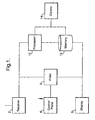
- Figure 1 illustrates schematically various components of a system for receiving a broadcast data service.
- a receiver 2 is provided for obtaining and demodulating transmitted data from an aerial, cable, satellite or the like.
- the demodulated data includes digital television data, together with associated broadcast service data.
- a video processor 6 Under the control of a control panel 4 or remote control, a video processor 6 extracts data from a received signal for a selected video channel and displays that video channel on the display 8.
- a processor 10 is also provided for extracting any broadcast service data from the received signal.
- the processor 10 may be provided together with the receiver 2, together with the memory 12, together with the controller 14 or separately.
- the data is stored in a memory 12 under the control of a controller 14.
- a user may then select (possibly using the control panel 4) desired portions of the data broadcast service. Under the control of the controller 14, the memory 12 then outputs appropriate data for display on the display 8.
- the memory 12 can be provided as a magnetic disc, for instance as is commonly known as a hard disc drive, a semiconductor memory or other means.
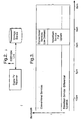
- the system of Figure 1 can be provided integrally within a television unit. However, it is also possible for various components of the system to be distributed around a network, for instance using the IEEE 1394 interface. This is illustrated in Figure 2.
- the system may be provided merely with an external storage device.
- the system may be provided as a broadcast service unit for connection to a television display and the broadcast service unit may itself have an internal memory or use an external memory and may itself have a processor.
- the broadcast service unit can obtain received digital data from the receiver, process portions of the data appropriately and provide selected portions to the television display upon demand.
- an audio/visual stream can typically consume 2 Mbit/s using current MPEG-2 compression technologies. This could be construed as wasteful.
- the system By making use of the memory of the system, it is possible to broadcast the audio and visual data at a rate slower than real time.
- the audio and visual data is extracted from the broadcast data service and stored in the memory 12 of the system.
- the system can then retrieve the data at the required data rate allowing replay in real-time.
- the bandwidth consumption of that portion of the service would also be halved.
- the cycle time would therefore also be doubled, by means of the memory of the system, access would be immediate unless a user happened to request a portion while it was being broadcast.
- Increased storage can allow different and possibly more effective compression and pre-processing to be applied to broadcast data.
- a large amount of storage allows broadcast to be downloaded as a whole block of data. This block of data is then processed as a whole, rather as a broadcast stream, where only a small fraction of the broadcast data is processed as it passes through the receiver.
- the video data can be compressed using a completely different non-streaming algorithm other than MPEG and be subjected to off-line compression/decompression as discussed.
- the increased storage also allows data to be stored for later processing. This effectively increases the processing power available in the receiver. Since the data is stored "offline" the receiver can then process the data as a background task or times of low usage. When the data is fully processed then it can be made available to the user.
- the video need not only be sent at slower than real time (for "trickle feed”). It could also be sent faster than real time, for instance for a mass video dump during the night.
- the data can be sent in a more interactive manner. For instance, there can be an almost permanent return channel connection from the receiver to the broadcast headend. This headend can field the requests from the receiver population and broadcast the data (video or whatever) according to the demand for each item.
- the "offline” processing can be carried out in different ways
- Post-processing or decompression of data can be conducted using an existing pre-defined protocol such as "WinZip”.
- Post-processing or decompression of data can be conducted using a downloaded protocol.
- Post processing of data can be conducted to provide a new set of data. For example, processing two video streams to provide a new video stream - perhaps a "reverse angle” or "birds eye” view of a video sequence.
- Offline decryption of a file can be conducted using a key provided to the user by broadcast or other means (on memory stick or smart card).
- Data may be input from another source that is then post processed using broadcast data.
- Offline compression or processing of video data can be conducted (perhaps DV format data from a digital camcorder) for later retransmission by e-mail, memory stick, i.LINK, or other means.
- the service can offer a rapid update rate if it consumes a large amount of bandwidth. That bandwidth can be reduced, but will result in cycle time being increased.
- the most visible parameter is the cycle rate.
- the viewer will want to have up-to-date information as soon as possible and will not want to have to wait. Hence, this is one of the key requirements for the service.
- the bandwidth consumed is probably the most important parameter.
- the bandwidth consumed by, in particular, data broadcast service affects the bandwidth available for other broadcast data services and television data itself. A reduction in the bandwidth available for other services is hence likely to affect the revenue available to the service provider.
- a broadcast data service may take many different forms. It may be transmitted cyclically as a carousel of main information topics. It is also possible that, within each topic, further data portions are transmitted cyclically as a sub-carousel.
- Each data portion may consist of a traditional style page of data or may consist of other data such as image data or audio/visual data.
- An entire page or audio/visual data sequence can be considered as a portion or a page or audio/visual sequence can be made up of a number of portions.
- the system should provide the data in portions which can be replaced individually in such a way as to update the overall broadcast service.
- individual bytes of data or groups of bytes could be considered as "portions" provided that the system allows individual replacement of such portions.
- the protocol overhead for embodying the system is likely to be undesirably high.
- the "differential" content will not be useful, as it will not comprise the full service. This situation will arise for instance when the memory of the broadcast service unit is first connected to the system.
- the system can configure the system such that over time, by storing all of the updated portions, the complete broadcast data service will be established.
- the full service could be broadcast either on a different dedicated channel (possibly by means of a non-broadcast download service) or at times when the demand for other conventional broadcast is lower.
- the bandwidth allocated for those conventional services can be reduced.
- the bandwidth available for the broadcast data services can be increased. This allows a receiver to quickly update its stored broadcast service information with the full information service. Subsequently, in the normal way, the system can keep up to date with the service using the differential update stream.
- the service provided using this system could not only carry MPEG-2 encoded audio and video data, but, as discussed above, could also carry information which has been compressed and encoded using other more suitable or efficient protocols. For instance, a football match could take advantage of the fact that most of the content features a lot of green with only a few small moving areas.
- an algorithm for decompressing and decoding could be delivered to the receiver and then executed by the receiver under a pre-defined protocol.
- the receiver processor can decode the content as a background task for display later.
- the data content of the broadcast data service need not be limited to audio/visual data or traditional data pages.
- the content can be suitable for use by an interactive engine in the receiver/broadcast service data unit. In this way, a mixed service could be provided featuring text, graphics and audio/visual clips.
- Data portions may also comprise data requiring off-line decoding.
- the data need not necessarily be a program, but could be any sort of data.
- MPEG compression and decompression systems are designed to be used in a broadcast system with limited decompression memory in the receiver, a small delay (of the order of a second) in decode delay and a limited "pick-up" delay (where "pick-up” delay is the delay when a receiver is turned on and has to wait a few frames for a full "I-frame” when it can pick-up the transmission and start decoding).
Landscapes
- Engineering & Computer Science (AREA)
- Multimedia (AREA)
- Signal Processing (AREA)
- Computer Networks & Wireless Communication (AREA)
- Databases & Information Systems (AREA)
- Two-Way Televisions, Distribution Of Moving Picture Or The Like (AREA)
- Television Systems (AREA)
Claims (16)
- Système pour usage avec un signal de diffusion comprenant un service de données de diffusion transmis en même temps que des données de télévision numérique, le service de données de diffusion étant exécuté de façon cyclique dans un carrousel, le système étant arrangé pour fournir de manière sélective des portions du service de données de diffusion, les portions comprenant des portions de données contenant des séquences de données vidéo numériques avec des données audio non en temps réel, le système comprenant :un processeur (10) prévu pour extraire des portions du service de données de diffusion disponibles à partir du signal de diffusion, et pour convertir les séquences de données vidéo numériques avec des données audio desdites portions de données en données en temps réel en vue de l'affichage ;une mémoire (12) prévue pour contenir des portions du service de données de diffusion ; etun contrôleur (14) prévu pour amener la mémoire (12) à délivrer en sortie des portions sélectionnées du service de données de diffusion ; caractérisé en ce que :la mémoire (12) est prévue pour contenir la totalité du service de données de diffusion ;le processeur (10) est prévu pour mettre à jour de manière continue le service de données de diffusion complet enregistré de telle sorte que le système enregistre la totalité des portions actuelle du service de données de diffusion dans la mémoire (12) ; etle contrôleur (14) est réactif à un signal de sélection indiquant des portions sélectionnées par un utilisateur de façon à amener la mémoire (12) à délivrer en sortie lesdites portions sélectionnées du service de données de diffusion, les séquences de données vidéo numériques avec des données audio de portions de données desdites portions sélectionnées étant retransmises en temps réel.
- Système selon la revendication 1, dans lequel les séquences de données vidéo numériques avec des données audio des portions de données sont compressées et/ou traitées, et le processeur (10) traite les portions de données hors ligne.
- Système selon la revendication 2, dans lequel le processeur (10) traite les portions de données à de moments de faible trafic.
- Système selon la revendication 1, 2 ou 3, dans lequel le processeur (10) opère directement sur les données dans la mémoire.
- Système selon l'une quelconque des revendications précédentes, dans lequel le processeur (10) opère selon un procédé de traitement par lots avec des données chargées localement à partir de la mémoire (12), en petits blocs.
- Système selon l'une quelconque des revendications précédentes, dans lequel le processeur (10) conduit le traitement en utilisant un protocole prédéfini.
- Système selon l'une quelconque des revendications précédentes, dans lequel le processeur (10) conduit le traitement en utilisant un protocole téléchargé.
- Système selon l'une quelconque des revendications précédentes, dans lequel le processeur (10) conduit un déchiffrement hors ligne des données en utilisant une clé.
- Système selon l'une quelconque des revendications précédentes, dans lequel la mémoire (12) est un lecteur de disque dur magnétique ou une mémoire à semi-conducteurs.
- Système selon l'une quelconque des revendications précédentes comprenant en outre un récepteur de télévision numérique (2) pour envoyer le signal de diffusion au processeur (10).
- Système selon la revendication 10, dans lequel le système est construit comme une unité intégrale unique.
- Système selon la revendication 10, dans lequel au moins la mémoire (12) est construite dans une unité séparée du récepteur de télévision numérique (2) et reliée au moyen d'une connexion réseau, comme une interface IEEE 1394, par exemple.
- Système selon la revendication 10, 11 ou 12, dans lequel le récepteur de télévision numérique (2) fournit de manière sélective des données de télévision numériques en vue de l'affichage, et dans lequel le processeur (10) extrait les portions du service de données de diffusion quel que soit cet affichage.
- Système selon l'une quelconque des revendications précédentes, dans lequel le contrôleur (14) a également pour fonction d'identifier des portions extraites et stockées correspondantes, et de remplacer des portions de données stockées dans la mémoire (10) par des portions respectives extraites du signal de diffusion.
- Système selon la revendication 14, dans lequel, si le signal de diffusion comprend périodiquement la totalité des portions du service de données de diffusion, le contrôleur (14) peut enregistrer la totalité des portions reçues dans la mémoire (12).
- Système selon la revendication 14 ou 15, dans lequel le contrôleur (14) peut aussi accéder à un canal de données supplémentaire de façon à obtenir et à enregistrer dans la mémoire (12) la totalité des portions du service de données de diffusion.
Applications Claiming Priority (2)
| Application Number | Priority Date | Filing Date | Title |
|---|---|---|---|
| GB9918284A GB2352914A (en) | 1999-08-03 | 1999-08-03 | Data broadcast method |
| GB9918284 | 1999-08-03 |
Publications (2)
| Publication Number | Publication Date |
|---|---|
| EP1075143A1 EP1075143A1 (fr) | 2001-02-07 |
| EP1075143B1 true EP1075143B1 (fr) | 2006-12-20 |
Family
ID=10858505
Family Applications (1)
| Application Number | Title | Priority Date | Filing Date |
|---|---|---|---|
| EP00306508A Expired - Lifetime EP1075143B1 (fr) | 1999-08-03 | 2000-07-31 | Procédé et appareil de diffusion de données de service avec des données de télévision numérique |
Country Status (4)
| Country | Link |
|---|---|
| US (3) | US7685618B1 (fr) |
| EP (1) | EP1075143B1 (fr) |
| DE (1) | DE60032420T2 (fr) |
| GB (2) | GB2352914A (fr) |
Families Citing this family (27)
| Publication number | Priority date | Publication date | Assignee | Title |
|---|---|---|---|---|
| US6817028B1 (en) | 1999-06-11 | 2004-11-09 | Scientific-Atlanta, Inc. | Reduced screen control system for interactive program guide |
| US7010801B1 (en) | 1999-06-11 | 2006-03-07 | Scientific-Atlanta, Inc. | Video on demand system with parameter-controlled bandwidth deallocation |
| US7992163B1 (en) | 1999-06-11 | 2011-08-02 | Jerding Dean F | Video-on-demand navigational system |
| GB2352914A (en) * | 1999-08-03 | 2001-02-07 | Sony Uk Ltd | Data broadcast method |
| US8516525B1 (en) | 2000-06-09 | 2013-08-20 | Dean F. Jerding | Integrated searching system for interactive media guide |
| US7200857B1 (en) | 2000-06-09 | 2007-04-03 | Scientific-Atlanta, Inc. | Synchronized video-on-demand supplemental commentary |
| US7975277B1 (en) | 2000-04-03 | 2011-07-05 | Jerding Dean F | System for providing alternative services |
| US7934232B1 (en) | 2000-05-04 | 2011-04-26 | Jerding Dean F | Navigation paradigm for access to television services |
| US8069259B2 (en) | 2000-06-09 | 2011-11-29 | Rodriguez Arturo A | Managing removal of media titles from a list |
| US7962370B2 (en) | 2000-06-29 | 2011-06-14 | Rodriguez Arturo A | Methods in a media service system for transaction processing |
| US7340759B1 (en) | 2000-11-10 | 2008-03-04 | Scientific-Atlanta, Inc. | Systems and methods for adaptive pricing in a digital broadband delivery system |
| US6651030B2 (en) * | 2001-06-22 | 2003-11-18 | Invensys Systems Inc. | Method and system for collecting and retrieving time-series, real-time and non-real-time data |
| US7512964B2 (en) | 2001-06-29 | 2009-03-31 | Cisco Technology | System and method for archiving multiple downloaded recordable media content |
| US8006262B2 (en) | 2001-06-29 | 2011-08-23 | Rodriguez Arturo A | Graphic user interfaces for purchasable and recordable media (PRM) downloads |
| US7526788B2 (en) | 2001-06-29 | 2009-04-28 | Scientific-Atlanta, Inc. | Graphic user interface alternate download options for unavailable PRM content |
| US7496945B2 (en) | 2001-06-29 | 2009-02-24 | Cisco Technology, Inc. | Interactive program guide for bidirectional services |
| US20030059200A1 (en) * | 2001-09-25 | 2003-03-27 | Koninklijke Philips Electronics N.V. | Recording and re-insertion of teletext data |
| KR100844629B1 (ko) * | 2001-12-19 | 2008-07-07 | 엘지전자 주식회사 | 데이터 방송 포매팅 정보 표시장치 및 방법 |
| US7334251B2 (en) | 2002-02-11 | 2008-02-19 | Scientific-Atlanta, Inc. | Management of television advertising |
| DE10249788B4 (de) * | 2002-10-24 | 2008-06-19 | Harman Becker Automotive Systems (Xsys Division) Gmbh | Schaltungsanordnung und Verfahren zum digitalen Fernsehempfang in mobilen Fersehempfängern |
| KR100527843B1 (ko) * | 2002-11-30 | 2005-11-15 | 한국전자통신연구원 | 엠펙-2 비디오/오디오 전송 스트림 처리 장치 및 그 방법과 그를 이용한 동기화 데이터 서비스 시스템 및 그 방법 |
| US8161388B2 (en) | 2004-01-21 | 2012-04-17 | Rodriguez Arturo A | Interactive discovery of display device characteristics |
| US8189472B2 (en) | 2005-09-07 | 2012-05-29 | Mcdonald James F | Optimizing bandwidth utilization to a subscriber premises |
| US8005466B2 (en) * | 2007-02-14 | 2011-08-23 | Samsung Electronics Co., Ltd. | Real time reproduction method of file being received according to non real time transfer protocol and a video apparatus thereof |
| US8161511B2 (en) * | 2007-08-24 | 2012-04-17 | Lg Electronics Inc. | Digital broadcasting system and method of processing data in digital broadcasting system |
| US8407743B2 (en) * | 2008-08-22 | 2013-03-26 | Lg Electronics Inc. | Method for processing additional information related to an announced service or content in an NRT service and a broadcast receiver |
| US20180262445A1 (en) * | 2017-03-08 | 2018-09-13 | Smart Mobile Broadcasting Technology, Inc. | Cross-region multilevel band structure and system and method applying the same for broadcasting |
Family Cites Families (43)
| Publication number | Priority date | Publication date | Assignee | Title |
|---|---|---|---|---|
| US5619274A (en) * | 1990-09-10 | 1997-04-08 | Starsight Telecast, Inc. | Television schedule information transmission and utilization system and process |
| ATE533112T1 (de) * | 1992-11-27 | 2011-11-15 | Io Res Pty Ltd | Verteiltes datenbanksystem und datenbankempfänger dafür |
| CA2271555C (fr) * | 1992-12-09 | 2003-11-11 | Discovery Communications, Inc. | Commande a distance pour systeme de television cable |
| JP3115157B2 (ja) | 1993-06-29 | 2000-12-04 | 三菱電機株式会社 | ソフトウェア配布サービス方式 |
| JP3617089B2 (ja) * | 1993-12-27 | 2005-02-02 | 株式会社日立製作所 | 映像蓄積配送装置及び映像蓄積配送システム |
| US6002444A (en) * | 1994-05-20 | 1999-12-14 | United Video Properties, Inc. | Video clip program guide |
| US5768539A (en) * | 1994-05-27 | 1998-06-16 | Bell Atlantic Network Services, Inc. | Downloading applications software through a broadcast channel |
| JPH0832530A (ja) | 1994-07-15 | 1996-02-02 | Sony Corp | データ放送システムおよびデータ受信装置 |
| US5619247A (en) * | 1995-02-24 | 1997-04-08 | Smart Vcr Limited Partnership | Stored program pay-per-play |
| US5651010A (en) * | 1995-03-16 | 1997-07-22 | Bell Atlantic Network Services, Inc. | Simultaneous overlapping broadcasting of digital programs |
| US6181867B1 (en) * | 1995-06-07 | 2001-01-30 | Intervu, Inc. | Video storage and retrieval system |
| US6069902A (en) * | 1995-06-14 | 2000-05-30 | Matsushita Electric Industrial Co., Ltd. | Broadcast receiver, transmission control unit and recording/reproducing apparatus |
| US5699124A (en) * | 1995-06-28 | 1997-12-16 | General Instrument Corporation Of Delaware | Bandwidth efficient communication of user data in digital television data stream |
| US5805825A (en) * | 1995-07-26 | 1998-09-08 | Intel Corporation | Method for semi-reliable, unidirectional broadcast information services |
| US5673401A (en) * | 1995-07-31 | 1997-09-30 | Microsoft Corporation | Systems and methods for a customizable sprite-based graphical user interface |
| US5724103A (en) * | 1995-11-13 | 1998-03-03 | Intel Corporation | CD ROM information references delivered to a personal computer using the vertical blanking intervals associated data technology from a nabts compliant television broadcast program |
| US5966120A (en) * | 1995-11-21 | 1999-10-12 | Imedia Corporation | Method and apparatus for combining and distributing data with pre-formatted real-time video |
| US5790935A (en) * | 1996-01-30 | 1998-08-04 | Hughes Aircraft Company | Virtual on-demand digital information delivery system and method |
| JPH09233467A (ja) * | 1996-02-21 | 1997-09-05 | Fujitsu Ltd | 画像データ通信装置及び画像データ通信システムにおける通信データ量調整方法 |
| US20020016963A1 (en) * | 1996-08-08 | 2002-02-07 | Hideki Inoue | Information receiving apparatus |
| GB2316563A (en) * | 1996-08-13 | 1998-02-25 | Apricot Computers Ltd | Computer able to Receive Broadcasts or Transmissions |
| US5886995A (en) * | 1996-09-05 | 1999-03-23 | Hughes Electronics Corporation | Dynamic mapping of broadcast resources |
| US6453471B1 (en) * | 1996-12-13 | 2002-09-17 | Starsight Telecast, Inc. | Electronic programming guide with movie preview |
| US6177931B1 (en) * | 1996-12-19 | 2001-01-23 | Index Systems, Inc. | Systems and methods for displaying and recording control interface with television programs, video, advertising information and program scheduling information |
| EP0854649A3 (fr) * | 1997-01-16 | 2000-02-23 | Digital Vision Laboratories | Système de transmission de télévision et récepteur |
| JP3662384B2 (ja) * | 1997-03-09 | 2005-06-22 | 松下電器産業株式会社 | 情報提供方法及びこれに用いる情報提供、受信装置 |
| JP3929553B2 (ja) * | 1997-06-11 | 2007-06-13 | 株式会社フィリップスエレクトロニクスジャパン | データ放送受信機の受信制御方法 |
| JP3983853B2 (ja) | 1997-07-31 | 2007-09-26 | 松下電器産業株式会社 | 放送受信装置 |
| US5970249A (en) * | 1997-10-06 | 1999-10-19 | Sun Microsystems, Inc. | Method and apparatus for performing byte-code optimization during pauses |
| JPH11146353A (ja) | 1997-11-05 | 1999-05-28 | Matsushita Electric Ind Co Ltd | 放送記録表示装置 |
| JPH11145918A (ja) | 1997-11-06 | 1999-05-28 | Mitsubishi Electric Corp | データ放送送信システム、データ放送受信システム及びデータ放送システム |
| KR19990042290A (ko) * | 1997-11-26 | 1999-06-15 | 전주범 | 개선된 위성방송 수신기의 안내 정보 인터페이스 장치 및 그 인터페이스 방법 |
| FR2771884B1 (fr) * | 1997-12-02 | 1999-12-31 | Thomson Multimedia Sa | Procede de gestion d'informations de service dans un systeme de television numerique et recepteur mettant en oeuvre ce procede |
| US6029045A (en) * | 1997-12-09 | 2000-02-22 | Cogent Technology, Inc. | System and method for inserting local content into programming content |
| JP3418541B2 (ja) | 1997-12-26 | 2003-06-23 | 松下電器産業株式会社 | 蓄積型情報放送システムと、このシステムの受信端末装置 |
| EP0952733B1 (fr) * | 1998-04-24 | 2006-11-02 | Sony United Kingdom Limited | Récepteur numérique multimédia et réseau comprenant un tel récepteur avec interface pour bus serie IEEE 1394 |
| US6698020B1 (en) * | 1998-06-15 | 2004-02-24 | Webtv Networks, Inc. | Techniques for intelligent video ad insertion |
| US6434653B1 (en) * | 1998-09-29 | 2002-08-13 | Intel Corporation | Method and apparatus for disabling power-on in a system requiring add-in modules |
| EP1024661A3 (fr) * | 1999-01-27 | 2002-07-17 | Hughes Electronics Corporation | Guide de programme électronique avec image et graphique |
| US7607152B1 (en) * | 2000-01-26 | 2009-10-20 | Cox Communications, Inc. | Demand-cast system and bandwidth management for delivery of interactive programming |
| US6701526B1 (en) * | 1999-07-01 | 2004-03-02 | Koninklijke Philips Electronics N.V. | Method and apparatus for capturing broadcast EPG data for program title display |
| GB2352914A (en) * | 1999-08-03 | 2001-02-07 | Sony Uk Ltd | Data broadcast method |
| US7284261B1 (en) * | 1999-10-05 | 2007-10-16 | Intel Corporation | Broadcasting and processing multiple data formats |
-
1999
- 1999-08-03 GB GB9918284A patent/GB2352914A/en not_active Withdrawn
-
2000
- 2000-07-31 EP EP00306508A patent/EP1075143B1/fr not_active Expired - Lifetime
- 2000-07-31 DE DE60032420T patent/DE60032420T2/de not_active Expired - Lifetime
- 2000-07-31 GB GB0018748A patent/GB2355122B/en not_active Expired - Lifetime
- 2000-08-01 US US09/630,971 patent/US7685618B1/en not_active Expired - Fee Related
-
2010
- 2010-02-26 US US12/714,115 patent/US7890975B2/en not_active Expired - Fee Related
- 2010-02-26 US US12/714,102 patent/US7996866B2/en not_active Expired - Fee Related
Also Published As
| Publication number | Publication date |
|---|---|
| GB9918284D0 (en) | 1999-10-06 |
| US7685618B1 (en) | 2010-03-23 |
| DE60032420T2 (de) | 2007-10-11 |
| US7890975B2 (en) | 2011-02-15 |
| US20100153987A1 (en) | 2010-06-17 |
| EP1075143A1 (fr) | 2001-02-07 |
| DE60032420D1 (de) | 2007-02-01 |
| GB2355122A (en) | 2001-04-11 |
| GB2352914A (en) | 2001-02-07 |
| GB2355122B (en) | 2004-02-11 |
| US7996866B2 (en) | 2011-08-09 |
| GB0018748D0 (en) | 2000-09-20 |
| US20100162311A1 (en) | 2010-06-24 |
Similar Documents
| Publication | Publication Date | Title |
|---|---|---|
| EP1075143B1 (fr) | Procédé et appareil de diffusion de données de service avec des données de télévision numérique | |
| JP3805253B2 (ja) | 複数のテレビチャンネルおよび電子番組ガイドコンテンツの同時視聴を可能にする装置および方法 | |
| JP4916537B2 (ja) | テレビジョン信号のための受信機における改良点 | |
| US8601507B2 (en) | System and method for focused navigation in a media center/extension device architecture | |
| US5892535A (en) | Flexible, configurable, hierarchical system for distributing programming | |
| KR100793458B1 (ko) | 대화식 비디오 프로그램 기억장치 | |
| US7697475B2 (en) | Processing a data stream format for mobile audiovisual reception | |
| US7657916B2 (en) | Digital subscriber television networks with local physical storage devices and virtual storage | |
| US20020087973A1 (en) | Inserting local signals during MPEG channel changes | |
| US7610598B2 (en) | Recording apparatus that switches decoding methods between data received over the internet and data received over a broadcast network | |
| JP2003523103A (ja) | 圧縮ディジタルデータのシームレスビデオ切り換えシステム | |
| US20030051249A1 (en) | System and method for data insertion (commercials) in client generic data-on-demand broadcast transmissions | |
| US20040111746A1 (en) | IP to DVB subchannel mapping | |
| US20090271815A1 (en) | Method and Tv Receiver for Storing Contents Associated to Tv Programs | |
| US20050235332A1 (en) | Interactive icon management | |
| GB2356518A (en) | Seamless switching between two groups of signals | |
| JP2002344399A (ja) | 情報配信システム、情報配信装置、及び受信端末 | |
| EP1149490A1 (fr) | Televiseur et procede d'utilisation en vue de l'affichage de messages d'information | |
| KR100650740B1 (ko) | 디지털 방송 수신 기능을 구비한 홈서버 | |
| JP5041620B2 (ja) | データ放送受信装置及びデータ放送方法 | |
| WO2003048894A2 (fr) | Systeme et procedes d'insertion de donnees (annonces publicitaires) dans des diffusions generiques de donnees a la demande | |
| HK1052811A1 (en) | Selective inactivation and copy protection | |
| HK1052811B (en) | Selective inactivation and copy protection |
Legal Events
| Date | Code | Title | Description |
|---|---|---|---|
| PUAI | Public reference made under article 153(3) epc to a published international application that has entered the european phase |
Free format text: ORIGINAL CODE: 0009012 |
|
| AK | Designated contracting states |
Kind code of ref document: A1 Designated state(s): DE FR |
|
| AX | Request for extension of the european patent |
Free format text: AL;LT;LV;MK;RO;SI |
|
| 17P | Request for examination filed |
Effective date: 20010806 |
|
| AKX | Designation fees paid |
Free format text: DE FR |
|
| 17Q | First examination report despatched |
Effective date: 20050317 |
|
| GRAP | Despatch of communication of intention to grant a patent |
Free format text: ORIGINAL CODE: EPIDOSNIGR1 |
|
| GRAS | Grant fee paid |
Free format text: ORIGINAL CODE: EPIDOSNIGR3 |
|
| GRAA | (expected) grant |
Free format text: ORIGINAL CODE: 0009210 |
|
| AK | Designated contracting states |
Kind code of ref document: B1 Designated state(s): DE FR |
|
| REF | Corresponds to: |
Ref document number: 60032420 Country of ref document: DE Date of ref document: 20070201 Kind code of ref document: P |
|
| ET | Fr: translation filed | ||
| PLBE | No opposition filed within time limit |
Free format text: ORIGINAL CODE: 0009261 |
|
| STAA | Information on the status of an ep patent application or granted ep patent |
Free format text: STATUS: NO OPPOSITION FILED WITHIN TIME LIMIT |
|
| 26N | No opposition filed |
Effective date: 20070921 |
|
| REG | Reference to a national code |
Ref country code: FR Ref legal event code: PLFP Year of fee payment: 17 |
|
| REG | Reference to a national code |
Ref country code: FR Ref legal event code: PLFP Year of fee payment: 18 |
|
| REG | Reference to a national code |
Ref country code: FR Ref legal event code: PLFP Year of fee payment: 19 |
|
| PGFP | Annual fee paid to national office [announced via postgrant information from national office to epo] |
Ref country code: FR Payment date: 20190725 Year of fee payment: 20 |
|
| PGFP | Annual fee paid to national office [announced via postgrant information from national office to epo] |
Ref country code: DE Payment date: 20190930 Year of fee payment: 20 |
|
| REG | Reference to a national code |
Ref country code: DE Ref legal event code: R071 Ref document number: 60032420 Country of ref document: DE |