EP1076048A1 - Procédé d'utilisation des lixiviats traités et dispositif utilisant ce procédé - Google Patents
Procédé d'utilisation des lixiviats traités et dispositif utilisant ce procédé Download PDFInfo
- Publication number
- EP1076048A1 EP1076048A1 EP20000402240 EP00402240A EP1076048A1 EP 1076048 A1 EP1076048 A1 EP 1076048A1 EP 20000402240 EP20000402240 EP 20000402240 EP 00402240 A EP00402240 A EP 00402240A EP 1076048 A1 EP1076048 A1 EP 1076048A1
- Authority
- EP
- European Patent Office
- Prior art keywords
- leachate
- treatment
- treated
- platform
- treatment station
- Prior art date
- Legal status (The legal status is an assumption and is not a legal conclusion. Google has not performed a legal analysis and makes no representation as to the accuracy of the status listed.)
- Granted
Links
Images


Classifications
-
- C—CHEMISTRY; METALLURGY
- C04—CEMENTS; CONCRETE; ARTIFICIAL STONE; CERAMICS; REFRACTORIES
- C04B—LIME, MAGNESIA; SLAG; CEMENTS; COMPOSITIONS THEREOF, e.g. MORTARS, CONCRETE OR LIKE BUILDING MATERIALS; ARTIFICIAL STONE; CERAMICS; REFRACTORIES; TREATMENT OF NATURAL STONE
- C04B22/00—Use of inorganic materials as active ingredients for mortars, concrete or artificial stone, e.g. accelerators or shrinkage compensating agents
- C04B22/002—Water
-
- B—PERFORMING OPERATIONS; TRANSPORTING
- B09—DISPOSAL OF SOLID WASTE; RECLAMATION OF CONTAMINATED SOIL
- B09B—DISPOSAL OF SOLID WASTE NOT OTHERWISE PROVIDED FOR
- B09B3/00—Destroying solid waste or transforming solid waste into something useful or harmless
- B09B3/20—Agglomeration, binding or encapsulation of solid waste
- B09B3/25—Agglomeration, binding or encapsulation of solid waste using mineral binders or matrix
- B09B3/27—Binding by sodium silicate, e.g. cement or water glass
-
- C—CHEMISTRY; METALLURGY
- C04—CEMENTS; CONCRETE; ARTIFICIAL STONE; CERAMICS; REFRACTORIES
- C04B—LIME, MAGNESIA; SLAG; CEMENTS; COMPOSITIONS THEREOF, e.g. MORTARS, CONCRETE OR LIKE BUILDING MATERIALS; ARTIFICIAL STONE; CERAMICS; REFRACTORIES; TREATMENT OF NATURAL STONE
- C04B18/00—Use of agglomerated or waste materials or refuse as fillers for mortars, concrete or artificial stone; Treatment of agglomerated or waste materials or refuse, specially adapted to enhance their filling properties in mortars, concrete or artificial stone
- C04B18/04—Waste materials; Refuse
- C04B18/06—Combustion residues, e.g. purification products of smoke, fumes or exhaust gases
- C04B18/10—Burned or pyrolised refuse
-
- Y—GENERAL TAGGING OF NEW TECHNOLOGICAL DEVELOPMENTS; GENERAL TAGGING OF CROSS-SECTIONAL TECHNOLOGIES SPANNING OVER SEVERAL SECTIONS OF THE IPC; TECHNICAL SUBJECTS COVERED BY FORMER USPC CROSS-REFERENCE ART COLLECTIONS [XRACs] AND DIGESTS
- Y02—TECHNOLOGIES OR APPLICATIONS FOR MITIGATION OR ADAPTATION AGAINST CLIMATE CHANGE
- Y02W—CLIMATE CHANGE MITIGATION TECHNOLOGIES RELATED TO WASTEWATER TREATMENT OR WASTE MANAGEMENT
- Y02W30/00—Technologies for solid waste management
- Y02W30/50—Reuse, recycling or recovery technologies
- Y02W30/91—Use of waste materials as fillers for mortars or concrete
Definitions
- the present invention relates to a method of using leachate treated. It also relates to a device using this method. She finds more particularly its use in the field of recycling of waste, especially in the recovery of residues, solid and or liquid, produced by the incineration of household waste. A favorite example of recovery of this waste according to the invention is the formation of serious treated hydraulic binders.
- a clinker is the solid result of an incineration household garbage. Due to their extinction in water and their exposure weathering, bottom ash contains a liquid phase which causes leachate, liquid residues that appear during storage, maturation or treatment of bottom ash. Bottles and leachate are the subject severe and strict government standards and regulations. Indeed, they contain many polluting components, in particular metals heavy.
- the advantage of the invention is that it offers a valuation of these bottom ash and leachate that do not require purification perfect precondition of these elements.
- Leachate from stored bottom ash is collected in ditches watertight located on a circumference of the watertight platform.
- the bottom ash solids remain on the platform.
- these leachates are led into a retention basin itself waterproof.
- a known use of bottom ash is mixing these bottom clinkers with hydraulic binders.
- the binder hydraulic for example a cement, allows obtaining serious hydraulic.
- a known use of leachate is their elimination, after completion of a perfect purification and clarification. Indeed, given the physico-chemical composition of the leachate, they must be treated first before being discharged into a sewage system common.
- a first drawback is that this clarification is long and costly. Indeed, given the pollution composite present in leachate, it is necessary to apply successively several treatment methods, possibly different. In this case, it is necessary on the one hand to exercise methods for remove soluble and suspended organic matter and on the other hand methods for retaining mineral materials such as sulfates and chlorides. And finally we must exercise treatments to remove metals heavy, such as lead, copper, or mercury.
- a second drawback is that this clarification of the leachate is carried out in pure loss. Indeed, the leachates from bottom ash are even purified and clarified, intended for rejection.
- the leachate treatment process poses a third problem. Indeed, the evacuation of the treated leachate, even after these various treatments is subject to numerous physico-chemical controls. These physico-chemical controls require detailed and expensive analyzes of so as to verify the continued compliance with environmental standards related to the evacuation of such leachate.
- the object of the invention is to remedy the problems cited by proposing a process for using leachate such as perfect purification of leachate is not necessary.
- the leachate is treated with a only treatment method, because not all polluting components must not necessarily be eliminated.
- the treatment with regard to heavy metals is unnecessary, because a planned use of leachate allows a trapping of these heavy metals.
- leachate treated as a mixing water of a mixture of bottom ash and hydraulic binders we use leachate treated as a mixing water of a mixture of bottom ash and hydraulic binders.
- the mixing water is the water necessary for this mixture takes and allows the formation, for example, of serious.
- the leachate treated in an intermediate tank does not contain components which could prevent setting hydraulic binder with clinker.
- the salts, in particular the salts chloride, and sulfates should be removed from the leachate.
- Metals heavy and in general the residual organic matter contained in these leachate does not need to be treated. Indeed, they will be trapped in a structure formed during the crystallization of clinker with the hydraulic binder.
- the treatment of leachate according to this preferred use of the invention is such that it does not require expensive treatment. Furthermore, it does not also does not require many analyzes following this treatment. In effect it has been shown that polluting components, such as matter organic or heavy metals, contained in these leachates actually do trapped and are not released into the environment, as for bottom ash, during the formation of gravel.
- a device using the method of use of bottom ash is such that it includes a sealed platform connected by a network of watertight pipes to a retention basin itself connected to a treatment station.
- the device has an intermediate tank or a tank for storing leachate treaties from the treatment station.
- the intermediate basin allows in particular to feed a mixer allowing the formation of gravels of clinker valued, treated with hydraulic binders.
- the invention also relates to a device using leachate treated comprising a sealed platform for storing bottom ash, a retention basin for receiving raw leachate from the platform by means of watertight ditches, this retention basin being connected to a raw leachate treatment station through watertight pipes, characterized in that it comprises a basin intermediate to receive the treated leachate, at the exit of the treatment, and in that it includes a mixing plant for mix a clinker, a hydraulic binder and the treated leachate.
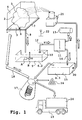
- FIG. 1 shows a platform 1 for storing a clinker 2 according to the invention.
- Platform 1 is in one example designed so that it has a floor 3 and a partition 4. The partition 4 is then mounted in a sealed manner perpendicular to the floor 3.
- Platform 1 is built in the open air.
- platform 1 is a perfectly waterproof structure in such a way that the stored elements, in particular bottom ash, do not not contribute to pollution of soil and groundwater.
- Partition 4 preferably has in this example an L-shape allowing form at least one pile in a hollow 5 of the L. Two sides of the L, forming the partition 4, can for example be orthogonal.
- This partition 4 is fixed and is preferably of the CHAPSOL type.
- the floor 3 has a length of thirty meters and the partition 4 has a height of three meters.
- the clinker 2 is for example brought to the platform 1 by trucks or conveyor belts. It is stored on this platform in the form of heap. Clinker 2 results from an incineration of waste. In a preferred example of the invention, the bottom clinkers 2 stored on platform 1 result from the incineration of household waste. This type of garbage then gives clinker 2 physicochemical characteristics particular.
- the heap of bottom ash 2 is stored on platform 1 for one time.
- the clinker undergoes a maturation. It is in particular a physico-chemical maturation. Of a part, part of the organic matter contained in these bottom ash is decomposed.
- mineral salts and metallic oxides also contained in these bottom ash are carbonated and hydrated.
- In these clinkers are leached out by meteoritic water.
- a juice 6 resulting from these bottom ash is called leachate. he it is a raw leachate 6.
- the bottom ash being stored in the air free, they are also subjected to oxygenation by ambient air.
- the floor 3 of the platform 1 is surrounded on a periphery by ditches 7.
- Ditches 7 are waterproof. Ditches 7 prevent raw leachate 6 to spread uncontrollably, and thus prevent pollution of the external environment. These ditches 7 lead into a pipeline watertight 8. This watertight pipe 8 allows the conveyance of leachate rough 6 to a retention basin 9.
- This retention basin 9 is preferably also located in the open air. It has a generally parallelepiped shape.
- the retention basin 9 has a volume such that it can contain a quantity representing a ten-year storm.
- the retention basin 9 has an internal volume of 210 m 3 .
- the characteristic dimensions of this watertight basin 9 are: a length of 20 meters, a width of 15 meters, and a height of 0.9 meters.
- the construction of such a watertight basin provides a safety margin with respect to the volume capacity.
- the height has a safety margin of 0.2 meters.
- the watertight basin 9 is equipped with filling detectors making it possible to constantly monitor the filling level of the basin 9. Thus, any overflow is avoided which could lead to pollution by raw leachate 6 from the external environment.
- the device according to the invention comprises a pump A provided with at least one hydro-ejector B, shown in Figure 3, allowing on the one hand to ventilate and on the other part of agitating the liquid contained in the basin.
- Pump A is preferably submersible and injects into each hydro-ejector a quantity of liquid, taken from the basin in which the pump is immersed. This amount of liquid injected is determined so as to create a depression in a cavity of the hydro-ejector, and thus to draw air into this cavity by through a pipe.
- the air intake pipe is mounted vertically on the cavity, it opens above the level of the pelvis. The hydro-ejector ensures an intimate mixture of the liquid and the air thus pumped.
- This ventilation and this agitation allow on the one hand to avoid a development of responsible anaerobic bacterial activity smelly emissions, and secondly to avoid sedimentation, or even fermentation, of biomass suspended in the basin. But they require the addition of an antifoam in the pelvis to prevent the formed foam does not fly away, and on the other hand require regular cleaning of the retention pond.
- a pump 10 located on a pipe connecting the basin of retention 9 at a treatment station 11 allows the routing of 6.2 aerated leachate to this treatment station 11. This routing is made via watertight piping 12.
- Watertight piping 8 and 12 are for example formed by a double envelope.
- a leachate treatment is carried out ventilated 6.2.
- leachate thus treated 6.3, in the preferred example, it is sought to essentially eliminate the chloride salts, sulfates, and the residual organic pollutant load in the leachate ventilated 6.2.
- other types of treatment can be offered in the treatment station 11.
- the treatment can be by coagulation, flocculation, then decantation of aerated leachate 6.2.
- Treatment requires then the use of coagulants and flocculants specific to the composition leachate, and also specific to the treatment sought.
- the treatment can be by adsorption on activated carbon.
- This second processing mode allows preferably an elimination of particulate organic matter or dissolved, micro-pollutants and metals contained in the leachate ventilated 6.2. But this second mode of treatment has no effect on the salts minerals.
- the treatment can be a electrophoresis or electrodialysis of aerated leachate 6.2.
- This third type of treatment requires the use of advanced technologies which allow effective demineralization.
- This treatment requires the use expensive consumables, such as electrodes.
- the treatment can be by evaporation and incineration of aerated leachate 6.2.
- This fourth type of treatment is particularly effective for treating small quantities. Given the use the possibilities offered by this fourth treatment will not be not considered in a global industrial application. Indeed, this variant results in destruction of leachate 6. However, it can be used to treat small residual amounts from these leachates ventilated 6.2.
- the treatment is membrane filtration. It is preferably semi-permeable membranes. Given the type of components to be filtered in aerated leachate 6.2, the membranes chosen are such that they allow filtration on the order of 0.0001 micrometers to 0.002 micrometers. So we can get a salt deconcentration by performing reverse osmosis or nanofiltration filtration.
- a favorite example of the invention requires the implementation of reverse osmosis filtration single-stage. In this example, a single membrane allowing the filtration, and on the other hand that this filtration is carried out in a single step.
- the treatment is an evaporation condensation of aerated leachate 6.2.
- This sixth treatment requires the setting using a boiler, a compressor and a room for evaporate and then condense the aerated leachate 6.2.
- we get a condensate and a concentrate we get a condensate and a concentrate.
- the concentrate, rich in chloride salts, is eliminate, and the decentralized condensate in chloride salts is to be reused according to the method of the invention.
- the treatment station is designed with a filtration device, and is designed to have a flow rate of the order of 1 m 3 / hour. In addition, this treatment station is scheduled to operate 20 hours a day. In this example, the treatment station has a flow rate of the order of 20 m 3 per day.
- approximately 80% of the aerated leachate 6.2 is transformed into clarified and purified water, also called permeate or treated leachate 6.3. The remaining 20% of aerated leachate 6.2 forms a concentrate and combines the pollutant load extracted by the treatment.
- the concentrate can for example be discharged into a tank 13 connected to the treatment station 11.
- the tank 13 will then be special treatment in an approved facility.
- it can be planned to carry out a treatment of the evaporation-incineration type on this concentrate.
- the treated leachate 6.3 is conducted by a pipe 14 in an intermediate tank 15, or a tank (not shown).
- This intermediate basin 15 in a preferred example of the invention has a volume of the order of 150 m 3 . It is intended to store up to five days of clarified and purified water produced by the treatment station 11.
- the intermediate basin has a parallelepiped shape, such that a length is equal to 20 meters, a width of 15 meters and a height of 0.7 meters. A safety margin vis-à-vis the filling volume is taken, the height is raised by 0.2 meters, to be able to guarantee a non-overflow of this intermediate basin 15.
- the treated leachate 6.3 contained in this intermediate basin 15 contain few salts, especially few chloride salts. However, the residual heavy metal content remains outside standards regulatory. Therefore the intermediate basin 15 must also be sealed. In fact, the treatment station 11 does not achieve perfect purification of the aerated leachate 6.2.
- the treated leachate 6.3 contained in the intermediate basin 15 may have several uses.
- a preferred use of this treated leachate 6.3 is in a mixture with bottom ash, for example from platform 1, and of hydraulic binders 16. This mixing takes place in a mixing plant 17.
- This mixing plant 17 is equipped with a two-shaft mixer horizontal. The mixer ensures the homogenization of the mixture.
- a conveyor 18 brings for example clinkers at the end of maturation, from platform 1 to the mixing plant 17.
- the hydraulic binder 16 is provided in dry form, or even pulverulent, in a silo of this mixing plant 17.
- the treated leachate 6.3 brought into this mixing plant 17 plays a role of mixing water. Indeed, it ensures the wetting of the hydraulic binder 16 and bottom ash 2, necessary for the hydraulic intake of the mixture.
- the advantage of the invention is that the heavy metals contained in the leachate treated 6.3 will be trapped in the mixture of clinker 2 with the binder hydraulic 16.
- a second advantage of the invention is that it allows to save water used in the mixing plant, because it uses leachate treated 6.3.
- the hydraulic binder 16 is, in a preferred example, of the invention a cement.
- a cement There are different types of cements to mix with bottom ash. 2. We choose the nature of the cement according to the physico-chemical characteristics clinkers of the desired type of gravel formed by this mixture.
- the mixing plant 17 pours its contents in a bucket 24 of a truck 19.
- the truck 19 then allows transport of this still not solidified mixture towards a zone of use, where the setting final mixing will take place.
- An area of use is in an example preferred a construction site for road or civil engineering works.
- FIG. 2 another use of treated leachate 6.3 maybe watering.
- a pump is used to drain the leachate treated 6.3 from the intermediate tank 15 to a barrel sprinkler 21.
- This spray cannon 21 is arranged in a screw with respect to platform 1, at a maximum height of 2 meters. In that case, the water from the treated leachate 6.3 is involved in the maturation of the bottom ash, then return to the retention basin 9 with the raw leachate 6.
- the device according to the invention comprises a means of control 22, for example a piezometer.
- This piezometer 22 is arranged with preferably between the sealed ditches 7 and the treatment station 11.
- the piezometer 22 is a device for taking samples of water from an underground aquifer of the device. It allows you to control regularly non-pollution of the external environment.
Landscapes
- Engineering & Computer Science (AREA)
- Chemical & Material Sciences (AREA)
- Environmental & Geological Engineering (AREA)
- Ceramic Engineering (AREA)
- Organic Chemistry (AREA)
- Materials Engineering (AREA)
- Structural Engineering (AREA)
- Inorganic Chemistry (AREA)
- Combustion & Propulsion (AREA)
- Civil Engineering (AREA)
- Processing Of Solid Wastes (AREA)
- Separation Using Semi-Permeable Membranes (AREA)
- Secondary Cells (AREA)
- Paper (AREA)
- Electric Double-Layer Capacitors Or The Like (AREA)
Abstract
Description
- on stocke ce mâchefer sur une plate-forme, où il subit une maturation,
- on achemine un lixiviat brut produit par ce mâchefer sur cette plate-forme, par l'intermédiaire de fossés étanches, vers un bassin de rétention,
- on fait subir une oxygénation forcée au lixiviat brut dans ce bassin de rétention pour réduire la charge organique polluante ;
- on pompe le lixiviat ainsi aéré contenu dans le bassin de rétention pour l'amener vers une station de traitement,
- on traite le lixiviat aéré dans cette station de traitement,
- on stocke le lixiviat traité dans une citerne ou un bassin intermédiaire,
- on alimente une centrale de malaxage avec le lixiviat traité, un mâchefer et un liant hydraulique.
- Figure 1 : un schéma représentant un dispositif permettant une utilisation des lixiviats selon l'invention ;
- Figure 2 : un logigramme présentant un procédé d'utilisation des lixiviats selon l'invention ;
- Figure 3 : une coupe d'un aérateur-agitateur utilisé selon l'invention.
Claims (12)
- Procédé d'utilisation des lixiviats (6) issus d'un mâchefer (2), le mâchefer résultant de préférence d'une incinération d'ordures ménagères, dans lequelcaractérisé en ce queon stocke ce mâchefer sur une plate-forme (1), où il subit une maturation,on achemine un lixiviat brut (6) produit par ce mâchefer sur cette plate-forme, par l'intermédiaire de fossés étanches (7), vers un bassin de rétention (9),on fait subir une oxygénation forcée au lixiviat brut dans ce bassin de rétention pour réduire la charge organique polluante ;on pompe le lixiviat ainsi aéré (6.2) contenu dans le bassin de rétention pour l'amener vers une station de traitement (11),on traite le lixiviat aéré dans cette station de traitement,on stocke le lixiviat traité (6.3) dans une citerne ou un bassin intermédiaire (15),on alimente une centrale de malaxage (17) avec le lixiviat traité, un mâchefer et un liant hydraulique (16).
- Procédé selon la revendication 1 caractérisé en ce queon réalise un traitement du lixiviat brut par osmose inverse mono-étagée dans la station de traitement.
- Procédé selon l'une des revendications 1 à 2 caractérisé en ce queon effectue un traitement du lixiviat brut par évaporation et condensation dans la station de traitement.
- Procédé selon l'une des revendications 1 à 3 caractérisé en ce queon réalise une oxygénation forcée du lixiviat brut du bassin de rétention avec des aérateurs, de préférence avec une pompe (A) reliée à au moins un hydro-éjecteur (B).
- Procédé selon l'une des revendications 1 à 4 caractérisé en ce queon asperge avec les lixiviats traités du bassin intermédiaire le mâchefer stocké sur la plate-forme grâce à des canons d'aspersion (21).
- Procédé selon l'une des revendications 1 à 5 caractérisé en ce queon évacue un concentrât résultant du traitement du lixiviat brut dans un réseau spécialisé.
- Dispositif utilisant des lixiviats traités comportant une plate-forme (1) étanche pour stocker des mâchefers (2), un bassin de rétention (9) pour recevoir des lixiviats bruts issus de la plate-forme par l'intermédiaire de fossés étanches (7), ce bassin de rétention étant relié à une station de traitement (11) des lixiviats par l'intermédiaire de canalisations étanches (8, 12), caractérisé en ce qu'il comporte un bassin intermédiaire (15) pour recevoir les lixiviats traités (6.3), à la sortie de la station de traitement, et en ce qu'il comporte une centrale de malaxage (17) pour y mélanger un mâchefer, un liant hydraulique (16) et les lixiviats traités.
- Dispositif selon la revendication 7 caractérisé en ce qu'il comporte un canon d'aspersion (21) relié par une pompe (20) au bassin intermédiaire, et orienté pour arroser la plate-forme.
- Dispositif selon l'une des revendications 7 à 8 caractérisé en ce qu'il comporte une citerne (13) reliée à la station de traitement, pour évacuer un concentrât issu du traitement des lixiviats bruts.
- Dispositif selon l'une des revendications 7 à 9 caractérisé en ce qu'il comporte un dispositif de contrôle, de préférence un piézomètre (22) disposé entre les fossés étanches et la station de traitement.
- Dispositif selon l'une des revendications 1 à 10 caractérisé en ce que la station de traitement comporte un système de filtration par osmose inverse mono-étagée.
- Dispositif selon l'une des revendications 1 à 11 caractérisé en ce qu'il comporte un aérateur et un agitateur dans le bassin de rétention, de préférence une pompe (A) reliée à un hydro-éjecteur (B).
Applications Claiming Priority (2)
| Application Number | Priority Date | Filing Date | Title |
|---|---|---|---|
| FR9910371 | 1999-08-10 | ||
| FR9910371A FR2797406B1 (fr) | 1999-08-10 | 1999-08-10 | Procede d'utilisation des lixiviats traites et dispositif utilisant ce procede |
Publications (2)
| Publication Number | Publication Date |
|---|---|
| EP1076048A1 true EP1076048A1 (fr) | 2001-02-14 |
| EP1076048B1 EP1076048B1 (fr) | 2002-10-23 |
Family
ID=9549055
Family Applications (1)
| Application Number | Title | Priority Date | Filing Date |
|---|---|---|---|
| EP20000402240 Expired - Lifetime EP1076048B1 (fr) | 1999-08-10 | 2000-08-07 | Procédé d'utilisation des lixiviats traités et dispositif utilisant ce procédé |
Country Status (4)
| Country | Link |
|---|---|
| EP (1) | EP1076048B1 (fr) |
| AT (1) | ATE226564T1 (fr) |
| DE (1) | DE60000641D1 (fr) |
| FR (1) | FR2797406B1 (fr) |
Cited By (1)
| Publication number | Priority date | Publication date | Assignee | Title |
|---|---|---|---|---|
| CN109454093A (zh) * | 2018-11-21 | 2019-03-12 | 湖州裕宇塑料有限公司 | 一种废弃物分类回收处理设备 |
Citations (7)
| Publication number | Priority date | Publication date | Assignee | Title |
|---|---|---|---|---|
| FR2473036A1 (fr) * | 1980-01-08 | 1981-07-10 | Le I Akademii K | Procede d'utilisation du residu des eaux de curage d'installations de filtrage et produit obtenu par application dudit procede |
| EP0362125A1 (fr) * | 1988-09-28 | 1990-04-04 | GebràDer Sulzer Aktiengesellschaft | Procédé pour le traitement des résidus solides, contenant des métaux lourds, provenant des incinérateurs |
| WO1992016317A1 (fr) * | 1991-03-25 | 1992-10-01 | Landfill Service Corporation | Couverture synthetique pour tas de dechets |
| US5340235A (en) * | 1992-07-31 | 1994-08-23 | Akzo Nobel, Inc. | Process for making cementitious mine backfill in a salt environment using solid waste materials |
| EP0630687A1 (fr) * | 1993-06-28 | 1994-12-28 | Sipac S.A. | Procédé de traitement de résidus d'installations d'incineration d'immondices ménagères et similaires |
| DE19531942A1 (de) * | 1995-08-18 | 1997-02-20 | Ver Energiewerke Ag | Verfahren zur Herstellung von hydraulisch erhärtenden Deponiebaustoffen und -systemen für Deponatverfestigung und -immobilisierung aus Rückständen von Braunkohlenkraftwerken |
| FR2754747A1 (fr) * | 1996-10-21 | 1998-04-24 | Andre Accetta | Procede de traitement de residus d'incineration des ordures menageres et le dispositif de mise en oeuvre |
-
1999
- 1999-08-10 FR FR9910371A patent/FR2797406B1/fr not_active Expired - Fee Related
-
2000
- 2000-08-07 DE DE60000641T patent/DE60000641D1/de not_active Expired - Lifetime
- 2000-08-07 EP EP20000402240 patent/EP1076048B1/fr not_active Expired - Lifetime
- 2000-08-07 AT AT00402240T patent/ATE226564T1/de not_active IP Right Cessation
Patent Citations (7)
| Publication number | Priority date | Publication date | Assignee | Title |
|---|---|---|---|---|
| FR2473036A1 (fr) * | 1980-01-08 | 1981-07-10 | Le I Akademii K | Procede d'utilisation du residu des eaux de curage d'installations de filtrage et produit obtenu par application dudit procede |
| EP0362125A1 (fr) * | 1988-09-28 | 1990-04-04 | GebràDer Sulzer Aktiengesellschaft | Procédé pour le traitement des résidus solides, contenant des métaux lourds, provenant des incinérateurs |
| WO1992016317A1 (fr) * | 1991-03-25 | 1992-10-01 | Landfill Service Corporation | Couverture synthetique pour tas de dechets |
| US5340235A (en) * | 1992-07-31 | 1994-08-23 | Akzo Nobel, Inc. | Process for making cementitious mine backfill in a salt environment using solid waste materials |
| EP0630687A1 (fr) * | 1993-06-28 | 1994-12-28 | Sipac S.A. | Procédé de traitement de résidus d'installations d'incineration d'immondices ménagères et similaires |
| DE19531942A1 (de) * | 1995-08-18 | 1997-02-20 | Ver Energiewerke Ag | Verfahren zur Herstellung von hydraulisch erhärtenden Deponiebaustoffen und -systemen für Deponatverfestigung und -immobilisierung aus Rückständen von Braunkohlenkraftwerken |
| FR2754747A1 (fr) * | 1996-10-21 | 1998-04-24 | Andre Accetta | Procede de traitement de residus d'incineration des ordures menageres et le dispositif de mise en oeuvre |
Cited By (1)
| Publication number | Priority date | Publication date | Assignee | Title |
|---|---|---|---|---|
| CN109454093A (zh) * | 2018-11-21 | 2019-03-12 | 湖州裕宇塑料有限公司 | 一种废弃物分类回收处理设备 |
Also Published As
| Publication number | Publication date |
|---|---|
| ATE226564T1 (de) | 2002-11-15 |
| FR2797406A1 (fr) | 2001-02-16 |
| DE60000641D1 (de) | 2002-11-28 |
| EP1076048B1 (fr) | 2002-10-23 |
| FR2797406B1 (fr) | 2001-09-21 |
Similar Documents
| Publication | Publication Date | Title |
|---|---|---|
| EP1791793B1 (fr) | Methode de traitement de polluants par phytolixiviation | |
| Malovanyy et al. | Two-stage treatment of solid waste leachates in aerated lagoons and at municipal wastewater treatment plants | |
| Rozzi et al. | Treatment and disposal of olive mill effluents | |
| CN101671095B (zh) | 垃圾渗滤液处理工艺 | |
| KR101417277B1 (ko) | 폐수 응집 처리장치 | |
| FR2876047A1 (fr) | Traitement de polluants par phytolixiviation | |
| US4769154A (en) | Chlorine oxidation waste water treatment method | |
| EP1076048B1 (fr) | Procédé d'utilisation des lixiviats traités et dispositif utilisant ce procédé | |
| CA2987529A1 (fr) | Procede et dispositif d'epuration d'eaux domestiques ou industrielles | |
| FR3100536A1 (fr) | Procédé de traitement d’un lixiviat de décharge ou d’un concentrat liquide de lixiviat ou de boues issues de lixiviats et dispositif pour la mise en œuvre du procédé | |
| CA2501960C (fr) | Procede de traitement de boues | |
| FR2674844A1 (fr) | Procede et installation de traitement d'epuration de lisiers d'animaux. | |
| WO2021018629A1 (fr) | Ouvrage d'assainissement des eaux usées | |
| EP0237391B1 (fr) | Procédé et dispositif pour le traitement des eaux usées | |
| CN1942406B (zh) | 处理淤浆的方法 | |
| EP0829276B1 (fr) | Procédé de solidification de résidus d'épuration des fumées d'incinérateurs d'ordures ménagères et de déchets industriels | |
| WO2002012138A1 (fr) | Installation et procede d'epuration des eaux usees ou residuaires notamment industrielles | |
| FR2708923A1 (fr) | Procédé et dispositif d'élimination continue en circuit fermé des graisses résiduelles organiques, selon le principe de la digestion aérobie. | |
| EP2046689B1 (fr) | Dispositif de purification préliminaire des eaux usées avec traitement ultérieur intégré des solides | |
| CN102001782A (zh) | 一种垃圾渗滤液处理工艺方法 | |
| EP0558421A1 (fr) | Procédé d'épuration d'excréments animaliers et son dispositif | |
| BE1013375A3 (fr) | Procede et installation pour la nitrification d'eaux polluees. ' | |
| EP3189013B1 (fr) | Pre-traitement d'eaux chaudes sursaturees | |
| FR2744034A1 (fr) | Procede et dispositif pour le pretraitement hydraulique et biologique des eaux residuaires | |
| WO2025202245A1 (fr) | Procédé et dispositif de traitement des effluents comprenant des matières en suspension, de l'azote et du phosphore |
Legal Events
| Date | Code | Title | Description |
|---|---|---|---|
| PUAI | Public reference made under article 153(3) epc to a published international application that has entered the european phase |
Free format text: ORIGINAL CODE: 0009012 |
|
| AK | Designated contracting states |
Kind code of ref document: A1 Designated state(s): AT BE CH CY DE DK ES FI FR GB GR IE IT LI LU MC NL PT SE |
|
| AX | Request for extension of the european patent |
Free format text: AL;LT;LV;MK;RO;SI |
|
| RIN1 | Information on inventor provided before grant (corrected) |
Inventor name: BASUYAU, VINCENT |
|
| 17P | Request for examination filed |
Effective date: 20010227 |
|
| AKX | Designation fees paid |
Free format text: AT BE CH CY DE DK ES FI FR GB GR IE IT LI LU MC NL PT SE |
|
| GRAG | Despatch of communication of intention to grant |
Free format text: ORIGINAL CODE: EPIDOS AGRA |
|
| 17Q | First examination report despatched |
Effective date: 20020131 |
|
| GRAG | Despatch of communication of intention to grant |
Free format text: ORIGINAL CODE: EPIDOS AGRA |
|
| GRAH | Despatch of communication of intention to grant a patent |
Free format text: ORIGINAL CODE: EPIDOS IGRA |
|
| GRAH | Despatch of communication of intention to grant a patent |
Free format text: ORIGINAL CODE: EPIDOS IGRA |
|
| GRAA | (expected) grant |
Free format text: ORIGINAL CODE: 0009210 |
|
| AK | Designated contracting states |
Kind code of ref document: B1 Designated state(s): AT BE CH CY DE DK ES FI FR GB GR IE IT LI LU MC NL PT SE |
|
| PG25 | Lapsed in a contracting state [announced via postgrant information from national office to epo] |
Ref country code: IT Free format text: LAPSE BECAUSE OF FAILURE TO SUBMIT A TRANSLATION OF THE DESCRIPTION OR TO PAY THE FEE WITHIN THE PRESCRIBED TIME-LIMIT;WARNING: LAPSES OF ITALIAN PATENTS WITH EFFECTIVE DATE BEFORE 2007 MAY HAVE OCCURRED AT ANY TIME BEFORE 2007. THE CORRECT EFFECTIVE DATE MAY BE DIFFERENT FROM THE ONE RECORDED. Effective date: 20021023 Ref country code: IE Free format text: LAPSE BECAUSE OF FAILURE TO SUBMIT A TRANSLATION OF THE DESCRIPTION OR TO PAY THE FEE WITHIN THE PRESCRIBED TIME-LIMIT Effective date: 20021023 Ref country code: FI Free format text: LAPSE BECAUSE OF FAILURE TO SUBMIT A TRANSLATION OF THE DESCRIPTION OR TO PAY THE FEE WITHIN THE PRESCRIBED TIME-LIMIT Effective date: 20021023 Ref country code: GR Free format text: LAPSE BECAUSE OF FAILURE TO SUBMIT A TRANSLATION OF THE DESCRIPTION OR TO PAY THE FEE WITHIN THE PRESCRIBED TIME-LIMIT Effective date: 20021023 Ref country code: NL Free format text: LAPSE BECAUSE OF FAILURE TO SUBMIT A TRANSLATION OF THE DESCRIPTION OR TO PAY THE FEE WITHIN THE PRESCRIBED TIME-LIMIT Effective date: 20021023 Ref country code: GB Free format text: LAPSE BECAUSE OF FAILURE TO SUBMIT A TRANSLATION OF THE DESCRIPTION OR TO PAY THE FEE WITHIN THE PRESCRIBED TIME-LIMIT Effective date: 20021023 Ref country code: AT Free format text: LAPSE BECAUSE OF FAILURE TO SUBMIT A TRANSLATION OF THE DESCRIPTION OR TO PAY THE FEE WITHIN THE PRESCRIBED TIME-LIMIT Effective date: 20021023 |
|
| REF | Corresponds to: |
Ref document number: 226564 Country of ref document: AT Date of ref document: 20021115 Kind code of ref document: T |
|
| REG | Reference to a national code |
Ref country code: GB Ref legal event code: FG4D Free format text: NOT ENGLISH |
|
| REG | Reference to a national code |
Ref country code: CH Ref legal event code: EP |
|
| REG | Reference to a national code |
Ref country code: IE Ref legal event code: FG4D Free format text: FRENCH |
|
| REF | Corresponds to: |
Ref document number: 60000641 Country of ref document: DE Date of ref document: 20021128 |
|
| PG25 | Lapsed in a contracting state [announced via postgrant information from national office to epo] |
Ref country code: SE Free format text: LAPSE BECAUSE OF FAILURE TO SUBMIT A TRANSLATION OF THE DESCRIPTION OR TO PAY THE FEE WITHIN THE PRESCRIBED TIME-LIMIT Effective date: 20030123 Ref country code: DK Free format text: LAPSE BECAUSE OF FAILURE TO SUBMIT A TRANSLATION OF THE DESCRIPTION OR TO PAY THE FEE WITHIN THE PRESCRIBED TIME-LIMIT Effective date: 20030123 Ref country code: PT Free format text: LAPSE BECAUSE OF FAILURE TO SUBMIT A TRANSLATION OF THE DESCRIPTION OR TO PAY THE FEE WITHIN THE PRESCRIBED TIME-LIMIT Effective date: 20030123 |
|
| PG25 | Lapsed in a contracting state [announced via postgrant information from national office to epo] |
Ref country code: DE Free format text: LAPSE BECAUSE OF FAILURE TO SUBMIT A TRANSLATION OF THE DESCRIPTION OR TO PAY THE FEE WITHIN THE PRESCRIBED TIME-LIMIT Effective date: 20030124 |
|
| NLV1 | Nl: lapsed or annulled due to failure to fulfill the requirements of art. 29p and 29m of the patents act | ||
| GBV | Gb: ep patent (uk) treated as always having been void in accordance with gb section 77(7)/1977 [no translation filed] |
Effective date: 20021023 |
|
| PG25 | Lapsed in a contracting state [announced via postgrant information from national office to epo] |
Ref country code: ES Free format text: LAPSE BECAUSE OF FAILURE TO SUBMIT A TRANSLATION OF THE DESCRIPTION OR TO PAY THE FEE WITHIN THE PRESCRIBED TIME-LIMIT Effective date: 20030429 |
|
| PG25 | Lapsed in a contracting state [announced via postgrant information from national office to epo] |
Ref country code: CY Free format text: LAPSE BECAUSE OF FAILURE TO SUBMIT A TRANSLATION OF THE DESCRIPTION OR TO PAY THE FEE WITHIN THE PRESCRIBED TIME-LIMIT Effective date: 20030807 Ref country code: LU Free format text: LAPSE BECAUSE OF NON-PAYMENT OF DUE FEES Effective date: 20030807 |
|
| REG | Reference to a national code |
Ref country code: IE Ref legal event code: FD4D Ref document number: 1076048E Country of ref document: IE |
|
| PLBE | No opposition filed within time limit |
Free format text: ORIGINAL CODE: 0009261 |
|
| STAA | Information on the status of an ep patent application or granted ep patent |
Free format text: STATUS: NO OPPOSITION FILED WITHIN TIME LIMIT |
|
| PG25 | Lapsed in a contracting state [announced via postgrant information from national office to epo] |
Ref country code: MC Free format text: LAPSE BECAUSE OF NON-PAYMENT OF DUE FEES Effective date: 20030831 Ref country code: BE Free format text: LAPSE BECAUSE OF NON-PAYMENT OF DUE FEES Effective date: 20030831 |
|
| 26N | No opposition filed |
Effective date: 20030724 |
|
| BERE | Be: lapsed |
Owner name: *YPREMA Effective date: 20030831 |
|
| PG25 | Lapsed in a contracting state [announced via postgrant information from national office to epo] |
Ref country code: CH Free format text: LAPSE BECAUSE OF NON-PAYMENT OF DUE FEES Effective date: 20040831 Ref country code: LI Free format text: LAPSE BECAUSE OF NON-PAYMENT OF DUE FEES Effective date: 20040831 |
|
| REG | Reference to a national code |
Ref country code: CH Ref legal event code: PL |
|
| PGFP | Annual fee paid to national office [announced via postgrant information from national office to epo] |
Ref country code: FR Payment date: 20130812 Year of fee payment: 14 |
|
| REG | Reference to a national code |
Ref country code: FR Ref legal event code: ST Effective date: 20150430 |
|
| PG25 | Lapsed in a contracting state [announced via postgrant information from national office to epo] |
Ref country code: FR Free format text: LAPSE BECAUSE OF NON-PAYMENT OF DUE FEES Effective date: 20140901 |