EP1076149A2 - Torblatt eines Decke- oder Seitensektionaltors - Google Patents
Torblatt eines Decke- oder Seitensektionaltors Download PDFInfo
- Publication number
- EP1076149A2 EP1076149A2 EP00116268A EP00116268A EP1076149A2 EP 1076149 A2 EP1076149 A2 EP 1076149A2 EP 00116268 A EP00116268 A EP 00116268A EP 00116268 A EP00116268 A EP 00116268A EP 1076149 A2 EP1076149 A2 EP 1076149A2
- Authority
- EP
- European Patent Office
- Prior art keywords
- folded
- edge
- door leaf
- hook
- box
- Prior art date
- Legal status (The legal status is an assumption and is not a legal conclusion. Google has not performed a legal analysis and makes no representation as to the accuracy of the status listed.)
- Withdrawn
Links
Images


Classifications
-
- E—FIXED CONSTRUCTIONS
- E06—DOORS, WINDOWS, SHUTTERS, OR ROLLER BLINDS IN GENERAL; LADDERS
- E06B—FIXED OR MOVABLE CLOSURES FOR OPENINGS IN BUILDINGS, VEHICLES, FENCES OR LIKE ENCLOSURES IN GENERAL, e.g. DOORS, WINDOWS, BLINDS, GATES
- E06B3/00—Window sashes, door leaves, or like elements for closing wall or like openings; Layout of fixed or moving closures, e.g. windows in wall or like openings; Features of rigidly-mounted outer frames relating to the mounting of wing frames
- E06B3/32—Arrangements of wings characterised by the manner of movement; Arrangements of movable wings in openings; Features of wings or frames relating solely to the manner of movement of the wing
- E06B3/48—Wings connected at their edges, e.g. foldable wings
- E06B3/485—Sectional doors
- E06B3/486—Sectional doors with hinges being at least partially integral part of the section panels
-
- E—FIXED CONSTRUCTIONS
- E06—DOORS, WINDOWS, SHUTTERS, OR ROLLER BLINDS IN GENERAL; LADDERS
- E06B—FIXED OR MOVABLE CLOSURES FOR OPENINGS IN BUILDINGS, VEHICLES, FENCES OR LIKE ENCLOSURES IN GENERAL, e.g. DOORS, WINDOWS, BLINDS, GATES
- E06B3/00—Window sashes, door leaves, or like elements for closing wall or like openings; Layout of fixed or moving closures, e.g. windows in wall or like openings; Features of rigidly-mounted outer frames relating to the mounting of wing frames
- E06B3/32—Arrangements of wings characterised by the manner of movement; Arrangements of movable wings in openings; Features of wings or frames relating solely to the manner of movement of the wing
- E06B3/48—Wings connected at their edges, e.g. foldable wings
- E06B3/485—Sectional doors
Definitions
- the invention relates to a door leaf of a ceiling or side sectional door or rotary gates, especially for car garages or for halls, made of articulated flat sections, the parallel to the swivel axes, transversal integrated hinge and stiffening profiles with molded continuous beads, which to form a continuous over the entire length Longitudinal hinge are hooked into each other in pairs and for Can be disassembled.
- Each box profile has at least one that is approximately normal to the surface of the door leaf Stiffener on.
- at or near the End faces in the hinge area of the bearing housing sections for the admission of the journal from laterally protruding Guide elements attached with which the sections in Running rails are guided.
- the door leaf of a sectional door for a private car garage usually consists of four to five sections with one Height from about 30 to 50 cm.
- the sections of a door leaf for Industrial halls or truck garages can also be higher, around 60 up to 70 cm.
- Such sections differ basically of roller shutter slats for roller shutters or roll armor for doors, shop windows or garages, which are usually only one height from 4 to 8 cm, rarely above.
- the shutter slats On their longitudinal edges the shutter slats have complementary hook-like longitudinal profiles, which are pushed together from the front.
- the Joints allow mutual pivoting around the longitudinal axis when winding up and unwinding the roller shutter or roller shutter.
- the sections are in about 90% of the door leaves for sectional doors hinged together by means of individual hinges. Continuous longitudinal hinges are less common to find extruded aluminum profiles. These profiles are manufactured in different widths and lengths. she are never an integral part of the sections. they always will screwed to the separate frame of the sections that then with metal sheets or with wooden profile bars or wooden panels be occupied. They cause further bracing the partially large door leaf exposed to wind loads as well a better seal between the sections.
- the invention has for its object a door leaf type mentioned so that the sections not with hinges to be installed one below the other must be connected and on a modern press brake rationally manufactured without clamping cables with only two tools can be.
- each Section consists of a single sheet of metal attached to each Long side to a double-layer protruding outwards Folded flag is bent, and that the folded flags to be continuous complementary articulated hooks folded and hooked together are.
- each section there is preferably a cross-section of a folded flag Z-shaped with two parallel to the section surface Cross legs and one connecting them, at an angle to connecting section to each section surface Articulated hook formed, and the free end cross leg has a beveled towards the connecting web narrow edge.
- the other double-layered flag is in the Cross-section hook-shaped to a complementary joint hook formed, compared to the cross-section in the Z-shaped bending fold two areas running parallel to its cross leg as well as a parallel to its connecting bridge in its Has wide extending area.
- An embodiment is preferred in which the distance from the Articulated hook closed box profiles are formed.
- an open box profile with protruding free edge strips for installation, fastening and closing of the box profile is formed on the inner area of the metal sheet.
- the outer sections are between the box profiles and folded the outer folded edges to the hinge hook. The section with the box profiles and the articulated hooks is in one piece.
- the folded is on each longitudinal edge Sheet of metal formed a double-layered folded flag that is formed into a hook joint by folding or pressing.
- the outer hook joint connects inwards a whole box, half a box or - if you don't on a box - just a flat surface, in which there are still patterns (Profiling according to wooden profile bars) embossed or pressed can be at.
- boxless training can the outside must be provided with a wooden covering. It will the sections are double-walled, and expedient they are foamed.
- the second sheet of metal is in the double-walled folding seams open to the outside with their inserted folds open inwards and closes the through the two Z-shaped webs formed, otherwise open half Box.
- the center bar can be at an angle of approximately 90 ° stand next to the two adjacent bridges.
- This construction according to the invention has the advantage that Smaller companies are able to implement a modern, all security policy fulfilling sectional door not only economical, but also advanced in function and aesthetically both for car garages and in design can also be manufactured for industrial halls.
- the sections can on a modern press brake without clamping cables with only two Tools are manufactured efficiently.
- Large companies can also produce the sections on a modern form rolling mill and if necessary, the facing central webs of the hooks form their swivel radius in an arc shape.
- the sections of a single-walled gate are made from one piece Sheet or sheet made.
- the sheet metal lanes are folded, folded and pressed in such a way that each section either one or two closed sides on both long sides Has box profiles for stabilization. If the top is flat, it can be covered with all types of wooden coverings, which are screwed on from the inside. To this Wise is a fire protection regulation (Austria) for wood-covered Goals met.
- the box profiles have the long sides of the bent hook joints, so that the Sections hinged effortlessly without screwing across Swivel axis interlocked and after screwing on the bearing piece with just one screw without risk of unhooking can be swiveled up to 70 °. This eliminates the Need to provide individual hinges that are aligned and have to be screwed on. There is no rotation via a hinge pin. Box profiles, infill panels and hook joint are in one piece - without bumps and Screws - and free of corrosion spots.
- the sheet metal surfaces between the box profiles can be varied train and can by edging, ornaments and Embossments are further braced and designed. Because the hook joints have double material thickness, they also wear, in particular the middle bar, to stiffen the Sections at.
- Eliminating hinges not only cuts costs for these themselves, but also the working hours for that Drilling the mounting holes and screwing on.
- a Garage door with a width of approx. 2.5 m and a height of approx. 2.3 m with six sections, there are 15 two-part hinges, 90 mounting screws and corresponding holes as well screwing in and greasing and tapping in the hinge bolts. It can also be long between sections Plastic seals and pulling in are no longer necessary.
- At least near the ends of the sections are in the only Articulated hooks projecting parallel to the level of the section, the is not retracted, positively engaging bearing pieces to accommodate roller or sliding element axles used and preferably secured against loosening on the box profile.
- the bearing pieces have below the retracted edge of the articulated hook a recess in which the outer edge of the Z-shaped articulated hook is pivotable and at one Boundary wall is present. With a locking lug of the bearing piece (see Fig. 5a) is a detachment and sliding of the other Articulated hook prevented.
- the sliding elements mounted on a sliding element axis should be flat rectangular in cross section for engaging in flat, box-shaped, partly open on one broadside Slide rails are formed.
- the sliding elements are out Plastic with appropriate sliding properties and the Slide rails preferably made of aluminum, which in turn a corresponding sliding coating or sliding layer formation have on their profile inside. After removal the sections can be uncoupled from each other be what double security when door mounting offers.
- the bearing pieces for the axes of the guide or Sliding elements are designed so that they have a double function as a back-up counter for the connected sections take over in the event of an unwanted swivel over 70 °.
- the sections can come in different widths and lengths pressed and folded a sheet metal strip with only two tools become.
- the hollow profiles closed along the long sides have a rectangular or square cross section. There the hook or knife joints do not rotate, only perform a pivoting movement in which the front edge of the one hook at the angle of the other hook on a line swiveling standing from 0 to 70 °, they never have to be lubricated become.
- the closed box profiles can be used for further stabilization be foamed.
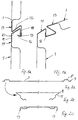
- Fig. 1 are two adjacent sections 1 of a sectional door shown, by pressing from a flat sheet of metal the box profiles fold the longitudinal edge and fold produced by means of the folding steps shown in Fig. 2 has been.
- the articulated hooks are also reinforced as the area on both sides of the box profiles 5.
- the Edge strip 7 bears against the metal sheet 3 and can be opened here be fixed in a known manner, for. B. by gluing. Same thing applies to the outside of the box in the area of the articulated hook 13 and 14.
- the upper articulated hook is 13 Z-shaped in cross section.
- the outside is another edge 16 inward mirror image of the central web 15 bent over, while the front edge 17 of the lower, non-Z-shaped hinge hook 14 back here to the inside Box profile 5 points out and the edge strip 18 parallel to Sheet 3 and the projecting web 19 runs.
- the weird one Connecting web 20 runs in that shown in Fig. 1a Position of the two sections approximately parallel to the central web 15 of the articulated hook 13.
- Fig. 1b angled position is the engagement of the front edge 17th of the lower articulated hook 14 in the outer base of the articulated hook 13 recognizable.
- the friction in this swivel or knife bearing is extremely low.
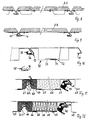
- FIGS. 3 and 4 Sections are the articulated hooks 13 and 14 in the middle of the box section 25 from this to the outside.
- Fig. 4a in the edge region of the sheet 3 two open box profiles 26 to form half height by pressing and in next folding step, the folding in the middle of the web 28 between to make the adjacent half-box profiles 26 um, as shown in Fig. 4b, a to the sheet 3 and the projecting folded flag 30 symmetrical square closed To get box profile 25.
- the folded flags 30 again to the hinge hook 13 and 14, p.
- Fig. 4c reshaped to interlock them to be able to, as can be seen from FIGS. 3a and 3b.
- the Interlocking is similar to that of sections 1 according to Fig. 1. Between the closed box profiles can be parallel to these a usual longitudinal profile in the manner of wooden profile bars be provided, which is not shown.
- 3a is the path of movement of the inner bending edge 31 of the Z-shaped hinge hook 13 as a dashed arc 32 shown. It can be seen that the gap compared to the The central web 15 of the articulated hook 13 opens little, a risk of injury is not given by pinching and thus meets the requirements for adequate finger protection are.
- the corresponding channel-like Has longitudinal recesses 62 so that the mutual pivoting the sections are not disabled. You can go through through the Sidewalls of the kasteriprofile protruding lugs 63 one Cover plate 64 or protruding, fixed to the box profile, inserted into bending folds 65 open to the hook joints Material strips 66 be secured.
- Bearing pieces 40 used from plastic consist of a largely filling the profile of the articulated hook 14 block-like plastic part and a mounting flange 42, which is fixed to the box section 25 by means of a screw 43 is.
- a channel-shaped recess 44 In the swivel range of the edge 16 of the Z-shaped articulated hook 13 there is a channel-shaped recess 44, which leaves the edge 16 the necessary freedom of movement.
- the lower limit see Fig. 5a, this recess 44 laid and designed so that in the stretched 5a, the edge 16 bears flat, whereby slipping outward through a protruding nose 46 on the bearing piece 40 is prevented.
- a bearing bore 48 Inside the main part of the bearing piece 40 is a bearing bore 48 provided the inclusion of a roller or Sliding element axis 50 is used.
- a roller or Sliding element axis 50 is used inside the main part of the bearing piece 40 .
- the running rail 54 is flat and box-shaped formed as shown in Fig. 6, and encloses the sliding element or the to the required extent Sliding block 52 form-fitting and leaves a very smooth running Sliding to guide the sections.
- Such flat, box-shaped Runners 54 can be used for design of transition arches slightly bend over wooden stencils what is more advantageous than the still predominantly used Steel upright rails for the accommodation of castors.
- a section can also be made of wood coverings of any type and shape single-walled with double-walled edge areas to form the Design articulated hooks 13 and 14 without box profiles, like this 7, 8 and 9.
- These sections stiffened enough. Because of that on the inside located sheet metal this gate also corresponds to the Fire regulations in place in different countries.
- the wooden covering is screwed on from the inside.
- the sheet has a left next to the folds Embossing 73 from the width of the bending fold 71 on the right Half of the box profile, around this next to the bending fold 72 to be able to place the left half of the box profile so that the Bending folds can be brought into engagement.
- the left Articulated hook 13 is a sliding profile 75, sh. also detailed picture, with inwardly protruding sealing bead 76, the one enables virtually noiseless pivoting of the articulated hook and helps seal between sections.
- the box profile foamed with insulating foam differs from that according to FIG. 10 in that the formed to the Z-profile with right angles Edge strips only a short distance inwards and am Edge folded out folds 65 into which the cover plate 64 with inward facing, to the bending folds 65 complementary bending folds 67 for closing the box section is inserted.
- the bending folds 67 are so wide that they form the protruding nose 63, which the Foam profile strips 60 and 61 holds under tension.
- the closed one filled with insulation mats 68 12 is initially an open box profile like that produced according to FIG. 11. But then it will closed by a closure panel 69, which after the inner edge strips with the folding seams open to the outside 65 is introduced.
- a closure panel 69 which after the inner edge strips with the folding seams open to the outside 65 is introduced.
- the material strip 66 is inserted, the side protrudes beyond the box profile. He holds it in the hook joint 13 inserted foam profile strips 60 securely fixed by placing it under tension on its upper side.
- the profile strip 61 for the hook joint 14 is located only between the bearing pieces 40 which at the two ends of the Hook joint 14 are provided. These bearing pieces 40 are in the left halves of Figs. 11 and 12 not shown to the profile strips 61 lying behind become visible to let.
- the profile strips introduced into the adjacent hook joint 13 61 by a material strip inserted into the bending fold 65 66 be secured.
- this strip of material 66 could also be under the bending fold 67 the cover plate 64 can be inserted into the bending fold 65.
Landscapes
- Engineering & Computer Science (AREA)
- Civil Engineering (AREA)
- Structural Engineering (AREA)
- Securing Of Glass Panes Or The Like (AREA)
- Support Devices For Sliding Doors (AREA)
- Gates (AREA)
Abstract
Description
- Fig. 1a und 1b
- die Längsränder zweier Sektionen, ineinandergehakt, zueinander nicht abgewinkelt und abgewinkelt,
- Fig. 2a bis 2c
- Verformungsschritte einer ebenen Blechtafel zu einer Sektion,
- Fig. 3a und 3b
- eine der Fig. 1 ähnliche Darstellung einer abgewandelten Ausführungsform einer Sektion mit mittig der Kastenprofile ausgebildeten Gelenkhaken,
- Fig. 4a bis 4c
- Verformungsschritte einer ebenen Blechbahn zu der Sektion nach Fig. 3,
- Fig. 5a und 5b
- eine der Fig. 3 ähnliche Darstellung der Sektionen in nicht abgewinkelter und abgewinkelter Stellung mit jeweils einem in den nicht Z-förmigen Gelenkhaken der unteren Sektion formschlüssig eingreifenden Lagerstück,
- Fig. 6
- eine flache, kastenförmige Laufschiene mit eingesetztem Kunststoff-Gleitelement auf einer Gleitachse, die in das in den Fig. 5a und 5b dargestellte Lagerstück eingeführt wird,
- Fig. 7
- den Querschnitt einer Sektion für ein leichtes Tor ohne Kastenprofile,
- Fig. 8
- das Torblatt nach Fig. 2 mit auf der Außenseite vorgesehenen Holzprofilstäben,
- Fig. 9
- das Torblatt nach Fig. 7 mit auf der Außenseite vorgesehenen Holzpaneelen,
- Fig. 10
- eine weitere Ausführungsform aus einer einzigen Blechtafel mit einem einzigen geschlossenen Kastenprofil,
- Fig. 11
- eine der Fig. 8 ähnliche Ausführungsform, bei der das ausgeschäumte Kastenprofil auf der Innenseite mit einer aufgeschobenen, am Rand gefalzten Blechtafel verschlossen ist, und
- Fig. 12
- eine der Fig. 9 ähnliche Ausführungsform mit unter die Randstreifen des nach innen offenen Kastenprofils eingeschobenen ebenen Blechtafel und Fingerschutzschaumstoff-Formprofil im Bereich der Gelenke.
Claims (13)
- Torblatt eines Decken- oder Seitensektionaltors, insbesondere für PKW-Garagen oder für Hallen, aus gelenkig miteinander verbundenen flächigen Sektionen (1), die parallel zu den Schwenkachsen verlaufende, quergerichtete integrierte Scharnier- und Aussteifungsprofile mit angeformten durchgehenden Wulsten aufweisen, welche zur Bildung eines über die gesamte Länge durchgehenden Längsscharniers paarweise ineinander eingehakt sind und zum Ausbau auseinanderhakbar sind,
dadurch gekennzeichnet,daß jede Sektion (1) aus einer einzigen Blechtafel (3) besteht, die an jeder Längsseite zu einer nach außen abstehenden doppellagigen Falzfahne (30) umgebogen ist, und daß die Falzfahnen zu durchgehenden komplementären Gelenkhaken (13, 14) abgekantet und ineinandergehakt sind. - Torblatt nach Anspruch 1,
dadurch gekennzeichnet, daß für jede Sektion (1) die eine doppellagige Falzfahne (13) im Querschnitt Z-förmig mit zwei parallel zur Sektionsfläche verlaufenden Querschenkeln und einem diese verbindenden, schräg zur jeweiligen Sektionsfläche verlaufenden Verbindungssteg (15) zu einem Gelenkhaken (13) ausgebildet ist und der endseitige, freie Querschenkel einen zu dem Verbindungssteg (15) hin abgekanteten schmalen Rand (16) aufweist, unddaß die andere doppellagige Falzfahne (14) im Querschnitt hakenförmig zu einem komplementären Gelenkhaken (14) ausgebildet ist, der gegenüber dem im Querschnitt Z-förmigen Biegefalz zwei parallel zu dessen Querschenkel verlaufende Bereiche (18, 19) sowie einen parallel zu dessen Verbindungssteg (15) in dessen Breite verlaufenden Bereich (20) aufweist. (Fig. 1) - Torblatt nach Anspruch 1, dadurch gekennzeichnet, daß mit Abstand von den Gelenkhaken geschlossene Kastenprofile (5, 25) ausgebildet sind, die ein- oder beidseitig von der Sektionsfläche abstehen.
- Torblatt nach Anspruch 3,
dadurch gekennzeichnet, daß an jedem Längsrand der Blechtafel (3) ein breiter Randstreifen umgefaltet ist und mit Abstand von der gebildeten Faltkante (9) in den umgefalteten Randstreifen (Falzfahne) ein offenes Kastenprofil (5, 25) mit abstehendem freien Randstreifen (7) zur Anlage, Befestigung und Schließung des Kastenprofils auf dem inneren Bereich der Blechtafel (3) ausgebildet ist und die äußeren Abschnitte zwischen Kastenprofil (5, 25) und Faltkante (9) zu den Gelenkhaken (13, 14) abgekantet sind. (Fig. 2) - Torblatt nach Anspruch 3,
dadurch gekennzeichnet, daß an jedem Längsrand der Blechtafel (3) ein breiter Randstreifen umgefaltet ist und mit Abstand von den gebildeten Faltkanten (9) in den umgefalteten Randstreifen (Falzfahnen) ein Z-förmiger Steg geformt und die freien Enden der parallel zum Mittelteil der Blechtafel verlaufenden freien Randstege zusammen ein geschlossenes Kastenprofil (70) bilden und die freien Randstege der beiden Randstreifen auf sich, einen Abstand belassend, zurückgebogen sind und die so entstandenen, nach außen offenen Biegefalze (71, 72) ineinandergehakt sind. (Fig. 10) - Torblatt nach Anspruch 3,
dadurch gekennzeichnet, daß an jedem Längsrand der Blechtafel (3) ein breiter Randstreifen umgefaltet ist und mit Abstand von den gebildeten Faltkanten (9) in den umgefalteten Randstreifen (Falzfahnen) ein Z-förmiger Steg geformt und die freien Enden der parallel zum Mittelteil der Blechtafel Verlaufenden freien Randstege zusammen ein offenes Kastenprofil bilden und die freien Randstege der beiden Randstreifen auf sich, einen Abstand belassend, zurückgebogen sind und in die so entstandenen nach außen offenen Biegefalze (65) eine Abdecktafel (64) mit längs deren Längsrändern vorgesehenen, nach innen offenen Biegefalzen (67) eingeschoben ist, die das offene Kastenprofil schließt. (Fig. 11) - Torblatt nach einem der Ansprüche 4 bis 6, dadurch gekennzeichnet, daß die gebildeten Kastenprofile mit Schaumstoff ausgefüllt, insbesondere ausgeschäumt, oder nur mit Isolationsmaterial, insbesondere Isolationsmatten (68), ausgefüllt sind.
- Torblatt nach Anspruch 1 oder 2, dadurch gekennzeichnet, daß auf die Außenseite des planen Blechtafelbereichs zwischen den Gelenkhaken (14, 14) ein Holzbelag (22, 23) aufgebracht und von der Innenseite her befestigt ist.
- Torblatt nach Anspruch 8, dadurch gekennzeichnet, daß der Blechtafelbereich zwischen den Gelenkhaken (13, 14) mit einer offenen Längsprofilierung versehen ist.
- Torblatt nach einem der Ansprüche 1 bis 9,
dadurch gekennzeichnet, daß wenigstens nahe den Stirnenden der Sektionen (1) in einem Gelenkhaken (14) formschlüssig eingreifende Lagerstücke (40) zur Aufnahme von Laufrollen- oder Gleitelementachsen (50) eingesetzt und vorzugsweise am Kastenprofil (5, 25) gegen Lösen gesichert sind, die eine Aussparung (44) unterhalb des eingezogenen Randes (18) des Gelenkhakens (14) haben, in der der äußere Rand (16) des Z-förmigen Gelenkhakens (13) schwenkbar ist und an deren einer Begrenzungswand anliegt. (Fig. 5, 11, 12 - Torblatt nach Anspruch 10,
dadurch gekennzeichnet, daß das Lagerstück (40) am Außenrand der Begrenzungswand der Aussparung (44), an der der äußere Rand (16) des Z-förmigen Gelenkhakens (13) anliegt, eine in der Aussparung etwas vorstehende Sicherungsnase (46) für den äußeren Rand (16) des Z-förmigen Gelenkhakens (13) aufweist. - Torblatt nach Anspruch 10 oder 11,
dadurch gekennzeichnet, daß die auf einer Gleitelement-Achse (50) gelagerten Gleitelemente (52) im Querschnitt flach rechteckig zum Eingreifen in flache, auf einer Breitseite teilweise offenen, kastenförmige Gleitschienen (54) ausgebildet sind. (Fig. 6) - Torblatt nach einem der Ansprüche 3 bis 13,
dadurch gekennzeichnet, daß von der zum Gelenkhaken (13, 14) weisenden Wand (63) des benachbarten Profilkastens ein Materialstreifen (66) oder eine Nase (63) vorsteht oder angeformt ist, hinter denen ein in den Gelenkhaken eingelegter Profilstreifen (60, 61) greift.
Applications Claiming Priority (2)
| Application Number | Priority Date | Filing Date | Title |
|---|---|---|---|
| DE19937766A DE19937766C2 (de) | 1999-08-10 | 1999-08-10 | Torblatt eines Decken- oder Seitensektionaltors |
| DE19937766 | 1999-08-10 |
Publications (2)
| Publication Number | Publication Date |
|---|---|
| EP1076149A2 true EP1076149A2 (de) | 2001-02-14 |
| EP1076149A3 EP1076149A3 (de) | 2001-05-16 |
Family
ID=7917872
Family Applications (1)
| Application Number | Title | Priority Date | Filing Date |
|---|---|---|---|
| EP00116268A Withdrawn EP1076149A3 (de) | 1999-08-10 | 2000-08-09 | Torblatt eines Decken- oder Seitensektionaltors |
Country Status (5)
| Country | Link |
|---|---|
| EP (1) | EP1076149A3 (de) |
| CN (1) | CN1283734A (de) |
| DE (1) | DE19937766C2 (de) |
| HU (1) | HUP0003271A3 (de) |
| PL (1) | PL341929A1 (de) |
Cited By (4)
| Publication number | Priority date | Publication date | Assignee | Title |
|---|---|---|---|---|
| EP1357250A3 (de) * | 2002-04-24 | 2005-03-02 | Wayne-Dalton Corp. | Sektionaltor |
| WO2008046818A1 (de) | 2006-10-17 | 2008-04-24 | Hörmann Kg Dissen | Rolltorpanzerprofilstab mit thermischer trennung, herstellverfahren hierfür sowie damit versehenes rolltor |
| US8109316B2 (en) | 2009-11-12 | 2012-02-07 | Shih-Hsien Wang | Slat member and fireproof, heat-insulating slat and rolling door |
| CN116400779A (zh) * | 2023-01-29 | 2023-07-07 | 苏州浪潮智能科技有限公司 | 服务器的机箱及服务器 |
Families Citing this family (2)
| Publication number | Priority date | Publication date | Assignee | Title |
|---|---|---|---|---|
| DE10211068A1 (de) * | 2002-03-13 | 2003-09-25 | Hoermann Kg | Bauelement zum Herstellen eines Torblattes für ein Sektionaltor |
| CN102773262B (zh) * | 2012-07-31 | 2014-05-28 | 中国重型机械研究院有限公司 | 一种用于冷轧机的轧机安全防护装置 |
Family Cites Families (6)
| Publication number | Priority date | Publication date | Assignee | Title |
|---|---|---|---|---|
| DE1269792B (de) * | 1958-05-12 | 1968-06-06 | Karl Maria Koelbl | Rolladen aus Metall- oder Kunststoffstaeben |
| GB863952A (en) * | 1958-05-12 | 1961-03-29 | Karl Maria Koelbl | Improvements in or relating to a roller-blind of metal or plastic material |
| FR1442079A (fr) * | 1965-08-03 | 1966-06-10 | Hunter Douglas | Rideau enroulable, volet roulant ou autre écran, et lame pour leur réalisation |
| DE2808177C2 (de) * | 1978-02-25 | 1983-04-21 | Th. Kauffmann KG-GmbH & Co Rolladen-Kauffmann, 5000 Köln | Rolladenstab |
| DE4036410A1 (de) * | 1990-03-12 | 1991-09-19 | Vaw Ver Aluminium Werke Ag | Formstabilisierter rolladenstab und verfahren zu seiner herstellung |
| DE19801280C2 (de) * | 1998-01-15 | 2003-03-27 | Erich Doering | Führungs- und Laufschienenanordnung eines Decken- oder Seiten-Sektionaltors oder Rundlauftors |
-
1999
- 1999-08-10 DE DE19937766A patent/DE19937766C2/de not_active Expired - Fee Related
-
2000
- 2000-08-09 PL PL00341929A patent/PL341929A1/xx not_active IP Right Cessation
- 2000-08-09 EP EP00116268A patent/EP1076149A3/de not_active Withdrawn
- 2000-08-10 CN CN00124001.3A patent/CN1283734A/zh active Pending
- 2000-08-10 HU HU0003271A patent/HUP0003271A3/hu unknown
Cited By (6)
| Publication number | Priority date | Publication date | Assignee | Title |
|---|---|---|---|---|
| EP1357250A3 (de) * | 2002-04-24 | 2005-03-02 | Wayne-Dalton Corp. | Sektionaltor |
| US6951237B2 (en) | 2002-04-24 | 2005-10-04 | Wayne-Dalton Corp. | Sectional door system |
| US7121317B2 (en) | 2002-04-24 | 2006-10-17 | Wayne-Dalton Corp. | Sectional door system |
| WO2008046818A1 (de) | 2006-10-17 | 2008-04-24 | Hörmann Kg Dissen | Rolltorpanzerprofilstab mit thermischer trennung, herstellverfahren hierfür sowie damit versehenes rolltor |
| US8109316B2 (en) | 2009-11-12 | 2012-02-07 | Shih-Hsien Wang | Slat member and fireproof, heat-insulating slat and rolling door |
| CN116400779A (zh) * | 2023-01-29 | 2023-07-07 | 苏州浪潮智能科技有限公司 | 服务器的机箱及服务器 |
Also Published As
| Publication number | Publication date |
|---|---|
| HUP0003271A3 (en) | 2002-03-28 |
| HU0003271D0 (en) | 2000-10-28 |
| DE19937766C2 (de) | 2001-06-28 |
| EP1076149A3 (de) | 2001-05-16 |
| CN1283734A (zh) | 2001-02-14 |
| DE19937766A1 (de) | 2001-03-15 |
| HUP0003271A2 (hu) | 2001-05-28 |
| PL341929A1 (en) | 2001-02-12 |
Similar Documents
| Publication | Publication Date | Title |
|---|---|---|
| DE3825370A1 (de) | Polycarbonat-rolladentor aus horizontalelementen | |
| EP0741831A1 (de) | Horizontalschiebefenster mit mindestens einem quer zur rahmenebene bewegbaren schiebeflügel | |
| DD159157A5 (de) | Gliederschuerze | |
| DE69623626T2 (de) | Türsystem | |
| DE102016125605A1 (de) | Faltanlage mit Stellleiste | |
| EP1498382B1 (de) | Türkämpfer für Aufzug | |
| EP4473182A1 (de) | Profilanordnung eines fensters oder einer tür mit einem flügelprofil, insbesondere einem schiebeflügelprofil | |
| EP1705335B1 (de) | Rolladenkastenabdeckung | |
| EP1108849B1 (de) | Torblatt eines Sektionaltores | |
| EP0844357B1 (de) | Sektionaltorblatt mit zwischen einander gegenüberliegenden Paneelen angeordneten Schutzleisten | |
| DE19937766C2 (de) | Torblatt eines Decken- oder Seitensektionaltors | |
| DE3021310A1 (de) | Tor, insbesondere garagentor | |
| DE3033751A1 (de) | Beschlag fuer den schiebefluegel von fenstern, tueren o.dgl. | |
| DE3831521C2 (de) | ||
| EP0128391A2 (de) | Bogenförmig verschiebbares Schiebetor | |
| DE4031388C2 (de) | Seitensektionaltor oder Rundlauftor, Deckensektionaltor | |
| EP0615048B1 (de) | Fenster oder Tür mit einem Rolladenkasten | |
| DE4227311C2 (de) | Paneel für ein Decken- oder Seitensektionaltor | |
| DE2839781A1 (de) | Fenster oder klappe | |
| DE3050971C3 (de) | Beschlag für den Schiebeflügel von Fenstern, Türen oder dgl. | |
| EP3854979A1 (de) | Sektionaltor | |
| EP0480290A1 (de) | Torblatt eines Sektional- oder Falttors, insbesondere für Garagen oder Hallen, mit Aussteifungsprofilen | |
| EP0724063B1 (de) | Rolltor | |
| DE20300786U1 (de) | Seitenlauftor | |
| AT504558B1 (de) | Seitensektionaltor |
Legal Events
| Date | Code | Title | Description |
|---|---|---|---|
| PUAI | Public reference made under article 153(3) epc to a published international application that has entered the european phase |
Free format text: ORIGINAL CODE: 0009012 |
|
| AK | Designated contracting states |
Kind code of ref document: A2 Designated state(s): AT BE CH CY DE DK ES FI FR GB GR IE IT LI LU MC NL PT SE |
|
| AX | Request for extension of the european patent |
Free format text: AL;LT;LV;MK;RO;SI |
|
| PUAL | Search report despatched |
Free format text: ORIGINAL CODE: 0009013 |
|
| AK | Designated contracting states |
Kind code of ref document: A3 Designated state(s): AT BE CH CY DE DK ES FI FR GB GR IE IT LI LU MC NL PT SE |
|
| AX | Request for extension of the european patent |
Free format text: AL;LT;LV;MK;RO;SI |
|
| RIC1 | Information provided on ipc code assigned before grant |
Free format text: 7E 06B 3/48 A, 7E 06B 9/15 B |
|
| 17P | Request for examination filed |
Effective date: 20011112 |
|
| AKX | Designation fees paid |
Free format text: AT BE CH CY DE DK ES FI FR GB GR IE IT LI LU MC NL PT SE |
|
| STAA | Information on the status of an ep patent application or granted ep patent |
Free format text: STATUS: THE APPLICATION IS DEEMED TO BE WITHDRAWN |
|
| 18D | Application deemed to be withdrawn |
Effective date: 20040302 |