EP1076718B1 - Nouveau procede de preparation d'intermediaires de synthese - Google Patents
Nouveau procede de preparation d'intermediaires de synthese Download PDFInfo
- Publication number
- EP1076718B1 EP1076718B1 EP99918034A EP99918034A EP1076718B1 EP 1076718 B1 EP1076718 B1 EP 1076718B1 EP 99918034 A EP99918034 A EP 99918034A EP 99918034 A EP99918034 A EP 99918034A EP 1076718 B1 EP1076718 B1 EP 1076718B1
- Authority
- EP
- European Patent Office
- Prior art keywords
- radical
- carbon atoms
- radical containing
- alkyl
- protease
- Prior art date
- Legal status (The legal status is an assumption and is not a legal conclusion. Google has not performed a legal analysis and makes no representation as to the accuracy of the status listed.)
- Expired - Lifetime
Links
- 238000000034 method Methods 0.000 title claims abstract description 60
- 239000000543 intermediate Substances 0.000 title description 7
- 238000003786 synthesis reaction Methods 0.000 title description 5
- 230000015572 biosynthetic process Effects 0.000 title description 4
- -1 alpha-phenylalanine ester Chemical class 0.000 claims abstract description 75
- 108091005804 Peptidases Proteins 0.000 claims abstract description 26
- 239000004365 Protease Substances 0.000 claims abstract description 26
- 102100037486 Reverse transcriptase/ribonuclease H Human genes 0.000 claims abstract description 19
- 108090001060 Lipase Proteins 0.000 claims abstract description 17
- 102000004882 Lipase Human genes 0.000 claims abstract description 17
- 239000004367 Lipase Substances 0.000 claims abstract description 17
- 235000019421 lipase Nutrition 0.000 claims abstract description 17
- 108090000371 Esterases Proteins 0.000 claims abstract description 16
- 239000000203 mixture Substances 0.000 claims abstract description 14
- 125000004432 carbon atom Chemical group C* 0.000 claims description 57
- 150000003254 radicals Chemical class 0.000 claims description 40
- 102000004190 Enzymes Human genes 0.000 claims description 25
- 108090000790 Enzymes Proteins 0.000 claims description 25
- 150000001875 compounds Chemical class 0.000 claims description 17
- 150000002148 esters Chemical class 0.000 claims description 16
- 125000000217 alkyl group Chemical group 0.000 claims description 14
- 238000006243 chemical reaction Methods 0.000 claims description 13
- 125000000753 cycloalkyl group Chemical group 0.000 claims description 10
- 125000001188 haloalkyl group Chemical group 0.000 claims description 10
- HTCSFFGLRQDZDE-SECBINFHSA-N (2r)-2-azaniumyl-2-phenylpropanoate Chemical class OC(=O)[C@@](N)(C)C1=CC=CC=C1 HTCSFFGLRQDZDE-SECBINFHSA-N 0.000 claims description 9
- HBAQYPYDRFILMT-UHFFFAOYSA-N 8-[3-(1-cyclopropylpyrazol-4-yl)-1H-pyrazolo[4,3-d]pyrimidin-5-yl]-3-methyl-3,8-diazabicyclo[3.2.1]octan-2-one Chemical class C1(CC1)N1N=CC(=C1)C1=NNC2=C1N=C(N=C2)N1C2C(N(CC1CC2)C)=O HBAQYPYDRFILMT-UHFFFAOYSA-N 0.000 claims description 9
- YXFVVABEGXRONW-UHFFFAOYSA-N Toluene Chemical compound CC1=CC=CC=C1 YXFVVABEGXRONW-UHFFFAOYSA-N 0.000 claims description 9
- NINIDFKCEFEMDL-UHFFFAOYSA-N Sulfur Chemical group [S] NINIDFKCEFEMDL-UHFFFAOYSA-N 0.000 claims description 8
- 125000003342 alkenyl group Chemical group 0.000 claims description 8
- 125000004183 alkoxy alkyl group Chemical group 0.000 claims description 8
- 125000001997 phenyl group Chemical group [H]C1=C([H])C([H])=C(*)C([H])=C1[H] 0.000 claims description 8
- 125000006350 alkyl thio alkyl group Chemical group 0.000 claims description 7
- 239000002904 solvent Substances 0.000 claims description 7
- 125000000304 alkynyl group Chemical group 0.000 claims description 6
- 125000004966 cyanoalkyl group Chemical group 0.000 claims description 6
- 125000005843 halogen group Chemical group 0.000 claims description 6
- 229910052760 oxygen Inorganic materials 0.000 claims description 6
- 239000001301 oxygen Substances 0.000 claims description 6
- 241000228212 Aspergillus Species 0.000 claims description 5
- WKBOTKDWSSQWDR-UHFFFAOYSA-N Bromine atom Chemical compound [Br] WKBOTKDWSSQWDR-UHFFFAOYSA-N 0.000 claims description 5
- ZAMOUSCENKQFHK-UHFFFAOYSA-N Chlorine atom Chemical compound [Cl] ZAMOUSCENKQFHK-UHFFFAOYSA-N 0.000 claims description 5
- 108090000787 Subtilisin Proteins 0.000 claims description 5
- CIUQDSCDWFSTQR-UHFFFAOYSA-N [C]1=CC=CC=C1 Chemical compound [C]1=CC=CC=C1 CIUQDSCDWFSTQR-UHFFFAOYSA-N 0.000 claims description 5
- 125000003545 alkoxy group Chemical group 0.000 claims description 5
- 125000004438 haloalkoxy group Chemical group 0.000 claims description 5
- 125000004414 alkyl thio group Chemical group 0.000 claims description 4
- 150000001412 amines Chemical class 0.000 claims description 4
- GDTBXPJZTBHREO-UHFFFAOYSA-N bromine Substances BrBr GDTBXPJZTBHREO-UHFFFAOYSA-N 0.000 claims description 4
- 229910052794 bromium Inorganic materials 0.000 claims description 4
- 239000003054 catalyst Substances 0.000 claims description 4
- 229910052801 chlorine Inorganic materials 0.000 claims description 4
- 239000000460 chlorine Substances 0.000 claims description 4
- 125000004995 haloalkylthio group Chemical group 0.000 claims description 4
- 229910052739 hydrogen Inorganic materials 0.000 claims description 4
- 239000001257 hydrogen Substances 0.000 claims description 4
- 125000004435 hydrogen atom Chemical group [H]* 0.000 claims description 4
- PNDPGZBMCMUPRI-UHFFFAOYSA-N iodine Chemical compound II PNDPGZBMCMUPRI-UHFFFAOYSA-N 0.000 claims description 4
- 210000004185 liver Anatomy 0.000 claims description 4
- 125000000449 nitro group Chemical group [O-][N+](*)=O 0.000 claims description 4
- QGJOPFRUJISHPQ-UHFFFAOYSA-N Carbon disulfide Chemical compound S=C=S QGJOPFRUJISHPQ-UHFFFAOYSA-N 0.000 claims description 3
- PXGOKWXKJXAPGV-UHFFFAOYSA-N Fluorine Chemical compound FF PXGOKWXKJXAPGV-UHFFFAOYSA-N 0.000 claims description 3
- 102000004142 Trypsin Human genes 0.000 claims description 3
- 108090000631 Trypsin Proteins 0.000 claims description 3
- 125000004453 alkoxycarbonyl group Chemical group 0.000 claims description 3
- 125000005129 aryl carbonyl group Chemical group 0.000 claims description 3
- 125000004093 cyano group Chemical group *C#N 0.000 claims description 3
- WCYWZMWISLQXQU-UHFFFAOYSA-N methyl Chemical compound [CH3] WCYWZMWISLQXQU-UHFFFAOYSA-N 0.000 claims description 3
- 229910052757 nitrogen Inorganic materials 0.000 claims description 3
- 238000007254 oxidation reaction Methods 0.000 claims description 3
- 125000004076 pyridyl group Chemical group 0.000 claims description 3
- 230000035484 reaction time Effects 0.000 claims description 3
- 238000007127 saponification reaction Methods 0.000 claims description 3
- 239000012588 trypsin Substances 0.000 claims description 3
- KKFDJZZADQONDE-UHFFFAOYSA-N (hydridonitrato)hydroxidocarbon(.) Chemical compound O[C]=N KKFDJZZADQONDE-UHFFFAOYSA-N 0.000 claims description 2
- UFHFLCQGNIYNRP-UHFFFAOYSA-N Hydrogen Chemical compound [H][H] UFHFLCQGNIYNRP-UHFFFAOYSA-N 0.000 claims description 2
- 125000002252 acyl group Chemical group 0.000 claims description 2
- 125000005090 alkenylcarbonyl group Chemical group 0.000 claims description 2
- 125000003302 alkenyloxy group Chemical group 0.000 claims description 2
- 125000005108 alkenylthio group Chemical group 0.000 claims description 2
- 125000005256 alkoxyacyl group Chemical group 0.000 claims description 2
- 125000005078 alkoxycarbonylalkyl group Chemical group 0.000 claims description 2
- 125000003282 alkyl amino group Chemical group 0.000 claims description 2
- 125000004390 alkyl sulfonyl group Chemical group 0.000 claims description 2
- 125000005278 alkyl sulfonyloxy group Chemical group 0.000 claims description 2
- 125000005133 alkynyloxy group Chemical group 0.000 claims description 2
- MDFFNEOEWAXZRQ-UHFFFAOYSA-N aminyl Chemical compound [NH2] MDFFNEOEWAXZRQ-UHFFFAOYSA-N 0.000 claims description 2
- 239000003849 aromatic solvent Substances 0.000 claims description 2
- 125000005099 aryl alkyl carbonyl group Chemical group 0.000 claims description 2
- 125000003710 aryl alkyl group Chemical group 0.000 claims description 2
- 125000003118 aryl group Chemical group 0.000 claims description 2
- 125000005160 aryl oxy alkyl group Chemical group 0.000 claims description 2
- 150000005840 aryl radicals Chemical class 0.000 claims description 2
- 125000005164 aryl thioalkyl group Chemical group 0.000 claims description 2
- 125000004618 benzofuryl group Chemical group O1C(=CC2=C1C=CC=C2)* 0.000 claims description 2
- 125000004196 benzothienyl group Chemical group S1C(=CC2=C1C=CC=C2)* 0.000 claims description 2
- 125000003236 benzoyl group Chemical group [H]C1=C([H])C([H])=C(C([H])=C1[H])C(*)=O 0.000 claims description 2
- 125000001584 benzyloxycarbonyl group Chemical group C(=O)(OCC1=CC=CC=C1)* 0.000 claims description 2
- MVPPADPHJFYWMZ-UHFFFAOYSA-N chlorobenzene Chemical compound ClC1=CC=CC=C1 MVPPADPHJFYWMZ-UHFFFAOYSA-N 0.000 claims description 2
- 238000007796 conventional method Methods 0.000 claims description 2
- 125000004985 dialkyl amino alkyl group Chemical group 0.000 claims description 2
- 238000005886 esterification reaction Methods 0.000 claims description 2
- 229910052731 fluorine Inorganic materials 0.000 claims description 2
- 239000011737 fluorine Substances 0.000 claims description 2
- 125000002541 furyl group Chemical group 0.000 claims description 2
- 125000005252 haloacyl group Chemical group 0.000 claims description 2
- 125000004993 haloalkoxycarbonyl group Chemical group 0.000 claims description 2
- 125000005347 halocycloalkyl group Chemical group 0.000 claims description 2
- BLNWTAHYTCHDJH-UHFFFAOYSA-O hydroxy(oxo)azanium Chemical compound O[NH+]=O BLNWTAHYTCHDJH-UHFFFAOYSA-O 0.000 claims description 2
- 125000001624 naphthyl group Chemical group 0.000 claims description 2
- 150000002825 nitriles Chemical class 0.000 claims description 2
- 125000004433 nitrogen atom Chemical group N* 0.000 claims description 2
- 230000003647 oxidation Effects 0.000 claims description 2
- CFHIDWOYWUOIHU-UHFFFAOYSA-N oxomethyl Chemical compound O=[CH] CFHIDWOYWUOIHU-UHFFFAOYSA-N 0.000 claims description 2
- 125000000951 phenoxy group Chemical group [H]C1=C([H])C([H])=C(O*)C([H])=C1[H] 0.000 claims description 2
- 125000006678 phenoxycarbonyl group Chemical group 0.000 claims description 2
- UYWQUFXKFGHYNT-UHFFFAOYSA-N phenylmethyl ester of formic acid Natural products O=COCC1=CC=CC=C1 UYWQUFXKFGHYNT-UHFFFAOYSA-N 0.000 claims description 2
- 125000002924 primary amino group Chemical group [H]N([H])* 0.000 claims description 2
- 125000003373 pyrazinyl group Chemical group 0.000 claims description 2
- 125000002098 pyridazinyl group Chemical group 0.000 claims description 2
- 125000005400 pyridylcarbonyl group Chemical group N1=C(C=CC=C1)C(=O)* 0.000 claims description 2
- 125000000714 pyrimidinyl group Chemical group 0.000 claims description 2
- 238000007363 ring formation reaction Methods 0.000 claims description 2
- 229910021653 sulphate ion Inorganic materials 0.000 claims description 2
- 125000001544 thienyl group Chemical group 0.000 claims description 2
- 229940088598 enzyme Drugs 0.000 claims 9
- 229940040461 lipase Drugs 0.000 claims 6
- 239000012429 reaction media Substances 0.000 claims 5
- QVGXLLKOCUKJST-UHFFFAOYSA-N atomic oxygen Chemical compound [O] QVGXLLKOCUKJST-UHFFFAOYSA-N 0.000 claims 3
- 101710098556 Lipase A Proteins 0.000 claims 1
- 101710099648 Lysosomal acid lipase/cholesteryl ester hydrolase Proteins 0.000 claims 1
- 102100026001 Lysosomal acid lipase/cholesteryl ester hydrolase Human genes 0.000 claims 1
- 108050006759 Pancreatic lipases Proteins 0.000 claims 1
- 102000019280 Pancreatic lipases Human genes 0.000 claims 1
- 241000235527 Rhizopus Species 0.000 claims 1
- 102000005158 Subtilisins Human genes 0.000 claims 1
- 108010056079 Subtilisins Proteins 0.000 claims 1
- QAOWNCQODCNURD-UHFFFAOYSA-L Sulfate Chemical compound [O-]S([O-])(=O)=O QAOWNCQODCNURD-UHFFFAOYSA-L 0.000 claims 1
- 125000004691 alkyl thio carbonyl group Chemical group 0.000 claims 1
- 125000004391 aryl sulfonyl group Chemical group 0.000 claims 1
- QUPDWYMUPZLYJZ-UHFFFAOYSA-N ethyl Chemical compound C[CH2] QUPDWYMUPZLYJZ-UHFFFAOYSA-N 0.000 claims 1
- 125000004693 haloalkylthiocarbonyl group Chemical group 0.000 claims 1
- TUJKJAMUKRIRHC-UHFFFAOYSA-N hydroxyl Chemical group [OH] TUJKJAMUKRIRHC-UHFFFAOYSA-N 0.000 claims 1
- 125000005956 isoquinolyl group Chemical group 0.000 claims 1
- 229940116369 pancreatic lipase Drugs 0.000 claims 1
- 125000005493 quinolyl group Chemical group 0.000 claims 1
- 125000004429 atom Chemical group 0.000 description 25
- 230000002255 enzymatic effect Effects 0.000 description 10
- 102000035195 Peptidases Human genes 0.000 description 7
- 238000006555 catalytic reaction Methods 0.000 description 7
- 101150093826 par1 gene Proteins 0.000 description 6
- 238000002360 preparation method Methods 0.000 description 6
- 229910052717 sulfur Inorganic materials 0.000 description 4
- 125000004434 sulfur atom Chemical group 0.000 description 4
- MYMOFIZGZYHOMD-UHFFFAOYSA-N Dioxygen Chemical compound O=O MYMOFIZGZYHOMD-UHFFFAOYSA-N 0.000 description 3
- 239000004480 active ingredient Substances 0.000 description 3
- 239000000126 substance Substances 0.000 description 3
- XLYOFNOQVPJJNP-UHFFFAOYSA-N water Substances O XLYOFNOQVPJJNP-UHFFFAOYSA-N 0.000 description 3
- NXRIDTLKJCKPOG-UHFFFAOYSA-N 1,4-dihydroimidazole-5-thione Chemical class S=C1CN=CN1 NXRIDTLKJCKPOG-UHFFFAOYSA-N 0.000 description 2
- CAAMSDWKXXPUJR-UHFFFAOYSA-N 3,5-dihydro-4H-imidazol-4-one Chemical class O=C1CNC=N1 CAAMSDWKXXPUJR-UHFFFAOYSA-N 0.000 description 2
- 238000004296 chiral HPLC Methods 0.000 description 2
- 230000000694 effects Effects 0.000 description 2
- 125000004494 ethyl ester group Chemical group 0.000 description 2
- 239000000417 fungicide Substances 0.000 description 2
- 238000004519 manufacturing process Methods 0.000 description 2
- 150000004702 methyl esters Chemical class 0.000 description 2
- 239000008363 phosphate buffer Substances 0.000 description 2
- 238000002560 therapeutic procedure Methods 0.000 description 2
- 238000005303 weighing Methods 0.000 description 2
- JTTHKOPSMAVJFE-UHFFFAOYSA-N 2-azaniumyl-4-phenylbutanoate Chemical compound OC(=O)C(N)CCC1=CC=CC=C1 JTTHKOPSMAVJFE-UHFFFAOYSA-N 0.000 description 1
- ZCYVEMRRCGMTRW-UHFFFAOYSA-N 7553-56-2 Chemical compound [I] ZCYVEMRRCGMTRW-UHFFFAOYSA-N 0.000 description 1
- 241000132092 Aster Species 0.000 description 1
- 241000894006 Bacteria Species 0.000 description 1
- 241000124008 Mammalia Species 0.000 description 1
- JCXJVPUVTGWSNB-UHFFFAOYSA-N Nitrogen dioxide Chemical compound O=[N]=O JCXJVPUVTGWSNB-UHFFFAOYSA-N 0.000 description 1
- 241000897276 Termes Species 0.000 description 1
- 239000002253 acid Substances 0.000 description 1
- 239000003905 agrochemical Substances 0.000 description 1
- 150000001413 amino acids Chemical class 0.000 description 1
- 125000004397 aminosulfonyl group Chemical group NS(=O)(=O)* 0.000 description 1
- 125000005279 aryl sulfonyloxy group Chemical group 0.000 description 1
- 125000000051 benzyloxy group Chemical group [H]C1=C([H])C([H])=C(C([H])=C1[H])C([H])([H])O* 0.000 description 1
- 230000002210 biocatalytic effect Effects 0.000 description 1
- 150000001733 carboxylic acid esters Chemical class 0.000 description 1
- 230000003197 catalytic effect Effects 0.000 description 1
- 125000005144 cycloalkylsulfonyl group Chemical group 0.000 description 1
- 238000010586 diagram Methods 0.000 description 1
- 239000003480 eluent Substances 0.000 description 1
- 229940082150 encore Drugs 0.000 description 1
- 125000001495 ethyl group Chemical group [H]C([H])([H])C([H])([H])* 0.000 description 1
- 238000004128 high performance liquid chromatography Methods 0.000 description 1
- 230000007062 hydrolysis Effects 0.000 description 1
- 238000006460 hydrolysis reaction Methods 0.000 description 1
- 125000002887 hydroxy group Chemical group [H]O* 0.000 description 1
- 239000011630 iodine Substances 0.000 description 1
- 229910052740 iodine Inorganic materials 0.000 description 1
- 125000004491 isohexyl group Chemical group C(CCC(C)C)* 0.000 description 1
- 125000001972 isopentyl group Chemical group [H]C([H])([H])C([H])(C([H])([H])[H])C([H])([H])C([H])([H])* 0.000 description 1
- 125000001449 isopropyl group Chemical group [H]C([H])([H])C([H])(*)C([H])([H])[H] 0.000 description 1
- 125000002183 isoquinolinyl group Chemical group C1(=NC=CC2=CC=CC=C12)* 0.000 description 1
- MPSVDCFUZLGFKX-SNVBAGLBSA-N methyl (2r)-2-amino-2-phenylpropanoate Chemical class COC(=O)[C@](C)(N)C1=CC=CC=C1 MPSVDCFUZLGFKX-SNVBAGLBSA-N 0.000 description 1
- 125000002496 methyl group Chemical group [H]C([H])([H])* 0.000 description 1
- 125000000325 methylidene group Chemical group [H]C([H])=* 0.000 description 1
- 125000004573 morpholin-4-yl group Chemical group N1(CCOCC1)* 0.000 description 1
- 125000004108 n-butyl group Chemical group [H]C([H])([H])C([H])([H])C([H])([H])C([H])([H])* 0.000 description 1
- 125000001280 n-hexyl group Chemical group C(CCCCC)* 0.000 description 1
- 125000000740 n-pentyl group Chemical group [H]C([H])([H])C([H])([H])C([H])([H])C([H])([H])C([H])([H])* 0.000 description 1
- 125000004123 n-propyl group Chemical group [H]C([H])([H])C([H])([H])C([H])([H])* 0.000 description 1
- 125000005244 neohexyl group Chemical group [H]C([H])([H])C(C([H])([H])[H])(C([H])([H])[H])C([H])([H])C([H])([H])* 0.000 description 1
- 125000001971 neopentyl group Chemical group [H]C([*])([H])C(C([H])([H])[H])(C([H])([H])[H])C([H])([H])[H] 0.000 description 1
- 230000003287 optical effect Effects 0.000 description 1
- 239000012074 organic phase Substances 0.000 description 1
- 239000012071 phase Substances 0.000 description 1
- 125000005554 pyridyloxy group Chemical group 0.000 description 1
- 125000002112 pyrrolidino group Chemical group [*]N1C([H])([H])C([H])([H])C([H])([H])C1([H])[H] 0.000 description 1
- 125000002943 quinolinyl group Chemical group N1=C(C=CC2=CC=CC=C12)* 0.000 description 1
- 150000003512 tertiary amines Chemical class 0.000 description 1
Classifications
-
- C—CHEMISTRY; METALLURGY
- C12—BIOCHEMISTRY; BEER; SPIRITS; WINE; VINEGAR; MICROBIOLOGY; ENZYMOLOGY; MUTATION OR GENETIC ENGINEERING
- C12P—FERMENTATION OR ENZYME-USING PROCESSES TO SYNTHESISE A DESIRED CHEMICAL COMPOUND OR COMPOSITION OR TO SEPARATE OPTICAL ISOMERS FROM A RACEMIC MIXTURE
- C12P41/00—Processes using enzymes or microorganisms to separate optical isomers from a racemic mixture
-
- C—CHEMISTRY; METALLURGY
- C12—BIOCHEMISTRY; BEER; SPIRITS; WINE; VINEGAR; MICROBIOLOGY; ENZYMOLOGY; MUTATION OR GENETIC ENGINEERING
- C12P—FERMENTATION OR ENZYME-USING PROCESSES TO SYNTHESISE A DESIRED CHEMICAL COMPOUND OR COMPOSITION OR TO SEPARATE OPTICAL ISOMERS FROM A RACEMIC MIXTURE
- C12P41/00—Processes using enzymes or microorganisms to separate optical isomers from a racemic mixture
- C12P41/003—Processes using enzymes or microorganisms to separate optical isomers from a racemic mixture by ester formation, lactone formation or the inverse reactions
- C12P41/005—Processes using enzymes or microorganisms to separate optical isomers from a racemic mixture by ester formation, lactone formation or the inverse reactions by esterification of carboxylic acid groups in the enantiomers or the inverse reaction
-
- A—HUMAN NECESSITIES
- A61—MEDICAL OR VETERINARY SCIENCE; HYGIENE
- A61P—SPECIFIC THERAPEUTIC ACTIVITY OF CHEMICAL COMPOUNDS OR MEDICINAL PREPARATIONS
- A61P31/00—Antiinfectives, i.e. antibiotics, antiseptics, chemotherapeutics
- A61P31/10—Antimycotics
-
- C—CHEMISTRY; METALLURGY
- C07—ORGANIC CHEMISTRY
- C07D—HETEROCYCLIC COMPOUNDS
- C07D233/00—Heterocyclic compounds containing 1,3-diazole or hydrogenated 1,3-diazole rings, not condensed with other rings
- C07D233/54—Heterocyclic compounds containing 1,3-diazole or hydrogenated 1,3-diazole rings, not condensed with other rings having two double bonds between ring members or between ring members and non-ring members
- C07D233/66—Heterocyclic compounds containing 1,3-diazole or hydrogenated 1,3-diazole rings, not condensed with other rings having two double bonds between ring members or between ring members and non-ring members with hetero atoms or with carbon atoms having three bonds to hetero atoms with at the most one bond to halogen, e.g. ester or nitrile radicals, directly attached to ring carbon atoms
- C07D233/72—Two oxygen atoms, e.g. hydantoin
- C07D233/80—Two oxygen atoms, e.g. hydantoin with hetero atoms or acyl radicals directly attached to ring nitrogen atoms
-
- C—CHEMISTRY; METALLURGY
- C12—BIOCHEMISTRY; BEER; SPIRITS; WINE; VINEGAR; MICROBIOLOGY; ENZYMOLOGY; MUTATION OR GENETIC ENGINEERING
- C12P—FERMENTATION OR ENZYME-USING PROCESSES TO SYNTHESISE A DESIRED CHEMICAL COMPOUND OR COMPOSITION OR TO SEPARATE OPTICAL ISOMERS FROM A RACEMIC MIXTURE
- C12P13/00—Preparation of nitrogen-containing organic compounds
- C12P13/04—Alpha- or beta- amino acids
Definitions
- the present invention relates to a new preparation process optically active synthetic intermediates for the manufacture of compounds chemical. More particularly, the present invention relates to a method enantiomeric enrichment of ⁇ -phenylalanine derivatives.
- the active chemical compounds are more and more complex and include very often one or more centers of asymmetry.
- Most of these products marketed on are in the form of a racemic, that is to say that all the enantiomeric forms and / or diastereoisomers are present in the active ingredient.
- only one of the optically active forms has the desired activity, while the other optical isomers are inactive or may go against the desired effect and even pose risks to mammals and / or the environment. It is therefore important to have chemical or biochemical synthesis processes (enzymatic for example) leading to the only desired isomer.
- Such methods are by example asymmetric syntheses or, when the starting product is a mixture enantiomers, the so-called enantiomeric enrichment processes.
- Enantiomeric enrichment methods by enzymatic catalysis are known in the literature. Among these, there may be mentioned, for example, the publication by B. Kaptein et al. ( Tetrahedron Asymetry, 4 (6), (1993), 1113-1116), in which the hydrolysis of an ethyl ester by pig liver lipase is described; however the selectivity is very bad, that is to say that the enantiomeric excess of the product is not satisfactory.
- WO-A-96/12035 discloses access by enzymatic catalysis to carboxylic acid esters having a high enantiomeric excess.
- the catalyst used is chosen from bacteria, lipases and proteases.
- the enantiomeric excesses observed are relatively small, and in particular in the case of the S enantiomers.
- An object of the present invention is to provide a method enantiomeric enrichment by enzymatic catalysis leading to a compound having a high enantiomeric excess.
- An object of the present invention is to provide a method of preparation by enzymatic catalysis of a substantially enantiomerically pure compound.
- Another object of the present invention is to provide a process for the preparation, by enzymatic catalysis, from a mixture of enantiomers, of the substantially pure S enantiomer, or of the substantially pure R enantiomer.
- Another object of the present invention is to provide a method Enantiomeric enrichment by enzymatic catalysis from a mixture enantiomers of esters.
- Another object of the invention is to provide a method of enrichment enantiomeric by enzymatic catalysis of a mixture of ester enantiomers in substantially enantiomerically pure compounds, with high yield.
- the present invention provides a new enrichment process enantiomer of ⁇ -phenylalanine esters, characterized in that contact is made a mixture of enantiomers of ⁇ -phenylalanine esters with an enzymatic catalyst comprising enzymes that are not purified, or partially or totally purified. These enzymes can be used free or absorbed or immobilized on supports organic or inorganic according to methods well known to those skilled in the art.
- the substantially enantiomerically pure compounds thus obtained can be used as synthesis intermediates in the development of active ingredients chirals useful in therapy or in agriculture.
- the enantiomers ⁇ -phenylalanine esters are used as intermediates in the preparation of certain 2-imidazoline-5-ones and 2-imidazoline-5-thiones fungicides described in Patent EP-A-0 629 616.
- the present invention therefore relates to a new process for the preparation of substantially enantiomerically pure ⁇ -phenylalanine esters of formulas (I) and (II): in which Alk represents a linear or branched alkyl radical containing from 1 to 6 carbon atoms, such as for example the methyl, ethyl, n-propyl, n-butyl, n-pentyl, n-hexyl, iso-propyl or iso radical -butyl, iso-pentyl, iso-hexyl, tertio-butyl, tertio-pentyl, tertio-hexyl, neo-pentyl or neo-hexyl, process characterized in that a mixture of enantiomers of asters of ⁇ -phenylalanine is brought into contact with a lipase, an esterase or a protease, in free form,
- substantially pure means that the enantiomeric excess of the enantiomer considered is greater than 80%, more particularly greater than 90%. Certain enzymes used in the process according to the invention also lead to a 100% enantiomeric excess; that is, in this case, the enantiomer obtained is pure, the other enantiomeric form not being detectable.
- enantiomeric excess is meant the ratio of the excess of the desired enantiomer relative to the unwanted enantiomer.
- the process of the invention uses enzymes, in particular lipases, esterases and proteases.
- Proteases provide access to the S enantiomer of formula (I) defined above ; lipases or esterases provide access to the R enantiomer of formula (II) defined above.
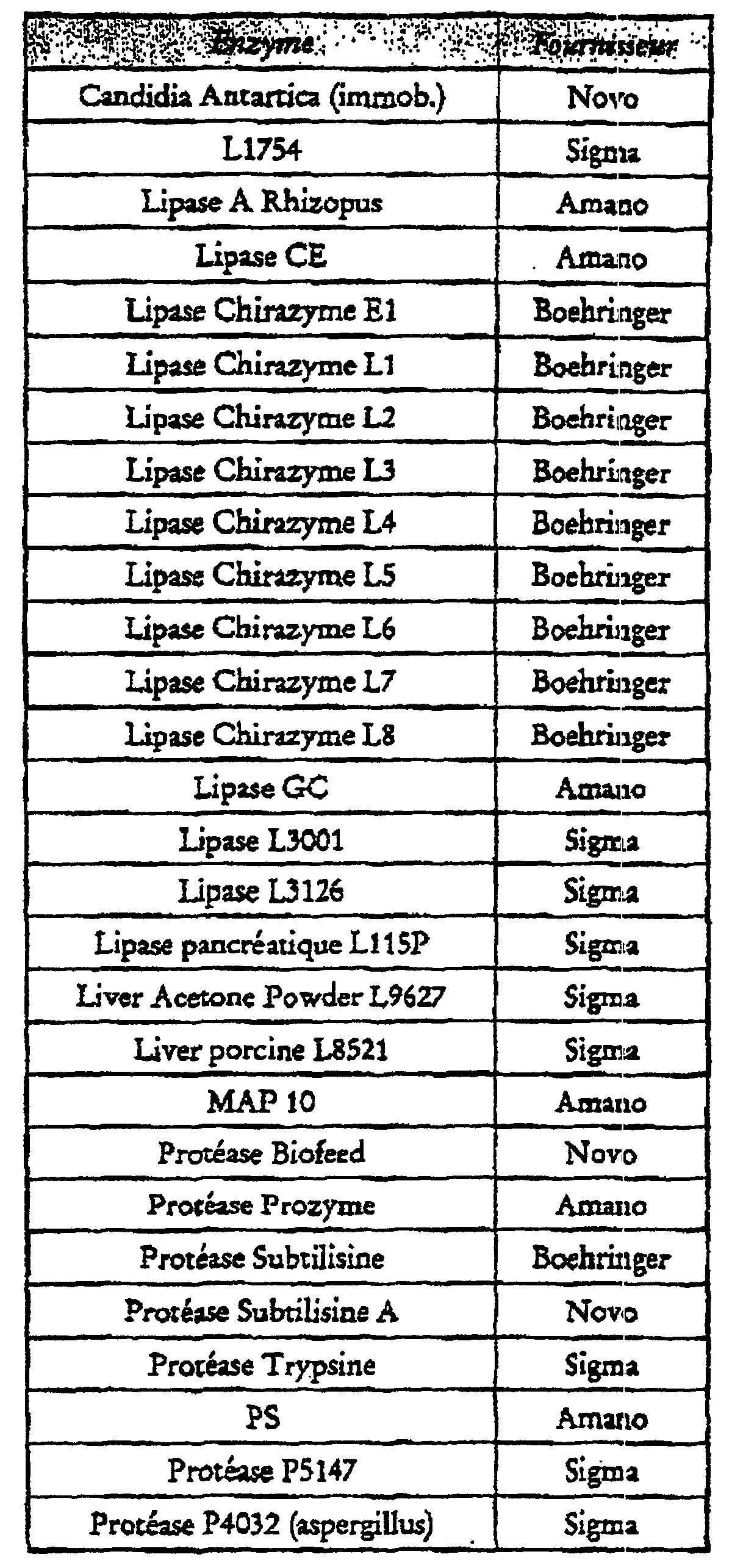
- the enzymes suitable for the process of the invention are more particularly chosen from the following enzymes available on the market:
- proteases we will prefer aspergillus proteases (like Prozyme from Amano or the protease P4032 from Sigma), the Subtilisin from Boehringer or from Novo, the Biofeed from Novo and trypsin.
- lipases are more particularly preferred.
- Chirazyme L2, L5, L7 and E1 from Boehringer.
- an aspergillus protease or a pig lipase or esterase that are specific for either of the two enantiomeric forms.
- Aspergillus proteases specifically lead to the S isomer of formula (I) defined above and among these a protease which is very particularly preferred in the process of the invention is Prozyme from the company Amano.
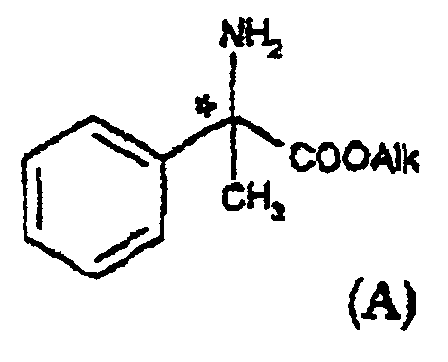
- the enantiomeric enrichment process according to the invention therefore consists in bringing a mixture of esters of formula (A) defined above into contact with a catalytic amount of enzyme, chosen from the proteases if it is desired to obtain the S enantiomer of formula (I) defined above, or chosen from lipases or esterases if it is desired to obtain the R enantiomer of formula (II) defined above.
- This reaction can be carried out under various and varied conditions which are well known to those skilled in the art, specialist in biocatalytic reactions, and known especially in the literature, including in the "Chemical Abstracts" and the bases of computer data.
- the process is carried out in a medium having a pH understood between 5 and 10.
- the reaction takes place at the optimum pH defined by the supplier of the enzyme.
- the reaction is carried out at a temperature generally between 4 ° C. and 70 ° C.
- the temperature is the optimal temperature defined by the supplier of the enzyme.
- the duration of the reaction has a direct impact on the conversion rate and is generally between 1 and 120 hours, more preferably between 10 and 60 hours, depending on the reaction temperature and the nature of the enzyme used.
- the method according to the invention can be implemented in the presence or in the absence of water, in the presence or absence of one or more solvents or in the presence of water and a or more solvents.
- these solvents are compatible with the enzymatic activity and are chosen from those which dissolve the ester of formula (A).
- these solvents are chosen among aromatic solvents. Even more preferably, the solvents are by for example toluene or monochlorobenzene.
- the process described above is generally carried out with the enzyme and the mixture of enantiomers being in homogeneous or heterogeneous phase.
- esters of formula (I) and (II) defined above obtained according to the method of the invention find a particularly interesting application as as synthetic intermediates in the development of useful chiral active ingredients especially in therapy or in agriculture.
- the process for preparing the compounds of formula (F) can be represented for example by the following scheme: scheme in which the radicals Alk, R 1 , R 2 , R 3 , R 4 , R 5 , M, p and W are as defined above, R represents a hydroxy, alkoxy radical containing from 1 to 6 carbon atoms, benzyloxy, an amino, alkylamino or dialkylamino radical, an alkylamino radical containing from 1 to 6 carbon atoms, and X represents a leaving group such as a halogen atom, chosen from chlorine, bromine and iodine, or a sulphate radical, or alkylsulfonyloxy or arylsulfonyloxy.
- Magnetically stirred weighing tubes are loaded successively 250 mg of aspergillus protease (Amano Prozyme 6) and 5 ml of phosphate buffer 100 mM containing 50 mM of a racemic mixture of methyl esters of the ⁇ -phenylalanine.
- Example Enzyme Configuration of the residual ester Enantiomeric excess 2 Subtilisin (Boehringer) S 79.5 3 Subtilisin a (Novo) S 80.5 4 Protease P4032 S 100 5 E1 esterase (Boehringer) R 71
Landscapes
- Chemical & Material Sciences (AREA)
- Organic Chemistry (AREA)
- Life Sciences & Earth Sciences (AREA)
- Engineering & Computer Science (AREA)
- Wood Science & Technology (AREA)
- Zoology (AREA)
- Health & Medical Sciences (AREA)
- Chemical Kinetics & Catalysis (AREA)
- General Chemical & Material Sciences (AREA)
- General Health & Medical Sciences (AREA)
- General Engineering & Computer Science (AREA)
- Bioinformatics & Cheminformatics (AREA)
- Biochemistry (AREA)
- Microbiology (AREA)
- Genetics & Genomics (AREA)
- Biotechnology (AREA)
- Analytical Chemistry (AREA)
- Nuclear Medicine, Radiotherapy & Molecular Imaging (AREA)
- Veterinary Medicine (AREA)
- Public Health (AREA)
- Animal Behavior & Ethology (AREA)
- Pharmacology & Pharmacy (AREA)
- Medicinal Chemistry (AREA)
- Oncology (AREA)
- Communicable Diseases (AREA)
- Preparation Of Compounds By Using Micro-Organisms (AREA)
- Organic Low-Molecular-Weight Compounds And Preparation Thereof (AREA)
- Pharmaceuticals Containing Other Organic And Inorganic Compounds (AREA)
- Steroid Compounds (AREA)
- Physical Or Chemical Processes And Apparatus (AREA)
Description
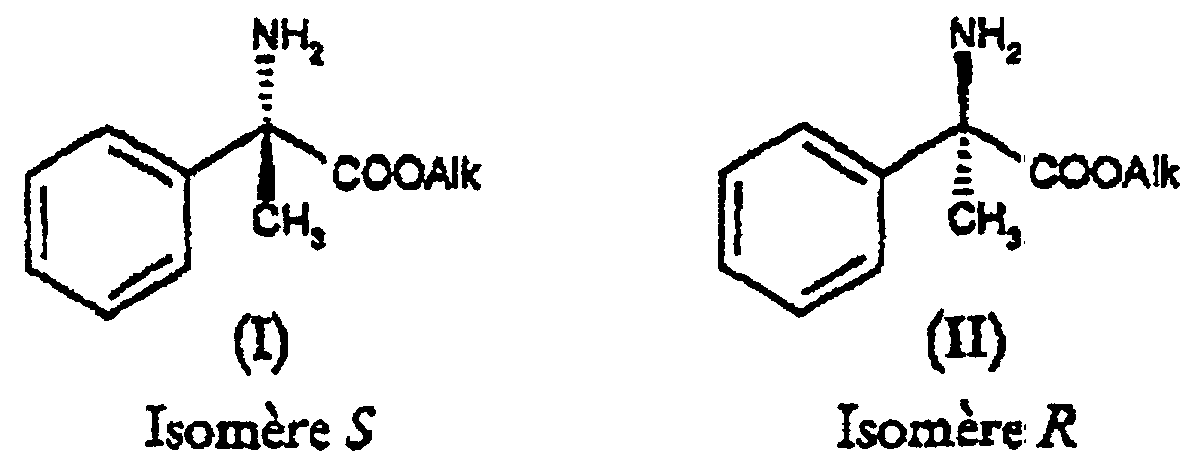
procédé caractérisé en ce que l'on met en présence un mélange d'énantiomères d'asters de l'α-phénylalanine avec une lipase, une estérase ou une protéase, sous forme libre, absorbée ou immobilisée, à l'exception de l'enzeyme PLE (Pig Liver Esterase).

- W représente un atome d'oxygène ou de soufre, ou un groupe S=O ;
- M représente un atome d'oxygène ou de soufre, ou un radical CH2, éventuellement halogéné ;
- p est un nombre entier égal à 0 ou 1 ;
- R3 représente :
- un hydrogène ou un radical C1-C2 alkyle éventuellement halogéné, lorsque p égale 0 ou (M)p est un radical CH2,
- un radical C1-C2 alkyle éventuellement halogéné, lorsque (M)p représente un atome d'oxygène ou de soufre ;
- R4 représente :
- l'atome d'hydrogène, ou
- un radical alkyle contenant de 1 à 6 atomes de carbone, ou
- un radical alkoxyalkyle, alkylthioalkyle, haloalkyle, cyanoalkyle, thiocyanatoalkyle, alcényle ou alcynyle contenant de 2 à 6 atomes de carbone, ou
- un radical dialkylaminoalkyle, alkoxycarbonylalkyle, ou N-alkylcarbamoylalkyle contenant de 3 à 6 atomes de carbone, ou
- un radical N,N-dialkylcarbamoylalkyle contenant de 4 à 8 atomes de carbone, ou
- un radical aryle, comprenant phényle, naphtyle, thiényle, furyle, pyridyle, pyrimidyle, pyridazinyle, pyrazinyle, benzothiényle, benzofuryle, quinolinyle, isoquinolinyle, ou méthylène dioxyphényle, éventuellement substitué par 1 à 3 groupements choisis parmi R6, ou
- un radical arylalkyle, aryloxyalkyle, arylthioalkyle ou arylsulfonylalkyle, les termes aryle et alkyle ayant les définitions données ci-dessus ;
- R5 représente :
- l'hydrogène, ou un radical alkyle, haloalkyle, alkylsulfonyle, haloalkylsulfonyle contenant de 1 à 6 atomes de carbone ou,
- un radical alkoxyalkyle, alkylthioakyle, acyle, alcényle, alcynyle, haloacyle, alkoxycarbonyle, haloalkoxycarbonyle, alkoxyalkylsulfonyle, cyanoalkylsulfonyle contenant de 2 à 6 atomes de carbone ou
- un radical alkoxyalkoxycarbonyle, alkylthioalkoxycarbonyle, cyanoalkoxycarbonyle contenant de 3 à 6 atomes de carbone ou,
- le radical formyle ou un radical cycloalkyle, alkoxyacyle, alkylthioacyle, cyanoacyle, alcénylcarbonyle, alcynylcarbonyle contenant de 3 à 6 atomes de carbone ou,
- un radical cycloalkylcarbonyle contenant de 4 à 8 atomes de carbone ou,
- un radical phényle; arylalkylcarbonyle, notamment phénylacétyle et phénylpropionyle, arylcarbonyle, notamment benzoyle, éventuellement substitué par 1 à 3 groupes parmi R6, thiénylcarbonyle, furylcarbonyle, pyridylcarbonyle, benzyloxycarbonyle, furfuryloxycarbonyle, tetrahydrofurfuryloxycarbonyle, thiénylméthoxycarbonyle, pyridylméthoxycarbonyle, phénoxycarbonyle ou phénylthiolcarbonyle, le radical phényle étant lui-même éventuellement substitué par 1 à 3 groupement choisis parmi R6, alkylthiolcarbonyle, haloalkylthiolcarbonyle, alkoxyalkylthiolcarbonyle, cyanoalkylthiolcarbonyle, benzylthiolcarbonyle, furfurylthiolcarbonyle, tétrahydrofurfurylthiolcarbonyle, thiénylméthylthiolcarbonyle, pyridylméthylthiolcarbonyle, ou arylsulfonyle ou
- un radical carbamoyle éventuellement mono ou disubstitué par :
- un groupe alkyle ou haloalkyle contenant de 1 à 6 atomes de carbone,
- un groupe cycloalkyle, alcényle ou alcynyle contenant de 3 à 6 atomes de carbone,
- un groupe alkoxyalkyle, alkylthioalkyle ou cyanoalkyle contenant de 2 à 6 atomes de carbone ou,
- un phényle éventuellement substitué par 1 à 3 groupement R6 ;
- un groupement sulfamoyle éventuellement mono ou disubstitué par :
- un groupe alkyle ou haloalkyle contenant de 1 à 6 atomes de carbone,
- un groupe cycloalkyle, alcényle ou alcynyle contenant de 3 à 6 atomes de carbone,
- un groupe alkoxyalkyle, alkylthioalkyle ou cyanoalkyle de 2 à 6 atomes de carbone ou
- un phényle éventuellement substitué par 1 à 3 groupement R6 ;
- un groupe alkylthioalkylsulfonyle contenant de 3 à 8 atomes de carbone ou cycloalkylsulfonyle contenant de 3 à 7 atomes de carbone ;
- R4 et R5 pris ensemble peuvent également former avec l'atome d'azote auquel ils sont attachés un groupe pyrrolidino, pipéridino, morpholino ou pipérazino éventuellement substitué par un radical alkyle contenant de 1 à 3 atomes de carbone.
- R6 représente :
- un atome d'halogène ou
- un radical alkyle, haloalkyle, alkoxy, haloalkoxy, alkylthio, haloalkylthio ou alkylsulfonyle contenant de 1 à 6 atomes de carbone ou
- un radical cycloalkyle, halocycloalkyle, alcényloxy, alcynyloxy, alcénylthio, alcynylthio contenant de 3 à 6 atomes de carbone ou
- le groupe nitro ou cyano ou
- un radical amino éventuellement mono ou disubstitué par un radical alkyle ou acyle contenant de 1 à 6 atomes de carbone ou alkoxycarbonyle contenant de 2 à 6 atomes de carbone,
- un radical phényle, phénoxy ou pyridyloxy, ces radicaux étant éventuellement substitués par 1 à 3 groupements, identiques ou différents, choisis parmi R7,
- R7 représente :
- un atome d'halogène choisi parmi le fluor, le chlore, le brome, l'iode ou,
- un radical alkyle contenant de 1 à 6 atomes de carbone, ou
- un radical alkoxy ou alkylthio contenant de 1 à 6 atomes de carbone ou,
- un radical haloalkoxy ou haloalkylthio contenant de 1 à 6 atomes de carbone ou,
- un radical nitrile ou nitro ;
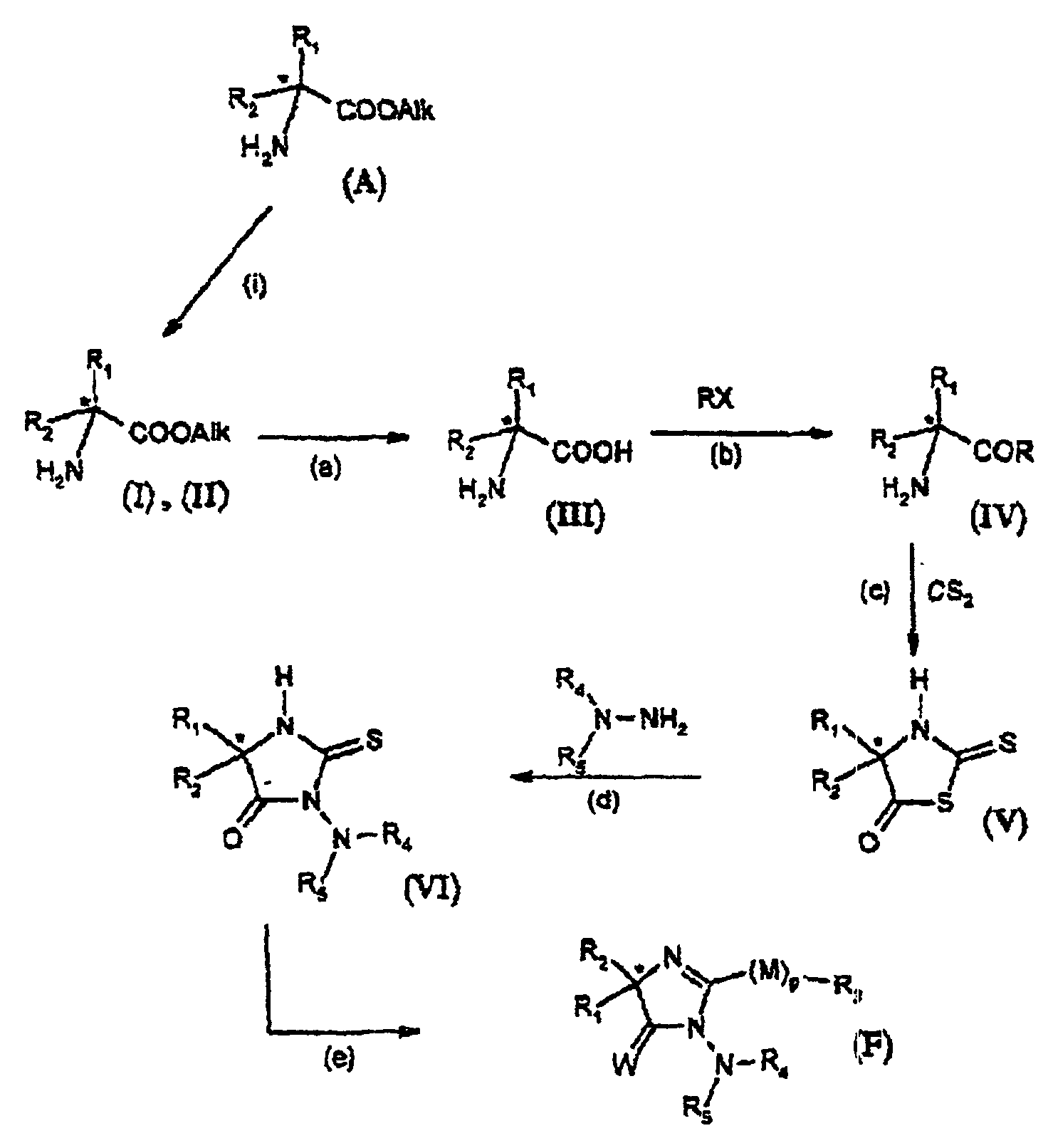
- l'étape (i) est le procédé de la présente invention et est exemplifié dans la suite de la présente description ;
- l'étape (a) est une étape classique de saponification ;
- l'étape (b) est une réaction d'estérification classique ;
- l'étape (c) est une réaction de cyclisation réalisée par addition de sulfure de carbone, en milieu basique et connue de l'homme du métier et décrite par exemple dans la demande de brevet internationale WO98/03490 ;
- l'étape (d) est réalisée par addition d'une amine de formule N(R4R5)-NH2, en présence d'un catalyseur (amine tertiaire par exemple), comme décrit par exemple dans la demande de brevet internationale WO98/03490 ;
- l'étape (c) est finalement réalisée par addition d'un composé de formule R3-X, pour conduire au composé -S-R3 correspondant, puis éventuellement oxydé, selon des techniques classiques pour conduire aux différents degrés d'oxydation de l'atome de soufre, ou encore traité par un composé de formule R3-OH pour conduire au composé -O-R3 correspondant. Ces différentes réactions sont bien connues de l'homme du métier et sont par exemple décrites dans la demande de brevet EP-A-0 629 616.
| Exemple | Enzyme | Configuration de l'ester résiduel | Excès énantiomérique |
| 2 | Subtilisine (Boehringer) | S | 79,5 |
| 3 | Subtilisine a (Novo) | S | 80,5 |
| 4 | Protéase P4032 | S | 100 |
| 5 | Estérase E1 (Boehringer) | R | 71 |
Claims (26)
- Procédé de préparation d'esters de l'α-phénylalanine substantiellement énantiomériquement purs de formules (I) et (II) :dans lesquelles Alk représente un radical alkyle linéaire ou ramifié comportant de 1 à 6 atomes de carbone, caractérisé en ce que l'on met en présence un mélange d'énantiomères d'esters de l'α-phénylalanine avec un enzyme qui est une lipase, une protéase ou une estérase, à l'exception de l'enzeyme PLE (Pig Liver Esterase).

- Procédé selon la revendication 1 dans lequel "Alk" représente le radical méthyle.
- Procédé selon la revendication 1 dans lequel "Alk" représente le radical éthyle.
- Procédé selon l'une des revendications 1 à 3 caractérisé en ce que l'ester substantiellement énantiomériquement pur est de configuration S et l'enzyme utilisé est une protéase.
- Procédé selon la revendication 4 dans lequel la protéase est choisie parmi le Biofeed, la Prozyme, la Subtilisine, la Subtilisine A, la Trypsine, la protéase PS, P5147 et P4032.
- Procédé selon l'une des revendications 4 ou 5 dans lequel la protéase est une protéase d'aspergillus, Prozyme ou protéase P4032, ou la subtilisine ou le Biofeed ou la trypsine.
- Procédé selon l'une des revendications 4 à 6 dans lequel la protéase est la Prozyme.
- Procédé selon l'une des revendications 1 à 3 caractérisé en ce que l'ester substantiellement énantiomériquement pur est de configuration R et l'enzyme utilisé est une lipase ou une estérase, à l'exception de l'enzeyme PLE (Pig Liver Esterase).
- Procédé selon la revendication 8 dans lequel la lipase ou l'estérase est choisie parmi la lipase A Rhizopus, la lipase CE, la Chirazyme E1, Chirazyme L1, Chirazyme L2, Chirazyme L3, Chirazyme L4, Chirazyme L5, Chirazyme L6, Chirazyme L7, Chirazyme L8, la lipase GC, L3001, L3126, et la lipase pancréatique L115P.
- Procédé selon l'une des revendications 8 ou 9 dans lequel la lipase ou l'estérase est choisie parmi la Chirazyme L2, L5, L7 et E1.
- Procédé selon l'une quelconque des revendications 1 à 10 dans lequel l'énantiomère substantiellement pur est obtenu avec un excès énantiomérique supérieur à 80%.
- Procédé selon l'une des revendications 1 à 11 dans lequel l'excès énantiomérique est supérieur à 90%.
- Procédé selon l'une des revendications 1 à 12 dans lequel l'enzyme utilisé est non purifié, ou partiellement ou totalement purifié.
- Procédé selon l'une des revendications 1 à 13, caractérisé en ce que le milieu réactionnel est en phase homogène.
- Procédé selon l'une des revendications 1 à 13, caractérisé en ce que le milieu réactionnel est en phase hétérogène.
- Procédé selon l'une des revendication 1 à 15 dans lequel l'enzyme est libre dans le milieu réactionnel.
- Procédé selon l'une des revendications 1 à 15 dans lequel l'enzyme est immobilisé sur support.
- Procédé selon l'une des revendications 1 à 17 caractérisé en ce que le milieu réactionnel a un pH compris entre 5 et 10.
- Procédé selon l'une des revendications 1 à 18 caractérisé en ce que la température réactionnelle est comprise entre 4°C et 70°C.
- Procédé selon l'une des revendications 1 à 19 caractérisé en ce que le temps de réaction est compris entre 1 heure et 120 heures.
- Procédé selon l'une des revendications 1 à 20 caractérisé en ce que le temps de réaction est compris entre 10 heures et 60 heures.
- Procédé selon l'une des revendications 1 à 21 caractérisé en ce que le milieu réactionnel comprend un ou plusieurs solvants aromatiques.
- Procédé selon la revendication 22 dans lequel le solvant est le toluène ou le monochlorobenzène.
- Utilisation d'un enzyme totalement ou partiellement purifié de type protéase pour l'obtention de l'énantiomère S de l'ester de formule (I) selon la revendication 1.
- Utilisation de la protéase Prozyme pour l'obtention de l'énantiomère S de l'ester de formule (I) selon la revendication 1.
- Procédé de préparation des composés de formule (F) selon le schéma réactionnel suivant :schéma dans lequel :
 schéma dans lequel :R1 représente le radical phényle et R2 représente le radical méthyle ;W représente un atome d'oxygène ou de soufre, ou un groupe S=O ;M représente un atome d'oxygène ou de soufre, ou un radical CH2, éventuellement halogéné ;p est un nombre entier égal à 0 ou 1 ;R3 représente :un hydrogène ou un radical C1-C2 alkyle éventuellement halogéné, lorsque p égale 0 ou (M)p est un radical CH2,un radical C1-C2 alkyle éventuellement halogéné, lorsque (M)p représente un atome d'oxygène ou de soufre ;représente :l'atome d'hydrogène, ouun radical alkyle contenant de 1 à 6 atomes de carbone, ouun radical alkoxyalkyle, alkylthioalkyle, haloalkyle, cyanoalkyle, thiocyanatoalkyle, alcényle ou alcynyle contenant de 2 à 6 atomes de carbone, ouun radical dialkylaminoalkyle, alkoxycarbonylalkyle, ou N-alkylcarbamoylalkyle contenant de 3 à 6 atomes de carbone, ouun radical N,N-dialkylcarbamoylalkyle contenant de 4 à 8 atomes de carbone, ouun radical aryle, comprenant phényle, naphtyle, thiényle, furyle, pyridyle, pyrimidyle, pyridazinyle, pyrazinyle, benzothiényle, benzofuryle, quinolinyle, isoquinolinyle, ou méthylène dioxyphényle, éventuellement substitué par 1 à 3 groupements choisis parmi R6, ouun radical arylalkyle, aryloxyalkyle, arylthioalkyle ou arylsulfonylalkyle, les termes aryle et alkyle ayant les définitions données ci-dessus ;R5 représente :l'hydrogène, ou un radical alkyle, haloalkyle, alkylsulfonyle, haloalkylsulfonyle contenant de 1 à 6 atomes de carbone ou,un radical alkoxyalkyle, alkylthioakyle, acyle, alcényle, alcynyle, haloacyle, alkoxycarbonyle, haloalkoxycarbonyle, alkoxyalkylsulfonyle, cyanoalkylsulfonyle contenant de 2 à 6 atomes de carbone ouun radical alkoxyalkoxycarbonyle, alkylthioalkoxycarbonyle, cyanoalkoxycarbonyle contenant de 3 à 6 atomes de carbone ou,le radical formyle ou un radical cycloalkyle, alkoxyacyle, alkylthioacyle, cyanoacyle, alcénylcarbonyle, alcynylcarbonyle contenant de 3 à 6 atomes de carbone ou,un radical cycloalkylcarbonyle contenant de 4 à 8 atomes de carbone ou,un radical phényle; arylalkylcarbonyle, notamment phénylacétyle et phénylpropionyle, arylcarbonyle, notamment benzoyle, éventuellement substitué par 1 à 3 groupes parmi R6, thiénylcarbonyle, furylcarbonyle, pyridylcarbonyle, benzyloxycarbonyle, furfuryloxycarbonyle, tetrahydrofurfuryloxycarbonyle, thiénylméthoxycarbonyle, pyridylméthoxycarbonyle, phénoxycarbonyle ou phénylthiolcarbonyle, le radical phényle étant lui-même éventuellement substitué par 1 à 3 groupement choisis parmi R6, alkylthiolcarbonyle, haloalkylthiolcarbonyle, alkoxyalkylthiolcarbonyle, cyanoalkylthiolcarbonyle, benzylthiolcarbonyle, furfurylthiolcarbonyle, tétrahydrofurfurylthiolcarbonyle, thiénylméthylthiolcarbonyle, pyridylméthylthiolcarbonyle, ou arylsulfonyle ouun radical carbamoyle éventuellement mono ou disubstitué par :un groupe alkyle ou haloalkyle contenant de 1 à 6 atomes de carbone,un groupe cycloalkyle, alcényle ou alcynyle contenant de 3 à 6 atomes de carbone,un groupe alkoxyalkyle, alkylthioalkyle ou cyanoalkyle contenant de 2 à 6 atomes de carbone ou,un phényle éventuellement substitué par 1 à 3 groupement R6;un groupement sulfamoyle éventuellement mono ou disubstitué par :un groupe alkyle ou haloalkyle contenant de 1 à 6 atomes de carbone,un groupe cycloalkyle, alcényle ou alcynyle contenant de 3 à 6 atomes de carbone,un groupe alkoxyalkyle, alkylthioalkyle ou cyanoalkyle de 2 à 6 atomes de carbone ouun phényle éventuellement substitué par 1 à 3 groupement R6 ;un groupe alkylthioalkylsulfonyle contenant de 3 à 8 atomes de carbone ou cycloalkylsulfonyle contenant de 3 à 7 atomes de carbone ;R4 et R5 pris ensemble peuvent également former avec l'atome d'azote auquel ils sont attachés un groupe pyrrolidino, pipéridino, morpholino ou pipérazino éventuellement substitué par un radical alkyle contenant de 1 à 3 atomes de carbone.R6 représente :un atome d'halogène ouun radical alkyle, haloalkyle, alkoxy, haloalkoxy, alkylthio, haloalkylthio ou alkylsulfonyle contenant de 1 à 6 atomes de carbone ouun radical cycloalkyle, halocycloalkyle, alcényloxy, alcynyloxy, alcénylthio, alcynylthio contenant de 3 à 6 atomes de carbone oule groupe nitro ou cyano ouun radical amino éventuellement mono ou disubstitué par un radical alkyle ou acyle contenant de 1 à 6 atomes de carbone ou alkoxycarbonyle contenant de 2 à 6 atomes de carbone,un radical phényle, phénoxy ou pyridyloxy, ces radicaux étant éventuellement substitués par 1 à 3 groupements, identiques ou différents, choisis parmi R7,R7 représente :un atome d'halogène choisi parmi le fluor, le chlore, le brome, l'iode ou,un radical alkyle contenant de 1 à 6 atomes de carbone, ouun radical alkoxy ou alkylthio contenant de 1 à 6 atomes de carbone ou,un radical haloalkoxy ou haloalkylthio contenant de 1 à 6 atomes de carbone ou,un radical nitrile ou nitro ;R représente un radical hydroxy, alkoxy contenant de 1 à 6 atomes de carbone, benzyloxy, un radical amino, alkylamino ou dialkylamino, un radical alkylamino contenant de 1 à 6 atomes de carbone ;X représence un groupement partant tel qu'un atome d'halogène, choisi parmi chlore, brome et iode, ou un radical sulfate, ou alkylsulfonyloxy ou arylsulfonyloxy, etAlk est tel que défini dans la revendication 1,l'étape (i) est le procédé de préparation d'esters de l'α-phénylalanine substantiellement énantiomériquement purs de formules (I) et (II) selon l'une quelconque des revendications précédentes;l'étape (a) est une étape classique de saponification ;l'étape (b) est une réaction d'estérification classique ;l'étape (c) est une réaction de cyclisation réalisée par addition de sulfure de carbone, en milieu basique et connue de l'homme du métier ;l'étape (d) est réalisée par addition d'une amine de formule N(R4R5)-NH2, en présence d'un catalyseur ;l'étape (e) est finalement réalisée par addition d'un composé de formule R3-X, pour conduire au composé -S-R3 correspondant, puis éventuellement oxydé, selon des techniques classiques pour conduire aux différents degrés d'oxydation de l'atome de soufre, ou encore traité par un composé de formule R3-OH pour conduire au composé -O-R3 correspondant.
Applications Claiming Priority (3)
| Application Number | Priority Date | Filing Date | Title |
|---|---|---|---|
| FR9806339A FR2778671B1 (fr) | 1998-05-14 | 1998-05-14 | Nouveau procede de preparation d'intermediaires de synthese |
| FR9806339 | 1998-05-14 | ||
| PCT/FR1999/001098 WO1999058706A1 (fr) | 1998-05-14 | 1999-05-10 | Nouveau procede de preparation d'intermediaires de synthese |
Publications (2)
| Publication Number | Publication Date |
|---|---|
| EP1076718A1 EP1076718A1 (fr) | 2001-02-21 |
| EP1076718B1 true EP1076718B1 (fr) | 2002-05-02 |
Family
ID=9526525
Family Applications (1)
| Application Number | Title | Priority Date | Filing Date |
|---|---|---|---|
| EP99918034A Expired - Lifetime EP1076718B1 (fr) | 1998-05-14 | 1999-05-10 | Nouveau procede de preparation d'intermediaires de synthese |
Country Status (17)
| Country | Link |
|---|---|
| US (1) | US6551816B1 (fr) |
| EP (1) | EP1076718B1 (fr) |
| JP (1) | JP4553485B2 (fr) |
| KR (1) | KR100576276B1 (fr) |
| CN (1) | CN1196795C (fr) |
| AT (1) | ATE217025T1 (fr) |
| AU (1) | AU3610299A (fr) |
| BR (1) | BR9910677A (fr) |
| CA (1) | CA2337269C (fr) |
| DE (1) | DE69901388T2 (fr) |
| DK (1) | DK1076718T3 (fr) |
| ES (1) | ES2175966T3 (fr) |
| FR (1) | FR2778671B1 (fr) |
| HU (1) | HU228080B1 (fr) |
| IL (1) | IL139600A0 (fr) |
| PT (1) | PT1076718E (fr) |
| WO (1) | WO1999058706A1 (fr) |
Families Citing this family (9)
| Publication number | Priority date | Publication date | Assignee | Title |
|---|---|---|---|---|
| US6759551B1 (en) | 2000-11-03 | 2004-07-06 | Bayer Cropscience S.A. | Chiral (s- or r-methylphenylglycine) amino acid crystal and method for preparing same |
| EP1483283A4 (fr) | 2002-03-13 | 2007-04-11 | Signum Biosciences Inc | Modulation de la methylation de proteines et du phosphate des phosphoproteines |
| US7923041B2 (en) | 2005-02-03 | 2011-04-12 | Signum Biosciences, Inc. | Compositions and methods for enhancing cognitive function |
| CA2601777A1 (fr) * | 2005-02-03 | 2006-08-10 | Signum Biosciences, Inc. | Compositions et procedes pour l'amelioration de la fonction cognitive |
| JP2008260755A (ja) * | 2007-03-20 | 2008-10-30 | Sumitomo Chemical Co Ltd | L−ビフェニルアラニン化合物の塩の回収方法、およびそれを用いたビフェニルアラニンエステル化合物の回収方法 |
| AU2009239430B2 (en) | 2008-04-21 | 2015-01-22 | Signum Biosciences, Inc. | Compounds, compositions and methods for making the same |
| CN101555211B (zh) * | 2009-05-13 | 2012-01-25 | 浙江九洲药业股份有限公司 | 2-酰基氨基-3-联苯基丙酸的化学合成方法 |
| CN102321690B (zh) * | 2011-07-27 | 2012-07-18 | 陆宏国 | 一种酯类手性胺化合物的制备方法 |
| WO2025262708A1 (fr) * | 2024-06-21 | 2025-12-26 | Council Of Scientific And Industrial Research | RÉSOLUTION CINÉTIQUE DYNAMIQUE ENZYMATIQUE D'ESTERS D'ACIDE α-AMINÉ DANS DES MINIÉMULSIONS |
Family Cites Families (5)
| Publication number | Priority date | Publication date | Assignee | Title |
|---|---|---|---|---|
| DE3438189A1 (de) * | 1984-10-18 | 1986-04-24 | Hoechst Ag, 6230 Frankfurt | Verfahren zur herstellung aromatisch substituierter l-aminosaeuren |
| FR2706456B1 (fr) | 1993-06-18 | 1996-06-28 | Rhone Poulenc Agrochimie | Dérivés optiquement actifs de 2-imidazoline-5-ones et 2-imidazoline-5-thiones fongicides. |
| US5552318A (en) * | 1995-05-26 | 1996-09-03 | Industrial Technology Research Institute | Method for preparing optically active amino acids and their esters using wheat germ lipase |
| US5552317A (en) * | 1995-05-26 | 1996-09-03 | Industrial Technology Research Institute | Method for preparing optically active homophenylalanine and esters thereof using lipase from wheat germ or Candida lipolytica |
| FR2751327A1 (fr) * | 1996-07-22 | 1998-01-23 | Rhone Poulenc Agrochimie | Intermediaires pour la preparation de 2-imidazoline-5-ones |
-
1998
- 1998-05-14 FR FR9806339A patent/FR2778671B1/fr not_active Expired - Fee Related
-
1999
- 1999-05-10 AU AU36102/99A patent/AU3610299A/en not_active Abandoned
- 1999-05-10 JP JP2000548497A patent/JP4553485B2/ja not_active Expired - Lifetime
- 1999-05-10 WO PCT/FR1999/001098 patent/WO1999058706A1/fr not_active Ceased
- 1999-05-10 US US09/700,379 patent/US6551816B1/en not_active Expired - Lifetime
- 1999-05-10 ES ES99918034T patent/ES2175966T3/es not_active Expired - Lifetime
- 1999-05-10 IL IL13960099A patent/IL139600A0/xx not_active IP Right Cessation
- 1999-05-10 CA CA002337269A patent/CA2337269C/fr not_active Expired - Fee Related
- 1999-05-10 CN CNB998075256A patent/CN1196795C/zh not_active Expired - Lifetime
- 1999-05-10 EP EP99918034A patent/EP1076718B1/fr not_active Expired - Lifetime
- 1999-05-10 DE DE69901388T patent/DE69901388T2/de not_active Expired - Lifetime
- 1999-05-10 HU HU0102348A patent/HU228080B1/hu unknown
- 1999-05-10 AT AT99918034T patent/ATE217025T1/de active
- 1999-05-10 PT PT99918034T patent/PT1076718E/pt unknown
- 1999-05-10 BR BR9910677-9A patent/BR9910677A/pt not_active Application Discontinuation
- 1999-05-10 DK DK99918034T patent/DK1076718T3/da active
- 1999-05-10 KR KR1020007012766A patent/KR100576276B1/ko not_active Expired - Lifetime
Also Published As
| Publication number | Publication date |
|---|---|
| CN1348500A (zh) | 2002-05-08 |
| ES2175966T3 (es) | 2002-11-16 |
| KR20010025022A (ko) | 2001-03-26 |
| PT1076718E (pt) | 2002-09-30 |
| DE69901388T2 (de) | 2002-08-29 |
| JP2002514436A (ja) | 2002-05-21 |
| ATE217025T1 (de) | 2002-05-15 |
| AU3610299A (en) | 1999-11-29 |
| BR9910677A (pt) | 2001-11-20 |
| CN1196795C (zh) | 2005-04-13 |
| HUP0102348A2 (hu) | 2001-10-28 |
| CA2337269A1 (fr) | 1999-11-18 |
| US6551816B1 (en) | 2003-04-22 |
| DK1076718T3 (da) | 2002-08-12 |
| JP4553485B2 (ja) | 2010-09-29 |
| CA2337269C (fr) | 2007-04-10 |
| IL139600A0 (en) | 2002-02-10 |
| FR2778671A1 (fr) | 1999-11-19 |
| WO1999058706A1 (fr) | 1999-11-18 |
| DE69901388D1 (de) | 2002-06-06 |
| HUP0102348A3 (en) | 2006-03-28 |
| KR100576276B1 (ko) | 2006-05-04 |
| HU228080B1 (en) | 2012-10-29 |
| FR2778671B1 (fr) | 2002-07-05 |
| EP1076718A1 (fr) | 2001-02-21 |
Similar Documents
| Publication | Publication Date | Title |
|---|---|---|
| Martinez et al. | Development of a chemoenzymatic manufacturing process for pregabalin | |
| Gutman et al. | Enzymatic resolution of racemic amines in a continuous reactor in organic solvents | |
| JPH09503658A (ja) | 酵素触媒作用アシル化による1級及び2級アミンのラセミ分割 | |
| EP1076718B1 (fr) | Nouveau procede de preparation d'intermediaires de synthese | |
| EP0498706B2 (fr) | Procédé de préparation du (-)-(2R,3S)-2,3-époxy-3-(4-méthoxyphényl)propionate de méthyle | |
| EP1206452B1 (fr) | Procede de preparation de composes benzoperhydroisoindole | |
| KR100654587B1 (ko) | 효소를 이용한 (r)- 또는(s)-n-(2,6-디메틸페닐)알라닌과 그것의 대응 에스테르화합물의 입체이성질체의 제조방법 | |
| FR2662178A1 (fr) | Procede de preparation d'intermediaires utiles dans la synthese de benzothiazepines. | |
| CN1215434A (zh) | 立体选择性的制备治疗酰胺的酶催化方法 | |
| EP1140794B1 (fr) | Nouveau procede de preparation d'aminoacides chiraux | |
| JP2002514436A5 (fr) | ||
| JP2001161392A (ja) | ラセミ化触媒を使用するアミノ酸およびアミノ酸誘導体のエナンチオ選択的な製造方法 | |
| EP1427840B1 (fr) | Procede enzymatique pour la resolution enantiomerique d'acides amines | |
| EP1102744A1 (fr) | NOUVEAU PROCEDE DE PREPARATION D'$g(a)-AMINONITRILES OPTIQUEMENT ACTIFS | |
| JP2612671B2 (ja) | 光学活性なプロピオン酸エステルの製造法 | |
| CA2389373A1 (fr) | Cristal d'acide amine (s- ou r-methylphenylglycine) chiral et son procede de preparation | |
| Parker | Dynamic kinetic resolution of [alpha]-substituted carboxylic acid derivatives | |
| JPH09191892A (ja) | 含硫黄光学活性アルコールの製造法 | |
| EP1650187A1 (fr) | Derive d'acide carboxylique 2-allyle optiquement actif et son procede de production | |
| CN101589152A (zh) | 用于生产含氟α-羟基羧酸的方法 | |
| JP2006197929A (ja) | 光学活性なプロパギルアルコールの製造方法 |
Legal Events
| Date | Code | Title | Description |
|---|---|---|---|
| PUAI | Public reference made under article 153(3) epc to a published international application that has entered the european phase |
Free format text: ORIGINAL CODE: 0009012 |
|
| 17P | Request for examination filed |
Effective date: 20001030 |
|
| AK | Designated contracting states |
Kind code of ref document: A1 Designated state(s): AT BE CH DE DK ES FI FR GB GR IE IT LI LU NL PT SE |
|
| GRAG | Despatch of communication of intention to grant |
Free format text: ORIGINAL CODE: EPIDOS AGRA |
|
| 17Q | First examination report despatched |
Effective date: 20010629 |
|
| GRAG | Despatch of communication of intention to grant |
Free format text: ORIGINAL CODE: EPIDOS AGRA |
|
| GRAH | Despatch of communication of intention to grant a patent |
Free format text: ORIGINAL CODE: EPIDOS IGRA |
|
| REG | Reference to a national code |
Ref country code: GB Ref legal event code: IF02 |
|
| GRAH | Despatch of communication of intention to grant a patent |
Free format text: ORIGINAL CODE: EPIDOS IGRA |
|
| GRAA | (expected) grant |
Free format text: ORIGINAL CODE: 0009210 |
|
| AK | Designated contracting states |
Kind code of ref document: B1 Designated state(s): AT BE CH DE DK ES FI FR GB GR IE IT LI LU NL PT SE |
|
| REF | Corresponds to: |
Ref document number: 217025 Country of ref document: AT Date of ref document: 20020515 Kind code of ref document: T |
|
| REG | Reference to a national code |
Ref country code: GB Ref legal event code: FG4D Free format text: NOT ENGLISH |
|
| REG | Reference to a national code |
Ref country code: CH Ref legal event code: EP |
|
| REG | Reference to a national code |
Ref country code: CH Ref legal event code: NV Representative=s name: MOINAS & SAVOYE SA |
|
| REF | Corresponds to: |
Ref document number: 69901388 Country of ref document: DE Date of ref document: 20020606 |
|
| REG | Reference to a national code |
Ref country code: IE Ref legal event code: FG4D Free format text: FRENCH |
|
| REG | Reference to a national code |
Ref country code: DK Ref legal event code: T3 |
|
| GBT | Gb: translation of ep patent filed (gb section 77(6)(a)/1977) |
Effective date: 20020720 |
|
| REG | Reference to a national code |
Ref country code: PT Ref legal event code: SC4A Free format text: AVAILABILITY OF NATIONAL TRANSLATION Effective date: 20020612 |
|
| REG | Reference to a national code |
Ref country code: GR Ref legal event code: EP Ref document number: 20020402505 Country of ref document: GR |
|
| REG | Reference to a national code |
Ref country code: ES Ref legal event code: FG2A Ref document number: 2175966 Country of ref document: ES Kind code of ref document: T3 |
|
| PLBE | No opposition filed within time limit |
Free format text: ORIGINAL CODE: 0009261 |
|
| STAA | Information on the status of an ep patent application or granted ep patent |
Free format text: STATUS: NO OPPOSITION FILED WITHIN TIME LIMIT |
|
| 26N | No opposition filed |
Effective date: 20030204 |
|
| PGFP | Annual fee paid to national office [announced via postgrant information from national office to epo] |
Ref country code: SE Payment date: 20090512 Year of fee payment: 11 Ref country code: LU Payment date: 20090616 Year of fee payment: 11 |
|
| PGFP | Annual fee paid to national office [announced via postgrant information from national office to epo] |
Ref country code: GR Payment date: 20090430 Year of fee payment: 11 |
|
| REG | Reference to a national code |
Ref country code: CH Ref legal event code: PUE Owner name: BAYER S.A.S. Free format text: AVENTIS CROPSCIENCE S.A.#14-20, RUE PIERRE-BAIZET#69009 LYON (FR) -TRANSFER TO- BAYER S.A.S.#16, RUE JEAN-MARIE LECLAIR#69009 LYON (FR) |
|
| REG | Reference to a national code |
Ref country code: NL Ref legal event code: TD Effective date: 20100531 |
|
| REG | Reference to a national code |
Ref country code: NL Ref legal event code: SD Effective date: 20100531 |
|
| REG | Reference to a national code |
Ref country code: CH Ref legal event code: NV Representative=s name: MOINAS & SAVOYE SA |
|
| REG | Reference to a national code |
Ref country code: GB Ref legal event code: 732E Free format text: REGISTERED BETWEEN 20100617 AND 20100623 |
|
| REG | Reference to a national code |
Ref country code: PT Ref legal event code: PC4A Owner name: BAYER SAS, FR Effective date: 20100623 |
|
| BECA | Be: change of holder's address |
Owner name: BAYER S.A.S.16, RUE JEAN-MARIE-LECLAIR, FR-69009 L Effective date: 20100804 |
|
| BECH | Be: change of holder |
Owner name: BAYER S.A.S.16, RUE JEAN-MARIE-LECLAIR, FR-69009 L Effective date: 20100804 |
|
| EUG | Se: european patent has lapsed | ||
| PG25 | Lapsed in a contracting state [announced via postgrant information from national office to epo] |
Ref country code: SE Free format text: LAPSE BECAUSE OF NON-PAYMENT OF DUE FEES Effective date: 20100511 Ref country code: GR Free format text: LAPSE BECAUSE OF NON-PAYMENT OF DUE FEES Effective date: 20101202 |
|
| REG | Reference to a national code |
Ref country code: ES Ref legal event code: PC2A Owner name: BAYER S.A.S. Effective date: 20110517 |
|
| PGFP | Annual fee paid to national office [announced via postgrant information from national office to epo] |
Ref country code: PT Payment date: 20110503 Year of fee payment: 13 Ref country code: IE Payment date: 20110517 Year of fee payment: 13 |
|
| PGFP | Annual fee paid to national office [announced via postgrant information from national office to epo] |
Ref country code: AT Payment date: 20110427 Year of fee payment: 13 |
|
| REG | Reference to a national code |
Ref country code: FR Ref legal event code: TP Owner name: BAYER SAS, FR Effective date: 20110921 Ref country code: FR Ref legal event code: CD Owner name: BAYER SAS, FR Effective date: 20110921 Ref country code: FR Ref legal event code: CA Effective date: 20110921 |
|
| PG25 | Lapsed in a contracting state [announced via postgrant information from national office to epo] |
Ref country code: LU Free format text: LAPSE BECAUSE OF NON-PAYMENT OF DUE FEES Effective date: 20100510 |
|
| REG | Reference to a national code |
Ref country code: PT Ref legal event code: MM4A Free format text: LAPSE DUE TO NON-PAYMENT OF FEES Effective date: 20121112 |
|
| REG | Reference to a national code |
Ref country code: AT Ref legal event code: MM01 Ref document number: 217025 Country of ref document: AT Kind code of ref document: T Effective date: 20120510 |
|
| PG25 | Lapsed in a contracting state [announced via postgrant information from national office to epo] |
Ref country code: AT Free format text: LAPSE BECAUSE OF NON-PAYMENT OF DUE FEES Effective date: 20120510 |
|
| REG | Reference to a national code |
Ref country code: IE Ref legal event code: MM4A |
|
| PG25 | Lapsed in a contracting state [announced via postgrant information from national office to epo] |
Ref country code: PT Free format text: LAPSE BECAUSE OF NON-PAYMENT OF DUE FEES Effective date: 20121112 |
|
| PG25 | Lapsed in a contracting state [announced via postgrant information from national office to epo] |
Ref country code: IE Free format text: LAPSE BECAUSE OF NON-PAYMENT OF DUE FEES Effective date: 20120510 |
|
| REG | Reference to a national code |
Ref country code: FR Ref legal event code: PLFP Year of fee payment: 18 |
|
| REG | Reference to a national code |
Ref country code: CH Ref legal event code: PFA Owner name: BAYER S.A.S., FR Free format text: FORMER OWNER: BAYER S.A.S., FR |
|
| REG | Reference to a national code |
Ref country code: FR Ref legal event code: PLFP Year of fee payment: 19 |
|
| REG | Reference to a national code |
Ref country code: FR Ref legal event code: PLFP Year of fee payment: 20 |
|
| PGFP | Annual fee paid to national office [announced via postgrant information from national office to epo] |
Ref country code: NL Payment date: 20180430 Year of fee payment: 20 |
|
| PGFP | Annual fee paid to national office [announced via postgrant information from national office to epo] |
Ref country code: DE Payment date: 20180424 Year of fee payment: 20 Ref country code: ES Payment date: 20180601 Year of fee payment: 20 Ref country code: CH Payment date: 20180516 Year of fee payment: 20 Ref country code: FI Payment date: 20180509 Year of fee payment: 20 Ref country code: DK Payment date: 20180514 Year of fee payment: 20 |
|
| PGFP | Annual fee paid to national office [announced via postgrant information from national office to epo] |
Ref country code: IT Payment date: 20180522 Year of fee payment: 20 Ref country code: FR Payment date: 20180501 Year of fee payment: 20 Ref country code: BE Payment date: 20180424 Year of fee payment: 20 |
|
| PGFP | Annual fee paid to national office [announced via postgrant information from national office to epo] |
Ref country code: GB Payment date: 20180509 Year of fee payment: 20 |
|
| REG | Reference to a national code |
Ref country code: DE Ref legal event code: R071 Ref document number: 69901388 Country of ref document: DE |
|
| REG | Reference to a national code |
Ref country code: DK Ref legal event code: EUP Effective date: 20190510 |
|
| REG | Reference to a national code |
Ref country code: CH Ref legal event code: PL Ref country code: NL Ref legal event code: MK Effective date: 20190509 |
|
| REG | Reference to a national code |
Ref country code: GB Ref legal event code: PE20 Expiry date: 20190509 |
|
| REG | Reference to a national code |
Ref country code: BE Ref legal event code: MK Effective date: 20190510 |
|
| PG25 | Lapsed in a contracting state [announced via postgrant information from national office to epo] |
Ref country code: GB Free format text: LAPSE BECAUSE OF EXPIRATION OF PROTECTION Effective date: 20190509 |
|
| REG | Reference to a national code |
Ref country code: ES Ref legal event code: FD2A Effective date: 20200724 |
|
| PG25 | Lapsed in a contracting state [announced via postgrant information from national office to epo] |
Ref country code: ES Free format text: LAPSE BECAUSE OF EXPIRATION OF PROTECTION Effective date: 20190511 |