EP1077074A2 - Nasenfilter und Verfahren zu dessen Herstellung - Google Patents
Nasenfilter und Verfahren zu dessen Herstellung Download PDFInfo
- Publication number
- EP1077074A2 EP1077074A2 EP00202857A EP00202857A EP1077074A2 EP 1077074 A2 EP1077074 A2 EP 1077074A2 EP 00202857 A EP00202857 A EP 00202857A EP 00202857 A EP00202857 A EP 00202857A EP 1077074 A2 EP1077074 A2 EP 1077074A2
- Authority
- EP
- European Patent Office
- Prior art keywords
- filter
- nasal
- filter housing
- housing
- disc
- Prior art date
- Legal status (The legal status is an assumption and is not a legal conclusion. Google has not performed a legal analysis and makes no representation as to the accuracy of the status listed.)
- Withdrawn
Links
- 238000000034 method Methods 0.000 title claims description 6
- 238000004519 manufacturing process Methods 0.000 claims description 14
- 239000000463 material Substances 0.000 claims description 11
- 239000000835 fiber Substances 0.000 claims description 8
- 239000004033 plastic Substances 0.000 claims description 7
- 229920003023 plastic Polymers 0.000 claims description 7
- 238000005516 engineering process Methods 0.000 claims description 6
- 238000001746 injection moulding Methods 0.000 claims description 6
- 210000000492 nasalseptum Anatomy 0.000 claims description 6
- 210000001331 nose Anatomy 0.000 claims description 6
- 206010020751 Hypersensitivity Diseases 0.000 claims description 2
- 208000026935 allergic disease Diseases 0.000 claims description 2
- 230000007815 allergy Effects 0.000 claims description 2
- 238000002347 injection Methods 0.000 claims description 2
- 239000007924 injection Substances 0.000 claims description 2
- 238000007493 shaping process Methods 0.000 claims description 2
- 238000010348 incorporation Methods 0.000 claims 1
- 230000000694 effects Effects 0.000 description 9
- 239000000243 solution Substances 0.000 description 6
- 238000003466 welding Methods 0.000 description 6
- 210000003928 nasal cavity Anatomy 0.000 description 4
- -1 polyethylene Polymers 0.000 description 4
- 238000007788 roughening Methods 0.000 description 4
- 238000004026 adhesive bonding Methods 0.000 description 3
- 239000000428 dust Substances 0.000 description 3
- 239000002245 particle Substances 0.000 description 3
- 241000207836 Olea <angiosperm> Species 0.000 description 2
- 239000004698 Polyethylene Substances 0.000 description 2
- 239000000853 adhesive Substances 0.000 description 2
- 230000001070 adhesive effect Effects 0.000 description 2
- 239000004744 fabric Substances 0.000 description 2
- 239000004816 latex Substances 0.000 description 2
- 229920000126 latex Polymers 0.000 description 2
- 238000003754 machining Methods 0.000 description 2
- 239000002984 plastic foam Substances 0.000 description 2
- 229920000573 polyethylene Polymers 0.000 description 2
- 229920000642 polymer Polymers 0.000 description 2
- 229920001296 polysiloxane Polymers 0.000 description 2
- 238000007789 sealing Methods 0.000 description 2
- 241000238876 Acari Species 0.000 description 1
- 241001465754 Metazoa Species 0.000 description 1
- 229920001410 Microfiber Polymers 0.000 description 1
- 239000004743 Polypropylene Substances 0.000 description 1
- 238000009825 accumulation Methods 0.000 description 1
- 238000005266 casting Methods 0.000 description 1
- 235000013339 cereals Nutrition 0.000 description 1
- 238000009760 electrical discharge machining Methods 0.000 description 1
- 230000003628 erosive effect Effects 0.000 description 1
- 238000001914 filtration Methods 0.000 description 1
- 238000003780 insertion Methods 0.000 description 1
- 230000037431 insertion Effects 0.000 description 1
- 230000002427 irreversible effect Effects 0.000 description 1
- 239000003658 microfiber Substances 0.000 description 1
- 238000000465 moulding Methods 0.000 description 1
- 230000009965 odorless effect Effects 0.000 description 1
- 230000003287 optical effect Effects 0.000 description 1
- 244000052769 pathogen Species 0.000 description 1
- 230000002093 peripheral effect Effects 0.000 description 1
- 229920000098 polyolefin Polymers 0.000 description 1
- 229920001155 polypropylene Polymers 0.000 description 1
- 230000001681 protective effect Effects 0.000 description 1
- 210000002345 respiratory system Anatomy 0.000 description 1
- 230000003068 static effect Effects 0.000 description 1
- 125000000391 vinyl group Chemical group [H]C([*])=C([H])[H] 0.000 description 1
- 229920002554 vinyl polymer Polymers 0.000 description 1
Images


Classifications
-
- A—HUMAN NECESSITIES
- A62—LIFE-SAVING; FIRE-FIGHTING
- A62B—DEVICES, APPARATUS OR METHODS FOR LIFE-SAVING
- A62B23/00—Filters for breathing-protection purposes
- A62B23/06—Nose filters
Definitions
- the invention relates to a nasal filter and a method for its production, the nasal filter can be used in particular in people who are sensitive to pollen, dust, microspores etc. as allergy sufferers and can also be worn by people who are in sterile rooms, for. B. work in the hospital area (operating room).
- Nasal filters are well known and are also described several times in the patent literature.
- WO 99/11326 discloses a nasal filter which is used as a compact body in each nasal passage separately.
- the filter body in cylindrical form, is enclosed by a porous fabric and has a brim-like widening on the side facing the nostril.
- the disadvantage of this solution lies in the fact that the shape of the nasal cavity (nasal passage) is not individually adapted to the wearer and the sealing against "foreign air" passing through is only achieved via the edge provided with an adhesive component. The comfort of this solution, which is very simple, takes some getting used to for the user.
- a filter device is presented in WO 95/33520, the special feature of which is that 2 Filter elements are connected to one another in one plane using a handle. Every filter element consists of an annular frame made of deformable latex material, which is the real thing Holds the filter element in position. The bridge, which is kinked in the middle, lies on the nasal septum and is used to remove the filter device if necessary.
- the filter element is like this processed that it has a disc-shaped shape and by the flexible latex frame essentially adapts to the circumstances of the nasal passage. The disadvantage of this solution then there is that leaks can still be permitted due to inexact fit and the effect of collecting z. B. cereal pollen, dust mites or other microspores are not is guaranteed.
- an air filter for insertion into the nostril which consists of plug-in bodies connected in parallel, the filter effect being achieved by interchangeable filter elements.
- a so-called “chimney effect" to increase the air throughput is not even effective. It is also to be feared that, due to the elastic connecting bridge between the two plug-in bodies, these are inclined towards one another, so that secondary air can pass unfiltered, especially since no further sealing measures are provided on the surfaces of the plug-in bodies.
- the invention is therefore based on the object of offering a solution which overcomes the disadvantages of the prior art and is particularly aimed at realizing a secure fit of the filter with optimum filtering action and high wearing comfort.
- the object is achieved in that the nasal filter is designed in the combination of the individual components to form a filter unit and steps for its expedient manufacture are specified.
- the two filter housings arranged parallel to each other essentially have one cylindrical shape and are ergonomically reshaped the nose interior, also for Support of holding the shape of so-called nasal olives can be used.
- This post-forming is made possible by physiologically harmless and thermally or machinable materials, such as. B. polymeric plastics are used. These also have the advantage that they are odorless and can be individually colored. Inside there is a cylindrical to oval cavity with a predominantly oval opening at the lower end. As a special feature, the opening facing the inside of the nose has a circumferential edge directed inwards by 90 °, to which a filter disk is attached by means of injection molding or thermal welding. This ensures that the absolute tightness between the filter housing and the filter disc is permanently ensured. The filter disk also takes on an oval shape, following the shape of the lower opening of the filter housing.
- the filter disk in the opposite manner, on Entrance of the filter housing (s) is placed and thus an increase in the filter area and of the volume is accessible.
- the thickness of the filter disc can be varied to achieve a volume filter can be increased.
- the filter housing has 3 basic shapes, which are based on the typical peculiarities of the nasal passages of male and female adults and children, these basic shapes being individually adaptable.
- the cavity of each filter housing has a very smooth surface, which has a positive influence on the flow resistance.
- For an optimal fit of the filter housings to be inserted in parallel, their outer surface is micro-roughened, this effect being supported by elongated lamellar incisions in the upper area of the filter housings. This constructive training and the individual post-forming particularly exclude the passage of "secondary air".
- the micro-roughening of the two filter housings can also be omitted if a concentric corrugation is provided on the circumference thereof instead.
- filter bodies made of physiologically and physically suitable plastic foam, without filter housing, to form, which are only connected to each other with a web.
- the plastic foam fulfills all requirements with regard to the filter properties in the micron range and also the mechanical properties with regard to flexibility, dimensional stability Compressibility.
- the inside of the filter disc contains a thin fleece made of split filter fibers can also be assigned to the polymeric plastics, which have a cover fleece on both Sides are enclosed.
- the permanent static charge of the "inner” fibers causes maximum adhesion of microspores and others contained in the air we breathe Particle.
- the material used for the filter discs corresponds to that for medical Purposes z. B. is used in operations on humans and animals.
- the design of the filter housing and especially the use of split filter fibers in the filter disk increases the filter effect through "spatial effect" and offers a comparatively higher filter capacity and service life as well as more comfortable wearing properties than with conventional surface filters. So that an optimal and even fit of 2 filter housings and filter disks is guaranteed, these are connected to each other via a web, which is also made of polymer plastic.
- the web length is adapted to the corresponding conditions of the wearer, the web width being up to approx. 5 mm and the thickness of the web being up to approx. 0.5 mm.
- the thickness of the web always corresponds to the wall thickness of the filter housing.
- the two ends of a web which is curved approximately in a semicircle, sit flush on the lower part of each filter housing and are fixed there thermally or by gluing to the filter unit.
- the manufacture of the nasal filter should be illustrated by the steps described below:
- polymeric plastic such as. B. polyethylene, Polyprophylen used. This material is easy to treat thermally and by machining.
- the outer basic shape of the filter housing corresponds essentially to the design of the Nasal cavity of male and female adults and children and is on the way of a previous "model impression" of the nasal passage and the nasal septum reshaped to the special circumstances.
- Elastomeric are used as impression materials irreversible materials based on silicone are used.
- this "model impression" is used to adapt the basic shape (outer shape) of the filter housing to the individual circumstances of the wearer, by means of a corresponding casting of the polymer plastic over this "model impression”.
- the surface of the filter housing is micro-roughened, for example by spark erosion, as a result of which a precise, non-slip fit is achieved.
- the “inner” surface of the filter housing is kept very smooth and it is on the top Side of the filter housing by means of thermal shaping an inward-facing circumferential Support edge for the filter disc to be applied there.
- the latter is then either during or after injection molding or during or after a deep-drawing process by means of thermal welding firmly connected to the filter housing.
- the last step is the Positioning and fastening of the web that connects the two filter housings to each other, on the lower and inner side of the filter housing in flush form by means of thermal Welding or gluing.
- the 3 basic shapes mentioned at the beginning can be created the filter housing with regard to the manufacture of the filter housing from the known Nose olives can be varied in a total of up to 36 basic forms. It is also provided here that CAD models in the injection molding process with simultaneous injection molding of the web and with produce simultaneous or subsequent welding of the filter material.
- the nasal filter is understood as a combination of individual elements that form a filter unit merge.
- the nasal filter has 2 connected to one another in parallel via a semicircular web 9
- These filter housings 1, 2 consist primarily of polymeric plastics, especially polyolefins, such as. B. polyethylene, polypropylene or other thermally have it reworked.
- the walls of the filter housings 1, 2 have a thickness of approximately 0.5 mm, which also corresponds to the thickness of the semicircular web 9.
- the filter housings 1, 2 have a smooth surface 4, with their lower end an edge 3 directed inwards by 90 ° is arranged. With this, a filter disc 6 is fixed connected.
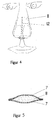
- This filter disc 6 consists of split filter fibers 8, each on both Sides are covered by the cover fleece 7.
- the filter housings 1, 2 have a micro-roughened Surface 5, in order to improve the fit at the lower end in the filter housing 1, 2nd lamellar incisions 10 are introduced.
- the inward peripheral edge 3 has a width of approx. 1 mm.
- the connection of the filter housing 1, 2 by means of a semicircular Web 9 is designed so that no offset to the outer wall of the filter housing 1, 2 occurs.
- the inlet opening of the filter housing 1, 2, the inward edge 3 and thus also the Filter disc 6 have an oval shape to ensure maximum air passage on.
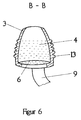
- the filter disk 6 can also be located at the outward opening the filter housing 1, 2 may be attached in variable thickness. This can advantageously the filter area and the filter volume are increased and the "spatial effect" is increased. Finally, the tight fit of the filter housings 1, 2 can be further improved in that instead of micro-roughening the surfaces, the filter housings 1, 2 are arranged concentrically Ripple 13 received.
Landscapes
- Health & Medical Sciences (AREA)
- Otolaryngology (AREA)
- General Health & Medical Sciences (AREA)
- Business, Economics & Management (AREA)
- Emergency Management (AREA)
- Respiratory Apparatuses And Protective Means (AREA)
- Orthopedics, Nursing, And Contraception (AREA)
Abstract
Description
Nasenfilter sind hinreichend bekannt und auch mehrfach in der Patentliteratur beschrieben.
Der Nachteil dieser Lösung liegt darin begründet, daß die Formgebung an den Naseninnenraum (Nasengang) nicht individuell dem Träger angepaßt ist und die Abdichtung gegen hindurchtretende "Fremdluft" lediglich über den mit einer Klebkomponente versehenen Rand erreicht wird. Der Tragekomfort ist bei dieser Lösung, die allerdings sehr einfach konzipiert ist, recht gewöhnungsbedürftig für den Nutzer.
Eine sogenannte "Kaminwirkung" zur Verstärkung des Luftdurchsatzes kommt erst gar nicht zur Geltung. Außerdem ist zu befürchten, daß aufgrund der elastischen Verbindungsbrücke zwischen den beiden Einsteckkörpern diese einander zugeneigt werden, sodaß dabei Nebenluft ungefiltert vorbeistreichen kann, zumal an den Oberflächen der Einsteckkörper keine weiteren dichtenden Maßnahmen vorgesehen sind.
Allerdings ist die Ausstattung der Filter"becher" mit als lose dargestelltein Filtergewebe als unvorteilhaft anzusehen, da u. U. Bestandteile daraus eingeatmet werden, da sich unmittelbar daran, an der Spitze der Filter"becher" kreisförmige bzw. punktförmige Öffnungen in Richtung des Naseninnenraums befinden. Es wird davon auszugehen sein, daß diese Lösung nur Stäube, Pollen oder andere Partikel in gröberer Form aufnimmt und auf keinen Fall dazu geeignet ist, Krankheitskeime und Mikrosporen abzufangen. Das Prinzip "Kaminwirkung" wird auch hier nicht praktiziert. Weitere zusätzliche Maßnahmen zur Verbesserung des Sitzes der Kombination bzgl. der Rutschsicherheit und Berücksichtigung ergonomischer Besonderheiten sind nicht vorgesehen.
Erfindungsgemäß wird die Aufgabe dadurch gelöst, daß der Nasenfilter in der Kombination der einzelnen Bestandteile zu einer Filtereinheit gestaltet wird und Schritte zu seiner zweckmäßigen Herstellung angegeben werden.
Die Mikroaufrauhung der beiden Filtergehäuse kann auch entfallen, wenn stattdessen eine konzentrische Riffelung am Umfang derselben vorgesehen ist.
Damit ein optimaler und gleichmäßiger Sitz von 2 Filtergehäusen nebst Filterscheiben garantiert ist, sind diese über einen Steg, der auch aus polymerem Kunststoff gefertigt ist, miteinander verbunden.
Die Steglänge wird dabei den entsprechenden Gegebenheiten des Trägers angepaßt, wobei die Stegbreite bis ca. 5 mm und die Stärke des Steges bis ca. 0,5 mm betragen kann. Die Stärke des Steges entspricht dabei stets der Wandstärke des Filtergehäuses. Die beiden Enden eines Steges, der etwa halbkreisförmig gebogen ist, sitzen am unteren Teil eines jeden Filtergehäuses bündig auf und sind dort thermisch oder durch Klebung mit diesem fest zur Filtereinheit verbunden.
In einem weiteren Schritt wird die Oberfläche des Filtergehäuses, beispielsweise durch Funkenerosion, mikroaufgerauht, wodurch ein paßgenauer und rutschsicherer Sitz erreicht wird.
- Fig. 1:
- Vorderansicht
- Fig. 2:
- Untere Draufsicht
- Fig. 3:
- Darstellung Schnitt A-A
- Fig. 4:
- Darstellung beim Benutzer
- Fig. 5:
- Filterscheibe im Schnitt
- Fig. 6:
- Filtergehäuse mit Riffelung Schnitt B-B
- Das Prinzip der "Raumform" realisiert eine längere Nutzung als es bei "Oberflächenfiltern" der Fall ist.
- Der Effekt der Raumform wird meistens dadurch verstärkt, daß gesplittete Mikrofasern verwendet werden, wodurch eine vergrößerte Filterkapazität erreicht wird.
- maximaler Luftdurchlaß bei minimalem Strömungswiderstand
- gute Atembarkeit
- vollkommen dichte Verbindung zur Naseninnenwand des Nasenganges und der Außenwandung der Filtergehäuse 1, 2 einerseits und zwischen dem nach innen gerichteten Rand 3 und Filterscheibe 6 andererseits.
- Schutz vor Mikrosporen etc. bei nicht nur entsprechend empfindlichen Personen, sondern auch Schutz von Personen, die in medizinisch sensiblen Bereichen tätig sind oder ähnliches.
- Endgültige Gestaltung nach einem "Modellabdruck" mittels elastomerer Abformwerkstoffe auf Vinylpolysiloxan-Basis.
- Wiederholbarkeit einer maßgenauen Nasenfertigung wird gegeben durch gute Lagerfähigkeit des "Formlings".
oder alternativ
oder alternativ
oder alternativ
oder alternativ
- 1
- - Filtergehäuse
- 2
- - Filtergehäuse
- 3
- - nach innen gerichteter Rand
- 4
- - glatte Oberfläche
- 5
- - mikroaufgerauhte Oberfläche
- 6
- - Filterscheibe
- 7
- - Deckvlies
- 8
- - gesplittete Filterfasern
- 9
- - halbkreisförmiger Steg
- 10
- - lamellenartige Einschnitte
- 11
- - Nasengang
- 12
- - Nasenscheidewand
- 13
- - konzentrische Riffelung
Claims (16)
- Nasenfilter, gekennzeichnet dadurch, daß er aus 2 über den halbkreisförmigen Steg (9) miteinander verbundenen Filtergehäusen (1, 2) besteht, wobei die obere Öffnung des Filtergehäuses (1, 2) eine vorzugsweise ovale Form hat und in diesem Bereich im Inneren ein um 90° nach innen gerichteter Rand (3) vorgesehen ist, der zur Aufnahme der Filterscheibe (6) dient und der innere Hohlraum der Filtergehäuse (1, 2) eine glatte Oberfläche (4) und die ergonomisch dem Nasengang (11) sowie der Nasenscheidewand (12) nachempfundene äußere Kontur eine mikroaufgerauhte Oberfläche (5) aufweist sowie an dem oberen Ende der Filtergehäuse (1, 2) lamellenartige Einschnitte (10) in Langsrichtung zur Symmetrieachse der Filtergehäuse (1, 2) eingebracht sind.
- Nasenfilter nach Anspruch 1, gekennzeichnet dadurch, daß die Filterscheibe (6) auch entgegengesetzt, am nasenauswärts weisenden unteren Ende der Filtergehäuse (1, 2), mit dem um 90° nach innen gerichteten Rand (3) verbunden ist und die äußere Kontur der Filtergehäuse (1, 2) konzentrische Riffelungen (13) aufweist.
- Nasenfilter nach Anspruch 1 und 2, gekennzeichnet dadurch, daß die Filterscheibe (6) mit dem um 90° nach innen gerichteten Rand (3) unlösbar verbunden ist.
- Nasenfilter nach Anspruch 1 bis 3, gekennzeichnet dadurch, daß die Filterscheibe (6) gesplittete Filterfasern (8) enthält, wobei diese durch 2 Platten Deckvlies (7) jeweils oben und unten abgedeckt sind und im Randbereich der Filterscheibe (6) eine Versiegelung besteht.
- Nasenfilter nach Anspruch 1, gekennzeichnet dadurch, daß der halbkreisförmige Steg (9) mit den beiden Filtergehäusen (1, 2) derart verbunden ist, daß seine beiden Enden stumpf an der unteren Seite der Filtergehäuse (1, 2) aufsitzen und eine feste Verbindung aufweisen, wobei Bündigkeit zwischen den Enden des Steges (9) und der äußeren Kontur der Filtergehäuse (1, 2) gegeben ist.
- Nasenfilter nach Anspruch 1 bis 5, gekennzeichnet dadurch, daß als Materialien für Filtergehäuse (1, 2) und halbkreisförmigem Steg (9) polymere Kunststoffe eingesetzt werden und auch für die gesplitteten Filterfasern (8).
- Nasenfilter nach Anspruch 4 und 6, gekennzeichnet dadurch, daß die gesplitteten Filterfasern (8) eine permanent elektrostatische Aufladung besitzen.
- Nasenfilter gekennzeichnet dadurch, daß die Anwendung für Allergiker, in sensiblen Krankenhausbereichen oder in Reinsträumen der Chipindustrie möglich ist.
- Verfahren zur Herstellung des Nasenfilters nach Anspruch 1, gekennzeichnet dadurch, daß vorzugsweise 3 als Grundformen gegebene Filtergehäuse (1, 2) thermisch exakt den individuellen Formen des Nasenganges (11) und der Nasenscheidewand (12) nachgeformt werden, wobei dieser endgültigen Formgebung der äußeren Kontur ein "Modellabdruck" mit einer Abdruckmasse vorangeht.
- Verfahren zur Herstellung des Nasenfilters nach Anspruch 9, gekennzeichnet dadurch, daß die Filtergehäuse (1, 2) mittels CAD-Technologie bzgl. ihrer Stärken und der räumlichen Lage von gegebenen Abflachungen des Naseninnenraumes gestaltet werden.
- Verfahren zur Herstellung des Nasenfilters nach Anspruch 9, gekennzeichnet dadurch, daß die im Randbereich versiegelte Filterscheibe (6) auf den um 90° nach innen gerichteten Rand (3) positioniert wird und entweder sofort während eines Tiefziehvorganges für die Filtergehäuse (1, 2) mit diesem oder in einem späteren Schritt thermisch verschweißt wird.
- Verfahren zur Herstellung des Nasenfilters nach Anspruch 11, gekennzeichnet dadurch, daß die Filterscheibe (6) entweder während des Spritzgusses eingebracht wird oder in einem späteren Schritt thermisch verschweißt wird.
- Verfahren zur Herstellung des Nasenfilters nach Anspruch 9, gekennzeichnet dadurch, daß die äußeren Flächen der Filtergehäuse (1, 2) mikroaufgerauht oder mit konzentrischen Riffelungen (13) versehen werden.
- Verfahren zur Herstellung des Nasenfilters nach Anspruch 9, gekennzeichnet dadurch, daß die endgefertigten Filtergehäuse (1, 2) mittels eines im Querschnitt rechteckigen Steges (9), der halbkreisförmig gebogen ist, thermisch fest miteinander verbunden oder aber auch verklebt werden können.
- Verfahren zur Herstellung des Nasenfilters nach Anspruch 9 und 14, gekennzeichnet dadurch, daß die Filtergehäuse (1, 2) mit Steg (9) auch komplett tiefgezogen oder spritzgegossen werden, sodaß eine Filtereinheit vorgefertigt wird unter gleichzeitiger oder späterer Einarbeitung der Filterscheibe (6).
- Verfahren zur Herstellung des Nasenfilters nach Anspruch 11, 12 und 15, gekennzeichnet dadurch, daß die Filterscheibe (6) mittels mechanischem Schneidverfahren oder Schneiden mit Laser aus Filtervlies hergestellt wird.
Applications Claiming Priority (2)
| Application Number | Priority Date | Filing Date | Title |
|---|---|---|---|
| DE19938610 | 1999-08-14 | ||
| DE1999138610 DE19938610A1 (de) | 1999-08-14 | 1999-08-14 | Nasenfilter und Verfahren zu dessen Herstellung |
Publications (2)
| Publication Number | Publication Date |
|---|---|
| EP1077074A2 true EP1077074A2 (de) | 2001-02-21 |
| EP1077074A3 EP1077074A3 (de) | 2001-09-19 |
Family
ID=7918424
Family Applications (1)
| Application Number | Title | Priority Date | Filing Date |
|---|---|---|---|
| EP00202857A Withdrawn EP1077074A3 (de) | 1999-08-14 | 2000-08-14 | Nasenfilter und Verfahren zu dessen Herstellung |
Country Status (2)
| Country | Link |
|---|---|
| EP (1) | EP1077074A3 (de) |
| DE (1) | DE19938610A1 (de) |
Cited By (3)
| Publication number | Priority date | Publication date | Assignee | Title |
|---|---|---|---|---|
| EP1340522A3 (de) * | 2002-02-14 | 2003-10-29 | Adrian John Soper | Nasenfiltervorrichtung |
| GB2354952B (en) * | 1999-08-27 | 2004-05-12 | Adrian John Soper | The hay fever guard |
| WO2007002979A1 (en) * | 2005-07-01 | 2007-01-11 | Robair Wartan Dallal | Advanced mask air filter |
Citations (4)
| Publication number | Priority date | Publication date | Assignee | Title |
|---|---|---|---|---|
| GB886056A (en) | 1958-12-22 | 1962-01-03 | Henry Louis Pierre Berge | Improved protective device for respiratory tracts |
| DE8804725U1 (de) | 1988-04-11 | 1988-05-26 | Weng, Kuo-Chin, Chiayi City | Luftfilter zur Einführung in die Nasenöffnungen |
| WO1995033520A1 (en) | 1994-06-02 | 1995-12-14 | Noreen Hurlin | Filtration device |
| WO1999011326A1 (en) | 1997-09-03 | 1999-03-11 | Amtec Products, Inc. | Improved nose filter |
Family Cites Families (2)
| Publication number | Priority date | Publication date | Assignee | Title |
|---|---|---|---|---|
| FR830545A (fr) * | 1937-12-08 | 1938-08-02 | Appareil nasal destiné à filtrer, aseptiser, imprégner ou modifier l'air respiré | |
| CH662742A5 (en) * | 1984-01-11 | 1987-10-30 | Reinhold Beister | Nose plug |
-
1999
- 1999-08-14 DE DE1999138610 patent/DE19938610A1/de not_active Withdrawn
-
2000
- 2000-08-14 EP EP00202857A patent/EP1077074A3/de not_active Withdrawn
Patent Citations (4)
| Publication number | Priority date | Publication date | Assignee | Title |
|---|---|---|---|---|
| GB886056A (en) | 1958-12-22 | 1962-01-03 | Henry Louis Pierre Berge | Improved protective device for respiratory tracts |
| DE8804725U1 (de) | 1988-04-11 | 1988-05-26 | Weng, Kuo-Chin, Chiayi City | Luftfilter zur Einführung in die Nasenöffnungen |
| WO1995033520A1 (en) | 1994-06-02 | 1995-12-14 | Noreen Hurlin | Filtration device |
| WO1999011326A1 (en) | 1997-09-03 | 1999-03-11 | Amtec Products, Inc. | Improved nose filter |
Cited By (3)
| Publication number | Priority date | Publication date | Assignee | Title |
|---|---|---|---|---|
| GB2354952B (en) * | 1999-08-27 | 2004-05-12 | Adrian John Soper | The hay fever guard |
| EP1340522A3 (de) * | 2002-02-14 | 2003-10-29 | Adrian John Soper | Nasenfiltervorrichtung |
| WO2007002979A1 (en) * | 2005-07-01 | 2007-01-11 | Robair Wartan Dallal | Advanced mask air filter |
Also Published As
| Publication number | Publication date |
|---|---|
| EP1077074A3 (de) | 2001-09-19 |
| DE19938610A1 (de) | 2001-02-22 |
Similar Documents
| Publication | Publication Date | Title |
|---|---|---|
| DE102015105496B4 (de) | Sprechventil mit Deckelteil, umfassend ein Verschlussteil mit einem ansteigenden Mittelteil | |
| DE202005019670U1 (de) | Wundbehandlungsvorrichtung mit elastisch verformbarem Unterdruckerzeugungselement | |
| EP3233168B1 (de) | Gehäuse eines feuchte-wärme-tauschers und verfahren zur lösung eines deckels von einem gehäuse | |
| WO2014060242A1 (de) | Sprechventil für tracheostomiekanüle | |
| WO2016001198A1 (de) | Atemschutzmaske und atemschutzkit | |
| DE102018125228A1 (de) | Modulare Atemschutzvorrichtung | |
| EP3551267B1 (de) | Wärme- und feuchtigkeitsaustauscher | |
| DE202020102119U1 (de) | Mund-Nasen-Schutzmaske | |
| WO2015062741A1 (de) | Sprechventil für laryngektomierte oder tracheotomierte | |
| EP3107492B1 (de) | Sprechventil mit deckelteil, umfassend ein kolbenförmiges verschlussteil | |
| EP1077074A2 (de) | Nasenfilter und Verfahren zu dessen Herstellung | |
| DE202020103896U1 (de) | Mund-Nasenbedeckung und deren Verwendung | |
| DE102012024817A1 (de) | Sprechventil | |
| EP3484562B1 (de) | Verneblereinheit mit wechselbarem mundstück | |
| EP3280478B1 (de) | Deckel für ein gehäuse eines feuchte-wärme-tauschers | |
| DE29914277U1 (de) | Nasenfilter | |
| WO2021161068A1 (de) | BEIM NIEß-, HUSTEN- ODER SCHNÄUZ-VORGANG EXPANDIERENDE ATEMSCHUTZVORRICHTUNG ZUR VERHINDERUNG DER INFEKTION MIT ATEMLUFTÜBERTRAGBAREN KRANKHEITEN | |
| EP3251718B1 (de) | Atemwegstherapiegerät | |
| DE4239425C2 (de) | Vorrichtung für die Durchführung einer Mund-zu-Mund-Beatmung | |
| DE20200168U1 (de) | Nasenring | |
| DE102021111850A1 (de) | Maske | |
| EP0730878A2 (de) | Vorrichtung zur Behandlung von Atemluft | |
| DE102023112402A1 (de) | Atemmaske mit Partikelfilter | |
| DE202010014099U1 (de) | Nasenfilter zum Schutz gegen Pollen, Feinstaub, Tröpfecheninfektion, üble Gerüche und Schadstoffe | |
| DE202015100431U1 (de) | Gesichtsmaske |
Legal Events
| Date | Code | Title | Description |
|---|---|---|---|
| PUAI | Public reference made under article 153(3) epc to a published international application that has entered the european phase |
Free format text: ORIGINAL CODE: 0009012 |
|
| AK | Designated contracting states |
Kind code of ref document: A2 Designated state(s): AT BE CH FR GB LI NL Kind code of ref document: A2 Designated state(s): AT BE CH CY DE DK ES FI FR GB GR IE IT LI LU MC NL PT SE |
|
| AX | Request for extension of the european patent |
Free format text: AL;LT;LV;MK;RO;SI |
|
| PUAL | Search report despatched |
Free format text: ORIGINAL CODE: 0009013 |
|
| RIN1 | Information on inventor provided before grant (corrected) |
Inventor name: SCHULZE, HOLGER J. |
|
| AK | Designated contracting states |
Kind code of ref document: A3 Designated state(s): AT BE CH CY DE DK ES FI FR GB GR IE IT LI LU MC NL PT SE |
|
| AX | Request for extension of the european patent |
Free format text: AL;LT;LV;MK;RO;SI |
|
| RAP1 | Party data changed (applicant data changed or rights of an application transferred) |
Owner name: RAEUSCHER, KHANH PHUONG |
|
| 17P | Request for examination filed |
Effective date: 20020309 |
|
| AKX | Designation fees paid |
Free format text: AT BE CH FR GB LI NL |
|
| REG | Reference to a national code |
Ref country code: DE Ref legal event code: 8566 |
|
| STAA | Information on the status of an ep patent application or granted ep patent |
Free format text: STATUS: THE APPLICATION IS DEEMED TO BE WITHDRAWN |
|
| 18D | Application deemed to be withdrawn |
Effective date: 20030301 |