EP1077962B1 - Agent de derivatisation d'isocyanates et procedes de fabrication et d'utilisation correspondants - Google Patents
Agent de derivatisation d'isocyanates et procedes de fabrication et d'utilisation correspondants Download PDFInfo
- Publication number
- EP1077962B1 EP1077962B1 EP99923040A EP99923040A EP1077962B1 EP 1077962 B1 EP1077962 B1 EP 1077962B1 EP 99923040 A EP99923040 A EP 99923040A EP 99923040 A EP99923040 A EP 99923040A EP 1077962 B1 EP1077962 B1 EP 1077962B1
- Authority
- EP
- European Patent Office
- Prior art keywords
- isocyanate
- pac
- derivatizing agent
- anthracenylmethyl
- radical
- Prior art date
- Legal status (The legal status is an assumption and is not a legal conclusion. Google has not performed a legal analysis and makes no representation as to the accuracy of the status listed.)
- Expired - Lifetime
Links
- 239000012948 isocyanate Substances 0.000 title claims abstract description 115
- 150000002513 isocyanates Chemical class 0.000 title claims abstract description 101
- 238000000034 method Methods 0.000 title claims abstract description 67
- 239000003795 chemical substances by application Substances 0.000 title claims abstract description 56
- 238000004519 manufacturing process Methods 0.000 title claims description 8
- 150000001875 compounds Chemical class 0.000 claims abstract description 24
- GLQJIZLPGZEGNZ-UHFFFAOYSA-N anthracen-9-ylmethyl piperazine-1-carboxylate Chemical compound C=12C=CC=CC2=CC2=CC=CC=C2C=1COC(=O)N1CCNCC1 GLQJIZLPGZEGNZ-UHFFFAOYSA-N 0.000 claims abstract description 13
- 235000013877 carbamide Nutrition 0.000 claims description 26
- GLUUGHFHXGJENI-UHFFFAOYSA-N Piperazine Chemical compound C1CNCCN1 GLUUGHFHXGJENI-UHFFFAOYSA-N 0.000 claims description 22
- 239000000203 mixture Substances 0.000 claims description 14
- 150000003672 ureas Chemical class 0.000 claims description 13
- 239000004202 carbamide Substances 0.000 claims description 12
- 239000007787 solid Substances 0.000 claims description 12
- RDAUVXVQAOJOSH-UHFFFAOYSA-N 9-(methylsulfanylmethyl)anthracene Chemical compound C1=CC=C2C(CSC)=C(C=CC=C3)C3=CC2=C1 RDAUVXVQAOJOSH-UHFFFAOYSA-N 0.000 claims description 11
- XSQUKJJJFZCRTK-UHFFFAOYSA-N Urea Chemical compound NC(N)=O XSQUKJJJFZCRTK-UHFFFAOYSA-N 0.000 claims description 11
- ACBQROXDOHKANW-UHFFFAOYSA-N bis(4-nitrophenyl) carbonate Chemical compound C1=CC([N+](=O)[O-])=CC=C1OC(=O)OC1=CC=C([N+]([O-])=O)C=C1 ACBQROXDOHKANW-UHFFFAOYSA-N 0.000 claims description 11
- 239000002904 solvent Substances 0.000 claims description 11
- NQRYJNQNLNOLGT-UHFFFAOYSA-N Piperidine Chemical compound C1CCNCC1 NQRYJNQNLNOLGT-UHFFFAOYSA-N 0.000 claims description 10
- 238000004128 high performance liquid chromatography Methods 0.000 claims description 10
- 239000002245 particle Substances 0.000 claims description 10
- RMBAVIFYHOYIFM-UHFFFAOYSA-M sodium methanethiolate Chemical compound [Na+].[S-]C RMBAVIFYHOYIFM-UHFFFAOYSA-M 0.000 claims description 10
- XFNJVJPLKCPIBV-UHFFFAOYSA-N trimethylenediamine Chemical compound NCCCN XFNJVJPLKCPIBV-UHFFFAOYSA-N 0.000 claims description 10
- JUJWROOIHBZHMG-UHFFFAOYSA-N Pyridine Chemical compound C1=CC=NC=C1 JUJWROOIHBZHMG-UHFFFAOYSA-N 0.000 claims description 8
- 150000004985 diamines Chemical group 0.000 claims description 8
- NXLNNXIXOYSCMB-UHFFFAOYSA-N (4-nitrophenyl) carbonochloridate Chemical compound [O-][N+](=O)C1=CC=C(OC(Cl)=O)C=C1 NXLNNXIXOYSCMB-UHFFFAOYSA-N 0.000 claims description 7
- 125000001931 aliphatic group Chemical group 0.000 claims description 6
- 125000002924 primary amino group Chemical group [H]N([H])* 0.000 claims description 6
- 150000003335 secondary amines Chemical class 0.000 claims description 6
- PRNRUOJLUPUJDN-UHFFFAOYSA-N 4-piperidin-4-ylpiperidine Chemical compound C1CNCCC1C1CCNCC1 PRNRUOJLUPUJDN-UHFFFAOYSA-N 0.000 claims description 5
- PIICEJLVQHRZGT-UHFFFAOYSA-N Ethylenediamine Chemical compound NCCN PIICEJLVQHRZGT-UHFFFAOYSA-N 0.000 claims description 5
- NAQMVNRVTILPCV-UHFFFAOYSA-N hexane-1,6-diamine Chemical compound NCCCCCCN NAQMVNRVTILPCV-UHFFFAOYSA-N 0.000 claims description 5
- JCJNNHDZTLRSGN-UHFFFAOYSA-N anthracen-9-ylmethanol Chemical compound C1=CC=C2C(CO)=C(C=CC=C3)C3=CC2=C1 JCJNNHDZTLRSGN-UHFFFAOYSA-N 0.000 claims description 4
- 238000004587 chromatography analysis Methods 0.000 claims description 4
- UMJSCPRVCHMLSP-UHFFFAOYSA-N pyridine Natural products COC1=CC=CN=C1 UMJSCPRVCHMLSP-UHFFFAOYSA-N 0.000 claims description 4
- 239000004814 polyurethane Substances 0.000 claims description 3
- 229920002635 polyurethane Polymers 0.000 claims description 3
- 239000002131 composite material Substances 0.000 claims description 2
- 239000002023 wood Substances 0.000 claims description 2
- VHRGRCVQAFMJIZ-UHFFFAOYSA-N cadaverine Chemical compound NCCCCCN VHRGRCVQAFMJIZ-UHFFFAOYSA-N 0.000 claims 8
- KIDHWZJUCRJVML-UHFFFAOYSA-N putrescine Chemical compound NCCCCN KIDHWZJUCRJVML-UHFFFAOYSA-N 0.000 claims 8
- 239000005700 Putrescine Substances 0.000 claims 4
- 239000000428 dust Substances 0.000 claims 1
- ZJHHPAUQMCHPRB-UHFFFAOYSA-N urea urea Chemical compound NC(N)=O.NC(N)=O ZJHHPAUQMCHPRB-UHFFFAOYSA-N 0.000 claims 1
- 230000007613 environmental effect Effects 0.000 abstract description 12
- 239000000178 monomer Substances 0.000 abstract description 8
- 230000008569 process Effects 0.000 abstract description 4
- 150000002894 organic compounds Chemical class 0.000 abstract description 3
- ZMXDDKWLCZADIW-UHFFFAOYSA-N N,N-Dimethylformamide Chemical compound CN(C)C=O ZMXDDKWLCZADIW-UHFFFAOYSA-N 0.000 description 162
- 239000000523 sample Substances 0.000 description 46
- YXFVVABEGXRONW-UHFFFAOYSA-N toluene Substances CC1=CC=CC=C1 YXFVVABEGXRONW-UHFFFAOYSA-N 0.000 description 40
- 239000000243 solution Substances 0.000 description 29
- WEVYAHXRMPXWCK-UHFFFAOYSA-N Acetonitrile Chemical compound CC#N WEVYAHXRMPXWCK-UHFFFAOYSA-N 0.000 description 27
- 239000005057 Hexamethylene diisocyanate Substances 0.000 description 23
- 239000003570 air Substances 0.000 description 21
- 239000000047 product Substances 0.000 description 21
- 238000003776 cleavage reaction Methods 0.000 description 20
- 230000007017 scission Effects 0.000 description 18
- DGTNSSLYPYDJGL-UHFFFAOYSA-N phenyl isocyanate Chemical compound O=C=NC1=CC=CC=C1 DGTNSSLYPYDJGL-UHFFFAOYSA-N 0.000 description 15
- 238000001514 detection method Methods 0.000 description 14
- LUBJCRLGQSPQNN-UHFFFAOYSA-N 1-Phenylurea Chemical compound NC(=O)NC1=CC=CC=C1 LUBJCRLGQSPQNN-UHFFFAOYSA-N 0.000 description 12
- 238000006243 chemical reaction Methods 0.000 description 12
- 239000003153 chemical reaction reagent Substances 0.000 description 11
- VLKZOEOYAKHREP-UHFFFAOYSA-N n-Hexane Chemical compound CCCCCC VLKZOEOYAKHREP-UHFFFAOYSA-N 0.000 description 10
- 238000004809 thin layer chromatography Methods 0.000 description 10
- IJGRMHOSHXDMSA-UHFFFAOYSA-N Atomic nitrogen Chemical compound N#N IJGRMHOSHXDMSA-UHFFFAOYSA-N 0.000 description 8
- WYURNTSHIVDZCO-UHFFFAOYSA-N Tetrahydrofuran Chemical compound C1CCOC1 WYURNTSHIVDZCO-UHFFFAOYSA-N 0.000 description 8
- IQPQWNKOIGAROB-UHFFFAOYSA-N isocyanate group Chemical group [N-]=C=O IQPQWNKOIGAROB-UHFFFAOYSA-N 0.000 description 8
- 238000005259 measurement Methods 0.000 description 8
- 239000011541 reaction mixture Substances 0.000 description 8
- XLYOFNOQVPJJNP-UHFFFAOYSA-N water Substances O XLYOFNOQVPJJNP-UHFFFAOYSA-N 0.000 description 8
- -1 aromatic isocyanates Chemical class 0.000 description 7
- UPMLOUAZCHDJJD-UHFFFAOYSA-N 4,4'-Diphenylmethane Diisocyanate Chemical compound C1=CC(N=C=O)=CC=C1CC1=CC=C(N=C=O)C=C1 UPMLOUAZCHDJJD-UHFFFAOYSA-N 0.000 description 6
- OKKJLVBELUTLKV-UHFFFAOYSA-N Methanol Chemical compound OC OKKJLVBELUTLKV-UHFFFAOYSA-N 0.000 description 6
- 230000036541 health Effects 0.000 description 6
- RRAMGCGOFNQTLD-UHFFFAOYSA-N hexamethylene diisocyanate Chemical compound O=C=NCCCCCCN=C=O RRAMGCGOFNQTLD-UHFFFAOYSA-N 0.000 description 6
- 238000005070 sampling Methods 0.000 description 6
- 238000001212 derivatisation Methods 0.000 description 5
- 238000002474 experimental method Methods 0.000 description 5
- 239000002244 precipitate Substances 0.000 description 5
- 238000000926 separation method Methods 0.000 description 5
- VYPSYNLAJGMNEJ-UHFFFAOYSA-N silicon dioxide Inorganic materials O=[Si]=O VYPSYNLAJGMNEJ-UHFFFAOYSA-N 0.000 description 5
- 238000003756 stirring Methods 0.000 description 5
- DVKJHBMWWAPEIU-UHFFFAOYSA-N toluene 2,4-diisocyanate Chemical compound CC1=CC=C(N=C=O)C=C1N=C=O DVKJHBMWWAPEIU-UHFFFAOYSA-N 0.000 description 5
- 230000005012 migration Effects 0.000 description 4
- 238000013508 migration Methods 0.000 description 4
- 229910052757 nitrogen Inorganic materials 0.000 description 4
- 125000001997 phenyl group Chemical group [H]C1=C([H])C([H])=C(*)C([H])=C1[H] 0.000 description 4
- 230000004044 response Effects 0.000 description 4
- 239000000741 silica gel Substances 0.000 description 4
- 229910002027 silica gel Inorganic materials 0.000 description 4
- 239000002594 sorbent Substances 0.000 description 4
- YLQBMQCUIZJEEH-UHFFFAOYSA-N tetrahydrofuran Natural products C=1C=COC=1 YLQBMQCUIZJEEH-UHFFFAOYSA-N 0.000 description 4
- VNZLQLYBRIOLFZ-UHFFFAOYSA-N 1-(2-methoxyphenyl)piperazine Chemical compound COC1=CC=CC=C1N1CCNCC1 VNZLQLYBRIOLFZ-UHFFFAOYSA-N 0.000 description 3
- WFDIJRYMOXRFFG-UHFFFAOYSA-N Acetic anhydride Chemical compound CC(=O)OC(C)=O WFDIJRYMOXRFFG-UHFFFAOYSA-N 0.000 description 3
- XEKOWRVHYACXOJ-UHFFFAOYSA-N Ethyl acetate Chemical compound CCOC(C)=O XEKOWRVHYACXOJ-UHFFFAOYSA-N 0.000 description 3
- 150000001412 amines Chemical class 0.000 description 3
- 238000004458 analytical method Methods 0.000 description 3
- XCCCHWWMLSAIOH-UHFFFAOYSA-N anthracen-1-ylmethanol Chemical compound C1=CC=C2C=C3C(CO)=CC=CC3=CC2=C1 XCCCHWWMLSAIOH-UHFFFAOYSA-N 0.000 description 3
- 230000008901 benefit Effects 0.000 description 3
- 238000010828 elution Methods 0.000 description 3
- 239000007788 liquid Substances 0.000 description 3
- 239000003960 organic solvent Substances 0.000 description 3
- 239000012071 phase Substances 0.000 description 3
- 238000002360 preparation method Methods 0.000 description 3
- 230000009257 reactivity Effects 0.000 description 3
- 239000000126 substance Substances 0.000 description 3
- 239000012485 toluene extract Substances 0.000 description 3
- 0 *C(OCc1c(cccc2)c2cc2c1cccc2)=O Chemical compound *C(OCc1c(cccc2)c2cc2c1cccc2)=O 0.000 description 2
- LFQSCWFLJHTTHZ-UHFFFAOYSA-N Ethanol Chemical compound CCO LFQSCWFLJHTTHZ-UHFFFAOYSA-N 0.000 description 2
- CDBYLPFSWZWCQE-UHFFFAOYSA-L Sodium Carbonate Chemical compound [Na+].[Na+].[O-]C([O-])=O CDBYLPFSWZWCQE-UHFFFAOYSA-L 0.000 description 2
- DTQVDTLACAAQTR-UHFFFAOYSA-N Trifluoroacetic acid Chemical compound OC(=O)C(F)(F)F DTQVDTLACAAQTR-UHFFFAOYSA-N 0.000 description 2
- 238000011088 calibration curve Methods 0.000 description 2
- 238000011109 contamination Methods 0.000 description 2
- 239000012043 crude product Substances 0.000 description 2
- 239000008367 deionised water Substances 0.000 description 2
- 229910021641 deionized water Inorganic materials 0.000 description 2
- 239000012156 elution solvent Substances 0.000 description 2
- 239000000284 extract Substances 0.000 description 2
- NIMLQBUJDJZYEJ-UHFFFAOYSA-N isophorone diisocyanate Chemical compound CC1(C)CC(N=C=O)CC(C)(CN=C=O)C1 NIMLQBUJDJZYEJ-UHFFFAOYSA-N 0.000 description 2
- 239000011159 matrix material Substances 0.000 description 2
- MQRIUFVBEVFILS-UHFFFAOYSA-N n-methyl-1-naphthalen-1-ylmethanamine Chemical compound C1=CC=C2C(CNC)=CC=CC2=C1 MQRIUFVBEVFILS-UHFFFAOYSA-N 0.000 description 2
- 238000002414 normal-phase solid-phase extraction Methods 0.000 description 2
- 229920005862 polyol Polymers 0.000 description 2
- 150000003077 polyols Chemical class 0.000 description 2
- WGYKZJWCGVVSQN-UHFFFAOYSA-N propylamine Chemical compound CCCN WGYKZJWCGVVSQN-UHFFFAOYSA-N 0.000 description 2
- 238000001953 recrystallisation Methods 0.000 description 2
- 230000000241 respiratory effect Effects 0.000 description 2
- RUELTTOHQODFPA-UHFFFAOYSA-N toluene 2,6-diisocyanate Chemical compound CC1=C(N=C=O)C=CC=C1N=C=O RUELTTOHQODFPA-UHFFFAOYSA-N 0.000 description 2
- APJYDQYYACXCRM-UHFFFAOYSA-N tryptamine Chemical compound C1=CC=C2C(CCN)=CNC2=C1 APJYDQYYACXCRM-UHFFFAOYSA-N 0.000 description 2
- 229940008841 1,6-hexamethylene diisocyanate Drugs 0.000 description 1
- XOMAHPANTKOFLM-UHFFFAOYSA-N 1-(anthracen-9-ylmethyl)piperazine Chemical compound C=12C=CC=CC2=CC2=CC=CC=C2C=1CN1CCNCC1 XOMAHPANTKOFLM-UHFFFAOYSA-N 0.000 description 1
- QPHLFSGMBIJFRA-UHFFFAOYSA-N 4-(4-nitrophenyl)butan-1-amine Chemical compound NCCCCC1=CC=C([N+]([O-])=O)C=C1 QPHLFSGMBIJFRA-UHFFFAOYSA-N 0.000 description 1
- LRJPKXCDOXCCSQ-UHFFFAOYSA-N 5-isocyanato-1-(isocyanatomethyl)-1,3,3-trimethylcyclohexane Chemical compound CC1(C)CC(N=C=O)CC(C)(CN=C=O)C1.CC1(C)CC(N=C=O)CC(C)(CN=C=O)C1 LRJPKXCDOXCCSQ-UHFFFAOYSA-N 0.000 description 1
- BWLUMTFWVZZZND-UHFFFAOYSA-N Dibenzylamine Chemical compound C=1C=CC=CC=1CNCC1=CC=CC=C1 BWLUMTFWVZZZND-UHFFFAOYSA-N 0.000 description 1
- 239000005058 Isophorone diisocyanate Substances 0.000 description 1
- LWPMBFDMNRMWTF-NTEUORMPSA-N NN(CC1)CCN1C(CO/C=C/c1c(cccc2)c2cc2ccccc12)=O Chemical compound NN(CC1)CCN1C(CO/C=C/c1c(cccc2)c2cc2ccccc12)=O LWPMBFDMNRMWTF-NTEUORMPSA-N 0.000 description 1
- PMZURENOXWZQFD-UHFFFAOYSA-L Sodium Sulfate Chemical compound [Na+].[Na+].[O-]S([O-])(=O)=O PMZURENOXWZQFD-UHFFFAOYSA-L 0.000 description 1
- 239000002253 acid Substances 0.000 description 1
- 230000002378 acidificating effect Effects 0.000 description 1
- 150000001336 alkenes Chemical group 0.000 description 1
- 239000012080 ambient air Substances 0.000 description 1
- 239000003472 antidiabetic agent Substances 0.000 description 1
- 229940125708 antidiabetic agent Drugs 0.000 description 1
- 150000004982 aromatic amines Chemical class 0.000 description 1
- 239000012298 atmosphere Substances 0.000 description 1
- 230000009286 beneficial effect Effects 0.000 description 1
- 239000003729 cation exchange resin Substances 0.000 description 1
- 239000013626 chemical specie Substances 0.000 description 1
- 238000013375 chromatographic separation Methods 0.000 description 1
- 238000004737 colorimetric analysis Methods 0.000 description 1
- 239000000356 contaminant Substances 0.000 description 1
- 238000006352 cycloaddition reaction Methods 0.000 description 1
- 230000006735 deficit Effects 0.000 description 1
- 238000010511 deprotection reaction Methods 0.000 description 1
- 201000010099 disease Diseases 0.000 description 1
- 208000037265 diseases, disorders, signs and symptoms Diseases 0.000 description 1
- 239000003814 drug Substances 0.000 description 1
- 229940079593 drug Drugs 0.000 description 1
- 238000001704 evaporation Methods 0.000 description 1
- 238000000605 extraction Methods 0.000 description 1
- 239000000835 fiber Substances 0.000 description 1
- 238000001914 filtration Methods 0.000 description 1
- 238000001917 fluorescence detection Methods 0.000 description 1
- 239000006260 foam Substances 0.000 description 1
- 125000002485 formyl group Chemical class [H]C(*)=O 0.000 description 1
- 239000011521 glass Substances 0.000 description 1
- 239000003365 glass fiber Substances 0.000 description 1
- 239000011491 glass wool Substances 0.000 description 1
- 239000000383 hazardous chemical Substances 0.000 description 1
- 239000004009 herbicide Substances 0.000 description 1
- 239000005457 ice water Substances 0.000 description 1
- 239000012535 impurity Substances 0.000 description 1
- 238000011065 in-situ storage Methods 0.000 description 1
- 238000002347 injection Methods 0.000 description 1
- 239000007924 injection Substances 0.000 description 1
- 238000009413 insulation Methods 0.000 description 1
- 238000004190 ion pair chromatography Methods 0.000 description 1
- 239000002085 irritant Substances 0.000 description 1
- 231100000021 irritant Toxicity 0.000 description 1
- 231100001032 irritation of the eye Toxicity 0.000 description 1
- 238000004811 liquid chromatography Methods 0.000 description 1
- 238000003760 magnetic stirring Methods 0.000 description 1
- 239000000463 material Substances 0.000 description 1
- 238000012986 modification Methods 0.000 description 1
- 230000004048 modification Effects 0.000 description 1
- 238000012544 monitoring process Methods 0.000 description 1
- 210000004400 mucous membrane Anatomy 0.000 description 1
- 150000002825 nitriles Chemical class 0.000 description 1
- 238000003953 normal phase liquid chromatography Methods 0.000 description 1
- 230000003647 oxidation Effects 0.000 description 1
- 238000007254 oxidation reaction Methods 0.000 description 1
- RPDJEKMSFIRVII-UHFFFAOYSA-N oxomethylidenehydrazine Chemical class NN=C=O RPDJEKMSFIRVII-UHFFFAOYSA-N 0.000 description 1
- 239000003973 paint Substances 0.000 description 1
- 230000000737 periodic effect Effects 0.000 description 1
- 230000002265 prevention Effects 0.000 description 1
- 230000002035 prolonged effect Effects 0.000 description 1
- 239000003223 protective agent Substances 0.000 description 1
- 238000010926 purge Methods 0.000 description 1
- GZRKXKUVVPSREJ-UHFFFAOYSA-N pyridinylpiperazine Chemical compound C1CNCCN1C1=CC=CC=N1 GZRKXKUVVPSREJ-UHFFFAOYSA-N 0.000 description 1
- 238000011002 quantification Methods 0.000 description 1
- 239000010453 quartz Substances 0.000 description 1
- 238000011084 recovery Methods 0.000 description 1
- 239000011347 resin Substances 0.000 description 1
- 229920005989 resin Polymers 0.000 description 1
- 239000012488 sample solution Substances 0.000 description 1
- 230000035945 sensitivity Effects 0.000 description 1
- 238000007086 side reaction Methods 0.000 description 1
- 238000010898 silica gel chromatography Methods 0.000 description 1
- 229910000029 sodium carbonate Inorganic materials 0.000 description 1
- 229910052938 sodium sulfate Inorganic materials 0.000 description 1
- 235000011152 sodium sulphate Nutrition 0.000 description 1
- 238000000638 solvent extraction Methods 0.000 description 1
- 238000003786 synthesis reaction Methods 0.000 description 1
- 238000004454 trace mineral analysis Methods 0.000 description 1
- JOYRKODLDBILNP-UHFFFAOYSA-N urethane group Chemical group NC(=O)OCC JOYRKODLDBILNP-UHFFFAOYSA-N 0.000 description 1
Images

Classifications
-
- C—CHEMISTRY; METALLURGY
- C07—ORGANIC CHEMISTRY
- C07D—HETEROCYCLIC COMPOUNDS
- C07D295/00—Heterocyclic compounds containing polymethylene-imine rings with at least five ring members, 3-azabicyclo [3.2.2] nonane, piperazine, morpholine or thiomorpholine rings, having only hydrogen atoms directly attached to the ring carbon atoms
- C07D295/16—Heterocyclic compounds containing polymethylene-imine rings with at least five ring members, 3-azabicyclo [3.2.2] nonane, piperazine, morpholine or thiomorpholine rings, having only hydrogen atoms directly attached to the ring carbon atoms acylated on ring nitrogen atoms
- C07D295/20—Heterocyclic compounds containing polymethylene-imine rings with at least five ring members, 3-azabicyclo [3.2.2] nonane, piperazine, morpholine or thiomorpholine rings, having only hydrogen atoms directly attached to the ring carbon atoms acylated on ring nitrogen atoms by radicals derived from carbonic acid, or sulfur or nitrogen analogues thereof
- C07D295/205—Radicals derived from carbonic acid
-
- G—PHYSICS
- G01—MEASURING; TESTING
- G01N—INVESTIGATING OR ANALYSING MATERIALS BY DETERMINING THEIR CHEMICAL OR PHYSICAL PROPERTIES
- G01N31/00—Investigating or analysing non-biological materials by the use of the chemical methods specified in the subgroup; Apparatus specially adapted for such methods
- G01N31/22—Investigating or analysing non-biological materials by the use of the chemical methods specified in the subgroup; Apparatus specially adapted for such methods using chemical indicators
Definitions
- the present invention relates generally to the fields of organic and analytical chemistry and more particularly to a derivatizing agent and method for detecting and quantifying isocyanate contamination in a sample, such as an environmental sample.
- the most common isocyanates employed in industry are 2,4- and 2,6-toluene diisocyanate (TDI), 4,4'-diphenylmethane diisocyanate (MDI), hexamethylene diisocyanate (HDI), and isophorone diisocyanate (IPDI).
- isocyanates are commercially beneficial, they have been known to create significant health risks. For example, isocyanates are severe respiratory irritants and can cause irritation of the eyes and mucous membranes. Prolonged exposure may result in permanent respiratory impairment. Because of the serious health risks associated with the use of isocyanates by industrial workers, most industrialized countries have set limits on the permissible levels of exposure.
- NIOSH National Institute for Occupational Safety and Health
- the United States has set a level of 5 ppb
- the Deutsche Anlagensscher in the Federal Republic of Germany has set a limit of 10 ppb
- the Health and Safety Executive of the United Kingdom has created a standard of 20 ⁇ g NCO m -3 for an eight hour time-weighted average and 70 ⁇ g NCO m -3 for a ten minute time-weighted average.
- the hazard posed by isocyanate contamination in the air is not limited to a single isocyanate species.
- Products made using isocyanates may contain several different isocyanate species and new species may be released during use of the product. Therefore, it is important to assess the total hazard resulting from exposure to isocyanates, which requires measuring all isocyanate species.
- analytical standards are unavailable for a majority of these species, preventing individual identification of all isocyanate species in routine sample analysis.
- Marcali Anal. Chem ., 29(4): 552-58, 1957 describes a colorimetric method for the measurement of isocyanate monomer.
- the Marcali method is limited to the measurement of aromatic isocyanates.
- the Marcali method is susceptible to interferences, exhibits poor sensitivity when compared with standard chromatographic methods, and the response varies with isocyanate structure.
- MDHS 25 Method 25 for the Determination of Hazardous Substances
- This method employs 1-(2-methoxyphenyl)-piperazine (MOPP) to derivatize isocyanate species.
- the derivatives are then analyzed with high performance liquid chromatography (HPLC) using ultraviolet and electrochemical detectors in series (HPLC/UV/EC).
- HPLC high performance liquid chromatography
- Bagon, et al. Am. Ind. Hyg. Assoc. J ., 45(1):39-43. 1984 disclose the use of MDHS 25 for determining isocyanate monomers and prepolymer relative to a monomer standard.
- the MDHS 25 method has been found to be unreliable in its ability to correctly identify isocyanate species and inaccurate in its quantitation of those species.
- U.S. Patent No. 3,533,750 to Belisle discloses a process for detecting toluene diisocyanate, other aromatic isocyanates, or aromatic amines in ambient air.
- the method involves contacting an air sample with an acid solution of glutaconic aldehyde and then with a cationic ion exchange resin.
- the isocyanate is converted to a corresponding amine that is reacted with a reagent to produce a yellow color that is concentrated on the surface of the resin.
- the method is quick and sensitive, it cannot be used to detect aliphatic isocyanate species.
- Hanus, et al. disclose the use of tubes packed with Chromosorb WAW®, end-plugged with glass wool and impregnated throughout with 1-(2-pyridyl)piperazine for collection and in situ derivatization of toluene 2,4-diisocyanate (TDI), 4,4'-diphenylmethane diisocyanate (MDI) and 1,6-hexamethylene diisocyanate (HDI), which are collected from air.
- TDI toluene 2,4-diisocyanate
- MDI 4,4'-diphenylmethane diisocyanate
- HDI 1,6-hexamethylene diisocyanate
- Dalene, et al. J. Chromat., 435: 469-81, 1988 disclose a high performance liquid chromatographic method for the trace analysis of complex air mixtures containing 2,6- and 2,4-toluene diisocyanates and related amino isocyanates and diamines. The method is based on derivatization of the isocyanate functional groups to corresponding urethane groups with alkaline ethanol as the sampling and reacting medium.
- a novel isocyanate derivitizing agent useful for the determination of isocyanates in a sample, such as an environmental sample.
- the agent is 9-anthracenylmethyl-1-piperazinecarboxylate, referred to herein as "PAC.”
- PAC 9-anthracenylmethyl-1-piperazinecarboxylate
- a method for producing PAC and a method for measuring the total level of isocyanate in an environmental sample are also provided.
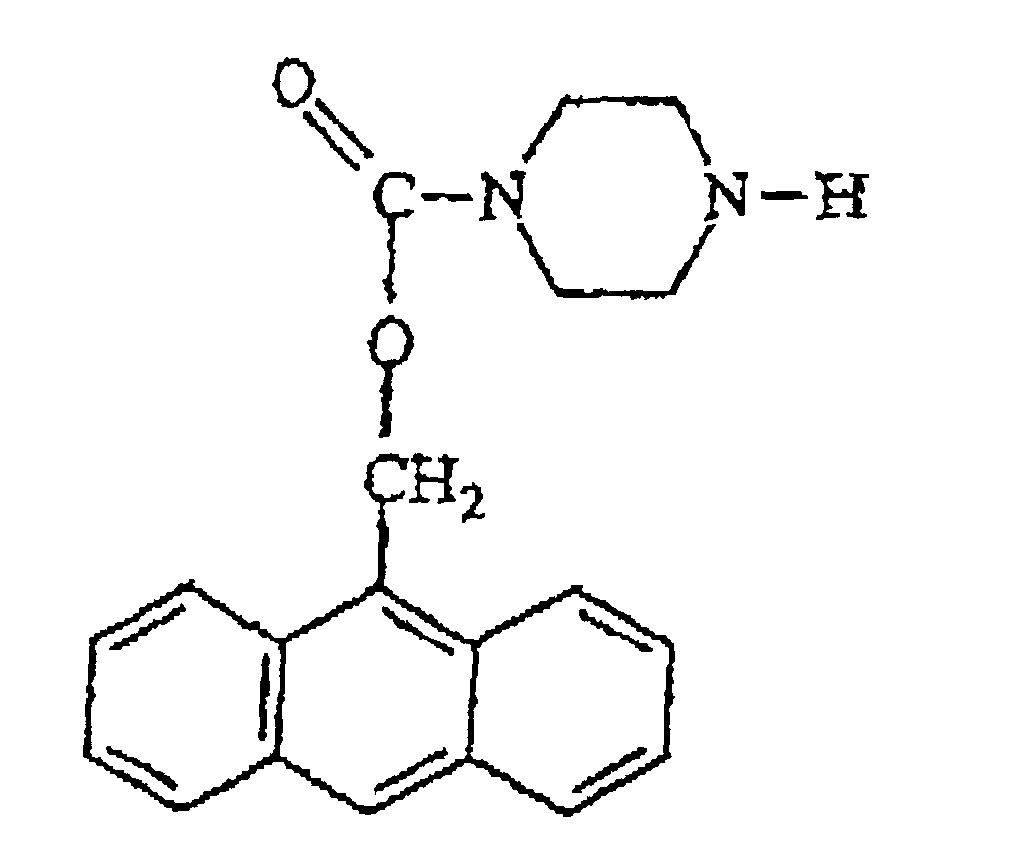
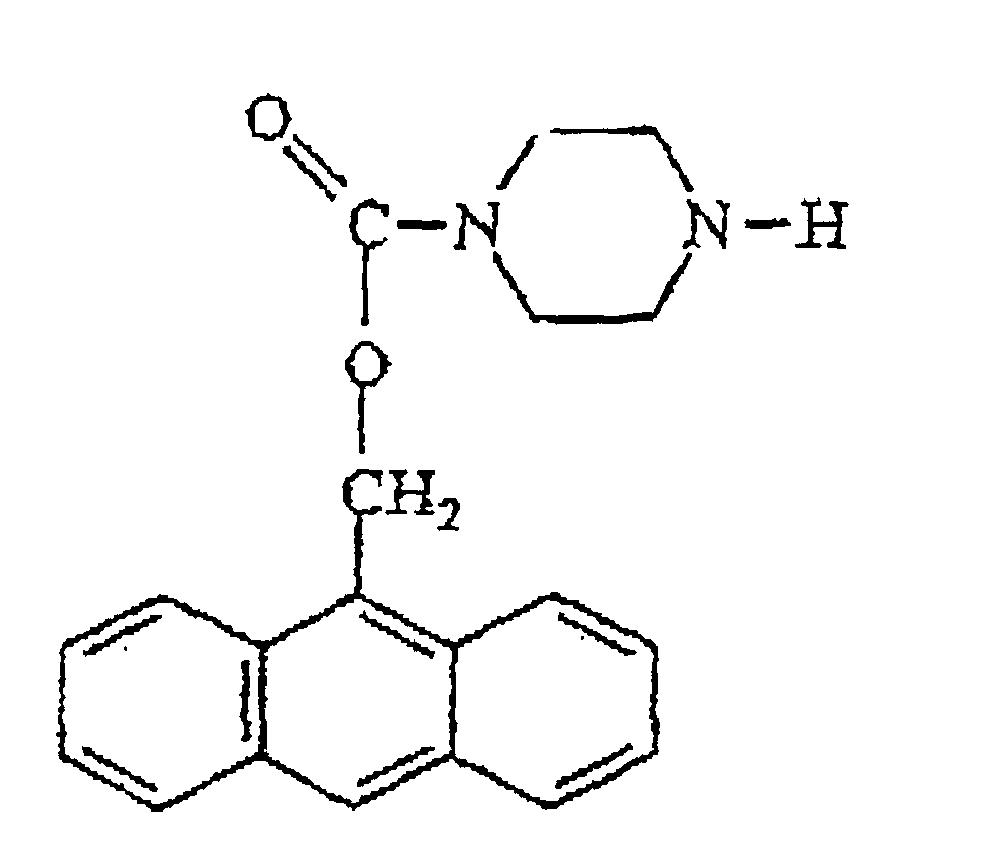
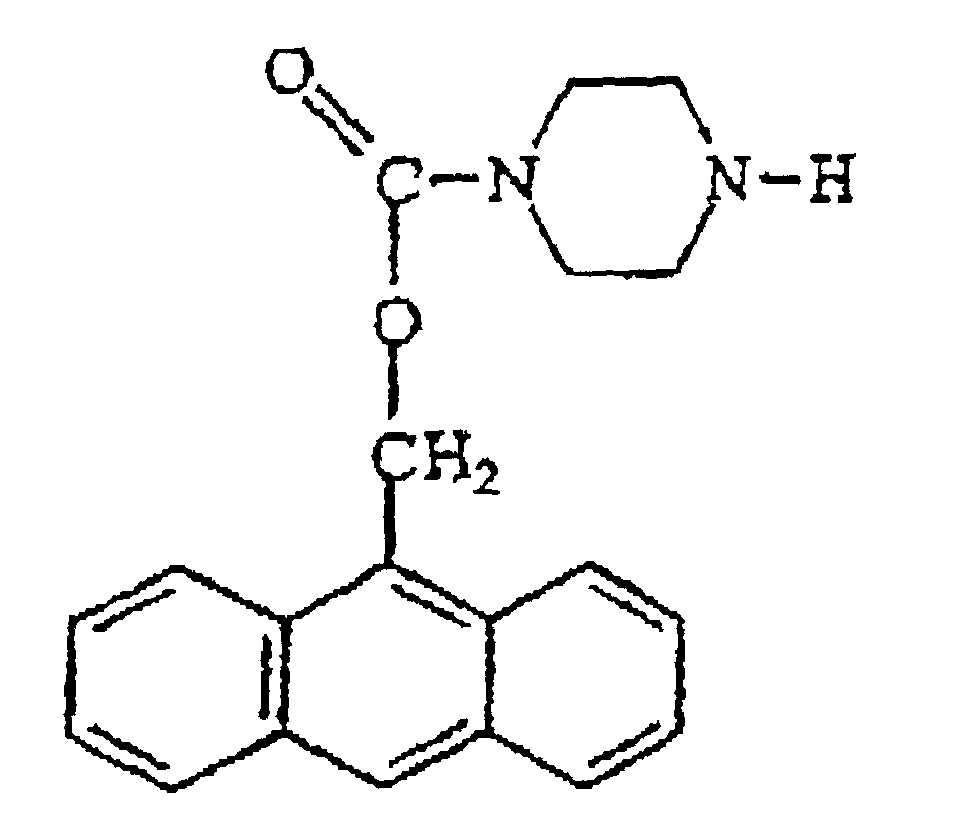
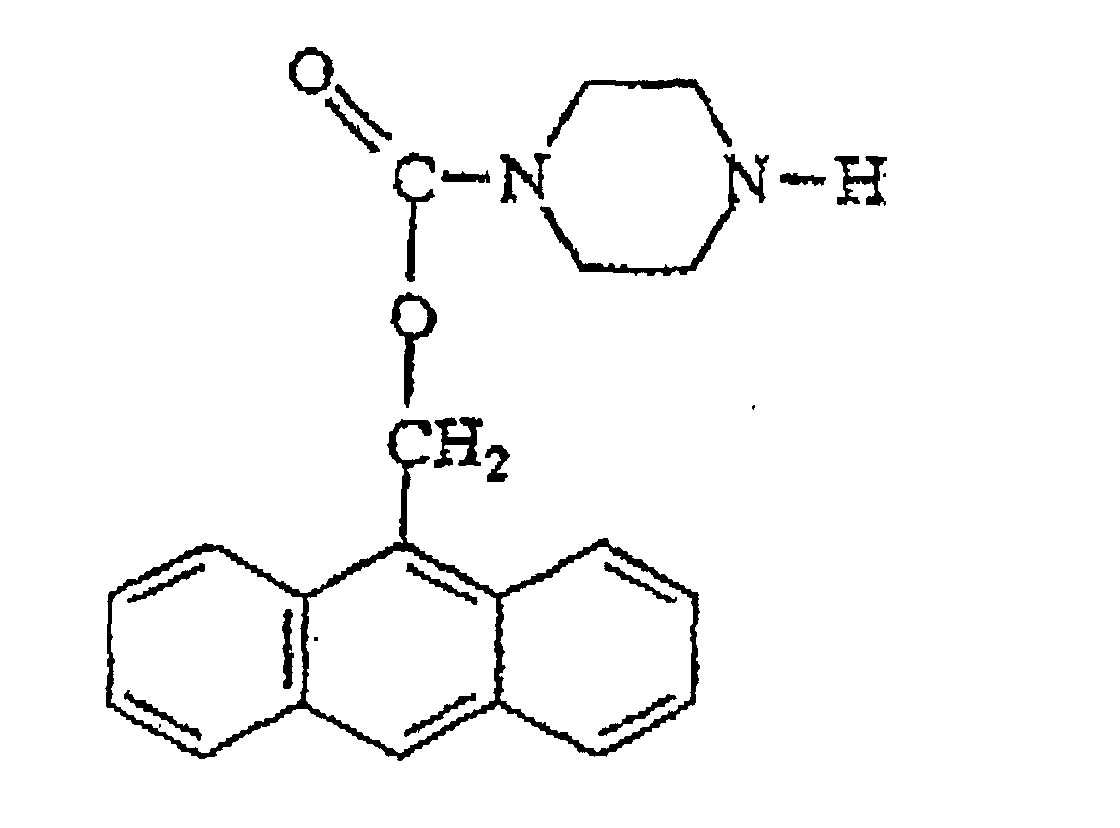
- PAC has the following chemical structure:
- PAC is produced by adding 9-anthacenemethanol and pyridine to a solution of p-nitrophenyl chloroformate.
- Product is isolated to provide a crude anthrylmethyl p-nitrophenyl carbonate, which is then added to a solution of piperazine.
- the reacted mixture is poured into water and extracted with a solvent, preferably an organic solvent such as toluene.
- the product is washed and dried to provide 9-anthracenylmethyl-1-piperazinecarboxylate (PAC).
- a derivatizing agent such as PAC or a similar compound is used in conjunction with any conventional type of environmental sampling device, such as an air sampling device, to detect the total amount of isocyanate present in the sample.
- the air sample containing the isocyanate is collected by passing air through an impinger or bubbler containing a solution of a derivatizing agent, such as PAC, or through a filter or sorbent cartridge impregnated with a derivatizing agent.
- a portion of the derivatizing agent molecule is cleaved from the derivatizing agent-isocyanate derivative and the cleaved portion is detected.
- the cleavage reaction is performed in a manner similar to the amine deprotection reactions described in Kornblum, et al . (J. Org. Chem., 42(2): 399-400, 1977).
- This method provides a distinct advantage over the isocyanate detection methods currently used by those skilled in the art because all of the isocyanate derivatives yield the same molecular cleavage residue, and total isocyanate levels are measured by simply measuring the amount of cleavage residue produced. Alternatively, if measurement of individual isocyanate species is desired, the individual species can be measured after derivatization but prior to cleavage.
- This method also provides an advantage over the prior art by allowing for the detection of isocyanate groups chemically bound to solid or particle surfaces, such as wood composites or polyurethane.
- an object of the present invention to provide an isocyanate derivatizing agent that is capable of derivatizing all isocyanate species.
- a novel organic compound, useful as an isocyanate derivatizing agent, is provided.
- the compound is 9-anthracenylmethyl-1-piperazinecarboxylate (PAC).
- Methods of producing PAC and methods of detecting and measuring isocyanate contaminant concentrations in an environmental sample using a derivatizing agent such as PAC are also provided.
- PAC has the following chemical structure:
- PAC can be synthesized by the following organic synthesis process.
- 9-anthacenemethanol and pyridine are added to a solution of p-nitrophenyl chloroformate.
- the reaction is monitored with thin-layer chromatography (TLC).
- TLC thin-layer chromatography
- product is isolated to provide a crude anthrylmethyl p-nitrophenyl carbonate, which is then added to a solution of piperazine.
- the reaction between the crude anthrylmethyl p-nitrophenyl carbonate and piperazine is also monitored with TLC.
- the reaction mixture is poured into water and extracted with a solvent, preferably an organic solvent such as toluene.
- the product is washed and dried to provide 9-anthracenylmethyl-1-piperazinecarboxylate (PAC).
- PAC 9-anthracenylmethyl-1-piperazinecarboxylate
- Isocyanates in a sample can be detected and quantified by the following method. This method can be used to quantify individual isocyanate monomers or to identify the total amount of isocyanate present in a sample, regardless of the individual isocyanate species present.
- a sample such as an environmental sample, is obtained using conventional sampling techniques known to those skilled in the art.
- the sample can be any environmental sample containing or suspected of containing isocyanates.
- Exemplary environmental samples include, but are not limited to, solids, liquids, air, and surface swipe samples.
- the environmental sample is an air sample, most preferably an air sample from a manufacturing facility that employs isocyanates.
- the sample may be obtained by any method, for example, by taking discreet samples at periodic intervals.
- An air sample containing a concentration of isocyanate to be detected or measured is contacted with a medium.
- a medium is an aprotic organic solvent, containing the derivatizing agent of the present invention.
- impingers or bubblers containing the solution of derivatizing agent, filters coated with the derivatizing agent, or sorbents coated with the derivatizing agent are used to contact the sample and the derivatizing agent.
- the sample is collected by passing air through an impinger or bubbler containing a solution of a derivatizing agent, such as PAC, or through a filter or sorbent cartridge impregnated with the derivatizing agent.
- the present method can be used to detect the total amount of isocyanate in a sample or to detect individual isocyanate derivatives.
- it is necessary to remove excess derivatizing agent because its presence can give an inaccurately high value.
- excess derivatizing agent Once excess derivatizing agent has been removed, a portion of the derivatizing agent molecule is cleaved from the derivatizing agent-isocyanate derivative, followed by detection of the cleavage residue.
- the entire derivatizing agent-isocyanate derivative may be detected without the necessity of cleaving the derivatizing agent-isocyanate derivative and without prior removal of excess derivatizing agent.
- Filters useful in the present invention are generally 13 mm, 25 mm, or 37 mm in diameter.
- the filter matrix into which the derivatizing agent is impregnated is preferably glass fiber or quartz fiber. Air is generally drawn through the filter with personal sampling pumps, typically at a rate of about 1 to 2 liters per minute. ,
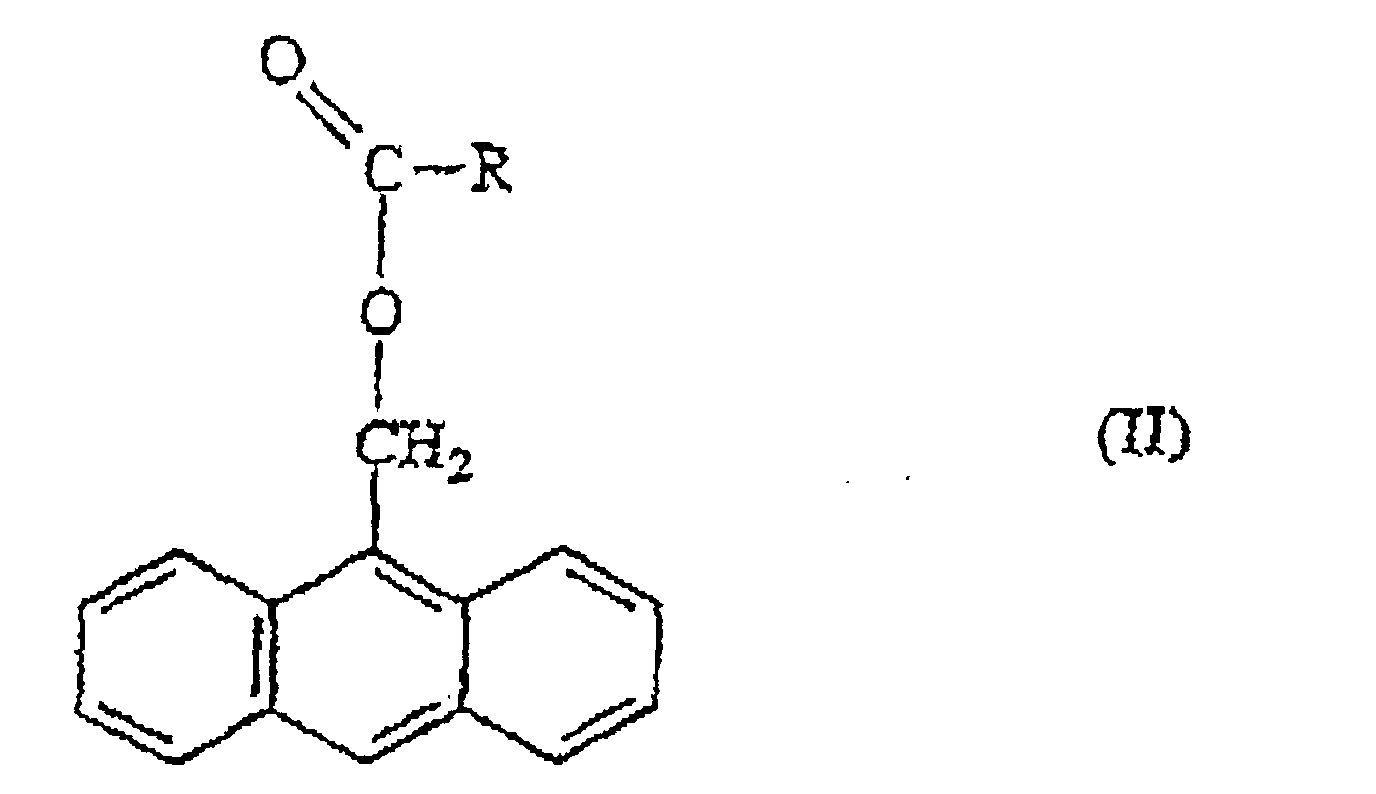
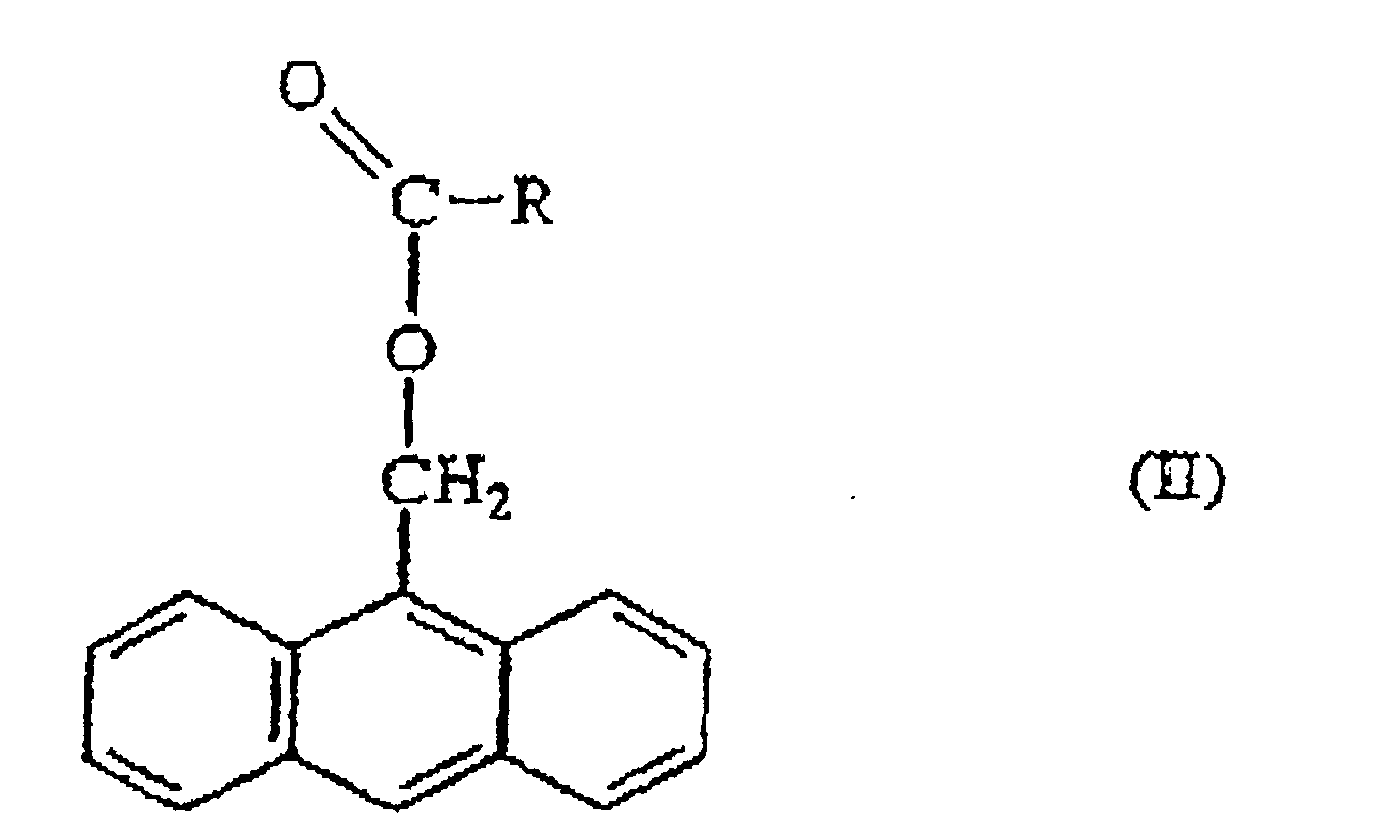
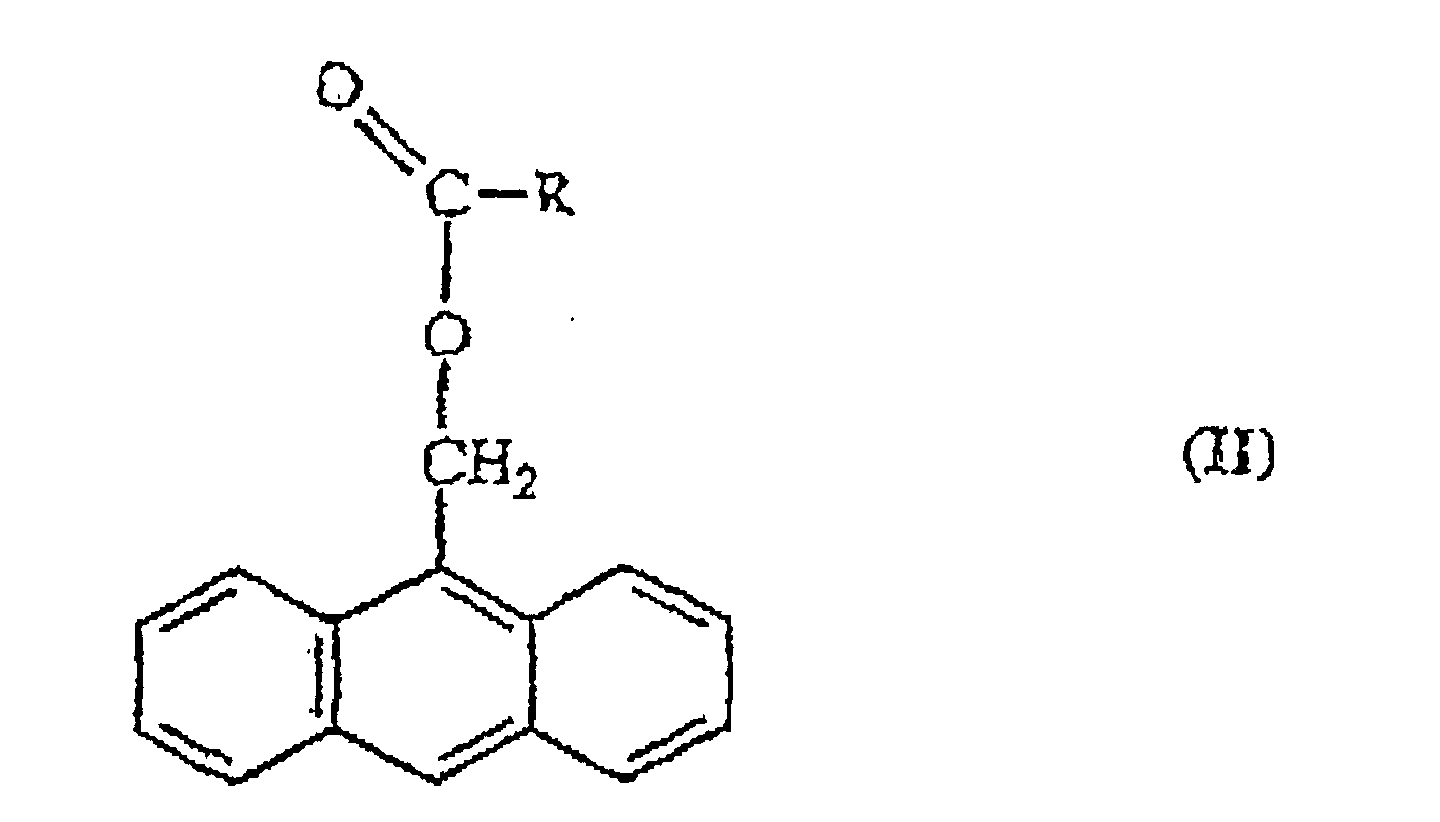
- the isocyanate-derivatizing agent with which the filter matrix is coated is a compound having the chemical formula of formula II, below: wherein R is a radical having a single isocyanate-derivatizing functionality comprising a primary or secondary amine.
- the derivatizing reagent reacts with the isocyanate functional groups of any isocyanate species present in the sample to form derivatized isocyanates which are a mixture of intermediate ureas.
- the mixture of intermediate ureas is then separated from excess PAC in the reaction mixture. Separation of excess derivatizing reagent is preferably achieved by passing the reaction mixture through a solid-phase extraction cartridge, such as a silica gel column, which retains both the mixture of intermediate ureas and any unreacted derivatizing agent. Separation of excess derivatizing reagent is important when using the present method to detect the total amount of isocyanate in the sample because the excess derivatizing agent will react with the cleavage agent to produce excess cleavage product.
- the mixture of intermediate ureas is then eluted from the column with a solvent, such as dimethylformamide (DMF).
- the DMF is generally used in concentrations from 1% to 10% in an appropriate solvent, such as acetonitrile, with 6% DMF being preferred (see Figure 1).
- a sample of the mixture of intermediate ureas is analyzed using, for example, high performance liquid chromatography (HPLC) to determine the quantity of one or more specific isocyanate species in the sample.
- HPLC high performance liquid chromatography
- the present invention can be used to determine the quantity of individual isocyanate species within a given air sample (see Figure 2).
- the mixture of intermediate ureas is reacted with a cleaving agent, such as sodium thiomethoxide or trifluoroacetic acid, to form a cleavage product, such as 9-anthracenylmethyl methyl sulfide.
- a cleaving agent such as sodium thiomethoxide or trifluoroacetic acid
- the cleavage product can then be quantified, for example, by high performance liquid chromatography (HPLC) equipped with an appropriate detector, such as a fluorescence detector.
- HPLC high performance liquid chromatography
- concentration of cleavage product is equal to the total concentration of isocyanate present in the air sample (see Figure 2).
- PAC or a derivatizing agent of formula II, as provided above is used to detect isocyanate compounds bound to a solid or particle surface.
- the solid surface or particles are treated with the derivatizing agent which reacts with the free isocyanate groups on the surface. Excess derivatizing agent is then removed from the surface by solvent extraction.
- the solid surface or particles are then treated with sodium thiomethoxide solution to generate 9-anthracenylmethyl methyl sulfide from the chemically bound isocyanate groups.
- the preferred isocyanate-derivatizing agent to be used in the method is PAC, which is prepared as described above.
- Isocyanate-derivatizing agents other than PAC, which are useful for detecting or measuring isocyanates in a sample, are described in more detail below.
- These isocyanate-derivatizing agents can be produced by a process similar to the PAC production process by first producing the crude anthrylmethyl p-nitrophenyl carbonate intermediate as described above, followed by reaction of the particular amine with the intermediate.
- Such compounds include those having the following formula: wherein R is a radical having a single isocyanate-derivatizing functionality comprising a primary or secondary amine.
- Preferred compounds of the present invention are those in which R comprises a radical of a primary or secondary diamine.
- Especially preferred compounds are those in which R comprises a radical of an aliphatic primary or secondary diamine.
- the most preferred compounds of the present invention are those in which R comprises a radical of a symmetrical aliphatic primary or secondary diamine.
- contemplated R groups include, but are not limited to, substituted or unsubstituted radicals of piperidine, piperazine, 1,2-diaminoethane, 1,3-diaminopropane, 1.4-diaminobutane, 1.5-diaminopentane, 1,6-diaminohexane, and 4,4'-bipiperidine.
- reaction mixture was then decanted to separate the solution from the white precipitate which had formed, followed by rote-evaporation to remove the THF.
- product residue was dissolved in toluene. This solution was then decanted to remove any undissolved product residue.
- the crude anthrylmethyl p-nitrophenyl carbonate (8.60 g) produced in Example 1 was dissolved in 40 ml of dimethylformamide (DMF), and 14.0 g of piperazine (162 mmoles, 10 fold excess) were dissolved in 20 ml of DMF.
- the solution of crude anthrylmethyl p-nitrophenyl carbonate was then added dropwise to the piperazine solution while stirring constantly. The reaction was monitored with TLC.
- reaction mixture was poured into 100 ml of ice water and extracted with toluene.
- the toluene extract was washed once with 100 ml of a 10% sodium carbonate solution and twice with 100 ml of deionized water.
- the toluene extract was then passed through a sodium sulfate column to remove any residual water, followed by roto-evaporatation to produce 9-anthracenylmethyl-1-piperazinecarboxylate (PAC).
- PAC 9-anthracenylmethyl-1-piperazinecarboxylate
- the precipitate was separated by filtration through a fritted glass funnel. The precipitate was washed three times with small amounts of toluene and twice with hexane. The precipitate, the urea of phenyl isocyanate and PAC, weighed 0.81 g (94% yield).
- the washed toluene extracts were then roto-evaporated to dryness.
- the crude product was dissolved in 10 ml of toluene and loaded onto a 100 ml silica gel column.
- the column was eluted with about 600 ml of hexane to remove impurities, followed by 2:1 hexane:ethyl acetate solution which quickly eluted the desired product.
- the fractions containing the product were then roto-evaporated, yielding 193 mg (88% yield) 9-anthracenylmethyl methyl sulfide.
- the sodium thiomethoxide solution used in this experiment is very sensitive to oxidation by air. If the sodium thiomethoxide solution is prepared under nitrogen but stored in air, it is only usable for one day. However, if the solution is both prepared and stored in nitrogen, it is stable for about one week. Concentrated solutions of the sodium thiomethoxide reagent prepared in methanol (100 mg/ml) can be stored for one week and then diluted with DMF for use in the reaction as described in this experiment.
- PAC can be readily separated from the urea mixture as shown in this example. In practice, this separation would be performed through solid-phase extraction.
- PAC and the PAC isocyanate ureas listed below in Table 1 were individually dissolved in DMF at concentrations of between 0.1-0.5%.
- One microliter of each sample solution was then placed 15 mm from the bottom of a 90 mm silica gel TLC plate.
- the DMF spotting solvent was removed by subjecting the plate to a high vacuum.
- the plate was then placed in the developing chamber in 10 ml of 5% DMF in acetonitrile and the solvent was allowed to climb the plate until 60 mm above the original spotting position. At this point the plate was removed from the developing chamber, the solvent was allowed to evaporate, and the position of the spots was evaluated under a UV light. The distance between the center of the spot and the original position of the spot was used as the migration distance.
- R f which is a measure of the extent of movement of a compound along the plate, was calculated as the ratio of the migration distance to the total distance traveled by the solvent. Then, the R f for the PAC-urea was divided by the R f for PAC to give a measure of the degree of separation of the two compounds.
- Example 5 The procedure provided in Example 5 was repeated using PAC and PAC-HDI (PAC-hexamethylene diisocyanate urea). The percentage of DMF in the acetonitrile was varied to determine the optimum DMF concentration for separation of unreacted PAC from the PAC-isocyanate ureas. As seen in Table 2 below and in Figure 1,6% DMF in acetonitrile was found to be the optimum elution solvent for separating excess PAC from the PAC-isocyanate ureas. Table 2 shows the results of repeat experiments conducted at different times.
- PAC and PAC-HDI PAC-hexamethylene diisocyanate urea
- MAP 1-(9-anthracenylmethyl)piperazine
- MAP for the detection of isocyanates is the subject matter of U.S. Patent No. 5,354,689.
- the advantage of PAC over MAP is its ability to detect all species of isocyanates through the PAC cleavage residue. MAP is not able to form such a residue and, therefore, only measures individual species of isocyanates.
- isocyanates are highly reactive and exist in samples together with compounds that can react with them (e.g., polyols and water), derivatizing reagents must react with isocyanates sufficiently fast to avoid losses to these side reactions. Also, efficient collection of isocyanate vapors on a reagent-impregnated filter requires rapid derivatization. In this experiment, phenyl isocyanate was reacted with an equimolar mixture of PAC and MAP, with the PAC and MAP to assess PAC's reactivity with isocyanates.
- PAC's reactivity with phenyl isocyanate is less than the MAP reagent, it is greater than the reactivity of at least one commonly used reagent, [N-(4-nitrobenzyl)propylamine], and considerably greater than that of the polyols and water against which it is competing for isocyanate.
Landscapes
- Chemical & Material Sciences (AREA)
- Organic Chemistry (AREA)
- Life Sciences & Earth Sciences (AREA)
- Health & Medical Sciences (AREA)
- Biochemistry (AREA)
- Immunology (AREA)
- Physics & Mathematics (AREA)
- Analytical Chemistry (AREA)
- Biophysics (AREA)
- General Health & Medical Sciences (AREA)
- General Physics & Mathematics (AREA)
- Molecular Biology (AREA)
- Pathology (AREA)
- Investigating Or Analyzing Non-Biological Materials By The Use Of Chemical Means (AREA)
- Organic Low-Molecular-Weight Compounds And Preparation Thereof (AREA)
- Preparation Of Compounds By Using Micro-Organisms (AREA)
- Acyclic And Carbocyclic Compounds In Medicinal Compositions (AREA)
- Pharmaceuticals Containing Other Organic And Inorganic Compounds (AREA)
Claims (24)
- Composé ayant la formule suivante :dans laquelle R est un radical ayant une unique fonctionnalité de dérivatisation d'isocyanate et dans laquelle l'unique fonctionnalité de dérivatisation d'isocyanate comprend une amine primaire ou secondaire.
- Composé selon la revendication 1, dans lequel R comprend au moins un radical d'une diamine primaire ou secondaire aliphatique symétrique.
- Composé selon la revendication 1, dans lequel R est choisi dans le groupe constitué d'un radical substitué ou non substitué de pipérazine, pipéridine, 4,4'-bipipéridine, 1,2-diaminoéthane, 1,3-diaminopropane, 1,4-diaminobutane, 1,5-diaminopentane et 1,6-diaminohexane, dans lequel le R est capable de réagir avec un isocyanate.
- Composé selon la revendication 3, ayant la formule :
- Procédé de préparation du 1-pipérazine-carboxylate de 9-anthracénylméthyle (PAC) comprenant :(a) la réaction du 9-anthracèneméthanol, de la pyridine et du chloroformate de p-nitrophényle pour produire du carbonate d'anthrylméthyle et de p-nitrophényle ;(b) l'isolation du carbonate d'anthrylméthyle et de p-nitrophényle produit à l'étape (a) ; et(c) la réaction du carbonate d'anthrylméthyle et de p-nitrophényle, isolé à l'étape (b), avec la pipérazine pour produire du 1-pipérazine-carboxylate de 9-anthracénylméthyle.
- Procédé de détermination de la quantité totale d'isocyanate dans un échantillon, comprenant :(a) la mise en contact de l'échantillon avec un agent de dérivatisation d'isocyanate ayant la formule suivante :dans laquelle R comprend au moins un radical d'une amine primaire ou secondaire pour former un mélange d'urées ;
 (b) la séparation du mélange d'urées de l'agent de dérivatisation n'ayant pas réagi ;(c) la réaction des urées avec du thiométhoxyde de sodium pour former le méthylsulfure de 9-anthracénylméthyle ; et(d) la quantification de la quantité de méthylsulfure de 9-anthracénylméthylméthyle produite.
 - Procédé selon la revendication 6, dans lequel R comprend au moins un radical d'une diamine primaire ou secondaire aliphatique symétrique.
- Procédé selon la revendication 6, dans lequel R est choisi dans le groupe constitué d'un radical substitué ou non substitué de pipérazine, pipéridine, 4,4'-bipipéridine, 1,2-diaminoéthane, 1,3-diaminopropane, 1,4-diaminobutane, 1,5-diaminopentane et 1,6-diaminohexane.
- Procédé selon la revendication 8, dans lequel l'agent de dérivatisation isocyanate est un composé ayant la formule suivante :
- Procédé selon la revendication 6, dans lequel le méthylsulfure de 9-anthracénylméthyle est quantifié en utilisant les procédés de chromatographie.
- Procédé selon la revendication 10, dans lequel le méthylsulfure de 9-anthracénylméthyle est quantifié en utilisant la chromatographie liquide haute performance (HPLC) munie d'un détecteur de fluorescence.
- Procédé de détermination de la quantité d'isocyanates individuels dans un échantillon, comprenant :(a) la mise en contact de l'échantillon avec un agent de dérivatisation d'isocyanate ayant la formule suivante :dans laquelle R comprend un radical d'une amine primaire ou secondaire pour former un mélange d'urées ; où l'agent de dérivatisation d'isocyanates est capable de déterminer la quantité totale des isocyanate dans un échantillon sans réaliser la somme de la quantité des isocyanates individuels détectés ;
 (b) la détection des urées individuelles dans l'échantillon ;(c) la quantification de la quantité de chaque urée individuelle, où la quantité de chaque urée correspond à l'isocyanate individuel à déterminer.
 - Procédé selon la revendication 12, dans lequel R comprend au moins un radical d'une diamine primaire ou secondaire aliphatique symétrique.
- Procédé selon la revendication 12, dans lequel R de l'agent de dérivatisation d'isocyanate est choisi dans le groupe constitué d'un radical substitué ou non substitué de pipérazine, pipéridine, 4,4'-bipipéridine, 1,2-diaminoéthane, 1,3-diaminopropane, 1,4-diaminobutane, 1,5-diaminopentane et 1,6-diaminohexane.
- Procédé selon la revendication 14, dans lequel l'agent de dérivatisation d'isocyanate est un composé ayant la formule suivante :
- Procédé selon la revendication 12, dans lequel l'urée est quantifiée en utilisant des procédés de chromatographie.
- Procédé selon la revendication 16, dans lequel l'urée est quantifiée en utilisant la chromatographie liquide haute performance (HPLC) munie d'un détecteur de fluorescence.
- Procédé de détermination de la quantité totale d'isocyanates sur un solide ou sur une surface d'une particule, comprenant :(a) la mise en contact d'un solide ou d'une surface d'une particule avec un agent de dérivatisation d'isocyanate ayant la formule suivante :dans laquelle R comprend au moins un radical d'amine primaire ou secondaire ;
 (b) le traitement du solide ou de la surface particulaire avec un solvant pour extraire l'excédent d'agent de dérivatisation d'isocyanate ;(c) le traitement du solide ou de la surface de la particule avec du thiométhoxyde de sodium pour former du methylsulfure de 9-anthracénylméthyle ; et(d) la quantification de la quantité de méthylsulfure de 9-anthracénylméthyle produite.
 - Procédé selon la revendication 18, dans lequel R comprend un radical d'une diamine primaire ou secondaire aliphatique symétrique.
- Procédé selon la revendication 18, dans lequel R est choisi dans le groupe constitué d'un radical substitué ou non substitué de pipérazine, pipéridine, 4,4'-bipipéridine, 1,2-diaminoéthane, 1,3-diaminopropane, 1,4-diaminobutane, 1,5-diaminopentane et 1,6-diaminohexane.
- Procédé selon la revendication 20, dans lequel l'agent de dérivatisation d'isocyanate est un composé ayant la formule suivante :
- Procédé selon la revendication 18, dans lequel le méthylsulfure de 9-anthracénylméthyle est quantifié en utilisant des procédés de chromatographie.
- Procédé selon la revendication 22, dans lequel le méthylsulfure de 9-anthracénylméthyle est quantifié en utilisant la chromatographie liquide haute performance (HPLC) munie d'un détecteur de fluorescence.
- Procédé selon la revendication 18, dans lequel le solide ou la particule sont choisis dans le groupe constitué du polyuréthane et de la poussière de composites de bois.
Applications Claiming Priority (3)
| Application Number | Priority Date | Filing Date | Title |
|---|---|---|---|
| US8526098P | 1998-05-13 | 1998-05-13 | |
| US85260P | 1998-05-13 | ||
| PCT/US1999/010634 WO1999058517A2 (fr) | 1998-05-13 | 1999-05-13 | Agent de derivatisation d'isocyanates et procedes de fabrication et d'utilisation correspondants |
Publications (2)
| Publication Number | Publication Date |
|---|---|
| EP1077962A2 EP1077962A2 (fr) | 2001-02-28 |
| EP1077962B1 true EP1077962B1 (fr) | 2005-04-13 |
Family
ID=22190464
Family Applications (1)
| Application Number | Title | Priority Date | Filing Date |
|---|---|---|---|
| EP99923040A Expired - Lifetime EP1077962B1 (fr) | 1998-05-13 | 1999-05-13 | Agent de derivatisation d'isocyanates et procedes de fabrication et d'utilisation correspondants |
Country Status (8)
| Country | Link |
|---|---|
| EP (1) | EP1077962B1 (fr) |
| AT (1) | ATE293105T1 (fr) |
| AU (1) | AU3990199A (fr) |
| CA (1) | CA2331539A1 (fr) |
| DE (1) | DE69924720T2 (fr) |
| DK (1) | DK1077962T3 (fr) |
| ES (1) | ES2242399T3 (fr) |
| WO (1) | WO1999058517A2 (fr) |
Families Citing this family (1)
| Publication number | Priority date | Publication date | Assignee | Title |
|---|---|---|---|---|
| JP5682311B2 (ja) * | 2008-12-02 | 2015-03-11 | 和光純薬工業株式会社 | 光塩基発生剤 |
Family Cites Families (1)
| Publication number | Priority date | Publication date | Assignee | Title |
|---|---|---|---|---|
| US5354689A (en) * | 1993-05-10 | 1994-10-11 | The United States Of America As Represented By The Department Of Health And Human Services | Method of detecting isocyanates |
-
1999
- 1999-05-13 CA CA002331539A patent/CA2331539A1/fr not_active Abandoned
- 1999-05-13 AU AU39901/99A patent/AU3990199A/en not_active Abandoned
- 1999-05-13 DE DE69924720T patent/DE69924720T2/de not_active Expired - Fee Related
- 1999-05-13 WO PCT/US1999/010634 patent/WO1999058517A2/fr not_active Ceased
- 1999-05-13 AT AT99923040T patent/ATE293105T1/de not_active IP Right Cessation
- 1999-05-13 EP EP99923040A patent/EP1077962B1/fr not_active Expired - Lifetime
- 1999-05-13 DK DK99923040T patent/DK1077962T3/da active
- 1999-05-13 ES ES99923040T patent/ES2242399T3/es not_active Expired - Lifetime
Also Published As
| Publication number | Publication date |
|---|---|
| EP1077962A2 (fr) | 2001-02-28 |
| ATE293105T1 (de) | 2005-04-15 |
| WO1999058517A2 (fr) | 1999-11-18 |
| ES2242399T3 (es) | 2005-11-01 |
| CA2331539A1 (fr) | 1999-11-18 |
| DK1077962T3 (da) | 2005-05-23 |
| DE69924720T2 (de) | 2006-05-04 |
| AU3990199A (en) | 1999-11-29 |
| DE69924720D1 (de) | 2005-05-19 |
| WO1999058517A3 (fr) | 2000-01-27 |
Similar Documents
| Publication | Publication Date | Title |
|---|---|---|
| Verma | Determination of ammonia and aliphatic amines in environmental aqueous samples utilizing pre-column derivatization to their phenylthioureas and high performance liquid chromatography | |
| Marand et al. | Determination of technical grade isocyanates used in the production of polyurethane plastics | |
| BAGON et al. | Evaluation of Total Isocyanate-in-air Method using l-(2-Methoxyphenyl) piperazine and HPLC | |
| Warwick et al. | Application of electrochemical detection to the measurement of free monomeric aromatic and aliphatic isocyanates in air by high-performance liquid chromatography | |
| Keller et al. | Determination of isocyanates in the working atmosphere by thin-layer chromatography | |
| Kääriä et al. | Exposure to 4, 4′-methylenediphenyl diisocyanate (MDI) during moulding of rigid polyurethane foam: determination of airborne MDI and urinary 4, 4′-methylenedianiline (MDA) | |
| EP1196756B1 (fr) | Echantillonneur | |
| Kormos et al. | Determination of isocyanates in air by liquid chromatography with fluorescence detection | |
| EP1077962B1 (fr) | Agent de derivatisation d'isocyanates et procedes de fabrication et d'utilisation correspondants | |
| US6656737B1 (en) | Isocynate derivatizing agent and methods of production and use | |
| Rando et al. | Evaluation of 9-methylamino-methylanthracene as a chemical label for total reactive isocyanate group: Application to isocyanate oligomers, polyurethane precursors, and phosgene | |
| Henriks-Eckerman et al. | Determination of airborne methyl isocyanate as dibutylamine or 1-(2-methoxyphenyl) piperazine derivatives by liquid and gas chromatography | |
| Guglya | Determination of isocyanates in air | |
| Schmidtke et al. | A highly sensitive high-performance liquid chromatographic procedure for the determination of isocyanates in air | |
| Levine et al. | Determination of aliphatic isocyanates in air by a liquid chromatographic-fluorescence technique | |
| Andersson et al. | Determination of ethylenediamine in air using reagent-coated adsorbent tubes and high-performance liquid chromatography on the 1-naphthylisothiourea derivative | |
| US5354689A (en) | Method of detecting isocyanates | |
| Skarping et al. | Trace analysis of airborne 1, 6-hexamethylenediisocyanate and the related aminoisocyanate and diamine by glass capillary gas chromatography | |
| US20060130565A1 (en) | Measurement of total reactive isocyanate groups in samples using bifunctional nucleophiles such as 1,8-diaminonaphthalene (dan) | |
| Brochhagen et al. | Diphenylmethane diisocyanate: the concentration of its saturated vapor | |
| Roh et al. | Development of a new approach for total isocyanate determination using the reagent 9-anthracenylmethyl-1-piperazinecarboxylate | |
| Lesage | Isocyanates: sampling, analysis, and health effects | |
| Daoud et al. | Development of a new SPE UPLC–MS/MS method for extraction and quantitation of toluene diamine on gloves following toluene diisocyanate exposure | |
| Zhou et al. | Silica based 3, 5-dinitrobenzoyl (DNB) reagent for off-line derivatization of amine nucleophiles in HPLC | |
| Selvakumar et al. | Detection techniques for air-borne isocyanates based on fluorescent derivatizing agents |
Legal Events
| Date | Code | Title | Description |
|---|---|---|---|
| PUAI | Public reference made under article 153(3) epc to a published international application that has entered the european phase |
Free format text: ORIGINAL CODE: 0009012 |
|
| 17P | Request for examination filed |
Effective date: 20001124 |
|
| AK | Designated contracting states |
Kind code of ref document: A2 Designated state(s): AT BE CH CY DE DK ES FI FR GB GR IE IT LI LU MC NL PT SE |
|
| 17Q | First examination report despatched |
Effective date: 20021001 |
|
| GRAP | Despatch of communication of intention to grant a patent |
Free format text: ORIGINAL CODE: EPIDOSNIGR1 |
|
| GRAS | Grant fee paid |
Free format text: ORIGINAL CODE: EPIDOSNIGR3 |
|
| GRAA | (expected) grant |
Free format text: ORIGINAL CODE: 0009210 |
|
| AK | Designated contracting states |
Kind code of ref document: B1 Designated state(s): AT BE CH CY DE DK ES FI FR GB GR IE IT LI LU MC NL PT SE |
|
| PG25 | Lapsed in a contracting state [announced via postgrant information from national office to epo] |
Ref country code: LI Free format text: LAPSE BECAUSE OF FAILURE TO SUBMIT A TRANSLATION OF THE DESCRIPTION OR TO PAY THE FEE WITHIN THE PRESCRIBED TIME-LIMIT Effective date: 20050413 Ref country code: IT Free format text: LAPSE BECAUSE OF FAILURE TO SUBMIT A TRANSLATION OF THE DESCRIPTION OR TO PAY THE FEE WITHIN THE PRE;WARNING: LAPSES OF ITALIAN PATENTS WITH EFFECTIVE DATE BEFORE 2007 MAY HAVE OCCURRED AT ANY TIME BEFORE 2007. THE CORRECT EFFECTIVE DATE MAY BE DIFFERENT FROM THE ONE RECORDED.SCRIBED TIME-LIMIT Effective date: 20050413 Ref country code: CH Free format text: LAPSE BECAUSE OF FAILURE TO SUBMIT A TRANSLATION OF THE DESCRIPTION OR TO PAY THE FEE WITHIN THE PRESCRIBED TIME-LIMIT Effective date: 20050413 Ref country code: BE Free format text: LAPSE BECAUSE OF FAILURE TO SUBMIT A TRANSLATION OF THE DESCRIPTION OR TO PAY THE FEE WITHIN THE PRESCRIBED TIME-LIMIT Effective date: 20050413 Ref country code: AT Free format text: LAPSE BECAUSE OF FAILURE TO SUBMIT A TRANSLATION OF THE DESCRIPTION OR TO PAY THE FEE WITHIN THE PRESCRIBED TIME-LIMIT Effective date: 20050413 |
|
| RAP1 | Party data changed (applicant data changed or rights of an application transferred) |
Owner name: THE GOVERNMENT OF THE UNITED STATES OF AMERICA,ASD |
|
| REG | Reference to a national code |
Ref country code: GB Ref legal event code: FG4D |
|
| REG | Reference to a national code |
Ref country code: CH Ref legal event code: EP |
|
| PG25 | Lapsed in a contracting state [announced via postgrant information from national office to epo] |
Ref country code: LU Free format text: LAPSE BECAUSE OF NON-PAYMENT OF DUE FEES Effective date: 20050513 Ref country code: CY Free format text: LAPSE BECAUSE OF FAILURE TO SUBMIT A TRANSLATION OF THE DESCRIPTION OR TO PAY THE FEE WITHIN THE PRESCRIBED TIME-LIMIT Effective date: 20050513 |
|
| REG | Reference to a national code |
Ref country code: SE Ref legal event code: TRGR |
|
| REG | Reference to a national code |
Ref country code: IE Ref legal event code: FG4D |
|
| REF | Corresponds to: |
Ref document number: 69924720 Country of ref document: DE Date of ref document: 20050519 Kind code of ref document: P |
|
| REG | Reference to a national code |
Ref country code: DK Ref legal event code: T3 |
|
| PG25 | Lapsed in a contracting state [announced via postgrant information from national office to epo] |
Ref country code: MC Free format text: LAPSE BECAUSE OF NON-PAYMENT OF DUE FEES Effective date: 20050531 |
|
| PGFP | Annual fee paid to national office [announced via postgrant information from national office to epo] |
Ref country code: FR Payment date: 20050622 Year of fee payment: 7 |
|
| PGFP | Annual fee paid to national office [announced via postgrant information from national office to epo] |
Ref country code: SE Payment date: 20050623 Year of fee payment: 7 |
|
| PGFP | Annual fee paid to national office [announced via postgrant information from national office to epo] |
Ref country code: NL Payment date: 20050624 Year of fee payment: 7 Ref country code: DK Payment date: 20050624 Year of fee payment: 7 |
|
| PGFP | Annual fee paid to national office [announced via postgrant information from national office to epo] |
Ref country code: ES Payment date: 20050627 Year of fee payment: 7 |
|
| PGFP | Annual fee paid to national office [announced via postgrant information from national office to epo] |
Ref country code: GB Payment date: 20050629 Year of fee payment: 7 Ref country code: FI Payment date: 20050629 Year of fee payment: 7 |
|
| PGFP | Annual fee paid to national office [announced via postgrant information from national office to epo] |
Ref country code: IE Payment date: 20050630 Year of fee payment: 7 |
|
| PG25 | Lapsed in a contracting state [announced via postgrant information from national office to epo] |
Ref country code: GR Free format text: LAPSE BECAUSE OF FAILURE TO SUBMIT A TRANSLATION OF THE DESCRIPTION OR TO PAY THE FEE WITHIN THE PRESCRIBED TIME-LIMIT Effective date: 20050713 |
|
| PGFP | Annual fee paid to national office [announced via postgrant information from national office to epo] |
Ref country code: DE Payment date: 20050729 Year of fee payment: 7 |
|
| PG25 | Lapsed in a contracting state [announced via postgrant information from national office to epo] |
Ref country code: PT Free format text: LAPSE BECAUSE OF FAILURE TO SUBMIT A TRANSLATION OF THE DESCRIPTION OR TO PAY THE FEE WITHIN THE PRESCRIBED TIME-LIMIT Effective date: 20050913 |
|
| REG | Reference to a national code |
Ref country code: CH Ref legal event code: PL |
|
| REG | Reference to a national code |
Ref country code: ES Ref legal event code: FG2A Ref document number: 2242399 Country of ref document: ES Kind code of ref document: T3 |
|
| PLBE | No opposition filed within time limit |
Free format text: ORIGINAL CODE: 0009261 |
|
| STAA | Information on the status of an ep patent application or granted ep patent |
Free format text: STATUS: NO OPPOSITION FILED WITHIN TIME LIMIT |
|
| ET | Fr: translation filed | ||
| 26N | No opposition filed |
Effective date: 20060116 |
|
| PG25 | Lapsed in a contracting state [announced via postgrant information from national office to epo] |
Ref country code: GB Free format text: LAPSE BECAUSE OF NON-PAYMENT OF DUE FEES Effective date: 20060513 Ref country code: FI Free format text: LAPSE BECAUSE OF NON-PAYMENT OF DUE FEES Effective date: 20060513 |
|
| PG25 | Lapsed in a contracting state [announced via postgrant information from national office to epo] |
Ref country code: SE Free format text: LAPSE BECAUSE OF NON-PAYMENT OF DUE FEES Effective date: 20060514 |
|
| PG25 | Lapsed in a contracting state [announced via postgrant information from national office to epo] |
Ref country code: IE Free format text: LAPSE BECAUSE OF NON-PAYMENT OF DUE FEES Effective date: 20060515 |
|
| PG25 | Lapsed in a contracting state [announced via postgrant information from national office to epo] |
Ref country code: ES Free format text: LAPSE BECAUSE OF NON-PAYMENT OF DUE FEES Effective date: 20060516 |
|
| PG25 | Lapsed in a contracting state [announced via postgrant information from national office to epo] |
Ref country code: DK Free format text: LAPSE BECAUSE OF NON-PAYMENT OF DUE FEES Effective date: 20060531 |
|
| PG25 | Lapsed in a contracting state [announced via postgrant information from national office to epo] |
Ref country code: NL Free format text: LAPSE BECAUSE OF NON-PAYMENT OF DUE FEES Effective date: 20061201 Ref country code: DE Free format text: LAPSE BECAUSE OF NON-PAYMENT OF DUE FEES Effective date: 20061201 |
|
| REG | Reference to a national code |
Ref country code: DK Ref legal event code: EBP |
|
| EUG | Se: european patent has lapsed | ||
| GBPC | Gb: european patent ceased through non-payment of renewal fee |
Effective date: 20060513 |
|
| NLV4 | Nl: lapsed or anulled due to non-payment of the annual fee |
Effective date: 20061201 |
|
| REG | Reference to a national code |
Ref country code: IE Ref legal event code: MM4A |
|
| REG | Reference to a national code |
Ref country code: FR Ref legal event code: ST Effective date: 20070131 |
|
| REG | Reference to a national code |
Ref country code: ES Ref legal event code: FD2A Effective date: 20060516 |
|
| PG25 | Lapsed in a contracting state [announced via postgrant information from national office to epo] |
Ref country code: FR Free format text: LAPSE BECAUSE OF NON-PAYMENT OF DUE FEES Effective date: 20060531 |