EP1078595A2 - Einmalelektrode für Neugeborene zum Einsatz in feuchter Umgebung - Google Patents
Einmalelektrode für Neugeborene zum Einsatz in feuchter Umgebung Download PDFInfo
- Publication number
- EP1078595A2 EP1078595A2 EP00118424A EP00118424A EP1078595A2 EP 1078595 A2 EP1078595 A2 EP 1078595A2 EP 00118424 A EP00118424 A EP 00118424A EP 00118424 A EP00118424 A EP 00118424A EP 1078595 A2 EP1078595 A2 EP 1078595A2
- Authority
- EP
- European Patent Office
- Prior art keywords
- skin
- hydrogel
- adjunct
- electrode
- patient
- Prior art date
- Legal status (The legal status is an assumption and is not a legal conclusion. Google has not performed a legal analysis and makes no representation as to the accuracy of the status listed.)
- Withdrawn
Links
Images

Classifications
-
- A—HUMAN NECESSITIES
- A61—MEDICAL OR VETERINARY SCIENCE; HYGIENE
- A61B—DIAGNOSIS; SURGERY; IDENTIFICATION
- A61B5/00—Measuring for diagnostic purposes; Identification of persons
- A61B5/24—Detecting, measuring or recording bioelectric or biomagnetic signals of the body or parts thereof
- A61B5/25—Bioelectric electrodes therefor
- A61B5/251—Means for maintaining electrode contact with the body
- A61B5/257—Means for maintaining electrode contact with the body using adhesive means, e.g. adhesive pads or tapes
- A61B5/259—Means for maintaining electrode contact with the body using adhesive means, e.g. adhesive pads or tapes using conductive adhesive means, e.g. gels
-
- A—HUMAN NECESSITIES
- A61—MEDICAL OR VETERINARY SCIENCE; HYGIENE
- A61B—DIAGNOSIS; SURGERY; IDENTIFICATION
- A61B2562/00—Details of sensors; Constructional details of sensor housings or probes; Accessories for sensors
- A61B2562/02—Details of sensors specially adapted for in-vivo measurements
- A61B2562/0209—Special features of electrodes classified in A61B5/24, A61B5/25, A61B5/283, A61B5/291, A61B5/296, A61B5/053
- A61B2562/0215—Silver or silver chloride containing
Definitions
- This invention relates to a disposable medical electrode which provides extended use in a high humidity environment. More particularly, this invention relates to an ECG, or the like, electrode which is suitable for use on neonatal patients who are placed in a high humidity incubator environment. The electrode of this invention will not prematurely disengage from the neonate's skin due to hydrogel member water absorption from the high humidity environment.
- Electrodes are widely used for the measurement and monitoring of ECT, EEG, EMG, ENG and impedance pneumography in hospitals. These electrode assemblies are used for both adult and neonatal patients, and are fastened directly to the skin of the patient for sensing of the respective electrical signals emanating from the patient's body.
- the electrodes most widely used at the present time include a silver-silver chloride sensor having a signal transmitting line connected thereto, and mounted in an electrically conductive, self adhesive hydrogel member.
- the hydrogel provides a conductive connection between the patient's skin and the sensor so that electrical signals emanating from the patient's body will be sensed by the sensor.
- the signal transmitting line is connected to a monitor, such as an oscilloscope, or the like, which provides a readout of the the sensed electrical signals from the patient.
- a monitor such as an oscilloscope, or the like
- the electrode may necessarily be used to monitor a patient for a relatively long period of time, therefore, it is critical that the intimate contact between the patient's skin and the electrode, which is provided by the conductive, adhesive hydrogel, be stable over the monitoring period. In most environments, stability of the patient-electrode contact is not a problem, and extended monitoring utility is obtainable.
- TEWL trans-epidermal water loss
- low birth weight about six hundred to about fifteen hundred grams
- TEWL is the first. Water escapes very easily through the skin, resulting in dehydration.
- "Swamping" is used to combat excessive TEWL by reducing the moisture gradient between the patient and the ambient environment. By elevating the ambient humidity, water is much less likely to migrate through the skin.
- the underdeveloped skin is prone to damage, leading to possible infection and death. Aggressive adhesives cannot be used on vital signs-monitoring devices due to the delicate condition of the skin.
- the relative humidity in such incubators is In the range of about 50% to about 90%.
- the conductive, adhesive hydrogel member of the electrode as noted above, is hydrophilic, and thus is prone to absorption of water from the highly humid atmosphere in the newly developed incubators.
- the result of placing the electrode hydrogel member in the high humidity environment of the aforesaid newly developed incubator is absorption of water by the hydrogel member, and subsequent erosion of the adhesiveness of the hydrogel.
- the electrode will thus simply fall off of the neonatal patient if left in the high humidity incubator environment for a time period which can be as short as one to two hours. It would thus be highly desirable to provide an electrode which displays extended adhesion to the skin of a neonate in the high humidity environment of the currently used incubators.
- the electrode of this invention includes the conventional sensor and electrical lead.
- a self adhesive conductive hydrogel member surrounds the sensor and serves to provide enhanced signals to the sensor.
- the hydrogel member is surrounded by an adjunct adhesive component which will not absorb significant amounts of water from the high humidity environment in the incubators.
- the adjunct adhesive component is preferably a relatively hydrophobic material and it is adhered intimately to the conductive hydrogel while allowing the conductive hydrogel to maintain its intimate contact with the neonate's skin.
- the adjunct adhesive component protects the conductive hydrogel member against excessive water absorption, and also enhances and stabilizes the adhesive bond between the electrode and the neonate's skin.
- One configuration of the adjunct adhesive component which has proven to be exemplary is an annular, or donut, shape.
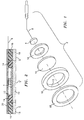
- FIG. 1 an exploded view of one embodiment of an electrode denoted generally by the numeral 2, which has been formed in accordance with this invention.
- the electrode 2 includes an Ag/AgCl sensor 4 which is coupled to a signal transmission wire 6 having a distal plug 8 for connection to a standard yoke cable (not shown).
- a disc-shaped electrically conductive and self-adhesive hydrogel member 10 contacts the sensor 4 and provides electrical contact between the sensor 4 and the patient's skin.
- the hydrogel member 10 is secured to a first annular foam ring 14 which forms a recess 12 for reception of the sensor 4.
- a second annular foam ring 16 surrounds the first foam ring 14 and is adhered to an adjunct adhesive ring 18 which, in turn, surrounds the hydrogel member 10.
- the adjunct adhesive ring 18 is not significantly hydrophilic, and is essentially non-conductive. Its function is as an adhesive to prevent the hydrogel member 10 from prematurely losing electrical contact with the patient's skin.
- the use of such an adjunct adhesive member in the electrode 2 has resulted in a markedly improved adherence of the electrode 2 to the neonate's skin in the above-described incubator swamping environment.
- FIG. 2 there is shown a cross-sectional view of the patient's skin-contacting portion of the electrode 2.
- the skin-contacting surface S of the adhesive ring 18, and the skin-contacting surface S' of the hydrogel member 10 are co-planar, so that both of these surfaces will intimately contact the skin of the neonatal patient being monitored. Due to the presence of the ring 18, absorption by the hydrogel member 10 of sufficient water from the incubator atmosphere which causes a degree of swelling of the hydrogel 10 that would result in loss of adhesive capability in the hydrogel 10 will not adversely effect the performance of the electrode 2. Thus, the inclusion of the adjunct adhesive ring 18, which will not absorb significant amounts of water from the incubator atmosphere, ensures extended electrode-to-patient-skin adherence.
- the adjunct adhesive ring 18 ensures that the electrode 2 will remain adhered to the neonate's skin for a period of time of at least five days in the high humidity swamping incubator environment.
- a cover layer 20 of adhesive paper preferably serves to bond the foam rings 14 and 16 to each other, and protects the sensor 4 from exposure to the humid atmosphere in the incubator.
- the annular adhesive ring 18 extends to the periphery of the hydrogel member 10 so as to provide a strong and intimate complete peripheral bond between the neonate's skin and the electrode 2.
- the ring 18 thus provides enhanced and stable adhesion of the electrode 2 to the neonate's skin.
- the combination of the adhesive disc 18 with the adhesive and electrically conductive hydrogel member 10 in the electrode 2 ensures prolonged adhesion of the electrode 2 to the neonate's skin along with acceptable signal transmission from the hydrogel member 10 to the sensor 4.
- the self adhesive and electrically conductive hydrogel 10 can be formed from the hydrogel which is a product of the Ludlow Corporation of Two Ludlow Park Dr., Chicopee, MA; and the self adhesive non-conductive ring can be formed from a hydrocolloid which is a product of Avery Dennison, 250 Chester Street, Painesville, OH.
Landscapes
- Health & Medical Sciences (AREA)
- Life Sciences & Earth Sciences (AREA)
- Medical Informatics (AREA)
- Molecular Biology (AREA)
- Dispersion Chemistry (AREA)
- Biophysics (AREA)
- Pathology (AREA)
- Engineering & Computer Science (AREA)
- Biomedical Technology (AREA)
- Heart & Thoracic Surgery (AREA)
- Chemical & Material Sciences (AREA)
- Physics & Mathematics (AREA)
- Surgery (AREA)
- Animal Behavior & Ethology (AREA)
- General Health & Medical Sciences (AREA)
- Public Health (AREA)
- Veterinary Medicine (AREA)
- Measurement And Recording Of Electrical Phenomena And Electrical Characteristics Of The Living Body (AREA)
- Measurement Of The Respiration, Hearing Ability, Form, And Blood Characteristics Of Living Organisms (AREA)
- Electrotherapy Devices (AREA)
Applications Claiming Priority (2)
| Application Number | Priority Date | Filing Date | Title |
|---|---|---|---|
| US382120 | 1999-08-24 | ||
| US09/382,120 US6687524B1 (en) | 1999-08-24 | 1999-08-24 | Disposable neonatal electrode for use in a high humidity environment |
Publications (2)
| Publication Number | Publication Date |
|---|---|
| EP1078595A2 true EP1078595A2 (de) | 2001-02-28 |
| EP1078595A3 EP1078595A3 (de) | 2001-03-07 |
Family
ID=23507596
Family Applications (1)
| Application Number | Title | Priority Date | Filing Date |
|---|---|---|---|
| EP00118424A Withdrawn EP1078595A3 (de) | 1999-08-24 | 2000-08-24 | Einmalelektrode für Neugeborene zum Einsatz in feuchter Umgebung |
Country Status (2)
| Country | Link |
|---|---|
| US (1) | US6687524B1 (de) |
| EP (1) | EP1078595A3 (de) |
Cited By (2)
| Publication number | Priority date | Publication date | Assignee | Title |
|---|---|---|---|---|
| EP2036492A1 (de) * | 2007-09-14 | 2009-03-18 | Dräger Medical AG & Co. KG | Medizinische Elektrode |
| CN103239221A (zh) * | 2012-02-07 | 2013-08-14 | 三星电子株式会社 | 测量生物电势的电极及其制造方法和测量生理信号的系统 |
Families Citing this family (16)
| Publication number | Priority date | Publication date | Assignee | Title |
|---|---|---|---|---|
| AU2002230684A1 (en) * | 2000-11-16 | 2002-05-27 | Axelgaard Manufacturing Company, Ltd. | Dual element sensor medical electrode |
| US9326695B1 (en) | 2004-11-12 | 2016-05-03 | Orbital Research Inc | Electrode harness and method of taking biopotential measurements |
| US7697999B2 (en) * | 2003-02-06 | 2010-04-13 | Axelgaard Manufacturing Company, Ltd. | Moisture resistant electrode with edge protection |
| US7697998B2 (en) * | 2006-01-20 | 2010-04-13 | Axelgaard Manufacturing Company, Ltd. | Electrode with edge protection |
| US7324847B2 (en) * | 2003-02-06 | 2008-01-29 | Axelgaard Manufacturing Co., Ltd. | Reverse current controlling electrode |
| CN102098959B (zh) * | 2008-07-18 | 2014-09-24 | 弗莱康股份有限公司 | 用于心电图检测系统的高阻抗信号检测系统和方法 |
| WO2012050847A2 (en) | 2010-09-28 | 2012-04-19 | Masimo Corporation | Depth of consciousness monitor including oximeter |
| US9775545B2 (en) | 2010-09-28 | 2017-10-03 | Masimo Corporation | Magnetic electrical connector for patient monitors |
| US9655787B2 (en) * | 2010-11-19 | 2017-05-23 | Covenant Ministries Of Benevolence | Stacked moisture sensing device |
| US8971983B2 (en) | 2012-04-03 | 2015-03-03 | Altec, Inc. | Disposable low-profile conformable biomedical sensor |
| US10004421B2 (en) | 2013-09-13 | 2018-06-26 | Altec, Inc. | Disposable protective overlay covering for biomedical sensors |
| US10154815B2 (en) | 2014-10-07 | 2018-12-18 | Masimo Corporation | Modular physiological sensors |
| JP6876360B2 (ja) * | 2017-04-03 | 2021-05-26 | 株式会社テクサー | 生体信号計測装置用電極及びそれを備える生体信号計測装置 |
| CN113873943B (zh) * | 2019-05-31 | 2024-02-27 | 世联株式会社 | 生物体电极以及附带生物体电极的装配用具 |
| CA3176601A1 (en) | 2020-03-25 | 2021-09-30 | Flexcon Company, Inc. | Isotropic non-aqueous electrode sensing material |
| JP2026053960A (ja) * | 2024-09-13 | 2026-03-26 | 積水化成品工業株式会社 | 生体用電極 |
Family Cites Families (12)
| Publication number | Priority date | Publication date | Assignee | Title |
|---|---|---|---|---|
| US4674511A (en) * | 1979-04-30 | 1987-06-23 | American Hospital Supply Corporation | Medical electrode |
| US4559950A (en) | 1983-11-25 | 1985-12-24 | Graphic Controls Corporation | Disposable biomedical and diagnostic electrode |
| US4694835A (en) * | 1986-05-21 | 1987-09-22 | Minnesota Mining And Manufacturing Company | Biomedical electrode |
| US5330527A (en) * | 1988-03-25 | 1994-07-19 | Lec Tec Corporation | Multipurpose medical electrode |
| US5215087A (en) * | 1988-09-22 | 1993-06-01 | Minnesota Mining And Manufacturing Company | Biomedical electrode construction |
| US5143071A (en) * | 1989-03-30 | 1992-09-01 | Nepera, Inc. | Non-stringy adhesive hydrophilic gels |
| DK0616505T3 (de) | 1991-11-15 | 1997-02-24 | Minnesota Mining & Mfg | |
| AU652494B2 (en) * | 1991-11-15 | 1994-08-25 | Minnesota Mining And Manufacturing Company | Solid state conductive polymer compositions, biomedical electrodes containing such compositions, and method of preparing same |
| GB2274995B (en) * | 1993-02-15 | 1996-10-09 | John Mccune Anderson | Biomedical electrode device |
| US5474065A (en) | 1994-04-04 | 1995-12-12 | Graphic Controls Corporation | Non-invasive fetal probe |
| US5924983A (en) * | 1996-04-29 | 1999-07-20 | Minnesota Mining And Manufacturing Company | Electrical conductor for biomedical electrodes and biomedical electrodes prepared therefrom |
| US5921925A (en) * | 1997-05-30 | 1999-07-13 | Ndm, Inc. | Biomedical electrode having a disposable electrode and a reusable leadwire adapter that interfaces with a standard leadwire connector |
-
1999
- 1999-08-24 US US09/382,120 patent/US6687524B1/en not_active Expired - Fee Related
-
2000
- 2000-08-24 EP EP00118424A patent/EP1078595A3/de not_active Withdrawn
Non-Patent Citations (1)
| Title |
|---|
| None |
Cited By (2)
| Publication number | Priority date | Publication date | Assignee | Title |
|---|---|---|---|---|
| EP2036492A1 (de) * | 2007-09-14 | 2009-03-18 | Dräger Medical AG & Co. KG | Medizinische Elektrode |
| CN103239221A (zh) * | 2012-02-07 | 2013-08-14 | 三星电子株式会社 | 测量生物电势的电极及其制造方法和测量生理信号的系统 |
Also Published As
| Publication number | Publication date |
|---|---|
| US6687524B1 (en) | 2004-02-03 |
| EP1078595A3 (de) | 2001-03-07 |
Similar Documents
| Publication | Publication Date | Title |
|---|---|---|
| US6687524B1 (en) | Disposable neonatal electrode for use in a high humidity environment | |
| US7904133B2 (en) | Wearable wireless device for monitoring, analyzing and communicating physiological status | |
| CA1166701A (en) | Vital signs monitor | |
| CN104665806B (zh) | 电极、生物信号检测装置和测量生物信号的方法 | |
| US11540730B2 (en) | Dry electrode and physiological multi-parameter monitoring equipment | |
| US11083415B2 (en) | Vital-signs patch having a strain relief | |
| US8718742B2 (en) | Integrated wireless patch for physiological monitoring | |
| EP2091424B1 (de) | Repositionierbarer hand-ekg-detektor | |
| US20070270678A1 (en) | Wireless Electrode for Biopotential Measurement | |
| JP7568370B2 (ja) | 生体センサ | |
| CA2217666A1 (en) | Non-invasive fetal probe having improved mechanical and electrical properties | |
| WO2014107018A1 (ko) | 생체신호 측정용 패치형 전극 | |
| EP3164064A1 (de) | Medizinische elektrode | |
| KR20170019033A (ko) | 생체신호 측정용 센서 | |
| KR101990894B1 (ko) | 진공 흡착을 이용한 cnt 혼합 전극 | |
| US8761858B1 (en) | Method of attaching electrode patches to an infant | |
| CN221813967U (zh) | 一种心电贴片传感器及心电仪 | |
| CN209847182U (zh) | 一次性柔性生物电信号传感器 | |
| JP2001340311A (ja) | 生体電極および装着方法 | |
| CN111643072A (zh) | 一种心电电极片及心电监测装置 | |
| CN114831649A (zh) | 一种具有柔性皮肤电极的无线可穿戴心电检测装置 | |
| JP3020953U (ja) | 生体電極用シールドおよび該シールドを用いた生体電極 | |
| KR102750123B1 (ko) | 생체 신호를 모니터링하기 위한 디바이스 | |
| CN219742711U (zh) | 心电电极贴片 | |
| CN223208420U (zh) | 一种一次性使用心电电极贴片及心电记录仪 |
Legal Events
| Date | Code | Title | Description |
|---|---|---|---|
| PUAI | Public reference made under article 153(3) epc to a published international application that has entered the european phase |
Free format text: ORIGINAL CODE: 0009012 |
|
| PUAL | Search report despatched |
Free format text: ORIGINAL CODE: 0009013 |
|
| AK | Designated contracting states |
Kind code of ref document: A2 Designated state(s): AT BE CH CY DE DK ES FI FR GB GR IE IT LI LU MC NL PT SE |
|
| AX | Request for extension of the european patent |
Free format text: AL;LT;LV;MK;RO;SI |
|
| AK | Designated contracting states |
Kind code of ref document: A3 Designated state(s): AT BE CH CY DE DK ES FI FR GB GR IE IT LI LU MC NL PT SE |
|
| AX | Request for extension of the european patent |
Free format text: AL;LT;LV;MK;RO;SI |
|
| 17P | Request for examination filed |
Effective date: 20010822 |
|
| AKX | Designation fees paid |
Free format text: AT BE CH CY DE DK ES FI FR GB GR IE IT LI LU MC NL PT SE |
|
| STAA | Information on the status of an ep patent application or granted ep patent |
Free format text: STATUS: THE APPLICATION HAS BEEN WITHDRAWN |
|
| 18W | Application withdrawn |
Effective date: 20030604 |