EP1078669A1 - Procédé et cristalliseur pour la purification de matières ou mélanges de matières - Google Patents
Procédé et cristalliseur pour la purification de matières ou mélanges de matières Download PDFInfo
- Publication number
- EP1078669A1 EP1078669A1 EP99810752A EP99810752A EP1078669A1 EP 1078669 A1 EP1078669 A1 EP 1078669A1 EP 99810752 A EP99810752 A EP 99810752A EP 99810752 A EP99810752 A EP 99810752A EP 1078669 A1 EP1078669 A1 EP 1078669A1
- Authority
- EP
- European Patent Office
- Prior art keywords
- crystallizer
- crystal layer
- gas
- heat exchanger
- temperature
- Prior art date
- Legal status (The legal status is an assumption and is not a legal conclusion. Google has not performed a legal analysis and makes no representation as to the accuracy of the status listed.)
- Withdrawn
Links
Images

Classifications
-
- C—CHEMISTRY; METALLURGY
- C07—ORGANIC CHEMISTRY
- C07D—HETEROCYCLIC COMPOUNDS
- C07D201/00—Preparation, separation, purification or stabilisation of unsubstituted lactams
- C07D201/16—Separation or purification
-
- B—PERFORMING OPERATIONS; TRANSPORTING
- B01—PHYSICAL OR CHEMICAL PROCESSES OR APPARATUS IN GENERAL
- B01D—SEPARATION
- B01D9/00—Crystallisation
- B01D9/0004—Crystallisation cooling by heat exchange
- B01D9/0013—Crystallisation cooling by heat exchange by indirect heat exchange
-
- B—PERFORMING OPERATIONS; TRANSPORTING
- B01—PHYSICAL OR CHEMICAL PROCESSES OR APPARATUS IN GENERAL
- B01D—SEPARATION
- B01D9/00—Crystallisation
- B01D9/004—Fractional crystallisation; Fractionating or rectifying columns
-
- B—PERFORMING OPERATIONS; TRANSPORTING
- B01—PHYSICAL OR CHEMICAL PROCESSES OR APPARATUS IN GENERAL
- B01D—SEPARATION
- B01D9/00—Crystallisation
- B01D9/0059—General arrangements of crystallisation plant, e.g. flow sheets
-
- B—PERFORMING OPERATIONS; TRANSPORTING
- B01—PHYSICAL OR CHEMICAL PROCESSES OR APPARATUS IN GENERAL
- B01D—SEPARATION
- B01D9/00—Crystallisation
- B01D9/0072—Crystallisation in microfluidic devices
-
- C—CHEMISTRY; METALLURGY
- C07—ORGANIC CHEMISTRY
- C07C—ACYCLIC OR CARBOCYCLIC COMPOUNDS
- C07C17/00—Preparation of halogenated hydrocarbons
- C07C17/38—Separation; Purification; Stabilisation; Use of additives
- C07C17/392—Separation; Purification; Stabilisation; Use of additives by crystallisation; Purification or separation of the crystals
-
- C—CHEMISTRY; METALLURGY
- C07—ORGANIC CHEMISTRY
- C07C—ACYCLIC OR CARBOCYCLIC COMPOUNDS
- C07C201/00—Preparation of esters of nitric or nitrous acid or of compounds containing nitro or nitroso groups bound to a carbon skeleton
- C07C201/06—Preparation of nitro compounds
- C07C201/16—Separation; Purification; Stabilisation; Use of additives
-
- C—CHEMISTRY; METALLURGY
- C07—ORGANIC CHEMISTRY
- C07C—ACYCLIC OR CARBOCYCLIC COMPOUNDS
- C07C209/00—Preparation of compounds containing amino groups bound to a carbon skeleton
- C07C209/82—Purification; Separation; Stabilisation; Use of additives
- C07C209/84—Purification
-
- C—CHEMISTRY; METALLURGY
- C07—ORGANIC CHEMISTRY
- C07C—ACYCLIC OR CARBOCYCLIC COMPOUNDS
- C07C253/00—Preparation of carboxylic acid nitriles
- C07C253/32—Separation; Purification; Stabilisation; Use of additives
- C07C253/34—Separation; Purification
-
- C—CHEMISTRY; METALLURGY
- C07—ORGANIC CHEMISTRY
- C07C—ACYCLIC OR CARBOCYCLIC COMPOUNDS
- C07C263/00—Preparation of derivatives of isocyanic acid
- C07C263/18—Separation; Purification; Stabilisation; Use of additives
- C07C263/20—Separation; Purification
-
- C—CHEMISTRY; METALLURGY
- C07—ORGANIC CHEMISTRY
- C07C—ACYCLIC OR CARBOCYCLIC COMPOUNDS
- C07C37/00—Preparation of compounds having hydroxy or O-metal groups bound to a carbon atom of a six-membered aromatic ring
- C07C37/68—Purification; separation; Use of additives, e.g. for stabilisation
- C07C37/70—Purification; separation; Use of additives, e.g. for stabilisation by physical treatment
- C07C37/84—Purification; separation; Use of additives, e.g. for stabilisation by physical treatment by crystallisation
-
- C—CHEMISTRY; METALLURGY
- C07—ORGANIC CHEMISTRY
- C07C—ACYCLIC OR CARBOCYCLIC COMPOUNDS
- C07C51/00—Preparation of carboxylic acids or their salts, halides or anhydrides
- C07C51/42—Separation; Purification; Stabilisation; Use of additives
- C07C51/43—Separation; Purification; Stabilisation; Use of additives by change of the physical state, e.g. crystallisation
-
- C—CHEMISTRY; METALLURGY
- C07—ORGANIC CHEMISTRY
- C07C—ACYCLIC OR CARBOCYCLIC COMPOUNDS
- C07C7/00—Purification; Separation; Use of additives
- C07C7/14—Purification; Separation; Use of additives by crystallisation; Purification or separation of the crystals
-
- C—CHEMISTRY; METALLURGY
- C11—ANIMAL OR VEGETABLE OILS, FATS, FATTY SUBSTANCES OR WAXES; FATTY ACIDS THEREFROM; DETERGENTS; CANDLES
- C11B—PRODUCING, e.g. BY PRESSING RAW MATERIALS OR BY EXTRACTION FROM WASTE MATERIALS, REFINING OR PRESERVING FATS, FATTY SUBSTANCES, e.g. LANOLIN, FATTY OILS OR WAXES; ESSENTIAL OILS; PERFUMES
- C11B15/00—Solidifying fatty oils, fats, or waxes by physical processes
-
- C—CHEMISTRY; METALLURGY
- C11—ANIMAL OR VEGETABLE OILS, FATS, FATTY SUBSTANCES OR WAXES; FATTY ACIDS THEREFROM; DETERGENTS; CANDLES
- C11B—PRODUCING, e.g. BY PRESSING RAW MATERIALS OR BY EXTRACTION FROM WASTE MATERIALS, REFINING OR PRESERVING FATS, FATTY SUBSTANCES, e.g. LANOLIN, FATTY OILS OR WAXES; ESSENTIAL OILS; PERFUMES
- C11B7/00—Separation of mixtures of fats or fatty oils into their constituents, e.g. saturated oils from unsaturated oils
- C11B7/0075—Separation of mixtures of fats or fatty oils into their constituents, e.g. saturated oils from unsaturated oils by differences of melting or solidifying points
-
- C—CHEMISTRY; METALLURGY
- C07—ORGANIC CHEMISTRY
- C07C—ACYCLIC OR CARBOCYCLIC COMPOUNDS
- C07C2603/00—Systems containing at least three condensed rings
- C07C2603/02—Ortho- or ortho- and peri-condensed systems
- C07C2603/04—Ortho- or ortho- and peri-condensed systems containing three rings
- C07C2603/06—Ortho- or ortho- and peri-condensed systems containing three rings containing at least one ring with less than six ring members
- C07C2603/10—Ortho- or ortho- and peri-condensed systems containing three rings containing at least one ring with less than six ring members containing five-membered rings
- C07C2603/12—Ortho- or ortho- and peri-condensed systems containing three rings containing at least one ring with less than six ring members containing five-membered rings only one five-membered ring
- C07C2603/18—Fluorenes; Hydrogenated fluorenes
-
- C—CHEMISTRY; METALLURGY
- C07—ORGANIC CHEMISTRY
- C07C—ACYCLIC OR CARBOCYCLIC COMPOUNDS
- C07C2603/00—Systems containing at least three condensed rings
- C07C2603/02—Ortho- or ortho- and peri-condensed systems
- C07C2603/04—Ortho- or ortho- and peri-condensed systems containing three rings
- C07C2603/06—Ortho- or ortho- and peri-condensed systems containing three rings containing at least one ring with less than six ring members
- C07C2603/10—Ortho- or ortho- and peri-condensed systems containing three rings containing at least one ring with less than six ring members containing five-membered rings
- C07C2603/12—Ortho- or ortho- and peri-condensed systems containing three rings containing at least one ring with less than six ring members containing five-membered rings only one five-membered ring
- C07C2603/20—Acenaphthenes; Hydrogenated acenaphthenes
-
- C—CHEMISTRY; METALLURGY
- C07—ORGANIC CHEMISTRY
- C07C—ACYCLIC OR CARBOCYCLIC COMPOUNDS
- C07C2603/00—Systems containing at least three condensed rings
- C07C2603/02—Ortho- or ortho- and peri-condensed systems
- C07C2603/04—Ortho- or ortho- and peri-condensed systems containing three rings
- C07C2603/22—Ortho- or ortho- and peri-condensed systems containing three rings containing only six-membered rings
- C07C2603/26—Phenanthrenes; Hydrogenated phenanthrenes
Definitions
- the invention relates to a method according to the preamble of claim 1 and a crystallizer according to the preamble of claim 11 for separation or Cleaning of dissolved, molten or liquid compounds or Connection mixtures.
- the crystal layer is then sweated and melted, by the heat transfer medium flowing past on the outside of the tubes is heated continuously or in discrete steps.
- the crystal layer is heated exclusively by the Heat exchanger surfaces through.
- the crystal layer is heated such that different fractions can be obtained, namely one so - called “sweating phase", which occurs when the crystals sweat, and a “crystal phase", which the crystal layer after sweating corresponds.
- the fractions resulting from the cleaning process i.e. the non-crystallized Residue or mother liquor, the sweat and crystal phase, can then be subjected to one or more further cleaning cycles be until the compound is in the desired purity resp. the Impurities in the mother liquor are highly enriched.
- the crystallization process described above can also be carried out using a perform static crystallizer.
- the static crystallizer consists of a container in which a number of mostly flat Heat exchanger surfaces are arranged. These heat exchanger surfaces can consist of double-walled cooling elements, which by a Heat transfer medium are flowed through.
- the so-called static The crystallization process differs from that described at the beginning dynamic process in that the tank filling at Crystallization process remains "static", i.e. not circulated or stirred becomes. Accordingly, the static crystallization process is important slower than that with a falling film crystallizer or a crystallizer dynamic crystallization processes applied with full tube filling.
- the object of the present invention is to implement the known methods for Cleaning connections or Connection mixtures by means of to improve fractional crystallization. Another goal is a better one To achieve separation performance in the fractional crystallization. It is also a The aim is to make the process more economical. Another job of The present invention is an apparatus for performing the To provide the procedure.
- Another advantage of the method is that by adding heat from two sides (liquid heat transfer medium on that of the crystal layer opposite side of the heat exchanger surfaces and gaseous Heat transfer medium on the side of the crystal layer Heat exchanger surfaces) the speed for the melting of the formed crystal layer can be increased.
- Gas sweating is particularly advantageous for substances or mixtures of substances, which are known to adhere poorly to the heat exchanger surfaces.
- the substances or mixtures of substances to be cleaned be sweated exclusively by gas sweating, which in the Heat exchanger surfaces circulating or. at that of the crystal layer downward-facing side of the heat exchanger surfaces Heat transfer medium preferably at a temperature below the Melting temperature of the substance to be cleaned resp. Mixed materials kept so that the layer adheres well to the heat exchanger surfaces is guaranteed.
- the melting advantageously takes place by placing the crystal layer first sweating (so-called sweating phase) and then melting (so-called Melting phase), at least temporarily for sweating Gas flow of a gaseous heat transfer medium over the crystal layer is directed.
- the sweating of the crystal layer can only be caused by the Use of the heated gas flow.
- By feeding Heat also from the side of the crystal layer facing away from the Heat exchanger surfaces forth (by means of a liquid or, if necessary gaseous heat transfer medium) can shorten the sweating phase become.
- the temperature of the sweat is advantageous on the one hand Heat transfer medium increased and on the other hand at least temporarily heated gas stream of a gaseous heat transfer medium over the Headed crystal layer.
- the heated gas stream essentially during the entire melting process, i.e. during the Crystal sweating and melting of the crystals used.
- the cleaning process can be shortened significantly and the Economics of the process can be improved.
- the gas can be a Noble gas, nitrogen, air, carbon dioxide, water vapor, freon, aliphatic or cyclic unsubstituted hydrocarbons, substituted halogenated hydrocarbons such as. Be a freone.
- the gas flow in the opposite direction to the flowing melt over the Can be passed is according to a preferred embodiment variant in the direction of the flowing Melt passed over the crystal layer. That means the heated gas flow is introduced in the top area of the crystallizer and in the lower area of the Crystallizer removed again. This results in a comparative better separation performance than if the gas flow in the opposite direction flowing melt is passed over the crystal layer.
- the gas stream is advantageously circulated.
- the Gas stream heated to a temperature which is at least 5 ° C, preferably at least 15 ° C and most preferably at least 25 ° C above Melting point of the crystals forming the crystal layer is. Because gases or Gas mixtures have a comparatively low heat content The melting process is easy to control. Gases can provide enough energy are supplied so that on the one hand a noticeable improvement in Separation performance and on the other hand a significant acceleration of the Procedure is achieved.
- the gas flow is heated can, by supplying a certain amount of energy per unit of time, according to a preferred variant, the gas flow is heated in a controlled manner. This has the advantage that the cleaning process can be easily optimized.
- Gas sweating is particularly advantageous for cleaning wax-like compounds or compound mixtures, Fatty acid mixtures, acrylic acid used by fractional crystallization.
- the crystal layer is sweated before melting by at least temporarily a gas stream of a gaseous one Heat transfer medium is passed over the crystal layer, the Gas flow is previously heated to a temperature which is higher than that Melting temperature of the crystal layer is.
- the present invention also relates to a crystallizer Characteristic of claim 11 characterized by at least one Gas inlet for the inlet of a gas into the container space and at least a gas outlet for the outlet of the gaseous container content from the Container space, a gas supply line with heating means, which with the gas inlet is connected to the heating of the gas to be supplied, and Funding to promote the gas in the container space, respectively. out of this out.
- the crystallizer according to the invention has the advantage that it allows heated gas to enter the crystallizer room and dissipate and thus increase the separation performance and throughput.
- the gas inlet and the Gas outlet connected to each other by a connecting line. This allows the gas to be circulated and used several times.
- the Connection line can partially through the circulation line to Circulation of the melt can be formed, since when the Crystal layer usually no circulation of the accumulated on the ground liquid tank content more takes place.
- the one gas connection point is expediently at a distance from the Crystallizer bottom provided. This prevents liquid (Melt) unintentionally leak or into the connecting line for the Circulation of the gas can occur.
- the gas connection line can be shut off by means of shut-off means so that they are also connected closer to the ground can.
- the heating means through an electrically heated heating surface or Heating coil can be formed, these are advantageous as a heat exchanger, e.g. a heating coil in which a heat exchange medium circulate can, trained.
- a heat exchanger has the advantage that Temperature is well adjustable.
- the heating means are expediently available a temperature sensor and a regulating valve which controls the flow of the heat exchange medium in the heat exchanger, in connection.
- a control circuit is implemented in connection with a control unit and the cleaning process can thus be optimized and, if this once optimized, easily controllable and reproducible.
- They are advantageous Funding designed in such a way that in operation the gas from the bottom to Head area of the crystallizer is promoted.
- the process according to the invention and the crystallizer according to the invention are particularly suitable for the purification of the following compounds: acrylic acid, methacrylic acid, waste water, methyl diphenyl isocyanate (MDI), toluene diisocyanate (TDI), caprolactam, benzoic acid, bisphenol A, nitrochlorobenzene, straight-chain and branched fatty acids, hydrazine, phenols such as para, meta and ortho-cresol, 2,6 and 3,5-dimethylphenol, naphthol and o, o-diphenol, chlorinated hydrocarbons such as dichlorobenzene and nitrochlorobenzene, naphthalene, 1- 2-methylnaphthalene, acenaphthene, fluorene, phenanthrene, adiponitrile, hexamethylene diamine , Lactides (polylactides), chlorpyrifos and paraffins from C 17 .
- the method can also be
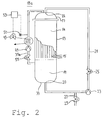
- the crystallizer 11 according to FIG. 1 has a container 13 with a Container space 14, in which a number of cooling or. heatable Crystallization or heat exchanger surfaces 15 are arranged.
- the Heat exchanger surfaces 15 extend coaxially to the longitudinal axis of the container from the top area 17 of the crystallizer to the bottom area 19.
- Purpose The lines, pumps and Heat exchanger apparatus, which in connection with the Heat exchanger surfaces a cooling or. Form heat cycle, not drawn.
- the bottom area 19 corresponds approximately to the filling volume of the crystallizer 11.
- a circulation line 21 connects one Junction 20 in the bottom region 19 of the crystallizer with a second one Junction 22 in the head region 17.
- a pump 23 is used for delivery of the liquid tank content in operation in the bottom area 19 to the crystallizer head area 17 so that the liquid to be cleaned or Mother liquor as a falling or trickle film on the heat exchanger surfaces can flow down.
- a valve 25 Liquid circulation line 21 can be shut off.
- a line 27 with Shut-off valve 29 is used for closing and Removal of raw and cleaned Material.
- the crystallizer differs from known ones Crystallizers in that means are provided to a heated gas to lead along the heat exchanger surfaces 15. This has the advantage that throughput can be increased and separation performance improved because the sweating and melting process accelerates and, surprisingly, the cleaning effect can be improved.
- the crystallizer 11 according to FIG. 1 has a for the circulation of a gas line connection, which the the below the Heat exchanger surfaces lying crystallizer room with that above that connects the heat exchanger surfaces so that the gaseous tank content circulates and a gas stream is directed past the heat exchanger surfaces can be.
- the line connection is realized according to Figure 1 by a Connection line 31, which is at a distance from the crystallizer bottom 33 Connects container space with the circulation line 21.
- the circulation line 21, which opens into the crystallizer cover 35, can be used to promote the Gases are used because during the sweat and part of the Melting phase, no melt is circulated in the circulation line 21 and it is therefore empty.
- the improvement according to the invention can be done with little effort with existing crystallizers to increase performance be retrofitted.
- the connecting line 31 can be shut off by valves 37, 39.
- a blower 41 serves to promote the gas located in line 31, e.g. Air.
- the Gas is through a heat exchanger arranged in the connecting line 31 43 warmed.
- the heat exchanger 43 can have a heat exchanger surface, an electric heating coil, an oven which surrounds the line 31 is arranged around, or the like.
- To get the gas on as quickly as possible is the heat exchanger 43 preferably integrated into the connecting line 31.
- a temperature sensor 51 and a control unit 53 form together a control loop, which the compliance of defined and enable reproducible conditions over a longer period of time.
- the crystallizer 11a according to FIG. 2 differs from that of Figure 1 in that the connecting line 31a is not in the Liquid circulation line but directly into the crystallizer cover flows.
- the connecting line 31a is through a with the reference number 55 designated shut-off valve lockable.
- the Heat exchanger surfaces essentially over the entire height of the Crystallizer. Accordingly, the gas outlet is closer to the gas circulation to choose the floor than with a falling film crystallizer. Basically It is also conceivable that the devices, lines, etc. at least partially in the Lead crystallizer.
- the cleaning of a compound mixture by means of layer crystallization e.g. in a falling film crystallizer, this is done as follows: liquid compound mixture is introduced into the crystallizer, the amount introduced can reach just up to the heat exchanger surfaces. Thereafter, the liquid compound mixture is circulated in line 21, and lowered the temperature of the heat exchanger surfaces 15 by the in this circulating heat exchange medium by means of a heat exchanger is cooled. As soon as the heat exchanger surfaces 15 a certain Temperature below the melting temperature of the desired compound reached, this begins to crystallize and on the heat exchanger surfaces to be deposited as a crystal layer. If the crystal layer is a certain one Has reached strength, the crystallization process is stopped and the drained non-crystallized mother liquor into a tank.
- cleaning can also be carried out substances or mixtures of substances that adhere poorly to the heat exchanger surfaces the heat exchange medium circulating in the heat exchangers on one Leave the temperature below the crystallization temperature of the layer and sweating exclusively through a heated gas flow respectively. This has the advantage of being good during sweating Adhesion of the crystal layer to the crystallizer surfaces is ensured.
- the crystallization process in a static crystallizer differs differ from that described above in that the crystallizer is so far with Melt is filled that the heat exchanger surfaces through the melt are covered. Then the heat exchanger surfaces are cooled and that desired product deposited as a crystal layer, during which Crystallization process practically no agitation of the liquid Crystallizer content takes place.
- the sweating and melting of the Crystal layer can as above with the help of a heated gas flow take place, also in the static crystallization process Improvement in separation performance is achievable.
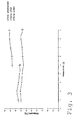
- FIG. 3 shows the improvement based on a comparative illustration can be achieved with the method according to the invention.
- the anhydrous butterfat used had one before cleaning Clear point of 36 ° C. Due to the dynamic crystallization used Fall film increased the clarity of the butter fat to about 43 to 44 ° C (curve a).
- Samples 1 to 4 were then sweated conventionally.
- To the (conventional) sweating i.e. Warming the secluded Crystal layer through the circulating in the heat exchanger surfaces Heat transfer medium, the heat transfer medium was during 20 Leave at a temperature of 35 ° C for minutes. Prolonged sweating was due to the low adhesion of the crystal layer to the Prevents heat exchanger surfaces (risk of slipping of the layer). After sweating, the crystal layer became clear again measured (curve b).
- curve a (experiments 1 to 4) with curve b shows that through the well-known sweating process from the inside (i.e. via the Heat exchanger surfaces) the clear point can be increased by approx. 1.0 to 1.2 ° C could.
- the new process is advantageously suitable for the purification of acrylic acid, methacrylic acid, waste water, methyl diphenyl isocyanate (MDI), toluenediisocyanate (TDI), caprolactam, benzoic acid, bisphenol A, nitrochlorobenzene, straight-chain and branched fatty acid, hydrazine, phenols such as para, meta and ortho-cresol, 2,6 and 3,5-dimethylphenol, naphthol and o, o-diphenol, chlorinated hydrocarbons such as dichlorobenzene and nitrochlorobenzene, naphthalene, 1- 2-methylnaphthalene, acenaphthene, fluorene, phenanthrene, adiponitrile, hexamethylenediamine, lactide (polylactide) Chlorpyrifos, fatty acid mixtures, butterfat and paraffins from C 17 .
- MDI methyl diphenyl isocyan
- the method according to the invention can be used with all crystallizer types (e.g. falling film type, fully flowed tube, crystallizer with flat, e.g. double-walled, heat exchanger surfaces), which are dynamic or use a static crystallization process and the one to be cleaned Compound is deposited as a crystal layer on heat exchanger surfaces.
- crystallizer types e.g. falling film type, fully flowed tube, crystallizer with flat, e.g. double-walled, heat exchanger surfaces
- Existing crystallizers can be retrofitted with little effort be to the application of gas sweating according to the invention enable.
Landscapes
- Chemical & Material Sciences (AREA)
- Organic Chemistry (AREA)
- Crystallography & Structural Chemistry (AREA)
- Chemical Kinetics & Catalysis (AREA)
- Engineering & Computer Science (AREA)
- Oil, Petroleum & Natural Gas (AREA)
- Physics & Mathematics (AREA)
- Life Sciences & Earth Sciences (AREA)
- Wood Science & Technology (AREA)
- Thermal Sciences (AREA)
- Analytical Chemistry (AREA)
- Dispersion Chemistry (AREA)
- Water Supply & Treatment (AREA)
- Organic Low-Molecular-Weight Compounds And Preparation Thereof (AREA)
Priority Applications (1)
| Application Number | Priority Date | Filing Date | Title |
|---|---|---|---|
| EP99810752A EP1078669A1 (fr) | 1999-08-23 | 1999-08-23 | Procédé et cristalliseur pour la purification de matières ou mélanges de matières |
Applications Claiming Priority (1)
| Application Number | Priority Date | Filing Date | Title |
|---|---|---|---|
| EP99810752A EP1078669A1 (fr) | 1999-08-23 | 1999-08-23 | Procédé et cristalliseur pour la purification de matières ou mélanges de matières |
Publications (1)
| Publication Number | Publication Date |
|---|---|
| EP1078669A1 true EP1078669A1 (fr) | 2001-02-28 |
Family
ID=8242988
Family Applications (1)
| Application Number | Title | Priority Date | Filing Date |
|---|---|---|---|
| EP99810752A Withdrawn EP1078669A1 (fr) | 1999-08-23 | 1999-08-23 | Procédé et cristalliseur pour la purification de matières ou mélanges de matières |
Country Status (1)
| Country | Link |
|---|---|
| EP (1) | EP1078669A1 (fr) |
Cited By (16)
| Publication number | Priority date | Publication date | Assignee | Title |
|---|---|---|---|---|
| US6670501B1 (en) * | 1997-07-12 | 2003-12-30 | Lucite International Uk Limited | Process for the production of methyl methacrylate |
| EP2599770A1 (fr) | 2011-12-02 | 2013-06-05 | Bayer Intellectual Property GmbH | Procédé destiné à la fabrication d'isocyanates |
| CN104208900A (zh) * | 2014-09-11 | 2014-12-17 | 江苏华伦化工有限公司 | 用于酸酐类的一种晶体捕集器 |
| CN105107223A (zh) * | 2015-10-15 | 2015-12-02 | 贺源 | 一种结晶装置及方法 |
| CN106701314A (zh) * | 2017-02-17 | 2017-05-24 | 无锡市新耀生物工程技术有限公司 | 一种鱼油冬化分提结晶养晶反应罐 |
| EP3313545A1 (fr) * | 2015-06-24 | 2018-05-02 | Sulzer Chemtech AG | Procédé et appareil de cristallisation semi-continue |
| CN110272376A (zh) * | 2019-07-19 | 2019-09-24 | 中冶焦耐(大连)工程技术有限公司 | 一种咔唑提纯工艺、系统及系统的操作方法 |
| CN111544921A (zh) * | 2020-06-29 | 2020-08-18 | 天津乐科节能科技有限公司 | 一种自回热连续熔融结晶系统及方法 |
| CN112090108A (zh) * | 2020-09-22 | 2020-12-18 | 安徽英特力工业工程技术有限公司 | 一种聚乳酸合成工艺中丙交酯循环结晶干燥设备 |
| CN112322350A (zh) * | 2020-11-05 | 2021-02-05 | 中国科学院山西煤炭化学研究所 | 由费托合成产物制备高焓值相变蜡的方法 |
| CN113754530A (zh) * | 2020-06-02 | 2021-12-07 | 中国石油化工股份有限公司 | 提纯己二酸的方法 |
| CN114191843A (zh) * | 2022-01-14 | 2022-03-18 | 上海东庚化工技术有限公司 | 一种高效连续型降膜熔融结晶器 |
| CN114671768A (zh) * | 2022-04-22 | 2022-06-28 | 上海东庚化工技术有限公司 | 一种己二胺工业提纯方法 |
| CN115400451A (zh) * | 2022-08-12 | 2022-11-29 | 上海东庚化工技术有限公司 | 一种动态降膜结晶器 |
| CN119258579A (zh) * | 2024-09-05 | 2025-01-07 | 湖北楚宇石化设备有限公司 | 一种精萘动态结晶器的远程控制方法及相关设备 |
| CN121314223A (zh) * | 2025-12-11 | 2026-01-13 | 福建德尔科技股份有限公司 | 一种高纯氟代碳酸酯基溶剂的纯化方法 |
Citations (2)
| Publication number | Priority date | Publication date | Assignee | Title |
|---|---|---|---|---|
| US3621664A (en) * | 1967-04-14 | 1971-11-23 | Buchs Metallwerk Ag | Fractional crystallization process |
| US5700435A (en) * | 1994-12-08 | 1997-12-23 | Sulzer Chemtech Ag | Method and apparatus for separating a substance from a liquid mixture by fractional crystallization |
-
1999
- 1999-08-23 EP EP99810752A patent/EP1078669A1/fr not_active Withdrawn
Patent Citations (2)
| Publication number | Priority date | Publication date | Assignee | Title |
|---|---|---|---|---|
| US3621664A (en) * | 1967-04-14 | 1971-11-23 | Buchs Metallwerk Ag | Fractional crystallization process |
| US5700435A (en) * | 1994-12-08 | 1997-12-23 | Sulzer Chemtech Ag | Method and apparatus for separating a substance from a liquid mixture by fractional crystallization |
Cited By (24)
| Publication number | Priority date | Publication date | Assignee | Title |
|---|---|---|---|---|
| US6670501B1 (en) * | 1997-07-12 | 2003-12-30 | Lucite International Uk Limited | Process for the production of methyl methacrylate |
| EP2599770A1 (fr) | 2011-12-02 | 2013-06-05 | Bayer Intellectual Property GmbH | Procédé destiné à la fabrication d'isocyanates |
| DE102011087654A1 (de) | 2011-12-02 | 2013-06-06 | Bayer Materialscience Aktiengesellschaft | Verfahren zur Herstellung von Isocyanaten |
| US8765991B2 (en) | 2011-12-02 | 2014-07-01 | Bayer Intellectual Property Gmbh | Process for the preparation of isocyanates |
| CN104208900A (zh) * | 2014-09-11 | 2014-12-17 | 江苏华伦化工有限公司 | 用于酸酐类的一种晶体捕集器 |
| EP3313545A1 (fr) * | 2015-06-24 | 2018-05-02 | Sulzer Chemtech AG | Procédé et appareil de cristallisation semi-continue |
| CN105107223A (zh) * | 2015-10-15 | 2015-12-02 | 贺源 | 一种结晶装置及方法 |
| CN106701314A (zh) * | 2017-02-17 | 2017-05-24 | 无锡市新耀生物工程技术有限公司 | 一种鱼油冬化分提结晶养晶反应罐 |
| CN106701314B (zh) * | 2017-02-17 | 2023-10-27 | 无锡市新耀生物工程技术有限公司 | 一种鱼油冬化分提结晶养晶反应罐 |
| CN110272376A (zh) * | 2019-07-19 | 2019-09-24 | 中冶焦耐(大连)工程技术有限公司 | 一种咔唑提纯工艺、系统及系统的操作方法 |
| CN110272376B (zh) * | 2019-07-19 | 2024-01-30 | 中冶焦耐(大连)工程技术有限公司 | 一种咔唑提纯工艺、系统及系统的操作方法 |
| CN113754530B (zh) * | 2020-06-02 | 2023-09-29 | 中国石油化工股份有限公司 | 提纯己二酸的方法 |
| CN113754530A (zh) * | 2020-06-02 | 2021-12-07 | 中国石油化工股份有限公司 | 提纯己二酸的方法 |
| CN111544921A (zh) * | 2020-06-29 | 2020-08-18 | 天津乐科节能科技有限公司 | 一种自回热连续熔融结晶系统及方法 |
| CN111544921B (zh) * | 2020-06-29 | 2020-10-16 | 天津乐科节能科技有限公司 | 一种自回热连续熔融结晶系统及方法 |
| CN112090108A (zh) * | 2020-09-22 | 2020-12-18 | 安徽英特力工业工程技术有限公司 | 一种聚乳酸合成工艺中丙交酯循环结晶干燥设备 |
| CN112322350A (zh) * | 2020-11-05 | 2021-02-05 | 中国科学院山西煤炭化学研究所 | 由费托合成产物制备高焓值相变蜡的方法 |
| CN112322350B (zh) * | 2020-11-05 | 2021-12-07 | 中国科学院山西煤炭化学研究所 | 由费托合成产物制备高焓值相变蜡的方法 |
| CN114191843A (zh) * | 2022-01-14 | 2022-03-18 | 上海东庚化工技术有限公司 | 一种高效连续型降膜熔融结晶器 |
| CN114671768B (zh) * | 2022-04-22 | 2023-09-12 | 上海东庚化工技术有限公司 | 一种己二胺工业提纯方法 |
| CN114671768A (zh) * | 2022-04-22 | 2022-06-28 | 上海东庚化工技术有限公司 | 一种己二胺工业提纯方法 |
| CN115400451A (zh) * | 2022-08-12 | 2022-11-29 | 上海东庚化工技术有限公司 | 一种动态降膜结晶器 |
| CN119258579A (zh) * | 2024-09-05 | 2025-01-07 | 湖北楚宇石化设备有限公司 | 一种精萘动态结晶器的远程控制方法及相关设备 |
| CN121314223A (zh) * | 2025-12-11 | 2026-01-13 | 福建德尔科技股份有限公司 | 一种高纯氟代碳酸酯基溶剂的纯化方法 |
Similar Documents
| Publication | Publication Date | Title |
|---|---|---|
| EP1078669A1 (fr) | Procédé et cristalliseur pour la purification de matières ou mélanges de matières | |
| DE1769123B2 (de) | Verfahren und vorrichtung zur stofftrennung aus einem fluessigen gemisch durch fraktionierte kristallisation | |
| DE3213025A1 (de) | Verfahren und vorrichtung zur nachkondensation von polykondensaten | |
| EP0614688B1 (fr) | Dispositif pour la génération des cristaux germes dans des matières fondues et installation de cristallisation comprenant un tel dispositif | |
| DE1794084C3 (de) | Vorrichtung zum kontinuierlichen Gewinnen von Kristallen aus einer Schmelze oder Losung | |
| EP0065775B1 (fr) | Procédé et appareil pour la cristallisation en continu par évaporation | |
| EP0488953B1 (fr) | Appareil de séparation des substances d'un mélange liquide par cristallisation | |
| DE1793345B1 (de) | Verfahren und Vorrichtung zur Reinigung von kristallisierbaren organischen Verbindungen | |
| DE19908035B4 (de) | Verfahren zum Betreiben einer Pasteurisierungsanlage | |
| EP0766985B1 (fr) | Procédé et dispositif de séparation de mélanges liquides eutectiques par cristallisation aux surfaces de refroidissement | |
| EP1249174B1 (fr) | Procédé et appareil de traitement continu pour le mise en oeuvre de masses grasses | |
| DE3029302A1 (de) | Verfahren zur kontinuierlichen reinigung von rohen, hochschmelzenden, hochsiedenden organischen verbindungen | |
| DE3517386A1 (de) | Verfahren zur kontinuierlichen reinigung von metallen durch fraktionierte kristallisation auf einem rotierenden zylinder | |
| EP0085791A1 (fr) | Procédé et dispositif de séparation d'un mélange liquide par cristallisation fractionnée | |
| DE69208901T2 (de) | Mehrstufiges Gegenstrom-Umkristallisationsverfahren und Vorrichtung zur Durchführung desselben | |
| DE19536792A1 (de) | Verfahren zur Stofftrennung aus einem flüssigen Gemisch durch Kristallisation | |
| DE2530481A1 (de) | Vorrichtung zum herstellen von groben nadel- und balkenfoermigen kristallen | |
| EP1144169B1 (fr) | Dispositif et procede pour traiter une matiere plastique | |
| DE3827455C2 (fr) | ||
| DE3426880A1 (de) | Kristallreinigungseinrichtung | |
| DE10225075A1 (de) | Verfahren und Vorrichtung zur kontinuierlichen Nachkondensation von Kunststoffgranulat, wie beispielsweise Polyester oder Nylon | |
| DE19637380C1 (de) | Verfahren zur Herstellung von Hydroxipivalinsäureneopentylglykolester-Granulaten | |
| DE3209747C2 (de) | Vorrichtung zur Herstellung von Granulat aus einer Schmelze | |
| EP0492149B1 (fr) | Procédé et dispositif pour nettoyer des substances chimiques | |
| DE1286507B (de) | Verfahren zum Konzentrieren eines aus mehreren Bestandteilen bestehenden fluessigen Materials |
Legal Events
| Date | Code | Title | Description |
|---|---|---|---|
| PUAI | Public reference made under article 153(3) epc to a published international application that has entered the european phase |
Free format text: ORIGINAL CODE: 0009012 |
|
| AK | Designated contracting states |
Kind code of ref document: A1 Designated state(s): AT BE CH CY DE DK ES FI FR GB GR IE IT LI LU MC NL PT SE |
|
| AX | Request for extension of the european patent |
Free format text: AL;LT;LV;MK;RO;SI |
|
| AKX | Designation fees paid | ||
| REG | Reference to a national code |
Ref country code: DE Ref legal event code: 8566 |
|
| STAA | Information on the status of an ep patent application or granted ep patent |
Free format text: STATUS: THE APPLICATION IS DEEMED TO BE WITHDRAWN |
|
| 18D | Application deemed to be withdrawn |
Effective date: 20010829 |