EP1079314A2 - Vorrichtung und Verfahren zur Belieferung eines Benutzers mit einer ihn interessierenden Information - Google Patents
Vorrichtung und Verfahren zur Belieferung eines Benutzers mit einer ihn interessierenden Information Download PDFInfo
- Publication number
- EP1079314A2 EP1079314A2 EP00306388A EP00306388A EP1079314A2 EP 1079314 A2 EP1079314 A2 EP 1079314A2 EP 00306388 A EP00306388 A EP 00306388A EP 00306388 A EP00306388 A EP 00306388A EP 1079314 A2 EP1079314 A2 EP 1079314A2
- Authority
- EP
- European Patent Office
- Prior art keywords
- information
- information item
- user
- characteristic data
- offered
- Prior art date
- Legal status (The legal status is an assumption and is not a legal conclusion. Google has not performed a legal analysis and makes no representation as to the accuracy of the status listed.)
- Withdrawn
Links
Images




Classifications
-
- G—PHYSICS
- G06—COMPUTING OR CALCULATING; COUNTING
- G06F—ELECTRIC DIGITAL DATA PROCESSING
- G06F16/00—Information retrieval; Database structures therefor; File system structures therefor
- G06F16/30—Information retrieval; Database structures therefor; File system structures therefor of unstructured textual data
- G06F16/35—Clustering; Classification
- G06F16/355—Creation or modification of classes or clusters
Definitions
- the present invention relates to an apparatus retrieving and providing a user with an information item of interest according to the operation history of the user operating the computer. More particularly, the present invention relates to an apparatus analyzing the user's operation history to retrieve and offer an information item of great interest to the user according to the analysis result.
- a system offers an information item that is required by a user of a computer to the user out of the information items stored in the computer.
- a user registers relevant keywords in advance and the system offers the information item of interest to the user. Although the required information item can be retrieved from the tremendous amount of information items, keyword registration is not so easy.
- Japanese Patent Laying-Open No. 7-56929 discloses an apparatus that retrieves an information item from the database utilizing the purchase history of items.
- This apparatus includes a purchase history database storing the history of objects formerly purchased by the user, an object database registering objects of interest for purchase, a distance calculation circuit calculating the similarity between an object of interest for purchase registered in the object database and an object that was purchased formerly by the user, an arrange circuit arranging the registered objects of interest for purchase in the descending order of similarity, and a recommended object display circuit displaying an object of high similarity as a recommended object.
- an object having the tendency of similarity with an object formerly purchased by the user can be retrieved from the object database to be displayed as a recommended object particularly of high similarity by referring to the past purchase history stored in the purchase history database.
- the user can purchase an object taking into consideration the recommended object.
- the foregoing apparatus is implemented to reduce the number of retrievals using additional information to select a portion of the history of purchased objects, a retrieval completely corresponding to the interest of the user cannot be provided by just the selected history.
- Japanese Patent Laying-Open No. 11-66081 discloses a profile acquisition apparatus that automatically acquires information of interest to the user.
- This apparatus includes a text retrieval circuit retrieving at least one text out of the text produced by the user, the text quoted by the user and the text referred to by the user, a keyword extraction circuit extracting a keyword according to a frequency of a word appearing in the retrieved text, a profile generation circuit generating a profile of the user according to the extracted keyword, and an information retrieval circuit retrieving new information corresponding to the profile according to the generated profile.
- This apparatus retrieves a text from the text database, extracts keywords according to the frequency of a word in the text, and generates a corresponding profile for the user according to the keyword. Corresponding new information can be retrieved according to the generated profile. As a result, words or phrases that are often used or referred to by the user are automatically obtained as keywords. New information is retrieved according to the profile including the obtained keywords to offer the retrieved information to the user.
- the retrieved results greatly differ depending upon what retrieval expression is used for retrieval since the retrieval is based on a retrieval expression generated by the OR or AND of the extracted keyword. A retrieval sufficiently reflecting the interest of the user could not be effected.
- An object of the present invention is to provide an information offer apparatus, an information offer method and a computer-readable recording medium encoded with a program that can extract information of high interest to the user rapidly and properly according to the history of computer usage by the user to retrieve and offer information reflecting the user's interest using the extracted information.
- Another object of the present invention is to provide an information offer apparatus, an information offer method, and a computer-readable recording medium encoded with a program that can extract information of high interest to the user rapidly and properly according to a word used in the computer-usage of the user to retrieve and offer information reflecting the user's interest using the extracted information.
- a further object of the present invention is to provide an information offer apparatus, an information offer method, and a computer-readable recording medium encoded with a program that can extract information of high interest to the user rapidly and properly according to a vector representing the characteristic of a word used in the computer-usage of the user to retrieve and offer information reflecting the user's interest using the extracted information.
- Still another object of the present invention is to provide an information offer apparatus, an information offer method, and a computer-readable recording medium encoded with a program that can extract information of high interest to the user rapidly and properly according to the history of computer-usage by the user distinguishing the user to whom an information item is to be offered to retrieve and offer information reflecting the user's interest using the extracted information.
- a still further object of the present invention is to provide an information offer apparatus, an information offer method, and a computer-readable recording medium encoded with a program that can extract information of high interest to the user rapidly and properly according to the history of computer-usage by the user distinguishing the type of information utilized by the user to retrieve and offer information reflecting the user's interest using the extracted information.
- an information offer apparatus includes a first storage unit storing a plurality of words and vectors representing the characteristic of respective words in correspondence, an information preparation circuit preparing an information item offered to the user and first characteristic data generated according to the word and vector stored in the first storage unit with respect to each offered information item, a second storage circuit storing an information item used by the user, a classify circuit classifying information items stored in the second storage circuit into a plurality of categories according to the words and corresponding vectors included in each information item by referring to the words and vectors stored in the first storage unit. Each of the plurality of categories is characterized by second characteristic data defined in relation to the word and vector included in the category.
- the information offer apparatus of the present aspect further includes a retrieval circuit retrieving and providing an information item including first characteristic data having a predetermined relationship with the second characteristic data out of the information items prepared and offered to the user by the information preparation circuit.
- the user can obtain an information item including first characteristic data that has a predetermined relationship with the second characteristic data out of the information items prepared and offered to the user by the information preparation circuit.
- the second characteristic data characterizes the category of the classified information items used by the user, and indicates information of high interest to the user. Since the information item that includes first characteristic data having a close relationship with the second characteristic data is information of high interest to the user, the user can obtain information that she/he is interested in.
- the second storage circuit stores a plurality of information items used by the user.
- the classify circuit includes a circuit that classify the plurality of information items stored in the second storage circuit into a plurality of categories according to one or both of the distance and cosine angle between a plurality of vectors corresponding to the plurality of information items.
- the classify circuit classifies information items into a plurality of categories according to one or both of the distance and cosine angle between the plurality of vectors.
- An information item can be retrieved rapidly and properly according to second characteristic data that characterizes a classified category based on an operation of the vector representing the characteristic of a word, not the information item per se used by the user.
- an information offer method provides an information item to the user utilizing a computer.
- the information offer method includes the steps of storing a plurality of words and vectors representing the characteristic of respective words in correspondence, preparing an information item offered to the user and first characteristic data generated according to the word and vector stored in the step of storing a plurality of words for each of the offered information item, storing an information item used by the user, and classifying the information items stored at the step of storing information items into a plurality of categories according to the word and corresponding vector included in each information item by referring to the word and vector stored in the step of storing a plurality of words.
- Each of the plurality of categories is characterized by second characteristic data defined in relation to the word and vector included in the category.
- the information offer method further includes the step of retrieving and providing an information item including first characteristic data having a predetermined relationship with the second characteristic data out of the information items prepared and offered to the user at the step of preparing information items.
- the user can obtain an information item including first characteristic data that has a predetermined relationship with the second characteristic data out of the information items offered to the user.
- the second characteristic data characterizes the category of the classified information items used by the user, and indicates information of high interest to the user. Since the information item that includes first characteristic data having a close relationship with the second characteristic data is information of high interest to the user, the user can obtain information that she/he is interested in.
- a computer-readable recording medium encoded with a program that realizes an information offer method offering an information item to a user utilizing a computer.
- the information offer method includes the steps of storing a plurality of words and vectors representing the characteristic of respective words in correspondence, preparing an information item offered to the user and first characteristic data generated according to the word and vector stored in the step of storing a plurality of words for each of the offered information item, storing an information item used by the user, and classifying the information items stored at the step of storing information items into a plurality of categories according to the word and corresponding vector included in each information item by referring to the word and vectors stored in the step of storing a plurality of words.
- Each of the plurality of categories is characterized by second characteristic data defined in relationship with the word and vector included in the category.
- the information offer method further includes the step of retrieving and providing an information item including first characteristic data having a predetermined relationship with the second characteristic data out of the information items prepared and offered to the user at the step of preparing information items.
- the user can obtain an information item including first characteristic data that has a predetermined relationship with the second characteristic data out of the information items prepared and offered to the user at the step of preparing an information item.
- the second characteristic data characterizes the category of the classified information items used by the user, and indicates information of high interest to the user. Since the information item that includes first characteristic data having a close relationship with the second characteristic data is information of high interest to the user, a computer-readable recording medium encoded with a program to realize an information offer method to allow the user to obtain information that she/he is interested in can be provided.
- an information offer apparatus includes an input unit 2 to enter operation history data including information items and the like used in the past by the user, a user identify unit 4 identifying the user, a word dictionary 6 storing words and word vectors representing the characteristic of the respective words, an offerable data storage unit 8 storing information items that can be offered to the user, an operation history data storage unit 10 connected to input unit 2 and user identify unit 4 to store user's operation history data input through input unit 2 for each user, an operation history vector storage unit 12 storing an operation history vector generated from the operation history data, an information-of-interest storage unit 14 applying a clustering process to classify operation history vectors and storing information-of-interest which is characteristic data for each category, an output unit 16 providing the retrieved result to a monitor, a printer or the like, and an information-of-interest processing unit 30 retrieving an information item of high interest to the user.
- Information-of-interest processing unit 30 which is realized by software executed on a computer in practice, includes a data identify processing unit 32 identifying a user or the type of operation history data, an unwanted word processing unit 34 deleting words not required in the process of offering an information item from words included in operation history data and offerable data, a word extraction processing unit 36 extracting a word from the operation history data and offerable data according to words stored in word dictionary 6, a vector generation processing unit 38 generating an operation history vector representing a characteristic for each operation history data according to a word vector stored in word dictionary 6 and the extracted word, a clustering processing unit 40 classifying operation history vectors into categories each consisting of vectors each pair of which vectors are within a predetermined short distance, an update processing unit 42 providing clustering processing unit 40 with an operation designation at a predetermined timing, an information-of-interest generation processing unit 44 generating information-of-interest for each category classified at clustering processing unit 40, a retrieval processing unit 46 retrieving an information item corresponding to the user from offerable data according to the information-of-
- Input unit 2 and user identify unit 4 are a computer keyboard, mouse, CD-ROM (Compact Disk Read-Only Memory) drive device, FD (Flexible Disk) drive device or the like, used by the user to enter operation history data and user identify code.
- the input operation history data includes, for example, home page data of the Internet, and EPG (Electronic Program Guide) data which is an information item of a television program. They correspond to home page data and EPG data in the event of the user viewing the same home page or same television program continuously for more than a predetermined time, downloading data from a certain home page, or recording a certain television program.
- the input operation history data is stored in operation history data storage unit 10 together with the user identify code and data type identify code. History data corresponding to operation of the Internet or the like can be stored in a fixed disk without the intervention of such an input unit 2 to generate operation history data from the stored history data in the fixed disk through an internal process of the computer.
- Word dictionary 6 offerable data storage unit 8
- operation history data storage unit 10 operation history vector storage unit 12
- information-of-interest storage unit 14 reside in predetermined storage regions on a fixed disk of the computer to store relevant data.
- the data stored in offerable data storage unit 8 is EPG data of a television program that is to be broadcasted, and includes the offerable data number and corresponding data contents.
- the EPG data includes the television program title on the first line, the broadcasting date and time, channel and G code identified television program on the second line, and a description of that program on the third line.
- Unwanted word processing unit 34 effects a process of ignoring in the subsequent processes the portion that is not directly related to the interest of the user with respect to the operation history data and offerable data as an unwanted word.
- the second line (broadcasting date and time, channel and G code) of the contents of the EPG data in Figs. 2 and 3 is set as the unwanted word.
- this unwanted word process corresponds to the process of removing the tags and the like of the HTML (Hyper-Text Markup Language) texts.
- the data stored in operation history data storage unit 10 is the EPG data of a television program that has been continuously viewed for over a predetermined time or recorded by the user, and includes the operation history data number and corresponding data contents.
- the data contents are similar to those described above, so that detailed description thereof will not be repeated here.
- word dictionary 6 includes a plurality of pairs of a word and a corresponding word vector.
- Word dictionary 6 is generated by having basic words and corresponding word vectors input manually and stored.
- the word vector indicates the degree of relationship between the concept of a word in the sentence and in the context. More specifically, the word vector represents the relationship between the concept of each word and a predetermined characteristic word in the form of a vector.
- the word vector will be described here taking n characteristic words as an example.
- the word vector of a certain word is an n-dimensional vector.
- the value of each element in the n-dimensional vector is defined corresponding to the characteristic word.
- xj(m) 0.
- xj(m) takes a value according to the degree of relationship.
- characteristic word (1) "entertainment ⁇ hobby”
- characteristic word (2) "geographical site”
- characteristic word (3) "nature”
- characteristic word (4) "dynamic”
- characteristic word (5) "emotion”
- characteristic word (6) "change”
- characteristic word (7) "complicated”
- characteristic word (8) "easy”
- characteristic word (9) "activity”
- characteristic word (10) "brightness”
- Word extraction processing unit 36 carries out a word extraction process from the data contents of the offerable data shown in Fig. 2 and the operation history data shown in Fig. 6 using the words stored in word dictionary 6 shown in Fig. 4.
- Vector generation unit 38 calculates the vector sum of the word vectors corresponding to the word extracted for each operation history data of Fig. 3 to generate an operation history vector.
- operation history data 1 of Fig. 3 for example, a process of setting the second line in the data contents as the unrequired word is carried out by unwanted word processing unit 34, and a word stored in word dictionary 6 of Fig. 4 is extracted by word extraction processing unit 36 with respect to data subjected to the unwanted word process.
- the five words of "today”, “journey”, “mood”, “hot spring” and “introduction” are extracted for operation history data 1 of Fig. 3.
- the sum of the word vectors corresponding to the extracted words stored in word dictionary 6 of Fig. 4 is calculated.
- the vector of operation history data 1 becomes (3, 2, 1, 2, 1, 0, 0, 2, 1). This is stored in operation history vector storage unit 12 (Fig. 5).
- Clustering processing unit 40 classifies the operation history data into categories that will be described afterwards using a self-organizing map according to a plurality of operation history vectors generated from the operation history data which is the user's operation history.
- This clustering processing method is not limited to a particular one as long as the operation history vectors can be classified into categories each comprising those vectors close to each other.
- two vectors are "close" when the Euclidean distance or cosine angle between the vectors is small.
- the method of carrying out clustering process on individual elements residing within a multidimension space includes the hierarchical method, the nonhierarchical method, and the like.
- the clustering method of the present embodiment employs a self-organizing map. Details of the learning model of a self-organizing map is disclosed in "The Self-organizing Map", Proc. IEEE, vol. 78(9), pp. 1464-1480 by T. Kohonen.
- the self-organizing map is a method proposed by T. Kohonen corresponding to an unsupervised learning model according to the neural network. This method is characterized in that vector data represented as a multidimensional characteristic value can be phase-arranged in two dimensions.
- unsupervised learning is carried out using each operation history data represented by the word vector as the input data for learning.
- Each unit of the output layer is phase-arranged in the two-dimensional space, and includes a vector of a dimension identical to that of the input data.
- Learning is carried out by selectively approximating the vector of each unit to the input data.
- the unit having a vector closest to the input data is found.
- respective vectors of the plurality of units which are the close-by unit within the closest vector are approximated to the input data.
- the vectors in the units other than the units in the close-by region are left anupdated.
- the process ends by mapping each operation history vector to the unit that has the closest vector.
- a plurality of operation history data having an identical word vector are assigned to the same unit and a plurality of operation history data having similar word vectors are assigned to the near unit to be classified.
- a category is a group of the same and adjacent unit.
- Update processing unit 42 designates a clustering process to clustering processing unit 40. For example, update processing unit 42 designates a clustering process at a constant interval or when operation history data exceeding a constant amount is stored in operation history data storage unit 10.
- Information-of-interest generation processing unit 44 searches for the word included in the operation history data in the classified categories and sets the word as information-of-interest for each category. For example, when operation history data 1-6 of Fig. 5 are subjected to a clustering process by the method of the self-organizing map, the data are classified into categories 1-3 shown in Fig. 6. By extracting the words in each classified category, information-of-interest corresponding to respective categories as shown in Fig. 7 are obtained. These information are stored in information-of-interest storage unit 14.
- Retrieval processing unit 46 retrieves an information item of interest to the user from the offerable data of Fig. 2 and information-of-interest.
- Retrieval processing unit 46 evaluates the matching level (referred to as "first retrieval point") between the word of the information-of-interest for each category and the word included in the offerable data according to the following first equation.
- First retrieval point number of words of information-of-interest included in offerable data x 100 / number of words of information-of-interest
- first retrieval point of first offerable data of Fig. 2 in first category of Fig. 7 will be described here.
- Four words i.e., "news”, “television”, “happening” and “sports” appear in first offerable data after the operation of unwanted word processing unit 34 and extraction by word extraction processing unit 36.
- Offering information sort processing unit 48 deletes the retrieval result by retrieval processing unit 46, when duplicated with the user's operation history data, or resorts the information items to be offered in the order of importance.
- information-of-interest processing unit 30 which is in practice realized by software executed on a computer such as a personal computer or work station.
- Fig. 8 shows an appearance of a computer which is an example of an information offer apparatus for the user.
- this computer 60 includes a computer body 70 with an FD drive device 82 and a CD-ROM drive device 84, a monitor 88, a printer 86, a keyboard 76 and a mouse 74.
- Fig. 9 is a block diagram showing a structure of computer 60.
- computer 70 includes a CPU 72 (Central Processing Unit), a memory 78 and a fixed disk 80 connected to each other through a bus in addition to FD and CD-ROM drive devices 82 and 84.
- An FD 90 is loaded onto FD drive device 82.
- a CD-ROM 92 is mounted onto CD-ROM drive device 84.
- the apparatus of offering an information to the user is realized by computer hardware and software executed by CPU 72.
- such software is stored and delivered in a recording medium such as CD-ROM 92 to be read out from the recording medium by FD drive device 82 or CD-ROM drive device 84 to be temporarily stored in fixed disk 80.
- the software is further read out from fixed disk 80 into memory 78 to be executed by CPU 72.
- the hardware per se of the computer shown in Figs. 8 and 9 are of the general type. Therefore, the most essential portion of the present invention is the software stored in the recording media such as FD 90, CD-ROM 92 and fixed disk 80.
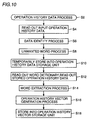
- step (abbreviated as "S" hereinafter) 2 is carried out when the stored amount of operation history data exceeds a predetermined amount or at an elapse of a predetermined time from the previous operation history data process.
- CPU 72 reads out from fixed disk 80 and stores into memory 78 the operation history data entered through input unit 2 and stored in operation history data storage unit 10.
- the user identify code and data identify code stored in operation history data storage unit 10 are also read out together.
- data identify processing unit 32 determines the type of data read out at S4. This determination is carried out based on the data identify code read out at S2. In the following description, the data type is determined as EPG data by data identify processing unit 32.
- unwanted word processing unit 34 extracts the unwanted word in the operation history data read out at S4 to carry out an unwanted word process for the word that is to be ignored in the subsequent process.
- the unwanted word is determined according to the data type identified at S6.
- the data type identified at S6 In the case of the EPG data of Fig. 3, for example, the broadcasting day and time, the broadcasting station, and the G code on the second line that are not directly related to the interest to the user are determined as the unwanted word.
- first operation history data corresponds to data of"today is in the mood of journey" and "hot spring introduction" as a result of the process of S8.
- CPU 72 temporarily stores the operation history data subjected to the unwanted word process into operation history data storage unit 10.
- CPU 72 reads out the word dictionary matching the type of the operation history data from word dictionary 6 stored in fixed disk 80, and then reads out from operation history data storage unit 10 the operation history data temporarily stored at S10.
- word extraction processing unit 36 carries out a word extraction process on the read out operation history data according to word dictionary 6 for each operation history data.
- vector generation processing unit 38 generates the operation history vector for each operation history as the vector sum of the word vectors corresponding to the word extracted for each operation history at S14.
- CPU 72 stores the operation history vectors for each operation history into operation history vector storage unit 12.
- operation history data of Fig. 3 for example, six operation history vectors corresponding to first to sixth operation history data are stored (Fig. 5).
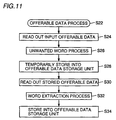
- the offerable data process is initiated at S22. This start timing does not have to be in synchronization with the start timing of the above-described operation history data process.
- CPU 72 reads out the offerable data input through input unit 2 and stored in offerable data storage unit 8.
- offerable data matching the user identify code and the data identify code is read out according to the user identify code and data identify code stored in memory 88.
- unwanted word processing unit 34 extracts the unwanted word with respect to the offerable data read out at S24 to carry out the unrequired word process for the word that is to be ignored in the subsequent process.
- CPU 72 stores in offerable data storage unit 8 the word extracted for each offerable data.
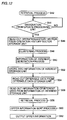
- CPU 72 determines whether a designation of updating the clustering process is output or not from update processing unit 42. When designation is provided (YES at S44), control proceeds to S46. When designation is not provided (NO at S44), control returns to S44 to wait for update designation.
- CPU 72 reads out the operation history data for each operation history stored in operation history vector storage unit 12 (Fig. 5).
- clustering processing unit 40 applies the self-organizing map method on the read out operation history vector to classify the operation history data for each category according to the closeness of vectors with respect to each other.
- the first to sixth operation history data of Fig. 5 are classified into three categories of Fig. 6.
- the first category relates to news and sports.
- the second category relates to journeys.
- the third category relates to variety shows. These categories are classified based on the characteristic of the operation history data. Respective categories can be considered of indicating the user's interest.
- information-of-interest generation processing unit 44 generates information-of-interest to the user from the categories classified at S48. All the words in the operation history data included in each category are set as the user's information-of-interest according to word dictionary 6 of Fig. 4.
- the information-of-interest of the third category in Fig. 6 is represented by the three words of "laughter”, “narrative” and “mood” (Fig. 7), for example.
- information-of-interest generation processing unit 44 stores in information-of-interest storage unit 14 the information-of-interest generated at S50.
- CPU 72 reads out offerable data from offerable data storage unit 8.
- CPU 72 reads out information-of-interest data from information-of-interest storage unit 14.
- retrieval processing unit 46 retrieves information-of-interest corresponding to the user from the offerable data read out at S54 according to the information-of-interest data read out at S56.
- First retrieval point for each offerable data shown in Fig. 2 is calculated for each category of Fig. 7. Those having the highest first retrieval point are represented as below: First category top first offerable data 37.5 Second category top third offerable data 28.6 top fifth offerable data 28.6 Third category top second offerable data 33.3
- offering information sort processing unit 48 defines the output order of the top offerable data for each category retrieved at S58.
- three operation history data, two operation history data and one operation history data are included in the first category, the second category and the third category, respectively.
- the user's interest is centralized in categories including many operation history data and the categories are considered to have great importance. Therefore, the categories are assorted in the order of the number of operation history data.
- the offerable data having the highest first retrieval point is output for each category according to the sorted category.
- the categories are in the order of the first category, the second category and the third category, whereas the output order of the information items are in the order of the first offerable data, the third offerable data, the fifth offerable data and the second offerable data.
- CPU 72 provides the offerable data to the user from output unit 16 according to the order defined at S60.
- the user inserts an FD 90, CD-ROM 92 or the like in which the EPG data of the program to be broadcasted is stored into FD drive device 82 or CD-ROM drive device 84 to store the EPG data in offerable data storage unit 88. Also, the EPG data of a program that has been viewed continuously over a predetermined time or recorded by the user is stored in operation history data storage unit 10 in a similar manner. At this stage, the user enters his/her user identify code through user identify unit 4.
- the type of the input operation history data is identified by data identify unit 32 (S6).
- the unwanted word process is carried out by unwanted word processing unit 34 according to the data type (S8).
- the operation history data is stored in operation history data storage unit 10 together with the user identify code (S10).
- An unwanted word process is carried out by unwanted word processing unit 34 on the input offerable data (S26). Words in the data are extracted according to word dictionary 6 by word extraction processing unit 36 (S32). The extracted words are stored in offerable data storage unit 8 (S34).
- words in the data are extracted according to word dictionary 6 by word extraction processing unit 36 (S14).
- the vector sum is calculated of the word vectors corresponding to the extracted word for each operation history data by vector generation processing unit 38 (S16). Then, the vector sum is stored in operation history vector storage unit 12 (S18).
- operation history vectors are read out to be classified into categories by clustering processing unit 40 (S48).
- Information-of-interest generation processing unit 44 generates information-of-interest extracting all words appearing in the operation history data included in each classified category (S50).
- Retrieval processing unit 46 retrieves an information item of high interest to the user from the offerable data according to the information-of-interest for each user (S58).
- the output order of the information items is determined by offering information sort processing unit 48 (S60).
- Output unit 16 provides monitor 88 or printer 86 with the information item of high interest to the user according to the output sequence (S62).
- the present modification has input unit 2 and output unit 16 of Fig. 1 modified into a reception unit 18 and a transmission unit 22, respectively.
- Reception unit 18 and transmission unit 22 are connected over the network with another computer, work station or the like via a communication line to allow data transmission and reception.
- Reception unit 18 receives use's operation history data with a user identify code from another computer.
- Transmission unit 22 transmits the information item sorted by offering information sort processing unit 48 according to the user identify code to the other computer that is the source of the reception data.
- the information offer apparatus of the present invention can be realized by a computer that functions as a proxy server for connection to the Internet.
- the operation history data is received together with the user identify code from the client's personal computer at reception unit 18.
- the operation history data is stored in operation history data storage unit 12 for each user.
- Information-of-interest processing unit 30 retrieves the information item to be offered to the user according to the characteristic of the operation history data.
- the information item to be offered is transmitted to the client's personal computer through transmission unit 22.
- an information item of interest to the user can be acquired efficiently by classifying the user's operation history into categories corresponding to the characteristics.
- an information item of interest to the user can be offered to the user.
- an information item of interest to the user can be offered even if each client's personal computer is not equipped with the information offer apparatus.
- the information offer apparatus of the present embodiment further includes an offerable vector storage unit 20 in addition to the apparatus of Fig. 1.
- the information offer apparatus of the second embodiment includes an information-of-interest generation processing unit 50 and a retrieval processing unit 52 instead of information-of-interest generation unit 44 and retrieval processing unit 46, respectively, shown in Fig. 1. Units 50 and 52 slightly differ from units 44 and 46, respectively, in function.
- offerable vector storage unit 20 resides in a predetermined storage region on a fixed disk of the computer to store relevant data.
- the offerable vector is generated by processes similar to those of the operation history vector by data identify processing unit 32, unwanted word processing unit 34, word extraction processing unit 36 and vector generation processing unit 38. Therefore, detailed description of the same process will not be repeated here.
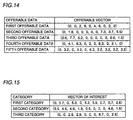
- operable vectors shown in Fig. 14 are generated from the first to fifth offerable data shown in Fig. 2 to be stored in offerable vector storage unit 20.
- a normalization process is carried out so that the size of each offerable vector becomes ten (10).
- Information-of-interest generation processing unit 50 generates a vector of interest as information-of-interest according to the operation history data classified by clustering processing unit 40.
- the vector of interest is obtained by obtaining the vector sum of the operation history vectors corresponding to each category and applying a normalization process that sets the size of the vectors to 10.
- the vector of interest of the second category in Fig. 6 corresponds to the sum of the operation history vectors of the first operation history data of the second category and the third operation history data.
- the vector sum of respective operation history data in Fig. 5 is calculated to become (6, 5, 5, 2, 1, 0, 0, 0, 5, 2).
- the operator " ⁇ " represents the inner product of the vectors. Since a normalization process to set the size of both Vq and Vi to ten is applied, the value of the second retrieval point takes a value from 0 to 100. The value of the second retrieval point becomes higher as the vector distance is closer.
- CPU 72 reads out the offerable vector from offerable vector storage unit 20 as offerable data.
- CPU 72 reads out the vector of interest from information-of-interest storage unit 14 as information-of-interest data.
- retrieval processing unit 52 retrieves a vector corresponding to the information item of interest to the user according to the vector of interest read out at S56 from the offerable vectors read out at S54.
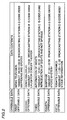
- the second retrieval point of the offerable vector for each offerable data shown in Fig. 14 is calculated. Those having the highest second retrieval point (top) are set forth in the following. First category top first offerable data 95 Second category top third offerable data 85.6 Third category top second offerable data 79.5
- offering information sort processing unit 48 defines the output order of the top offerable data for each category retrieved at S58.
- the order is the first offerable data, the third offerable data and the second offerable data.
- the user's operation history data are classified into categories according to the characteristic thereof to generate a vector of interest for each category. Also, a word vector of the offerable data is generated. By a vector operation thereof, an information item of interest to the user can be acquired in high accuracy.
Landscapes
- Engineering & Computer Science (AREA)
- Theoretical Computer Science (AREA)
- Data Mining & Analysis (AREA)
- Databases & Information Systems (AREA)
- Physics & Mathematics (AREA)
- General Engineering & Computer Science (AREA)
- General Physics & Mathematics (AREA)
- Information Retrieval, Db Structures And Fs Structures Therefor (AREA)
Applications Claiming Priority (2)
| Application Number | Priority Date | Filing Date | Title |
|---|---|---|---|
| JP23717499 | 1999-08-24 | ||
| JP23717499A JP3730451B2 (ja) | 1999-08-24 | 1999-08-24 | 情報提供装置 |
Publications (2)
| Publication Number | Publication Date |
|---|---|
| EP1079314A2 true EP1079314A2 (de) | 2001-02-28 |
| EP1079314A3 EP1079314A3 (de) | 2001-06-06 |
Family
ID=17011482
Family Applications (1)
| Application Number | Title | Priority Date | Filing Date |
|---|---|---|---|
| EP00306388A Withdrawn EP1079314A3 (de) | 1999-08-24 | 2000-07-27 | Vorrichtung und Verfahren zur Belieferung eines Benutzers mit einer ihn interessierenden Information |
Country Status (2)
| Country | Link |
|---|---|
| EP (1) | EP1079314A3 (de) |
| JP (1) | JP3730451B2 (de) |
Cited By (4)
| Publication number | Priority date | Publication date | Assignee | Title |
|---|---|---|---|---|
| US7945864B2 (en) | 2006-11-15 | 2011-05-17 | Panasonic Corporation | Operation assisting apparatus and operation assisting method |
| US7949959B2 (en) | 2006-11-10 | 2011-05-24 | Panasonic Corporation | Target estimation device and target estimation method |
| US20240220527A1 (en) * | 2013-12-20 | 2024-07-04 | Google Llc | Classifying data objects |
| US12619644B2 (en) * | 2021-09-18 | 2026-05-05 | Beijing Boe Technology Development Co., Ltd. | Text recommendation method and apparatus, model training method and apparatus, and readable storage medium |
Families Citing this family (4)
| Publication number | Priority date | Publication date | Assignee | Title |
|---|---|---|---|---|
| JP4669642B2 (ja) * | 2001-08-27 | 2011-04-13 | 株式会社リコー | 文書分類装置および文書分類方法、並びに文書分類方法をコンピュータに実行させるプログラムを記録したコンピュータ読み取り可能な記録媒体 |
| US7657906B2 (en) * | 2003-11-13 | 2010-02-02 | Panasonic Corporation | Program recommendation apparatus, method and program used in the program recommendation apparatus |
| JP5151913B2 (ja) * | 2008-10-31 | 2013-02-27 | コニカミノルタエムジー株式会社 | 情報処理装置 |
| JP6434954B2 (ja) * | 2016-11-28 | 2018-12-05 | ヤフー株式会社 | 情報処理装置、情報処理方法、およびプログラム |
Family Cites Families (2)
| Publication number | Priority date | Publication date | Assignee | Title |
|---|---|---|---|---|
| JP2978044B2 (ja) * | 1993-10-18 | 1999-11-15 | シャープ株式会社 | 文書分類装置 |
| JP3195752B2 (ja) * | 1997-02-28 | 2001-08-06 | シャープ株式会社 | 検索装置 |
-
1999
- 1999-08-24 JP JP23717499A patent/JP3730451B2/ja not_active Expired - Fee Related
-
2000
- 2000-07-27 EP EP00306388A patent/EP1079314A3/de not_active Withdrawn
Cited By (4)
| Publication number | Priority date | Publication date | Assignee | Title |
|---|---|---|---|---|
| US7949959B2 (en) | 2006-11-10 | 2011-05-24 | Panasonic Corporation | Target estimation device and target estimation method |
| US7945864B2 (en) | 2006-11-15 | 2011-05-17 | Panasonic Corporation | Operation assisting apparatus and operation assisting method |
| US20240220527A1 (en) * | 2013-12-20 | 2024-07-04 | Google Llc | Classifying data objects |
| US12619644B2 (en) * | 2021-09-18 | 2026-05-05 | Beijing Boe Technology Development Co., Ltd. | Text recommendation method and apparatus, model training method and apparatus, and readable storage medium |
Also Published As
| Publication number | Publication date |
|---|---|
| JP3730451B2 (ja) | 2006-01-05 |
| EP1079314A3 (de) | 2001-06-06 |
| JP2001067360A (ja) | 2001-03-16 |
Similar Documents
| Publication | Publication Date | Title |
|---|---|---|
| US6993517B2 (en) | Information retrieval system for documents | |
| US7487151B2 (en) | Information processing apparatus, information processing method, program for implementing information processing method, information processing system, and method for information processing system | |
| US8626758B2 (en) | Filtering system for providing personalized information in the absence of negative data | |
| US6078917A (en) | System for searching internet using automatic relevance feedback | |
| US10157233B2 (en) | Search engine that applies feedback from users to improve search results | |
| JP3598742B2 (ja) | 文書検索装置及び文書検索方法 | |
| US6938025B1 (en) | Method and apparatus for automatically determining salient features for object classification | |
| US6519564B1 (en) | Content-driven speech-or audio-browser | |
| US6356879B2 (en) | Content based method for product-peer filtering | |
| US5675788A (en) | Method and apparatus for generating a composite document on a selected topic from a plurality of information sources | |
| US20070244915A1 (en) | System and method for clustering documents | |
| JP2001519952A (ja) | データ要約装置 | |
| JP2001160067A (ja) | 類似文書検索方法および該類似文書検索方法を利用した推薦記事通知サービスシステム | |
| US20040107221A1 (en) | Information storage and retrieval | |
| US20040107194A1 (en) | Information storage and retrieval | |
| CN110188197B (zh) | 一种用于标注平台的主动学习方法及装置 | |
| US20070094285A1 (en) | Question answering over structured content on the web | |
| JP2001306612A (ja) | 情報提供装置、情報提供方法およびその方法を実現するプログラムを記録した機械読取可能な記録媒体 | |
| EP1079314A2 (de) | Vorrichtung und Verfahren zur Belieferung eines Benutzers mit einer ihn interessierenden Information | |
| JP2002215665A (ja) | 情報推薦サーバー装置 | |
| KR101355945B1 (ko) | 온라인 문맥기반 광고 장치 및 방법 | |
| JP2000057090A (ja) | 他者グループ嗜好情報を利用した情報提供方法及び情報提供装置、並びに、情報提供プログラムを記録した記録媒体 | |
| JP2002342360A (ja) | 情報提供装置、その方法、そのコンピュータ・プログラムおよびそのプログラムを記録した記録媒体 | |
| JP2000242652A (ja) | 情報潮流検索方法、装置、および情報潮流検索プログラムを記録した記録媒体 | |
| KR100781513B1 (ko) | 선호도에 따른 컨텐츠를 제공하는 장치 및 방법 |
Legal Events
| Date | Code | Title | Description |
|---|---|---|---|
| PUAI | Public reference made under article 153(3) epc to a published international application that has entered the european phase |
Free format text: ORIGINAL CODE: 0009012 |
|
| AK | Designated contracting states |
Kind code of ref document: A2 Designated state(s): DE FR GB |
|
| AX | Request for extension of the european patent |
Free format text: AL;LT;LV;MK;RO;SI |
|
| PUAL | Search report despatched |
Free format text: ORIGINAL CODE: 0009013 |
|
| AK | Designated contracting states |
Kind code of ref document: A3 Designated state(s): AT BE CH CY DE DK ES FI FR GB GR IE IT LI LU MC NL PT SE |
|
| AX | Request for extension of the european patent |
Free format text: AL;LT;LV;MK;RO;SI |
|
| 17P | Request for examination filed |
Effective date: 20010817 |
|
| AKX | Designation fees paid |
Free format text: DE FR GB |
|
| 17Q | First examination report despatched |
Effective date: 20050415 |
|
| STAA | Information on the status of an ep patent application or granted ep patent |
Free format text: STATUS: THE APPLICATION IS DEEMED TO BE WITHDRAWN |
|
| 18D | Application deemed to be withdrawn |
Effective date: 20050826 |