EP1080710A2 - Halteeinrichtung zum befestigen eines Kissenelementes am Rücken - Google Patents
Halteeinrichtung zum befestigen eines Kissenelementes am Rücken Download PDFInfo
- Publication number
- EP1080710A2 EP1080710A2 EP00113513A EP00113513A EP1080710A2 EP 1080710 A2 EP1080710 A2 EP 1080710A2 EP 00113513 A EP00113513 A EP 00113513A EP 00113513 A EP00113513 A EP 00113513A EP 1080710 A2 EP1080710 A2 EP 1080710A2
- Authority
- EP
- European Patent Office
- Prior art keywords
- cushiony member
- cushiony
- user
- tool
- coupler
- Prior art date
- Legal status (The legal status is an assumption and is not a legal conclusion. Google has not performed a legal analysis and makes no representation as to the accuracy of the status listed.)
- Withdrawn
Links
Images



Classifications
-
- A—HUMAN NECESSITIES
- A61—MEDICAL OR VETERINARY SCIENCE; HYGIENE
- A61F—FILTERS IMPLANTABLE INTO BLOOD VESSELS; PROSTHESES; DEVICES PROVIDING PATENCY TO, OR PREVENTING COLLAPSING OF, TUBULAR STRUCTURES OF THE BODY, e.g. STENTS; ORTHOPAEDIC, NURSING OR CONTRACEPTIVE DEVICES; FOMENTATION; TREATMENT OR PROTECTION OF EYES OR EARS; BANDAGES, DRESSINGS OR ABSORBENT PADS; FIRST-AID KITS
- A61F5/00—Orthopaedic methods or devices for non-surgical treatment of bones or joints; Nursing devices ; Anti-rape devices
- A61F5/56—Devices for preventing snoring
-
- A—HUMAN NECESSITIES
- A61—MEDICAL OR VETERINARY SCIENCE; HYGIENE
- A61G—TRANSPORT, PERSONAL CONVEYANCES, OR ACCOMMODATION SPECIALLY ADAPTED FOR PATIENTS OR DISABLED PERSONS; OPERATING TABLES OR CHAIRS; CHAIRS FOR DENTISTRY; FUNERAL DEVICES
- A61G7/00—Beds specially adapted for nursing; Devices for lifting patients or disabled persons
- A61G7/05—Parts, details or accessories of beds
- A61G7/065—Rests specially adapted therefor
- A61G7/07—Rests specially adapted therefor for the head or torso, e.g. special back-rests
-
- A—HUMAN NECESSITIES
- A61—MEDICAL OR VETERINARY SCIENCE; HYGIENE
- A61G—TRANSPORT, PERSONAL CONVEYANCES, OR ACCOMMODATION SPECIALLY ADAPTED FOR PATIENTS OR DISABLED PERSONS; OPERATING TABLES OR CHAIRS; CHAIRS FOR DENTISTRY; FUNERAL DEVICES
- A61G7/00—Beds specially adapted for nursing; Devices for lifting patients or disabled persons
- A61G7/05—Parts, details or accessories of beds
- A61G7/057—Arrangements for preventing bed-sores or for supporting patients with burns, e.g. mattresses specially adapted therefor
Definitions
- the present invention relates to a tool for firmly carrying a cushiony member on one's back, which may be used to relieve a bedsore, a snore and so on, in particular.
- a bedridden person can have bedsores easily since the circulation of the blood degrades at a pressed portion of his or her body.
- he or she has been made to change his or her position on a bed, or a doughnut-shaped pillow has been put under his or her buttocks. If a snoring person continuously lies on his or her back, his or her base of the tongue lowers to make the snore serious, which causes lack of sleep or a sleep apnea syndrome.
- the tool for firmly carrying a cushiony member on a user's back includes a coupler to be coupled to a cushiony member and a shoulder band.
- the coupler is supposed to be coupled to the cushiony member.
- the cushiony member is supposed to be positioned on a user's back and located between the back and a bed to work for keeping him or her lying on his or her side when he or she lies on the bed and leans against the cushiony member.
- the shoulder band is coupled to the coupler, allowing him or her to carrying the cushiony member coupled to the coupler on the user's back.
- the cushiony member may be fixed to the coupler.
- the coupler may be a winding band.
- the winding band may be wound around the cushiony member.
- the coupler may be a bag.
- the bag is served to house the cushiony member.
- the shoulder band may have a waist belt coupled thereto.
- the shoulder band may have a breast belt coupled thereto.
- the user can lean his or her body against the cushiony member firmly carried on the back to naturally lie on his or her side, preventing him or her from having bedsores or easily snoring.
- This mode can eliminate the cause of lack of sleep or a sleep apnea syndrome.
- This mode can also use the shoulder band to fix the cushiony member to the user's body, causing the cushiony member to follow his or her body movement even if he or she is a patient or a bedridden person.
- the tool can offer an advantage to provide a simple structure in addition to the advantages offered by the first mode.
- the user can offer an advantage to wind the winding band around the cushiony member to fix the cushiony member to the shoulder band in addition to the advantages offered by the first mode.
- the tool is easy to carry before the tool has had the cushiony member combined therewith.
- the user can offer an advantage to house the cushiony member and fix the cushiony member to the shoulder band in addition to the advantages offered by the first mode.
- the tool is easy to carry before the tool has had the cushiony member combined therewith.
- the user can offer an advantage to use the waist belt to put the cushiony member on his or her body in close contact in addition to the advantages offered by the first mode.
- the user can have an improved feeling of fit to the cushiony member, decreasing a feeling of discomfort caused by wearing.
- the user can offer an advantage to use the breast belt to put the cushiony member on his or her body in close contact in addition to the advantages offered by the first mode.
- the user can have an improved feeling of fit to the cushiony member, decreasing a feeling of discomfort caused by wearing.
- the first numeral 10 designates a tool for firmly carrying a cushiony member on a user's back.
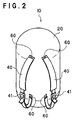
- the tool 10 is served to carry a cushiony member 20 on a user's back 30 as shown in Figures 1-3.
- the tool 20 basically includes the following parts as shown in Figures 1-3.
- the tool 10 is not limited to one with the parts (1) and (2) mounted thereto, and may include an additional part.
- the cushiony member 20 When a user lies on a bed 50, carrying the cushiony member 20 on the back, and leans against the cushiony member 20, the cushiony member is positioned on the user's back 30 and located between the back and the bed 50 to work for keeping him or her lain on his or her side as shown in Figures 1-3.
- the cushiony member 20 is a bag with a suitable amount of sponge filled therein, for instance, though not shown.
- the user can use the shoulder bands 40 to carry the cushiony member 20 on his or her back.
- the shoulder bands are formed in a belt shape and are positioned at two locations, i.e., on right and left positions of his or her body as in Figures 1-3.
- buckles 41 are mounted to the shoulder bands 40 to provide the shoulder bands with adjustable length.
- the shoulder bands 40 may be made of a rubber material to have adjustable length.
- the number of the shoulder bands 40 is not limited to two but may be one.
- the shoulder bands 40 are not limited to ones in a belt shape but may be clothing, such as a vest and night clothing.
- Both ends of each of the right and left shoulder bands 40 are fixed to the cushiony member 20 through couplers 60 as shown in Figure 2.
- the couplers 60 may be provided by sewing totally four of the respective ends of the right and left shoulder bands 40 on the cushiony member 20 as shown in Figure 2. Instead of sewing the respective ends of the shoulder bands 40 on the cushiony member 20, the shoulder bands may be coupled to the cushiony member 20 through rings.
- the tool 10 thus constructed will be used as follows:
- the user slings the two shoulder bands 40 over his or her shoulders to carry the cushiony member 20 on the back as shown in Figures 1 and 3.
- the user lies down on the bed 50, carrying the cushiony member 20 on the back.
- the cushiony member 20 is crushed and deformed between his or her body 30 and the bed 50 as shown in Figures 1 and 3.
- the cushiony member 20 creates an elastic restoring force to push the back of his or her body 30 back, and the user can easily maintain a posture to lie on his or her side. Even if the user applies the weight of his or her body to the cushiony member 20, one of his or her shoulders is forced to rise away from the bed 50 to prevent the user from lying on the back since the cushiony member 20 exists between the bed 50 and his or her body.
- the couplers are constituted by bands 70 and 71 as shown in Figure 40.
- the couplers are constituted by bands 70 and 71 as shown in Figure 40.
- the upper band 70 is fixedly sewed on the respective upper ends of the right and left shoulder bands 40.
- the lower band 71 is fixedly sewed on the respective lower ends of the right and left shoulder bands 40.
- the upper and lower bands 70 and 71 may have adjustable length or be extensive and retractable according to the outer diameter of the cushiony member 20, though not shown.
- the number of the bands 70 and 71 is not limited to two, but the number may be one or not less than three. When the upper and lower bands are used, the bands are fixedly wound around a cushion, a pillow or a similar one, though not shown.
- a cushion or pillow may be utilized as the cushiony member 20.
- the tool is easy to carry before the tool has had the cushiony member 20 combined therewith.
- the right and left shoulder bands 40 include a waist belt 80 and a breast belt 90 as shown in Figure 4.
- the waist belt 80 and the breast belt 90 have adjustable length since both belts include buckles 81 and 91 as shown in Figure 4.
- the waist belt 80 or the breast belt 90 may be made of a flexible material, such as rubber, so as to have adjustable length.
- the waist belt 80 or the breast belt 90 can put the cushiony member on the user's body 30 in closer contact, relieving a feeling of discomfort.
- the coupler is a bag 100 as shown in Figure 5.
- the bag 100 has a network structure as shown in Figure 5.
- the bag 100 has a portion, such as an upper side and a lateral side, formed to be openable, though not shown.
- the bag 100 is not limited to have a network structure as long as the bag is formed in an envelope shape.
- a cushion, a pillow, a collection of sponge pieces, a collection of pieces of cloth or another cushiony member is put into the bag through the opening (not shown) and the bag is closed.
- various kinds of cushiony members can be utilized as the cushiony member 20 by being put into the bag 100.
- the tool 10 is easy to carry before the tool has had the cushiony member 20 combined therewith.
Landscapes
- Health & Medical Sciences (AREA)
- Life Sciences & Earth Sciences (AREA)
- Veterinary Medicine (AREA)
- Public Health (AREA)
- Nursing (AREA)
- General Health & Medical Sciences (AREA)
- Animal Behavior & Ethology (AREA)
- Orthopedic Medicine & Surgery (AREA)
- Vascular Medicine (AREA)
- Heart & Thoracic Surgery (AREA)
- Biomedical Technology (AREA)
- Engineering & Computer Science (AREA)
- Pulmonology (AREA)
- Otolaryngology (AREA)
- Invalid Beds And Related Equipment (AREA)
- Mattresses And Other Support Structures For Chairs And Beds (AREA)
- Orthopedics, Nursing, And Contraception (AREA)
- Professional, Industrial, Or Sporting Protective Garments (AREA)
Applications Claiming Priority (2)
| Application Number | Priority Date | Filing Date | Title |
|---|---|---|---|
| JP24391999 | 1999-08-30 | ||
| JP24391999A JP2001061875A (ja) | 1999-08-30 | 1999-08-30 | クッションの背部固定具 |
Publications (2)
| Publication Number | Publication Date |
|---|---|
| EP1080710A2 true EP1080710A2 (de) | 2001-03-07 |
| EP1080710A3 EP1080710A3 (de) | 2002-09-04 |
Family
ID=17110978
Family Applications (1)
| Application Number | Title | Priority Date | Filing Date |
|---|---|---|---|
| EP00113513A Withdrawn EP1080710A3 (de) | 1999-08-30 | 2000-06-26 | Halteeinrichtung zum befestigen eines Kissenelementes am Rücken |
Country Status (4)
| Country | Link |
|---|---|
| EP (1) | EP1080710A3 (de) |
| JP (1) | JP2001061875A (de) |
| AU (1) | AU4374700A (de) |
| CA (1) | CA2312602A1 (de) |
Cited By (5)
| Publication number | Priority date | Publication date | Assignee | Title |
|---|---|---|---|---|
| AT411218B (de) * | 2002-01-23 | 2003-11-25 | Rohrhofer Friedrich Ing | Trainingsbehelf zur überwachung und korrektur der schlafposition als ergänzung oder ersatz eines schlafanzuges |
| FR2930427A1 (fr) * | 2008-04-23 | 2009-10-30 | Philippe Ducrocq | Dispositif de positionnement d'un individu durant son sommeil |
| FR2949192A1 (fr) * | 2009-08-19 | 2011-02-25 | Pasuldo | Dispositif anti-ronflement |
| CN104224475A (zh) * | 2014-09-10 | 2014-12-24 | 张瑞华 | 持续气道开放枕 |
| CN113995594A (zh) * | 2021-11-29 | 2022-02-01 | 上海理工大学 | 一种睡眠呼吸暂停综合征治疗床 |
Families Citing this family (7)
| Publication number | Priority date | Publication date | Assignee | Title |
|---|---|---|---|---|
| WO2002052993A1 (en) * | 2000-12-28 | 2002-07-11 | Chikako Kamma | Attaching structure of back pillow |
| JP2007167668A (ja) * | 2006-12-25 | 2007-07-05 | Shimabukuro Masako | 睡眠時無呼吸防止のための健康バッグ |
| JP5620026B1 (ja) * | 2014-05-23 | 2014-11-05 | 義明 白輪地 | 無呼吸治療具兼いびき防止具 |
| JP5887394B1 (ja) * | 2014-12-01 | 2016-03-16 | 佳巳 藤村 | いびき抑制用背枕 |
| US20170014287A1 (en) * | 2015-07-17 | 2017-01-19 | Tai-Tien Chung | Pull-type Body Turning Aid and Pull-type Body Turning Device Including the Same |
| TWI691324B (zh) * | 2015-07-17 | 2020-04-21 | 鍾泰天 | 牽引式翻身輔具及牽引式翻身裝置 |
| CN107296698A (zh) * | 2017-07-10 | 2017-10-27 | 湖北物连网智能用品有限公司 | 一种平稳转移的恒温手术护理床 |
Citations (1)
| Publication number | Priority date | Publication date | Assignee | Title |
|---|---|---|---|---|
| JPH11243919A (ja) | 1998-02-27 | 1999-09-14 | Kawakubo Seisakusho:Kk | 小魚等の不純物除去装置 |
Family Cites Families (3)
| Publication number | Priority date | Publication date | Assignee | Title |
|---|---|---|---|---|
| BE448660A (de) * | 1940-09-21 | |||
| DE1198005B (de) * | 1964-01-17 | 1965-08-05 | Elia Mielnik | Geraet zur Schnarchverhinderung |
| US6357444B1 (en) * | 1998-02-18 | 2002-03-19 | Jonathan A. Parker | Motion limiting device |
-
1999
- 1999-08-30 JP JP24391999A patent/JP2001061875A/ja active Pending
-
2000
- 2000-06-26 EP EP00113513A patent/EP1080710A3/de not_active Withdrawn
- 2000-06-27 CA CA 2312602 patent/CA2312602A1/en not_active Abandoned
- 2000-06-29 AU AU43747/00A patent/AU4374700A/en not_active Abandoned
Patent Citations (1)
| Publication number | Priority date | Publication date | Assignee | Title |
|---|---|---|---|---|
| JPH11243919A (ja) | 1998-02-27 | 1999-09-14 | Kawakubo Seisakusho:Kk | 小魚等の不純物除去装置 |
Cited By (6)
| Publication number | Priority date | Publication date | Assignee | Title |
|---|---|---|---|---|
| AT411218B (de) * | 2002-01-23 | 2003-11-25 | Rohrhofer Friedrich Ing | Trainingsbehelf zur überwachung und korrektur der schlafposition als ergänzung oder ersatz eines schlafanzuges |
| FR2930427A1 (fr) * | 2008-04-23 | 2009-10-30 | Philippe Ducrocq | Dispositif de positionnement d'un individu durant son sommeil |
| FR2949192A1 (fr) * | 2009-08-19 | 2011-02-25 | Pasuldo | Dispositif anti-ronflement |
| CN104224475A (zh) * | 2014-09-10 | 2014-12-24 | 张瑞华 | 持续气道开放枕 |
| CN104224475B (zh) * | 2014-09-10 | 2017-04-05 | 张瑞华 | 持续气道开放枕 |
| CN113995594A (zh) * | 2021-11-29 | 2022-02-01 | 上海理工大学 | 一种睡眠呼吸暂停综合征治疗床 |
Also Published As
| Publication number | Publication date |
|---|---|
| CA2312602A1 (en) | 2001-02-28 |
| EP1080710A3 (de) | 2002-09-04 |
| AU4374700A (en) | 2001-03-08 |
| JP2001061875A (ja) | 2001-03-13 |
Similar Documents
| Publication | Publication Date | Title |
|---|---|---|
| US5692246A (en) | Chest pillow chest protector | |
| US5647378A (en) | Invalid support belt | |
| US5725139A (en) | Backpack with adjustments for body size | |
| US5466214A (en) | Dynamic harness for human spine | |
| US8272385B2 (en) | Method for treating obstructive sleep apnea and/or snoring | |
| EP1452155A2 (de) | Rückenstützunterlage | |
| EP1080710A2 (de) | Halteeinrichtung zum befestigen eines Kissenelementes am Rücken | |
| WO2003011081A2 (en) | Multipurpose pillow assembly | |
| US5338289A (en) | Spinal support for reclining persons | |
| US5105828A (en) | Back, abdomen and posture supporting and retaining Johnson belt | |
| US4571000A (en) | Vest type restraining garment | |
| US20230329452A1 (en) | Nursing sling pillow | |
| KR200473475Y1 (ko) | 아기띠 힙시트 | |
| US5242380A (en) | Orthopedic under-arm back harness | |
| KR200318259Y1 (ko) | 어깨걸이 포대기의 허리 지지구조 | |
| US5263496A (en) | Patient support pad for easing pain | |
| JP2979292B2 (ja) | 腰痛の予防及び緩和用の腰バンド | |
| EP1607009A1 (de) | Kleidung für den unterkörper von schwangeren | |
| JP2003116896A (ja) | 骨折予防用保護帯 | |
| KR102115805B1 (ko) | 팔걸이식 유아용 아기띠 | |
| KR200291528Y1 (ko) | 아기포대기 | |
| JP7687679B2 (ja) | おんぶ用具 | |
| KR200322104Y1 (ko) | 수유용 베개 및 쿠션 세트 | |
| KR102326818B1 (ko) | 어깨 외전 보조기 | |
| KR200274753Y1 (ko) | 개량형 아기 포대기 |
Legal Events
| Date | Code | Title | Description |
|---|---|---|---|
| PUAI | Public reference made under article 153(3) epc to a published international application that has entered the european phase |
Free format text: ORIGINAL CODE: 0009012 |
|
| AK | Designated contracting states |
Kind code of ref document: A2 Designated state(s): AT BE CH CY DE DK ES FI FR GB GR IE IT LI LU MC NL PT SE |
|
| AX | Request for extension of the european patent |
Free format text: AL;LT;LV;MK;RO;SI |
|
| PUAL | Search report despatched |
Free format text: ORIGINAL CODE: 0009013 |
|
| AK | Designated contracting states |
Kind code of ref document: A3 Designated state(s): AT BE CH CY DE DK ES FI FR GB GR IE IT LI LU MC NL PT SE |
|
| AX | Request for extension of the european patent |
Free format text: AL;LT;LV;MK;RO;SI |
|
| AKX | Designation fees paid |
Designated state(s): DE FR GB |
|
| STAA | Information on the status of an ep patent application or granted ep patent |
Free format text: STATUS: THE APPLICATION IS DEEMED TO BE WITHDRAWN |
|
| 18D | Application deemed to be withdrawn |
Effective date: 20030305 |