EP1081909A2 - Kommunikationssystem - Google Patents
Kommunikationssystem Download PDFInfo
- Publication number
- EP1081909A2 EP1081909A2 EP00109654A EP00109654A EP1081909A2 EP 1081909 A2 EP1081909 A2 EP 1081909A2 EP 00109654 A EP00109654 A EP 00109654A EP 00109654 A EP00109654 A EP 00109654A EP 1081909 A2 EP1081909 A2 EP 1081909A2
- Authority
- EP
- European Patent Office
- Prior art keywords
- communications
- data
- host computer
- terminals
- terminal
- Prior art date
- Legal status (The legal status is an assumption and is not a legal conclusion. Google has not performed a legal analysis and makes no representation as to the accuracy of the status listed.)
- Withdrawn
Links
- 230000006854 communication Effects 0.000 title claims abstract description 86
- 238000004891 communication Methods 0.000 title claims abstract description 86
- 230000005540 biological transmission Effects 0.000 claims abstract description 48
- 230000004044 response Effects 0.000 claims abstract description 4
- 238000012545 processing Methods 0.000 claims description 7
- 125000004122 cyclic group Chemical group 0.000 claims description 5
- 230000002452 interceptive effect Effects 0.000 claims description 2
- 230000007175 bidirectional communication Effects 0.000 claims 2
- 230000002457 bidirectional effect Effects 0.000 claims 1
- 238000000034 method Methods 0.000 description 9
- 238000010586 diagram Methods 0.000 description 7
- 230000002146 bilateral effect Effects 0.000 description 3
- 238000012546 transfer Methods 0.000 description 3
- 238000012217 deletion Methods 0.000 description 2
- 230000037430 deletion Effects 0.000 description 2
- 230000000694 effects Effects 0.000 description 2
- 238000005516 engineering process Methods 0.000 description 2
- 238000010276 construction Methods 0.000 description 1
- 238000012937 correction Methods 0.000 description 1
- 230000003247 decreasing effect Effects 0.000 description 1
- 230000001419 dependent effect Effects 0.000 description 1
- 230000000977 initiatory effect Effects 0.000 description 1
- 238000013508 migration Methods 0.000 description 1
- 230000005012 migration Effects 0.000 description 1
- 238000012544 monitoring process Methods 0.000 description 1
- 230000003287 optical effect Effects 0.000 description 1
- 230000008054 signal transmission Effects 0.000 description 1
Images


Classifications
-
- H—ELECTRICITY
- H04—ELECTRIC COMMUNICATION TECHNIQUE
- H04N—PICTORIAL COMMUNICATION, e.g. TELEVISION
- H04N7/00—Television systems
- H04N7/16—Analogue secrecy systems; Analogue subscription systems
- H04N7/167—Systems rendering the television signal unintelligible and subsequently intelligible
-
- H—ELECTRICITY
- H04—ELECTRIC COMMUNICATION TECHNIQUE
- H04L—TRANSMISSION OF DIGITAL INFORMATION, e.g. TELEGRAPHIC COMMUNICATION
- H04L63/00—Network architectures or network communication protocols for network security
- H04L63/04—Network architectures or network communication protocols for network security for providing a confidential data exchange among entities communicating through data packet networks
-
- A—HUMAN NECESSITIES
- A63—SPORTS; GAMES; AMUSEMENTS
- A63F—CARD, BOARD, OR ROULETTE GAMES; INDOOR GAMES USING SMALL MOVING PLAYING BODIES; VIDEO GAMES; GAMES NOT OTHERWISE PROVIDED FOR
- A63F13/00—Video games, i.e. games using an electronically generated display having two or more dimensions
- A63F13/30—Interconnection arrangements between game servers and game devices; Interconnection arrangements between game devices; Interconnection arrangements between game servers
- A63F13/33—Interconnection arrangements between game servers and game devices; Interconnection arrangements between game devices; Interconnection arrangements between game servers using wide area network [WAN] connections
- A63F13/335—Interconnection arrangements between game servers and game devices; Interconnection arrangements between game devices; Interconnection arrangements between game servers using wide area network [WAN] connections using Internet
-
- A—HUMAN NECESSITIES
- A63—SPORTS; GAMES; AMUSEMENTS
- A63F—CARD, BOARD, OR ROULETTE GAMES; INDOOR GAMES USING SMALL MOVING PLAYING BODIES; VIDEO GAMES; GAMES NOT OTHERWISE PROVIDED FOR
- A63F13/00—Video games, i.e. games using an electronically generated display having two or more dimensions
- A63F13/30—Interconnection arrangements between game servers and game devices; Interconnection arrangements between game devices; Interconnection arrangements between game servers
- A63F13/33—Interconnection arrangements between game servers and game devices; Interconnection arrangements between game devices; Interconnection arrangements between game servers using wide area network [WAN] connections
- A63F13/338—Interconnection arrangements between game servers and game devices; Interconnection arrangements between game devices; Interconnection arrangements between game servers using wide area network [WAN] connections using television networks
-
- A—HUMAN NECESSITIES
- A63—SPORTS; GAMES; AMUSEMENTS
- A63F—CARD, BOARD, OR ROULETTE GAMES; INDOOR GAMES USING SMALL MOVING PLAYING BODIES; VIDEO GAMES; GAMES NOT OTHERWISE PROVIDED FOR
- A63F13/00—Video games, i.e. games using an electronically generated display having two or more dimensions
- A63F13/70—Game security or game management aspects
- A63F13/71—Game security or game management aspects using secure communication between game devices and game servers, e.g. by encrypting game data or authenticating players
-
- H—ELECTRICITY
- H04—ELECTRIC COMMUNICATION TECHNIQUE
- H04L—TRANSMISSION OF DIGITAL INFORMATION, e.g. TELEGRAPHIC COMMUNICATION
- H04L9/00—Cryptographic mechanisms or cryptographic arrangements for secret or secure communications; Network security protocols
- H04L9/40—Network security protocols
-
- H—ELECTRICITY
- H04—ELECTRIC COMMUNICATION TECHNIQUE
- H04N—PICTORIAL COMMUNICATION, e.g. TELEVISION
- H04N7/00—Television systems
- H04N7/16—Analogue secrecy systems; Analogue subscription systems
- H04N7/173—Analogue secrecy systems; Analogue subscription systems with two-way working, e.g. subscriber sending a programme selection signal
Definitions
- the present invention is directed to a novel communications apparatus that scrambles data to be communicated in order to prevent unauthorized use of the data in wired or wireless communications.
- the present invention is also directed to an arrangement in which a single host computer synchronizes a plurality of terminals in transfer timing when the plurality of terminals send data in wired communications using wired line.
- data to be communicated is coded by an encoder prior to transmission.
- a receiver has a decoder that decodes encoded data the receiver has received.
- the encoding and decoding are performed according to a predetermined communication protocol.
- the encoder for encoding data to be communicated has a cryptographic program for encoding the data according to predetermined sequence. Once decoded, however, the data are accumulated in normal state. The user of a terminal may pay for a first use of the data. For subsequent use, however, the data may be available to the user free of charge. This allows practically unauthorized use, and presents a serious problem to an information provider at a host computer side. Such a system presents no problem if the data is of such a nature that it is at the user's disposal at the terminal once the host computer downloads the data to the terminal. Depending on the type of data, the information provider may want to bill the user for each service, that is, the downloading of the data. If the data is stored at the terminal, however, no subsequent service is requested, and thus no billing happens.
- the data transmission rate is also an issue.
- a limitation is imposed on the data transmission rate, particularly in wired network such as wired telephone line.
- the data transmission rate is also dependent on the modem or interface that connects the terminal with the line. Varied transmission rates are available from a number of modems. Assuming that two computers having respective modem are linked and that one modem is higher than the other in transmission rate, the lower transmission rate overrides.
- communications take place between the two computers at the lower transmission rate rather than the higher transmission rate if one modem is faster than the other in transmission rate.
- the host computer processes data on a task by task basis, and does not synchronize to the lowest transmission rate from among others.
- the date rate of each terminal modem determines communications rate between the host computer and each terminal. Data transmission rate of the host computer is thus varied from terminal to terminal. This arrangement presents no problem in such a system that each terminal accesses for information to the host computer that stores some particular database.
- a host computer stores a video game that may be simultaneously played by a plurality of terminals. Varied data transmission rates among the terminals present a problem.
- Terminal computers can participate any way in the video game that is controlled by the host computer, but input timing may be critical in enjoying a video game, particularly one like shooting games. Difference in data rate biases some participants into their favor at the expense of others in enjoying the video game. Although the input timing of the command that is the participant's direct responsibility is a major factor, the difference in data transmission rate among modems contributes to biased conditions of the game.
- the present invention allows the host computer to send scrambled data body to a plurality of terminals over a unilateral communications link in a cyclic manner.
- the host computer is linked to each terminal via bilateral communications network.
- the host computer downloads descrambling data to descramble downloaded data and a loader to execute the data body.
- the terminal stores the data body, the descrambling data, and the loader into its external memory, transfers the loader and the descrambling data to the available space in its main memory, and the loader descrambles the data body according to the descrambling data.
- the host computer sets the plurality of terminals to the lowest data transmission rate available from among them.
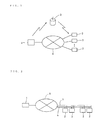
- Fig.1 is a block diagram of a communications network system using a communications satellite.
- Fig.2 is a block diagram of a communications network system using CATV network.
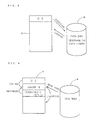
- Fig.3 is a diagram showing that a terminal reads a data body, descrambling data, and a loader into its memory.
- Fig.4 is a diagram showing that the main memory reads the descrambling data and the loader.
- Fig.5 shows another embodiment, different from that of Fig.4.
- Fig.6 is a block diagram showing a communications network system using a public communications network.
- Fig.7 is a block diagram showing task performing of a CPU.
- Fig.8 is a flowchart showing the sequence of the task of Fig.7.
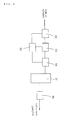
- Fig.9 is a block diagram of a terminal.
- Fig.1 shows the network system made of a communications satellite link and a public communications network as wired link.
- the network system comprises a host computer 1 at an information provider, terminals 2, a communications satellite 3 and a public communication network 4 which may be digital or analogue.
- the host computer 1 sends unilaterally information to any terminal while bilateral communications take place between the host computer 1 and the terminals 2 over the public communications network 4.
- the communications satellite is employed as radio communications link. Instead, terrestrial radio communications link is a perfectly acceptable alternative.
- Fig.2 shows the network system that employs CATV network.
- a host computer 1 is connected to each terminal via CATV network 5 of any known cable link such as optical communication link or coaxial cable link.
- the CATV network 5 is interactive, 6 being upline, and 7 downline.
- the use of an existing CATV having unilateral communications capability only may be contemplated. In this case, however, a public network is used for the upline 6 from each terminal to the host computer 1.
- the data to be communicated is constructed of a data body, descrambling data and a loader.
- the host computer 1 sends numerous data bodies to the terminal 2 via the communications satellite 3 or the CATV network 5 in a cyclic manner, while the host computer 1 sends the descrambling data and the loader to the terminal 2 on demand via the public network 4.
- the descrambling data and the loader are sent over a channel separate from the channel used for the transmission of the data body.
- the descrambling data and the loader are subjected to necessary processing, such as attaching a unique identification code, prior to their transmission.
- the data to be communicated are divided between two separate transmission routes; some of data bodies are so large in size that they are suited to a faster transmission rate communication, while the descrambling data and the loader are relatively small in data size, needing to identify a service requesting terminal for billing purposes.
- the data body to be communicated is scrambled.
- the descrambling data is made of scrambling parameters, a password and compressed dictionary as a type of scramble.
- the data body means the one that contains an execution file and is initiated by certain command.
- the loader is used to initiate the data body.
- the loader descrambles the data body according to the descrambling data while unwinding the data body onto the available memory space of the main memory of a terminal or an external memory device such as a hard disk unit. Then, the loader transfers control to the descrambled data. Both the descrambling data and the loader are unwinded into the main memory and the external memory device.
- the descrambling data in the external memory device is automatically deleted according to a predetermined sequence or is deleted or rewritten when the entire scrambled data is decoded or descrambled. An attempt to reinitiate the data body later is aborted without the downloading of the descrambling data from the host computer. This prevents unauthorized use of data. The same effect may be achieved if the loader is deleted or rewritten in same manner as above.
- a desired data body is retrieved.
- the retrieval of data may be performed in several methods.
- each packet is preceded by an identification code indicative of the data body, and the terminal 2 specifies the identification code to retrieve the data.
- Identification codes may be transmitted in the form of a table in a cyclic manner so that the user may easily check them on the monitor screen of the terminal 2.
- the terminal 2 retrieves the desired data body, but the terminal 2 is unable to do on its own since the data is scrambled.
- the terminal 2 accesses the host computer 2 via the public communications network 4 or the CATV network 5 to request the downloading of the descrambling data and the loader by specifying the identification code or any code corresponding to the identification code.
- the terminal then retrieves the desired data body. If, in this case, correspondence between a data body and its descrambling data and loader may be implemented into a program, no input of the identification code indicative of each data body is required.
- Fig.3 shows the state in which a terminal 2 has read a data body, its scrambling data and loader into its memory.
- An external memory device such as a hard disk drive is designated 8.
- a memory area 9 of the main memory for executing process is already partially occupied by OS.
- the external memory device 8 stores the data body, the descrambling data and the loader in their own separate files.
- the OS accesses the external memory device 8, and processes the available memory space 9 of the main memory.
- This state is illustrated in Fig.4. Specifically, the loader 10 and the descrambling data 11 are transferred to the available memory space 9. Also, control is transferred from the OS to the loader 10.
- the loader 10 reads the data body in the external memory device 8 while decoding the data body referring to the descrambling data. In the meantime, the descrambling data and the loader in the external memory device 8 are deleted.
- the timing of the deletion is not important as long as the deletion has been completed before completion of data processing at the terminal 2. It is perfectly acceptable that either the descrambling data or the loader is deleted in the external memory device. Also, the same effect will be achieved by migration, namely parallel operations of copy and delete, instead of the above method in which the descrambling data and the loader are once entirely copied to the memory area 9 from the external memory device 8 and then deleted at a time entirely.
- Fig.5 shows another type of sequence.
- Calling the loader in the external memory device 8 initiates reading of the loader 10 and the descrambling data 11 into the available space of the memory area 9.
- the loader 10 reads the data body stored in the external memory device 8 referring to the descrambling data 11, and unwinds the data to the available memory space.
- the loader 8 completes at least the unwinding of the scrambled data such as an execution file in the data body.
- the descrambling data and the loader are rewritten.
- To receive a next service a user is required to acquire the descrambling data and the loader again. This prevents unauthorized use of data at each terminal. It is perfectly acceptable that either the descrambling data or the loader is rewritten.
- substantially improved overall transmission efficiency results since large-sized data is communicated via highly efficient communications system while files for preventing unauthorized use of data are communicated via bilateral communication networks.
- This arrangement also achieves improved information management at the host computer.
- Fig.6 shows the host computer and the terminals arranged into a system configuration that embodies the present invention.
- the host computer 21 is connected to each of the terminals 22 via a public communications network 23.
- Fig.7 shows the construction of the host computer 21.
- the host computer 21 comprises a CPU 24 as its core. Based on the capability of the CPU 24, the host computer 21 processes tasks 25a - 25n in a time sharing system.
- the number of terminals 22 simultaneously accessible to the host computer 21 agrees with n, which is the number of tasks.
- Modems 26a-26n are provided, correspondingly to the tasks 22a-22n.
- Modems 26a-26n do not usually agree with the modems of the terminals 22 in data transmission rate (bps). Different rate modems are often paired.
- the tasks 25a-25n do not reside within the CPU 24, and are increasing or decreasing in response to the number of accessing terminals within the limitation of n terminals at maximum.
- the host computer 21 grants simultaneous access to three terminals 22a, 22b, and 22c having data transmission rates 2400 bps, 4800 bps, and 9600 bps, respectively.
- the host computer 21 performs communications with terminals 22a, 22b, and 22c at their respective rates.
- the host computer 21 communicates with all of the three terminals at 2400 bps, which is the lowest of the three rates.
- the CPU 24 operates as follows. When a first terminal is connected to the host computer 21, the host computer 21 determines the data transmission rate of the first terminal modem. A second terminal is then connected to the host computer 21 which in turn determines the data transmission rate of the second terminal.
- the host computer 21 judges the first rate to be equal to the first rate, the host computer proceeds to next step. If the host computer judges this rate to be different from the first rate, it proceeds to judge which is slower, and selects the slower rate.
- the host computer transmits instruction code to any terminal transmitting and receiving at a rate other than the selected rate to force the selected rate to the terminal. Thus, a plurality of terminals are forced to operate in a single common data transmission rate. This sequence is illustrated in Fig.8.
- Fig.9 shows a transceiver circuitry of the terminal 22. Shown in Fig.9 are a line monitoring unit 31, a modem 32, a model control unit 33, a delay control unit 34, and a variable frequency divider 35. Assume that the terminal 22 employs a data transmission rate of 9600 bps, that the terminal 22 initially communicates with the host computer 21 at 9600 and that the host computer 21 instructs the terminal 22 to switch to 2400 bps. The modem control unit 33 in Fig.9 calculates the ratio of the current data transmission rate to the instructed rate, and outputs a resulting ratio to the delay control unit 34. The delay control unit 34 causes the variable frequency divider 35 to operate at the ratio for feedback to the modem 32. Data transmission rate is thus determined.
- the ratio is 9600 to 2400, and the variable frequency divider 35 operates at divide-by-four to slow the data transmission rate.
- These circuits determine the uplink data transmission rate from the terminal 22 to the host computer 21.
- the downlink rate is determined by an input delay control unit 36.
- the input delay control unit 36 controls an input stage (not shown) such as a video game computer, which may be connected to the input delay control unit 36.
- a plurality of terminals are included, and thus a plurality of circuits of Fig.9 are simultaneously connected to the host computer 21.
- the host computer determines its data transmission rate.
- the single common rate is applied to all the terminals.
- Network's own traffic issue aside, communications between the host computer and the terminals are performed under unbiased conditions. This arrangement presents a useful synchronization means in a game playing in which input timing from the participating terminals is critical.
- a single common data transmission rate is applied to all the terminals.
- the host computer instructs them to select the lowest rate of all the data transmission rates of the connected terminals.
- any connected terminal performs communications with the host computer under unbiased conditions. Variations in data transmission rate among the terminals do not affect the quality of communications.
- the present invention offers an effective system in such an application where the input timings among a plurality of terminals need accurate judgement.
Landscapes
- Engineering & Computer Science (AREA)
- Multimedia (AREA)
- Computer Security & Cryptography (AREA)
- Signal Processing (AREA)
- Computer Networks & Wireless Communication (AREA)
- Computing Systems (AREA)
- General Engineering & Computer Science (AREA)
- Computer Hardware Design (AREA)
- Business, Economics & Management (AREA)
- General Business, Economics & Management (AREA)
- Data Exchanges In Wide-Area Networks (AREA)
- Communication Control (AREA)
- Computer And Data Communications (AREA)
- Small-Scale Networks (AREA)
Applications Claiming Priority (5)
| Application Number | Priority Date | Filing Date | Title |
|---|---|---|---|
| JP35362693 | 1993-12-27 | ||
| JP5353626A JPH07202877A (ja) | 1993-12-27 | 1993-12-27 | データのスクランブル装置 |
| JP35021193A JP3406666B2 (ja) | 1993-12-28 | 1993-12-28 | データ伝送同期装置 |
| JP35021193 | 1993-12-28 | ||
| EP94109917A EP0664631B1 (de) | 1993-12-27 | 1994-06-27 | Kommunikationsgerät für Datenfernladung |
Related Parent Applications (1)
| Application Number | Title | Priority Date | Filing Date |
|---|---|---|---|
| EP94109917A Division EP0664631B1 (de) | 1993-12-27 | 1994-06-27 | Kommunikationsgerät für Datenfernladung |
Publications (2)
| Publication Number | Publication Date |
|---|---|
| EP1081909A2 true EP1081909A2 (de) | 2001-03-07 |
| EP1081909A3 EP1081909A3 (de) | 2004-02-11 |
Family
ID=26579149
Family Applications (2)
| Application Number | Title | Priority Date | Filing Date |
|---|---|---|---|
| EP94109917A Expired - Lifetime EP0664631B1 (de) | 1993-12-27 | 1994-06-27 | Kommunikationsgerät für Datenfernladung |
| EP00109654A Withdrawn EP1081909A3 (de) | 1993-12-27 | 1994-06-27 | Kommunikationssystem |
Family Applications Before (1)
| Application Number | Title | Priority Date | Filing Date |
|---|---|---|---|
| EP94109917A Expired - Lifetime EP0664631B1 (de) | 1993-12-27 | 1994-06-27 | Kommunikationsgerät für Datenfernladung |
Country Status (7)
| Country | Link |
|---|---|
| US (1) | US5526435A (de) |
| EP (2) | EP0664631B1 (de) |
| KR (1) | KR100337713B1 (de) |
| AU (1) | AU694426B2 (de) |
| CA (1) | CA2127781C (de) |
| DE (1) | DE69426760T2 (de) |
| ES (1) | ES2154276T3 (de) |
Cited By (4)
| Publication number | Priority date | Publication date | Assignee | Title |
|---|---|---|---|---|
| EP1692795A4 (de) * | 2003-11-12 | 2007-05-30 | Interdigital Tech Corp | System für autonomen anwendungsserver-zugriff üebr verschiedene arten von zugriffstechnologienetzwerken hinweg |
| US7924785B2 (en) | 2004-03-12 | 2011-04-12 | Interdigital Technology Corporation | Method and system for switching a radio access technology between wireless communication systems with a multi-mode wireless transmit/receive unit |
| US8140112B2 (en) | 2002-07-02 | 2012-03-20 | Interdigital Technology Corporation | Method and apparatus for handoff between a wireless local area network (WLAN) and a universal mobile telecommunication system (UMTS) |
| US8548478B2 (en) | 2003-11-13 | 2013-10-01 | Interdigital Technology Corporation | Method and system for facilitating handover from a third generation (3G) cellular communication system to a wireless local area network (WLAN) |
Families Citing this family (6)
| Publication number | Priority date | Publication date | Assignee | Title |
|---|---|---|---|---|
| US6411714B1 (en) * | 1995-09-13 | 2002-06-25 | Hitachi, Ltd. | Data decompression/decryption method and system |
| WO1997034279A1 (en) * | 1996-03-15 | 1997-09-18 | Sony Corporation | Data transmitter, data transmission method, data receiver, data receiving method, data transfer device, and data transfer method |
| JPH10257098A (ja) * | 1997-03-07 | 1998-09-25 | Sony Corp | 通信経路制御装置及び通信経路制御方法、並びに通信経路制御ユニット |
| JP4016359B2 (ja) * | 1998-03-24 | 2007-12-05 | ソニー株式会社 | 受信装置及びプログラム書き換え方法 |
| US8274893B2 (en) * | 2007-06-15 | 2012-09-25 | Microsoft Corporation | Network interface selection using historical connection information |
| KR102650809B1 (ko) | 2019-08-02 | 2024-03-26 | 삼성전자주식회사 | 스토리지 장치 및 그것의 동작 방법 |
Citations (1)
| Publication number | Priority date | Publication date | Assignee | Title |
|---|---|---|---|---|
| US4258433A (en) * | 1978-04-28 | 1981-03-24 | L M Ericsson Pty. Ltd. | Digital data communication network having differing data transmission rate capabilities |
Family Cites Families (4)
| Publication number | Priority date | Publication date | Assignee | Title |
|---|---|---|---|---|
| US3789131A (en) * | 1972-08-03 | 1974-01-29 | Oak Industries Inc | Selective coding system for subscription television |
| JPS51115718A (en) * | 1975-02-24 | 1976-10-12 | Pioneer Electronic Corp | Bi-directional catv system |
| DE69028705T2 (de) * | 1989-04-28 | 1997-03-06 | Softel Inc | Verfahren und vorrichtung zur fernsteuerung und -überwachung der anwendung von rechnerprogrammen |
| JPH03214834A (ja) * | 1990-01-19 | 1991-09-20 | Canon Inc | マルチメデイアネツトワークシステム |
-
1994
- 1994-06-27 EP EP94109917A patent/EP0664631B1/de not_active Expired - Lifetime
- 1994-06-27 ES ES94109917T patent/ES2154276T3/es not_active Expired - Lifetime
- 1994-06-27 EP EP00109654A patent/EP1081909A3/de not_active Withdrawn
- 1994-06-27 DE DE69426760T patent/DE69426760T2/de not_active Expired - Lifetime
- 1994-06-30 US US08/268,496 patent/US5526435A/en not_active Expired - Lifetime
- 1994-07-04 KR KR1019940015913A patent/KR100337713B1/ko not_active Expired - Lifetime
- 1994-07-06 AU AU67301/94A patent/AU694426B2/en not_active Expired
- 1994-07-11 CA CA002127781A patent/CA2127781C/en not_active Expired - Lifetime
Patent Citations (1)
| Publication number | Priority date | Publication date | Assignee | Title |
|---|---|---|---|---|
| US4258433A (en) * | 1978-04-28 | 1981-03-24 | L M Ericsson Pty. Ltd. | Digital data communication network having differing data transmission rate capabilities |
Cited By (10)
| Publication number | Priority date | Publication date | Assignee | Title |
|---|---|---|---|---|
| US8140112B2 (en) | 2002-07-02 | 2012-03-20 | Interdigital Technology Corporation | Method and apparatus for handoff between a wireless local area network (WLAN) and a universal mobile telecommunication system (UMTS) |
| US9237503B2 (en) | 2002-07-02 | 2016-01-12 | Interdigital Technology Corporation | Method and apparatus for handoff between a wireless local area network (WLAN) and a universal mobile telecommunication system (UMTS) |
| EP1692795A4 (de) * | 2003-11-12 | 2007-05-30 | Interdigital Tech Corp | System für autonomen anwendungsserver-zugriff üebr verschiedene arten von zugriffstechnologienetzwerken hinweg |
| EP2228931A3 (de) * | 2003-11-12 | 2010-11-17 | Interdigital Technology Corporation | System für autonomen Zugriff auf Anwendungsserver über verschiedene Zugriffstechnologienetzwerke |
| US8014367B2 (en) | 2003-11-12 | 2011-09-06 | Interdigital Technology Corporation | System for application server autonomous access across different types of access technology networks |
| US8548478B2 (en) | 2003-11-13 | 2013-10-01 | Interdigital Technology Corporation | Method and system for facilitating handover from a third generation (3G) cellular communication system to a wireless local area network (WLAN) |
| US10045271B2 (en) | 2003-11-13 | 2018-08-07 | Interdigital Technology Corporation | Method and system for facilitating inter-system handover for wireless communication |
| US7924785B2 (en) | 2004-03-12 | 2011-04-12 | Interdigital Technology Corporation | Method and system for switching a radio access technology between wireless communication systems with a multi-mode wireless transmit/receive unit |
| US9380501B2 (en) | 2004-03-12 | 2016-06-28 | InterDigital Technology Corporation, Inc. | Method and system for switching a radio access technology between wireless communication systems with a multi-mode wireless transmit/receive unit |
| US10165478B2 (en) | 2004-03-12 | 2018-12-25 | Interdigital Technology Corporation | Method and system for switching a radio access technology between wireless communication systems with a multi-mode wireless transmit/receive unit |
Also Published As
| Publication number | Publication date |
|---|---|
| KR950022402A (ko) | 1995-07-28 |
| EP0664631A3 (de) | 1995-12-13 |
| AU6730194A (en) | 1995-07-06 |
| CA2127781A1 (en) | 1995-06-28 |
| CA2127781C (en) | 2002-11-26 |
| EP1081909A3 (de) | 2004-02-11 |
| DE69426760T2 (de) | 2001-06-13 |
| AU694426B2 (en) | 1998-07-23 |
| KR100337713B1 (ko) | 2002-11-18 |
| EP0664631B1 (de) | 2001-02-28 |
| DE69426760D1 (de) | 2001-04-05 |
| ES2154276T3 (es) | 2001-04-01 |
| EP0664631A2 (de) | 1995-07-26 |
| US5526435A (en) | 1996-06-11 |
Similar Documents
| Publication | Publication Date | Title |
|---|---|---|
| KR100456924B1 (ko) | 미디어-온-디맨드 시스템과 미디어-온-디맨드 시스템내의미디어에 구성가능 액세스를 제공하는 방법과 머신판독가능 저장 장치 | |
| CA1304526C (en) | Dynamic callback technique | |
| US5400402A (en) | System for limiting use of down-loaded video-on-demand data | |
| US4599647A (en) | Receiver with interface for interaction with controller-decoder | |
| US5157716A (en) | Dynamic callback technique | |
| KR0184237B1 (en) | Program transmission optimisation | |
| CA2109490C (en) | Billing system for radio communications | |
| US5526435A (en) | Communications apparatus for scrambling data and synchronizing a plurality of terminals | |
| RU2000114163A (ru) | Система и способ передачи цифрового видеосигнала и данных через канал связи | |
| WO1996004753A1 (en) | An interactive audiovisual distribution system | |
| JP3462229B2 (ja) | 無線通信における情報の無断利用防止装置 | |
| US8640178B2 (en) | Server, content providing apparatus, content receiving apparatus, content providing method, content receiving method, and program | |
| CN1081041A (zh) | 防止发送数据的越权接收的特许码镇定装置 | |
| EP0789499B1 (de) | Leitungsvermittelte Daten-Dienste in GSM | |
| WO1996021184A1 (en) | Method and system for two-way data transmission with secondary one-way circuit | |
| CA2386903A1 (en) | Communications apparatus | |
| WO2006025241A1 (ja) | データ送信装置、データ受信装置、サーバ、データ共有システム、データ送信プログラム、データ受信プログラム、データ共有プログラムおよびコンピュータ読取り可能な記録媒体 | |
| AU4665897A (en) | Method and apparatus for configuring a modem | |
| JPH07202877A (ja) | データのスクランブル装置 | |
| JP3098406B2 (ja) | 映像及び音声サービスシステム | |
| KR20040062807A (ko) | 셋탑박스에서 소프트웨어 업그레이드 방법 | |
| US20020083321A1 (en) | Distributed digital television system and related method | |
| JP2002509393A (ja) | セキュリティを有する通信のための多回線無線電話システムにおけるハンドセットの初期化 | |
| GB2398701A (en) | Controlling bandwidth by introducing variable delay in transmission path | |
| JPH02223252A (ja) | 同報番組制御方式 |
Legal Events
| Date | Code | Title | Description |
|---|---|---|---|
| PUAI | Public reference made under article 153(3) epc to a published international application that has entered the european phase |
Free format text: ORIGINAL CODE: 0009012 |
|
| AC | Divisional application: reference to earlier application |
Ref document number: 664631 Country of ref document: EP |
|
| AK | Designated contracting states |
Kind code of ref document: A2 Designated state(s): DE ES FR GB IT NL |
|
| PUAL | Search report despatched |
Free format text: ORIGINAL CODE: 0009013 |
|
| AK | Designated contracting states |
Kind code of ref document: A3 Designated state(s): DE ES FR GB IT NL |
|
| 17P | Request for examination filed |
Effective date: 20040401 |
|
| AKX | Designation fees paid |
Designated state(s): DE ES FR GB IT NL |
|
| 17Q | First examination report despatched |
Effective date: 20050629 |
|
| STAA | Information on the status of an ep patent application or granted ep patent |
Free format text: STATUS: THE APPLICATION IS DEEMED TO BE WITHDRAWN |
|
| 18D | Application deemed to be withdrawn |
Effective date: 20080829 |