EP1083490A2 - Intelligence artificielle interactive - Google Patents
Intelligence artificielle interactive Download PDFInfo
- Publication number
- EP1083490A2 EP1083490A2 EP00119786A EP00119786A EP1083490A2 EP 1083490 A2 EP1083490 A2 EP 1083490A2 EP 00119786 A EP00119786 A EP 00119786A EP 00119786 A EP00119786 A EP 00119786A EP 1083490 A2 EP1083490 A2 EP 1083490A2
- Authority
- EP
- European Patent Office
- Prior art keywords
- interest
- emotion
- generating unit
- memory
- emotions
- Prior art date
- Legal status (The legal status is an assumption and is not a legal conclusion. Google has not performed a legal analysis and makes no representation as to the accuracy of the status listed.)
- Withdrawn
Links
Images





Classifications
-
- G—PHYSICS
- G06—COMPUTING OR CALCULATING; COUNTING
- G06N—COMPUTING ARRANGEMENTS BASED ON SPECIFIC COMPUTATIONAL MODELS
- G06N20/00—Machine learning
-
- G—PHYSICS
- G06—COMPUTING OR CALCULATING; COUNTING
- G06N—COMPUTING ARRANGEMENTS BASED ON SPECIFIC COMPUTATIONAL MODELS
- G06N3/00—Computing arrangements based on biological models
- G06N3/004—Artificial life, i.e. computing arrangements simulating life
- G06N3/008—Artificial life, i.e. computing arrangements simulating life based on physical entities controlled by simulated intelligence so as to replicate intelligent life forms, e.g. based on robots replicating pets or humans in their appearance or behaviour
Definitions
- the present invention relates to a method for adjusting behavior of a device, and particularly to a method for adjusting the behavior based on the device's experience.
- the user sets a target value at output which the user wants, and the device is controlled in such a way that the output matches the target value, while feeding the output back to a control system which compares the feedback and the target value to adjust the output.
- the output of the device to be controlled can approach the target value, thereby achieving control satisfying the user's preference.
- control system may not be appropriate in an area where the user can develop emotions such as companionship toward a device.
- a device includes toys, games, communication tools, search tools, and other tools and devices subjected to personal use. Further, if a target value is not determinable due to the system's complexity or lack of information, the conventional control system does not work.
- a device senses numerous pieces of information, it is difficult to sort them out and use them as useful information to act thereon. If the device is operated solely in accordance with the user's command, the above may not be a problem. However, for an autonomic device which acts without the user's command, it is important to obtain meaningful information.
- a general objective of the present invention is to provide a control system which enables a device to autonomously modify its behavior or performance through interaction with its external environment, i.e., based on its experience. That is a self-development system.
- the control system can generate pseudo-emotions which are used as a parameter for controlling behavior.
- the control system can collect information on an object of its own interest, and can store the information and update it by itself.
- This autonomous behavior system is advantageous, especially when applied to robots, toys, or games.
- the present invention has exploited a real-time basis behavior-adjusting system.
- An embodiment of the present invention is a method for adjusting behavior of a device based on the device's experience.
- the device comprises: (i) a sensing unit for sensing signals; (ii) an interest-generating unit programmed to generate interest-parameters; (iii) an emotion-generating unit programmed to generate emotion-parameters; and (iv) an actuating unit for actuating the device.
- step (b) if no information on the object is stored in the memory, steps (d) and (e) can be performed by regarding ⁇ E i-1 as zero. Further, in step (a), if no object of interest is selected because there is no record, an object sensed by the sensing unit can be selected as an object of interest. Accordingly, the device can learn various objects' characteristics and can improve its behavior.
- control system further comprises a working memory which temporarily pools and stores information from the sensing unit, the interest-generating unit, the emotion-generating unit, in the first-mentioned memory until the device completes its action, and which outputs information to the interest-generating unit, the actuating unit, and the first-mentioned memory. Accordingly, processing becomes efficient.
- the interest-parameters and the emotion-parameters can have any labels and definitions.
- the interest-parameters can represent "safety”, “affection”, “hunger”, and “play”, respectively
- the emotion-parameters can represent "happy”, “angry”, “surprised”, “sad”, “fearful”, and “disgust”, respectively.
- the definition of each label can be predetermined.
- the number of interest-parameters and the number of emotion-parameters are not limited. The larger the number of parameters, the more complex the behavior becomes. If an object-oriented language program, such as JAVA and C++, is used for parameter control, new labels can be automatically created, so that new behavior can be generated accordingly.
- a device controlled by the above control system can behave autonomously and improve behavior based on its experience.
- the present invention can be applied to a method as well as an apparatus. Further, the system need not be an integrated system, but can be composed of plural separate units. That is, by networking plural devices or by using a separable medium (CD or IC card), an individual device can be downsized without losing memory and programming capacities.
- CD or IC card separable medium
- control system for controlling a device using emotion-parameters of the present invention
- an agent or device comprises: (i) an external/internal condition recognition unit, (ii) a interest-generating unit, (iii) an emotion-generating unit, (iv) a long-term memory, (v) a working memory, (vi) a behavior planning unit, and (vii) an actuating unit.
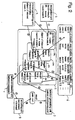
- Figure 1 is a diagram showing an embodiment of the entire control system according to the present invention. As described above, this is a conceptual or functional structure, but not a physical structure.
- an autonomic device comprises a sensing unit 1, a recognition unit 2, an emotion-generating unit 3, an interest-generating unit 4, a working memory 5 for producing data sheets, a long-term memory 6 for storing data, a behavior planning unit 7, and an actuating unit 8.
- the sensing unit 1 senses various signals including external and internal information. External information includes visual, tactile, auditory information, and electrically transmitted signals, and internal information includes battery level and malfunction signals.
- the sensed signals are inputted into the recognition unit 2 which analyzes the signals to generate meaningful information which includes characterization and identification of an object.
- This recognized information is inputted into the working memory 5 for producing data sheets.
- the interest-generating unit 4 is programmed to generate interest-parameters in response to the recognized information.
- the interest-parameters are not limited and may include "safety”, “affection”, “hunger”, “study”, and “play”.
- the recognized information need not be all information but at least a piece of information (pre-selected) recognized at the recognition unit 2.
- Each interest-parameter is regulated independently of or harmoniously with each other.
- Each interest-parameter may include a time factor; that is, the value of each interest-parameter changes with time (some of them fade with time while others increase with time). Further, each interest-parameter may have its own predetermined function and fluctuate accordingly.
- the interest-generating unit 4 receives a signal from the working memory 5, which signal indicates whether or not the interest at issue is satisfied.
- the interest-generating unit 4 outputs a signal of interest to the working memory 5 for producing data sheets.
- the emotion-generating unit 3 is programmed to generate emotion-parameters in response to the recognized information.
- This recognized information need not be all but part of the information (pre-selected) recognized at the recognition unit 2, and may be different from that used at the interest-generating unit 4.
- the emotion-parameters are not limited but may include "happy”, “angry”, “surprised”, “sad”, “fearful”, and “disgust”.
- Each emotion-parameter is regulated independently of or harmoniously with each other.
- Each emotion-parameter may include a time factor; that is, the value of each emotion-parameter changes with time (some of them fade with time while others increase with time). Further, the emotion-parameters are generated when receiving the recognized information from the recognition unit 2 and signals from the interest-generating unit 4.
- the emotion-generating unit 3 outputs signals of emotions to the working memory 5 for producing data sheets.
- the long-term memory 6 is for storing data when the working memory 5 produces a final data sheet and inputs it to the long-term memory 6.
- the final data sheets are pooled and rearranged under the index of the object in the long-term memory 6 so that data can be retrieved as necessary.
- the data from the working memory 5 updates the long-term memory 6.
- the woriking memory 5 can be omitted, and the long-term memory 6 can also function as the working memory 5, or vise versa.
- the working memory 5 can be omitted, and each of the emotion-generating unit 3 and the interest-generating unit 4 can include a memory and can be connected to each other and to the other units.
- the working memory 5 receives signals from the recognition unit 2, the emotion-generating unit 3, the interest-generating unit 4, and the long-term memory 6 to produce data sheets (algorithms will be explained later).
- a data sheet may indicate an object, which is being observed, a current interest, which is generated by the interest-generating unit 4, current emotions, which are generated by the emotion-generating unit 3, variations of emotions when previously encountering the object, which are extracted from the long-term memory 6, and a current situation surrounding the device, which is recognized by the recognition unit 2.
- the behavior planning unit 7 decides on a pattern of behavior and outputs a signal to the actuating unit 8.
- a behavior pattern may be selected based on emotions which are obtained by adding the variations of emotions to the current emotions, for example; that is, behavior is modified based on the variations of emotion previously generated. Patterns of behavior are not limited but may include “approach”, “attack”, “avoid”, “explore”, and “random”. If the device has various movable parts such as a tail, ears, hands, and eyebrows, various patterns of behavior can be formed.
- the result is sensed by the sensing unit 1; that is, the result is fed back to the device.
- the sensing unit 1 For example, as a result of approaching the object, if the device was hit, that impact is sensed by the sensing unit 1 and inputted into the working memory 5 via the recognition unit 2 where the impact is converted to variations of emotions.
- the data sheet for this event in the working memory 5 is complete upon inputting the variations of emotions.
- This data sheet is provided to the long-term memory 6 and updates the data therein. After one data sheet is complete (one event is over) and stored in the long-term memory 6, the device proceeds to a new event.
- FIG. 2 is a schematic diagram showing data flow and processing flow of an embodiment according to the present invention.
- the information is derived from the sensing unit 1 and shows that the device is being touched, there is no obstacle in front of the device, and the device is seeing user A.
- the data sheet 10a includes items "CONTACT', "IR”, “VISION”, “OBJECT OF INTEREST', and "CURRENT EMOTION”. These items are simply an example and can be selected depending on the types of sensors and recognition systems.
- "CONTACT", “IR”, and “VISION” are updated using the information (current status) from the recognition unit 2.
- the interest-generating unit 4 is programmed to generate interest-parameters (explained later), and here, "play” has the highest intensity among the interest-parameters (e.g., "play", "safety", “hungry”, etc.).
- the relationship between "play” and "user” is predetermined.
- the "user” can be defined by motion, color, and voice, or simply by an electronic name tag.
- the interest-generating unit 4 selects "play” and based on the predetermined relationship, user A is selected as an object of interest.
- the data sheet 10b and the data sheet 10a are the same, but simply for the purpose of showing changes with time or by step, the data sheet 10b is separately indicated (data sheets 10c and 10d are separately indicated for the same reason).
- the long-term memory 6 has a spreadsheet wherein data are stored under the indexes of objects.
- Various data storage systems can be adapted in the long-term memory.
- the memory stores data after every event.
- data stored under the index of user A are extracted. Extraction can be conducted in various ways. If the data sheet includes more information or items, data can be extracted under plural indices. For example, data can be collected under indices of "USER A", “TOUCH”, and "APPROACH". Here, a single index, "USER A”, is used. Under the index of "USER A", variations of emotions are totaled.
- Each emotion-parameter can be added separately from the other emotion-parameters.
- a single scale is used; that is, "HAPPY” is plus and “SAD” is minus.
- HAPPY a single scale
- SAD a single scale
- the total value of variations of emotions is "HAPPY” +0.5.
- the behavior-planning unit 7 receives the information of the data sheet 10c from the working memory 5.
- the information indicates that the device is being touched, there is no obstacle in front of the device, the device is seeing user A, and the emotion level (happy) increases by 0.5.
- the behavior-planning unit 7 is programmed to determine a pattern of behavior based on these pieces of information.
- the behavior-planning unit 7 selects "APPROACH" based on the situation that the emotion level increases by 0.5, and the direction is toward user A.
- the approaching speed may be dependent on the emotion level (e.g., the higher the level, the higher the speed becomes).
- the actuating unit 8 receives information from the behavior-planning unit 7 or directly from the working memory 5, so that the actuating unit 8 can determine the direction of movement to achieve the task (APPROACH to USER A).
- the actuating unit 8 determines "FORWARD".
- the device further approaches user A while user A is touching the device.
- the device receives a consequence of the action.
- user A hits the device because the device approaches too closely at high speed.
- the recognition unit 2 recognizes user A's reaction as “PAINFUL” (this processing flow is not shown), and the emotion-generating unit 3 determines the emotion level as. "HAPPY” -0.1" ("SAD 0.1").
- the emotion-generating unit 3 is programmed to generate emotion-parameters. There are various ways to determine "CURRENT EMOTIONS” other than addition (explained later).
- the device will behave differently than it did previously. For example, if " ⁇ EMOTION” is retrieved from the long-term memory 6 under the index of "USER A”, when the device recognizes user A, the emotion level changes to a lower level, and the device will approach user A at a low speed or avoid user A. This behavior of the device depends on the manner of updating the data in the long-term memory 6 (explained later). In the above, if “ ⁇ EMOTION” is retrieved from the long-term memory 6 under the indices of not only "OBJECT OF INTEREST” but also "CONTACT" and "IR”, more complex behavior patters can be performed. That is, when the device is touched by user A and there is no obstacle, the device will approach user A at a low speed or will not move, depending on the manner of updating the long-term memory 6.
- the emotion-generating unit 3 may receive the information from the interest-generating unit 4 and the recognition unit 2 in order to generate emotion-parameters.
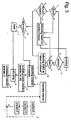
- FIG 3 is a flow chart diagram showing an embodiment of the control system according to the present invention.
- the device senses the environment (step a).
- the control system checks whether any interest is generated by the interest-generating unit (step b). If there is an interest, the control system checks whether any object is recognized by the device (step c). If an object is recognized, the control system checks whether the object falls in the category of the interest (step d). If the object is within the category of the interest, the control system checks whether the long-term memory has data on the object (step h). If the long-term memory has data on the object, variation of emotion is extracted from the long-term memory (step j).
- the control system modifies the current emotion (EMOTION A) to obtain a modified emotion (EMOTION B) based on the extracted variation of emotion (step k).
- the device is actuated based on the modified emotion (step 1).
- the control system determines consequent emotion (EMOTION C) (step m).
- step i if the long-term memory does not have data on the object, new data under the index of the object is created and stored in the long-term memory (step i), and the device is actuated (step 1).
- a variation of emotion (EMOTION C - EMOTION A) is calculated and inputted to the long-term memory under the index of the object (step n).
- step b if there is no significant interest, the control system checks whether any object is recognized by the device (step e). If an object is recognized by the device, the object is selected as "an object of interest" (step g), then step h is activated. In steps c and e, if the device recognizes no object, the device behaves based on its emotion and/or interest (step f), then returning to step a. In step d, if the object is not within the category of the interest, the device behaves based on its emotion and interest (step f), then returning to step a.
- step g the object which the device recognizes need not be selected as an object of interest, and the object can be ignored, and the device continues looking for an object.
- step n a variation of emotion can be calculated by subtracting EMOTION B from EMOTION C. This indicates a change in emotion from the one at the time the device starts interacting with the object, regardless of the initial emotion.
- the device may comprise a CCD camera as a visual detection means, a pressure-sensing sensor and an approach-sensing sensor as touch detection means, a microphone as a hearing-detection means, and an infrared sensor as an obstacle-detection means.
- the device may further comprise a battery capacity sensor which detects the remaining capacity of the battery.
- the device may comprise a radio wave signal receiver. By using these sensing means, the device detects objects, the environment, and internal conditions. Further, these sensors allow the device to detect the state of the user, such as a tone of voice, facial expressions, and gestures, and the operational environments where the device is used.
- the CCD camera is installed on the top of the head and can be set in any direction via a universal joint.
- the robot can be controlled in such a way that the robot automatically moves toward an object, such as a human or animal, which is a cause or source of information such as changes in temperature and sound.
- Image information such as facial expressions of the user and surrounding environments is supplied to a controller.
- the pressure-sensing sensor may be installed in the lower front of the robot so that when the robot has actual contact with an obstacle, such information is provided to the controller.
- the microphone may be installed on the side of the head of the robot, and provides information to the controller upon collecting sound/voices arose around the robot.
- the sensed signals i.e., primitive information
- the sensed signals can be used directly, without further processing.
- the control system is designed to work based on the color (an object is recognized simply by the color)
- no further processing is required.
- the device if the device is designed to respond to more than the color, the device needs to recognize more complex information and may require processing information. For example, based on the color, movement, and sound, the object can be recognized.
- the user's facial expression can be detected, and the device can respond to the emotions of the user which are represented by the facial changes (Hanaya, et al., "An attempt of individual identification from face photographs", Technical Report of the Institute of Electronics, Information and Communication Engineers, CS96-123, IE96-92 (1996-12), pp. 55-60).
- a face neuron or neural network technology can be adapted.
- the device can detect an object which possesses an identification tag transmitting identification information.
- the radio wave detection sensor can transmit radio waves and receive resonance signals emitted from the identification tag which has a particular resonance circuit.
- magnetic identification or bar code identification can be adapted.
- a neural network can be used for recognizing an object based on the sensed signals.
- the interest-generating unit is used for selecting an object of interest, so that the device can behave and collect data efficiently, and can improve its behavior quickly, without information overflow.
- the device can select an object by itself, without a user's command, so that the device can behave autonomously.
- the interest-generating unit can be independent from the external conditions or environment, and can be a function of its own equations. However, the interest-generating unit may be affected by the internal conditions such as battery level and the degree of satisfaction of each interest-parameter. Further, the interest-generating unit may have a time factor and change each interest-parameter with time. A change with time may occur in the direction of fading.
- the functions controlling each interest-parameter can be independent of each other, and they may create fluctuation cycles of each interest-parameter.
- the working memory may store data showing the number of occurrences of "play” and a degree of satisfaction, so that the interest-generating unit receives the data and modifies each interest-parameter.
- the working memory shown in Figure 3 can include the item “capacity” which shows a level or degree of satisfaction, and, for example, when the consequent emotion is positive, the working memory outputs a signal to the interest-generating unit to raise the satisfaction level or degree.
- I f (t, C) wherein I is an interest-parameter, f is a function, t is a time factor, and C is capacity.
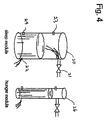
- FIG 4 is a diagram showing an embodiment of the above metaphoric tanks.
- a tank 20 of "sleep" has a small hole 22 at the bottom, so that the contents 25 (interest-parameter) leaks with time.
- the tank has two level switches; a first switch is a lower switch 24 disposed at a lower part of the tank, which triggers opening a valve 21 to fill the tank with the contents (interest-parameter), and the other switch is a higher switch 23 disposed at a higher part of the tank, which triggers closing the valve 21 to stop filling the tank with the contents (interest-parameter).
- FIG. 5 is a flow chart showing time management flow.
- step i if there is any signal stimulating "safety" (step i), the value of the interest-parameter is modified in accordance with the intensity of the stimulation (step ii). If there is no signal stimulating "safety" in step i, the value of the interest-parameter is modified under predetermined rules (step iii). In Figure 5, the value of the interest-parameter is fading or is multiplied by 0.9.
- the interest-generating unit can be established using a neural network by regulating a relationship between the recognized signals and the interest-parameters.
- Figure 6 is a diagram showing an embodiment of a neural network 30 for the interest-generating unit.
- each interest-parameter is related to one another.
- output of the neural network is connected to a time management sub-routine 31 to change each output with time.
- the time management can be conducted by activating the time factor (e.g., reducing 10%) at pre-selected time intervals or after every (or pre-selected number) running cycle(s) of a program.
- the neural network can be established off-line or on-line. If it is conducted on-line, output of the device is fed back to the control system, and coupling coefficients can be adjusted. Further, coupling coefficients can be modified using evolutionary computing technology such as genetic algorithms and genetic programming. However, if on-line establishment is conducted, a "training" period will be required.
- the interest-generating unit can be constituted by a multi-dimensional map defined by the recognized signals and the interest-parameters.
- the interest-generating unit may select one interest-parameter which has the lowest value among all of the interest-parameters at the time the interest-generating unit is called for. Selection of an interest-parameter can be conducted in various ways, including selection at random or under predetermined rules or functions.
- the device can recognize "user A", for example, as an object of interest in various ways.
- a simple method is to predetermine the relationship between interest-parameters and objects. That is, the interest-generating unit can be programmed to recognize "user A” when "play” is selected as the interest. User A can be defined by color, voice, face configuration, and/or name tag.
- the interest-generating unit can be programmed to recognize "dark” and “quiet” place when "sleep” is selected as the interest. The term “dark” and "quiet” can be relative evaluation, and the device can find a relatively dark and quiet place among the objects the device is observing.
- the device is directed in a direction where values indicated by audio sensor and brightness sensor become lower. This relative evaluation can be performed easily.
- the interest-generating unit is provided with a predetermined relationship between the interest-parameters and the specific objects, if the device observes a new object, the device cannot respond to it. For example, if "play" and "user A" are specifically related to each other, if the device observes user B, the device may not recognize user B as an object of interest. If the objects are defined by genetic characteristics or loose rules such as a "moving" object making "sound”, user A and user B can be an object of interest. After the device recognizes user A and while the device interacts with user A, the device can collect data on identification of user A by using the sensing unit.
- the data can be stored in the long-term memory and written in the spreadsheet under the index of user #1. Subsequently, when the device observes user #1 inputs data on a data sheet in the working memory, the device extracts data on user #1 from the long-term memory to modify the emotion as explained above.
- the interest-generating unit does not differentiate user #1 from other users; that is, user #1 is not and will not be an object of interest.
- the interest-generating unit recognizes an object of interest which is, for example, "moving" and making "sound”.
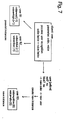
- FIG. 7 is a diagram showing schematic processes of JAVA.
- the "object” is “user”
- “user parameters” are “color” and “voice”
- “method” is (user parameter x (color + voice)).
- the program checks whether user #3 falls within the profiles of user #1 or #2.
- user #3 is neither red (-1) nor blue (+1), indicating that user #3's color is new which is 0 (yellow).
- the program creates a new instance under the index of user #3 and defines user #3 by color (0, yellow) and voice (0, intermediate).
- the device may select an object which the device is seeing, as an object of interest as explained above.
- User #3 will be one of objects of interest. That is, when the interest-generating unit selects "play", the program checks whether the object the device is seeing is either one of users #1, #2, and #3. By continuing such experiments, the device stores many objects of interest.
- the emotion-generating unit can be operated by various ways which include a neural network.
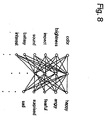
- Figure 8 is a diagram showing an embodiment of an emotion-generating unit using a neural network.
- the structure of the neural network in Figure 8 is similar to that indicated in Figure 6. The difference is that this neural network uses signals from the interest-generating unit as one of the inputs. Alternatively, the output from the neural network can be multiplied by signals from the interest-generating unit.
- the input-output relationship of the neural network may be regulated in advance by off-line training, although the neural network can be established off-line or on-line. If it is conducted on-line, output of the device is fed back to the control system, and coupling coefficients can be adjusted. Further, coupling coefficients can be modified using evolutionary computing technology such as genetic algorithms and genetic programming. However, if on-line establishment is conducted, a "training" period will be required.
- each emotion-parameter is defined by a facial expression which the robot can output, and teacher data are not required to establish the neural network if output evaluation can be conducted by using reward signals (e.g., being caressed) or penalty signals (e.g., being hit), instead of teacher data.
- the emotion-generating unit can be constituted by a multi-dimensional map defined by the recognized signals and the emotion-parameters.
- the input-output relationship in the emotion-generating unit can be simplified by directly relating recognized signals with emotions. For example, if the device is "hit”, the device is “sad”; if the device is softly “touched”, the device is “happy”; if the device is “low in power”, the device is “angry”; if the device hears “loud sound”, the device is “surprised”, etc.
- the device's behavior is modified by variations of emotions when the device encounters the object.
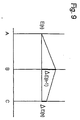
- the variations of emotions are extracted from the long-term memory. If the device has emotion-parameters (E n ) initially; and upon sensing the object, if information on variations of emotions ( ⁇ E n-1 ) is extracted from a memory under the index of the object, the initial emotions (E n ) of the device are modified with the variations of emotions ( ⁇ E n-1 ). As a result, the device has the modified emotions ( E n + ⁇ E n-1 ) when the device is actuated. Variations of emotions ( ⁇ E n ) are generated by the device during interaction with the object, thereby updating the memory. The device has encountered the object (n-1) times before, and this is #n interaction with the object.
- Figure 9 is a diagram showing an embodiment of changes in emotions.
- ⁇ E' n can be simply the average of ⁇ E n or the average of ⁇ E n multiplied by ⁇ .
- the long-term memory does not need to have a large memory capacity because one column is sufficient for one object.
- ⁇ E' n ⁇ E n - ⁇ E n-1
- the long-term memory has a spreadsheet 41 indicating HAPPY 0.3, SAD 0.01, and FEAR -0.1, as variations of emotions ( ⁇ E n-1 ), which update E n (data sheet 40b).
- the data sheet 40b indicates HAPPY 0.4, SAD 0.11, and FEAR 0.0, as modified emotions ( E n + ⁇ E n-1 ) (The modified emotions need not be simply ( E n + ⁇ E n-1 ) but can be a function of E n and ⁇ E n-1 ).
- the device is actuated and consequently, variations of emotions occur (data sheet 40c).
- the data sheet 40c indicates HAPPY 0.8, SAD 0.0, and FEAR 0.0, as consequent emotions (E n' ).
- the variations of emotions after actuation of the device are ⁇ E n (E n' - E n ).
- ⁇ E n HAPPY 0.7, SAD - 0.1, and FEAR -0.1.
- Variations of emotions to be saved in the long-term memory ( ⁇ E' n ) are HAPPY 0.34, SAD -0.01, and FEAR -0.1, which update the long-term memory. When the device encounters the object, the emotions will be modified by ⁇ E' n .
- Figure 11 is a diagram showing an embodiment of behavior patterns.
- the device's behavior is modified in accordance with the variations of emotions. If the initial behavior is "APPROACH", when the device raises an "ANGRY” score, the behavior is changed to "ATTACK”; when the device raises a “FEAR” score, the behavior is changed to "AVOID”; when the device raises a "DISGUST' score, the behavior is changed to "RANDOM”; when the device raises a "SAD” score, the behavior is changed to "EXPLORE”; when the device raises a "HAPPY” score, the behavior is not changed, but may be more active (faster movement).
- the initial behavior is "ATTACH”
- the device raises a “HAPPY” score the behavior is changed to "APPROACH”
- the device raises a "DISGUST” score the behavior is changed to "RANDOM”
- the device raises an "ANGRY” score the behavior is not changed, but may be more active (faster movement).
- the device raises an "ANGRY” score run away is not successful
- the behavior is changed to "ATTACK”.
- behavior patterns can be established by a neural network by regulating the input-output relationship or by a multi-dimensional map. Further, coupling coefficients of the neural network can be modified using evolutionary computing technology such as genetic algorithms and genetic programming. However, if on-line establishment is conducted, a "training" period will be required.
- the technology disclosed in United States Patent Application No. 09/059,278, filed April 13, 1998, by Tamiya, et al., as described above can be adapted to the present invention. The reference is hereby incorporated herein as reference.
- the behavior-planning unit can be very simple.
- the following conditions can be predetermined: Interest Emotion Behavior Sociality Happy Approach Safety Fearful Avoid Fatigue Low Sleep Curiosity High Explore ........ ........ .
- the behavior-planning unit can be constituted by a multi-dimensional map defined by the generated interest-parameters and the generated emotion-parameters.
- all moving parts can be allocated on a multi-dimensional map.
- This approach can be used in combination with a neural network, wherein a multi-dimensional map is connected downstream of the neural network.
- sensed signals, emotion-parameters, and interest-parameters are used as input signals of the neural network.
- "APPROACH”, “ATTACK”, “EXPLORE”, “AVOID”, “RANDOM”, “STILL”, etc. are outputted from the neural network. Training the neural network can be conducted off-line.
- a multi-dimensional map Downstream of the neural network, a multi-dimensional map is connected, which regulates the output in such a way, for example, that if "APPROACH” 0.1 and "EXPLORE” 0.3, the device slowly moves toward the object with a tail slowly moving.
- the map can be modified by using evolutionary computing technology. Evolutionary reinforcement learning methods does not require teacher data. Evaluation functions can be obtained by using reward signals (e.g., being caressed) or penalty signals (e.g., being hit), instead of teacher data.
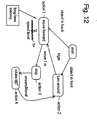
- Figure 12 is a diagram showing an embodiment of a behavior control system.
- the behavior-planning unit can have a plurality of modules, each regulating one action.
- the modules can be selected by using technology described above.
- Each module commands the device's movement sequentially on conditions of the external and internal conditions.
- Figure 12 shows an embodiment of a "RUN AWAY" module. If the object is behind the device, the device moves forward (action 1). If the object is in front of the device, the device turns around (action 2). If predetermined conditions are satisfied, action 1 (moving forward) is triggered from action 2.
- a trigger may be defined by the distance from the object, the moving speed of the object and its direction, the intensity of sound the object is making, the absence of obstacles, etc.
- the trigger can be determined based on theoretical sum of all of the conditions, each having a trigger range. If the device moves a certain distance, the device stops (action 3). If the device stops, the device turns at 180 degrees without condition (action 4). If the object is close to the device, action 2 is triggered. If the object is not close to the device, the series of actions end.
- each action is constituted by a sub-module.
- Each sub-module can include emotion-parameters.
- the module for action 1 (moving forward) can be programmed to change the moving speed in accordance with emotion-parameters. If a "FEARFUL" score is high, the device moves faster than when the score is low.
- the "FEARFUL" score becomes high.
- These data are transferred to the working memory and update the data sheet.
- the data are saved in the long-term memory.
- the sub-module for action 1 receives a signal to raise the moving speed (50).
- the spreadsheet in the long-term memory, the data sheet in the working memory, and the action modules can be modified based on the user's preferences.
- the connected toy can be connected to an external system (computer) through cordless networks. That is, the data and/or programs used in the present system, including the long-term memory, the working memory, the emotion-generating unit, the interest-generating unit, and the behavior-planning unit, can be saved or installed in a separable medium such as a compact disc (ROM or RAM) or IC card, so that the user can implant the information in another device.
- the data and/or programs can be transmitted to another device via communication means.
- the data can be pooled from plural devices and installed into a new device which will possess an extensive memory even if the new device has never been used.
- behavior patterns of the device can be changed.
- any one or more of the intelligent portions of the device including the recognition unit, the emotion-generating unit, the interest-generating unit, and the behavior-planning unit can be installed in a main computer separately from the device, wherein a network is established between the main computer and the device via, for example, the Internet, so that the device can be made compact, and which may need to have simply sensing units, an output unit, and a communication unit for contacting the main computer.
- a network is established between the main computer and the device via, for example, the Internet, so that the device can be made compact, and which may need to have simply sensing units, an output unit, and a communication unit for contacting the main computer.
- Through the sensing units of each device it is possible to monitor the user or the external environment of each device, by use of the main computer. Further, each device can be connected to other devices to
- correlations between various inputs and various outputs of the control system can be determined using existing techniques such as neural networks, fuzzy neural networks, and genetic algorithms if the correlations are highly complex, or using existing techniques such as maps and functional equations if the correlations are rather simple.
- existing techniques such as neural networks, fuzzy neural networks, and genetic algorithms if the correlations are highly complex, or using existing techniques such as maps and functional equations if the correlations are rather simple.
- Da Ruan (editor) Intelligent Hybrid Systems -- Fuzzy Logic, Neural Networks, and Genetic Algorithms --” Kluwer Academic Publishers (1997), J.-S. R. Jang, C.-T. Sun, E. Mizutani,”Neuro-Fuzzy and Soft Computing” Prentice Hall Upper Saddle River, NJ 07458 (1997), C.-T. Lin and C. S.
- genetic programming or other evolutionary computing techniques can be adapted to the present invention (Wolfgang Banzhaf, et al. (editor), "Genetic Programming, An Introduction”, pp. 363-377, 1999, Morgan Kaufmann Publishers, Inc., for example). These techniques are sometimes categorized as "heuristic control” which includes evolution, simulated annealing, and reinforcement learning method (S. Suzuki, et al., “Vision-Based Learning for Real Robot: Towards RoboCup", RoboCup - 97 Workshop, 23, 24, and 29 August, 1997 Nagoya Congress Center, pp. 107-110; K.
- the evolutionary computing includes a multi-agent system which is used for competitive co-evolution (Tamashiro, et al., "Study about the performance of competitive co-evolution in multi-agent system", Technical Report of the Institute of Electronics, Information and Communication Engineers, NS99-16 (1999-06), pp.37-41).
- neural networks may be used for learning control rules.
- a CMAC Cerebellar Model Arithmetic Computer
- the CMAC is excellent in terms of additional learning and the high speed of learning, as compared with the hierarchical neural network.
- the device may be a personal robot, toy robot or robot pet.
- the device of the present control system is not limited to a toy robot, and can be any given control which can be used in a vehicle, an auxiliary drive of a bicycle, or wheelchair, or an industrial robot.
Landscapes
- Engineering & Computer Science (AREA)
- Theoretical Computer Science (AREA)
- Physics & Mathematics (AREA)
- Software Systems (AREA)
- Computing Systems (AREA)
- Mathematical Physics (AREA)
- Artificial Intelligence (AREA)
- General Physics & Mathematics (AREA)
- General Engineering & Computer Science (AREA)
- Data Mining & Analysis (AREA)
- Evolutionary Computation (AREA)
- Biomedical Technology (AREA)
- Robotics (AREA)
- General Health & Medical Sciences (AREA)
- Computational Linguistics (AREA)
- Biophysics (AREA)
- Life Sciences & Earth Sciences (AREA)
- Health & Medical Sciences (AREA)
- Molecular Biology (AREA)
- Computer Vision & Pattern Recognition (AREA)
- Medical Informatics (AREA)
- Manipulator (AREA)
- Feedback Control In General (AREA)
- Management, Administration, Business Operations System, And Electronic Commerce (AREA)
- User Interface Of Digital Computer (AREA)
- Toys (AREA)
Applications Claiming Priority (2)
| Application Number | Priority Date | Filing Date | Title |
|---|---|---|---|
| US393146 | 1995-02-21 | ||
| US09/393,146 US6604091B2 (en) | 1999-09-10 | 1999-09-10 | Interactive artificial intelligence |
Publications (2)
| Publication Number | Publication Date |
|---|---|
| EP1083490A2 true EP1083490A2 (fr) | 2001-03-14 |
| EP1083490A3 EP1083490A3 (fr) | 2003-12-10 |
Family
ID=23553467
Family Applications (1)
| Application Number | Title | Priority Date | Filing Date |
|---|---|---|---|
| EP00119786A Withdrawn EP1083490A3 (fr) | 1999-09-10 | 2000-09-11 | Intelligence artificielle interactive |
Country Status (3)
| Country | Link |
|---|---|
| US (1) | US6604091B2 (fr) |
| EP (1) | EP1083490A3 (fr) |
| JP (1) | JP2001160130A (fr) |
Cited By (4)
| Publication number | Priority date | Publication date | Assignee | Title |
|---|---|---|---|---|
| GB2442756A (en) * | 2006-10-10 | 2008-04-16 | Gabor Miklos Hujber | Utilising a spreadsheet to control a machine. |
| WO2012104804A1 (fr) * | 2011-02-03 | 2012-08-09 | Yuri Salamatov | Procédé et système de vente de services aux consommateurs |
| EP3312775A4 (fr) * | 2015-06-17 | 2018-06-27 | Cocoro SB Corp. | Système de commande, système, et programme |
| US11989036B2 (en) | 2021-12-03 | 2024-05-21 | Piaggio Fast Forward Inc. | Vehicle with communicative behaviors |
Families Citing this family (19)
| Publication number | Priority date | Publication date | Assignee | Title |
|---|---|---|---|---|
| EP1182610A1 (fr) * | 2000-02-09 | 2002-02-27 | Sony Corporation | Dispositif et procede de traitement de l'information, dispositif de stockage de donnees et programme |
| US20010047346A1 (en) * | 2000-04-10 | 2001-11-29 | Dejian Liu | Artificial intelligence and computer interface |
| JP2002370183A (ja) * | 2001-06-15 | 2002-12-24 | Yamaha Motor Co Ltd | 監視装置及び監視システム |
| US20030078783A1 (en) * | 2001-10-18 | 2003-04-24 | Shinichi Yamamoto | Method and system for preventing accident |
| KR100457813B1 (ko) * | 2003-02-07 | 2004-11-18 | 삼성전자주식회사 | 커뮤니티 서비스 제공 시스템 및 방법 |
| JP2004268235A (ja) * | 2003-03-11 | 2004-09-30 | Sony Corp | ロボット装置、その行動制御方法及びプログラム |
| EP1629359A4 (fr) | 2003-04-07 | 2008-01-09 | Sevenecho Llc | Procede, systeme et logiciel de personnalisation de presentations narratives personnalisees |
| US20090170769A1 (en) * | 2005-05-13 | 2009-07-02 | Pei Jin | Cell surface receptor isoforms and methods of identifying and using the same |
| US7814048B2 (en) * | 2006-08-14 | 2010-10-12 | Microsoft Corporation | Knowledge extraction from online discussion forums |
| JP2009072910A (ja) * | 2008-12-22 | 2009-04-09 | Nec Corp | ロボット装置及びその制御方法 |
| US8775341B1 (en) | 2010-10-26 | 2014-07-08 | Michael Lamport Commons | Intelligent control with hierarchical stacked neural networks |
| US9015093B1 (en) | 2010-10-26 | 2015-04-21 | Michael Lamport Commons | Intelligent control with hierarchical stacked neural networks |
| EP3217349A4 (fr) | 2014-11-07 | 2018-03-28 | Sony Corporation | Dispositif de traitement d'informations, procédé de commande et support de stockage |
| WO2017177128A1 (fr) * | 2016-04-08 | 2017-10-12 | The Trustees Of Columbia University In The City Of New York | Systèmes et procédés d'apprentissage de renforcement profond à l'aide d'une interface d'intelligence artificielle cérébrale |
| US11893488B2 (en) | 2017-03-22 | 2024-02-06 | Larsx | Continuously learning and optimizing artificial intelligence (AI) adaptive neural network (ANN) computer modeling methods and systems |
| US11138503B2 (en) | 2017-03-22 | 2021-10-05 | Larsx | Continuously learning and optimizing artificial intelligence (AI) adaptive neural network (ANN) computer modeling methods and systems |
| JP7170977B2 (ja) * | 2018-04-09 | 2022-11-15 | 純一 武野 | 意識モジュールの新機能 |
| JP2020017206A (ja) * | 2018-07-27 | 2020-01-30 | ソニー株式会社 | 情報処理装置、行動決定方法及びプログラム |
| US12346432B2 (en) * | 2018-12-31 | 2025-07-01 | Intel Corporation | Securing systems employing artificial intelligence |
Family Cites Families (14)
| Publication number | Priority date | Publication date | Assignee | Title |
|---|---|---|---|---|
| JPH0612401A (ja) * | 1992-06-26 | 1994-01-21 | Fuji Xerox Co Ltd | 感情模擬装置 |
| US5999908A (en) | 1992-08-06 | 1999-12-07 | Abelow; Daniel H. | Customer-based product design module |
| US5682469A (en) | 1994-07-08 | 1997-10-28 | Microsoft Corporation | Software platform having a real world interface with animated characters |
| JPH0822392A (ja) * | 1994-07-11 | 1996-01-23 | Hitachi Ltd | 意志決定方法及び装置 |
| DE19508474A1 (de) * | 1995-03-09 | 1996-09-19 | Siemens Ag | Intelligentes Rechner-Leitsystem |
| US5999895A (en) | 1995-07-24 | 1999-12-07 | Forest; Donald K. | Sound operated menu method and apparatus |
| US6005549A (en) | 1995-07-24 | 1999-12-21 | Forest; Donald K. | User interface method and apparatus |
| US6034652A (en) | 1996-03-22 | 2000-03-07 | Interval Research Corporation | Attention manager for occupying the peripheral attention of a person in the vicinity of a display device |
| US5832189A (en) * | 1996-09-26 | 1998-11-03 | Interval Research Corporation | Affect-based robot communication methods and systems |
| US5852819A (en) | 1997-01-30 | 1998-12-22 | Beller; Stephen E. | Flexible, modular electronic element patterning method and apparatus for compiling, processing, transmitting, and reporting data and information |
| JP3159242B2 (ja) * | 1997-03-13 | 2001-04-23 | 日本電気株式会社 | 感情生成装置およびその方法 |
| JP3273550B2 (ja) | 1997-05-29 | 2002-04-08 | オムロン株式会社 | 自動応答玩具 |
| JPH11126017A (ja) * | 1997-08-22 | 1999-05-11 | Sony Corp | 記憶媒体、ロボット、情報処理装置、並びに電子ペットシステム |
| US6195651B1 (en) | 1998-11-19 | 2001-02-27 | Andersen Consulting Properties Bv | System, method and article of manufacture for a tuned user application experience |
-
1999
- 1999-09-10 US US09/393,146 patent/US6604091B2/en not_active Expired - Fee Related
-
2000
- 2000-09-11 EP EP00119786A patent/EP1083490A3/fr not_active Withdrawn
- 2000-09-11 JP JP2000274750A patent/JP2001160130A/ja active Pending
Cited By (4)
| Publication number | Priority date | Publication date | Assignee | Title |
|---|---|---|---|---|
| GB2442756A (en) * | 2006-10-10 | 2008-04-16 | Gabor Miklos Hujber | Utilising a spreadsheet to control a machine. |
| WO2012104804A1 (fr) * | 2011-02-03 | 2012-08-09 | Yuri Salamatov | Procédé et système de vente de services aux consommateurs |
| EP3312775A4 (fr) * | 2015-06-17 | 2018-06-27 | Cocoro SB Corp. | Système de commande, système, et programme |
| US11989036B2 (en) | 2021-12-03 | 2024-05-21 | Piaggio Fast Forward Inc. | Vehicle with communicative behaviors |
Also Published As
| Publication number | Publication date |
|---|---|
| US20030069863A1 (en) | 2003-04-10 |
| EP1083490A3 (fr) | 2003-12-10 |
| JP2001160130A (ja) | 2001-06-12 |
| US6604091B2 (en) | 2003-08-05 |
Similar Documents
| Publication | Publication Date | Title |
|---|---|---|
| US6594649B2 (en) | Interactive artificial intelligence | |
| US6446056B1 (en) | Interactive artificial intelligence | |
| US6604091B2 (en) | Interactive artificial intelligence | |
| EP0978770B1 (fr) | Système et méthode de contrôle d'objets par simulation d'émotions et de personnalité dans l'objet | |
| US6430523B1 (en) | Control system for controlling object using pseudo-emotions and pseudo-personality generated in the object | |
| EP1486300B1 (fr) | Systeme de commande de robot, procede correspondant, et robot | |
| Pirjanian | Behavior coordination mechanisms-state-of-the-art | |
| KR101028814B1 (ko) | 소프트웨어 로봇 장치와 그 장치에서 소프트웨어 로봇의행동 발현 방법 | |
| US8204839B2 (en) | Apparatus and method for expressing behavior of software robot | |
| Nordin et al. | Real time control of a Khepera robot using genetic programming | |
| US20050240412A1 (en) | Robot behavior control system and method, and robot apparatus | |
| Meyer | Evolutionary approaches to neural control in mobile robots | |
| JP2000222378A (ja) | 疑似感情及び/又は疑似性格を用いた制御対象の制御方法、使用者に適合して動作する自律装置、使用者の特徴に装置の動作を適合させる方法 | |
| Hoffmann | An overview on soft computing in behavior based robotics | |
| Hurst et al. | TCS learning classifier system controller on a real robot | |
| EP1083489A2 (fr) | Intelligence artifcielle interactive | |
| Kim et al. | The origin of artificial species: Genetic robot | |
| Saxena et al. | Advancement of industrial automation in integration with robotics | |
| Erdem | Application of neuro-fuzzy controller for sumo robot control | |
| Nordin et al. | Real time evolution of behavior and a world model for a miniature robot using genetic programming | |
| Sim et al. | A foundation for robot learning | |
| Fukuda et al. | Computational intelligence in robotics and mechatronics | |
| Jun et al. | Emergence of Cooperative Behavior based on Learning and Evolution in Collective Autonomous Mobile Robots | |
| Bonarini et al. | Learning context motivation in coordinated behaviors | |
| Nauck et al. | The evolution of neuro-fuzzy systems |
Legal Events
| Date | Code | Title | Description |
|---|---|---|---|
| PUAI | Public reference made under article 153(3) epc to a published international application that has entered the european phase |
Free format text: ORIGINAL CODE: 0009012 |
|
| AK | Designated contracting states |
Kind code of ref document: A2 Designated state(s): AT BE CH CY DE DK ES FI FR GB GR IE IT LI LU MC NL PT SE |
|
| AX | Request for extension of the european patent |
Free format text: AL;LT;LV;MK;RO;SI |
|
| PUAL | Search report despatched |
Free format text: ORIGINAL CODE: 0009013 |
|
| AK | Designated contracting states |
Kind code of ref document: A3 Designated state(s): AT BE CH CY DE DK ES FI FR GB GR IE IT LI LU MC NL PT SE |
|
| AX | Request for extension of the european patent |
Extension state: AL LT LV MK RO SI |
|
| RIC1 | Information provided on ipc code assigned before grant |
Ipc: 7G 06N 3/00 B Ipc: 7G 06F 15/18 A |
|
| 17P | Request for examination filed |
Effective date: 20040123 |
|
| AKX | Designation fees paid |
Designated state(s): DE FR GB IT |
|
| STAA | Information on the status of an ep patent application or granted ep patent |
Free format text: STATUS: THE APPLICATION IS DEEMED TO BE WITHDRAWN |
|
| 18D | Application deemed to be withdrawn |
Effective date: 20060331 |