EP1083576A1 - Système de présentation visuelle de paramètres de fonctionnement d'un coeur de réacteur nucléaire - Google Patents
Système de présentation visuelle de paramètres de fonctionnement d'un coeur de réacteur nucléaire Download PDFInfo
- Publication number
- EP1083576A1 EP1083576A1 EP00307235A EP00307235A EP1083576A1 EP 1083576 A1 EP1083576 A1 EP 1083576A1 EP 00307235 A EP00307235 A EP 00307235A EP 00307235 A EP00307235 A EP 00307235A EP 1083576 A1 EP1083576 A1 EP 1083576A1
- Authority
- EP
- European Patent Office
- Prior art keywords
- reactor core
- data
- time
- files
- core performance
- Prior art date
- Legal status (The legal status is an assumption and is not a legal conclusion. Google has not performed a legal analysis and makes no representation as to the accuracy of the status listed.)
- Withdrawn
Links
- 238000013079 data visualisation Methods 0.000 title claims abstract description 13
- 238000012800 visualization Methods 0.000 claims abstract description 28
- 238000010586 diagram Methods 0.000 claims abstract description 15
- 238000000034 method Methods 0.000 claims abstract description 9
- 238000004891 communication Methods 0.000 claims abstract description 5
- 239000000446 fuel Substances 0.000 claims description 13
- 238000004590 computer program Methods 0.000 claims 1
- 239000003758 nuclear fuel Substances 0.000 claims 1
- 238000003491 array Methods 0.000 abstract description 6
- 230000000007 visual effect Effects 0.000 abstract description 5
- 238000013500 data storage Methods 0.000 abstract description 3
- 230000036962 time dependent Effects 0.000 abstract description 3
- 239000000284 extract Substances 0.000 abstract 1
- 238000013461 design Methods 0.000 description 6
- 238000012544 monitoring process Methods 0.000 description 4
- 238000012545 processing Methods 0.000 description 3
- 239000003086 colorant Substances 0.000 description 2
- 238000004886 process control Methods 0.000 description 2
- 238000012552 review Methods 0.000 description 2
- 230000003068 static effect Effects 0.000 description 2
- 238000013459 approach Methods 0.000 description 1
- 230000006399 behavior Effects 0.000 description 1
- 230000005540 biological transmission Effects 0.000 description 1
- 230000001419 dependent effect Effects 0.000 description 1
- 238000011156 evaluation Methods 0.000 description 1
- 230000020169 heat generation Effects 0.000 description 1
- 238000005259 measurement Methods 0.000 description 1
- 230000001105 regulatory effect Effects 0.000 description 1
- 238000004088 simulation Methods 0.000 description 1
- 230000002123 temporal effect Effects 0.000 description 1
Images


Classifications
-
- G—PHYSICS
- G21—NUCLEAR PHYSICS; NUCLEAR ENGINEERING
- G21D—NUCLEAR POWER PLANT
- G21D3/00—Control of nuclear power plant
- G21D3/001—Computer implemented control
-
- G—PHYSICS
- G21—NUCLEAR PHYSICS; NUCLEAR ENGINEERING
- G21C—NUCLEAR REACTORS
- G21C17/00—Monitoring; Testing ; Maintaining
-
- G—PHYSICS
- G21—NUCLEAR PHYSICS; NUCLEAR ENGINEERING
- G21D—NUCLEAR POWER PLANT
- G21D3/00—Control of nuclear power plant
- G21D3/008—Man-machine interface, e.g. control room layout
-
- Y—GENERAL TAGGING OF NEW TECHNOLOGICAL DEVELOPMENTS; GENERAL TAGGING OF CROSS-SECTIONAL TECHNOLOGIES SPANNING OVER SEVERAL SECTIONS OF THE IPC; TECHNICAL SUBJECTS COVERED BY FORMER USPC CROSS-REFERENCE ART COLLECTIONS [XRACs] AND DIGESTS
- Y02—TECHNOLOGIES OR APPLICATIONS FOR MITIGATION OR ADAPTATION AGAINST CLIMATE CHANGE
- Y02E—REDUCTION OF GREENHOUSE GAS [GHG] EMISSIONS, RELATED TO ENERGY GENERATION, TRANSMISSION OR DISTRIBUTION
- Y02E30/00—Energy generation of nuclear origin
-
- Y—GENERAL TAGGING OF NEW TECHNOLOGICAL DEVELOPMENTS; GENERAL TAGGING OF CROSS-SECTIONAL TECHNOLOGIES SPANNING OVER SEVERAL SECTIONS OF THE IPC; TECHNICAL SUBJECTS COVERED BY FORMER USPC CROSS-REFERENCE ART COLLECTIONS [XRACs] AND DIGESTS
- Y02—TECHNOLOGIES OR APPLICATIONS FOR MITIGATION OR ADAPTATION AGAINST CLIMATE CHANGE
- Y02E—REDUCTION OF GREENHOUSE GAS [GHG] EMISSIONS, RELATED TO ENERGY GENERATION, TRANSMISSION OR DISTRIBUTION
- Y02E30/00—Energy generation of nuclear origin
- Y02E30/30—Nuclear fission reactors
Definitions
- the invention relates generally to nuclear reactor and, more particularly, to a method and apparatus for extracting and visually displaying core performance data from either a nuclear reactor core simulator or an operating nuclear reactor.
- reactor core performance parameters such as Minimum Critical Power Ratio (MCPR) and Linear Heat Generation Rate (LHGR)
- MPR Minimum Critical Power Ratio
- LHGR Linear Heat Generation Rate
- Access to performance parameter data is important because these parameters reflect the continually changing thermal-hydraulic and thermal-mechanical conditions of the various elements which make up a reactor core -- such as, for example, the many fuel rod bundles and control blades.
- MCPR Minimum Critical Power Ratio
- LHGR Linear Heat Generation Rate
- measured (or simulated) reactor core performance parameter data is printed or displayed as numerical values in the form of tables and simple two-dimensional graphs. Due to the complexity of the engineering concepts involved, the examination and interpretation of time-varying, dynamic, multi-dimensional reactor performance data presented in this static form requires highly trained technical personnel having extensive knowledge and experience with nuclear reactor design, licensing requirements and operational limits. Moreover, partially due to the large amount of information, it is often an extremely laborious and time-consuming endeavor that can easily consume hundreds of costly man-hours. In addition, because of the traditional dependence on static numeric tables and non-animated two-dimensional graphs to portray information relating to time-varying three-dimensional parameters, reactor core performance is both difficult to analyze and prone to misinterpretation.
- the present invention attempts to accomplish these objectives and overcome the inefficiencies of traditional approaches toward presenting and reviewing reactor performance data by providing specific data visualization tools that will enable nuclear engineers and reactor plant operators to view selected time-varying reactor core parameters as three-dimensional animation sequences, dynamic two-dimensional contour plots and manipulatable three-dimensional objects in a virtual reality environment.
- a reactor core performance visualization system that allows plant operators and engineers to view selected time-varying core parameters as three-dimensional animation sequences, dynamic two-dimensional contour plots or as a manipulatable image object in a virtual reality environment. Consequently, the present disclosure is directed toward a method and system for acquiring, extracting and visually displaying core performance data obtained from either an operating nuclear reactor core or a nuclear reactor core simulator.
- the reactor core performance visualization system of the present invention includes a data processor (which may be, for example, an Intel PentiumTM type processor found in conventional desktop personal computer systems) having a large data storage capacity and a color monitor or other display device capable of handling multi-color graphics.
- the performance visualization system acquires pertinent reactor core performance data from, for example, a reactor process control computer or a nuclear reactor core simulator via a communications link.
- the method and apparatus of the present invention could be incorporated as a part of a reactor process control computer or a reactor core simulation computer.
- Different types of reactor core performance data are identified, separated and organized into two separate data arrays stored in the visualization system computer memory.
- a first data array is constructed of spatially-related time-varying performance parameter data corresponding to reactor elements in two dimensions and organized, for example, according to its associated two-dimensional core location coordinate information (x, y).
- a second data array is constructed of spatially-related reactor core performance parameter data corresponding to performance of reactor elements in three dimensions at one or more selected point(s) in time and organized, for example, according to its associated three-dimensional spacial location coordinate (x, y, z) within the core.
- the visualization system then utilizes data from the first array to create digital animation display files for illustrating the time-wise evolution of the reactor core performance parameters.
- These files are preferably formatted using a conventional digital protocol for creating digital image animation files such as, for example, Microsoft Corporation's audio visual interleave (AVI) file protocol.
- AVI audio visual interleave
- the three-dimensional spatially-related information stored in the second data array is used to generate virtual reality modeling language (VRML) protocol files.
- VRML virtual reality modeling language
- These VRML files are used by the visualization system to display a three-dimensional (3-D)model of a portion of a reactor core, portraying the 3-D configuration of fuel and control elements within the core, the viewing perspective of which may be manipulated by the viewer.
- AVI and VRML protocol files in the present invention further allows for the easy and convenient transmission and exchange of reactor core performance information between parties using computers having conventional World Wide Web browser software (with the appropriate VRML and AVI software plug-ins), and communicating either over a local network or over larger distances via the internet.
- a reactor plant operator or engineer can view 2-D animated color-coded diagrams that both illustrate the positional configuration of elements within the core and indicate the value of the selected performance parameter for each element. Information is displayed for indicating the current burn cycle "exposure" time of a particular core element and the location in the core where operational or regulatory limits have been or will be exceeded. In this manner, any actual or potential violation of predetermined core operating limits can be easily and quickly identified visually.
- a reactor plant operator or engineer can control the view and orientation of a displayed 3-D virtual reality model of a reactor core to examine performance parameters of multiple core elements simultaneously.
- the virtual reality 3-D display feature of the visualization system can be operated so as to provide a simulated visual "fly-through” or "fly-around" tour of the reactor core.
- the data visualization system is configured to run as a software application under MicroSoft's Windows95 or 98TM operating system. In this manner, a user may enter various performance parameter selection criterion and visualization system commands for manipulating displayed images via keyboard or, for example, a point-and-click desk-top mouse input device.
- the core performance data visualization system of the present invention is described in the context of communicating with an operational nuclear reactor.
- sensors and instrumentation located in an operational nuclear reactor core provide real-time measurement data to some sort of reactor control computer or, for example, to a reactor core monitoring system computer 101.
- Numerical core performance data acquired by core monitoring system computer 101 is provided to the data visualization system of the present invention via a digital communications channel 102.
- the visualization system apparatus includes a digital computer or central processing unit 103, preferably having a large data storage capacity including both working RAM and archival storage, input devices such as a keyboard and a mouse (not shown), and a high resolution color display device 108.
- visualization system computer 103 Upon acquiring all pertinent core performance data from core monitoring system computer 101, visualization system computer 103 constructs two distinct data arrays, 104 and 105, in memory from temporal and spatially-related core performance data. These two data arrays are then used in creating specially formatted files for generating different types of visual displays viewable on system monitor 108.
- the data visualization system uses VRML and creates AVI files. Both VRML programs and the AVI file protocol are well known. Likewise, VRML and AVI authoring/viewing software is commonly available from commercial software developers, either as shareware or as packaged products. Moreover, although the data visualization system of the present invention uses conventional AVI and VRML file protocols, other multimedia file protocols could be employed in the present invention for constructing and viewing the animation and 3-D image files.
- data array 104 is constructed in computer memory by visualization system computer 103 from 2-D (two-dimensional) spatially-related time-varying core performance parameter data, P(x,y,t), received from core monitoring computer 101.
- This data includes various different performance parameter values associated with each element in the core and is indexed within array 104 according to a time value (elapsed real or exposure time) and a two-dimensional location coordinate for the particular core element.
- Visualization system computer 103 uses the P(x,y,t) data to create AVI digital image animation files 106 for displaying a variety of dynamic color-coded graphics, such as reactor core element diagrams and multi-ordinate graphs.
- Conventional AVI file viewing software resident in the visualization system computer memory, is used to access animation files 106 and display the animated 2-D color coded graphics on display device 108.
- the animated graphics allow the user, for example, to simultaneously view the time-wise numerical evolution of core performance parameter values (and/or other multiple variable-dependent data) for one or more elements in the reactor core.
- the visualization system of the present invention utilizes the conventional MicroSoft WindowsTM operating system environment to provide a user-friendly interface having parameter and display selection menus (not shown) to allow the viewer to select from a variety of display arrangements.
- a user may select a display arrangement having multiple animated graphics for tracking several performance parameters simultaneously or a display arrangement showing only a single animated graphic of a 1 ⁇ 4-core diagram illustrating the time-wise evolution of a selected parameter.
- Another data array 105 is formed in system memory from 3-D (three-dimensional) spatially-related core performance parameter information, P(x,y,z), that was or is indicative of the state of the reactor core at a selected point(s) in time.
- This information includes performance parameter data and/or core configuration information indexed within array 105 according to its three-dimensional spacial location coordinate of origin within the core.
- the P(x,y,z) data in array 105 is then formatted by visualization system computer 103 into virtual reality modeling language (VRML) files 107.
- VRML virtual reality modeling language
- Conventional VRML file viewing software resident in the visualization system computer memory, is used to access VRML files 107 and display a virtual 3-D color-coded reactor core model image that can be manipulated in three dimensions by the viewer.
- the AVI and VRML files of the present invention can be viewed using a computer running a conventional memory-resident World Wide Web browser (e.g., Netscape Communicator4.51TM) with the appropriate AVI or VRML "plug-in” (e.g., Netscape's avi plug-in DLL NPAVI32 or VRML World's Cosmo Player 1.0).
- a conventional memory-resident World Wide Web browser e.g., Netscape Communicator4.51TM
- the appropriate AVI or VRML "plug-in” e.g., Netscape's avi plug-in DLL NPAVI32 or VRML World's Cosmo Player 1.0.
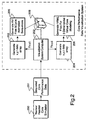
- FIGURE 2 an alternate embodiment of the reactor core performance visualization system of the present invention is shown in the context of obtaining performance data from a reactor core simulator.
- a nuclear reactor core simulator computer, 200 provides simulated core performance parameter data via data channel 201 to the core performance data visualization system.
- visualization computer 202 selects and organizes this data into two separate arrays, 203 and 204, which are then used to respectively create AVI animation files 205 and VRML files 206 for producing a visual image(s) on display device 208.
- FIGURE 3 shows a single frame of an example animation sequence generated by the reactor core performance visualization system computer.
- spatially-related time-varying data, P(x,y,t) for one or more selected reactor core performance parameters (e.g., MAPLHGR, MFLPD and CPR) are displayed as animated color-coded graphics in which colors and indicia change during the animation sequence to reflect the changing conditions within the core over a predetermined passage of time or sequence of events.
- the animated display images include one or more color-coded reactor core configuration diagrams, 301, one or more two-dimensional graphs/contour plots, 302, and a two-dimensional color-coded perspective image of the reactor core 303.
- Each core configuration diagram 301 consists of a 1 ⁇ 4-core representation of the arrangement of fuel bundles and control blades as viewed from the top of the reactor looking down into the core.
- the range of colors used by the visualization system in displaying the various diagrams and graphics are set to correspond to the range of numerical values possible for the particular performance parameter(s) selected for display.
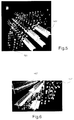
- FIGURES 4 through 6 show several example computer display screen images of a 3-D virtual reality model of a nuclear reactor core created from VRML files containing P(x,y,z) core performance data.
- control blades are represented by cross-beam figures 402, 502, 602 and fuel bundles are represented by vertical strings of color-coded cubes or blocks 401, 501, 601.
- the displayed color of each block is indicative of a numerical value or range for a selected performance parameter.
- the color of a particular block is indicative of the power being produced at a corresponding physical portion of the fuel bundle, e.g., "hotter" high-power portions are represented by red shades and "cooler" low-power portions by blue shades.
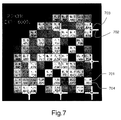
- FIGURE 7 shows an enlarged view of a portion of the display screen image of Figure 3 showing a 1 ⁇ 4-core diagram illustrating one of the dynamic performance parameters for the reactor core.
- a color-coded multi-square diagram represents the physical configuration (as viewed from above) of fuel bundles and control blades within a one-quarter section of a reactor core.
- Indicia identifying the particular performance parameter data selected for display by the viewer e.g., CPR
- CPR a numerical value indicative of the elapsed "exposure” (or "burn") time of the represented elements within the reactor core is displayed, e.g., a value representing units of elapsed time in the current burn cycle.
- Square color-coded boxes 700 represent fuel bundles and cross-like symbols 702 represent control blades.
- the color of each box or block is representative of the power produced by the fuel bundle at the current exposure time.
- Each box 700 also contains x and y location indicia 701 indicative of its position relative to other bundles in the core.
- Another (larger) numerical indicia 704 indicates the value of the currently selected performance parameter (e.g. CPR) associated with the particular fuel bundle.
- the cross-like symbols 702 representing control blades include central numeric indicia 703 that represent the vertical height of the control blade within the reactor core. Since the numerical values for various characteristics are time dependent, the displayed indicia are dynamic and will change during the animation sequence.
- the above described visualization system and method for presenting nuclear reactor core performance data is believed to be applicable to a wide range of reactors and core lading arrangements for reducing the man-hours of decision-making time required in determining core operational limits and evaluating nuclear core designs.
- the visualization system of the present invention is not intended to be limited solely to the use of the AVI protocol or VRML for creating animation of 3-D virtual reality modeling files from the acquired performance parameter data.
- any other conventional animation file protocol and/or 3-D virtual reality modeling software could be used in conjunction with the present invention by creating files of the appropriate protocol and format from the data stored in arrays 104/203 and 105/206.
Landscapes
- Engineering & Computer Science (AREA)
- Physics & Mathematics (AREA)
- General Engineering & Computer Science (AREA)
- Plasma & Fusion (AREA)
- High Energy & Nuclear Physics (AREA)
- Monitoring And Testing Of Nuclear Reactors (AREA)
- Processing Or Creating Images (AREA)
Applications Claiming Priority (2)
| Application Number | Priority Date | Filing Date | Title |
|---|---|---|---|
| US393290 | 1999-09-10 | ||
| US09/393,290 US6404437B1 (en) | 1999-09-10 | 1999-09-10 | Nuclear reactor core performance data visualization system |
Publications (1)
| Publication Number | Publication Date |
|---|---|
| EP1083576A1 true EP1083576A1 (fr) | 2001-03-14 |
Family
ID=23554094
Family Applications (1)
| Application Number | Title | Priority Date | Filing Date |
|---|---|---|---|
| EP00307235A Withdrawn EP1083576A1 (fr) | 1999-09-10 | 2000-08-22 | Système de présentation visuelle de paramètres de fonctionnement d'un coeur de réacteur nucléaire |
Country Status (3)
| Country | Link |
|---|---|
| US (1) | US6404437B1 (fr) |
| EP (1) | EP1083576A1 (fr) |
| JP (1) | JP2001228283A (fr) |
Cited By (5)
| Publication number | Priority date | Publication date | Assignee | Title |
|---|---|---|---|---|
| EP1821314A1 (fr) * | 2006-02-16 | 2007-08-22 | General Electric Company | Outil d'affichage, visualisation et traitement pour la réduction de la distorsion de canal et la friction de cellule |
| CN108875213A (zh) * | 2018-06-19 | 2018-11-23 | 哈尔滨工程大学 | 一种反应堆堆芯热工水力多尺度分析方法 |
| CN111008070A (zh) * | 2019-12-10 | 2020-04-14 | 北京科技大学 | 一种快中子反应堆全堆芯子通道并行任务划分方法及系统 |
| CN111128416A (zh) * | 2019-12-31 | 2020-05-08 | 西安交通大学 | 一种核电站死管段可视化热工水力实验装置及方法 |
| US20240006086A1 (en) * | 2021-03-19 | 2024-01-04 | Ats Corporation | Systems and methods for simulating an operation of one or more automated tools within a nuclear facility |
Families Citing this family (34)
| Publication number | Priority date | Publication date | Assignee | Title |
|---|---|---|---|---|
| US7155715B1 (en) * | 1999-03-31 | 2006-12-26 | British Telecommunications Public Limited Company | Distributed software system visualization |
| US6678585B1 (en) * | 1999-09-28 | 2004-01-13 | Pavilion Technologies, Inc. | Method and apparatus for maximizing power usage in a power plant |
| JP3548065B2 (ja) * | 1999-11-15 | 2004-07-28 | インターナショナル・ビジネス・マシーンズ・コーポレーション | リモートコントロールシステム、サーバ・クライアントシステム、製品端末機器の制御用サーバ、製品端末機器操作方法、機器情報共有方法、および記憶媒体 |
| DE10005881A1 (de) * | 2000-02-10 | 2001-08-30 | Norbert Zimmermann | Verfahren und System zur Visualisierung dreidimensionaler Objekte |
| US8873698B2 (en) * | 2002-12-18 | 2014-10-28 | Global Nuclear Fuel—Americas, LLC | Computer-implemented method and system for designing a nuclear reactor core which satisfies licensing criteria |
| US7222061B2 (en) * | 2002-12-18 | 2007-05-22 | Global Nuclear Fuel - Americas, Llc | Method and arrangement for developing rod patterns in nuclear reactors |
| US7231333B2 (en) * | 2003-03-31 | 2007-06-12 | Global Nuclear Fuel - Americas, Llc | Method and arrangement for developing core loading patterns in nuclear reactors |
| US9047995B2 (en) * | 2002-12-18 | 2015-06-02 | Global Nuclear Fuel—Americas, LLC | Method and system for designing a nuclear reactor core for uprated power operations |
| US7200541B2 (en) | 2002-12-23 | 2007-04-03 | Global Nuclear Fuel-Americas, Llc | Method and arrangement for determining nuclear reactor core designs |
| US7424412B2 (en) * | 2002-12-23 | 2008-09-09 | Global Nuclear Fuel - Americas, Llc | Method of determining nuclear reactor core design with reduced control blade density |
| US7693249B2 (en) * | 2003-01-31 | 2010-04-06 | Global Nuclear Fuel - Americas, Llc | Method of improving nuclear reactor performance |
| US7280946B2 (en) * | 2003-04-30 | 2007-10-09 | Global Nuclear Fuel-Americas, Llc | Method and arrangement for determining pin enrichments in fuel bundle of nuclear reactor |
| US7499840B2 (en) * | 2003-10-06 | 2009-03-03 | Global Nuclear Fuel - Americas, Llc | Method and apparatus for creating and editing a nuclear reactor core loading template |
| US7636652B2 (en) * | 2003-10-06 | 2009-12-22 | Global Nuclear Fuel - Americas, Llc | Method and apparatus for facilitating recovery of nuclear fuel from a fuel pool |
| CN1760990B (zh) | 2004-10-15 | 2011-11-30 | 西屋电气有限责任公司 | 改进的首次堆芯燃料组件布置和实现上述布置的方法 |
| US8041548B2 (en) * | 2004-12-30 | 2011-10-18 | Global Nuclear Fuels-Americas, LLC | Method and apparatus for evaluating a proposed solution to a constraint problem for a nuclear reactor involving channel deformation |
| US7409032B2 (en) * | 2005-05-13 | 2008-08-05 | Global Nuclear Fuel - Americas, Llc | Method of fuel bundle consideration in a reactor |
| JP4703281B2 (ja) * | 2005-06-17 | 2011-06-15 | 株式会社東芝 | Bwrの過度燃料健全性監視システム |
| US7839401B2 (en) * | 2007-05-10 | 2010-11-23 | International Business Machines Corporation | Management of enterprise systems and applications using three-dimensional visualization technology |
| US8294705B2 (en) * | 2007-05-10 | 2012-10-23 | International Business Machines Corporation | Virtual network operations center |
| US8373698B2 (en) * | 2007-05-10 | 2013-02-12 | International Business Machines Corporation | Holographic enterprise network |
| US20080288220A1 (en) * | 2007-05-17 | 2008-11-20 | Dillenberger Donna N | Use of a three-dimensional (3d) data center to share service operations |
| US8259099B2 (en) * | 2007-05-17 | 2012-09-04 | International Business Machines Corporation | Use of three-dimensional data center to support servicing external operations |
| RU2358314C1 (ru) * | 2007-10-08 | 2009-06-10 | Федеральное государственное унитарное предприятие "Научно-исследовательский технологический институт имени А.П. Александрова" | Способ имитации реактивности ядерного реактора |
| EP2294569B1 (fr) * | 2008-05-26 | 2015-07-29 | Colin Gavrilenco | Dispositif d'affichage pour afficher des représentations d'un objet en coupe transversale |
| US9489279B2 (en) * | 2011-01-18 | 2016-11-08 | Cisco Technology, Inc. | Visualization of performance data over a network path |
| US9424376B2 (en) | 2011-11-18 | 2016-08-23 | Terrapower, Llc | Enhanced neutronics systems |
| US20140376678A1 (en) * | 2013-06-25 | 2014-12-25 | Robert H. Leyse | Method of and Apparatus for Monitoring a Nuclear Reactor Core Under Normal and Accident Conditions |
| US9152695B2 (en) * | 2013-08-28 | 2015-10-06 | Intelati, Inc. | Generation of metadata and computational model for visual exploration system |
| JP6366960B2 (ja) * | 2014-02-28 | 2018-08-01 | 株式会社東芝 | 監視システム及び監視方法 |
| CN110402467B (zh) * | 2017-02-27 | 2023-04-28 | 泰拉能源公司 | 用于为核反应堆建模的系统和方法 |
| TWI669616B (zh) * | 2018-08-13 | 2019-08-21 | 行政院原子能委員會核能研究所 | 圓柱狀和圓餅狀數位模型之模擬切割方法 |
| CN112860967B (zh) * | 2021-02-02 | 2024-06-21 | 中广核工程有限公司 | 面向多类型用户的核事故多元信息可视化方法和电子设备 |
| JP7830377B2 (ja) * | 2023-03-20 | 2026-03-16 | 株式会社東芝 | 炉心監視システム及び炉心監視プログラム |
Citations (4)
| Publication number | Priority date | Publication date | Assignee | Title |
|---|---|---|---|---|
| EP0088572A2 (fr) * | 1982-03-01 | 1983-09-14 | The Babcock & Wilcox Company | Système moniteur pour les conditions transitoires anormales de consigne dans des installations de réacteur nucléaire d'eau sous pression |
| EP0243049A2 (fr) * | 1986-04-10 | 1987-10-28 | Westinghouse Electric Corporation | Dispositif de surveillance en deux et trois dimensions pour la distribution de la puissance du coeur et son affichage |
| WO1996003753A1 (fr) * | 1994-07-21 | 1996-02-08 | Westinghouse Electric Corporation | Procede et systeme permettant de calculer precisement la puissance d'un reacteur a eau sous pression a partir de courants captes par un detecteur situe hors coeur et corriges en fonction de changements dans la distribution de puissance tridimensionnelle et dans la densite du liquide de refroidissement |
| EP0860759A1 (fr) * | 1997-02-20 | 1998-08-26 | Volkswagen Aktiengesellschaft | Méthode et dispositif de visualisation multimédia de systèmes complexes |
Family Cites Families (8)
| Publication number | Priority date | Publication date | Assignee | Title |
|---|---|---|---|---|
| JP3037717B2 (ja) * | 1990-04-27 | 2000-05-08 | 株式会社東芝 | 原子炉の燃料集合体 |
| WO1993006557A1 (fr) * | 1991-09-17 | 1993-04-01 | General Physics International Engineering & Simulation, Inc. | Analyse en temps reel d'un phenomene thermohydraulique dans une centrale electrique |
| US5309485A (en) * | 1992-07-06 | 1994-05-03 | General Electric Company | Core automated monitoring system |
| JP3253450B2 (ja) * | 1994-06-21 | 2002-02-04 | 株式会社東芝 | 炉心性能推定装置および炉心性能推定方法 |
| US5790616A (en) | 1996-08-09 | 1998-08-04 | General Electric Company | Method and system for determining nuclear reactor core control blade positioning |
| US5790618A (en) | 1997-07-21 | 1998-08-04 | General Electric Company | Method and system for determining the impact of a mislocated nuclear fuel bundle loading |
| US6097399A (en) * | 1998-01-16 | 2000-08-01 | Honeywell Inc. | Display of visual data utilizing data aggregation |
| US6310929B1 (en) * | 1998-08-25 | 2001-10-30 | Kabushiki Kaisha Toshiba | In-core fixed nuclear instrumentation system and power distribution monitoring system |
-
1999
- 1999-09-10 US US09/393,290 patent/US6404437B1/en not_active Expired - Fee Related
-
2000
- 2000-08-22 EP EP00307235A patent/EP1083576A1/fr not_active Withdrawn
- 2000-09-08 JP JP2000272401A patent/JP2001228283A/ja not_active Withdrawn
Patent Citations (4)
| Publication number | Priority date | Publication date | Assignee | Title |
|---|---|---|---|---|
| EP0088572A2 (fr) * | 1982-03-01 | 1983-09-14 | The Babcock & Wilcox Company | Système moniteur pour les conditions transitoires anormales de consigne dans des installations de réacteur nucléaire d'eau sous pression |
| EP0243049A2 (fr) * | 1986-04-10 | 1987-10-28 | Westinghouse Electric Corporation | Dispositif de surveillance en deux et trois dimensions pour la distribution de la puissance du coeur et son affichage |
| WO1996003753A1 (fr) * | 1994-07-21 | 1996-02-08 | Westinghouse Electric Corporation | Procede et systeme permettant de calculer precisement la puissance d'un reacteur a eau sous pression a partir de courants captes par un detecteur situe hors coeur et corriges en fonction de changements dans la distribution de puissance tridimensionnelle et dans la densite du liquide de refroidissement |
| EP0860759A1 (fr) * | 1997-02-20 | 1998-08-26 | Volkswagen Aktiengesellschaft | Méthode et dispositif de visualisation multimédia de systèmes complexes |
Cited By (7)
| Publication number | Priority date | Publication date | Assignee | Title |
|---|---|---|---|---|
| EP1821314A1 (fr) * | 2006-02-16 | 2007-08-22 | General Electric Company | Outil d'affichage, visualisation et traitement pour la réduction de la distorsion de canal et la friction de cellule |
| CN108875213A (zh) * | 2018-06-19 | 2018-11-23 | 哈尔滨工程大学 | 一种反应堆堆芯热工水力多尺度分析方法 |
| CN108875213B (zh) * | 2018-06-19 | 2022-04-12 | 哈尔滨工程大学 | 一种反应堆堆芯热工水力多尺度分析方法 |
| CN111008070A (zh) * | 2019-12-10 | 2020-04-14 | 北京科技大学 | 一种快中子反应堆全堆芯子通道并行任务划分方法及系统 |
| CN111008070B (zh) * | 2019-12-10 | 2023-05-12 | 北京科技大学 | 一种快中子反应堆全堆芯子通道并行任务划分方法及系统 |
| CN111128416A (zh) * | 2019-12-31 | 2020-05-08 | 西安交通大学 | 一种核电站死管段可视化热工水力实验装置及方法 |
| US20240006086A1 (en) * | 2021-03-19 | 2024-01-04 | Ats Corporation | Systems and methods for simulating an operation of one or more automated tools within a nuclear facility |
Also Published As
| Publication number | Publication date |
|---|---|
| JP2001228283A (ja) | 2001-08-24 |
| US6404437B1 (en) | 2002-06-11 |
Similar Documents
| Publication | Publication Date | Title |
|---|---|---|
| US6404437B1 (en) | Nuclear reactor core performance data visualization system | |
| US6289299B1 (en) | Systems and methods for interactive virtual reality process control and simulation | |
| CN104680260B (zh) | 一种电网可视化感知模型构建方法及系统 | |
| Mahadev et al. | Envisioning power system data: concepts and a prototype system state representation | |
| CN112650808A (zh) | 一种可实时校验和模拟校验的变电站防误逻辑可视化方法 | |
| CN107529667B (zh) | 混合现实核电站仿真和分析系统 | |
| CN115062493B (zh) | 电网二次设备连续运行测试专用数字孪生系统及构建方法 | |
| JPH04229380A (ja) | 数値データ視覚化方法および装置 | |
| CN107657135B (zh) | 一种核电站发电机内定子更换方法及系统 | |
| CN112035934B (zh) | 一种基于变电站的数字化设计模型进行施工管理控制的方法 | |
| CN111176642A (zh) | 一种基于平面图的交互可视化处理系统及应用方法 | |
| EP0449293A2 (fr) | Méthode et appareil pour affichage tridimensionnel de quantité physique | |
| Guo et al. | Visualization of a hydro-electric generating unit and its applications | |
| Hsieh et al. | Visualization system for field monitoring data and its effectiveness | |
| Klump et al. | Real-time data retrieval and new visualization techniques for the energy industry | |
| CN109918738B (zh) | 核电厂反应堆功率状态三维可视化方法、评估方法及系统 | |
| JPH10115096A (ja) | プラント建設支援システム | |
| CN119987901A (zh) | 一种快速流场可视化数据加载方法 | |
| Waller et al. | Experiencing virtual factories of the future | |
| Lee et al. | Development of human factors validation system for the advanced control room of APR1400 | |
| CN118568825A (zh) | 一种斜拉桥健康监测数据在线映射方法及系统 | |
| KR20250103195A (ko) | 대용량 시뮬레이션 데이터 처리 기술을 이용한 제조 공정용 디지털 트윈 시스템 | |
| JP2001005522A (ja) | データ表示装置 | |
| Fujiwara et al. | User-friendly workstation for power systems analysis | |
| KR102933517B1 (ko) | 제조 공장의 데이터 기반 실시간 상태 반영 모델링 시스템 및 방법 |
Legal Events
| Date | Code | Title | Description |
|---|---|---|---|
| PUAI | Public reference made under article 153(3) epc to a published international application that has entered the european phase |
Free format text: ORIGINAL CODE: 0009012 |
|
| AK | Designated contracting states |
Kind code of ref document: A1 Designated state(s): DE SE |
|
| AX | Request for extension of the european patent |
Free format text: AL;LT;LV;MK;RO;SI |
|
| 17P | Request for examination filed |
Effective date: 20010914 |
|
| AKX | Designation fees paid |
Free format text: DE SE |
|
| STAA | Information on the status of an ep patent application or granted ep patent |
Free format text: STATUS: THE APPLICATION HAS BEEN WITHDRAWN |
|
| 18W | Application withdrawn |
Effective date: 20030522 |