EP1083688A2 - Procédé et dispositif de traitement d'un train de bits numérique - Google Patents
Procédé et dispositif de traitement d'un train de bits numérique Download PDFInfo
- Publication number
- EP1083688A2 EP1083688A2 EP00307789A EP00307789A EP1083688A2 EP 1083688 A2 EP1083688 A2 EP 1083688A2 EP 00307789 A EP00307789 A EP 00307789A EP 00307789 A EP00307789 A EP 00307789A EP 1083688 A2 EP1083688 A2 EP 1083688A2
- Authority
- EP
- European Patent Office
- Prior art keywords
- input
- bit rate
- bit stream
- rate
- delay
- Prior art date
- Legal status (The legal status is an assumption and is not a legal conclusion. Google has not performed a legal analysis and makes no representation as to the accuracy of the status listed.)
- Withdrawn
Links
Images
Classifications
-
- H—ELECTRICITY
- H04—ELECTRIC COMMUNICATION TECHNIQUE
- H04N—PICTORIAL COMMUNICATION, e.g. TELEVISION
- H04N21/00—Selective content distribution, e.g. interactive television or video on demand [VOD]
- H04N21/20—Servers specifically adapted for the distribution of content, e.g. VOD servers; Operations thereof
- H04N21/23—Processing of content or additional data; Elementary server operations; Server middleware
- H04N21/236—Assembling of a multiplex stream, e.g. transport stream, by combining a video stream with other content or additional data, e.g. inserting a URL [Uniform Resource Locator] into a video stream, multiplexing software data into a video stream; Remultiplexing of multiplex streams; Insertion of stuffing bits into the multiplex stream, e.g. to obtain a constant bit-rate; Assembling of a packetised elementary stream
- H04N21/23611—Insertion of stuffing data into a multiplex stream, e.g. to obtain a constant bitrate
-
- H—ELECTRICITY
- H04—ELECTRIC COMMUNICATION TECHNIQUE
- H04J—MULTIPLEX COMMUNICATION
- H04J3/00—Time-division multiplex systems
- H04J3/02—Details
- H04J3/06—Synchronising arrangements
- H04J3/0602—Systems characterised by the synchronising information used
-
- H—ELECTRICITY
- H04—ELECTRIC COMMUNICATION TECHNIQUE
- H04J—MULTIPLEX COMMUNICATION
- H04J3/00—Time-division multiplex systems
- H04J3/02—Details
- H04J3/06—Synchronising arrangements
- H04J3/062—Synchronisation of signals having the same nominal but fluctuating bit rates, e.g. using buffers
- H04J3/0632—Synchronisation of packets and cells, e.g. transmission of voice via a packet network, circuit emulation service [CES]
-
- H—ELECTRICITY
- H04—ELECTRIC COMMUNICATION TECHNIQUE
- H04N—PICTORIAL COMMUNICATION, e.g. TELEVISION
- H04N21/00—Selective content distribution, e.g. interactive television or video on demand [VOD]
- H04N21/20—Servers specifically adapted for the distribution of content, e.g. VOD servers; Operations thereof
- H04N21/23—Processing of content or additional data; Elementary server operations; Server middleware
- H04N21/236—Assembling of a multiplex stream, e.g. transport stream, by combining a video stream with other content or additional data, e.g. inserting a URL [Uniform Resource Locator] into a video stream, multiplexing software data into a video stream; Remultiplexing of multiplex streams; Insertion of stuffing bits into the multiplex stream, e.g. to obtain a constant bit-rate; Assembling of a packetised elementary stream
- H04N21/23608—Remultiplexing multiplex streams, e.g. involving modifying time stamps or remapping the packet identifiers
-
- H—ELECTRICITY
- H04—ELECTRIC COMMUNICATION TECHNIQUE
- H04N—PICTORIAL COMMUNICATION, e.g. TELEVISION
- H04N21/00—Selective content distribution, e.g. interactive television or video on demand [VOD]
- H04N21/40—Client devices specifically adapted for the reception of or interaction with content, e.g. set-top-box [STB]; Operations thereof
- H04N21/43—Processing of content or additional data, e.g. demultiplexing additional data from a digital video stream; Elementary client operations, e.g. monitoring of home network or synchronising decoder's clock; Client middleware
- H04N21/434—Disassembling of a multiplex stream, e.g. demultiplexing audio and video streams, extraction of additional data from a video stream; Remultiplexing of multiplex streams; Extraction or processing of SI; Disassembling of packetised elementary stream
- H04N21/4344—Remultiplexing of multiplex streams, e.g. by modifying time stamps or remapping the packet identifiers
-
- H—ELECTRICITY
- H04—ELECTRIC COMMUNICATION TECHNIQUE
- H04L—TRANSMISSION OF DIGITAL INFORMATION, e.g. TELEGRAPHIC COMMUNICATION
- H04L7/00—Arrangements for synchronising receiver with transmitter
- H04L7/04—Speed or phase control by synchronisation signals
- H04L7/041—Speed or phase control by synchronisation signals using special codes as synchronising signal
- H04L2007/045—Fill bit or bits, idle words
Definitions
- the present invention relates to the field of digital broadcasting, and more particularly, the processing of digital transport streams.
- a digital transport stream is created from a number of different sources, such as video, audio, data and control sources. These individual sources are usually encoded and multiplexed together to form a robust digital transport stream which is suitable for broadcast over a transmission network such as for example a satellite, terrestrial or microwave network.
- a transmission network such as for example a satellite, terrestrial or microwave network.
- a transport stream is produced at a broadcast head-end, such as a television station.
- the transport stream is then transmitted to a modulator where it is modulated into a form suitable for broadcast over the chosen transmission network.
- the modulator is usually situated in close proximity to a broadcast antenna.
- the modulator is usually situated near a satellite uplink station. Whichever kind of transmission network is used, the site where the transport stream is produced and the site where the transport stream is broadcast are rarely in the same place, and may be many hundreds of kilometres away.
- modulators In order to correctly modulate a transport stream, modulators require the transport stream to have a precise bit rate relative to the internal clocks of the modulator.
- the transport stream may be transmitted to a remote modulator via a telecommunications network.
- the telecommunication networks often introduce some degree of jitter or delay into the transport stream. Problems also arise in other situations where it is not possible to lock the bit rates of the equipment being used to the bit rate of the transport stream source.
- One way of ensuring the precision of the transport stream bit rate is by inserting an appropriate number of null packets. This technique is commonly known as transport rate adaptation.
- transport rate adaptation For transport rate adaptation to work, the incoming transport stream must have a lower bit rate than required by the modulator to allow null packets to be inserted.
- MPEG-2 Moving Pictures Expert Group
- An MPEG-2 compliant transport stream includes interspersed clock references, known as program clock references (PCR).
- PCR program clock references
- Each PCR is a reference value to a 27MHz counter at the original transport stream source (e.g. an encoder) and is used to synchronise the clocks of a receiver.
- the PCR values in the transport stream should correspond to the precise moment in time that they are to be presented to a receiver so that smooth clock synchronisation can be achieved. If a null packet is inserted, as described above, the PCR values either side of the null packet are presented at different times from the times they represent. In other words, the PCR has become corrupted. To eliminate the corruption the affected PCR values must be changed to take account of any insertion of null packets.
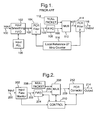
- a prior art transport rate adaptation system is shown in Figure 1.
- a transport stream 100 is input to an input buffer 102.
- the input buffer 102 is a first in first out (FIFO) buffer which helps smooth any jitter in the input signal.
- An input phase locked loop (PLL) 106 is used to synchronise the output rate of FIFO 102 to that of the input rate.
- the smoothed transport stream 103 is then input to a PCR filter 104.
- the PCR filter 104 locates PCR values in the transport stream 103 and subtracts a local reference 27 MHz counter value, supplied by a local reference counter 116 from each PCR value. This new value is then used to overwrite the existing PCR value in the transport stream, creating a further modified transport stream 105.
- the transport stream 105 is then input to a FIFO buffer 108.
- the output 109 of the FIFO 108 is fed to a multiplexer 110 together with the output from a null packet generator 112.
- the multiplexer 110 inserts null packets from null packet generator 112 into the transport stream output 109.
- the number and frequency of null packets inserted is dependent on the bit rate which is required for the transport stream.
- An output transport stream 107 produced by the multiplexer 110 is subsequently input to a second PCR filter 114.
- the second PCR filter 114 modifies all PCR values in the transport stream 107 by adding a local reference 27 MHz counter value, supplied by the local reference counter 116, to each PCR value.
- Output 118 is therefore a transport rate adapted transport stream, which has been adapted to have a bit rate suitable for input to a modulator.
- the difference in PCR value between the input and output of this process is equal to the change in the local 27 MHz reference counter over this period of time. Since the change in PCR value is equal to the delay of the transport rate adaptation process the clock rate on either side of the process must be stable. If either clock rate is 'jittery' then this jitter is transferred to the PCR values.
- a modulator such as an orthogonal frequency division multiplex (OFDM) modulator
- the output clock rate will be set to a stable value, but the input rate will depend on the communication channel between the multiplexer and the modulator.
- This communication channel will not typically present a stable data rate and so the input rate smoothing buffer 102 must be placed before the PCR filter 104 to convert a data burst and/or jittery input rate to a transport stream with a continuous stable bit rate 103.
- the input transport stream rate must be smoothed before the rate adaptation process can be performed.
- a large buffer may be required to perform this transport stream rate smoothing.
- the clock signal for the continuous stable bit rate data 103 must be generated and locked to the input data rate.
- the technique of locking this clock to the input rate often has to be optimised for different input data interfaces. For example, many input interfaces will present data bursts in various packet sizes, such as DVB, ASI and ATM interfaces. Optimal clock locking techniques are only achieved if these packet sizes are taken into account.
- an unacceptable delay occurs in the input transport stream the smoothing buffer may not be large enough to cope and data loss will occur. An example of such a delay includes transport stream switching. The larger the size of smoothing buffer, the greater the latency through the system - this is particularly undesirable in situations requiring direct two-way communications, such as a live interview between a studio and an outside broadcast unit.
- one object of the present invention is to overcome at least some of the problems of the prior art, and to provide a system for rate adapting an input transport stream in a simple and effective manner.
- a method of processing an input bit stream including a plurality of data packets and synchronisation markers, to produce an output bit stream at a predetermined bit rate, wherein the average bit rate of the input bit stream is not greater than the predetermined bit rate, the method comprising the steps of measuring the bit rate of the input bit stream; inserting null information into the input bit stream to increase the bit rate of the input bit stream to substantially match the predetermined bit rate; deriving a delay of the input bit stream introduced by the inserting step; and amending the synchronisation markers in dependence of the derived delay.
- an apparatus for processing an input bit stream which includes a plurality of data packets and synchronisation markers to produce an output bit stream at a predetermined bit rate, wherein the average bit rate of the input bit stream is not greater than the predetermined bit rate
- said apparatus including means for measuring the bit rate of the input bit stream, means for inserting null information in the input bit stream to increase the bit rate of the input bit stream to substantially match the predetermined bit rate, means for deriving the delay of the input bit stream by the inserting means, and means for revising the synchronisation markers in dependence upon the derived delay.
- the invention avoids the need of smoothing the input data rate before the transport rate adaptation process required by the prior art. Also, the present invention removes the requirement for phase locked loop circuits, optimised for various input interfaces, and large input smoothing buffers, and provides a simple, accurate and effective way of transport rate adapting a transport stream.
- an input transport stream 200 is input to an input rate monitor 202.
- the monitor 202 monitors the bit rate of the input transport stream 200.
- a measure of the input bit rate is fed to a controller 210.
- the transport stream 200 is also input to a FIFO buffer 204.
- the buffer 204 can be any size greater than 1 packet. The larger the buffer the more protection is provided against buffer overflow due to data bursts.
- the output from the FIFO buffer 204 and the output from a null packet generator 206 are fed to a multiplexer 208 to produce a multiplexed output bit stream 209.
- the controller 210 controls the multiplexer 208 in such a way as to provide a constant output bit rate bit stream 209. If the input bit stream is lower than the required output bit rate, null packets are inserted in the transport stream by the multiplexer 208. This operation must be carefully managed to prevent the FIFO 204 from under-flowing. Preventing overflow of the FIFO 204 can only be achieved by ensuring that the bit rate of the input transport stream is below that of the output transport stream.
- the PCR values in the transport stream 209, at the output of the multiplexer 208, are thus likely to be corrupt. This is due to the insertion of null packets.
- the PCR values in the output bit stream must be processed to remove the effects of any corruption - a PCR corrector 212 achieves this.
- the PCR corrector 212 must correct the PCRs in the transport stream 209 to take into account the length of time it takes to perform the transport rate adaptation process outlined above. This period will be referred to hereinafter as the process delay. Since it is possible to calculate the process delay without having to use complex measurement techniques, it is possible to virtually correct the PCRs in the transport stream 209.
- the fill level of the FIFO 204 is initialised to 8 packets full, i.e. that 8 packets of data are placed in FIFO 204, before starting to extract data from the buffer.
- the process delay will be the number of bytes in eight packets of data multiplied by the time it took to receive one byte. This value is then converted to 27MHz sample periods (since this is the unit used in MPEG encoders for synchronisation purposes).
- Pr ocessDelay initial 8 ⁇ packet _ length ⁇ input_period ⁇ 27 ⁇ 10 6
- packet _ length 188 or 204 (if Reed-Solomon encoder used).
- the PCR corrector 212 adds this process delay to every PCR value it finds in the data stream, thereby correcting the PCR values corrupted by the transport rate adaptation process itself.
- the average process delay should be equivalent to the average fill level of the FIFO buffer.
- the process delay is the calculated expected fill level of the FIFO buffer, converted to 27 MHz time periods.
- the average fill level and average process delay may drift apart.
- Pr ocessDelay Pr ocessDelay + ( output _ period - input _ period ) ⁇ 27 ⁇ 10 6 ) + ⁇ (( FIFO _ Fill _ Level ⁇ input _ period ⁇ 27 ⁇ 10 6 ) - Pr ocessDelay ) ⁇ is a coefficient, which controls the bandwidth of the PLL, used to lock the ProcessDelay to the FIFO_Fill_Level.
- Equation 4 calculates the difference between the calculated process delay and the instantaneous measured process delay. The instantaneous measured delay is the FIFO fill level, converted to a time base with units of 27 MHz time periods.
- This difference is taken as an error value and a portion thereof is added on to the process delay.
- the effect of the error value is to reduce the difference between the calculated process delay and instantaneous measured process delay to an average of zero. Hence the process delay becomes locked to the average fill level of the FIFO.
- a high value of ⁇ will result in the process delay quickly tracking changes in the FIFO fill level, but this makes the process delay more susceptible to jitter in the fill level of the FIFO caused by jitter on the input stream.
- the value of ⁇ must be set to a value low enough to avoid problems with FIFO fill level jitter.
- the process delay For each data byte output, the process delay should be recalculated using equation 4, for each null packet byte output, the process delay should be recalculated using equation 3.
- the process delay is a continuously updated value, accounting for the movement of data.
- the quality, and hence accuracy, of the PCR correction according to the present invention is governed by a number of factors. These include the accuracy of which the process delay can be calculated, the amount of averaging used in determining the input bit rate, and the value of ⁇ used in Equation 4 for determining the process delay. These calculations may be implemented in either hardware or software.
- the quality of the PCR correction is dependent on the effectiveness of the input rate smoothing circuit.
- a very large input smoothing buffer may be required, along with a low bandwidth phase locked loop.
- the system of the present invention removes the requirement for phase locked loop circuits, optimised for various input interfaces, and large input smoothing buffers, and provides a simple, accurate and effective way of transport rate adapting a transport stream.
Landscapes
- Engineering & Computer Science (AREA)
- Signal Processing (AREA)
- Multimedia (AREA)
- Computer Networks & Wireless Communication (AREA)
- Computer Hardware Design (AREA)
- Data Exchanges In Wide-Area Networks (AREA)
- Synchronisation In Digital Transmission Systems (AREA)
Applications Claiming Priority (2)
| Application Number | Priority Date | Filing Date | Title |
|---|---|---|---|
| GB9921261 | 1999-09-09 | ||
| GBGB9921261.5A GB9921261D0 (en) | 1999-09-09 | 1999-09-09 | Method and apparatus for processing a digital bitstream |
Publications (2)
| Publication Number | Publication Date |
|---|---|
| EP1083688A2 true EP1083688A2 (fr) | 2001-03-14 |
| EP1083688A3 EP1083688A3 (fr) | 2002-10-23 |
Family
ID=10860596
Family Applications (1)
| Application Number | Title | Priority Date | Filing Date |
|---|---|---|---|
| EP00307789A Withdrawn EP1083688A3 (fr) | 1999-09-09 | 2000-09-08 | Procédé et dispositif de traitement d'un train de bits numérique |
Country Status (2)
| Country | Link |
|---|---|
| EP (1) | EP1083688A3 (fr) |
| GB (1) | GB9921261D0 (fr) |
Cited By (3)
| Publication number | Priority date | Publication date | Assignee | Title |
|---|---|---|---|---|
| EP1503592A1 (fr) * | 2003-07-30 | 2005-02-02 | Sony Corporation | Appareil d'édition, méthode de contrôle de débit, et programme de contrôle de débit |
| WO2009040680A3 (fr) * | 2007-06-15 | 2009-06-11 | Michele Bargauan | Ré-horodatage de référence d'horloge de programme déterministe pour une adaptation de débit binaire synchrone sur la base d'un paquet d'initialisation de méga-trame |
| US7843969B2 (en) | 2007-06-15 | 2010-11-30 | Screen Service Broadcasting Technologies S.P.A. | Communications system to feed multiple single frequency networks with multiple content |
Family Cites Families (4)
| Publication number | Priority date | Publication date | Assignee | Title |
|---|---|---|---|---|
| US5566174A (en) * | 1994-04-08 | 1996-10-15 | Philips Electronics North America Corporation | MPEG information signal conversion system |
| US5652627A (en) * | 1994-09-27 | 1997-07-29 | Lucent Technologies Inc. | System and method for reducing jitter in a packet-based transmission network |
| JP3575100B2 (ja) * | 1994-11-14 | 2004-10-06 | ソニー株式会社 | データ送信/受信装置及び方法並びにデータ記録/再生装置及び方法 |
| US5905732A (en) * | 1996-08-27 | 1999-05-18 | Zenith Electronics Corporation | PCR restamper |
-
1999
- 1999-09-09 GB GBGB9921261.5A patent/GB9921261D0/en not_active Ceased
-
2000
- 2000-09-08 EP EP00307789A patent/EP1083688A3/fr not_active Withdrawn
Cited By (5)
| Publication number | Priority date | Publication date | Assignee | Title |
|---|---|---|---|---|
| EP1503592A1 (fr) * | 2003-07-30 | 2005-02-02 | Sony Corporation | Appareil d'édition, méthode de contrôle de débit, et programme de contrôle de débit |
| WO2009040680A3 (fr) * | 2007-06-15 | 2009-06-11 | Michele Bargauan | Ré-horodatage de référence d'horloge de programme déterministe pour une adaptation de débit binaire synchrone sur la base d'un paquet d'initialisation de méga-trame |
| US7843969B2 (en) | 2007-06-15 | 2010-11-30 | Screen Service Broadcasting Technologies S.P.A. | Communications system to feed multiple single frequency networks with multiple content |
| US7924886B2 (en) | 2007-06-15 | 2011-04-12 | Screen Service Broadcasting Technologies S.P.A. | Deterministic program clock reference re-stamping for synchronous bit rate adaptation based on mega-frame initialization packet |
| US7983303B2 (en) | 2007-06-15 | 2011-07-19 | Screen Service Broadcasting Technologies S.P.A. | Mega-frame initialization packet generation and synchronous re-generation with bit rate adaptation for single frequency networks with multiple modulation schemes |
Also Published As
| Publication number | Publication date |
|---|---|
| GB9921261D0 (en) | 1999-11-10 |
| EP1083688A3 (fr) | 2002-10-23 |
Similar Documents
| Publication | Publication Date | Title |
|---|---|---|
| CA2559225C (fr) | Suppresseur de gigue dans le flux de transport | |
| US5936968A (en) | Method and apparatus for multiplexing complete MPEG transport streams from multiple sources using a PLL coupled to both the PCR and the transport encoder clock | |
| US8718091B2 (en) | Cable modem system with sample and packet synchronization | |
| US7899089B2 (en) | Constant bit rate padding of MPEG transport streams | |
| US7983268B1 (en) | Method and apparatus for modifying the rate of MPEG transport streams | |
| US7006510B2 (en) | Method of clock mismatch and drift compensation for packet networks | |
| US20080211969A1 (en) | Systems, apparatus, methods and computer program products for providing atsc interoperability | |
| US11943494B2 (en) | Adaptive video slew rate for video delivery | |
| US7778173B2 (en) | Clock recovery algorithm for remultiplexing MPEG-2 SPTSs and/or MPTSs in the presence of network jitter | |
| US7924886B2 (en) | Deterministic program clock reference re-stamping for synchronous bit rate adaptation based on mega-frame initialization packet | |
| CN1969563B (zh) | 用于程序时钟参照消除抖动的速度限制的控制方法和系统 | |
| US6266384B1 (en) | Method and apparatus for time base recovery and processing | |
| CN102204249B (zh) | Mpeg传输流的恒定比特率填充 | |
| CN103975600B (zh) | 用信号发送传输时间和/或系统时钟脉冲的方法及设备 | |
| US7418011B2 (en) | Method and system for multiplexing DOCSIS data into an MPEG transport stream | |
| JPH10117188A (ja) | Pllパラメータの調整方法と装置 | |
| US20240372639A1 (en) | Method of measuring timing holdover performance in an r-phy system | |
| US20080025345A1 (en) | Methods and Systems for Buffer Management | |
| EP0912065A2 (fr) | Méthode et dispositif de résynchronisation d'un signal numérique | |
| WO2026057978A1 (fr) | Transfert de temps | |
| MXPA06010293A (en) | Transport stream dejitterer |
Legal Events
| Date | Code | Title | Description |
|---|---|---|---|
| PUAI | Public reference made under article 153(3) epc to a published international application that has entered the european phase |
Free format text: ORIGINAL CODE: 0009012 |
|
| AK | Designated contracting states |
Kind code of ref document: A2 Designated state(s): AT BE CH CY DE DK ES FI FR GB GR IE IT LI LU MC NL PT SE |
|
| AX | Request for extension of the european patent |
Free format text: AL;LT;LV;MK;RO;SI |
|
| PUAL | Search report despatched |
Free format text: ORIGINAL CODE: 0009013 |
|
| AK | Designated contracting states |
Kind code of ref document: A3 Designated state(s): AT BE CH CY DE DK ES FI FR GB GR IE IT LI LU MC NL PT SE |
|
| AX | Request for extension of the european patent |
Free format text: AL;LT;LV;MK;RO;SI |
|
| RIC1 | Information provided on ipc code assigned before grant |
Free format text: 7H 04J 3/06 A, 7H 04N 7/24 B |
|
| 17P | Request for examination filed |
Effective date: 20030423 |
|
| AKX | Designation fees paid |
Designated state(s): GB |
|
| RBV | Designated contracting states (corrected) |
Designated state(s): AT BE CH CY DE DK ES FI FR GB GR IE IT LI LU MC NL PT SE |
|
| REG | Reference to a national code |
Ref country code: DE Ref legal event code: 8566 |
|
| 17Q | First examination report despatched |
Effective date: 20040901 |
|
| STAA | Information on the status of an ep patent application or granted ep patent |
Free format text: STATUS: THE APPLICATION IS DEEMED TO BE WITHDRAWN |
|
| 18D | Application deemed to be withdrawn |
Effective date: 20050112 |