EP1083751A1 - Mesure de l'activité d'images vidéo dans le domaine DCT - Google Patents
Mesure de l'activité d'images vidéo dans le domaine DCT Download PDFInfo
- Publication number
- EP1083751A1 EP1083751A1 EP99830560A EP99830560A EP1083751A1 EP 1083751 A1 EP1083751 A1 EP 1083751A1 EP 99830560 A EP99830560 A EP 99830560A EP 99830560 A EP99830560 A EP 99830560A EP 1083751 A1 EP1083751 A1 EP 1083751A1
- Authority
- EP
- European Patent Office
- Prior art keywords
- activity
- macroblock
- actj
- coefficient
- block
- Prior art date
- Legal status (The legal status is an assumption and is not a legal conclusion. Google has not performed a legal analysis and makes no representation as to the accuracy of the status listed.)
- Granted
Links
- 230000000694 effects Effects 0.000 title claims abstract description 40
- 238000005259 measurement Methods 0.000 title 1
- 238000000034 method Methods 0.000 claims abstract description 29
- 230000015654 memory Effects 0.000 claims abstract description 17
- 238000013139 quantization Methods 0.000 claims abstract description 14
- 230000002123 temporal effect Effects 0.000 description 9
- 238000004364 calculation method Methods 0.000 description 7
- 239000011159 matrix material Substances 0.000 description 7
- 230000008569 process Effects 0.000 description 5
- 238000010586 diagram Methods 0.000 description 4
- 230000009467 reduction Effects 0.000 description 4
- 230000006835 compression Effects 0.000 description 3
- 238000007906 compression Methods 0.000 description 3
- 230000006870 function Effects 0.000 description 3
- 230000004044 response Effects 0.000 description 3
- 230000003044 adaptive effect Effects 0.000 description 2
- 230000005540 biological transmission Effects 0.000 description 1
- 230000003139 buffering effect Effects 0.000 description 1
- 238000007796 conventional method Methods 0.000 description 1
- RXOIEVSUURELPG-UHFFFAOYSA-N fenozolone Chemical compound O1C(NCC)=NC(=O)C1C1=CC=CC=C1 RXOIEVSUURELPG-UHFFFAOYSA-N 0.000 description 1
- 238000001914 filtration Methods 0.000 description 1
- 230000006872 improvement Effects 0.000 description 1
- 238000006467 substitution reaction Methods 0.000 description 1
- 230000017105 transposition Effects 0.000 description 1
- 238000011144 upstream manufacturing Methods 0.000 description 1
- 239000013598 vector Substances 0.000 description 1
Images


Classifications
-
- H—ELECTRICITY
- H04—ELECTRIC COMMUNICATION TECHNIQUE
- H04N—PICTORIAL COMMUNICATION, e.g. TELEVISION
- H04N19/00—Methods or arrangements for coding, decoding, compressing or decompressing digital video signals
- H04N19/42—Methods or arrangements for coding, decoding, compressing or decompressing digital video signals characterised by implementation details or hardware specially adapted for video compression or decompression, e.g. dedicated software implementation
-
- H—ELECTRICITY
- H04—ELECTRIC COMMUNICATION TECHNIQUE
- H04N—PICTORIAL COMMUNICATION, e.g. TELEVISION
- H04N19/00—Methods or arrangements for coding, decoding, compressing or decompressing digital video signals
- H04N19/10—Methods or arrangements for coding, decoding, compressing or decompressing digital video signals using adaptive coding
- H04N19/102—Methods or arrangements for coding, decoding, compressing or decompressing digital video signals using adaptive coding characterised by the element, parameter or selection affected or controlled by the adaptive coding
- H04N19/115—Selection of the code volume for a coding unit prior to coding
-
- H—ELECTRICITY
- H04—ELECTRIC COMMUNICATION TECHNIQUE
- H04N—PICTORIAL COMMUNICATION, e.g. TELEVISION
- H04N19/00—Methods or arrangements for coding, decoding, compressing or decompressing digital video signals
- H04N19/10—Methods or arrangements for coding, decoding, compressing or decompressing digital video signals using adaptive coding
- H04N19/102—Methods or arrangements for coding, decoding, compressing or decompressing digital video signals using adaptive coding characterised by the element, parameter or selection affected or controlled by the adaptive coding
- H04N19/124—Quantisation
-
- H—ELECTRICITY
- H04—ELECTRIC COMMUNICATION TECHNIQUE
- H04N—PICTORIAL COMMUNICATION, e.g. TELEVISION
- H04N19/00—Methods or arrangements for coding, decoding, compressing or decompressing digital video signals
- H04N19/10—Methods or arrangements for coding, decoding, compressing or decompressing digital video signals using adaptive coding
- H04N19/134—Methods or arrangements for coding, decoding, compressing or decompressing digital video signals using adaptive coding characterised by the element, parameter or criterion affecting or controlling the adaptive coding
- H04N19/136—Incoming video signal characteristics or properties
- H04N19/14—Coding unit complexity, e.g. amount of activity or edge presence estimation
-
- H—ELECTRICITY
- H04—ELECTRIC COMMUNICATION TECHNIQUE
- H04N—PICTORIAL COMMUNICATION, e.g. TELEVISION
- H04N19/00—Methods or arrangements for coding, decoding, compressing or decompressing digital video signals
- H04N19/10—Methods or arrangements for coding, decoding, compressing or decompressing digital video signals using adaptive coding
- H04N19/134—Methods or arrangements for coding, decoding, compressing or decompressing digital video signals using adaptive coding characterised by the element, parameter or criterion affecting or controlling the adaptive coding
- H04N19/146—Data rate or code amount at the encoder output
- H04N19/15—Data rate or code amount at the encoder output by monitoring actual compressed data size at the memory before deciding storage at the transmission buffer
-
- H—ELECTRICITY
- H04—ELECTRIC COMMUNICATION TECHNIQUE
- H04N—PICTORIAL COMMUNICATION, e.g. TELEVISION
- H04N19/00—Methods or arrangements for coding, decoding, compressing or decompressing digital video signals
- H04N19/10—Methods or arrangements for coding, decoding, compressing or decompressing digital video signals using adaptive coding
- H04N19/134—Methods or arrangements for coding, decoding, compressing or decompressing digital video signals using adaptive coding characterised by the element, parameter or criterion affecting or controlling the adaptive coding
- H04N19/157—Assigned coding mode, i.e. the coding mode being predefined or preselected to be further used for selection of another element or parameter
- H04N19/159—Prediction type, e.g. intra-frame, inter-frame or bidirectional frame prediction
-
- H—ELECTRICITY
- H04—ELECTRIC COMMUNICATION TECHNIQUE
- H04N—PICTORIAL COMMUNICATION, e.g. TELEVISION
- H04N19/00—Methods or arrangements for coding, decoding, compressing or decompressing digital video signals
- H04N19/10—Methods or arrangements for coding, decoding, compressing or decompressing digital video signals using adaptive coding
- H04N19/169—Methods or arrangements for coding, decoding, compressing or decompressing digital video signals using adaptive coding characterised by the coding unit, i.e. the structural portion or semantic portion of the video signal being the object or the subject of the adaptive coding
- H04N19/17—Methods or arrangements for coding, decoding, compressing or decompressing digital video signals using adaptive coding characterised by the coding unit, i.e. the structural portion or semantic portion of the video signal being the object or the subject of the adaptive coding the unit being an image region, e.g. an object
- H04N19/172—Methods or arrangements for coding, decoding, compressing or decompressing digital video signals using adaptive coding characterised by the coding unit, i.e. the structural portion or semantic portion of the video signal being the object or the subject of the adaptive coding the unit being an image region, e.g. an object the region being a picture, frame or field
-
- H—ELECTRICITY
- H04—ELECTRIC COMMUNICATION TECHNIQUE
- H04N—PICTORIAL COMMUNICATION, e.g. TELEVISION
- H04N19/00—Methods or arrangements for coding, decoding, compressing or decompressing digital video signals
- H04N19/10—Methods or arrangements for coding, decoding, compressing or decompressing digital video signals using adaptive coding
- H04N19/169—Methods or arrangements for coding, decoding, compressing or decompressing digital video signals using adaptive coding characterised by the coding unit, i.e. the structural portion or semantic portion of the video signal being the object or the subject of the adaptive coding
- H04N19/17—Methods or arrangements for coding, decoding, compressing or decompressing digital video signals using adaptive coding characterised by the coding unit, i.e. the structural portion or semantic portion of the video signal being the object or the subject of the adaptive coding the unit being an image region, e.g. an object
- H04N19/176—Methods or arrangements for coding, decoding, compressing or decompressing digital video signals using adaptive coding characterised by the coding unit, i.e. the structural portion or semantic portion of the video signal being the object or the subject of the adaptive coding the unit being an image region, e.g. an object the region being a block, e.g. a macroblock
-
- H—ELECTRICITY
- H04—ELECTRIC COMMUNICATION TECHNIQUE
- H04N—PICTORIAL COMMUNICATION, e.g. TELEVISION
- H04N19/00—Methods or arrangements for coding, decoding, compressing or decompressing digital video signals
- H04N19/60—Methods or arrangements for coding, decoding, compressing or decompressing digital video signals using transform coding
-
- H—ELECTRICITY
- H04—ELECTRIC COMMUNICATION TECHNIQUE
- H04N—PICTORIAL COMMUNICATION, e.g. TELEVISION
- H04N19/00—Methods or arrangements for coding, decoding, compressing or decompressing digital video signals
- H04N19/60—Methods or arrangements for coding, decoding, compressing or decompressing digital video signals using transform coding
- H04N19/61—Methods or arrangements for coding, decoding, compressing or decompressing digital video signals using transform coding in combination with predictive coding
Definitions
- the present invention relates to the coding of video sequences and in particular to a method for measuring the activity of a portion of a picture in order to improve the effectiveness of the buffering that is performed during the coding process, specially in low cost applications.
- the invention is useful in digital video coders where it is necessary to evaluate the activity of a block of information in the frequency domain.
- the MPEG Moving Pictures Experts Group
- the MPEG defines a set of algorithms dedicated to the compression of sequences of digitized pictures. These techniques are based on the reduction of the temporal, spatial and statistical redundance of the information constituting the sequence.
- DCT discrete cosine transform
- each image can be expressed, locally, as a translation of a previous and/or subsequent image of the sequence.
- the MPEG standard uses three kinds of pictures, indicated with I (Intra Coded Frame), P (Predicted Frame) and B (Bidirectionally Predicted Frame).
- the I pictures are coded in a fully independent mode; the P pictures are coded in respect to a preceding I or P picture in the sequence; the B pictures are coded in respect to two pictures, of I or P kind: the preceding one and the following one in the video sequence.
- a typical sequence of pictures can be the following one: I B B P B B P B B B I B... This is the order in which they will be viewed, but given that any P is coded in respect to the previous I or P, and any B in respect to the preceding and following I or P, it is necessary that the decoder receive the P pictures before the B pictures, and the I pictures before the P pictures. Therefore the order of transmission of the pictures will be I P B B P B B I B B...
- Motion estimation is based on the following consideration: a set of pixels of a picture frame called current pixel set may be placed in a position of the subsequent and/or precedent picture obtained by rigid translation of the corresponding one to the current pixel set.
- these transpositions of objects may expose parts that were not visible before as well as changes of their shape (e.g. during a zooming, rotations and the like).
- motion estimation The family of algorithms suitable to identify and associate these portions of pictures is generally referred to as of "motion estimation”. Such association of pixels is instrumental to calculate the relative coordinates between the current portion and the portion identified as the best predictor, and to calculate the portion of picture difference, so removing redundant temporal information, thus making more effective the subsequent processes of DCT compression, quantization and entropic coding.
- FIG. 1 A typical block diagram of a video MPEG-2 coder is depicted in Fig. 1.
- Such system is constituted of the following functional blocks:
- this block there is a low pass finite time response filter operating on the chrominance component, which allows the substitution of any pixel with the weighed sum of neighbouring pixels placed on the same column and multiplied by appropriate coefficients. This allows a subsequent subsampling by two, thus obtaining a halved vertical definition of the chrominance.
- This blocks is composed of one or several frame memories outputting the frames in the coding order required by the MPEG standard. For example, if the input sequence is I B B P B B P etc., the output order will be I P B B P B B ....
- the I picture and the error pictures P and B are divided in blocks of 8*8 pixels Y, U, V, on which the DCT transform is performed.
- An 8*8 block resulting from the DCT transform is then divided by a so-called quantizing matrix (in particular to divide the cosine transformed matrix of the macroblock by the matrix mQuant*Quantizer_Matrix where Quantizer_Matrix is a priori established and can vary from picture to picture) in order to reduce more or less drastically the bit number magnitude of the DCT coefficients.
- quantizing matrix in particular to divide the cosine transformed matrix of the macroblock by the matrix mQuant*Quantizer_Matrix where Quantizer_Matrix is a priori established and can vary from picture to picture
- VLC Variable Length Coding
- the codification words output from the quantizer tend to contain null coefficients in a more or less large number, followed by nonnull values.
- the null values preceding the first nonnull value are counted and the count figure constitutes the first portion of a codification word, the second portion of which represents the nonnull coefficient.
- Data generated by the variable length coder for each macroblock, the motion vectors, the kind of macroblock I/P/B, the mQuant values, the quantizing matrices of each picture and other syntactic elements are assembled for constructing the serial bitstream whose final syntax is fully defined by the MPEG-2 video section standard.
- the resulting bitstream is stored in a memory buffer, the limit size of which is defined by the MPEG-2 standard requisite that the buffer cannot be overflown, otherwise a loss of information useful in decoding is generated.
- the quantizer block Q attends to the respect of such a limit, by making more or less drastic the division of the DCT 8*8 blocks depending on how far the system is from the filling or depletion limit of such a memory buffer and on the energy of the luminance component of the 16*16 source macroblock taken upstream of the motion estimation, of the prediction error generation and DCT transform.
- variable length coding functions specified above are executed in the inverse order.
- the words output by the I-VLC block are reordered in the 8*8 block structure, which is multiplied by the same quantizing matrix used for its previous quantization.
- the DCT transform function is inverted and applied to the 8*8 block output by the inverse quantization process. This permits to pass from the domain of spatial frequencies to the pixel domain.
- At the output of the I-DCT may be present either:
- This unit converts the pictures from the format 4:2:0 to the format 4:2:2 and generates the interlaced format for the subsequent displaying.
- the chrominance components eliminated by means of the functional block 1 are restored by interpolation of the neighbouring pixels.
- the interpolation consists in a weighed sum of the neighbouring pixels for appropriate coefficients and in limiting between 0 and 255 the value so obtained.
- the block named "rate control" of Fig. I actually is composed of five blocks, as shown in Fig. 2:
- a picture frame which is constituted of a pair of half-frames. They are constituted by luminance and chrominance components. Let us suppose, for example, to apply the algorithm for measuring the macroblock activity only on the most energetic component that is the richest of information, as the luminance component.
- this component be represented as a matrix having N rows and M columns. Let us divide each frame in portions called macroblocks of R rows and S columns. The results of the division N/R and M/S must be two integers, not necessarily equals to each other.
- MBq(i,j) be a macroblock belonging to the current frame and subjected to the MPEG2 coding (motion estimation, prediction error calculation, DCT transform, quantization etc.) and whose first pixel, in the top left side, is in the cross-position between the i-th row and j-th column.
- the pair (i,j) is characterized in that i and j are an integer multiple respectively of R and S.
- MBe(i,j) be the prediction error macroblock calculated as a difference between the corresponding pixels of two macroblocks: the first said MBq(i,j) and belonging to the current frame and the second MBp(k,h) resulted as best predictor of MBq at the end of the process of motion estimation and belonging to a precedent and/or future frame or to an average of both of them.
- the calculation of the activity and thus of the parameter N_actj in the model proposed by the cited patents is carried out by estimating the variance of the luminance component for each block.
- the activity of the macroblock is given by the smallest of the activities of eight luminance blocks in which a frame macroblock is decomposable.
- the method may be described as follows.
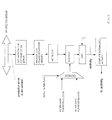
- the proposed algorithm provides an efficient alternative to the above-noted conventional method that has been used for calculating the activity, and in particular it carries out the calculation of the prediction error considered in the spatial frequency domain obtained by the discrete cosine transform (as showed in figure 3), instead of carrying it out on the macroblocks placed on the source picture.
- the method of the invention consists in carrying out a filtering of the DCT coefficients of each prediction error block by means of an appropriate frequency response mask. Afterwards the value of such response is averaged on the four blocks composing the luminance component of the DCT transformed macroblock to obtain the activity coefficient. It is not necessary to make any distinction on the frame or half-frame type of content because such a choice has been already done on the data before the dct transform.
- the method of the invention consists of the following steps:
- the variance formula is: which implies 65 multiplications and 126 sums per spective block.
- the new method of the invention is based on the calculation of the activity in the spatial frequency domain of the DCT and is applied to a number of coefficients per mask remarkably lower than 64, e.g. 15 and 20 for I blocks and P/B blocks, respectively.
Landscapes
- Engineering & Computer Science (AREA)
- Multimedia (AREA)
- Signal Processing (AREA)
- Compression Or Coding Systems Of Tv Signals (AREA)
- Compression, Expansion, Code Conversion, And Decoders (AREA)
Priority Applications (4)
| Application Number | Priority Date | Filing Date | Title |
|---|---|---|---|
| EP99830560A EP1083751B1 (fr) | 1999-09-08 | 1999-09-08 | Mesure de l'activité d'images vidéo dans le domaine DCT |
| DE69940506T DE69940506D1 (de) | 1999-09-08 | 1999-09-08 | Messung der Videobildaktivität im DCT-Bereich |
| US09/657,433 US6542643B1 (en) | 1999-09-08 | 2000-09-07 | Measurement of activity of video image by DCT and filtering of the prediction error coefficients |
| JP2000273887A JP3935667B2 (ja) | 1999-09-08 | 2000-09-08 | Dct及び予測エラー係数のフィルタリングによるビデオ画像の活動の測定 |
Applications Claiming Priority (1)
| Application Number | Priority Date | Filing Date | Title |
|---|---|---|---|
| EP99830560A EP1083751B1 (fr) | 1999-09-08 | 1999-09-08 | Mesure de l'activité d'images vidéo dans le domaine DCT |
Publications (2)
| Publication Number | Publication Date |
|---|---|
| EP1083751A1 true EP1083751A1 (fr) | 2001-03-14 |
| EP1083751B1 EP1083751B1 (fr) | 2009-03-04 |
Family
ID=8243575
Family Applications (1)
| Application Number | Title | Priority Date | Filing Date |
|---|---|---|---|
| EP99830560A Expired - Lifetime EP1083751B1 (fr) | 1999-09-08 | 1999-09-08 | Mesure de l'activité d'images vidéo dans le domaine DCT |
Country Status (4)
| Country | Link |
|---|---|
| US (1) | US6542643B1 (fr) |
| EP (1) | EP1083751B1 (fr) |
| JP (1) | JP3935667B2 (fr) |
| DE (1) | DE69940506D1 (fr) |
Cited By (2)
| Publication number | Priority date | Publication date | Assignee | Title |
|---|---|---|---|---|
| US20120170864A1 (en) * | 2010-12-30 | 2012-07-05 | STMicroelectronics (Shenzhen) R&D Co., Ltd. | Perceptual block masking estimation system |
| WO2015160803A3 (fr) * | 2014-04-15 | 2016-01-21 | Qualcomm Incorporated | Système et procédé permettant la détection de planéité pour une compression de flux d'affichage (dsc) |
Families Citing this family (2)
| Publication number | Priority date | Publication date | Assignee | Title |
|---|---|---|---|---|
| KR100755388B1 (ko) | 2006-01-13 | 2007-09-04 | 부산대학교 산학협력단 | 동영상 압축에서의 복원 오차 추정 방법 및 장치 |
| JP5363302B2 (ja) * | 2009-12-24 | 2013-12-11 | 株式会社メガチップス | 画像符号化装置及び画像変換装置 |
Citations (7)
| Publication number | Priority date | Publication date | Assignee | Title |
|---|---|---|---|---|
| EP0492528A2 (fr) * | 1990-12-27 | 1992-07-01 | Kabushiki Kaisha Toshiba | Appareil d'enregistrement et de reproduction |
| EP0586225A2 (fr) * | 1992-08-31 | 1994-03-09 | Victor Company Of Japan, Ltd. | Système de codage et décodage par transformation orthogonale |
| WO1996036182A1 (fr) * | 1995-05-08 | 1996-11-14 | Futuretel, Inc. | Codeur mpeg determinant de maniere concurrente le format et le controle de la cadence de codage de donnees video |
| EP0743793A2 (fr) * | 1995-05-19 | 1996-11-20 | Lg Electronics Inc. | Dispositif pour déterminer le numéro de quantification dans un codeur d'image |
| US5699457A (en) * | 1992-03-17 | 1997-12-16 | Zoran Corporation | Image compression coder having improved bit rate control and block allocation |
| US5742344A (en) * | 1991-05-31 | 1998-04-21 | Kabushiki Kaisha Toshiba | Motion compensated video decoding method and system for decoding a coded video signal using spatial and temporal filtering |
| EP0905981A1 (fr) * | 1997-03-12 | 1999-03-31 | Matsushita Electric Industrial Co., Ltd. | Procede et dispositif de codage du signal video |
Family Cites Families (2)
| Publication number | Priority date | Publication date | Assignee | Title |
|---|---|---|---|---|
| US6101276A (en) * | 1996-06-21 | 2000-08-08 | Compaq Computer Corporation | Method and apparatus for performing two pass quality video compression through pipelining and buffer management |
| US6026217A (en) * | 1996-06-21 | 2000-02-15 | Digital Equipment Corporation | Method and apparatus for eliminating the transpose buffer during a decomposed forward or inverse 2-dimensional discrete cosine transform through operand decomposition storage and retrieval |
-
1999
- 1999-09-08 DE DE69940506T patent/DE69940506D1/de not_active Expired - Lifetime
- 1999-09-08 EP EP99830560A patent/EP1083751B1/fr not_active Expired - Lifetime
-
2000
- 2000-09-07 US US09/657,433 patent/US6542643B1/en not_active Expired - Lifetime
- 2000-09-08 JP JP2000273887A patent/JP3935667B2/ja not_active Expired - Lifetime
Patent Citations (7)
| Publication number | Priority date | Publication date | Assignee | Title |
|---|---|---|---|---|
| EP0492528A2 (fr) * | 1990-12-27 | 1992-07-01 | Kabushiki Kaisha Toshiba | Appareil d'enregistrement et de reproduction |
| US5742344A (en) * | 1991-05-31 | 1998-04-21 | Kabushiki Kaisha Toshiba | Motion compensated video decoding method and system for decoding a coded video signal using spatial and temporal filtering |
| US5699457A (en) * | 1992-03-17 | 1997-12-16 | Zoran Corporation | Image compression coder having improved bit rate control and block allocation |
| EP0586225A2 (fr) * | 1992-08-31 | 1994-03-09 | Victor Company Of Japan, Ltd. | Système de codage et décodage par transformation orthogonale |
| WO1996036182A1 (fr) * | 1995-05-08 | 1996-11-14 | Futuretel, Inc. | Codeur mpeg determinant de maniere concurrente le format et le controle de la cadence de codage de donnees video |
| EP0743793A2 (fr) * | 1995-05-19 | 1996-11-20 | Lg Electronics Inc. | Dispositif pour déterminer le numéro de quantification dans un codeur d'image |
| EP0905981A1 (fr) * | 1997-03-12 | 1999-03-31 | Matsushita Electric Industrial Co., Ltd. | Procede et dispositif de codage du signal video |
Non-Patent Citations (1)
| Title |
|---|
| TAE-YUN CHUNG ET AL: "QUANTIZATION CONTROL FOR IMRPOVEMENT OF IMAGE QUALITY COMPATIBLE WITH MPEG2", IEEE TRANSACTIONS ON CONSUMER ELECTRONICS,US,IEEE INC. NEW YORK, vol. 40, no. 4, 1 November 1994 (1994-11-01), pages 821 - 825, XP000495820, ISSN: 0098-3063 * |
Cited By (6)
| Publication number | Priority date | Publication date | Assignee | Title |
|---|---|---|---|---|
| US20120170864A1 (en) * | 2010-12-30 | 2012-07-05 | STMicroelectronics (Shenzhen) R&D Co., Ltd. | Perceptual block masking estimation system |
| CN102567961A (zh) * | 2010-12-30 | 2012-07-11 | 意法半导体研发(深圳)有限公司 | 感知块屏蔽估算系统 |
| US8811766B2 (en) * | 2010-12-30 | 2014-08-19 | Stmicroelectronics Asia Pacific Pte. Ltd. | Perceptual block masking estimation system |
| CN102567961B (zh) * | 2010-12-30 | 2016-05-18 | 意法半导体研发(深圳)有限公司 | 感知块屏蔽估算系统 |
| WO2015160803A3 (fr) * | 2014-04-15 | 2016-01-21 | Qualcomm Incorporated | Système et procédé permettant la détection de planéité pour une compression de flux d'affichage (dsc) |
| US9930346B2 (en) | 2014-04-15 | 2018-03-27 | Qualcomm Incorporated | System and method for flatness detection for display stream compression (DSC) |
Also Published As
| Publication number | Publication date |
|---|---|
| EP1083751B1 (fr) | 2009-03-04 |
| US6542643B1 (en) | 2003-04-01 |
| JP3935667B2 (ja) | 2007-06-27 |
| JP2001119698A (ja) | 2001-04-27 |
| DE69940506D1 (de) | 2009-04-16 |
Similar Documents
| Publication | Publication Date | Title |
|---|---|---|
| US6236764B1 (en) | Image processing circuit and method for reducing a difference between pixel values across an image boundary | |
| US10171808B2 (en) | In-loop adaptive wiener filter for video coding and decoding | |
| US7630583B2 (en) | Circuit and method for decoding an encoded version of an image having a first resolution directly into a decoded version of the image having a second resolution | |
| US5438374A (en) | System and method for filtering video signals | |
| EP0811951B1 (fr) | Système et méthode d'estimation de mouvement dans le domaine DCT, à rendement amélioré | |
| US6687296B1 (en) | Apparatus and method for transforming picture information | |
| US6415055B1 (en) | Moving image encoding method and apparatus, and moving image decoding method and apparatus | |
| JPWO1999023834A1 (ja) | ディジタル信号変換方法およびディジタル信号変換装置 | |
| US6829373B2 (en) | Automatic setting of optimal search window dimensions for motion estimation | |
| WO2000002381A1 (fr) | Circuit de traitement d'images et procede de modification d'une valeur de pixel | |
| US7113646B2 (en) | Decoding of predicted AC coefficient without division | |
| US7068850B2 (en) | Decoding of predicted DC coefficient without division | |
| US6545727B1 (en) | Method for recognizing a progressive or an interlaced content in a video sequence | |
| EP1083751B1 (fr) | Mesure de l'activité d'images vidéo dans le domaine DCT | |
| US7095785B2 (en) | Determination of prediction direction in MPEG-4 | |
| KR100210124B1 (ko) | 영상복호화기의 데이터 디포맷팅 회로 |
Legal Events
| Date | Code | Title | Description |
|---|---|---|---|
| PUAI | Public reference made under article 153(3) epc to a published international application that has entered the european phase |
Free format text: ORIGINAL CODE: 0009012 |
|
| AK | Designated contracting states |
Kind code of ref document: A1 Designated state(s): DE FR GB IT |
|
| AX | Request for extension of the european patent |
Free format text: AL;LT;LV;MK;RO;SI |
|
| 17P | Request for examination filed |
Effective date: 20010807 |
|
| AKX | Designation fees paid |
Free format text: DE FR GB IT |
|
| 17Q | First examination report despatched |
Effective date: 20061020 |
|
| GRAP | Despatch of communication of intention to grant a patent |
Free format text: ORIGINAL CODE: EPIDOSNIGR1 |
|
| GRAS | Grant fee paid |
Free format text: ORIGINAL CODE: EPIDOSNIGR3 |
|
| GRAA | (expected) grant |
Free format text: ORIGINAL CODE: 0009210 |
|
| AK | Designated contracting states |
Kind code of ref document: B1 Designated state(s): DE FR GB IT |
|
| REG | Reference to a national code |
Ref country code: GB Ref legal event code: FG4D |
|
| REF | Corresponds to: |
Ref document number: 69940506 Country of ref document: DE Date of ref document: 20090416 Kind code of ref document: P |
|
| PLBE | No opposition filed within time limit |
Free format text: ORIGINAL CODE: 0009261 |
|
| STAA | Information on the status of an ep patent application or granted ep patent |
Free format text: STATUS: NO OPPOSITION FILED WITHIN TIME LIMIT |
|
| 26N | No opposition filed |
Effective date: 20091207 |
|
| REG | Reference to a national code |
Ref country code: FR Ref legal event code: PLFP Year of fee payment: 18 |
|
| REG | Reference to a national code |
Ref country code: FR Ref legal event code: PLFP Year of fee payment: 19 |
|
| REG | Reference to a national code |
Ref country code: FR Ref legal event code: PLFP Year of fee payment: 20 |
|
| PGFP | Annual fee paid to national office [announced via postgrant information from national office to epo] |
Ref country code: DE Payment date: 20180821 Year of fee payment: 20 Ref country code: IT Payment date: 20180828 Year of fee payment: 20 Ref country code: FR Payment date: 20180822 Year of fee payment: 20 |
|
| PGFP | Annual fee paid to national office [announced via postgrant information from national office to epo] |
Ref country code: GB Payment date: 20180823 Year of fee payment: 20 |
|
| REG | Reference to a national code |
Ref country code: DE Ref legal event code: R071 Ref document number: 69940506 Country of ref document: DE |
|
| REG | Reference to a national code |
Ref country code: GB Ref legal event code: PE20 Expiry date: 20190907 |
|
| PG25 | Lapsed in a contracting state [announced via postgrant information from national office to epo] |
Ref country code: GB Free format text: LAPSE BECAUSE OF EXPIRATION OF PROTECTION Effective date: 20190907 |