EP1084484B1 - Procede de gestion a distance par carte a puce - Google Patents
Procede de gestion a distance par carte a puce Download PDFInfo
- Publication number
- EP1084484B1 EP1084484B1 EP99923716A EP99923716A EP1084484B1 EP 1084484 B1 EP1084484 B1 EP 1084484B1 EP 99923716 A EP99923716 A EP 99923716A EP 99923716 A EP99923716 A EP 99923716A EP 1084484 B1 EP1084484 B1 EP 1084484B1
- Authority
- EP
- European Patent Office
- Prior art keywords
- session
- card
- service
- site
- smart card
- Prior art date
- Legal status (The legal status is an assumption and is not a legal conclusion. Google has not performed a legal analysis and makes no representation as to the accuracy of the status listed.)
- Expired - Lifetime
Links
Images


Classifications
-
- G—PHYSICS
- G07—CHECKING-DEVICES
- G07F—COIN-FREED OR LIKE APPARATUS
- G07F7/00—Mechanisms actuated by objects other than coins to free or to actuate vending, hiring, coin or paper currency dispensing or refunding apparatus
- G07F7/08—Mechanisms actuated by objects other than coins to free or to actuate vending, hiring, coin or paper currency dispensing or refunding apparatus by coded identity card or credit card or other personal identification means
-
- G—PHYSICS
- G06—COMPUTING OR CALCULATING; COUNTING
- G06Q—INFORMATION AND COMMUNICATION TECHNOLOGY [ICT] SPECIALLY ADAPTED FOR ADMINISTRATIVE, COMMERCIAL, FINANCIAL, MANAGERIAL OR SUPERVISORY PURPOSES; SYSTEMS OR METHODS SPECIALLY ADAPTED FOR ADMINISTRATIVE, COMMERCIAL, FINANCIAL, MANAGERIAL OR SUPERVISORY PURPOSES, NOT OTHERWISE PROVIDED FOR
- G06Q20/00—Payment architectures, schemes or protocols
- G06Q20/04—Payment circuits
- G06Q20/06—Private payment circuits, e.g. involving electronic currency used among participants of a common payment scheme
- G06Q20/065—Private payment circuits, e.g. involving electronic currency used among participants of a common payment scheme using e-cash
- G06Q20/0652—Private payment circuits, e.g. involving electronic currency used among participants of a common payment scheme using e-cash e-cash with decreasing value according to a parameter, e.g. time
-
- G—PHYSICS
- G06—COMPUTING OR CALCULATING; COUNTING
- G06Q—INFORMATION AND COMMUNICATION TECHNOLOGY [ICT] SPECIALLY ADAPTED FOR ADMINISTRATIVE, COMMERCIAL, FINANCIAL, MANAGERIAL OR SUPERVISORY PURPOSES; SYSTEMS OR METHODS SPECIALLY ADAPTED FOR ADMINISTRATIVE, COMMERCIAL, FINANCIAL, MANAGERIAL OR SUPERVISORY PURPOSES, NOT OTHERWISE PROVIDED FOR
- G06Q30/00—Commerce
- G06Q30/04—Billing or invoicing
Definitions
- the present invention relates to a remote management method by smart card. It can be used by both private users and by industrial users. Its purpose is to organize and simplify the remote management of services, in particular the management of services on the Internet network.
- the problem to be solved is that of payment for the service by users.
- the management of such payments is confronted with difficulties linked the virtual nature of the services available on the Internet, and the multitude various accesses.
- the object of the invention will be in this area to achieve a reasonable payment for the service if not rigorous.
- the management should be simplified as much as possible in order to limit interventions administrative for operations which, economically, have not otherwise not much yield.
- the object of the invention is to remedy these drawbacks by proposing a method of management by smart card.
- the principle of the invention consists in after a first reading of a smart card to authorize access to the service for a first session. Then the amount of service consumed during this first session is measured. Then at least when the user comes for a second session to consume the same service or an equivalent service, we count in his card (or in a file of the system corresponding to his card) prepaid units corresponding to the service consumed during the first session. So on for each session next. There are therefore two clearly separated accesses in time, two smart card readings, to take into account the start of the measurement on the one hand, and payment on the other.
- the method according to the invention comprises a double reading of the same smart card with prepaid units to take into account only one consumption session.
- the consumption of a service on Intemet is particular in that only one access terminal (at the entrance and exit of the service) is provided to read the smart card. In this case, each introduction of the card will alternately correspond to the entry mode and the exit mode.
- the terminal can be in practice the keyboard of a computer can be used to connect to the Internet and which has a side smart card reader. Any other peripheral circuit, internal or external to microcomputer, and playing this role is however usable.
- consumption can basically be proportional to the connection time. But any other means of measurement, such as a number of documents viewed or a number of bytes transmitted, is also possible.
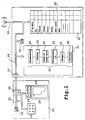
- a smart card 14 preferably comprises a microprocessor 20 connected by a data, address and command bus 21 to a card connector chip 22, to a memory 23 to hold data 24 and a program 25, and to a memory 26 of prepaid units.
- the connector 22 comes into contact with a connector 27 of a reader chip card recorder 14 present in a reading terminal in relation with a microcomputer which presents the Internal session to the user. If necessary, the terminal has a slot in the keyboard of this microcomputer.
- the connector 27 is connected by a bus 28 of the same type as the bus 21 to a microprocessor 29.
- the microprocessor 29 executes a program 30 contained in a memory program 31 and stores messages in a data memory 32 of the terminal.
- the messages are intended to measure consumption of services by the smart card holder.
- Messages can by elsewhere be transmitted by a modem, not shown, towards a center of remote management.
- the modem is connected to the remote management center by a cable or by an antenna 33.
- the connection is periodic, for example daily.
- the link can be a wired telephone line type link.
- circuits 27-32 are in fact contained in a data server of the service provider who makes their services available on a site of the Internet network. Via the microcomputer in session on this site, and from connector 27, this server can intervene or involve in the smart card to cancel units. Therefore, the microprocessor 29, memory 31 and memory 32 can be in a first microcomputer available to the smart card holder 14, in a second microcomputer that serves as a server for an Internet site visited by the smart card holder, or preferably in a third microcomputer serving as the remote management center for this visited website.
- the program 30 includes a first instruction 34 executed during first access to the Internet service.
- the user then introduces his card to chip in the player and this one causes, during the Internet session managed, recognition of the smart card.
- the smart card can itself make a reader recognition.
- Recognition protocols of this type are known, with or without the composition of a secret code.
- the composition of this secret code plays a role of authorization of access to the service, in particular in the event that this secret code has been communicated to the user by the service provider.
- the user can also be asked to select by keyboard keys the nature of the services he intends to use, or indicate other useful information. As a variant, this selection will be made at the end of use. Once the recognition operations have been carried out, access to the service is opened during an operation 36.
- the quantity of services consumed is measured.
- this measure can be flat-rate, subjective, by taking into account account of a unit of passage, or objective.
- the second reading according to the invention is preferably before the start of a next session.
- the second reading of the smart card could locate during the same session if the operator has not removed his smart card in the meantime.
- the count 40 the message resulting from consumption, will include an order addressed to card 14 for obliterate one or more memory units 26.
- the counting would not be a lump sum but proportional, the number of units 26 to be obliterated is proportional to the measured quantity of the services consumed.
- the count is fixed, it will be made by reading a table 42 present in memory 32. Table 42 provides information in advance, due to a prior contract, on the number of units to be deducted each time a recognized user presents himself. This user's units can be recorded in his card or in memory 32. In this case the memory 32 will establish an account of the remaining prepaid units.
- the message will not be saved to the smart card 14 (by obliteration of memory 26), but will be saved in memory 32.
- This will collect the following information relating to each user: serial number, user name, user address, municipality, nature of the services consumed, current date, and so on. The units counted, if any, relate to this information collected. Therefore, it will be possible to keep a file and manage situations as diverse as proportional type subscriptions intended for manufacturers, or free subscriptions reserved for privileged users.
- the message recorded in the smart card in the frame Internet will be a basic message: it will consist of obliterating units prepaid already consumed previously. This cancellation will be prior to, and will constitute the condition of, a consumption session next. Rather than counting the units in the card, we can nevertheless record them in a system file.
- the memory 32 can be managed by, or contained in a central system 100 linked, for example via the Internet 101, to site 102.
- the central system 100 manages a database contained in memory 32.
- a user has a smart card 103 which can be inserted into a reader 104.
- the smart card 103 has information in a memory AAA identification.
- This Internet connection assigns an address 105 to reader 104.
- This address 105 is a virtual address, for example it is an address of IP (Internet Protocol) type. It provides reader 104 with a door transmission over the Internet 101.
- This address 105 is an address session. In fact, each time you connect to the Internet 101, a service provider assigns a new session-specific address which has just been opened. Then, for example, the user chooses to connect to site 102. Site 102 also has an address 106, which being a site is permanent.
- the Internet 101 makes communication information between addresses 105 and 106 via one or more routes.
- Site 102 is controlled access.
- site 102 launches a recognition protocol 107, FIG. 3.
- This recognition protocol 107 includes several identifications.
- protocol 107 provides for a step of identifying the smart card 103.
- the AAA identification information of the card 103 is then transmitted to site 102.
- This AAA identification information can be replaced by a serial number carried by the card 103.
- the step identification may possibly include entering a linked password to this card 103 and or to the site 102.
- the card 103 is preferably a card with prepaid units.
- protocol 107 proceeds to recognize the address 105 session virtual.
- the protocol eventually proceeds to the acquisition from a date t0 on which the reader 104 connected to the site 102.
- the process for managing this site 102 provides a logical sequence of questions allowing real access to services provided by this site 102.
- the site 102 queries the central system 100 to find out whether a user, for through card 103 (reference AAA), has already accessed the site 102. If card 103 is new and has never been used for access to the site 102, then we create a record 109 in memory 32 in filling in a first zone of this record by AAA identification of the card 103. Furthermore, in this record 109, a second field by session address 105, and preferably a third zone by the date t0 of the start of connection of the reader 104 to the site 102.
- This recording of recording 109 one can also take information N from the balance of units from the card available in this map, and enter it in a fourth area of record 109, and zero a fifth area of this record 109.
- This fifth zone corresponds to a zone of incremental accounting of the services consumed during a session, and quantified in the form of X consumption units.
- the validity of the access can be checked by a second question 110 optional.
- This validity can take the form of a evaluation of the balance of the N units available in card 103 and of a comparison of this balance with a minimum balance.
- the user consumes services. In practice, this consumption corresponds to transmissions to the reader 104 of stored digital images and or sounds in the site 102 and which the user designates with a keyboard of the reader 104.
- This consumption leads to an increment, in the fifth zone of record 109, of the number of units consumed during the session, in proportion to the services transmitted.
- the user disconnects from the site and or from the Internet.
- the smart card 103 includes then a balance N, while consumption X has been achieved. These consumption X are kept in the fifth zone of the recording 109 stored in memory 32.
- a another session address 111 is assigned to the same smart card 103.
- this card 103 is recognized at the question 108 as having already allowed access to site 102.
- a record 109 of memory 32 already contains information, AAA, 105, t0, and N, and especially information on the consumptions X carried out during the previous access.
- the management method according to the invention provides for a third question 112.
- the purpose of question 112 is to compare session address 105, given during the previous access and stored in record 109, with session address 111 recognized during the recognition protocol 107 launched by the second connection to site 102. This way of doing things has the advantage of consider as performed in a single session every consumption corresponding to a single session address (105) and therefore authorizes intermediate visits to sites other than site 102 during this first session.
- a first answer is that the session address 105 is the same as that contained in record 109, because two successive consumptions are produced during this same session 105. In this case, the validity of access is possibly checked again by the second question 110, and then opens on a possibility of consumption. In this case second question 110 can be used to verify that the consumptions X already made during the session started are less than the balance N.
- a second possible answer to question 112 is that the address 111 is different from the 105 in the recording 109.
- This second response means that a user has logged in first time, then a second time at Intemet with this card 103.
- the site management method 102 provides, according to the invention, to perform the actual obliteration of X units contained in card 103. This cancellation corresponds to the payment due following the consumptions made during the first session, with address 105.
- a session on site 102 therefore corresponds to the duration for which successive consumptions, without payment, were made.
- a session is therefore linked to a given session address, 105 or 111.
- a session can nevertheless be defined in another way, according to the criteria of acceptance tested in the second question 110. Indeed, since the payment for the services takes place only at a following connection on the site 102, it possibly be able to prevent situations in which a user would remain connected indefinitely on the Internet and on the site 102, situation in which a user would keep an same session address.
- the validity of access can result management of the maximum connection time on site 102, or management of the maximum quantity of services that can be taken from the site 102 during a session, or even when the site is disconnected from a certain frequency, for example every day.
- the maximum duration of connection to site 102 for example an hour, is accessible by that, in the third zone, we took care to memorize the date t0 of the start of the connection to the site.
- the management of the maximum quantity can be fixed at balance, i.e. N-X units at the start of the second session.
- the amount maximum can also be fixed and be lower or higher than the N-X balance. In the latter case, an overdraft is eventually authorized.
- the validity of the access can be evaluated with each new consumption. Indeed, the database 100 records as and measures the consumption of the current session.
- the parameters of the second question 110 can be modified and are chosen by the owner of the site 102. For example, we can authorize consumption exceeding the purchasing power conferred by the card 103 within a certain limit. In the event that overdrafts are tolerated, of a subsequent connection, the card 103 would then not contain enough units to be able to pay for the consumption of the previous session. In this case, the site 102 or another operator can offer to recharge the card 103 so that this card 103 can allow again to access the site 102. To favor this card recharge system 102, provision can be made for an improvement in recharging. This bonus can be greater than an average consumption overrun at the end of validity from card 103.
- the same prepaid card 103 can give access to several separate sites 102, 114, 115 all capable of managing or having managed the memory 32 of the central system 100. These separate sites thus manage information concerning the smart card 103 in the same database data. Thus, a consumption made on a site 102 during a session 105 may be debited at a later session 111 from connection with one of the other sites 114, or 115.
- the distributions of units consumed, and the compensation for provision of service by each of the managers of sites 102, 114 and 115 can be organized as follows. Either an arbitrary contract defines quotas. Either these quotas are evaluated with indicators frequentation provided by each of the sites Or these indicators of frequency are stored in memory 32 which can identify sites origins of consumption.
- a sixth area of record 109 includes, next to consumption information X, the references (102) of the site through which the services were provided to a previous session. Along with the fourth pay area is update, and or that the fifth consumption zone is reset to zero, the X units consumed are added to another table (by example also in memory 32) to a total of units consumed on site 102.
- site 114 can for example be the accountant for the site 102 of the services that the latter had previously provided.
Landscapes
- Business, Economics & Management (AREA)
- Physics & Mathematics (AREA)
- General Physics & Mathematics (AREA)
- Accounting & Taxation (AREA)
- General Business, Economics & Management (AREA)
- Strategic Management (AREA)
- Finance (AREA)
- Engineering & Computer Science (AREA)
- Theoretical Computer Science (AREA)
- Development Economics (AREA)
- Economics (AREA)
- Marketing (AREA)
- Financial Or Insurance-Related Operations Such As Payment And Settlement (AREA)
- Computer And Data Communications (AREA)
- Control Of Vending Devices And Auxiliary Devices For Vending Devices (AREA)
Abstract
Description
- au début d'une session de consommation, un utilisateur introduit une carte à puce munie d'unités prépayées qu'il détient et contenues dans la carte ou dans un fichier du système correspondant à la carte dans une borne en relation avec le système et qui gère l'accès au service,
- la borne lit la carte à puce, puis autorise un accès au service,
- le système mesure la consommation de service de la session et produit et mémorise un message relatif à cette mesure,
- au cours d'une lecture suivante de la même carte à puce le système enregistre ce message dans un fichier en relation avec la carte à puce,
- la lecture suivante de la même carte à puce se produit préalablement au début d'une deuxième session de consommation du service, et en ce que le message est un message de décompte d'unités prépayées disponibles contenues dans la carte à puce ou dans un fichier du système correspondant à la carte.
Claims (3)
- Procédé de gestion à distance de la délivrance d'un service disponible sur le réseau Internet par un système comportant dans l'ordre les étapes suivantes:caractérisé en ce queau début d'une session de consommation, un utilisateur introduit une carte (14) à puce munie d'unités prépayées qu'il détient et contenues dans la carte ou dans un fichier du système correspondant à la carte dans une borne en relation avec le système et qui gère l'accès au service,la borne lit la carte à puce, puis autorise un accès au service,le système mesure la consommation de service de la session et produit et mémorise (32) un message relatif à cette mesure,au cours d'une lecture suivante de la même carte à puce le système enregistre ce message dans un fichier (26) en relation avec la carte à puce,la lecture suivante de la même carte à puce se produit préalablement au début d'une deuxième session de consommation de service, et en ce que le message est un message de décompte d'unités prépayées disponibles contenues dans la carte ou dans un fichier du système correspondant à la carte.
- Procédé selon la revendication 1 caractérisé en ce que la deuxième session de consommation concerne d'un service différent de celui consommé à la session de consommation précédente.
- Procédé selon l'une des revendications 1 à 2 caractérisé en ce qu'on fixe une limite de consommation pour chaque session de consommation de services.
Applications Claiming Priority (3)
| Application Number | Priority Date | Filing Date | Title |
|---|---|---|---|
| FR9807272 | 1998-06-10 | ||
| FR9807272A FR2779856B1 (fr) | 1998-06-10 | 1998-06-10 | Procede de gestion a distance par carte a puce |
| PCT/FR1999/001377 WO1999064994A1 (fr) | 1998-06-10 | 1999-06-10 | Procede de gestion a distance par carte a puce |
Publications (2)
| Publication Number | Publication Date |
|---|---|
| EP1084484A1 EP1084484A1 (fr) | 2001-03-21 |
| EP1084484B1 true EP1084484B1 (fr) | 2002-04-03 |
Family
ID=9527209
Family Applications (1)
| Application Number | Title | Priority Date | Filing Date |
|---|---|---|---|
| EP99923716A Expired - Lifetime EP1084484B1 (fr) | 1998-06-10 | 1999-06-10 | Procede de gestion a distance par carte a puce |
Country Status (5)
| Country | Link |
|---|---|
| EP (1) | EP1084484B1 (fr) |
| AU (1) | AU4048899A (fr) |
| DE (1) | DE69901181D1 (fr) |
| FR (1) | FR2779856B1 (fr) |
| WO (1) | WO1999064994A1 (fr) |
Families Citing this family (1)
| Publication number | Priority date | Publication date | Assignee | Title |
|---|---|---|---|---|
| FR2819130B1 (fr) * | 2000-12-29 | 2003-03-21 | Euro 3 Wssa | Procede pour restreintre au profit d'utilisateurs autorises, l'acces a des ressources appartenant a des services interactifs d'au moins un bouquet de services |
Family Cites Families (5)
| Publication number | Priority date | Publication date | Assignee | Title |
|---|---|---|---|---|
| CA2109490C (fr) * | 1992-10-30 | 2003-09-09 | Mihoji Tsumura | Systeme de facturation pour les radiocommunications |
| US5629980A (en) * | 1994-11-23 | 1997-05-13 | Xerox Corporation | System for controlling the distribution and use of digital works |
| US5577100A (en) * | 1995-01-30 | 1996-11-19 | Telemac Cellular Corporation | Mobile phone with internal accounting |
| US6141652A (en) * | 1995-10-10 | 2000-10-31 | British Telecommunications Public Limited Company | Operating apparatus |
| JPH1049584A (ja) * | 1996-08-05 | 1998-02-20 | Canon Inc | 課金システムおよびその方法 |
-
1998
- 1998-06-10 FR FR9807272A patent/FR2779856B1/fr not_active Expired - Fee Related
-
1999
- 1999-06-10 WO PCT/FR1999/001377 patent/WO1999064994A1/fr not_active Ceased
- 1999-06-10 DE DE69901181T patent/DE69901181D1/de not_active Expired - Lifetime
- 1999-06-10 AU AU40488/99A patent/AU4048899A/en not_active Abandoned
- 1999-06-10 EP EP99923716A patent/EP1084484B1/fr not_active Expired - Lifetime
Also Published As
| Publication number | Publication date |
|---|---|
| FR2779856B1 (fr) | 2000-08-11 |
| WO1999064994A1 (fr) | 1999-12-16 |
| FR2779856A1 (fr) | 1999-12-17 |
| DE69901181D1 (de) | 2002-05-08 |
| EP1084484A1 (fr) | 2001-03-21 |
| AU4048899A (en) | 1999-12-30 |
Similar Documents
| Publication | Publication Date | Title |
|---|---|---|
| EP1153376B1 (fr) | Procede de telepaiement et systeme pour la mise en oeuvre de ce procede | |
| EP1179271B1 (fr) | Terminal radiotelephonique avec une carte a puce dotee d'un navigateur | |
| EP1161747B1 (fr) | Procede de gestion de stationnement de vehicules | |
| JP2001357312A5 (fr) | ||
| JP4304162B2 (ja) | 決済方法及び決済中継サーバ | |
| CA2261830A1 (fr) | Systeme de controle et de gestion de services | |
| WO2008063028A1 (fr) | Système et méthode d'établissement d'un service personnalisé de site de portail sécurisé utilisant un dispositif à carte à puce intégrée | |
| JP5283604B2 (ja) | ゲームシステム | |
| EP1084484B1 (fr) | Procede de gestion a distance par carte a puce | |
| EP1391078A1 (fr) | Procede et systeme de traitement de donnees pour le chronometrage de la duree d'une session | |
| EP1012797B1 (fr) | Carte a circuit integre avec compteur de gratification et procede de comptage de gratifications | |
| KR100748274B1 (ko) | 고객 포인트 통합 관리 시스템 및 방법 | |
| JP2003288274A (ja) | デジタルコンテンツのレンタル管理方法およびレンタル管理システム | |
| FR2869702A1 (fr) | Procedure d'acces a un service pre ou post-paye avec authentification d'un compte utilisateur et gestion dudit compte | |
| JP4126232B2 (ja) | 通信システム、認証方法及び登録装置 | |
| EP0481880B1 (fr) | Procédé de télésurveillance à gestion simplifiée | |
| FR2850824A1 (fr) | Procede de commande et de conversion de contenu et systeme d'utilisation de contenu | |
| JP5807003B2 (ja) | ゲームシステム | |
| JP3621049B2 (ja) | バーチャル墓地サーバおよびプログラム | |
| FR2980893A1 (fr) | Procede et systeme de signalisation de consommations realisees, et installation de location automatisee de vehicules mettant en oeuvre un tel procede et/ou un tel systeme. | |
| EP1452028B1 (fr) | Procede de gestion de fourniture d'acces a un contenu crypte destine a etre diffuse sur un reseau, ainsi que systeme et serveur pour la mise en oeuvre de ce procede | |
| KR20020038307A (ko) | 인터넷 경마 중계 및 배팅 시스템과 그의 운영 방법 | |
| CA2259528A1 (fr) | Procede de controle de l'utilisation d'un messageur, messageur fonctionnant selon ce procede et carte a puce pour l'acces conditionne a un messageur | |
| KR20050048418A (ko) | 온라인 게임 아이템의 대여 상거래 방법 | |
| JP2002304479A (ja) | 情報流通促進システム |
Legal Events
| Date | Code | Title | Description |
|---|---|---|---|
| PUAI | Public reference made under article 153(3) epc to a published international application that has entered the european phase |
Free format text: ORIGINAL CODE: 0009012 |
|
| 17P | Request for examination filed |
Effective date: 20010110 |
|
| AK | Designated contracting states |
Kind code of ref document: A1 Designated state(s): BE CH DE ES FI FR GB IT LI NL SE |
|
| GRAG | Despatch of communication of intention to grant |
Free format text: ORIGINAL CODE: EPIDOS AGRA |
|
| 17Q | First examination report despatched |
Effective date: 20010718 |
|
| GRAG | Despatch of communication of intention to grant |
Free format text: ORIGINAL CODE: EPIDOS AGRA |
|
| GRAH | Despatch of communication of intention to grant a patent |
Free format text: ORIGINAL CODE: EPIDOS IGRA |
|
| GRAH | Despatch of communication of intention to grant a patent |
Free format text: ORIGINAL CODE: EPIDOS IGRA |
|
| REG | Reference to a national code |
Ref country code: GB Ref legal event code: IF02 |
|
| GRAA | (expected) grant |
Free format text: ORIGINAL CODE: 0009210 |
|
| AK | Designated contracting states |
Kind code of ref document: B1 Designated state(s): BE CH DE ES FI FR GB IT LI NL SE |
|
| PG25 | Lapsed in a contracting state [announced via postgrant information from national office to epo] |
Ref country code: NL Free format text: LAPSE BECAUSE OF FAILURE TO SUBMIT A TRANSLATION OF THE DESCRIPTION OR TO PAY THE FEE WITHIN THE PRESCRIBED TIME-LIMIT Effective date: 20020403 Ref country code: IT Free format text: LAPSE BECAUSE OF FAILURE TO SUBMIT A TRANSLATION OF THE DESCRIPTION OR TO PAY THE FEE WITHIN THE PRESCRIBED TIME-LIMIT;WARNING: LAPSES OF ITALIAN PATENTS WITH EFFECTIVE DATE BEFORE 2007 MAY HAVE OCCURRED AT ANY TIME BEFORE 2007. THE CORRECT EFFECTIVE DATE MAY BE DIFFERENT FROM THE ONE RECORDED. Effective date: 20020403 Ref country code: FI Free format text: LAPSE BECAUSE OF FAILURE TO SUBMIT A TRANSLATION OF THE DESCRIPTION OR TO PAY THE FEE WITHIN THE PRESCRIBED TIME-LIMIT Effective date: 20020403 |
|
| REG | Reference to a national code |
Ref country code: CH Ref legal event code: EP |
|
| REF | Corresponds to: |
Ref document number: 69901181 Country of ref document: DE Date of ref document: 20020508 |
|
| PG25 | Lapsed in a contracting state [announced via postgrant information from national office to epo] |
Ref country code: SE Free format text: LAPSE BECAUSE OF FAILURE TO SUBMIT A TRANSLATION OF THE DESCRIPTION OR TO PAY THE FEE WITHIN THE PRESCRIBED TIME-LIMIT Effective date: 20020703 |
|
| PG25 | Lapsed in a contracting state [announced via postgrant information from national office to epo] |
Ref country code: DE Free format text: LAPSE BECAUSE OF FAILURE TO SUBMIT A TRANSLATION OF THE DESCRIPTION OR TO PAY THE FEE WITHIN THE PRESCRIBED TIME-LIMIT Effective date: 20020704 |
|
| NLV1 | Nl: lapsed or annulled due to failure to fulfill the requirements of art. 29p and 29m of the patents act | ||
| PG25 | Lapsed in a contracting state [announced via postgrant information from national office to epo] |
Ref country code: ES Free format text: LAPSE BECAUSE OF FAILURE TO SUBMIT A TRANSLATION OF THE DESCRIPTION OR TO PAY THE FEE WITHIN THE PRESCRIBED TIME-LIMIT Effective date: 20021030 |
|
| GBT | Gb: translation of ep patent filed (gb section 77(6)(a)/1977) |
Effective date: 20021010 |
|
| PLBE | No opposition filed within time limit |
Free format text: ORIGINAL CODE: 0009261 |
|
| STAA | Information on the status of an ep patent application or granted ep patent |
Free format text: STATUS: NO OPPOSITION FILED WITHIN TIME LIMIT |
|
| 26N | No opposition filed |
Effective date: 20030106 |
|
| PG25 | Lapsed in a contracting state [announced via postgrant information from national office to epo] |
Ref country code: LI Free format text: LAPSE BECAUSE OF NON-PAYMENT OF DUE FEES Effective date: 20030630 Ref country code: CH Free format text: LAPSE BECAUSE OF NON-PAYMENT OF DUE FEES Effective date: 20030630 |
|
| REG | Reference to a national code |
Ref country code: CH Ref legal event code: PL |
|
| PGFP | Annual fee paid to national office [announced via postgrant information from national office to epo] |
Ref country code: BE Payment date: 20120625 Year of fee payment: 14 |
|
| BERE | Be: lapsed |
Owner name: *SCHILTZ PATRICK Effective date: 20130630 |
|
| PG25 | Lapsed in a contracting state [announced via postgrant information from national office to epo] |
Ref country code: BE Free format text: LAPSE BECAUSE OF NON-PAYMENT OF DUE FEES Effective date: 20130630 |
|
| REG | Reference to a national code |
Ref country code: FR Ref legal event code: PLFP Year of fee payment: 18 |
|
| PGFP | Annual fee paid to national office [announced via postgrant information from national office to epo] |
Ref country code: GB Payment date: 20160627 Year of fee payment: 18 |
|
| PGFP | Annual fee paid to national office [announced via postgrant information from national office to epo] |
Ref country code: FR Payment date: 20160629 Year of fee payment: 18 |
|
| GBPC | Gb: european patent ceased through non-payment of renewal fee |
Effective date: 20170610 |
|
| REG | Reference to a national code |
Ref country code: FR Ref legal event code: ST Effective date: 20180228 |
|
| PG25 | Lapsed in a contracting state [announced via postgrant information from national office to epo] |
Ref country code: GB Free format text: LAPSE BECAUSE OF NON-PAYMENT OF DUE FEES Effective date: 20170610 |
|
| PG25 | Lapsed in a contracting state [announced via postgrant information from national office to epo] |
Ref country code: FR Free format text: LAPSE BECAUSE OF NON-PAYMENT OF DUE FEES Effective date: 20170630 |