EP1084754A2 - Zentrifugentrommel mit Abschnitten unterschiedlicher Neigung - Google Patents
Zentrifugentrommel mit Abschnitten unterschiedlicher Neigung Download PDFInfo
- Publication number
- EP1084754A2 EP1084754A2 EP00307037A EP00307037A EP1084754A2 EP 1084754 A2 EP1084754 A2 EP 1084754A2 EP 00307037 A EP00307037 A EP 00307037A EP 00307037 A EP00307037 A EP 00307037A EP 1084754 A2 EP1084754 A2 EP 1084754A2
- Authority
- EP
- European Patent Office
- Prior art keywords
- basket
- solids
- angle
- centrifuge
- stage
- Prior art date
- Legal status (The legal status is an assumption and is not a legal conclusion. Google has not performed a legal analysis and makes no representation as to the accuracy of the status listed.)
- Withdrawn
Links
Images


Classifications
-
- B—PERFORMING OPERATIONS; TRANSPORTING
- B04—CENTRIFUGAL APPARATUS OR MACHINES FOR CARRYING-OUT PHYSICAL OR CHEMICAL PROCESSES
- B04B—CENTRIFUGES
- B04B7/00—Elements of centrifuges
- B04B7/08—Rotary bowls
- B04B7/18—Rotary bowls formed or coated with sieving or filtering elements
-
- B—PERFORMING OPERATIONS; TRANSPORTING
- B04—CENTRIFUGAL APPARATUS OR MACHINES FOR CARRYING-OUT PHYSICAL OR CHEMICAL PROCESSES
- B04B—CENTRIFUGES
- B04B11/00—Feeding, charging, or discharging bowls
- B04B11/04—Periodical feeding or discharging; Control arrangements therefor
- B04B11/043—Load indication with or without control arrangements
-
- B—PERFORMING OPERATIONS; TRANSPORTING
- B04—CENTRIFUGAL APPARATUS OR MACHINES FOR CARRYING-OUT PHYSICAL OR CHEMICAL PROCESSES
- B04B—CENTRIFUGES
- B04B13/00—Control arrangements specially designed for centrifuges; Program control of centrifuges
-
- B—PERFORMING OPERATIONS; TRANSPORTING
- B04—CENTRIFUGAL APPARATUS OR MACHINES FOR CARRYING-OUT PHYSICAL OR CHEMICAL PROCESSES
- B04B—CENTRIFUGES
- B04B15/00—Other accessories for centrifuges
- B04B15/12—Other accessories for centrifuges for drying or washing the separated solid particles
-
- B—PERFORMING OPERATIONS; TRANSPORTING
- B04—CENTRIFUGAL APPARATUS OR MACHINES FOR CARRYING-OUT PHYSICAL OR CHEMICAL PROCESSES
- B04B—CENTRIFUGES
- B04B3/00—Centrifuges with rotary bowls in which solid particles or bodies become separated by centrifugal force and simultaneous sifting or filtering
Definitions
- the present invention relates to continuous centrifuges of the type comprising a rotating perforated drum or basket (hereinafter referred to as a "basket”), along whose inner peripheral wall a liquids/solids mix is caused to travel, with solids being discharged over the mouth of the rotating basket and liquids being collected via the basket perforations.
- a rotating perforated drum or basket hereinafter referred to as a "basket”
- the separation of crystalline materials from liquid may be made in a tapered, rotating and perforated basket.
- the basket is conical with the straight sides subtending an angle in the range of 22° to 36° to separate sugar crystals - with angles larger or smaller used on some other products.
- the conical basket is usually of single angle throughout its length, although it is also known for the basket to have regions of two different basket angles.
- US-A-379953 describes a centrifuge basket having two portions of different inclination so selected that they are greater than the greatest angle of slide of the solid phase that is to be separated by the centrifuge.
- W095/21697 describes a centrifuge basket having two portions of different inclination corresponding respectively to a lower zone providing drainage and filtration and an upper zone providing drainage only.
- Fig. 1 of the accompanying drawings shows a typical state of the art continuous centrifuge.
- the basket (1) is perforated (2) and lined with a screen (3) perforated with fine slots, the slot width being less than the minimum crystal dimension.
- the basket rotates about a vertical axis (4) driven by a motor (5) and belts (6).
- the massecuite (a mixture of crystals and mother liquid) (7) flows through a control valve mounted near the axis (4) into a feeding pot (9).
- the function of the pot is (a) to accelerate the massecuite to the rotational speed of the smaller diameter (10) of the basket and (b) to distribute the massecuite evenly around the periphery of the basket smaller diameter portion (10).
- the solids remain suspended in the liquid until deposited on screen (3) for separation to commence.
- the angle (11) of the basket is such that the massecuite and crystals migrate up the basket wall, the mother liquid flowing progressively through the slots in the screen (3) and basket perforations (2) as it is subjected to the increasing centrifugal force of rotation.
- the crystals remain on the slotted screen and slide to the largest diameter of the basket to be discharged over the lip (12).
- the outer casing (13) of the centrifuge and baffles (14) guide the separated liquid and crystals to outlets (15) and (16), respectively.
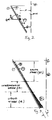
- Fig. 2 of the accompanying drawings shows, in an elementary way and omitting the effects of gravity, the frictional and rotational forces on a typical isolated crystal on the perforated screen (3).
- the isolated crystal (17) of unit mass is at radius r in conical basket (1) of angle ⁇ and rotation w.
- the centrifugal force G applied to the crystal is resolved into force x pushing the crystal up the basket and force y normal to the basket wall.
- the frictional force F between the crystal and basket wall that resists the movement of the crystal is ⁇ . y, where ⁇ is the coefficient of friction. From the geometry of Fig. 2, for the crystal to move to discharge, x must be greater than ⁇ .y. For an acceptable residence time then, tan ⁇ must be slightly greater than ⁇ .
- the massecuite 3A is subject to relatively low centrifugal force, much of the liquid remains in the basket and the flow is that of a liquid carrying individual free solids.
- the flow through this zone is streamlined with increasing viscosity as the liquid content is reduced, the viscosity being the main factor in controlling the flow rate.
- the solids approaching discharge will behave either independently or as an interconnected mass.
- the solids volume is low and the solids are not in contact with each other. They slide independently to discharge, the sliding rate depending primarily upon the crystal (17) to screen (3) coefficient of friction.
- a higher solids volume causes the crystals to be in contact with each other. Then the sliding rate to discharge will depend also on the inter-crystalline friction and any compaction or deformation of the crystals. This additional intercrystalline friction reduces the velocity of the crystals along the basket wall and increases the crystal residence time.
- an additional liquid is applied near the junction of stages (19) and (20) and/or (18) and (19) to assist separation. This displaces some of the remaining mother liquid, washes the crystals and alters the viscosity locally.
- stage (18) there is a smooth transition between stages (18), (19) and (20) and out of the wash stage (21).
- the thickness t of the massecuite can be many times that of the crystal bed of stage (20), altering the apparent angle at the massecuite inner surface to assist flow.
- the residence time in each of the stages described above depends upon the viscosity, crystal/liquid ratio, coefficient of friction between the screen and crystals, the interactions between adjacent crystals and centrifugal force. These vary between the stages and the angle of the straight-sided conical basket must be chosen to ensure that the crystals slide under the most difficult conditions in a selected one of the stages, for example stage (20). Residence time is then uncontrolled during the other separating stages resulting in reduced residence time and separating efficiency.
- the residence time over each separating stage individually is controlled by selecting and setting the basket angle locally to suit the local values controlling the flow at that stage.
- a continuous centrifuge of the type comprising a perforated basket of generally frusto-conical configuration which is adapted to rotate about a rotational axis and along whose inner peripheral wall a liquids/solids mix is caused to travel, with solids being discharged over the mouth of the rotating basket at its wider end and liquids being collected via the basket perforations, wherein the basket wall has at least three regions of different inclination relative to the basket rotational axis corresponding respectively to (i) a liquid stage at the narrow most end of the basket wherein, in use, solids in a liquids/solids mix are largely suspended as individual particles in a liquid volume, with liquid viscosity and local basket angle being principally responsible for controlling the flow rate of the mixture along the inclined basket wall, (ii) an intermediate stage wherein, in use, the solids are immersed in a reduced liquid volume such that contact with each other and with the basket wall is increased, with a resulting increased liquid visco
- the basket wall can include a washing stage located either between the liquid and intermediate stages and/or between the intermediate and solids stages.
- the basket inclination at the washing stage can be different to that at any of the liquid, intermediate and solids stages.
- the different basket stages are joined together with abrupt changes in basket angle. In other embodiments the different drum stages are joined together with smooth changes of angle.
- the angles of the various basket stages are of progressively increasing angle towards the discharge end.
- the basket stages can be of progressively decreasing angle towards the discharge end, except perhaps for intermediate washing stages which may be at a reduced or increased basket angle compared to that of the preceding stage.
- Some embodiments can include a colour sensing device disposed so as to be focussed on a position in the basket where a colour change is expected in use of the centrifuge between the intermediate and solids changes, and a first control device which responds to detection of a predetermined colour to adjust the flow of liquids/solids mix into the basket or to adjust the speed of basket rotation whereby to correspondingly adjust a colour change line into a desired position.
- Some embodiments can include a viscosity or pressure transducer which is fitted at a position in the basket wall to rotate therewith, and a second control device which detects the level of viscosity or pressure at that position in the basket wall and adjusts the flow of liquids/solids mix to achieve a predetermined value of viscosity or pressure at that position to control the position of the colour change line.
- the invention also includes a continuous centrifuge of the type comprising a perforated basket of generally frusto-conical configuration which is adapted to rotate about a rotational axis and along whose inner peripheral wall a liquids/solids mix is caused to travel, with solids being discharged over the mouth of the rotating basket at its wider end and liquids being collected via the basket perforations, characterised in that the basket has at least three separating stages of different inclination relative to the basket rotational axis, with the respective residence time over each separating stage being controlled by adjusting and changing the basket angle locally to set the angle to suit the local values controlling the flow at that stage.
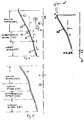
- FIG. 4 shows a basket constructed from a series of short conical sections of differing angles joined together. Massecuite flows via the feeding pot to enter the liquid stage where, for a given flow rate and viscosity, the basket angle is set to remove the 'surplus' molasses using the minimum area of perforated screen (3) - a typical angle being in the range of 5° to 15°. Factors influencing this angle are the liquid viscosity and molasses flow rate through the perforations.
- a crystal wash stage (21) is required at the end of the intermediate stage (19)
- a fourth change in basket angle may be needed depending upon the wash liquid applied. If this removes the molasses surface from the crystals, an angle between that of the intermediate and solids stages would be needed.
- the wash stage may lie in the range of 5° - 30°, depending on where it is positioned.
- the factors controlling the flow change gradually within each stage, and from stage to stage.
- the basket shape would be a continuous curve through points (a), (b), (c) and (d) of Fig. 4 as shown in Fig. 5.
- Fig. 5 contains a wash stage, and is drawn to show clearly the transition to a smooth curve.
- any wash stage is usually applied at or near the end of the intermediate stage, at which point the appearance of the flow changes from dark to light brown as the crystals begin to appear on the surface.
- the position of this colour change i.e. the line between the intermediate and solids stages
- a further, although not essential, feature of this invention is the introduction of a colour sensing device (illustrated diagrammatically at 30 in Fig. 4) focused on the position where the colour change is required. If the colour sensing device records dark brown, a control system 32 is arranged to reduce the massecuite flow into the basket or to increase the speed of rotation. If light brown is sensed, the control system 32 does the converse, thus maintaining the colour change line in the correct position and matching the stages 18,19,20,21 to the basket profile.
- a further alternative is the fitting of rotating viscosity or pressure transducers in the basket, typically positioned near the junction of stages 18 and 19 (or 17 and 18) (for example as shown diagrammatically at 34 in Fig. 4).
- the transducers are connected via cables and slip rings mounted on axis (4) or via another form of link, to an external control unit 36.
- the control unit registers high viscosities or pressure, indicating excess liquid, it reduces the massecuite flow (or increases the speed of rotation) and vice versa to match the stages of the basket profile.
- the separation of sugar from molasses is characterised by high molasses viscosity, high solids content in the massecuite and a regular crystalline solid.
- the invention is applicable to other solids/liquid separations over which the liquid viscosity, solids shape, type, size distribution and coefficient of friction can vary widely.
- Baskets used in this invention may be manufactured in metal, reinforced resin or other materials.
- the preferred material for baskets built from a series of conoidal sections of varying angles is steel.
- the preferred material for baskets with curved sides is fibre reinforced resin following the process outlined in UK Patent Application No. 9121174.8.
Landscapes
- Centrifugal Separators (AREA)
Applications Claiming Priority (2)
| Application Number | Priority Date | Filing Date | Title |
|---|---|---|---|
| GBGB9919555.4A GB9919555D0 (en) | 1999-08-19 | 1999-08-19 | Improvements in continuous centrifuges |
| GB9919555 | 1999-08-19 |
Publications (2)
| Publication Number | Publication Date |
|---|---|
| EP1084754A2 true EP1084754A2 (de) | 2001-03-21 |
| EP1084754A3 EP1084754A3 (de) | 2002-02-06 |
Family
ID=10859386
Family Applications (1)
| Application Number | Title | Priority Date | Filing Date |
|---|---|---|---|
| EP00307037A Withdrawn EP1084754A3 (de) | 1999-08-19 | 2000-08-17 | Zentrifugentrommel mit Abschnitten unterschiedlicher Neigung |
Country Status (3)
| Country | Link |
|---|---|
| US (1) | US6521120B1 (de) |
| EP (1) | EP1084754A3 (de) |
| GB (1) | GB9919555D0 (de) |
Cited By (1)
| Publication number | Priority date | Publication date | Assignee | Title |
|---|---|---|---|---|
| WO2003033163A1 (en) * | 2001-10-18 | 2003-04-24 | Wdt (Engineers) Pty Ltd | Continuous centrifuge |
Families Citing this family (4)
| Publication number | Priority date | Publication date | Assignee | Title |
|---|---|---|---|---|
| US8071148B2 (en) | 2007-06-26 | 2011-12-06 | Heat And Control Inc. | Method for separating cooking oils from snack food products through a quasi-continuous centrifuge action |
| CN104741247B (zh) * | 2015-03-27 | 2017-12-05 | 湖南省香味园食品有限责任公司 | 榨菜连续脱水离心分离机 |
| CN104741248B (zh) * | 2015-03-27 | 2017-12-05 | 湖南省香味园食品有限责任公司 | 倒扣式榨菜连续脱水离心分离机 |
| DK3290093T3 (da) | 2016-09-06 | 2022-07-11 | Alfa Laval Corp Ab | Fremgangsmåde til oprensning af brændselsolie til en dieselmotor |
Family Cites Families (13)
| Publication number | Priority date | Publication date | Assignee | Title |
|---|---|---|---|---|
| US1569778A (en) * | 1921-09-07 | 1926-01-12 | Edward S Murphy | Continuous automatic separator |
| US2328394A (en) * | 1938-12-14 | 1943-08-31 | Jacob J Neuman | Full automatic centrifugal extractor machine |
| GB918386A (en) * | 1959-05-22 | 1963-02-13 | Braunschweigische Maschb Ansta | Improvements in continuous acting sieve centrifuges |
| FR1355763A (fr) | 1963-02-08 | 1964-03-20 | Fives Lille Cail | Essoreuse continue, avec lavage et séparation d'égouts |
| DE2151476C2 (de) | 1971-10-15 | 1980-10-23 | Kurt 4044 Kaarst Pause | Dickschicht-Strömungszentrifuge |
| FR2184502B1 (de) | 1972-05-19 | 1974-12-27 | Fives Lille Cail | |
| FR2187424B1 (de) | 1972-06-06 | 1975-03-28 | Fives Lille Cail | |
| DE2364260A1 (de) | 1973-12-22 | 1975-06-26 | Krauss Maffei Ag | Waschzentrifuge |
| DE2550496B2 (de) | 1975-11-11 | 1980-12-04 | Braunschweigische Maschinenbauanstalt, 3300 Braunschweig | Verfahren und Zentrifuge zum Abschleudern und Wiederauflösen von Zucker |
| CH604907A5 (de) | 1975-11-14 | 1978-09-15 | Sandoz Ag | |
| DE3628588A1 (de) | 1986-08-22 | 1988-03-03 | Braunschweigische Masch Bau | Kontinuierlich arbeitende zuckerzentrifuge |
| AUPM376094A0 (en) | 1994-02-08 | 1994-03-03 | Stg Holdings Pty Ltd | Centrifugal separations apparatus |
| US6267899B1 (en) * | 1997-04-22 | 2001-07-31 | Stg-Fcb Holdings Pty Ltd. | Centrifugal separation apparatus and method of using the same |
-
1999
- 1999-08-19 GB GBGB9919555.4A patent/GB9919555D0/en not_active Ceased
-
2000
- 2000-08-17 EP EP00307037A patent/EP1084754A3/de not_active Withdrawn
- 2000-08-17 US US09/641,059 patent/US6521120B1/en not_active Expired - Fee Related
Cited By (2)
| Publication number | Priority date | Publication date | Assignee | Title |
|---|---|---|---|---|
| WO2003033163A1 (en) * | 2001-10-18 | 2003-04-24 | Wdt (Engineers) Pty Ltd | Continuous centrifuge |
| US7208048B2 (en) | 2001-10-18 | 2007-04-24 | Wdt (Engineers) Pty. Ltd. | Continuous centrifuge |
Also Published As
| Publication number | Publication date |
|---|---|
| US6521120B1 (en) | 2003-02-18 |
| EP1084754A3 (de) | 2002-02-06 |
| GB9919555D0 (en) | 1999-10-20 |
Similar Documents
| Publication | Publication Date | Title |
|---|---|---|
| US4339072A (en) | Centrifuge for separating solids/liquids mixtures | |
| US5261869A (en) | Decanter centrifuge having discontinuous flights in the beach area | |
| US5695442A (en) | Decanter centrifuge and associated method for producing cake with reduced moisture content and high throughput | |
| EP0798045B1 (de) | Dekantierzentrifuge mit Einstellregelung der Auslassöffnung und Betriebsverfahren dafür | |
| US4005817A (en) | Nozzle type centrifuge | |
| EP0602766B1 (de) | Dekantierzentrifuge zur hochgradigen Eindickung | |
| US5586965A (en) | Centrifugal separator with conical bowl section and axially spaced recesses | |
| EP0600628B1 (de) | Dekanterzentrifuge | |
| US4714456A (en) | Solid bowl centrifuge with terminal clarification device | |
| US4279747A (en) | Rapid continuous clarifier | |
| US6521120B1 (en) | Continuous centrifuges | |
| US2973288A (en) | Process and apparatus for continuous centrifuging of viscous sugar compounds | |
| US7255670B2 (en) | Three phase decanter centrifuge | |
| US4331482A (en) | Continuously operating centrifuge | |
| JP4153138B2 (ja) | 遠心分離装置 | |
| EP0258012A2 (de) | Flüssig-Fest-Zentrifugalseparator | |
| US4153551A (en) | Wobble centrifuge and method of operation | |
| FI65766B (fi) | Centrifug med tvao koncentriska trummor foer avvattning av slam | |
| US3250391A (en) | Centrifuges | |
| US20030224920A1 (en) | Rotating-machine bowl assembly with flow guide | |
| JPS6354961A (ja) | 連続作動型砂糖遠心分離機 | |
| Leung et al. | Dewatering of fine-particle slurries using a compound-beach decanter with cake-flow control | |
| CN111330351B (zh) | 一种带有碟片装置的肾型滤油机 | |
| JPH03151007A (ja) | ろ過装置 | |
| US4162760A (en) | Disc centrifuge with underflow discharge |
Legal Events
| Date | Code | Title | Description |
|---|---|---|---|
| PUAI | Public reference made under article 153(3) epc to a published international application that has entered the european phase |
Free format text: ORIGINAL CODE: 0009012 |
|
| AK | Designated contracting states |
Kind code of ref document: A2 Designated state(s): AT BE CH CY DE DK ES FI FR GB GR IE IT LI LU MC NL PT SE Kind code of ref document: A2 Designated state(s): DE FR IT SE |
|
| AX | Request for extension of the european patent |
Free format text: AL;LT;LV;MK;RO;SI |
|
| PUAL | Search report despatched |
Free format text: ORIGINAL CODE: 0009013 |
|
| AK | Designated contracting states |
Kind code of ref document: A3 Designated state(s): AT BE CH CY DE DK ES FI FR GB GR IE IT LI LU MC NL PT SE |
|
| AX | Request for extension of the european patent |
Free format text: AL;LT;LV;MK;RO;SI |
|
| 17P | Request for examination filed |
Effective date: 20020711 |
|
| AKX | Designation fees paid |
Free format text: DE FR IT SE |
|
| 17Q | First examination report despatched |
Effective date: 20040920 |
|
| STAA | Information on the status of an ep patent application or granted ep patent |
Free format text: STATUS: THE APPLICATION IS DEEMED TO BE WITHDRAWN |
|
| 18D | Application deemed to be withdrawn |
Effective date: 20050401 |