EP1084888A1 - Procédé de collage d'un panneau sur une carrosserie - Google Patents
Procédé de collage d'un panneau sur une carrosserie Download PDFInfo
- Publication number
- EP1084888A1 EP1084888A1 EP99118568A EP99118568A EP1084888A1 EP 1084888 A1 EP1084888 A1 EP 1084888A1 EP 99118568 A EP99118568 A EP 99118568A EP 99118568 A EP99118568 A EP 99118568A EP 1084888 A1 EP1084888 A1 EP 1084888A1
- Authority
- EP
- European Patent Office
- Prior art keywords
- adhesive
- resistance wire
- contact surface
- disc
- pane
- Prior art date
- Legal status (The legal status is an assumption and is not a legal conclusion. Google has not performed a legal analysis and makes no representation as to the accuracy of the status listed.)
- Withdrawn
Links
- 238000000034 method Methods 0.000 title claims abstract description 25
- 239000000853 adhesive Substances 0.000 claims abstract description 89
- 230000001070 adhesive effect Effects 0.000 claims abstract description 89
- 238000010438 heat treatment Methods 0.000 claims abstract description 20
- 239000011521 glass Substances 0.000 claims abstract description 19
- 239000012790 adhesive layer Substances 0.000 claims abstract description 3
- 239000004814 polyurethane Substances 0.000 claims description 11
- 238000004026 adhesive bonding Methods 0.000 claims description 10
- 235000011837 pasties Nutrition 0.000 claims description 10
- 229920002635 polyurethane Polymers 0.000 claims description 10
- 229920001187 thermosetting polymer Polymers 0.000 claims description 10
- 230000008439 repair process Effects 0.000 claims description 9
- 230000000737 periodic effect Effects 0.000 claims description 6
- 229920001228 polyisocyanate Polymers 0.000 claims description 5
- 239000005056 polyisocyanate Substances 0.000 claims description 5
- 238000001029 thermal curing Methods 0.000 claims description 5
- 239000004838 Heat curing adhesive Substances 0.000 claims description 4
- 238000013007 heat curing Methods 0.000 abstract 1
- 238000001723 curing Methods 0.000 description 10
- 239000000463 material Substances 0.000 description 9
- 239000000203 mixture Substances 0.000 description 9
- 238000003860 storage Methods 0.000 description 8
- 239000010410 layer Substances 0.000 description 7
- 239000011248 coating agent Substances 0.000 description 5
- 238000000576 coating method Methods 0.000 description 5
- 230000008569 process Effects 0.000 description 4
- 239000004721 Polyphenylene oxide Substances 0.000 description 3
- 239000002390 adhesive tape Substances 0.000 description 3
- 239000003795 chemical substances by application Substances 0.000 description 3
- 150000001875 compounds Chemical class 0.000 description 3
- 238000004132 cross linking Methods 0.000 description 3
- 239000003292 glue Substances 0.000 description 3
- 229910052751 metal Inorganic materials 0.000 description 3
- 239000002184 metal Substances 0.000 description 3
- 229920000570 polyether Polymers 0.000 description 3
- 230000007704 transition Effects 0.000 description 3
- PISLZQACAJMAIO-UHFFFAOYSA-N 2,4-diethyl-6-methylbenzene-1,3-diamine Chemical compound CCC1=CC(C)=C(N)C(CC)=C1N PISLZQACAJMAIO-UHFFFAOYSA-N 0.000 description 2
- 229920001730 Moisture cure polyurethane Polymers 0.000 description 2
- 229920013701 VORANOL™ Polymers 0.000 description 2
- 239000011324 bead Substances 0.000 description 2
- 230000008901 benefit Effects 0.000 description 2
- 239000006229 carbon black Substances 0.000 description 2
- 239000003054 catalyst Substances 0.000 description 2
- 239000011231 conductive filler Substances 0.000 description 2
- 150000002009 diols Chemical class 0.000 description 2
- 229920001971 elastomer Polymers 0.000 description 2
- 239000000806 elastomer Substances 0.000 description 2
- 239000011152 fibreglass Substances 0.000 description 2
- 239000000945 filler Substances 0.000 description 2
- 238000011049 filling Methods 0.000 description 2
- 239000012948 isocyanate Substances 0.000 description 2
- 150000002513 isocyanates Chemical class 0.000 description 2
- 238000013008 moisture curing Methods 0.000 description 2
- 229920005862 polyol Polymers 0.000 description 2
- 150000003077 polyols Chemical class 0.000 description 2
- 239000007787 solid Substances 0.000 description 2
- PCHXZXKMYCGVFA-UHFFFAOYSA-N 1,3-diazetidine-2,4-dione Chemical compound O=C1NC(=O)N1 PCHXZXKMYCGVFA-UHFFFAOYSA-N 0.000 description 1
- 239000005995 Aluminium silicate Substances 0.000 description 1
- 239000004970 Chain extender Substances 0.000 description 1
- 239000009261 D 400 Substances 0.000 description 1
- PIICEJLVQHRZGT-UHFFFAOYSA-N Ethylenediamine Chemical compound NCCN PIICEJLVQHRZGT-UHFFFAOYSA-N 0.000 description 1
- 229920000459 Nitrile rubber Polymers 0.000 description 1
- 229910000831 Steel Inorganic materials 0.000 description 1
- 239000004830 Super Glue Substances 0.000 description 1
- UKLDJPRMSDWDSL-UHFFFAOYSA-L [dibutyl(dodecanoyloxy)stannyl] dodecanoate Chemical compound CCCCCCCCCCCC(=O)O[Sn](CCCC)(CCCC)OC(=O)CCCCCCCCCCC UKLDJPRMSDWDSL-UHFFFAOYSA-L 0.000 description 1
- 230000004913 activation Effects 0.000 description 1
- 239000000654 additive Substances 0.000 description 1
- 230000003679 aging effect Effects 0.000 description 1
- 229910052782 aluminium Inorganic materials 0.000 description 1
- XAGFODPZIPBFFR-UHFFFAOYSA-N aluminium Chemical compound [Al] XAGFODPZIPBFFR-UHFFFAOYSA-N 0.000 description 1
- 235000012211 aluminium silicate Nutrition 0.000 description 1
- 150000001412 amines Chemical class 0.000 description 1
- 230000003712 anti-aging effect Effects 0.000 description 1
- 150000004984 aromatic diamines Chemical class 0.000 description 1
- NTXGQCSETZTARF-UHFFFAOYSA-N buta-1,3-diene;prop-2-enenitrile Chemical compound C=CC=C.C=CC#N NTXGQCSETZTARF-UHFFFAOYSA-N 0.000 description 1
- 239000000919 ceramic Substances 0.000 description 1
- YACLQRRMGMJLJV-UHFFFAOYSA-N chloroprene Chemical compound ClC(=C)C=C YACLQRRMGMJLJV-UHFFFAOYSA-N 0.000 description 1
- 238000001816 cooling Methods 0.000 description 1
- 239000013256 coordination polymer Substances 0.000 description 1
- 239000003599 detergent Substances 0.000 description 1
- 239000012975 dibutyltin dilaurate Substances 0.000 description 1
- 239000000975 dye Substances 0.000 description 1
- 230000000694 effects Effects 0.000 description 1
- 238000010292 electrical insulation Methods 0.000 description 1
- 230000005674 electromagnetic induction Effects 0.000 description 1
- 230000005670 electromagnetic radiation Effects 0.000 description 1
- 238000005516 engineering process Methods 0.000 description 1
- FGBJXOREULPLGL-UHFFFAOYSA-N ethyl cyanoacrylate Chemical compound CCOC(=O)C(=C)C#N FGBJXOREULPLGL-UHFFFAOYSA-N 0.000 description 1
- 239000000835 fiber Substances 0.000 description 1
- 230000009969 flowable effect Effects 0.000 description 1
- 229910052736 halogen Inorganic materials 0.000 description 1
- 150000002367 halogens Chemical class 0.000 description 1
- 239000008240 homogeneous mixture Substances 0.000 description 1
- 230000006698 induction Effects 0.000 description 1
- 239000004615 ingredient Substances 0.000 description 1
- 230000000977 initiatory effect Effects 0.000 description 1
- 238000009413 insulation Methods 0.000 description 1
- IQPQWNKOIGAROB-UHFFFAOYSA-N isocyanate group Chemical group [N-]=C=O IQPQWNKOIGAROB-UHFFFAOYSA-N 0.000 description 1
- NLYAJNPCOHFWQQ-UHFFFAOYSA-N kaolin Chemical compound O.O.O=[Al]O[Si](=O)O[Si](=O)O[Al]=O NLYAJNPCOHFWQQ-UHFFFAOYSA-N 0.000 description 1
- 239000004922 lacquer Substances 0.000 description 1
- 238000004519 manufacturing process Methods 0.000 description 1
- 238000002844 melting Methods 0.000 description 1
- 230000008018 melting Effects 0.000 description 1
- 239000007769 metal material Substances 0.000 description 1
- 239000002808 molecular sieve Substances 0.000 description 1
- 238000013021 overheating Methods 0.000 description 1
- 239000008029 phthalate plasticizer Substances 0.000 description 1
- 239000004014 plasticizer Substances 0.000 description 1
- 229920000768 polyamine Polymers 0.000 description 1
- 229920000728 polyester Polymers 0.000 description 1
- 229920000642 polymer Polymers 0.000 description 1
- 229920001451 polypropylene glycol Polymers 0.000 description 1
- 238000009417 prefabrication Methods 0.000 description 1
- 238000002360 preparation method Methods 0.000 description 1
- 238000000518 rheometry Methods 0.000 description 1
- 238000007789 sealing Methods 0.000 description 1
- 239000012205 single-component adhesive Substances 0.000 description 1
- 239000000779 smoke Substances 0.000 description 1
- URGAHOPLAPQHLN-UHFFFAOYSA-N sodium aluminosilicate Chemical compound [Na+].[Al+3].[O-][Si]([O-])=O.[O-][Si]([O-])=O URGAHOPLAPQHLN-UHFFFAOYSA-N 0.000 description 1
- 239000004071 soot Substances 0.000 description 1
- 239000003381 stabilizer Substances 0.000 description 1
- 239000010959 steel Substances 0.000 description 1
- 238000003756 stirring Methods 0.000 description 1
- 239000000126 substance Substances 0.000 description 1
- DVKJHBMWWAPEIU-UHFFFAOYSA-N toluene 2,4-diisocyanate Chemical compound CC1=CC=C(N=C=O)C=C1N=C=O DVKJHBMWWAPEIU-UHFFFAOYSA-N 0.000 description 1
- 230000001960 triggered effect Effects 0.000 description 1
- 150000004072 triols Chemical class 0.000 description 1
- 150000003672 ureas Chemical class 0.000 description 1
- 239000002966 varnish Substances 0.000 description 1
Images

Classifications
-
- B—PERFORMING OPERATIONS; TRANSPORTING
- B60—VEHICLES IN GENERAL
- B60J—WINDOWS, WINDSCREENS, NON-FIXED ROOFS, DOORS, OR SIMILAR DEVICES FOR VEHICLES; REMOVABLE EXTERNAL PROTECTIVE COVERINGS SPECIALLY ADAPTED FOR VEHICLES
- B60J10/00—Sealing arrangements
- B60J10/70—Sealing arrangements specially adapted for windows or windscreens
-
- B—PERFORMING OPERATIONS; TRANSPORTING
- B60—VEHICLES IN GENERAL
- B60J—WINDOWS, WINDSCREENS, NON-FIXED ROOFS, DOORS, OR SIMILAR DEVICES FOR VEHICLES; REMOVABLE EXTERNAL PROTECTIVE COVERINGS SPECIALLY ADAPTED FOR VEHICLES
- B60J10/00—Sealing arrangements
- B60J10/30—Sealing arrangements characterised by the fastening means
- B60J10/34—Sealing arrangements characterised by the fastening means using adhesives
Definitions
- the present invention relates to a method for gluing a pane, preferably a windshield, with a body and a related Arrangement, a kit and a glass module according to the features of the preamble of independent claims.
- the workshop therefore needs a flexible system for gluing, which is characterized by little effort in storage and assembly.
- the Storage of bulky, precisely adapted profile building parts is undesirable.
- WO 94/18255 describes a storable glass pane, on the circumference of which a strip of a thermal curing adhesive is already applied. It is a One-component polyurethane adhesive.
- the adhesive is either a prepolymer with terminal, blocked isocyanate groups or from a polyol / polyamine mixed with encapsulated polyisocyanates or from a radical polymerizable polyurethane prepolymer.
- the crosslinking reaction is initiated thermally; the necessary Energy supply can be achieved through ohmic heating (electrical resistance heating), electromagnetic radiation or induction.
- ohmic heating electrical resistance heating
- Conductive fillers such as metal flakes or steel fibers are added to the adhesive mixture become.
- a disadvantage in the case of ohmic heating is the influencing of the material and Aging properties of the adhesive due to the metallic fillers and the risk of uneven hardening of individual areas of the bond.
- the glass component itself has no expiry date and can be exposed to high temperatures while the adhesive is not.
- the storage requirements of the Glue e.g. with regard to the ambient temperature or the humidity, determine the Storage of the bulky glass component.
- a flexible system of separately stored adhesive and glass component is preferable.
- US 3,574,024 describes an adhesive tape and its use in a method for Vehicle glazing.
- the adhesive tape consists of a thermosetting elastomer with a central resistance wire for electrical resistance heating.
- Elastomers are, for example, chloroprene or butadiene-acrylonitrile copolymer.
- the resistance wire runs centrally in a fiberglass tube that connects to the deformable one Adhesive is coated. After applying resistance heating or 'heating' the adhesive for a few more days for complete latent curing; only then is one given sufficient strength of the bond.
- a disadvantage of this solution is the need to cut the sealing tape with the one in it embedded wire and the handling of the wire ends for connection to the Power source without affecting the window seal.
- the ends must e.g. be crossed, whereby there is easily a joint in the bond.
- the fiberglass core must also be carefully positioned during assembly so that it is pressed when the Washer on the body is not pushed to the edge of the zone to be glued.
- the Align the resistance wire to the bonding zone for the purpose of optimal The influence of heat requires constant control.
- the curing time is for the purpose of one Emergency repair too long.
- the object of the present invention is to avoid the disadvantages of the known and a Process for gluing panes, preferably windscreens, to one To create body that is easy to use and reliable Hardening distinguishes.
- Another object of the present invention are a kit and a storable glass module for carrying out such a method and one itself arrangement of a pane on a body resulting from the implementation of the method according to the features of the independent claims.
- the inventive method for gluing a pane, preferably one Windshield with a body requires the application of a strip of one pasty, heat-curing adhesive on a contact surface of the window or the body, the placement of the contact surface of the disc on the applied adhesive and that thermal curing of the adhesive by electrical resistance heating, taking on a resistance wire is placed on at least one contact surface.
- the resistance wire is therefore placed on a contact surface that is later covered by the adhesive.
- Resistance wire and adhesive form a layer structure between the contact surfaces of Washer and body.
- the advantage of the process is that the adhesive is not a special one Preparation requires, for example, with electro-conductive fillers. Also a prefabrication as complicated, multi-layer component is not necessary.
- the adhesive can be compact Mold, e.g. as a malleable mass in a cartridge or as a wound one Stripes. It is also advantageous that the primary heat effect on one for gluing important transition zone between adhesive mass and glass material or adhesive mass and Body takes place.
- the surface of the pane which is a glass surface or can be an applied ceramic screen print, preferably by Applying an adhesion-promoting coating, e.g. a commercially available primer be pretreated.
- the surface of the body can be prepared for gluing by for example, an adhesion-promoting substance, such as that for such, on the lacquer layer Adhesions are available, is applied.
- an adhesion-promoting substance such as that for such, on the lacquer layer Adhesions are available.
- Adhesions are available, is applied.
- Corresponding pretreatment products are known to the person skilled in the art.
- the crosslinking of the adhesive is carried out directly on the Contact surface between washer or flange and adhesive triggered.
- the resistance wire generates a constant, in contrast to electrically conductive filling materials reproducible current flow and heating over the entire contact area. It can be one uniform curing of the adhesive strip can be achieved.
- a body is also a metal frame a preformed support surface (flange), which is intended to hold a disc.
- a contact surface denotes the contact surface in the sense of the present invention. It can be vehicle bodies, i.e. bodies for cars, trucks, buses, etc. It can also be simple containers, vehicle structures, railway wagons, etc. act.
- the contact area of the disc is one on the inside of the disc along the outer circumferential stripes; it can be up to a few centimeters wide, according to the desired area of the bond.
- a resistance wire in the context of the present invention can have a voltage in Range of 10-100V. He can use a thermally conductive, electrical insulating coating.
- the thermal conductivity of the coating the temperature to be reached on the outer surface of the wire or coating that makes contact with the adhesive, the temperature gradient within the adhesive composition and the heating power (W / cm 2 ) or the available surface of the (coated) wire must be taken into account in order to determine the optimal heating time.
- the resistance wire can be placed on the contact surface through the adhesive strip be attached yourself. Alternatively, additional funds can also be used. It is possible, the resistance wire punctually with any adhesive (e.g. lowest Amounts of a cyanoacrylate adhesive) or punctually with a small amount of the pasty, to fix the adhesive according to the invention against slipping. But it is also possible that Wire before placing the adhesive strip e.g. with magnetic holders or mechanical clips fix against slipping.
- any adhesive e.g. lowest Amounts of a cyanoacrylate adhesive
- Wire before placing the adhesive strip e.g. with magnetic holders or mechanical clips fix against slipping.
- Such a storable glass module with a resistance wire attached to it is another Subject of the present invention.
- the resistance wire is through the Adhesive layer covered.
- the Resistance wire in the form of a periodic pattern across the entire width of the contact area.
- the ends of the resistance wire are on the Contact surface placed in parallel.
- Another preferred embodiment of the method is to place the resistance wire on the Apply contact surface in the form of a preferably periodic pattern.
- the total length of the wire is therefore greater than the outer circumference of the contact area. It it is possible to use a zigzag or accordion-like resistor wire Prefabricate structure.
- the wire is therefore not when applied to the contact surface stretched more, but runs in a periodic pattern between the two outer ones Limitations of the contact area.
- the advantage of this is that the entire contact surface is covered the wire is covered and later heated evenly. This enables direct Heating and curing of the adhesive on the largest possible surface. It promotes Speed and quality of bonding.
- the pasty, heat-curing adhesive is a One-component adhesive.
- pasty in the sense of this invention is a Room temperature deformable, not flowable, but extrudable mass. It can be a homogeneous mixture or a finely dispersed system.
- the use of a one-component adhesive makes the process according to the invention fast and easy.
- the one-component adhesive is a solid at room temperature, meltable at elevated temperature. This allows the Ready-to-use strips of adhesive needed to assemble the pane to be stored by the adhesive at a temperature above the melting temperature, however below the curing temperature, is extruded into a strip.
- the one-component adhesive is at one temperature can be hardened at more than 80 ° C.
- one according to the invention hardens One-component adhesive in less than an hour, particularly preferably in less than 30 min.
- An adhesive hardened in this way meets the safety requirements.
- a Resistance heating allows you to set up within a few seconds Voltage on the transition surface of the resistance wire to the adhesive To generate temperature between 80 ° C up to a maximum of 250 ° C. The maximum temperature is controlled by the current intensity, thus overheating the adhesive material prevented.
- the increased temperature required to initiate curing causes a high reaction rate of the crosslinking reaction.
- a one-component adhesive is used selected from the group of thermosetting polyurethane adhesives, comprising surface-deactivated polyisocyanates and at least one isocyanate-reactive component, preferably one component is polymeric in nature.
- Polyurethane adhesives are preferred materials from the prior art Window bonding known. They assign the required processing and Hardening properties.
- a one-component polyurethane adhesive already contains all of them reactive components.
- a polyurethane adhesive in the sense of the present invention not moisture curing. This, in conjunction with that for thermal curing required high activation temperature, good storage stability achieved.
- the through the Mechanical properties to be achieved through thermal curing preferably achieved in less than an hour. The initiation of curing is through the required temperature controllable.
- Process-inactivated polyisocyanate can be formed either by forming a Polyadduct with H-active compounds, one by inclusion in cage components (Molecular sieves) or an encapsulated inactivated polyisocyanate.
- the Single-component adhesive can also contain additives such as plasticizers, fillers, Soot, anti-aging agents, catalysts, etc. included.
- the isocyanate-reactive component has Zerewitinow active groups. It can be a polyurethane prepolymer, a polyester or polyether or a polymer grafted with alkylhydroxy radicals or a mixture of such ingredients.
- the One-component adhesive contains other compounds that react with the isocyanate, e.g. (Poly) amine or aromatic diamines as chain extenders and rheology adjusters Agents.
- the weight-average molar mass of the isocyanate reactive is preferably Components are in the range of 50-50,000, particularly preferably in the range of 80-10,000.
- a preferred embodiment of the method according to the invention is used as One-component adhesive, the polyurethane adhesive EFBOND HA 111 (manufacturer: EFTEC AG / CH).
- This one-component adhesive has the preferred in the aforementioned Embodiments mentioned properties: It is over as a pasty mass without cooling Can be stored for several months in a suitable container, thermally curing at one temperature of at least 80 ° C and can be repaired with a window repair within approx. 15 Harden for minutes. A pane glued in this way is sufficient for technical reasons Security requirements.
- the contact surface of the body can be bare metal, it can but also one with a dye or varnish or adhesive residues of the previous one Activate window coating on coated surface.
- the storage stability of EFBOND HA 111 is at least 13 months at 25 ° C.
- the resistance wire is applied before the application of the Glue applied to a contact surface.
- the resistance wire is placed on a contact surface of the pane or the body and the Apply adhesive to the opposite contact surface of the body or window and then the washer is applied to the body.
- Another object of the present invention is an implementation of the Arrangement of a disk or a resistance wire resulting from the method according to the invention and a strip of a thermosetting or cured adhesive on a body.
- the cured adhesive is preferably a polyurethane.
- kits for window repair preferably for vehicles, comprising an electrically heatable resistance wire and one Prefabricated strips of a pasty, thermosetting adhesive.
- the Kit also a washer.
- a kit provides components for carrying out the The process according to the invention is available in ready-to-use, portioned form. He is therefore suitable e.g. also for private use.
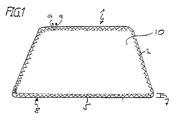
- FIG. 1 shows the top view of a disk 1 with a resistance wire 2 for it the repair glazing of a vehicle.
- the resistance wire 2 runs on the circumference 8 the disk surface 10; the ends 9 of the resistance wire 2 are parallel and demonstrate outside so as to seamlessly harden one onto the resistance wire 2 and the underlying contact surface 5 of the disc 1 of a strip 6a to enable heat-curing adhesive 3.
- the resistance wire 2 has a diameter in Range of 1-5 mm, preferably 2-4 mm, using a suitable electrical Insulation layer can be coated.
- the strip 6a (Fig. 2a, 2b) made of a pasty, thermosetting adhesive 3 has a thickness in the range 0.5 -5 cm, preferably 1-2 cm.
- the strip 6 (Fig.
- the resistance wire 2 deforms when the disc 1 with the strip 6 and Resistance wire 2 in the arrangement according to the invention on the contact surface 5 of the Body 4 is placed and pressed.
- the resistance wire 2 runs according to FIGS. 1 and 2a in the form of a periodic pattern, e.g. B. zigzag-shaped, so that along the outer Circumferential 8 extending contact surface 5 of the disc 1 over the entire width 7 in regular Cover arrangement and subsequently to uniform heating over the whole To guide contact surface 5. This allows optimal gluing to the contact surface 5. It are different variations of this or another pattern, also a straight line Leadership, possible.
- the resistance wire 2 allows temperatures up to 200 ° C by applying a voltage of e.g. Generate 60V DC within a few minutes. There are but other operating voltages are also possible. The current flow becomes about 10-20 A at one Wire length of approx. 4.5 m. Suitable metallic materials for the resistance wire 2 are known from the prior art.
- FIGS. 2a and 2b show cross sections through the arrangement of windshield 1, Resistance wire 2, a strip 6 of the one-component adhesive 3 and the one in the cutout shown body 4.
- the resistance wire 2 and the strip 6 of the adhesive 3 are arranged in layers between the contact surfaces 5 of pane 1 and body 4.
- the Resistance wire 2 heats the adhesive 3 evenly and directly on for adhesion important transition between strip 6 and a contact surface.
- the one for curing the inner areas of the strip 6 of the one-component adhesive 3 required Heat transfer does not affect the mechanical properties in the cured condition.
- the representation of the layer structure of disc 1, resistance wire 2, the strip 6 of the one-component adhesive 3 and the one shown in the detail Body 4 in Figures 2a and 2b is idealized.
- the one in the uncured state pasty strips 6 of the adhesive 3 is by the weight of the disc 1 when Laying on the body 4 deformed; the adhesive 3 thus forms a tight seal between the contact surfaces 5 of window 1 and body 4.
- the resistance wire 2 is then surrounded by adhesive 3.
- Figure 2a shows the arrangement of the resistance wire 2 at the interface with the disc 5, while Figure 2b shows the resistance wire 2 between the body and adhesive 3.
- a windshield is made by sequential application of detergent and / or Primer prepared for gluing. After removal, the body flange prepared according to the specifications of the automobile manufacturer. Prepared for this Flange becomes a resistance wire, which has been cut to size on site, on the flange fixed on the surface to be glued using clamps.
- Resistor wire was a Raychem wire with the designation LSOH type 1, low smoke, 0 halogen, blue used. The ends of the wire were run parallel to each other suitable openings through an aluminum block and to the voltage source connected.
- the EFBOND adhesive was then applied using a cartridge gun HA 111 applied in the form of a triangular bead on the wire, the height of the bead was thereby 10-12 mm.
- the disc was placed in the using suction cups Body opening inserted and fixed with adhesive tape. The glue was through Applying a voltage of 60 V cured ready for use within 15 min. The Finished automobile was checked for leaks in a car wash.
- a polyether diol In a planetary mixer, 240 parts by weight of a polyether diol are mixed with the Molecular weight 3800 (OH number: 28) Voranol EP 1900, 450 parts by weight of one Polyether triols with a molecular weight of 4800 (OH number: 35), Voranol CP 4755, 240 Parts by weight of a phthalate plasticizer and 12 parts by weight of a polyetheramine Jeffamine D 400 mixed and evacuated. Then 100 parts by weight of dried carbon black and 750 parts by weight of a precipitated surface-treated chalk. The Mixture is mixed homogeneously for about 1 ⁇ 2 hour. Then 92 parts by weight of Togodur are added Add T9 (TDI Uretdione) and mix under vacuum until the mixture is homogeneous. The product is filled into cartridges for storage and use.
- Voranol EP 1900 450 parts by weight of one Polyether triols with a molecular weight of 4800 (OH number: 35), Voranol
- a planetary mixer 20 parts by weight of one at room temperature Polypropylene oxide diol (OHZ 57) and 1.2 equivalent percent of the stabilizer ethylenediamine mixed. Thereafter, 10.5 parts by weight of TDIH (urea dimer from Tolylene diisocyanate, e.g. Desmodur VP-LS 2116) added and the mixture for 1 hour homogenized. After adding 0.5 parts by weight of DETDA (diethyltoluenediamine) and 40.6 The mixture is degassed for 30 minutes by weight of Jeffamin T5000.
- TDIH urea dimer from Tolylene diisocyanate, e.g. Desmodur VP-LS 2116
- DETDA diethyltoluenediamine
Landscapes
- Engineering & Computer Science (AREA)
- Mechanical Engineering (AREA)
- Adhesives Or Adhesive Processes (AREA)
Priority Applications (1)
| Application Number | Priority Date | Filing Date | Title |
|---|---|---|---|
| EP99118568A EP1084888A1 (fr) | 1999-09-20 | 1999-09-20 | Procédé de collage d'un panneau sur une carrosserie |
Applications Claiming Priority (1)
| Application Number | Priority Date | Filing Date | Title |
|---|---|---|---|
| EP99118568A EP1084888A1 (fr) | 1999-09-20 | 1999-09-20 | Procédé de collage d'un panneau sur une carrosserie |
Publications (1)
| Publication Number | Publication Date |
|---|---|
| EP1084888A1 true EP1084888A1 (fr) | 2001-03-21 |
Family
ID=8239024
Family Applications (1)
| Application Number | Title | Priority Date | Filing Date |
|---|---|---|---|
| EP99118568A Withdrawn EP1084888A1 (fr) | 1999-09-20 | 1999-09-20 | Procédé de collage d'un panneau sur une carrosserie |
Country Status (1)
| Country | Link |
|---|---|
| EP (1) | EP1084888A1 (fr) |
Cited By (3)
| Publication number | Priority date | Publication date | Assignee | Title |
|---|---|---|---|---|
| US4929383A (en) * | 1984-01-27 | 1990-05-29 | The Clorox Company | Stable emulstified bleaching compositions |
| DE102006033368A1 (de) * | 2006-07-19 | 2008-01-24 | Wilhelm Karmann Gmbh | Verfahren zur Herstellung einer Verklebung und Fahrzeugdach mit textilem Verdeckstoff |
| WO2026057488A1 (fr) | 2024-09-10 | 2026-03-19 | Saint-Gobain Sekurit France | Vitrage, notamment vitrage de véhicule, destiné à être collé sur un élément de support |
Citations (8)
| Publication number | Priority date | Publication date | Assignee | Title |
|---|---|---|---|---|
| US3574024A (en) | 1963-04-16 | 1971-04-06 | Bitumen Ind Ltd | Method of bonding a window to the window opening in a vehicle |
| US4115609A (en) * | 1971-09-24 | 1978-09-19 | Denman Stephen A | Strip type coupling member |
| DE3124138A1 (de) * | 1981-06-19 | 1982-12-30 | Vereinigte Glaswerke Gmbh, 5100 Aachen | "verfahren zum einbauen oder ausbauen einer glsscheibe in den rahmen einer karosserie, und glasscheibe zur druchfuehrung des verfahrens |
| EP0081426A1 (fr) * | 1981-12-04 | 1983-06-15 | Boussois S.A. | Cordon en matière thermo-plastique pour fixer une feuille de verre, procédé pour fixer celle-ci et couche conductrice utilisée à cet effet |
| DE3501490A1 (de) * | 1985-01-18 | 1986-07-24 | Daimler-Benz Ag, 7000 Stuttgart | In den rahmen einer autokarosserie mittels eines elastomeren vernetzten klebers eingeklebte glasscheibe |
| EP0262831A1 (fr) * | 1986-09-15 | 1988-04-06 | Sharaway Limited | Procédé de thermodurcissement, procédé pour la pose de pare-brise, et composition d'étanchéité pour ces procédés |
| EP0382602A1 (fr) * | 1989-02-06 | 1990-08-16 | Saint-Gobain Vitrage International | Vitrage prêt à la pose et procédé de fabrication |
| WO1994018255A1 (fr) | 1993-02-12 | 1994-08-18 | Gurit-Essex Ag | Element de construction modulaire thermiquement activable, son utilisation, procede de vitrage direct de vehicules et adhesif |
-
1999
- 1999-09-20 EP EP99118568A patent/EP1084888A1/fr not_active Withdrawn
Patent Citations (8)
| Publication number | Priority date | Publication date | Assignee | Title |
|---|---|---|---|---|
| US3574024A (en) | 1963-04-16 | 1971-04-06 | Bitumen Ind Ltd | Method of bonding a window to the window opening in a vehicle |
| US4115609A (en) * | 1971-09-24 | 1978-09-19 | Denman Stephen A | Strip type coupling member |
| DE3124138A1 (de) * | 1981-06-19 | 1982-12-30 | Vereinigte Glaswerke Gmbh, 5100 Aachen | "verfahren zum einbauen oder ausbauen einer glsscheibe in den rahmen einer karosserie, und glasscheibe zur druchfuehrung des verfahrens |
| EP0081426A1 (fr) * | 1981-12-04 | 1983-06-15 | Boussois S.A. | Cordon en matière thermo-plastique pour fixer une feuille de verre, procédé pour fixer celle-ci et couche conductrice utilisée à cet effet |
| DE3501490A1 (de) * | 1985-01-18 | 1986-07-24 | Daimler-Benz Ag, 7000 Stuttgart | In den rahmen einer autokarosserie mittels eines elastomeren vernetzten klebers eingeklebte glasscheibe |
| EP0262831A1 (fr) * | 1986-09-15 | 1988-04-06 | Sharaway Limited | Procédé de thermodurcissement, procédé pour la pose de pare-brise, et composition d'étanchéité pour ces procédés |
| EP0382602A1 (fr) * | 1989-02-06 | 1990-08-16 | Saint-Gobain Vitrage International | Vitrage prêt à la pose et procédé de fabrication |
| WO1994018255A1 (fr) | 1993-02-12 | 1994-08-18 | Gurit-Essex Ag | Element de construction modulaire thermiquement activable, son utilisation, procede de vitrage direct de vehicules et adhesif |
Cited By (4)
| Publication number | Priority date | Publication date | Assignee | Title |
|---|---|---|---|---|
| US4929383A (en) * | 1984-01-27 | 1990-05-29 | The Clorox Company | Stable emulstified bleaching compositions |
| DE102006033368A1 (de) * | 2006-07-19 | 2008-01-24 | Wilhelm Karmann Gmbh | Verfahren zur Herstellung einer Verklebung und Fahrzeugdach mit textilem Verdeckstoff |
| EP1880882A3 (fr) * | 2006-07-19 | 2011-05-04 | Wilhelm Karmann GmbH | Procédé destiné à la fabrication d'un collage, toit de véhicule doté de tissu textile et composant de véhicule doté de matière textile |
| WO2026057488A1 (fr) | 2024-09-10 | 2026-03-19 | Saint-Gobain Sekurit France | Vitrage, notamment vitrage de véhicule, destiné à être collé sur un élément de support |
Similar Documents
| Publication | Publication Date | Title |
|---|---|---|
| DE3124138C2 (de) | Verfahren zum Einbauen und Ausbauen einer Glasscheibe, die in den Rahmen einer Fahrzeugkarosserie einklebbar ist, und Glasscheibe zur Druchführung des Verfahrens | |
| DE3824771C1 (fr) | ||
| EP0318542B1 (fr) | Procede de durcissement au moins partiel de matieres d'etancheite et d'adhesifs | |
| EP0303645B1 (fr) | Procédé de préparation d'un joint et d'un adhésif en polyuréthane,à un composant et réticulable sous l'action de la chaleur et de l'humidité. | |
| EP0422516B1 (fr) | Objet en verre, adapté pour scellement à un autre matériau, procédé pour sa production et son usage | |
| DE4210277C2 (de) | Kleb- und Dichtstoff und dessen Verwendung | |
| DE69313252T2 (de) | Verfahren zur Behandlung einer Verglasung zum randseitigen Verkleben eines Profils | |
| DE4123588A1 (de) | Verfahren und vorrichtung zur herstellung eines fahrzeugfensters | |
| DE3435365A1 (de) | Verglasungsaufbau und verfahren zu seiner herstellung | |
| DE3690129C2 (de) | Mehrfachscheibeneinheit und Verfahren zur Herstellung derselben | |
| EP1956063A2 (fr) | Procédé destiné au collage d'un premier composant et d'un second composant | |
| EP0801121A2 (fr) | Ruban adhésif auto-collant à base de polyuréthane | |
| DE60114607T2 (de) | Herstellungsverfahren für ein modulares, klebfähiges element, und montageverfahren | |
| DE102015204494A1 (de) | Hybrid-Seitenschweller für ein Kraftfahrzeug und Herstellungsverfahren desselben | |
| DE69211768T2 (de) | Dielektrische Rand-Feld-Heizung | |
| DE3781423T2 (de) | Verfahren zur herstellung eines sicherheitsglases fuer kraftfahrzeuge und gebaeude und so erhaltener gegenstand. | |
| DE4133662A1 (de) | Mit einem einbaurahmen aus einem elastomer vorgeruestete glasscheibe | |
| EP1084888A1 (fr) | Procédé de collage d'un panneau sur une carrosserie | |
| DE102008019769A1 (de) | Verfahren zum Verkleben eines ersten Bauteils mit einem zweiten Bauteil | |
| DE3435469C2 (de) | Verfahren zur Herstellung eines Kautschukprodukts | |
| EP0025500A1 (fr) | Procédé pour fabriquer un film adhérant d'élastomère polyuréthane ou polyurée sur des articles en caoutchouc | |
| DE102013003912A1 (de) | Verkleben von Kunststoffbauteilen mittels elektrisch leitfähigem Mehrkomponenten-Klebstoff | |
| DE102005000851A1 (de) | Wischerblatt und Verfahren zu seiner Herstellung | |
| EP1082399B1 (fr) | Colle a fusion stable au stockage, a reaction latente et procede pour coller un element modulaire | |
| DE9108269U1 (de) | Verbundmaterial und Verbundkörper |
Legal Events
| Date | Code | Title | Description |
|---|---|---|---|
| PUAI | Public reference made under article 153(3) epc to a published international application that has entered the european phase |
Free format text: ORIGINAL CODE: 0009012 |
|
| AK | Designated contracting states |
Kind code of ref document: A1 Designated state(s): AT BE CH CY DE DK ES FI FR GB GR IE IT LI LU MC NL PT SE |
|
| AX | Request for extension of the european patent |
Free format text: AL;LT;LV;MK;RO;SI |
|
| RAP1 | Party data changed (applicant data changed or rights of an application transferred) |
Owner name: EFTEC EUROPE HOLDING AG |
|
| AKX | Designation fees paid | ||
| STAA | Information on the status of an ep patent application or granted ep patent |
Free format text: STATUS: THE APPLICATION IS DEEMED TO BE WITHDRAWN |
|
| 18D | Application deemed to be withdrawn |
Effective date: 20010922 |
|
| REG | Reference to a national code |
Ref country code: DE Ref legal event code: 8566 |