EP1085471A2 - Verfahren zur Erzeugung eines dynamischen Bildes, Speichermedium und Gerät zur Ausführung eines Programms - Google Patents
Verfahren zur Erzeugung eines dynamischen Bildes, Speichermedium und Gerät zur Ausführung eines Programms Download PDFInfo
- Publication number
- EP1085471A2 EP1085471A2 EP00307980A EP00307980A EP1085471A2 EP 1085471 A2 EP1085471 A2 EP 1085471A2 EP 00307980 A EP00307980 A EP 00307980A EP 00307980 A EP00307980 A EP 00307980A EP 1085471 A2 EP1085471 A2 EP 1085471A2
- Authority
- EP
- European Patent Office
- Prior art keywords
- dimensional
- image
- coordinate calculating
- calculating step
- virtual
- Prior art date
- Legal status (The legal status is an assumption and is not a legal conclusion. Google has not performed a legal analysis and makes no representation as to the accuracy of the status listed.)
- Withdrawn
Links
Images



Classifications
-
- G—PHYSICS
- G06—COMPUTING OR CALCULATING; COUNTING
- G06T—IMAGE DATA PROCESSING OR GENERATION, IN GENERAL
- G06T13/00—Animation
- G06T13/20—Three-dimensional [3D] animation
-
- A—HUMAN NECESSITIES
- A63—SPORTS; GAMES; AMUSEMENTS
- A63F—CARD, BOARD, OR ROULETTE GAMES; INDOOR GAMES USING SMALL MOVING PLAYING BODIES; VIDEO GAMES; GAMES NOT OTHERWISE PROVIDED FOR
- A63F2300/00—Features of games using an electronically generated display having two or more dimensions, e.g. on a television screen, showing representations related to the game
- A63F2300/60—Methods for processing data by generating or executing the game program
- A63F2300/66—Methods for processing data by generating or executing the game program for rendering three dimensional images
-
- A—HUMAN NECESSITIES
- A63—SPORTS; GAMES; AMUSEMENTS
- A63F—CARD, BOARD, OR ROULETTE GAMES; INDOOR GAMES USING SMALL MOVING PLAYING BODIES; VIDEO GAMES; GAMES NOT OTHERWISE PROVIDED FOR
- A63F2300/00—Features of games using an electronically generated display having two or more dimensions, e.g. on a television screen, showing representations related to the game
- A63F2300/60—Methods for processing data by generating or executing the game program
- A63F2300/66—Methods for processing data by generating or executing the game program for rendering three dimensional images
- A63F2300/6638—Methods for processing data by generating or executing the game program for rendering three dimensional images for simulating particle systems, e.g. explosion, fireworks
Definitions
- the present invention relates to a technique for drawing a two-dimensional image obtained by shooting a virtual three-dimensional object displayed in a virtual three-dimensional world by a virtual camera.
- Three-dimensional computer graphics animation obtained by shooting by a virtual camera a virtual three-dimensional object, being disposed and moving in a virtual three-dimensional world, is widely used in various fields including entertainment such as games and movies, medical activities, manufacturing industries and education.
- techniques used in conventional three-dimensional graphics, which are required for creating (rendering) one two-dimensional image include Z-buffer method, scan line method, ray tracing method or the like as a technique for erasing hidden lines and hidden surfaces, flat shading method, glow shading method, ray tracing method or the like as a technique for shading, and the texture mapping method or the like as a technique for rendering surface textures and patterns on a surface of a three-dimensional object.
- a processing volume for creating a three-dimensional computer graphics animation increases as the number and/or an amount of movements of three-dimensional objects to be represented increase. Therefore, if a great number of three-dimensional objects, especially moving three-dimensional objects are disposed in a three-dimensional space, the processing volume may exceed an allowable range of the apparatus. For example, in the case of an apparatus which is required to create and display a three-dimensional computer graphics animation in real time such as a video game apparatus which provides an interactive three-dimensional computer graphics animation, a proper three-dimensional computer graphics animation may not be provided in real time, due to an excessive processing volume.
- the present invention was made taking the above-described situation into consideration, and it is an object of the invention to create a three-dimensional computer graphics animation with a smaller processing volume.
- a method of creating image frames forming a dynamic image which is obtained by projecting a virtual three-dimensional object moving in a virtual three-dimensional world with predetermined motion characteristics, upon a virtual camera screen from an arbitrary view point, the method having:
- changes only in the position of a point on a three-dimensional object to be drawn are regularly calculated, and an image of the object is drawn by drawing (pasting) a two-dimensional image on the camera screen upon which the calculated position is projected. Therefore, for example, the image can be created with a quite small processing load in a quit short processing time compared to conventional methods in which an object is represented as polygon models and which involves various processes required for rendering polygon models, such as a simulation of changes in each vertex position of each polygon and a perspective transformation thereof.
- Fig. 1 illustrates an appearance of an entertainment apparatus and a controller therefor according to an embodiment of the invention.
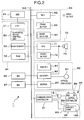
- Fig. 2 is a block diagram showing a configuration of the entertainment apparatus according to the embodiment.
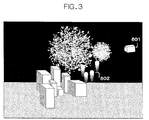
- Fig. 3 is an illustration for explaining contents of a video game according to the embodiment.
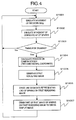
- Fig. 4 is a flow chart for explaining a process of creating a CG animation for the entertainment apparatus according to the embodiment.
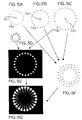
- Figs. 5A through 5G are illustrations for explaining a process of drawing sparks of fire performed by the entertainment apparatus when the video game according to the embodiment is provided.
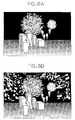
- Figs. 6A and 6B are illustrations for explaining a process of decorating a displayed image performed by the entertainment apparatus when the video game according to the embodiment is provided.
- Fig 7 is a flow chart for explaining a process of accepting operations of a player in the entertainment apparatus according to the embodiment.
- Figs. 8A through 8F are illustrations for explaining a user interface provided by the entertainment apparatus when the video game according to the embodiment is provided.
- Figs. 9A through 9F are illustrations for explaining a user interface provided by the entertainment apparatus when the video game according to the embodiment is provided.
- Figs. 10A and 10B are illustrations for explaining a range of an induced explosion which is controlled by the entertainment apparatus when the video game according to the embodiment is provided.
- Fig. 1 shows an appearance of the entertainment apparatus according to the present embodiment.
- the entertainment apparatus reads a game program stored in, for example, an optical disk or the like and executes the game program in accordance with instructions from a user (a game player).
- execution of a game primarily means an operation of controlling progress, display and sounds of a game.
- a main body 2 of the entertainment apparatus 1 has a disk mounting portion 3 located in the middle thereof for mounting an optical disk such as a CD-ROM which is a recording medium for supplying an application program such as a video game, a reset switch 4 for resetting a game, a power supply switch 5, a disk operating switch 6 for operating the mounting of the optical disk and, slot portions, for example, two of them, 7A and 7B.
- an optical disk such as a CD-ROM which is a recording medium for supplying an application program such as a video game
- a reset switch 4 for resetting a game
- a power supply switch 5 for resetting a game
- a power supply switch 5 for resetting a game
- a disk operating switch 6 for operating the mounting of the optical disk and, slot portions, for example, two of them, 7A and 7B.
- Two controllers 20 can be connected to the slot portions 7A and 7B to allow two users to play a fighting game or the like.
- the slot portions 7A and 7B accept a memory card device 26 in and from which game data can be saved (stored) and read or portable digital apparatus 100 which allows a game to be executed separately from the main body.
- the controller 20 has first and second operating portions 21 and 22, an L-button 23L, an R-button 23R, a start button 24 and a selection button 25. It further has operating portions 31 and 32 which enable analog operations, a mode selection switch 33 for selecting a mode of operation of the operating portions 31 and 32 and a display portion 34 for displaying a selected mode of operation.
- FIG. 2 A configuration of the entertainment apparatus 1 is shown in Fig. 2.
- the entertainment apparatus 1 has a control system 50 constituted by a central processing unit (CPU) 51, peripheral devices therefor, etc., a graphic system 60 including a graphic processing unit (GPU) 62 for performing drawing in a frame buffer 63, etc., a sound system 70 including a sound processing unit (SPU) 71 for generating sounds of music, sound effects, etc., an optical disk control unit 80 for controlling an optical disk 81 on which an application program is recorded, a communication control unit 90 for controlling signals from the controller 20 through which instructions from a user are inputted, and input and output of data from and to the memory card 26 and portable digital apparatus 100 which store a setting of a game and the like, and a bus BUS or the like for connecting the above-described parts.
- CPU central processing unit
- GPU graphic processing unit
- SPU sound processing unit
- an optical disk control unit 80 for controlling an optical disk 81 on which an application program is recorded
- a communication control unit 90 for controlling signals from the controller 20 through which instructions from a user are inputted,
- the control system 50 has the CPU 51, a peripheral device control unit 52 for controlling operations such as interrupts and direct memory access (DMA) transfers, a main memory 53 constituted by a RAM (random access memory) and a ROM (read only memory) 54 in which programs such as a so-called operating system (OS) for managing the main memory 53, graphic system 60, sound system 70, etc. are stored.
- a peripheral device control unit 52 for controlling operations such as interrupts and direct memory access (DMA) transfers
- main memory 53 constituted by a RAM (random access memory) and a ROM (read only memory) 54 in which programs such as a so-called operating system (OS) for managing the main memory 53, graphic system 60, sound system 70, etc. are stored.
- OS operating system
- the CPU 51 executes the operating system stored in the ROM 54 to control the entertainment apparatus 1 as a whole and is constituted, for example, by a RISC-CPU.
- the CPU 51 of the control system 50 executes the operating system stored in the ROM 54 to control the graphic system 60, sound system 70, etc.
- the CPU 51 When the operating system is executed, the CPU 51 also performs initialization of the entertainment apparatus 1 as a whole including operation check and thereafter controls the optical disk control unit 80 to execute an application program such as a game recorded on the optical disk.
- the program such as a game is executed, in accordance with instructions from the user, the CPU 51 controls the graphic system 60, sound system 70, etc. to control display of images and generation of music sound and sound effects.
- the graphic system 60 has a GTE (geometry transfer engine) 61 for processing such as coordinate transformation, a GPU 62 for performing a drawing process according to drawing instructions from the CPU 51, a frame buffer 63 for storing images drawn by the GPU 62, and an image decoder 64 for decoding image data which have been compressed and encoded through orthogonal transformation such as discrete cosine transformation.
- GTE geometric transfer engine
- the GTE 61 has a parallel calculation function for performing a plurality of calculations in parallel, and it performs calculations of matrices, vectors and the like, such as coordinate transformation calculations at a high speed. Specifically, the GTE 61 performs calculations such as perspective transformation for rendering in a case wherein a virtual three-dimensional object is formed using a set of, for example, triangular polygons and a projected image of a three-dimensional model is obtained by projecting the three-dimensional object upon a virtual camera screen, i.e., calculations of coordinate values of the vertexes of each polygon as projected upon the camera screen.
- the GPU 62 performs rendering of the three-dimensional object to create an image in the frame buffer 63 utilizing the GTE 61 in accordance with a command from the CPU 51.
- the Z-buffer method, scan line method, ray tracing method or the like may be used.
- the flat shading method, glow shading method, ray tracing method or the like may be used.
- texture mapping or the like may be used.
- the frame buffer 63 is constituted by a so-called dual port RAM and is capable of allowing the rendering by the CPU 62 or transferring from the main memory 53 and readout for display simultaneously.
- a texture region for storing textures used for the above-described texture mapping or the like is provided in the frame buffer 63 in addition to an image region in which readout for rendering and display is carried out.
- the image decoder 64 decodes image data of still images and dynamic images stored in the main memory 53 under control of the CPU 51 and stores it in the main memory 53 again.
- the decoded image data can be used as a background of an image to be rendered by the above-described GPU 62 by storing the decoded image data in the frame buffer 63 via the GPU 62.
- the sound system 70 has an SPU 71 for generating sounds of music, sound effects etc. in accordance with instructions from the CPU 51, a sound buffer 72 in which waveform data and etc. are stored by the SPU 71, and a speaker 73 for outputting the sounds of music, sound effects, etc. generated by the SPU 71.
- the SPU 71 has functions such as an ADPCM (adaptive differential PCM) decoding function for reproducing audio data which have been subjected to ADPCM, and a reproducing function for reproducing the waveform data stored in the sound buffer 72 to generate sound effects and etc, and a modulating function for modulating and reproducing the waveform data stored in the sound buffer 72.
- ADPCM adaptive differential PCM
- Such functions allow the sound system 70 to be used as a so-called sampling sound source which generates sounds of music, sound effects, etc. based on the waveform data stored in the sound buffer 72 according to instructions from the CPU 51.
- the optical disk control unit 80 has an optical disk device 81 for reproducing a program, data or the like recorded on an optical disk, a decoder 82 for decoding a program, data or the like which is recorded with, for example error correction codes (ECCs) added thereon, and a buffer 83 for temporarily storing data from the optical disk device 81 to increase the speed of reading from the optical disk.
- a sub CPU 84 is connected to the decoder 82.
- Audio data recorded in an optical disk read by the optical disk device 81 includes so-called PCM data which is obtained by performing analog-to-digital conversion on an audio signal in addition to the above-described ADPCM data.
- the ADPCM data is supplied to the above-described SPU 71 after being decoded by the decoder 82, is subjected to processes such as digital-to-analog conversion at the SPU 71 and is used for driving the speaker 73.
- the PCM data is subjected to processes such as a digital-to-analog conversion at the SPU 71 and is thereafter used for driving the speaker 73.
- the communication control unit 90 has a communication controller 91 for controlling communication with the CPU 51 through the bus BUS.
- a controller connecting unit 12 to which the controller 20 for inputting instructions from a user is connected and memory card inserting units 8A and 8B to which the memory card 26 and portable digital apparatus 100 as auxiliary storages for storing game setting data and the like.
- the controller 20 connected to the controller connecting unit 12 transmits states of the above-described buttons and operating portions to the communication controller 91 with synchronous communication in accordance with instructions from the communication controller 91 in order to allow instructions from the user to be accepted.
- the communication controller 91 transmits the state of the buttons and operating portions of the controller 20 to the CPU 51.
- instructions from the user are inputted to the CPU 51, and the CPU 51 performs processes in accordance with the instructions from the user, based on the game program, etc., which is being executed.
- the entertainment apparatus 1 is adapted to allow so-called DMA transfer in which data is directly transferred between the main memory 53, CPU 62, image decoder 64, decoder 82, etc., under the control of the peripheral device control unit 52 without intervention of the CPU 51. This makes it possible to reduce loads to the CPU 51 associated with data transfers, thereby allowing data transfers at a high speed.
- the CPU 51 transmits the data to be stored to the communication controller 91, and the communication controller 91 writes the data from the CPU 51 in the memory card 26 or the portable digital apparatus 100 inserted in the slot of the memory card inserting unit 8A or 8B.
- the communication controller 91 has a protection circuit for preventing electrical breakdown.
- the memory card 26 and portable digital apparatus 100 are separated from the bus BUS and can be inserted and removed while the power supply of the apparatus main body 2 is on. Therefore, in the case of a shortage of the memory capacity of the memory card 26, or the portable digital apparatus 100, a new memory card or the like can be inserted without turning the power supply of the apparatus main body 2 off. This prevents loss of game data which is to be backed up and makes it possible to write the necessary data in a new memory card by inserting the new memory card.
- a parallel I/O interface (PIO) 96 and a serial I/O interface (SIO) 97 are interfaces for connecting the memory card 26 and portable digital apparatus 100 to the entertainment apparatus 1.
- the video game will be first described briefly.
- the video game executed by the entertainment apparatus 1 of the present embodiment is a game in which a player captures and explodes firework balls 602 which are set off one after another in the air in the urban scenery on the background so as to display fireworks explosion of the firework balls 602, while monitoring their images shot by a camera 601.
- the entertainment apparatus 1 of the present embodiment accepts operations of a player and creates a CG animation which proceeds in accordance with the operations of the player.
- Fig. 4 is a flow chart for explaining a process of creating a CG animation in the entertainment apparatus 1 of the present embodiment.
- the CPU 51 operates following the flow shown in Fig. 4 to create a CG animation in accordance with an application program and various data stored in an optical disk mounted in the disk mounting portion 3.
- the CPU 51 moves the camera 601 in accordance with a predetermined path or operations of the player on the controller 20 in a world coordinate space in which a three-dimensional model of a grand and a city on the grand are disposed, and disposes the firework balls 602, being three-dimensional objects, one after another, from a position fixed with respect to the camera 601.
- This position may be fixed, for example, at a lower position with respect to the camera 601 by a predetermined distance in a height direction of the world coordinate space.
- the CPU 51 simulates a change in the position (movement) of each firework ball 602 that occurs when it is set off forward the upper direction at a predetermined initial velocity, and makes the exploded firework balls 602 disappear from the world coordinate space.
- the exploded firework balls 602 are made disappear from the world coordinate space and provides new firework balls in positions in the world coordinate space corresponding to the positions of the exploded firework balls (step S1001). As will be described later, which firework ball 602 is to be exploded is determined by an operation accepted from the user.
- the CPU 51 sets a plurality of spark center points in the world coordinate space for the firework ball 602 to be exploded, according to preset attributes of the firework ball 602, and simulates a change in the position (movement) of each spark center point that occurs when each spark center point is emitted at a predetermined initial velocity in a direction determined by the attributes, e.g., in the radial direction from the center point of the firework ball 602 to be exploded (step S1002).
- the CPU 51 periodically performs first coordinate transformation using the GTE 61 to transform the coordinates of the three-dimensional models such as the city and the firework balls 602 represented by a number of polygons provided in the world coordinate space, and the center point of each spark represented by a dot into coordinates on an XYZ coordinate system (screen coordinate system) in which the camera position is the origin and the line of sight of the camera is the direction of the Z-axis.
- the CPU 51 also performs second coordinate transformation on the coordinates X and Y of each coordinate value obtained by the first coordinate transformation to provide a two-dimensional coordinate which is obtained by multiplying the coordinates X and Y by a value Q which becomes smaller according to a predetermined function, the greater the Z-value is (arithmetic matrix).
- the CPU 51 extracts points at which the X and Y of the coordinate after the calculation are included in the ranges from -W/2 to W/2 and from -H/2 to H/2, respectively, where W and H represent the size of the camera screen which is the projecting surface.
- the coordinates of each of the extracted points are shifted in the X- and Y-directions by W/2 and -H/2 respectively, and the resultant X and Y coordinates are defined as coordinates on the camera screen (two-dimensional coordinate) associated with the extracted points (step S1004).
- the above-described Q-value is used to represent perspective and basically causes coordinate transformation such that an object located further way from the camera than another object is displayed closer to the line of sight (i.e., in a position closer to the center of the camera screen), even if those objects are located at a same distance from the line of sight in a perpendicular direction.
- the CPU 51 calculates on the camera screen as described above, the coordinates of the three-dimensional models provided in the world coordinate space, such as the city and the firework ball 602 and the center points of sparks, the CPU 51 allows the GPU 62 to draw them on the camera screen in the order of their decreasing distances in the direction of the depth of the screen coordinate system.
- a first rendering image is thus generated (step S1005).
- the CPU 51 manages the attributes of individual firework balls 602 which exist in the world coordinate space and also manages the drawing range of each firework ball 602 drawn in the first rendering image as one of those attributes. As described above, whether to provide a new firework ball in a position associated with the exploded firework 602 is determined by its attributes. That is, the firework balls 602 sequentially disposed in the world coordinate space by the CPU 51 include firework balls having different attributes, i.e., different kinds of firework balls.
- Each spark is drawn by pasting a texture representing the spark in a position of the camera screen corresponding to the center point of the spark, the texture having a size in accordance with the distance or the like of the center point of the spark from the camera.
- the texture of the spark is drawn on the first rendering image with a size which is obtained by multiplying the original size of the texture of the spark by a Q-value obtained by the above-described calculation.
- a texture of a spark is a two-dimensional image which is stored by the CPU 51 in the texture region of the frame buffer 63 in advance and which has a predetermined shape, colors and patterns representing the spark that appears when an actual firework is exploded.
- Such a texture is drawn in the position of the center point of a spark with a size in accordance with a Q-value obtained by the above calculation such that it always face forward (i.e., such that the texture always faces in the direction of the Z-axis in the XYZ coordinate system whose origin is the camera and whose Z-axis is the line of sight (the screen coordinate system)).
- the above-described coordinate transformation transforms the coordinate of the center point of the spark, instead of transforming the coordinate of each vertex of the polygon a plurality of which represent a three-dimensional shape. Pasting a polygon that faces forward at the center point thereof always represents each spark.
- FIG. 5A A specific example of this process will now be described with reference to Figs. 5A through 5G.
- the center 701 represents a center of explosion of a certain firework ball 602 and that centers 702 of 24 sparks in total are released from the center 701.
- the position of center 702 of each of the sparks sequentially changes as shown in Figs. 5A, 5B and 5C.
- the state at the current point in time is shown in Fig. 5C.
- a spark texture shown in Fig. 5D is pasted in a position on the camera screen corresponding to the center 702 of each of the sparks shown in Fig. 5C to obtain an image of sparks which are arranged like a circle as shown in Fig. 5E, i.e., an image of an exploded firework.
- Such a technique in which changes only in the central position of an object to be drawn are regularly simulated and an image of the object is drawn by pasting a texture image at the central position makes it possible to draw an object with a quite small processing load in a quit short processing time compared to conventional techniques in which an object is represented as a three-dimensional image whose three-dimensional shape is represented by a plurality of polygons and in which various processes required for rendering a 3D model are carried out, the processes including simulation of changes in the position of each of the vertexes of each polygon forming a part of the three-dimensional model and perspective transformation thereof.
- the CPU 51 stores, as to each spark on a predetermined number of first rendering images that trace back to the past starting with the current point in time, the history of the coordinates of the center points of the spark concerned.
- the CPU 51 allows the GPU 62 to draw, as to each spark, line segments connecting the center points in the history on the current first rendering image such that the center point of a spark becomes more transparent, namely, blending ratio of the line segments with the first rendering image becomes smaller, the older it is in the history (step S1006).
- points in the history in the first rendering images in the past at predetermined time intervals may be used, and line segments connecting those center points of each spark may be drawn.
- Figs. 5A through 5G let us assume that the history of points shown in Fig. 5F associated with the history of each spark center point 702 shown in Figs. 5A, 5B and 5C in which Fig. 5C represents the current point in time and Figs. 5A and 5B represent earlier points in time are used. Then, since three points on the same radial line are associated with the same spark center point 702, line segments connecting those lines associated with each other are drawn. As a result, an image is obtained in which a locus of each spark is represented, as shown in Fig. 5G.
- the locus of the displayed matter can be represented with a quit small processing load in a quite short processing time compared to those of conventional techniques such as motion blurring.
- the firework balls and their loci may also be similarly drawn by pasting textures and drawing line segments.
- a first rendering image with line segments drawn thereon is now referred to as "a second rendering image"
- the CPU 51 allows the GPU 62 to enlarge, using interpolation based on the bilinear or trilinear filtering technique, a part of an image of sparks drawn on a second rendering image which was created at a past point in time preceding the current point in time by a quantity corresponding to a predetermined number of second rendering images.
- the enlarged image is drawn on the second rendering image at the current point in time as a semi-transparent image (by blending the enlarged image with the second rendering image) to obtain, finally, a rendering image which is displayed as a display image (step S1007).
- the CPU 51 stores parts of images of sparks drawn on a predetermined number of second rendering images in the past.
- Such a process provides a brilliant display image as shown in Fig. 6B decorated with enlarged sparks, which is a version of a second rendering image shown in Fig.6A.
- decoration can be provided with a reduced number of processing steps because there is no need for creating any separate image for decoration. Further, since a predetermined number of past images are used as images for decoration, the images to be used for decoration change as time passes. As a result, such decorations can also be dynamic images, which make it possible to provide a quite significant decorative effects.
- Fig 7 is a flow chart for explaining a process of accepting operations of a player in the entertainment apparatus 1 of the present embodiment.
- the CPU 51 operates according to the flow shown in Fig. 7 to accept operations of the player in accordance with the application program recorded on the optical disk mounted in the disk mounting portion 3.
- the CPU 51 displays a cursor 801 on a display image as shown in Fig. 8A through the operating system (OS).
- the display portion of the cursor is moved in accordance with the operation of the player on the controller 20 (step S2001).
- the CPU 51 displays a directional line 802 which extends from the cursor in a direction specified by the player through a direction specifying operation on the controller 20 through the OS (step S2002).
- the CPU 51 refers to drawing ranges of the firework balls 602 under its management indicated by the attributes thereof to detect a firework ball drawn in the vicinity of the directional line 802 drawn on the display image and draws a mark 803 in the position of the detected firework ball as shown in Fig. 8C. Thereafter, the display position of the mark 803 is operated to follow up the movement of the detected firework ball (step S2003).
- step S2003 When the player instructs lock-on by operating the controller 20 in this state (step 52004), lock-on is set as an attribute of the detected firework ball (step S2005). Then, the mark 803 displayed in the position where the detected firework ball is drawn is erased and, as shown in Fig.
- step S2006 color attributes of the detected firework ball are changed to change the display color, and the display position of the cursor 801 is moved to the position where the detected firework ball is displayed (step S2006).
- the display position of the cursor 801 may also be operated such that it thereafter follows up the movement of the detected firework ball.
- the detection of the firework ball 602 drawn in the vicinity of the directional line 802 is carried out by detecting any firework ball for which a line drawn from the position of the same perpendicularly to the directional line 802 is equal to or smaller than a predetermined length.
- a firework ball closest to the directional line 802 or the display position of the cursor 801 is detected as a firework ball drawn in the vicinity of the directional line 802. It is not essential to draw the directional line 802 actually, and the directional line 802 may only virtually set on the display image.
- the player can move the cursor and select the object promptly, in a shorter time compared to techniques in which an object is selected by moving the cursor to the object.
- the CPU 51 chooses the firework ball for which a lock-on attribute is set as the firework ball to be exploded (step S2007).
- the above-described process allows the chosen firework ball to spread as shown in Figs. 8E and 8F.
- Figs. 9A through 9D when lock-on is set in a plurality of firework balls through operations of the directional line and lock-on instructions made by the player consecutively, and then, the player instructs explosion of them, all of the firework balls for which lock-on is set are chosen as firework balls to be exploded. As a result, the above-described process allows those firework balls to spread as shown in Figs. 9E and 9F.
- the CPU 51 sets a range for an induced explosion around an exploding firework balls drawn on the display image according to the attributes of the firework balls, for example, as indicated by the broken line in Fig. 10A (step S2008).
- the CPU 51 refers to the drawing ranges of the firework balls under its management and chooses other firework balls drawn within the range for the induced explosion as firework balls to be exploded (step S2009).
- step S2009 the above-described process allows the firework balls located around the exploded firework ball to be also exploded as shown in Fig. 10B.
- such an induced explosion can be represented with a smaller processing load in a shorter processing time than those, for example, in a technique in which collisions of sparks against a firework ball are calculated to simulate an actual induced explosion caused by such collisions against the firework.
- lock-on may be set in advance as the attribute of the new firework ball.
- the positions where ranges for an induced explosion are set, the time zone in which they are set, the number of them and whether they are moved or not may be determined by preset attributes of a firework ball which is exploded.
- a range for an induced explosion may be set around an exploded firework ball in the world coordinate space according to the attributes thereof, and another firework ball located within the range for the induced explosion in the word coordinate space may be chosen as a firework ball to be exploded.
- a range for an induced explosion may be set for each spark.
- the movement of the cursor, the specification of the direction of the directional line, the instruction for lock-on and the instruction for an explosion in each of the above processes may be accepted at any button or any operating portions on the controller 20. However, it is preferable at least to allow eight directions at angular intervals of 45 degrees to be accepted as moving directions of the cursor and directions of a directional line.
- a preferred embodiment of the invention has been described above with reference to an application of the invention to a video game utilizing an entertainment apparatus. Any applications other than games are possible for the technique described with reference to an example of drawing of sparks (the technique to represent an object to be displayed by calculating one point on the object to be displayed and pasting a texture at the calculated position), the technique described above with reference to an example of drawing of loci of sparks (the technique to draw a locus of a moving object by drawing line segments connecting positions that form a history of movement), the technique described above with reference to an example of drawing of an image of past sparks in an enlarged form (the technique to decorate a display image by drawing a past image thereon), the technique described above with reference to an example of selection of a firework ball by a player (the technique to accept selection of an object based on a direction and movement of a cursor) and the technique described above with reference to an example of a range for an induced explosion (the technique to find an object influenced by an object of interest based on a range set for the
- Entertainment apparatuses according to the invention are not limited to video game machines and various apparatus for executing programs (electronic computers) such as personal computers, PDAs and portable telephones are included.
- the present invention makes it possible to create a three-dimensional computer graphics animation with a smaller processing volume.
Landscapes
- Physics & Mathematics (AREA)
- General Physics & Mathematics (AREA)
- Engineering & Computer Science (AREA)
- Theoretical Computer Science (AREA)
- Processing Or Creating Images (AREA)
- Image Generation (AREA)
- Alarm Systems (AREA)
Applications Claiming Priority (4)
| Application Number | Priority Date | Filing Date | Title |
|---|---|---|---|
| JP26113899 | 1999-09-14 | ||
| JP26113899 | 1999-09-14 | ||
| JP2000233094 | 2000-08-01 | ||
| JP2000233094A JP2001155184A (ja) | 1999-09-14 | 2000-08-01 | 画像作成方法、記憶媒体およびプログラム実行装置 |
Publications (2)
| Publication Number | Publication Date |
|---|---|
| EP1085471A2 true EP1085471A2 (de) | 2001-03-21 |
| EP1085471A3 EP1085471A3 (de) | 2001-12-12 |
Family
ID=26544931
Family Applications (1)
| Application Number | Title | Priority Date | Filing Date |
|---|---|---|---|
| EP00307980A Withdrawn EP1085471A3 (de) | 1999-09-14 | 2000-09-14 | Verfahren zur Erzeugung eines dynamischen Bildes, Speichermedium und Gerät zur Ausführung eines Programms |
Country Status (2)
| Country | Link |
|---|---|
| EP (1) | EP1085471A3 (de) |
| JP (1) | JP2001155184A (de) |
Cited By (1)
| Publication number | Priority date | Publication date | Assignee | Title |
|---|---|---|---|---|
| CN116051713A (zh) * | 2022-08-04 | 2023-05-02 | 荣耀终端有限公司 | 渲染方法、电子设备和计算机可读存储介质 |
Family Cites Families (2)
| Publication number | Priority date | Publication date | Assignee | Title |
|---|---|---|---|---|
| US4645459A (en) * | 1982-07-30 | 1987-02-24 | Honeywell Inc. | Computer generated synthesized imagery |
| US5561745A (en) * | 1992-10-16 | 1996-10-01 | Evans & Sutherland Computer Corp. | Computer graphics for animation by time-sequenced textures |
-
2000
- 2000-08-01 JP JP2000233094A patent/JP2001155184A/ja active Pending
- 2000-09-14 EP EP00307980A patent/EP1085471A3/de not_active Withdrawn
Cited By (2)
| Publication number | Priority date | Publication date | Assignee | Title |
|---|---|---|---|---|
| CN116051713A (zh) * | 2022-08-04 | 2023-05-02 | 荣耀终端有限公司 | 渲染方法、电子设备和计算机可读存储介质 |
| CN116051713B (zh) * | 2022-08-04 | 2023-10-31 | 荣耀终端有限公司 | 渲染方法、电子设备和计算机可读存储介质 |
Also Published As
| Publication number | Publication date |
|---|---|
| JP2001155184A (ja) | 2001-06-08 |
| EP1085471A3 (de) | 2001-12-12 |
Similar Documents
| Publication | Publication Date | Title |
|---|---|---|
| US6778948B1 (en) | Method of creating a dynamic image, storage medium and program executing apparatus | |
| JP5706241B2 (ja) | 画像生成プログラム、画像生成装置、画像生成システム及び画像生成方法 | |
| JP4651435B2 (ja) | プログラム、情報記憶媒体及び画像生成システム | |
| US6646642B1 (en) | Method of creating image frames, storage medium and apparatus for executing program | |
| JP4412715B2 (ja) | プログラム、情報記憶媒体および画像生成システム | |
| US6717575B2 (en) | Image drawing method, image drawing apparatus, recording medium, and program | |
| US6686919B1 (en) | Method of creating image frames, storage medium and program executing apparatus | |
| JP2001070633A (ja) | 画像生成システム及び情報記憶媒体 | |
| US7881521B2 (en) | Rotational image generation method, program, and information storage medium and virtual camera | |
| JP3001538B1 (ja) | ビデオゲーム装置、ビデオゲームにおけるモデル表示方法及びビデオゲームにおけるモデル表示プログラムが記録された可読記録媒体 | |
| JP3005581B1 (ja) | 画像作成装置、画像作成方法、画像作成プログラムが記録された可読記録媒体およびビデオゲ―ム装置 | |
| JP4651204B2 (ja) | 画像生成システム、プログラム及び情報記憶媒体 | |
| EP1085404A2 (de) | Verfharhen zum Auswahl eines Anzeigeobjektes, Speichermedium und Programmausführungsgerät | |
| JP4408681B2 (ja) | プログラム、情報記憶媒体、及び画像生成システム | |
| JP4245356B2 (ja) | ゲームシステム及び情報記憶媒体 | |
| JP3297410B2 (ja) | 画像生成システム及び情報記憶媒体 | |
| EP1085471A2 (de) | Verfahren zur Erzeugung eines dynamischen Bildes, Speichermedium und Gerät zur Ausführung eines Programms | |
| JP4458607B2 (ja) | ゲームシステム及び情報記憶媒体 | |
| JP3583994B2 (ja) | エンタテインメント装置、記憶媒体およびオブジェクト表示方法 | |
| GB2364495A (en) | Object insertion in virtual game scene | |
| JP3494974B2 (ja) | 仮想物体表示プログラムを記録したコンピュータ読み取り可能な記録媒体、ならびに、表示制御装置および方法 | |
| JP2001243499A (ja) | ゲームシステム及び情報記憶媒体 | |
| JP2006318196A (ja) | プログラム、情報記憶媒体及び画像生成システム | |
| JP2002279445A (ja) | 画像生成システム、プログラム及び情報記憶媒体 | |
| JP2001250124A (ja) | ゲームシステム及び情報記憶媒体 |
Legal Events
| Date | Code | Title | Description |
|---|---|---|---|
| PUAI | Public reference made under article 153(3) epc to a published international application that has entered the european phase |
Free format text: ORIGINAL CODE: 0009012 |
|
| AK | Designated contracting states |
Kind code of ref document: A2 Designated state(s): AT BE CH CY DE DK ES FI FR GB GR IE IT LI LU MC NL PT SE Kind code of ref document: A2 Designated state(s): DE ES FR GB IT |
|
| AX | Request for extension of the european patent |
Free format text: AL;LT;LV;MK;RO;SI |
|
| PUAL | Search report despatched |
Free format text: ORIGINAL CODE: 0009013 |
|
| AK | Designated contracting states |
Kind code of ref document: A3 Designated state(s): AT BE CH CY DE DK ES FI FR GB GR IE IT LI LU MC NL PT SE |
|
| AX | Request for extension of the european patent |
Free format text: AL;LT;LV;MK;RO;SI |
|
| 17P | Request for examination filed |
Effective date: 20020514 |
|
| AKX | Designation fees paid |
Free format text: DE ES FR GB IT |
|
| STAA | Information on the status of an ep patent application or granted ep patent |
Free format text: STATUS: THE APPLICATION HAS BEEN WITHDRAWN |
|
| 18W | Application withdrawn |
Withdrawal date: 20021107 |