EP1087625A2 - Système numérique de transcodage - Google Patents
Système numérique de transcodage Download PDFInfo
- Publication number
- EP1087625A2 EP1087625A2 EP00118575A EP00118575A EP1087625A2 EP 1087625 A2 EP1087625 A2 EP 1087625A2 EP 00118575 A EP00118575 A EP 00118575A EP 00118575 A EP00118575 A EP 00118575A EP 1087625 A2 EP1087625 A2 EP 1087625A2
- Authority
- EP
- European Patent Office
- Prior art keywords
- bit stream
- bit rate
- digital
- data
- input
- Prior art date
- Legal status (The legal status is an assumption and is not a legal conclusion. Google has not performed a legal analysis and makes no representation as to the accuracy of the status listed.)
- Granted
Links
- 238000013139 quantization Methods 0.000 claims description 36
- 230000033001 locomotion Effects 0.000 claims description 16
- 230000015654 memory Effects 0.000 claims description 10
- 238000012937 correction Methods 0.000 claims description 4
- 238000001514 detection method Methods 0.000 claims description 2
- 238000012544 monitoring process Methods 0.000 claims description 2
- 238000012806 monitoring device Methods 0.000 claims 1
- 238000010586 diagram Methods 0.000 description 23
- 238000000034 method Methods 0.000 description 13
- 230000033228 biological regulation Effects 0.000 description 12
- 230000008569 process Effects 0.000 description 10
- 238000004364 calculation method Methods 0.000 description 9
- 230000006870 function Effects 0.000 description 9
- 230000003287 optical effect Effects 0.000 description 7
- 238000004458 analytical method Methods 0.000 description 6
- 230000005540 biological transmission Effects 0.000 description 4
- 238000006243 chemical reaction Methods 0.000 description 4
- 239000011159 matrix material Substances 0.000 description 3
- 238000012360 testing method Methods 0.000 description 3
- 230000009466 transformation Effects 0.000 description 3
- 230000006978 adaptation Effects 0.000 description 2
- 230000008901 benefit Effects 0.000 description 2
- 238000011161 development Methods 0.000 description 2
- 230000000694 effects Effects 0.000 description 2
- 238000005516 engineering process Methods 0.000 description 2
- 238000012545 processing Methods 0.000 description 2
- YBJHBAHKTGYVGT-ZKWXMUAHSA-N (+)-Biotin Chemical compound N1C(=O)N[C@@H]2[C@H](CCCCC(=O)O)SC[C@@H]21 YBJHBAHKTGYVGT-ZKWXMUAHSA-N 0.000 description 1
- 241001136792 Alle Species 0.000 description 1
- 230000003044 adaptive effect Effects 0.000 description 1
- 230000003139 buffering effect Effects 0.000 description 1
- 238000005266 casting Methods 0.000 description 1
- 230000008859 change Effects 0.000 description 1
- 238000004891 communication Methods 0.000 description 1
- 238000003384 imaging method Methods 0.000 description 1
- 239000003550 marker Substances 0.000 description 1
- 230000009467 reduction Effects 0.000 description 1
- 239000004065 semiconductor Substances 0.000 description 1
- 230000002123 temporal effect Effects 0.000 description 1
- 238000012549 training Methods 0.000 description 1
- 238000000844 transformation Methods 0.000 description 1
- 238000012795 verification Methods 0.000 description 1
- FEPMHVLSLDOMQC-UHFFFAOYSA-N virginiamycin-S1 Natural products CC1OC(=O)C(C=2C=CC=CC=2)NC(=O)C2CC(=O)CCN2C(=O)C(CC=2C=CC=CC=2)N(C)C(=O)C2CCCN2C(=O)C(CC)NC(=O)C1NC(=O)C1=NC=CC=C1O FEPMHVLSLDOMQC-UHFFFAOYSA-N 0.000 description 1
Images




Classifications
-
- H—ELECTRICITY
- H04—ELECTRIC COMMUNICATION TECHNIQUE
- H04N—PICTORIAL COMMUNICATION, e.g. TELEVISION
- H04N19/00—Methods or arrangements for coding, decoding, compressing or decompressing digital video signals
- H04N19/40—Methods or arrangements for coding, decoding, compressing or decompressing digital video signals using video transcoding, i.e. partial or full decoding of a coded input stream followed by re-encoding of the decoded output stream
-
- H—ELECTRICITY
- H04—ELECTRIC COMMUNICATION TECHNIQUE
- H04N—PICTORIAL COMMUNICATION, e.g. TELEVISION
- H04N19/00—Methods or arrangements for coding, decoding, compressing or decompressing digital video signals
- H04N19/10—Methods or arrangements for coding, decoding, compressing or decompressing digital video signals using adaptive coding
- H04N19/102—Methods or arrangements for coding, decoding, compressing or decompressing digital video signals using adaptive coding characterised by the element, parameter or selection affected or controlled by the adaptive coding
- H04N19/115—Selection of the code volume for a coding unit prior to coding
-
- H—ELECTRICITY
- H04—ELECTRIC COMMUNICATION TECHNIQUE
- H04N—PICTORIAL COMMUNICATION, e.g. TELEVISION
- H04N19/00—Methods or arrangements for coding, decoding, compressing or decompressing digital video signals
- H04N19/10—Methods or arrangements for coding, decoding, compressing or decompressing digital video signals using adaptive coding
- H04N19/102—Methods or arrangements for coding, decoding, compressing or decompressing digital video signals using adaptive coding characterised by the element, parameter or selection affected or controlled by the adaptive coding
- H04N19/124—Quantisation
- H04N19/126—Details of normalisation or weighting functions, e.g. normalisation matrices or variable uniform quantisers
-
- H—ELECTRICITY
- H04—ELECTRIC COMMUNICATION TECHNIQUE
- H04N—PICTORIAL COMMUNICATION, e.g. TELEVISION
- H04N19/00—Methods or arrangements for coding, decoding, compressing or decompressing digital video signals
- H04N19/10—Methods or arrangements for coding, decoding, compressing or decompressing digital video signals using adaptive coding
- H04N19/134—Methods or arrangements for coding, decoding, compressing or decompressing digital video signals using adaptive coding characterised by the element, parameter or criterion affecting or controlling the adaptive coding
- H04N19/146—Data rate or code amount at the encoder output
- H04N19/149—Data rate or code amount at the encoder output by estimating the code amount by means of a model, e.g. mathematical model or statistical model
-
- H—ELECTRICITY
- H04—ELECTRIC COMMUNICATION TECHNIQUE
- H04N—PICTORIAL COMMUNICATION, e.g. TELEVISION
- H04N19/00—Methods or arrangements for coding, decoding, compressing or decompressing digital video signals
- H04N19/10—Methods or arrangements for coding, decoding, compressing or decompressing digital video signals using adaptive coding
- H04N19/134—Methods or arrangements for coding, decoding, compressing or decompressing digital video signals using adaptive coding characterised by the element, parameter or criterion affecting or controlling the adaptive coding
- H04N19/146—Data rate or code amount at the encoder output
- H04N19/15—Data rate or code amount at the encoder output by monitoring actual compressed data size at the memory before deciding storage at the transmission buffer
-
- H—ELECTRICITY
- H04—ELECTRIC COMMUNICATION TECHNIQUE
- H04N—PICTORIAL COMMUNICATION, e.g. TELEVISION
- H04N19/00—Methods or arrangements for coding, decoding, compressing or decompressing digital video signals
- H04N19/10—Methods or arrangements for coding, decoding, compressing or decompressing digital video signals using adaptive coding
- H04N19/134—Methods or arrangements for coding, decoding, compressing or decompressing digital video signals using adaptive coding characterised by the element, parameter or criterion affecting or controlling the adaptive coding
- H04N19/146—Data rate or code amount at the encoder output
- H04N19/152—Data rate or code amount at the encoder output by measuring the fullness of the transmission buffer
-
- H—ELECTRICITY
- H04—ELECTRIC COMMUNICATION TECHNIQUE
- H04N—PICTORIAL COMMUNICATION, e.g. TELEVISION
- H04N19/00—Methods or arrangements for coding, decoding, compressing or decompressing digital video signals
- H04N19/10—Methods or arrangements for coding, decoding, compressing or decompressing digital video signals using adaptive coding
- H04N19/169—Methods or arrangements for coding, decoding, compressing or decompressing digital video signals using adaptive coding characterised by the coding unit, i.e. the structural portion or semantic portion of the video signal being the object or the subject of the adaptive coding
- H04N19/17—Methods or arrangements for coding, decoding, compressing or decompressing digital video signals using adaptive coding characterised by the coding unit, i.e. the structural portion or semantic portion of the video signal being the object or the subject of the adaptive coding the unit being an image region, e.g. an object
- H04N19/172—Methods or arrangements for coding, decoding, compressing or decompressing digital video signals using adaptive coding characterised by the coding unit, i.e. the structural portion or semantic portion of the video signal being the object or the subject of the adaptive coding the unit being an image region, e.g. an object the region being a picture, frame or field
-
- H—ELECTRICITY
- H04—ELECTRIC COMMUNICATION TECHNIQUE
- H04N—PICTORIAL COMMUNICATION, e.g. TELEVISION
- H04N19/00—Methods or arrangements for coding, decoding, compressing or decompressing digital video signals
- H04N19/10—Methods or arrangements for coding, decoding, compressing or decompressing digital video signals using adaptive coding
- H04N19/169—Methods or arrangements for coding, decoding, compressing or decompressing digital video signals using adaptive coding characterised by the coding unit, i.e. the structural portion or semantic portion of the video signal being the object or the subject of the adaptive coding
- H04N19/17—Methods or arrangements for coding, decoding, compressing or decompressing digital video signals using adaptive coding characterised by the coding unit, i.e. the structural portion or semantic portion of the video signal being the object or the subject of the adaptive coding the unit being an image region, e.g. an object
- H04N19/176—Methods or arrangements for coding, decoding, compressing or decompressing digital video signals using adaptive coding characterised by the coding unit, i.e. the structural portion or semantic portion of the video signal being the object or the subject of the adaptive coding the unit being an image region, e.g. an object the region being a block, e.g. a macroblock
-
- H—ELECTRICITY
- H04—ELECTRIC COMMUNICATION TECHNIQUE
- H04N—PICTORIAL COMMUNICATION, e.g. TELEVISION
- H04N19/00—Methods or arrangements for coding, decoding, compressing or decompressing digital video signals
- H04N19/50—Methods or arrangements for coding, decoding, compressing or decompressing digital video signals using predictive coding
- H04N19/503—Methods or arrangements for coding, decoding, compressing or decompressing digital video signals using predictive coding involving temporal prediction
- H04N19/51—Motion estimation or motion compensation
-
- H—ELECTRICITY
- H04—ELECTRIC COMMUNICATION TECHNIQUE
- H04N—PICTORIAL COMMUNICATION, e.g. TELEVISION
- H04N19/00—Methods or arrangements for coding, decoding, compressing or decompressing digital video signals
- H04N19/60—Methods or arrangements for coding, decoding, compressing or decompressing digital video signals using transform coding
- H04N19/61—Methods or arrangements for coding, decoding, compressing or decompressing digital video signals using transform coding in combination with predictive coding
Definitions
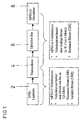
- the invention relates to a digital transcoding system for Receive and output data bit streams of a first bit rate of a data bit stream compared to the first bit rate different and in particular reduced second bit rate according to the features of the preamble of claim 1.
- a main area of application for digital transcoding is in the processing of video bit streams.
- DVD-Video video bit streams (DVD: Digital Video Disc or Digital Versatile Disc) according to the MPEG-2 video coding standard saved.
- the bit streams have a bit rate of e.g. up to 9.8 Mbit / s, the bit rate being constant over time or can be variable.
- this maximum bit rate is too high because the bus systems only a limited and mostly constant bit rate is available put.
- Adaptation of DVD technology for the application in the automobile therefore only works with a digital transcoder, which is the mean bit rate as well as the bit rate characteristic the video bit streams changed.
- An MPEG-2 program stream is usually stored on the DVD-Video and contains, for example, one video bit stream, several audio bit streams, subtitle and navigation information.
- the video bit stream is usually data reduced and encoded according to the video coding standards MPEG-1 or MPEG-2. Since the MPEG-2 video coding standard is mostly used, Table 1 shows some properties of the MPEG-2 video bit stream on the DVD-Video. DVD video. Some properties of the MPEG-2 video bit stream.
- the need to adapt DVD technology for the Use in automobiles becomes clear when you look at the properties considered the optical bus over which the video bit stream is distributed in the automobile.
- the optical bus For the transmission of the video bit stream the optical bus only sets a bit rate of 3 up to 4 Mbit / s ready.
- the bit rate provided is temporal constant, d. that is, in every time interval of the same duration the same amount of data is transported.
- These two properties of the bus lead to requirements for the to be transmitted Video bitstream.
- the video bit stream may therefore only be one Have a bit rate of 3 to 4 Mbit / s and the bit rate must be constant over time. If you compare the requirements with the entries in Table 1, it is clear that the video bit stream on the DVD video this does not meet.
- the middle and maximum bit rate on the DVD-Video are too high since that Video bit streams have a bit rate of up to 9.8 Mbit / s allowed to.
- the video bit streams on the DVD-Video in addition to a constant (CBR) also a variable (VBR) Own bit rate.
- CBR constant
- VBR variable Own bit rate.
- the video bit streams on the DVD-Video must therefore be related to that Bit rate level and the bit rate characteristic to the properties the optical bus can be adapted in the automobile. The adaptation is done by a digital transcoder.
- the digital transcoder forms the interface between two areas with different Characteristics.
- the development of a conversion algorithm for the transcoder and implementation of the algorithm is in a video processor platform therefore target different development work.
- the digital transcoder needs the bit rate reduce the supplied video bit stream and if necessary change its bit rate characteristic, so that at the output of the transcoder a CBR bit stream with a defined bit rate is present.
- the first requirement is that procedures be found to the amount of data of the supplied video bit stream to reduce subsequently.
- the second demand is through a bit rate regulation that meets the methods found above so that the transcoded video bit stream has the desired constant bit rate.
- the transcoding algorithm In addition to the requirements for the functions of the Transcoder, there are still requirements for the type and How these functions should be implemented. The additional Requirements for the implementation of the functions result from the intended realization with a Video processor. In order to simplify the realization, the transcoding algorithm not only a low complexity, but also have low storage requirements. The delay time caused by the bit rate control should be as low as possible to the runtime of the bit streams not to get too high by the system in Fig. 1.
- the picture quality of the transcoded Video bit stream are taken into account, because it depends significantly the acceptance of the system.
- the image quality should meeting the above requirements as good as to be possible.
- a known embodiment of a digital transcoder is in the article mentioned at the beginning Transcoder Architectures for Video Coding "on page 3 in connection with the block diagram shown there.
- the block diagram is shown here in analogy in Fig. 2.
- the known transcoder 4 consists of the chain connection of a complete MPEG-2 video decoder 10 and a complete MPEG 2 video encoder 20.
- the MPEG-2 video decoder 10 has the series connection of an input buffer 11, a VLC decoder 12 (VLC: code of variable length), a dequantizer 13, an inverse DCT stage 14 (DCT: discrete cosine transformation ) and a subsequent addition unit 15.
- the output signal of the addition stage 15 is fed to one input of an adder 30 of the MPEG-2 video encoder 20 and at the same time applied to an image memory 16 with a downstream motion compensation stage 17 and a second input of the addition stage 15.
- the MPEG-2 video encoder 20 has a series connection DCT stage 24, a subsequent quantizer 21 with downstream VLC encoder 22 and output buffer 23.
- the output of the quantizer 21 is with the input of a dequantizer 25 in connection, at the exit of another IDCT stage 26 is connected. Its output is with the Input of an adder 27 in connection.
- the exit of the Addition stage 27 is connected via an image memory 28 Movement compensation level 29 to a second Input of the adder stage fed back and to a second Input of the adder 30 out.
- Motion compensation level 29 is a motion estimation level 29a coupled.
- a bit rate control stage 31 of the MPEG-2 encoder 20 thus represents the quantizer 21 that the desired low constant target bit rate is reached becomes.
- Such a transcoder fulfills the requirements mentioned above the functions of the desired transcoder, however, the implementation effort is too high.
- the motion compensation and above all the motion estimation is the complexity way too high to do with reasonable effort in hardware implementation to enable.
- the storage requirements are also great, because for the implementation of motion compensation two images must be saved.
- a cause of the great complexity of the general Transcoder lies in the lack of communication between the decoder and the encoder.
- the encoder can on the in Decoder present coding parameters of the input bit stream do not access and must all coding parameters decide again. In particular, the encoder performs a new one Motion estimation by.
- the complexity and complexity of the general transcoder can be reduced if not all coding parameters decided again and the corresponding parameters of the Input bit stream can be used. Depending on the number and choice of result from coding parameters adopted from the input bit stream simplified transcoders.
- a well known simplified digital transcoder without the 2 and described above there is feedback only from the blocks with a gray background in Fig. 2 and is e.g. from image 2 on page 411 of the publication mentioned at the beginning "Rate Conversion Of MPEG Coded Video By Re-Quantization Process ".
- An adaptive requantization and bit rate control is provided in that the new requantization factor as a product of basic quantization factors and the quotient of input quantization factors And mean input quantization factors are determined.
- the present invention is based on the object initially mentioned digital, non-feedback transcoder to improve so that this in a very simple Way, without taking up much space in the implementation, is feasible.
- FIG. 3 shows the input side the transcoder 4 is converted into a first data stream R1 Input buffer 11 supplied.
- This input buffer 11 is used for the temporary storage of a section of the data bit stream R1.
- On the output side is the input buffer 11 with a VLD decoder and demultiplexer 12 in connection, which on the output side again at the entrance of a dequantizer 13 is laid.
- the output of the dequantizer 13 is directly with the input of a downstream quantizer 21 in connection, the output of which is connected to a VLC encoder.
- Output side is the digital transcoder 4 with one Output buffer 23 provided.
- a second data bit stream R2 can be tapped, for example compared to the input data stream R1 in its bit rate is reduced and constant while the received one Bit stream R1 can also be variable in its bit rate.
- FIG. 3 further shows, motion data in the VLC decoder and demultiplexer 12 directly and unchanged to the VLC encoder 22 given.
- the quantizer 21 is one Bit rate control level 50 in connection, the invention ensures that the data bit stream R2 in its bit rate is constant and a predetermined target bit rate having.
- the scope of the coefficient data depends on the chosen one Quantization from.
- a rough quantization with a big one Quantization factor reduces the amount of data of the coefficients, because many coefficients are quantized to zero, d. H. omitted, and the remaining coefficients in terms of amount grow small. Few small coefficients can be in the VLC unit can be encoded efficiently and cause a small amount of data.
- the high-rate input bit stream R1 contains finely quantized Coefficients.
- the finely quantized coefficients are Requantization process coarser quantized. This will decrease the Amount of data of the coefficients and the bit rate of the transcoded Bit streams. If the requantization factor is sufficient is chosen large, all coefficients disappear. This Special case is recognized in the transcoding process and accordingly the MPEG-2 standard in a manner known per se and Treated wisely.
- the bit rate control in the transcoder 4 ensures that the transcoded bit stream the desired requirements on the average and maximum bit rate and the bit rate characteristic Fulfills.
- the requantization factor is the only one for this Instrument of regulation. Every bit rate regulation in one Transcoder has a delay time. This attribute is supposed to be based on a general model of a bit rate regulation are explained.
- the bit rate regulation reads first a section of the input bitstream to close it analyze. Here, for. B. the amount of data of the coefficients per image and the quantization factors in the input bit stream evaluated. Only after the analysis, i.e. with one Delay time corresponding to the saved section of the input bit stream corresponds to the stored coefficient data requantized.
- a macro block is a data area in the MPEG-2 video bitstream, which contains both the coefficients and also the motion data of a 16 x 16 pixel size Includes image section.
- a macroblock is created from the Input bit stream read in, requanted without delay and written in the transcoded output bit stream.
- bit rate control Since the bit rate control does not pre-analyze the input bit stream carries out, it is oriented in the determination of the requantization gate to the amount of data already transcoded bit stream and the last used requantization factors. For some control setting parameters, that are not known due to the lack of a preliminary analysis, reasonable estimates must be made, which are expedient based on empirical and statistical surveys.
- VBR bit stream variable bit rate
- CBR bit stream constant bit rate
- the video bit streams on the DVD-Video are usually VBR bitstreams. Differentiate VBR bitstreams different from CBR bitstreams in some respects. Again Name expresses, VBR bitstreams have a variable Bit rate over time. That is, the for the transmission of a The bandwidth required by VBR bit streams fluctuates over time. On the other hand a CBR bitstream needs the same at all times Bandwidth because the bit rate is constant over time. The Bit rate characteristics are reflected in the amount of data per Image reflected. A VBR bitstream has a very fluctuating Amount of data per image.
- VBR bitstream Every picture gets that Amount of data allocated, which enables a very good image quality. Therefore, the picture quality of VBR bitstreams in the Usually constant over time and constantly at a high level.
- a CBR bitstream is subject to the limitation that it must have the same bit rate at all times. The The amount of data per image may only fluctuate within the frame, so that a constant bit rate is just maintained. The consequence is that simple images with a relatively large amount of data and encoded complicated pictures with a relatively small amount of data Need to become.
- the bit rate control in the invention Transcoder 4 takes into account the properties mentioned above of the VBR input bit stream and generates a transcoded Bit stream that meets the CBR properties.
- FIG 4 is a compared to the block diagram of Figure 3 more detailed circuit diagram shown.
- the bit rate regulation level 50 consists of a series of circuit blocks 51 to 57, the signals or setting parameters still to be explained a) to j) are fed to the requantization factor in the quantization stage 21 to regulate so that the output Data bit stream R2 a predetermined, constant Has target bit rate.
- the bit rate control stage 50 has a bit allocation stage 51 to determine the target amount of data for an image.
- This Level 51 is associated with an estimation level 53.
- a verification unit 54 is coupled to the estimation point 53 and checks the estimates based on the information in the received data bit stream R1.
- Another signal b becomes the bit allocation stage 51 provided by a cut detection stage 55. In this Section recognition level 55 becomes image or scene sections detected.
- Bit allocation stage 51 generates signals a to f a signal j for the target data amount of an image and leads this to a so-called rate control stage 52.
- This rate control level 52 stands directly with the quantizer 21 of the Transcoder 4 in connection and provides the quantizer 21st of the transcoder 4 the requantization factors for each Macroblock available in the picture.
- the rate control level 52 in addition to the target data set j an additional one Information about the refresh rate and target bit rate (Signals e and f) provided. It also receives the rate control stage 52 transmits an information signal g the number of macroblocks per picture (signal g) and an information signal about the number of bits used in transcoding of the individual marker blocks were generated (signal H).
- the rate control stage 52 receives one Signal i from a monitoring unit 56 with a VBV memory 57 is connected.
- the signal i indicates that the VBV memory (VBV: Video Buffering Verifier) 57 neither is still empty.
- Bit allocation level 51 are estimates for the GOP length and the structure of a Image group (GOP structure) provided. This is necessary so that the bit allocation level 51 is meaningful Can calculate the value for the target data volume of an image.
- the dequantizer 13 and quantizer 21 can be replaced by a common stage 40.
- An example of such a common stage 40 is shown in FIG. 9.
- the common stage 40 has a multiplier 41, to which the coefficient data QF old and the division result from the division of the old requantization factors qs old to the new requantization factors qs new are fed from the VLD decoder and demultiplexer 12.
- the division from qs old to qs new takes place in a divider 45.
- the new requantization factors qs new are made available, as explained in connection with FIG. 4, via the bit control stage 50 or manually.
- the old requantization factor qs old is fed directly from the VLD decoder and demultiplexer 12 to the divider 45.
- the output of the multiplier 41 is connected to a float integer conversion stage 42, at the output of which the new coefficient data QF are newly available and are fed to the input of the VLC encoder 22.
- the quantization and requantization factors are therefore not determined independently of one another in two steps, but together in one step.
- the quantization of the DCT coefficients i.e. coefficient data
- the quantization matrix contains a value for each of the 64 DCT coefficients of a block.
- the quantization factor qs is constant for all blocks and thus also for all coefficients of a macro block.
- a characteristic of the requantization process according to the invention is that the quantization matrix is not changed.
- the transcoded bit stream contains the same quantization matrices as the input bit stream R1. Since the quantization matrices remain unchanged, the requantization formula contains according to no elements of the quantization matrices.
- the quotient qs old / qs new is constant for all DCT coefficients of a macroblock, it only has to be calculated once per macroblock and only if qs old or qs new have changed compared to the previous macroblock.
- the new coefficient data QS new is calculated by mere multiplication with the factor from qs old / qs new with the old coefficient data QF old .
- the multiplication advantageously only has to be carried out if QF old is not equal to zero.
- the above requatisation formula shows its full Benefit when the effort in computing operations is minimized should be, as is the case with hardware implementations is.
- the requantization formula mentioned above only causes at most one division per macroblock and at most one Multiplication per DCT coefficient.
- FIG. 10 is the block diagram for a circuit arrangement to calculate the new requantization factors qsnew shown. This type of calculation can be done in any transcoder be used (also in the known 2 and 3) and is therefore independent from the circuit arrangement for determining the DCT coefficients. However, it is preferred that the block diagram of FIG. 10 in combination with the arrangement of FIG. 9 is used.
- Fig. 10 The block diagram of Fig. 10 consists of different arithmetic stages 60 to 67, each with different calculation parameters be fed. To the way of calculation To understand first is the theoretical background explained for the realization.
- bit rate control for a transcoder is based on the complexity measure, in short Complexity ".
- Complexity A distinction must be made between the following complexities:
- the regulation determines the Requantticians tone qs new [i] for each macroblock.
- Target amount of data for a transcoded macroblock td MB [i] Target amount of data for a transcoded slice td slice Target amount of data for a transcoded image td picture Target amount of data for a transcoded GOP td GOP
- the target amount of data is the amount of data that a macroblock, Slice, picture, or using a GOP after transcoding the requantization factor specified by the regulation should have transcoded bit stream.
- the index BO "(reference object) stands for slice, image or GOP, that is BO ⁇ ⁇ slice, image, GOP ⁇ . It is thus agreed that the following equations apply to various reference objects BO and that the regulation can be implemented with regard to different reference objects BO. In the following equations, BO always stands for the same reference object, i.e. slice, image or GOP.
- the bit rate control requires the bit rate r in of the input bit stream.
- a section of the input bit stream is stored. The section extends from an intra-image (including this I-image) to the subsequent intra-image (excluding this I-image).
- R denotes a weighting factor
- S denotes a factor to prevent the VBV memory from over- or idling.
- the regulation inserts so-called stuffing bytes into the bit stream.
- S is a function depending on the fill level of the VBV memory. In one example, the function for S can be linear. The function then delivers a value S> 1.0 at a low fill level in order to increase qs MB in [i]. If the fill level is high, the function returns a value S ⁇ 1.0 to reduce qs MB out [i]. S is updated after the transcoding of an image or a macro block (if a certain fill level is exceeded or fallen below if necessary).
- a central computing device 67 is provided with the predetermined factors R, A and S as well as the bit rate r in of the received and therefore input-side data bit stream and the desired output bit rate r out .
- the computing device 67 determines therefrom the new Requantticians tileen qs new.
- A is determined according to the above formula.
- the stage 65 is connected on the output side to the computing device 67 and receives the parameter C BO in from the stage 62 and the value td BO from the stage 60.
- the stage 65 calculates the value for the correction factor A from the quotient of C BO in / td BO .
- the stage 60 generates the value td BO from the quantities ⁇ d BO , d BO in , r in and r out and supplies this to the stage 65.
- the dBO in and r in values are provided by stage 64.
- stage 64 provides the value d MB in [i] of stage 62 and the value r in computing device 67.
- the stage 62 also receives the old requantization factors qs alt [i] as input and supplies the stage 65 with the value C BO in .
- the correction factor S comes from the stage 63 to the computing device 67.
- the transcoding algorithm for the bit rate control transcoder was developed and investigated in accordance with the above.
- the functionality of the algorithm is shown using an example.
- the well-known image test sequence with the name Susie "(note: this test sequence shows a lady on the phone) has a resolution of 720 x 576 pixels and a refresh rate of 25 Hz.
- An MPEG-2 encoder is configured in such a way that it generates a video bit stream with an average bit rate of 6 Mbit / s generated.
- This bit stream is applied to the input of the transcoder according to the invention and transcoded to 3 Mbit / s.
- the transcoded bit stream at the output of the transcoder according to the invention has a constant bit rate, as desired.
- the selected bit rates are typical for the given problem, however, although the DVD-Video allows a maximum bit rate of 9.8 Mbit / s, the average bit rate of the VBR bit streams stored on it is only 6 Mbit / s or less.
- the reduction in the amount of data in the transcoder according to the invention succeeds through requantization with a rough quantization factor.
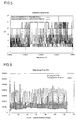
- Fig. 5 illustrates the requantization process.
- QS is the quantization factor on the vertical of the diagram QS in the input bitstream (weakly drawn Curve shape) and in the transcoded bit stream (bold drawn curve). On the horizontal the continuous macroblocks are shown.
- the input bitstream contains relative small quantization factors.
- At the bit rate of the input bit stream to reduce from 6 to 3 Mbit / s are in Requantization process increases the quantization factors. This corresponds to a coarser quantization.
- the curve that represents the quantization factors in the transcoded bit stream therefore runs above the curve representing the quantization factors reproduces in the input bitstream.
- the coarser Quantization in the transcoded bit stream, and thus the lower bit rate, is reflected in the amount of data per image contrary.
- Fig. 6 shows that the individual images in the transcoded Bitstream a smaller amount of data than in the higher-rate input bitstream have.
- the transcoded bit stream has due to its lower bit rate, a smaller amount of data per image, as can be seen from the bold curve is.
- PSNR Peak Signal-to-Noise Ratio
- the transcoder according to the invention thus delivers approximately the same picture quality as the general transcoder. This result is very positive , because it says that the transcoder according to the invention, despite the lower complexity and the lower memory requirements has almost the same performance as the general transcoder and has been shown to be even better in some cases. The extremely high implementation costs of the transcoder from FIG. 2 can thus be avoided.
- the results of the example are representative and can be reproduced using other test sequences and bit rates.
- the transcoder Take into account the requirements for the transcoder according to the invention the simplest possible realization with one Video processor.
- the previous explanations have shown that the transcoder not only this Meets requirements, but also provides image quality, with the well-known, very complex transcoder 2 is comparable.
- the realization of the transcoder according to the invention by a video processor possible with little storage effort and e.g. in an optical Bus system realizable within a motor vehicle.
- the input bit stream is written piece by piece into the input buffer 11.
- the VLD unit 12 breaks down the input bit stream R1 into its syntax elements and for this purpose decodes the code words with variable length. Of the syntax elements, only those are processed that identify coefficient data. Coefficient data are understood to mean the pixels of all images transformed into the frequency domain with the discrete cosine transformation (DCT).
- the coefficient data are dequantized (Q -1 ) and then the requantization process ( Q ) subjected.
- the bit rate control regulates the requantization factor so that the transcoded bit stream has the desired low constant bit rate at the output.
- the requantized coefficient data are converted into code words in the VLC unit 22.
- the VLC unit 22 also inserts the unchanged motion data from the input bit stream R1 into the transcoded bit stream.
- the complete transcoded bit stream is stored in the output buffer 23 and output.
- the transcoder according to the invention has a low level of complexity since, in comparison to the general transcoder in FIG. 2, it does not carry out any transformations (IDCT, DCT), no motion compensation (MC) in a feedback loop and no motion estimation (ME). Since motion compensation is dispensed with, the transcoder according to the invention does not require any image memories (FS). The storage requirements are therefore low.
- the bit rate control works with a short delay time.
- the transcoder according to the invention thus fulfills all the requirements which are necessary for an advantageous implementation with a video processor.
- the transcoder 4 is used in a digital video recording system for recording digital data on a storage medium 80 with a data bit stream R2 of constant bit rate, which is independent of the bit rate of the received data bit stream R1.
- the transcoder 4 is on the input side to a digital video source, e.g. B. a digital video disc 65 or a signal source 60 to which a digital video broadcast casting signal (DVBS, DVBC, DVBT) is provided.
- the corresponding signal source 60 or 65 can be selected via a switch 70.
- the signals of the signal sources 60 or 65 can be stored directly via a connecting line 72 onto the storage medium 80 or reduced in bitrate if the switches of the switching device 71 are in the position shown in FIG. 8.
- the received data bit stream R1 or R1 ' is routed via the transcoder 4 and reduced in bit rate, and is stored on the storage medium 80 having a constant bit rate.
- a Longplay recording function "can be achieved because the storage medium 80 receives bit rate-reduced storage data.
- the recording or recording time of the storage medium 80 which can be, for example, a magnetic tape or a semiconductor memory, is thus significantly increased by the transcoder 4 according to the invention.
- the main advantage of using the transcoder 4 to record data is that at the exit of the Transcoder 4 in any case a constant bit rate Is available regardless of whether the input side Data bit streams are variable or constant.
- the storage medium 80 can be a decoder 85, e.g. B. an MPEG-2 decoder.
- a decoder 85 e.g. B. an MPEG-2 decoder.
- the transcoder 4 it is also possible to use the transcoder 4 in such a way that he has a transcoding program in recording mode and executes a decoding program in the playback mode. This is microprocessor controlled possible.
Landscapes
- Engineering & Computer Science (AREA)
- Multimedia (AREA)
- Signal Processing (AREA)
- Physics & Mathematics (AREA)
- Algebra (AREA)
- General Physics & Mathematics (AREA)
- Mathematical Analysis (AREA)
- Mathematical Optimization (AREA)
- Pure & Applied Mathematics (AREA)
- Compression Or Coding Systems Of Tv Signals (AREA)
- Compression, Expansion, Code Conversion, And Decoders (AREA)
Applications Claiming Priority (2)
| Application Number | Priority Date | Filing Date | Title |
|---|---|---|---|
| DE19946267A DE19946267C2 (de) | 1999-09-27 | 1999-09-27 | Digitales Transcodiersystem |
| DE19946267 | 1999-09-27 |
Publications (3)
| Publication Number | Publication Date |
|---|---|
| EP1087625A2 true EP1087625A2 (fr) | 2001-03-28 |
| EP1087625A3 EP1087625A3 (fr) | 2005-11-09 |
| EP1087625B1 EP1087625B1 (fr) | 2012-06-13 |
Family
ID=7923461
Family Applications (1)
| Application Number | Title | Priority Date | Filing Date |
|---|---|---|---|
| EP00118575A Expired - Lifetime EP1087625B1 (fr) | 1999-09-27 | 2000-08-26 | Système numérique de transcodage |
Country Status (4)
| Country | Link |
|---|---|
| US (2) | US7106799B1 (fr) |
| EP (1) | EP1087625B1 (fr) |
| JP (1) | JP4628535B2 (fr) |
| DE (1) | DE19946267C2 (fr) |
Cited By (26)
| Publication number | Priority date | Publication date | Assignee | Title |
|---|---|---|---|---|
| WO2003047264A2 (fr) | 2001-11-21 | 2003-06-05 | Vixs Systems Inc. | Procede et systeme pour reguler le debit pendant le transcodage video |
| US7054964B2 (en) | 2001-07-30 | 2006-05-30 | Vixs Systems, Inc. | Method and system for bit-based data access |
| US7106715B1 (en) | 2001-11-16 | 2006-09-12 | Vixs Systems, Inc. | System for providing data to multiple devices and method thereof |
| US7130350B1 (en) | 2003-02-28 | 2006-10-31 | Vixs Systems, Inc. | Method and system for encoding and decoding data in a video stream |
| US7133452B1 (en) | 2003-02-24 | 2006-11-07 | Vixs Systems, Inc. | Method and system for transcoding video data |
| US7139330B1 (en) | 2001-10-31 | 2006-11-21 | Vixs Systems, Inc. | System for signal mixing and method thereof |
| US7165180B1 (en) | 2001-11-27 | 2007-01-16 | Vixs Systems, Inc. | Monolithic semiconductor device for preventing external access to an encryption key |
| US7277101B2 (en) | 2003-09-29 | 2007-10-02 | Vixs Systems Inc | Method and system for scaling images |
| US7310679B1 (en) | 2002-04-29 | 2007-12-18 | Vixs Systems Inc. | Method and system for transmitting video content while preventing other transmissions in a contention-based network |
| US7327784B2 (en) | 2003-02-24 | 2008-02-05 | Vixs Systems, Inc. | Method and system for transcoding video data |
| US7400869B2 (en) | 2005-03-22 | 2008-07-15 | Vixs Systems Inc. | System and method for adaptive DC offset compensation in wireless transmissions |
| US7403564B2 (en) | 2001-11-21 | 2008-07-22 | Vixs Systems, Inc. | System and method for multiple channel video transcoding |
| US7406598B2 (en) | 2004-02-17 | 2008-07-29 | Vixs Systems Inc. | Method and system for secure content distribution |
| US7408989B2 (en) | 2003-01-16 | 2008-08-05 | Vix5 Systems Inc | Method of video encoding using windows and system thereof |
| US7421048B2 (en) | 2005-01-20 | 2008-09-02 | Vixs Systems, Inc. | System and method for multimedia delivery in a wireless environment |
| EP1087622A3 (fr) * | 1999-09-27 | 2009-09-30 | XSYS Interactive Research GmbH | Système numérique de transcodage |
| US7602847B1 (en) | 2001-03-27 | 2009-10-13 | Vixs Systems, Inc. | Device and method for compression of a video stream |
| US7606305B1 (en) | 2003-02-24 | 2009-10-20 | Vixs Systems, Inc. | Method and system for transcoding video data |
| US7609766B2 (en) | 2005-02-08 | 2009-10-27 | Vixs Systems, Inc. | System of intra-picture complexity preprocessing |
| US7668396B2 (en) | 2003-09-29 | 2010-02-23 | Vixs Systems, Inc. | Method and system for noise reduction in an image |
| US7675972B1 (en) | 2001-07-30 | 2010-03-09 | Vixs Systems, Inc. | System and method for multiple channel video transcoding |
| US7707485B2 (en) | 2005-09-28 | 2010-04-27 | Vixs Systems, Inc. | System and method for dynamic transrating based on content |
| US7739105B2 (en) | 2003-06-13 | 2010-06-15 | Vixs Systems, Inc. | System and method for processing audio frames |
| US8107524B2 (en) | 2001-03-30 | 2012-01-31 | Vixs Systems, Inc. | Adaptive bandwidth footprint matching for multiple compressed video streams in a fixed bandwidth network |
| US8131995B2 (en) | 2006-01-24 | 2012-03-06 | Vixs Systems, Inc. | Processing feature revocation and reinvocation |
| US8949920B2 (en) | 2005-03-17 | 2015-02-03 | Vixs Systems Inc. | System and method for storage device emulation in a multimedia processing system |
Families Citing this family (16)
| Publication number | Priority date | Publication date | Assignee | Title |
|---|---|---|---|---|
| DE19946267C2 (de) * | 1999-09-27 | 2002-09-26 | Harman Becker Automotive Sys | Digitales Transcodiersystem |
| US9445133B2 (en) * | 2002-07-10 | 2016-09-13 | Arris Enterprises, Inc. | DVD conversion for on demand |
| JP4747494B2 (ja) * | 2004-03-03 | 2011-08-17 | ソニー株式会社 | データ処理装置およびその方法と符号化装置 |
| US7530089B1 (en) * | 2004-03-29 | 2009-05-05 | Nortel Networks Limited | System and method for improving video quality using a constant bit rate data stream |
| KR20070033363A (ko) * | 2004-06-21 | 2007-03-26 | 코닌클리케 필립스 일렉트로닉스 엔.브이. | 처리할 데이터 부분들이 선택되는 비디오 트랜스코딩 |
| JP4225957B2 (ja) | 2004-08-03 | 2009-02-18 | 富士通マイクロエレクトロニクス株式会社 | 映像符号化装置及び映像符号化方法 |
| EP1805996B1 (fr) * | 2004-10-20 | 2009-04-22 | Koninklijke Philips Electronics N.V. | Procede pour limiter le bruit de quantification |
| CN101001371B (zh) * | 2007-01-19 | 2010-05-19 | 华为技术有限公司 | 视频转码的方法及其装置 |
| JP4823150B2 (ja) * | 2007-05-31 | 2011-11-24 | キヤノン株式会社 | 符号化装置並びに符号化方法 |
| US8279935B2 (en) * | 2007-09-27 | 2012-10-02 | Intel Corporation | Method and apparatus for image quality control in video data |
| JP5550032B2 (ja) * | 2008-08-05 | 2014-07-16 | 株式会社メガチップス | トランスコーダ |
| US8521520B2 (en) * | 2010-02-03 | 2013-08-27 | General Electric Company | Handoffs between different voice encoder systems |
| US9380327B2 (en) * | 2011-12-15 | 2016-06-28 | Comcast Cable Communications, Llc | System and method for synchronizing timing across multiple streams |
| US9137285B2 (en) * | 2013-10-21 | 2015-09-15 | Broadcom Corporation | Adaptive audio video (AV) stream processing |
| FR3024314B1 (fr) * | 2014-07-25 | 2017-12-08 | Allegro Dvt | Codeur de video a faible latence |
| CN119420900A (zh) | 2019-04-25 | 2025-02-11 | 华为技术有限公司 | 图像预测方法、装置和计算机可读存储介质 |
Citations (3)
| Publication number | Priority date | Publication date | Assignee | Title |
|---|---|---|---|---|
| DE19623934A1 (de) | 1996-06-15 | 1997-12-18 | Ise Interactive Systems Entwic | Digitales Datenempfangssystem |
| WO1997049206A2 (fr) | 1996-06-15 | 1997-12-24 | Ise Interactive Systems Entwicklungsgesellschaft Mbh & Co. Kg | Systeme numerique d'emission de donnees avec differents taux de compression, en particulier pour radiodiffusion numerique |
| US5754235A (en) | 1994-03-25 | 1998-05-19 | Sanyo Electric Co., Ltd. | Bit-rate conversion circuit for a compressed motion video bitstream |
Family Cites Families (19)
| Publication number | Priority date | Publication date | Assignee | Title |
|---|---|---|---|---|
| US6215425B1 (en) * | 1992-02-19 | 2001-04-10 | Netergy Networks, Inc. | Deblocking filter for encoder/decoder arrangement and method with divergence reduction |
| JP3085024B2 (ja) * | 1993-06-01 | 2000-09-04 | 松下電器産業株式会社 | 画像再圧縮器及び画像記録装置 |
| US5537440A (en) * | 1994-01-07 | 1996-07-16 | Motorola, Inc. | Efficient transcoding device and method |
| JP3244399B2 (ja) * | 1994-03-25 | 2002-01-07 | 三洋電機株式会社 | 圧縮動画像符号信号の情報量変換回路、及び方法 |
| US5541852A (en) * | 1994-04-14 | 1996-07-30 | Motorola, Inc. | Device, method and system for variable bit-rate packet video communications |
| US5940130A (en) * | 1994-04-21 | 1999-08-17 | British Telecommunications Public Limited Company | Video transcoder with by-pass transfer of extracted motion compensation data |
| US5889561A (en) * | 1994-11-04 | 1999-03-30 | Rca Thomson Licensing Corporation | Method and apparatus for scaling a compressed video bitstream |
| DE69607696T2 (de) * | 1995-02-15 | 2000-10-19 | Koninklijke Philips Electronics N.V., Eindhoven | Vorrichtung und verfahren zur transkodierung von videosignalen |
| JP3208039B2 (ja) * | 1995-03-09 | 2001-09-10 | ケイディーディーアイ株式会社 | 画像符号化データのレート変換装置 |
| US5870146A (en) * | 1997-01-21 | 1999-02-09 | Multilink, Incorporated | Device and method for digital video transcoding |
| US6278735B1 (en) * | 1998-03-19 | 2001-08-21 | International Business Machines Corporation | Real-time single pass variable bit rate control strategy and encoder |
| US6466623B1 (en) * | 1998-03-27 | 2002-10-15 | Industrial Technology Research Institute | Method and apparatus for motion estimation for high performance transcoding |
| US6226328B1 (en) * | 1998-05-01 | 2001-05-01 | Boom Corporation | Transcoding apparatus for digital video networking |
| KR100304103B1 (ko) * | 1998-05-29 | 2001-09-24 | 이계철 | 비트율이급변되는재양자화계단크기선택방법및그를이용한비트율제어방법 |
| US6310915B1 (en) * | 1998-11-20 | 2001-10-30 | Harmonic Inc. | Video transcoder with bitstream look ahead for rate control and statistical multiplexing |
| US6259741B1 (en) * | 1999-02-18 | 2001-07-10 | General Instrument Corporation | Method of architecture for converting MPEG-2 4:2:2-profile bitstreams into main-profile bitstreams |
| US6441754B1 (en) * | 1999-08-17 | 2002-08-27 | General Instrument Corporation | Apparatus and methods for transcoder-based adaptive quantization |
| DE19946267C2 (de) * | 1999-09-27 | 2002-09-26 | Harman Becker Automotive Sys | Digitales Transcodiersystem |
| US6847656B1 (en) * | 2000-09-25 | 2005-01-25 | General Instrument Corporation | Statistical remultiplexing with bandwidth allocation among different transcoding channels |
-
1999
- 1999-09-27 DE DE19946267A patent/DE19946267C2/de not_active Expired - Fee Related
-
2000
- 2000-08-26 EP EP00118575A patent/EP1087625B1/fr not_active Expired - Lifetime
- 2000-09-27 JP JP2000293345A patent/JP4628535B2/ja not_active Expired - Fee Related
- 2000-09-27 US US09/672,293 patent/US7106799B1/en not_active Expired - Fee Related
-
2006
- 2006-09-11 US US11/519,461 patent/US7936816B2/en not_active Expired - Fee Related
Patent Citations (3)
| Publication number | Priority date | Publication date | Assignee | Title |
|---|---|---|---|---|
| US5754235A (en) | 1994-03-25 | 1998-05-19 | Sanyo Electric Co., Ltd. | Bit-rate conversion circuit for a compressed motion video bitstream |
| DE19623934A1 (de) | 1996-06-15 | 1997-12-18 | Ise Interactive Systems Entwic | Digitales Datenempfangssystem |
| WO1997049206A2 (fr) | 1996-06-15 | 1997-12-24 | Ise Interactive Systems Entwicklungsgesellschaft Mbh & Co. Kg | Systeme numerique d'emission de donnees avec differents taux de compression, en particulier pour radiodiffusion numerique |
Non-Patent Citations (2)
| Title |
|---|
| "Artikel Transcoder Architectures For Video Coding", IEEE INTERNATIONAL CONFERENCE ON IMAGING PROCESSING, vol. 3, 1995, pages 408 - 411 |
| IEEE TRANSACTIONS ON CONSUMER ELECTRONICS, vol. 44, no. 1, February 1998 (1998-02-01), pages 88 - 98 |
Cited By (30)
| Publication number | Priority date | Publication date | Assignee | Title |
|---|---|---|---|---|
| EP1087622A3 (fr) * | 1999-09-27 | 2009-09-30 | XSYS Interactive Research GmbH | Système numérique de transcodage |
| US7602847B1 (en) | 2001-03-27 | 2009-10-13 | Vixs Systems, Inc. | Device and method for compression of a video stream |
| US8107524B2 (en) | 2001-03-30 | 2012-01-31 | Vixs Systems, Inc. | Adaptive bandwidth footprint matching for multiple compressed video streams in a fixed bandwidth network |
| US9826259B2 (en) | 2001-03-30 | 2017-11-21 | Vixs Systems Inc. | Managed degradation of a video stream |
| US7675972B1 (en) | 2001-07-30 | 2010-03-09 | Vixs Systems, Inc. | System and method for multiple channel video transcoding |
| US7054964B2 (en) | 2001-07-30 | 2006-05-30 | Vixs Systems, Inc. | Method and system for bit-based data access |
| US7139330B1 (en) | 2001-10-31 | 2006-11-21 | Vixs Systems, Inc. | System for signal mixing and method thereof |
| US7106715B1 (en) | 2001-11-16 | 2006-09-12 | Vixs Systems, Inc. | System for providing data to multiple devices and method thereof |
| WO2003047264A2 (fr) | 2001-11-21 | 2003-06-05 | Vixs Systems Inc. | Procede et systeme pour reguler le debit pendant le transcodage video |
| US10129552B2 (en) | 2001-11-21 | 2018-11-13 | Vixs Systems Inc. | Method and system for rate control during video transcoding |
| US7356079B2 (en) | 2001-11-21 | 2008-04-08 | Vixs Systems Inc. | Method and system for rate control during video transcoding |
| US7403564B2 (en) | 2001-11-21 | 2008-07-22 | Vixs Systems, Inc. | System and method for multiple channel video transcoding |
| WO2003047264A3 (fr) * | 2001-11-21 | 2003-09-04 | Vixs Systems Inc | Procede et systeme pour reguler le debit pendant le transcodage video |
| US7165180B1 (en) | 2001-11-27 | 2007-01-16 | Vixs Systems, Inc. | Monolithic semiconductor device for preventing external access to an encryption key |
| US7310679B1 (en) | 2002-04-29 | 2007-12-18 | Vixs Systems Inc. | Method and system for transmitting video content while preventing other transmissions in a contention-based network |
| US7408989B2 (en) | 2003-01-16 | 2008-08-05 | Vix5 Systems Inc | Method of video encoding using windows and system thereof |
| US7133452B1 (en) | 2003-02-24 | 2006-11-07 | Vixs Systems, Inc. | Method and system for transcoding video data |
| US7327784B2 (en) | 2003-02-24 | 2008-02-05 | Vixs Systems, Inc. | Method and system for transcoding video data |
| US7606305B1 (en) | 2003-02-24 | 2009-10-20 | Vixs Systems, Inc. | Method and system for transcoding video data |
| US7130350B1 (en) | 2003-02-28 | 2006-10-31 | Vixs Systems, Inc. | Method and system for encoding and decoding data in a video stream |
| US7739105B2 (en) | 2003-06-13 | 2010-06-15 | Vixs Systems, Inc. | System and method for processing audio frames |
| US7668396B2 (en) | 2003-09-29 | 2010-02-23 | Vixs Systems, Inc. | Method and system for noise reduction in an image |
| US7277101B2 (en) | 2003-09-29 | 2007-10-02 | Vixs Systems Inc | Method and system for scaling images |
| US7406598B2 (en) | 2004-02-17 | 2008-07-29 | Vixs Systems Inc. | Method and system for secure content distribution |
| US7421048B2 (en) | 2005-01-20 | 2008-09-02 | Vixs Systems, Inc. | System and method for multimedia delivery in a wireless environment |
| US7609766B2 (en) | 2005-02-08 | 2009-10-27 | Vixs Systems, Inc. | System of intra-picture complexity preprocessing |
| US8949920B2 (en) | 2005-03-17 | 2015-02-03 | Vixs Systems Inc. | System and method for storage device emulation in a multimedia processing system |
| US7400869B2 (en) | 2005-03-22 | 2008-07-15 | Vixs Systems Inc. | System and method for adaptive DC offset compensation in wireless transmissions |
| US7707485B2 (en) | 2005-09-28 | 2010-04-27 | Vixs Systems, Inc. | System and method for dynamic transrating based on content |
| US8131995B2 (en) | 2006-01-24 | 2012-03-06 | Vixs Systems, Inc. | Processing feature revocation and reinvocation |
Also Published As
| Publication number | Publication date |
|---|---|
| EP1087625A3 (fr) | 2005-11-09 |
| JP4628535B2 (ja) | 2011-02-09 |
| DE19946267C2 (de) | 2002-09-26 |
| US20070116116A1 (en) | 2007-05-24 |
| DE19946267A1 (de) | 2001-04-05 |
| US7106799B1 (en) | 2006-09-12 |
| EP1087625B1 (fr) | 2012-06-13 |
| JP2001136530A (ja) | 2001-05-18 |
| US7936816B2 (en) | 2011-05-03 |
Similar Documents
| Publication | Publication Date | Title |
|---|---|---|
| EP1087625B1 (fr) | Système numérique de transcodage | |
| DE69230704T2 (de) | Verfahren und Einrichtung zur Kompression von sich bewegenden Videobildern mit adaptiver Bitzuordnung und Quantisierung | |
| DE69815720T2 (de) | Kodierung von bewegten bildern mit variabler bitrate in einem durchgang | |
| DE69524847T2 (de) | Verfahren und Einrichtung zum Skalieren eines komprimierten Videobitstromes | |
| DE69435000T2 (de) | Bildkodierungsvorrichtung | |
| DE60023576T2 (de) | Verfahren und Vorrichtung zur Bewegtbilddatentranscodierung | |
| DE69827548T2 (de) | Anordnung zur Vorverarbeitung für MPEG-2-Kodierung | |
| DE69430877T2 (de) | Bildkodierungsverfahren und -vorrichtung | |
| DE10253380B4 (de) | Verfahren und Einrichtung zum Kodieren sich bewegender Bilder mit fester Rechenkomplexität | |
| DE69801339T2 (de) | Verfahren und vorrichtung zur bestimmung der bit-ordnung in einem videokompressionssystem | |
| DE60032841T2 (de) | Signalprozessor zum nahtlosen Zusammenfügen von MPEG-2 Bitströmen in einem Videokoder | |
| DE69735756T2 (de) | Dynamische steuerung der kodierrate in einem blockbasierten videokodierungssystem | |
| DE69521238T2 (de) | Bilddatenquantisierung in Bildkomprimierung | |
| DE69837003T2 (de) | Vorrichtung und verfahren zur optimierung der bitratensteurung in einem kodiersystem | |
| DE69815159T2 (de) | Kodierung von bewegten bildern mit globaler konstanter bitrate | |
| DE69512548T2 (de) | Verfahren und Vorrichtung zur Vermeidung von wiederholenden Zufallsfehlern in Transformationskoeffizienten von Bewegtbildsignalen | |
| DE69921108T2 (de) | Verfahren und vorrichtung zur adaptiven codierung eines videodatenstroms | |
| DE69611488T2 (de) | Modifiziertes Leaky-Bucketverfahren | |
| DE69816875T2 (de) | Sequenzadaptive bit-zuordnung zur codierung von bildern | |
| DE69715660T2 (de) | Videokodierung | |
| EP1025708B1 (fr) | Procede et dispositif pour le traitement d'une image numerique | |
| DE69935564T2 (de) | Kodiervorrichtung und -verfahren | |
| DE69616962T2 (de) | Verfahren und Vorrichtung zur Kompression von digitalen Daten | |
| DE69321924T2 (de) | Verfahren zum zwei-standard-kodieren von bildern, mit sehr niedriger datenrate und codierer/decodierer zur durchführung dieses verfahrens | |
| DE69624399T2 (de) | Einrichtung zur Kompression von bewegten Videobildern mit adaptiver Quantisierung |
Legal Events
| Date | Code | Title | Description |
|---|---|---|---|
| PUAI | Public reference made under article 153(3) epc to a published international application that has entered the european phase |
Free format text: ORIGINAL CODE: 0009012 |
|
| AK | Designated contracting states |
Kind code of ref document: A2 Designated state(s): AT BE CH CY DE DK ES FI FR GB GR IE IT LI LU MC NL PT SE |
|
| AX | Request for extension of the european patent |
Free format text: AL;LT;LV;MK;RO;SI |
|
| PUAL | Search report despatched |
Free format text: ORIGINAL CODE: 0009013 |
|
| AK | Designated contracting states |
Kind code of ref document: A3 Designated state(s): AT BE CH CY DE DK ES FI FR GB GR IE IT LI LU MC NL PT SE |
|
| AX | Request for extension of the european patent |
Extension state: AL LT LV MK RO SI |
|
| 17P | Request for examination filed |
Effective date: 20060415 |
|
| AKX | Designation fees paid |
Designated state(s): AT BE CH CY DE DK ES FI FR GB GR IE IT LI LU MC NL PT SE |
|
| 17Q | First examination report despatched |
Effective date: 20090123 |
|
| GRAP | Despatch of communication of intention to grant a patent |
Free format text: ORIGINAL CODE: EPIDOSNIGR1 |
|
| GRAS | Grant fee paid |
Free format text: ORIGINAL CODE: EPIDOSNIGR3 |
|
| GRAA | (expected) grant |
Free format text: ORIGINAL CODE: 0009210 |
|
| AK | Designated contracting states |
Kind code of ref document: B1 Designated state(s): AT BE CH CY DE DK ES FI FR GB GR IE IT LI LU MC NL PT SE |
|
| REG | Reference to a national code |
Ref country code: GB Ref legal event code: FG4D Free format text: NOT ENGLISH |
|
| REG | Reference to a national code |
Ref country code: CH Ref legal event code: EP Ref country code: AT Ref legal event code: REF Ref document number: 562438 Country of ref document: AT Kind code of ref document: T Effective date: 20120615 |
|
| REG | Reference to a national code |
Ref country code: IE Ref legal event code: FG4D Free format text: LANGUAGE OF EP DOCUMENT: GERMAN |
|
| REG | Reference to a national code |
Ref country code: DE Ref legal event code: R096 Ref document number: 50016235 Country of ref document: DE Effective date: 20120809 |
|
| REG | Reference to a national code |
Ref country code: NL Ref legal event code: VDEP Effective date: 20120613 |
|
| PG25 | Lapsed in a contracting state [announced via postgrant information from national office to epo] |
Ref country code: SE Free format text: LAPSE BECAUSE OF FAILURE TO SUBMIT A TRANSLATION OF THE DESCRIPTION OR TO PAY THE FEE WITHIN THE PRESCRIBED TIME-LIMIT Effective date: 20120613 Ref country code: FI Free format text: LAPSE BECAUSE OF FAILURE TO SUBMIT A TRANSLATION OF THE DESCRIPTION OR TO PAY THE FEE WITHIN THE PRESCRIBED TIME-LIMIT Effective date: 20120613 Ref country code: CY Free format text: LAPSE BECAUSE OF FAILURE TO SUBMIT A TRANSLATION OF THE DESCRIPTION OR TO PAY THE FEE WITHIN THE PRESCRIBED TIME-LIMIT Effective date: 20120613 |
|
| PG25 | Lapsed in a contracting state [announced via postgrant information from national office to epo] |
Ref country code: GR Free format text: LAPSE BECAUSE OF FAILURE TO SUBMIT A TRANSLATION OF THE DESCRIPTION OR TO PAY THE FEE WITHIN THE PRESCRIBED TIME-LIMIT Effective date: 20120914 |
|
| BERE | Be: lapsed |
Owner name: XSYS INTERACTIVE RESEARCH G.M.B.H. Effective date: 20120831 |
|
| PG25 | Lapsed in a contracting state [announced via postgrant information from national office to epo] |
Ref country code: PT Free format text: LAPSE BECAUSE OF FAILURE TO SUBMIT A TRANSLATION OF THE DESCRIPTION OR TO PAY THE FEE WITHIN THE PRESCRIBED TIME-LIMIT Effective date: 20121015 Ref country code: IT Free format text: LAPSE BECAUSE OF FAILURE TO SUBMIT A TRANSLATION OF THE DESCRIPTION OR TO PAY THE FEE WITHIN THE PRESCRIBED TIME-LIMIT Effective date: 20120613 |
|
| REG | Reference to a national code |
Ref country code: CH Ref legal event code: PL |
|
| PG25 | Lapsed in a contracting state [announced via postgrant information from national office to epo] |
Ref country code: NL Free format text: LAPSE BECAUSE OF FAILURE TO SUBMIT A TRANSLATION OF THE DESCRIPTION OR TO PAY THE FEE WITHIN THE PRESCRIBED TIME-LIMIT Effective date: 20120613 Ref country code: MC Free format text: LAPSE BECAUSE OF NON-PAYMENT OF DUE FEES Effective date: 20120831 |
|
| PLBE | No opposition filed within time limit |
Free format text: ORIGINAL CODE: 0009261 |
|
| STAA | Information on the status of an ep patent application or granted ep patent |
Free format text: STATUS: NO OPPOSITION FILED WITHIN TIME LIMIT |
|
| PG25 | Lapsed in a contracting state [announced via postgrant information from national office to epo] |
Ref country code: ES Free format text: LAPSE BECAUSE OF FAILURE TO SUBMIT A TRANSLATION OF THE DESCRIPTION OR TO PAY THE FEE WITHIN THE PRESCRIBED TIME-LIMIT Effective date: 20120924 Ref country code: DK Free format text: LAPSE BECAUSE OF FAILURE TO SUBMIT A TRANSLATION OF THE DESCRIPTION OR TO PAY THE FEE WITHIN THE PRESCRIBED TIME-LIMIT Effective date: 20120613 Ref country code: LI Free format text: LAPSE BECAUSE OF NON-PAYMENT OF DUE FEES Effective date: 20120831 Ref country code: CH Free format text: LAPSE BECAUSE OF NON-PAYMENT OF DUE FEES Effective date: 20120831 |
|
| 26N | No opposition filed |
Effective date: 20130314 |
|
| REG | Reference to a national code |
Ref country code: IE Ref legal event code: MM4A |
|
| PG25 | Lapsed in a contracting state [announced via postgrant information from national office to epo] |
Ref country code: BE Free format text: LAPSE BECAUSE OF NON-PAYMENT OF DUE FEES Effective date: 20120831 |
|
| REG | Reference to a national code |
Ref country code: DE Ref legal event code: R097 Ref document number: 50016235 Country of ref document: DE Effective date: 20130314 |
|
| PG25 | Lapsed in a contracting state [announced via postgrant information from national office to epo] |
Ref country code: IE Free format text: LAPSE BECAUSE OF NON-PAYMENT OF DUE FEES Effective date: 20120826 |
|
| REG | Reference to a national code |
Ref country code: AT Ref legal event code: MM01 Ref document number: 562438 Country of ref document: AT Kind code of ref document: T Effective date: 20120831 |
|
| PG25 | Lapsed in a contracting state [announced via postgrant information from national office to epo] |
Ref country code: AT Free format text: LAPSE BECAUSE OF NON-PAYMENT OF DUE FEES Effective date: 20120831 |
|
| PG25 | Lapsed in a contracting state [announced via postgrant information from national office to epo] |
Ref country code: LU Free format text: LAPSE BECAUSE OF NON-PAYMENT OF DUE FEES Effective date: 20120826 |
|
| PGFP | Annual fee paid to national office [announced via postgrant information from national office to epo] |
Ref country code: GB Payment date: 20140827 Year of fee payment: 15 Ref country code: FR Payment date: 20140818 Year of fee payment: 15 |
|
| PGFP | Annual fee paid to national office [announced via postgrant information from national office to epo] |
Ref country code: DE Payment date: 20150827 Year of fee payment: 16 |
|
| GBPC | Gb: european patent ceased through non-payment of renewal fee |
Effective date: 20150826 |
|
| REG | Reference to a national code |
Ref country code: FR Ref legal event code: ST Effective date: 20160429 |
|
| PG25 | Lapsed in a contracting state [announced via postgrant information from national office to epo] |
Ref country code: GB Free format text: LAPSE BECAUSE OF NON-PAYMENT OF DUE FEES Effective date: 20150826 |
|
| PG25 | Lapsed in a contracting state [announced via postgrant information from national office to epo] |
Ref country code: FR Free format text: LAPSE BECAUSE OF NON-PAYMENT OF DUE FEES Effective date: 20150831 |
|
| REG | Reference to a national code |
Ref country code: DE Ref legal event code: R119 Ref document number: 50016235 Country of ref document: DE |
|
| PG25 | Lapsed in a contracting state [announced via postgrant information from national office to epo] |
Ref country code: DE Free format text: LAPSE BECAUSE OF NON-PAYMENT OF DUE FEES Effective date: 20170301 |