EP1087634A1 - Verfahren zur Steuerung der Übertragung zwischen einem Endgerät und einer Basisstation - Google Patents
Verfahren zur Steuerung der Übertragung zwischen einem Endgerät und einer Basisstation Download PDFInfo
- Publication number
- EP1087634A1 EP1087634A1 EP99460059A EP99460059A EP1087634A1 EP 1087634 A1 EP1087634 A1 EP 1087634A1 EP 99460059 A EP99460059 A EP 99460059A EP 99460059 A EP99460059 A EP 99460059A EP 1087634 A1 EP1087634 A1 EP 1087634A1
- Authority
- EP
- European Patent Office
- Prior art keywords
- carrier
- couple
- radio
- blind
- terminal
- Prior art date
- Legal status (The legal status is an assumption and is not a legal conclusion. Google has not performed a legal analysis and makes no representation as to the accuracy of the status listed.)
- Withdrawn
Links
- 238000000034 method Methods 0.000 title claims abstract description 14
- 230000005540 biological transmission Effects 0.000 title claims description 16
- 239000000969 carrier Substances 0.000 claims abstract description 6
- 238000011160 research Methods 0.000 claims description 3
- 230000010365 information processing Effects 0.000 abstract 1
- 238000004891 communication Methods 0.000 description 9
- 238000007726 management method Methods 0.000 description 4
- 230000000903 blocking effect Effects 0.000 description 2
- 238000012937 correction Methods 0.000 description 1
- 230000001419 dependent effect Effects 0.000 description 1
- 230000008672 reprogramming Effects 0.000 description 1
- 238000011144 upstream manufacturing Methods 0.000 description 1
- 238000012795 verification Methods 0.000 description 1
Images


Classifications
-
- H—ELECTRICITY
- H04—ELECTRIC COMMUNICATION TECHNIQUE
- H04W—WIRELESS COMMUNICATION NETWORKS
- H04W36/00—Hand-off or reselection arrangements
- H04W36/06—Reselecting a communication resource in the serving access point
-
- H—ELECTRICITY
- H04—ELECTRIC COMMUNICATION TECHNIQUE
- H04W—WIRELESS COMMUNICATION NETWORKS
- H04W24/00—Supervisory, monitoring or testing arrangements
-
- H—ELECTRICITY
- H04—ELECTRIC COMMUNICATION TECHNIQUE
- H04W—WIRELESS COMMUNICATION NETWORKS
- H04W36/00—Hand-off or reselection arrangements
- H04W36/0005—Control or signalling for completing the hand-off
- H04W36/0083—Determination of parameters used for hand-off, e.g. generation or modification of neighbour cell lists
- H04W36/0085—Hand-off measurements
- H04W36/0088—Scheduling hand-off measurements
Definitions
- the present invention relates to a management method of a transmission of information between a terminal of telecommunications comprising a so-called "blind” radio and a base station of a telecommunications network, said process used to change the carrier torque during of this transmission. It finds its application in the field of wireless telecommunications networks using a so-called "blind” radio.
- DECT digital electrospray
- communications are carried on carrier frequencies having each a frame structure. Three strips of frequencies are allocated to the DECT system. Each of these frequency bands is cut into ten frequencies carriers. Each carrier is divided into 24 time intervals of which twelve are used for upstream transmission (terminal to base station) and the other twelve at transmission downward (base station to terminal). Conventionally, the connection between a terminal and its base station is performed, in the downward direction, on a first carrier couple- time interval n and carrier frequency c - and, upward, on another carrier couple dependent on the first couple - time interval n + 12 and carrier frequency c -.
- carrier couple commonly called “bearer” in the Anglo-Saxon literature
- the carrier couples each have a unique time interval.
- the carrier couples may include several consecutive time intervals.
- the carrier couple formed by the interval of time n and the carrier frequency c is noted [n; c]
- the carrier couple formed by time intervals n and n + 1 and the carrier frequency c is noted [(n, n + 1); c].
- the terminal When interference disrupts the connection radio between the terminal and the base station it's sometimes necessary to change the carrier torque. The terminal then starts looking for a new one carrier couple on which the radio link will not be disturbed. When a new carrier couple has been found, the communication between the terminal and the base station is transferred to this new couple carrier by reprogramming the terminal radio and base station on this new couple.
- the terminal radio must process both signals from the couple carrying the disturbed link and those of the new carrier couple possible.
- a radio so-called “blind” in the terminals strongly limits the number of possible new carrier couples.
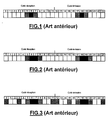
- so-called “blind” radios designate radios who are unable to process signals contained in two consecutive time intervals. he as a result, such a radio, also called radio blind, cannot find a new carrier couple having a time interval which is adjacent to that of the carrier couple already in use. This impossibility is illustrated on a DECT frame shown in Figure 1.
- the carrier couples [6; c] and [18; c] are allocated to the transmission of information between the terminal and the base station respectively downward and upward. Yes, for any reason, the carrier couple [6; c] (or the couple [18; c]) must be changed, the radio "blind" of the terminal is not able to process both the carrier couple [6; c] and the carrier couple [5; c] or [7; c] (resp [17; c] or [19; c]). She will not be more capable of carrying torque [5; c '], [6; c'] or [7; c '] (resp.
- a "blind" radio limits sensitive the possibilities of torque change carrier. This can result in deadlock situations when the remaining carrier couples are already used for other communications.
- FIG. 2 represents a DECT frame of carrier frequency c.
- a terminal and a base communicate on the double carrier couple [(6,7); c] in the downward direction and on the torque double carrier [(18,19); c] in the upward direction.
- the number of the first of the two intervals consecutive time is necessarily even.
- the new carrier couples double with single carrying couples [5; c or c '] and [8; c or c'] are prohibited.
- the choice of new carrier couples double is even more restricted.
- FIG. 3 An example of blocking on a carrier frequency c is illustrated by Figure 3.
- the double carrier couple [(6,7); c] is used for data transport and couples simple carriers [0; c], [3; c] and [11; c] (hatched in the frame of figure 3) are used for the transport of telephone communications. If, for a whatever reason it is necessary to change the double carrier couple, there is no possibility on this carrier due to the constraints imposed by radio blind and LU7 protocol.
- An object of the invention is to propose a method of transmission management to reduce the number of blocking situations during a change of carrier couple.
- Another aim is to propose a process allowing to increase traffic in a network of telecommunications with terminals equipped with "blind" radios.
- the invention relates to a method of management of a transmission of information by frames successive radios between a terminal telecommunications comprising a so-called "blind" radio and a base station of a telecommunications network, each radio frame comprising a plurality of pairs carriers each defined by at least one interval of time in the radio frame and a carrier frequency, said transmission of information being carried out on a first bearing couple, said method serving to change the carrier torque during said transmission and including a step to find a new one carrier torque available and a programming step of the so-called "blind” radio on said new couple carrier, characterized in that said step of search is performed on a limited number of radio frames and in that, during this step, the programming of the so-called "blind” radio on said first carrier couple is interrupted.
- the new carrier couples can be defined on time intervals adjacent to that (or those in the case of a first couple double carrier) of the first carrier couple.
- the information contained in the radio frames not received by the terminal during the search stage are saved in a base station buffer for this step then retransmitted to the terminal after connection establishment on the new couple carrier.
- first carrier couple the carrier couple on which the link is established before torque change carrier.
- the programming of the "blind" radio of the terminal on the first carrier couple is interrupted during the search for the new couple carrier. So the constraints imposed by radio "blind" of the terminal no longer intervene in the change in carrier torque. So in the example of FIG. 3, the new carrier couples [5; c] and [8; c] are no longer prohibited. This new situation is illustrated in Figure 4.
- the buffer used for backing up data not received is generally already present in base stations. It is usually used to save data in case of repeat request (ARQ) for error correction.
- ARQ repeat request
- An example of buffer is shown in Figure 6. It has eight registers capable of storing data each contained in a time interval of a DECT frame. With this buffer memory, radio programming "blind" can be interrupted for eight radio frames maximum without loss of information.
- field B can contain 720 or 800 bits of data. Also, to retransmit the data saved in the buffer memory, we pass the field B of common frames from 720 to 800 bits for clear an eighth (1/8) of the data in a frame saved (80 bits) for each current frame.
- the "blind" radio is reprogrammed on the first carrier couple after the research stage and data not received by the terminal during the step are then retransmitted with the frames common in the same way as before.
Landscapes
- Engineering & Computer Science (AREA)
- Computer Networks & Wireless Communication (AREA)
- Signal Processing (AREA)
- Mobile Radio Communication Systems (AREA)
Priority Applications (6)
| Application Number | Priority Date | Filing Date | Title |
|---|---|---|---|
| EP99460059A EP1087634A1 (de) | 1999-09-27 | 1999-09-27 | Verfahren zur Steuerung der Übertragung zwischen einem Endgerät und einer Basisstation |
| DE60020785T DE60020785T2 (de) | 1999-09-27 | 2000-07-11 | Verfahren zur Verwaltung der Übertragung von einem Endgerät zu einer Basisstation |
| AT00305853T ATE298179T1 (de) | 1999-09-27 | 2000-07-11 | Verfahren zur verwaltung der übertragung von einem endgerät zu einer basisstation |
| EP20000305853 EP1087632B1 (de) | 1999-09-27 | 2000-07-11 | Verfahren zur Verwaltung der Übertragung von einem Endgerät zu einer Basisstation |
| US09/667,348 US6728549B1 (en) | 1999-09-27 | 2000-09-22 | Switching to an improved bearer during a call connection |
| JP2000293219A JP3730104B2 (ja) | 1999-09-27 | 2000-09-27 | 基地局伝送に対してターミナルを管理する方法 |
Applications Claiming Priority (1)
| Application Number | Priority Date | Filing Date | Title |
|---|---|---|---|
| EP99460059A EP1087634A1 (de) | 1999-09-27 | 1999-09-27 | Verfahren zur Steuerung der Übertragung zwischen einem Endgerät und einer Basisstation |
Publications (1)
| Publication Number | Publication Date |
|---|---|
| EP1087634A1 true EP1087634A1 (de) | 2001-03-28 |
Family
ID=8242418
Family Applications (1)
| Application Number | Title | Priority Date | Filing Date |
|---|---|---|---|
| EP99460059A Withdrawn EP1087634A1 (de) | 1999-09-27 | 1999-09-27 | Verfahren zur Steuerung der Übertragung zwischen einem Endgerät und einer Basisstation |
Country Status (5)
| Country | Link |
|---|---|
| US (1) | US6728549B1 (de) |
| EP (1) | EP1087634A1 (de) |
| JP (1) | JP3730104B2 (de) |
| AT (1) | ATE298179T1 (de) |
| DE (1) | DE60020785T2 (de) |
Families Citing this family (1)
| Publication number | Priority date | Publication date | Assignee | Title |
|---|---|---|---|---|
| FI110974B (fi) * | 2000-03-01 | 2003-04-30 | Nokia Corp | Laskurin alustaminen, erityisesti radiokehyksiä varten |
Citations (3)
| Publication number | Priority date | Publication date | Assignee | Title |
|---|---|---|---|---|
| EP0722259A2 (de) * | 1995-01-10 | 1996-07-17 | Nokia Mobile Phones Ltd. | Verfahren zur Kanalabtastung für tragbare Funktelefone |
| WO1998015148A1 (de) * | 1996-09-30 | 1998-04-09 | Siemens Aktiengesellschaft | Basisstation mit schneller kanalwechselfunktion eines zellularen tdma/fdma-funksystems, insbesondere eines zellularen dect-systems |
| WO1999049685A1 (en) * | 1998-03-26 | 1999-09-30 | Italtel Spa | Method for the realization of a quick and complete pre-selection of the channels in a digital telecommunication system |
Family Cites Families (4)
| Publication number | Priority date | Publication date | Assignee | Title |
|---|---|---|---|---|
| US5416778A (en) * | 1992-06-26 | 1995-05-16 | U.S. Philips Corporation | Digital radio communication system and primary and secondary station for use in such a system |
| GB2297014B (en) * | 1995-01-10 | 1999-07-28 | Nokia Mobile Phones Ltd | Portable radio telephones and method of operation |
| SE506816C2 (sv) * | 1996-06-20 | 1998-02-16 | Ericsson Telefon Ab L M | Ett förfarande och en kommunikationsenhet för snabb identifiering av basstationer i ett kommunikationsnät |
| US6381462B1 (en) * | 1999-03-16 | 2002-04-30 | Telefonaktiebolaget Lm Ericsson (Publ) | Method and communications system with dynamically adaptable subscriber units |
-
1999
- 1999-09-27 EP EP99460059A patent/EP1087634A1/de not_active Withdrawn
-
2000
- 2000-07-11 DE DE60020785T patent/DE60020785T2/de not_active Expired - Fee Related
- 2000-07-11 AT AT00305853T patent/ATE298179T1/de not_active IP Right Cessation
- 2000-09-22 US US09/667,348 patent/US6728549B1/en not_active Expired - Lifetime
- 2000-09-27 JP JP2000293219A patent/JP3730104B2/ja not_active Expired - Fee Related
Patent Citations (3)
| Publication number | Priority date | Publication date | Assignee | Title |
|---|---|---|---|---|
| EP0722259A2 (de) * | 1995-01-10 | 1996-07-17 | Nokia Mobile Phones Ltd. | Verfahren zur Kanalabtastung für tragbare Funktelefone |
| WO1998015148A1 (de) * | 1996-09-30 | 1998-04-09 | Siemens Aktiengesellschaft | Basisstation mit schneller kanalwechselfunktion eines zellularen tdma/fdma-funksystems, insbesondere eines zellularen dect-systems |
| WO1999049685A1 (en) * | 1998-03-26 | 1999-09-30 | Italtel Spa | Method for the realization of a quick and complete pre-selection of the channels in a digital telecommunication system |
Also Published As
| Publication number | Publication date |
|---|---|
| JP3730104B2 (ja) | 2005-12-21 |
| JP2001136584A (ja) | 2001-05-18 |
| DE60020785D1 (de) | 2005-07-21 |
| ATE298179T1 (de) | 2005-07-15 |
| DE60020785T2 (de) | 2006-05-11 |
| US6728549B1 (en) | 2004-04-27 |
Similar Documents
| Publication | Publication Date | Title |
|---|---|---|
| EP0775394B1 (de) | Verfahren zur luftschnittstellenanpassung in einer mobilen funkkommunikationsanordnung | |
| EP1524798B1 (de) | Drahtloses Netzwerk für die Leitung von der Zuweisung von einem Frequenzband dass zur Übertragung von Prioritätenbitten von einer Verbindungseinrichtung reserviert wurde | |
| WO1999014963A3 (en) | Data transmission method in gprs | |
| FR2665276A1 (fr) | Procede et appareil de transfert de donnees utilisant un bus de donnees synchrone-asynchrone. | |
| EP0993167A1 (de) | Schutzverfahren für Funkkommunikationsterminal gegen unbefugtem Gebrauch | |
| EP0692920A1 (de) | Zellenauswahl in einem mehrschichtigen zellularen Funktelefonnetz | |
| FR2772164A1 (fr) | Procede d'identification d'une pluralite de transpondeurs, dispositif d'analyse et transpondeurs pour la mise en oeuvre d'un tel procede | |
| RU2000130718A (ru) | Способ передачи полезных данных в системах телекоммуникации с беспроводной, основанной на заданном протоколе воздушного интерфейса связью между устройствами телекоммуникации, в частности, речевых и/или пакетных данных в системах dect | |
| EP0603049B1 (de) | Anordnung zum Verbindungsaufbau von einem Endgerät zum Netz eines Funkkommunikationssystems mit mehreren Netzen | |
| KR100259082B1 (ko) | 네트워크 트래픽 우선순위 결정방법 | |
| FR2877175A1 (fr) | Procede de communication dans un reseau comprenant des noeuds filaires et des noeuds non filaires | |
| EP1087634A1 (de) | Verfahren zur Steuerung der Übertragung zwischen einem Endgerät und einer Basisstation | |
| FR2836617A1 (fr) | Procede d'affectation de ressources variables dans le temps pour assurer des services continus et application de ce procede a la planification d'un systeme de telecommunication | |
| EP3391561B1 (de) | Steuerung des zugangs zu einem online-dienst über ein li-fi-netzwerk | |
| EP3742681A1 (de) | Steuerungsrahmen von kurzer dauer in einer physikalschen schicht | |
| FR2809900A1 (fr) | Procede et systeme de transmission de donnees bi-mode, emetteur et recepteur correspondant | |
| EP2577876A2 (de) | Verfahren und netzwerk zur informationsübertragung zwischen funkelektro-stationen | |
| EP2854467B1 (de) | System und Verfahren zum Aufteilen der verteilten Kapazität in einem Ad-hoc-Netz | |
| ES2300543T3 (es) | Aparato y metodo para manejar procedimientos simultaneos de control de recursos de radio utran con instantes de activacion en un equipo de usuario umts. | |
| EP0693247B1 (de) | Synchronisationseinrichtung für endgerat eines funkkommunikationssystems | |
| EP3776946B1 (de) | Drahtloskommunikationsvorrichtungen, -systeme und -verfahren zur decodierung von datenpaketen zur einrichtung latenzkritischer dienste | |
| FR2702109A1 (fr) | Procédé de gestion de la redéfinition de fréquence dans un système de radiocommunication cellulaire avec des stations mobiles. | |
| EP3834380A1 (de) | Relais zur konvergenz zwischen geografischem multi-hop-routing und zellularem routing | |
| US20060007909A1 (en) | Proxy networking device for a router | |
| EP0471633A1 (de) | Kommunikationsnetz mit Schreib- und Lesering, und Zugriffs- und Rekonfigurationsverfahren eines solchen Netzes |
Legal Events
| Date | Code | Title | Description |
|---|---|---|---|
| PUAI | Public reference made under article 153(3) epc to a published international application that has entered the european phase |
Free format text: ORIGINAL CODE: 0009012 |
|
| AK | Designated contracting states |
Kind code of ref document: A1 Designated state(s): AT BE CH CY DE DK ES FI FR GB GR IE IT LI LU MC NL PT SE |
|
| AX | Request for extension of the european patent |
Free format text: AL;LT;LV;MK;RO;SI |
|
| AKX | Designation fees paid | ||
| REG | Reference to a national code |
Ref country code: DE Ref legal event code: 8566 |
|
| STAA | Information on the status of an ep patent application or granted ep patent |
Free format text: STATUS: THE APPLICATION IS DEEMED TO BE WITHDRAWN |
|
| 18D | Application deemed to be withdrawn |
Effective date: 20010929 |