EP1087701B1 - Stent pour le pontage de collets d'anevrisme - Google Patents
Stent pour le pontage de collets d'anevrisme Download PDFInfo
- Publication number
- EP1087701B1 EP1087701B1 EP99930303A EP99930303A EP1087701B1 EP 1087701 B1 EP1087701 B1 EP 1087701B1 EP 99930303 A EP99930303 A EP 99930303A EP 99930303 A EP99930303 A EP 99930303A EP 1087701 B1 EP1087701 B1 EP 1087701B1
- Authority
- EP
- European Patent Office
- Prior art keywords
- aneurysm
- closure device
- metallic
- vaso
- struts
- Prior art date
- Legal status (The legal status is an assumption and is not a legal conclusion. Google has not performed a legal analysis and makes no representation as to the accuracy of the status listed.)
- Expired - Lifetime
Links
Images


Classifications
-
- A—HUMAN NECESSITIES
- A61—MEDICAL OR VETERINARY SCIENCE; HYGIENE
- A61B—DIAGNOSIS; SURGERY; IDENTIFICATION
- A61B17/00—Surgical instruments, devices or methods
- A61B17/12—Surgical instruments, devices or methods for ligaturing or otherwise compressing tubular parts of the body, e.g. blood vessels or umbilical cord
- A61B17/12022—Occluding by internal devices, e.g. balloons or releasable wires
- A61B17/12099—Occluding by internal devices, e.g. balloons or releasable wires characterised by the location of the occluder
- A61B17/12109—Occluding by internal devices, e.g. balloons or releasable wires characterised by the location of the occluder in a blood vessel
- A61B17/12113—Occluding by internal devices, e.g. balloons or releasable wires characterised by the location of the occluder in a blood vessel within an aneurysm
-
- A—HUMAN NECESSITIES
- A61—MEDICAL OR VETERINARY SCIENCE; HYGIENE
- A61B—DIAGNOSIS; SURGERY; IDENTIFICATION
- A61B17/00—Surgical instruments, devices or methods
- A61B17/0057—Implements for plugging an opening in the wall of a hollow or tubular organ, e.g. for sealing a vessel puncture or closing a cardiac septal defect
-
- A—HUMAN NECESSITIES
- A61—MEDICAL OR VETERINARY SCIENCE; HYGIENE
- A61B—DIAGNOSIS; SURGERY; IDENTIFICATION
- A61B17/00—Surgical instruments, devices or methods
- A61B17/12—Surgical instruments, devices or methods for ligaturing or otherwise compressing tubular parts of the body, e.g. blood vessels or umbilical cord
- A61B17/12022—Occluding by internal devices, e.g. balloons or releasable wires
-
- A—HUMAN NECESSITIES
- A61—MEDICAL OR VETERINARY SCIENCE; HYGIENE
- A61B—DIAGNOSIS; SURGERY; IDENTIFICATION
- A61B17/00—Surgical instruments, devices or methods
- A61B17/12—Surgical instruments, devices or methods for ligaturing or otherwise compressing tubular parts of the body, e.g. blood vessels or umbilical cord
- A61B17/12022—Occluding by internal devices, e.g. balloons or releasable wires
- A61B17/12131—Occluding by internal devices, e.g. balloons or releasable wires characterised by the type of occluding device
-
- A—HUMAN NECESSITIES
- A61—MEDICAL OR VETERINARY SCIENCE; HYGIENE
- A61F—FILTERS IMPLANTABLE INTO BLOOD VESSELS; PROSTHESES; DEVICES PROVIDING PATENCY TO, OR PREVENTING COLLAPSING OF, TUBULAR STRUCTURES OF THE BODY, e.g. STENTS; ORTHOPAEDIC, NURSING OR CONTRACEPTIVE DEVICES; FOMENTATION; TREATMENT OR PROTECTION OF EYES OR EARS; BANDAGES, DRESSINGS OR ABSORBENT PADS; FIRST-AID KITS
- A61F2/00—Filters implantable into blood vessels; Prostheses, i.e. artificial substitutes or replacements for parts of the body; Appliances for connecting them with the body; Devices providing patency to, or preventing collapsing of, tubular structures of the body, e.g. stents
- A61F2/95—Instruments specially adapted for placement or removal of stents or stent-grafts
- A61F2/962—Instruments specially adapted for placement or removal of stents or stent-grafts having an outer sleeve
- A61F2/966—Instruments specially adapted for placement or removal of stents or stent-grafts having an outer sleeve with relative longitudinal movement between outer sleeve and prosthesis, e.g. using a push rod
-
- A—HUMAN NECESSITIES
- A61—MEDICAL OR VETERINARY SCIENCE; HYGIENE
- A61B—DIAGNOSIS; SURGERY; IDENTIFICATION
- A61B17/00—Surgical instruments, devices or methods
- A61B17/12—Surgical instruments, devices or methods for ligaturing or otherwise compressing tubular parts of the body, e.g. blood vessels or umbilical cord
- A61B17/12022—Occluding by internal devices, e.g. balloons or releasable wires
- A61B2017/1205—Introduction devices
- A61B2017/12054—Details concerning the detachment of the occluding device from the introduction device
- A61B2017/12063—Details concerning the detachment of the occluding device from the introduction device electrolytically detachable
-
- A—HUMAN NECESSITIES
- A61—MEDICAL OR VETERINARY SCIENCE; HYGIENE
- A61F—FILTERS IMPLANTABLE INTO BLOOD VESSELS; PROSTHESES; DEVICES PROVIDING PATENCY TO, OR PREVENTING COLLAPSING OF, TUBULAR STRUCTURES OF THE BODY, e.g. STENTS; ORTHOPAEDIC, NURSING OR CONTRACEPTIVE DEVICES; FOMENTATION; TREATMENT OR PROTECTION OF EYES OR EARS; BANDAGES, DRESSINGS OR ABSORBENT PADS; FIRST-AID KITS
- A61F2/00—Filters implantable into blood vessels; Prostheses, i.e. artificial substitutes or replacements for parts of the body; Appliances for connecting them with the body; Devices providing patency to, or preventing collapsing of, tubular structures of the body, e.g. stents
- A61F2/95—Instruments specially adapted for placement or removal of stents or stent-grafts
- A61F2/958—Inflatable balloons for placing stents or stent-grafts
-
- A—HUMAN NECESSITIES
- A61—MEDICAL OR VETERINARY SCIENCE; HYGIENE
- A61F—FILTERS IMPLANTABLE INTO BLOOD VESSELS; PROSTHESES; DEVICES PROVIDING PATENCY TO, OR PREVENTING COLLAPSING OF, TUBULAR STRUCTURES OF THE BODY, e.g. STENTS; ORTHOPAEDIC, NURSING OR CONTRACEPTIVE DEVICES; FOMENTATION; TREATMENT OR PROTECTION OF EYES OR EARS; BANDAGES, DRESSINGS OR ABSORBENT PADS; FIRST-AID KITS
- A61F2/00—Filters implantable into blood vessels; Prostheses, i.e. artificial substitutes or replacements for parts of the body; Appliances for connecting them with the body; Devices providing patency to, or preventing collapsing of, tubular structures of the body, e.g. stents
- A61F2/82—Devices providing patency to, or preventing collapsing of, tubular structures of the body, e.g. stents
- A61F2002/823—Stents, different from stent-grafts, adapted to cover an aneurysm
Definitions
- This invention is a device for bridging the neck of a wide-necked or narrow-necked aneurysm in the vasculature.
- it is a device used to stabilize aneurysms found in the vasculature by at least partially closing the opening to that aneurysm with consequent limiting of the amount of blood flowing into and out of the chamber.
- the device is generally made of a metallic or polymeric sheet and is of a shape which may be deployed using a catheter.
- the device typically has three major components or regions: the central area, the centrifugal stabilizers, and the axial stabilizers.
- the device is intended to be a permanent implant and may be used with or without occlusive devices and materials placed inside the aneurysm volume. It may be delivered by introduction through or on a catheter or via a delivery wire.
- vascular aneurysms are formed as a result of a weakening in the wall of an artery and subsequent ballooning of the artery wall. Aneurysms are often a site of internal bleeding and, catastrophically, the site of strokes.
- embolic agents are known to be suitable for treatment of such aneurysms. These treatments are commonly known as “artificial vaso-occlusion.”
- embolic agents includes injectable fluids or suspensions, such as microfibrillar collagen, various polymeric beads, and polyvinyl alcohol foam. These polymeric agents may additionally be crosslinked, sometimes in vivo to extend the persistence of the agent at the vascular site. These agents may be introduced into the vasculature through a catheter. After such introduction, materials there form a solid space-filling mass. Although some such agents provide for excellent short-term occlusion, many are thought to allow vessel recanalization due to absorption of polymer into the blood. Another procedure in which a partially hydrolyzed polyvinyl acetate (PVA) is dissolved in ethanol solvent and infected into a desired vascular site is found in Park et al. (U.S. Patent US-A-5 925 683, filed October 17, 1996, for "LIQUID EMBOLIC AGENTS").
- PVA polyvinyl acetate
- Other materials including polymeric resins, typically cyanoacrylates, are also employed as injectable vaso-occlusive materials. These resins are typically mixed with a radio-opaque contrast material or made radio-opaque by the addition of a tantalum powder. These materials are difficult to use in that the placement of the mixture in the body may be a problem. These materials cross-link within the human body. Inadvertent embolisms in normal vasculature, due to the inability of controlling the destination of the precursor resinous materials, is not uncommon. The material is also difficult or even impossible to retrieve once it has been placed into the vasculature.
- vaso-occlusive coils Implantable metal coils that are useful in artificial occlusion devices in vasculature lumens or aneurysms are herein referred to as "vaso-occlusive coils.”
- Vaso-occlusive coils are generally constructed of wire, usually made of a metal or metal alloy, that is first wound into a helix. Many such devices are introduced to the selected target site through a catheter in a stretched linear form.
- the vaso-occlusive device may assume an irregular shape upon discharge of the device from the distal end of the catheter.
- a variety of vaso-occlusive coils and braids are known.
- U.S. Patent No. 4,994,069, to Ritchart et al. shows a flexible, preferably coiled, wire for use in small vessel vaso-occlusion. These coils are described as being between 0,25 and 0,76 mm (0.010 and 0.030 inches) in diameter.
- the wire used to make up the coils may be, for instance, 0,05 to 0,15 (0.002 to 0.006 inches) in diameter.
- Tungsten, platinum, and gold threads or wires are said to be preferred. These devices may be used to fill aneurysms.
- vaso-occlusive devices be delivered through microcatheters such as the type shown in U.S. Patent No. 4,739,768, to Engelson. These microcatheters track a guidewire to a point just proximal or within the desired occlusion site. The vaso-occlusive coils are then advanced through the microcatheter, once the guidewire is removed, and out the distal end hole so to at least partially fill the selected site and create occlusion within the aneurysm.
- vaso-occlusive devices In addition to the various types of space-filling mechanisms and geometries of vaso-occlusive coils, other particularize features of coil designs, such as mechanisms for delivering vaso-occlusive coils through delivery catheters and implanting them in desired occlusion sites, have also been described. Examples of such vaso-occlusive devices based upon their delivery mechanisms include pushable coils (see Ritchart et al., discussed above), mechanically detachable vaso-occlusive devices (see U.S. Patent Nos. 5,261,916 to Engelson or 5,250,071 to Palermo), or electrolytically detachable vaso-occlusive devices (see U.S. Patent Nos. 5,122,136 and 5,354,295 to Guglielmi et al.).
- Each of the devices described above may be used in the treatment, by occlusion, of aneurysms.
- aneurysms present particularly acute medical risks due to the dangers of potential rupture of the thin wall inherent in such a vascular anomaly.
- Occlusion of aneurysms by the use of vaso-occlusive coils without occluding the adjacent artery is a special challenge.
- vaso-occlusive coils in treating aneurysms is widespread. These vaso-occlusive devices are placed in an aneurysm by the use of a microcatheter. The distal end of the microcatheter is advanced into the mouth of the aneurysm. The vaso-occlusive coil is then advanced through and out of that micro catheter. After, or perhaps during, delivery of such a coil into the aneurysm, there is a specific risk that a portion of the coil might migrate out of the aneurysm entrance zone and into the feeding vessel. The presence of such a coil in that feeding vessel may cause the undesirable response of causing an occlusion there. Also, there is a quantifiable risk that the blood flow in the vessel and the aneurysm may induce movement of the coil farther out of the aneurysm, resulting in a more thoroughly developed embolus in the patent vessel.
- aneurysm commonly known as a "wide-neck aneurysm” is known to present particular difficulty in the placement and retention of vaso-occlusive coils.
- Wide-neck aneurysms are herein referred to as aneurysms of vessel walls having a neck or a "entrance zone" from the adjacent vessel, which entrance zone has a diameter of either (1) at least 80% of the largest diameter of the aneurysm; or (2) is clinically observed to be too wide effectively to retain vaso-occlusive coils that are deployed using the techniques discussed herein.
- vaso-occlusive coils lacking substantial secondary shape strength may be difficult to maintain the position within an aneurysm no matter how skillfully they are placed.
- a microcatheter is inserted into the lumen so that the distal end of the catheter is inserted into the aneurysm cavity.
- One or more vasoocclusive devices is then introduced into the aneurysm cavity.
- the retainer device maintains the presence of the vaso-occlusive devices within the aneurysm whether it is a large-mouth aneurysm or not.
- US-A-5 620 461 describes a percutaneously insertable system for sealing punctures in blood vessels including a flexible sheet and in the center connected thereto, a fixation attachment in the form of a thread. None of these devices are of the same configuration as that described herein.
- This invention includes an implantable medical device useful for at least partially closing the opening to an aneurysm. It may further be used for retaining other occlusion devices within an aneurysm.
- the invention involves an implantable stent having a central closure area, opposing axially positioned struts extending from the closure area, and circumferential struts extending generally orthogonal to the axial struts.
- the device is constructed from a metallic or polymeric sheet material and may be delivered using an intravascular catheter.
- This invention involves the device for at least partially closing the mouth of an aneurysm, typically a small-necked aneurysm.
- closure devices may be used to maintain the presence of vaso-occlusive devices such as coils in an aneurysm.
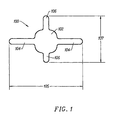
- Figure 1 is a plan view of an inventive device (100). It is made up, conceptually, of three major components.
- the first component is closure region (102).
- Closure region (102) is generally chosen by the physician introducing the device into the body to generally approximate the size of the aneurysm opening to be closed. It need not be that large in that the closure region may be sized so that only a portion of the aneurysm opening is covered. In this instance, the closure region merely operates to prevent passage of fresh blood into the aneurysm itself. To some extent, this partial closure will prevent the direct impingement of flowing blood on the weakened back wall of the aneurysm.
- Closure region (102) may be larger than the opening into the aneurysm but it need not be. Generally, it is most desirable to minimize the amount of material placed in these devices since that also minimizes the stiffness of the device when it is placed into the body through the vasculature.
- Extending outwardly from the central or closure region (102) are a number of struts.
- the struts are usually paired so that they extend from the closure region (102) in generally opposite directions.
- axial struts (104) extend in generally opposite directions from closure region (102).
- Axial struts (104) are typically longer than their circumferential struts (106) since axial struts (104) are generally used to extend along the wall of an artery and parallel to the axis of the artery.
- Axial struts (104) it may be said, point in the direction of blood flow in the artery into which they are placed.
- the axial length (105) of the device is functionally simply long enough to prevent the device from rotating in the lumen of the blood vessel into which it is placed.
- the circumferential struts (106) extend outwardly from the closure region (102) and have a length (107) which desirably is greater than half of the circumference of the vessel into which it is placed so to maintain the closure region (102) reasonably firmly against the mouth of the aneurysm.
- the device (100) typically is of metallic or polymeric materials.
- Typical metallic materials include stainless steel and the nickel ⁇ titanium alloys often used for their superelastic or shape-memory properties, the most common of which is known as nitinol.
- Inherently slippery polymers such as many of the fluorocarbons and hydrophilic polymers, e.g., polyvinyl pyrrolidone, are members of these groups.
- these devices should be as thin as is reasonably possible so to make easy the insertion of the device.
- stainless steel or superelastic alloys might be as thin as 6,35 microns (0.25 mils 0.00025 inches) up to 381 microns (15 mils), although typically no thicker than 178-305 microns (7-12 mils).
- Figures 2 through 5 show various configurations and aspect ratios of devices made according to this invention.
- Figure 2 shows a device (200) in which the closure region (202) is circular and one axial strut (204) is longer than its opposing strut (206).
- the closure region (202) is circular and one axial strut (204) is longer than its opposing strut (206).
- Such a configuration may be desirable in instances where the aneurysm is on the exterior of a turn in an artery.
- the circumferential struts (208) are narrow and of fairly short length.
- Figure 3 shows another variation in which the closure region (302) and the axial struts (304) and (306) each have identical diameters (as viewed vertically in Figure 3).
- the circumferential struts (308) are also shown.
- Figure 4 shows a similar variation (400) in which the closure region (402) and the axial struts (404) and (406) have the same diameter. It should be noted that in Figure 4 the upstream strut (404) is the same length as is the downstream strut (406). In contrast, the upstream strut (306) is shorter in Figure 3 than is the downstream strut (304).
- Figure 5 shows still another variation of the invention (500).
- This variation may be used to cover a stent which has an oval mouth or is a so-called "wide-mouth” aneurysm.
- the device has the noted longitudinal struts (502) and supplemental longitudinal struts (504).
- the circumferential struts include, by area, the supplemental longitudinal struts (504). Each of these struts emanates from the closure region (508).
- Figures 6A and 6B show the positioning of the inventive device (100) in an artery (122) over an aneurysm (124).
- the aneurysm has a mouth (120) as it enters the wall of artery (122).
- Figure 6A is a cross-section side view of placement of the device (100) showing the desired positioning of the closure region (102) about the aneurysm opening (120).
- the Figure 6A depiction also shows the positioning of the axial or longitudinal struts (104) along the axis of artery (122).
- the placement of circumferential struts (106) is also seen.
- Figures 6A and 6B show that the circumferential struts (106) desirably extend more than 180' around the circumference of the artery. This permits the device to stay in place and snugly against the mouth (120) of the aneurysm (124).
- Figures 7A show a simplified procedure for placing the device (100) in the opening (120) of aneurysm (124).
- device (100) is rolled tightly against a core wire (150) with a sheath (152) holding the rolled device (100) in place.
- the assembly is delivered to the mouth of aneurysm (124) using a catheter (154) of known design and size. It is desirable that the sheath (152) be marked using radio-opaque markers (156) of some type so that the device can be readily , positioned about the mouth (120) of aneurysm (124). From the exterior of the body, core wire (150) is held in place while sheath (152) is pulled proximally to expose the inventive device and allow it to unroll.
- Figure 7B shows the inventive device (100) in place and the delivery catheter (154) being withdrawn along with sheath (152) and core wire (150).
- Figure 8 shows, in partial cross-section , another way of delivering the inventive device to a selected site in the body.
- the neck bridge (100) is likely constructed of a material which is deformable by the use of the balloon (170) into the final shape as outlined in the discussion relating to Figures 6A and 6B above.
- the balloon (170) is not of a critical design except that it be of a size and toughness suitable for expanding the noted device much in the same way that a balloon is used to place a stent.
- the balloon (170) along with its associated components in the overall assembly may, for instance, be that found in U.S. Patent No. 5,135,494, to Engelson et al.
- the guidewire (172) may be used both as a guidewire per se and, in conjunction with a bead placed on the guidewire body, as a valving means for closing the single lumen catheter (174) and inflating the balloon (170).
- the closing valve seat (176) used in conjunction with the unshown bead on the guidewire body may be seen on the distal portion of the catheter body (174) just proximal of the catheter distal end.
- An optional sheath (178) is shown. The sheath is to protect the neck bridge (100) during its transit through the delivery catheter (180).
- the device (100) is delivered to the chosen site, the balloon (170) is inflated and the device is left in at the chosen site.
- Figure 9 shows another variation in which the inventive device (100) is delivered using an electrolytic joint (184) to secure a self-expanding version of the neck bridge (100).
- a simple wire having the neck bridge (100) wound onto its distal end is introduced into the vasculature. Release of the neck bridge (100) is accomplished by imposition of a current into wire (188).
- the electrolytic joint (184) erodes and the neck bridge (100) self expands.
- Use of electrolytic joints in deploying implants is described, for instance, in U.S. Pat. No. 5,122,136, to Guglielmi et al , and others.
- the inventive device discussed above may be at least partially covered by, e.g., radio opaque materials to help with the location of the device in the body using a fluoroscope, or with lubricious materials, e.g., fluorocarbonaceous polymers (PTFE, FEP, etc.) or hydrophilics (polyvinylpyrolidone, etc.) or silicones if the user sees such a need.
- radio opaque materials e.g., fluorocarbonaceous polymers (PTFE, FEP, etc.) or hydrophilics (polyvinylpyrolidone, etc.) or silicones if the user sees such a need.
Landscapes
- Health & Medical Sciences (AREA)
- Life Sciences & Earth Sciences (AREA)
- Surgery (AREA)
- Engineering & Computer Science (AREA)
- Biomedical Technology (AREA)
- General Health & Medical Sciences (AREA)
- Veterinary Medicine (AREA)
- Heart & Thoracic Surgery (AREA)
- Public Health (AREA)
- Animal Behavior & Ethology (AREA)
- Nuclear Medicine, Radiotherapy & Molecular Imaging (AREA)
- Vascular Medicine (AREA)
- Medical Informatics (AREA)
- Molecular Biology (AREA)
- Reproductive Health (AREA)
- Cardiology (AREA)
- Transplantation (AREA)
- Neurosurgery (AREA)
- Oral & Maxillofacial Surgery (AREA)
- Surgical Instruments (AREA)
Abstract
Claims (9)
- Dispositif de fermeture d'anévrisme (100) pouvant être délivré à travers le système vasculaire comprenant une feuille polymère ou métallique en une seule pièce ayant une région de fermeture généralement centrale (102) dimensionnée de manière à couvrir au moins la plus grande partie d'une ouverture dans un anévrisme vasculaire choisi, au moins deux entretoises circonférentielles (106) s'étendant dans des directions généralement opposées depuis ladite région de fermeture, et au moins deux entretoises longitudinales (104) s'étendant dans des directions généralement opposées depuis ladite région de fermeture, généralement orthogonales par rapport auxdites entretoises circonférentielles, et ensemble d'une longueur suffisante pour stabiliser ledit dispositif de fermeture d'anévrisme après un mouvement, lorsqu'il est positionné de manière à couvrir ladite au moins plus grande partie d'une ouverture dans un anévrisme vasculaire en coopération avec lesdites entretoises circonférentielles.
- Dispositif de fermeture d'anévrisme selon la revendication 1, dans lequel ladite feuille métallique ou polymère est métallique.
- Dispositif de fermeture d'anévrisme selon la revendication 2, dans lequel ladite feuille métallique ou polymère est polymère.
- Dispositif de fermeture d'anévrisme selon la revendication 2, dans lequel ladite feuille métallique se compose d'un alliage super élastique.
- Dispositif de fermeture d'anévrisme selon la revendication 4, dans lequel ledit alliage super élastique est un alliage de Ni/Ti.
- Dispositif de fermeture d'anévrisme selon la revendication 2, dans lequel ladite feuille métallique se compose d'un alliage d'acier inoxydable.
- Dispositif de fermeture d'anévrisme selon la revendication 1, dans lequel lesdites au moins deux entretoises circonférentielles (106) sont ensemble d'une longueur suffisante pour recouvrir une partie mais pas la totalité d'une circonférence d'une lumière vasculaire à l'extérieur dudit anévrisme lorsque ledit dispositif de fermeture d'anévrisme (100) est positionné de manière à couvrir ladite au moins plus grande partie d'une ouverture dans un anévrisme vasculaire.
- Dispositif de fermeture d'anévrisme selon la revendication 1, dans lequel ladite région de fermeture généralement centrale est dimensionnée de manière à couvrir la totalité d'une ouverture dans un anévrisme vasculaire choisi.
- Dispositif de fermeture d'anévrisme selon la revendication 1, en combinaison avec un ou plusieurs dispositifs vaso-occlusifs.
Priority Applications (1)
| Application Number | Priority Date | Filing Date | Title |
|---|---|---|---|
| EP04018740A EP1475042A3 (fr) | 1998-06-16 | 1999-06-16 | stent modificateur de débit à occlusion minimale pour le pontage de collets d'anévrisme |
Applications Claiming Priority (3)
| Application Number | Priority Date | Filing Date | Title |
|---|---|---|---|
| US09/098,124 US6139564A (en) | 1998-06-16 | 1998-06-16 | Minimally occlusive flow disruptor stent for bridging aneurysm necks |
| US98124 | 1998-06-16 | ||
| PCT/US1999/013554 WO1999065397A1 (fr) | 1998-06-16 | 1999-06-16 | Stent modificateur de debit a occlusion minimale pour le pontage de collets d'anevrisme |
Related Child Applications (1)
| Application Number | Title | Priority Date | Filing Date |
|---|---|---|---|
| EP04018740A Division EP1475042A3 (fr) | 1998-06-16 | 1999-06-16 | stent modificateur de débit à occlusion minimale pour le pontage de collets d'anévrisme |
Publications (2)
| Publication Number | Publication Date |
|---|---|
| EP1087701A1 EP1087701A1 (fr) | 2001-04-04 |
| EP1087701B1 true EP1087701B1 (fr) | 2004-10-13 |
Family
ID=22267329
Family Applications (2)
| Application Number | Title | Priority Date | Filing Date |
|---|---|---|---|
| EP99930303A Expired - Lifetime EP1087701B1 (fr) | 1998-06-16 | 1999-06-16 | Stent pour le pontage de collets d'anevrisme |
| EP04018740A Withdrawn EP1475042A3 (fr) | 1998-06-16 | 1999-06-16 | stent modificateur de débit à occlusion minimale pour le pontage de collets d'anévrisme |
Family Applications After (1)
| Application Number | Title | Priority Date | Filing Date |
|---|---|---|---|
| EP04018740A Withdrawn EP1475042A3 (fr) | 1998-06-16 | 1999-06-16 | stent modificateur de débit à occlusion minimale pour le pontage de collets d'anévrisme |
Country Status (5)
| Country | Link |
|---|---|
| US (1) | US6139564A (fr) |
| EP (2) | EP1087701B1 (fr) |
| AU (1) | AU4686699A (fr) |
| DE (1) | DE69921129T2 (fr) |
| WO (1) | WO1999065397A1 (fr) |
Families Citing this family (129)
| Publication number | Priority date | Publication date | Assignee | Title |
|---|---|---|---|---|
| US5928260A (en) * | 1997-07-10 | 1999-07-27 | Scimed Life Systems, Inc. | Removable occlusion system for aneurysm neck |
| US7569066B2 (en) * | 1997-07-10 | 2009-08-04 | Boston Scientific Scimed, Inc. | Methods and devices for the treatment of aneurysms |
| US20040130599A1 (en) * | 1997-07-15 | 2004-07-08 | Silverbrook Research Pty Ltd | Ink jet printhead with amorphous ceramic chamber |
| US6613074B1 (en) | 1999-03-10 | 2003-09-02 | Cordis Corporation | Endovascular aneurysm embolization device |
| FR2797176A1 (fr) * | 1999-08-06 | 2001-02-09 | Alain Fouere | Endoprothese vasculaire pour occlusion d'anevrismes et moyens d'implantation de cette endoprothese |
| US7267679B2 (en) | 1999-09-13 | 2007-09-11 | Rex Medical, L.P | Vascular hole closure device |
| US8083766B2 (en) | 1999-09-13 | 2011-12-27 | Rex Medical, Lp | Septal defect closure device |
| US7662161B2 (en) | 1999-09-13 | 2010-02-16 | Rex Medical, L.P | Vascular hole closure device |
| AU7373700A (en) | 1999-09-13 | 2001-04-17 | Rex Medical, Lp | Vascular closure |
| US7341595B2 (en) | 1999-09-13 | 2008-03-11 | Rex Medical, L.P | Vascular hole closure device |
| US7942888B2 (en) | 1999-09-13 | 2011-05-17 | Rex Medical, L.P. | Vascular hole closure device |
| US6875204B1 (en) * | 2000-06-30 | 2005-04-05 | Abbott Laboratories | Universal connector |
| US6589265B1 (en) * | 2000-10-31 | 2003-07-08 | Endovascular Technologies, Inc. | Intrasaccular embolic device |
| EP1349515B1 (fr) * | 2000-12-15 | 2008-10-08 | Donald R. Ricci | Système de délivrance d'endoprothèse vasculaire |
| AU2002215751A1 (en) * | 2000-12-15 | 2002-06-24 | Marotta, Thomas A. | Endovascular prosthesis delivery system |
| US6454780B1 (en) | 2001-06-21 | 2002-09-24 | Scimed Life Systems, Inc. | Aneurysm neck obstruction device |
| US8715312B2 (en) | 2001-07-20 | 2014-05-06 | Microvention, Inc. | Aneurysm treatment device and method of use |
| US7572288B2 (en) | 2001-07-20 | 2009-08-11 | Microvention, Inc. | Aneurysm treatment device and method of use |
| US8252040B2 (en) | 2001-07-20 | 2012-08-28 | Microvention, Inc. | Aneurysm treatment device and method of use |
| US7695488B2 (en) * | 2002-03-27 | 2010-04-13 | Boston Scientific Scimed, Inc. | Expandable body cavity liner device |
| US20040044391A1 (en) * | 2002-08-29 | 2004-03-04 | Stephen Porter | Device for closure of a vascular defect and method of treating the same |
| US8075585B2 (en) | 2002-08-29 | 2011-12-13 | Stryker Corporation | Device and method for treatment of a vascular defect |
| US20040111112A1 (en) * | 2002-11-20 | 2004-06-10 | Hoffmann Gerard Von | Method and apparatus for retaining embolic material |
| US20040193246A1 (en) * | 2003-03-25 | 2004-09-30 | Microvention, Inc. | Methods and apparatus for treating aneurysms and other vascular defects |
| US20040193179A1 (en) | 2003-03-26 | 2004-09-30 | Cardiomind, Inc. | Balloon catheter lumen based stent delivery systems |
| AU2004226464A1 (en) | 2003-03-26 | 2004-10-14 | Cardiomind, Inc. | Implant delivery technologies |
| US7771463B2 (en) | 2003-03-26 | 2010-08-10 | Ton Dai T | Twist-down implant delivery technologies |
| AU2004241111B2 (en) | 2003-05-15 | 2010-05-27 | Dsm Ip Assets B.V | Manufacture and use of implantable reticulated elastomeric matrices |
| DE10335648A1 (de) * | 2003-07-30 | 2005-03-03 | Eberhard-Karls-Universität Tübingen | Verschlussstopfen für eine Öffnung in einer Wand eines Gefäßes oder Hohlorgans |
| US8333798B2 (en) | 2003-11-07 | 2012-12-18 | Merlin Md Pte Ltd. | Implantable medical devices with enhanced visibility, mechanical properties and biocompatability |
| US7763077B2 (en) | 2003-12-24 | 2010-07-27 | Biomerix Corporation | Repair of spinal annular defects and annulo-nucleoplasty regeneration |
| US8992592B2 (en) | 2004-12-29 | 2015-03-31 | Boston Scientific Scimed, Inc. | Medical devices including metallic films |
| US8591568B2 (en) | 2004-03-02 | 2013-11-26 | Boston Scientific Scimed, Inc. | Medical devices including metallic films and methods for making same |
| US8632580B2 (en) | 2004-12-29 | 2014-01-21 | Boston Scientific Scimed, Inc. | Flexible medical devices including metallic films |
| US8998973B2 (en) | 2004-03-02 | 2015-04-07 | Boston Scientific Scimed, Inc. | Medical devices including metallic films |
| US7651521B2 (en) | 2004-03-02 | 2010-01-26 | Cardiomind, Inc. | Corewire actuated delivery system with fixed distal stent-carrying extension |
| US7901447B2 (en) | 2004-12-29 | 2011-03-08 | Boston Scientific Scimed, Inc. | Medical devices including a metallic film and at least one filament |
| US8915952B2 (en) | 2004-03-31 | 2014-12-23 | Merlin Md Pte Ltd. | Method for treating aneurysms |
| US8500751B2 (en) | 2004-03-31 | 2013-08-06 | Merlin Md Pte Ltd | Medical device |
| US8715340B2 (en) | 2004-03-31 | 2014-05-06 | Merlin Md Pte Ltd. | Endovascular device with membrane |
| US8267985B2 (en) | 2005-05-25 | 2012-09-18 | Tyco Healthcare Group Lp | System and method for delivering and deploying an occluding device within a vessel |
| WO2006024491A1 (fr) | 2004-08-30 | 2006-03-09 | Interstitial Therapeutics | Procedes et compositions pour le traitement de la proliferation cellulaire |
| CA2581272A1 (fr) * | 2004-09-22 | 2006-05-18 | Lee R. Guterman | Systeme de traitement d'anevrisme cranien |
| EP1815010A2 (fr) * | 2004-09-24 | 2007-08-08 | Ingeneus Inc. | Analyse genomique |
| WO2006078988A2 (fr) * | 2005-01-21 | 2006-07-27 | Loubert Suddaby | Appareil et procede de reparation d'anevrisme |
| US20060206198A1 (en) * | 2005-03-12 | 2006-09-14 | Churchwell Stacey D | Aneurysm treatment devices and methods |
| ES2401442T3 (es) | 2005-04-22 | 2013-04-19 | Rex Medical, L.P. | Dispositivo de cierre para orejuela izquierda |
| US7854760B2 (en) | 2005-05-16 | 2010-12-21 | Boston Scientific Scimed, Inc. | Medical devices including metallic films |
| US8273101B2 (en) | 2005-05-25 | 2012-09-25 | Tyco Healthcare Group Lp | System and method for delivering and deploying an occluding device within a vessel |
| CN101180006B (zh) | 2005-05-25 | 2010-09-22 | 切斯纳特医药技术公司 | 用于在血管内输送和展开封堵器的系统 |
| BRPI0617652A2 (pt) | 2005-10-19 | 2011-08-02 | Pulsar Vascular Inc | métodos e sistemas para incisão endovascular e reparo de defeitos de tecido e lúmen |
| US8545530B2 (en) | 2005-10-19 | 2013-10-01 | Pulsar Vascular, Inc. | Implantable aneurysm closure systems and methods |
| US20070100414A1 (en) | 2005-11-02 | 2007-05-03 | Cardiomind, Inc. | Indirect-release electrolytic implant delivery systems |
| US7699884B2 (en) | 2006-03-22 | 2010-04-20 | Cardiomind, Inc. | Method of stenting with minimal diameter guided delivery systems |
| AU2007285800A1 (en) * | 2006-08-17 | 2008-02-21 | Nfocus Neuromedical, Inc. | Isolation devices for the treatment of aneurysms |
| US8187315B1 (en) | 2006-12-08 | 2012-05-29 | Cardica, Inc. | Partial stent for treatment of a vascular aneurysm |
| EP2157937B1 (fr) | 2007-06-04 | 2017-03-22 | Sequent Medical, Inc. | Dispositifs pour le traitement de défauts vasculaires |
| EP2162101B1 (fr) | 2007-06-25 | 2019-02-20 | MicroVention, Inc. | Prothèse auto-expansible |
| AU2008276658B2 (en) | 2007-07-13 | 2013-10-03 | Rex Medical, Lp | Vascular hole closure device |
| US20090143815A1 (en) * | 2007-11-30 | 2009-06-04 | Boston Scientific Scimed, Inc. | Apparatus and Method for Sealing a Vessel Puncture Opening |
| US8920462B2 (en) | 2008-02-15 | 2014-12-30 | Rex Medical, L.P. | Vascular hole closure device |
| US8920463B2 (en) | 2008-02-15 | 2014-12-30 | Rex Medical, L.P. | Vascular hole closure device |
| US8491629B2 (en) | 2008-02-15 | 2013-07-23 | Rex Medical | Vascular hole closure delivery device |
| US20110029013A1 (en) | 2008-02-15 | 2011-02-03 | Mcguckin James F | Vascular Hole Closure Device |
| US9226738B2 (en) | 2008-02-15 | 2016-01-05 | Rex Medical, L.P. | Vascular hole closure delivery device |
| US8070772B2 (en) | 2008-02-15 | 2011-12-06 | Rex Medical, L.P. | Vascular hole closure device |
| EP2387959B1 (fr) | 2008-04-21 | 2013-11-13 | Covidien LP | Dispositifs emboliques à balle tressée et systèmes de mise en place |
| US10028747B2 (en) | 2008-05-01 | 2018-07-24 | Aneuclose Llc | Coils with a series of proximally-and-distally-connected loops for occluding a cerebral aneurysm |
| US10716573B2 (en) | 2008-05-01 | 2020-07-21 | Aneuclose | Janjua aneurysm net with a resilient neck-bridging portion for occluding a cerebral aneurysm |
| CN102083493A (zh) | 2008-05-01 | 2011-06-01 | 安纽克罗斯有限责任公司 | 动脉瘤闭塞装置 |
| EP2279023B1 (fr) | 2008-05-02 | 2020-12-02 | Sequent Medical, Inc. | Dispositifs filamentaires pour le traitement de défauts vasculaires |
| WO2009140437A1 (fr) | 2008-05-13 | 2009-11-19 | Nfocus Neuromedical, Inc. | Systèmes de pose d'implant tressé |
| BRPI0916353A2 (pt) | 2008-07-22 | 2018-06-12 | Micro Therapeutics Inc | dispositivos de remodelação |
| WO2010028314A1 (fr) | 2008-09-05 | 2010-03-11 | Pulsar Vascular, Inc. | Systèmes et procédés pour soutenir ou fermer une ouverture ou cavité physiologique |
| US8262692B2 (en) | 2008-09-05 | 2012-09-11 | Merlin Md Pte Ltd | Endovascular device |
| US8470013B2 (en) * | 2008-10-20 | 2013-06-25 | Imds Corporation | Systems and methods for aneurysm treatment and vessel occlusion |
| US20100131043A1 (en) * | 2008-11-26 | 2010-05-27 | Casas Jesus W | Endoluminal Implants For Bioactive Material Delivery |
| US8657870B2 (en) | 2009-06-26 | 2014-02-25 | Biosensors International Group, Ltd. | Implant delivery apparatus and methods with electrolytic release |
| EP2451363A2 (fr) | 2009-09-04 | 2012-05-16 | Pulsar Vascular, Inc. | Systèmes et procédés de fermeture d'ouverture anatomique |
| WO2011057002A2 (fr) | 2009-11-05 | 2011-05-12 | Sequent Medical Inc. | Dispositifs filamentaires multicouches pour le traitement d'anomalies vasculaires |
| EP2498691B1 (fr) | 2009-11-09 | 2015-01-07 | Covidien LP | Caractéristiques de dispositif d'embolisation à balle tressée |
| US9358140B1 (en) | 2009-11-18 | 2016-06-07 | Aneuclose Llc | Stent with outer member to embolize an aneurysm |
| US8906057B2 (en) | 2010-01-04 | 2014-12-09 | Aneuclose Llc | Aneurysm embolization by rotational accumulation of mass |
| JP4499831B1 (ja) * | 2010-01-22 | 2010-07-07 | 規方 田熊 | 動脈瘤塞栓具 |
| WO2011094638A1 (fr) | 2010-01-28 | 2011-08-04 | Micro Therapeutics, Inc. | Dispositif de remodelage vasculaire |
| CN102770091B (zh) | 2010-01-28 | 2015-07-08 | 泰科保健集团有限合伙公司 | 脉管重塑装置 |
| WO2011139781A2 (fr) * | 2010-04-27 | 2011-11-10 | Covalent Medical, Inc. | Procédés et compositions pour la réparation d'un tissu vasculaire |
| EP2613735B1 (fr) | 2010-09-10 | 2018-05-09 | Covidien LP | Dispositifs utilisés pour le traitement d'anomalies vasculaires |
| US8998947B2 (en) | 2010-09-10 | 2015-04-07 | Medina Medical, Inc. | Devices and methods for the treatment of vascular defects |
| AU2012214240B2 (en) | 2011-02-11 | 2015-03-12 | Covidien Lp | Two-stage deployment aneurysm embolization devices |
| US9089332B2 (en) | 2011-03-25 | 2015-07-28 | Covidien Lp | Vascular remodeling device |
| EP2706926B1 (fr) | 2011-05-11 | 2016-11-30 | Covidien LP | Dispositif de remodelage vasculaire |
| WO2012155093A1 (fr) | 2011-05-11 | 2012-11-15 | Microvention, Inc. | Dispositif permettant d'occlure une lumière |
| US9138232B2 (en) | 2011-05-24 | 2015-09-22 | Aneuclose Llc | Aneurysm occlusion by rotational dispensation of mass |
| ES2656328T3 (es) | 2011-06-03 | 2018-02-26 | Pulsar Vascular, Inc. | Dispositivos de aneurismo con mecanismos de anclaje adicionales y sistemas asociados |
| CA2837717C (fr) | 2011-06-03 | 2019-07-09 | Pulsar Vascular, Inc. | Systemes et procedes pour fermer une ouverture anatomique, comprenant des dispositifs d'anevrisme absorbant les chocs |
| US9060886B2 (en) | 2011-09-29 | 2015-06-23 | Covidien Lp | Vascular remodeling device |
| JP6174033B2 (ja) | 2011-10-05 | 2017-08-02 | パルサー バスキュラー インコーポレイテッド | 動脈瘤装置 |
| US8968354B2 (en) * | 2011-10-26 | 2015-03-03 | Boston Scientific Scimed, Inc. | Extended protection embolic filter |
| US9072620B2 (en) | 2011-11-04 | 2015-07-07 | Covidien Lp | Protuberant aneurysm bridging device deployment method |
| US8771341B2 (en) * | 2011-11-04 | 2014-07-08 | Reverse Medical Corporation | Protuberant aneurysm bridging device and method of use |
| JP6324371B2 (ja) | 2012-04-06 | 2018-05-16 | マーリン エムディー プライベート リミテッド | 動脈瘤を治療するためのデバイスおよび方法 |
| JP6411331B2 (ja) | 2012-05-10 | 2018-10-24 | パルサー バスキュラー インコーポレイテッド | コイル付き動脈瘤装置 |
| US9155647B2 (en) | 2012-07-18 | 2015-10-13 | Covidien Lp | Methods and apparatus for luminal stenting |
| US9314248B2 (en) | 2012-11-06 | 2016-04-19 | Covidien Lp | Multi-pivot thrombectomy device |
| US20140135811A1 (en) | 2012-11-13 | 2014-05-15 | Covidien Lp | Occlusive devices |
| US9295571B2 (en) | 2013-01-17 | 2016-03-29 | Covidien Lp | Methods and apparatus for luminal stenting |
| US9463105B2 (en) | 2013-03-14 | 2016-10-11 | Covidien Lp | Methods and apparatus for luminal stenting |
| CN108433769B (zh) | 2013-03-15 | 2021-06-08 | 柯惠有限合伙公司 | 闭塞装置 |
| US9907684B2 (en) | 2013-05-08 | 2018-03-06 | Aneuclose Llc | Method of radially-asymmetric stent expansion |
| US9955976B2 (en) | 2013-08-16 | 2018-05-01 | Sequent Medical, Inc. | Filamentary devices for treatment of vascular defects |
| US9078658B2 (en) | 2013-08-16 | 2015-07-14 | Sequent Medical, Inc. | Filamentary devices for treatment of vascular defects |
| US9629635B2 (en) | 2014-04-14 | 2017-04-25 | Sequent Medical, Inc. | Devices for therapeutic vascular procedures |
| US9375333B1 (en) | 2015-03-06 | 2016-06-28 | Covidien Lp | Implantable device detachment systems and associated devices and methods |
| US10478194B2 (en) | 2015-09-23 | 2019-11-19 | Covidien Lp | Occlusive devices |
| US10478195B2 (en) | 2016-08-04 | 2019-11-19 | Covidien Lp | Devices, systems, and methods for the treatment of vascular defects |
| US10576099B2 (en) | 2016-10-21 | 2020-03-03 | Covidien Lp | Injectable scaffold for treatment of intracranial aneurysms and related technology |
| US10675036B2 (en) | 2017-08-22 | 2020-06-09 | Covidien Lp | Devices, systems, and methods for the treatment of vascular defects |
| US11129621B2 (en) | 2018-12-17 | 2021-09-28 | Covidien Lp | Devices, systems, and methods for the treatment of vascular defects |
| US11504105B2 (en) | 2019-01-25 | 2022-11-22 | Rex Medical L.P. | Vascular hole closure device |
| CN113573650B (zh) | 2019-03-15 | 2024-05-28 | 后续医疗股份有限公司 | 用于治疗血管缺陷的具有柔性连接部的丝装置 |
| US11317921B2 (en) | 2019-03-15 | 2022-05-03 | Sequent Medical, Inc. | Filamentary devices for treatment of vascular defects |
| US11559309B2 (en) | 2019-03-15 | 2023-01-24 | Sequent Medical, Inc. | Filamentary devices for treatment of vascular defects |
| WO2021092619A1 (fr) | 2019-11-04 | 2021-05-14 | Covidien Lp | Systèmes et méthodes de traitement d'anévrismes |
| US20210282789A1 (en) | 2020-03-11 | 2021-09-16 | Microvention, Inc. | Multiple layer devices for treatment of vascular defects |
| US12023034B2 (en) | 2020-03-11 | 2024-07-02 | Microvention, Inc. | Devices for treatment of vascular defects |
| US12070220B2 (en) | 2020-03-11 | 2024-08-27 | Microvention, Inc. | Devices having multiple permeable shells for treatment of vascular defects |
| US11931041B2 (en) | 2020-05-12 | 2024-03-19 | Covidien Lp | Devices, systems, and methods for the treatment of vascular defects |
| US12446891B2 (en) | 2021-08-30 | 2025-10-21 | Microvention, Inc. | Devices for treatment of vascular defects |
Family Cites Families (19)
| Publication number | Priority date | Publication date | Assignee | Title |
|---|---|---|---|---|
| US4878906A (en) * | 1986-03-25 | 1989-11-07 | Servetus Partnership | Endoprosthesis for repairing a damaged vessel |
| US4739768B2 (en) * | 1986-06-02 | 1995-10-24 | Target Therapeutics Inc | Catheter for guide-wire tracking |
| US4820298A (en) * | 1987-11-20 | 1989-04-11 | Leveen Eric G | Internal vascular prosthesis |
| US5135494A (en) * | 1988-08-01 | 1992-08-04 | Target Therapeutics | Valved catheter device and method |
| US4994069A (en) * | 1988-11-02 | 1991-02-19 | Target Therapeutics | Vaso-occlusion coil and method |
| NL8901350A (nl) * | 1989-05-29 | 1990-12-17 | Wouter Matthijs Muijs Van De M | Afsluitsamenstel. |
| US5620461A (en) * | 1989-05-29 | 1997-04-15 | Muijs Van De Moer; Wouter M. | Sealing device |
| US5354295A (en) * | 1990-03-13 | 1994-10-11 | Target Therapeutics, Inc. | In an endovascular electrolytically detachable wire and tip for the formation of thrombus in arteries, veins, aneurysms, vascular malformations and arteriovenous fistulas |
| US5122136A (en) * | 1990-03-13 | 1992-06-16 | The Regents Of The University Of California | Endovascular electrolytically detachable guidewire tip for the electroformation of thrombus in arteries, veins, aneurysms, vascular malformations and arteriovenous fistulas |
| US5242452A (en) * | 1991-10-11 | 1993-09-07 | Kanji Inoue | Device for collapsing an appliance collapsible for insertion into human organs |
| US5261916A (en) * | 1991-12-12 | 1993-11-16 | Target Therapeutics | Detachable pusher-vasoocclusive coil assembly with interlocking ball and keyway coupling |
| US5258042A (en) * | 1991-12-16 | 1993-11-02 | Henry Ford Health System | Intravascular hydrogel implant |
| US5250071A (en) * | 1992-09-22 | 1993-10-05 | Target Therapeutics, Inc. | Detachable embolic coil assembly using interlocking clasps and method of use |
| US5795331A (en) * | 1994-01-24 | 1998-08-18 | Micro Therapeutics, Inc. | Balloon catheter for occluding aneurysms of branch vessels |
| US5879366A (en) * | 1996-12-20 | 1999-03-09 | W.L. Gore & Associates, Inc. | Self-expanding defect closure device and method of making and using |
| US5609628A (en) * | 1995-04-20 | 1997-03-11 | Keranen; Victor J. | Intravascular graft and catheter |
| DE19604817C2 (de) * | 1996-02-09 | 2003-06-12 | Pfm Prod Fuer Die Med Ag | Vorrichtung zum Verschließen von Defektöffnungen im menschlichen oder tierischen Körper |
| US6190402B1 (en) * | 1996-06-21 | 2001-02-20 | Musc Foundation For Research Development | Insitu formable and self-forming intravascular flow modifier (IFM) and IFM assembly for deployment of same |
| US5980514A (en) * | 1996-07-26 | 1999-11-09 | Target Therapeutics, Inc. | Aneurysm closure device assembly |
-
1998
- 1998-06-16 US US09/098,124 patent/US6139564A/en not_active Expired - Lifetime
-
1999
- 1999-06-16 DE DE69921129T patent/DE69921129T2/de not_active Expired - Lifetime
- 1999-06-16 EP EP99930303A patent/EP1087701B1/fr not_active Expired - Lifetime
- 1999-06-16 EP EP04018740A patent/EP1475042A3/fr not_active Withdrawn
- 1999-06-16 WO PCT/US1999/013554 patent/WO1999065397A1/fr not_active Ceased
- 1999-06-16 AU AU46866/99A patent/AU4686699A/en not_active Abandoned
Also Published As
| Publication number | Publication date |
|---|---|
| EP1475042A2 (fr) | 2004-11-10 |
| EP1475042A3 (fr) | 2006-02-15 |
| US6139564A (en) | 2000-10-31 |
| AU4686699A (en) | 2000-01-05 |
| EP1087701A1 (fr) | 2001-04-04 |
| DE69921129T2 (de) | 2006-02-23 |
| WO1999065397A1 (fr) | 1999-12-23 |
| DE69921129D1 (de) | 2004-11-18 |
Similar Documents
| Publication | Publication Date | Title |
|---|---|---|
| US6139564A (en) | Minimally occlusive flow disruptor stent for bridging aneurysm necks | |
| US6036720A (en) | Sheet metal aneurysm neck bridge | |
| US11076860B2 (en) | Aneurysm occlusion device | |
| EP1109499B1 (fr) | Piece de fermeture detachable pour collet anevrysmal | |
| US7976527B2 (en) | Device and method for controlling injection of liquid embolic composition | |
| JP4324103B2 (ja) | 耐伸張性治療具 | |
| US5935148A (en) | Detachable, varying flexibility, aneurysm neck bridge | |
| EP1295563B1 (fr) | Dispositif d'embolisation d'aneurisme | |
| US7083632B2 (en) | Aneurysm embolic device with an occlusive member | |
| EP3622901A1 (fr) | Dispositif d'occlusion d'anévrisme | |
| US20150272589A1 (en) | Aneurysm occlusion device | |
| JPH08317992A (ja) | 片寄りらせん形状および撚り合わせ形状を有する塞栓コイル | |
| JPH08299454A (ja) | 二次形状を有する液体様コイル | |
| JP2001286478A (ja) | 血管内に挿入される動脈瘤の塞栓形成装置 | |
| WO2005016186A1 (fr) | Systeme de pose d'un implant utilisant un element de reduction de lumiere | |
| WO2024035592A1 (fr) | Dispositifs d'administration pour le traitement de défauts vasculaires |
Legal Events
| Date | Code | Title | Description |
|---|---|---|---|
| PUAI | Public reference made under article 153(3) epc to a published international application that has entered the european phase |
Free format text: ORIGINAL CODE: 0009012 |
|
| 17P | Request for examination filed |
Effective date: 20001227 |
|
| AK | Designated contracting states |
Kind code of ref document: A1 Designated state(s): DE ES FR GB IE NL |
|
| GRAP | Despatch of communication of intention to grant a patent |
Free format text: ORIGINAL CODE: EPIDOSNIGR1 |
|
| GRAS | Grant fee paid |
Free format text: ORIGINAL CODE: EPIDOSNIGR3 |
|
| GRAA | (expected) grant |
Free format text: ORIGINAL CODE: 0009210 |
|
| AK | Designated contracting states |
Kind code of ref document: B1 Designated state(s): DE ES FR GB IE NL |
|
| PG25 | Lapsed in a contracting state [announced via postgrant information from national office to epo] |
Ref country code: FR Free format text: LAPSE BECAUSE OF FAILURE TO SUBMIT A TRANSLATION OF THE DESCRIPTION OR TO PAY THE FEE WITHIN THE PRESCRIBED TIME-LIMIT Effective date: 20041013 |
|
| REG | Reference to a national code |
Ref country code: GB Ref legal event code: FG4D |
|
| REG | Reference to a national code |
Ref country code: IE Ref legal event code: FG4D |
|
| REF | Corresponds to: |
Ref document number: 69921129 Country of ref document: DE Date of ref document: 20041118 Kind code of ref document: P |
|
| PG25 | Lapsed in a contracting state [announced via postgrant information from national office to epo] |
Ref country code: ES Free format text: LAPSE BECAUSE OF FAILURE TO SUBMIT A TRANSLATION OF THE DESCRIPTION OR TO PAY THE FEE WITHIN THE PRESCRIBED TIME-LIMIT Effective date: 20050124 |
|
| PGFP | Annual fee paid to national office [announced via postgrant information from national office to epo] |
Ref country code: GB Payment date: 20050506 Year of fee payment: 7 |
|
| PLBE | No opposition filed within time limit |
Free format text: ORIGINAL CODE: 0009261 |
|
| STAA | Information on the status of an ep patent application or granted ep patent |
Free format text: STATUS: NO OPPOSITION FILED WITHIN TIME LIMIT |
|
| 26N | No opposition filed |
Effective date: 20050714 |
|
| EN | Fr: translation not filed | ||
| PG25 | Lapsed in a contracting state [announced via postgrant information from national office to epo] |
Ref country code: GB Free format text: LAPSE BECAUSE OF NON-PAYMENT OF DUE FEES Effective date: 20060616 |
|
| GBPC | Gb: european patent ceased through non-payment of renewal fee |
Effective date: 20060616 |
|
| PGFP | Annual fee paid to national office [announced via postgrant information from national office to epo] |
Ref country code: NL Payment date: 20080530 Year of fee payment: 10 |
|
| NLV4 | Nl: lapsed or anulled due to non-payment of the annual fee |
Effective date: 20100101 |
|
| PG25 | Lapsed in a contracting state [announced via postgrant information from national office to epo] |
Ref country code: NL Free format text: LAPSE BECAUSE OF NON-PAYMENT OF DUE FEES Effective date: 20100101 |
|
| PGFP | Annual fee paid to national office [announced via postgrant information from national office to epo] |
Ref country code: DE Payment date: 20120613 Year of fee payment: 14 Ref country code: IE Payment date: 20120612 Year of fee payment: 14 |
|
| REG | Reference to a national code |
Ref country code: DE Ref legal event code: R082 Ref document number: 69921129 Country of ref document: DE Representative=s name: VIERING, JENTSCHURA & PARTNER PATENT- UND RECH, DE Effective date: 20121129 Ref country code: DE Ref legal event code: R082 Ref document number: 69921129 Country of ref document: DE Representative=s name: VIERING, JENTSCHURA & PARTNER, DE Effective date: 20121129 Ref country code: DE Ref legal event code: R081 Ref document number: 69921129 Country of ref document: DE Owner name: STRYKER NV OPERATIONS LTD., IE Free format text: FORMER OWNER: BOSTON SCIENTIFIC LTD., ST. MICHAEL, BARBADOS, BB Effective date: 20121129 Ref country code: DE Ref legal event code: R081 Ref document number: 69921129 Country of ref document: DE Owner name: STRYKER CORP., KALAMAZOO, US Free format text: FORMER OWNER: BOSTON SCIENTIFIC LTD., ST. MICHAEL, BARBADOS, BB Effective date: 20121129 Ref country code: DE Ref legal event code: R081 Ref document number: 69921129 Country of ref document: DE Owner name: STRYKER CORP., US Free format text: FORMER OWNER: BOSTON SCIENTIFIC LTD., ST. MICHAEL, BB Effective date: 20121129 Ref country code: DE Ref legal event code: R081 Ref document number: 69921129 Country of ref document: DE Owner name: STRYKER NV OPERATIONS LTD., IE Free format text: FORMER OWNER: BOSTON SCIENTIFIC LTD., ST. MICHAEL, BB Effective date: 20121129 |
|
| REG | Reference to a national code |
Ref country code: IE Ref legal event code: MM4A |
|
| REG | Reference to a national code |
Ref country code: DE Ref legal event code: R119 Ref document number: 69921129 Country of ref document: DE Effective date: 20140101 |
|
| PG25 | Lapsed in a contracting state [announced via postgrant information from national office to epo] |
Ref country code: DE Free format text: LAPSE BECAUSE OF NON-PAYMENT OF DUE FEES Effective date: 20140101 Ref country code: IE Free format text: LAPSE BECAUSE OF NON-PAYMENT OF DUE FEES Effective date: 20130616 |