EP1087967B1 - 1,3-oxazolin- und 1,3-thiazolin-derivate, verfahren zu ihrer herstellung und ihre verwendung als schädlingsbekämpfungsmittel - Google Patents
1,3-oxazolin- und 1,3-thiazolin-derivate, verfahren zu ihrer herstellung und ihre verwendung als schädlingsbekämpfungsmittel Download PDFInfo
- Publication number
- EP1087967B1 EP1087967B1 EP99927818A EP99927818A EP1087967B1 EP 1087967 B1 EP1087967 B1 EP 1087967B1 EP 99927818 A EP99927818 A EP 99927818A EP 99927818 A EP99927818 A EP 99927818A EP 1087967 B1 EP1087967 B1 EP 1087967B1
- Authority
- EP
- European Patent Office
- Prior art keywords
- alkyl
- halogen
- group
- alkoxy
- cyano
- Prior art date
- Legal status (The legal status is an assumption and is not a legal conclusion. Google has not performed a legal analysis and makes no representation as to the accuracy of the status listed.)
- Expired - Lifetime
Links
- IMSODMZESSGVBE-UHFFFAOYSA-N 2-Oxazoline Chemical compound C1CN=CO1 IMSODMZESSGVBE-UHFFFAOYSA-N 0.000 title claims abstract description 25
- CBDKQYKMCICBOF-UHFFFAOYSA-N thiazoline Chemical class C1CN=CS1 CBDKQYKMCICBOF-UHFFFAOYSA-N 0.000 title claims abstract description 9
- 239000000575 pesticide Substances 0.000 title description 9
- 238000004519 manufacturing process Methods 0.000 title description 7
- 150000001875 compounds Chemical class 0.000 claims abstract description 51
- 125000001997 phenyl group Chemical group [H]C1=C([H])C([H])=C(*)C([H])=C1[H] 0.000 claims abstract description 27
- 229910052760 oxygen Inorganic materials 0.000 claims abstract description 12
- 239000001301 oxygen Substances 0.000 claims abstract description 10
- 230000000895 acaricidal effect Effects 0.000 claims abstract description 8
- 125000004076 pyridyl group Chemical group 0.000 claims abstract description 8
- 229910052717 sulfur Inorganic materials 0.000 claims abstract description 8
- QVGXLLKOCUKJST-UHFFFAOYSA-N atomic oxygen Chemical compound [O] QVGXLLKOCUKJST-UHFFFAOYSA-N 0.000 claims abstract description 6
- 230000000749 insecticidal effect Effects 0.000 claims abstract description 6
- NINIDFKCEFEMDL-UHFFFAOYSA-N Sulfur Chemical compound [S] NINIDFKCEFEMDL-UHFFFAOYSA-N 0.000 claims abstract description 5
- 125000003373 pyrazinyl group Chemical group 0.000 claims abstract description 4
- 125000003226 pyrazolyl group Chemical group 0.000 claims abstract description 4
- 125000000714 pyrimidinyl group Chemical group 0.000 claims abstract description 4
- 239000011593 sulfur Substances 0.000 claims abstract description 4
- 125000001544 thienyl group Chemical group 0.000 claims abstract description 4
- -1 (C1-C4)-alkynyl Chemical group 0.000 claims description 131
- 229910052736 halogen Inorganic materials 0.000 claims description 58
- 150000002367 halogens Chemical class 0.000 claims description 58
- 239000000203 mixture Substances 0.000 claims description 52
- 125000004178 (C1-C4) alkyl group Chemical group 0.000 claims description 48
- 125000004093 cyano group Chemical group *C#N 0.000 claims description 43
- 125000000229 (C1-C4)alkoxy group Chemical group 0.000 claims description 33
- 238000009472 formulation Methods 0.000 claims description 22
- 125000006552 (C3-C8) cycloalkyl group Chemical group 0.000 claims description 21
- 238000002360 preparation method Methods 0.000 claims description 21
- 238000000034 method Methods 0.000 claims description 19
- 125000006583 (C1-C3) haloalkyl group Chemical group 0.000 claims description 17
- 125000004209 (C1-C8) alkyl group Chemical group 0.000 claims description 17
- KDLHZDBZIXYQEI-UHFFFAOYSA-N Palladium Chemical compound [Pd] KDLHZDBZIXYQEI-UHFFFAOYSA-N 0.000 claims description 17
- 125000004767 (C1-C4) haloalkoxy group Chemical group 0.000 claims description 16
- 125000004455 (C1-C3) alkylthio group Chemical group 0.000 claims description 15
- 125000006677 (C1-C3) haloalkoxy group Chemical group 0.000 claims description 14
- 125000004765 (C1-C4) haloalkyl group Chemical group 0.000 claims description 14
- 229910052801 chlorine Inorganic materials 0.000 claims description 14
- 125000006554 (C4-C8) cycloalkenyl group Chemical group 0.000 claims description 13
- 125000004435 hydrogen atom Chemical class [H]* 0.000 claims description 13
- 241000238631 Hexapoda Species 0.000 claims description 11
- 241000244206 Nematoda Species 0.000 claims description 9
- 125000004414 alkyl thio group Chemical group 0.000 claims description 9
- 125000003884 phenylalkyl group Chemical group 0.000 claims description 8
- 125000004768 (C1-C4) alkylsulfinyl group Chemical group 0.000 claims description 7
- 125000003545 alkoxy group Chemical group 0.000 claims description 7
- 125000005103 alkyl silyl group Chemical group 0.000 claims description 7
- 229910052739 hydrogen Inorganic materials 0.000 claims description 7
- 239000001257 hydrogen Substances 0.000 claims description 7
- 125000002071 phenylalkoxy group Chemical group 0.000 claims description 7
- 241000238876 Acari Species 0.000 claims description 6
- 239000000654 additive Substances 0.000 claims description 6
- 125000004390 alkyl sulfonyl group Chemical group 0.000 claims description 6
- 125000004399 C1-C4 alkenyl group Chemical group 0.000 claims description 5
- 241000237852 Mollusca Species 0.000 claims description 5
- 229910052740 iodine Inorganic materials 0.000 claims description 5
- 125000000449 nitro group Chemical group [O-][N+](*)=O 0.000 claims description 5
- 239000003755 preservative agent Substances 0.000 claims description 5
- 230000008569 process Effects 0.000 claims description 5
- 125000006274 (C1-C3)alkoxy group Chemical group 0.000 claims description 4
- 125000006650 (C2-C4) alkynyl group Chemical group 0.000 claims description 4
- 125000003349 3-pyridyl group Chemical group N1=C([H])C([*])=C([H])C([H])=C1[H] 0.000 claims description 4
- 125000004644 alkyl sulfinyl group Chemical group 0.000 claims description 4
- 229910052794 bromium Inorganic materials 0.000 claims description 4
- 229910052763 palladium Inorganic materials 0.000 claims description 4
- 125000006272 (C3-C7) cycloalkyl group Chemical group 0.000 claims description 3
- 125000006553 (C3-C8) cycloalkenyl group Chemical group 0.000 claims description 3
- 125000004648 C2-C8 alkenyl group Chemical group 0.000 claims description 3
- 125000004649 C2-C8 alkynyl group Chemical group 0.000 claims description 3
- 239000013543 active substance Substances 0.000 claims description 3
- 125000004453 alkoxycarbonyl group Chemical group 0.000 claims description 3
- 125000004448 alkyl carbonyl group Chemical group 0.000 claims description 3
- 238000006555 catalytic reaction Methods 0.000 claims description 3
- 239000005068 cooling lubricant Substances 0.000 claims description 3
- 239000010730 cutting oil Substances 0.000 claims description 3
- 125000001316 cycloalkyl alkyl group Chemical group 0.000 claims description 3
- 125000004473 dialkylaminocarbonyl group Chemical group 0.000 claims description 3
- 238000005553 drilling Methods 0.000 claims description 3
- 238000005555 metalworking Methods 0.000 claims description 3
- 230000001069 nematicidal effect Effects 0.000 claims description 3
- 239000003973 paint Substances 0.000 claims description 3
- 230000002335 preservative effect Effects 0.000 claims description 3
- 125000001424 substituent group Chemical group 0.000 claims description 3
- 239000000758 substrate Substances 0.000 claims description 3
- 150000002902 organometallic compounds Chemical class 0.000 claims description 2
- 239000000565 sealant Substances 0.000 claims 2
- 241001484259 Lacuna Species 0.000 claims 1
- 125000003342 alkenyl group Chemical group 0.000 claims 1
- 239000003814 drug Substances 0.000 claims 1
- 239000011864 timber preservative Substances 0.000 claims 1
- 230000000694 effects Effects 0.000 abstract description 11
- 238000001228 spectrum Methods 0.000 abstract description 5
- 239000004480 active ingredient Substances 0.000 description 34
- JUJWROOIHBZHMG-UHFFFAOYSA-N Pyridine Chemical compound C1=CC=NC=C1 JUJWROOIHBZHMG-UHFFFAOYSA-N 0.000 description 25
- 229910052731 fluorine Inorganic materials 0.000 description 20
- 239000011737 fluorine Substances 0.000 description 20
- YCKRFDGAMUMZLT-UHFFFAOYSA-N Fluorine atom Chemical compound [F] YCKRFDGAMUMZLT-UHFFFAOYSA-N 0.000 description 19
- IJGRMHOSHXDMSA-UHFFFAOYSA-N Atomic nitrogen Chemical compound N#N IJGRMHOSHXDMSA-UHFFFAOYSA-N 0.000 description 18
- XLYOFNOQVPJJNP-UHFFFAOYSA-N water Substances O XLYOFNOQVPJJNP-UHFFFAOYSA-N 0.000 description 18
- 239000000047 product Substances 0.000 description 16
- 239000000460 chlorine Substances 0.000 description 14
- KWGKDLIKAYFUFQ-UHFFFAOYSA-M lithium chloride Chemical compound [Li+].[Cl-] KWGKDLIKAYFUFQ-UHFFFAOYSA-M 0.000 description 14
- 150000003254 radicals Chemical class 0.000 description 14
- 238000005160 1H NMR spectroscopy Methods 0.000 description 13
- 239000008187 granular material Substances 0.000 description 13
- BTHSKBNIIDWPDA-UHFFFAOYSA-N 4-(4-bromophenyl)-2-(2,6-difluorophenyl)-4,5-dihydro-1,3-oxazole Chemical compound FC1=CC=CC(F)=C1C1=NC(C=2C=CC(Br)=CC=2)CO1 BTHSKBNIIDWPDA-UHFFFAOYSA-N 0.000 description 12
- XEKOWRVHYACXOJ-UHFFFAOYSA-N Ethyl acetate Chemical compound CCOC(C)=O XEKOWRVHYACXOJ-UHFFFAOYSA-N 0.000 description 12
- DEQYTNZJHKPYEZ-UHFFFAOYSA-N ethyl acetate;heptane Chemical compound CCOC(C)=O.CCCCCCC DEQYTNZJHKPYEZ-UHFFFAOYSA-N 0.000 description 12
- UMJSCPRVCHMLSP-UHFFFAOYSA-N pyridine Natural products COC1=CC=CN=C1 UMJSCPRVCHMLSP-UHFFFAOYSA-N 0.000 description 12
- 239000000126 substance Substances 0.000 description 12
- 241000196324 Embryophyta Species 0.000 description 11
- 239000003795 chemical substances by application Substances 0.000 description 11
- ZAMOUSCENKQFHK-UHFFFAOYSA-N Chlorine atom Chemical compound [Cl] ZAMOUSCENKQFHK-UHFFFAOYSA-N 0.000 description 10
- 229910052757 nitrogen Inorganic materials 0.000 description 10
- 238000003786 synthesis reaction Methods 0.000 description 10
- RIOQSEWOXXDEQQ-UHFFFAOYSA-N triphenylphosphine Chemical compound C1=CC=CC=C1P(C=1C=CC=CC=1)C1=CC=CC=C1 RIOQSEWOXXDEQQ-UHFFFAOYSA-N 0.000 description 10
- 230000015572 biosynthetic process Effects 0.000 description 9
- 238000004587 chromatography analysis Methods 0.000 description 9
- RYHBNJHYFVUHQT-UHFFFAOYSA-N 1,4-Dioxane Chemical compound C1COCCO1 RYHBNJHYFVUHQT-UHFFFAOYSA-N 0.000 description 8
- 239000004215 Carbon black (E152) Substances 0.000 description 8
- 241001465754 Metazoa Species 0.000 description 8
- CDBYLPFSWZWCQE-UHFFFAOYSA-L Sodium Carbonate Chemical compound [Na+].[Na+].[O-]C([O-])=O CDBYLPFSWZWCQE-UHFFFAOYSA-L 0.000 description 8
- 230000009471 action Effects 0.000 description 8
- 229930195733 hydrocarbon Natural products 0.000 description 8
- 239000000243 solution Substances 0.000 description 8
- 241000607479 Yersinia pestis Species 0.000 description 7
- 239000007864 aqueous solution Substances 0.000 description 7
- 239000012043 crude product Substances 0.000 description 7
- 239000004495 emulsifiable concentrate Substances 0.000 description 7
- 238000000605 extraction Methods 0.000 description 7
- 239000002609 medium Substances 0.000 description 7
- 239000003921 oil Substances 0.000 description 7
- 239000002243 precursor Substances 0.000 description 7
- 150000003839 salts Chemical class 0.000 description 7
- 239000007787 solid Substances 0.000 description 7
- QTBSBXVTEAMEQO-UHFFFAOYSA-N Acetic acid Chemical compound CC(O)=O QTBSBXVTEAMEQO-UHFFFAOYSA-N 0.000 description 6
- YMWUJEATGCHHMB-UHFFFAOYSA-N Dichloromethane Chemical compound ClCCl YMWUJEATGCHHMB-UHFFFAOYSA-N 0.000 description 6
- HEMHJVSKTPXQMS-UHFFFAOYSA-M Sodium hydroxide Chemical compound [OH-].[Na+] HEMHJVSKTPXQMS-UHFFFAOYSA-M 0.000 description 6
- ZMANZCXQSJIPKH-UHFFFAOYSA-N Triethylamine Chemical compound CCN(CC)CC ZMANZCXQSJIPKH-UHFFFAOYSA-N 0.000 description 6
- 239000002253 acid Substances 0.000 description 6
- 239000003995 emulsifying agent Substances 0.000 description 6
- 235000015097 nutrients Nutrition 0.000 description 6
- 150000002918 oxazolines Chemical class 0.000 description 6
- 229910052708 sodium Inorganic materials 0.000 description 6
- 239000011734 sodium Substances 0.000 description 6
- 239000002904 solvent Substances 0.000 description 6
- 230000009261 transgenic effect Effects 0.000 description 6
- 0 *c(ccc(-c1ccc(*C(C*2)N=C2c2c(*)cccc2*)cc1)c1)c1N=C Chemical compound *c(ccc(-c1ccc(*C(C*2)N=C2c2c(*)cccc2*)cc1)c1)c1N=C 0.000 description 5
- UFHFLCQGNIYNRP-UHFFFAOYSA-N Hydrogen Chemical compound [H][H] UFHFLCQGNIYNRP-UHFFFAOYSA-N 0.000 description 5
- DGAQECJNVWCQMB-PUAWFVPOSA-M Ilexoside XXIX Chemical compound C[C@@H]1CC[C@@]2(CC[C@@]3(C(=CC[C@H]4[C@]3(CC[C@@H]5[C@@]4(CC[C@@H](C5(C)C)OS(=O)(=O)[O-])C)C)[C@@H]2[C@]1(C)O)C)C(=O)O[C@H]6[C@@H]([C@H]([C@@H]([C@H](O6)CO)O)O)O.[Na+] DGAQECJNVWCQMB-PUAWFVPOSA-M 0.000 description 5
- ZMXDDKWLCZADIW-UHFFFAOYSA-N N,N-Dimethylformamide Chemical compound CN(C)C=O ZMXDDKWLCZADIW-UHFFFAOYSA-N 0.000 description 5
- 101100030361 Neurospora crassa (strain ATCC 24698 / 74-OR23-1A / CBS 708.71 / DSM 1257 / FGSC 987) pph-3 gene Proteins 0.000 description 5
- VYPSYNLAJGMNEJ-UHFFFAOYSA-N Silicium dioxide Chemical compound O=[Si]=O VYPSYNLAJGMNEJ-UHFFFAOYSA-N 0.000 description 5
- 150000001414 amino alcohols Chemical class 0.000 description 5
- 238000006243 chemical reaction Methods 0.000 description 5
- 239000013078 crystal Substances 0.000 description 5
- 238000005516 engineering process Methods 0.000 description 5
- 239000000843 powder Substances 0.000 description 5
- 238000010992 reflux Methods 0.000 description 5
- 238000012360 testing method Methods 0.000 description 5
- FYSNRJHAOHDILO-UHFFFAOYSA-N thionyl chloride Chemical compound ClS(Cl)=O FYSNRJHAOHDILO-UHFFFAOYSA-N 0.000 description 5
- ZFLPXVODVSLZIU-UHFFFAOYSA-N (6-ethoxypyridin-3-yl)-trimethylstannane Chemical compound CCOC1=CC=C([Sn](C)(C)C)C=N1 ZFLPXVODVSLZIU-UHFFFAOYSA-N 0.000 description 4
- KTNHFPRYCCCOQV-UHFFFAOYSA-N 2-amino-2-(4-bromophenyl)ethanol Chemical compound OCC(N)C1=CC=C(Br)C=C1 KTNHFPRYCCCOQV-UHFFFAOYSA-N 0.000 description 4
- WJQAPGSCDBSIOO-UHFFFAOYSA-N 5-(5,5-dimethyl-1,3,2-dioxaborinan-2-yl)-2-(2,2,2-trifluoroethoxy)pyridine Chemical compound O1CC(C)(C)COB1C1=CC=C(OCC(F)(F)F)N=C1 WJQAPGSCDBSIOO-UHFFFAOYSA-N 0.000 description 4
- UJOBWOGCFQCDNV-UHFFFAOYSA-N 9H-carbazole Chemical compound C1=CC=C2C3=CC=CC=C3NC2=C1 UJOBWOGCFQCDNV-UHFFFAOYSA-N 0.000 description 4
- 241001143309 Acanthoscelides obtectus Species 0.000 description 4
- 241000239223 Arachnida Species 0.000 description 4
- MYMOFIZGZYHOMD-UHFFFAOYSA-N Dioxygen Chemical compound O=O MYMOFIZGZYHOMD-UHFFFAOYSA-N 0.000 description 4
- 241000258937 Hemiptera Species 0.000 description 4
- 241000257303 Hymenoptera Species 0.000 description 4
- KYQCOXFCLRTKLS-UHFFFAOYSA-N Pyrazine Chemical compound C1=CN=CC=N1 KYQCOXFCLRTKLS-UHFFFAOYSA-N 0.000 description 4
- 241001481703 Rhipicephalus <genus> Species 0.000 description 4
- 241000256248 Spodoptera Species 0.000 description 4
- HEDRZPFGACZZDS-MICDWDOJSA-N Trichloro(2H)methane Chemical compound [2H]C(Cl)(Cl)Cl HEDRZPFGACZZDS-MICDWDOJSA-N 0.000 description 4
- 240000008042 Zea mays Species 0.000 description 4
- 235000005824 Zea mays ssp. parviglumis Nutrition 0.000 description 4
- 235000002017 Zea mays subsp mays Nutrition 0.000 description 4
- OEUJXHRHHARJJG-UHFFFAOYSA-N [4-[2-(2,6-difluorophenyl)-4,5-dihydro-1,3-oxazol-4-yl]phenyl]-trimethylstannane Chemical compound C1=CC([Sn](C)(C)C)=CC=C1C1N=C(C=2C(=CC=CC=2F)F)OC1 OEUJXHRHHARJJG-UHFFFAOYSA-N 0.000 description 4
- 125000000217 alkyl group Chemical group 0.000 description 4
- 235000005822 corn Nutrition 0.000 description 4
- 238000011161 development Methods 0.000 description 4
- 235000014113 dietary fatty acids Nutrition 0.000 description 4
- 235000013601 eggs Nutrition 0.000 description 4
- BRMNIPUJQIHQIE-UHFFFAOYSA-N ethanol;toluene;hydrate Chemical compound O.CCO.CC1=CC=CC=C1 BRMNIPUJQIHQIE-UHFFFAOYSA-N 0.000 description 4
- 239000000194 fatty acid Substances 0.000 description 4
- 229930195729 fatty acid Natural products 0.000 description 4
- 125000005843 halogen group Chemical group 0.000 description 4
- 150000002430 hydrocarbons Chemical group 0.000 description 4
- 239000002917 insecticide Substances 0.000 description 4
- 239000000463 material Substances 0.000 description 4
- QCAWEPFNJXQPAN-UHFFFAOYSA-N methoxyfenozide Chemical compound COC1=CC=CC(C(=O)NN(C(=O)C=2C=C(C)C=C(C)C=2)C(C)(C)C)=C1C QCAWEPFNJXQPAN-UHFFFAOYSA-N 0.000 description 4
- 230000002013 molluscicidal effect Effects 0.000 description 4
- NFHFRUOZVGFOOS-UHFFFAOYSA-N palladium;triphenylphosphane Chemical compound [Pd].C1=CC=CC=C1P(C=1C=CC=CC=1)C1=CC=CC=C1.C1=CC=CC=C1P(C=1C=CC=CC=1)C1=CC=CC=C1.C1=CC=CC=C1P(C=1C=CC=CC=1)C1=CC=CC=C1.C1=CC=CC=C1P(C=1C=CC=CC=1)C1=CC=CC=C1 NFHFRUOZVGFOOS-UHFFFAOYSA-N 0.000 description 4
- 229910000029 sodium carbonate Inorganic materials 0.000 description 4
- 239000002689 soil Substances 0.000 description 4
- 239000007790 solid phase Substances 0.000 description 4
- 150000003871 sulfonates Chemical class 0.000 description 4
- AWJXKMXLIKSGIM-UHFFFAOYSA-N 2-(4-bromophenyl)-2-methoxyiminoethanol Chemical compound CON=C(CO)C1=CC=C(Br)C=C1 AWJXKMXLIKSGIM-UHFFFAOYSA-N 0.000 description 3
- JSYQQBQGDIUUFS-UHFFFAOYSA-N 5-bromo-2-(2,2,2-trifluoroethoxy)pyridine Chemical compound FC(F)(F)COC1=CC=C(Br)C=N1 JSYQQBQGDIUUFS-UHFFFAOYSA-N 0.000 description 3
- HBAQYPYDRFILMT-UHFFFAOYSA-N 8-[3-(1-cyclopropylpyrazol-4-yl)-1H-pyrazolo[4,3-d]pyrimidin-5-yl]-3-methyl-3,8-diazabicyclo[3.2.1]octan-2-one Chemical class C1(CC1)N1N=CC(=C1)C1=NNC2=C1N=C(N=C2)N1C2C(N(CC1CC2)C)=O HBAQYPYDRFILMT-UHFFFAOYSA-N 0.000 description 3
- 241001425390 Aphis fabae Species 0.000 description 3
- 241000258924 Ctenocephalides felis Species 0.000 description 3
- 241000489975 Diabrotica Species 0.000 description 3
- LFQSCWFLJHTTHZ-UHFFFAOYSA-N Ethanol Chemical compound CCO LFQSCWFLJHTTHZ-UHFFFAOYSA-N 0.000 description 3
- AFVFQIVMOAPDHO-UHFFFAOYSA-N Methanesulfonic acid Chemical compound CS(O)(=O)=O AFVFQIVMOAPDHO-UHFFFAOYSA-N 0.000 description 3
- OKKJLVBELUTLKV-UHFFFAOYSA-N Methanol Chemical compound OC OKKJLVBELUTLKV-UHFFFAOYSA-N 0.000 description 3
- MUBZPKHOEPUJKR-UHFFFAOYSA-N Oxalic acid Chemical compound OC(=O)C(O)=O MUBZPKHOEPUJKR-UHFFFAOYSA-N 0.000 description 3
- 241000258242 Siphonaptera Species 0.000 description 3
- YXFVVABEGXRONW-UHFFFAOYSA-N Toluene Chemical compound CC1=CC=CC=C1 YXFVVABEGXRONW-UHFFFAOYSA-N 0.000 description 3
- 239000000642 acaricide Substances 0.000 description 3
- 239000002585 base Substances 0.000 description 3
- 238000009835 boiling Methods 0.000 description 3
- HPNSNYBUADCFDR-UHFFFAOYSA-N chromafenozide Chemical compound CC1=CC(C)=CC(C(=O)N(NC(=O)C=2C(=C3CCCOC3=CC=2)C)C(C)(C)C)=C1 HPNSNYBUADCFDR-UHFFFAOYSA-N 0.000 description 3
- 238000004440 column chromatography Methods 0.000 description 3
- 239000012141 concentrate Substances 0.000 description 3
- 125000004122 cyclic group Chemical group 0.000 description 3
- 239000003085 diluting agent Substances 0.000 description 3
- 239000006185 dispersion Substances 0.000 description 3
- 239000000428 dust Substances 0.000 description 3
- 239000003480 eluent Substances 0.000 description 3
- 125000001495 ethyl group Chemical group [H]C([H])([H])C([H])([H])* 0.000 description 3
- NYPJDWWKZLNGGM-UHFFFAOYSA-N fenvalerate Aalpha Natural products C=1C=C(Cl)C=CC=1C(C(C)C)C(=O)OC(C#N)C(C=1)=CC=CC=1OC1=CC=CC=C1 NYPJDWWKZLNGGM-UHFFFAOYSA-N 0.000 description 3
- 239000003337 fertilizer Substances 0.000 description 3
- 239000000417 fungicide Substances 0.000 description 3
- CNKHSLKYRMDDNQ-UHFFFAOYSA-N halofenozide Chemical compound C=1C=CC=CC=1C(=O)N(C(C)(C)C)NC(=O)C1=CC=C(Cl)C=C1 CNKHSLKYRMDDNQ-UHFFFAOYSA-N 0.000 description 3
- 244000000013 helminth Species 0.000 description 3
- RAXXELZNTBOGNW-UHFFFAOYSA-N imidazole Natural products C1=CNC=N1 RAXXELZNTBOGNW-UHFFFAOYSA-N 0.000 description 3
- 125000000959 isobutyl group Chemical group [H]C([H])([H])C([H])(C([H])([H])[H])C([H])([H])* 0.000 description 3
- 125000001449 isopropyl group Chemical group [H]C([H])([H])C([H])(*)C([H])([H])[H] 0.000 description 3
- NLYAJNPCOHFWQQ-UHFFFAOYSA-N kaolin Chemical compound O.O.O=[Al]O[Si](=O)O[Si](=O)O[Al]=O NLYAJNPCOHFWQQ-UHFFFAOYSA-N 0.000 description 3
- 230000001418 larval effect Effects 0.000 description 3
- 125000002496 methyl group Chemical group [H]C([H])([H])* 0.000 description 3
- YYROPELSRYBVMQ-UHFFFAOYSA-N p-toluenesulfonyl chloride Substances CC1=CC=C(S(Cl)(=O)=O)C=C1 YYROPELSRYBVMQ-UHFFFAOYSA-N 0.000 description 3
- 125000001436 propyl group Chemical group [H]C([*])([H])C([H])([H])C([H])([H])[H] 0.000 description 3
- XSCHRSMBECNVNS-UHFFFAOYSA-N quinoxaline Chemical compound N1=CC=NC2=CC=CC=C21 XSCHRSMBECNVNS-UHFFFAOYSA-N 0.000 description 3
- 125000002914 sec-butyl group Chemical group [H]C([H])([H])C([H])([H])C([H])(*)C([H])([H])[H] 0.000 description 3
- 239000004094 surface-active agent Substances 0.000 description 3
- 229910052718 tin Inorganic materials 0.000 description 3
- 239000004563 wettable powder Substances 0.000 description 3
- 239000002023 wood Substances 0.000 description 3
- 238000010626 work up procedure Methods 0.000 description 3
- ZCVAOQKBXKSDMS-PVAVHDDUSA-N (+)-trans-(S)-allethrin Chemical compound CC1(C)[C@H](C=C(C)C)[C@H]1C(=O)O[C@@H]1C(C)=C(CC=C)C(=O)C1 ZCVAOQKBXKSDMS-PVAVHDDUSA-N 0.000 description 2
- 125000002861 (C1-C4) alkanoyl group Chemical group 0.000 description 2
- CFRPSFYHXJZSBI-DHZHZOJOSA-N (E)-nitenpyram Chemical compound [O-][N+](=O)/C=C(\NC)N(CC)CC1=CC=C(Cl)N=C1 CFRPSFYHXJZSBI-DHZHZOJOSA-N 0.000 description 2
- NWWZPOKUUAIXIW-DHZHZOJOSA-N (E)-thiamethoxam Chemical compound [O-][N+](=O)/N=C/1N(C)COCN\1CC1=CN=C(Cl)S1 NWWZPOKUUAIXIW-DHZHZOJOSA-N 0.000 description 2
- IQVNEKKDSLOHHK-FNCQTZNRSA-N (E,E)-hydramethylnon Chemical compound N1CC(C)(C)CNC1=NN=C(/C=C/C=1C=CC(=CC=1)C(F)(F)F)\C=C\C1=CC=C(C(F)(F)F)C=C1 IQVNEKKDSLOHHK-FNCQTZNRSA-N 0.000 description 2
- IANQTJSKSUMEQM-UHFFFAOYSA-N 1-benzofuran Chemical compound C1=CC=C2OC=CC2=C1 IANQTJSKSUMEQM-UHFFFAOYSA-N 0.000 description 2
- FCEHBMOGCRZNNI-UHFFFAOYSA-N 1-benzothiophene Chemical compound C1=CC=C2SC=CC2=C1 FCEHBMOGCRZNNI-UHFFFAOYSA-N 0.000 description 2
- KWZZKUHFLNZPNJ-UHFFFAOYSA-N 2-(2,6-difluorophenyl)-4-[4-(6-ethoxypyridin-3-yl)phenyl]-4,5-dihydro-1,3-oxazole Chemical compound C1=NC(OCC)=CC=C1C1=CC=C(C2N=C(OC2)C=2C(=CC=CC=2F)F)C=C1 KWZZKUHFLNZPNJ-UHFFFAOYSA-N 0.000 description 2
- ZPBXJQLHTSYHDS-UHFFFAOYSA-N 2-(2,6-difluorophenyl)-4-[4-(6-propoxypyridin-3-yl)phenyl]-4,5-dihydro-1,3-oxazole Chemical compound C1=NC(OCCC)=CC=C1C1=CC=C(C2N=C(OC2)C=2C(=CC=CC=2F)F)C=C1 ZPBXJQLHTSYHDS-UHFFFAOYSA-N 0.000 description 2
- DJRJOCPWOBWDGH-UHFFFAOYSA-N 2-(2,6-difluorophenyl)-4-[4-(6-propylpyridin-3-yl)phenyl]-4,5-dihydro-1,3-oxazole Chemical compound C1=NC(CCC)=CC=C1C1=CC=C(C2N=C(OC2)C=2C(=CC=CC=2F)F)C=C1 DJRJOCPWOBWDGH-UHFFFAOYSA-N 0.000 description 2
- IRCYJWAFVBHUQE-UHFFFAOYSA-N 2-(2,6-difluorophenyl)-4-[4-[6-(2,2,2-trifluoroethoxy)pyridin-3-yl]phenyl]-4,5-dihydro-1,3-oxazole Chemical compound FC1=CC=CC(F)=C1C1=NC(C=2C=CC(=CC=2)C=2C=NC(OCC(F)(F)F)=CC=2)CO1 IRCYJWAFVBHUQE-UHFFFAOYSA-N 0.000 description 2
- IBAPCICFXFJEHU-UHFFFAOYSA-N 2-(2,6-difluorophenyl)-4-[4-[6-(2,2,2-trifluoroethoxy)pyridin-3-yl]phenyl]-4,5-dihydro-1,3-thiazole Chemical compound FC1=CC=CC(F)=C1C1=NC(C=2C=CC(=CC=2)C=2C=NC(OCC(F)(F)F)=CC=2)CS1 IBAPCICFXFJEHU-UHFFFAOYSA-N 0.000 description 2
- XMOHDELLFYEVIM-UHFFFAOYSA-N 2-(2-chlorophenyl)-4-[4-[6-(2,2,2-trifluoroethoxy)pyridin-3-yl]phenyl]-4,5-dihydro-1,3-oxazole Chemical compound C1=NC(OCC(F)(F)F)=CC=C1C1=CC=C(C2N=C(OC2)C=2C(=CC=CC=2)Cl)C=C1 XMOHDELLFYEVIM-UHFFFAOYSA-N 0.000 description 2
- 125000004493 2-methylbut-1-yl group Chemical group CC(C*)CC 0.000 description 2
- ZRDUSMYWDRPZRM-UHFFFAOYSA-N 2-sec-butyl-4,6-dinitrophenyl 3-methylbut-2-enoate Chemical compound CCC(C)C1=CC([N+]([O-])=O)=CC([N+]([O-])=O)=C1OC(=O)C=C(C)C ZRDUSMYWDRPZRM-UHFFFAOYSA-N 0.000 description 2
- SWBHWUYHHJCADA-UHFFFAOYSA-N 3-(2-chlorophenyl)-6-(2,6-difluorophenyl)-1,2,4,5-tetrazine Chemical compound FC1=CC=CC(F)=C1C1=NN=C(C=2C(=CC=CC=2)Cl)N=N1 SWBHWUYHHJCADA-UHFFFAOYSA-N 0.000 description 2
- XJYIFBMDKXPNJD-UHFFFAOYSA-N 4-[[5-[4-[2-(2,6-difluorophenyl)-4,5-dihydro-1,3-oxazol-4-yl]phenyl]pyridin-2-yl]amino]butan-2-one Chemical compound C1=NC(NCCC(=O)C)=CC=C1C1=CC=C(C2N=C(OC2)C=2C(=CC=CC=2F)F)C=C1 XJYIFBMDKXPNJD-UHFFFAOYSA-N 0.000 description 2
- NSPMIYGKQJPBQR-UHFFFAOYSA-N 4H-1,2,4-triazole Chemical compound C=1N=CNN=1 NSPMIYGKQJPBQR-UHFFFAOYSA-N 0.000 description 2
- KDCGOANMDULRCW-UHFFFAOYSA-N 7H-purine Chemical compound N1=CNC2=NC=NC2=C1 KDCGOANMDULRCW-UHFFFAOYSA-N 0.000 description 2
- 241000934064 Acarus siro Species 0.000 description 2
- 241000238818 Acheta domesticus Species 0.000 description 2
- 241000256111 Aedes <genus> Species 0.000 description 2
- 241000902874 Agelastica alni Species 0.000 description 2
- 241001136265 Agriotes Species 0.000 description 2
- 239000005995 Aluminium silicate Substances 0.000 description 2
- 241000238679 Amblyomma Species 0.000 description 2
- 241001398046 Amphimallon solstitiale Species 0.000 description 2
- 241001147657 Ancylostoma Species 0.000 description 2
- 241000411449 Anobium punctatum Species 0.000 description 2
- 241000256186 Anopheles <genus> Species 0.000 description 2
- 241001427556 Anoplura Species 0.000 description 2
- 241001640910 Anthrenus Species 0.000 description 2
- 241001414828 Aonidiella aurantii Species 0.000 description 2
- 241001600408 Aphis gossypii Species 0.000 description 2
- 241001095118 Aphis pomi Species 0.000 description 2
- 241001480748 Argas Species 0.000 description 2
- 241000237518 Arion Species 0.000 description 2
- 241000244186 Ascaris Species 0.000 description 2
- 241000387321 Aspidiotus nerii Species 0.000 description 2
- 241000131286 Attagenus Species 0.000 description 2
- 241001490249 Bactrocera oleae Species 0.000 description 2
- 241000254127 Bemisia tabaci Species 0.000 description 2
- 241001142392 Bibio Species 0.000 description 2
- 241000237359 Biomphalaria Species 0.000 description 2
- 241001573716 Blaniulus guttulatus Species 0.000 description 2
- 241000238657 Blattella germanica Species 0.000 description 2
- 241000283690 Bos taurus Species 0.000 description 2
- 241000982105 Brevicoryne brassicae Species 0.000 description 2
- 241000398201 Bryobia praetiosa Species 0.000 description 2
- 241000041029 Bulinus Species 0.000 description 2
- 241001491790 Bupalus piniaria Species 0.000 description 2
- GPRYKVSEZCQIHD-UHFFFAOYSA-N CC(c(cc1)ccc1N)=O Chemical compound CC(c(cc1)ccc1N)=O GPRYKVSEZCQIHD-UHFFFAOYSA-N 0.000 description 2
- 241000257163 Calliphora vicina Species 0.000 description 2
- 241001350371 Capua Species 0.000 description 2
- 241001221118 Cecidophyopsis ribis Species 0.000 description 2
- 241000255579 Ceratitis capitata Species 0.000 description 2
- 241001098608 Ceratophyllus Species 0.000 description 2
- 241000893172 Chabertia Species 0.000 description 2
- 241000426499 Chilo Species 0.000 description 2
- 241000258920 Chilopoda Species 0.000 description 2
- 241000359266 Chorioptes Species 0.000 description 2
- 241000255942 Choristoneura fumiferana Species 0.000 description 2
- 241001414836 Cimex Species 0.000 description 2
- 241000254173 Coleoptera Species 0.000 description 2
- 241001427559 Collembola Species 0.000 description 2
- 241000683561 Conoderus Species 0.000 description 2
- 241001126268 Cooperia Species 0.000 description 2
- 241001212534 Cosmopolites sordidus Species 0.000 description 2
- 241000500845 Costelytra zealandica Species 0.000 description 2
- 241001094916 Cryptomyzus ribis Species 0.000 description 2
- 241000256054 Culex <genus> Species 0.000 description 2
- 241000692095 Cuterebra Species 0.000 description 2
- 241001635274 Cydia pomonella Species 0.000 description 2
- 241001481695 Dermanyssus gallinae Species 0.000 description 2
- 241001641895 Dermestes Species 0.000 description 2
- 241001300085 Deroceras Species 0.000 description 2
- 241000489973 Diabrotica undecimpunctata Species 0.000 description 2
- 241000258963 Diplopoda Species 0.000 description 2
- 241000511318 Diprion Species 0.000 description 2
- 241000255925 Diptera Species 0.000 description 2
- 241000193907 Dreissena Species 0.000 description 2
- 241000255601 Drosophila melanogaster Species 0.000 description 2
- 241001425477 Dysdercus Species 0.000 description 2
- 241000353522 Earias insulana Species 0.000 description 2
- 241000488562 Eotetranychus Species 0.000 description 2
- 241000917109 Eriosoma Species 0.000 description 2
- 241000060469 Eupoecilia ambiguella Species 0.000 description 2
- 241000483001 Euproctis chrysorrhoea Species 0.000 description 2
- 241000515838 Eurygaster Species 0.000 description 2
- 241001034433 Eutetranychus Species 0.000 description 2
- 241000371383 Fannia Species 0.000 description 2
- VZCYOOQTPOCHFL-OWOJBTEDSA-N Fumaric acid Chemical compound OC(=O)\C=C\C(O)=O VZCYOOQTPOCHFL-OWOJBTEDSA-N 0.000 description 2
- YLQBMQCUIZJEEH-UHFFFAOYSA-N Furan Chemical compound C=1C=COC=1 YLQBMQCUIZJEEH-UHFFFAOYSA-N 0.000 description 2
- 241000585112 Galba Species 0.000 description 2
- 241000255890 Galleria Species 0.000 description 2
- 241001660203 Gasterophilus Species 0.000 description 2
- 241000237858 Gastropoda Species 0.000 description 2
- 241000723283 Geophilus carpophagus Species 0.000 description 2
- 241001442498 Globodera Species 0.000 description 2
- 241001243091 Gryllotalpa Species 0.000 description 2
- 241000790933 Haematopinus Species 0.000 description 2
- 241000243976 Haemonchus Species 0.000 description 2
- 241000256257 Heliothis Species 0.000 description 2
- 241000256244 Heliothis virescens Species 0.000 description 2
- 241001659688 Hercinothrips femoralis Species 0.000 description 2
- 241000920462 Heterakis Species 0.000 description 2
- 241001466007 Heteroptera Species 0.000 description 2
- 241000957299 Homona magnanima Species 0.000 description 2
- 241001417351 Hoplocampa Species 0.000 description 2
- 241001480803 Hyalomma Species 0.000 description 2
- 241001251909 Hyalopterus pruni Species 0.000 description 2
- VEXZGXHMUGYJMC-UHFFFAOYSA-N Hydrochloric acid Chemical compound Cl VEXZGXHMUGYJMC-UHFFFAOYSA-N 0.000 description 2
- 241000832180 Hylotrupes bajulus Species 0.000 description 2
- 241001508566 Hypera postica Species 0.000 description 2
- 241000257176 Hypoderma <fly> Species 0.000 description 2
- SIKJAQJRHWYJAI-UHFFFAOYSA-N Indole Chemical compound C1=CC=C2NC=CC2=C1 SIKJAQJRHWYJAI-UHFFFAOYSA-N 0.000 description 2
- 241001495069 Ischnocera Species 0.000 description 2
- 241001149911 Isopoda Species 0.000 description 2
- 241000256602 Isoptera Species 0.000 description 2
- 241000238681 Ixodes Species 0.000 description 2
- 241001470017 Laodelphax striatella Species 0.000 description 2
- 241000256686 Lasius <genus> Species 0.000 description 2
- 241000238866 Latrodectus mactans Species 0.000 description 2
- 241000255777 Lepidoptera Species 0.000 description 2
- 241000500881 Lepisma Species 0.000 description 2
- 241000258916 Leptinotarsa decemlineata Species 0.000 description 2
- 241001113970 Linognathus Species 0.000 description 2
- 241000254025 Locusta migratoria migratorioides Species 0.000 description 2
- 241000257162 Lucilia <blowfly> Species 0.000 description 2
- 241000257166 Lucilia cuprina Species 0.000 description 2
- 241000736227 Lucilia sericata Species 0.000 description 2
- 241001177134 Lyctus Species 0.000 description 2
- 241000721696 Lymantria Species 0.000 description 2
- 241000237354 Lymnaea Species 0.000 description 2
- 241000255685 Malacosoma neustria Species 0.000 description 2
- OFOBLEOULBTSOW-UHFFFAOYSA-N Malonic acid Chemical compound OC(=O)CC(O)=O OFOBLEOULBTSOW-UHFFFAOYSA-N 0.000 description 2
- 241000555303 Mamestra brassicae Species 0.000 description 2
- 241001415015 Melanoplus differentialis Species 0.000 description 2
- 241000243785 Meloidogyne javanica Species 0.000 description 2
- 241000254099 Melolontha melolontha Species 0.000 description 2
- 241000952627 Monomorium pharaonis Species 0.000 description 2
- 241000257229 Musca <genus> Species 0.000 description 2
- LRHPLDYGYMQRHN-UHFFFAOYSA-N N-Butanol Chemical compound CCCCO LRHPLDYGYMQRHN-UHFFFAOYSA-N 0.000 description 2
- MZRVEZGGRBJDDB-UHFFFAOYSA-N N-Butyllithium Chemical compound [Li]CCCC MZRVEZGGRBJDDB-UHFFFAOYSA-N 0.000 description 2
- 150000001204 N-oxides Chemical class 0.000 description 2
- 241000358422 Nephotettix cincticeps Species 0.000 description 2
- 241001556089 Nilaparvata lugens Species 0.000 description 2
- JCXJVPUVTGWSNB-UHFFFAOYSA-N Nitrogen dioxide Chemical class O=[N]=O JCXJVPUVTGWSNB-UHFFFAOYSA-N 0.000 description 2
- 241000510960 Oesophagostomum Species 0.000 description 2
- 241000488557 Oligonychus Species 0.000 description 2
- 241000565675 Oncomelania Species 0.000 description 2
- 241000963703 Onychiurus armatus Species 0.000 description 2
- 241001491877 Operophtera brumata Species 0.000 description 2
- 241000238814 Orthoptera Species 0.000 description 2
- 241000975417 Oscinella frit Species 0.000 description 2
- 241000243795 Ostertagia Species 0.000 description 2
- 241000486438 Panolis flammea Species 0.000 description 2
- 241000488585 Panonychus Species 0.000 description 2
- 241001494479 Pecora Species 0.000 description 2
- 241000721451 Pectinophora gossypiella Species 0.000 description 2
- 241000517306 Pediculus humanus corporis Species 0.000 description 2
- 241000721454 Pemphigus Species 0.000 description 2
- 241000238675 Periplaneta americana Species 0.000 description 2
- 241001608567 Phaedon cochleariae Species 0.000 description 2
- 244000046052 Phaseolus vulgaris Species 0.000 description 2
- PCNDJXKNXGMECE-UHFFFAOYSA-N Phenazine Natural products C1=CC=CC2=NC3=CC=CC=C3N=C21 PCNDJXKNXGMECE-UHFFFAOYSA-N 0.000 description 2
- NBIIXXVUZAFLBC-UHFFFAOYSA-N Phosphoric acid Chemical compound OP(O)(O)=O NBIIXXVUZAFLBC-UHFFFAOYSA-N 0.000 description 2
- 241000497192 Phyllocoptruta oleivora Species 0.000 description 2
- 241001517955 Phyllonorycter blancardella Species 0.000 description 2
- 241000255972 Pieris <butterfly> Species 0.000 description 2
- 241000690748 Piesma Species 0.000 description 2
- 241000500437 Plutella xylostella Species 0.000 description 2
- 241000193943 Pratylenchus Species 0.000 description 2
- 235000005805 Prunus cerasus Nutrition 0.000 description 2
- 241000722234 Pseudococcus Species 0.000 description 2
- 241001649229 Psoroptes Species 0.000 description 2
- 241000526145 Psylla Species 0.000 description 2
- KAESVJOAVNADME-UHFFFAOYSA-N Pyrrole Chemical compound C=1C=CNC=1 KAESVJOAVNADME-UHFFFAOYSA-N 0.000 description 2
- 239000006004 Quartz sand Substances 0.000 description 2
- SMWDFEZZVXVKRB-UHFFFAOYSA-N Quinoline Chemical compound N1=CC=CC2=CC=CC=C21 SMWDFEZZVXVKRB-UHFFFAOYSA-N 0.000 description 2
- 241001509970 Reticulitermes <genus> Species 0.000 description 2
- 241000722249 Rhodnius prolixus Species 0.000 description 2
- 241001510236 Rhyparobia maderae Species 0.000 description 2
- 241000318997 Rhyzopertha dominica Species 0.000 description 2
- 241000316887 Saissetia oleae Species 0.000 description 2
- 241000509416 Sarcoptes Species 0.000 description 2
- 241000253973 Schistocerca gregaria Species 0.000 description 2
- 241000522594 Scorpio maurus Species 0.000 description 2
- 241001157779 Scutigera Species 0.000 description 2
- 241001313237 Scutigerella immaculata Species 0.000 description 2
- 241000254181 Sitophilus Species 0.000 description 2
- 241000256247 Spodoptera exigua Species 0.000 description 2
- 241000985245 Spodoptera litura Species 0.000 description 2
- 229920002472 Starch Polymers 0.000 description 2
- 238000006619 Stille reaction Methods 0.000 description 2
- 241001494139 Stomoxys Species 0.000 description 2
- 241000244174 Strongyloides Species 0.000 description 2
- 241001301282 Succinea Species 0.000 description 2
- QAOWNCQODCNURD-UHFFFAOYSA-N Sulfuric acid Chemical compound OS(O)(=O)=O QAOWNCQODCNURD-UHFFFAOYSA-N 0.000 description 2
- 241000883295 Symphyla Species 0.000 description 2
- 241000255626 Tabanus <genus> Species 0.000 description 2
- 241000254109 Tenebrio molitor Species 0.000 description 2
- 241001454295 Tetranychidae Species 0.000 description 2
- 241001454294 Tetranychus Species 0.000 description 2
- 241001454293 Tetranychus urticae Species 0.000 description 2
- YTPLMLYBLZKORZ-UHFFFAOYSA-N Thiophene Chemical compound C=1C=CSC=1 YTPLMLYBLZKORZ-UHFFFAOYSA-N 0.000 description 2
- 241000339374 Thrips tabaci Species 0.000 description 2
- 241001414989 Thysanoptera Species 0.000 description 2
- 241000511627 Tipula paludosa Species 0.000 description 2
- 241001238451 Tortrix viridana Species 0.000 description 2
- 241000242541 Trematoda Species 0.000 description 2
- 241000018137 Trialeurodes vaporariorum Species 0.000 description 2
- 241001414833 Triatoma Species 0.000 description 2
- 241001259047 Trichodectes Species 0.000 description 2
- 241000255993 Trichoplusia ni Species 0.000 description 2
- 241000267823 Trogoderma Species 0.000 description 2
- 235000013447 Xanthosoma atrovirens Nutrition 0.000 description 2
- 240000001781 Xanthosoma sagittifolium Species 0.000 description 2
- 241000353224 Xenopsylla Species 0.000 description 2
- 241001466337 Yponomeuta Species 0.000 description 2
- 241001414985 Zygentoma Species 0.000 description 2
- KAATUXNTWXVJKI-QPIRBTGLSA-N [(s)-cyano-(3-phenoxyphenyl)methyl] 3-(2,2-dichloroethenyl)-2,2-dimethylcyclopropane-1-carboxylate Chemical compound CC1(C)C(C=C(Cl)Cl)C1C(=O)O[C@H](C#N)C1=CC=CC(OC=2C=CC=CC=2)=C1 KAATUXNTWXVJKI-QPIRBTGLSA-N 0.000 description 2
- CFGPESLNPCIKIX-UHFFFAOYSA-N [2-[ethoxy(propylsulfanyl)phosphoryl]oxyphenyl] n-methylcarbamate Chemical compound CCCSP(=O)(OCC)OC1=CC=CC=C1OC(=O)NC CFGPESLNPCIKIX-UHFFFAOYSA-N 0.000 description 2
- 235000011054 acetic acid Nutrition 0.000 description 2
- 125000002252 acyl group Chemical group 0.000 description 2
- 239000000853 adhesive Substances 0.000 description 2
- 230000001070 adhesive effect Effects 0.000 description 2
- WNLRTRBMVRJNCN-UHFFFAOYSA-N adipic acid Chemical compound OC(=O)CCCCC(O)=O WNLRTRBMVRJNCN-UHFFFAOYSA-N 0.000 description 2
- GMAUQNJOSOMMHI-JXAWBTAJSA-N alanycarb Chemical compound CSC(\C)=N/OC(=O)N(C)SN(CCC(=O)OCC)CC1=CC=CC=C1 GMAUQNJOSOMMHI-JXAWBTAJSA-N 0.000 description 2
- 229910001854 alkali hydroxide Inorganic materials 0.000 description 2
- FPIPGXGPPPQFEQ-OVSJKPMPSA-N all-trans-retinol Chemical compound OC\C=C(/C)\C=C\C=C(/C)\C=C\C1=C(C)CCCC1(C)C FPIPGXGPPPQFEQ-OVSJKPMPSA-N 0.000 description 2
- 235000012211 aluminium silicate Nutrition 0.000 description 2
- VSCWAEJMTAWNJL-UHFFFAOYSA-K aluminium trichloride Chemical compound Cl[Al](Cl)Cl VSCWAEJMTAWNJL-UHFFFAOYSA-K 0.000 description 2
- 150000001408 amides Chemical class 0.000 description 2
- 150000001412 amines Chemical class 0.000 description 2
- AVKUERGKIZMTKX-NJBDSQKTSA-N ampicillin Chemical compound C1([C@@H](N)C(=O)N[C@H]2[C@H]3SC([C@@H](N3C2=O)C(O)=O)(C)C)=CC=CC=C1 AVKUERGKIZMTKX-NJBDSQKTSA-N 0.000 description 2
- 229960000892 attapulgite Drugs 0.000 description 2
- IOJUPLGTWVMSFF-UHFFFAOYSA-N benzothiazole Chemical compound C1=CC=C2SC=NC2=C1 IOJUPLGTWVMSFF-UHFFFAOYSA-N 0.000 description 2
- VHLKTXFWDRXILV-UHFFFAOYSA-N bifenazate Chemical compound C1=C(NNC(=O)OC(C)C)C(OC)=CC=C1C1=CC=CC=C1 VHLKTXFWDRXILV-UHFFFAOYSA-N 0.000 description 2
- 229960001901 bioallethrin Drugs 0.000 description 2
- 229910052796 boron Inorganic materials 0.000 description 2
- GDTBXPJZTBHREO-UHFFFAOYSA-N bromine Chemical compound BrBr GDTBXPJZTBHREO-UHFFFAOYSA-N 0.000 description 2
- 125000000484 butyl group Chemical group [H]C([*])([H])C([H])([H])C([H])([H])C([H])([H])[H] 0.000 description 2
- 150000004657 carbamic acid derivatives Chemical class 0.000 description 2
- 125000004432 carbon atom Chemical group C* 0.000 description 2
- BVKZGUZCCUSVTD-UHFFFAOYSA-N carbonic acid Chemical compound OC(O)=O BVKZGUZCCUSVTD-UHFFFAOYSA-N 0.000 description 2
- 150000001733 carboxylic acid esters Chemical class 0.000 description 2
- 239000000969 carrier Substances 0.000 description 2
- 239000012876 carrier material Substances 0.000 description 2
- 238000013375 chromatographic separation Methods 0.000 description 2
- 239000004927 clay Substances 0.000 description 2
- 239000000084 colloidal system Substances 0.000 description 2
- 239000012230 colorless oil Substances 0.000 description 2
- JHIVVAPYMSGYDF-UHFFFAOYSA-N cyclohexanone Chemical compound O=C1CCCCC1 JHIVVAPYMSGYDF-UHFFFAOYSA-N 0.000 description 2
- 125000000113 cyclohexyl group Chemical group [H]C1([H])C([H])([H])C([H])([H])C([H])(*)C([H])([H])C1([H])[H] 0.000 description 2
- 230000001419 dependent effect Effects 0.000 description 2
- 239000003599 detergent Substances 0.000 description 2
- TXCDCPKCNAJMEE-UHFFFAOYSA-N dibenzofuran Chemical compound C1=CC=C2C3=CC=CC=C3OC2=C1 TXCDCPKCNAJMEE-UHFFFAOYSA-N 0.000 description 2
- IYYZUPMFVPLQIF-UHFFFAOYSA-N dibenzothiophene Chemical compound C1=CC=C2C3=CC=CC=C3SC2=C1 IYYZUPMFVPLQIF-UHFFFAOYSA-N 0.000 description 2
- BQYJATMQXGBDHF-UHFFFAOYSA-N difenoconazole Chemical compound O1C(C)COC1(C=1C(=CC(OC=2C=CC(Cl)=CC=2)=CC=1)Cl)CN1N=CN=C1 BQYJATMQXGBDHF-UHFFFAOYSA-N 0.000 description 2
- XBDQKXXYIPTUBI-UHFFFAOYSA-N dimethylselenoniopropionate Natural products CCC(O)=O XBDQKXXYIPTUBI-UHFFFAOYSA-N 0.000 description 2
- USIUVYZYUHIAEV-UHFFFAOYSA-N diphenyl ether Chemical compound C=1C=CC=CC=1OC1=CC=CC=C1 USIUVYZYUHIAEV-UHFFFAOYSA-N 0.000 description 2
- 201000010099 disease Diseases 0.000 description 2
- 208000037265 diseases, disorders, signs and symptoms Diseases 0.000 description 2
- 239000002270 dispersing agent Substances 0.000 description 2
- GCKZANITAMOIAR-XWVCPFKXSA-N dsstox_cid_14566 Chemical compound [O-]C(=O)C1=CC=CC=C1.C1=C[C@H](C)[C@@H]([C@@H](C)CC)O[C@]11O[C@H](C\C=C(C)\[C@@H](O[C@@H]2O[C@@H](C)[C@H](O[C@@H]3O[C@@H](C)[C@H]([NH2+]C)[C@@H](OC)C3)[C@@H](OC)C2)[C@@H](C)\C=C\C=C/2[C@]3([C@H](C(=O)O4)C=C(C)[C@@H](O)[C@H]3OC\2)O)C[C@H]4C1 GCKZANITAMOIAR-XWVCPFKXSA-N 0.000 description 2
- 244000078703 ectoparasite Species 0.000 description 2
- 230000012173 estrus Effects 0.000 description 2
- IDGUHHHQCWSQLU-UHFFFAOYSA-N ethanol;hydrate Chemical compound O.CCO IDGUHHHQCWSQLU-UHFFFAOYSA-N 0.000 description 2
- 150000002170 ethers Chemical class 0.000 description 2
- CHDFNIZLAAFFPX-UHFFFAOYSA-N ethoxyethane;oxolane Chemical compound CCOCC.C1CCOC1 CHDFNIZLAAFFPX-UHFFFAOYSA-N 0.000 description 2
- IXSZQYVWNJNRAL-UHFFFAOYSA-N etoxazole Chemical compound CCOC1=CC(C(C)(C)C)=CC=C1C1N=C(C=2C(=CC=CC=2F)F)OC1 IXSZQYVWNJNRAL-UHFFFAOYSA-N 0.000 description 2
- 150000004665 fatty acids Chemical class 0.000 description 2
- 150000002191 fatty alcohols Chemical class 0.000 description 2
- 210000003608 fece Anatomy 0.000 description 2
- 239000000945 filler Substances 0.000 description 2
- DUFVKSUJRWYZQP-UHFFFAOYSA-N fosthiazate Chemical compound CCC(C)SP(=O)(OCC)N1CCSC1=O DUFVKSUJRWYZQP-UHFFFAOYSA-N 0.000 description 2
- 239000011521 glass Substances 0.000 description 2
- 239000003630 growth substance Substances 0.000 description 2
- 125000003187 heptyl group Chemical group [H]C([*])([H])C([H])([H])C([H])([H])C([H])([H])C([H])([H])C([H])([H])C([H])([H])[H] 0.000 description 2
- 125000004051 hexyl group Chemical group [H]C([H])([H])C([H])([H])C([H])([H])C([H])([H])C([H])([H])C([H])([H])* 0.000 description 2
- 150000004678 hydrides Chemical class 0.000 description 2
- 150000002431 hydrogen Chemical class 0.000 description 2
- VBCVPMMZEGZULK-NRFANRHFSA-N indoxacarb Chemical compound C([C@@]1(OC2)C(=O)OC)C3=CC(Cl)=CC=C3C1=NN2C(=O)N(C(=O)OC)C1=CC=C(OC(F)(F)F)C=C1 VBCVPMMZEGZULK-NRFANRHFSA-N 0.000 description 2
- AWJUIBRHMBBTKR-UHFFFAOYSA-N isoquinoline Chemical compound C1=NC=CC2=CC=CC=C21 AWJUIBRHMBBTKR-UHFFFAOYSA-N 0.000 description 2
- 239000007788 liquid Substances 0.000 description 2
- 238000002844 melting Methods 0.000 description 2
- 230000008018 melting Effects 0.000 description 2
- LVWZTYCIRDMTEY-UHFFFAOYSA-N metamizole Chemical compound O=C1C(N(CS(O)(=O)=O)C)=C(C)N(C)N1C1=CC=CC=C1 LVWZTYCIRDMTEY-UHFFFAOYSA-N 0.000 description 2
- BDAGIHXWWSANSR-UHFFFAOYSA-N methanoic acid Natural products OC=O BDAGIHXWWSANSR-UHFFFAOYSA-N 0.000 description 2
- 244000005700 microbiome Species 0.000 description 2
- 238000002156 mixing Methods 0.000 description 2
- 239000003750 molluscacide Substances 0.000 description 2
- 239000005645 nematicide Substances 0.000 description 2
- SNQQPOLDUKLAAF-UHFFFAOYSA-N nonylphenol Chemical class CCCCCCCCCC1=CC=CC=C1O SNQQPOLDUKLAAF-UHFFFAOYSA-N 0.000 description 2
- 229910052625 palygorskite Inorganic materials 0.000 description 2
- 125000001147 pentyl group Chemical group C(CCCC)* 0.000 description 2
- 229920000151 polyglycol Polymers 0.000 description 2
- 239000010695 polyglycol Substances 0.000 description 2
- 238000000746 purification Methods 0.000 description 2
- 239000011541 reaction mixture Substances 0.000 description 2
- 238000001694 spray drying Methods 0.000 description 2
- 238000005507 spraying Methods 0.000 description 2
- 235000019698 starch Nutrition 0.000 description 2
- 239000008107 starch Substances 0.000 description 2
- 238000003860 storage Methods 0.000 description 2
- 125000004434 sulfur atom Chemical group 0.000 description 2
- 238000001308 synthesis method Methods 0.000 description 2
- 239000000454 talc Substances 0.000 description 2
- 229910052623 talc Inorganic materials 0.000 description 2
- ZZYSLNWGKKDOML-UHFFFAOYSA-N tebufenpyrad Chemical compound CCC1=NN(C)C(C(=O)NCC=2C=CC(=CC=2)C(C)(C)C)=C1Cl ZZYSLNWGKKDOML-UHFFFAOYSA-N 0.000 description 2
- XLNZEKHULJKQBA-UHFFFAOYSA-N terbufos Chemical compound CCOP(=S)(OCC)SCSC(C)(C)C XLNZEKHULJKQBA-UHFFFAOYSA-N 0.000 description 2
- 150000003606 tin compounds Chemical class 0.000 description 2
- WPALTCMYPARVNV-UHFFFAOYSA-N tolfenpyrad Chemical compound CCC1=NN(C)C(C(=O)NCC=2C=CC(OC=3C=CC(C)=CC=3)=CC=2)=C1Cl WPALTCMYPARVNV-UHFFFAOYSA-N 0.000 description 2
- 230000001988 toxicity Effects 0.000 description 2
- 231100000419 toxicity Toxicity 0.000 description 2
- NKNFWVNSBIXGLL-UHFFFAOYSA-N triazamate Chemical compound CCOC(=O)CSC1=NC(C(C)(C)C)=NN1C(=O)N(C)C NKNFWVNSBIXGLL-UHFFFAOYSA-N 0.000 description 2
- DBRNUXFCQQBVHV-UHFFFAOYSA-N trimethyl-[6-(2,2,2-trifluoroethoxy)pyridin-3-yl]stannane Chemical compound C[Sn](C)(C)C1=CC=C(OCC(F)(F)F)N=C1 DBRNUXFCQQBVHV-UHFFFAOYSA-N 0.000 description 2
- 238000009736 wetting Methods 0.000 description 2
- 239000000080 wetting agent Substances 0.000 description 2
- 239000011701 zinc Substances 0.000 description 2
- 229910052725 zinc Inorganic materials 0.000 description 2
- ZCVAOQKBXKSDMS-AQYZNVCMSA-N (+)-trans-allethrin Chemical compound CC1(C)[C@H](C=C(C)C)[C@H]1C(=O)OC1C(C)=C(CC=C)C(=O)C1 ZCVAOQKBXKSDMS-AQYZNVCMSA-N 0.000 description 1
- CXBMCYHAMVGWJQ-CABCVRRESA-N (1,3-dioxo-4,5,6,7-tetrahydroisoindol-2-yl)methyl (1r,3r)-2,2-dimethyl-3-(2-methylprop-1-enyl)cyclopropane-1-carboxylate Chemical compound CC1(C)[C@H](C=C(C)C)[C@H]1C(=O)OCN1C(=O)C(CCCC2)=C2C1=O CXBMCYHAMVGWJQ-CABCVRRESA-N 0.000 description 1
- KAATUXNTWXVJKI-NSHGMRRFSA-N (1R)-cis-(alphaS)-cypermethrin Chemical compound CC1(C)[C@@H](C=C(Cl)Cl)[C@H]1C(=O)O[C@H](C#N)C1=CC=CC(OC=2C=CC=CC=2)=C1 KAATUXNTWXVJKI-NSHGMRRFSA-N 0.000 description 1
- KAATUXNTWXVJKI-GGPKGHCWSA-N (1R)-trans-(alphaS)-cypermethrin Chemical compound CC1(C)[C@H](C=C(Cl)Cl)[C@H]1C(=O)O[C@H](C#N)C1=CC=CC(OC=2C=CC=CC=2)=C1 KAATUXNTWXVJKI-GGPKGHCWSA-N 0.000 description 1
- FJDPATXIBIBRIM-QFMSAKRMSA-N (1R)-trans-cyphenothrin Chemical compound CC1(C)[C@H](C=C(C)C)[C@H]1C(=O)OC(C#N)C1=CC=CC(OC=2C=CC=CC=2)=C1 FJDPATXIBIBRIM-QFMSAKRMSA-N 0.000 description 1
- SBNFWQZLDJGRLK-RTWAWAEBSA-N (1R)-trans-phenothrin Chemical compound CC1(C)[C@H](C=C(C)C)[C@H]1C(=O)OCC1=CC=CC(OC=2C=CC=CC=2)=C1 SBNFWQZLDJGRLK-RTWAWAEBSA-N 0.000 description 1
- ZXQYGBMAQZUVMI-RDDWSQKMSA-N (1S)-cis-(alphaR)-cyhalothrin Chemical compound CC1(C)[C@H](\C=C(/Cl)C(F)(F)F)[C@@H]1C(=O)O[C@@H](C#N)C1=CC=CC(OC=2C=CC=CC=2)=C1 ZXQYGBMAQZUVMI-RDDWSQKMSA-N 0.000 description 1
- YATDSXRLIUJOQN-SVRRBLITSA-N (2,3,4,5,6-pentafluorophenyl)methyl (1r,3s)-3-(2,2-dichloroethenyl)-2,2-dimethylcyclopropane-1-carboxylate Chemical compound CC1(C)[C@H](C=C(Cl)Cl)[C@H]1C(=O)OCC1=C(F)C(F)=C(F)C(F)=C1F YATDSXRLIUJOQN-SVRRBLITSA-N 0.000 description 1
- NHOWDZOIZKMVAI-UHFFFAOYSA-N (2-chlorophenyl)(4-chlorophenyl)pyrimidin-5-ylmethanol Chemical compound C=1N=CN=CC=1C(C=1C(=CC=CC=1)Cl)(O)C1=CC=C(Cl)C=C1 NHOWDZOIZKMVAI-UHFFFAOYSA-N 0.000 description 1
- SAPGTCDSBGMXCD-UHFFFAOYSA-N (2-chlorophenyl)-(4-fluorophenyl)-pyrimidin-5-ylmethanol Chemical compound C=1N=CN=CC=1C(C=1C(=CC=CC=1)Cl)(O)C1=CC=C(F)C=C1 SAPGTCDSBGMXCD-UHFFFAOYSA-N 0.000 description 1
- ZMYFCFLJBGAQRS-IAGOWNOFSA-N (2S,3R)-epoxiconazole Chemical compound C1=CC(F)=CC=C1[C@]1(CN2N=CN=C2)[C@@H](C=2C(=CC=CC=2)Cl)O1 ZMYFCFLJBGAQRS-IAGOWNOFSA-N 0.000 description 1
- RYAUSSKQMZRMAI-ALOPSCKCSA-N (2S,6R)-4-[3-(4-tert-butylphenyl)-2-methylpropyl]-2,6-dimethylmorpholine Chemical compound C=1C=C(C(C)(C)C)C=CC=1CC(C)CN1C[C@H](C)O[C@H](C)C1 RYAUSSKQMZRMAI-ALOPSCKCSA-N 0.000 description 1
- LZTIMERBDGGAJD-SNAWJCMRSA-N (2e)-2-(nitromethylidene)-1,3-thiazinane Chemical compound [O-][N+](=O)\C=C1/NCCCS1 LZTIMERBDGGAJD-SNAWJCMRSA-N 0.000 description 1
- DXEMHWAAAJAXBG-UHFFFAOYSA-N (3-methyl-5-propan-2-ylphenyl) n-butanoyl-n-methylcarbamate Chemical compound CCCC(=O)N(C)C(=O)OC1=CC(C)=CC(C(C)C)=C1 DXEMHWAAAJAXBG-UHFFFAOYSA-N 0.000 description 1
- LDVVMCZRFWMZSG-OLQVQODUSA-N (3ar,7as)-2-(trichloromethylsulfanyl)-3a,4,7,7a-tetrahydroisoindole-1,3-dione Chemical compound C1C=CC[C@H]2C(=O)N(SC(Cl)(Cl)Cl)C(=O)[C@H]21 LDVVMCZRFWMZSG-OLQVQODUSA-N 0.000 description 1
- XUNYDVLIZWUPAW-UHFFFAOYSA-N (4-chlorophenyl) n-(4-methylphenyl)sulfonylcarbamate Chemical compound C1=CC(C)=CC=C1S(=O)(=O)NC(=O)OC1=CC=C(Cl)C=C1 XUNYDVLIZWUPAW-UHFFFAOYSA-N 0.000 description 1
- QYOXAEWIVYMSGJ-CMPLNLGQSA-N (5s,6s)-6-hydroxy-2,2,7,7-tetramethyl-5-(1,2,4-triazol-1-yl)octan-3-one Chemical compound CC(C)(C)C(=O)C[C@@H]([C@@H](O)C(C)(C)C)N1C=NC=N1 QYOXAEWIVYMSGJ-CMPLNLGQSA-N 0.000 description 1
- 125000004769 (C1-C4) alkylsulfonyl group Chemical group 0.000 description 1
- 125000006625 (C3-C8) cycloalkyloxy group Chemical group 0.000 description 1
- WRIDQFICGBMAFQ-UHFFFAOYSA-N (E)-8-Octadecenoic acid Natural products CCCCCCCCCC=CCCCCCCC(O)=O WRIDQFICGBMAFQ-UHFFFAOYSA-N 0.000 description 1
- WCXDHFDTOYPNIE-RIYZIHGNSA-N (E)-acetamiprid Chemical compound N#C/N=C(\C)N(C)CC1=CC=C(Cl)N=C1 WCXDHFDTOYPNIE-RIYZIHGNSA-N 0.000 description 1
- XGWIJUOSCAQSSV-XHDPSFHLSA-N (S,S)-hexythiazox Chemical compound S([C@H]([C@@H]1C)C=2C=CC(Cl)=CC=2)C(=O)N1C(=O)NC1CCCCC1 XGWIJUOSCAQSSV-XHDPSFHLSA-N 0.000 description 1
- ZFHGXWPMULPQSE-SZGBIDFHSA-N (Z)-(1S)-cis-tefluthrin Chemical compound FC1=C(F)C(C)=C(F)C(F)=C1COC(=O)[C@@H]1C(C)(C)[C@@H]1\C=C(/Cl)C(F)(F)F ZFHGXWPMULPQSE-SZGBIDFHSA-N 0.000 description 1
- QNBTYORWCCMPQP-JXAWBTAJSA-N (Z)-dimethomorph Chemical compound C1=C(OC)C(OC)=CC=C1C(\C=1C=CC(Cl)=CC=1)=C/C(=O)N1CCOCC1 QNBTYORWCCMPQP-JXAWBTAJSA-N 0.000 description 1
- PCKNFPQPGUWFHO-SXBRIOAWSA-N (Z)-flucycloxuron Chemical compound FC1=CC=CC(F)=C1C(=O)NC(=O)NC(C=C1)=CC=C1CO\N=C(C=1C=CC(Cl)=CC=1)\C1CC1 PCKNFPQPGUWFHO-SXBRIOAWSA-N 0.000 description 1
- CKPCAYZTYMHQEX-NBVRZTHBSA-N (e)-1-(2,4-dichlorophenyl)-n-methoxy-2-pyridin-3-ylethanimine Chemical compound C=1C=C(Cl)C=C(Cl)C=1C(=N/OC)/CC1=CC=CN=C1 CKPCAYZTYMHQEX-NBVRZTHBSA-N 0.000 description 1
- NRPCZWUIOZTKHN-FMIVXFBMSA-N (ne)-n-[1-[(2-chloro-1,3-thiazol-5-yl)methyl]-3,5-dimethyl-1,3,5-triazinan-2-ylidene]nitramide Chemical compound C1N(C)CN(C)\C(=N/[N+]([O-])=O)N1CC1=CN=C(Cl)S1 NRPCZWUIOZTKHN-FMIVXFBMSA-N 0.000 description 1
- SCYULBFZEHDVBN-UHFFFAOYSA-N 1,1-Dichloroethane Chemical compound CC(Cl)Cl SCYULBFZEHDVBN-UHFFFAOYSA-N 0.000 description 1
- MZJYQXPULRLGCA-UHFFFAOYSA-N 1,1-dichlorocyclopropane Chemical group ClC1(Cl)CC1 MZJYQXPULRLGCA-UHFFFAOYSA-N 0.000 description 1
- FIDRAVVQGKNYQK-UHFFFAOYSA-N 1,2,3,4-tetrahydrotriazine Chemical compound C1NNNC=C1 FIDRAVVQGKNYQK-UHFFFAOYSA-N 0.000 description 1
- FNQJDLTXOVEEFB-UHFFFAOYSA-N 1,2,3-benzothiadiazole Chemical compound C1=CC=C2SN=NC2=C1 FNQJDLTXOVEEFB-UHFFFAOYSA-N 0.000 description 1
- BBVIDBNAYOIXOE-UHFFFAOYSA-N 1,2,4-oxadiazole Chemical compound C=1N=CON=1 BBVIDBNAYOIXOE-UHFFFAOYSA-N 0.000 description 1
- YGTAZGSLCXNBQL-UHFFFAOYSA-N 1,2,4-thiadiazole Chemical compound C=1N=CSN=1 YGTAZGSLCXNBQL-UHFFFAOYSA-N 0.000 description 1
- FYADHXFMURLYQI-UHFFFAOYSA-N 1,2,4-triazine Chemical compound C1=CN=NC=N1 FYADHXFMURLYQI-UHFFFAOYSA-N 0.000 description 1
- CSNIZNHTOVFARY-UHFFFAOYSA-N 1,2-benzothiazole Chemical compound C1=CC=C2C=NSC2=C1 CSNIZNHTOVFARY-UHFFFAOYSA-N 0.000 description 1
- KTZQTRPPVKQPFO-UHFFFAOYSA-N 1,2-benzoxazole Chemical compound C1=CC=C2C=NOC2=C1 KTZQTRPPVKQPFO-UHFFFAOYSA-N 0.000 description 1
- FKASFBLJDCHBNZ-UHFFFAOYSA-N 1,3,4-oxadiazole Chemical compound C1=NN=CO1 FKASFBLJDCHBNZ-UHFFFAOYSA-N 0.000 description 1
- MBIZXFATKUQOOA-UHFFFAOYSA-N 1,3,4-thiadiazole Chemical compound C1=NN=CS1 MBIZXFATKUQOOA-UHFFFAOYSA-N 0.000 description 1
- JIHQDMXYYFUGFV-UHFFFAOYSA-N 1,3,5-triazine Chemical compound C1=NC=NC=N1 JIHQDMXYYFUGFV-UHFFFAOYSA-N 0.000 description 1
- BCMCBBGGLRIHSE-UHFFFAOYSA-N 1,3-benzoxazole Chemical compound C1=CC=C2OC=NC2=C1 BCMCBBGGLRIHSE-UHFFFAOYSA-N 0.000 description 1
- RNHDAKUGFHSZEV-UHFFFAOYSA-N 1,4-dioxane;hydrate Chemical compound O.C1COCCO1 RNHDAKUGFHSZEV-UHFFFAOYSA-N 0.000 description 1
- VMLKTERJLVWEJJ-UHFFFAOYSA-N 1,5-naphthyridine Chemical compound C1=CC=NC2=CC=CN=C21 VMLKTERJLVWEJJ-UHFFFAOYSA-N 0.000 description 1
- VSOSXKMEQPYESP-UHFFFAOYSA-N 1,6-naphthyridine Chemical compound C1=CN=CC2=CC=CN=C21 VSOSXKMEQPYESP-UHFFFAOYSA-N 0.000 description 1
- MXBVNILGVJVVMH-UHFFFAOYSA-N 1,7-naphthyridine Chemical compound C1=NC=CC2=CC=CN=C21 MXBVNILGVJVVMH-UHFFFAOYSA-N 0.000 description 1
- FLBAYUMRQUHISI-UHFFFAOYSA-N 1,8-naphthyridine Chemical compound N1=CC=CC2=CC=CN=C21 FLBAYUMRQUHISI-UHFFFAOYSA-N 0.000 description 1
- JWUCHKBSVLQQCO-UHFFFAOYSA-N 1-(2-fluorophenyl)-1-(4-fluorophenyl)-2-(1H-1,2,4-triazol-1-yl)ethanol Chemical compound C=1C=C(F)C=CC=1C(C=1C(=CC=CC=1)F)(O)CN1C=NC=N1 JWUCHKBSVLQQCO-UHFFFAOYSA-N 0.000 description 1
- WURBVZBTWMNKQT-UHFFFAOYSA-N 1-(4-chlorophenoxy)-3,3-dimethyl-1-(1,2,4-triazol-1-yl)butan-2-one Chemical compound C1=NC=NN1C(C(=O)C(C)(C)C)OC1=CC=C(Cl)C=C1 WURBVZBTWMNKQT-UHFFFAOYSA-N 0.000 description 1
- RURQAJURNPMSSK-UHFFFAOYSA-N 1-(4-chlorophenoxy)-3-{[2-(4-ethoxyphenyl)-3,3,3-trifluoropropoxy]methyl}benzene Chemical compound C1=CC(OCC)=CC=C1C(C(F)(F)F)COCC1=CC=CC(OC=2C=CC(Cl)=CC=2)=C1 RURQAJURNPMSSK-UHFFFAOYSA-N 0.000 description 1
- PXMNMQRDXWABCY-UHFFFAOYSA-N 1-(4-chlorophenyl)-4,4-dimethyl-3-(1H-1,2,4-triazol-1-ylmethyl)pentan-3-ol Chemical compound C1=NC=NN1CC(O)(C(C)(C)C)CCC1=CC=C(Cl)C=C1 PXMNMQRDXWABCY-UHFFFAOYSA-N 0.000 description 1
- VGPIBGGRCVEHQZ-UHFFFAOYSA-N 1-(biphenyl-4-yloxy)-3,3-dimethyl-1-(1,2,4-triazol-1-yl)butan-2-ol Chemical compound C1=NC=NN1C(C(O)C(C)(C)C)OC(C=C1)=CC=C1C1=CC=CC=C1 VGPIBGGRCVEHQZ-UHFFFAOYSA-N 0.000 description 1
- WKBPZYKAUNRMKP-UHFFFAOYSA-N 1-[2-(2,4-dichlorophenyl)pentyl]1,2,4-triazole Chemical compound C=1C=C(Cl)C=C(Cl)C=1C(CCC)CN1C=NC=N1 WKBPZYKAUNRMKP-UHFFFAOYSA-N 0.000 description 1
- PZBPKYOVPCNPJY-UHFFFAOYSA-N 1-[2-(allyloxy)-2-(2,4-dichlorophenyl)ethyl]imidazole Chemical compound ClC1=CC(Cl)=CC=C1C(OCC=C)CN1C=NC=C1 PZBPKYOVPCNPJY-UHFFFAOYSA-N 0.000 description 1
- MGNFYQILYYYUBS-UHFFFAOYSA-N 1-[3-(4-tert-butylphenyl)-2-methylpropyl]piperidine Chemical compound C=1C=C(C(C)(C)C)C=CC=1CC(C)CN1CCCCC1 MGNFYQILYYYUBS-UHFFFAOYSA-N 0.000 description 1
- ULCWZQJLFZEXCS-UHFFFAOYSA-N 1-[[2-(2,4-dichlorophenyl)-5-(2,2,2-trifluoroethoxy)oxolan-2-yl]methyl]-1,2,4-triazole Chemical compound O1C(OCC(F)(F)F)CCC1(C=1C(=CC(Cl)=CC=1)Cl)CN1N=CN=C1 ULCWZQJLFZEXCS-UHFFFAOYSA-N 0.000 description 1
- YIKWKLYQRFRGPM-UHFFFAOYSA-N 1-dodecylguanidine acetate Chemical compound CC(O)=O.CCCCCCCCCCCCN=C(N)N YIKWKLYQRFRGPM-UHFFFAOYSA-N 0.000 description 1
- XQOQIWOYSFZCFO-UHFFFAOYSA-M 1-dodecylpyrimidin-1-ium;bromide Chemical compound [Br-].CCCCCCCCCCCC[N+]1=CC=CN=C1 XQOQIWOYSFZCFO-UHFFFAOYSA-M 0.000 description 1
- 125000004776 1-fluoroethyl group Chemical group [H]C([H])([H])C([H])(F)* 0.000 description 1
- 125000004066 1-hydroxyethyl group Chemical group [H]OC([H])([*])C([H])([H])[H] 0.000 description 1
- LDKSCZJUIURGMW-UHFFFAOYSA-N 1-isothiocyanato-3-methylsulfanylpropane Chemical group CSCCCN=C=S LDKSCZJUIURGMW-UHFFFAOYSA-N 0.000 description 1
- FMTFEIJHMMQUJI-NJAFHUGGSA-N 102130-98-3 Natural products CC=CCC1=C(C)[C@H](CC1=O)OC(=O)[C@@H]1[C@@H](C=C(C)C)C1(C)C FMTFEIJHMMQUJI-NJAFHUGGSA-N 0.000 description 1
- QWENRTYMTSOGBR-UHFFFAOYSA-N 1H-1,2,3-Triazole Chemical compound C=1C=NNN=1 QWENRTYMTSOGBR-UHFFFAOYSA-N 0.000 description 1
- HYZJCKYKOHLVJF-UHFFFAOYSA-N 1H-benzimidazole Chemical compound C1=CC=C2NC=NC2=C1 HYZJCKYKOHLVJF-UHFFFAOYSA-N 0.000 description 1
- BAXOFTOLAUCFNW-UHFFFAOYSA-N 1H-indazole Chemical compound C1=CC=C2C=NNC2=C1 BAXOFTOLAUCFNW-UHFFFAOYSA-N 0.000 description 1
- KJUGUADJHNHALS-UHFFFAOYSA-N 1H-tetrazole Chemical compound C=1N=NNN=1 KJUGUADJHNHALS-UHFFFAOYSA-N 0.000 description 1
- 125000004793 2,2,2-trifluoroethoxy group Chemical group FC(CO*)(F)F 0.000 description 1
- 125000004206 2,2,2-trifluoroethyl group Chemical group [H]C([H])(*)C(F)(F)F 0.000 description 1
- YQTCQNIPQMJNTI-UHFFFAOYSA-N 2,2-dimethylpropan-1-one Chemical group CC(C)(C)[C]=O YQTCQNIPQMJNTI-UHFFFAOYSA-N 0.000 description 1
- QPYKYDBKQYZEKG-UHFFFAOYSA-N 2,2-dimethylpropane-1,1-diol Chemical compound CC(C)(C)C(O)O QPYKYDBKQYZEKG-UHFFFAOYSA-N 0.000 description 1
- YNEKMCSWRMRXIR-UHFFFAOYSA-N 2,3,5,5-tetrachloro-4,7-bis(chloromethyl)-7-(dichloromethyl)bicyclo[2.2.1]heptane Chemical compound C1C(Cl)(Cl)C2(CCl)C(Cl)C(Cl)C1C2(C(Cl)Cl)CCl YNEKMCSWRMRXIR-UHFFFAOYSA-N 0.000 description 1
- ZHXUWDPHUQHFOV-UHFFFAOYSA-N 2,5-dibromopyridine Chemical compound BrC1=CC=C(Br)N=C1 ZHXUWDPHUQHFOV-UHFFFAOYSA-N 0.000 description 1
- OZSVBRVFXIOJSU-UHFFFAOYSA-N 2,6-dichloro-n-[[4-(trifluoromethyl)phenyl]methyl]benzamide Chemical compound C1=CC(C(F)(F)F)=CC=C1CNC(=O)C1=C(Cl)C=CC=C1Cl OZSVBRVFXIOJSU-UHFFFAOYSA-N 0.000 description 1
- QRHUZEVERIHEPT-UHFFFAOYSA-N 2,6-difluorobenzoyl chloride Chemical compound FC1=CC=CC(F)=C1C(Cl)=O QRHUZEVERIHEPT-UHFFFAOYSA-N 0.000 description 1
- YTOPFCCWCSOHFV-UHFFFAOYSA-N 2,6-dimethyl-4-tridecylmorpholine Chemical compound CCCCCCCCCCCCCN1CC(C)OC(C)C1 YTOPFCCWCSOHFV-UHFFFAOYSA-N 0.000 description 1
- YLQUPISPAAAEBE-UHFFFAOYSA-N 2-(1,3,2-dioxaborinan-2-yl)pyridine Chemical class O1CCCOB1C1=CC=CC=N1 YLQUPISPAAAEBE-UHFFFAOYSA-N 0.000 description 1
- STMIIPIFODONDC-UHFFFAOYSA-N 2-(2,4-dichlorophenyl)-1-(1H-1,2,4-triazol-1-yl)hexan-2-ol Chemical compound C=1C=C(Cl)C=C(Cl)C=1C(O)(CCCC)CN1C=NC=N1 STMIIPIFODONDC-UHFFFAOYSA-N 0.000 description 1
- NCZCUOAPSMKUEP-UHFFFAOYSA-N 2-(2,6-difluorophenyl)-4-[4-(6-ethylsulfanylpyridin-3-yl)phenyl]-4,5-dihydro-1,3-oxazole Chemical compound C1=NC(SCC)=CC=C1C1=CC=C(C2N=C(OC2)C=2C(=CC=CC=2F)F)C=C1 NCZCUOAPSMKUEP-UHFFFAOYSA-N 0.000 description 1
- MGSJJUDQNNKMPA-UHFFFAOYSA-N 2-(2,6-difluorophenyl)-4-[4-(6-ethylsulfinylpyridin-3-yl)phenyl]-4,5-dihydro-1,3-oxazole Chemical compound C1=NC(S(=O)CC)=CC=C1C1=CC=C(C2N=C(OC2)C=2C(=CC=CC=2F)F)C=C1 MGSJJUDQNNKMPA-UHFFFAOYSA-N 0.000 description 1
- JTOPBOMDLQMGHO-UHFFFAOYSA-N 2-(2,6-difluorophenyl)-4-[4-[6-(2-methylpropoxy)pyridin-3-yl]phenyl]-4,5-dihydro-1,3-oxazole Chemical compound C1=NC(OCC(C)C)=CC=C1C1=CC=C(C2N=C(OC2)C=2C(=CC=CC=2F)F)C=C1 JTOPBOMDLQMGHO-UHFFFAOYSA-N 0.000 description 1
- KWBKYNKZZAMNME-UHFFFAOYSA-N 2-(2-fluorophenyl)-4-[4-[6-(2,2,2-trifluoroethoxy)pyridin-3-yl]phenyl]-4,5-dihydro-1,3-oxazole Chemical compound FC1=CC=CC=C1C1=NC(C=2C=CC(=CC=2)C=2C=NC(OCC(F)(F)F)=CC=2)CO1 KWBKYNKZZAMNME-UHFFFAOYSA-N 0.000 description 1
- RUGYNGIMTAFTLP-UHFFFAOYSA-N 2-(3,5-dimethylpyrazol-1-yl)-1h-benzimidazole Chemical compound N1=C(C)C=C(C)N1C1=NC2=CC=CC=C2N1 RUGYNGIMTAFTLP-UHFFFAOYSA-N 0.000 description 1
- HZJKXKUJVSEEFU-UHFFFAOYSA-N 2-(4-chlorophenyl)-2-(1H-1,2,4-triazol-1-ylmethyl)hexanenitrile Chemical compound C=1C=C(Cl)C=CC=1C(CCCC)(C#N)CN1C=NC=N1 HZJKXKUJVSEEFU-UHFFFAOYSA-N 0.000 description 1
- JKGLRGGCGUQNEX-UHFFFAOYSA-N 2-(chloromethyl)isoindole-1,3-dione Chemical compound C1=CC=C2C(=O)N(CCl)C(=O)C2=C1 JKGLRGGCGUQNEX-UHFFFAOYSA-N 0.000 description 1
- RELFZPZYUIBSFE-UHFFFAOYSA-N 2-(nitromethyl)-1,3-thiazolidine Chemical compound [O-][N+](=O)CC1NCCS1 RELFZPZYUIBSFE-UHFFFAOYSA-N 0.000 description 1
- OWMUJGVUSWFZKG-UHFFFAOYSA-N 2-(nitromethyl)thiazinane Chemical compound [O-][N+](=O)CN1CCCCS1 OWMUJGVUSWFZKG-UHFFFAOYSA-N 0.000 description 1
- LBLYYCQCTBFVLH-UHFFFAOYSA-N 2-Methylbenzenesulfonic acid Chemical compound CC1=CC=CC=C1S(O)(=O)=O LBLYYCQCTBFVLH-UHFFFAOYSA-N 0.000 description 1
- BOTNFCTYKJBUMU-UHFFFAOYSA-N 2-[4-(2-methylpropyl)piperazin-4-ium-1-yl]-2-oxoacetate Chemical compound CC(C)C[NH+]1CCN(C(=O)C([O-])=O)CC1 BOTNFCTYKJBUMU-UHFFFAOYSA-N 0.000 description 1
- YFPFCNCHHPYMRX-UHFFFAOYSA-N 2-amino-2-[4-[6-(2,2,2-trifluoroethoxy)pyridin-3-yl]phenyl]ethanol Chemical compound C1=CC(C(CO)N)=CC=C1C1=CC=C(OCC(F)(F)F)N=C1 YFPFCNCHHPYMRX-UHFFFAOYSA-N 0.000 description 1
- UXGVMFHEKMGWMA-UHFFFAOYSA-N 2-benzofuran Chemical compound C1=CC=CC2=COC=C21 UXGVMFHEKMGWMA-UHFFFAOYSA-N 0.000 description 1
- LYTMVABTDYMBQK-UHFFFAOYSA-N 2-benzothiophene Chemical compound C1=CC=CC2=CSC=C21 LYTMVABTDYMBQK-UHFFFAOYSA-N 0.000 description 1
- FKJSFKCZZIXQIP-UHFFFAOYSA-N 2-bromo-1-(4-bromophenyl)ethanone Chemical compound BrCC(=O)C1=CC=C(Br)C=C1 FKJSFKCZZIXQIP-UHFFFAOYSA-N 0.000 description 1
- 125000004974 2-butenyl group Chemical group C(C=CC)* 0.000 description 1
- 125000000069 2-butynyl group Chemical group [H]C([H])([H])C#CC([H])([H])* 0.000 description 1
- OWDLFBLNMPCXSD-UHFFFAOYSA-N 2-chloro-N-(2,6-dimethylphenyl)-N-(2-oxotetrahydrofuran-3-yl)acetamide Chemical compound CC1=CC=CC(C)=C1N(C(=O)CCl)C1C(=O)OCC1 OWDLFBLNMPCXSD-UHFFFAOYSA-N 0.000 description 1
- ZDOOQPFIGYHZFV-UHFFFAOYSA-N 2-ethyl-4-[(4-phenoxyphenoxy)methyl]-1,3-dioxolane Chemical compound O1C(CC)OCC1COC(C=C1)=CC=C1OC1=CC=CC=C1 ZDOOQPFIGYHZFV-UHFFFAOYSA-N 0.000 description 1
- 125000000954 2-hydroxyethyl group Chemical group [H]C([*])([H])C([H])([H])O[H] 0.000 description 1
- JXEHBRQVIPIGRN-UHFFFAOYSA-N 2-hydroxyimino-2-phenylethanol Chemical class OCC(=NO)C1=CC=CC=C1 JXEHBRQVIPIGRN-UHFFFAOYSA-N 0.000 description 1
- 125000004200 2-methoxyethyl group Chemical group [H]C([H])([H])OC([H])([H])C([H])([H])* 0.000 description 1
- 125000006022 2-methyl-2-propenyl group Chemical group 0.000 description 1
- 125000006101 2-methylbutyl sulfinyl group Chemical group 0.000 description 1
- IIVWHGMLFGNMOW-UHFFFAOYSA-N 2-methylpropane Chemical compound C[C](C)C IIVWHGMLFGNMOW-UHFFFAOYSA-N 0.000 description 1
- 125000003903 2-propenyl group Chemical group [H]C([*])([H])C([H])=C([H])[H] 0.000 description 1
- 125000001494 2-propynyl group Chemical group [H]C#CC([H])([H])* 0.000 description 1
- LQJBNNIYVWPHFW-UHFFFAOYSA-N 20:1omega9c fatty acid Natural products CCCCCCCCCCC=CCCCCCCCC(O)=O LQJBNNIYVWPHFW-UHFFFAOYSA-N 0.000 description 1
- AZSNMRSAGSSBNP-UHFFFAOYSA-N 22,23-dihydroavermectin B1a Natural products C1CC(C)C(C(C)CC)OC21OC(CC=C(C)C(OC1OC(C)C(OC3OC(C)C(O)C(OC)C3)C(OC)C1)C(C)C=CC=C1C3(C(C(=O)O4)C=C(C)C(O)C3OC1)O)CC4C2 AZSNMRSAGSSBNP-UHFFFAOYSA-N 0.000 description 1
- VHMICKWLTGFITH-UHFFFAOYSA-N 2H-isoindole Chemical compound C1=CC=CC2=CNC=C21 VHMICKWLTGFITH-UHFFFAOYSA-N 0.000 description 1
- BMYNFMYTOJXKLE-UHFFFAOYSA-N 3-azaniumyl-2-hydroxypropanoate Chemical compound NCC(O)C(O)=O BMYNFMYTOJXKLE-UHFFFAOYSA-N 0.000 description 1
- CDOUZKKFHVEKRI-UHFFFAOYSA-N 3-bromo-n-[(prop-2-enoylamino)methyl]propanamide Chemical compound BrCCC(=O)NCNC(=O)C=C CDOUZKKFHVEKRI-UHFFFAOYSA-N 0.000 description 1
- NHQDETIJWKXCTC-UHFFFAOYSA-N 3-chloroperbenzoic acid Chemical compound OOC(=O)C1=CC=CC(Cl)=C1 NHQDETIJWKXCTC-UHFFFAOYSA-N 0.000 description 1
- 150000000499 3-oxazolines Chemical class 0.000 description 1
- LABQLTFAPITERI-UHFFFAOYSA-N 4-(1-but-2-ynoxyethyl)-1,2-dimethoxybenzene Chemical compound COC1=CC=C(C(C)OCC#CC)C=C1OC LABQLTFAPITERI-UHFFFAOYSA-N 0.000 description 1
- OSWFIVFLDKOXQC-UHFFFAOYSA-N 4-(3-methoxyphenyl)aniline Chemical compound COC1=CC=CC(C=2C=CC(N)=CC=2)=C1 OSWFIVFLDKOXQC-UHFFFAOYSA-N 0.000 description 1
- BXIWTXBKFUWFFT-UHFFFAOYSA-N 4-(4-bromophenyl)-2-(2,6-difluorophenyl)-4,5-dihydro-1,3-thiazole Chemical compound FC1=CC=CC(F)=C1C1=NC(C=2C=CC(Br)=CC=2)CS1 BXIWTXBKFUWFFT-UHFFFAOYSA-N 0.000 description 1
- MTWUTYPWQRIMDN-UHFFFAOYSA-N 4-(4-bromophenyl)-2-(2-chlorophenyl)-4,5-dihydro-1,3-oxazole Chemical compound ClC1=CC=CC=C1C1=NC(C=2C=CC(Br)=CC=2)CO1 MTWUTYPWQRIMDN-UHFFFAOYSA-N 0.000 description 1
- GNGWVQFVSYPYON-UHFFFAOYSA-N 4-[(5-iodopyridin-2-yl)amino]butan-2-one Chemical compound CC(=O)CCNC1=CC=C(I)C=N1 GNGWVQFVSYPYON-UHFFFAOYSA-N 0.000 description 1
- BQMRHYBXRAYYQS-UHFFFAOYSA-N 4-dihydroxyphosphinothioyloxy-n,n-diethyl-6-methylpyrimidin-2-amine Chemical compound CCN(CC)C1=NC(C)=CC(OP(O)(O)=S)=N1 BQMRHYBXRAYYQS-UHFFFAOYSA-N 0.000 description 1
- SBUKOHLFHYSZNG-UHFFFAOYSA-N 4-dodecyl-2,6-dimethylmorpholine Chemical compound CCCCCCCCCCCCN1CC(C)OC(C)C1 SBUKOHLFHYSZNG-UHFFFAOYSA-N 0.000 description 1
- JYJKVJGVILZRBG-UHFFFAOYSA-N 4-hydroxy-3-(2-methylbut-3-en-2-yl)naphthalene-1,2-dione Chemical compound C1=CC=C2C(=O)C(=O)C(C(C)(C=C)C)=C(O)C2=C1 JYJKVJGVILZRBG-UHFFFAOYSA-N 0.000 description 1
- 125000004203 4-hydroxyphenyl group Chemical group [H]OC1=C([H])C([H])=C(*)C([H])=C1[H] 0.000 description 1
- 125000000339 4-pyridyl group Chemical group N1=C([H])C([H])=C([*])C([H])=C1[H] 0.000 description 1
- GDRVFDDBLLKWRI-UHFFFAOYSA-N 4H-quinolizine Chemical compound C1=CC=CN2CC=CC=C21 GDRVFDDBLLKWRI-UHFFFAOYSA-N 0.000 description 1
- NWGNZYZVPGXHNV-UHFFFAOYSA-N 5-(5,5-dimethyl-1,3,2-dioxaborinan-2-yl)-2-(2-methylpropoxy)pyridine Chemical compound C1=NC(OCC(C)C)=CC=C1B1OCC(C)(C)CO1 NWGNZYZVPGXHNV-UHFFFAOYSA-N 0.000 description 1
- BEFOSNDCMBTVEV-UHFFFAOYSA-N 5-(5,5-dimethyl-1,3,2-dioxaborinan-2-yl)-2-propylpyridine Chemical compound CC1(COB(OC1)C=1C=CC(=NC1)CCC)C BEFOSNDCMBTVEV-UHFFFAOYSA-N 0.000 description 1
- ZOCSXAVNDGMNBV-UHFFFAOYSA-N 5-amino-1-[2,6-dichloro-4-(trifluoromethyl)phenyl]-4-[(trifluoromethyl)sulfinyl]-1H-pyrazole-3-carbonitrile Chemical compound NC1=C(S(=O)C(F)(F)F)C(C#N)=NN1C1=C(Cl)C=C(C(F)(F)F)C=C1Cl ZOCSXAVNDGMNBV-UHFFFAOYSA-N 0.000 description 1
- VIQPNWPNGXUVOZ-UHFFFAOYSA-N 5-bromo-1-propylpyridin-2-one Chemical compound CCCN1C=C(Br)C=CC1=O VIQPNWPNGXUVOZ-UHFFFAOYSA-N 0.000 description 1
- WQXZKMUZWPUZGL-UHFFFAOYSA-N 5-bromo-2-ethoxypyridine Chemical compound CCOC1=CC=C(Br)C=N1 WQXZKMUZWPUZGL-UHFFFAOYSA-N 0.000 description 1
- XJFIKRXIJXAJGH-UHFFFAOYSA-N 5-chloro-1,3-dihydroimidazo[4,5-b]pyridin-2-one Chemical group ClC1=CC=C2NC(=O)NC2=N1 XJFIKRXIJXAJGH-UHFFFAOYSA-N 0.000 description 1
- IBSREHMXUMOFBB-JFUDTMANSA-N 5u8924t11h Chemical compound O1[C@@H](C)[C@H](O)[C@@H](OC)C[C@@H]1O[C@@H]1[C@@H](OC)C[C@H](O[C@@H]2C(=C/C[C@@H]3C[C@@H](C[C@@]4(O3)C=C[C@H](C)[C@@H](C(C)C)O4)OC(=O)[C@@H]3C=C(C)[C@@H](O)[C@H]4OC\C([C@@]34O)=C/C=C/[C@@H]2C)/C)O[C@H]1C.C1=C[C@H](C)[C@@H]([C@@H](C)CC)O[C@]11O[C@H](C\C=C(C)\[C@@H](O[C@@H]2O[C@@H](C)[C@H](O[C@@H]3O[C@@H](C)[C@H](O)[C@@H](OC)C3)[C@@H](OC)C2)[C@@H](C)\C=C\C=C/2[C@]3([C@H](C(=O)O4)C=C(C)[C@@H](O)[C@H]3OC\2)O)C[C@H]4C1 IBSREHMXUMOFBB-JFUDTMANSA-N 0.000 description 1
- ZCYVEMRRCGMTRW-UHFFFAOYSA-N 7553-56-2 Chemical group [I] ZCYVEMRRCGMTRW-UHFFFAOYSA-N 0.000 description 1
- SPBDXSGPUHCETR-JFUDTMANSA-N 8883yp2r6d Chemical compound O1[C@@H](C)[C@H](O)[C@@H](OC)C[C@@H]1O[C@@H]1[C@@H](OC)C[C@H](O[C@@H]2C(=C/C[C@@H]3C[C@@H](C[C@@]4(O[C@@H]([C@@H](C)CC4)C(C)C)O3)OC(=O)[C@@H]3C=C(C)[C@@H](O)[C@H]4OC\C([C@@]34O)=C/C=C/[C@@H]2C)/C)O[C@H]1C.C1C[C@H](C)[C@@H]([C@@H](C)CC)O[C@@]21O[C@H](C\C=C(C)\[C@@H](O[C@@H]1O[C@@H](C)[C@H](O[C@@H]3O[C@@H](C)[C@H](O)[C@@H](OC)C3)[C@@H](OC)C1)[C@@H](C)\C=C\C=C/1[C@]3([C@H](C(=O)O4)C=C(C)[C@@H](O)[C@H]3OC\1)O)C[C@H]4C2 SPBDXSGPUHCETR-JFUDTMANSA-N 0.000 description 1
- QSBYPNXLFMSGKH-UHFFFAOYSA-N 9-Heptadecensaeure Natural products CCCCCCCC=CCCCCCCCC(O)=O QSBYPNXLFMSGKH-UHFFFAOYSA-N 0.000 description 1
- 239000005660 Abamectin Substances 0.000 description 1
- 239000005875 Acetamiprid Substances 0.000 description 1
- 239000005964 Acibenzolar-S-methyl Substances 0.000 description 1
- 239000005652 Acrinathrin Substances 0.000 description 1
- 241000218473 Agrotis Species 0.000 description 1
- 241000566548 Anagrapha Species 0.000 description 1
- 241000380490 Anguina Species 0.000 description 1
- 241000399940 Anguina tritici Species 0.000 description 1
- 241000272517 Anseriformes Species 0.000 description 1
- 241000254177 Anthonomus Species 0.000 description 1
- 241000294569 Aphelenchoides Species 0.000 description 1
- 241000680417 Aphelenchoides ritzemabosi Species 0.000 description 1
- 241001124076 Aphididae Species 0.000 description 1
- 241001162025 Archips podana Species 0.000 description 1
- 241001174347 Atomaria Species 0.000 description 1
- 235000007319 Avena orientalis Nutrition 0.000 description 1
- 244000075850 Avena orientalis Species 0.000 description 1
- NKUYBNCXFLAOEC-UHFFFAOYSA-N BTG 505 Natural products C1=CC=C2C(=O)C(C(C)(C=C)C)=C(O)C(=O)C2=C1 NKUYBNCXFLAOEC-UHFFFAOYSA-N 0.000 description 1
- 241000193388 Bacillus thuringiensis Species 0.000 description 1
- 241000894006 Bacteria Species 0.000 description 1
- 241000223679 Beauveria Species 0.000 description 1
- 239000005734 Benalaxyl Substances 0.000 description 1
- 241001028523 Bentholebouria blatta Species 0.000 description 1
- 241000219310 Beta vulgaris subsp. vulgaris Species 0.000 description 1
- 239000005884 Beta-Cyfluthrin Substances 0.000 description 1
- 239000005653 Bifenazate Substances 0.000 description 1
- 239000005874 Bifenthrin Substances 0.000 description 1
- LSNNMFCWUKXFEE-UHFFFAOYSA-M Bisulfite Chemical compound OS([O-])=O LSNNMFCWUKXFEE-UHFFFAOYSA-M 0.000 description 1
- 241001148506 Bitylenchus dubius Species 0.000 description 1
- 241000238662 Blatta orientalis Species 0.000 description 1
- 239000005996 Blood meal Substances 0.000 description 1
- 235000014698 Brassica juncea var multisecta Nutrition 0.000 description 1
- 235000006008 Brassica napus var napus Nutrition 0.000 description 1
- 240000000385 Brassica napus var. napus Species 0.000 description 1
- 235000006618 Brassica rapa subsp oleifera Nutrition 0.000 description 1
- 235000004977 Brassica sinapistrum Nutrition 0.000 description 1
- 241001444260 Brassicogethes aeneus Species 0.000 description 1
- NYQDCVLCJXRDSK-UHFFFAOYSA-N Bromofos Chemical compound COP(=S)(OC)OC1=CC(Cl)=C(Br)C=C1Cl NYQDCVLCJXRDSK-UHFFFAOYSA-N 0.000 description 1
- KWGUFOITWDSNQY-UHFFFAOYSA-N Bromophos-ethyl Chemical group CCOP(=S)(OCC)OC1=CC(Cl)=C(Br)C=C1Cl KWGUFOITWDSNQY-UHFFFAOYSA-N 0.000 description 1
- 239000005741 Bromuconazole Substances 0.000 description 1
- 241001517925 Bucculatrix Species 0.000 description 1
- 239000005885 Buprofezin Substances 0.000 description 1
- ZZVVDIVWGXTDRQ-BSYVCWPDSA-N Buthiobate Chemical compound C=1C=CN=CC=1\N=C(/SCCCC)SCC1=CC=C(C(C)(C)C)C=C1 ZZVVDIVWGXTDRQ-BSYVCWPDSA-N 0.000 description 1
- JFLRKDZMHNBDQS-UCQUSYKYSA-N CC[C@H]1CCC[C@@H]([C@H](C(=O)C2=C[C@H]3[C@@H]4C[C@@H](C[C@H]4C(=C[C@H]3[C@@H]2CC(=O)O1)C)O[C@H]5[C@@H]([C@@H]([C@H]([C@@H](O5)C)OC)OC)OC)C)O[C@H]6CC[C@@H]([C@H](O6)C)N(C)C.CC[C@H]1CCC[C@@H]([C@H](C(=O)C2=C[C@H]3[C@@H]4C[C@@H](C[C@H]4C=C[C@H]3C2CC(=O)O1)O[C@H]5[C@@H]([C@@H]([C@H]([C@@H](O5)C)OC)OC)OC)C)O[C@H]6CC[C@@H]([C@H](O6)C)N(C)C Chemical compound CC[C@H]1CCC[C@@H]([C@H](C(=O)C2=C[C@H]3[C@@H]4C[C@@H](C[C@H]4C(=C[C@H]3[C@@H]2CC(=O)O1)C)O[C@H]5[C@@H]([C@@H]([C@H]([C@@H](O5)C)OC)OC)OC)C)O[C@H]6CC[C@@H]([C@H](O6)C)N(C)C.CC[C@H]1CCC[C@@H]([C@H](C(=O)C2=C[C@H]3[C@@H]4C[C@@H](C[C@H]4C=C[C@H]3C2CC(=O)O1)O[C@H]5[C@@H]([C@@H]([C@H]([C@@H](O5)C)OC)OC)OC)C)O[C@H]6CC[C@@H]([C@H](O6)C)N(C)C JFLRKDZMHNBDQS-UCQUSYKYSA-N 0.000 description 1
- 239000005745 Captan Substances 0.000 description 1
- TWFZGCMQGLPBSX-UHFFFAOYSA-N Carbendazim Natural products C1=CC=C2NC(NC(=O)OC)=NC2=C1 TWFZGCMQGLPBSX-UHFFFAOYSA-N 0.000 description 1
- 239000005746 Carboxin Substances 0.000 description 1
- STUSTWKEFDQFFZ-UHFFFAOYSA-N Chlordimeform Chemical compound CN(C)C=NC1=CC=C(Cl)C=C1C STUSTWKEFDQFFZ-UHFFFAOYSA-N 0.000 description 1
- RZXLPPRPEOUENN-UHFFFAOYSA-N Chlorfenson Chemical compound C1=CC(Cl)=CC=C1OS(=O)(=O)C1=CC=C(Cl)C=C1 RZXLPPRPEOUENN-UHFFFAOYSA-N 0.000 description 1
- KZBUYRJDOAKODT-UHFFFAOYSA-N Chlorine Chemical compound ClCl KZBUYRJDOAKODT-UHFFFAOYSA-N 0.000 description 1
- RAPBNVDSDCTNRC-UHFFFAOYSA-N Chlorobenzilate Chemical compound C=1C=C(Cl)C=CC=1C(O)(C(=O)OCC)C1=CC=C(Cl)C=C1 RAPBNVDSDCTNRC-UHFFFAOYSA-N 0.000 description 1
- 239000005944 Chlorpyrifos Substances 0.000 description 1
- 239000005945 Chlorpyrifos-methyl Substances 0.000 description 1
- 239000005887 Chromafenozide Substances 0.000 description 1
- PITWUHDDNUVBPT-UHFFFAOYSA-N Cloethocarb Chemical compound CNC(=O)OC1=CC=CC=C1OC(CCl)OC PITWUHDDNUVBPT-UHFFFAOYSA-N 0.000 description 1
- 239000005749 Copper compound Substances 0.000 description 1
- 229920000742 Cotton Polymers 0.000 description 1
- XDTMQSROBMDMFD-UHFFFAOYSA-N Cyclohexane Chemical compound C1CCCCC1 XDTMQSROBMDMFD-UHFFFAOYSA-N 0.000 description 1
- 239000005946 Cypermethrin Substances 0.000 description 1
- KRZUZYJEQBXUIN-UHFFFAOYSA-N Cyprofuram Chemical compound ClC1=CC=CC(N(C2C(OCC2)=O)C(=O)C2CC2)=C1 KRZUZYJEQBXUIN-UHFFFAOYSA-N 0.000 description 1
- 239000005891 Cyromazine Substances 0.000 description 1
- FBPFZTCFMRRESA-FSIIMWSLSA-N D-Glucitol Natural products OC[C@H](O)[C@H](O)[C@@H](O)[C@H](O)CO FBPFZTCFMRRESA-FSIIMWSLSA-N 0.000 description 1
- YVGGHNCTFXOJCH-UHFFFAOYSA-N DDT Chemical compound C1=CC(Cl)=CC=C1C(C(Cl)(Cl)Cl)C1=CC=C(Cl)C=C1 YVGGHNCTFXOJCH-UHFFFAOYSA-N 0.000 description 1
- 239000005892 Deltamethrin Substances 0.000 description 1
- PZIRJMYRYORVIT-UHFFFAOYSA-N Demeton-S-methylsulphon Chemical compound CCS(=O)(=O)CCSP(=O)(OC)OC PZIRJMYRYORVIT-UHFFFAOYSA-N 0.000 description 1
- MUMQYXACQUZOFP-UHFFFAOYSA-N Dialifor Chemical compound C1=CC=C2C(=O)N(C(CCl)SP(=S)(OCC)OCC)C(=O)C2=C1 MUMQYXACQUZOFP-UHFFFAOYSA-N 0.000 description 1
- URDNHJIVMYZFRT-UHFFFAOYSA-N Diclobutrazol Chemical compound C1=NC=NN1C(C(O)C(C)(C)C)CC1=CC=C(Cl)C=C1Cl URDNHJIVMYZFRT-UHFFFAOYSA-N 0.000 description 1
- 239000005759 Diethofencarb Substances 0.000 description 1
- 239000005893 Diflubenzuron Substances 0.000 description 1
- 239000005947 Dimethoate Substances 0.000 description 1
- 239000005761 Dimethomorph Substances 0.000 description 1
- HDWLUGYOLUHEMN-UHFFFAOYSA-N Dinobuton Chemical compound CCC(C)C1=CC([N+]([O-])=O)=CC([N+]([O-])=O)=C1OC(=O)OC(C)C HDWLUGYOLUHEMN-UHFFFAOYSA-N 0.000 description 1
- 239000005764 Dithianon Substances 0.000 description 1
- 241000399934 Ditylenchus Species 0.000 description 1
- 241000399948 Ditylenchus destructor Species 0.000 description 1
- 241000399949 Ditylenchus dipsaci Species 0.000 description 1
- 239000005765 Dodemorph Substances 0.000 description 1
- 239000005766 Dodine Substances 0.000 description 1
- AIGRXSNSLVJMEA-UHFFFAOYSA-N EPN Chemical compound C=1C=CC=CC=1P(=S)(OCC)OC1=CC=C([N+]([O-])=O)C=C1 AIGRXSNSLVJMEA-UHFFFAOYSA-N 0.000 description 1
- YUGWDVYLFSETPE-JLHYYAGUSA-N Empenthrin Chemical compound CC\C=C(/C)C(C#C)OC(=O)C1C(C=C(C)C)C1(C)C YUGWDVYLFSETPE-JLHYYAGUSA-N 0.000 description 1
- 241000995023 Empoasca Species 0.000 description 1
- 241000630736 Ephestia Species 0.000 description 1
- 241000122098 Ephestia kuehniella Species 0.000 description 1
- 241000462639 Epilachna varivestis Species 0.000 description 1
- 239000005895 Esfenvalerate Substances 0.000 description 1
- FNELVJVBIYMIMC-UHFFFAOYSA-N Ethiprole Chemical compound N1=C(C#N)C(S(=O)CC)=C(N)N1C1=C(Cl)C=C(C(F)(F)F)C=C1Cl FNELVJVBIYMIMC-UHFFFAOYSA-N 0.000 description 1
- 239000005961 Ethoprophos Substances 0.000 description 1
- 239000005897 Etoxazole Substances 0.000 description 1
- 239000005769 Etridiazole Substances 0.000 description 1
- FGIWFCGDPUIBEZ-UHFFFAOYSA-N Etrimfos Chemical compound CCOC1=CC(OP(=S)(OC)OC)=NC(CC)=N1 FGIWFCGDPUIBEZ-UHFFFAOYSA-N 0.000 description 1
- 241001585293 Euxoa Species 0.000 description 1
- 241000233488 Feltia Species 0.000 description 1
- 239000005958 Fenamiphos (aka phenamiphos) Substances 0.000 description 1
- 239000005656 Fenazaquin Substances 0.000 description 1
- 239000005898 Fenoxycarb Substances 0.000 description 1
- 239000005777 Fenpropidin Substances 0.000 description 1
- 239000005778 Fenpropimorph Substances 0.000 description 1
- 239000005657 Fenpyroximate Substances 0.000 description 1
- PNVJTZOFSHSLTO-UHFFFAOYSA-N Fenthion Chemical compound COP(=S)(OC)OC1=CC=C(SC)C(C)=C1 PNVJTZOFSHSLTO-UHFFFAOYSA-N 0.000 description 1
- 239000005899 Fipronil Substances 0.000 description 1
- 239000005780 Fluazinam Substances 0.000 description 1
- KVKHBPGBGOVMBN-PWLVHAGJSA-N Flubenzimine Chemical compound C=1C=CC=CC=1N/1C(=N/C(F)(F)F)/S\C(=N/C(F)(F)F)\C\1=N/C1=CC=CC=C1 KVKHBPGBGOVMBN-PWLVHAGJSA-N 0.000 description 1
- PXGOKWXKJXAPGV-UHFFFAOYSA-N Fluorine Chemical compound FF PXGOKWXKJXAPGV-UHFFFAOYSA-N 0.000 description 1
- 239000005785 Fluquinconazole Substances 0.000 description 1
- 239000005786 Flutolanil Substances 0.000 description 1
- 239000005787 Flutriafol Substances 0.000 description 1
- 239000005789 Folpet Substances 0.000 description 1
- PNKUSGQVOMIXLU-UHFFFAOYSA-N Formamidine Chemical class NC=N PNKUSGQVOMIXLU-UHFFFAOYSA-N 0.000 description 1
- AIKKULXCBHRFOS-UHFFFAOYSA-N Formothion Chemical compound COP(=S)(OC)SCC(=O)N(C)C=O AIKKULXCBHRFOS-UHFFFAOYSA-N 0.000 description 1
- 239000005959 Fosthiazate Substances 0.000 description 1
- 239000005791 Fuberidazole Substances 0.000 description 1
- 241000233866 Fungi Species 0.000 description 1
- QTDRLOKFLJJHTG-UHFFFAOYSA-N Furmecyclox Chemical compound C1=C(C)OC(C)=C1C(=O)N(OC)C1CCCCC1 QTDRLOKFLJJHTG-UHFFFAOYSA-N 0.000 description 1
- 241000287828 Gallus gallus Species 0.000 description 1
- 241001043186 Gibbium Species 0.000 description 1
- 235000010469 Glycine max Nutrition 0.000 description 1
- 241000219146 Gossypium Species 0.000 description 1
- 241001480224 Heterodera Species 0.000 description 1
- 241000040487 Heterodera trifolii Species 0.000 description 1
- 239000005661 Hexythiazox Substances 0.000 description 1
- 240000005979 Hordeum vulgare Species 0.000 description 1
- 235000007340 Hordeum vulgare Nutrition 0.000 description 1
- 239000005795 Imazalil Substances 0.000 description 1
- 239000005906 Imidacloprid Substances 0.000 description 1
- 239000005907 Indoxacarb Substances 0.000 description 1
- 206010061217 Infestation Diseases 0.000 description 1
- 239000005867 Iprodione Substances 0.000 description 1
- KFZMGEQAYNKOFK-UHFFFAOYSA-N Isopropanol Chemical group CC(C)O KFZMGEQAYNKOFK-UHFFFAOYSA-N 0.000 description 1
- 239000005909 Kieselgur Substances 0.000 description 1
- 229920001732 Lignosulfonate Polymers 0.000 description 1
- 239000005912 Lufenuron Substances 0.000 description 1
- 235000007688 Lycopersicon esculentum Nutrition 0.000 description 1
- 241000721715 Macrosiphum Species 0.000 description 1
- 239000005949 Malathion Substances 0.000 description 1
- 239000005802 Mancozeb Substances 0.000 description 1
- 240000003183 Manihot esculenta Species 0.000 description 1
- 235000016735 Manihot esculenta subsp esculenta Nutrition 0.000 description 1
- 241001143352 Meloidogyne Species 0.000 description 1
- 241000243787 Meloidogyne hapla Species 0.000 description 1
- 241000243786 Meloidogyne incognita Species 0.000 description 1
- 239000005805 Mepanipyrim Substances 0.000 description 1
- 239000005807 Metalaxyl Substances 0.000 description 1
- 239000005868 Metconazole Substances 0.000 description 1
- NTAHCMPOMKHKEU-AATRIKPKSA-N Methacrifos Chemical compound COC(=O)C(\C)=C\OP(=S)(OC)OC NTAHCMPOMKHKEU-AATRIKPKSA-N 0.000 description 1
- 239000005916 Methomyl Substances 0.000 description 1
- 239000005917 Methoxyfenozide Substances 0.000 description 1
- 239000005918 Milbemectin Substances 0.000 description 1
- 239000005811 Myclobutanil Substances 0.000 description 1
- 241000721623 Myzus Species 0.000 description 1
- 238000005481 NMR spectroscopy Methods 0.000 description 1
- 238000006411 Negishi coupling reaction Methods 0.000 description 1
- 244000061176 Nicotiana tabacum Species 0.000 description 1
- 235000002637 Nicotiana tabacum Nutrition 0.000 description 1
- 241001385056 Niptus hololeucus Species 0.000 description 1
- GRYLNZFGIOXLOG-UHFFFAOYSA-N Nitric acid Chemical compound O[N+]([O-])=O GRYLNZFGIOXLOG-UHFFFAOYSA-N 0.000 description 1
- CTQNGGLPUBDAKN-UHFFFAOYSA-N O-Xylene Chemical compound CC1=CC=CC=C1C CTQNGGLPUBDAKN-UHFFFAOYSA-N 0.000 description 1
- 239000005642 Oleic acid Substances 0.000 description 1
- ZQPPMHVWECSIRJ-UHFFFAOYSA-N Oleic acid Natural products CCCCCCCCC=CCCCCCCCC(O)=O ZQPPMHVWECSIRJ-UHFFFAOYSA-N 0.000 description 1
- 241000384105 Oniscus Species 0.000 description 1
- 240000007594 Oryza sativa Species 0.000 description 1
- 235000007164 Oryza sativa Nutrition 0.000 description 1
- 241000131101 Oryzaephilus surinamensis Species 0.000 description 1
- 241001147398 Ostrinia nubilalis Species 0.000 description 1
- 239000005950 Oxamyl Substances 0.000 description 1
- ZCQWOFVYLHDMMC-UHFFFAOYSA-N Oxazole Chemical compound C1=COC=N1 ZCQWOFVYLHDMMC-UHFFFAOYSA-N 0.000 description 1
- 229910019142 PO4 Inorganic materials 0.000 description 1
- 239000005813 Penconazole Substances 0.000 description 1
- 239000005814 Pencycuron Substances 0.000 description 1
- 235000010627 Phaseolus vulgaris Nutrition 0.000 description 1
- 241001401861 Phorodon humuli Species 0.000 description 1
- ILBONRFSLATCRE-UHFFFAOYSA-N Phosfolan Chemical compound CCOP(=O)(OCC)N=C1SCCS1 ILBONRFSLATCRE-UHFFFAOYSA-N 0.000 description 1
- 239000005921 Phosmet Substances 0.000 description 1
- 241001525654 Phyllocnistis citrella Species 0.000 description 1
- 239000005923 Pirimicarb Substances 0.000 description 1
- TZBPRYIIJAJUOY-UHFFFAOYSA-N Pirimiphos-ethyl Chemical group CCOP(=S)(OCC)OC1=CC(C)=NC(N(CC)CC)=N1 TZBPRYIIJAJUOY-UHFFFAOYSA-N 0.000 description 1
- 239000005924 Pirimiphos-methyl Substances 0.000 description 1
- 240000004713 Pisum sativum Species 0.000 description 1
- 235000010582 Pisum sativum Nutrition 0.000 description 1
- RVGRUAULSDPKGF-UHFFFAOYSA-N Poloxamer Chemical compound C1CO1.CC1CO1 RVGRUAULSDPKGF-UHFFFAOYSA-N 0.000 description 1
- 229920003171 Poly (ethylene oxide) Polymers 0.000 description 1
- 229920001214 Polysorbate 60 Polymers 0.000 description 1
- 239000004372 Polyvinyl alcohol Substances 0.000 description 1
- 241000908127 Porcellio scaber Species 0.000 description 1
- ZLMJMSJWJFRBEC-UHFFFAOYSA-N Potassium Chemical compound [K] ZLMJMSJWJFRBEC-UHFFFAOYSA-N 0.000 description 1
- 241000193940 Pratylenchus penetrans Species 0.000 description 1
- 239000005820 Prochloraz Substances 0.000 description 1
- 239000005821 Propamocarb Substances 0.000 description 1
- 239000005822 Propiconazole Substances 0.000 description 1
- 239000005823 Propineb Substances 0.000 description 1
- 241001105129 Ptinus Species 0.000 description 1
- YPCALTGLHFLNGA-UHFFFAOYSA-N Pyracarbolid Chemical compound C1CCOC(C)=C1C(=O)NC1=CC=CC=C1 YPCALTGLHFLNGA-UHFFFAOYSA-N 0.000 description 1
- WTKZEGDFNFYCGP-UHFFFAOYSA-N Pyrazole Chemical compound C=1C=NNC=1 WTKZEGDFNFYCGP-UHFFFAOYSA-N 0.000 description 1
- 239000005663 Pyridaben Substances 0.000 description 1
- 239000005927 Pyriproxyfen Substances 0.000 description 1
- 241000201377 Radopholus Species 0.000 description 1
- 241000201375 Radopholus similis Species 0.000 description 1
- ISRUGXGCCGIOQO-UHFFFAOYSA-N Rhoden Chemical compound CNC(=O)OC1=CC=CC=C1OC(C)C ISRUGXGCCGIOQO-UHFFFAOYSA-N 0.000 description 1
- 241000125167 Rhopalosiphum padi Species 0.000 description 1
- 241000855013 Rotylenchus Species 0.000 description 1
- 241000710331 Rotylenchus robustus Species 0.000 description 1
- OUNSASXJZHBGAI-UHFFFAOYSA-N Salithion Chemical compound C1=CC=C2OP(OC)(=S)OCC2=C1 OUNSASXJZHBGAI-UHFFFAOYSA-N 0.000 description 1
- 235000007238 Secale cereale Nutrition 0.000 description 1
- 244000082988 Secale cereale Species 0.000 description 1
- 241000180219 Sitobion avenae Species 0.000 description 1
- KEAYESYHFKHZAL-UHFFFAOYSA-N Sodium Chemical compound [Na] KEAYESYHFKHZAL-UHFFFAOYSA-N 0.000 description 1
- VMHLLURERBWHNL-UHFFFAOYSA-M Sodium acetate Chemical compound [Na+].CC([O-])=O VMHLLURERBWHNL-UHFFFAOYSA-M 0.000 description 1
- 239000004280 Sodium formate Substances 0.000 description 1
- DBMJMQXJHONAFJ-UHFFFAOYSA-M Sodium laurylsulphate Chemical compound [Na+].CCCCCCCCCCCCOS([O-])(=O)=O DBMJMQXJHONAFJ-UHFFFAOYSA-M 0.000 description 1
- 229920002125 Sokalan® Polymers 0.000 description 1
- 240000003768 Solanum lycopersicum Species 0.000 description 1
- 244000061456 Solanum tuberosum Species 0.000 description 1
- 235000002595 Solanum tuberosum Nutrition 0.000 description 1
- 244000062793 Sorghum vulgare Species 0.000 description 1
- 239000005930 Spinosad Substances 0.000 description 1
- 241000256250 Spodoptera littoralis Species 0.000 description 1
- 235000021355 Stearic acid Nutrition 0.000 description 1
- 235000021536 Sugar beet Nutrition 0.000 description 1
- 241000282887 Suidae Species 0.000 description 1
- ULUAUXLGCMPNKK-UHFFFAOYSA-N Sulfobutanedioic acid Chemical compound OC(=O)CC(C(O)=O)S(O)(=O)=O ULUAUXLGCMPNKK-UHFFFAOYSA-N 0.000 description 1
- 238000006069 Suzuki reaction reaction Methods 0.000 description 1
- 239000005839 Tebuconazole Substances 0.000 description 1
- 239000005937 Tebufenozide Substances 0.000 description 1
- 239000005658 Tebufenpyrad Substances 0.000 description 1
- 239000005938 Teflubenzuron Substances 0.000 description 1
- 239000005939 Tefluthrin Substances 0.000 description 1
- QUWSDLYBOVGOCW-UHFFFAOYSA-N Tetrasul Chemical compound C1=CC(Cl)=CC=C1SC1=CC(Cl)=C(Cl)C=C1Cl QUWSDLYBOVGOCW-UHFFFAOYSA-N 0.000 description 1
- 239000005941 Thiamethoxam Substances 0.000 description 1
- FZWLAAWBMGSTSO-UHFFFAOYSA-N Thiazole Chemical compound C1=CSC=N1 FZWLAAWBMGSTSO-UHFFFAOYSA-N 0.000 description 1
- GNOOAFGERMHQJE-UHFFFAOYSA-N Thicyofen Chemical compound CCS(=O)C=1SC(C#N)=C(Cl)C=1C#N GNOOAFGERMHQJE-UHFFFAOYSA-N 0.000 description 1
- 239000005843 Thiram Substances 0.000 description 1
- ATJFFYVFTNAWJD-UHFFFAOYSA-N Tin Chemical group [Sn] ATJFFYVFTNAWJD-UHFFFAOYSA-N 0.000 description 1
- 239000005846 Triadimenol Substances 0.000 description 1
- 241000254086 Tribolium <beetle> Species 0.000 description 1
- 239000005942 Triflumuron Substances 0.000 description 1
- RHQDFWAXVIIEBN-UHFFFAOYSA-N Trifluoroethanol Chemical compound OCC(F)(F)F RHQDFWAXVIIEBN-UHFFFAOYSA-N 0.000 description 1
- 235000021307 Triticum Nutrition 0.000 description 1
- 244000098338 Triticum aestivum Species 0.000 description 1
- 241000855019 Tylenchorhynchus Species 0.000 description 1
- 241000402796 Tylenchorhynchus claytoni Species 0.000 description 1
- 241001267618 Tylenchulus Species 0.000 description 1
- 241001267621 Tylenchulus semipenetrans Species 0.000 description 1
- 229930195482 Validamycin Natural products 0.000 description 1
- 240000006677 Vicia faba Species 0.000 description 1
- 235000010749 Vicia faba Nutrition 0.000 description 1
- 235000002096 Vicia faba var. equina Nutrition 0.000 description 1
- 241000700605 Viruses Species 0.000 description 1
- GBAWQJNHVWMTLU-RQJHMYQMSA-N [(1R,5S)-7-chloro-6-bicyclo[3.2.0]hepta-2,6-dienyl] dimethyl phosphate Chemical compound C1=CC[C@@H]2C(OP(=O)(OC)OC)=C(Cl)[C@@H]21 GBAWQJNHVWMTLU-RQJHMYQMSA-N 0.000 description 1
- VXSIXFKKSNGRRO-MXOVTSAMSA-N [(1s)-2-methyl-4-oxo-3-[(2z)-penta-2,4-dienyl]cyclopent-2-en-1-yl] (1r,3r)-2,2-dimethyl-3-(2-methylprop-1-enyl)cyclopropane-1-carboxylate;[(1s)-2-methyl-4-oxo-3-[(2z)-penta-2,4-dienyl]cyclopent-2-en-1-yl] (1r,3r)-3-[(e)-3-methoxy-2-methyl-3-oxoprop-1-enyl Chemical class CC1(C)[C@H](C=C(C)C)[C@H]1C(=O)O[C@@H]1C(C)=C(C\C=C/C=C)C(=O)C1.CC1(C)[C@H](/C=C(\C)C(=O)OC)[C@H]1C(=O)O[C@@H]1C(C)=C(C\C=C/C=C)C(=O)C1 VXSIXFKKSNGRRO-MXOVTSAMSA-N 0.000 description 1
- QQODLKZGRKWIFG-RUTXASTPSA-N [(R)-cyano-(4-fluoro-3-phenoxyphenyl)methyl] (1S)-3-(2,2-dichloroethenyl)-2,2-dimethylcyclopropane-1-carboxylate Chemical compound CC1(C)C(C=C(Cl)Cl)[C@@H]1C(=O)O[C@@H](C#N)C1=CC=C(F)C(OC=2C=CC=CC=2)=C1 QQODLKZGRKWIFG-RUTXASTPSA-N 0.000 description 1
- FZSVSABTBYGOQH-XFFZJAGNSA-N [(e)-(3,3-dimethyl-1-methylsulfanylbutan-2-ylidene)amino] n-methylcarbamate Chemical compound CNC(=O)O\N=C(C(C)(C)C)\CSC FZSVSABTBYGOQH-XFFZJAGNSA-N 0.000 description 1
- FSAVDKDHPDSCTO-WQLSENKSSA-N [(z)-2-chloro-1-(2,4-dichlorophenyl)ethenyl] diethyl phosphate Chemical compound CCOP(=O)(OCC)O\C(=C/Cl)C1=CC=C(Cl)C=C1Cl FSAVDKDHPDSCTO-WQLSENKSSA-N 0.000 description 1
- WVJNUSKWCAWXMV-UHFFFAOYSA-N [3-(2-methylbut-3-en-2-yl)-1,4-dioxonaphthalen-2-yl] acetate Chemical compound C1=CC=C2C(=O)C(OC(=O)C)=C(C(C)(C)C=C)C(=O)C2=C1 WVJNUSKWCAWXMV-UHFFFAOYSA-N 0.000 description 1
- INISTDXBRIBGOC-CGAIIQECSA-N [cyano-(3-phenoxyphenyl)methyl] (2s)-2-[2-chloro-4-(trifluoromethyl)anilino]-3-methylbutanoate Chemical compound N([C@@H](C(C)C)C(=O)OC(C#N)C=1C=C(OC=2C=CC=CC=2)C=CC=1)C1=CC=C(C(F)(F)F)C=C1Cl INISTDXBRIBGOC-CGAIIQECSA-N 0.000 description 1
- YXWCBRDRVXHABN-JCMHNJIXSA-N [cyano-(4-fluoro-3-phenoxyphenyl)methyl] 3-[(z)-2-chloro-2-(4-chlorophenyl)ethenyl]-2,2-dimethylcyclopropane-1-carboxylate Chemical compound C=1C=C(F)C(OC=2C=CC=CC=2)=CC=1C(C#N)OC(=O)C1C(C)(C)C1\C=C(/Cl)C1=CC=C(Cl)C=C1 YXWCBRDRVXHABN-JCMHNJIXSA-N 0.000 description 1
- 229950008167 abamectin Drugs 0.000 description 1
- YASYVMFAVPKPKE-UHFFFAOYSA-N acephate Chemical compound COP(=O)(SC)NC(C)=O YASYVMFAVPKPKE-UHFFFAOYSA-N 0.000 description 1
- QDRXWCAVUNHOGA-UHFFFAOYSA-N acequinocyl Chemical compound C1=CC=C2C(=O)C(CCCCCCCCCCCC)=C(OC(C)=O)C(=O)C2=C1 QDRXWCAVUNHOGA-UHFFFAOYSA-N 0.000 description 1
- 125000002777 acetyl group Chemical group [H]C([H])([H])C(*)=O 0.000 description 1
- 150000007513 acids Chemical class 0.000 description 1
- YLFSVIMMRPNPFK-WEQBUNFVSA-N acrinathrin Chemical compound CC1(C)[C@@H](\C=C/C(=O)OC(C(F)(F)F)C(F)(F)F)[C@H]1C(=O)O[C@H](C#N)C1=CC=CC(OC=2C=CC=CC=2)=C1 YLFSVIMMRPNPFK-WEQBUNFVSA-N 0.000 description 1
- 239000008186 active pharmaceutical agent Substances 0.000 description 1
- 239000001361 adipic acid Substances 0.000 description 1
- 235000011037 adipic acid Nutrition 0.000 description 1
- 230000000274 adsorptive effect Effects 0.000 description 1
- QGLZXHRNAYXIBU-WEVVVXLNSA-N aldicarb Chemical compound CNC(=O)O\N=C\C(C)(C)SC QGLZXHRNAYXIBU-WEVVVXLNSA-N 0.000 description 1
- 239000003513 alkali Substances 0.000 description 1
- 150000008044 alkali metal hydroxides Chemical class 0.000 description 1
- 150000001447 alkali salts Chemical class 0.000 description 1
- 125000006193 alkinyl group Chemical group 0.000 description 1
- 125000002877 alkyl aryl group Chemical group 0.000 description 1
- 239000011717 all-trans-retinol Substances 0.000 description 1
- 235000019169 all-trans-retinol Nutrition 0.000 description 1
- 229940024113 allethrin Drugs 0.000 description 1
- HSFWRNGVRCDJHI-UHFFFAOYSA-N alpha-acetylene Natural products C#C HSFWRNGVRCDJHI-UHFFFAOYSA-N 0.000 description 1
- 229910000147 aluminium phosphate Inorganic materials 0.000 description 1
- 150000001409 amidines Chemical class 0.000 description 1
- 229960002587 amitraz Drugs 0.000 description 1
- QXAITBQSYVNQDR-ZIOPAAQOSA-N amitraz Chemical compound C=1C=C(C)C=C(C)C=1/N=C/N(C)\C=N\C1=CC=C(C)C=C1C QXAITBQSYVNQDR-ZIOPAAQOSA-N 0.000 description 1
- IMHBYKMAHXWHRP-UHFFFAOYSA-N anilazine Chemical compound ClC1=CC=CC=C1NC1=NC(Cl)=NC(Cl)=N1 IMHBYKMAHXWHRP-UHFFFAOYSA-N 0.000 description 1
- 238000003975 animal breeding Methods 0.000 description 1
- 238000010171 animal model Methods 0.000 description 1
- 238000013459 approach Methods 0.000 description 1
- 125000003118 aryl group Chemical group 0.000 description 1
- 150000005840 aryl radicals Chemical class 0.000 description 1
- 239000005667 attractant Substances 0.000 description 1
- VNKBTWQZTQIWDV-UHFFFAOYSA-N azamethiphos Chemical compound C1=C(Cl)C=C2OC(=O)N(CSP(=O)(OC)OC)C2=N1 VNKBTWQZTQIWDV-UHFFFAOYSA-N 0.000 description 1
- RQVGAIADHNPSME-UHFFFAOYSA-N azinphos-ethyl Chemical group C1=CC=C2C(=O)N(CSP(=S)(OCC)OCC)N=NC2=C1 RQVGAIADHNPSME-UHFFFAOYSA-N 0.000 description 1
- CJJOSEISRRTUQB-UHFFFAOYSA-N azinphos-methyl Chemical group C1=CC=C2C(=O)N(CSP(=S)(OC)OC)N=NC2=C1 CJJOSEISRRTUQB-UHFFFAOYSA-N 0.000 description 1
- 229940097012 bacillus thuringiensis Drugs 0.000 description 1
- FYZBOYWSHKHDMT-UHFFFAOYSA-N benfuracarb Chemical compound CCOC(=O)CCN(C(C)C)SN(C)C(=O)OC1=CC=CC2=C1OC(C)(C)C2 FYZBOYWSHKHDMT-UHFFFAOYSA-N 0.000 description 1
- LJOZMWRYMKECFF-UHFFFAOYSA-N benodanil Chemical compound IC1=CC=CC=C1C(=O)NC1=CC=CC=C1 LJOZMWRYMKECFF-UHFFFAOYSA-N 0.000 description 1
- RIOXQFHNBCKOKP-UHFFFAOYSA-N benomyl Chemical compound C1=CC=C2N(C(=O)NCCCC)C(NC(=O)OC)=NC2=C1 RIOXQFHNBCKOKP-UHFFFAOYSA-N 0.000 description 1
- YFXPPSKYMBTNAV-UHFFFAOYSA-N bensultap Chemical compound C=1C=CC=CC=1S(=O)(=O)SCC(N(C)C)CSS(=O)(=O)C1=CC=CC=C1 YFXPPSKYMBTNAV-UHFFFAOYSA-N 0.000 description 1
- 239000000440 bentonite Substances 0.000 description 1
- 229910000278 bentonite Inorganic materials 0.000 description 1
- SVPXDRXYRYOSEX-UHFFFAOYSA-N bentoquatam Chemical compound O.O=[Si]=O.O=[Al]O[Al]=O SVPXDRXYRYOSEX-UHFFFAOYSA-N 0.000 description 1
- SRSXLGNVWSONIS-UHFFFAOYSA-N benzenesulfonic acid Chemical compound OS(=O)(=O)C1=CC=CC=C1 SRSXLGNVWSONIS-UHFFFAOYSA-N 0.000 description 1
- 229940092714 benzenesulfonic acid Drugs 0.000 description 1
- QRUDEWIWKLJBPS-UHFFFAOYSA-N benzotriazole Chemical compound C1=CC=C2N[N][N]C2=C1 QRUDEWIWKLJBPS-UHFFFAOYSA-N 0.000 description 1
- 239000012964 benzotriazole Substances 0.000 description 1
- MITFXPHMIHQXPI-UHFFFAOYSA-N benzoxaprofen Natural products N=1C2=CC(C(C(O)=O)C)=CC=C2OC=1C1=CC=C(Cl)C=C1 MITFXPHMIHQXPI-UHFFFAOYSA-N 0.000 description 1
- OMFRMAHOUUJSGP-IRHGGOMRSA-N bifenthrin Chemical compound C1=CC=C(C=2C=CC=CC=2)C(C)=C1COC(=O)[C@@H]1[C@H](\C=C(/Cl)C(F)(F)F)C1(C)C OMFRMAHOUUJSGP-IRHGGOMRSA-N 0.000 description 1
- 230000004071 biological effect Effects 0.000 description 1
- VEMKTZHHVJILDY-UXHICEINSA-N bioresmethrin Chemical compound CC1(C)[C@H](C=C(C)C)[C@H]1C(=O)OCC1=COC(CC=2C=CC=CC=2)=C1 VEMKTZHHVJILDY-UXHICEINSA-N 0.000 description 1
- 229950002373 bioresmethrin Drugs 0.000 description 1
- OIPMQULDKWSNGX-UHFFFAOYSA-N bis[[ethoxy(oxo)phosphaniumyl]oxy]alumanyloxy-ethoxy-oxophosphanium Chemical compound [Al+3].CCO[P+]([O-])=O.CCO[P+]([O-])=O.CCO[P+]([O-])=O OIPMQULDKWSNGX-UHFFFAOYSA-N 0.000 description 1
- 230000037396 body weight Effects 0.000 description 1
- KGBXLFKZBHKPEV-UHFFFAOYSA-N boric acid Chemical class OB(O)O KGBXLFKZBHKPEV-UHFFFAOYSA-N 0.000 description 1
- 238000009395 breeding Methods 0.000 description 1
- 230000001488 breeding effect Effects 0.000 description 1
- FOANIXZHAMJWOI-UHFFFAOYSA-N bromopropylate Chemical compound C=1C=C(Br)C=CC=1C(O)(C(=O)OC(C)C)C1=CC=C(Br)C=C1 FOANIXZHAMJWOI-UHFFFAOYSA-N 0.000 description 1
- HJJVPARKXDDIQD-UHFFFAOYSA-N bromuconazole Chemical compound ClC1=CC(Cl)=CC=C1C1(CN2N=CN=C2)OCC(Br)C1 HJJVPARKXDDIQD-UHFFFAOYSA-N 0.000 description 1
- PRLVTUNWOQKEAI-VKAVYKQESA-N buprofezin Chemical compound O=C1N(C(C)C)\C(=N\C(C)(C)C)SCN1C1=CC=CC=C1 PRLVTUNWOQKEAI-VKAVYKQESA-N 0.000 description 1
- 125000004744 butyloxycarbonyl group Chemical group 0.000 description 1
- 125000004063 butyryl group Chemical group O=C([*])C([H])([H])C([H])([H])C([H])([H])[H] 0.000 description 1
- KXRPCFINVWWFHQ-UHFFFAOYSA-N cadusafos Chemical compound CCC(C)SP(=O)(OCC)SC(C)CC KXRPCFINVWWFHQ-UHFFFAOYSA-N 0.000 description 1
- 159000000007 calcium salts Chemical class 0.000 description 1
- 239000002775 capsule Substances 0.000 description 1
- JHRWWRDRBPCWTF-OLQVQODUSA-N captafol Chemical compound C1C=CC[C@H]2C(=O)N(SC(Cl)(Cl)C(Cl)Cl)C(=O)[C@H]21 JHRWWRDRBPCWTF-OLQVQODUSA-N 0.000 description 1
- 229940117949 captan Drugs 0.000 description 1
- 229960005286 carbaryl Drugs 0.000 description 1
- CVXBEEMKQHEXEN-UHFFFAOYSA-N carbaryl Chemical compound C1=CC=C2C(OC(=O)NC)=CC=CC2=C1 CVXBEEMKQHEXEN-UHFFFAOYSA-N 0.000 description 1
- 239000006013 carbendazim Substances 0.000 description 1
- JNPZQRQPIHJYNM-UHFFFAOYSA-N carbendazim Chemical compound C1=C[CH]C2=NC(NC(=O)OC)=NC2=C1 JNPZQRQPIHJYNM-UHFFFAOYSA-N 0.000 description 1
- DUEPRVBVGDRKAG-UHFFFAOYSA-N carbofuran Chemical compound CNC(=O)OC1=CC=CC2=C1OC(C)(C)C2 DUEPRVBVGDRKAG-UHFFFAOYSA-N 0.000 description 1
- 150000004649 carbonic acid derivatives Chemical class 0.000 description 1
- JLQUFIHWVLZVTJ-UHFFFAOYSA-N carbosulfan Chemical compound CCCCN(CCCC)SN(C)C(=O)OC1=CC=CC2=C1OC(C)(C)C2 JLQUFIHWVLZVTJ-UHFFFAOYSA-N 0.000 description 1
- GYSSRZJIHXQEHQ-UHFFFAOYSA-N carboxin Chemical compound S1CCOC(C)=C1C(=O)NC1=CC=CC=C1 GYSSRZJIHXQEHQ-UHFFFAOYSA-N 0.000 description 1
- 150000001732 carboxylic acid derivatives Chemical class 0.000 description 1
- IRUJZVNXZWPBMU-UHFFFAOYSA-N cartap Chemical compound NC(=O)SCC(N(C)C)CSC(N)=O IRUJZVNXZWPBMU-UHFFFAOYSA-N 0.000 description 1
- 239000003054 catalyst Substances 0.000 description 1
- 235000013339 cereals Nutrition 0.000 description 1
- WOWHHFRSBJGXCM-UHFFFAOYSA-M cetyltrimethylammonium chloride Chemical compound [Cl-].CCCCCCCCCCCCCCCC[N+](C)(C)C WOWHHFRSBJGXCM-UHFFFAOYSA-M 0.000 description 1
- 239000003153 chemical reaction reagent Substances 0.000 description 1
- 235000013330 chicken meat Nutrition 0.000 description 1
- XFDJMIHUAHSGKG-UHFFFAOYSA-N chlorethoxyfos Chemical compound CCOP(=S)(OCC)OC(Cl)C(Cl)(Cl)Cl XFDJMIHUAHSGKG-UHFFFAOYSA-N 0.000 description 1
- CWFOCCVIPCEQCK-UHFFFAOYSA-N chlorfenapyr Chemical compound BrC1=C(C(F)(F)F)N(COCC)C(C=2C=CC(Cl)=CC=2)=C1C#N CWFOCCVIPCEQCK-UHFFFAOYSA-N 0.000 description 1
- UISUNVFOGSJSKD-UHFFFAOYSA-N chlorfluazuron Chemical compound FC1=CC=CC(F)=C1C(=O)NC(=O)NC(C=C1Cl)=CC(Cl)=C1OC1=NC=C(C(F)(F)F)C=C1Cl UISUNVFOGSJSKD-UHFFFAOYSA-N 0.000 description 1
- 150000001805 chlorine compounds Chemical class 0.000 description 1
- QGTYWWGEWOBMAK-UHFFFAOYSA-N chlormephos Chemical compound CCOP(=S)(OCC)SCCl QGTYWWGEWOBMAK-UHFFFAOYSA-N 0.000 description 1
- KWTSZCJMWHGPOS-UHFFFAOYSA-M chloro(trimethyl)stannane Chemical compound C[Sn](C)(C)Cl KWTSZCJMWHGPOS-UHFFFAOYSA-M 0.000 description 1
- 125000004218 chloromethyl group Chemical group [H]C([H])(Cl)* 0.000 description 1
- SBPBAQFWLVIOKP-UHFFFAOYSA-N chlorpyrifos Chemical compound CCOP(=S)(OCC)OC1=NC(Cl)=C(Cl)C=C1Cl SBPBAQFWLVIOKP-UHFFFAOYSA-N 0.000 description 1
- WCZVZNOTHYJIEI-UHFFFAOYSA-N cinnoline Chemical compound N1=NC=CC2=CC=CC=C21 WCZVZNOTHYJIEI-UHFFFAOYSA-N 0.000 description 1
- 239000007859 condensation product Substances 0.000 description 1
- 238000001816 cooling Methods 0.000 description 1
- 229910052802 copper Inorganic materials 0.000 description 1
- 239000010949 copper Substances 0.000 description 1
- 150000001880 copper compounds Chemical class 0.000 description 1
- 244000038559 crop plants Species 0.000 description 1
- 125000004966 cyanoalkyl group Chemical group 0.000 description 1
- 125000006637 cyclobutyl carbonyl group Chemical group 0.000 description 1
- 125000001995 cyclobutyl group Chemical group [H]C1([H])C([H])([H])C([H])(*)C1([H])[H] 0.000 description 1
- 125000000582 cycloheptyl group Chemical group [H]C1([H])C([H])([H])C([H])([H])C([H])([H])C([H])(*)C([H])([H])C1([H])[H] 0.000 description 1
- 125000006639 cyclohexyl carbonyl group Chemical group 0.000 description 1
- NQOJWOIPQBVKKX-UHFFFAOYSA-N cyclooctane Chemical compound [CH]1CCCCCCC1 NQOJWOIPQBVKKX-UHFFFAOYSA-N 0.000 description 1
- 125000006638 cyclopentyl carbonyl group Chemical group 0.000 description 1
- 125000001511 cyclopentyl group Chemical group [H]C1([H])C([H])([H])C([H])([H])C([H])(*)C1([H])[H] 0.000 description 1
- 125000006255 cyclopropyl carbonyl group Chemical group [H]C1([H])C([H])([H])C1([H])C(*)=O 0.000 description 1
- 125000001559 cyclopropyl group Chemical group [H]C1([H])C([H])([H])C1([H])* 0.000 description 1
- LSFUGNKKPMBOMG-UHFFFAOYSA-N cycloprothrin Chemical compound ClC1(Cl)CC1(C=1C=CC=CC=1)C(=O)OC(C#N)C1=CC=CC(OC=2C=CC=CC=2)=C1 LSFUGNKKPMBOMG-UHFFFAOYSA-N 0.000 description 1
- 229960001591 cyfluthrin Drugs 0.000 description 1
- QQODLKZGRKWIFG-QSFXBCCZSA-N cyfluthrin Chemical compound CC1(C)[C@@H](C=C(Cl)Cl)[C@H]1C(=O)O[C@@H](C#N)C1=CC=C(F)C(OC=2C=CC=CC=2)=C1 QQODLKZGRKWIFG-QSFXBCCZSA-N 0.000 description 1
- ZXQYGBMAQZUVMI-UNOMPAQXSA-N cyhalothrin Chemical compound CC1(C)C(\C=C(/Cl)C(F)(F)F)C1C(=O)OC(C#N)C1=CC=CC(OC=2C=CC=CC=2)=C1 ZXQYGBMAQZUVMI-UNOMPAQXSA-N 0.000 description 1
- WCMMILVIRZAPLE-UHFFFAOYSA-M cyhexatin Chemical compound C1CCCCC1[Sn](C1CCCCC1)(O)C1CCCCC1 WCMMILVIRZAPLE-UHFFFAOYSA-M 0.000 description 1
- KAATUXNTWXVJKI-UHFFFAOYSA-N cypermethrin Chemical compound CC1(C)C(C=C(Cl)Cl)C1C(=O)OC(C#N)C1=CC=CC(OC=2C=CC=CC=2)=C1 KAATUXNTWXVJKI-UHFFFAOYSA-N 0.000 description 1
- 229960005424 cypermethrin Drugs 0.000 description 1
- LVQDKIWDGQRHTE-UHFFFAOYSA-N cyromazine Chemical compound NC1=NC(N)=NC(NC2CC2)=N1 LVQDKIWDGQRHTE-UHFFFAOYSA-N 0.000 description 1
- 229950000775 cyromazine Drugs 0.000 description 1
- 229960002483 decamethrin Drugs 0.000 description 1
- 125000003074 decanoyl group Chemical group [H]C([H])([H])C([H])([H])C([H])([H])C([H])([H])C([H])([H])C([H])([H])C([H])([H])C([H])([H])C([H])([H])C(*)=O 0.000 description 1
- OWZREIFADZCYQD-NSHGMRRFSA-N deltamethrin Chemical compound CC1(C)[C@@H](C=C(Br)Br)[C@H]1C(=O)O[C@H](C#N)C1=CC=CC(OC=2C=CC=CC=2)=C1 OWZREIFADZCYQD-NSHGMRRFSA-N 0.000 description 1
- WEBQKRLKWNIYKK-UHFFFAOYSA-N demeton-S-methyl Chemical compound CCSCCSP(=O)(OC)OC WEBQKRLKWNIYKK-UHFFFAOYSA-N 0.000 description 1
- 230000036576 dermal application Effects 0.000 description 1
- WOWBFOBYOAGEEA-UHFFFAOYSA-N diafenthiuron Chemical compound CC(C)C1=C(NC(=S)NC(C)(C)C)C(C(C)C)=CC(OC=2C=CC=CC=2)=C1 WOWBFOBYOAGEEA-UHFFFAOYSA-N 0.000 description 1
- FHIVAFMUCKRCQO-UHFFFAOYSA-N diazinon Chemical compound CCOP(=S)(OCC)OC1=CC(C)=NC(C(C)C)=N1 FHIVAFMUCKRCQO-UHFFFAOYSA-N 0.000 description 1
- 125000004915 dibutylamino group Chemical group C(CCC)N(CCCC)* 0.000 description 1
- WURGXGVFSMYFCG-UHFFFAOYSA-N dichlofluanid Chemical compound CN(C)S(=O)(=O)N(SC(F)(Cl)Cl)C1=CC=CC=C1 WURGXGVFSMYFCG-UHFFFAOYSA-N 0.000 description 1
- OEBRKCOSUFCWJD-UHFFFAOYSA-N dichlorvos Chemical compound COP(=O)(OC)OC=C(Cl)Cl OEBRKCOSUFCWJD-UHFFFAOYSA-N 0.000 description 1
- 229950001327 dichlorvos Drugs 0.000 description 1
- UOAMTSKGCBMZTC-UHFFFAOYSA-N dicofol Chemical compound C=1C=C(Cl)C=CC=1C(C(Cl)(Cl)Cl)(O)C1=CC=C(Cl)C=C1 UOAMTSKGCBMZTC-UHFFFAOYSA-N 0.000 description 1
- VEENJGZXVHKXNB-VOTSOKGWSA-N dicrotophos Chemical compound COP(=O)(OC)O\C(C)=C\C(=O)N(C)C VEENJGZXVHKXNB-VOTSOKGWSA-N 0.000 description 1
- LNJNFVJKDJYTEU-UHFFFAOYSA-N diethofencarb Chemical compound CCOC1=CC=C(NC(=O)OC(C)C)C=C1OCC LNJNFVJKDJYTEU-UHFFFAOYSA-N 0.000 description 1
- FAXIJTUDSBIMHY-UHFFFAOYSA-N diethoxy-(2-ethylsulfanylethoxy)-sulfanylidene-$l^{5}-phosphane;1-diethoxyphosphorylsulfanyl-2-ethylsulfanylethane Chemical compound CCOP(=O)(OCC)SCCSCC.CCOP(=S)(OCC)OCCSCC FAXIJTUDSBIMHY-UHFFFAOYSA-N 0.000 description 1
- JXSJBGJIGXNWCI-UHFFFAOYSA-N diethyl 2-[(dimethoxyphosphorothioyl)thio]succinate Chemical compound CCOC(=O)CC(SP(=S)(OC)OC)C(=O)OCC JXSJBGJIGXNWCI-UHFFFAOYSA-N 0.000 description 1
- 229940019503 diflubenzuron Drugs 0.000 description 1
- 125000001028 difluoromethyl group Chemical group [H]C(F)(F)* 0.000 description 1
- CJHXCRMKMMBYJQ-UHFFFAOYSA-N dimethirimol Chemical compound CCCCC1=C(C)NC(N(C)C)=NC1=O CJHXCRMKMMBYJQ-UHFFFAOYSA-N 0.000 description 1
- MCWXGJITAZMZEV-UHFFFAOYSA-N dimethoate Chemical compound CNC(=O)CSP(=S)(OC)OC MCWXGJITAZMZEV-UHFFFAOYSA-N 0.000 description 1
- SPCNPOWOBZQWJK-UHFFFAOYSA-N dimethoxy-(2-propan-2-ylsulfanylethylsulfanyl)-sulfanylidene-$l^{5}-phosphane Chemical compound COP(=S)(OC)SCCSC(C)C SPCNPOWOBZQWJK-UHFFFAOYSA-N 0.000 description 1
- FBOUIAKEJMZPQG-BLXFFLACSA-N diniconazole-M Chemical compound C1=NC=NN1/C([C@H](O)C(C)(C)C)=C/C1=CC=C(Cl)C=C1Cl FBOUIAKEJMZPQG-BLXFFLACSA-N 0.000 description 1
- 235000019329 dioctyl sodium sulphosuccinate Nutrition 0.000 description 1
- SURBAJYBTYLRMQ-UHFFFAOYSA-N dioxido(propan-2-yloxy)borane Chemical compound CC(C)OB([O-])[O-] SURBAJYBTYLRMQ-UHFFFAOYSA-N 0.000 description 1
- 238000007598 dipping method Methods 0.000 description 1
- YDEXUEFDPVHGHE-GGMCWBHBSA-L disodium;(2r)-3-(2-hydroxy-3-methoxyphenyl)-2-[2-methoxy-4-(3-sulfonatopropyl)phenoxy]propane-1-sulfonate Chemical compound [Na+].[Na+].COC1=CC=CC(C[C@H](CS([O-])(=O)=O)OC=2C(=CC(CCCS([O-])(=O)=O)=CC=2)OC)=C1O YDEXUEFDPVHGHE-GGMCWBHBSA-L 0.000 description 1
- DWHOIYXAMUMQTI-UHFFFAOYSA-L disodium;2-[(1-sulfonatonaphthalen-2-yl)methyl]naphthalene-1-sulfonate Chemical compound [Na+].[Na+].C1=CC2=CC=CC=C2C(S(=O)(=O)[O-])=C1CC1=CC=C(C=CC=C2)C2=C1S([O-])(=O)=O DWHOIYXAMUMQTI-UHFFFAOYSA-L 0.000 description 1
- 238000004821 distillation Methods 0.000 description 1
- DOFZAZXDOSGAJZ-UHFFFAOYSA-N disulfoton Chemical compound CCOP(=S)(OCC)SCCSCC DOFZAZXDOSGAJZ-UHFFFAOYSA-N 0.000 description 1
- PYZSVQVRHDXQSL-UHFFFAOYSA-N dithianon Chemical compound S1C(C#N)=C(C#N)SC2=C1C(=O)C1=CC=CC=C1C2=O PYZSVQVRHDXQSL-UHFFFAOYSA-N 0.000 description 1
- SNRUBQQJIBEYMU-UHFFFAOYSA-N dodecane Chemical group CCCCCCCCCCCC SNRUBQQJIBEYMU-UHFFFAOYSA-N 0.000 description 1
- JMXKCYUTURMERF-UHFFFAOYSA-N dodemorph Chemical compound C1C(C)OC(C)CN1C1CCCCCCCCCCC1 JMXKCYUTURMERF-UHFFFAOYSA-N 0.000 description 1
- 239000003651 drinking water Substances 0.000 description 1
- 235000020188 drinking water Nutrition 0.000 description 1
- 244000013123 dwarf bean Species 0.000 description 1
- 235000005489 dwarf bean Nutrition 0.000 description 1
- AWZOLILCOUMRDG-UHFFFAOYSA-N edifenphos Chemical compound C=1C=CC=CC=1SP(=O)(OCC)SC1=CC=CC=C1 AWZOLILCOUMRDG-UHFFFAOYSA-N 0.000 description 1
- 230000001804 emulsifying effect Effects 0.000 description 1
- 239000000839 emulsion Substances 0.000 description 1
- 229960002125 enilconazole Drugs 0.000 description 1
- NYPJDWWKZLNGGM-RPWUZVMVSA-N esfenvalerate Chemical compound C=1C([C@@H](C#N)OC(=O)[C@@H](C(C)C)C=2C=CC(Cl)=CC=2)=CC=CC=1OC1=CC=CC=C1 NYPJDWWKZLNGGM-RPWUZVMVSA-N 0.000 description 1
- 150000002148 esters Chemical class 0.000 description 1
- HEZNVIYQEUHLNI-UHFFFAOYSA-N ethiofencarb Chemical compound CCSCC1=CC=CC=C1OC(=O)NC HEZNVIYQEUHLNI-UHFFFAOYSA-N 0.000 description 1
- RIZMRRKBZQXFOY-UHFFFAOYSA-N ethion Chemical compound CCOP(=S)(OCC)SCSP(=S)(OCC)OCC RIZMRRKBZQXFOY-UHFFFAOYSA-N 0.000 description 1
- BBXXLROWFHWFQY-UHFFFAOYSA-N ethirimol Chemical compound CCCCC1=C(C)NC(NCC)=NC1=O BBXXLROWFHWFQY-UHFFFAOYSA-N 0.000 description 1
- VJYFKVYYMZPMAB-UHFFFAOYSA-N ethoprophos Chemical compound CCCSP(=O)(OCC)SCCC VJYFKVYYMZPMAB-UHFFFAOYSA-N 0.000 description 1
- 125000003754 ethoxycarbonyl group Chemical group C(=O)(OCC)* 0.000 description 1
- 125000005745 ethoxymethyl group Chemical group [H]C([H])([H])C([H])([H])OC([H])([H])* 0.000 description 1
- 125000004494 ethyl ester group Chemical group 0.000 description 1
- 125000006351 ethylthiomethyl group Chemical group [H]C([H])([H])C([H])([H])SC([H])([H])* 0.000 description 1
- 125000002534 ethynyl group Chemical group [H]C#C* 0.000 description 1
- YREQHYQNNWYQCJ-UHFFFAOYSA-N etofenprox Chemical compound C1=CC(OCC)=CC=C1C(C)(C)COCC1=CC=CC(OC=2C=CC=CC=2)=C1 YREQHYQNNWYQCJ-UHFFFAOYSA-N 0.000 description 1
- KQTVWCSONPJJPE-UHFFFAOYSA-N etridiazole Chemical compound CCOC1=NC(C(Cl)(Cl)Cl)=NS1 KQTVWCSONPJJPE-UHFFFAOYSA-N 0.000 description 1
- 230000029142 excretion Effects 0.000 description 1
- JISACBWYRJHSMG-UHFFFAOYSA-N famphur Chemical compound COP(=S)(OC)OC1=CC=C(S(=O)(=O)N(C)C)C=C1 JISACBWYRJHSMG-UHFFFAOYSA-N 0.000 description 1
- 230000002349 favourable effect Effects 0.000 description 1
- ZCJPOPBZHLUFHF-UHFFFAOYSA-N fenamiphos Chemical compound CCOP(=O)(NC(C)C)OC1=CC=C(SC)C(C)=C1 ZCJPOPBZHLUFHF-UHFFFAOYSA-N 0.000 description 1
- DMYHGDXADUDKCQ-UHFFFAOYSA-N fenazaquin Chemical compound C1=CC(C(C)(C)C)=CC=C1CCOC1=NC=NC2=CC=CC=C12 DMYHGDXADUDKCQ-UHFFFAOYSA-N 0.000 description 1
- 229950006668 fenfluthrin Drugs 0.000 description 1
- JFSPBVWPKOEZCB-UHFFFAOYSA-N fenfuram Chemical compound O1C=CC(C(=O)NC=2C=CC=CC=2)=C1C JFSPBVWPKOEZCB-UHFFFAOYSA-N 0.000 description 1
- DIRFUJHNVNOBMY-UHFFFAOYSA-N fenobucarb Chemical compound CCC(C)C1=CC=CC=C1OC(=O)NC DIRFUJHNVNOBMY-UHFFFAOYSA-N 0.000 description 1
- HJUFTIJOISQSKQ-UHFFFAOYSA-N fenoxycarb Chemical compound C1=CC(OCCNC(=O)OCC)=CC=C1OC1=CC=CC=C1 HJUFTIJOISQSKQ-UHFFFAOYSA-N 0.000 description 1
- FKLFBQCQQYDUAM-UHFFFAOYSA-N fenpiclonil Chemical compound ClC1=CC=CC(C=2C(=CNC=2)C#N)=C1Cl FKLFBQCQQYDUAM-UHFFFAOYSA-N 0.000 description 1
- XQUXKZZNEFRCAW-UHFFFAOYSA-N fenpropathrin Chemical compound CC1(C)C(C)(C)C1C(=O)OC(C#N)C1=CC=CC(OC=2C=CC=CC=2)=C1 XQUXKZZNEFRCAW-UHFFFAOYSA-N 0.000 description 1
- YYJNOYZRYGDPNH-MFKUBSTISA-N fenpyroximate Chemical compound C=1C=C(C(=O)OC(C)(C)C)C=CC=1CO/N=C/C=1C(C)=NN(C)C=1OC1=CC=CC=C1 YYJNOYZRYGDPNH-MFKUBSTISA-N 0.000 description 1
- XDNBJTQLKCIJBV-UHFFFAOYSA-N fensulfothion Chemical compound CCOP(=S)(OCC)OC1=CC=C(S(C)=O)C=C1 XDNBJTQLKCIJBV-UHFFFAOYSA-N 0.000 description 1
- WDQNIWFZKXZFAY-UHFFFAOYSA-M fentin acetate Chemical compound CC([O-])=O.C1=CC=CC=C1[Sn+](C=1C=CC=CC=1)C1=CC=CC=C1 WDQNIWFZKXZFAY-UHFFFAOYSA-M 0.000 description 1
- BFWMWWXRWVJXSE-UHFFFAOYSA-M fentin hydroxide Chemical compound C=1C=CC=CC=1[Sn](C=1C=CC=CC=1)(O)C1=CC=CC=C1 BFWMWWXRWVJXSE-UHFFFAOYSA-M 0.000 description 1
- GOWLARCWZRESHU-AQTBWJFISA-N ferimzone Chemical compound C=1C=CC=C(C)C=1C(/C)=N\NC1=NC(C)=CC(C)=N1 GOWLARCWZRESHU-AQTBWJFISA-N 0.000 description 1
- 229940013764 fipronil Drugs 0.000 description 1
- UZCGKGPEKUCDTF-UHFFFAOYSA-N fluazinam Chemical compound [O-][N+](=O)C1=CC(C(F)(F)F)=C(Cl)C([N+]([O-])=O)=C1NC1=NC=C(C(F)(F)F)C=C1Cl UZCGKGPEKUCDTF-UHFFFAOYSA-N 0.000 description 1
- 229950006719 fluazuron Drugs 0.000 description 1
- YOWNVPAUWYHLQX-UHFFFAOYSA-N fluazuron Chemical compound FC1=CC=CC(F)=C1C(=O)NC(=O)NC1=CC=C(Cl)C(OC=2C(=CC(=CN=2)C(F)(F)F)Cl)=C1 YOWNVPAUWYHLQX-UHFFFAOYSA-N 0.000 description 1
- RFHAOTPXVQNOHP-UHFFFAOYSA-N fluconazole Chemical compound C1=NC=NN1CC(C=1C(=CC(F)=CC=1)F)(O)CN1C=NC=N1 RFHAOTPXVQNOHP-UHFFFAOYSA-N 0.000 description 1
- 229960004884 fluconazole Drugs 0.000 description 1
- GBIHOLCMZGAKNG-CGAIIQECSA-N flucythrinate Chemical compound O=C([C@@H](C(C)C)C=1C=CC(OC(F)F)=CC=1)OC(C#N)C(C=1)=CC=CC=1OC1=CC=CC=C1 GBIHOLCMZGAKNG-CGAIIQECSA-N 0.000 description 1
- MUJOIMFVNIBMKC-UHFFFAOYSA-N fludioxonil Chemical compound C=12OC(F)(F)OC2=CC=CC=1C1=CNC=C1C#N MUJOIMFVNIBMKC-UHFFFAOYSA-N 0.000 description 1
- RYLHNOVXKPXDIP-UHFFFAOYSA-N flufenoxuron Chemical compound C=1C=C(NC(=O)NC(=O)C=2C(=CC=CC=2F)F)C(F)=CC=1OC1=CC=C(C(F)(F)F)C=C1Cl RYLHNOVXKPXDIP-UHFFFAOYSA-N 0.000 description 1
- 125000004216 fluoromethyl group Chemical group [H]C([H])(F)* 0.000 description 1
- IJJVMEJXYNJXOJ-UHFFFAOYSA-N fluquinconazole Chemical compound C=1C=C(Cl)C=C(Cl)C=1N1C(=O)C2=CC(F)=CC=C2N=C1N1C=NC=N1 IJJVMEJXYNJXOJ-UHFFFAOYSA-N 0.000 description 1
- FQKUGOMFVDPBIZ-UHFFFAOYSA-N flusilazole Chemical compound C=1C=C(F)C=CC=1[Si](C=1C=CC(F)=CC=1)(C)CN1C=NC=N1 FQKUGOMFVDPBIZ-UHFFFAOYSA-N 0.000 description 1
- PTCGDEVVHUXTMP-UHFFFAOYSA-N flutolanil Chemical compound CC(C)OC1=CC=CC(NC(=O)C=2C(=CC=CC=2)C(F)(F)F)=C1 PTCGDEVVHUXTMP-UHFFFAOYSA-N 0.000 description 1
- HKIOYBQGHSTUDB-UHFFFAOYSA-N folpet Chemical compound C1=CC=C2C(=O)N(SC(Cl)(Cl)Cl)C(=O)C2=C1 HKIOYBQGHSTUDB-UHFFFAOYSA-N 0.000 description 1
- KVGLBTYUCJYMND-UHFFFAOYSA-N fonofos Chemical compound CCOP(=S)(CC)SC1=CC=CC=C1 KVGLBTYUCJYMND-UHFFFAOYSA-N 0.000 description 1
- 235000019253 formic acid Nutrition 0.000 description 1
- 125000002485 formyl group Chemical group [H]C(*)=O 0.000 description 1
- 239000012458 free base Substances 0.000 description 1
- ZEYJIQLVKGBLEM-UHFFFAOYSA-N fuberidazole Chemical compound C1=COC(C=2N=C3[CH]C=CC=C3N=2)=C1 ZEYJIQLVKGBLEM-UHFFFAOYSA-N 0.000 description 1
- 239000001530 fumaric acid Substances 0.000 description 1
- 235000011087 fumaric acid Nutrition 0.000 description 1
- 244000053095 fungal pathogen Species 0.000 description 1
- 230000000855 fungicidal effect Effects 0.000 description 1
- HAWJXYBZNNRMNO-UHFFFAOYSA-N furathiocarb Chemical compound CCCCOC(=O)N(C)SN(C)C(=O)OC1=CC=CC2=C1OC(C)(C)C2 HAWJXYBZNNRMNO-UHFFFAOYSA-N 0.000 description 1
- JLYXXMFPNIAWKQ-GNIYUCBRSA-N gamma-hexachlorocyclohexane Chemical compound Cl[C@H]1[C@H](Cl)[C@@H](Cl)[C@@H](Cl)[C@H](Cl)[C@H]1Cl JLYXXMFPNIAWKQ-GNIYUCBRSA-N 0.000 description 1
- JLYXXMFPNIAWKQ-UHFFFAOYSA-N gamma-hexachlorocyclohexane Natural products ClC1C(Cl)C(Cl)C(Cl)C(Cl)C1Cl JLYXXMFPNIAWKQ-UHFFFAOYSA-N 0.000 description 1
- 238000000227 grinding Methods 0.000 description 1
- 239000001963 growth medium Substances 0.000 description 1
- WIFXJBMOTMKRMM-UHFFFAOYSA-N halfenprox Chemical compound C=1C=C(OC(F)(F)Br)C=CC=1C(C)(C)COCC(C=1)=CC=CC=1OC1=CC=CC=C1 WIFXJBMOTMKRMM-UHFFFAOYSA-N 0.000 description 1
- 125000004438 haloalkoxy group Chemical group 0.000 description 1
- 125000000268 heptanoyl group Chemical group O=C([*])C([H])([H])C([H])([H])C([H])([H])C([H])([H])C([H])([H])C([H])([H])[H] 0.000 description 1
- 239000004009 herbicide Substances 0.000 description 1
- 125000001072 heteroaryl group Chemical group 0.000 description 1
- 125000000623 heterocyclic group Chemical group 0.000 description 1
- 125000005844 heterocyclyloxy group Chemical group 0.000 description 1
- 125000004468 heterocyclylthio group Chemical group 0.000 description 1
- RGNPBRKPHBKNKX-UHFFFAOYSA-N hexaflumuron Chemical compound C1=C(Cl)C(OC(F)(F)C(F)F)=C(Cl)C=C1NC(=O)NC(=O)C1=C(F)C=CC=C1F RGNPBRKPHBKNKX-UHFFFAOYSA-N 0.000 description 1
- VLKZOEOYAKHREP-UHFFFAOYSA-N hexane Substances CCCCCC VLKZOEOYAKHREP-UHFFFAOYSA-N 0.000 description 1
- 125000003104 hexanoyl group Chemical group O=C([*])C([H])([H])C([H])([H])C([H])([H])C([H])([H])C([H])([H])[H] 0.000 description 1
- 125000005935 hexyloxycarbonyl group Chemical group 0.000 description 1
- XNXVOSBNFZWHBV-UHFFFAOYSA-N hydron;o-methylhydroxylamine;chloride Chemical compound Cl.CON XNXVOSBNFZWHBV-UHFFFAOYSA-N 0.000 description 1
- 125000004029 hydroxymethyl group Chemical group [H]OC([H])([H])* 0.000 description 1
- AGKSTYPVMZODRV-UHFFFAOYSA-N imibenconazole Chemical compound C1=CC(Cl)=CC=C1CSC(CN1N=CN=C1)=NC1=CC=C(Cl)C=C1Cl AGKSTYPVMZODRV-UHFFFAOYSA-N 0.000 description 1
- 229940056881 imidacloprid Drugs 0.000 description 1
- YWTYJOPNNQFBPC-UHFFFAOYSA-N imidacloprid Chemical compound [O-][N+](=O)\N=C1/NCCN1CC1=CC=C(Cl)N=C1 YWTYJOPNNQFBPC-UHFFFAOYSA-N 0.000 description 1
- 150000002466 imines Chemical class 0.000 description 1
- RONFGUROBZGJKP-UHFFFAOYSA-N iminoctadine Chemical compound NC(N)=NCCCCCCCCNCCCCCCCCN=C(N)N RONFGUROBZGJKP-UHFFFAOYSA-N 0.000 description 1
- VPRAQYXPZIFIOH-UHFFFAOYSA-N imiprothrin Chemical compound CC1(C)C(C=C(C)C)C1C(=O)OCN1C(=O)N(CC#C)CC1=O VPRAQYXPZIFIOH-UHFFFAOYSA-N 0.000 description 1
- 238000011065 in-situ storage Methods 0.000 description 1
- PZOUSPYUWWUPPK-UHFFFAOYSA-N indole Natural products CC1=CC=CC2=C1C=CN2 PZOUSPYUWWUPPK-UHFFFAOYSA-N 0.000 description 1
- RKJUIXBNRJVNHR-UHFFFAOYSA-N indolenine Natural products C1=CC=C2CC=NC2=C1 RKJUIXBNRJVNHR-UHFFFAOYSA-N 0.000 description 1
- 239000004615 ingredient Substances 0.000 description 1
- 238000002347 injection Methods 0.000 description 1
- 239000007924 injection Substances 0.000 description 1
- 239000013067 intermediate product Substances 0.000 description 1
- ONUFESLQCSAYKA-UHFFFAOYSA-N iprodione Chemical compound O=C1N(C(=O)NC(C)C)CC(=O)N1C1=CC(Cl)=CC(Cl)=C1 ONUFESLQCSAYKA-UHFFFAOYSA-N 0.000 description 1
- QXJSBBXBKPUZAA-UHFFFAOYSA-N isooleic acid Natural products CCCCCCCC=CCCCCCCCCC(O)=O QXJSBBXBKPUZAA-UHFFFAOYSA-N 0.000 description 1
- QBSJMKIUCUGGNG-UHFFFAOYSA-N isoprocarb Chemical compound CNC(=O)OC1=CC=CC=C1C(C)C QBSJMKIUCUGGNG-UHFFFAOYSA-N 0.000 description 1
- UFHLMYOGRXOCSL-UHFFFAOYSA-N isoprothiolane Chemical compound CC(C)OC(=O)C(C(=O)OC(C)C)=C1SCCS1 UFHLMYOGRXOCSL-UHFFFAOYSA-N 0.000 description 1
- ZLTPDFXIESTBQG-UHFFFAOYSA-N isothiazole Chemical compound C=1C=NSC=1 ZLTPDFXIESTBQG-UHFFFAOYSA-N 0.000 description 1
- SDMSCIWHRZJSRN-UHFFFAOYSA-N isoxathion Chemical compound O1N=C(OP(=S)(OCC)OCC)C=C1C1=CC=CC=C1 SDMSCIWHRZJSRN-UHFFFAOYSA-N 0.000 description 1
- CTAPFRYPJLPFDF-UHFFFAOYSA-N isoxazole Chemical compound C=1C=NOC=1 CTAPFRYPJLPFDF-UHFFFAOYSA-N 0.000 description 1
- 229960002418 ivermectin Drugs 0.000 description 1
- UGWALRUNBSBTGI-ZKMZRDRYSA-N kadethrin Chemical compound C(/[C@@H]1C([C@@H]1C(=O)OCC=1C=C(CC=2C=CC=CC=2)OC=1)(C)C)=C1/CCSC1=O UGWALRUNBSBTGI-ZKMZRDRYSA-N 0.000 description 1
- 229910052622 kaolinite Inorganic materials 0.000 description 1
- 239000005910 lambda-Cyhalothrin Substances 0.000 description 1
- 125000000400 lauroyl group Chemical group O=C([*])C([H])([H])C([H])([H])C([H])([H])C([H])([H])C([H])([H])C([H])([H])C([H])([H])C([H])([H])C([H])([H])C([H])([H])C([H])([H])[H] 0.000 description 1
- CFHGBZLNZZVTAY-UHFFFAOYSA-N lawesson's reagent Chemical compound C1=CC(OC)=CC=C1P1(=S)SP(=S)(C=2C=CC(OC)=CC=2)S1 CFHGBZLNZZVTAY-UHFFFAOYSA-N 0.000 description 1
- 229920005610 lignin Polymers 0.000 description 1
- 239000012280 lithium aluminium hydride Substances 0.000 description 1
- 229960000521 lufenuron Drugs 0.000 description 1
- PWPJGUXAGUPAHP-UHFFFAOYSA-N lufenuron Chemical compound C1=C(Cl)C(OC(F)(F)C(C(F)(F)F)F)=CC(Cl)=C1NC(=O)NC(=O)C1=C(F)C=CC=C1F PWPJGUXAGUPAHP-UHFFFAOYSA-N 0.000 description 1
- 229960000453 malathion Drugs 0.000 description 1
- YKSNLCVSTHTHJA-UHFFFAOYSA-L maneb Chemical compound [Mn+2].[S-]C(=S)NCCNC([S-])=S YKSNLCVSTHTHJA-UHFFFAOYSA-L 0.000 description 1
- 229920000940 maneb Polymers 0.000 description 1
- 235000013372 meat Nutrition 0.000 description 1
- CIFWZNRJIBNXRE-UHFFFAOYSA-N mepanipyrim Chemical compound CC#CC1=CC(C)=NC(NC=2C=CC=CC=2)=N1 CIFWZNRJIBNXRE-UHFFFAOYSA-N 0.000 description 1
- BCTQJXQXJVLSIG-UHFFFAOYSA-N mepronil Chemical compound CC(C)OC1=CC=CC(NC(=O)C=2C(=CC=CC=2)C)=C1 BCTQJXQXJVLSIG-UHFFFAOYSA-N 0.000 description 1
- 229910052752 metalloid Inorganic materials 0.000 description 1
- XWPZUHJBOLQNMN-UHFFFAOYSA-N metconazole Chemical compound C1=NC=NN1CC1(O)C(C)(C)CCC1CC1=CC=C(Cl)C=C1 XWPZUHJBOLQNMN-UHFFFAOYSA-N 0.000 description 1
- NNKVPIKMPCQWCG-UHFFFAOYSA-N methamidophos Chemical compound COP(N)(=O)SC NNKVPIKMPCQWCG-UHFFFAOYSA-N 0.000 description 1
- VNWKTOKETHGBQD-UHFFFAOYSA-N methane Natural products C VNWKTOKETHGBQD-UHFFFAOYSA-N 0.000 description 1
- 229940098779 methanesulfonic acid Drugs 0.000 description 1
- IXJOSTZEBSTPAG-UHFFFAOYSA-N methasulfocarb Chemical compound CNC(=O)SC1=CC=C(OS(C)(=O)=O)C=C1 IXJOSTZEBSTPAG-UHFFFAOYSA-N 0.000 description 1
- ZWJNEYVWPYIKMB-UHFFFAOYSA-N methfuroxam Chemical compound CC1=C(C)OC(C)=C1C(=O)NC1=CC=CC=C1 ZWJNEYVWPYIKMB-UHFFFAOYSA-N 0.000 description 1
- MEBQXILRKZHVCX-UHFFFAOYSA-N methidathion Chemical compound COC1=NN(CSP(=S)(OC)OC)C(=O)S1 MEBQXILRKZHVCX-UHFFFAOYSA-N 0.000 description 1
- UHXUZOCRWCRNSJ-QPJJXVBHSA-N methomyl Chemical compound CNC(=O)O\N=C(/C)SC UHXUZOCRWCRNSJ-QPJJXVBHSA-N 0.000 description 1
- 125000001160 methoxycarbonyl group Chemical group [H]C([H])([H])OC(*)=O 0.000 description 1
- 125000004184 methoxymethyl group Chemical group [H]C([H])([H])OC([H])([H])* 0.000 description 1
- GEPDYQSQVLXLEU-AATRIKPKSA-N methyl (e)-3-dimethoxyphosphoryloxybut-2-enoate Chemical compound COC(=O)\C=C(/C)OP(=O)(OC)OC GEPDYQSQVLXLEU-AATRIKPKSA-N 0.000 description 1
- ZQEIXNIJLIKNTD-UHFFFAOYSA-N methyl N-(2,6-dimethylphenyl)-N-(methoxyacetyl)alaninate Chemical compound COCC(=O)N(C(C)C(=O)OC)C1=C(C)C=CC=C1C ZQEIXNIJLIKNTD-UHFFFAOYSA-N 0.000 description 1
- CJPQIRJHIZUAQP-UHFFFAOYSA-N methyl N-(2,6-dimethylphenyl)-N-(phenylacetyl)alaninate Chemical compound CC=1C=CC=C(C)C=1N(C(C)C(=O)OC)C(=O)CC1=CC=CC=C1 CJPQIRJHIZUAQP-UHFFFAOYSA-N 0.000 description 1
- CIEXPHRYOLIQQD-UHFFFAOYSA-N methyl N-(2,6-dimethylphenyl)-N-2-furoylalaninate Chemical compound CC=1C=CC=C(C)C=1N(C(C)C(=O)OC)C(=O)C1=CC=CO1 CIEXPHRYOLIQQD-UHFFFAOYSA-N 0.000 description 1
- 125000001570 methylene group Chemical group [H]C([H])([*:1])[*:2] 0.000 description 1
- 125000004092 methylthiomethyl group Chemical group [H]C([H])([H])SC([H])([H])* 0.000 description 1
- 239000003094 microcapsule Substances 0.000 description 1
- ZLBGSRMUSVULIE-GSMJGMFJSA-N milbemycin A3 Chemical compound O1[C@H](C)[C@@H](C)CC[C@@]11O[C@H](C\C=C(C)\C[C@@H](C)\C=C\C=C/2[C@]3([C@H](C(=O)O4)C=C(C)[C@@H](O)[C@H]3OC\2)O)C[C@H]4C1 ZLBGSRMUSVULIE-GSMJGMFJSA-N 0.000 description 1
- 235000019713 millet Nutrition 0.000 description 1
- 239000002480 mineral oil Substances 0.000 description 1
- 150000007522 mineralic acids Chemical class 0.000 description 1
- KRTSDMXIXPKRQR-AATRIKPKSA-N monocrotophos Chemical compound CNC(=O)\C=C(/C)OP(=O)(OC)OC KRTSDMXIXPKRQR-AATRIKPKSA-N 0.000 description 1
- YUAUPYJCVKNAEC-UHFFFAOYSA-N n-(2,4-dimethylphenyl)-3-methyl-1,3-thiazol-2-imine Chemical group CC1=CC(C)=CC=C1N=C1N(C)C=CS1 YUAUPYJCVKNAEC-UHFFFAOYSA-N 0.000 description 1
- 125000004108 n-butyl group Chemical group [H]C([H])([H])C([H])([H])C([H])([H])C([H])([H])* 0.000 description 1
- 125000004123 n-propyl group Chemical group [H]C([H])([H])C([H])([H])C([H])([H])* 0.000 description 1
- UQJQVUOTMVCFHX-UHFFFAOYSA-L nabam Chemical compound [Na+].[Na+].[S-]C(=S)NCCNC([S-])=S UQJQVUOTMVCFHX-UHFFFAOYSA-L 0.000 description 1
- BUYMVQAILCEWRR-UHFFFAOYSA-N naled Chemical compound COP(=O)(OC)OC(Br)C(Cl)(Cl)Br BUYMVQAILCEWRR-UHFFFAOYSA-N 0.000 description 1
- VZPRFNYMFQEGNV-UHFFFAOYSA-N naphthalen-2-ylmethyl cyclopropanecarboxylate Chemical compound C=1C=C2C=CC=CC2=CC=1COC(=O)C1CC1 VZPRFNYMFQEGNV-UHFFFAOYSA-N 0.000 description 1
- 229930014626 natural product Natural products 0.000 description 1
- 229940079888 nitenpyram Drugs 0.000 description 1
- 229910017604 nitric acid Inorganic materials 0.000 description 1
- 125000001402 nonanoyl group Chemical group O=C([*])C([H])([H])C([H])([H])C([H])([H])C([H])([H])C([H])([H])C([H])([H])C([H])([H])C([H])([H])[H] 0.000 description 1
- 229920000847 nonoxynol Polymers 0.000 description 1
- NJPPVKZQTLUDBO-UHFFFAOYSA-N novaluron Chemical compound C1=C(Cl)C(OC(F)(F)C(OC(F)(F)F)F)=CC=C1NC(=O)NC(=O)C1=C(F)C=CC=C1F NJPPVKZQTLUDBO-UHFFFAOYSA-N 0.000 description 1
- QIQXTHQIDYTFRH-UHFFFAOYSA-N octadecanoic acid Chemical compound CCCCCCCCCCCCCCCCCC(O)=O QIQXTHQIDYTFRH-UHFFFAOYSA-N 0.000 description 1
- OQCDKBAXFALNLD-UHFFFAOYSA-N octadecanoic acid Natural products CCCCCCCC(C)CCCCCCCCC(O)=O OQCDKBAXFALNLD-UHFFFAOYSA-N 0.000 description 1
- 125000002801 octanoyl group Chemical group C(CCCCCCC)(=O)* 0.000 description 1
- 125000002347 octyl group Chemical group [H]C([*])([H])C([H])([H])C([H])([H])C([H])([H])C([H])([H])C([H])([H])C([H])([H])C([H])([H])[H] 0.000 description 1
- ZQPPMHVWECSIRJ-KTKRTIGZSA-N oleic acid Chemical compound CCCCCCCC\C=C/CCCCCCCC(O)=O ZQPPMHVWECSIRJ-KTKRTIGZSA-N 0.000 description 1
- 235000021313 oleic acid Nutrition 0.000 description 1
- PZXOQEXFMJCDPG-UHFFFAOYSA-N omethoate Chemical compound CNC(=O)CSP(=O)(OC)OC PZXOQEXFMJCDPG-UHFFFAOYSA-N 0.000 description 1
- 230000003287 optical effect Effects 0.000 description 1
- 150000007524 organic acids Chemical class 0.000 description 1
- 235000005985 organic acids Nutrition 0.000 description 1
- 239000003960 organic solvent Substances 0.000 description 1
- UWVQIROCRJWDKL-UHFFFAOYSA-N oxadixyl Chemical compound CC=1C=CC=C(C)C=1N(C(=O)COC)N1CCOC1=O UWVQIROCRJWDKL-UHFFFAOYSA-N 0.000 description 1
- 235000006408 oxalic acid Nutrition 0.000 description 1
- KZAUOCCYDRDERY-UHFFFAOYSA-N oxamyl Chemical compound CNC(=O)ON=C(SC)C(=O)N(C)C KZAUOCCYDRDERY-UHFFFAOYSA-N 0.000 description 1
- AMEKQAFGQBKLKX-UHFFFAOYSA-N oxycarboxin Chemical compound O=S1(=O)CCOC(C)=C1C(=O)NC1=CC=CC=C1 AMEKQAFGQBKLKX-UHFFFAOYSA-N 0.000 description 1
- PMCVMORKVPSKHZ-UHFFFAOYSA-N oxydemeton-methyl Chemical compound CCS(=O)CCSP(=O)(OC)OC PMCVMORKVPSKHZ-UHFFFAOYSA-N 0.000 description 1
- 244000045947 parasite Species 0.000 description 1
- LCCNCVORNKJIRZ-UHFFFAOYSA-N parathion Chemical compound CCOP(=S)(OCC)OC1=CC=C([N+]([O-])=O)C=C1 LCCNCVORNKJIRZ-UHFFFAOYSA-N 0.000 description 1
- RLBIQVVOMOPOHC-UHFFFAOYSA-N parathion-methyl Chemical group COP(=S)(OC)OC1=CC=C([N+]([O-])=O)C=C1 RLBIQVVOMOPOHC-UHFFFAOYSA-N 0.000 description 1
- 244000052769 pathogen Species 0.000 description 1
- OGYFATSSENRIKG-UHFFFAOYSA-N pencycuron Chemical compound C1=CC(Cl)=CC=C1CN(C(=O)NC=1C=CC=CC=1)C1CCCC1 OGYFATSSENRIKG-UHFFFAOYSA-N 0.000 description 1
- 230000000149 penetrating effect Effects 0.000 description 1
- 125000001148 pentyloxycarbonyl group Chemical group 0.000 description 1
- 229960000490 permethrin Drugs 0.000 description 1
- RLLPVAHGXHCWKJ-UHFFFAOYSA-N permethrin Chemical compound CC1(C)C(C=C(Cl)Cl)C1C(=O)OCC1=CC=CC(OC=2C=CC=CC=2)=C1 RLLPVAHGXHCWKJ-UHFFFAOYSA-N 0.000 description 1
- 229960003536 phenothrin Drugs 0.000 description 1
- XAMUDJHXFNRLCY-UHFFFAOYSA-N phenthoate Chemical compound CCOC(=O)C(SP(=S)(OC)OC)C1=CC=CC=C1 XAMUDJHXFNRLCY-UHFFFAOYSA-N 0.000 description 1
- BULVZWIRKLYCBC-UHFFFAOYSA-N phorate Chemical compound CCOP(=S)(OCC)SCSCC BULVZWIRKLYCBC-UHFFFAOYSA-N 0.000 description 1
- IOUNQDKNJZEDEP-UHFFFAOYSA-N phosalone Chemical compound C1=C(Cl)C=C2OC(=O)N(CSP(=S)(OCC)OCC)C2=C1 IOUNQDKNJZEDEP-UHFFFAOYSA-N 0.000 description 1
- LMNZTLDVJIUSHT-UHFFFAOYSA-N phosmet Chemical compound C1=CC=C2C(=O)N(CSP(=S)(OC)OC)C(=O)C2=C1 LMNZTLDVJIUSHT-UHFFFAOYSA-N 0.000 description 1
- RGCLLPNLLBQHPF-HJWRWDBZSA-N phosphamidon Chemical compound CCN(CC)C(=O)C(\Cl)=C(/C)OP(=O)(OC)OC RGCLLPNLLBQHPF-HJWRWDBZSA-N 0.000 description 1
- 239000010452 phosphate Substances 0.000 description 1
- 150000003014 phosphoric acid esters Chemical class 0.000 description 1
- 150000003018 phosphorus compounds Chemical class 0.000 description 1
- ATROHALUCMTWTB-OWBHPGMISA-N phoxim Chemical compound CCOP(=S)(OCC)O\N=C(\C#N)C1=CC=CC=C1 ATROHALUCMTWTB-OWBHPGMISA-N 0.000 description 1
- 229950001664 phoxim Drugs 0.000 description 1
- LFSXCDWNBUNEEM-UHFFFAOYSA-N phthalazine Chemical compound C1=NN=CC2=CC=CC=C21 LFSXCDWNBUNEEM-UHFFFAOYSA-N 0.000 description 1
- 125000000587 piperidin-1-yl group Chemical group [H]C1([H])N(*)C([H])([H])C([H])([H])C([H])([H])C1([H])[H] 0.000 description 1
- YFGYUFNIOHWBOB-UHFFFAOYSA-N pirimicarb Chemical compound CN(C)C(=O)OC1=NC(N(C)C)=NC(C)=C1C YFGYUFNIOHWBOB-UHFFFAOYSA-N 0.000 description 1
- QHOQHJPRIBSPCY-UHFFFAOYSA-N pirimiphos-methyl Chemical group CCN(CC)C1=NC(C)=CC(OP(=S)(OC)OC)=N1 QHOQHJPRIBSPCY-UHFFFAOYSA-N 0.000 description 1
- 239000004584 polyacrylic acid Substances 0.000 description 1
- 229920000570 polyether Polymers 0.000 description 1
- 229920001522 polyglycol ester Polymers 0.000 description 1
- 229920002451 polyvinyl alcohol Polymers 0.000 description 1
- 239000011591 potassium Substances 0.000 description 1
- 229910052700 potassium Inorganic materials 0.000 description 1
- 244000144977 poultry Species 0.000 description 1
- 235000013594 poultry meat Nutrition 0.000 description 1
- 239000004540 pour-on Substances 0.000 description 1
- SMKRKQBMYOFFMU-UHFFFAOYSA-N prallethrin Chemical compound CC1(C)C(C=C(C)C)C1C(=O)OC1C(C)=C(CC#C)C(=O)C1 SMKRKQBMYOFFMU-UHFFFAOYSA-N 0.000 description 1
- 150000003141 primary amines Chemical class 0.000 description 1
- WHHIPMZEDGBUCC-UHFFFAOYSA-N probenazole Chemical compound C1=CC=C2C(OCC=C)=NS(=O)(=O)C2=C1 WHHIPMZEDGBUCC-UHFFFAOYSA-N 0.000 description 1
- TVLSRXXIMLFWEO-UHFFFAOYSA-N prochloraz Chemical compound C1=CN=CN1C(=O)N(CCC)CCOC1=C(Cl)C=C(Cl)C=C1Cl TVLSRXXIMLFWEO-UHFFFAOYSA-N 0.000 description 1
- QXJKBPAVAHBARF-BETUJISGSA-N procymidone Chemical compound O=C([C@]1(C)C[C@@]1(C1=O)C)N1C1=CC(Cl)=CC(Cl)=C1 QXJKBPAVAHBARF-BETUJISGSA-N 0.000 description 1
- QYMMJNLHFKGANY-UHFFFAOYSA-N profenofos Chemical compound CCCSP(=O)(OCC)OC1=CC=C(Br)C=C1Cl QYMMJNLHFKGANY-UHFFFAOYSA-N 0.000 description 1
- WZZLDXDUQPOXNW-UHFFFAOYSA-N propamocarb Chemical compound CCCOC(=O)NCCCN(C)C WZZLDXDUQPOXNW-UHFFFAOYSA-N 0.000 description 1
- PWYIUEFFPNVCMW-UHFFFAOYSA-N propaphos Chemical compound CCCOP(=O)(OCCC)OC1=CC=C(SC)C=C1 PWYIUEFFPNVCMW-UHFFFAOYSA-N 0.000 description 1
- ZYHMJXZULPZUED-UHFFFAOYSA-N propargite Chemical compound C1=CC(C(C)(C)C)=CC=C1OC1C(OS(=O)OCC#C)CCCC1 ZYHMJXZULPZUED-UHFFFAOYSA-N 0.000 description 1
- STJLVHWMYQXCPB-UHFFFAOYSA-N propiconazole Chemical compound O1C(CCC)COC1(C=1C(=CC(Cl)=CC=1)Cl)CN1N=CN=C1 STJLVHWMYQXCPB-UHFFFAOYSA-N 0.000 description 1
- KKMLIVYBGSAJPM-UHFFFAOYSA-L propineb Chemical compound [Zn+2].[S-]C(=S)NC(C)CNC([S-])=S KKMLIVYBGSAJPM-UHFFFAOYSA-L 0.000 description 1
- 235000019260 propionic acid Nutrition 0.000 description 1
- 125000001501 propionyl group Chemical group O=C([*])C([H])([H])C([H])([H])[H] 0.000 description 1
- 125000004742 propyloxycarbonyl group Chemical group 0.000 description 1
- 239000011814 protection agent Substances 0.000 description 1
- YRRBXJLFCBCKNW-UHFFFAOYSA-N prothiocarb Chemical compound CCSC(=O)NCCCN(C)C YRRBXJLFCBCKNW-UHFFFAOYSA-N 0.000 description 1
- FITIWKDOCAUBQD-UHFFFAOYSA-N prothiofos Chemical compound CCCSP(=S)(OCC)OC1=CC=C(Cl)C=C1Cl FITIWKDOCAUBQD-UHFFFAOYSA-N 0.000 description 1
- CPNGPNLZQNNVQM-UHFFFAOYSA-N pteridine Chemical compound N1=CN=CC2=NC=CN=C21 CPNGPNLZQNNVQM-UHFFFAOYSA-N 0.000 description 1
- 239000008262 pumice Substances 0.000 description 1
- QHGVXILFMXYDRS-UHFFFAOYSA-N pyraclofos Chemical compound C1=C(OP(=O)(OCC)SCCC)C=NN1C1=CC=C(Cl)C=C1 QHGVXILFMXYDRS-UHFFFAOYSA-N 0.000 description 1
- JOOMJVFZQRQWKR-UHFFFAOYSA-N pyrazophos Chemical compound N1=C(C)C(C(=O)OCC)=CN2N=C(OP(=S)(OCC)OCC)C=C21 JOOMJVFZQRQWKR-UHFFFAOYSA-N 0.000 description 1
- HYJYGLGUBUDSLJ-UHFFFAOYSA-N pyrethrin Natural products CCC(=O)OC1CC(=C)C2CC3OC3(C)C2C2OC(=O)C(=C)C12 HYJYGLGUBUDSLJ-UHFFFAOYSA-N 0.000 description 1
- 229940070846 pyrethrins Drugs 0.000 description 1
- 239000002728 pyrethroid Substances 0.000 description 1
- DWFZBUWUXWZWKD-UHFFFAOYSA-N pyridaben Chemical compound C1=CC(C(C)(C)C)=CC=C1CSC1=C(Cl)C(=O)N(C(C)(C)C)N=C1 DWFZBUWUXWZWKD-UHFFFAOYSA-N 0.000 description 1
- SSRHUSRCYKOCMA-UHFFFAOYSA-N pyridin-2-ylstannane Chemical class [SnH3]C1=CC=CC=N1 SSRHUSRCYKOCMA-UHFFFAOYSA-N 0.000 description 1
- 150000003222 pyridines Chemical class 0.000 description 1
- BWESROVQGZSBRX-UHFFFAOYSA-N pyrido[3,2-d]pyrimidine Chemical compound C1=NC=NC2=CC=CN=C21 BWESROVQGZSBRX-UHFFFAOYSA-N 0.000 description 1
- NHDHVHZZCFYRSB-UHFFFAOYSA-N pyriproxyfen Chemical compound C=1C=CC=NC=1OC(C)COC(C=C1)=CC=C1OC1=CC=CC=C1 NHDHVHZZCFYRSB-UHFFFAOYSA-N 0.000 description 1
- 229910052903 pyrophyllite Inorganic materials 0.000 description 1
- XRJLAOUDSILTFT-UHFFFAOYSA-N pyroquilon Chemical compound O=C1CCC2=CC=CC3=C2N1CC3 XRJLAOUDSILTFT-UHFFFAOYSA-N 0.000 description 1
- 125000002112 pyrrolidino group Chemical group [*]N1C([H])([H])C([H])([H])C([H])([H])C1([H])[H] 0.000 description 1
- 239000010453 quartz Substances 0.000 description 1
- JYQUHIFYBATCCY-UHFFFAOYSA-N quinalphos Chemical compound C1=CC=CC2=NC(OP(=S)(OCC)OCC)=CN=C21 JYQUHIFYBATCCY-UHFFFAOYSA-N 0.000 description 1
- JWVCLYRUEFBMGU-UHFFFAOYSA-N quinazoline Chemical compound N1=CN=CC2=CC=CC=C21 JWVCLYRUEFBMGU-UHFFFAOYSA-N 0.000 description 1
- IUVKMZGDUIUOCP-BTNSXGMBSA-N quinbolone Chemical compound O([C@H]1CC[C@H]2[C@H]3[C@@H]([C@]4(C=CC(=O)C=C4CC3)C)CC[C@@]21C)C1=CCCC1 IUVKMZGDUIUOCP-BTNSXGMBSA-N 0.000 description 1
- 238000001953 recrystallisation Methods 0.000 description 1
- 230000009467 reduction Effects 0.000 description 1
- 229940108410 resmethrin Drugs 0.000 description 1
- VEMKTZHHVJILDY-FIWHBWSRSA-N resmethrin Chemical compound CC1(C)[C@H](C=C(C)C)C1C(=O)OCC1=COC(CC=2C=CC=CC=2)=C1 VEMKTZHHVJILDY-FIWHBWSRSA-N 0.000 description 1
- 238000012552 review Methods 0.000 description 1
- 235000009566 rice Nutrition 0.000 description 1
- 239000004576 sand Substances 0.000 description 1
- 150000003335 secondary amines Chemical class 0.000 description 1
- 238000010956 selective crystallization Methods 0.000 description 1
- 238000000926 separation method Methods 0.000 description 1
- HPYNBECUCCGGPA-UHFFFAOYSA-N silafluofen Chemical compound C1=CC(OCC)=CC=C1[Si](C)(C)CCCC1=CC=C(F)C(OC=2C=CC=CC=2)=C1 HPYNBECUCCGGPA-UHFFFAOYSA-N 0.000 description 1
- 239000001632 sodium acetate Substances 0.000 description 1
- 235000017281 sodium acetate Nutrition 0.000 description 1
- HLBBKKJFGFRGMU-UHFFFAOYSA-M sodium formate Chemical compound [Na+].[O-]C=O HLBBKKJFGFRGMU-UHFFFAOYSA-M 0.000 description 1
- 235000019254 sodium formate Nutrition 0.000 description 1
- 239000012312 sodium hydride Substances 0.000 description 1
- 229910000104 sodium hydride Inorganic materials 0.000 description 1
- FGDMJJQHQDFUCP-UHFFFAOYSA-M sodium;2-propan-2-ylnaphthalene-1-sulfonate Chemical compound [Na+].C1=CC=CC2=C(S([O-])(=O)=O)C(C(C)C)=CC=C21 FGDMJJQHQDFUCP-UHFFFAOYSA-M 0.000 description 1
- DAJSVUQLFFJUSX-UHFFFAOYSA-M sodium;dodecane-1-sulfonate Chemical compound [Na+].CCCCCCCCCCCCS([O-])(=O)=O DAJSVUQLFFJUSX-UHFFFAOYSA-M 0.000 description 1
- 239000000600 sorbitol Substances 0.000 description 1
- 238000001179 sorption measurement Methods 0.000 description 1
- 241000894007 species Species 0.000 description 1
- 229940014213 spinosad Drugs 0.000 description 1
- 239000004544 spot-on Substances 0.000 description 1
- 239000007921 spray Substances 0.000 description 1
- 239000007858 starting material Substances 0.000 description 1
- 239000008117 stearic acid Substances 0.000 description 1
- BDHFUVZGWQCTTF-UHFFFAOYSA-M sulfonate Chemical compound [O-]S(=O)=O BDHFUVZGWQCTTF-UHFFFAOYSA-M 0.000 description 1
- 238000006277 sulfonation reaction Methods 0.000 description 1
- JXHJNEJVUNHLKO-UHFFFAOYSA-N sulprofos Chemical compound CCCSP(=S)(OCC)OC1=CC=C(SC)C=C1 JXHJNEJVUNHLKO-UHFFFAOYSA-N 0.000 description 1
- 239000000725 suspension Substances 0.000 description 1
- 229920003002 synthetic resin Polymers 0.000 description 1
- 239000000057 synthetic resin Substances 0.000 description 1
- QYPNKSZPJQQLRK-UHFFFAOYSA-N tebufenozide Chemical compound C1=CC(CC)=CC=C1C(=O)NN(C(C)(C)C)C(=O)C1=CC(C)=CC(C)=C1 QYPNKSZPJQQLRK-UHFFFAOYSA-N 0.000 description 1
- AWYOMXWDGWUJHS-UHFFFAOYSA-N tebupirimfos Chemical compound CCOP(=S)(OC(C)C)OC1=CN=C(C(C)(C)C)N=C1 AWYOMXWDGWUJHS-UHFFFAOYSA-N 0.000 description 1
- CJDWRQLODFKPEL-UHFFFAOYSA-N teflubenzuron Chemical compound FC1=CC=CC(F)=C1C(=O)NC(=O)NC1=CC(Cl)=C(F)C(Cl)=C1F CJDWRQLODFKPEL-UHFFFAOYSA-N 0.000 description 1
- WWJZWCUNLNYYAU-UHFFFAOYSA-N temephos Chemical compound C1=CC(OP(=S)(OC)OC)=CC=C1SC1=CC=C(OP(=S)(OC)OC)C=C1 WWJZWCUNLNYYAU-UHFFFAOYSA-N 0.000 description 1
- 125000006318 tert-butyl amino group Chemical group [H]N(*)C(C([H])([H])[H])(C([H])([H])[H])C([H])([H])[H] 0.000 description 1
- 125000005931 tert-butyloxycarbonyl group Chemical group [H]C([H])([H])C(OC(*)=O)(C([H])([H])[H])C([H])([H])[H] 0.000 description 1
- 125000001973 tert-pentyl group Chemical group [H]C([H])([H])C([H])([H])C(*)(C([H])([H])[H])C([H])([H])[H] 0.000 description 1
- 150000003512 tertiary amines Chemical class 0.000 description 1
- UBCKGWBNUIFUST-YHYXMXQVSA-N tetrachlorvinphos Chemical compound COP(=O)(OC)O\C(=C/Cl)C1=CC(Cl)=C(Cl)C=C1Cl UBCKGWBNUIFUST-YHYXMXQVSA-N 0.000 description 1
- MLGCXEBRWGEOQX-UHFFFAOYSA-N tetradifon Chemical compound C1=CC(Cl)=CC=C1S(=O)(=O)C1=CC(Cl)=C(Cl)C=C1Cl MLGCXEBRWGEOQX-UHFFFAOYSA-N 0.000 description 1
- 229960005199 tetramethrin Drugs 0.000 description 1
- 239000004308 thiabendazole Substances 0.000 description 1
- 235000010296 thiabendazole Nutrition 0.000 description 1
- 229960004546 thiabendazole Drugs 0.000 description 1
- WJCNZQLZVWNLKY-UHFFFAOYSA-N thiabendazole Chemical compound S1C=NC(C=2NC3=CC=CC=C3N=2)=C1 WJCNZQLZVWNLKY-UHFFFAOYSA-N 0.000 description 1
- WOSNCVAPUOFXEH-UHFFFAOYSA-N thifluzamide Chemical compound S1C(C)=NC(C(F)(F)F)=C1C(=O)NC1=C(Br)C=C(OC(F)(F)F)C=C1Br WOSNCVAPUOFXEH-UHFFFAOYSA-N 0.000 description 1
- 125000005031 thiocyano group Chemical group S(C#N)* 0.000 description 1
- DNVLJEWNNDHELH-UHFFFAOYSA-N thiocyclam Chemical compound CN(C)C1CSSSC1 DNVLJEWNNDHELH-UHFFFAOYSA-N 0.000 description 1
- BAKXBZPQTXCKRR-UHFFFAOYSA-N thiodicarb Chemical compound CSC(C)=NOC(=O)NSNC(=O)ON=C(C)SC BAKXBZPQTXCKRR-UHFFFAOYSA-N 0.000 description 1
- OPASCBHCTNRLRM-UHFFFAOYSA-N thiometon Chemical compound CCSCCSP(=S)(OC)OC OPASCBHCTNRLRM-UHFFFAOYSA-N 0.000 description 1
- 229930192474 thiophene Natural products 0.000 description 1
- 229960002447 thiram Drugs 0.000 description 1
- KUAZQDVKQLNFPE-UHFFFAOYSA-N thiram Chemical compound CN(C)C(=S)SSC(=S)N(C)C KUAZQDVKQLNFPE-UHFFFAOYSA-N 0.000 description 1
- JOXIMZWYDAKGHI-UHFFFAOYSA-M toluene-4-sulfonate Chemical compound CC1=CC=C(S([O-])(=O)=O)C=C1 JOXIMZWYDAKGHI-UHFFFAOYSA-M 0.000 description 1
- HYVWIQDYBVKITD-UHFFFAOYSA-N tolylfluanid Chemical compound CN(C)S(=O)(=O)N(SC(F)(Cl)Cl)C1=CC=C(C)C=C1 HYVWIQDYBVKITD-UHFFFAOYSA-N 0.000 description 1
- YWSCPYYRJXKUDB-KAKFPZCNSA-N tralomethrin Chemical compound CC1(C)[C@@H](C(Br)C(Br)(Br)Br)[C@H]1C(=O)O[C@H](C#N)C1=CC=CC(OC=2C=CC=CC=2)=C1 YWSCPYYRJXKUDB-KAKFPZCNSA-N 0.000 description 1
- VZCYOOQTPOCHFL-UHFFFAOYSA-N trans-butenedioic acid Natural products OC(=O)C=CC(O)=O VZCYOOQTPOCHFL-UHFFFAOYSA-N 0.000 description 1
- DDVNRFNDOPPVQJ-HQJQHLMTSA-N transfluthrin Chemical compound CC1(C)[C@H](C=C(Cl)Cl)[C@H]1C(=O)OCC1=C(F)C(F)=CC(F)=C1F DDVNRFNDOPPVQJ-HQJQHLMTSA-N 0.000 description 1
- BAZVSMNPJJMILC-UHFFFAOYSA-N triadimenol Chemical compound C1=NC=NN1C(C(O)C(C)(C)C)OC1=CC=C(Cl)C=C1 BAZVSMNPJJMILC-UHFFFAOYSA-N 0.000 description 1
- JWXZLCFGVKMEEK-UHFFFAOYSA-N triarathene Chemical compound C1=CC(Cl)=CC=C1C1=CC(C=2C=CC=CC=2)=C(C=2C=CC=CC=2)S1 JWXZLCFGVKMEEK-UHFFFAOYSA-N 0.000 description 1
- AMFGTOFWMRQMEM-UHFFFAOYSA-N triazophos Chemical compound N1=C(OP(=S)(OCC)OCC)N=CN1C1=CC=CC=C1 AMFGTOFWMRQMEM-UHFFFAOYSA-N 0.000 description 1
- NFACJZMKEDPNKN-UHFFFAOYSA-N trichlorfon Chemical compound COP(=O)(OC)C(O)C(Cl)(Cl)Cl NFACJZMKEDPNKN-UHFFFAOYSA-N 0.000 description 1
- DQJCHOQLCLEDLL-UHFFFAOYSA-N tricyclazole Chemical compound CC1=CC=CC2=C1N1C=NN=C1S2 DQJCHOQLCLEDLL-UHFFFAOYSA-N 0.000 description 1
- 150000008648 triflates Chemical class 0.000 description 1
- HSMVPDGQOIQYSR-KGENOOAVSA-N triflumizole Chemical compound C1=CN=CN1C(/COCCC)=N/C1=CC=C(Cl)C=C1C(F)(F)F HSMVPDGQOIQYSR-KGENOOAVSA-N 0.000 description 1
- XAIPTRIXGHTTNT-UHFFFAOYSA-N triflumuron Chemical compound C1=CC(OC(F)(F)F)=CC=C1NC(=O)NC(=O)C1=CC=CC=C1Cl XAIPTRIXGHTTNT-UHFFFAOYSA-N 0.000 description 1
- GRGCWBWNLSTIEN-UHFFFAOYSA-N trifluoromethanesulfonyl chloride Chemical compound FC(F)(F)S(Cl)(=O)=O GRGCWBWNLSTIEN-UHFFFAOYSA-N 0.000 description 1
- 125000002023 trifluoromethyl group Chemical group FC(F)(F)* 0.000 description 1
- RROQIUMZODEXOR-UHFFFAOYSA-N triforine Chemical compound O=CNC(C(Cl)(Cl)Cl)N1CCN(C(NC=O)C(Cl)(Cl)Cl)CC1 RROQIUMZODEXOR-UHFFFAOYSA-N 0.000 description 1
- APTGLCZIVXEHLK-UHFFFAOYSA-N trimethyl-(6-propoxypyridin-3-yl)stannane Chemical compound CCCOC1=CC=C([Sn](C)(C)C)C=N1 APTGLCZIVXEHLK-UHFFFAOYSA-N 0.000 description 1
- CCRMAATUKBYMPA-UHFFFAOYSA-N trimethyltin Chemical compound C[Sn](C)C.C[Sn](C)C CCRMAATUKBYMPA-UHFFFAOYSA-N 0.000 description 1
- JARYYMUOCXVXNK-IMTORBKUSA-N validamycin Chemical compound N([C@H]1C[C@@H]([C@H]([C@H](O)[C@H]1O)O[C@H]1[C@@H]([C@@H](O)[C@H](O)[C@@H](CO)O1)O)CO)[C@H]1C=C(CO)[C@H](O)[C@H](O)[C@H]1O JARYYMUOCXVXNK-IMTORBKUSA-N 0.000 description 1
- LESVOLZBIFDZGS-UHFFFAOYSA-N vamidothion Chemical compound CNC(=O)C(C)SCCSP(=O)(OC)OC LESVOLZBIFDZGS-UHFFFAOYSA-N 0.000 description 1
- 235000013311 vegetables Nutrition 0.000 description 1
- 125000000391 vinyl group Chemical group [H]C([*])=C([H])[H] 0.000 description 1
- 229920002554 vinyl polymer Polymers 0.000 description 1
- 239000004562 water dispersible granule Substances 0.000 description 1
- 239000001993 wax Substances 0.000 description 1
- 239000008096 xylene Substances 0.000 description 1
- 239000005943 zeta-Cypermethrin Substances 0.000 description 1
Classifications
-
- C—CHEMISTRY; METALLURGY
- C07—ORGANIC CHEMISTRY
- C07D—HETEROCYCLIC COMPOUNDS
- C07D413/00—Heterocyclic compounds containing two or more hetero rings, at least one ring having nitrogen and oxygen atoms as the only ring hetero atoms
- C07D413/02—Heterocyclic compounds containing two or more hetero rings, at least one ring having nitrogen and oxygen atoms as the only ring hetero atoms containing two hetero rings
- C07D413/10—Heterocyclic compounds containing two or more hetero rings, at least one ring having nitrogen and oxygen atoms as the only ring hetero atoms containing two hetero rings linked by a carbon chain containing aromatic rings
-
- A—HUMAN NECESSITIES
- A01—AGRICULTURE; FORESTRY; ANIMAL HUSBANDRY; HUNTING; TRAPPING; FISHING
- A01N—PRESERVATION OF BODIES OF HUMANS OR ANIMALS OR PLANTS OR PARTS THEREOF; BIOCIDES, e.g. AS DISINFECTANTS, AS PESTICIDES OR AS HERBICIDES; PEST REPELLANTS OR ATTRACTANTS; PLANT GROWTH REGULATORS
- A01N43/00—Biocides, pest repellants or attractants, or plant growth regulators containing heterocyclic compounds
- A01N43/72—Biocides, pest repellants or attractants, or plant growth regulators containing heterocyclic compounds having rings with nitrogen atoms and oxygen or sulfur atoms as ring hetero atoms
- A01N43/74—Biocides, pest repellants or attractants, or plant growth regulators containing heterocyclic compounds having rings with nitrogen atoms and oxygen or sulfur atoms as ring hetero atoms five-membered rings with one nitrogen atom and either one oxygen atom or one sulfur atom in positions 1,3
-
- C—CHEMISTRY; METALLURGY
- C07—ORGANIC CHEMISTRY
- C07D—HETEROCYCLIC COMPOUNDS
- C07D413/00—Heterocyclic compounds containing two or more hetero rings, at least one ring having nitrogen and oxygen atoms as the only ring hetero atoms
- C07D413/14—Heterocyclic compounds containing two or more hetero rings, at least one ring having nitrogen and oxygen atoms as the only ring hetero atoms containing three or more hetero rings
-
- C—CHEMISTRY; METALLURGY
- C07—ORGANIC CHEMISTRY
- C07D—HETEROCYCLIC COMPOUNDS
- C07D417/00—Heterocyclic compounds containing two or more hetero rings, at least one ring having nitrogen and sulfur atoms as the only ring hetero atoms, not provided for by group C07D415/00
- C07D417/02—Heterocyclic compounds containing two or more hetero rings, at least one ring having nitrogen and sulfur atoms as the only ring hetero atoms, not provided for by group C07D415/00 containing two hetero rings
- C07D417/10—Heterocyclic compounds containing two or more hetero rings, at least one ring having nitrogen and sulfur atoms as the only ring hetero atoms, not provided for by group C07D415/00 containing two hetero rings linked by a carbon chain containing aromatic rings
Definitions
- the invention relates to diaryl-1,3-oxazolines and -1,3-thiazolines, processes for their Manufacture, agents containing them and their use for combating animal pests, in particular insects, spider mites, ectoparasites and Helminths.
- 1,3-oxazolines and 1,3-thiazolines are suitable because of their biological activity to control animal pests (see e.g. EP-A-0 345 775 and EP-A-0 432 661; WO-A-97/06153; WO-A-93/24470 and WO-A-95/04726).
- the object of the present invention was to provide compounds through which the spectrum of pesticides under different aspects is widened.
- compounds of the formula (I) have a better acaricide and insecticidal activity in terms of spectrum of activity and potency as known 1,3-oxazoline and 1,3-thiazoline derivatives.
- halogen is to be understood as meaning a fluorine, chlorine, bromine or iodine atom
- (C 1 -C 4 ) alkyl an unbranched or branched hydrocarbon radical with 1 to 4 carbon atoms, such as methyl, ethyl, propyl, isopropyl, 1-butyl, 2-butyl, To understand 2-methylpropyl or tert-butyl radical
- (C 1 -C 8 ) -alkyl the aforementioned alkyl radicals and, for example, pentyl, 2-methylbutyl, 1,1-dimethylpropyl, hexyl, heptyl, octyl or 1,1,3 , 3-tetramethylbutyl radical
- (C 1 -C 4 ) -haloalkyl an alkyl group mentioned under the term "(C 1 -C 4 ) -alkyl” in which
- the present invention relates to the compounds of formula (I) in the form of the free Base or an acid addition salt.
- Acids used to form salts are inorganic acids such as hydrochloric acid, hydrobromic acid, Nitric acid, sulfuric acid, phosphoric acid or organic acids such as Formic acid, acetic acid, propionic acid, malonic acid, oxalic acid, fumaric acid, Adipic acid, stearic acid, oleic acid, methanesulfonic acid, benzenesulfonic acid or Toluenesulfonic acid.
- Some of the compounds of the formula (I) have one or more asymmetric ones Carbon atoms or stereoisomers on double bonds. It can therefore Enantiomers or diastereomers occur.
- the invention includes both the pure Isomers and their mixtures.
- the mixtures of diastereomers can after common methods, e.g. by selective crystallization from suitable Solvents or separated into the components by chromatography will. Racemates can be converted into the enantiomers by customary methods separated, e.g. by salt formation with a chiral, enantiomerically pure acid, separation of the diastereomeric salts and release of the pure enantiomers using a base.
- X 1 , X 2 , Z, R 4 , R 5 and R 6 each have the meanings given in formula (I) (X 1 , X 2 ⁇ X).
- R 5 and R 6 each have the meanings given in formula (I).
- the compounds according to the invention are prepared by per se methods known from the literature, as they are in standard works on organic synthesis, e.g. Houben-Weyl, Methods of Organic Chemistry, Georg-Thieme-Verlag, Stuttgart.
- the starting materials can also be formed in situ, and in such a way that they are not isolated from the reaction mixture, but immediately further converts to the compounds of formula (I).
- 1,3-oxazolines The general chemistry of 1,3-oxazolines is described, for example, in Tetrahedron, 1994, 50, 2297-2360 and in Nachr. Chem. Tech. Lab. 1996, 44, 744-750.
- G 3-pyridyl, 4-pyridyl, 2-pyridon-5-yl, 2-pyridon-3-yl (compare formula (I)).
- the phenyl ring is linked to a pyridine ring, for example by palladium catalysis using the Suzuki coupling, Stille coupling or Negishi coupling (see e.g. P. Knöchel, Chem. Review 1993, 93, 2117-2188 or Jiro Tsuji, Palladium Reagents and Catalysts, John Wiley & Sons, 1996).
- oxazoline precursors of the formula (II) are, for example, on the following, for Manufactured in part known ways (EP-A-0 432 661; G. Helmchen, Tetrahedron 1996, 52, 7547-7583)):
- Active carboxylic acid derivatives are reacted with amino alcohols (VI) (suitably substituted with R 1 , R 2 , R 3 ) (synthesis K Drauz, J. Org. Chem. 1993, 58, 3568-3571) to give the amide alcohols (VII):
- the oxazolines (II) are formed from (VIII) by the action of bases.
- Suitable bases are, for example, basic salts, such as alkali hydroxides, Alkali carbonates, hydrides, alcoholates and amines.
- the pyridine precursors of the formula (III) are formed, for example, by generating metalated pyridine derivatives with the suitable substituents R 4 , R 5 , R 6 according to formula (I) and their reactions with, for example, boric acid esters, tin halides or zinc halides.
- the amino alcohol precursors (VI) can be prepared by hydride reduction of known 2-hydroxyacetophenone oximes.
- Collections of compounds of formula (I) following the above scheme can be synthesized can also be produced in a parallelized manner be, this in manual, partially automated or fully can be done in an automated manner. It is possible, for example, to use the Carrying out the reaction, working up or purifying the products or Automate intermediate stages. Overall, this is a procedure understood as for example by S.H. DeWitt in "Annual Reports in Combinatorial Chemistry and Molecular Diversity: Automated Synthesis ", Volume 1, Verlag Escom 1997, pages 69 to 77 is described.
- a series can be used for carrying out the reaction and working up in parallel be used by commercially available devices such as those used by the companies Stem Corporation, Woodrolfe road, Tollesbury, Essex, CM9 8SE, England or H + P Labortechnik GmbH, Bruckmannring 28, 85764 Oberschl complicatheim, Germany.
- Chromatography equipment available, for example from ISCO, Inc., 4700 Superior Street, Lincoln, NE 68504, USA.
- the equipment listed leads to a modular approach in which the individual work steps are automated, between the work steps however, manual operations must be performed. This can be done through the Use of partially or fully integrated automation systems are circumvented, in which the respective automation modules, for example operated by robots.
- Such automation systems can, for example from Zymark Corporation, Zymark Center, Hopkinton, MA 01748, USA can be obtained.
- the preparation according to the process described here provides compounds of Formula (I) in the form of substance collections called libraries.
- the present invention also provides libraries that contain at least contain two compounds of formula (I).
- the plant-parasitic nematodes that can be controlled according to the invention include, for example, the root-parasitic soil nematodes such as those of the genera Meloidogyne (root knot nematodes, such as Meloidogyne incognita, Meloidogyne hapla and Meloidogyne javanica), Heterodera and Globodera, such as globodera pallodera (rostrum-forming Heterodera trifolii) and the genera Radopholus such as Radopholus similis, Pratylenchus such as Pratyglenchus neglectus, Pratylenchus penetrans and Pratylenchus curvitatus; Tylenchulus such as Tylenchulus semipenetrans, Tylenchorhynchus, such as Tylenchorhynchus dubius and Tylenchorhynchus claytoni, Rotylenchus such as Rotylenchus robustus, Heli
- the Nematode genera Ditylenchus stem parasites such as Ditylenchus dipsaci and Ditylenchus destructor
- Aphelenchoides leaf nematodes, such as Aphelenchoides ritzemabosi
- Anguina flower nematodes, such as Anguina tritici
- the invention also relates to agents, for example crop protection agents, preferably insecticidal, acaricidal, ixodicidal, nematicidal, molluscicidal or fungicidal, especially preferably insecticidal and acaricidal agents which contain one or more compounds of the Formula (I) in addition to suitable formulation auxiliaries.
- crops protection agents preferably insecticidal, acaricidal, ixodicidal, nematicidal, molluscicidal or fungicidal, especially preferably insecticidal and acaricidal agents which contain one or more compounds of the Formula (I) in addition to suitable formulation auxiliaries.
- the agents according to the invention contain the active ingredients of the formula (I) in generally from 1 to 95% by weight.
- the active ingredient and the other additives together and brings them into a suitable application form.
- Combinations with others can also be made on the basis of these formulations pesticidally active substances, fertilizers and / or growth regulators manufacture, e.g. in the form of a ready-to-use formulation or as a tank mix.
- wettable powders Preparations that are uniformly dispersible in water and which, in addition to the active ingredient, except a diluent or inert substance or wetting agents, e.g. polyoxethylated Alkylphenols, polyoxethylated fatty alcohols, alkyl or alkylphenol sulfonates and Dispersants, e.g. sodium lignin sulfonic acid, 2,2'-dinaphthylmetnan-6,6'-disulfonic acid Contain sodium.
- a diluent or inert substance or wetting agents e.g. polyoxethylated Alkylphenols, polyoxethylated fatty alcohols, alky
- Emulsifiable concentrates are made by dissolving the active ingredient in a organic solvents, e.g. butanol, cyclohexanone, dimethylformamide, xylene or higher-boiling aromatics or hydrocarbons with the addition of one or more emulsifiers.
- a organic solvents e.g. butanol, cyclohexanone, dimethylformamide, xylene or higher-boiling aromatics or hydrocarbons.
- alkylarylsulfonic acid calcium salts such as Cadodecylbenzene sulfonate or nonionic emulsifiers such as Fatty acid polyglycol esters, alkylaryl polyglycol ethers, fatty alcohol polyglycol ethers, Propylene oxide-ethylene oxide condensation products, alkyl polyethers, Sorbitan fatty acid ester, polyoxyethylene sorbitan fatty acid ester or Polyoxyethylene sorbitol ester.
- alkylarylsulfonic acid calcium salts such as Cadodecylbenzene sulfonate
- nonionic emulsifiers such as Fatty acid polyglycol esters, alkylaryl polyglycol ethers, fatty alcohol polyglycol ethers, Propylene oxide-ethylene oxide condensation products, alkyl polyethers, Sorbitan fatty acid ester, polyoxyethylene sorbitan fatty acid ester or Polyoxyethylene sorbitol ester.
- Dusts are obtained, for example, by grinding the active ingredient with finely distributed solid substances, e.g. talc or natural clays such as kaolin, bentonite, Pyrophyllite or diatomaceous earth.
- Granules can be produced either by atomizing the Active ingredient on adsorptive, granulated inert material or by application of active ingredient concentrates using adhesives, e.g. polyvinyl alcohol, polyacrylic acid sodium or mineral oils, on the surface of Carriers such as sand, kaolinite or granulated inert material will.
- Suitable active ingredients can also be used in the for the production of Fertilizer granules in the usual way - if desired in a mixture with Fertilizers - to be granulated.
- the active ingredient concentration is, for example, about 10 to 90% by weight, the The remainder to 100% by weight consists of the usual formulation components.
- the active ingredient concentration can be about 5 to 80% by weight.
- Dust-like formulations usually contain 5 to 20% by weight of active ingredient, sprayable solutions about 2 to 20% by weight.
- the active ingredient content depends in part on whether or not they are effective The compound is liquid or solid and what granulating aids, fillers, etc. be used.
- the active ingredient formulations mentioned may contain the customary adhesive, wetting, dispersing, emulsifying, penetrating, solvent, Fillers or carriers.
- the concentrates available in commercially available form are used if necessary diluted in the usual way, e.g. in the case of wettable powders, emulsifiable Concentrates, dispersions and sometimes also with microgranulates using water. Dust-like and granulated preparations as well as sprayable solutions are used Usually no longer diluted with other inert substances before use.
- the temperature varies with the external conditions such as temperature, humidity, etc. required application rate. It can fluctuate within wide limits, for example between 0.0005 and 10.0 kglha or more active ingredient, preferably however, they are between 0.001 and 5 kg / ha.
- the active compounds according to the invention can be used in their commercially available form Formulations as well as those prepared from these formulations Application forms (see the means given above) in mixtures with other active ingredients such as insecticides, attractants, sterilants, acaricides, Nematicides, fungicides, molluscicides, growth regulators or Herbicides are present.
- Pesticides include, for example, phosphoric acid esters, Carbamates, carboxylic acid esters, formamidines, tin compounds and through Substances produced by microorganisms.
- Preferred mixing partners are:
- Alanycarb (OK-135), Aldicarb, 2-sec.-Butylphenylmethylcarbamate (BPMC), Carbaryl, Carbofuran, Carbosulfan, Cloethocarb, Benfuracarb, Ethiofencarb, Furathiocarb, HCN-801, Isoprocarb, Methomyl, 5-Methyl-m-cumenylbutyryl (methyl) carbamate, Oxamyl, Pirimicarb, Propoxur, Thiodicarb, Thiofanox, 1-methylthio (ethylideneamino) -N-methyl-N- (morpholinothio) carbamate (UC 51717), triazamates;
- Halofenprox (MTI-732), Hexaflumuron (DE_473), Hexythiazox, HOI-9004, Hydramethylnon (AC 217300), Lufenuron, Imidacloprid, Indoxacarb (DPX-MP062), Kanemite (AKD-2023), M-020, MTI-446, Ivermectin, M-020.
- Methoxyfenozide (Intrepid, RH-2485), Milbemectin, NC-196, Neemgard, Nitenpyram (TI-304), 2-nitromethyl-4,5-dihydro-6H-thiazine (DS 52618), 2-nitromethyl-3,4-dihydrothiazole (SD 35651), 2-nitromethylene-1,2-thiazinan-3-ylcarbamaldehydes (WL 108477), pyriproxyfen (S-71639), NC-196, NC-1111, NNI-9768, Novaluron (MCW-275), OK-9701, OK-9601, OK-9602, Propargite, Pymethrozine, Pyridaben, Pyrimidifene (SU-8801), RH-0345, RH-2485, RYI-210, S-1283, S-1833, SB7242, SI-8601.
- the active ingredient content of the prepared from the commercially available formulations can range from 0.00000001 to 95% by weight of active ingredient, preferably between 0.00001 and 1% by weight.
- the application happens in a customary manner adapted to the application forms.
- the invention also provides a method for combating Insect pests, acarina, mollusks and / or nematodes, in which one on these or the plants, surfaces or substrates they have attacked effective amount of a compound of the invention or one Applies agent according to the invention
- the invention also relates to the use of one according to the invention Compound or an agent according to the invention for combating Insect pests, acarina, mollusks and / or nematodes.
- the active ingredients according to the invention are also suitable on the veterinary field, preferably for combating endo- and Ectoparasites, and in the field of animal husbandry.
- the active compounds according to the invention can be used in a known manner happen, such as by oral use in the form of, for example, tablets, Capsules, potions or granules, through dermal application in the form for example immersing (dipping), spraying (spraying), pouring on (pour-on and spot-on) and powder, as well as parenteral application in form for example the injection.
- the compounds according to the invention are also suitable for use in technical areas, for example as wood preservatives, as Preservatives in paints, in cooling lubricants for the Metalworking or as a preservative in drilling and cutting oils.
- the compounds of the formula (I) according to the invention can accordingly also particularly advantageous in animal husbandry (e.g. cattle, sheep, pigs and Poultry such as chickens, geese, etc.).
- animal husbandry e.g. cattle, sheep, pigs and Poultry such as chickens, geese, etc.
- the animals are the new compounds, optionally in suitable formulations (see above) and optionally with administered orally to drinking water or feed. Since excretion in the feces in If done effectively, it is very easy to develop in this way Prevent insects in the animal droppings.
- the appropriate dosages and Formulations are particularly dependent on the type and stage of development Farm animals and also dependent on the infestation pressure and can be according to the usual Easily identify and define methods.
- the compounds can be used in cattle e.g. can be used in doses of 0.01 to 1 mg / kg of body weight.
- Mainly insecticidal, acaricidal, molluscicidal or nematodicidal active compounds of the formula (I) can be used in their commercially available Formulations either alone or in combination with those known from the literature Fungicides are applied.
- the active ingredient content of the prepared from the commercially available formulations can vary within wide ranges, the active ingredient concentration the use forms can range from 0.0001 to 95% by weight of active ingredient, preferably are between 0.0001 and 1% by weight.
- the application happens in one of the Usage forms adapted to the usual manner.
- the invention also relates to seeds coated with a effective amount of a compound of the invention or one agent according to the invention.
- the compounds of formula (I) can also be used to combat Harmful organisms in cultures of known or yet to be developed genetically modified plants are used.
- the transgenic plants are usually characterized by particularly advantageous properties, for example through resistance to certain pesticides, Resistance to plant diseases or pathogens from Plant diseases such as certain insects or microorganisms such as fungi, Bacteria or viruses.
- Other special properties concern e.g. the harvested crop in terms of quantity, quality, shelf life, composition and more Ingredients. So are transgenic plants with increased starch content or Altered starch quality or those with a different fatty acid composition of the crop known.
- Useful and ornamental plants e.g. of grain such as wheat, barley, rye, oats, Millet, rice, cassava and corn or crops of sugar beet, cotton, soy, Canola, potato, tomato, pea and other vegetables.
- Harmful organisms When used in transgenic cultures, especially those with insect resistance occur in addition to the effects observed in other cultures Harmful organisms often have effects that are relevant for the application in the respective transgenic culture are specific, for example an altered or special extended range of pests that can be controlled, or changed application rates that can be used for the application.
- the invention therefore also relates to the use of compounds of Formula (I) for combating harmful organisms in transgenic crop plants.
- Pre-product VP2 2-Amino-2- (4-bromophenyl) ethanol (amino alcohol of formula VI)
- the amide alcohol VP3 (5.0 g, 14.0 mmol) was mixed in dichloromethane (40 mL) with triethylamine (5.67 g, 56 mmol) and tosyl chloride (2.94 g, 15.5 mmol) and refluxed for 5 h. The mixture was concentrated, the residue was stirred with water and extracted with ethyl acetate. The crude product (4.6 g) was recrystallized with ethanol-water 8: 2.
- 5-Bromo-2-trifluoroethoxypyridine (30.0 g, 117 mmol) was placed in THF diethyl ether 2: 1 (250 ml) under nitrogen and cooled. At about -85 ° C, a n-butyllithium solution (2.5 M, 53.9 mL, 135 mmol) was added with the syringe. After 10 min, isopropyl borate (33.1 mL, 141 mmol) was added dropwise at about -80 ° C.
- VPB precursor 2-ethoxy-5-trimethylstannylpyridine
- Example 106 was produced analogously to Example No. 25.
- Example No. 402 was produced analogously to Example No. 25.
- Field beans (Vicia faba) were formulated with an aqueous solution of the test and Preparation sprayed until it begins to drip off. Aphid mortality was determined after 3 days. At a concentration of 300 ppm (based on the content of active ingredient) was shown by the preparations according to Example No. 1, 2, 3, 4, 7, 8, 152 90-100% mortality.
- After closing the Petri dish this was stored at approx. 25 ° C in a climatic chamber.
- Corn seeds were pre-germinated under water for 6 hours, then in 10 ml Glass tubes and covered with 2 ml of soil each. After adding 1 ml The plants remained in the glass tubes at 21 ° C until water Reaching a height of approx. 3 cm. Then 10 L2 larvae of the Corn rootworm (Diabrotica undecimpunctata) in the vial on the ground given. Two hours thereafter, 1 ml of an aqueous solution of the to test and formulated preparation on the surface of the earth in the vial pipetted. After 5 days of standing under laboratory conditions at 21 ° C, soil became and root parts searched for live Diabrotica larvae and mortality established. At a concentration of 300 ppm (based on the content of Active ingredient) showed the preparations according to Example No. 2, 3, 5, 9, 19, 39, one, 100% Mortality in the experimental animals used.
- Example 7 Action against developmental stages of the cat flea, Ctenocephalides felis
- the larval nutrient medium of the cat flea consisting of blood meal and quartz sand in equal parts, the test substance was at a concentration of 1000 ppm mixed in. About 30 freshly obtained from a breeding colony were added to the medium Spent flea eggs. To evaluate the effect of the preparation, the slip of the Flea larvae and their development into pupae and adult fleas observed. the Test substances according to Example No. 2, 3, 4 caused a mortality of 100%.
Landscapes
- Chemical & Material Sciences (AREA)
- Organic Chemistry (AREA)
- Life Sciences & Earth Sciences (AREA)
- Dentistry (AREA)
- Wood Science & Technology (AREA)
- Plant Pathology (AREA)
- Health & Medical Sciences (AREA)
- Engineering & Computer Science (AREA)
- Agronomy & Crop Science (AREA)
- General Health & Medical Sciences (AREA)
- Pest Control & Pesticides (AREA)
- Zoology (AREA)
- Environmental Sciences (AREA)
- Agricultural Chemicals And Associated Chemicals (AREA)
- Plural Heterocyclic Compounds (AREA)
- Heterocyclic Carbon Compounds Containing A Hetero Ring Having Nitrogen And Oxygen As The Only Ring Hetero Atoms (AREA)
- Nitrogen Condensed Heterocyclic Rings (AREA)
Abstract
Description
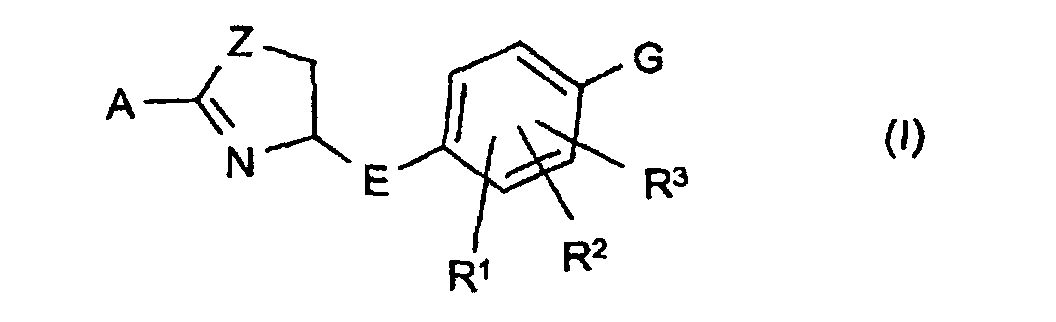
- A
- ist Phenyl, Pyridyl, Pyrimidinyl, Pyrazinyl, Pyrazolyl oder Thienyl, wobei jede der genannten Gruppen gegebenenfalls durch einen oder mehrere, vorzugsweise einen, zwei oder drei, Reste X substituiert ist;
- X
- ist gleich oder verschieden
- a) Halogen, Cyano, Nitro;
- b) (C1-C4)-Alkyl, (C2-C4)-Alkenyl, (C2-C4)-Alkinyl, (C1-C4)-Alkoxy, (C1-C4)-Alkylthio,
(C1-C4)-Alkylsulfinyl, (C3-C8)-Cycloalkyl, (C4-C8)-Cycloalkenyl,
Phenyl,
wobei die Reste der Gruppe b gegebenenfalls durch einen oder mehrere, vorzugsweise einen, zwei oder drei, Reste aus der Gruppe Halogen, Cyano, (C1-C4)-Alkyl, (C1-C4)-Haloalkyl, (C1-C4)-Alkoxy und (C1-C4)-Haloalkoxy substituiert sind;
- E
- ist eine Einfachbindung;
- G
- ist ein Rest aus der Gruppe:

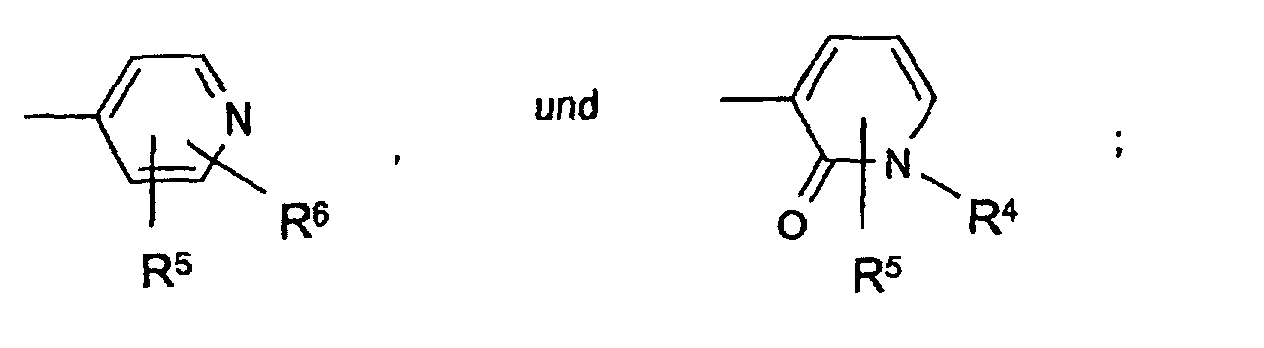
- Z
- ist Sauerstoff oder Schwefel;
- R1, R2 und R3
- sind gleich oder verschieden Wasserstoff, Halogen, (C1-C4)Haloalkyl, (C1-C4)Alkyl, (C1-C4)Alkoxy, (C1-C4)Haloalkoxy oder Cyano;
- R4
- ist Wasserstoff oder eine Gruppe (C1-C8)Alkyl, (C2-C8)Alkenyl, (C2-C8)Alkinyl, (C3-C8)Cycloalkyl, (C3-C8)Cycloalkenyl, (C4-C10)Cycloalkyl-alkyl oder (C7-C12)Phenylalkyl, wobei jede der genannten Gruppen gegebenenfalls durch einen oder mehrere Substituenten aus der Gruppe Halogen, (C1-C4)Alkyl, (C1-C3)Haloalkyl, (C1-C4)Alkoxy, (C1-C3)Haloalkoxy, (C1-C3)Alkylthio, (C3-C8)Cycloalkyl, (C7-C12)Phenylalkyoxy, (C2-C4)Alkylcarbonyl, Alkoxycarbonyl, (C2-C6)Monoalkyl- und (C3-C9)Dialkyl-aminocarbonyl, Cyano und Tri(C1-C4)alkylsilyl substituiert ist;
- R5 und R6
- sind gleich oder verschieden
- a) Wasserstoff, Halogen, Cyano,
- b) (C1-C8)Alkyl, (C3-C8)Cycloalkyl, (C4-C8)Cycloalkenyl, (C1-C8)Alkylthio, (C1-C8)Alkylsulfinyl, (C1-C8)Alkylsulfonyl, (C7-C12)Phenylalkyl, (C7-C12)Phenylalkoxy, (C4-C7)Oxacycloalkyl, (C4-C7)Oxacycloalkenyl, wobei jede der Gruppen b gegebenenfalls durch einen oder mehrere, vorzugsweise einen bis drei, Reste aus der Gruppe Halogen, (C1-C4)Alkyl, (C1-C3)Haloalkyl, (C1-C3)Alkoxy, (C1-C3)Haloalkoxy, (C1-C3)Alkylthio, und Cyano substituiert ist;
- c) (C1-C8)Alkoxy, wobei jede der Gruppen c gegebenenfalls durch einen oder mehrere, vorzugsweise einen bis drei, Reste aus der Gruppe Halogen, (C1-C3)Alkylthio und Cyano substituiert ist; oder
- A
- ist vorzugsweise Phenyl oder Pyridyl, besonders bevorzugt Phenyl.
- X
- ist bevorzugt
- a) Halogen, Cyano, Nitro oder
- b) (C1-C4)-Alkyl, (C1-C4)-Alkenyl, (C1-C4)-Alkinyl, (C1-C4)-Alkoxy, (C1-C4)-Alkylthio,
(C1-C4)-Alkylsulfinyl, (C3-C7)-Cycloalkyl, (C4-C8)-Cycloalkenyl,
wobei die Reste der Gruppe b gegebenenfalls durch einen oder mehrere, vorzugsweise einen, zwei oder drei Reste aus der Gruppe Halogen, Cyano, (C1-C4)-Alkoxy und (C1-C4)-Haloalkoxy substituiert sind;
- X
- ist besonders bevorzugt Halogen, (C1-C4)-Alkyl, (C1-C3)-Haloalkyl, (C1-C4)-Alkoxy oder (C1-C3)-Haloalkoxy.
- G
- ist bevorzugt
besonders bevorzugt 3-Pyridyl.
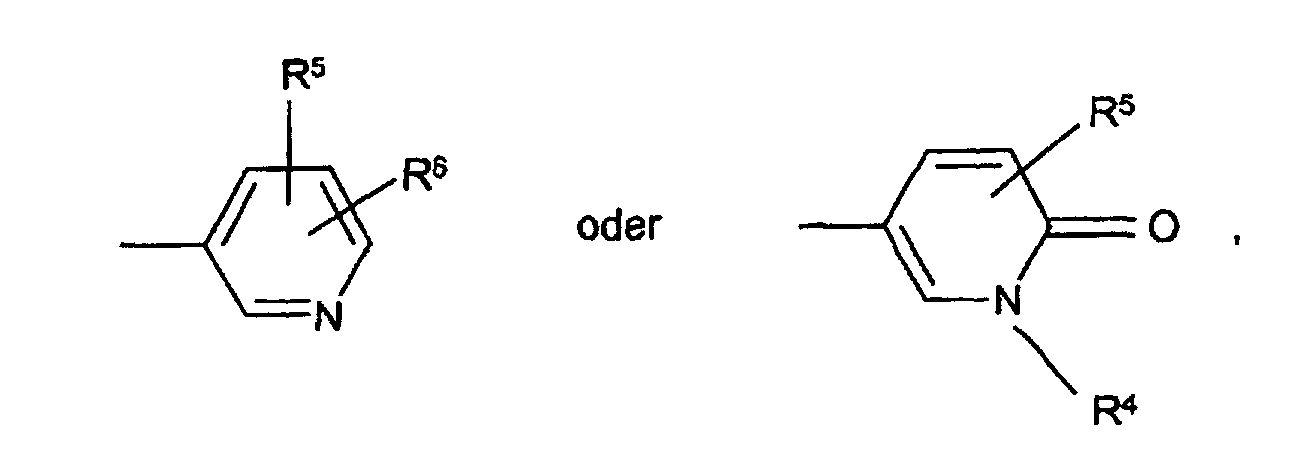
- Z
- ist bevorzugt Sauerstoff.
- R1, R2, R3
- sind bevorzugt H, Halogen, (C1-C4)-Haloalkyl, (C1-C4)-Alkyl, (C1-C4)-Alkoxy, (C1-C4)-Haloalkoxy oder Cyano, besonders bevorzugt H, Halogen, (C1-C4)-Haloalkyl, (C1-C4)-Alkyl, (C1-C4)-Alkoxy, (C1-C4)-Haloalkoxy,
- R4
- ist bevorzugt H oder (C1-C8)-Alkyl, welches gegebenenfalls durch einen oder mehrere, vorzugsweise 1 bis 3, Reste aus der Gruppe Halogen, (C1-C4)-Alkyl, (C1-C3)-Haloalkyl, (C1-C4)-Alkoxy, (C1-C3)-Haloalkoxy, (C1-C3)-Alkylthio, (C3-C8)-Cycloalkyl, Cyano oder Tri(C1-C4)alkylsilyl substituiert ist.
- R5, R6
- sind bevorzugt
- a) H, Halogen, Cyano,
- b) (C1-C8)-Alkyl, (C1-C8)-Alkoxy, (C3-C8)-Cycloalkyl, (C4-C8)-Cycloalkenyl, (C1-C8)-Alkylthio, (C1-C8)-Alkylsulfinyl, (C1-C8)-Alkylsulfonyl, (C7-C12)- Phenylkalkyl oder (C7-C12)-Phenylalkoxy,
unter dem Ausdruck "(C1-C4)-Alkyl" ein unverzweigter oder verzweigter Kohlenwasserstoffrest mit 1 bis 4 Kohlenstoffatomen, wie z.B. der Methyl-, Ethyl-, Propyl-, Isopropyl-, 1-Butyl-, 2-Butyl-, 2-Methylpropyl- oder tert.-Butytrest zu verstehen;
unter dem Ausdruck "(C1-C8)-Alkyl" die vorgenannten Alkylreste sowie z.B. der Pentyl-, 2-Methylbutyl-, 1,1-Dimethylpropyl-, Hexyl-, Heptyl-, Octyl- oder der 1,1,3,3-Tetramethylbutyl-Rest;
unter dem Ausdruck "(C1-C4)-Halogenalkyl" eine unter dem Ausdruck "(C1-C4)-Alkyl" genannte Alkylgruppe, in der ein oder mehrere Wasserstoffatome durch die obengenannten Halogenatome, bevorzugt Chlor oder Fluor, ersetzt sind, wie beispielsweise die Trifluormethylgruppe, die 1-Fluorethylgruppe, die 2,2,2-Trifluorethylgruppe, die Chlormethyl-, Fluormethylgruppe, die Difluormethylgruppe oder die 1,1,2,2-Tetrafluorethylgruppe; unter dem Ausdruck "(C3-C8)-Cycloalkyl" beispielsweise die Cyclopropyl-, Cyclobutyl- oder Cyclopentylgruppe; sowie der Cyclohexyl-, Cycloheptyl- oder Cyclooctyl-Rest;
unter dem Ausdruck "(C3-C8)-Halogencycloalkyl" eine der oben aufgeführten (C3-C5)-Cycloalkylreste, in denen eines oder mehrere, im Falle von Fluor gegebenenfalls auch alle Wasserstoffatome, durch Halogen, bevorzugt Fluor oder Chlor, ersetzt sind, wie beispielsweise die 2,2-Difluor- oder 2,2-Dichlorcyclopropan-Gruppe oder der Fluorcyclopentan-Rest;
unter dem Ausdruck "(C2-C4)-Alkenyl" z.B. die Vinyl-, Allyl-, 2-Methyl-2-propenyl- oder 2-Butenyl-Gruppe;
unter dem Ausdruck "(C2-C4)-Halogenalkenyl" eine (C2-C4)-Alkenyl-Gruppe, in der die Wasserstoffatome teilweise oder im Falle von Fluor auch vollständig durch Halogen, bevorzugt Fluor oder Chlor ersetzt sind;
unter dem Ausdruck "(C2-C4)-Alkinyl" z.B. die Ethinyl-, Propargyl-, 2-Methyl-2-propinyl oder 2-Butinyl-Gruppe;
unter dem Ausdruck "(C2-C8)-Alkinyl" z.B. die vorstehend genannten Reste sowie z.B. die 1-Pentinyl, 2-Pentinyl-, 3-Pentinyl-, 4-Pentinyl- oder die 1-Octinyl-Gruppe; unter dem Ausdruck "(C2-C4)-Halogenalkinyl" eine (C2-C4)-Alkinylgruppe in der die Wasserstoffatome teilweise, im Falle von Fluor auch vollständig, durch Halogenatome, bevorzugt Fluor oder Chlor, ersetzt sind;
unter dem Ausdruck "(C1-C4)-Hydroxyalkyl" z.B. die Hydroxymethyl-, 1-Hydroxyethyl-, 2-Hydroxyethyl-, 1-Hydroxy-1-methyl-ethyl- oder die 1-Hydroxypropyl-Gruppe;
unter dem Ausdruck "(C1-C4)-Alkanoyl-(C1-C4)alkyl" z.B. eine Acetylmethyl-, Propionylmethyl-, 2-Acetylethyl- oder eine Butyrylmethyl-Gruppe;
unter dem Ausdruck "(C1-C4)-Alkanoyl" z.B. die Formyl-, Acetyl-, Propionyl-, 2-Methylpropionyl- oder Butyryl-Gruppe;
unter dem Ausdruck "(C1-C8)-Alkanoyl" die vorstehend genannte Reste sowie z.B. die Valeroyl-, Pivaloyl, Hexanoyl-, Heptanoyl- oder Octanoyl-Gruppe;
unter dem Ausdruck "(C1-C12)-Alkanoyl" z.B. die vorgenannten Reste sowie beispielsweise die Nonanoyl-, Decanoyl- oder die Dodecanoyl-Gruppe;
unter dem Ausdruck "(C2-C4)-Halogenalkanoyl" eine (C1-C4)-Alkanoyl-Gruppe, in der die Wasserstoffatome teilweise, im Falle von Fluor auch vollständig, durch Halogenatome, bevorzugt Fluor oder Chlor ersetzt sind;
unter dem Ausdruck "(C2-C12)-Halogenalkanoyl" eine (C1-C20)-Alkanoyl-Gruppe, in der die Wasserstoffatome teilweise, im Falle von Fluor auch vollständig, durch Halogenatome, bevorzugt Fluor oder Chlor, ersetzt sind;
unter dem Ausdruck "Cyan-(C1-C4)-alkyl" eine Cyanalkyl-Gruppe, deren Kohlenwasserstoffrest die unter dem Ausdruck "(C1-C4)-Alkyl" angegebenen Bedeutungen hat;
unter den Ausdrücken "(C1-C4)-Nitroalkyl" oder "(C1-C4)-Thiocyanoalkyl" eine der oben genannten (C1-C4)-Alkylgruppen, die mit einer Nitro- oder einer Thiocyano-Gruppe substituiert sind;
unter dem Ausdruck "(C1-C4)-Alkoxycarbonyl" z.B. die Methoxycarbonyl-, Ethoxycarbonyl-, Propoxycarbonyl-, Butoxycarbonyl oder tert.-Butoxycarbonyl-Gruppe;
unter dem Ausdruck "(C1-C8)-Alkoxycarbonyl" z.B. die vorstehend genannten Reste sowie z.B. die Pentyloxycarbonyl, Hexyloxycarbonyl- oder die Octyloxycarbonyl-Gruppe;
unter dem Ausdruck "(C1-C12)-Alkoxycarbonyl" die vorstehend genannten Reste sowie z.B. die Nonyloxycarbonyl-, 2-Methyloctyloxycarbonyl-, Decyloxycarbonyl- oder Dodecyloxycarbonyl-Gruppe;
unter dem Ausdruck "(C1-C4)-Alkoxycarbonyl-(C1-C4)-alkyl" z.B. eine Methoxycarbonylmethyl, Ethoxycarbonylmethyl- oder Methoxycarbonylethyl-Gruppe; unter dem Ausdruck "(C1-C4)-Halogenalkoxycarbonyl" eine (C1-C4)-Alkoxycarbonyl-Gruppe in der eines oder mehrere, im Falle von Fluor gegebenenfalls auch alle Wasserstoffatome, durch Halogen, bevorzugt Fluor oder Chlor, ersetzt sind;
unter dem Ausdruck "(C1-C4)-Alkylthio" eine Alkylthiogruppe, deren Kohlenwasserstoffrest die unter dem Ausdruck "(C1-C4)-Alkyl" angegebene Bedeutung hat;
unter dem Ausdruck "(C1-C8)-Alkylthio" eine Alkylthiogruppe, deren Alkylrest die unter dem Ausdruck "(C1-C8)-Alkyl" angegebene Bedeutung hat;
unter dem Ausdruck "(C1-C4)-Halogenalkylthio" eine (C1-C4)-Alkylthio-Gruppe, in der ein oder mehrere, im Falle von Fluor gegebenenfalls auch alle Wasserstoffatome des Kohlenwasserstoff-Teils durch Halogen, insbesondere Chlor oder Fluor ersetzt sind;
unter dem Ausdruck "(C1-C4)-Alkylsulfinyl" z.B. die Methyl-, Ethyl-, Propyl-, Isopropyl-, Butyl-, Isobutyl-, sek.-Butyl- oder tert.-Butylsulfinyl-Gruppe;
unter dem Ausdruck "(C1-C8)-Alkylsulfinyl" eine der vorstehend genannten Alkylsulfinyl-Gruppen sowie z.B. die Pentylsulfinyl-, 2-Methylbutylsulfinyl-, Hexylsuffinyl- oder Octylsulfinyl-Gruppe;
unter dem Ausdruck "(C1-C4)-Alkylsulfonyl" z.B. die Methyl-, Ethyl-, Propyl-, Isopropyl-, Butyl-, Isobutyl-, sek.-Butyl- oder tert.-Butylsulfonyl-Gruppe;
unter den Ausdrücken "(C1-C4)-Halogenalkylsulfinyl" und "(C1-C4)-Halogenalkylsulfonyl" (C1-C4)-Alkylsulfinyl- und -sulfonyl-Reste mit den oben angegebenen Bedeutungen, bei denen ein oder mehrere, im Falle von Fluor gegebenenfalls auch alle Wasserstoffatome des Kohlenwasserstoff-Teils durch Halogen, insbesondere Chlor oder Fluor ersetzt sind;
unter den Ausdrücken "Fluormethylsulfinyl" und "Fluormethylsulfonyl" die Mono-, Diund Trifluormethyl-sulfinyl- und -sulfonyl-Gruppe;
unter dem Ausdruck "(C1-C4)-Alkoxy" eine Alkoxygruppe, deren Kohlenwasserstoffrest die unter dem Ausdruck "(C1-C4)-Alkyl" angegebene Bedeutung hat;
unter dem Ausdruck "(C1-C8)-Alkoxy" eine Alkoxy-Gruppe, deren Kohlenwasserstoffrest die unter dem Ausdruck "(C1-C8)-Alkyl" angegebene Bedeutung hat;
unter dem Ausdruck "(C1-C8)-Alkylsulfonyl" eine der vorstehend genannten Alkylsulfonyl-Gruppen, sowie z.B. die Pentyl-, 2-Methylbutyl-, Hexyl-, Heptyl- oder Octylsulfonyl-Gruppe,
unter dem Ausdruck "(C1-C4)-Alkylamino" z.B. die Methylamino-, Ethylamino-, Propylamino-, Isopropylamino-, Butylamino-, Isobutylamino-, sek.-Butylamino- oder die tert.-Butylaminogruppe,
unter dem Ausdruck "(C1-C8)-Alkylamino" eine der vorstehend genannten (C1-C4)-Alkylamino-Gruppen sowie z.B. die Pentylamino-, Hexylamino-, Heptylamino- oder Octylamino-Gruppe;
unter dem Ausdruck "(C1-C4)-Dialkylamino" z.B. die Dimethylamino-, Methyl-ethylamino-, Diethylamino-, Dipropylamino- oder die Dibutylamino-Gruppe, aber auch cyclische Systeme wie z.B. die Pyrrolidino- oder Piperidino-Gruppe,
unter dem Ausdruck "(C1-C8)-Dialkylamino" eine der vorstehend genannten (C1-C4)-Dialkylamino-Gruppen, sowie z.B. die Dipentyl-, Dihexyl- oder die Dioctylamino-Gruppe;
unter dem Ausdruck "(C1-C4)-Halogenalkoxy" eine Halogenalkoxygruppe, deren Halogen-Kohlenwasserstoffrest die unter dem Ausdruck "(C1-C4)-Halogenalkyl" angegebene Bedeutung hat;
unter dem Ausdruck "(C1-C4)-Alkoxy-(C1-C4)-alkyl" beispielsweise eine 1-Methoxyethylgruppe, eine 2-Methoxyethylgruppe, eine 2-Ethoxyethylgruppe, eine Methoxymethyl- oder Ethoxymethylgruppe, eine 3-Methoxypropylgruppe oder eine 4-Butoxybutylgruppe;
unter den Ausdrücken "(C1-C4)-Halogenalkoxy-(C1-C4)-Alkyl", "(C1-C4)-Alkoxy-(C1-C4)-halogenalkyl" und "(C1-C4)-Halogenalkoxy-(C1-C4)-halogenalkyl" (C1-C4)-Alkoxy-(C1-C4)-alkyl-Reste mit den oben angegebenen Bedeutungen, bei denen eines oder mehrere, im Falle von Fluor gegebenenfalls auch alle Wasserstoffatome der entsprechenden Kohlenwasserstoff-Anteile durch Halogen, bevorzugt Chlor oder Fluor ersetzt sind;
unter dem Ausdruck "(C1-C4)-Alkylthio-(C1-C4)-alkyl" beispielsweise Methylthiomethyl, Ethylthiomethyl, Propylthiomethyl, 2-Methylthioethyl, 2-Ethylthioethyl oder 3-Methylthiopropyl;
unter dem Ausdruck "Heterocyclyl" ein heteroaromatisches oder heteroaliphatisches Ringsystem, wobei unter "heteroaromatisches Ringsystem" ein Arylrest, worin mindestens eine CH-Gruppe durch N ersetzt ist und/oder mindestens zwei benachbarte CH-Gruppen durch S, NH oder O ersetzt sind, zu verstehen ist, z.B. ein Rest von Thiophen, Furan, Pyrrol, Thiazol, Oxazol, Imidazol, Isothiazol, Isoxazol, Pyrazol, 1.3,4-Oxadiazol, 1,3,4-Thiadiazol, 1,3,4-Triazol, 1,2,4-Oxadiazol, 1,2,4-Thiadiazol, 1,2,4-Triazol, 1,2,3-Triazol, 1,2,3,4-Tetrazol, Benzo[b]thiophen, Benzo[b]furan, Indol, Benzo[c]thiophen, Benzo[c]furan, Isoindol, Benzoxazol, Benzothiazol, Benzimidazol, Benzisoxazol, Benzisothiazol, Benzopyrazol, Benzothiadiazol, Benzotriazol, Dibenzofuran, Dibenzothiophen, Carbazol, Pyridin, Pyrazin, Pyrimidin, Pyridazin, 1,3,5-Triazin, 1,2,4-Triazin, 1,2,4,5-Triazin, Chinolin, Isochinolin, Chinoxalin, Chinazolin, Cinnolin, 1,8-Naphthyridin, 1,5-Naphthyridin, 1,6-Naphthyridin, 1,7-Naphthyridin, Phthalazin, Pyridopyrimidin, Purin, Pteridin oder 4H-Chinolizin;
und unter dem Ausdruck "heteroaliphatisches Ringsystem" einen (C3-C8)-Cycloalkylrest in dem mindestens eine Kohlenstoff-Einheit durch O, S oder eine Gruppe NR11 ersetzt ist und R11 Wasserstoff, (C1-C4)-Alkyl, (C1-C4)-Alkoxy oder Aryl bedeutet;
unter dem Ausdruck "Heterocyclyloxy" oder "Heterocyclylthio" einen der oben genannten heterocyclischen Reste die über ein Sauerstoff- oder Schwefelatom verknüpft sind;
unter dem Ausdruck "(C3-C8)-Cycloalkoxy" oder "(C3-C8)-Cycloalkylthio" eine der oben angeführten (C3-C8)-Cycloalkyl-Reste, die über ein Sauerstoff- oder Schwefelatom verknüpft sind;
unter dem Ausdruck "Aryl-(C1-C4)-alkanoyl" z.B. die Phenylacetyl-, 3-Phenylpropionyl-, 2-Phenylpropionyl-, 2-Methyl-2-phenyl-propionyl-, 4-Phenylbutyryl- oder die Naphthylacetyl-Gruppe;
unter dem Ausdruck "(C3-C6)-Cycloalkyl-(C1-C4)-alkanoyl" z.B. die Cyclopropylcarbonyl-, Cyclobutylcarbonyl-, Cyclopentylcarbonyl-, Cyclohexylcarbonyl-, Cyclohexylacetyl- oder die Cyclohexylbutyryl-Gruppe;
unter dem Ausdruck "Heterocyclyl-(C1-C4)-alkanoyl" z.B. die Thenoyl-, Furoyl-, Nicotinoyl-, Thienylacetyl- oder die Pyridin-propionyl-Gruppe;
unter dem Ausdruck "(C3-C8)-Cycloalkoxycarbonyl" z.B. die Cyclobutyloxycarbonyl-, Cyclopentyloxycarbonyl-, Cyclohexyloxycarbonyl- oder die Cycloheptyloxycarbonyl-Gruppe;
unter dem Ausdruck "(C3-C8)-Cycloalkyl-(C1-C4)-alkoxycarbonyl" z.B. die Cyclopropylmethoxycarbonyl-, Cyclobutylmethoxycarbonyl-, Cyclopentyloxymethoxycarbonyl, Cyclohexyloxymethoxycarbonyl-, 1-(Cyclohexyl)-ethoxycarbonyl- oder die 2-(Cyclohexyl)-ethoxycarbonyl-Gruppe;


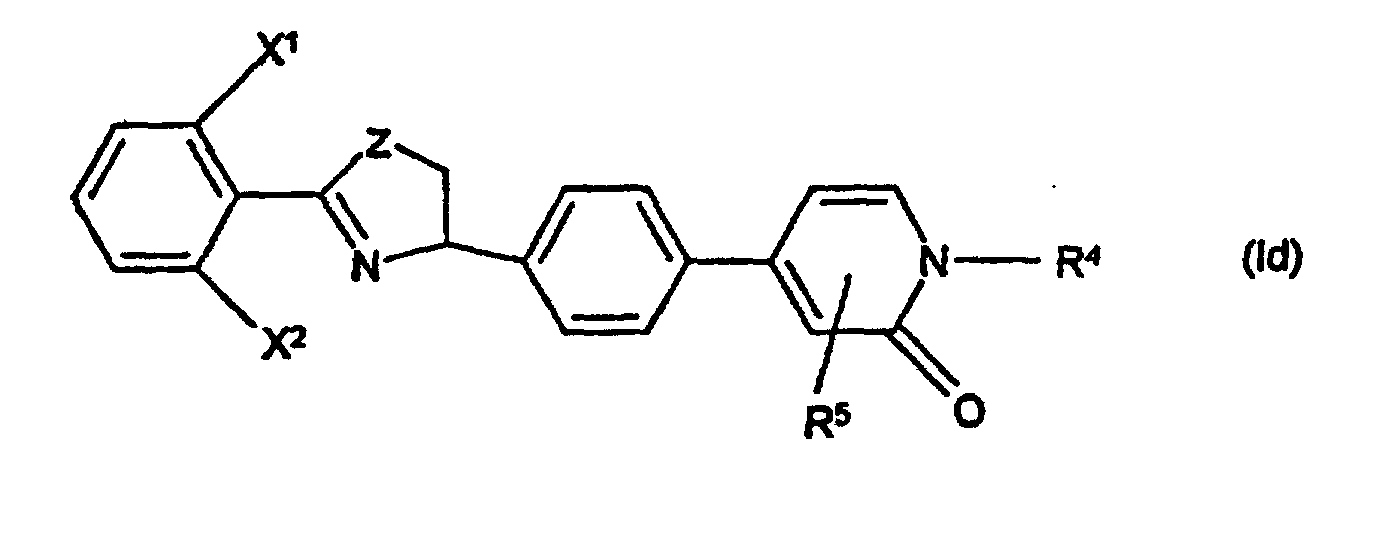
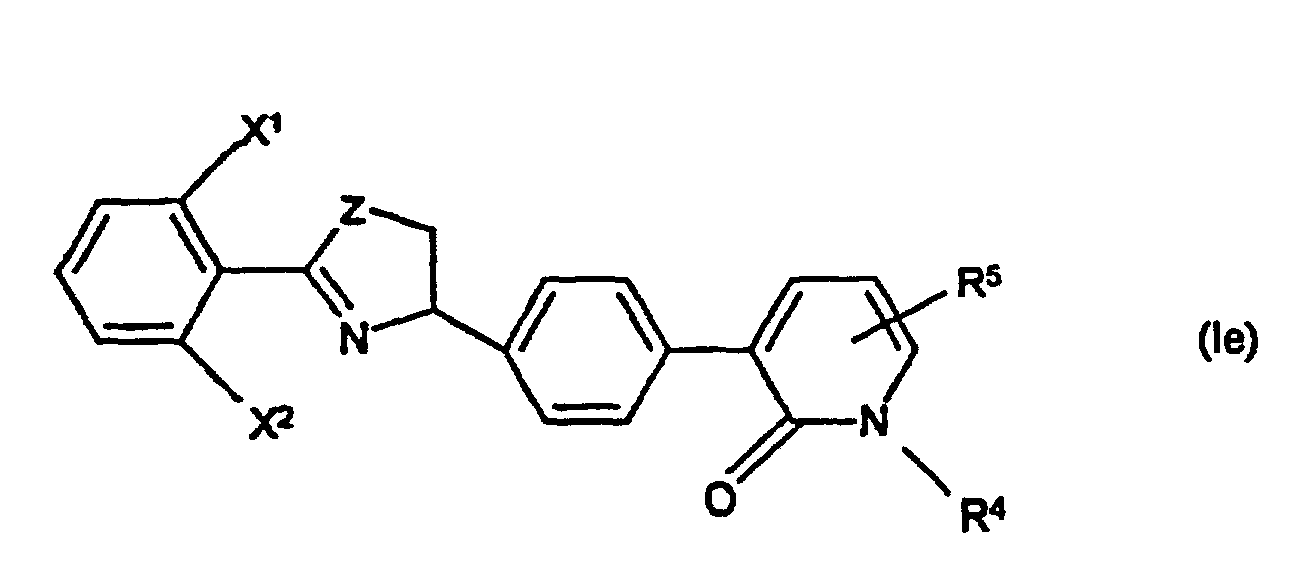

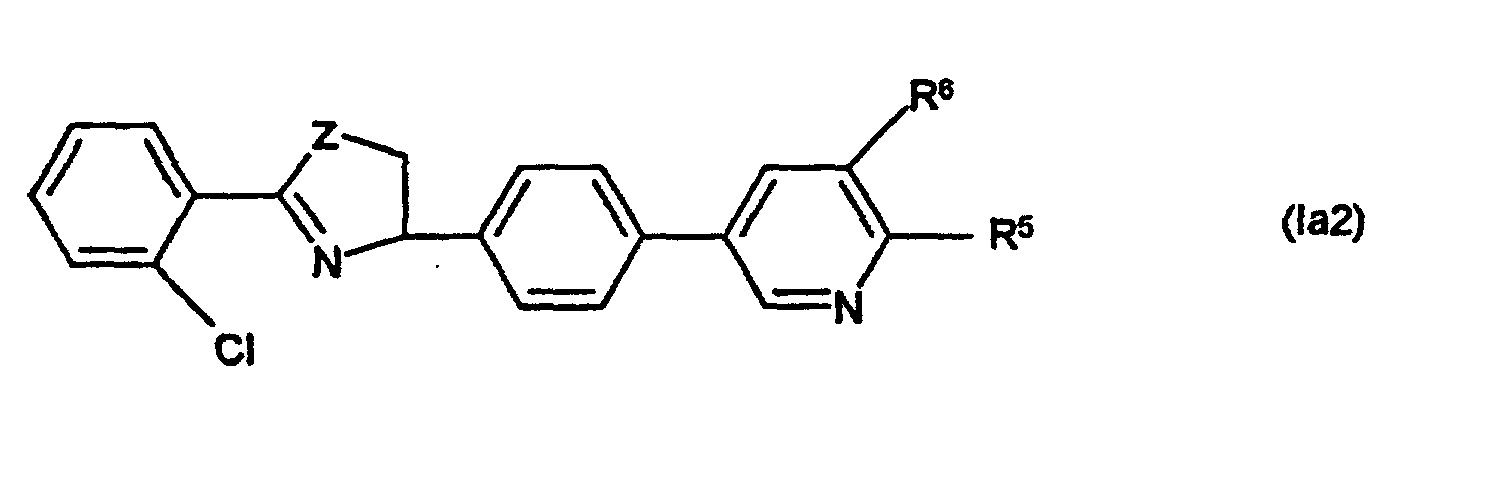
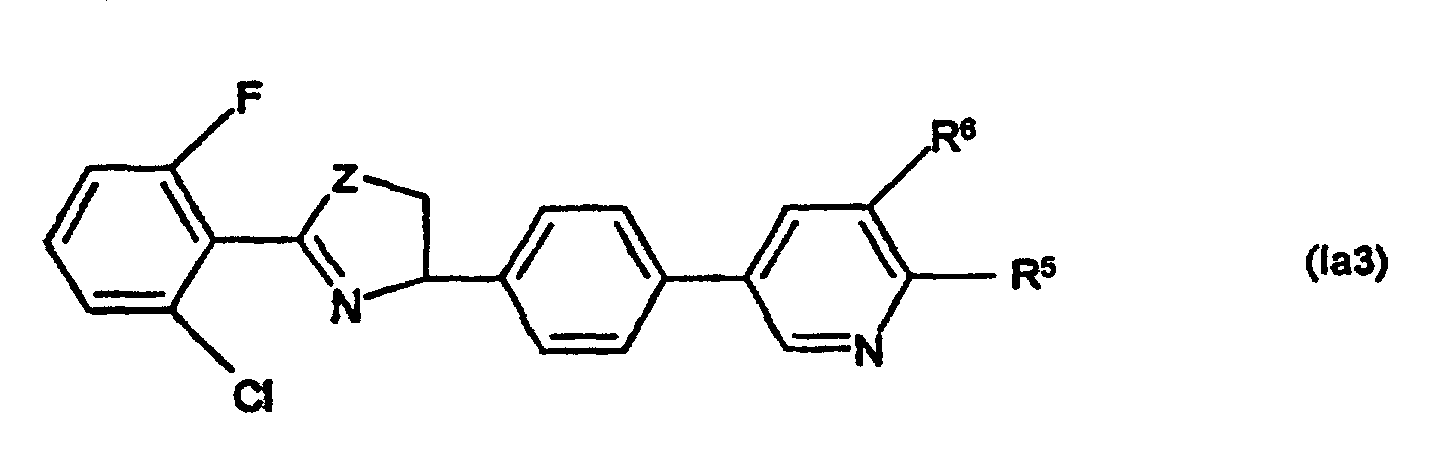
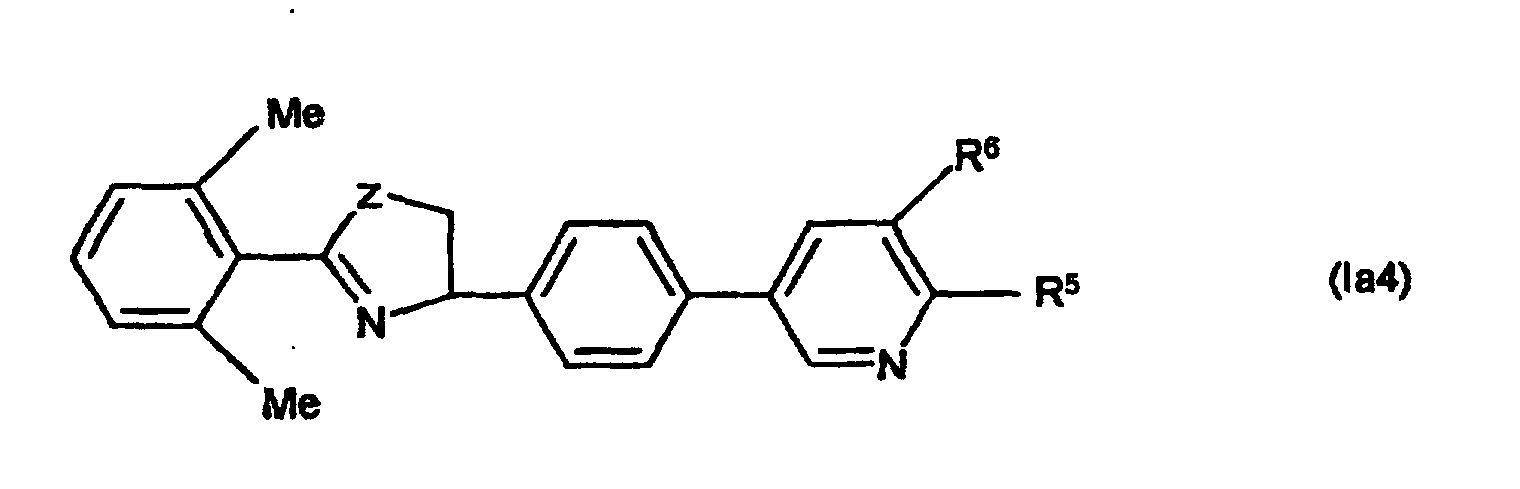
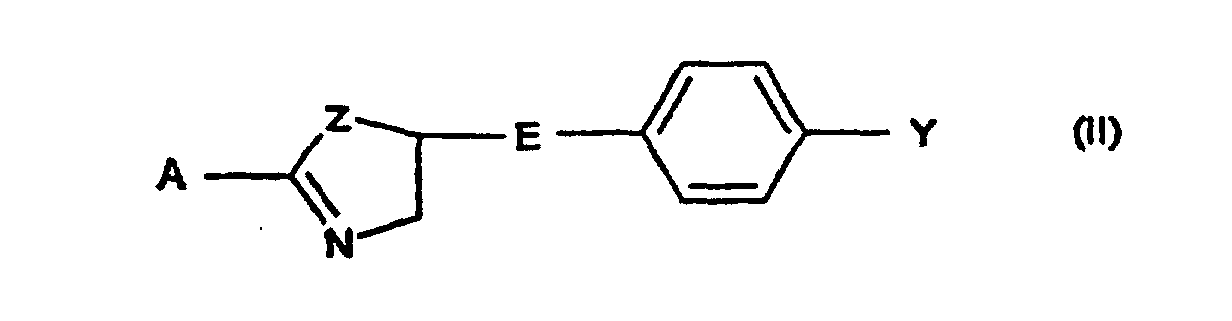
- Y
- Cl, Br, I oder Perfluoralkylsulfonat bedeutet und
- A, Z und E
- die in der Formel (I) angegebenen Bedeutungen haben,
G-M (III),
worin
- M
- eine B, Sn oder Zn-haltige Abgangsgruppe bedeutet und
- G
- die in der Formel (I) angegebenen Bedeutung hat,
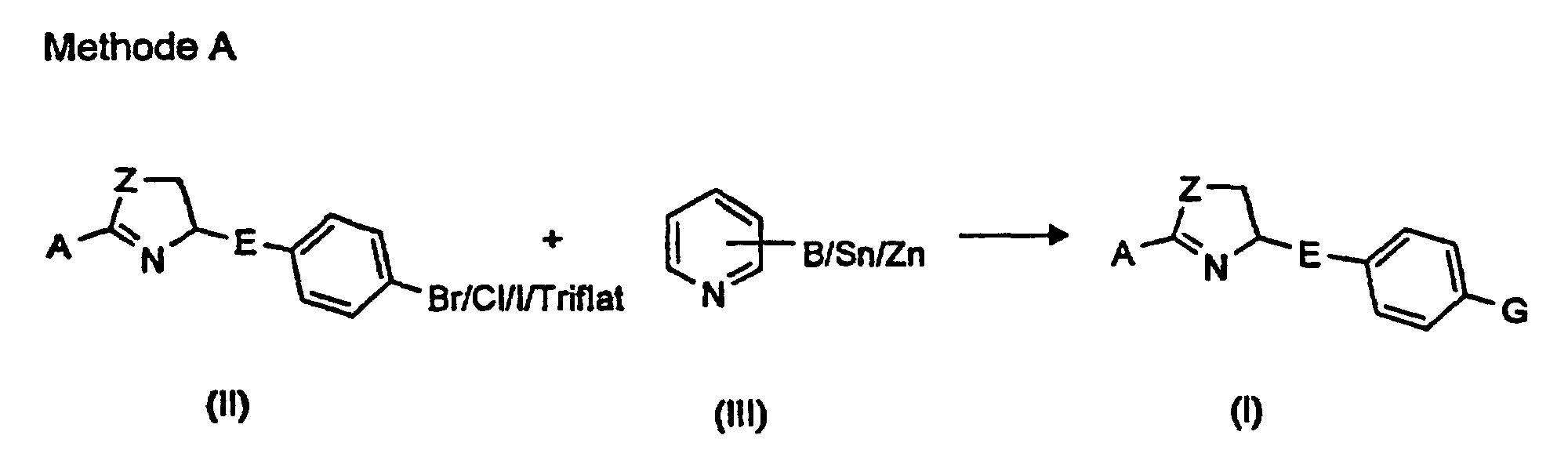
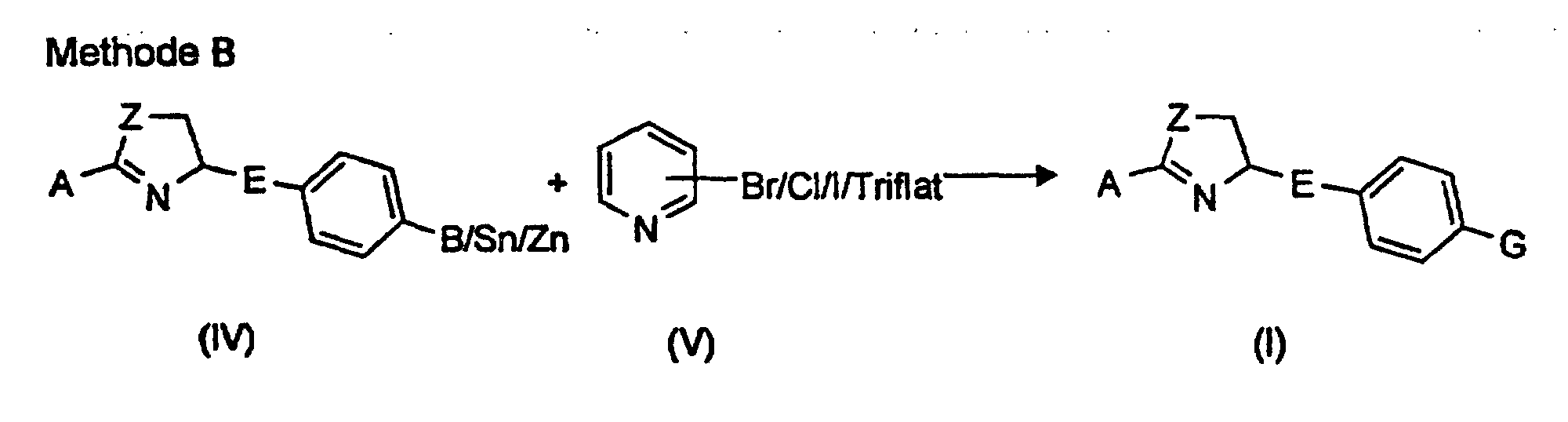
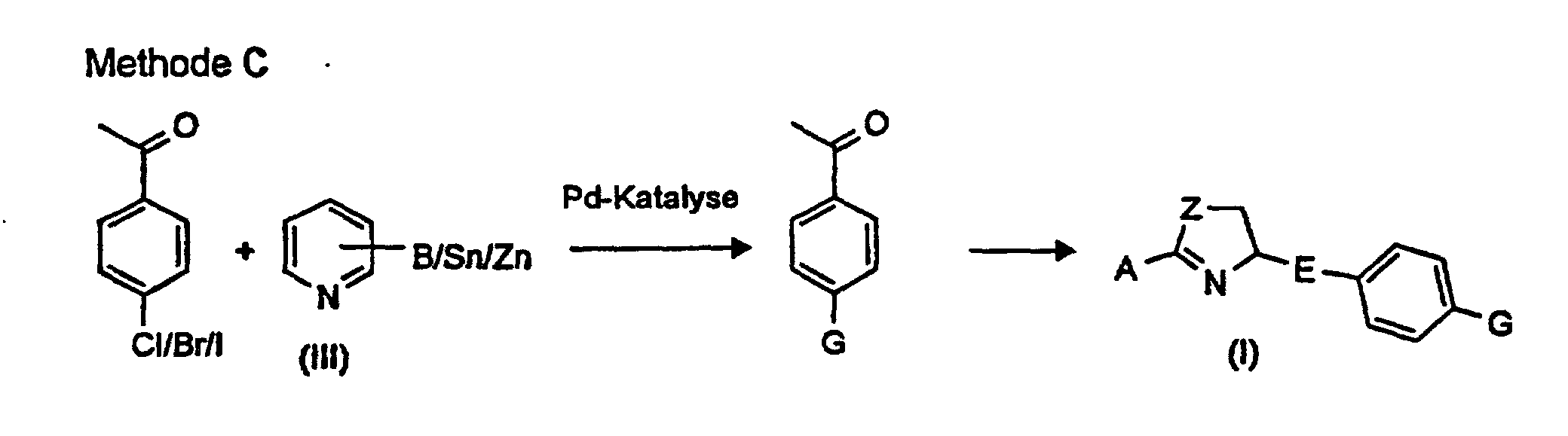
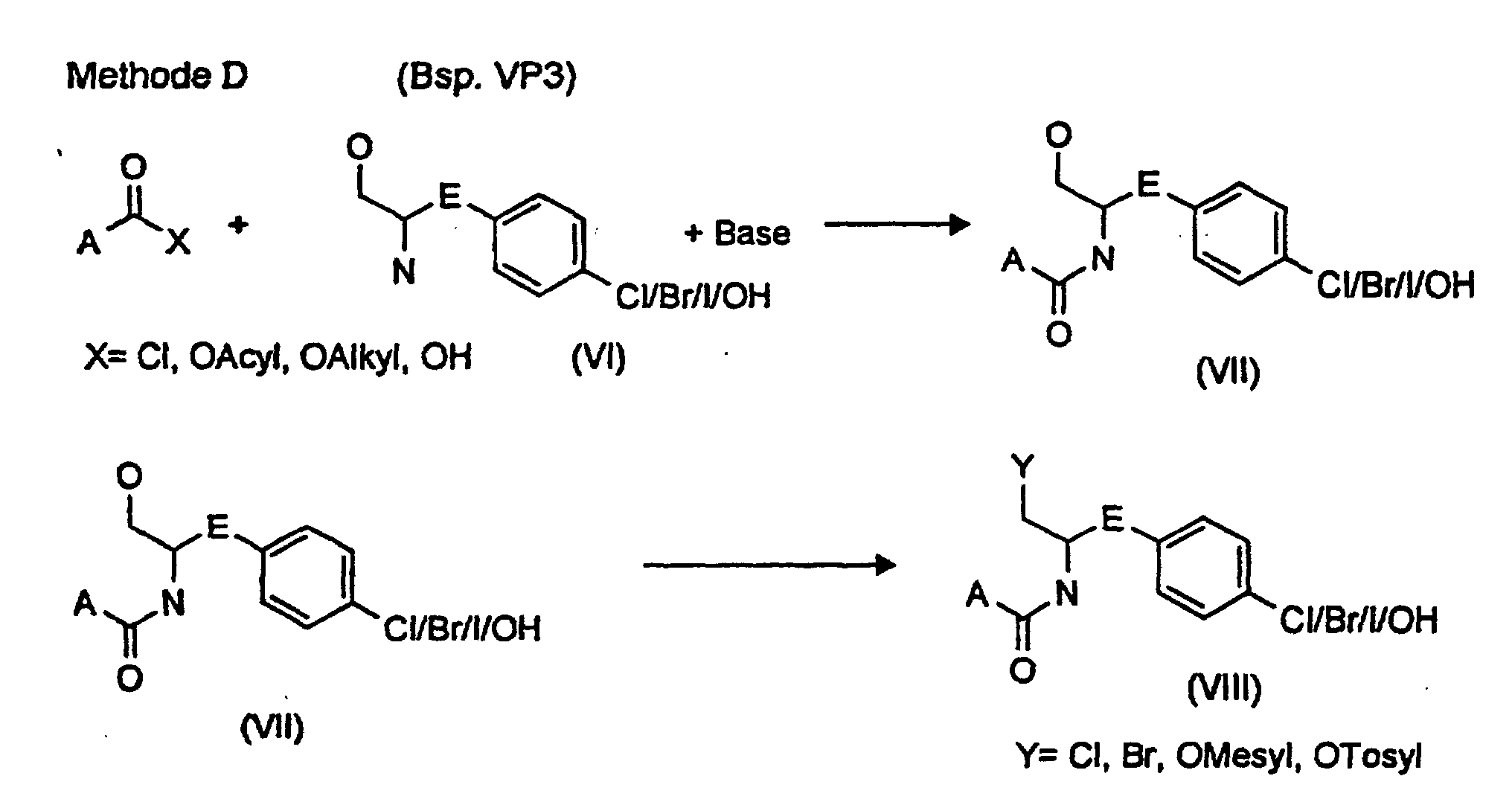


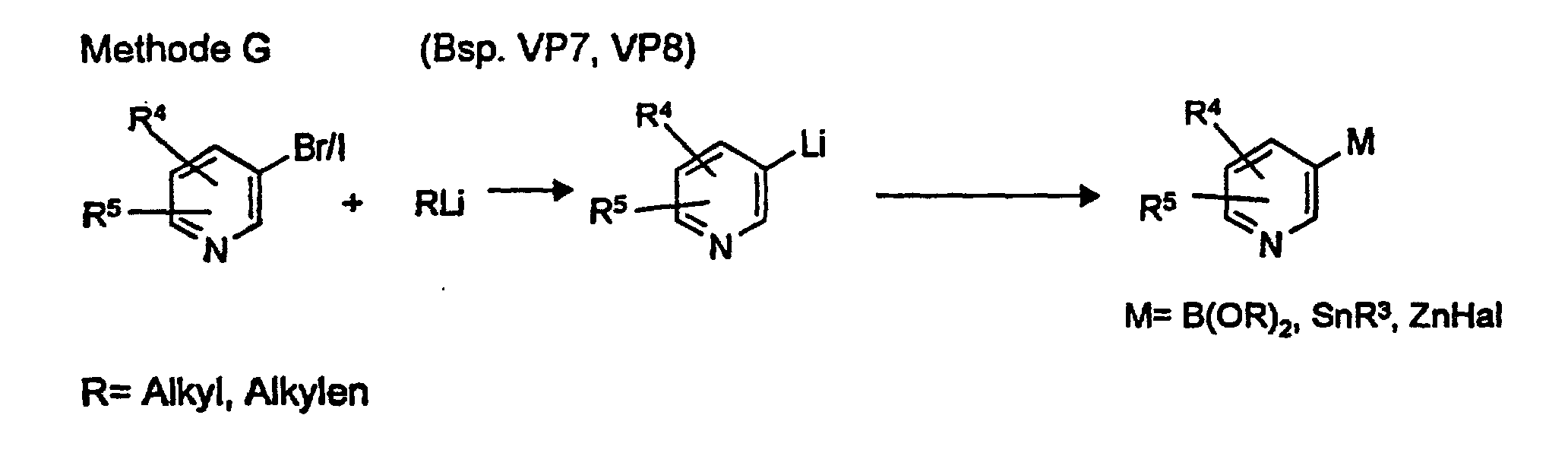
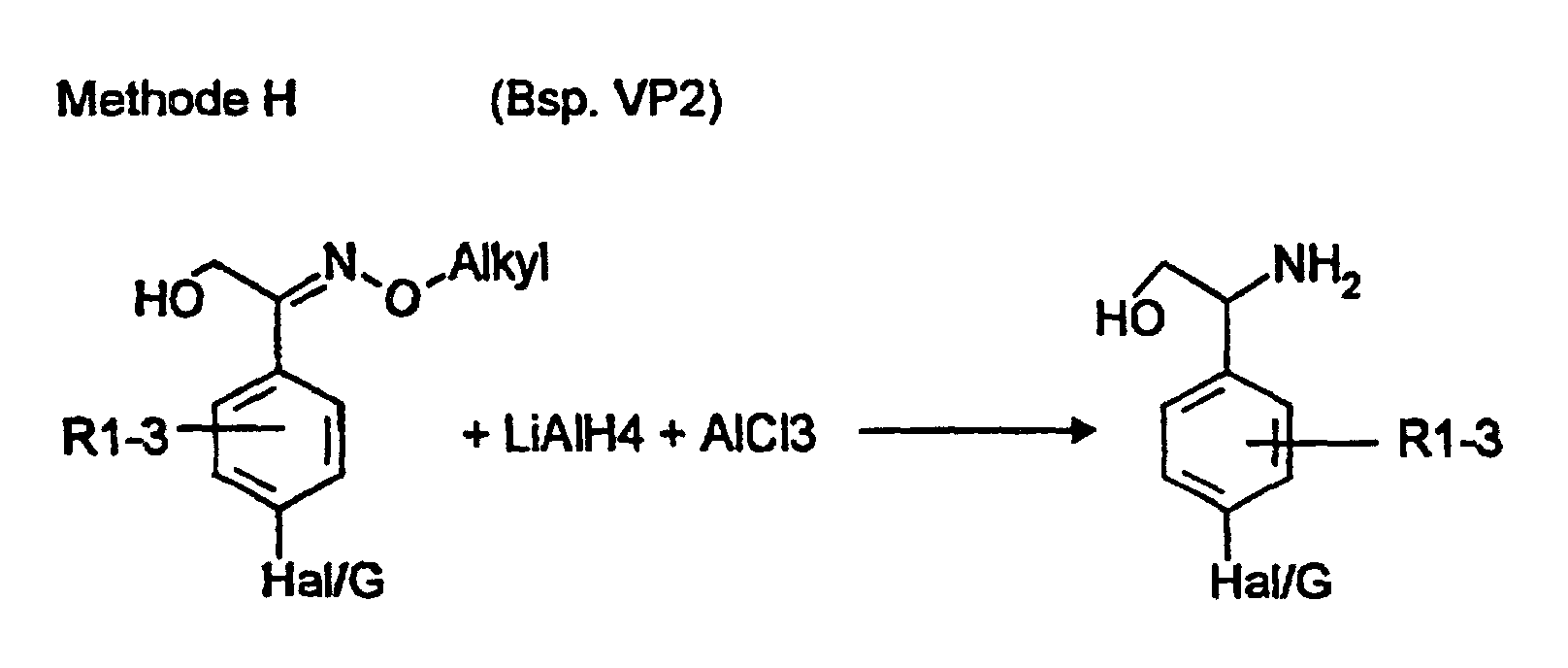
Tylenchulus wie Tylenchulus semipenetrans, Tylenchorhynchus, wie Tylenchorhynchus dubius und Tylenchorhynchus claytoni, Rotylenchus wie Rotylenchus robustus, Heliocotylenchus wie Haliocotylenchus multicinctus, Belonoaimus wie Belonoaimus longicaudatus, Longidorus wie Longidorus elongatus, Trichodorus wie Trichodorus primitivus und Xiphinema wie Xiphinema index.
Analog wurden andere Alkoxypyridine und Alkylthiopyridine hergestellt.
Analog wurden andere 2-Pyridyl-1,3,2-dioxaborinane hergestellt.
Analog wurden andere Stannylpyridine hergestellt.
19F-NMR (CDCl3): -75.05 (CF3), -110.45 (ArF).
1H-NMR (CDCl3, ppm): 1.05, 1.82, 4.29, OC3H7; 4.32, 4.86, 5.51, Oxazolin; 6.80, 7.78, 8.37, Pyridin; 7.02, 7.42, 7.54, Phenyl.
1H-NMR (CDCl3, ppm): 1.04, 2.11, 4.10, O-Isobutyl; 4.33, 4.84, 5.51, Oxazolin; 7.00, 7.42, 7.55, Phenyl; 6.81, 7.77, 8.37, Pyridin.
1H-NMR (CDCl3, ppm): 3.45, 3.94, 5.83, Thiazolin; 4.82, OCH2CF3; 6.95, 7.87, 8.36, Pyridin; 7.00, 7.40, 7.53, Phenyl.
1H-NMR (CDCl3, ppm): 1.01, 1.80, 2.81, n-Propyl; 4.34, 4.85, 5.53, Oxazolin; 7.00, 7.44, 7.59, Phenyl; 7.21, 7.79, 8.76, Pyridyl.
1H-NMR (CDCl3, ppm): 1.24, 2.98, 3.21, SO-CH2CH3; 4.33, 4.87, 5.56, Oxazolin; 7.01, 7.48, 7.64, Phenyl; 8.03, 8.11, 8.84, Pyridin .
1H-NMR (CDCl3, ppm): 1.19, 3.94, NC2H5; 2.08, COCH3; 4.33, 4.87, 5.54, Oxazolin; 7.00, 7.43, 7.48, 7.61, Phenyl; 7.32, 7.96, 8.75, Pyridin .
1H-NMR (CDCI3, ppm): 1.00, 1.81, 3.96 NC3H7; 4.30, 4.83, 5.49, Oxazolin; 6.64, Pyridon; 7.00, 7.4-7.7, Phenyl und Pyridon.
1H-NMR (CDCl3): 1.45, 4.15 OEt; 4.45, 4.92, 5.73, Oxazolin, 4.81 OCH2CF3; 6.94, 7.84, 8.35, Pyridin; 6.98, 7.12, 7.41, 7.53, Phenyl.
1H-NMR (CDCl3): 4.31, 4.82, 5.48, Oxazolin; 4.80, OCH2CF3; 6.92, 7.84, 8.35, Pyridin; 7.20, 7.40, 7.50, 8.00, Phenyl.

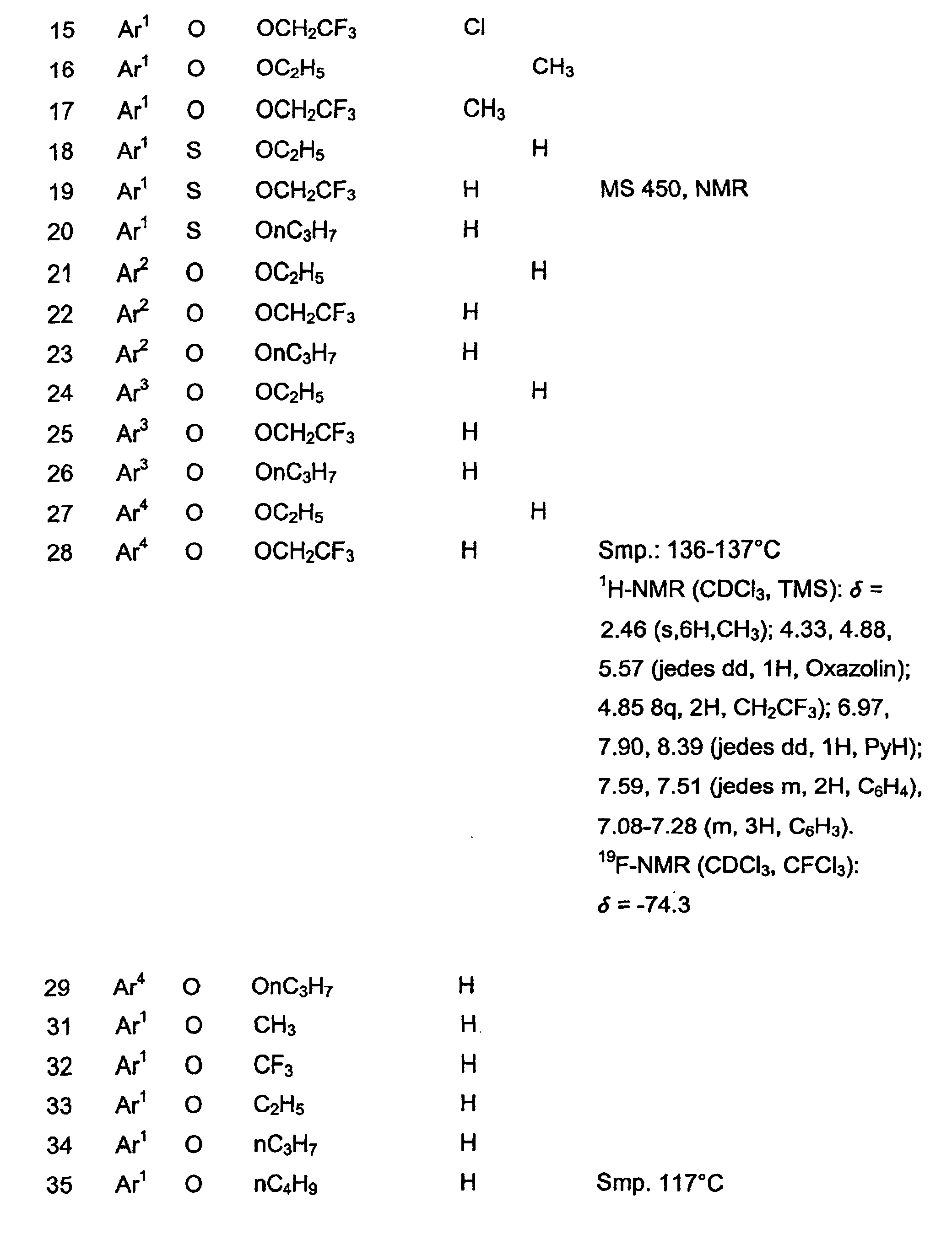
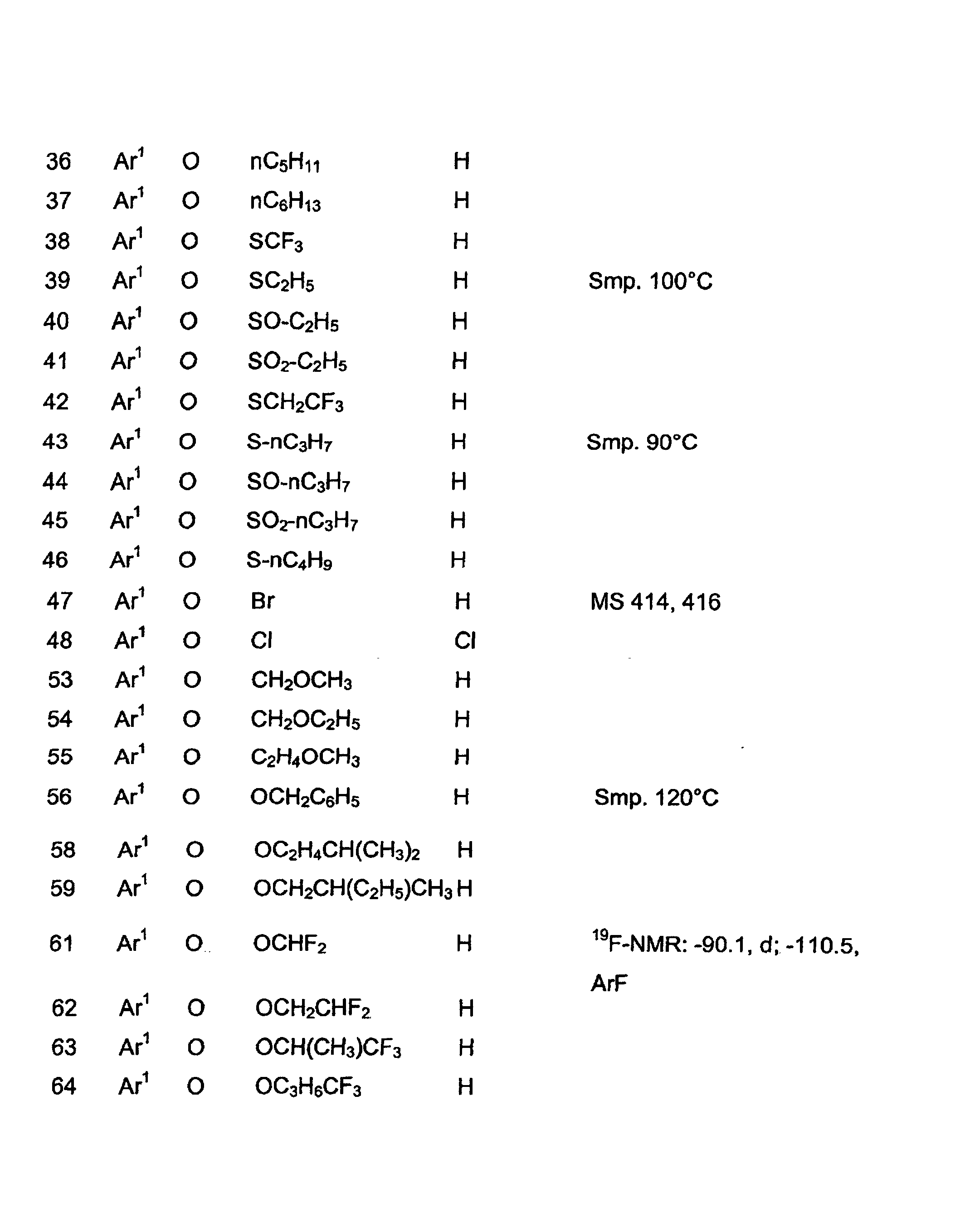
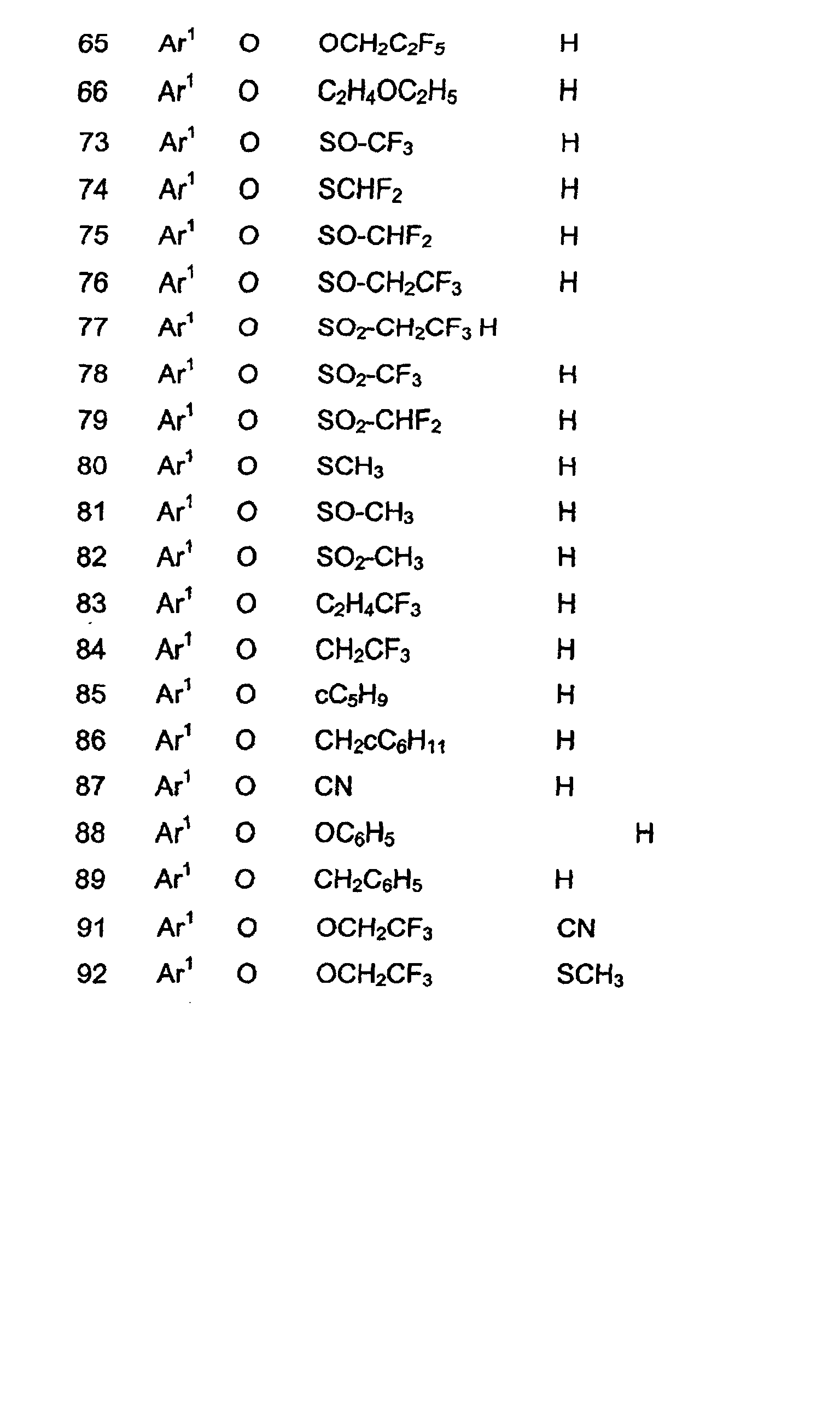
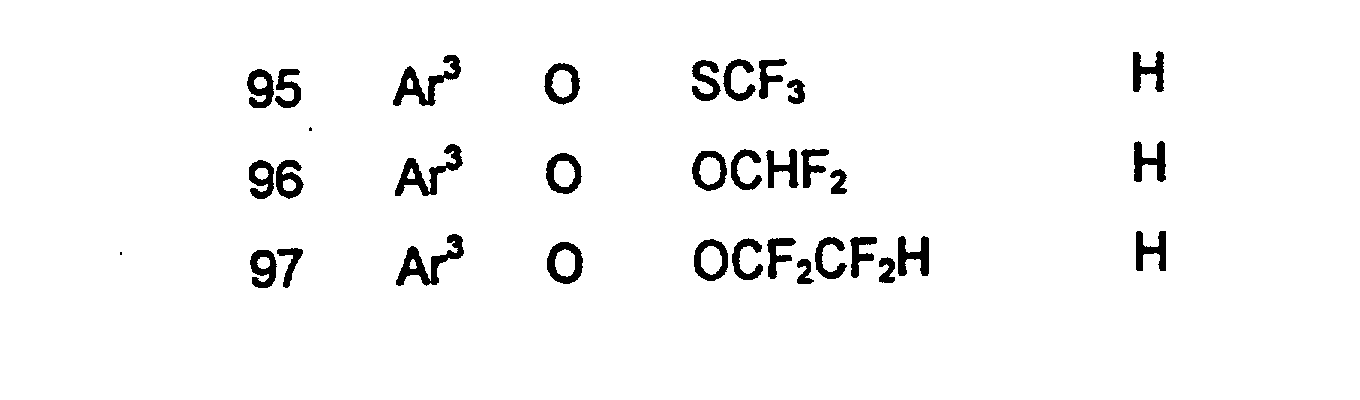
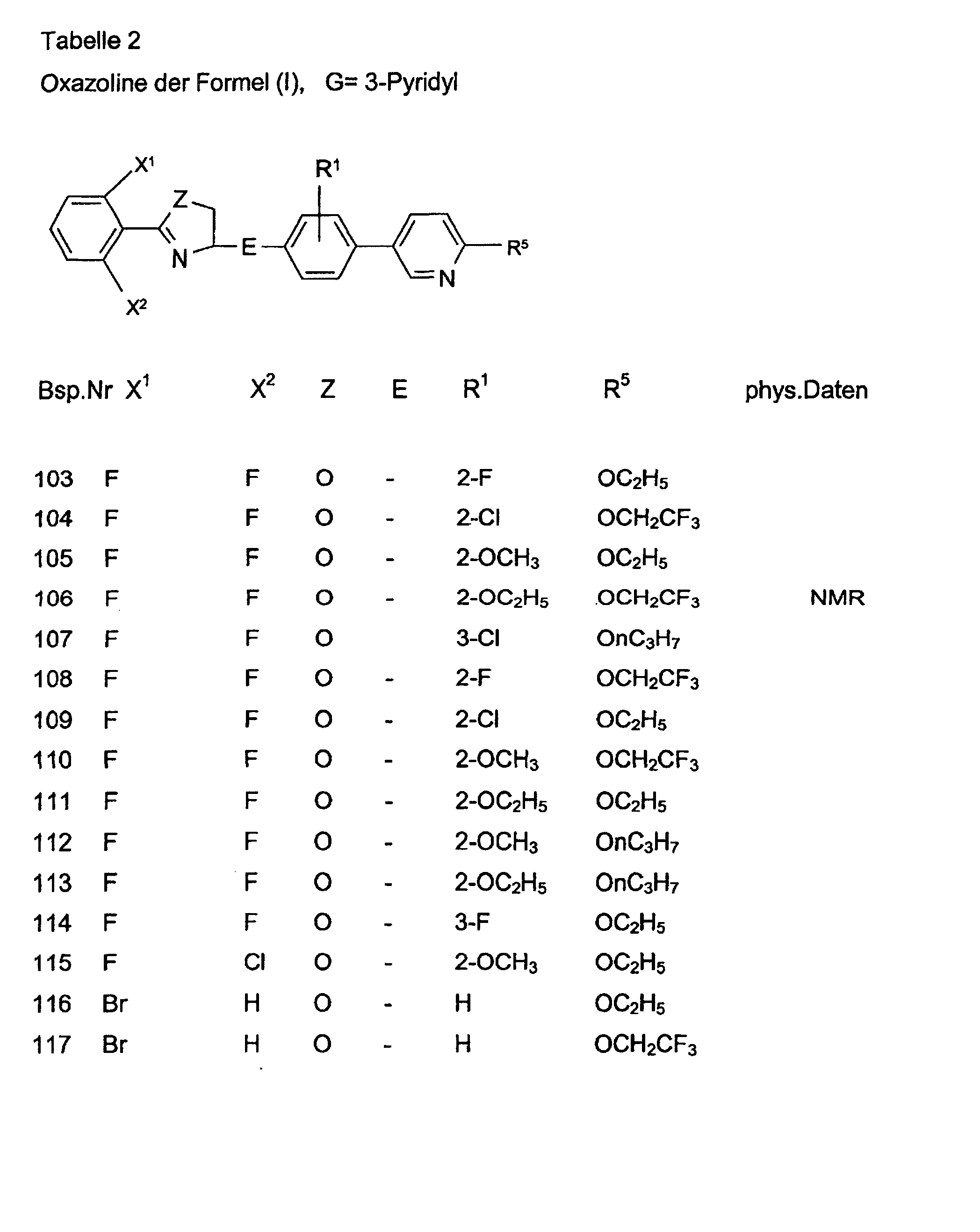


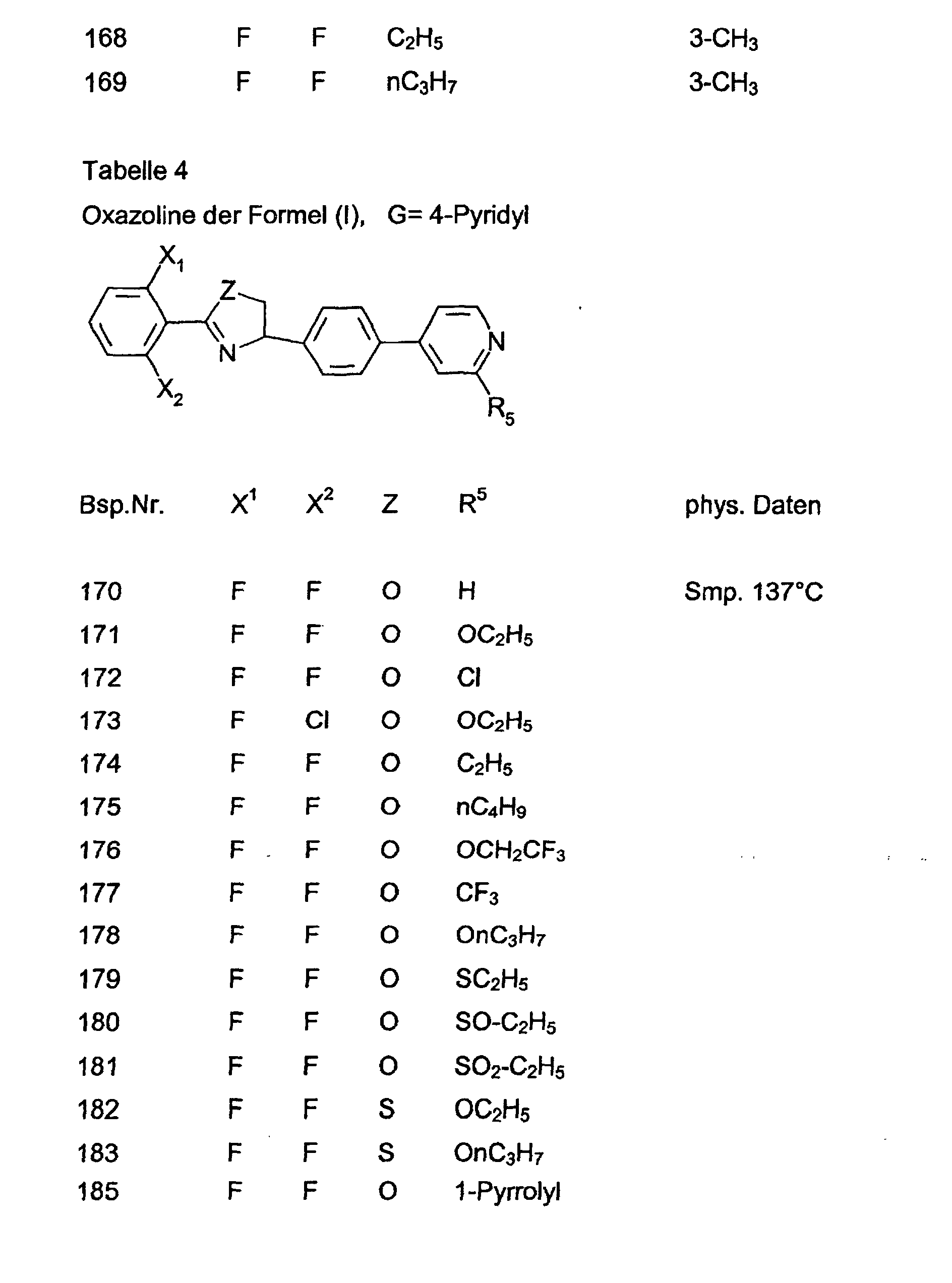


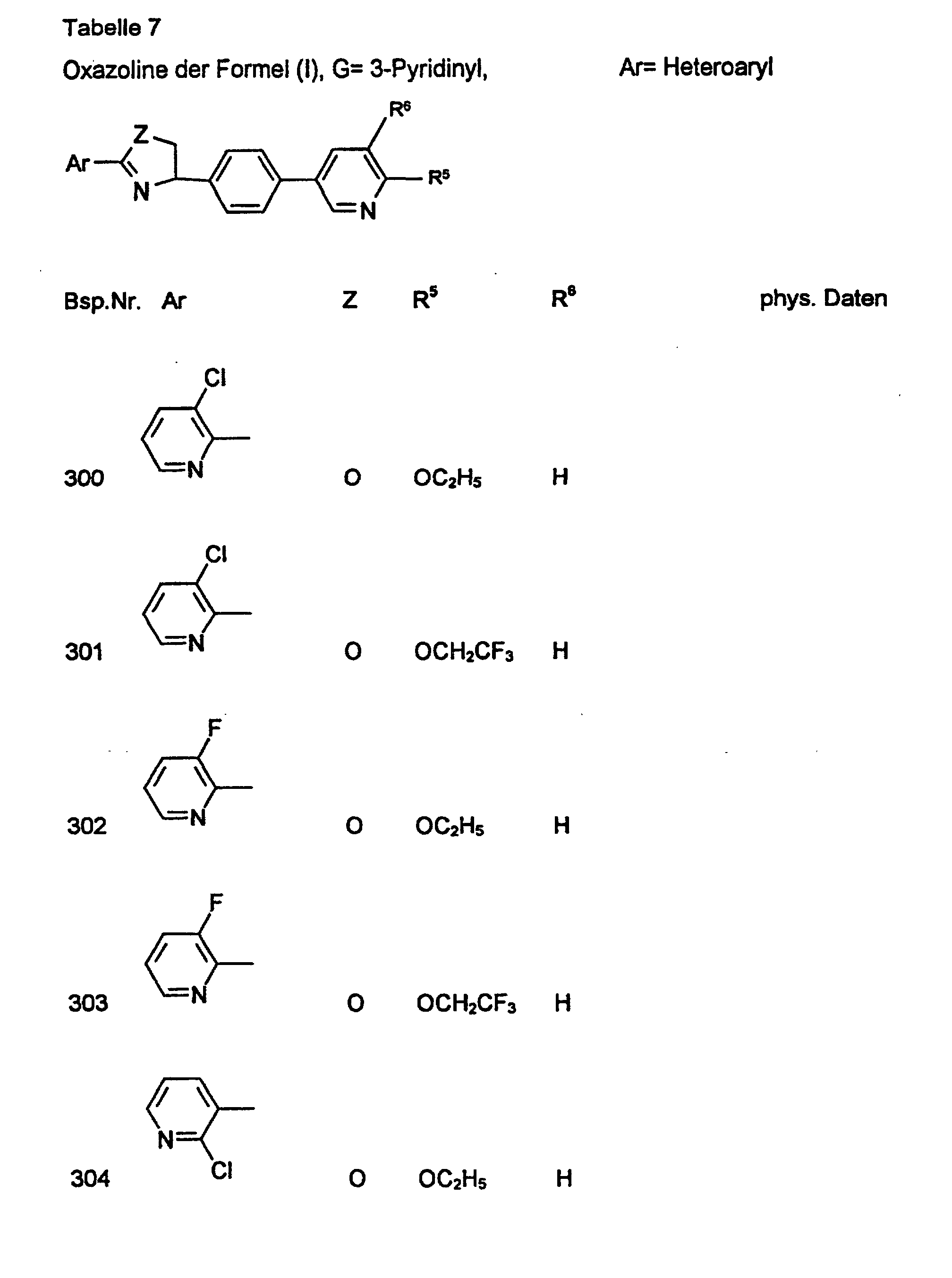

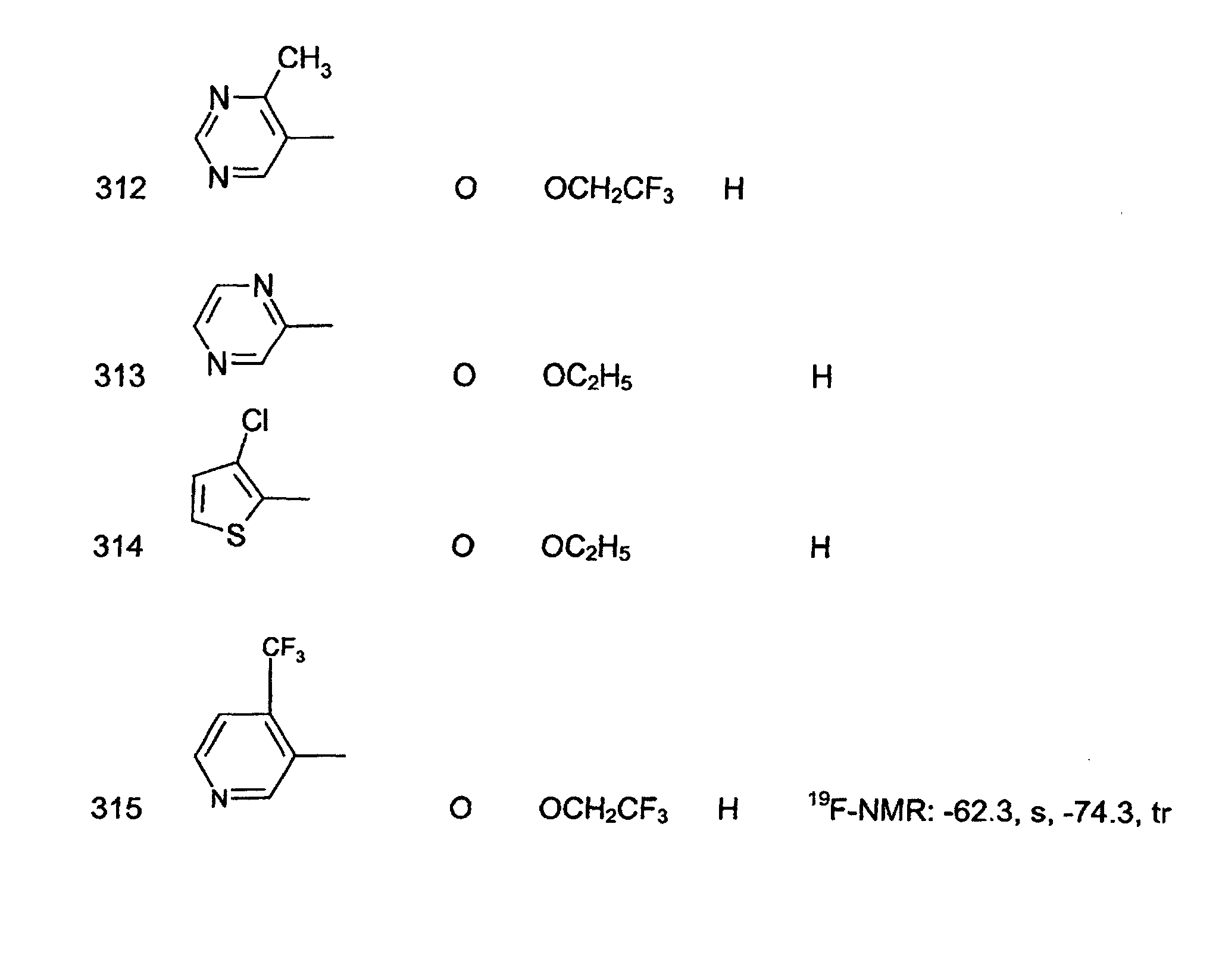
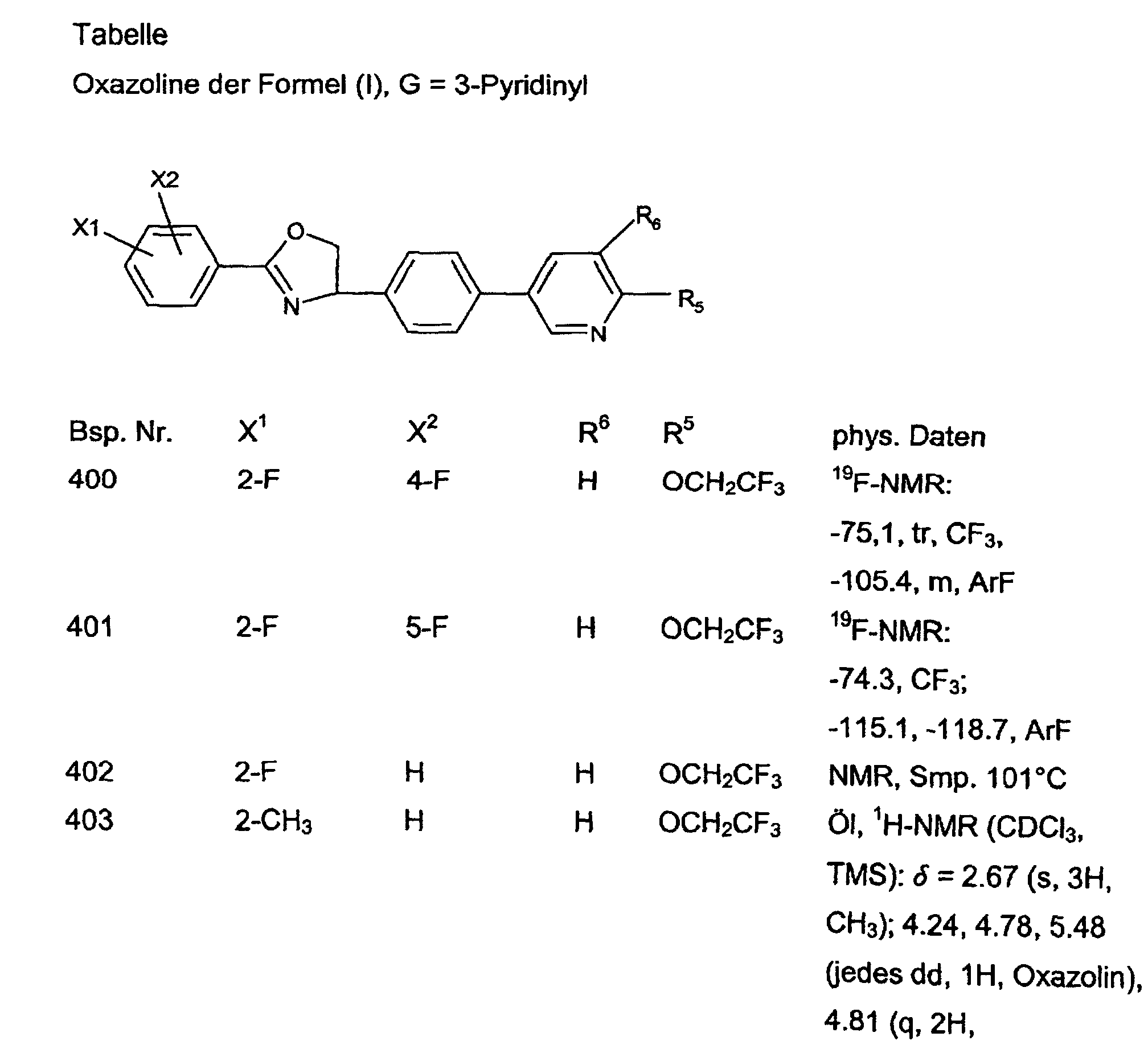
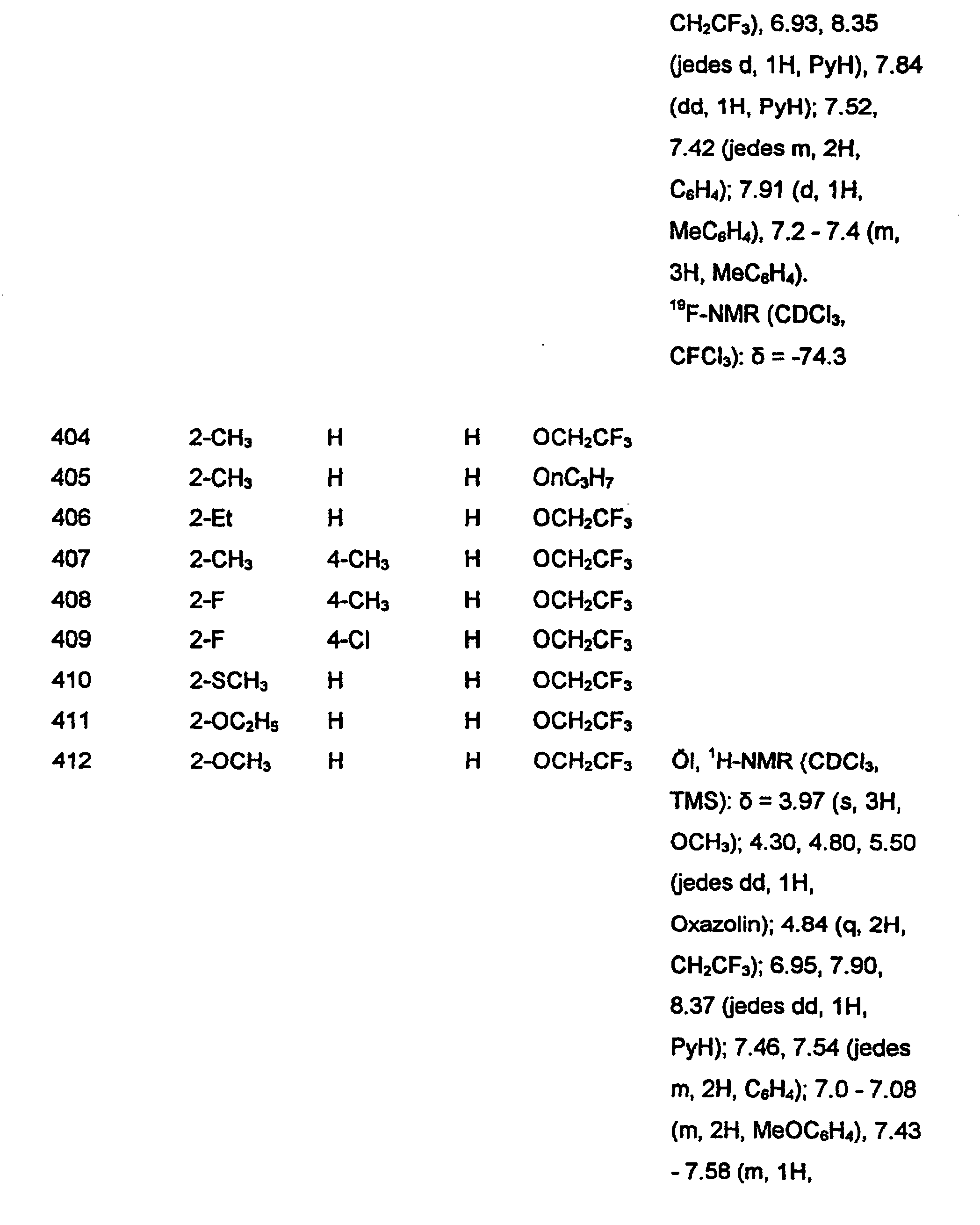
Claims (16)
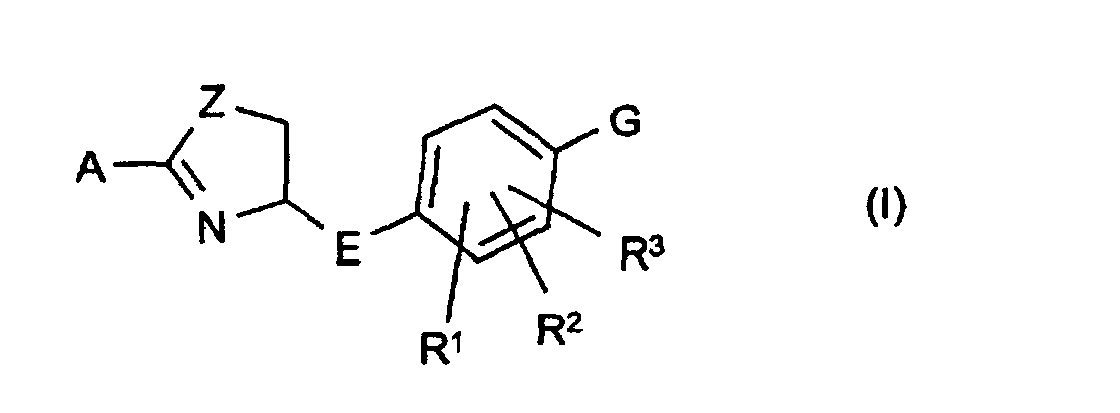
- A
- ist Phenyl, Pyridyl, Pyrimidinyl, Pyrazinyl, Pyrazolyl oder Thienyl, wobei jede der genannten Gruppen gegebenenfalls durch einen oder mehrere Reste X substituiert ist;
- X
- ist gleich oder verschieden
- a) Halogen, Cyano, Nitro;
- b) (C1-C4)-Alkyl, (C2-C4)-Alkenyl, (C2-C4)-Alkinyl, (C1-C4)-Alkoxy, (C1-C4)-Alkylthio,
(C1-C4)-Alkylsulfinyl, (C3-C8)-Cycloalkyl, (C4-C8)-Cycloalkenyl,
Phenyl,
wobei die Reste der Gruppe b gegebenenfalls durch einen oder mehrere Reste aus der Gruppe Halogen, Cyano, (C1-C4)-Alkyl, (C1-C4)-Haloalkyl, (C1-C4)-Alkoxy und (C1-C4)-Haloalkoxy substituiert sind;
- E
- ist eine Einfachbindung,
- G
- ist ein Rest aus der Gruppe:
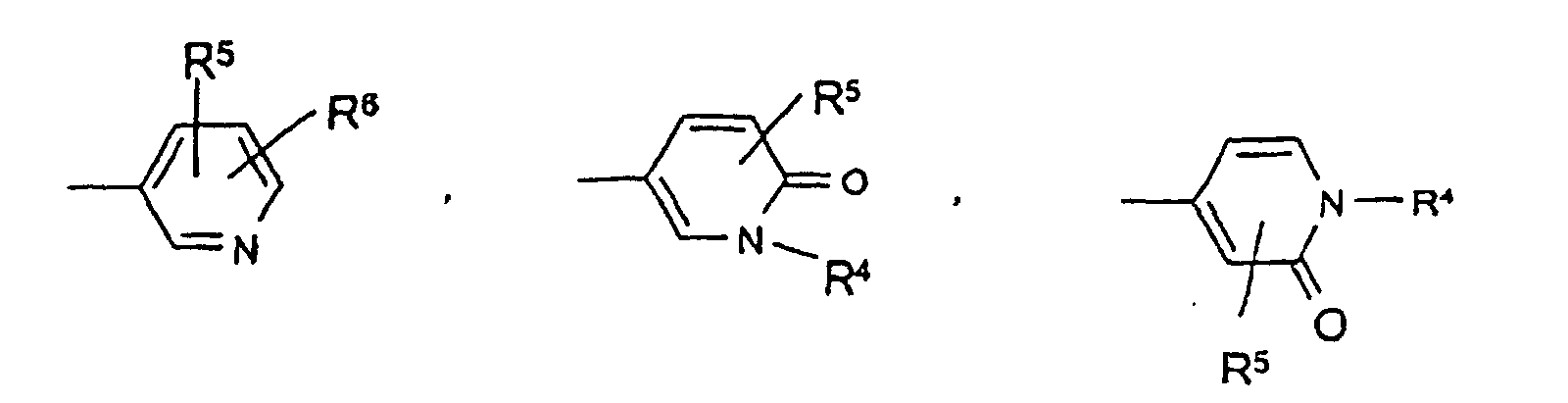
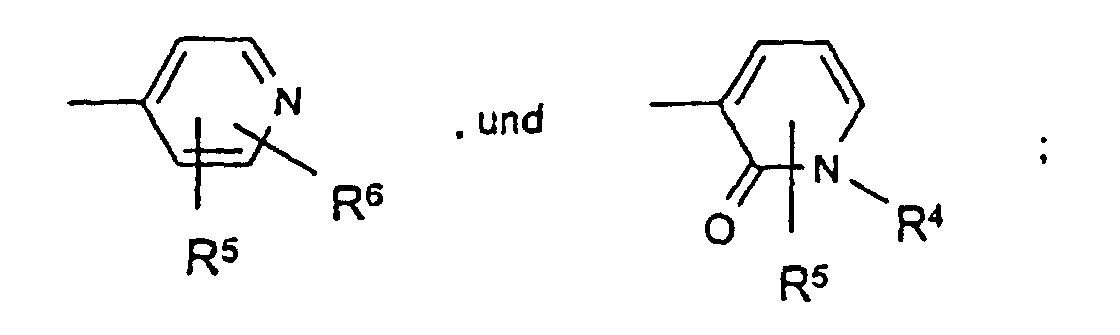
- Z
- ist Sauerstoff oder Schwefel;
- R1, R2 und R3
- sind gleich oder verschieden Wasserstoff, Halogen, (C1-C4)Haloalkyl, (C1-C4)Alkyl, (C1-C4)Alkoxy, (C1-C4)Haloalkoxy oder Cyano;
- R4
- ist Wasserstoff oder eine Gruppe (C1-C8)Alkyl, (C2-C8)Alkenyl, (C2-C8)Alkinyl, (C3-C8)Cycloalkyl, (C3-C8)Cycloalkenyl, (C4-C10)Cycloalkyl-alkyl oder (C7-C12)Phenylalkyl, wobei jede der genannten Gruppen gegebenenfalls durch einen oder mehrere Substituenten aus der Gruppe Halogen, (C1-C4)Alkyl, (C1-C3)Haloalkyl, (C1-C4)Alkoxy, (C1-C3)Haloalkoxy, (C1-C3)Alkylthio, (C3-C8)Cycloalkyl, (C7-C12)Phenylalkoxy, (C2-C4)Alkylcarbonyl, Alkoxycarbonyl, (C2-C6)Monoalkyl- und (C3-C9)Dialkyl-aminocarbonyl Cyano und Tri(C1-C4)alkylsilyl substituiert ist;
- R5, R6 sind
- a) Wasserstoff, Halogen, Cyano;
- b) (C1-C8)Alkyl, (C3-C8)Cycloalkyl, (C4-C8)Cycloalkenyl, (C1-C8)Alkylthio, (C1-C8)Alkylsulfinyl, (C1-C8)Alkylsulfonyl, (C7-C12)Phenylalkyl, (C7-C12)Phenylalkoxy, (C4-C7)Oxycycloalkyl oder (C4-C7)Oxacycloalkenyl, welche gegebenenfalls durch einen oder mehrere Reste aus der Gruppe Halogen, (C1-C4)Alkyl, (C1-C3)Haloalkyl, (C1-C3)Alkoxy, (C1-C3)Haloalkoxy, (C1-C3)Alkylthio und Cyano substituiert sind; oder
- c) (C1-C8)Alkoxy, welches gegebenenfalls durch einen oder mehrere Reste aus der Gruppe Halogen, (C1-C3)Alkylthio und Cyano substituiert ist.
- A
- ist Phenyl oder Pyridyl;
- X
- ist
- a) Halogen, Cyano, Nitro oder
- b) (C1-C4)-Alkyl, (C1-C4)-Alkenyl, (C1-C4)-Alkinyl, (C1-C4)-Alkoxy,
(C1-C4)-Alkylthio, (C1-C4)-Aklylsulfinyl, (C3-C7)-Cycloalkyl, (C4-C8)-Cycloalkenyl,
wobei die Reste der Gruppe b gegebenenfalls durch einen oder mehrere Reste aus der Gruppe Halogen, Cyano, (C1-C4)-Alkoxy und (C1-C4)-Haloalkoxy substituiert sind;
- E
- ist eine Einfachbindung ;
- G
- ist
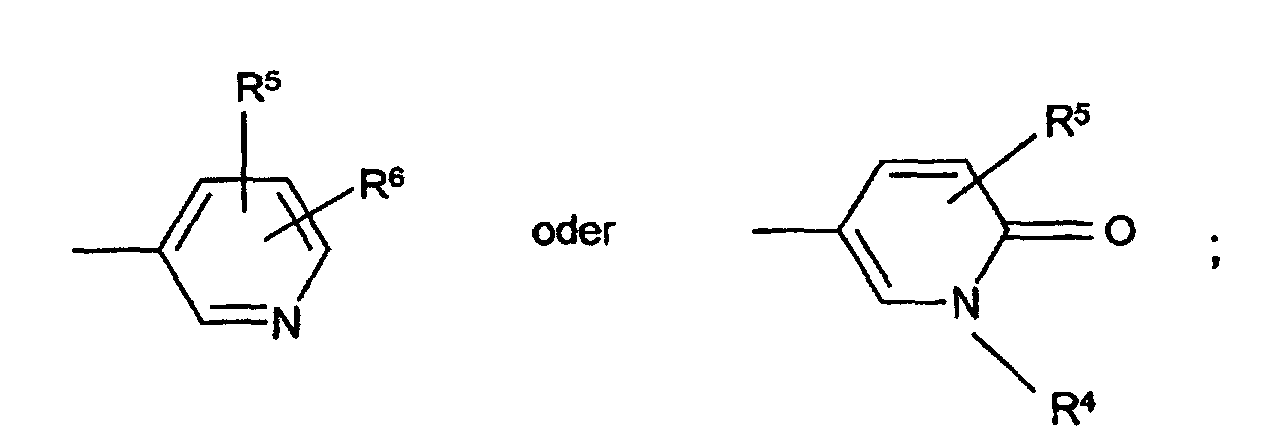
- Z
- ist Sauerstoff;
- R1, R2, R3
- sind H, Halogen, (C1-C4)-Haloalkyl, (C1-C4)-Alkyl, (C1-C4)-Alkoxy, (C1-C4)-Haloalkoxy oder Cyano;
- R4
- ist H oder (C1-C8)-Alkyl, welches gegebenenfalls durch einen oder mehrere Reste aus der Gruppe Halogen, (C1-C4)-Alkyl, (C1-C3)-Haloalkyl, (C1-C4)- Alkoxy, (C1-C3)-Haloalkoxy, (C1-C3)-Alkylthio, (C3-C8)-Cycloalkyl, Cyano oder Tri(C1-C4)alkylsilyl substituiert ist;
- R5, R6
- sind
- a) H, Halogen, Cyano;
- b) (C1-C8)-Alkyl, (C3-C8)-Cycloalkyl, (C4-C8)-Cycloalkenyl, (C1-C8)-
Alkylthio, (C1-C8)-Alkylsulfinyl, (C1-C8)-Alkylsulfonyl, (C7-C12)-
Phenylkalkyl, (C7-C12)-Phenylalkoxy, (C4-C7)-Oxycycloalkyl oder
(C4-C7)-Oxacycloalkenyl,
wobei die Gruppen b gegebenenfalls durch einen oder mehrere Reste aus der Gruppe Halogen, (C1-C4)-Alkyl, (C1-C3)-Haloalkyl, (C1-C3)-Alkoxy, (C1-C3)-Haloalkoxy, (C1-C3)-Alkylthio und Cyano substituiert sind; oder - c) (C1-C8)-Alkoxy, welches gegebenenfalls durch einen oder mehrere Reste aus der Gruppe Halogen, (C1-C3)Alkylthio und Cyano substituiert ist.
- A
- ist Phenyl;
- X
- ist Halogen, (C1-C4)-Alkyl, (C1-C3)-Haloalkyl, (C1-C4)-Alkoxy oder (C1-C3)-Haloalkoxy;
- E
- ist eine Einfachbindung;
- G
- ist 3-Pyridyl;
- Z
- ist Sauerstoff;
- R1, R2, R3
- sind H, Halogen, (C1-C4)-Haloalkyl, (C1-C4)-Alkyl, (C1-C4)-Alkoxy, (C1-C4)-Haloalkoxy;
- R4
- ist H oder (C1-C8)-Alkyl, welches gegebenenfalls durch einen oder mehrere Reste aus der Gruppe Halogen, (C1-C4)-Alkyl, (C1-C3)-Haloalkyl, (C1-C4)-Alkoxy, (C1-C3)-Haloalkoxy, (C1-C3)-Alkylthio, (C3-C8)-Cycloalkyl, Cyano oder Tri(C1-C4)alkylsilyl substituiert ist;
- R5, R6 sind
-
- a) H, Halogen, Cyano,
- b) (C1-C8)-Alkyl, (C1-C8)-Alkoxy, (C3-C8)-Cycloalkyl, (C4-C8)-Cycloalkenyl, (C1-C8)-Alkylthio, (C1-C8)-Alkylsulfinyl, (C1-C8)-Alkylsulfonyl, (C7-C12)-Phenylkalkyl oder (C7-C12)-Phenylalkoxyl,


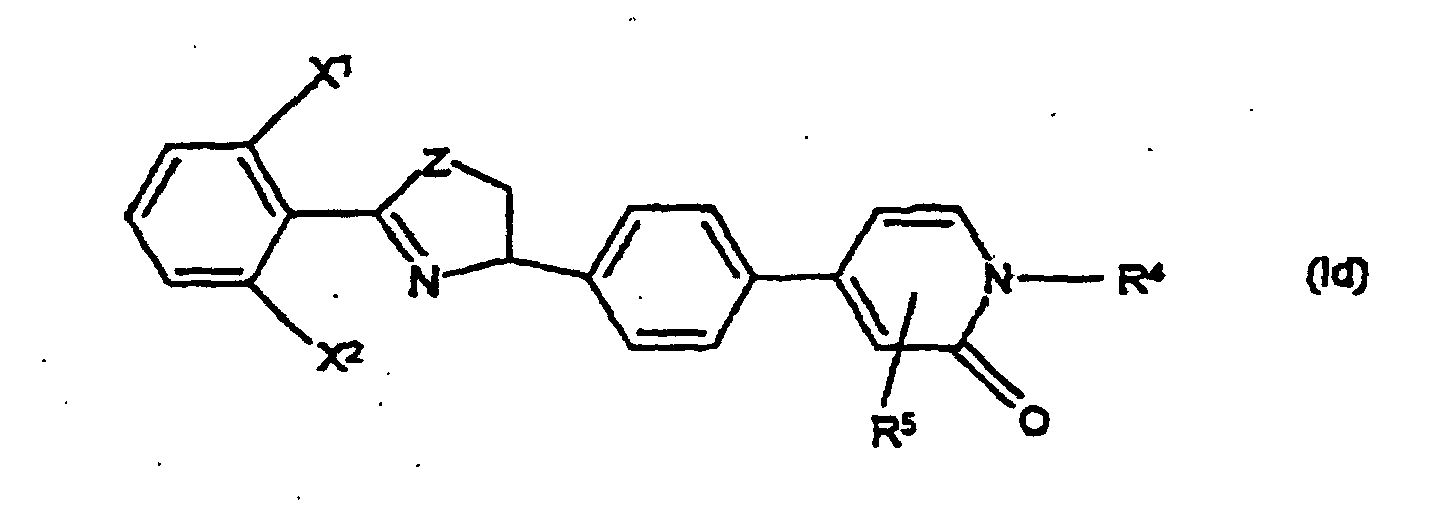

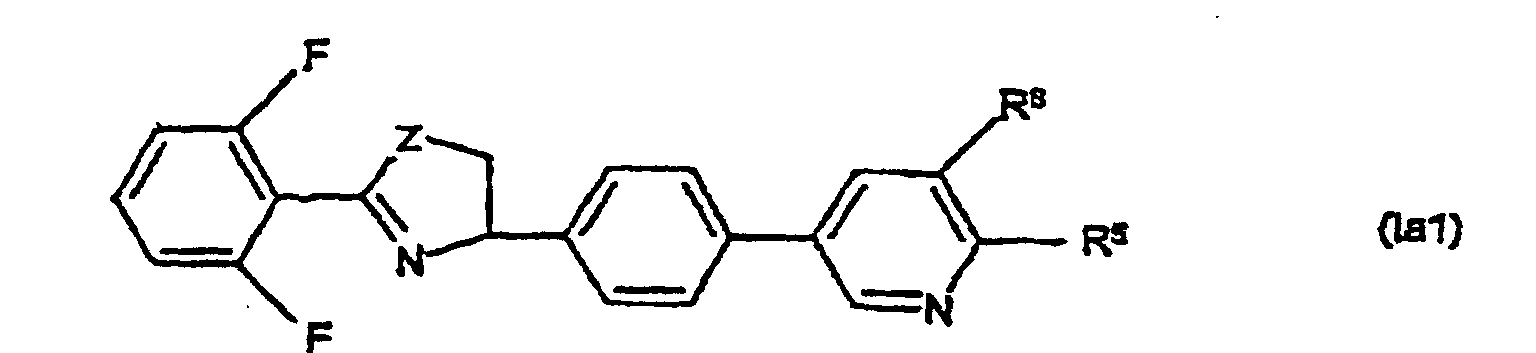
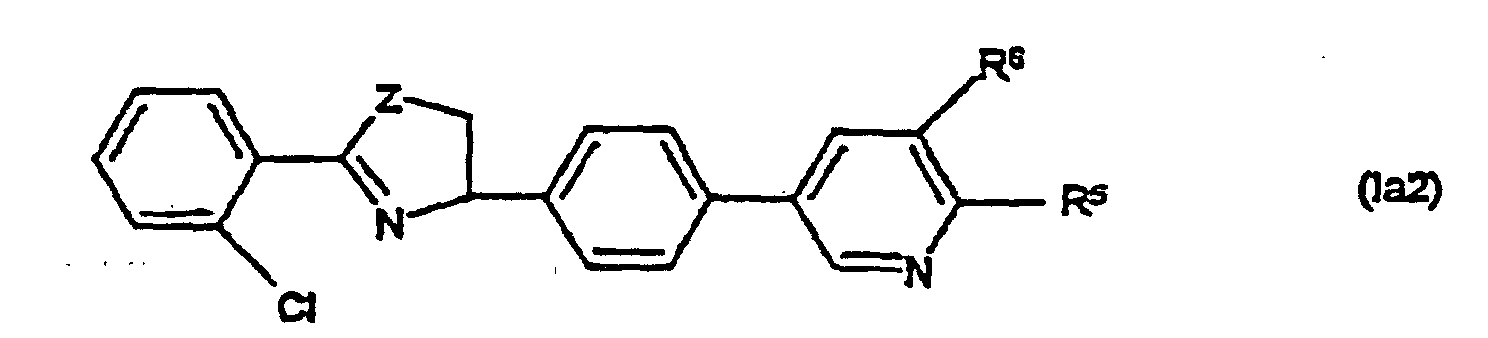

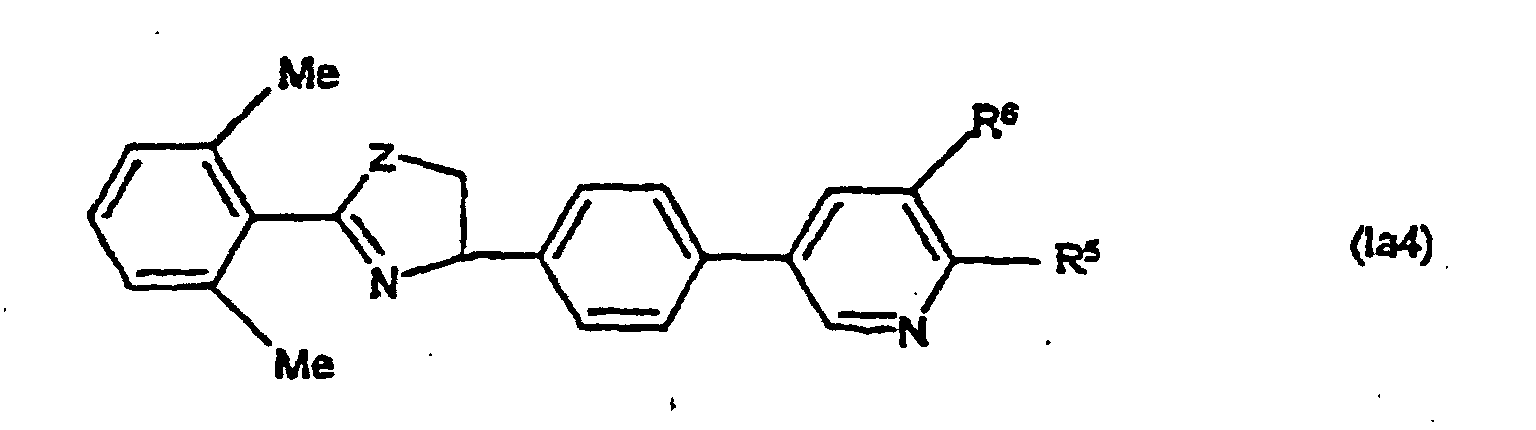

- Y
- Cl, Br, I oder Perfluoralkylsulfonat bedeutet und
- A, Z und E
- die in der Formel (I) angegebenen Bedeutungen haben,
- M
- eine B, Sn oder Zn-haltige Abgangsgruppe bedeutet und
- G
- die in der Formel (I) in Anspruch (1) angegebenen Bedeutungen hat,
Applications Claiming Priority (3)
| Application Number | Priority Date | Filing Date | Title |
|---|---|---|---|
| DE19826671A DE19826671A1 (de) | 1998-06-16 | 1998-06-16 | 1,3-Oxazolin- und 1,3-Thiazolin-Derivate, Verfahren zu ihrer Herstellung und ihre Verwendung als Schädlingsbekämpfungsmittel |
| DE19826671 | 1998-06-16 | ||
| PCT/EP1999/003776 WO1999065901A1 (de) | 1998-06-16 | 1999-06-01 | 1,3-oxazolin- und 1,3-thiazolin-derivate, verfahren zu ihrer herstellung und ihre verwendung als schädlingsbekämpfungsmittel |
Publications (2)
| Publication Number | Publication Date |
|---|---|
| EP1087967A1 EP1087967A1 (de) | 2001-04-04 |
| EP1087967B1 true EP1087967B1 (de) | 2003-10-22 |
Family
ID=7870979
Family Applications (1)
| Application Number | Title | Priority Date | Filing Date |
|---|---|---|---|
| EP99927818A Expired - Lifetime EP1087967B1 (de) | 1998-06-16 | 1999-06-01 | 1,3-oxazolin- und 1,3-thiazolin-derivate, verfahren zu ihrer herstellung und ihre verwendung als schädlingsbekämpfungsmittel |
Country Status (20)
| Country | Link |
|---|---|
| US (2) | US6265350B1 (de) |
| EP (1) | EP1087967B1 (de) |
| JP (1) | JP2002518389A (de) |
| KR (1) | KR20010052959A (de) |
| CN (1) | CN1305476A (de) |
| AR (1) | AR018673A1 (de) |
| AT (1) | ATE252578T1 (de) |
| AU (1) | AU750324B2 (de) |
| BR (1) | BR9911358A (de) |
| CA (1) | CA2335352A1 (de) |
| CO (1) | CO5050288A1 (de) |
| DE (2) | DE19826671A1 (de) |
| ES (1) | ES2209451T3 (de) |
| HU (1) | HUP0102360A3 (de) |
| ID (1) | ID26652A (de) |
| IL (1) | IL140236A (de) |
| PL (1) | PL345041A1 (de) |
| TR (1) | TR200003690T2 (de) |
| WO (1) | WO1999065901A1 (de) |
| ZA (1) | ZA200007301B (de) |
Families Citing this family (56)
| Publication number | Priority date | Publication date | Assignee | Title |
|---|---|---|---|---|
| DE19858192A1 (de) * | 1998-12-17 | 2000-06-21 | Aventis Cropscience Gmbh | 4-Trifluormethyl-3-oxazolylpyridine, Verfahren zu ihrer Herstellung, sie enthaltende Mittel und ihre Verwendung als Schädlingsbekämpfungsmittel |
| JP4730485B2 (ja) * | 2000-06-01 | 2011-07-20 | 日産化学工業株式会社 | 安定化される農薬組成物 |
| TWI275589B (en) | 2000-06-22 | 2007-03-11 | Dow Agrosciences Llc | 2-(3,5-disubstituted-4-pyridyl)-4-(thienyl, thiazolyl or arylphenyl)-1,3-oxazoline compounds |
| DE10039477A1 (de) * | 2000-08-08 | 2002-02-21 | Aventis Cropscience Gmbh | Heterocyclylalkylazol-Derivate und ihre Verwendung als Schädlingsbekämpfungsmittel |
| DE10104871A1 (de) * | 2001-02-03 | 2002-08-08 | Aventis Cropscience Gmbh | Verfahren zur Kontrolle von Schadorganismen in Nutzpflanzenkulturen |
| JP4439908B2 (ja) * | 2001-06-22 | 2010-03-24 | ダウ アグロサイエンシィズ エルエルシー | 殺昆虫剤及び殺ダニ剤として有用である2−(2,6−ジ置換フェニル)−4−アリール−5−アルキル−1,3−オキサゾリン化合物 |
| US7998986B2 (en) | 2001-12-21 | 2011-08-16 | Exelixis Patent Company Llc | Modulators of LXR |
| US7482366B2 (en) | 2001-12-21 | 2009-01-27 | X-Ceptor Therapeutics, Inc. | Modulators of LXR |
| AP1822A (en) * | 2002-02-14 | 2008-01-30 | Pharmacia Corp | Substituted pyridinones as modulators of P38 MAP kinase. |
| US6573286B1 (en) | 2002-06-21 | 2003-06-03 | Dow Agrosciences Llc | 2-(2,6-disubstituted phenyl)-4-aryl-5-alkyl-1,3-oxazoline compounds |
| US20040156742A1 (en) * | 2003-02-11 | 2004-08-12 | Milan Jolanda Bianca | Synergistically-effective cyclohexylethan-1-yl ester mixtures as malodour counteractants as measured physiologically and psychometrically and methods for using same |
| US20050106192A1 (en) * | 2003-11-13 | 2005-05-19 | Parekh Prabodh P. | Synergistically-effective composition of zinc ricinoleate and one or more substituted monocyclic organic compounds and use thereof for preventing and/or suppressing malodors |
| MX2007007330A (es) | 2004-12-16 | 2007-10-04 | Vertex Pharma | Piridonas de utilidad como inhibidores de quinasas . |
| JP5053253B2 (ja) * | 2005-03-21 | 2012-10-17 | ビーエーエスエフ ソシエタス・ヨーロピア | 殺虫剤混合物 |
| AP2007004244A0 (en) | 2005-05-10 | 2007-12-31 | Intermune Inc | Method of modulating stress-activated protein kinase system |
| AR059898A1 (es) | 2006-03-15 | 2008-05-07 | Janssen Pharmaceutica Nv | Derivados de 3-ciano-piridona 1,4-disustituida y su uso como moduladores alostericos de los receptores mglur2 |
| TW200845978A (en) | 2007-03-07 | 2008-12-01 | Janssen Pharmaceutica Nv | 3-cyano-4-(4-tetrahydropyran-phenyl)-pyridin-2-one derivatives |
| TW200900065A (en) | 2007-03-07 | 2009-01-01 | Janssen Pharmaceutica Nv | 3-cyano-4-(4-pyridinyloxy-phenyl)-pyridin-2-one derivatives |
| US8012554B2 (en) * | 2007-09-12 | 2011-09-06 | Pactiv Corporation | Bags having odor management capabilities |
| BRPI0816970A2 (pt) | 2007-09-14 | 2015-03-24 | Ortho Mcneil Janssen Pharm | 1,3-dissubstituídas-4-fenil-1h-piridin-2-onas |
| EA017648B1 (ru) | 2007-09-14 | 2013-02-28 | Орто-Макнейл-Янссен Фармасьютикалз, Инк. | 1',3'-двузамещенные-4-фенил-3,4,5,6-тетрагидро-2н,1'н-[1,4']бипириди-нил-2'-оны |
| TW200922566A (en) | 2007-09-14 | 2009-06-01 | Ortho Mcneil Janssen Pharm | 1,3 disubstituted 4-(aryl-X-phenyl)-1H-pyridin-2-ones |
| CA2704436C (en) | 2007-11-14 | 2016-01-05 | Ortho-Mcneil-Janssen Pharmaceuticals, Inc. | Imidazo[1,2-a]pyridine derivatives and their use as positive allosteric modulators of mglur2 receptors |
| EP2296653B1 (de) | 2008-06-03 | 2016-01-27 | Intermune, Inc. | Verbindungen und verfahren zur behandlung von entzündungserkrankungen und fibrotischen erkrankungen |
| JP5547194B2 (ja) | 2008-09-02 | 2014-07-09 | ジャンセン ファーマシューティカルズ, インコーポレイテッド. | 代謝型グルタミン酸受容体の調節因子としての3−アザビシクロ[3.1.0]ヘキシル誘導体 |
| WO2010043396A1 (en) | 2008-10-16 | 2010-04-22 | Ortho-Mcneil-Janssen Pharmaceuticals, Inc. | Indole and benzomorpholine derivatives as modulators of metabotropic glutamate receptors |
| JP5690277B2 (ja) | 2008-11-28 | 2015-03-25 | ジャンセン ファーマシューティカルズ, インコーポレイテッド. | 代謝型グルタミン酸受容体の調節因子としてのインドールおよびベンゾオキサジン誘導体 |
| PL3354650T3 (pl) | 2008-12-19 | 2022-06-13 | Vertex Pharmaceuticals Incorporated | Związki przydatne jako inhibitory kinazy atr |
| MY153913A (en) | 2009-05-12 | 2015-04-15 | Janssen Pharmaceuticals Inc | 7-aryl-1,2,4-triazolo[4,3-a]pyridine derivatives and their use as positive allosteric modulators of mglur2 receptors |
| CN102439015B (zh) | 2009-05-12 | 2015-05-13 | 杨森制药有限公司 | 1,2,4-三唑并[4,3-a]吡啶衍生物和其作为mGluR2受体的正向变构调节剂的用途 |
| HRP20131122T1 (hr) | 2009-05-12 | 2013-12-20 | Janssen Pharmaceuticals, Inc. | Derivati 1,2,4-triazolo[4,3-a] piridina i njihova uporaba u lijeäśenju ili prevenciji neuroloških i psihijatrijskih poremeä†aja |
| JP5836367B2 (ja) * | 2010-05-12 | 2015-12-24 | バーテックス ファーマシューティカルズ インコーポレイテッドVertex Pharmaceuticals Incorporated | Atrキナーゼ阻害剤として有用な化合物 |
| JP2013526540A (ja) | 2010-05-12 | 2013-06-24 | バーテックス ファーマシューティカルズ インコーポレイテッド | Atrキナーゼ阻害剤として有用な化合物 |
| EP2661435B1 (de) | 2010-11-08 | 2015-08-19 | Janssen Pharmaceuticals, Inc. | 1,2,4-triazol[4,3-a]pyridinderivate und ihre verwendung als positive allosterische mglur2-rezeptormodulatoren |
| ES2536433T3 (es) | 2010-11-08 | 2015-05-25 | Janssen Pharmaceuticals, Inc. | Derivados de 1,2,4-triazolo[4,3-a]piridina y su uso como moduladores alostéricos positivos de receptores mGluR2 |
| JP5852664B2 (ja) | 2010-11-08 | 2016-02-03 | ジヤンセン・フアーマシユーチカルズ・インコーポレーテツド | 1,2,4−トリアゾロ[4,3−a]ピリジン誘導体およびmGluR2受容体のポジティブアロステリックモジュレーターとしてのそれらの使用 |
| AU2012315384B2 (en) | 2011-09-30 | 2017-08-10 | Vertex Pharmaceuticals Incorporated | Treating pancreatic cancer and non-small cell lung cancer with ATR inhibitors |
| RU2018147217A (ru) | 2011-09-30 | 2019-01-18 | Вертекс Фармасьютикалз Инкорпорейтед | Способы получения соединений, которые можно использовать в качестве ингибиторов киназы atr |
| CN104582795B (zh) | 2012-04-05 | 2018-04-20 | 沃泰克斯药物股份有限公司 | 可用作atr激酶抑制剂的化合物及其组合疗法 |
| WO2013169599A1 (en) * | 2012-05-08 | 2013-11-14 | Dow Agrosciences Llc | 2,4-(substituted aromatic)-1,3-oxazoline compounds as a seed treatment to control pests |
| AR092742A1 (es) | 2012-10-02 | 2015-04-29 | Intermune Inc | Piridinonas antifibroticas |
| DK2904406T3 (en) | 2012-10-04 | 2018-06-18 | Vertex Pharma | METHOD OF DETERMINING THE ATR INHIBITION, INCREASED DNA DAMAGE |
| JO3368B1 (ar) | 2013-06-04 | 2019-03-13 | Janssen Pharmaceutica Nv | مركبات 6، 7- ثاني هيدرو بيرازولو [5،1-a] بيرازين- 4 (5 يد)- اون واستخدامها بصفة منظمات تفارغية سلبية لمستقبلات ميجلور 2 |
| JO3367B1 (ar) | 2013-09-06 | 2019-03-13 | Janssen Pharmaceutica Nv | مركبات 2،1، 4- ثلاثي زولو [3،4-a] بيريدين واستخدامها بصفة منظمات تفارغية موجبة لمستقبلات ميجلور 2 |
| ME03518B (de) | 2014-01-21 | 2020-04-20 | Janssen Pharmaceutica Nv | Kombinationen mit positiven allosterischen modulatoren von metabotropem glutamatergen rezeptor vom subtyp 2 und deren verwendung |
| PL3096790T3 (pl) | 2014-01-21 | 2020-01-31 | Janssen Pharmaceutica, N.V. | Kombinacje zawierające pozytywne modulatory allosteryczne lub agonistów ortosterycznych metabotropowego receptora glutaminergicznego podtypu 2 i ich zastosowanie |
| RU2692485C2 (ru) | 2014-04-02 | 2019-06-25 | Интермьюн, Инк. | Противофиброзные пиридиноны |
| US11464774B2 (en) | 2015-09-30 | 2022-10-11 | Vertex Pharmaceuticals Incorporated | Method for treating cancer using a combination of DNA damaging agents and ATR inhibitors |
| AR111295A1 (es) | 2017-03-20 | 2019-06-26 | Forma Therapeutics Inc | Composiciones de pirrolopirrol como activadores de piruvato quinasa (pkr) |
| US20200129485A1 (en) | 2018-09-19 | 2020-04-30 | Forma Therapeutics, Inc. | Treating sickle cell disease with a pyruvate kinase r activating compound |
| WO2020061255A1 (en) | 2018-09-19 | 2020-03-26 | Forma Therapeutics, Inc. | Activating pyruvate kinase r |
| MX2022003025A (es) | 2019-09-19 | 2022-04-07 | Forma Therapeutics Inc | Activacion de la piruvato cinasa r. |
| KR20230153387A (ko) | 2021-02-02 | 2023-11-06 | 리미널 바이오사이언시스 리미티드 | Gpr84 길항제 및 이의 용도 |
| JP2024506858A (ja) | 2021-02-02 | 2024-02-15 | リミナル・バイオサイエンシーズ・リミテッド | Gpr84アンタゴニストおよびその使用 |
| US12128035B2 (en) | 2021-03-19 | 2024-10-29 | Novo Nordisk Health Care Ag | Activating pyruvate kinase R |
| WO2026159962A1 (ja) * | 2025-01-21 | 2026-07-30 | 協友アグリ株式会社 | 置換ピリジルフェニルオキサゾリン誘導体及びその有害生物の防除方法 |
Family Cites Families (8)
| Publication number | Priority date | Publication date | Assignee | Title |
|---|---|---|---|---|
| US4977171A (en) | 1988-06-09 | 1990-12-11 | Yashima Chemical Industrial Co., Ltd. | Oxa- or thia-zoline derivative |
| AU634608B2 (en) | 1989-12-09 | 1993-02-25 | Kyoyu Agri Co., Ltd. | 2-substituted phenyl-2-oxazoline or thiazoline derivatives, process for producing the same and insectides and acaricides containing the same |
| ES2107027T3 (es) | 1992-05-26 | 1997-11-16 | Du Pont | Oxazalinas y tiazolinas artropodicas. |
| TW259693B (de) * | 1993-08-04 | 1995-10-11 | Du Pont | |
| DE4401098A1 (de) | 1994-01-17 | 1995-07-20 | Bayer Ag | Diphenyloxazolin-Derivate |
| BR9510149A (pt) * | 1995-01-20 | 1998-06-02 | Du Pont | Composto composição artropodicida e método para controle de artrópodes |
| DE19528778A1 (de) | 1995-08-04 | 1997-02-06 | Bayer Ag | 4-Alkyl-1,3-oxa(thia)zolin-Derivate |
| DE19548419A1 (de) | 1995-12-22 | 1997-06-26 | Bayer Ag | Substituierte Thiazoline |
-
1998
- 1998-06-16 DE DE19826671A patent/DE19826671A1/de not_active Withdrawn
-
1999
- 1999-06-01 ID IDW20002618A patent/ID26652A/id unknown
- 1999-06-01 AT AT99927818T patent/ATE252578T1/de not_active IP Right Cessation
- 1999-06-01 PL PL99345041A patent/PL345041A1/xx not_active Application Discontinuation
- 1999-06-01 AU AU45038/99A patent/AU750324B2/en not_active Ceased
- 1999-06-01 KR KR1020007014344A patent/KR20010052959A/ko not_active Withdrawn
- 1999-06-01 CA CA002335352A patent/CA2335352A1/en not_active Abandoned
- 1999-06-01 HU HU0102360A patent/HUP0102360A3/hu unknown
- 1999-06-01 WO PCT/EP1999/003776 patent/WO1999065901A1/de not_active Ceased
- 1999-06-01 DE DE59907464T patent/DE59907464D1/de not_active Expired - Fee Related
- 1999-06-01 BR BR9911358-9A patent/BR9911358A/pt not_active Application Discontinuation
- 1999-06-01 EP EP99927818A patent/EP1087967B1/de not_active Expired - Lifetime
- 1999-06-01 IL IL14023699A patent/IL140236A/xx not_active IP Right Cessation
- 1999-06-01 TR TR2000/03690T patent/TR200003690T2/xx unknown
- 1999-06-01 CN CN99807444A patent/CN1305476A/zh active Pending
- 1999-06-01 JP JP2000554726A patent/JP2002518389A/ja active Pending
- 1999-06-01 ES ES99927818T patent/ES2209451T3/es not_active Expired - Lifetime
- 1999-06-11 AR ARP990102820A patent/AR018673A1/es active IP Right Grant
- 1999-06-14 US US09/332,225 patent/US6265350B1/en not_active Expired - Fee Related
- 1999-06-16 CO CO99037535A patent/CO5050288A1/es unknown
-
2000
- 2000-12-08 ZA ZA200007301A patent/ZA200007301B/en unknown
-
2001
- 2001-06-21 US US09/886,551 patent/US6670307B2/en not_active Expired - Fee Related
Also Published As
| Publication number | Publication date |
|---|---|
| CO5050288A1 (es) | 2001-06-27 |
| AU4503899A (en) | 2000-01-05 |
| HUP0102360A3 (en) | 2002-03-28 |
| ID26652A (id) | 2001-01-25 |
| ATE252578T1 (de) | 2003-11-15 |
| HUP0102360A2 (hu) | 2001-10-28 |
| WO1999065901A1 (de) | 1999-12-23 |
| KR20010052959A (ko) | 2001-06-25 |
| DE19826671A1 (de) | 1999-12-23 |
| TR200003690T2 (tr) | 2001-06-21 |
| EP1087967A1 (de) | 2001-04-04 |
| CN1305476A (zh) | 2001-07-25 |
| AR018673A1 (es) | 2001-11-28 |
| ZA200007301B (en) | 2002-02-08 |
| JP2002518389A (ja) | 2002-06-25 |
| AU750324B2 (en) | 2002-07-18 |
| BR9911358A (pt) | 2001-03-13 |
| PL345041A1 (en) | 2001-11-19 |
| DE59907464D1 (de) | 2003-11-27 |
| IL140236A0 (en) | 2002-02-10 |
| US6265350B1 (en) | 2001-07-24 |
| IL140236A (en) | 2005-08-31 |
| US20020068828A1 (en) | 2002-06-06 |
| ES2209451T3 (es) | 2004-06-16 |
| CA2335352A1 (en) | 1999-12-23 |
| US6670307B2 (en) | 2003-12-30 |
Similar Documents
| Publication | Publication Date | Title |
|---|---|---|
| US6265350B1 (en) | 1,3-oxazoline and 1,3-thiazoline derivatives, their preparation, and their use as pesticides | |
| EP1390356B1 (de) | Arylisoxazolin-derivative, verfahren zu ihrer herstellung und ihre verwendung als schädlingsbekämpfungsmittel | |
| EP1434485B1 (de) | Nicotinsäure-heterocyclyl-amide und analoge pyrimidin-derivate als schädlingsbekämpfungsmittel | |
| EP1140921B1 (de) | 4-trifluormethyl-3-oxazolylpyridine, verfahren zu ihrer herstellung, sie enthaltende mittel und ihre verwendung als schädlingsbekämpfungsmittel | |
| DE10144872A1 (de) | Azetidinderivate, Verfahren zu ihrer Herstellung und ihre Verwendung als Schädlingsbekämpfungsmittel | |
| EP1432313B1 (de) | N-thio-nicotinamid derivate und verwandte verbindungen zur verwendung als schädlingsbekämpfungsmittel | |
| EP1068197A1 (de) | Substituierte piperidine, verfahren zu ihrer herstellung und ihre verwendung als schädlingsbekämpfungsmittel und fungizide | |
| EP1140922A1 (de) | 4-trifluormethyl-3-oxadiazolylpyridine, verfahren zu ihrer herstellung, sie enthaltende mittel und ihre verwendung als schädlingsbekämpfungsmittel | |
| DE10155385A1 (de) | Dihalogenpropen-Verbindungen, Verfahren zu ihrer Herstellung, sie enthaltende Mittel und ihre Verwendung als Schädlingsbekämpfungsmittel | |
| DE10039477A1 (de) | Heterocyclylalkylazol-Derivate und ihre Verwendung als Schädlingsbekämpfungsmittel | |
| DE10239905A1 (de) | Substituierte Pyridine oder Pyrimidine, Verfahren zu ihrer Herstellung, sie enthaltende Mittel und ihre Verwendung als Schädlingsbekämpfungsmittel | |
| DE10014006A1 (de) | Heterocyclische Acylsulfimine, Verfahren zu ihrer Herstellung , sie enthalten Mittel und ihre Verwendung als Schädlingsbekämpfungsmittel | |
| EP1244658A2 (de) | Azolyl-alkyl-oxa(di)azolyl-pyri(mi)din-derivate, verfahren zu deren herstellung und deren verwendung als schädlingsbekämpfungsmittel | |
| AU2008202971B2 (en) | Arylisoxazoline derviatives | |
| MXPA00012631A (en) | 1,3-oxazoline and 1,3-thiazoline derivatives, method for producing the same and their use as pesticides | |
| EP1236727A1 (de) | Azabicycloverbindungen als Pestizide |
Legal Events
| Date | Code | Title | Description |
|---|---|---|---|
| PUAI | Public reference made under article 153(3) epc to a published international application that has entered the european phase |
Free format text: ORIGINAL CODE: 0009012 |
|
| 17P | Request for examination filed |
Effective date: 20010116 |
|
| AK | Designated contracting states |
Kind code of ref document: A1 Designated state(s): AT BE CH DE ES FR GB GR IT LI NL |
|
| 17Q | First examination report despatched |
Effective date: 20010521 |
|
| RAP1 | Party data changed (applicant data changed or rights of an application transferred) |
Owner name: BAYER CROPSCIENCE GMBH |
|
| GRAH | Despatch of communication of intention to grant a patent |
Free format text: ORIGINAL CODE: EPIDOS IGRA |
|
| GRAH | Despatch of communication of intention to grant a patent |
Free format text: ORIGINAL CODE: EPIDOS IGRA |
|
| GRAA | (expected) grant |
Free format text: ORIGINAL CODE: 0009210 |
|
| RBV | Designated contracting states (corrected) |
Designated state(s): AT BE CH DE ES FR GB GR IT LI NL PT |
|
| AK | Designated contracting states |
Kind code of ref document: B1 Designated state(s): AT BE CH DE ES FR GB GR IT LI NL PT |
|
| REG | Reference to a national code |
Ref country code: GB Ref legal event code: FG4D Free format text: NOT ENGLISH |
|
| RIN1 | Information on inventor provided before grant (corrected) |
Inventor name: MERTENS,CHRISTINA Inventor name: SANFT, ULRICH Inventor name: KERN, MANFRED Inventor name: SCHNATTERER, STEFAN |
|
| REG | Reference to a national code |
Ref country code: CH Ref legal event code: EP |
|
| REF | Corresponds to: |
Ref document number: 59907464 Country of ref document: DE Date of ref document: 20031127 Kind code of ref document: P |
|
| PG25 | Lapsed in a contracting state [announced via postgrant information from national office to epo] |
Ref country code: GR Free format text: LAPSE BECAUSE OF FAILURE TO SUBMIT A TRANSLATION OF THE DESCRIPTION OR TO PAY THE FEE WITHIN THE PRESCRIBED TIME-LIMIT Effective date: 20040122 |
|
| GBT | Gb: translation of ep patent filed (gb section 77(6)(a)/1977) |
Effective date: 20040308 |
|
| PG25 | Lapsed in a contracting state [announced via postgrant information from national office to epo] |
Ref country code: AT Free format text: LAPSE BECAUSE OF NON-PAYMENT OF DUE FEES Effective date: 20040601 |
|
| REG | Reference to a national code |
Ref country code: ES Ref legal event code: FG2A Ref document number: 2209451 Country of ref document: ES Kind code of ref document: T3 |
|
| ET | Fr: translation filed | ||
| PLBE | No opposition filed within time limit |
Free format text: ORIGINAL CODE: 0009261 |
|
| STAA | Information on the status of an ep patent application or granted ep patent |
Free format text: STATUS: NO OPPOSITION FILED WITHIN TIME LIMIT |
|
| 26N | No opposition filed |
Effective date: 20040723 |
|
| REG | Reference to a national code |
Ref country code: GB Ref legal event code: 732E |
|
| REG | Reference to a national code |
Ref country code: CH Ref legal event code: PFA Owner name: BAYER CROPSCIENCE AG Free format text: BAYER CROPSCIENCE GMBH#BRUENINGSTRASSE 50#65929 FRANKFURT/MAIN (DE) -TRANSFER TO- BAYER CROPSCIENCE AG#ALFRED-NOBEL-STRASSE 50#40789 MONHEIM (DE) Ref country code: CH Ref legal event code: NV Representative=s name: E. BLUM & CO. AG PATENT- UND MARKENANWAELTE VSP |
|
| PG25 | Lapsed in a contracting state [announced via postgrant information from national office to epo] |
Ref country code: PT Free format text: LAPSE BECAUSE OF NON-PAYMENT OF DUE FEES Effective date: 20040322 |
|
| NLS | Nl: assignments of ep-patents |
Owner name: BAYER CROPSCIENCE AG Effective date: 20071213 |
|
| REG | Reference to a national code |
Ref country code: FR Ref legal event code: TP |
|
| PGFP | Annual fee paid to national office [announced via postgrant information from national office to epo] |
Ref country code: NL Payment date: 20090603 Year of fee payment: 11 |
|
| PGFP | Annual fee paid to national office [announced via postgrant information from national office to epo] |
Ref country code: IT Payment date: 20090618 Year of fee payment: 11 |
|
| PGFP | Annual fee paid to national office [announced via postgrant information from national office to epo] |
Ref country code: BE Payment date: 20090619 Year of fee payment: 11 |
|
| PGFP | Annual fee paid to national office [announced via postgrant information from national office to epo] |
Ref country code: ES Payment date: 20090709 Year of fee payment: 11 Ref country code: CH Payment date: 20090615 Year of fee payment: 11 |
|
| PGFP | Annual fee paid to national office [announced via postgrant information from national office to epo] |
Ref country code: GB Payment date: 20090527 Year of fee payment: 11 Ref country code: DE Payment date: 20090520 Year of fee payment: 11 |
|
| BERE | Be: lapsed |
Owner name: *BAYER CROPSCIENCE A.G. Effective date: 20100630 |
|
| REG | Reference to a national code |
Ref country code: NL Ref legal event code: V1 Effective date: 20110101 |
|
| REG | Reference to a national code |
Ref country code: CH Ref legal event code: PL |
|
| GBPC | Gb: european patent ceased through non-payment of renewal fee |
Effective date: 20100601 |
|
| REG | Reference to a national code |
Ref country code: FR Ref legal event code: ST Effective date: 20110228 |
|
| PG25 | Lapsed in a contracting state [announced via postgrant information from national office to epo] |
Ref country code: IT Free format text: LAPSE BECAUSE OF NON-PAYMENT OF DUE FEES Effective date: 20100601 |
|
| PG25 | Lapsed in a contracting state [announced via postgrant information from national office to epo] |
Ref country code: LI Free format text: LAPSE BECAUSE OF NON-PAYMENT OF DUE FEES Effective date: 20100630 Ref country code: DE Free format text: LAPSE BECAUSE OF NON-PAYMENT OF DUE FEES Effective date: 20110101 Ref country code: CH Free format text: LAPSE BECAUSE OF NON-PAYMENT OF DUE FEES Effective date: 20100630 |
|
| PG25 | Lapsed in a contracting state [announced via postgrant information from national office to epo] |
Ref country code: NL Free format text: LAPSE BECAUSE OF NON-PAYMENT OF DUE FEES Effective date: 20110101 Ref country code: FR Free format text: LAPSE BECAUSE OF NON-PAYMENT OF DUE FEES Effective date: 20100630 |
|
| PG25 | Lapsed in a contracting state [announced via postgrant information from national office to epo] |
Ref country code: BE Free format text: LAPSE BECAUSE OF NON-PAYMENT OF DUE FEES Effective date: 20100630 |
|
| PG25 | Lapsed in a contracting state [announced via postgrant information from national office to epo] |
Ref country code: GB Free format text: LAPSE BECAUSE OF NON-PAYMENT OF DUE FEES Effective date: 20100601 |
|
| REG | Reference to a national code |
Ref country code: ES Ref legal event code: FD2A Effective date: 20111118 |
|
| PG25 | Lapsed in a contracting state [announced via postgrant information from national office to epo] |
Ref country code: ES Free format text: LAPSE BECAUSE OF NON-PAYMENT OF DUE FEES Effective date: 20100602 |
|
| PGFP | Annual fee paid to national office [announced via postgrant information from national office to epo] |
Ref country code: FR Payment date: 20090611 Year of fee payment: 11 |