EP1089520A2 - H.323 Mobiltitätsstruktur mit Benutzern, Diensten und Dienstanbietern fürs intelligente Multimedianetzwerk - Google Patents
H.323 Mobiltitätsstruktur mit Benutzern, Diensten und Dienstanbietern fürs intelligente Multimedianetzwerk Download PDFInfo
- Publication number
- EP1089520A2 EP1089520A2 EP00308393A EP00308393A EP1089520A2 EP 1089520 A2 EP1089520 A2 EP 1089520A2 EP 00308393 A EP00308393 A EP 00308393A EP 00308393 A EP00308393 A EP 00308393A EP 1089520 A2 EP1089520 A2 EP 1089520A2
- Authority
- EP
- European Patent Office
- Prior art keywords
- user
- called
- alias address
- home
- entity
- Prior art date
- Legal status (The legal status is an assumption and is not a legal conclusion. Google has not performed a legal analysis and makes no representation as to the accuracy of the status listed.)
- Ceased
Links
Images

Classifications
-
- H—ELECTRICITY
- H04—ELECTRIC COMMUNICATION TECHNIQUE
- H04L—TRANSMISSION OF DIGITAL INFORMATION, e.g. TELEGRAPHIC COMMUNICATION
- H04L12/00—Data switching networks
- H04L12/02—Details
- H04L12/16—Arrangements for providing special services to substations
- H04L12/18—Arrangements for providing special services to substations for broadcast or conference, e.g. multicast
-
- H—ELECTRICITY
- H04—ELECTRIC COMMUNICATION TECHNIQUE
- H04L—TRANSMISSION OF DIGITAL INFORMATION, e.g. TELEGRAPHIC COMMUNICATION
- H04L61/00—Network arrangements, protocols or services for addressing or naming
- H04L61/30—Managing network names, e.g. use of aliases or nicknames
- H04L61/301—Name conversion
-
- H—ELECTRICITY
- H04—ELECTRIC COMMUNICATION TECHNIQUE
- H04L—TRANSMISSION OF DIGITAL INFORMATION, e.g. TELEGRAPHIC COMMUNICATION
- H04L61/00—Network arrangements, protocols or services for addressing or naming
- H04L61/30—Managing network names, e.g. use of aliases or nicknames
-
- H—ELECTRICITY
- H04—ELECTRIC COMMUNICATION TECHNIQUE
- H04L—TRANSMISSION OF DIGITAL INFORMATION, e.g. TELEGRAPHIC COMMUNICATION
- H04L65/00—Network arrangements, protocols or services for supporting real-time applications in data packet communication
- H04L65/1066—Session management
- H04L65/1101—Session protocols
- H04L65/1106—Call signalling protocols; H.323 and related
-
- H—ELECTRICITY
- H04—ELECTRIC COMMUNICATION TECHNIQUE
- H04L—TRANSMISSION OF DIGITAL INFORMATION, e.g. TELEGRAPHIC COMMUNICATION
- H04L2101/00—Indexing scheme associated with group H04L61/00
- H04L2101/30—Types of network names
- H04L2101/365—Application layer names, e.g. buddy names, unstructured names chosen by a user or home appliance name
Definitions
- the present invention relates generally to audio and video conferencing services, and more particularly to coupling home/small business network-based devices using Internet Protocol (IP) techniques to provide audio and/or video conferencing services using a wide area network-based intelligent service controller.
- IP Internet Protocol
- H.323 is an International Telecommunications Union (ITU) standard that provides a foundation for audio, video, and data communications across packet-based networks, including the Internet. Compliance with the H.323 standard permits interoperability, allowing users to communicate without concern about non-compatibility.
- the H.323 recommendation provides a standard for multimedia communications over packet switched networks. Such networks include many corporate networks, packet-switched TCP/IP networks, IPX over Ethernet, Fast Ethernet and Token Ring technologies, public Internet, ATM networks, and/or others.
- H.323 enables videoconferencing as well as addressing call control, multimedia management, and bandwidth management.
- H.323 encompasses inter-network multipoint conferencing among terminals that support not only audio, but also video and data communication.
- the present invention provides an H.323 user, service and service provider mobility framework for implementing H.323 alias address portability in real-time H.323 multimedia communications.
- the H.323 user is registered with a home gatekeeper for the H.323's home zone.
- Alias address portability may be obtained using a central database that is known to the administrative zones and is used for alias address mapping, or alternatively, may be obtained by using a distributed database.
- the method may be implemented by: sending, by the H.323 user, a message with a called H.323 entity's alias address, to the home gatekeeper to originate a call to the called H.323 entity; confirming that the alias address is portable; converting the alias address to a called routable alias address for the called H.323 entity and sending the alias address to the H.323 user; and placing the call to the called H.323 entity.
- Real-time H.323 multimedia communications services such as audio, video and/or data require a multimedia intelligent networking platform when the mobility of users, services such as H.450.x (i.e., supplementary services: multimedia call forwarding, multimedia call transfer, etc) and service providers are addressed.
- services such as H.450.x (i.e., supplementary services: multimedia call forwarding, multimedia call transfer, etc) and service providers are addressed.
- User, service, and service provider portability require a new kind of multimedia intelligent networking in the context of H.323.
- User mobility is defined as the ability for a user to maintain the same user identity on different terminals or terminal types.
- H.323 there can be many user identities such as alias addresses E.164, Transport Address, H323ID, URL-ID, Email-ID, Party Number, and the like, that a user can identify.
- aliases such as IMEI, IMSI, and TMSI have also been proposed.
- User mobility is defined as an ability of a user to access H.323 services at any terminal, i.e., maintaining the same user identity on different terminals or terminal types, and the capability of the H.323 system is an ability to provide the H.323 services according to the user's subscription. User mobility also allows the user to register on any terminal for incoming and outgoing calls.
- An H.323 user may have a sequence of optional alias addresses:
- E.164 may be the first item that a user may like to keep the same on different terminals.
- the E.164 number portability in H.323 is almost the same local number portability (LNP) issue as in the intelligent network (IN).
- LNP is also related to the service mobility, service provider mobility, and location (geographic) mobility (beyond or outside a rate center).
- an endpoint that a user is usually identified with will also have a call signaling or transport address and a RAS address.
- An endpoint may also use different transport or network addresses for different channels (e.g., audio, video, and/or data) within the same call.
- the basic assumption is that the call signaling address and the RAS address are not considered to be fixed while considering the H.323 user mobility.
- the transport or network address that can be used as an alias address by a user's endpoint is not considered to kept fixed for the user mobility.
- Service mobility is defined as the ability for a user to obtain a particular service independent of user and terminal mobility. That is, the foreign network must have the means to obtain the parameters required for the service.
- Service mobility means that the user may have the same H.323 services (e.g., H.450.x supplementary services such as multimedia call forwarding, multimedia call transfer, etc.), may keep the same user identity (user mobility), or may use the same terminal (terminal mobility) as the user moves from its home network to a foreign one. Service mobility may also imply that the user may use the same user identity (user mobility) or the same terminal (terminal mobility) after changing H.323 service providers. As used herein, service mobility is discussed in the context of user mobility only.
- H.450.x supplementary services such as multimedia call forwarding, multimedia call transfer, etc.
- Service provider mobility is defined as the ability for a user to maintain the same user identity on different terminals or terminal types after changing the service providers.
- the network or networks that carry an H.323 multimedia call may have more multiple carriers.
- the user mobility implies that the alias address or addresses are portable. For example, for the E.164 address, there must be a mechanism that provides for the portable E.164 address to be mapped over the physical packet-based network for actual routing of the call.
- the mapping function of the E.164 address to an actual routable call in H.323 may be similar to the local routing number (LRN) method in the IN.
- LRN local routing number
- the service provider portability in H.323 may be achieved using a method similar to IN's LRN.
- using such a method has severe implications on the H.323 networking because a significant amount of analysis is needed to understand how the service provider portability can be accomplished.
- H.323 multimedia (audio, video, and/or data) services e.g., H.450.x
- This user, service, and service provider mobility is termed "multimedia intelligent networking".
- H.323 uses alias addresses for endpoints. Such alias addresses are used to identify users. More alias addresses such as IMEI, IMSI, TMSI, and personal ID have also been proposed. In the case of mobile users, one or more of the alias addresses may be fixed while the users move from one place to another. In the present invention, the H.323 users, like endpoints, are also associated with the H.323 alias addresses. In the present invention, if a user wants to keep the same identity while moving from place to place, the following objectives are needed to maintain both service and service provider mobility:
- the calling endpoint addresses the called endpoint directly using the Call Signaling Channel Transport Address of the called endpoint.
- the Gatekeeper translates the called endpoint into its Call Signaling Channel Transport Address or alias address.
- the called endpoint's E.164 address may consist of an optional access code followed by the E.164 address.
- the access code consists of n digits from the set of 0 to 9, * and #, where n is a predetermined number whose number of digits and their meaning is left to the discretion of the manufacturer.
- One purpose of such an access code might be to request access to a Gateway.
- the Gatekeeper may alter this address prior to sending it to the destination.
- the H.323 ID consists of a stung of ISO/IEC 10646-1 characters as defined in Recommendation H.225.0. It may be a user name, conference name, e-mail name, or other identifier.
- An endpoint may have more than one alias address, including more than one of the same type, which is translated to the same Transport Address.
- the endpoint's alias addresses are unique within a Zone.
- the call signaling transport or network address and the RAS transport or network address are not kept fixed in the context of the user mobility.
- the called endpoint's E.164 address may consist of an optional access code followed by the E.164 address.
- E.164 provides a 10-digit telephone number of format NPA-XXX-XXXX In this format, Number Plan Area (NPA) may be a geometric information code (GIC) or a service access code (SAC). The last seven digits usually represents a subscriber number in the NXXXXX where N is a number between 2 and 9, and X is a number between 0 and 9. In this subscriber number format, the first three digits (i.e., NXX) are typically a central office (CO) code that identifies the CO switch of the telephone number.
- CO central office
- G-NPA geographic NPA
- NG-NPA non-geographic NPA
- the H.323 communications system deals with the packet-based network (PBN).
- PBN packet-based network
- E.164 number used by a user or endpoint may be considered to have a kind of non-geographic significance.
- Such is also the case with respect to user mobility where an H.323 user wants to keep the same identity even if the user moves from one place to another.
- H.323 deals with the multimedia (audio, video, and/or data) calls.
- a call may be point-to-point, point-to-multipoint, or multipoint-to-multipoint.
- the call-processing intelligence may be centralized as well as distributed over the packet-based networks (e.g., IP, ATM).
- IP packet-based networks
- the user, service, and service provider mobility requires that the alias addresses be portable and be kept fixed while users roam from place to place. Consequently, these portable addresses will have no geographical significance with respect to the packet-based networks.
- Such networking is termed as multimedia intelligent networking (MIN) in the context of H.323.
- multimedia intelligent networking adds multimedia (audio, video, and/or data) service capabilities to the packet-based networks, which are independent of the involved packet switches (e.g., IP routers, ATM switches).
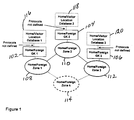
- each mobile entity needs to register with its home gatekeeper GK1 102, GK2 104, GK3 106.
- the mobile entity designates its home GK, which becomes the central controlling point to manage its mobility.
- Each mobile entity has a home/foreign zone 108, 110, 112, 114. Even if a mobile moves to a foreign zone, it needs to register with a foreign GK As result, a GK needs to manage the location information for both home and foreign visitors.
- a GK has databases 116, 118, 120 for keeping location information for both home and visitor or foreign locations.
- the terminology “foreign” and “visitor” are used interchangeably herein.
- the home/visitor architecture is also distributive.
- each mobile entity needs to register with its home GK.
- the mobile entity designates its home GK, which becomes the central controlling point to manage its mobility. Even if a mobile moves to a foreign zone, it needs to register with a foreign GK. As a result, a GK needs to manage the location information for both home and foreign visitors.
- each GK has and maintains databases for home and visitor location information.
- Figure 1 shows one embodiment of zones, GKs and home/visitor databases architecture in accordance with the present invention.
- the services between the GK and the location database are known as the backend services and the protocol between these functional entities is known as the backend services protocol. Since the backend services and the protocol have not yet been standardized in H.323, any known backend service and protocol technique may be used.
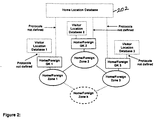
- Location management involves the updating of location databases when current location information is available. During the call establishment, these databases are queried to determine the current location of the mobile entity. Such querying may be costly, especially when the mobile entity is located far away from its assigned home GK So, the location management may need to be further optimized. In one embodiment, the location of the home location information may be centralized to optimize location management.
- the management is generally simpler because the home location of a mobile entity remains the same, and this information may be kept in a central database 202.
- the scalability of such a solution may be problematic, especially in the context of the large-scale IP network or the public Internet.
- the choice of using a distributive location management database vs. using a centralized location management database is a matter of choice of implementation. Both embodiments are described below.
- alias address portability utilize the alias address databases to route multimedia (audio, video, and/or data) calls to their destinations.
- multimedia audio, video, and/or data
- a portable H.323 alias address is not a network routable number. It needs to be translated to a network address for routing the call to the destination.
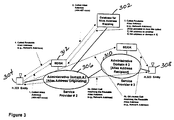
- a central database 302 that is known to all administrative zones may be utilized to provide alias address mapping.
- User mobility is implemented using the database.
- a call is placed by a calling H.323 entity 304 residing in administrative domain 2 306.
- the called H.323 entity is a mobile user whose alias address (e.g., E.164) remains the same as it moves from place to place.
- the called mobile user 308 has an alias address assigned from an administrative domain and has moved to administrative domain 3 310.
- the H.323 user Upon going to administrative domain 3, the H.323 user registers with the BE or GK of domain 3, typically in a similar way of registering in the case of terminal mobility, which is known to those skilled in the art and will not be described further here. Typically, registration information has also been updated in the central database that provides the alias address mapping. The triggering mechanism for updating the database for user mobility is not defined in the H.323 standard. However, following the MIN concept, multimedia call delivery to a ported alias number consists of the following steps as shown in Figure 3:
- Figure 4 illustrates an example wherein an H.323 user 404 is connected to administrative domain 2 402 and wants to place a call to another user 406 whose E.164 alias address is 404-457-xxxx.
- administrative domain 1 (service provider 1) 408 is the donor of this alias address. So, domain 1 408 is the domain that has the information on whether this alias address is portable or not. It shows how the alias address is allocated, and whether information with certain criteria may be distributed among different databases.
- the following steps may be used in a distributed environment in accordance with the MIN concept:
- the query to the donor domain saves an unnecessary database query that is needed in the case of the centralized database case. This results in cost savings.
- the alias address is a ported number, there may be some issues that need to be resolved between the donor (original carrier or original service provider) and originator (new carrier or new service provider) related to the routing and cost of the call to the customers.
- the central database architecture may have scalability problems when the alias addresses portability is deployed nationwide (similar to 800/900 databases) or worldwide. A more appropriate solution may be to maintain the regional databases. Then the issue becomes: Who will maintain the alias addresses portability databases? Will these databases be maintained by one or more neutral third parties so that the alias addresses resources are efficiently made available to new H.323 service providers.
- the databases may contain only the ported alias addresses, the associated routable network addresses and service provider information.
- addresses may be cached by the GKs. Similar caching mechanism may also be applied for the alias addresses portability. In database-based alias addresses portabilty, it is likely that some of the ported alias addresses are frequently accessed from an originating GK or BE. In that originating GK or BE, one may keep a cache to map the frequently ported alias addresses to the routable network addresses of their recipient GKs or BEs. Thus, the routing information of the frequently ported alias addresses may be obtained from the cache instead of the expensive MIN query to the alias addresses portable (AAP) database.
- the cache approach may be applied using the following steps:
- the H.323 user mobility scheme requires that the alias addresses need to be portable. The same alias addresses will be used by users as they move from one place to another.
- the scenarios described earlier show that problems of the user, service, and service provider mobility are interrelated.
- the H.323 signaling protocol extensions of RAS and creation of new signaling messages for the database queries to provide backend services
- the H.323 signaling protocol is enhanced to include all functionalities described above will also allow a user to keep the same alias number after changing the service providers. Thus, it also serves the purpose of the service provider mobility.
- the H.323-based MIN system may be similar to the traditional PSTN/ISDN intelligent networking (IN) system.
- I intelligent networking
- the present invention provides an overall architecture and overview of the protocol for the user, service, and service provider mobility primarily in the context of inter-domain communications although the same principles can also be used for intra-domain or inter-zone communications.
- the example also shows all media (e.g., audio, video, and data) as if they are following the same path from their source and destination. As a result, it is as if all media have also followed the same address portability as shown in those examples. However, it is also possible that each of the media may follow a different path through the network although they have the same source and destination addresses (e.g., E.164 addresses).
- audio, video and data may originate from the same source address and can reach the same destination address, but the real-time audio and video may follow the same path for maintaining the stringent performance constraint, while the path for data traffic through the network may be different from that of the audio and video.
- the path for the data traffic will be different: 1.
- Data traffic may be handled by a different network or service provider from that of the audio/video, and 2.
- Data traffic may be offered a different QoS from that of the audio/video, although the services may be offered by the same network or service provider.
- the intermediate addresses of the data traffic may be different. In this scenario, it is quite possible to have address portability for the intermediate address(es) of the data traffic considering: 1. Either a single or multiple service providers, 2. Either single or multiple zones, and/or 3. Either a single or multiple domains.
Landscapes
- Engineering & Computer Science (AREA)
- Computer Networks & Wireless Communication (AREA)
- Signal Processing (AREA)
- Business, Economics & Management (AREA)
- General Business, Economics & Management (AREA)
- Multimedia (AREA)
- Data Exchanges In Wide-Area Networks (AREA)
- Telephonic Communication Services (AREA)
- Mobile Radio Communication Systems (AREA)
Priority Applications (1)
| Application Number | Priority Date | Filing Date | Title |
|---|---|---|---|
| EP08150214A EP1959634A1 (de) | 1999-09-28 | 2000-09-25 | H.323 Mobiltitätsstruktur mit Benutzern, Diensten und Dienstanbietern fürs intelligente Multimedianetzwerk |
Applications Claiming Priority (4)
| Application Number | Priority Date | Filing Date | Title |
|---|---|---|---|
| US15636399P | 1999-09-28 | 1999-09-28 | |
| US15648299P | 1999-09-28 | 1999-09-28 | |
| US156363P | 1999-09-28 | ||
| US156482P | 1999-09-28 |
Related Child Applications (1)
| Application Number | Title | Priority Date | Filing Date |
|---|---|---|---|
| EP08150214A Division EP1959634A1 (de) | 1999-09-28 | 2000-09-25 | H.323 Mobiltitätsstruktur mit Benutzern, Diensten und Dienstanbietern fürs intelligente Multimedianetzwerk |
Publications (2)
| Publication Number | Publication Date |
|---|---|
| EP1089520A2 true EP1089520A2 (de) | 2001-04-04 |
| EP1089520A3 EP1089520A3 (de) | 2003-06-25 |
Family
ID=26853105
Family Applications (2)
| Application Number | Title | Priority Date | Filing Date |
|---|---|---|---|
| EP00308393A Ceased EP1089520A3 (de) | 1999-09-28 | 2000-09-25 | H.323 Mobiltitätsstruktur mit Benutzern, Diensten und Dienstanbietern fürs intelligente Multimedianetzwerk |
| EP08150214A Withdrawn EP1959634A1 (de) | 1999-09-28 | 2000-09-25 | H.323 Mobiltitätsstruktur mit Benutzern, Diensten und Dienstanbietern fürs intelligente Multimedianetzwerk |
Family Applications After (1)
| Application Number | Title | Priority Date | Filing Date |
|---|---|---|---|
| EP08150214A Withdrawn EP1959634A1 (de) | 1999-09-28 | 2000-09-25 | H.323 Mobiltitätsstruktur mit Benutzern, Diensten und Dienstanbietern fürs intelligente Multimedianetzwerk |
Country Status (3)
| Country | Link |
|---|---|
| EP (2) | EP1089520A3 (de) |
| KR (1) | KR100724294B1 (de) |
| CA (1) | CA2320690C (de) |
Cited By (2)
| Publication number | Priority date | Publication date | Assignee | Title |
|---|---|---|---|---|
| WO2003019862A1 (en) * | 2001-08-29 | 2003-03-06 | Huawei Technologies Co., Ltd. | A calling method for node across zones in ip network system |
| GB2405285A (en) * | 2003-04-11 | 2005-02-23 | Hutchison Whampoa Three G Ip | Real-time communications between telephone and internet users |
Families Citing this family (3)
| Publication number | Priority date | Publication date | Assignee | Title |
|---|---|---|---|---|
| KR100372842B1 (ko) * | 2001-04-03 | 2003-02-25 | 학교법인 한국정보통신학원 | 단말 이동성을 위한 핸드오프 방법 |
| KR100588746B1 (ko) * | 2002-09-25 | 2006-06-12 | 주식회사 케이티 | 인터넷 텔레포니의 단문메시지 수신 장치 및 그 방법 |
| US7649895B2 (en) * | 2003-12-30 | 2010-01-19 | Airwide Solutions Inc. | Apparatus and method for routing multimedia messages between a user agent and multiple multimedia message service centers |
Family Cites Families (6)
| Publication number | Priority date | Publication date | Assignee | Title |
|---|---|---|---|---|
| AU2975497A (en) * | 1996-06-11 | 1998-01-07 | Vdonet Corporation Ltd. | Ip name resolution system |
| SE513246C2 (sv) * | 1997-06-23 | 2000-08-07 | Ericsson Telefon Ab L M | Förfarande och anordning i ett IP-baserat nät |
| US6519242B1 (en) * | 1998-12-09 | 2003-02-11 | Nortel Networks Limited | Apparatus and method of PSTN based network roaming and SCP based subscriber management for internet telephony systems |
| DE19858463A1 (de) * | 1998-12-18 | 2000-06-21 | Centeon Pharma Gmbh | Verwendung eines Fibrinklebers zur Regeneration des Lebergewebes |
| US6266405B1 (en) * | 1998-12-28 | 2001-07-24 | Telefonaktiebolaget Lm Ericsson (Publ) | Extended number portability database services |
| KR20010094490A (ko) * | 2000-03-31 | 2001-11-01 | 임명관 | 인터넷 전화 시스템 및 통화 접속 방법 |
-
2000
- 2000-09-25 EP EP00308393A patent/EP1089520A3/de not_active Ceased
- 2000-09-25 EP EP08150214A patent/EP1959634A1/de not_active Withdrawn
- 2000-09-26 CA CA002320690A patent/CA2320690C/en not_active Expired - Fee Related
- 2000-09-28 KR KR1020000057069A patent/KR100724294B1/ko not_active Expired - Fee Related
Cited By (5)
| Publication number | Priority date | Publication date | Assignee | Title |
|---|---|---|---|---|
| WO2003019862A1 (en) * | 2001-08-29 | 2003-03-06 | Huawei Technologies Co., Ltd. | A calling method for node across zones in ip network system |
| RU2272361C2 (ru) * | 2001-08-29 | 2006-03-20 | Хювей Текнолоджиз Ко., Лтд. | Способ обращения к конечной точке из одной зоны в другую в системе ip-сети |
| US8032638B2 (en) | 2001-08-29 | 2011-10-04 | Huawei Technologies Co., Ltd. | Calling method for node across zones in IP network system |
| GB2405285A (en) * | 2003-04-11 | 2005-02-23 | Hutchison Whampoa Three G Ip | Real-time communications between telephone and internet users |
| GB2405285B (en) * | 2003-04-11 | 2006-01-11 | Hutchison Whampoa Three G Ip | Real-time communications between telephone and internet users |
Also Published As
| Publication number | Publication date |
|---|---|
| CA2320690A1 (en) | 2001-03-28 |
| CA2320690C (en) | 2006-02-21 |
| EP1959634A1 (de) | 2008-08-20 |
| KR100724294B1 (ko) | 2007-06-04 |
| KR20010067254A (ko) | 2001-07-12 |
| EP1089520A3 (de) | 2003-06-25 |
Similar Documents
| Publication | Publication Date | Title |
|---|---|---|
| US7471686B2 (en) | H.323 user, service and service provider mobility framework for the multimedia intelligent networking | |
| CN1247003C (zh) | 用于因特网寻址的可移动性数据库服务的方法和系统 | |
| US7274683B2 (en) | Method and apparatus for a telecommunications network to communicate using an internet protocol | |
| CN100377555C (zh) | 分组交换电话网内的移动性 | |
| US6751459B1 (en) | Nomadic computing with personal mobility domain name system | |
| US6611516B1 (en) | Short message service support over a packet-switched telephony network | |
| WO2000079825A1 (en) | Gateway, system and method for supporting roaming | |
| JP5330540B2 (ja) | 企業ネットワークアクセスポイントの判定のための方法およびシステム | |
| US20060193461A1 (en) | Method and system for dynamically terminating wireless and wireline calls between carriers | |
| EP1089520A2 (de) | H.323 Mobiltitätsstruktur mit Benutzern, Diensten und Dienstanbietern fürs intelligente Multimedianetzwerk | |
| US8223952B2 (en) | Routing based upon origin of a call | |
| EP1279269B1 (de) | Verfahren und system zum kommunikationsaufbau zwischen einer ersten und einer zweiten kommunikationseinheit | |
| JP2001160804A (ja) | マルチメディア・インテリジェント・ネットワーキングのためのモビリティ・フレームワーク | |
| WO2000079815A1 (en) | Mobility in packet-switched telephony networks | |
| Beijar | Trip, ENUM and Number Portability | |
| Beijar | Telephony Routing with Support for Number Portability in Interconnected Circuit and Packet Switched Networks | |
| KR20070039665A (ko) | 번호번역서버를 이용한 BcN에서의 번호 라우팅 방법 |
Legal Events
| Date | Code | Title | Description |
|---|---|---|---|
| PUAI | Public reference made under article 153(3) epc to a published international application that has entered the european phase |
Free format text: ORIGINAL CODE: 0009012 |
|
| AK | Designated contracting states |
Kind code of ref document: A2 Designated state(s): AT BE CH CY DE DK ES FI FR GB GR IE IT LI LU MC NL PT SE |
|
| AX | Request for extension of the european patent |
Free format text: AL;LT;LV;MK;RO;SI |
|
| PUAL | Search report despatched |
Free format text: ORIGINAL CODE: 0009013 |
|
| AK | Designated contracting states |
Designated state(s): AT BE CH CY DE DK ES FI FR GB GR IE IT LI LU MC NL PT SE |
|
| AX | Request for extension of the european patent |
Extension state: AL LT LV MK RO SI |
|
| 17P | Request for examination filed |
Effective date: 20030818 |
|
| 17Q | First examination report despatched |
Effective date: 20031031 |
|
| AKX | Designation fees paid |
Designated state(s): DE ES FR GB IT |
|
| APBN | Date of receipt of notice of appeal recorded |
Free format text: ORIGINAL CODE: EPIDOSNNOA2E |
|
| APBR | Date of receipt of statement of grounds of appeal recorded |
Free format text: ORIGINAL CODE: EPIDOSNNOA3E |
|
| APAF | Appeal reference modified |
Free format text: ORIGINAL CODE: EPIDOSCREFNE |
|
| APAF | Appeal reference modified |
Free format text: ORIGINAL CODE: EPIDOSCREFNE |
|
| APBT | Appeal procedure closed |
Free format text: ORIGINAL CODE: EPIDOSNNOA9E |
|
| STAA | Information on the status of an ep patent application or granted ep patent |
Free format text: STATUS: THE APPLICATION HAS BEEN REFUSED |
|
| 18R | Application refused |
Effective date: 20080223 |