EP1089921B1 - Produit alimentaire emballe incluant un liquide ajoute, et procede d'elaboration - Google Patents
Produit alimentaire emballe incluant un liquide ajoute, et procede d'elaboration Download PDFInfo
- Publication number
- EP1089921B1 EP1089921B1 EP99930509A EP99930509A EP1089921B1 EP 1089921 B1 EP1089921 B1 EP 1089921B1 EP 99930509 A EP99930509 A EP 99930509A EP 99930509 A EP99930509 A EP 99930509A EP 1089921 B1 EP1089921 B1 EP 1089921B1
- Authority
- EP
- European Patent Office
- Prior art keywords
- film
- percent
- article
- seal
- food product
- Prior art date
- Legal status (The legal status is an assumption and is not a legal conclusion. Google has not performed a legal analysis and makes no representation as to the accuracy of the status listed.)
- Expired - Lifetime
Links
- 239000007788 liquid Substances 0.000 title claims abstract description 56
- 238000000034 method Methods 0.000 title claims description 39
- 230000008569 process Effects 0.000 title claims description 35
- 235000021485 packed food Nutrition 0.000 title description 2
- 239000012267 brine Substances 0.000 claims abstract description 43
- HPALAKNZSZLMCH-UHFFFAOYSA-M sodium;chloride;hydrate Chemical compound O.[Na+].[Cl-] HPALAKNZSZLMCH-UHFFFAOYSA-M 0.000 claims abstract description 43
- 235000013305 food Nutrition 0.000 claims abstract description 42
- 235000013622 meat product Nutrition 0.000 claims abstract description 25
- 238000012360 testing method Methods 0.000 claims abstract description 23
- 235000013372 meat Nutrition 0.000 claims abstract description 22
- 235000013351 cheese Nutrition 0.000 claims abstract description 5
- 238000012858 packaging process Methods 0.000 claims abstract description 3
- VGGSQFUCUMXWEO-UHFFFAOYSA-N Ethene Chemical compound C=C VGGSQFUCUMXWEO-UHFFFAOYSA-N 0.000 claims description 93
- 239000005977 Ethylene Substances 0.000 claims description 93
- 239000004711 α-olefin Substances 0.000 claims description 70
- 229920000089 Cyclic olefin copolymer Polymers 0.000 claims description 45
- 238000007789 sealing Methods 0.000 claims description 22
- 235000015277 pork Nutrition 0.000 claims description 17
- 229920006257 Heat-shrinkable film Polymers 0.000 claims description 15
- 239000002985 plastic film Substances 0.000 claims description 6
- 229920002457 flexible plastic Polymers 0.000 claims description 5
- 239000012298 atmosphere Substances 0.000 claims description 3
- 238000000151 deposition Methods 0.000 claims description 2
- 238000011109 contamination Methods 0.000 abstract description 16
- 238000002791 soaking Methods 0.000 abstract description 2
- 239000010410 layer Substances 0.000 description 177
- 229920001577 copolymer Polymers 0.000 description 62
- 229920000642 polymer Polymers 0.000 description 55
- 239000000047 product Substances 0.000 description 46
- 239000000203 mixture Substances 0.000 description 39
- 239000000126 substance Substances 0.000 description 27
- XLYOFNOQVPJJNP-UHFFFAOYSA-N water Substances O XLYOFNOQVPJJNP-UHFFFAOYSA-N 0.000 description 27
- 239000000178 monomer Substances 0.000 description 24
- 238000004806 packaging method and process Methods 0.000 description 20
- 238000001125 extrusion Methods 0.000 description 18
- 239000000243 solution Substances 0.000 description 17
- 239000000463 material Substances 0.000 description 16
- 239000000155 melt Substances 0.000 description 14
- 239000005033 polyvinylidene chloride Substances 0.000 description 14
- 229920001328 Polyvinylidene chloride Polymers 0.000 description 12
- 238000009826 distribution Methods 0.000 description 12
- VXNZUUAINFGPBY-UHFFFAOYSA-N 1-Butene Chemical compound CCC=C VXNZUUAINFGPBY-UHFFFAOYSA-N 0.000 description 11
- 238000007334 copolymerization reaction Methods 0.000 description 11
- 229920000092 linear low density polyethylene Polymers 0.000 description 11
- 239000004707 linear low-density polyethylene Substances 0.000 description 11
- 238000002844 melting Methods 0.000 description 10
- 230000008018 melting Effects 0.000 description 10
- 239000000758 substrate Substances 0.000 description 10
- 239000004952 Polyamide Substances 0.000 description 9
- 238000007654 immersion Methods 0.000 description 9
- 229920002647 polyamide Polymers 0.000 description 9
- 238000010926 purge Methods 0.000 description 9
- 150000008064 anhydrides Chemical class 0.000 description 8
- -1 polyethylene naphthalate Polymers 0.000 description 8
- 238000006116 polymerization reaction Methods 0.000 description 8
- LIKMAJRDDDTEIG-UHFFFAOYSA-N 1-hexene Chemical compound CCCCC=C LIKMAJRDDDTEIG-UHFFFAOYSA-N 0.000 description 7
- 150000001336 alkenes Chemical class 0.000 description 7
- 239000011248 coating agent Substances 0.000 description 7
- 238000000576 coating method Methods 0.000 description 7
- 229920001971 elastomer Polymers 0.000 description 7
- 235000011389 fruit/vegetable juice Nutrition 0.000 description 7
- JRZJOMJEPLMPRA-UHFFFAOYSA-N olefin Natural products CCCCCCCC=C JRZJOMJEPLMPRA-UHFFFAOYSA-N 0.000 description 7
- 235000015278 beef Nutrition 0.000 description 6
- 230000000052 comparative effect Effects 0.000 description 6
- 229920000098 polyolefin Polymers 0.000 description 6
- QQONPFPTGQHPMA-UHFFFAOYSA-N propylene Natural products CC=C QQONPFPTGQHPMA-UHFFFAOYSA-N 0.000 description 6
- 125000004805 propylene group Chemical group [H]C([H])([H])C([H])([*:1])C([H])([H])[*:2] 0.000 description 6
- 230000005855 radiation Effects 0.000 description 6
- 229920005989 resin Polymers 0.000 description 6
- 239000011347 resin Substances 0.000 description 6
- 239000005060 rubber Substances 0.000 description 6
- 150000003839 salts Chemical class 0.000 description 6
- 229920000219 Ethylene vinyl alcohol Polymers 0.000 description 5
- BAPJBEWLBFYGME-UHFFFAOYSA-N acrylic acid methyl ester Natural products COC(=O)C=C BAPJBEWLBFYGME-UHFFFAOYSA-N 0.000 description 5
- 235000020996 boneless meat Nutrition 0.000 description 5
- 238000003851 corona treatment Methods 0.000 description 5
- 239000004715 ethylene vinyl alcohol Substances 0.000 description 5
- 229920001519 homopolymer Polymers 0.000 description 5
- 230000005865 ionizing radiation Effects 0.000 description 5
- 229920000554 ionomer Polymers 0.000 description 5
- 229920000728 polyester Polymers 0.000 description 5
- 230000009467 reduction Effects 0.000 description 5
- KWKAKUADMBZCLK-UHFFFAOYSA-N 1-octene Chemical compound CCCCCCC=C KWKAKUADMBZCLK-UHFFFAOYSA-N 0.000 description 4
- VZCYOOQTPOCHFL-OWOJBTEDSA-N Fumaric acid Chemical compound OC(=O)\C=C\C(O)=O VZCYOOQTPOCHFL-OWOJBTEDSA-N 0.000 description 4
- 235000019687 Lamb Nutrition 0.000 description 4
- 239000004594 Masterbatch (MB) Substances 0.000 description 4
- FAPWRFPIFSIZLT-UHFFFAOYSA-M Sodium chloride Chemical compound [Na+].[Cl-] FAPWRFPIFSIZLT-UHFFFAOYSA-M 0.000 description 4
- 239000000654 additive Substances 0.000 description 4
- 230000004888 barrier function Effects 0.000 description 4
- 238000001816 cooling Methods 0.000 description 4
- 238000004132 cross linking Methods 0.000 description 4
- JBKVHLHDHHXQEQ-UHFFFAOYSA-N epsilon-caprolactam Chemical compound O=C1CCCCCN1 JBKVHLHDHHXQEQ-UHFFFAOYSA-N 0.000 description 4
- UFRKOOWSQGXVKV-UHFFFAOYSA-N ethene;ethenol Chemical compound C=C.OC=C UFRKOOWSQGXVKV-UHFFFAOYSA-N 0.000 description 4
- 238000010438 heat treatment Methods 0.000 description 4
- 229920001903 high density polyethylene Polymers 0.000 description 4
- 239000004700 high-density polyethylene Substances 0.000 description 4
- 239000012785 packaging film Substances 0.000 description 4
- 229920006280 packaging film Polymers 0.000 description 4
- 244000144977 poultry Species 0.000 description 4
- 235000013594 poultry meat Nutrition 0.000 description 4
- 230000010076 replication Effects 0.000 description 4
- 239000000565 sealant Substances 0.000 description 4
- VZCYOOQTPOCHFL-UHFFFAOYSA-N trans-butenedioic acid Natural products OC(=O)C=CC(O)=O VZCYOOQTPOCHFL-UHFFFAOYSA-N 0.000 description 4
- 241000251468 Actinopterygii Species 0.000 description 3
- 241000283707 Capra Species 0.000 description 3
- 241000283073 Equus caballus Species 0.000 description 3
- 239000004698 Polyethylene Substances 0.000 description 3
- XTXRWKRVRITETP-UHFFFAOYSA-N Vinyl acetate Chemical compound CC(=O)OC=C XTXRWKRVRITETP-UHFFFAOYSA-N 0.000 description 3
- 239000000853 adhesive Substances 0.000 description 3
- 230000001070 adhesive effect Effects 0.000 description 3
- 239000011324 bead Substances 0.000 description 3
- 239000003054 catalyst Substances 0.000 description 3
- 150000001875 compounds Chemical class 0.000 description 3
- 239000012792 core layer Substances 0.000 description 3
- 208000028659 discharge Diseases 0.000 description 3
- 229920001038 ethylene copolymer Polymers 0.000 description 3
- 238000002347 injection Methods 0.000 description 3
- 239000007924 injection Substances 0.000 description 3
- 238000012986 modification Methods 0.000 description 3
- 230000004048 modification Effects 0.000 description 3
- 229920003023 plastic Polymers 0.000 description 3
- 239000004033 plastic Substances 0.000 description 3
- 229920000573 polyethylene Polymers 0.000 description 3
- 229920001155 polypropylene Polymers 0.000 description 3
- 229920001897 terpolymer Polymers 0.000 description 3
- 238000011282 treatment Methods 0.000 description 3
- 229920001866 very low density polyethylene Polymers 0.000 description 3
- SOGAXMICEFXMKE-UHFFFAOYSA-N Butylmethacrylate Chemical compound CCCCOC(=O)C(C)=C SOGAXMICEFXMKE-UHFFFAOYSA-N 0.000 description 2
- BVKZGUZCCUSVTD-UHFFFAOYSA-L Carbonate Chemical compound [O-]C([O-])=O BVKZGUZCCUSVTD-UHFFFAOYSA-L 0.000 description 2
- 102000008934 Muscle Proteins Human genes 0.000 description 2
- 108010074084 Muscle Proteins Proteins 0.000 description 2
- 229910019142 PO4 Inorganic materials 0.000 description 2
- OFOBLEOULBTSOW-UHFFFAOYSA-N Propanedioic acid Natural products OC(=O)CC(O)=O OFOBLEOULBTSOW-UHFFFAOYSA-N 0.000 description 2
- 239000002253 acid Substances 0.000 description 2
- 230000015572 biosynthetic process Effects 0.000 description 2
- 239000008280 blood Substances 0.000 description 2
- 210000004369 blood Anatomy 0.000 description 2
- CQEYYJKEWSMYFG-UHFFFAOYSA-N butyl acrylate Chemical compound CCCCOC(=O)C=C CQEYYJKEWSMYFG-UHFFFAOYSA-N 0.000 description 2
- 150000001732 carboxylic acid derivatives Chemical class 0.000 description 2
- 238000006243 chemical reaction Methods 0.000 description 2
- 239000000975 dye Substances 0.000 description 2
- 238000010828 elution Methods 0.000 description 2
- 150000002148 esters Chemical class 0.000 description 2
- 238000009459 flexible packaging Methods 0.000 description 2
- 238000005194 fractionation Methods 0.000 description 2
- 239000001530 fumaric acid Substances 0.000 description 2
- 239000007789 gas Substances 0.000 description 2
- 230000007062 hydrolysis Effects 0.000 description 2
- 238000006460 hydrolysis reaction Methods 0.000 description 2
- 230000006872 improvement Effects 0.000 description 2
- 230000000977 initiatory effect Effects 0.000 description 2
- 238000011068 loading method Methods 0.000 description 2
- VZCYOOQTPOCHFL-UPHRSURJSA-N maleic acid Chemical compound OC(=O)\C=C/C(O)=O VZCYOOQTPOCHFL-UPHRSURJSA-N 0.000 description 2
- 239000011976 maleic acid Substances 0.000 description 2
- 229910052751 metal Chemical class 0.000 description 2
- 239000002184 metal Chemical class 0.000 description 2
- TVMXDCGIABBOFY-UHFFFAOYSA-N n-Octanol Natural products CCCCCCCC TVMXDCGIABBOFY-UHFFFAOYSA-N 0.000 description 2
- NBIIXXVUZAFLBC-UHFFFAOYSA-K phosphate Chemical compound [O-]P([O-])([O-])=O NBIIXXVUZAFLBC-UHFFFAOYSA-K 0.000 description 2
- 239000010452 phosphate Substances 0.000 description 2
- 229920003207 poly(ethylene-2,6-naphthalate) Polymers 0.000 description 2
- 229920002239 polyacrylonitrile Polymers 0.000 description 2
- 229920001281 polyalkylene Polymers 0.000 description 2
- 239000011112 polyethylene naphthalate Substances 0.000 description 2
- 239000002954 polymerization reaction product Substances 0.000 description 2
- 229920005672 polyolefin resin Polymers 0.000 description 2
- 239000004814 polyurethane Substances 0.000 description 2
- 229920002635 polyurethane Polymers 0.000 description 2
- 229920000915 polyvinyl chloride Polymers 0.000 description 2
- 239000004800 polyvinyl chloride Substances 0.000 description 2
- 238000010791 quenching Methods 0.000 description 2
- 230000000171 quenching effect Effects 0.000 description 2
- 230000000630 rising effect Effects 0.000 description 2
- 235000013580 sausages Nutrition 0.000 description 2
- 239000002356 single layer Substances 0.000 description 2
- 239000011780 sodium chloride Substances 0.000 description 2
- 235000012424 soybean oil Nutrition 0.000 description 2
- 239000003549 soybean oil Substances 0.000 description 2
- 239000000454 talc Substances 0.000 description 2
- 229910052623 talc Inorganic materials 0.000 description 2
- 229920001169 thermoplastic Polymers 0.000 description 2
- 229920001862 ultra low molecular weight polyethylene Polymers 0.000 description 2
- 238000011144 upstream manufacturing Methods 0.000 description 2
- 238000009461 vacuum packaging Methods 0.000 description 2
- OKTJSMMVPCPJKN-UHFFFAOYSA-N Carbon Chemical compound [C] OKTJSMMVPCPJKN-UHFFFAOYSA-N 0.000 description 1
- 239000004716 Ethylene/acrylic acid copolymer Substances 0.000 description 1
- 241000287828 Gallus gallus Species 0.000 description 1
- VEXZGXHMUGYJMC-UHFFFAOYSA-N Hydrochloric acid Chemical compound Cl VEXZGXHMUGYJMC-UHFFFAOYSA-N 0.000 description 1
- XEEYBQQBJWHFJM-UHFFFAOYSA-N Iron Chemical group [Fe] XEEYBQQBJWHFJM-UHFFFAOYSA-N 0.000 description 1
- 229920010126 Linear Low Density Polyethylene (LLDPE) Polymers 0.000 description 1
- VVQNEPGJFQJSBK-UHFFFAOYSA-N Methyl methacrylate Chemical compound COC(=O)C(C)=C VVQNEPGJFQJSBK-UHFFFAOYSA-N 0.000 description 1
- 239000006057 Non-nutritive feed additive Substances 0.000 description 1
- 239000004372 Polyvinyl alcohol Substances 0.000 description 1
- 239000004708 Very-low-density polyethylene Substances 0.000 description 1
- 238000005299 abrasion Methods 0.000 description 1
- 238000009825 accumulation Methods 0.000 description 1
- 150000001252 acrylic acid derivatives Chemical class 0.000 description 1
- 230000000996 additive effect Effects 0.000 description 1
- 239000012790 adhesive layer Substances 0.000 description 1
- 125000001931 aliphatic group Chemical group 0.000 description 1
- 239000003963 antioxidant agent Substances 0.000 description 1
- 239000002216 antistatic agent Substances 0.000 description 1
- 125000003118 aryl group Chemical group 0.000 description 1
- QVGXLLKOCUKJST-UHFFFAOYSA-N atomic oxygen Chemical compound [O] QVGXLLKOCUKJST-UHFFFAOYSA-N 0.000 description 1
- 230000005250 beta ray Effects 0.000 description 1
- 229920001400 block copolymer Polymers 0.000 description 1
- 238000007664 blowing Methods 0.000 description 1
- 210000000988 bone and bone Anatomy 0.000 description 1
- IAQRGUVFOMOMEM-UHFFFAOYSA-N butene Natural products CC=CC IAQRGUVFOMOMEM-UHFFFAOYSA-N 0.000 description 1
- 229910052799 carbon Inorganic materials 0.000 description 1
- 238000005266 casting Methods 0.000 description 1
- 238000006555 catalytic reaction Methods 0.000 description 1
- 230000008859 change Effects 0.000 description 1
- 239000007795 chemical reaction product Substances 0.000 description 1
- 238000004737 colorimetric analysis Methods 0.000 description 1
- 229920006037 cross link polymer Polymers 0.000 description 1
- 125000004122 cyclic group Chemical group 0.000 description 1
- 230000007423 decrease Effects 0.000 description 1
- 230000001419 dependent effect Effects 0.000 description 1
- 230000001627 detrimental effect Effects 0.000 description 1
- 150000001993 dienes Chemical class 0.000 description 1
- 238000000113 differential scanning calorimetry Methods 0.000 description 1
- 230000003292 diminished effect Effects 0.000 description 1
- 238000004980 dosimetry Methods 0.000 description 1
- 239000000806 elastomer Substances 0.000 description 1
- HQQADJVZYDDRJT-UHFFFAOYSA-N ethene;prop-1-ene Chemical group C=C.CC=C HQQADJVZYDDRJT-UHFFFAOYSA-N 0.000 description 1
- 229920006242 ethylene acrylic acid copolymer Polymers 0.000 description 1
- 125000000816 ethylene group Chemical group [H]C([H])([*:1])C([H])([H])[*:2] 0.000 description 1
- 239000005043 ethylene-methyl acrylate Substances 0.000 description 1
- 238000007765 extrusion coating Methods 0.000 description 1
- 239000000945 filler Substances 0.000 description 1
- 238000010096 film blowing Methods 0.000 description 1
- 230000004927 fusion Effects 0.000 description 1
- 230000005251 gamma ray Effects 0.000 description 1
- 238000012685 gas phase polymerization Methods 0.000 description 1
- 238000005227 gel permeation chromatography Methods 0.000 description 1
- 229920000578 graft copolymer Polymers 0.000 description 1
- 229920001112 grafted polyolefin Polymers 0.000 description 1
- RZXDTJIXPSCHCI-UHFFFAOYSA-N hexa-1,5-diene-2,5-diol Chemical compound OC(=C)CCC(O)=C RZXDTJIXPSCHCI-UHFFFAOYSA-N 0.000 description 1
- 239000011229 interlayer Substances 0.000 description 1
- 238000005304 joining Methods 0.000 description 1
- 229920001684 low density polyethylene Polymers 0.000 description 1
- 230000001050 lubricating effect Effects 0.000 description 1
- 238000004519 manufacturing process Methods 0.000 description 1
- 238000005259 measurement Methods 0.000 description 1
- 229920001179 medium density polyethylene Polymers 0.000 description 1
- 229920003145 methacrylic acid copolymer Polymers 0.000 description 1
- 229940117841 methacrylic acid copolymer Drugs 0.000 description 1
- 210000003205 muscle Anatomy 0.000 description 1
- 230000003647 oxidation Effects 0.000 description 1
- 238000007254 oxidation reaction Methods 0.000 description 1
- 229910052760 oxygen Inorganic materials 0.000 description 1
- 239000001301 oxygen Substances 0.000 description 1
- 239000005022 packaging material Substances 0.000 description 1
- 239000011087 paperboard Substances 0.000 description 1
- PNJWIWWMYCMZRO-UHFFFAOYSA-N pent‐4‐en‐2‐one Natural products CC(=O)CC=C PNJWIWWMYCMZRO-UHFFFAOYSA-N 0.000 description 1
- 239000000049 pigment Substances 0.000 description 1
- 229920006255 plastic film Polymers 0.000 description 1
- 229920006112 polar polymer Polymers 0.000 description 1
- 229920001083 polybutene Polymers 0.000 description 1
- 229920005638 polyethylene monopolymer Polymers 0.000 description 1
- 229920000306 polymethylpentene Polymers 0.000 description 1
- 239000011116 polymethylpentene Substances 0.000 description 1
- 229920005629 polypropylene homopolymer Polymers 0.000 description 1
- 229920002451 polyvinyl alcohol Polymers 0.000 description 1
- 235000020991 processed meat Nutrition 0.000 description 1
- 239000002516 radical scavenger Substances 0.000 description 1
- 229920005604 random copolymer Polymers 0.000 description 1
- 238000012163 sequencing technique Methods 0.000 description 1
- 239000012748 slip agent Substances 0.000 description 1
- 239000002002 slurry Substances 0.000 description 1
- 239000007787 solid Substances 0.000 description 1
- 241000894007 species Species 0.000 description 1
- 235000013599 spices Nutrition 0.000 description 1
- 239000007921 spray Substances 0.000 description 1
- 239000003381 stabilizer Substances 0.000 description 1
- 230000003746 surface roughness Effects 0.000 description 1
- 238000002076 thermal analysis method Methods 0.000 description 1
- 239000003017 thermal stabilizer Substances 0.000 description 1
- 239000012815 thermoplastic material Substances 0.000 description 1
- 229920002397 thermoplastic olefin Polymers 0.000 description 1
- 239000004416 thermosoftening plastic Substances 0.000 description 1
- 125000000391 vinyl group Chemical group [H]C([*])=C([H])[H] 0.000 description 1
- 229920002554 vinyl polymer Polymers 0.000 description 1
Images


Classifications
-
- B—PERFORMING OPERATIONS; TRANSPORTING
- B32—LAYERED PRODUCTS
- B32B—LAYERED PRODUCTS, i.e. PRODUCTS BUILT-UP OF STRATA OF FLAT OR NON-FLAT, e.g. CELLULAR OR HONEYCOMB, FORM
- B32B27/00—Layered products comprising a layer of synthetic resin
- B32B27/06—Layered products comprising a layer of synthetic resin as the main or only constituent of a layer, which is next to another layer of the same or of a different material
- B32B27/08—Layered products comprising a layer of synthetic resin as the main or only constituent of a layer, which is next to another layer of the same or of a different material of synthetic resin
-
- B—PERFORMING OPERATIONS; TRANSPORTING
- B32—LAYERED PRODUCTS
- B32B—LAYERED PRODUCTS, i.e. PRODUCTS BUILT-UP OF STRATA OF FLAT OR NON-FLAT, e.g. CELLULAR OR HONEYCOMB, FORM
- B32B27/00—Layered products comprising a layer of synthetic resin
- B32B27/30—Layered products comprising a layer of synthetic resin comprising vinyl (co)polymers; comprising acrylic (co)polymers
- B32B27/304—Layered products comprising a layer of synthetic resin comprising vinyl (co)polymers; comprising acrylic (co)polymers comprising vinyl halide (co)polymers, e.g. PVC, PVDC, PVF, PVDF
-
- B—PERFORMING OPERATIONS; TRANSPORTING
- B32—LAYERED PRODUCTS
- B32B—LAYERED PRODUCTS, i.e. PRODUCTS BUILT-UP OF STRATA OF FLAT OR NON-FLAT, e.g. CELLULAR OR HONEYCOMB, FORM
- B32B27/00—Layered products comprising a layer of synthetic resin
- B32B27/32—Layered products comprising a layer of synthetic resin comprising polyolefins
-
- B—PERFORMING OPERATIONS; TRANSPORTING
- B32—LAYERED PRODUCTS
- B32B—LAYERED PRODUCTS, i.e. PRODUCTS BUILT-UP OF STRATA OF FLAT OR NON-FLAT, e.g. CELLULAR OR HONEYCOMB, FORM
- B32B27/00—Layered products comprising a layer of synthetic resin
- B32B27/34—Layered products comprising a layer of synthetic resin comprising polyamides
-
- B—PERFORMING OPERATIONS; TRANSPORTING
- B32—LAYERED PRODUCTS
- B32B—LAYERED PRODUCTS, i.e. PRODUCTS BUILT-UP OF STRATA OF FLAT OR NON-FLAT, e.g. CELLULAR OR HONEYCOMB, FORM
- B32B27/00—Layered products comprising a layer of synthetic resin
- B32B27/36—Layered products comprising a layer of synthetic resin comprising polyesters
-
- B—PERFORMING OPERATIONS; TRANSPORTING
- B32—LAYERED PRODUCTS
- B32B—LAYERED PRODUCTS, i.e. PRODUCTS BUILT-UP OF STRATA OF FLAT OR NON-FLAT, e.g. CELLULAR OR HONEYCOMB, FORM
- B32B3/00—Layered products comprising a layer with external or internal discontinuities or unevennesses, or a layer of non-planar shape; Layered products comprising a layer having particular features of form
- B32B3/02—Layered products comprising a layer with external or internal discontinuities or unevennesses, or a layer of non-planar shape; Layered products comprising a layer having particular features of form characterised by features of form at particular places, e.g. in edge regions
- B32B3/04—Layered products comprising a layer with external or internal discontinuities or unevennesses, or a layer of non-planar shape; Layered products comprising a layer having particular features of form characterised by features of form at particular places, e.g. in edge regions characterised by at least one layer folded at the edge, e.g. over another layer ; characterised by at least one layer enveloping or enclosing a material
-
- B—PERFORMING OPERATIONS; TRANSPORTING
- B65—CONVEYING; PACKING; STORING; HANDLING THIN OR FILAMENTARY MATERIAL
- B65D—CONTAINERS FOR STORAGE OR TRANSPORT OF ARTICLES OR MATERIALS, e.g. BAGS, BARRELS, BOTTLES, BOXES, CANS, CARTONS, CRATES, DRUMS, JARS, TANKS, HOPPERS, FORWARDING CONTAINERS; ACCESSORIES, CLOSURES, OR FITTINGS THEREFOR; PACKAGING ELEMENTS; PACKAGES
- B65D75/00—Packages comprising articles or materials partially or wholly enclosed in strips, sheets, blanks, tubes or webs of flexible sheet material, e.g. in folded wrappers
- B65D75/002—Packages comprising articles or materials partially or wholly enclosed in strips, sheets, blanks, tubes or webs of flexible sheet material, e.g. in folded wrappers in shrink films
-
- B—PERFORMING OPERATIONS; TRANSPORTING
- B32—LAYERED PRODUCTS
- B32B—LAYERED PRODUCTS, i.e. PRODUCTS BUILT-UP OF STRATA OF FLAT OR NON-FLAT, e.g. CELLULAR OR HONEYCOMB, FORM
- B32B2309/00—Parameters for the laminating or treatment process; Apparatus details
- B32B2309/08—Dimensions, e.g. volume
- B32B2309/10—Dimensions, e.g. volume linear, e.g. length, distance, width
- B32B2309/105—Thickness
-
- B—PERFORMING OPERATIONS; TRANSPORTING
- B32—LAYERED PRODUCTS
- B32B—LAYERED PRODUCTS, i.e. PRODUCTS BUILT-UP OF STRATA OF FLAT OR NON-FLAT, e.g. CELLULAR OR HONEYCOMB, FORM
- B32B2439/00—Containers; Receptacles
- B32B2439/70—Food packaging
-
- B—PERFORMING OPERATIONS; TRANSPORTING
- B65—CONVEYING; PACKING; STORING; HANDLING THIN OR FILAMENTARY MATERIAL
- B65D—CONTAINERS FOR STORAGE OR TRANSPORT OF ARTICLES OR MATERIALS, e.g. BAGS, BARRELS, BOTTLES, BOXES, CANS, CARTONS, CRATES, DRUMS, JARS, TANKS, HOPPERS, FORWARDING CONTAINERS; ACCESSORIES, CLOSURES, OR FITTINGS THEREFOR; PACKAGING ELEMENTS; PACKAGES
- B65D2275/00—Details of sheets, wrappers or bags
- B65D2275/02—Sheets wrappers or bags provided with protective or puncture resistant patches, specially adapted for meat on the bone, e.g. patch bags
-
- B—PERFORMING OPERATIONS; TRANSPORTING
- B65—CONVEYING; PACKING; STORING; HANDLING THIN OR FILAMENTARY MATERIAL
- B65D—CONTAINERS FOR STORAGE OR TRANSPORT OF ARTICLES OR MATERIALS, e.g. BAGS, BARRELS, BOTTLES, BOXES, CANS, CARTONS, CRATES, DRUMS, JARS, TANKS, HOPPERS, FORWARDING CONTAINERS; ACCESSORIES, CLOSURES, OR FITTINGS THEREFOR; PACKAGING ELEMENTS; PACKAGES
- B65D81/00—Containers, packaging elements, or packages, for contents presenting particular transport or storage problems, or adapted to be used for non-packaging purposes after removal of contents
- B65D81/18—Containers, packaging elements, or packages, for contents presenting particular transport or storage problems, or adapted to be used for non-packaging purposes after removal of contents providing specific environment for contents, e.g. temperature above or below ambient
- B65D81/22—Containers, packaging elements, or packages, for contents presenting particular transport or storage problems, or adapted to be used for non-packaging purposes after removal of contents providing specific environment for contents, e.g. temperature above or below ambient in moist conditions or immersed in liquids
-
- B—PERFORMING OPERATIONS; TRANSPORTING
- B65—CONVEYING; PACKING; STORING; HANDLING THIN OR FILAMENTARY MATERIAL
- B65D—CONTAINERS FOR STORAGE OR TRANSPORT OF ARTICLES OR MATERIALS, e.g. BAGS, BARRELS, BOTTLES, BOXES, CANS, CARTONS, CRATES, DRUMS, JARS, TANKS, HOPPERS, FORWARDING CONTAINERS; ACCESSORIES, CLOSURES, OR FITTINGS THEREFOR; PACKAGING ELEMENTS; PACKAGES
- B65D85/00—Containers, packaging elements or packages, specially adapted for particular articles or materials
- B65D85/70—Containers, packaging elements or packages, specially adapted for particular articles or materials for materials not otherwise provided for
- B65D85/72—Containers, packaging elements or packages, specially adapted for particular articles or materials for materials not otherwise provided for for edible or potable liquids, semiliquids, or plastic or pasty materials
- B65D85/76—Containers, packaging elements or packages, specially adapted for particular articles or materials for materials not otherwise provided for for edible or potable liquids, semiliquids, or plastic or pasty materials for cheese
Definitions
- the present invention relates to a packaged product in which an article, such as a bag, pouch, or casing, is used to package a product, such as food.
- the invention also relates to a process for making the packaged product according to the present invention.
- Injecting fresh meat with liquid is a means to tenderize the meat.
- the brine interacts with the muscle proteins, with the resulting liquid mixture exuding from the meat.
- the liquid which is on the surface of such injected meat products is a blend of the injected brine, muscle proteins, and natural juices and blood from the meat product.
- This liquid blend tends to smear onto the packaging film in the region to be sealed.
- the liquid blend is difficult to seal through.
- One solution to the seal failure problem has been to provide an oversized shrink bag, so that the seal is made far enough from the product that the shrinkage of the bag does not result in the seal contacting the product within the bag. Although this may reduce the seal failure problem, it causes other problems. More particularly, it produces a packaged product of lesser aesthetic value due to excess film extending outward from the product being packaged. Secondly, the excess film provides an envelope which tends to collect juices from the meat product, which are unsightly and also exhibit an accelerated spoilage rate relative to the remainder of the meat product.
- seal failure rates can be dramatically reduced for the packaging of a boneless meat product in which the meat has been injected with brine, without using an oversized bag and while providing a package in which the film is shrunk tightly against the meat product.
- bags made from particular films can be sealed through a brine-containing liquid blend, with significantly fewer seal failures even after the film is shrunk tightly against the boneless meat product.
- EP-A1-0,756,931 discloses a packaged meat product packaged in a flexible plastic film article which is both surrounding and in contact with the food product, the film being heat sealed to itself and having a seal layer which comprises a homogeneous ethylene/alpha-olefin copolymer.
- the present invention is directed to a packaged product comprising:
- the film article comprises a heat-shrinkable film.
- the film is a multilayer film comprising a seal layer comprising a homogeneous ethylene/alpha-olefin copolymer.
- the film has a thickness of from about 0.038 to 0.076 mm (1.5 to 3 mils); more preferably, from about 0.046 to 0.069 mm (1.8 to 2.7 mils); still more preferably, from about 0.051 to 0.061 mm (2 to 2.4 mils).
- the film has a free shrink of from about 15 to 60 percent in at least one direction; more preferably, from about 20 to 50 percent.
- the film has a shrink tension from about 3.5 to 24.6 kg/cm 2 (50 to 350 pounds per square inch (i.e. "psi")) in a first direction and from about 2.1 to 70.3 kg/cm 2 (300-1000) in a second direction; more preferably, from about 0.7 to 1.4 MPa (100 to 200 psi) in the first direction, and from 2.5 to 4.1 MPa (360 to 600 psi) in the second direction.
- Shrink tension is measured in accordance with ASTM D 2838.
- the first direction is the machine direction (i.e. longitudinal direction), so that a seal made through liquid contamination is forced against the product by the shrink tension in the first direction.
- the first direction is the transverse direction.
- the second direction has a shrink tension of at least about 120 percent of the shrink tension of the first direction; more preferably, from about 150 to 2000 percent of the shrink tension of the first direction; still more preferably, from about 150 to 350 percent of the shrink tension of the first direction; and, yet still more preferably, from about 150 to 300 percent of the shrink tension of the second direction.
- the multilayer film has a seal layer comprising at least one member selected from the group consisting of polyolefin, polyamide, polyester, polyvinyl chloride, and ionomer; more preferably, homogeneous ethylene/alpha-olefin copolymer, ethylene/unsaturated ester copolymer (especially ethylene/vinyl acetate copolymer), and ionomer.
- the seal layer comprises homogeneous ethylene/alpha/olefin copolymer in an amount of at least about 90 weight percent.
- a particularly preferred seal layer comprises homogeneous ethylene/alpha-olefin copolymer in an amount of about 80 percent, based on layer weight, and linear low density polyethylene in an amount of about 20 percent, based on layer weight.
- the multilayer film further comprises an O 2- barrier layer, which in turn preferably comprises at least one member selected from the group consisting of ethylene/vinyl alcohol copolymer, polyvinylidene chloride (PVDC), polyalkylene carbonate, polyamide, polyethylene naphthalate, polyester, polyacrylonitrile.
- the film comprises a crosslinked polymer network, which is preferably obtained by irradiation of one or more layers of the film.
- the film comprises an O 2- barrier layer, preferably the film further comprises one or more adhesive layers (i.e. "tie" layers) to enhance interlayer adhesion of the various film layers to one another.
- the free liquid additive comprises brine.
- the brine is present in an amount of from about 1 percent to 30 percent, based on the weight of the product; more preferably, from about 5 to 25 percent; still more preferably, from about 6 to 20 percent; yet still more preferably, from about 10 to 12 percent, or from about 16 to 18 percent.
- the food product comprises meat.
- the meat product comprises at least one member selected from the group consisting of poultry, pork, beef, lamb, goat, horse, and fish; more preferably, at least one member selected from the group consisting of poultry, pork, beef, and lamb; still more preferably, at last one member selected from the group consisting of pork and beef; yet still more preferably, brine-injected pork.
- the present invention is directed to a packaging process comprising:
- the process further comprises evacuating atmosphere from within the film article after the boneless food product is placed into the film article but before the heat scaling across the open top of the film article.
- Preferred films, food products, and added liquids are as set forth above in the first aspect of the present invention.
- brine is injected into a boneless meat product before the meat product is placed into the film article.
- the film article comprises at least one member selected from the group consisting of an end-seal bag, a side-seal bag, a casing, and a pouch, with the first direction being parallel to a length of the article, and the second direction being perpendicular to the length of the article.
- the article is an end-seal bag, casing, or pouch; if the first direction is the transverse direction and the second direction is the machine direction, preferably the article is a side-seal bag.
- the film article is a casing, it can be either seamless or backseamed. If the film article is a pouch, it can be an L-seal pouch or a U-seal pouch.
- Preferred boneless meat products include bone-in beef, pork, lamb, foul (including chicken, turkey, etc.), fish, goat and horse.
- the phrase "added liquid” refers to any liquid which is added to the food product, i.e., to the surface of the food product and/or within the structure of the food product.
- added liquids include brine, spice solutions, etc., injected into meat products, or used as soaking solutions for cheese.
- a portion of the added liquid remains within the food product at the time of packaging, while another portion of the added liquid exudes onto the surface (or remains on the surface) of the food product at the time of packaging. It is this added liquid which is on the surface of the food product, i.e., not within the food product, which is available to contaminate the inside surface of the film article which is to be sealed.
- brine is a preferred added liquid.
- the term "brine” is inclusive of a solution of salt (e.g. sodium chloride) in water, regardless of whether or not other salts are also present, such as various phosphate-containing salts.
- the brine contains salt in an amount of from about 3 to 20 percent, based on the weight of the solution.
- free liquid refers to liquid that is in a package which contains a food product, the liquid being in the package but not contained within the food product. That is, a free liquid is not being held within the boneless-food product.
- purge which is known by those of skill in the art as being natural juice exuded from fresh meat, is considered to be a free liquid once the liquid exudes from the meat product.
- liquid that is present on the surface of a meat product is also considered to be a free liquid.
- a liquid such as brine
- the liquid that exudes from the meat product is likewise considered to be free liquid, even though the liquid is not a natural juice within the meat product.
- films of and used in the present invention have a thickness of 0.25 mm or less.
- packaging refers to packaging materials used in the packaging of a product.
- the film according to the present invention comprises a total of from 3 to 20 layers; more preferably, from 4 to 12 layers; and still more preferably, from 5 to 9 layers.
- the multilayer film of the present invention can have any total thickness desired, so long as the film provides the desired properties for the particular packaging operation in which the film is used, especially desired drop test results.
- the phrases “seal layer”, “sealing layer”, “heat seal layer”, and “sealant layer”, refer to an outer layer, or layers, involved in the sealing of the film to itself, another layer of the same or another film, and/or another article which is not a film.
- the phrase “seal layer,” and the like refer herein only to the outer layer(s) which is to be heat-sealed to itself, another film, etc. Any inner layers which contribute to the sealing performance of the film are herein designated as “seal-assist" layers.
- the phrase "sealant layer” generally refers to the inside layer of a package, the inside layer being an outer layer which frequently also serves as a food contact layer in the packaging of foods.
- the composition of the other layers can also affect sealability and seal strength.
- thermoplastic polymer which includes thermoplastic polyolefin, polyamide, polyester, polyvinyl chloride, and ionomer.
- Preferred polymers for the sealant layer include homogeneous ethylene/alpha-olefin copolymer, ethylene/vinyl acetate copolymer, and ionomer.
- heat-seal refers to any seal of a first region of a film surface to a second region of a film surface, wherein the seal is formed by heating the regions to at least their respective seal initiation temperatures.
- the heating can be performed by any one or more of a wide variety of manners, such as using a heated bar, hot wire, hot air, infrared radiation, ultrasonic sealing, etc.
- Heat-sealing is the process of joining two or more thermoplastic films or sheets by heating areas in contact with each other to the temperature at which fusion occurs, usually aided by pressure. Heat-sealing is inclusive of thermal sealing, melt-bead sealing, impulse sealing, dielectric sealing, and ultrasonic sealing.
- barrier layer As used herein, the term “barrier,” and the phrase “barrier layer,” as applied to films and/or layers, is used with reference to the ability of a film or layer to serve as a barrier to one or more gases.
- oxygen (i.e., gaseous O 2 ) barrier layers have included, for example, ethylene/vinyl alcohol copolymer, polyvinylidene chloride (PVDC), polyalkylene carbonate, polyamide, polyethylene naphthalate, polyester, polyacrylonitrile, etc., as known to those of skill in the art.
- the O 2 -barrier layer preferably comprises either EVOH or polyvinylidene chloride, the PVDC comprising a thermal stabilizer (i.e., HCl scavenger, e.g., epoxidized soybean oil) and a lubricating processing aid, which, for example, comprises one or more acrylates.
- a thermal stabilizer i.e., HCl scavenger, e.g., epoxidized soybean oil
- a lubricating processing aid which, for example, comprises one or more acrylates.
- the phrases “abuse layer”, as well as the phrase “puncture-resistant layer”, refer to any layer which serves to resist abrasion, puncture, and other potential causes of reduction of package integrity, as well as potential causes of reduction of package appearance quality.
- the phrase “skin layer” refers to an outside layer of a multilayer film in packaging a product, this skin layer being subject to abuse.
- core refers to any internal layer which preferably has a function other than serving as an adhesive or compatibilizer for adhering two layers to one another.
- the core layer or layers provide the multilayer film with a desired level of strength, i.e., modulus, and/or optics, and/or added abuse resistance, and/or specific impermeability.
- tie layer refers to any internal layer having the primary purpose of adhering two layers to one another.
- tie layers can comprise any polymer having a polar group grafted thereon, so that the polymer is capable of covalent bonding to polar polymers such as polyamide and ethylene/vinyl alcohol copolymer.
- Preferred polymers for use in tie layers include, but are not restricted to, ethylene/unsaturated acid copolymer, ethylene/unsaturated ester copolymer, anhydride-grafted polyolefin, polyurethane, and mixtures thereof.
- the phrase "bulk layer” refers to any layer of a film which is present for the purpose of increasing the abuse-resistance, toughness, modulus, etc., of a multilayer film. Bulk layers generally comprise polymers which are inexpensive relative to other polymers in the film.
- the phrases “food-contact layer” and “meat-contact layer”, refer to a layer of a multilayer film which is in direct contact with the food/meat in the package comprising the film.
- the food-contact/meat-contact layer is an outer layer of the multilayer film, in the sense that the food-contact/meat-contact layer is in direct contact with the meat product within the package.
- the food-contact/meat-contact layer is an inside layer in the sense that with respect to the packaged food product/meat product, the food-contact/meat-contact layer is the inside layer (i.e., innermost layer) of the package, this inside layer being in direct contact with the food/meat.
- food-contact surface and “meat-contact surface” refers to an outer surface of a food-contact layer/meat-contact layer, this outer surface being in direct contact with the food/meat within the package.
- EVOH refers to ethylene/vinyl alcohol copolymer, i.e., polymerized ethylene vinyl alcohol.
- EVOH includes saponified or hydrolyzed ethylene/vinyl acetate copolymers, and refers to a vinyl alcohol copolymer having an ethylene comonomer, and prepared by, for example, hydrolysis of vinyl acetate copolymers, or by chemical reactions with polyvinyl alcohol.
- the degree of hydrolysis is preferably at least 50%, and more preferably, at least 85%.
- the EVOH comprises from about 28 to about 48 mole % ethylene, more preferably, from about 32 to about 44 mole % ethylene, and even more preferably, from about 38 to about 44 mole % ethylene.
- the term "oriented” refers to a polymer-containing material which has been stretched at an elevated temperature (the orientation temperature), followed by being “set” in the stretched configuration by cooling the material while substantially retaining the stretched dimensions. Upon subsequently heating unrestrained, unannealed, oriented polymer-containing material to its orientation temperature, heat shrinkage is produced almost to the original unstretched, i.e., pre-oriented dimensions. More particularly, the term "oriented”, as used herein, refers to oriented films, wherein the orientation can be produced in one or more of a variety of manners.
- the phrase "orientation ratio" refers to the multiplication product of the extent to which the plastic film material is expanded in several directions, usually two directions perpendicular to one another. Expansion in the machine direction is herein referred to as “drawing”, whereas expansion in the transverse direction is herein referred to as “stretching". For films extruded through an annular die, stretching is usually obtained by "blowing" the film to produce a bubble. For such films, drawing is usually obtained by passing the film through two sets of powered nip rolls, with the downstream set having a higher surface speed than the upstream set, with the resulting draw ratio being the surface speed of the downstream set of nip rolls divided by the surface speed of the upstream set of nip rolls. The degree of orientation is also referred to as the orientation ratio, or sometimes as the "racking ratio".
- machine direction refers to a direction “along the length” of the film, i.e.. in the direction of the film as the film is formed during extrusion and/or coating.
- transverse direction refers to a direction across the film, perpendicular to the machine or longitudinal direction.
- heat-shrinkable refers to the tendency of a film, generally an oriented film, to shrink upon the application of heat, i.e., to contract upon being heated, such that the size (area) of the film decreases while the film is in an unrestrained state.
- tension of a heat-shrinkable film increases upon the application of heat if the film is restrained from shrinking.
- heat-contracted refers to a heat-shrinkable film, or a portion thereof, which has been exposed to heat such that the film or portion thereof is in a heat-shrunken state, i.e., reduced in size (unrestrained) or under increased tension (restrained).
- free shrink refers to the percent dimensional change in a 10 cm x 10 cm specimen of film, when subjected to selected heat (i.e., at a certain temperature), with the quantitative determination being carried out according to ASTM D 2732, as set forth in the 1990 Annual Book of ASTM Standards , Vol. 08.02, pp.368-371, which is hereby incorporated, in its entirety, by reference thereto.
- the phrase "heat-shrinkable” is used with reference to all films which exhibit a total free shrink (i.e., L + T) of at least 10 percent at 85°C (185°F).
- the multilayer film used in the present invention preferably has a total free shrink (i.e., L+T before shrinkage) of at least 40 percent at 85°C (185°F)
- the film preferably has a free shrink of at least 15 percent at 85°C (185°F) in the machine direction, and at least 15 percent at 85°C (185°F) in the transverse direction.
- Total free shrink is determined by summing the percent free shrink in the machine direction with the percentage of free shrink in the transverse direction. For example, a film which exhibits, at 85°C (185°F), 30 percent free shrink in the transverse direction and 20 percent free shrink in the machine direction, has a "total free shrink” at 85°C (185°F) of 50 percent.
- the multilayer films of the invention can be annealed or heat-set to reduce the free shrink either slightly, substantially or completely.
- the term "monomer” refers to a relatively simple compound, usually containing carbon and of low molecular weight, which can react to form a polymer by combining with itself or with other similar molecules or compounds.
- the term "comonomer” refers to a monomer which is copolymerized with at least one different monomer in a copolymerization reaction, the result of which is a copolymer.
- polymer refers to the product of a polymerization reaction, and is inclusive of homopolymers, copolymers, terpolymers, etc.
- a film layer can consist of a single polymer (with or without non-polymeric additives), or can have still additional polymers together therewith, i.e., blended therewith.
- homopolymer is used with reference to a polymer resulting from the polymerization of a single monomer, i.e., a polymer consisting essentially of a single type of mer, i.e., repeating unit.
- copolymer refers to polymers formed by the polymerization reaction of at least two different monomers.
- copolymer includes the copolymerization reaction product of ethylene and an alpha-olefin, such as 1-hexene.
- copolymer is also inclusive of, for example, the copolymerization of a mixture of ethylene, propylene, 1-hexene, and 1-octene.
- copolymer is also inclusive of polymers produced by reaction, such as graft copolymer, block copolymer, and random copolymer.
- polymerization is inclusive of homopolymerizations, copolymerizations, terpolymerizations, etc., and includes all types of copolymerizations such as random, graft, block, etc.
- Polymers in the films used in accordance with the present invention can be prepared in accordance with any suitable polymerization process, including slurry polymerization, gas phase polymerization, and high pressure polymerization processes.
- copolymerization refers to the simultaneous polymerization of two or more monomers to result in a copolymer.
- a copolymer identified in terms of a plurality of monomers e.g., "propylene/ethylene copolymer” refers to a copolymer in which either monomer may copolymerize in a higher weight or molar percent than the other monomer or monomers.
- the first listed monomer preferably polymerizes in a higher weight percent than the second listed monomer, and, for copolymers which are terpolymers, quadripolymers, etc., preferably the first monomer copolymerizes in a higher weight percent than the second monomer, and the second monomer copolymerizes in a higher weight percent than the third monomer, etc.
- copolymers are identified, i.e., named, in terms of the monomers from which the copolymers are produced.
- the phrase "propylene/ethylene copolymer” refers to a copolymer produced by the copolymerization of both propylene and ethylene, with or without additional comonomer(s).
- a copolymer comprises recurring "mers" derived from the monomers from which the copolymer is produced, e.g., a propylene/ethylene copolymer comprises propylene mer units and ethylene mer units.
- ethylene alpha-olefin copolymer is the equivalent of "ethylene/alpha-olefin copolymer.”
- heterogeneous polymer refers to polymerization reaction products of relatively wide variation in molecular weight and relatively wide variation in composition distribution; i.e., typical polymers prepared, for example, using conventional Ziegler-Natta catalysts. Heterogeneous polymers are useful in various layers of the film used in the present invention. Although there are a few exceptions (such as TAFMER TM linear homogeneous ethylene/alpha-olefin copolymers produced by Mitsui Petrochemical Corporation, using Ziegler-Natta catalysts), heterogeneous polymers typically contain a relatively wide variety of chain lengths and comonomer percentages.
- homogeneous polymer refers to polymerization reaction products of relatively narrow molecular weight distribution and relatively narrow composition distribution. Homogeneous polymers are useful in various layers of the multilayer film used in the present invention. Homogeneous polymers are structurally different from heterogeneous polymers, in that homogeneous polymers exhibit a relatively even sequencing of comonomers within a chain, a mirroring of sequence distribution in all chains, and a similarity of length of all chains, i.e., a narrower molecular weight distribution. Furthermore, homogeneous polymers are typically prepared using metallocene, or other single-site type catalysis, rather than using Ziegler Natta catalysts.
- homogeneous ethylene/alpha-olefin copolymers may be characterized by one or more methods known to those of skill in the art, such as molecular weight distribution (M w /M n ), composition distribution breadth index (CDBI), and narrow melting point range and single melt point behavior.
- M w /M n molecular weight distribution
- CDBI composition distribution breadth index
- M w /M n composition distribution breadth index
- the homogeneous ethylene/alpha-olefin copolymers useful in this invention generally have (M w /M n ) of less than 2.7; preferably from about 1.9 to about 2.5; more preferably, from about 1.9 to about 2.3.
- composition distribution breadth index (CDBI) of such homogeneous ethylene/alpha-olefin copolymers will generally be greater than about 70 percent.
- the CDBI is defined as the weight percent of the copolymer molecules having a comonomer content within 50 percent (i.e., plus or minus 50%) of the median total molar comonomer content.
- the CDBI of linear polyethylene, which does not contain a comonomer, is defined to be 100%.
- the Composition Distribution Breadth Index (CDBI) is determined via the technique of Temperature Rising Elution Fractionation (TREF).
- CDBI determination clearly distinguishes the homogeneous copolymers used in the present invention (narrow composition distribution as assessed by CDBI values generally above 70%) from VLDPEs available commercially which generally have a broad composition distribution as assessed by CDBI values generally less than 55%.
- the CDBI of a copolymer is readily calculated from data obtained from techniques known in the art, such as, for example, temperature rising elution fractionation as described, for example, in Wild et. al., J. Poly. Sci. Poly. Phys. Ed., Vol. 20, p.441 (1982).
- the homogeneous ethylene/alpha-olefin copolymers have a CDBI greater than about 70%, i.e..
- the homogeneous ethylene/alpha-olefin copolymers in the multilayer films to be used in the present invention also exhibit a relatively narrow melting point range, in comparison with "heterogeneous copolymers", i.e., polymers having a CDBI of less than 55%.
- the homogeneous ethylene/alpha-olefin copolymers exhibit an essentially singular melting point characteristic, with a peak melting point (T m ), as determined by Differential Scanning Colorimetry (DSC), of from about 60°C to about 105°C.
- the homogeneous copolymer has a DSC peak T m of from about 80°C to about 100°C.
- the phrase "essentially single melting point" means that at least about 80%, by weight, of the material corresponds to a single T m peak at a temperature within the range of from about 60°C to about 105°C, and essentially no substantial fraction of the material has a peak melting point in excess of about 115°C. as determined by DSC analysis.
- DSC measurements are made on a Perkin Elmer System 7 Thermal Analysis System. Melting information reported are second melting data, i.e., the sample is heated at a programmed rate of 10°C/min. to a temperature below its critical range. The sample is then reheated (2nd melting) at a programmed rate of 10°C/min.
- the presence of higher melting peaks is detrimental to film properties such as haze, and compromises the chances for meaningful reduction in the seal initiation temperature of the final film.
- a homogeneous ethylene/alpha-olefin copolymer can be prepared by the copolymerization of ethylene and any one or more alpha-olefins.
- the alpha-olefin is a C 3 -C 20 alpha-monoolefin, more preferably, a C 4 -C 12 alpha-monoolefin, still more preferably, a C 4 -C 8 alpha-monoolefin.
- the alpha-olefin comprises at least one member selected from the group consisting of butene-1,hexene-1, and octene-1, i.e., 1-butene, 1-hexene, and 1-octene, respectively.
- the alpha-olefin comprises octene-1, and/or a blend of hexene-1 and butene-1.
- polyolefin refers to any polymerized olefin, which can be linear, branched, cyclic, aliphatic, aromatic, substituted, or unsubstituted. More specifically, included in the term polyolefin are homopolymers of olefin, copolymers of olefin, copolymers of an olefin and an non-olefinic comonomer copolymerizable with the olefin, such as vinyl monomers, modified polymers thereof, and the like.
- polyethylene homopolymer polypropylene homopolymer, polybutene, ethylene/alpha-olefin copolymer, propylene/alpha-olefin copolymer, butene/alpha-olefin copolymer, ethylene/unsaturated ester copolymer, ethylene/unsaturated acid copolymer, (especially ethyl acrylate copolymer, ethylene/butyl acrylate copolymer, ethylene/methyl acrylate copolymer, ethylene/acrylic acid copolymer, ethylene/methacrylic acid copolymer), modified polyolefin resin, ionomer resin, polymethylpentene, etc.
- Modified polyolefin resin is inclusive of modified polymer prepared by copolymerizing the homopolymer of the olefin or copolymer thereof with an unsaturated carboxylic acid, e.g., maleic acid, fumaric acid or the like, or a derivative thereof such as the anhydride, ester or metal salt or the like. It could also be obtained by incorporating into the olefin homopolymer or copolymer, an unsaturated carboxylic acid, e.g., maleic acid, fumaric acid or the like, or a derivative thereof such as the anhydride, ester or metal salt or the like.
- an unsaturated carboxylic acid e.g., maleic acid, fumaric acid or the like
- a derivative thereof such as the anhydride, ester or metal salt or the like.
- identifying polymers such as “polyamide”, “polyester”, “polyurethane”, etc. are inclusive of not only polymers comprising repeating units derived from monomers known to polymerize to form a polymer of the named type, but are also inclusive of comonomers, derivatives, etc. which can copolymerize with monomers known to polymerize to produce the named polymer.
- polyamide encompasses both polymers comprising repeating units derived from monomers, such as caprolactam, which polymerize to form a polyamide, as well as copolymers derived from the copolymerization of caprolactam with a comonomer which when polymerized alone does not result in the formation of a polyamide.
- terms identifying polymers are also inclusive of mixtures, blends, etc. of such polymers with other polymers of a different type.
- modified polymer as well as more specific phrases such as “modified ethylene/vinyl acetate copolymer”, and “modified polyolefin” refer to such polymers having an anhydride functionality, as defined immediately above, grafted thereon and/or copolymerized therewith and/or blended therewith.
- modified polymers Preferably, such modified polymers have the anhydride functionality grafted on or polymerized therewith, as opposed to merely blended therewith.
- anhydride-containing polymer and “anhydride-modified polymer”, refer to one or more of the following: (1) polymers obtained by copolymerizing an anhydride-containing monomer with a second, different monomer, and (2) anhydride grafted copolymers, and (3) a mixture of a polymer and an anhydride-containing compound.
- ethylene alpha-olefin copolymer and “ethylene/alpha-olefin copolymer” refer to such heterogeneous materials as linear low density polyethylene (LLDPE), and very low and ultra low density polyethylene (VLDPE and ULDPE); and homogeneous polymers such as metallocene-catalyzed EXACT TM linear homogeneous ethylene/alpha olefin copolymer resins obtainable from the Exxon Chemical Company, of Baytown, Texas, and TAFMER TM linear homogeneous ethylene/alpha-olefin copolymer resins obtainable from the Mitsui Petrochemical Corporation.
- LLDPE linear low density polyethylene
- VLDPE and ULDPE very low and ultra low density polyethylene
- homogeneous polymers such as metallocene-catalyzed EXACT TM linear homogeneous ethylene/alpha olefin copolymer resins obtainable from the Exxon Chemical Company, of Baytown, Texas
- All these materials generally include copolymers of ethylene with one or more comonomers selected from C 4 to C 10 alpha-olefin such as butene-1 (i.e., 1-butene), hexene-1, octene-1, etc. in which the molecules of the copolymers comprise long chains with relatively few side chain branches or cross-linked structures.
- This molecular structure is to be contrasted with conventional low or medium density polyethylenes which are more highly branched than their respective counterparts.
- the heterogeneous elhylene/alpha-olefin commonly known as LLDPE has a density usually in the range of from about 0.91 grams per cubic centimeter to about 0.94 grams per cubic centimeter.
- ethylene/alpha-olefin copolymers such as the long chain branched homogeneous ethylene/alpha-olefin copolymers available from The Dow Chemical Company, known as AFFINITY TM resins, are also included as another type of homogeneous ethylene/alpha-olefin copolymer useful in the present invention.
- the ethylene/alpha-olefin copolymer comprises a copolymer resulting from the copolymerization of from about 80 to about 99 weight percent ethylene and from 1 to about 20 weight percent alpha-olefin.
- the ethylene/alpha-olefin copolymer comprises a copolymer resulting from the copolymerization of from about 85 to about 95 weight percent ethylene and from about 5 to about 15 weight percent alpha-olefin.
- the phrases “inner layer” and “internal layer” refer to any layer, of a multilayer film, having both of its principal surfaces directly adhered to another layer of the film.
- outer layer refers to any layer of film having less than two of its principal surfaces directly adhered to another layer of the film.
- the phrase is inclusive of monolayer and multilayer films.
- multilayer films there are two outer layers, each of which has a principal surface adhered to only one other layer of the multilayer film.
- monolayer films there is only one layer, which, of course, is an outer layer in that neither of its two principal surfaces are adhered to another layer of the film.
- inside layer refers to the outer layer, of a multilayer film packaging a product, which is closest to the product, relative to the other layers of the multilayer film. "Inside layer” also is used with reference to the innermost layer of a plurality of concentrically arranged layers simultaneously coextruded through an annular die.
- outside layer refers to the outer layer, of a multilayer film packaging a product, which is furthest from the product relative to the other layers of the multilayer film.
- the phrase “outside layer” also is used with reference to the outermost layer of a plurality of concentrically arranged layers coextruded through an annular die.
- the term "adhered” is inclusive of films which are directly adhered to one another using a heat-seal or other means, as well as films which are adhered to one another using an adhesive which is between the two films.
- the phrase "directly adhered”, as applied to layers, is defined as adhesion of the subject layer to the object layer, without a tie layer, adhesive, or other layer therebetween.
- the word "between”, as applied to a layer expressed as being between two other specified layers, includes both direct adherence of the subject layer between to the two other layers it is between, as well as including a lack of direct adherence to either or both of the two other layers the subject layer is between, i.e., one or more additional layers can be imposed between the subject layer and one or more of the layers the subject layer is between.
- the term "extrusion” is used with reference to the process of forming continuous shapes by forcing a molten plastic material through a die, followed by cooling or chemical hardening. Immediately prior to extrusion through the die, the relatively high-viscosity polymeric material is fed into a rotating screw of variable pitch, i.e., an extruder, which forces the polymeric material through the die.
- coextrusion refers to the process of extruding two or more materials through a single die with two or more orifices arranged so that the extrudates merge and weld together into a laminar structure before chilling, i.e., quenching. Coextrusion can be employed in film blowing, free film extrusion, and extrusion coating processes.
- At least a portion of the multilayer film of the present invention is preferably irradiated to induce crosslinking.
- the film is subjected to one or more energetic radiation treatments, such as corona discharge, plasma, flame, ultraviolet, X-ray, gamma ray, beta ray, and high energy electron treatment, each of which induces cross-linking between molecules of the irradiated material.
- energetic radiation treatments such as corona discharge, plasma, flame, ultraviolet, X-ray, gamma ray, beta ray, and high energy electron treatment, each of which induces cross-linking between molecules of the irradiated material.
- a suitable radiation dosage of high energy electrons is employed, preferably using an electron accelerator, with a dosage level being determined by standard dosimetry methods, Other accelerators such as a Van de Graaf or resonating transformer may be used.
- the radiation is not limited to electrons from an accelerator since any ionizing radiation may be used.
- the ionizing radiation can be used to crosslink the polymers in the film.
- the film is irradiated at a level of from about 30 kGy to about 207 kGy, more preferably from about 30 kGy to about 140 kGy. As can be seen from the descriptions of preferred films for use in the present invention, the most preferred amount of radiation is dependent upon the film and its end use.
- corona treatment and “corona discharge treatment” refer to subjecting the surfaces of thermoplastic materials, such as polyolefins, to corona discharge, i.e., the ionization of a gas such as air in close proximity to a film surface, the ionization initiated by a high voltage passed through a nearby electrode, and causing oxidation and other changes to the film surface, such as surface roughness.
- thermoplastic materials such as polyolefins
- Corona treatment of polymeric materials is disclosed in U.S. Patent No. 4,120,716, to BONET, issued October 17, 1978.
- BONET discloses improved adherence characteristics of the surface of polyethylene by corona treatment, to oxidize the polyethylene surface.
- U.S. Patent No. 4,879,430, to HOFFMAN also hereby incorporated in its entirety by reference thereto, discloses the use of corona discharge for the treatment of plastic webs for use in meat cook-in packaging, with the corona treatment of the inside surface of the web to increase the adhesion of the meat to the adhesion of the meat to the proteinaceous material.
- the films of this invention can be corona-treated in a preferred embodiment.
- multilayer films for use in the present invention. Only 4-, 6-, and 7-layer preferred embodiments are provided here as illustrations.
- the multilayer films useful in the present invention can also comprise additional layers or fewer layers.
- modifications and variations may be utilized without departing from the principles and scope of the invention, as those skilled in the art will readily understand.
- the film is produced by casting an annular tape which is thereafter oriented at least 2:1 in at least 1 direction; more preferably, from about 2:1 to about 10:1 in at least one direction; still more preferably, at least 2.5:1 to 5:1 in at least one direction.
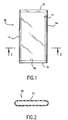
- FIG 1 is a schematic of a preferred end seal bag 10, in a lay-flat position, this bag being in accord with the present invention
- Figure 2 is a cross-sectional view of bag 10 taken through section 2-2 of Figure 1.
- bag 10 comprises bag film 11, top edge 12 defining an open top, first bag side edge 13, second bag side edge 14, bottom edge 15, and end seal 16.
- Figures 3 and 4 illustrate side-seal bag 18.
- Figure 3 illustrates a schematic of side seal bag 18, in a lay-flat view;
- Figure 4 illustrates a cross-sectional view taken through section 4-4 of Figure 3.
- side seal bag 18 is comprised of bag film 19, top edge 20 defining an open top, bottom edge 21, first side seal 22, and second side seal 23.
- the packaging article can also be a casing made from a flexible packaging film, i.e., a film tubing.
- the casing can be a seamless casing or a backseamed casing, the latter being a casing having a seam running the length of the tubing.
- Backseamed casings include both lap-seal backseamed casings as well as butt-sealed backseamed casings, the latter utilizing a butt-seal tape which is sealed to the casing film, as is known to those of skill in the art.
- a packaging article which can be utilized is generally referred to as a "pouch,” which is generally made from two rectangular pieces of flexible packaging film of the same dimensions, which are sealed to one another along 3 edges, leaving the unsealed fourth edges to form the open top, into which a product can be inserted.
- Figure 5 illustrates a schematic view of a first preferred process for making films according to the present invention.
- solid polymer beads (not illustrated) are fed to a.plurality of extruders 28 (for simplicity, only one extruder is illustrated). Inside extruders 28, the polymer beads are forwarded, melted, and degassed, following which the resulting bubble-free melt is forwarded into die head 30, and extruded through an annular die, resulting in tubing 32 which is preferably about 10 to 20 mils thick.
- tubing 32 After cooling or quenching by water spray from cooling ring 34, tubing 32 is collapsed by pinch rolls 36, and is thereafter fed through irradiation vault 3 8 surrounded by shielding 40, where tubing 32 is irradiated with high energy electrons (i.e., ionizing radiation) from iron core transformer accelerator 42.
- Tubing 32 is guided through irradiation vault 38 on rolls 44.
- tubing 32 is irradiated to a level of from about 40 kGy to about 120kGy.
- irradiated tubing 46 is directed through pinch rolls 48, following which irradiated tubing 46 is slightly inflated, resulting in trapped bubble 50.
- trapped bubble 50 the tubing is not significantly drawn longitudinally, as the surface speed of nip rolls 52 are about the same speed as nip rolls 48.
- irradiated tubing 46 is inflated only enough to provide a substantially circular tubing without significant transverse orientation, i.e., without stretching.
- Coating stream 58 preferably comprises an O 2 -barrier layer, which does not pass through the ionizing radiation. Further details of the above-described coating step are generally as set forth in U.S. Patent No. 4,278,738, to BRAX et. al., which is hereby incorporated by reference thereto, in its entirety.
- two-ply tubing film 60 is wound up onto windup roll 62. Thereafter, windup roll 62 is removed and installed as unwind roll 64, on a second stage in the process of making the tubing film as ultimately desired.
- Two-ply tubular film 60, from unwind roll 64, is unwound and passed over guide roll 66, after which two-ply tubular film 60 passes into hot water bath tank 68 containing hot water 70.
- the now collapsed, irradiated, coated tubular film 60 is immersed in hot water 70 (preferably at a temperature of from about 185°F to 210°F) for a period of from about 10 to about 100 seconds, i.e., for a time period in order to bring the film up to the desired temperature for biaxial orientation.
- irradiated tubular film 60 is directed through nip rolls 72, and bubble 74 is blown, thereby transversely stretching tubular film 60.
- nip rolls 76 draw tubular film 60 in the longitudinal direction, as nip rolls 76 have a surface speed higher than the surface speed of nip rolls 72.
- irradiated, coated biaxially-oriented blown tubing film 78 is produced, this blown tubing preferably having been both stretched in a ratio of from about 1:1.5 to about 1:6, and drawn at a ratio of from about 1:1.5 to about 1:6; more preferably, the stretching and drawing are each performed a ratio of from about 1:2 to about 1:4.
- the result is a biaxial orientation of from about 1:2.25 to about 1:36, more preferably, from about 1:4 to about 1:16.
- a 7-layer, partially-irradiated, extrusion-coated, biaxially oriented, heat shrinkable, O 2 -barrier film was produced by a process as illustrated in Figure 5, described above.
- a tape containing the first, second, and third layers was coextruded as a substrate which was irradiated to a level of 71 kGy.
- the fourth, fifth, sixth, and seventh layers were extrusion coated onto the irradiated substrate. In this manner, the layer comprising PVDC-MA was not subjected to irradiation.
- the orientation of the resulting 22 mil thick tape i.e., to form the oriented, heat-shrinkable film, was carried out by immersing the tape in hot water at 92°C (197°F), followed by immediate immersion in hot water at 89°C (192°F), followed immediately by orientation.
- the tape was oriented 3.5X in the longitudinal direction, and 3.5X in the transverse direction.
- the resulting film had a thickness of 0.055 mm (2.2 mils).
- the film had a free shrink at 85°C (185°F) in the longitudinal direction of 37 percent, and a free shrink at 85°C (185°F) in the transverse direction of 53 percent.
- the various layers of the tape had the following composition and thickness: TABLE 2 Layer Designation Layer Chemical Identity Layer Thickness mm (mils) First Homogeneous ethylene/alpha-olefin copolymer #1 0.127 (5) Second 90% homogeneous ethylene/alpha-olefin #2 10% rubber 0.229 (9) Third EVA #1 0.025 (1) Fourth PVDC/MA 0.051 (2) Fifth EMA 0.025 (1) Sixth Homogeneous ethylene/alpha-olefin #2 0.064 (2.5) Seventh Homogeneous ethylene/alpha-olefin #3 0.038 (1.5)
- ethylene/alpha-olefin #3 was AFFINITY® PL1850 single-site-catalyzed, long chain branched, ethylene/octene copolymer which had a density of 0.902 g/cc, and a melt index of 3.0 g/10 min., and was obtained from The Dow Chemical Company of Midland, Michigan.
- Rubber was BUNA EP-T-2370P ethylene/propylene/diene (5-ethyledene 2-norbomene) resin which had a density of 0.867 g/cc, a melt index of 2.0 g/10 min, and which was obtained from Bayer Inc., Rubber Division, of Akron, Ohio.
- EVA #1 was LD-713.93 ethylene/vinyl acetate copolymer which had a vinyl acetate content of 15 percent, a density of 0.934 g/cc, and a melt index of 3.5 g/10 min., and which was obtained from the Exxon Chemical Company of Baytown, Texas.
- PVDC/MA was a blend of: (a) 96% XU32034.06 polyvinylidene chloride/methyl acrylate copolymer which contained 91.5% PVDC and 8.5% methyl acrylate, obtained from The Dow Chemical Company, of Midland, Michigan; (b) 2% PLAS CHEK® 775 epoxidized soy bean oil obtained from the Bedford Chemical Division of Ferro Corporation, of Bedford, Mass.; and (c) 2% METABLEN® L-1000 butyl acrylate/methyl methacrylate/butyl methacrylate terpolymer having a density of 1.14g/cc and obtained from Elf Atochem NA, Inc., of Philadelphia, Pennsylvania; the blend of (a), (b), and (c) had a density of 1.69 g/cc.
- EMA was EMAC SP 1305TM ethylene/methyl acrylate copolymer having a density of 0.944 g/cc and a melt index of 2.0 g/10 min, and was obtained from the Chevron Chemical Company of Houston, Texas.
- the tape was oriented 2.8X in the longitudinal direction, and 3.5X in the transverse direction.
- the resulting film had a thickness of 0.056 mm (2.2 mils).
- the film had a free shrink at 85°C (185°F) in the longitudinal direction of 36 percent, and a free shrink at 85°C (185°F) in the transverse direction of 48 percent.
- the various layers of the tape had the following composition and thickness: TABLE 3 Layer Designation Layer Chemical Identity Layer Thickness mm (mils) First Homogeneous ethylene/alpha-olefin copolymer #1 0.102 (4) Second 90% homogeneous ethylene/alpha-olefin #2 10% rubber 0.183 (7.2) Third EVA #1 0.020 (0.8) Fourth PVDC/MA 0.041 (1.6) Fifth sixth EMA 0.020 (0.8) Homogeneous ethylene/alpha-olefin #2 0.051 (2) Seventh Homogeneous ethylene/alpha-olefin #3 0.030 (1.2)
- the tape was oriented 3.5X in The longitudinal direction, and 3.5X in the transverse direction.
- the resulting film had a thickness of 0.055 mm (2.2 mils).
- the film had a free shrink at 85°C (185°F) in the longitudinal direction of 37 percent, and a free shrink at 85°C (185°F) in the transverse direction of 46 percent.
- the various layers of the tape had the following composition and thickness: TABLE 4 Layer Designation Layer Chemical Identity Layer Thickness mm (mils) First Homogeneous ethylene/alpha-olefin copolymer #1 0-127 (5) Second 60% homogeneous ethylene/alpha-olefin #2 30% LLDPE#1 10% rubber 0.229 (9) Third EVA #1 0.025 (1) Fourth PVDC/MA 0.051 (2) Fifth EMA 0.025 (1) Sixth Homogeneous ethylene/alpha-olefin #2 0.064 (2.5) Seventh Homogeneous ethylene/alpha-olefin #3 0.038 (1.5)
- LLDPE #1 was DOWLEX® 2045,03 ethylene/octene copolymer which had a density of 0.920 g/cc, and a melt index of 1.1 g/10 min., and was obtained from The Dow Chemical Company of Midland, Michigan.
- a 4-layer partially-irradiated, extrusion-coated, biaxially oriented, heat-shrinkable, O 2 -barrier film was produced by a process as illustrated in Figure 5, described above.
- a tape containing the first and second layers was coextruded as a substrate which was irradiated to a level of 64 kGy.
- the third and fourth layers were extrusion coated onto the irradiated substrate. In this manner, the layer comprising PVDC-MA was not subjected to irradiation.
- the orientation of the resulting 0.635 mm (25 mil) thick tape i.e., to form the oriented, heat-shrinkable film, was carried out by immersing the tape in a preheat water bath containing water at a temperature of 99°C (210°F), followed by immediate immersion in a hot water bath containing water also at 99°C (210°F) followed immediately by orientation.
- the tape was oriented 3.5X in the longitudinal direction, and 3.5X in the transverse direction.
- the resulting film had a thickness of 0.059 mm (2.32 mils).
- the film had a free shrink at 85°C (185°F) in the longitudinal direction of 21 percent, and a free shrink at 85°C (185°F) in the transverse direction of 30 percent.
- the various layers of the tape had the following composition and thickness: TABLE 5 Layer Designation Layer Chemical Identity Layer Thickness mm (mils) First 80% homogeneous ethylene/alpha-olefin copolymer #1, and 20% LLDPE #2 0.127 (5) Second 85% LLDPE#1 15% EBA 0.305 (12) Third PVDC/MA 0.051 (2) Fourth 90% EVA #2 10% HDPE 0.152 (6)
- LLDPE #2 was ESCORENE® LL3003.32 ethylene/hexene copolymer which had a density of 0.9175 g/cc, and a melt index of 3.2 g/10 min., and was obtained from the Exxon Chemical Company of Baytown, Texas.
- EBA was SP 1802 ethylene/butyl acrylate copolymer, having a butyl acrylate mer content of 18%, a density of 0.928 g/cc, and a melt index of 0.5 g/10 min, and was obtained from the Chevron Chemical Company, of Houston, Texas.
- EVA #2 was ESCORENE® LD-318.92 ethylene/vinyl acetate copolymer which had a vinyl acetate content of 9 percent, a density of 0.930 g/cc, and a melt index of 2.0 g/10 min., and which was obtained from the Exxon Chemical Company of Baytown, Texas.
- HDPE was FORTIFLEX® T60-500-119 high density polyethylene, having a density of 0.961 g/cc, and a melt index of 6.2 g/10 min., and which was obtained from Solvay Polymers, Inc., of Houston, Texas.
- a 7-layer partially-irradiated, extrusion-coated, biaxially oriented, heat-shrinkable, O 2 -barrier film was produced by a process as illustrated in Figure 5, described above.
- a tape containing the first, second, and third layers was coextruded as a substrate which was irradiated to a level of 71 kGy.
- the fourth, fifth, sixth, and seventh layers were extrusion-coated onto the irradiated substrate.
- the layer comprising PVDC-MA was not subjected to irradiation.
- the orientation of the resulting 0.564 mm (22.2 mil) thick tape i.e., to form the oriented, heat-shrinkable film, was carried out by immersing the tape in hot water at 92°C (197°F), followed by immediate immersion in hot water at 89°C (192°F), followed immediately by orientation.
- the tape was oriented 3.6X in the longitudinal direction, and 3.55X in the transverse direction.
- the resulting film had a thickness of 0.056 m (2.2 mils).
- the film had a free shrink at 185°F in the longitudinal direction of 32 percent; and a free shrink at 85°C (185°F) in the transverse direction of 43 percent.
- the various layers of the tape had the following composition and thickness: TABLE 6 Layer Designation Layer Chemical Identity Layer Thickness mm (mils) First 80% homogeneous ethylene/alpha-olefin copolymer #1, and 20% LLDPE #2 0.124 (4.9) Second 60% homogeneous ethylene/alpha-olefin #2 30% LLDPE#1 10% rubber 0.229 (9.0) Third EVA #1 0.025 (1.0) Fourth PVDC/MA 0.048 (1.9) Fifth EMA 0.025 (1.0) Sixth Homogeneous ethylene/alpha-olefin #2 0.066 (2.6) Seventh 85% homogeneous ethylene/alpha-olefin #3, and 15% LLDPE #1 0.046 (1.8)
- O 2 -barrier film was produced by a process as illustrated in Figure 5, described above.
- a tape containing the first and second layers was coextruded as a substrate which was irradiated to a level of 64 kGy.
- the third, fourth, fifth, and sixth layers were extrusion-coated onto the irradiated substrate.
- the layer comprising PVDC-MA was not subjected to irradiation.
- the orientation of the resulting 0.536 mm (21.1 mil) thick tape i.e., to form the oriented, heat-shrinkable film, was carried out by immersing the tape in hot water at 89°C (193°F) followed by immediate immersion in hot water at 82°C (180°F), followed immediately by orientation.
- the tape was oriented 3.2X in the longitudinal direction, and 3.7X in the transverse direction.
- the resulting film had a thickness of 0.046 mm (1.8 mils).
- the film had a free shrink at 85°C (185°F) in the longitudinal direction of 48 percent, and a free shrink at 85°C (185°F) in the transverse direction of 60 percent.
- the various layers of the tape had the following composition and thickness: TABLE 7 Layer Designation Layer Chemical Identity Layer Thickness mm (mils) First Homogeneous ethylene/alpha-olefin copolymer # I 0.127 (5) Second EVA#1 0.213 (8.4) Third PVDC/MA 0.056 (2.2) Fourth EMA 0.025 (1.0) Fifth Homogeneous ethylene/alpha-olefin #4 0.076 (3.0) Sixth 85% homogeneous ethylene/alpha-olefin #4, and 2% Antiblock Masterbatch 0.033 (1.5)
- Antiblock Masterbatch was L-7118-AB antiblock masterbatch in which 20% talc was present in an AFFINITY® ethylene/alpha-olefin copolymer carrier, obtained from Bayshore Industrial of LaPorte, Texas; the masterbatch had a density of 1.039 and a melt index of 5.5 g/10 min.
- a 7-layer partially-irradiated, extrusion-coated, biaxially oriented, heat-shrinkable, O 2 -barrier film was produced by a process as illustrated in Figure 5, described above.
- a tape containing the first, second, and third layers was coextruded as a substrate which was irradiated to a level of 50 kGy.
- the fourth, fifth, sixth, and seventh layers were extrusion-coated onto the irradiated substrate.
- the layer comprising PVDC-MA was not subjected to irradiation.
- the orientation of the resulting 0.605 mm (23.8 mil) thick tape i.e., to form the oriented, heat-shrinkable film, was carried out by immersing the tape in hot water at 91°C (205°F), followed by immediate immersion in hot water at 91°C (195°F), followed immediately by orientation.
- the tape was oriented 3.5X in the longitudinal direction, and 4X in the transverse direction.
- the resulting film had a thickness of 0.049 mm (1.93 mils).
- the film had a free shrink at 85°C (185°F) in the longitudinal direction of 31 percent, and a free shrink at 85°C (185°F) in the transverse direction of 45 percent.
- the various layers of the tape had the following composition and thickness: TABLE 8 Layer Designation Layer Chemical Identity Layer Thickness mm (mils) First 80% homogeneous ethylene/alpha-olefin copolymer # I, and 20% LLDPE #2 0.140 5.5 Second EVA #3 0.231 (9.1) Third EVA #3 0.025 (1.0) Fourth PVDC/MA 0.056 (2.2) Fifth EVA #2 0.020 (0.8) Sixth EVA#2 0.099 (3.9) Seventh 90% EVA #2, and 10% HDPE 0.033 (1.3)
- EVA #3 was ESCORENE® LD 720.92 ethylene/vinyl acetate copolymer which had a vinyl acetate content of 19 percent, a density of 0.940 g/cc, and a melt index of 1-5 g/10 min., and which was obtained from the Exxon Chemical Company of Baytown, Texas.
- the Standard Drop Test was conducted as follows. First, boneless pork sirloin pieces were injected with a brine-based injection solution.
- the brine-based injection solution contained about 5 percent sodium chloride and about 1.1 percent phosphate.
- the boneless pork sirloin pieces were injected with the brine solution in an amount of about 11 percent, based on the weight of the boneless sirloin pieces.
- test bag preferably, an end-seal bag having a lay-flat width of from about 200 to 240 mm (8 to 91 ⁇ 2 inches), and a length of about 460 mm (18 inches).
- the seal area of the bag was kept free of contamination by loading the meat into the bag using a loading horn.
- the seal area of the bag i.e., a portion of the inside surface of the bag through which the seal was to be made
- the brine/purge seal contamination solution was prepared as follows: 500 milliliters of the brine solution, which was the same as the injection solution discussed above, as mixed with 500 milliliters of pork purge (i.e., blood) and 100 g of lean pork muscle. This mixture was then blended until liquefied, and was chilled to a temperature of from about 0°C to 7°C (32° to 45°F) for at least 1 hour prior to use.
- the bag was heat sealed using a Cryovac® 8600-B18 rotary chamber vacuum packaging machine. While in the Cryovac® 8600-B18 rotary chamber vacuum packaging machine, the atmosphere within the bag was evacuated to a level of about 2-3 torr, and while the bag was evacuated, it was closed around the product by heat sealing, the seal being made through that portion of the bag to which the brine/purge seal contamination solution had been applied.
- the sealing parameters were as follows: seal voltage: 76 amps; seal time: 0.5 seconds; machine speed: 30 packages per minute. The seal was made within about 100 mm (4 inches) of the injected pork sirloin pieces. After sealing, the resulting package was shrunk in a Cryovac® BFT6570 E shrink tunnel which operated with a water temperature of 195°F and a belt speed of 17 m/min (55 ft/min).
- a total of 50 replications were conducted in order to establish the performance criteria, i.e., the failure rate, which was reported in terms of the percent of the bags which exhibited leaking at the seal. Leaks occurring at an area other than the seal are discarded, i.e., do not contribute to the test result.
- no box was used (i.e, dropped) more than three times.
- the sirloin pieces were used no more than 5 times, i.e., no more than 5 replications.
- the sirloin pieces were maintained at a temperature of from about 0.7 to 7°C (32°F to 45°F). Between each replication the sirloin pieces were submerged in the brine solution for a minimum of 5 minutes before repackaging. The temperature of the brine solution was maintained between 0°C and 7°C (32°F and 45°F).
- Factors also believed to affect film performance in the Standard Drop Test include seal layer composition (homogeneous ethylene/alpha-olefin copolymer appeared to perform better), film thickness (thicker films appeared to perform better), film free shrink and shrink tension in the direction perpendicular to the seal made through the contamination (low free shrink and shrink tension appeared to perform better), amount and type of contamination in the area to be sealed (less contamination is better), type of meat product (including size, shape, meat species, etc), and presence or absence of bone in the meat product.
- the multilayer film can be a tubular casing, preferably a shirrable casing.
- the casing is used for the packaging of food products, especially boneless meat products and processed meat products.
- the types of meat which can be packaged in the films and packages according to the present invention are poultry, pork, beef, sausage, lamb, goat, horse, and fish.
- the casing of the present invention is used in the packaging of pork, poultry, beef, and sausage products.
- the polymer components used to fabricate multilayer films according to the present invention may also contain appropriate amounts of other additives normally included in such compositions. These include slip agents such as talc, antioxidants, fillers, dyes, pigments and dyes, radiation stabilizers, antistatic agents, elastomers, and the like additives known to those of skill in the art of packaging films.
- slip agents such as talc, antioxidants, fillers, dyes, pigments and dyes, radiation stabilizers, antistatic agents, elastomers, and the like additives known to those of skill in the art of packaging films.
Landscapes
- Engineering & Computer Science (AREA)
- Mechanical Engineering (AREA)
- Wrappers (AREA)
- Packages (AREA)
- Food Preservation Except Freezing, Refrigeration, And Drying (AREA)
- Dairy Products (AREA)
- Meat, Egg Or Seafood Products (AREA)
- General Preparation And Processing Of Foods (AREA)
- Bakery Products And Manufacturing Methods Therefor (AREA)
- Packging For Living Organisms, Food Or Medicinal Products That Are Sensitive To Environmental Conditiond (AREA)
Claims (13)
- Produit emballé comprenant :(A) un produit alimentaire sans os comprenant au moins un élément choisi dans le groupe consistant en viande et fromage, le produit alimentaire ayant un liquide ajouté, le liquide ajouté comprenant une saumure ;(B) un article de film plastique flexible qui est à la fois autour du produit alimentaire et du liquide ajouté et en contact avec ceux-ci, le film étant thermosoudé à travers le liquide ajouté en contact avec le film dans la région de la soudure sur lui-même, sur un autre film ou sur un autre article qui n'est pas un film, le film ayant une couche de soudure qui comprend un copolymère homogène d'éthylène et d'alpha-oléfine ;dans lequel l'article de film présente un taux d'échec au test de chute standard inférieur à 60%.
- Produit emballé selon la revendication 1, dans lequel le film est thermorétractable.
- Produit emballé selon la revendication 1, dans lequel le film présente un taux d'échec au test de chute standard inférieur à 50% et de préférence inférieur à 40%.
- Produit emballé selon l'une quelconque des revendications 1 à 3, dans lequel le produit à base de viande comprend du porc dans lequel est injectée une saumure.
- Produit emballé selon l'une quelconque des revendications 1 à 4, dans lequel la saumure est présente en une quantité d'environ 1% à 30% par rapport au poids du produit.
- Produit emballé selon l'une quelconque des revendications 1 à 5, dans lequel le film multicouche a une épaisseur d'environ 38 à 76 µm (1,5 à 3 mils).
- Produit emballé selon l'une quelconque des revendications 1 à 6, dans lequel l'article de film comprend un film multicouche ayant un retrait libre d'environ 15 à 60% dans au moins une direction, et ayant une tension de retrait d'environ 3,5 à 24,6 kg/cm2 (50 à 350 psi) dans une première direction et d'environ 2,1 à 70,3 kg/cm2 (300 à 1000 psi) dans une seconde direction.
- Procédé d'emballage comprenant :(A) la fabrication d'un article de film plastique flexible comprenant au moins un élément choisi dans le groupe consistant en un sac, une poche ou une barquette, l'article ayant une partie supérieure ouverte, dans lequel le film est thermosoudé sur lui-même ou sur un second film, le film étant une couche de soudure comprenant un copolymère homogène d'éthylène et d'alpha-oléfine ;(B) la mise en place dans l'article de film d'un produit alimentaire sans os sur lequel est ajouté un liquide, le liquide ajouté comprenant une saumure, le produit alimentaire sans os déposant le liquide sur une région d'une surface intérieure de l'article de film qui doit être soudée après la mise en place du produit alimentaire sans os dans l'article de film, le liquide déposé comprenant le liquide ajouté ; et(C) la thermosoudure à travers la partie supérieure ouverte de l'article de film après mise en place du produit alimentaire sans os à l'intérieur de celui-ci, la thermosoudure étant effectuée à travers le liquide déposé sur la surface intérieure de l'article de film, de façon à former un produit emballé ;dans lequel l'article de film présente un taux d'échec au test de chute standard inférieur à 60%.
- Procédé selon la revendication 8, dans lequel le procédé comprend de plus l'élimination de l'atmosphère de l'intérieur de l'article de film après la mise en place du produit alimentaire sans os dans l'article de film, mais avant la thermosoudure à travers la partie supérieure ouverte de l'article de film.
- Procédé selon la revendication 8 ou 9, dans lequel le produit alimentaire sans os comprend de la viande, et dans lequel de la saumure est injectée dans la viande avant la mise en place de la viande dans l'article de film.
- Procédé selon la revendication 8, 9 ou 10, dans lequel le film est un film thermorétractable, et le procédé comprend de plus le retrait à chaud de l'article de film après la thermosoudure de la partie supérieure ouverte de l'article de film.
- Procédé selon la revendication 11, dans lequel l'article de film est un sac à soudure terminale et le film thermorétractable a un retrait libre à 85°C (185°F) d'environ 15 à environ 60% dans une direction de la machine, et un retrait libre à 85°C (185°F) d'environ 15 à environ 60% dans une direction transversale, et le film thermorétractable a de plus une tension de retrait à 85°C (185°F) dans une direction de la machine d'environ 3,5 à 24,6 kg/cm2 (50 à environ 350 psi) et une tension de retrait à 85°C (185°F) dans une direction transversale d'environ 21,8 à 70,3 kg/cm2 (310 à environ 1000 psi), et dans lequel la tension de retrait dans la direction transversale est d'au moins 120% de la tension de retrait dans la direction de la machine.
- Procédé selon l'une quelconque des revendications 8 à 12, dans lequel l'article de film comprend au moins un élément choisi dans le groupe consistant en sac à soudure terminale, sac à soudure latérale, barquette et poche, la première direction étant parallèle à la longueur de l'article de film et la seconde direction étant perpendiculaire à la longueur de l'article de film.
Applications Claiming Priority (5)
| Application Number | Priority Date | Filing Date | Title |
|---|---|---|---|
| US09/102,256 US6355287B2 (en) | 1998-06-22 | 1998-06-22 | Packaged food product having added liquid |
| US102256 | 1998-06-22 | ||
| US09/138,991 US6372274B2 (en) | 1998-06-22 | 1998-08-24 | Process for making a packaged product |
| US138991 | 1998-08-24 | ||
| PCT/US1999/013996 WO1999067153A1 (fr) | 1998-06-22 | 1999-06-21 | Produit alimentaire emballe, y compris un liquide ajoute, et procede d'elaboration |
Publications (2)
| Publication Number | Publication Date |
|---|---|
| EP1089921A1 EP1089921A1 (fr) | 2001-04-11 |
| EP1089921B1 true EP1089921B1 (fr) | 2006-10-11 |
Family
ID=26799190
Family Applications (1)
| Application Number | Title | Priority Date | Filing Date |
|---|---|---|---|
| EP99930509A Expired - Lifetime EP1089921B1 (fr) | 1998-06-22 | 1999-06-21 | Produit alimentaire emballe incluant un liquide ajoute, et procede d'elaboration |
Country Status (9)
| Country | Link |
|---|---|
| EP (1) | EP1089921B1 (fr) |
| AT (1) | ATE342207T1 (fr) |
| AU (1) | AU762118B2 (fr) |
| CA (1) | CA2335552C (fr) |
| DE (1) | DE69933563T2 (fr) |
| DK (1) | DK1089921T3 (fr) |
| ES (1) | ES2273500T3 (fr) |
| NZ (1) | NZ508943A (fr) |
| WO (1) | WO1999067153A1 (fr) |
Family Cites Families (17)
| Publication number | Priority date | Publication date | Assignee | Title |
|---|---|---|---|---|
| US3673041A (en) * | 1970-09-08 | 1972-06-27 | Us Army | Heat sealer |
| US4064296A (en) | 1975-10-02 | 1977-12-20 | W. R. Grace & Co. | Heat shrinkable multi-layer film of hydrolyzed ethylene vinyl acetate and a cross-linked olefin polymer |
| GB1580187A (en) | 1976-06-03 | 1980-11-26 | Grace W R & Co | Flexible envelopes |
| US4278738A (en) | 1978-03-10 | 1981-07-14 | W. R. Grace & Co. | Ethylene-vinyl acetate copolymer film laminate |
| US4617241A (en) * | 1984-01-23 | 1986-10-14 | W. R. Grace & Co., Cryovac Div. | Linear polyethylene stretch/shrink films |
| GB2203024B (en) * | 1987-04-02 | 1991-02-13 | Grace W R & Co | Method for salting meat |
| US4879430A (en) | 1987-05-14 | 1989-11-07 | Plicon Corporation | Patterned adherent film structures and process for making |
| JP2857438B2 (ja) | 1988-09-30 | 1999-02-17 | エクソン・ケミカル・パテンツ・インク | 分子量分布および組成分布のせまい共重合体の線状エチレン共重合体ブレンド |
| US5079051A (en) * | 1989-12-08 | 1992-01-07 | W. R. Grace & Co.-Conn. | High shrink energy/high modulus thermoplastic multi-layer packaging film and bags made therefrom |
| US5213900A (en) * | 1990-03-23 | 1993-05-25 | W. R. Grace & Co.-Conn. | Cook-in film with improved seal strength |
| US5272236A (en) | 1991-10-15 | 1993-12-21 | The Dow Chemical Company | Elastic substantially linear olefin polymers |
| CA2113627A1 (fr) | 1991-07-18 | 1993-02-18 | Prasadarao Meka | Article thermoscelle |
| US5278272A (en) | 1991-10-15 | 1994-01-11 | The Dow Chemical Company | Elastic substantialy linear olefin polymers |
| US5206075A (en) | 1991-12-19 | 1993-04-27 | Exxon Chemical Patents Inc. | Sealable polyolefin films containing very low density ethylene copolymers |
| US5241031A (en) | 1992-02-19 | 1993-08-31 | Exxon Chemical Patents Inc. | Elastic articles having improved unload power and a process for their production |
| NZ280151A (en) * | 1994-10-04 | 1997-12-19 | Grace W R & Co | Heat-shrinkable, multilayer packaging film which maintains transparency after shrinking |
| DE69606811T3 (de) * | 1995-07-31 | 2012-01-12 | Kureha Corp. | Mehrschichtfolie |
-
1999
- 1999-06-21 AU AU47037/99A patent/AU762118B2/en not_active Ceased
- 1999-06-21 CA CA002335552A patent/CA2335552C/fr not_active Expired - Fee Related
- 1999-06-21 EP EP99930509A patent/EP1089921B1/fr not_active Expired - Lifetime
- 1999-06-21 NZ NZ508943A patent/NZ508943A/en unknown
- 1999-06-21 WO PCT/US1999/013996 patent/WO1999067153A1/fr not_active Ceased
- 1999-06-21 ES ES99930509T patent/ES2273500T3/es not_active Expired - Lifetime
- 1999-06-21 DK DK99930509T patent/DK1089921T3/da active
- 1999-06-21 DE DE69933563T patent/DE69933563T2/de not_active Expired - Fee Related
- 1999-06-21 AT AT99930509T patent/ATE342207T1/de not_active IP Right Cessation
Also Published As
| Publication number | Publication date |
|---|---|
| AU762118B2 (en) | 2003-06-19 |
| DK1089921T3 (da) | 2007-02-19 |
| AU4703799A (en) | 2000-01-10 |
| ES2273500T3 (es) | 2007-05-01 |
| EP1089921A1 (fr) | 2001-04-11 |
| ATE342207T1 (de) | 2006-11-15 |
| CA2335552C (fr) | 2005-07-26 |
| WO1999067153A1 (fr) | 1999-12-29 |
| DE69933563D1 (de) | 2006-11-23 |
| NZ508943A (en) | 2003-10-31 |
| DE69933563T2 (de) | 2007-05-31 |
| CA2335552A1 (fr) | 1999-12-29 |
Similar Documents
| Publication | Publication Date | Title |
|---|---|---|
| AU755801B2 (en) | Stack-sealable, heat-shrinkable multilayer packaging film | |
| US7200977B2 (en) | Heat-shrinkable multilayer packaging film comprising inner layer comprising a polyester | |
| US8012520B2 (en) | Packaging product, process for making same, and product made therefrom | |
| AU692957B2 (en) | Patch bag comprising homogeneous ethylene/alpha-olefin copolymer | |
| US6372274B2 (en) | Process for making a packaged product | |
| US6282869B1 (en) | Method of cutting and sealing film | |
| AU2002230583A1 (en) | Packaging product, process for making same, and product made therefrom | |
| AU702611B2 (en) | High shrink, multilayer film which maintains optics upon shrinking | |
| WO2003013981A1 (fr) | Sac de cuisson avec piece et processus d'utilisation de ce sac | |
| AU2002355396A1 (en) | Cook-in patch bag and process for using same | |
| EP1089921B1 (fr) | Produit alimentaire emballe incluant un liquide ajoute, et procede d'elaboration | |
| GB2328673A (en) | Patch bag comprising homogeneous ethylene/alpha-olefin copolymer |
Legal Events
| Date | Code | Title | Description |
|---|---|---|---|
| EUG | Se: european patent has lapsed | ||
| PUAI | Public reference made under article 153(3) epc to a published international application that has entered the european phase |
Free format text: ORIGINAL CODE: 0009012 |
|
| 17P | Request for examination filed |
Effective date: 20001219 |
|
| AK | Designated contracting states |
Kind code of ref document: A1 Designated state(s): AT BE CH DE DK ES FI FR GB GR IE IT LI NL PT SE |
|
| REG | Reference to a national code |
Ref country code: SE Ref legal event code: TRGR |
|
| 17Q | First examination report despatched |
Effective date: 20040827 |
|
| GRAP | Despatch of communication of intention to grant a patent |
Free format text: ORIGINAL CODE: EPIDOSNIGR1 |
|
| GRAS | Grant fee paid |
Free format text: ORIGINAL CODE: EPIDOSNIGR3 |
|
| GRAA | (expected) grant |
Free format text: ORIGINAL CODE: 0009210 |
|
| AK | Designated contracting states |
Kind code of ref document: B1 Designated state(s): AT BE CH DE DK ES FI FR GB GR IE IT LI NL PT SE |
|
| PG25 | Lapsed in a contracting state [announced via postgrant information from national office to epo] |
Ref country code: NL Free format text: LAPSE BECAUSE OF FAILURE TO SUBMIT A TRANSLATION OF THE DESCRIPTION OR TO PAY THE FEE WITHIN THE PRESCRIBED TIME-LIMIT Effective date: 20061011 Ref country code: LI Free format text: LAPSE BECAUSE OF FAILURE TO SUBMIT A TRANSLATION OF THE DESCRIPTION OR TO PAY THE FEE WITHIN THE PRESCRIBED TIME-LIMIT Effective date: 20061011 Ref country code: IT Free format text: LAPSE BECAUSE OF FAILURE TO SUBMIT A TRANSLATION OF THE DESCRIPTION OR TO PAY THE FEE WITHIN THE PRESCRIBED TIME-LIMIT;WARNING: LAPSES OF ITALIAN PATENTS WITH EFFECTIVE DATE BEFORE 2007 MAY HAVE OCCURRED AT ANY TIME BEFORE 2007. THE CORRECT EFFECTIVE DATE MAY BE DIFFERENT FROM THE ONE RECORDED. Effective date: 20061011 Ref country code: FI Free format text: LAPSE BECAUSE OF FAILURE TO SUBMIT A TRANSLATION OF THE DESCRIPTION OR TO PAY THE FEE WITHIN THE PRESCRIBED TIME-LIMIT Effective date: 20061011 Ref country code: CH Free format text: LAPSE BECAUSE OF FAILURE TO SUBMIT A TRANSLATION OF THE DESCRIPTION OR TO PAY THE FEE WITHIN THE PRESCRIBED TIME-LIMIT Effective date: 20061011 Ref country code: BE Free format text: LAPSE BECAUSE OF FAILURE TO SUBMIT A TRANSLATION OF THE DESCRIPTION OR TO PAY THE FEE WITHIN THE PRESCRIBED TIME-LIMIT Effective date: 20061011 Ref country code: AT Free format text: LAPSE BECAUSE OF FAILURE TO SUBMIT A TRANSLATION OF THE DESCRIPTION OR TO PAY THE FEE WITHIN THE PRESCRIBED TIME-LIMIT Effective date: 20061011 |
|
| REG | Reference to a national code |
Ref country code: GB Ref legal event code: FG4D |
|
| REG | Reference to a national code |
Ref country code: CH Ref legal event code: EP |
|
| REG | Reference to a national code |
Ref country code: IE Ref legal event code: FG4D |
|
| REF | Corresponds to: |
Ref document number: 69933563 Country of ref document: DE Date of ref document: 20061123 Kind code of ref document: P |
|
| PG25 | Lapsed in a contracting state [announced via postgrant information from national office to epo] |
Ref country code: PT Free format text: LAPSE BECAUSE OF FAILURE TO SUBMIT A TRANSLATION OF THE DESCRIPTION OR TO PAY THE FEE WITHIN THE PRESCRIBED TIME-LIMIT Effective date: 20070319 |
|
| NLV1 | Nl: lapsed or annulled due to failure to fulfill the requirements of art. 29p and 29m of the patents act | ||
| REG | Reference to a national code |
Ref country code: CH Ref legal event code: PL |
|
| REG | Reference to a national code |
Ref country code: ES Ref legal event code: FG2A Ref document number: 2273500 Country of ref document: ES Kind code of ref document: T3 |
|
| EN | Fr: translation not filed | ||
| PLBE | No opposition filed within time limit |
Free format text: ORIGINAL CODE: 0009261 |
|
| STAA | Information on the status of an ep patent application or granted ep patent |
Free format text: STATUS: NO OPPOSITION FILED WITHIN TIME LIMIT |
|
| 26N | No opposition filed |
Effective date: 20070712 |
|
| PGFP | Annual fee paid to national office [announced via postgrant information from national office to epo] |
Ref country code: IT Payment date: 20070625 Year of fee payment: 9 |
|
| REG | Reference to a national code |
Ref country code: DK Ref legal event code: EBP |
|
| EUG | Se: european patent has lapsed | ||
| GBPC | Gb: european patent ceased through non-payment of renewal fee |
Effective date: 20070621 |
|
| PG25 | Lapsed in a contracting state [announced via postgrant information from national office to epo] |
Ref country code: GR Free format text: LAPSE BECAUSE OF FAILURE TO SUBMIT A TRANSLATION OF THE DESCRIPTION OR TO PAY THE FEE WITHIN THE PRESCRIBED TIME-LIMIT Effective date: 20070112 Ref country code: FR Free format text: LAPSE BECAUSE OF FAILURE TO SUBMIT A TRANSLATION OF THE DESCRIPTION OR TO PAY THE FEE WITHIN THE PRESCRIBED TIME-LIMIT Effective date: 20070601 Ref country code: DE Free format text: LAPSE BECAUSE OF NON-PAYMENT OF DUE FEES Effective date: 20080101 |
|
| PG25 | Lapsed in a contracting state [announced via postgrant information from national office to epo] |
Ref country code: IE Free format text: LAPSE BECAUSE OF NON-PAYMENT OF DUE FEES Effective date: 20070621 Ref country code: GB Free format text: LAPSE BECAUSE OF NON-PAYMENT OF DUE FEES Effective date: 20070621 |
|
| PG25 | Lapsed in a contracting state [announced via postgrant information from national office to epo] |
Ref country code: SE Free format text: LAPSE BECAUSE OF NON-PAYMENT OF DUE FEES Effective date: 20070622 |
|
| PG25 | Lapsed in a contracting state [announced via postgrant information from national office to epo] |
Ref country code: DK Free format text: LAPSE BECAUSE OF NON-PAYMENT OF DUE FEES Effective date: 20070702 |
|
| REG | Reference to a national code |
Ref country code: ES Ref legal event code: FD2A Effective date: 20070622 |
|
| PG25 | Lapsed in a contracting state [announced via postgrant information from national office to epo] |
Ref country code: ES Free format text: LAPSE BECAUSE OF NON-PAYMENT OF DUE FEES Effective date: 20070622 |
|
| PG25 | Lapsed in a contracting state [announced via postgrant information from national office to epo] |
Ref country code: FR Free format text: LAPSE BECAUSE OF FAILURE TO SUBMIT A TRANSLATION OF THE DESCRIPTION OR TO PAY THE FEE WITHIN THE PRESCRIBED TIME-LIMIT Effective date: 20061011 |
|
| PG25 | Lapsed in a contracting state [announced via postgrant information from national office to epo] |
Ref country code: IT Free format text: LAPSE BECAUSE OF NON-PAYMENT OF DUE FEES Effective date: 20080621 |